

Introduction
Representation is fundamental to democratic governance in the United States, where elected officials act as intermediaries between the government and the public. Across different levels of government, representatives are expected to advance the policy preferences and priorities of their constituents. While voters may not always possess in-depth knowledge of policymaking processes, research underscores the significance of descriptive representation. This concept suggests that when elected officials reflect the demographic characteristics and lived experiences of their constituents, such as race, gender, or socioeconomic background, it can shape public preferences toward policy and enhance political legitimacy (Pitkin, Reference Pitkin2023).
Descriptive representation fosters relational connections between voters and lawmakers, often strengthening trust and policy support. While much of the prior research on descriptive representation has focused on race and gender (e.g., Clayton, O’Brien and Piscopo, Reference Clayton, O’Brien and Piscopo2019; Fowler, Merolla & Sellers, Reference Fowler, Merolla and Sellers2014; Heideman, Reference Heideman2020; Jones, Reference Jones2014; Montoya, Bejarano, Brown & Gershon, Reference Montoya, Bejarano, Brown and Gershon2022), it is plausible that its effects extend to other societal cleavages rooted in social identification. One of the most prominent forms of social identification is place-based identity, tied to geography, which has created a significant divide in the United States, splitting Americans into two camps: urban and rural (Cramer, Reference Cramer2016; Jacobs and Shea, Reference Jacobs and Shea2023; Munis, Memovic & Christley, 2024). Like other social identities, place-based identification fosters collective norms and beliefs within the group (Tajfel, Reference Tajfel1981; Turner and Tajfel, Reference Turner and Tajfel2004). Turner and Tajfel (Reference Turner and Tajfel2004) further highlight the importance of in-groups and out-groups in shaping social identity, a dynamic also present in place-based identification. Recent work by Borwein and Lucas (Reference Borwein and Lucas2023) demonstrates that rural identification is strongly associated with solidarity among other rural communities and hostility toward urban areas. This growing body of literature suggests that place-based identification is a meaningful and influential way in which individuals perceive themselves. Consequently, like other social identities, place-based identification serves as a critical lens through which individuals interpret and engage with the political world (Munis and Nemerever, Reference Munis and Nemerever2025).
In this study, we argue that rural individuals use the descriptive attributes of state representatives to aid in evaluating new policies. Our focus on rural Americans is rooted in the broader framework of descriptive representation research, which highlights its particular salience among minority or marginalized groups, such as those defined by race or gender. Similarly, rural Americans, constituting only about 20% of the U.S. population, represent a distinct minority group with a shared rural consciousness and a sense of resentment toward urban areas (Cramer, Reference Cramer2016; Ratcliffe et al., Reference Ratcliffe, Burd, Holder and Fields2016). This unique identity makes rural Americans an especially fitting population for exploring the role of place-based descriptive representation.
But how do rural representatives signal their identification as rural Americans? Research on identity suggests that identity is not monolithic, but rather a “bundle of sticks,” a collection of traits and associations tied to one’s self-conception and public presentation (Sen and Wasow, Reference Sen and Wasow2016). Accordingly, rural Americans may assess a state representative’s rural identity through multiple channels, such as where they reside, the type of work they do, or, central to this study, how they are characterized by the news media.
We argue that the rural identity of state representatives serves as a powerful signal that enhances rural individuals’ trust in lawmakers and fosters more favorable preferences toward the policies they propose. To test this theory, we conducted a survey experiment of 502 rural Americans to assess how they respond to recently passed laws based on the place-based identity of the state representative who proposed them. Participants evaluated their support for the law, its perceived benefits to their community, whether they believed it would primarily serve urban or rural areas, and trust in the lawmaker who proposed the new law.
Our findings reveal that rural Americans exhibit significantly more support for the law, perceive greater benefits to their community, and are more likely to believe that the law would help rural areas when they view a lawmaker sharing their rural identity. Extending these results, we then demonstrate that respondents express higher levels of trust in rural lawmakers, even in the absence of additional information. These findings highlight the crucial role of place-based descriptive representation in shaping public preferences and demonstrate how identity-based cues influence policy evaluations and perceptions of political elites.
Role of descriptive representation
Descriptive representation refers to the phenomenon where individuals are represented by an individual who shares their social identity, irrespective of the representative’s political party or policy positions (Pitkin, Reference Pitkin2023). While other models of representation (such as substantive representation) assume that elected officials follow constituent preferences, descriptive representation shifts the focus from policy preferences to identity-based characteristics of the representative.
Despite potential trade-offs, being descriptively represented has profound consequences on how individuals feel about their representation. Individuals often lack detailed knowledge of policy and instead rely on identity-based cues provided by descriptive representation to evaluate their representatives and political systems (Gay, Reference Gay2002). These cues can boost political engagement and foster trust that lawmakers are acting in the best interest of their constituency. Hayes and Hibbing (Reference Hayes and Hibbing2017) find that while descriptive and substantive representation can coexist, individuals perceive them as distinct and value descriptive representation independently. Their study demonstrates that descriptive representation enhances constituents’ policy perceptions, even when actual policy outcomes fall short of expectations. This effect arises because individuals who share a social identity with their representative are more likely to view the government as responsive to their needs and concerns (Mansbridge, Reference Mansbridge1999).
Descriptive representation sends a powerful signal to constituents: the presence of a representative who shares their demographic or social identity communicates that their perspectives are being acknowledged and addressed (Mansbridge, Reference Mansbridge1999; Phillips, Reference Phillips1995). For example, Clayton, O’Brien and Piscopo (Reference Clayton, O’Brien and Piscopo2019) demonstrate that cues indicating increased descriptive representation of women legitimize democratic processes and enhance institutional trust.
Citizens frequently rely on these identity-based cues, as gathering and processing detailed policy information is cognitively demanding (Achen and Bartels, Reference Achen and Bartels2017; Kinder and Kam, Reference Kinder and Kam2010; Shi and Rosas, Reference Shi and Rosas2024). Even politically sophisticated individuals often lack knowledge of specific policy details (Gilens, Reference Gilens2001). Instead, social identities act as lenses through which individuals interpret the political world. In complex policy debates, identity cues enable citizens to assess whether policies align with their group’s values and interests, bypassing the need to analyze intricate policy details (Turner and Tajfel, Reference Turner and Tajfel2004).
Moreover, descriptive representation can mitigate feelings of marginalization, particularly among historically underrepresented groups (Mansbridge, Reference Mansbridge1999). By seeing themselves reflected in positions of power, constituents are more likely to feel that their interests are being actively considered, which in turn increases their trust not only in the representative but also in the broader institutions of governance (Clayton, O’Brien and Piscopo, Reference Clayton, O’Brien and Piscopo2019; Montoya et al., Reference Montoya, Bejarano, Brown and Gershon2022). This dynamic underscores the symbolic importance of descriptive representation: it is not merely about demographic similarities but also about the broader psychological and emotional connections that shape how individuals evaluate political actors and institutions.
Ultimately, descriptive representation goes beyond signaling alignment with constituent interests; it reinforces the belief that representatives are acting to advance the well-being of those they represent. This creates a foundation of trust that can endure even in the face of political disagreement or suboptimal outcomes (Hayes and Hibbing, Reference Hayes and Hibbing2017), demonstrating the unique and far-reaching impact of descriptive representation on public preferences toward policy and governance.
We hasten to note here that extant theory makes clear that not every social grouping derives the same value from descriptive representation. Mansbridge (Reference Mansbridge1999) identifies four contexts in which descriptive representation is especially valuable: (1) communication in contexts of mistrust between a group and political institutions, (2) innovative thinking in contexts of uncrystallized interests, (3) creating a social meaning of “ability to rule” for groups whose competence has been questioned, and (4) increasing the polity’s de facto legitimacy in contexts of past discrimination. These contexts delineate the circumstances in which descriptive representation should matter most. Building on this framework, we focus on identities in which group memberships are difficult or costly to change, that organize everyday experiences of work, service access, and social interaction, and that are historically associated with marginalization or neglect (Dovi, Reference Dovi2002; Phillips, Reference Phillips1995). Race and gender are paradigmatic in this regard, but the underlying logic concerns patterns of exclusion, mistrust, and contested legitimacy rather than any fixed list of ascriptive traits.
Building on this account, we take descriptive representation to be particularly influential for constituent preferences when two conditions hold. First, the group has reasons, grounded in history or widely shared experience, to doubt that institutions will otherwise attend to its interests. Second, group membership carries distinctive and recognizable life experiences that give co-identity representatives the experiential knowledge that Mansbridge argues is crucial for understanding and advancing those interests (Mansbridge, Reference Mansbridge1999). While not all identities satisfy these two conditions, when they do hold, shared identity provides a low-cost shortcut that a representative will understand and advocate for the group, even in the absence of detailed information about policy positions (Achen and Bartels, Reference Achen and Bartels2017; Gay, Reference Gay2002).
Rural place-based identity, which we elaborate on in the next section, exhibits precisely these features. Rural Americans constitute a numerical minority and hold enduring mistrust of urban-centered institutions, demonstrated by their deep-rooted perceptions of uneven investment and perceived neglect by state and national governments (Cramer, Reference Cramer2016; Hochschild, Reference Hochschild2018; Wuthnow, Reference Wuthnow2019). Negative perceptions are central to the mechanisms we study, because it is those beliefs that shape how individuals interpret descriptive cues. At the same time, these beliefs are not merely imagined; they track observable disparities. Residence in low-density areas structures daily experiences: rural areas have faced economic struggles in recent years (Brown and Swanson, Reference Brown and Swanson2015; Tickamyer and Duncan, Reference Tickamyer and Duncan1990), and face decreasing access to medical support (Cox, Epp & Shepherd, Reference Cox, Epp and Shepherd2025; Kaufman et al., Reference Kaufman, Thomas, Randolph, Perry, Thompson, Holmes and Pink2016; Shepherd, Reference Shepherd2025).Footnote 1 The perceptions and realities experienced by individuals with a rural place-based identity create a sense of in-group and out-group distinction. Rural identity is also highly durable for many individuals because place is deeply intertwined with family ties, property, and occupational trajectories. Because these experiences are unique, spatially visible, and not easily discarded, they function as signals of a shared standpoint among rural Americans.
Place as a social identity
The urban–rural divide has emerged as one of the most significant political cleavages in American society (Gimpel et al., Reference Gimpel, Lovin, Moy and Reeves2020). This divide reflects deep cultural, economic, and political distinctions between urban and rural areas, with profound implications for how individuals perceive themselves and engage with politics. At the core of this divide is the concept of place-based identification, a politically salient social identity that emerges from shared experiences, activities, and behaviors unique to urban or rural settings. Rural Americans, in particular, exhibit a strong collective identity shaped by common economic activities and distinct community practices that foster a sense of belonging and mutual understanding (Gimpel and Reeves, Reference Gimpel and Reeves2024; Jacobs and Shea, Reference Jacobs and Shea2023). While some scholarship has questioned the relevance of contextual factors, such as political geography, in shaping political behavior (King, Reference King1996), we contend that place-based identification continues to serve as a fundamental lens through which individuals interpret the political world.
This collective rural identity goes beyond cultural commonalities; it actively shapes core beliefs about the political world. Rural Americans often see themselves as part of an in-group defined by shared struggles and values, contrasted against an urban out-group that they perceive as politically and culturally dominant (Lyons and Utych, Reference Lyons and Utych2023; Walsh, Reference Walsh2012). Scholars emphasize how rural Americans extend this out-group perception to individuals and institutions closely associated with urban areas, further reinforcing feelings of exclusion (Lunz Trujillo, Reference Lunz Trujillo2022; Nelsen and Petsko, Reference Nelsen and Petsko2021). Central to this dynamic is the concept of “rural consciousness,” which encapsulates three core beliefs: that rural communities are overlooked by lawmakers, that rural areas receive fewer resources than they deserve, and that rural culture is distinct and often undervalued compared to urban counterparts (Cramer, Reference Cramer2016; Walsh, Reference Walsh2012). While rural residency and rural consciousness are not one and the same, past work has demonstrated the high prevalence of rural consciousness among rural Americans (Jacobs and Munis, Reference Jacobs and Munis2019; Lunz Trujillo and Crowley, Reference Lunz Trujillo and Crowley2022).
While rural consciousness is influenced by cultural norms shaped by neighbors and community interactions (Parker et al., Reference Parker, Horowitz, Brown, Richard Fry and Igielnik2018), its implications for political preferences are particularly significant in shaping how rural Americans perceive government. Rural Americans frequently view state governments as serving urban interests disproportionately, neglecting rural needs in the process (Nelsen and Petsko, Reference Nelsen and Petsko2021). This perception fuels distrust and negative preferences toward state governments and their legislative work (Hochschild, Reference Hochschild2018; Wuthnow, Reference Wuthnow2019). As such, rural Americans’ place-based identity influences not only their relationship with government but also their political preferences and evaluations of political representation (Alexander, Reference Alexander2026; Lin and Lunz Trujillo, Reference Lin and Trujillo2023, Reference Lin and Trujillo2025; Munis and Nemerever, Reference Munis and Nemerever2025).
We argue that a key avenue for addressing this mistrust lies in descriptive representation. The presence of representatives who share a rural identity has the potential to improve rural Americans’ perceptions of policy and representation. Descriptive representation is particularly impactful because individuals often rely on social identity as a shortcut for processing political information, especially in the absence of detailed policy knowledge (Lupia, Reference Lupia1994; Zaller, Reference Zaller1992). For rural Americans, this reliance on rural place-based identity shortcuts may be particularly important in shaping political understanding, given their strong attachment to place (Cramer, Reference Cramer2016).
Place-based descriptive representation, therefore, holds particular salience for rural Americans. As Jacobs and Munis (Reference Jacobs and Munis2019) argue, place has become a deeply meaningful dimension of identity that fundamentally shapes how individuals interact with one another and the political system. Indeed, Jacobs and Shea (Reference Jacobs and Shea2023) write, “ruralness is like other important identities we use to make sense of American politics, such as class, race, and gender” [p. 13]. For rural Americans, rural identity is their most significant place-based identity and can rival other core identities in shaping political views.
Rural Americans and descriptive representation
This paper builds on insights from prior research on descriptive representation with the growing recognition of place-based social identification to examine whether rural Americans exhibit improved policy preferences when they are descriptively represented. Building on research that underscores the salience of descriptive representation for minority groups, such as African Americans (Hayes and Hibbing, Reference Hayes and Hibbing2017) and women (Clayton, O’Brien and Piscopo, Reference Clayton, O’Brien and Piscopo2019), we extend the framework to rural Americans, conceptualizing them as a minority place-based identity group.
We argue that rural Americans will demonstrate greater support for legislation when it is proposed by a state representative who shares their rural place-based social identity. This phenomenon is rooted in the broader literature on identity-based political judgments. As Gay (Reference Gay2002) has shown, individuals often lack detailed knowledge about specific policies and instead rely on identity-based cues to form their initial evaluations. Rural Americans, when encountering a state representative who they perceive as sharing their social identity, are likely to interpret this descriptive alignment as a signal of shared values. This reliance on identity-based cues aligns with broader findings that individuals use shortcuts to navigate the cognitively demanding task of evaluating complex policies (Achen and Bartels, Reference Achen and Bartels2017). Based on this reasoning, we propose our first hypothesis:
H1: Rural Americans will exhibit greater levels of support for legislation proposed by state representatives who descriptively represent their rural place-based social identity.
Support for this hypothesis would indicate that rural Americans use descriptive representation as a shortcut when evaluating policy, underscoring the importance of identity cues in shaping political preferences. More broadly, these findings would expand the scope of descriptive representation research, demonstrating its relevance beyond traditional domains like race and gender. They would also highlight how rural Americans’ social identity influences their political decision-making, offering insights into the broader role of descriptive representation in American society.
Beyond exploring how rural descriptive representation affects levels of policy support, this paper also investigates whether individuals associate the descriptive characteristics of state representatives with the perceived beneficiaries of their legislation. A foundational principle of descriptive representation is the belief that representatives who share one’s social identity are better equipped to advocate for individuals like oneself (Hayes and Hibbing, Reference Hayes and Hibbing2017). In the context of place-based identification, this suggests that rural Americans will expect laws proposed by descriptively representative state representatives to prioritize rural areas. From this, we derive our second hypothesis:
H2: Rural Americans will believe that rural areas are more likely to benefit from legislation proposed by state representatives who share their rural place-based social identity.
If supported, this hypothesis would provide evidence that rural Americans derive substantive expectations from descriptive representation, paralleling the benefits observed in studies of race and gender-based descriptive representation. It would also suggest that descriptive representation fosters an illusion of substantive representation, even when a shared identity does not guarantee that the lawmaker’s actions align with the community’s best interests. To further explore the relationship between descriptive representation and individuals’ trust in their lawmakers to act in their best interest, we propose the following hypothesis:
H3: Rural Americans will exhibit higher levels of trust in state representatives advocating for their interests when they share a place-based social identity.
Ultimately, this paper advances the study of descriptive representation by demonstrating that rural place-based identification is a powerful force in shaping political behavior. We expand the conceptual scope of descriptive representation to include how shared attachments to place shape policy preferences and perceptions of elected officials for rural Americans. In doing so, it underscores the critical role of geographic identity in an era defined by political nationalization (Carson, Sievert & Williamson, Reference Carson, Sievert and Williamson2024; Hopkins, Reference Hopkins2018). This research not only affirms the continued salience of place in American political life but also offers a more comprehensive framework for understanding the complex intersections of identity, representation, and democratic responsiveness.
Data and methods
To assess the impact of rural descriptive representation on policy preferences among rural Americans, we conducted a survey experiment with 502 participants.Footnote 2 To create our sample of rural Americans, we asked respondents: “Which of the following best describes the area you live in?” Only those who selected “rural” were admitted into the survey. The inclusion question aligns with prior research identifying rural place-based identification (Jacobs and Munis, Reference Jacobs and Munis2019, Reference Jacobs and Munis2023) and is consistent with large-scale surveys used to examine public opinion in the United States (American National Election Studies, 2021). While this measure offers one approach to conceptualizing rural Americans based on respondents’ self-perceptions of geographic residence, we also conduct a robustness check using USDA RUCA codes to further validate our findings, another common method for identifying rural Americans (Lin and Lunz Trujillo, Reference Lin and Trujillo2025).Footnote 3 The experiment, fielded January 23–25, 2026, presented respondents with a series of six vignettes, each designed to examine how place-based descriptive representation shapes perceptions of policy and political actors. Each vignette presented a news clip from an unspecified local television news channel, simulating how individuals might encounter political news in their everyday lives. Figure 1 illustrates one of the vignettes shown to respondents.
Example vignette of Logan Allen – Urban treatment condition.

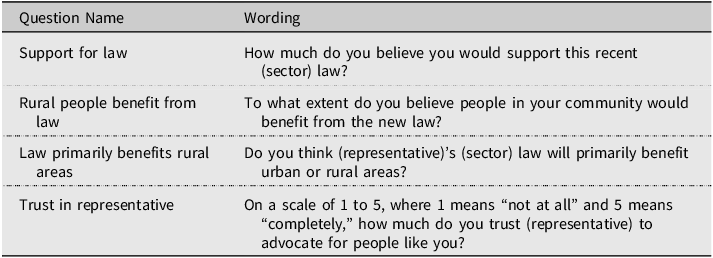
Each television news story includes information about a hypothetical law recently proposed by a state representative and passed into law. These laws are about generic policy sectors frequently discussed by state representatives and include the following: transportation, education, utilities, public health, banking, and infrastructure. For each respondent, the six sectors are divided into two sets of three (transportation, education, and utilities in the first set; public health, infrastructure, and banking in the second set). Within each set, we randomly assign the three representative place conditions: rural, urban, and no place information (control), to the three sectors, so that exactly one vignette in the set features a rural representative, one an urban representative, and one a control representative. The three vignettes in each set are then presented in random order. This procedure ensures that every respondent experiences two rural, two urban, and two control representative, each paired with a different policy sector, while the mapping of sectors to representative type varies at random across respondents. Since our focus is on rural descriptive representation, the sole experimental manipulation is this place cue; we do not jointly vary any other representative attributes. All the state representatives in the vignettes are white men, dressed in business suits, and approximately the same age, so that race, gender, and age are held constant across conditions. The names were selected from Butler and Homola (Reference Butler and Homola2017). After viewing each vignette, respondents answer five questions: their support for the proposed law, their perceptions of the law’s benefits to their community, their views on whether the law benefits urban or rural areas, their level of trust in the lawmaker, and their perceived similarity to the lawmaker.Footnote 4 Table 1 presents the wording of the four questions included in the main analysis of the survey.Footnote 5
Main survey questions accompanying each vignette

Our survey yielded a sample of 502 respondents. To test our three hypotheses, we leverage the iterated design of the survey, where each respondent completes the process six times. Given this structure, we account for within-subject correlation by clustering responses at the respondent level, employing ordinary least squares regression as our primary analytical method. For our modeling approach, we designate the control condition as the baseline and report the estimated coefficients for respondents’ exposure to either urban or rural state representatives. To improve the efficiency of our main estimates, we control for age, sex, race, and seven-point party identification and include fixed effects for policy sectors.Footnote 6
Results
To assess how place-based descriptive representation influences policy preferences, we begin by examining whether rural respondents evaluate the new law more favorably when it was proposed by a state representative who shares their rural place-based identity. Specifically, we analyze responses to two key measures: support for the proposed law and perceived benefit of the law for rural Americans. These measures capture the extent to which rural respondents express support for the policy absent additional substantive details, and the degree to which they believe the policy would benefit rural communities.
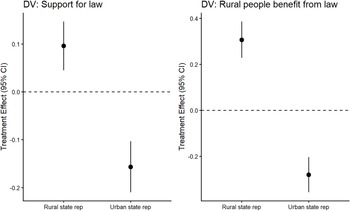
Figure 2 presents the results.Footnote 7 The left panel examines support for the law using a four-point outcome variable ranging from strong opposition to strong support. The baseline comparison group consists of respondents in a control condition who received no information about the place-based identity of the state representative. When rural respondents were presented with a rural state representative advocating for the law, support for the policy increased by 0.096 points, a positive and statistically significant effect. Substantively, this represents approximately a 3.2 percentage-point increase in support, solely due to the descriptive alignment between the lawmaker and the respondent. By contrast, exposure to an urban state representative produced the opposite effect: support for the law decreased by 0.157 points (or about 5.2 percentage points), a negative and statistically significant effect. These results suggest that, in the absence of detailed policy information, rural respondents exhibit greater support for legislation advanced by a representative who shares their place-based identity and are less inclined to support the same legislation when attributed to an urban representative.
Marginal effects from regression estimates among rural respondents, examining how the place-based identity of the proposing state representative influences support for a recently passed law (left) and perceived benefits to the respondent’s rural community (right). Includes policy area fixed effects; standard errors clustered at the respondent level.

Next, in the right panel of Figure 2, we examine perceptions of how much rural communities would benefit from the proposed law. This measure is a five-point ordinal variable ranging from “not at all” to “extremely.” When respondents viewed a rural state representative advocating for the law, they were significantly more likely to believe the policy would benefit rural people. The coefficient was 0.307, which represents about a 7.6 percentage-point increase. In contrast, exposure to an urban state representative produced a negative and statistically significant coefficient of −0.281, indicating that rural respondents viewed the policy as less beneficial when proposed by an urban representative. These findings underscore the salience of place-based descriptive representation in shaping political preferences. Even in the absence of substantive policy details, rural Americans appear to rely on place-based social identification when evaluating policy proposals, inferring greater policy benefits and expressing higher levels of support when the lawmaker is descriptively representative.
To further examine this relationship, the left panel of Figure 3 reports the results of a model estimating responses to the survey question assessing which geographic area – urban or rural – would primarily benefit from the proposed law.Footnote 8 The outcome variable records whether the respondent selected “urban areas” or “rural areas” as the primary beneficiary of the legislation. The control condition serves as the baseline for comparison.
Marginal effects from regression estimates among rural respondents, examining how the place-based identity of the proposing state representative influences perceptions of whether the recently passed law primarily benefits rural areas (left), and trust in the state representative (right). Estimates include policy area fixed effects; standard errors are clustered at the respondent level.

The results indicate that when rural respondents were exposed to the rural state representative condition, their probability of believing that the law would benefit rural areas increased by 31.4 percentage points, a substantively large effect. Conversely, exposure to the urban state representative condition resulted in a decrease of 7.3 percentage points in the likelihood of selecting rural areas as the primary beneficiary. These findings further reinforce the role of place-based descriptive representation in shaping rural respondents’ perceptions of policy. Even in the absence of substantive information about the law itself, respondents appear to rely on the descriptive characteristics of the representative to infer the likely distribution of policy benefits. Based on the results, we find strong support for our first two hypotheses.
To evaluate our third hypothesis, we assess respondents’ level of trust in the state representatives presented in the experiment, specifically regarding their ability to advocate for the respondents’ interests. Importantly, respondents were provided no information about the state representative’s prior actions or the contents of the law, ensuring that trust evaluations were based solely on descriptive characteristics rather than substantive policy considerations.
The right panel of Figure 3 presents the results. Trust in the representative was measured using a five-point Likert scale, ranging from 1 (“Not at all”) to 5 (“Completely”). When rural respondents were exposed to a rural state representative, their trust in the representative’s ability to advocate for their interests increased by 0.293 points, a statistically significant effect that corresponds to approximately a 7.3 percentage-point increase in trust. Conversely, when rural respondents viewed an urban representative, their trust in the representative decreased by 0.201 points, a substantively meaningful and statistically significant decline.
Taken together, these results provide compelling evidence in support of our theoretical expectations. Across multiple outcome measures – including support for the proposed law, perceived benefits for rural communities, beliefs about the geographic distribution of those benefits, and trust in the state representative – we find consistent and substantively meaningful effects of place-based descriptive representation. Rural respondents express more favorable evaluations when a recently passed law was proposed by a state representative who shares their rural place-based identity and respond negatively when the same law is attributed to an urban state representative. Crucially, these effects emerge in the absence of detailed policy content, underscoring the power of place-based identity cues in shaping how rural Americans evaluate both political actors and policy proposals.Footnote 9
Discussion
Our findings provide evidence that place-based descriptive representation influences rural Americans’ policy preferences and trust in representatives. Consistent with our hypotheses, respondents expressed greater support for new laws and were more likely to perceive them as beneficial to their communities when introduced by a rural state representative. Conversely, exposure to an urban out-group state representative led to diminished support, less favorable policy evaluations, and lower levels of trust. These results align with research on racial and gender-based descriptive representation, demonstrating that place-based identity serves as a powerful shortcut through which individuals assess policies and lawmakers. Notably, our findings reveal that descriptive representation can both enhance and undermine evaluations, rather than producing exclusively positive effects. This underscores the dual impact of descriptive representation: reinforcing trust and legitimacy when individuals feel represented, while also highlighting the potential for out-group cues to negatively shape perceptions of representatives and policies.
Beyond shaping policy preferences, our findings indicate that rural Americans exhibit higher levels of trust in rural lawmakers, even in the absence of substantive policy information. This underscores the symbolic power of shared identity, reinforcing prior research suggesting that descriptive representation fosters political legitimacy and institutional trust (Clayton, O’Brien and Piscopo, Reference Clayton, O’Brien and Piscopo2019; Montoya et al., Reference Montoya, Bejarano, Brown and Gershon2022).
Broadly, this paper refines descriptive representation by centering rural place-based identity as a critical driver of political behavior. In a political era increasingly defined by nationalization (Carson et al., Reference Carson, Sievert and Williamson2024; Hopkins, Reference Hopkins2018), our findings reveal that geographic identity continues to shape how rural Americans perceive politics, policies, and representation. The persistent relevance of rural place-based identification illustrates that local context and identity are not only analytically distinct but remain central to how many Americans engage with democratic institutions. This research offers a more comprehensive framework for understanding the intersection of place, identity, and political responsiveness in American politics.
These findings carry important implications for representation and political behavior in rural America. As political polarization increasingly aligns with geographic divides, rural Americans’ perceptions of exclusion from national policymaking have intensified (Cramer, Reference Cramer2016; Munis et al., 2024). Our study indicates that increasing geographic representation may foster greater political trust among rural voters. However, it also raises normative concerns: if descriptive cues outweigh substantive policy evaluation, elected officials may win support based more on shared identity than concrete outcomes. Ultimately, this study expands our understanding of place as a meaningful and durable form of political identity, one that shapes perceptions, trust, and engagement even in an era dominated by national partisan narratives.
Supplementary material
The supplementary material for this article can be found at https://doi.org/10.1017/XPS.2026.10029.
Data availability
This study was financially supported by Washington University in St. Louis. The data and code to replicate the findings in this paper can be found in the Journal of Experimental Political Science Dataverse at https://doi.org/10.7910/DVN/KHSFVX (Alexander and Shi, Reference Alexander and Shi2026).
Acknowledgements
Authors contributed equally on this project. We are grateful for insight and feedback from Taylor Carlson, Dino Christenson, Abbie Eastman, Matthew Hayes, Nicholas Jacobs, Diana O’Brien, Andrew Reeves, Andrew Strasberg, Jordan Duffin Wong, audiences at the 81st Annual Midwest Political Science Association Conference, and the American Politics Workshop at Washington University in St. Louis, among others.
Competing interests
The authors declare no conflicts of interest relevant to the content of this article.



 Open access

