


1. Introduction
In the challenge to provide sustainable solutions, product development companies need to develop capabilities that allow them to address new types of needs and integrate novel technologies into functioning solutions (Reference Hallstedt, Isaksson, Nylander, Andersson and KnutsHallstedt, Isaksson, et al., 2023). A key approach to building these capabilities is through Sustainable product development (SPD), defined as when a strategic sustainability perspective is integrated and implemented into the early phases of the product innovation process, including life-cycle thinking (Reference Hallstedt and IsakssonHallstedt & Isaksson, 2017). While there are many tools to advance SPD, their implementation remains low (Reference Faludi, Hoffenson, Kwok, Saidani, Hallstedt, Telenko and MartinezFaludi et al., 2020) and SPD practices are not systematically applied (Reference Vilochani, Borgianni, McAloone and PigossoVilochani et al., 2024). Current design process in industry is incompatible with sustainable design practices (Reference Mallalieu, Isaksson Hallstedt, Isaksson, Watz and AlmefeltMallalieu et al., 2024) and while research efforts should focus on implementing tools rather than developing new ones, and few research projects include this aspect in their scope.
SPD tools can support different goals, such as i) evaluating and managing sustainability and business risks and opportunities (e.g. Reference Schulte and KnutsSchulte & Knuts, 2022), ii) evaluating a product’s potential sustainability impacts throughout its lifecycle (e.g. Reference Hallstedt, Villamil, Lövdahl and NylanderHallstedt, Villamil, et al., 2023) and iii) identifying and implementing actions or guidelines to reduce the product’s sustainability footprint (e.g. Reference Luttropp and LagerstedtLuttropp & Lagerstedt, 2006). Typically, SPD tools fulfil one or two of these functionalities and are targeted for a specific product development stage, such as technology development (Reference Parolin, Arnbjerg, Eriksen, McAloone and PigossoParolin et al., 2024) or planning stage (Reference Hallstedt, Villamil, Lövdahl and NylanderHallstedt, Villamil, et al., 2023). Reference Hallstedt, Isaksson, Watz, Mallalieu and SchulteHallstedt et al. (2022) highlight the need to not only have an “SPD toolbox” but also to integrate the tools together and use them in conjunction. Despite the availability of SPD tools, their integration into industrial practice remains underexplored, particularly in high-complexity sectors such as aerospace.
This study takes place at GKN Aerospace, a design and manufacturing company which has collaborated with SPD researchers since 2007 (Reference Hallstedt, Villamil, Lövdahl and NylanderHallstedt, Isaksson, et al., 2023). Emissions from the aviation industry are projected to double by 2050 under business-as-usual scenarios (ICAO, 2025), and there is an urgent need to change the approach to product development within the industry. Adopting a proactive approach, GKN Aerospace is beginning to move away from ad-hoc use of SPD tools and heading towards a process involving systematic, synergistic and strategic implementation of SPD. Through action research, this study aims to understand the implementation and usage of SPD tools in practice within the case company and answer the following question:
How can Sustainable Product Development tools be systematically and strategically implemented in an aerospace manufacturing company?
This study sheds light on the implementation of SPD from the industry’s perspective. Findings allow an increased understanding of what happens in design organisations after a research project ends and highlight gaps and challenges related to the implementation journey.
2. Methods
This study adopts an action research approach to gain deeper insights through organisational diagnosis with collaborative engagement (Reference CoghlanCoghlan, 2019). This paper presents the product development process of GKN Aerospace and their implementation of SPD tools. GKN Aerospace is a leading global tier one supplier of airframe and engine components. This study focuses on the company’s Engines division which designs aeroengine components and manufactures products in over 90% of new large passenger aircraft. The company has collaborated in several Sustainable Product Development (SPD)-related research projects for the past fifteen years (Reference Hallstedt, Isaksson, Nylander, Andersson and KnutsHallstedt, Isaksson, et al., 2023).
The authors being practitioners in industry, results and discussions are based on the authors’ experience in the case company over the last six years as sustainability specialists with the responsibility to integrate sustainability in the company’s product development process. Planning and reflecting stages of action research took place iteratively through discussions management at the case company to plan how to drive forward the implementation of SPD tools and allocate resources to do so. Additionally, research projects for specific tools with academia allowed for more structured stages. The acting and observing stages included numerous case studies where the authors were involved in product and technology development projects and supporting teams with sustainability assessments, sustainability risk management and identifying opportunities for improvements. It includes observations from weekly meetings, technical reviews and workshops and written documents such as meeting notes, technical reports and review matrixes. Reflection analysis was conducted throughout the research and key interpretations and insights were documented and discussed among researchers, which supported the identification of patters and informed adjustments to the interventions.
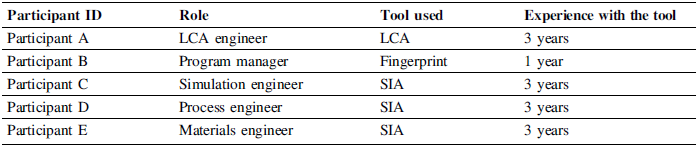
In addition to the authors’ perspectives, tool users have been asked to participate through a questionnaire to further understand the benefits, limitations and challenges of using the tools. Table 1 shows the participants and the tools they were asked to evaluate, detailed in the next section of this paper.
List of study participants

3. Results
This section provides an overview of the tools used for Sustainable Product Development (SPD) at GKN Aerospace and further describes each tool individually.
3.1. Overview
GKN Aerospace has sustainability integrated at different levels in the organisation: corporate, business lines, and business areas. It is within business lines that lies the responsibility to drive and implement Sustainable Product Development (SPD), support business areas to develop SPD capabilities, and update the product development process. The SPD process at GKN Aerospace is made of four different tools show in Figure 1, which are spread at various product development stages:
-
• Fingerprint: Co-developed with researchers and adapted to the company’s approach to sustainability. This tool is targeted on pre-design phases called Bid/No-bid and is an initial sustainability impact assessment.
-
• Sustainability Impact Assessment (SIA): Co-developed with researchers. It is connected to the gates assessments from planning to the end of detailed design. It aims to assess sustainability impacts, and identify risks, challenges, opportunities and improvement actions.
-
• Life Cycle Assessment (LCA): LCA is a well-known tool, which has been adapted by the case company to not only be applicable in detailed but also in conceptual design through an initial environmental impact assessment.
-
• Footprint: Following launch of the product, the company has developed a tool similar to the Environmental Product Declaration (EPD) which assesses the final product from a holistic sustainability perspective (i.e. social, environmental and economic) and communicates results to key stakeholders.
Overview of the SPD toolbox at GKN Aerospace; the four tools span over the whole product development process

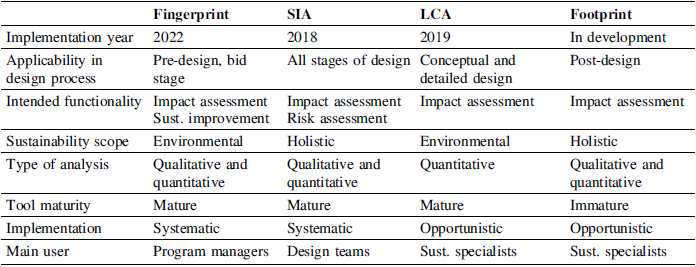
Overview of the characteristics of the four tools of the SPD toolbox

Because of the different years of implementation and the long cycles of aerospace product development (10-15 years), the SPD process described in this paper has not been fully tested on a single use case, but each module has been validated separately on multiple use cases. The tools have been developed using the same theoretical understanding of sustainability using the framework for strategic sustainable development, which includes principle-based definition of sustainability combined with backcasting (Reference Broman and RobèrtBroman & Robèrt, 2017). Table 2 shows a detailed overview of the characteristics of the four tools which are further detailed in the sections below. Most of the tools have the main functionality to perform sustainability impact assessments, although some of them are only addressing the environmental dimension of sustainability.
3.2. Fingerprint tool
The Fingerprint tool is systematically employed during “Bid/No-bid” decision process, a critical commercial gate that determines whether the company should pursue opportunities to design or manufacture new products. This strategic tool used by program managers and follows a lifecycle approach. Adapted from a tool co-developed with researchers (Reference Hallstedt, Villamil, Lövdahl and NylanderHallstedt, Villamil, et al., 2023), Fingerprint is customised with company-specific leading sustainability criteria that are the most important to address (Reference Watz and HallstedtWatz & Hallstedt, 2024) and enables anticipation of the product sustainability performance. While the original version of the tool includes both environmental and social criteria, the case company has chosen to adapt the tool and align it with the company’s environmental targets. While it is systematically used in product development, there is currently no review system in place to ensure objectivity and consistency besides the build-in functions in the tool.
Insights from tool users illustrate its practical impact and perceived value. Participant A used Fingerprint in the commercial gate process for taking over manufacturing contract of an existing product. They noted: “It puts sustainability on the table in our daily work and supports going towards sustainable products through awareness”. They were also able to use the tool output to identify opportunities to make the product more sustainable and use it as leverage with the potential customer: “The tool could give contractual ideas; it’s an opportunity to create business value for the customer and win the contract”. However, despite the simple approach of the Fingerprint, they mentioned the need for initial support from an experienced colleague to “get into the right mindset”.
Slide used for a “Bid/No-bid” process for manufacturing a new product in 2023 using the Fingerprint tool output (on the left) and key takeaways from the assessment (on the right)

Output from the Fingerprint tool is usually included in slide packs supporting the decision whether to start product development, as Figure 2 shows for the decision to manufacture a new product. The tool uses a qualitative scale where each level is accompanied by a detailed description to reduce subjectivity in assessment. Each criterion has a default weight which although simple, aligns real LCA data which shows the use phase and raw material extraction as main hotspots. In the example on Figure 2, the product is meant to be used on the latest civil aircraft generation which is best-of-its-class in terms of environmental impact in use, which gives the best system impact, and encourages the decision-maker to avoid contracts related to old less efficient aircrafts. It also raises awareness on the issue of global supply chains and encourages the exploration of more local suppliers to decrease transportation. Insights on the usefulness and effectiveness of this tool are limited as few new product development activities have been experienced since the tool’s implementation as aerospace manufacturers experience financial pressures that force them to focus on sustaining existing programs rather than launching new ones.
3.3. Sustainability impact assessment tool
In each gate within product or technology development, GKN Aerospace uses a tool called Sustainability Impact Assessment (SIA), originally co-developed in an industry-academia collaboration project (Reference Hallstedt and PigossoHallstedt & Pigosso, 2017). The purpose of this tool is to increase awareness of the environmental, social and economic impacts early in the design process and support the identification of sustainability challenges and activities to handle them. The SIA is based on a strategic step-by-step approach (shown in Figure 3): the further the product development project proceeds, the more steps need to be performed, and the tool is meant to be updated throughout the project duration. The tool has been updated several times since internal launch and includes modules such as a material criticality assessment (Reference Hallstedt and IsakssonHallstedt & Isaksson, 2017) and a use-phase CO2 assessment.
Steps of the SIA tool; the further the product development project proceeds, the more steps need to be performed

Figure 4 shows step 3 of the SIA tool conducted on a case product, which is constituted of several welded metallic sectors instead of a single-piece component that is more common in this family of products. While the development of such concept was economically driven due to quality issues in the baseline design, the SIA allows design teams to see the implications of economic decisions on environmental and social aspects, as well as visual trade-offs.
Results of the alternatives step of the SIA tool on a case product; the simple comparison between new concept and baseline is applicable to early design stages

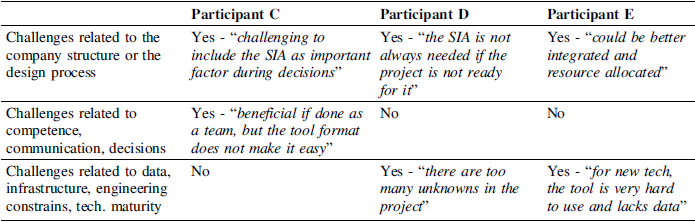
The SIA tool is strategically integrated in the company’s technical review system: it is mandatory for product development team to use the tool to pass a gate, ensuring a systematic consideration of sustainability. Additionally, the SIA must be reviewed by a sustainability specialist, then approved by a product owner or project manager, which increases the validity of the assessment and can support in improving consistency and objectivity. As currently implemented, a product with poor sustainability assessment results would still be able to pass the gate: only performing and getting the assessment approved is required. Over the last six years, only once has sustainability blocked a review as the SIA revealed concerning findings. The current approach with systematic implementation could also present structural limitations as summarized in Table 3. Participant D explains: “I think a SIA is not always needed if the project is not ready for it. Promote thinking if this deliverable is needed in this project phase, rather than the system demands it”. A systematic implementation ensures that the tool will be used, whether it is needed or not, which might feel counterproductive in projects with high time pressure. Then, the tools should be implemented so that most projects would have the necessary maturity to use it, but the example of Participant D shows that the current approach is not entirely succesful.
Participant’s answers to: which challenges have you encountered when using the tool?

Another key takeaway from the questionnaires relates to implementing sustainability tools in the technical review system, and how it does not systematically ensure a proactive approach to sustainability: “I feel that often the SIA is just made “last minute” before a gate and that the sustainability questions are not properly and objectively factored in the decision making” (Participant C). Other limitations described by tool users relate to usefulness and usability of the tools. Participants C, D and E were asked “what does the tool help to accomplish?”. All agreed that the SIA supports evaluating a product’s potential sustainability impacts throughout its lifecycle, but only C and E also added that the tool helps with evaluating and managing sustainability and business risks and opportunities and identifying and implementing actions or guidelines to reduce the product’s sustainability footprint. While those two goals are clearly stated in the tool and the template aims to guide users through these tasks, there might be gaps in the ability of the tool to address these aspects.
Although the tool was designed with integrated guidelines, tool users found it essential to get proper training to get started “I liked the sustainability expert mentorship. In this way it becomes easier to handle if there is a more experienced reviewer that guides during the creation of this document.” (Participant D). There are concerns about the breadth of the lifecycle approach of the tool. “I would suggest to briefly filter the most critical processes (…). The tool can become easier to handle for a member of the project and then can be developed further by a sustainability expert.” (Participant D). Current tool format presents limits to collaboration and typically leads to one engineer conducting the assessment instead of the recommended participative approach: “Completing and updating the SIA would be more beneficial if done as a team instead of a single engineer interested in these questions. (…) Maybe a more interactive tool could help.” (Participant C).
3.4. Life cycle assessment tool
LCAs are used at two specific instances at GKN Aerospace’s product development process: in conceptual and in detailed design. Currently, this tool is not systematically implemented and is conducted by LCA specialists within a specific business line. This ad-hoc approach is a result of both resource constraints and directing interventions towards critical sustainability hotspots. There are, however, internal standards for data collection, management and quality analysis, and reporting following ISO 14040 and 14044 standards (ISO, 2006) and the company actively works with industrial networks to establish guidance frameworks for LCA (IAEG, 2025). LCA capabilities are sparse and often acquired through knowledge sharing and external courses.
There are significant differences in approaches between an Initial LCA done at early design stages, and a Full LCA which are done towards the end of product development. The scope of an Initial LCA does not aim to be holistic but to target the environmental hotspots of a product, which becomes more and more evident as the company performs Full LCA on similar products. If the evaluated concepts are expected to impact the use phase differently, then the Initial LCA focuses on the use phase as use typically accounts for 99% of the total lifecycle environmental impact. If there is no difference on the use phase impact among concepts, then an Initial LCA is typically performed on the cradle-to-gate scope, using assumptions and results from Full LCAs. It is a dialogue between the sustainability expert and the design teams to model the flows correctly. For the company, performing LCAs is of strategic value on the long term. It allows to measure the potential impact of a new product on the company’s environmental footprint, which can support the achievement of corporate environmental targets. However, as Participant A noted, communicating LCA results can be challenging: “It can be difficult to put the results into context. If we are not making a comparison, where we can put the numbers into perspective, it is difficult to communicate the LCA results, especially to stakeholders who are less experienced with LCA”. Additionally, there is the recurring issue of data collection and data uncertainty which is broadly discussed in LCA-related literature (e.g. Reference Keiser, Schnoor, Pupkes and FreitagKeiser et al., 2023).
In product development, LCA has frequently been used reactively in conjunction with the SIA (Section 3.2) when it showed an orange or red finding in technical reviews. This triggered the involvement of LCA engineers to support in understanding of the main environmental hotspots and how to mitigate them. This was the case in 2023 in a project where new concepts using additive manufacturing technology were proposed, which raised questions on the environmental footprint of feedstock material and impact of material efficiency in the deposition process. As GKN Aerospace products are often made of metals which are only available in certain regions of the Earth, raw materials production and transportation frequently dominate the environmental footprint in cradle-to-gate. An LCA was therefore conducted and concluded that sustainable suppliers need to be secured, and the technology needs further developing before this new concept would improve the environmental impact of the baseline. In other cases, product development teams have proactively reached out to the sustainability team for quantitative sustainability assessment to support in concept selection, which the default tool SIA cannot provide with its more qualitative approach. Following the events in 2023, projects related to additive manufacturing frequently reach out to LCA specialists for conducting initial environmental assessments.
At the detailed design stage, the component design cannot be significantly altered which means that there is little influence on the use phase anymore. However, LCAs have proven helpful to guide engineering activities towards tackling the most impactful environmental challenges related to manufacturing, supply or transportation. It was also identified as strategically supporting the industrialization phase with regards to supplier selection, logistic management and design of new factory space. Finally, LCAs are internally peer-reviewed and approved by the receiver of the study, typically the product owner or project manager, as customers have not yet requested LCAs to the case company.
3.5. Footprint tool
The Footprint tool was created to address communication challenges with customers regarding the complexity of sustainability, to foster internal sustainability awareness and enable continuous improvement. As the industry is very climate and safety focused, other sustainability issues are often left out. Therefore, the Footprint tool has a holistic approach to sustainability by applying the framework for strategic sustainable development (Reference Broman and RobèrtBroman & Robèrt, 2017), which is a radically different approach to most regulations or industry standards. Being the most recent SPD tool implemented at GKN, it builds upon the other tools presented in this paper. It takes the approach of leading sustainability criteria from the original Fingerprint tool (Section 3.2), and reuses elements of the SIA (Section 3.3) such as the material criticality score. It also includes results from an LCA (Section 3.4). The Footprint was co-created and validated through a case study including collaborative workshops involving various internal stakeholders within product development, external program partners of the case product and academic experts in sustainable product development. These iterative sessions focused on: 1) Identifying relevant sustainability criteria, 2) Refining the rating scale, 3) comparison with existing standards (Product Environmental Footprint, Environmental Product Declaration, etc.), 4) Testing the tool on products, 5) Exploring visualization concepts and 6) Validation with expert reviews and stakeholder feedback.
Currently, the tool comprises 27 criteria evaluated spread across four key lifecycle phases shown on Figure 5: raw material extraction, production (supplier and main manufacturer), usage, and end-of-life. Environmental indicators include climate impact, enabler of sustainable aviation, energy mix, material efficiency, environmental management and recyclability. Social dimensions cover aspects such as conflict minerals, worker health and safety, substances of concern, noise and in-flight. Economic criteria include lifecycle cost, durability, and supply chain resilience (dual sourcing).
The 27 criteria from the Footprint tool organised by product life stage

Similarly to the original Fingerprint tool (Reference Hallstedt, Villamil, Lövdahl and NylanderHallstedt, Villamil, et al., 2023), it uses the Sustainability Compliance Index levels (Reference HallstedtHallstedt, 2017) and Each criterion is rated on a 0-9 scale. This provides a nuanced view of sustainability performance, balancing ambition with realism, and allows incorporating both quantitative and qualitative metrics. Level 9 indicates that the strategic sustainability criterion is fulfilled, and therefore complies with sustainability principles (Reference Broman and RobèrtBroman & Robèrt, 2017). Although a score of 9 may not always be practically attainable within the current aerospace context, it remains an important reference point for objectivity and ambition. Level 6 means that a proactive approach is adopted and the product is moving towards excellence. Level 3 means that the product complies with regulations and customer expectations – it is a low, but acceptable level. Level 0 means there is not enough information to provide a score. A first case study was conducted on a structural engine component designed for fuel efficiency and produced for past decade. The results showed that the main sustainability hotspots reside in raw material production, parts production at suppliers and end-of-life phases and both external customers and internal customer program function expressed strong interest in the tool’s output. However, the tool remains immature and further development is needed to bridge strategic corporate targets and product development activities. Future development and effective implementation of the Footprint tool will most likely be shaped by upcoming regulations and customer expectations related to sustainability. Another current limitation relates to objectivity and validation the Footprint assessment, and today’s approach relies on trust and transparency.
4. Concluding discussion
Companies must adapt and provide sustainable solutions, and while many tools and method are available, they struggle to implement them. This study delved into a case company, GKN Aerospace, with the aim to understand what it means to conduct a systematic and strategic implementation of Sustainable Product Development (SPD) and identify remaining challenges. The development and implementation process of the tools was described, and insights from practitioners were gathered to further evaluate benefits and gaps (Reference Hallstedt and NylanderHallstedt & Nylander, 2019).
A systematic implementation of Sustainable Product Development
Two tools have been systematically implemented at the case company through the stage-gate process: the Fingerprint tool for commercial gates and the Sustainability Impact Assessment tool for product and technology development. Program managers and product development teams are now systematically using these tools, which support the assessment of sustainability in early design, identifying main hotspots and acts as a starting point for discussions to improve the product sustainability. As of 2025, Life Cycle Assessments are not systematically conducted but targeted at critical products in a strategic approach. The Footprint tool is not systematically implemented either as it needs further validation. Our results show that while using gates to ensure that sustainability tools are used and that results are approved, it does not systematically lead to sustainability improvements. A potentially more effective approach could instead measure the expected sustainability performance of product in development, and projects which score too low should be prevented to go further in development.
A strategic implementation of Sustainable Product Development
Based on the findings, we propose that a strategic SPD implementation requires the following elements: i) SPD tools are implemented at critical product development stages, i.e. where the most impactful decisions are being taken. Research frequently refers to the early stages of innovation as critical (e.g. Reference Hallstedt, Villamil, Lövdahl and NylanderHallstedt, Villamil, et al., 2023). GKN Aerospace implemented tools not only at the early stages of product development, but also at later stages which is relevant in the aerospace context, with development cycles of 10-15 years and often re-designs and upgrades products during their lifetime.
ii) Awareness and responsibility are spread across the organisation. For SPD tools at GKN Aerospace, this means implementing different tools for different users from program management to design teams and sustainability specialists. The tools have been adapted to specific users and situations with a variety of aims from creating awareness to identify actions and supporting decision-making. This must take place across all organisational levels as recommended in other research (Reference Mallalieu, Isaksson Hallstedt, Isaksson, Watz and AlmefeltMallalieu, 2024).
iii) There is cohesiveness between the tools, sustainability approach and metrics used. Using Leading Sustainability Criteria (Reference Watz and HallstedtWatz & Hallstedt, 2024) and the Sustainability Compliance Index (Reference HallstedtHallstedt, 2017) approaches allows cohesiveness throughout product development stages and can be further used to set product development targets at the company, which in turn will support connection to the company strategy.
Reflections on action research and remaining gaps
After fifteen years of collaboration with researchers, GKN Aerospace has strategically implemented four tools covering both early and late design stages which aim to assess, improve and communicate product sustainability. The high level of adaptability of the tools was proven to be a significant accelerator in the adoption of new methods as highlighted by Reference Hallstedt and NylanderHallstedt and Nylander (2019).
While all tools are derived from the same definition of strategic sustainable development, they do not yet constitute a cohesive approach. This gap is evident as each tool has a different set of sustainability criteria and has its own approach to assess them. Additionally, the use of SPD tools can induce subjectivity and validation challenges. While SIAs and LCAs are required to go through a formal internal review, it remains an issue to ensure consistent and reliable results. There is particularly a stronger scepticism when using qualitative metrics, whereas quantitative assessments such as LCAs were found to be less questioned and more easily accepted. Finally, uncertainty remains if the SPD process proposed in this paper is effective. Using the tools has enabled capability building and relative sustainability improvements, but it is still unclear whether is it sufficient to accelerate the industry’s sustainability transition.
Implications for research and practice
This study contributes to research in the field of SPD by providing new insights on SPD implementation in industry, which is received too little attention in previous research. Through action research, it provides rich, deep insights on what it means to conduct a systematic and strategic implementation of SPD in an industrial context with structural, human and technical barriers to address. Findings from this study could be generalisable to other industries with structured, long product development process.
Regarding implications for practice, the case of SPD implementation can be an example for other companies seeking to integrate SPD further into their organisation, ensuring that sustainability is not a one-time assessment, but is embedded continuously within critical product development stages. This research raises awareness on the need to have several tools for different users and situations, and calls for a critical view on SPD initiatives in isolated product development stages.
Limitations and future work
While the company’s product development process is similar to other industries, the tools and implementation methods are tailored for the specific context of the case company and may limit its generalizability. Moreover, the question whether these tools have directly improved product sustainability performance has not been proven, as the aerospace industry experiences long product lifecycle, where more years of action research would be required to make such conclusions.
Future research should aim to gather more practitioners’ perspectives through a longitudinal study to gain further understanding of the consequences of SPD implementation on capability building and product sustainability performance. Future work should also further investigate the problem of cohesiveness between tools, for example by using the Leading Sustainability Criteria approach.
Acknowledgements
This work has been financially supported by the Sweden´s Innovation Agency (Vinnova) through the national aerospace research program NFFP8. We would like to thank all the participants from GKN Aerospace who generously shared their time, insights, and experiences.





 Open access

