





1. Introduction
Numerous studies, and anecdotes from parents, suggest that children are effective and efficient word learners (Clark, Reference Clark2023; Haman et al., Reference Haman, Zevenbergen, Andrus and Chmielewska2009). Starting around 12 months of age, children soon acquire hundreds of new words, rapidly and without formal instruction (e.g. Clark, Reference Clark2023; Hoff et al., Reference Hoff, Core, Place, Rumiche, Señor and Parra2012). Young children’s development of language skills, including their rapid expansion of vocabulary, can be attributed, in part, to successful use of word-formation devices (Clark, Reference Clark2009). In the process of learning new words, children must apply word-formation rules present in their language (Becker, Reference Becker1994). That is, children obtain experience in using appropriate word-formation rules in a language that not only allows them to increase their vocabulary systematically but also enables them to use language more precisely. Thus, eliciting new word coinage in experimental situations can reveal children’s understanding of word-formation rules, as well as their linguistic awareness of the language (Haman et al., Reference Haman, Zevenbergen, Andrus and Chmielewska2009).
2. Compounding processes in English and Polish
Languages differ significantly in the extent to which they exploit word-formation processes in general, and word-formation devices in particular (Clark, Reference Clark, Spencer and Zwicky1998a; Fabb, Reference Fabb, Spencer and Zwicky2017; Haman et al., Reference Haman, Zevenbergen, Andrus and Chmielewska2009; Kuczyński, Reference Kuczyński2022). English has a somewhat limited word-formation system, although some methods for forming words in English are quite productive and easily acquired by children. For example, compounding, or the formation of new words by linking two free morphemes into one word to create a new word (e.g. bookbag), is a useful and readily acquired word-formation device (Bauer, Reference Bauer, Aarts, McMahon and Hinrichs2020; Clark, Reference Clark, Spencer and Zwicky1998a; Lieber, Reference Lieber, Stekauer and Lieber2005).
Multiple forms of compounding exist in English, including two major forms of compounds that are readily distinguished: root and synthetic compounds (Lieber, Reference Lieber, Stekauer and Lieber2005). Root compounds composed of two bare roots such as noun–noun combinations (e.g. boyfriend) comprise the largest subgroup of root compounds and are highly productive in English (Bauer, Reference Bauer, Aarts, McMahon and Hinrichs2020; Lieber, Reference Lieber, Stekauer and Lieber2005). Thus, they were the focus of the present study. Although noun–verb (e.g. babysit) or verb–verb (e.g. stir-fry) root compounds exist in English, they are more difficult to form and therefore are relatively unproductive in the language (Lieber, Reference Lieber, Stekauer and Lieber2005). Thus, noun–verb and verb–verb root compounds were not examined in the present study, nor were other forms of root compounding (e.g. adjective–noun).
Synthetic compounds, sometimes referred to as deverbal or verbal nexus compounds, include a derivational suffix (e.g. −er, −ing) that follows a noun–verb combination (e.g. firefighter, gift-giving, snowblower). Like noun–noun root compounds, synthetic compounds are highly productive in English (Fabb, Reference Fabb, Spencer and Zwicky2017; Lieber, Reference Lieber, Stekauer and Lieber2005). As such, synthetic compounding is a productive way to form English noun–verb compounds (Haman et al., Reference Haman, Zevenbergen, Andrus and Chmielewska2009).
Previous research suggests that the process of compounding in English is relatively easy, especially the formation of root (noun–noun) compounds (Bauer, Reference Bauer, Aarts, McMahon and Hinrichs2020; Clark & Berman, Reference Clark and Berman1984; Lieber, Reference Lieber, Stekauer and Lieber2005). Therefore, it is not surprising that root (noun–noun) compounds are evident in young English-speakers’ spontaneous speech by about one and a half years of age (Clark, Reference Clark, Spencer and Zwicky1998a; Schipke & Kauschke, Reference Schipke and Kauschke2011). Synthetic (noun–verb + suffix) compounding usually develops after the second birthday, and in English-speaking children, is generally not mastered until after three years of age (Woodward & Markman, Reference Woodward, Markman and Damon1998).
However, in some languages such as Polish, compounding is less productive and used less frequently (Szymanek, Reference Szymanek2010, Reference Szymanek, Trips and Kornfilt2017). According to Haman et al. (Reference Haman, Zevenbergen, Andrus and Chmielewska2009), noun–noun compounds are rare in Polish but are possible through the use of a linking formant like -o- (e.g. płuc-o-serce “lung-heart machine”). However, because Polish almost always uses a linking formant, compounds are more likely to be noun–verb or noun–adjective combinations (e.g. prac-o-daw-ca “work-giv-er”/“employer”), yet even these are not common (Haman et al., Reference Haman, Zevenbergen, Andrus and Chmielewska2009; Szymanek, Reference Szymanek, Trips and Kornfilt2017). Formations in Polish that do not use the interfix -o- are called closed compounds and typically involve combinations of an adjective or verb with a noun and not a noun–noun combination (Haman et al., Reference Haman, Zevenbergen, Andrus and Chmielewska2009). However, closed compounds are relatively rare in Polish.
3. Derivational processes in English and Polish
In Polish, new words or lexemes are often the product of derivation, or the formation of words by adding bound morphemes or affixes (prefix or suffix) to a root (e.g. czyt-nik “read-er” from czytać “to read”; Haman et al., Reference Haman, Zevenbergen, Andrus and Chmielewska2009). Studies on the Polish language have shown that a variety of affixes exist in the language. For example, comprehensive digital dictionaries such as Słowniki Języka Polskiego Portal PWN (2003) list 184 affixes in modern Polish. In contrast, English contains a smaller repertoire of affixes (approximately 86; Haman et al., Reference Haman, Zevenbergen, Andrus and Chmielewska2009). According to Haman et al. (Reference Haman, Zevenbergen, Andrus and Chmielewska2009), this difference between Polish and English in affixes “concerns mainly derivation” and the fact that Polish is a “pro-derivative” language (p. 178).
Indeed, Dąbrowska (Reference Dąbrowska2006) notes that it is possible to add diminutive affixes to most nouns in Polish. Forming nouns from nouns through derivational processes is highly productive in Polish, especially via the use of diminutive suffixes (i.e., suffixes that convey smallness) like -ek, −ka, and -ko (e.g. kacząt-ko “duck-ling” from kaczka “duck”; Dąbrowska, Reference Dąbrowska2006; Haman, Reference Haman2003; Pytlik, Reference Pytlik2018). In fact, forming Polish nouns with diminutive suffixes is quite common in child-directed speech (from parents) and child language (Dąbrowska, Reference Dąbrowska2006; Haman et al., Reference Haman, Zevenbergen, Andrus and Chmielewska2009; Tabakowska, Reference Tabakowska2022), especially when children are just beginning to speak (Haman, Reference Haman2003).
Derivation is a productive word-formation strategy in English as well (Kuczyński, Reference Kuczyński2022; Lieber, Reference Lieber, Stekauer and Lieber2005), although less productive than compounding processes (Clark, Reference Clark2023). English speakers most often use derivation to form new nouns (e.g. dis-comfort, build-er; Baayen & Lieber, Reference Baayen and Lieber1991; Shqerra & Shqerra, Reference Shqerra and Shqerra2014). For example, English suffixes such as -er are used frequently to form nouns (e.g. help-er from help; Clark & Berman, Reference Clark and Berman1984; Clark, Reference Clark2023). However, and in comparison with Polish, it is relatively uncommon to use derivation with diminutive suffixes to form new nouns in English (Haman et al., Reference Haman, Zevenbergen, Andrus and Chmielewska2009). According to Pytlik (Reference Pytlik2018), English diminutives are formed primarily with two words: an adjective meaning small and a base noun. Therefore, it is more common to say little bear instead of the derivational form, bear-y. Although there are cases where the opposite is true (e.g. dolly instead of little doll), compared to Polish, there are very few diminutive suffixes in English (e.g. −y, −ie), limiting the productivity of using derivation to form diminutives in the language. Thus, derivation tends to be acquired later than compounding in English. That is, English-speaking children begin to use derivation at approximately two and a half years of age and typically master the strategy by age four (Schipke & Kauschke, Reference Schipke and Kauschke2011; Woodward & Markman, Reference Woodward, Markman and Damon1998). This is in contrast to Polish-speaking children, who use this type of derivational process when they are just beginning to speak (Haman, Reference Haman2003).
4. Input language and compounding and derivational processes
Although limited in number, past studies suggest that input language can greatly affect children’s word-formation preferences. For example, using novel word-formation tasks, researchers have shown that Polish-speaking children (three to five years of age) favour the use of derivation over compounding, whereas the reverse was true for their English-speaking peers (Haman et al., Reference Haman, Zevenbergen, Andrus and Chmielewska2009). Additionally, Schipke and Kauschke (Reference Schipke and Kauschke2011) found that English-speaking toddlers lagged behind German-speaking toddlers in their simultaneous use of compounding and derivation – two common forms of word-formation devices in German. In contrast, English-speaking toddlers’ early word learning was first characterized by compounding, and only later derivation, following the English pattern of acquiring word-formation strategies (Clark, Reference Clark, Spencer and Zwicky1998a; Woodward & Markman, Reference Woodward, Markman and Damon1998). Although cross-linguistic studies such as these appear infrequently in the literature, their findings are important because they attest to the significant impact input language has on the way children form words.
Moreover, the results of past studies provide greater understanding about the processes that may, or may not, affect word formation in a given language. To illustrate, originally it was believed that children develop the ability to use compounding earlier than derivation, and when forming novel words, they also prefer compounding over derivation (see Schipke & Kauschke, Reference Schipke and Kauschke2011, for a discussion). Basic language learning principles such as transparency and simplicity supported these assertions: compounding should be relatively easy for children because single parts of a compound are more transparent than those created through derivation (Clark, Reference Clark, Gelman and Bynes1991; Clark & Berman, Reference Clark and Berman1984). In addition, it was initially believed that compounding should be preferred over derivation because “Simpler forms are easier to acquire than more complex forms, where simplicity is measured by the degree of change in the form. The less a word form changes, the simpler it is” (Clark, Reference Clark, Gelman and Bynes1991, p. 94). Yet, early studies on these topics were conducted primarily with monolingual speakers in either English or German (Clark, Reference Clark, Spencer and Zwicky1998a; Woodward & Markman, Reference Woodward, Markman and Damon1998).
Studies with children who speak languages other than English suggest that other mechanisms may be at play, including the productivity of different word-formation devices in a child’s input language (Haman et al., Reference Haman, Zevenbergen, Andrus and Chmielewska2009; Schipke & Kauschke, Reference Schipke and Kauschke2011). For instance, Clark (Reference Clark1998b) found that French-speaking children preferred to use prepositional phrases instead of compounding when modifying nouns in French, matching the higher productivity of prepositional phrases and lower productivity of compounding in the French language. Moreover, the productivity of word-formation devices in a language may also influence children’s rate of acquisition of those devices. For example, Clark and Berman (Reference Clark and Berman1984) found that Hebrew-speaking children preferred to coin words based on one lexeme and did not start using compounds until about five years of age, whereas English-speaking children tend to use compounding before age two (Clark, Reference Clark, Spencer and Zwicky1998a).
5. Bilingual children and compounding and derivational processes
Given that languages can vary in the extent to which they use compounding and derivation processes, what happens when a child is learning two languages, each differing in the degree to which word-formation devices are productive? According to Nicoladis (Reference Nicoladis2012), cross-linguistic influence can occur in bilingual children at the phonological, morphological, or syntactic level when their knowledge of one language impacts the decisions made about how another language should be used. At the morphosyntactic level, this could result in either an increase or decrease in the use of a word-formation device (e.g. compounding, derivation, prepositional phrases; Hulk & Müller, Reference Hulk and Müller2000; Nicoladis, Reference Nicoladis2012). Further, structural ambiguity theories (e.g. Döpke, Reference Döpke1998; Hulk & Müller, Reference Hulk and Müller2000) state that structural ambiguity can occur when the morphosyntactic structures in two languages are allowed in both languages, but a different structure is also allowed in one of the languages. Döpke (Reference Döpke1998) has argued that it is when children receive ambiguous cues from their languages that cross-linguistic influence occurs, with children’s use of a structure being based on the frequency in which it occurs in one or both languages. Additionally, according to structural ambiguity theories, cross-linguistic influence should not occur when structures are not ambiguous between languages (i.e., when each language employs different morphosyntactic structures; Hulk & Müller, Reference Hulk and Müller2000).
Although evidence exists for structural ambiguity models (see Anderssen & Bentzen, Reference Anderssen and Bentzen2018; Hermas, Reference Hermas2024; Kupisch, Reference Kupisch2007; Serratrice, Reference Serratrice2007), Nicoladis (Reference Nicoladis2003) has argued that the cross-linguistic influence that has been observed among French/English-speaking bilingual children cannot be explained by structural ambiguity theories. As root (noun–noun) compounds are right-headed in English and left-headed in French, the structural ambiguity hypothesis would suggest that there should be no cross-linguistic influence in French–English bilingual children’s formation of compounds (Nicoladis, Reference Nicoladis2003). Instead, the formation of root (noun–noun) compounds should be right-headed in English and left-headed in French. However, the researchers found that French/English-speaking bilinguals reversed novel root (noun–noun) compounds almost twice as often in both languages (French and English) in comparison to their English-speaking monolingual peers (Nicoladis, Reference Nicoladis2002).
Because bilingual children tend to be more proficient in one of their languages than the other (Bedore et al., Reference Bedore, Peña, Summers, Boerger, Resendiz, Greene, Bohman and Gillam2012; Hoff, Reference Hoff2021), it is possible that language exposure and language dominance may also influence cross-linguistic influence (Argyri & Sorace, Reference Argyri and Sorace2007; Foroodi-Nejad & Paradis, Reference Foroodi-Nejad and Paradis2009; Kupisch, Reference Kupisch2007; Nicoladis, Reference Nicoladis2012). Indeed, previous research shows that bilingual children may be more likely to use structures from their dominant language when they are speaking in their weaker language (Nicoladis & Gavrila, Reference Nicoladis and Gavrila2014; Yip & Matthews, Reference Yip and Matthews2007). For example, Yip and Matthews (Reference Yip and Matthews2000) observed that a Cantonese-English bilingual child (who was dominant in Cantonese) used Cantonese constructions (e.g. wh- interrogatives, relative clauses) when speaking in English.
However, a number of studies (Anderssen & Bentzen, Reference Anderssen and Bentzen2018; Kutsuki, Reference Kutsuki2019; Müller & Hulk, Reference Müller and Hulk2001; Nicoladis, Reference Nicoladis2002) have found the opposite: that language dominance does not impact cross-linguistic influence during word formation. For example, Nicoladis (Reference Nicoladis2002) found that children’s receptive vocabulary size, used as a measure of language proficiency and dominance, did not influence French/English-speaking bilinguals’ word order reversals during noun–noun compounding. That is, the rate of reversal (e.g. toilet paper versus paper toilet) was not accounted for by language dominance in French or English. Similarly, in a sample of Spanish/Japanese-speaking bilingual preschoolers, Kutsuki (Reference Kutsuki2019) found no evidence that the children’s language dominance, which was assessed via receptive vocabulary, affected cross-linguistic influence during noun compounding tasks. In Japanese, compound nouns are predominately right-headed with modifiers placed before the head nouns, whereas in Spanish, the head noun is always the first noun followed by a modifier. Dominance in one language, however, did not affect reversal rates and children’s use of these compounding rules.
Finally, in experimental tasks, the language of testing may influence bilingual children’s use of word-formation devices. In French/English-speaking four-year-old bilingual children, Nicoladis (Reference Nicoladis2002) found that the children preferred to use prepositional phrases over compounding when modifying novel nouns in French, whereas the reverse was true when the children were tested in English. In addition to providing support for input language effects on children’s use of compounding, based on the productivity of compounding in English and French, these findings also suggest that bilingual children may use certain word-formation devices based on the language of the task. Indeed, previous research has shown that bilingual children are receptive to perceptual and social cues in their environment (Buac et al., Reference Buac, Tauzin-Larché, Weisberg and Kaushanskaya2019; Groba et al., Reference Groba, De Houwer, Mehnert, Rossi and Obrig2018). For example, by approximately two years of age, bilingual children are aware of which people in their environments speak each of their languages, leading them to use their languages separately and appropriately with monolingual speakers (Paradis & Nicoladis, Reference Paradis and Nicoladis2007). Thus, it may be that, in experimental tasks, bilingual children may recognize that the experimenter is using a certain language, and in turn, use the word-formation devices that are most productive in that language.
6. The present study
In this study, we explored how English-speaking monolingual and English/Polish-speaking bilingual children growing up in the United States use word-formation devices during a novel, experimental word-formation task. With assistance from colleagues in Poland, we initially included a Polish-speaking monolingual group of children as an additional comparison group. Unfortunately, issues arose during data collection that prevented us from using that data. Thus, our results speak particularly of the experiences of children living in an English-dominant culture and may not be applicable to children growing up in other language contexts.
Specifically, we presented a word-formation task to American children that was designed to elicit either compounding (root and synthetic types) or derivation (to form nouns, verbs, and adjectives). As compounding is more productive than derivation in English, and derivation is more productive than compounding in Polish, the primary goal of the present study was to examine how monolingual (English) and bilingual (English, Polish) children’s input languages influence their use of compounding and derivation word-formation devices. Bilingual children were tested in either English or Polish on the word-formation task to examine how the language of testing affects children’s use of word-formation devices without influence from the other language. This allowed us to assess the productivity of compounding and derivation in each language.
Additionally, we used receptive vocabulary as a measure of language proficiency in English for monolingual children and in English and Polish for bilingual children. This allowed us to examine whether receptive vocabulary, as a proxy for language proficiency, was related to children’s use of word-formation devices. According to previous studies, measures of receptive vocabulary (e.g. the Peabody Picture Vocabulary Test, PPVT; Dunn & Dunn, Reference Dunn and Dunn2007) can be a highly efficient method for determining the size of a child’s lexicon and tracking the developmental trajectory and growth of word knowledge (Hadley & Dickinson, Reference Hadley and Dickinson2018).
Although a productive measure of language proficiency may be more in line with the productive nature of a word-formation task, we chose a receptive measure of language proficiency for several reasons. Firstly, productive measures, at least of vocabulary, tend to underestimate bilingual children’s knowledge of a language (Giguere & Hoff, Reference Giguere and Hoff2022; Keller et al., Reference Keller, Troesch and Grob2015). In particular, a bilingual child’s receptive vocabulary is typically larger than their productive vocabulary (Keller et al., Reference Keller, Troesch and Grob2015; Webb, Reference Webb2008), a phenomenon that has been referred to as the “receptive–expressive gap” (Gibson et al., Reference Gibson, Peña, Bedore and McCarter2022). Secondly, receptive skills are generally faster to acquire and can serve as the building blocks for productive language (Laufer & Paribakht, Reference Laufer and Paribakht1998). Thirdly, scores on the PPVT are significantly correlated with scores on the MacArthur–Bates Communicative Development Inventory (CDI; Vagh et al., Reference Vagh, Pan and Mancilla-Martinez2009), a parental report of young children’s productive vocabulary and productive syntactic skills. Finally, other researchers examining morphosyntactic language skills have used receptive measures to assess language proficiency (Davidson et al., Reference Davidson, Vanegas, Hilvert and Misiunaite2017; Nicoladis, Reference Nicoladis2002, Reference Nicoladis2012; Nicoladis & Gavrila, Reference Nicoladis and Gavrila2014; Nicoladis & Paradis, Reference Nicoladis and Paradis2012).
Thus, specific research predictions are as follows:
Hypothesis 1a: We predict that children’s use of word-formation devices (compounding, derivation) will mirror the language(s) they know (i.e., English; English and Polish) and the language of testing. Thus, English-speaking monolingual children should favour compounding over derivation, following the pattern of word learning in English. It is less clear how bilingual (English, Polish) children will respond. For bilingual children who are growing up in an English-dominant culture and speak both English and Polish at age-level proficiency, it may be that they will use derivation more often than compounding when assessed in Polish, because derivation is more productive than compounding in Polish. However, when tested in English, bilingual children may use compounding more often than derivation, matching the productivities of English word-formation devices. These predictions are in line with previous empirical findings with monolingual (Clark, Reference Clark1998b; Haman et al., Reference Haman, Zevenbergen, Andrus and Chmielewska2009; Schipke & Kauschke, Reference Schipke and Kauschke2011) and bilingual children (Nicoladis, Reference Nicoladis2002), which note strong associations between the productivity of word-formation devices in the input language and children’s use of those devices.
Hypothesis 1b: Yet, productivity alone may not explain between-subject differences between monolingual and bilingual children tested in English. When tested in English, bilingual children may prefer compounding over derivation but to a lesser extent than English-speaking monolingual children. This would be in line with structural ambiguity theories (e.g. Döpke, Reference Döpke1998; Hulk & Müller, Reference Hulk and Müller2000) that state that structural ambiguity can occur when the morphosyntactic structures in two languages are allowed in both languages, as is the case in English and Polish, but to a different degree in one of the languages.
Hypothesis 1c: Alternatively, bilingual children may prefer to use structures that are more productive in their dominant language (Nicoladis & Gavrila, Reference Nicoladis and Gavrila2014; Yip & Matthews, Reference Yip and Matthews2000). For example, bilingual children with greater receptive vocabulary skills in Polish may be more likely to use derivation, whereas bilingual children with greater receptive vocabulary skills in English may be more likely to use compounding.
Hypothesis 2: Productivity patterns in a language may also predict children’s formation of root (noun–noun) compounds and synthetic (noun–verb + suffix) compounds. As both root and synthetic compounds are highly productive in English (Fabb, Reference Fabb, Spencer and Zwicky2017; Lieber, Reference Lieber, Stekauer and Lieber2005), there may be no significant difference in the use of root versus synthetic compounding among English-speaking monolingual children. The same pattern may be found for bilingual children tested in English, although they may exhibit both types of compounding (root, synthetic) to a lesser extent due to their knowledge of Polish and the fact that compounding is considerably less common in Polish (Haman et al., Reference Haman, Zevenbergen, Andrus and Chmielewska2009; Szymanek, Reference Szymanek2010, Reference Szymanek, Trips and Kornfilt2017).
Bilingual children tested in Polish, however, may show infrequent usage of both types of compounding (root, synthetic) because compounding is not as productive as derivation is in Polish. Finally, if bilingual children tested in Polish use compounding less frequently than bilingual children tested in English, it may be due to an influence of the testing language. Such results would be in line with the findings of Nicoladis (Reference Nicoladis2002), in which bilingual children (French/English) used compounding at different rates when tested in each of their languages, matching the productivity of compounding in each language.
Hypothesis 3: Based on previous research, in the derivation condition of the word-formation elicitation task, we expect that all children will use derivation more frequently with stimuli depicting images of nouns than with stimuli of verbs or adjectives. This pattern is expected because derivation is most often used for noun coinage (as compared to verb or adjective coinage) in both English (Baayen & Lieber, Reference Baayen and Lieber1991; Shqerra & Shqerra, Reference Shqerra and Shqerra2014) and Polish (Dąbrowska, Reference Dąbrowska2006; Haman, Reference Haman2003; Pytlik, Reference Pytlik2018). However, because derivation is more productive in Polish than English, bilingual children tested in English and English-speaking monolingual children may use derivation to lesser extents than the bilingual children tested in Polish, with the English monolinguals using derivation the least (Haman et al., Reference Haman, Zevenbergen, Andrus and Chmielewska2009).
7. Method
7.1. Participants
In the present study, 62 children were tested (see Table 1). All of the children were recruited from two private elementary schools located in middle-income neighbourhoods in Chicago, IL. Of this sample, 41 were English-speaking monolingual children (M age = 7;10 years; months; SD = 4.58 months) and 21 were English/Polish-speaking bilingual children (M age = 8;0 years; months; SD = 6.25 months). No significant differences were found between monolingual and bilingual language groups in terms of age, t(60) = 1.46, p = 0.15. Seven- and eight-year-old children were chosen for this study for several reasons. Firstly, prior to age six, we found that proficiency in English and in Polish varied greatly between bilingual children. In contrast, fewer differences were found between bilingual children in terms of their proficiencies in each language once they had completed almost a year of verbal and written Polish instruction at a Saturday school they were attending (see below). Secondly, pilot testing revealed that our word-formation tasks were often too difficult for younger children.
Participants’ demographics and language exposure information. Means, with standard deviations in parentheses, and frequency counts, with percentages in parentheses, are provided, as appropriate. Language learning information from the parent questionnaire is reported for the English/Polish bilingual children as a whole. PPVT-4: Peabody Picture Vocabulary Test, Fourth Edition. Effect size was measured with eta-squared η2 (one-way ANOVA), Cohen’s d (independent samples t-tests), and Phi Φ (Pearson’s chi-square test). Eta-squared effect size of 0.01 is small, 0.06 medium, and ≥ 0.14 large. Cohen’s d effect size of 0.2 is small, 0.5 medium, and ≥ 0.8 large. Phi effect size of 0.1 is considered small, 0.3 medium, and ≥ 0.5 large (Cohen, Reference Cohen1988)

According to parent reports, all English-speaking monolingual children were native speakers of English, and all had been born in the United States. Most bilingual children (n = 19; 95%) were first- or second-generation, born in the United States to parents or grandparents from Poland. Only one child had been born in Poland, and one additional child was born in another country, but the parent did not specify where (see Table 1).
Language exposure. All of the bilingual children included in this study were enrolled in Polish classes to promote learning of the Polish language and culture beyond what the children received at home (i.e., primarily oral language skills). Classes included instruction on using the Polish language in multiple modalities (i.e., pronunciation, letters and writing, basic reading skills), in addition to education on Polish culture (e.g. history, geography). All bilingual children had been in their Saturday Polish language and culture classes for approximately one year.
Parents of participating children completed a Parent Report on Language Development Questionnaire (Davidson et al., Reference Davidson, Vanegas, Hilvert and Misiunaite2017) in either English or Polish, depending on their preferred language. When parents of the bilingual children were asked to estimate whether their children learned English or Polish first, approximately 72% (n = 15) reported that their children were simultaneous learners of the languages, whereas 25% (n = 5) reported that their children had learned Polish first. Only one parent reported that English was learned at home before Polish.
According to the parent report responses (see Table 1), every bilingual child had at least one parent who spoke Polish at home, and 84% (n = 18) had two parents who spoke Polish at home. Approximately 72% (n = 15) of the parents reported that Polish was used exclusively in their conversations with their children. The six remaining parents reported that both English and Polish were used about equally in their conversations with their children. In contrast, many of the parents (n = 18) reported that grandparents often spoke Polish exclusively to the children, although we did not ask how much contact children had with their grandparents. Moreover, Polish language learning was primarily verbal, rather than written, in the home context. That is, most parents (89%; n = 19) reported that they reserved the bulk of their children’s Polish reading and writing instruction for Saturday school.
In terms of children’s English language exposure, parents reported that most conversations between bilingual siblings were held in English. English was also the main form of language on traditional and digital media (e.g. television, Internet) at home, although some parents reported playing a Chicago-based Polish-speaking radio station at home.
Receptive vocabulary. As a measure of language proficiency, children’s receptive vocabulary was assessed in English using the PPVT, 4th edition (PPVT-4; Dunn & Dunn, Reference Dunn and Dunn2007). Form A of the PPVT-4 was administered to all English speakers, including monolingual and bilingual children. Form B of the PPVT-4, which was translated into Polish by native speakers of Polish who were also fluent in written and spoken English, was also administered to the English/Polish-speaking bilingual group. Discussions of the use of PPVT translations and backtranslations, as used in this study, can be found in Davidson and Tell (Reference Davidson and Tell2005) and Davidson et al. (Reference Davidson, Raschke and Pervez2010). Raw PPVT-4 scores are used in this study, because there are no standardized scores for the Polish translation.
As previously noted, although measures of productive vocabulary may be more in line with the productive nature of word-formation tasks, we chose to use a receptive measure of vocabulary to assess language proficiency because previous studies have shown that productive vocabulary measures tend to underestimate bilingual children’s knowledge of a language (Giguere & Hoff, Reference Giguere and Hoff2022; Keller et al., Reference Keller, Troesch and Grob2015). Moreover, receptive skills often serve as the building blocks for productive language (Laufer & Paribakht, Reference Laufer and Paribakht1998).
Table 1 shows children’s mean raw (continuous) scores on the PPVT-4 by language group. Overall, the English monolingual children had significantly higher English receptive vocabulary raw scores (MEnglish = 116.24, SD = 2.73, n = 41) than the English/Polish-speaking bilingual children (MEnglish = 109.49, SD = 11.17, n = 21), t(21.23) = −2.73, p = .01. Still, the bilingual children had significantly higher raw scores in English (MEnglish = 109.49, SD = 11.17) than in Polish (MPolish = 102.71, SD = 8.87), t(20) = 2.59, p = .01. Thus, the bilingual children in the present study showed significantly better receptive vocabulary proficiency in English (i.e., English dominance) – a common finding in American bilinguals (e.g. Davidson et al., Reference Davidson, Vanegas, Hilvert and Misiunaite2017; Davidson & Tell, Reference Davidson and Tell2005). Note that there were no significant differences in English receptive vocabulary proficiency, t(19) = −1.49, p = 0.15, or Polish receptive vocabulary proficiency, t(19) = −1.15, p = 0.27, between the two groups of bilingual children (i.e., those who were tested in English and in Polish; see Table 1).
7.2. Measures and procedure
In addition to completing the PPVT-4 receptive vocabulary assessment(s), all children completed an experimental word-formation elicitation task.
Word-formation elicitation task. Two versions of a word-formation elicitation task, one in English and one in Polish, were created and used for this study. The two sets allowed researchers to examine how the language of testing may influence English/Polish bilingual children’s use of compounding and derivational processes. All monolingual children were tested using the English version. Through random assignment, half of the bilingual children were tested using the English version (n = 10), whereas the remaining bilingual children were tested using the Polish version (n = 11). Note that although the two bilingual groups were small, post hoc power analyses conducted using G*Power confirmed that having 10 children in each language group resulted in sufficient power (0.80–0.89) to detect medium-to-large effect sizes (f = 0.30) with alpha = .05 in a mixed-model ANOVA design.
A within-subjects design was not used to test bilingual children in both languages for two reasons. Firstly, we did not want one input language to affect the other if both were assessed during the experiment. Instead, we wanted bilingual children’s performance to be influenced by their knowledge of English or Polish that they applied during the task, without interference from an earlier version of the task that had been presented in the other language. Secondly, we did not assess bilingual children in both languages because of time constraints placed upon us by the schools. This was to minimize disruption to the activities and learning in the Saturday learning and culture classroom.
Each version of the word-formation elicitation task (English, Polish) consisted of 35 items that were presented to children. For each item, the child was shown an artist-drawn 21.6 x 27.9 cm illustration in color and given oral instructions. The instructions included a description of the illustration (in one or two sentences) and a question for the child: “What would you call [the object or concept shown in the illustration]?” That is, for each item, the researcher asked the child to come up with a new word to describe what was depicted in the illustration. Following their response, no feedback was provided about their answer.
We chose to include 35 items on our word-formation elicitation task to be fairly consistent with previous studies. For example, Haman et al. (Reference Haman, Zevenbergen, Andrus and Chmielewska2009) used 32 items to examine the cross-linguistic elicitation of compounds and derivatives in Polish-speaking monolingual preschoolers and adults. Moreover, a pilot study we conducted that used more items (including filler items) became too repetitious for children, so we made the decision to include only 35 items on our task.
Each item on the task was designed to elicit either a compound or a derivative response. Compound and derivative items were randomly ordered during the task, so that the participant could not necessarily use the same word-formation device for responding from one question to the next. At the start of the experiment, and presented in a random order, were two practice items, one eliciting compounding and the other derivation. Twenty of the stimulus items were intended to elicit a compound response, half of which (10 items) depicted root (noun–noun) compounds (e.g. caterpillar-knife) and half of which (10 items) depicted synthetic (noun–verb + suffix) compounds (e.g. hair-brush-er). For example, for the root compound items, children were shown illustrations of two objects (e.g. a knife and a caterpillar) that were combined in such a way that it appeared to be one object. The synthetic compound illustrations typically showed two objects and an action. These two types of compounds were interspersed randomly during testing. The specific coding of children’s responses is described below. Examples of the illustrations and instructions used for root and synthetic compounds are shown in Figure 1.
Examples of items designed to elicit compounding (root, synthetic).
Note: All items are available from the authors upon request.

The remaining 15 items that were interspersed randomly were designed to produce a derivative response, in which an affix is attached to a root. In both the English and Polish conditions, these included depictions of noun derivatives (five items; e.g. writ-er), verb derivatives (five items; e.g. bloom-ing), and adjective derivatives (five items; e.g. un-equal). Additionally, in both English and Polish, approximately one-third of the depicted derivatives were intended to elicit a prefix, while the rest of the derivatives were designed to elicit a suffix. Examples of the illustrations and instructions used for derivatives are provided in Figure 2. The coding of children’s responses on the derivation task is described in the section below.
Examples of items designed to elicit derivation (noun, verb, adjective).
Note: Items are available from the authors upon request.

Coding of the word-formation elicitation task. In terms of root compounding, children’s responses were coded as a root compound regardless of which noun they put first (e.g. knife-caterpillar, caterpillar-knife). We scored their response as a synthetic compound if they used a noun, a verb, and a suffix, in that order. If they only used one part of speech (e.g. noun), it was not counted as a root or synthetic compound. For derivation responses, an affix had to be attached to the target root, and the word had to match the part of speech that was intended to be elicited.
Overall, children used compounding or derivation approximately 70% of the time. When children did not use compounding or derivation across these tasks, they gave what we termed a “neither” response. These “neither” responses were almost always children making up a word or labelling the item with a nonsense word that was neither a compound nor derivative (e.g. “Oh, that’s a gooberdobo!”). Therefore, we based our analyses on the number of times children used compounding or derivation; we did not analyze “neither” responses further.
Testing procedure. Prior to testing, we obtained Institutional Review Board (IRB) approval. The IRB ensures that all research projects at the host university follow ethical standards governing research with human participants. Children were also instructed that they could stop testing at any time, but none opted to do so, perhaps because they found the pictures used on the word-formation task interesting.
Schools and parents provided written consent for their children to participate in the study, and children were asked to provide verbal assent prior to testing. The child measures (i.e., PPVT-4 assessments, word-formation elicitation task) were administered across two testing sessions. Each testing session lasted approximately 30 minutes and was conducted individually in a quiet room at the child’s school (e.g. school library). The English-speaking monolingual children completed their PPVT-4 and the word-formation elicitation tasks separately, across the two testing sessions. Half of the monolingual children were randomly assigned to complete the PPVT-4 at the first testing session, and half were randomly assigned to complete the PPVT-4 at the second testing session. As the bilingual children were tested using both versions of the PPVT-4 (i.e., in English and Polish), the bilingual children who were tested on the word-formation elicitation task in English received the English version of the PPVT-4 at the beginning of the first testing session (i.e., before the experimental task), and the Polish version at the second testing session. The testing order of the PPVT-4s was vice versa for the bilingual children who were tested on the word-formation elicitation task in Polish (i.e., the Polish PPVT-4 at the beginning of the first testing session; the English PPVT-4 at the second testing session). This structure allowed us to maintain consistency of input language during the course of the experiment.
8. Results
8.1. Use of word-formation devices (compounding, derivation) by language group
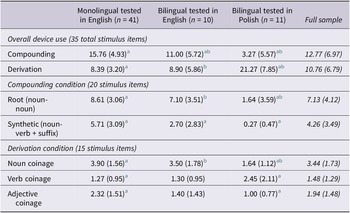
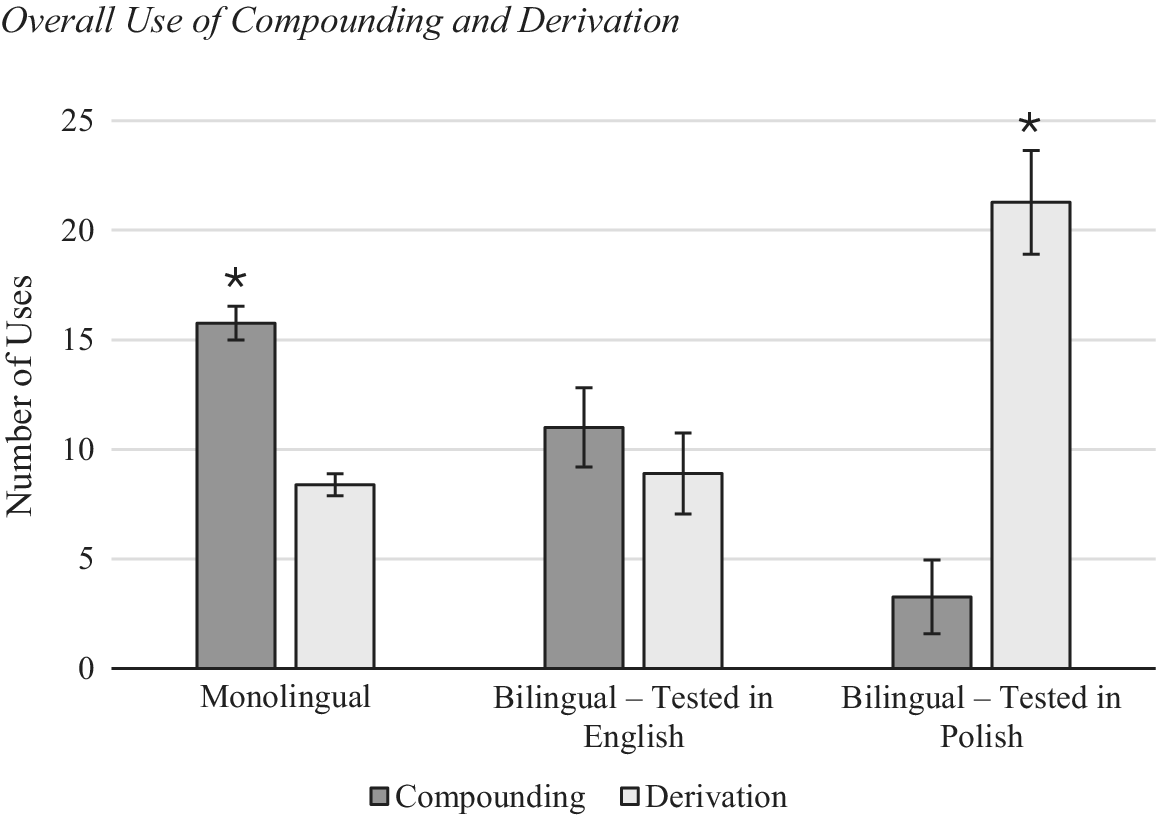
To examine whether children’s use of word-formation devices (compounding, derivation) mirrors the language(s) they know and the language in which they are being tested (Hypothesis 1a & 1b), a mixed-model analysis of variance (ANOVA) was conducted on children’s overall use of compounds and derivatives. The between-subjects variable was language group (monolingual English, bilingual tested in English, bilingual tested in Polish), and the within-subjects variable was type of device (compound, derivative). For more power, we also collapsed over items in our ANOVA analyses, as we did not find any outliers for individual items. The analysis revealed two main effects, one of language group, F(2, 59) = 3.27, p < .05, ηp2 = 0.10, and one of type of device, F(1, 59) = 4.55, p < .05, ηp2 = 0.07, but were qualified by a significant language group x type of device interaction, F(2, 59) = 37.50, p < .001, ηp2 = 0.56. Follow-up testing using the Bonferroni approach indicated that the use of word-formation devices significantly differed between language groups (Hypothesis 1b). Specifically, bilingual children tested in Polish used compounding less frequently than the English-speaking monolingual children (p < .001) and the bilingual children tested in English (p < .01; see Table 2 and Figure 3). The bilingual children tested in English also used compounding significantly less frequently than the monolingual children (p < .05). Follow-up analyses also revealed that the bilingual children tested in Polish used derivation more frequently than the English-speaking monolingual children (p < .001) and the bilingual children tested in English (p < .001). There was no difference in the overall use of derivation for the monolingual children and the bilingual children tested in English (p = 1.00).
Use of word-formation devices across compounding and derivation conditions

Note: Means with standard deviations in parentheses are provided above. Thirty-five items in total were displayed during the word-formation elicitation task. Twenty items were designed to elicit compounding (compounding condition), and 15 items were designed to elicit derivation (derivation condition).
a Significant difference between the monolingual children and a group of bilingual children.
b Significant difference between the two groups of bilingual children.
Overall use of compounding and derivation.
Note: There were 35 total items on the word-formation elicitation task.

In terms of within-subject effects (Hypothesis 1a), paired samples t-tests using the Bonferroni approach revealed that bilingual children tested in Polish used significantly more derivation (M = 21.27, SD = 7.85) than compounding (M = 3.27, SD = 5.57), t(10) = 4.81, p < .001, while English monolinguals used significantly more compounding (M = 15.76, SD = 4.93) than derivation (M = 8.39, SD = 3.20), t(40) = 6.76, p < .001. For bilingual children tested in English, there was no significant difference in overall use of compounding (M = 11.00, SD = 5.72) and derivation (M = 8.90, SD = 5.86), t(9) = 0.66, p = 0.52.
8.2. Elicitation of compounding by type (root, synthetic)
To examine monolingual and bilingual children’s use of compounding by type (Hypothesis 2), a mixed-model analysis of variance was conducted on data from the compounding condition, as those stimulus items depicted either root (noun-noun) or synthetic (noun–verb + suffix) compounds. For this analysis, the between-subjects variable was language group (monolingual English, bilingual tested in English, bilingual tested in Polish), and the within-subjects variable was compound type (root, synthetic). The analysis revealed significant main effects of compound type, F(1, 59) = 21.61, p < .001, ηp2 = 0.27, and language group, F(2, 59) = 33.81, p < .001, ηp2 = 0.53. The interaction between the two variables was nonsignificant (p = 0.23). Follow-up testing with the Bonferroni approach indicated that, on average, children in the study formed more root (noun–noun) compounds than synthetic (noun–verb + suffix) compounds (p < .001; see Table 2). Additionally, the English-speaking monolingual children used compounding (root and synthetic) more frequently overall than the bilingual children tested in English (p < .05) and the bilingual children tested in Polish (p < .001).
In particular, the English-speaking monolingual children and the bilingual children tested in English used root compounding significantly more frequently than the bilingual children tested in Polish (p’s < .001; see Table 2). However, additional (i.e., between-subjects) follow-up analyses using the Bonferroni approach revealed that English-speaking monolingual children used more synthetic (noun–verb + suffix) compounding than bilingual children tested in English (p = .01) and bilingual children tested in Polish (p < .001); no significant difference was found between the two bilingual groups in terms of synthetic compounding use (p = 0.15). Paired samples t-tests further revealed that English-speaking monolingual children used significantly more root compounding (M = 8.61, SD = 3.06) than synthetic compounding (M = 5.71, SD = 3.09), t(40) = 4.46, p < .001, as did bilingual children tested in English, although to a lesser extent (MRoot = 7.10, SD = 3.51; MSynthetic = 2.70, SD = 2.83), t(9) = 3.50, p < .01. In comparison, bilingual children tested in Polish used compounding minimally, with no significant difference found between their root (M = 1.64, SD = 3.59) and synthetic (M = 0.27, SD = 0.47) compounding frequencies, t(10) = 1.34, p = 0.21.
8.3. Elicitation of derivation by parts of speech (noun, verb, adjective)
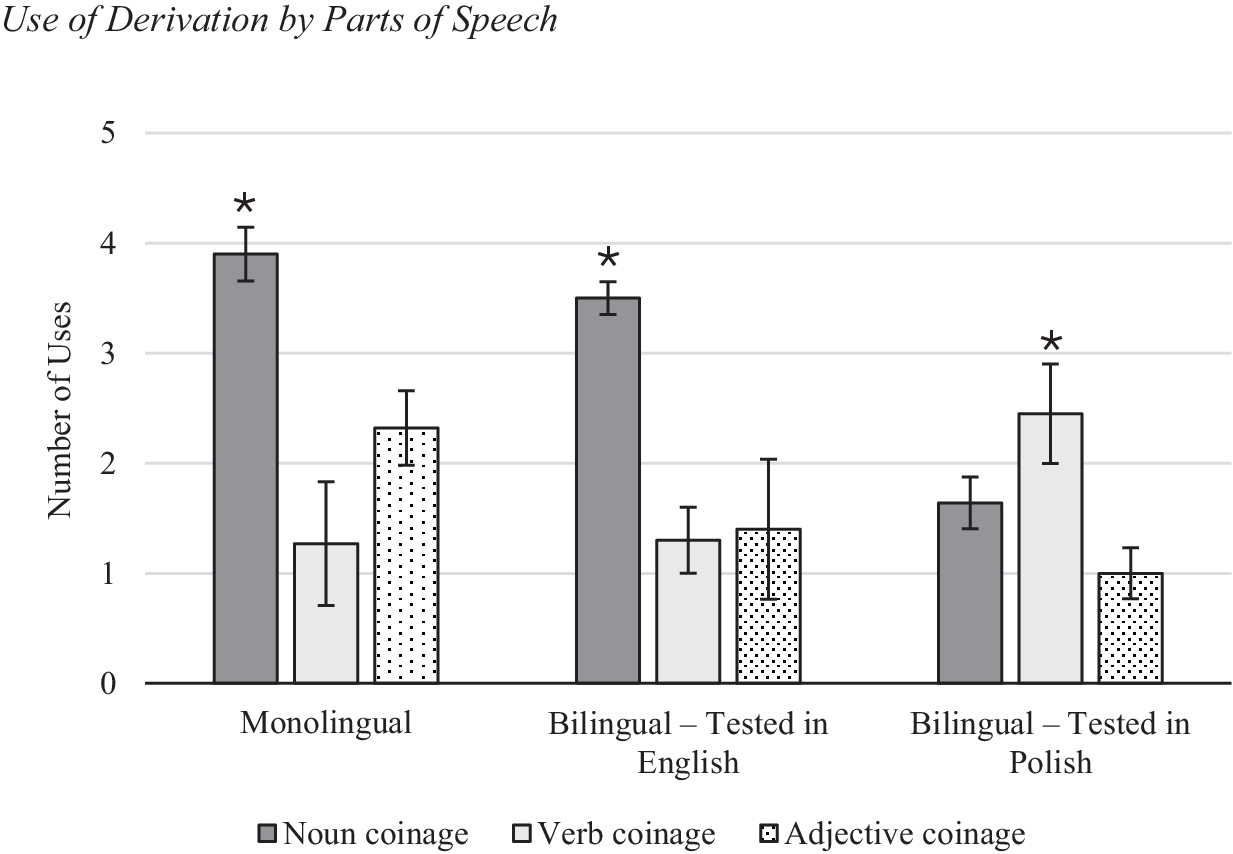
As the stimulus items used in the derivation condition of the word-formation task were designed to illustrate different parts of speech (nouns, verbs, adjectives), a mixed-model analysis of variance was conducted on the derivation data to examine the children’s use of derivation by parts of speech (Hypothesis 3). For this analysis, the between-subjects variable was language group, and the within-subjects variable was parts of speech (noun, verb, adjective). Overall, this ANOVA revealed significant main effects of language group, F(2, 59) = 5.65, p = .006, ηp2 = 0.16, and parts of speech, F(1.79, 105.47) = 12.90, p < .001, ηp2 = 0.18. However, these main effects were qualified by the significant language group x parts of speech interaction, F(3.58, 105.47) = 6.84, p < .001, ηp2 = 0.19, indicating that the use of derivation for different stimulus items (i.e., the illustrations of nouns, verbs, and adjectives) significantly differed by language group (see Figure 4).
Use of derivation by parts of speech.
Note: Fifteen items were included the derivation condition. Five items were intended to elicit each part of speech.

Follow-up testing with a Bonferroni correction further revealed that, overall, children were more likely to use derivation when describing noun illustrations than when describing verb (p < .001) and adjective illustrations (p < .001; see Table 2). In terms of between-subject effects, follow-up testing with a Bonferroni correction showed that bilingual children tested in Polish were less likely to use derivation for stimuli depicting nouns when compared to bilingual children tested in English (p < .05) and English-speaking monolingual children (p < .001). Noun coinage via derivation was not significantly different between monolingual children and bilingual children tested in English (p = 1.00). Moreover, bilingual children tested in Polish were more likely to use derivation for stimuli depicting verbs than English-speaking monolingual children (p < .05).
Furthermore, within-subjects findings indicated that the English-speaking monolingual children and the bilingual children tested in English used derivation significantly more when they were shown images of nouns than images of verbs (p < .001 and p < .01, respectively) and images of adjectives (p < .001 and p < .05, respectively). The monolingual children also used derivation significantly more for images of adjectives than for images of verbs (p = .001). In comparison, the bilingual children tested in English did not show a difference in derivation use between images of verbs and images of adjectives (p = 1.00). Interestingly, the bilingual children tested in Polish used derivation significantly more for images of verbs than for images of adjectives (p < .05), but there were no significant differences in their use of derivation for images of nouns and verbs (p = 0.49) or for images of nouns and adjectives (p = 1.00). Means and standard deviations indicating how often each group of children used derivation to form nouns, verbs, and adjectives are shown in Table 2.
8.4. Relations between receptive vocabulary and use of word-formation devices
Receptive vocabulary and compounding. To explore whether children’s language proficiency, as measured by receptive vocabulary, was related to their use of compounding (Hypothesis 1c), Pearson bivariate correlation analyses were conducted between PPVT-4 scores in both English and Polish and overall use of compounding during the word-formation elicitation task. These analyses were conducted for children in each language group (monolingual English, bilingual tested in English, bilingual tested in Polish). Results showed a significant, positive correlation between English receptive vocabulary and overall compounding use for English-speaking monolingual children, r = 0.34, p = .03. That is, higher English receptive vocabulary scores were associated with a greater use of compounding in the monolingual children. There were no significant correlations found between English or Polish receptive vocabulary scores and overall compounding use for bilingual children tested in English or for bilingual children tested in Polish.
To further explore whether language proficiency was related to children’s use of root and synthetic compounding types, additional Pearson bivariate correlation analyses were conducted between receptive vocabulary (in English and Polish) and the number of root (noun–noun) compounds formed in the compounding condition of the word-formation elicitation task. From these analyses, we identified a positive correlation between Polish receptive vocabulary and number of root (noun–noun) compounds for the bilingual children tested in Polish, r = 0.67, p = .02. However, no significant correlations were found between Polish receptive vocabulary and number of root (noun–noun) compounds for bilingual children tested in English. Additionally, these correlational analyses did not reveal significant correlations between English receptive vocabulary and number of root (noun–noun) compounds for any language group (monolingual English, bilingual tested in English, bilingual tested in Polish).
Next, Pearson correlation analyses were conducted between receptive vocabulary (in English and Polish) and the number of synthetic (noun-verb + suffix) compounds formed in the compounding condition of the word-formation elicitation task. Again, these analyses were conducted in the three language groups (monolingual English, bilingual tested in English, bilingual tested in Polish). A positive relationship between English receptive vocabulary and number of synthetic (noun–verb + suffix) compounds was found for English-speaking monolingual children, r = 0.34, p = .03. However, there were no significant correlations found between English receptive vocabulary and number of synthetic (noun-verb + suffix) compounds for bilingual children tested in English or Polish. Moreover, for the bilingual children, there were no significant correlations found between Polish receptive vocabulary and number of synthetic (noun–verb + suffix) compounds.
Receptive vocabulary and derivation. To examine the relation between children’s language proficiency, as measured by receptive vocabulary, and their use of derivational processes, Pearson bivariate correlation analyses were conducted between PPVT-4 scores in both English and Polish and overall use of derivation during the word-formation elicitation task. Across all three language groups (monolingual English, bilingual tested in English, bilingual tested in Polish), analyses revealed no significant correlations between English receptive vocabulary and overall use of derivation, nor between Polish receptive vocabulary and overall use of derivation. To further explore whether language proficiency may be related to children’s derivational formations of words of nouns, verbs, and adjectives, an additional set of Pearson correlation analyses were conducted between receptive vocabulary (in English and Polish) and derivation use (i.e., noun, verb, and adjective coinage). Across all three groups of children (monolingual English, bilingual tested in English, bilingual tested in Polish), no significant correlations were revealed. That is, the results suggest that neither English receptive vocabulary nor Polish receptive vocabulary was correlated with children’s use of derivation.
9. Discussion
The form and manner in which the lexicon is acquired in children is central in understanding how language develops. In the present research, children’s use of word-formation devices (i.e., compounding, the formation of a new word by the adding two base roots together, and derivation, the formation of a new word by the use of affixes) was examined in English-speaking monolingual children and English/Polish-speaking bilingual children growing up in the United States. English and Polish were the languages of interest in this study because they vary greatly in their use of these word-formation devices, with compounding being more productive in English and derivation being more productive in Polish.
9.1. Children’s overall use of compounding and derivation
Consistent with Hypothesis 1a, English-speaking monolinguals used compounding more often than derivation, matching the productivity of word-formation devices in English, a pro-compounding language. Furthermore, bilingual children tested in Polish used derivation significantly more often than bilingual children tested in English and English-speaking monolingual children. Bilingual children tested in Polish also used compounding significantly less frequently than the children tested in English (monolinguals and bilinguals). While we could not recruit a monolingual Polish-speaking group of children in the United States, these results mirror the findings of our colleagues in Poland, although our methodologies differed. Specifically, Polish-speaking monolingual children used derivation to a greater extent than compounding (Haman et al., Reference Haman, Zevenbergen, Andrus and Chmielewska2009), following the pattern of productivity for derivation in Polish. These results are also consistent with the findings of Schipke and Kauschke (Reference Schipke and Kauschke2011), who showed that in English-speaking monolingual children, compounding developed before derivation, whereas in German-speaking children, compounding and derivation development occurred simultaneously, in line with the use of such devices in each language. Coupled with our findings, these results provide evidence that the extent to which a word-formation rule can be used freely in a given language affects children’s use of those rules. It also suggests that young children are likely influenced by the productivity of language learning rules in their input language(s).
Examining these results more closely, the bilingual children tested in English used compounding and derivation to roughly the same extent. It may be that bilingual children’s knowledge of Polish, and their exposure to derivation in the Polish language, decreased their rate of compounding in comparison to the English-speaking monolingual children (Hulk & Müller, Reference Hulk and Müller2000; Nicoladis, Reference Nicoladis2002). Consequently, these findings are in line with Hypothesis 1b, which suggests that there may be cross-linguistic influence from Polish when bilingual children are choosing to use a word-formation device in English. However, including a Polish-speaking monolingual sample in our study would have allowed us to make additional comparisons between monolinguals and bilinguals in order to support this assertion. Our results are also consistent with the findings of Nicoladis (Reference Nicoladis2002), to the extent that French/English-speaking bilingual children used more compounds when tested in English and more prepositional phrases when tested in French but still used compounding less than monolingual English speakers. Yet, a sample of French-speaking monolingual children was not included as a contrast in the Nicoladis study. Thus, future studies examining compounding and derivational word-formation strategies would benefit from including monolingual samples for each language tested. Additionally, it should be noted that any departures from monolingual patterns do not necessarily reflect cross-linguistic influence. As we were reminded by a reviewer, there may be bilingual-specific biases or patterns unrelated to structures of either language.
Overall, the present findings indicate that bilingual children, both when they were tested in English and in Polish, did not prefer compounding over derivation. Thus, these findings do not follow the language learning principles of transparency and simplicity, which suggest that compounding should be preferred over derivation because compounding relies on more easily acquired (i.e., more transparent) roots and affixes that do not change as much in form (i.e., are simpler; Clark, Reference Clark, Gelman and Bynes1991). Instead, the results of the present study, as well as findings from other studies with monolingual children (Haman et al., Reference Haman, Zevenbergen, Andrus and Chmielewska2009; Schipke & Kauschke, Reference Schipke and Kauschke2011), indicate that the productivity of word-formation devices in a language affects children’s use of these devices when asked to create new words in a language. These results suggest that future examinations of children’s word-formation processes should be considered within the framework of the productivity of word-formation devices in the child’s language or languages.
9.2. Children’s use of root versus synthetic compounding
In terms of type of compounding, we predicted that for English-speaking monolingual children, root (noun–noun) and synthetic (noun–verb + suffix) compounding would be used to the same extent (Hypothesis 2) because they are both highly productive in English (Lieber, Reference Lieber, Stekauer and Lieber2005). However, English monolingual children and bilingual children tested in English were significantly more likely to form root compounds than synthetic compounds in the compounding condition. The fact that we saw this pattern across monolingual and bilingual children may be because both English and Polish are noun-centered languages (Rescorla et al., Reference Rescorla, Constants, Białecka-Pikul, Stępień-Nycz and Ochał2017), meaning that during language acquisition, young children tend to learn nouns before verbs (i.e., a noun bias). This focus on nouns may have contributed to the overall finding that root compounding was preferred over synthetic compounding by all children (monolingual and bilingual) in this study. Thus, future studies should also aim to explore compounding patterns in bilingual children who speak a verb-centered language (e.g. Korean; Mandarin) in addition to a noun-centered language (e.g. English, Polish).
It should also be noted that while English-speaking monolingual children and bilingual children tested in English did not differ significantly in their use of root compounding, they did differ in their use of synthetic compounding. Additionally, when bilingual children were tested in Polish, their use of both root and synthetic compounding was at near-zero levels. The difference in compounding frequency (i.e., root versus synthetic types) between the bilingual groups suggests that the language of testing (English, Polish) may have played a role in whether children’s responses matched English or Polish productivity patterns. Specifically, results show that bilingual children tested in Polish followed Polish compounding trends (i.e., showed low levels of both root and synthetic compounding), while bilingual children tested in English followed English compounding trends. However, without a group of Polish-speaking monolingual children in our study, we cannot know for certain whether the use of root and synthetic compounding by bilingual children tested in Polish is in line with compounding tendencies of Polish-speaking monolingual children. Still, the patterns observed in the present study are similar to results from Nicoladis (Reference Nicoladis2002), who found that French/English-speaking bilingual children responded based on the productivity patterns of certain devices in their language (i.e., prepositional phrases, compounds) when tested in French and English, respectively.
9.3. Children’s use of derivation (nouns versus verbs versus adjectives)
In the derivation condition, children tested in English (monolingual and bilingual) showed similar frequencies of using derivation for noun formation. Additionally, when compared to the English/Polish-speaking bilingual children tested in Polish, the English-speaking monolingual children were less likely to use derivation for verb formation and more likely to use derivation for adjective formation. The results also revealed that English monolingual children and bilingual children tested in English used derivation significantly more often for noun formation than for verb or adjective formation. As derivation is most commonly used to form nouns in both English and Polish, this pattern was expected for all three groups of children (Hypothesis 3). Indeed, using derivation to form diminutive nouns is highly productive in Polish (Haman et al., Reference Haman, Zevenbergen, Andrus and Chmielewska2009; Pytlik, Reference Pytlik2018; Tabakowska, Reference Tabakowska2022), especially during the early years of a child’s life (Dąbrowska, Reference Dąbrowska2006; Haman, Reference Haman2003).
However, there is an exception to this pattern of results that needs to be noted. For bilingual children tested in Polish, their use of derivation for noun formation was not significantly higher than their use of derivation for verb and adjective formation. It is possible that the bilingual children tested in Polish may not have used derivation for noun formation as frequently because the derivational stimuli were designed to elicit the use of affixes that resulted in diminutive formation (e.g. −ek, −ka, −ko; one stimulus item) and affixes that are less commonly used with nouns (e.g. −cz, współ-; four stimulus items).
9.4. Language proficiency and children’s use of word-formation devices
Additional findings from the present study revealed that English-speaking monolingual children’s receptive vocabulary skill, taken as a general measure of language proficiency, was positively related to their use of compounding in English. Specifically, for monolingual children, higher language proficiency in English was related to greater overall compounding use. This finding is consistent with our prediction for monolingual children (Hypothesis 1c). Providing additional support for Hypothesis 1c, the English-speaking monolingual children used more synthetic (noun-verb + suffix) compounds when they had greater receptive vocabulary skill in English. As such, monolingual children who are more proficient in their language, at least as measured by receptive vocabulary, may use more complex word-formation devices (e.g. synthetic compounding in English).
For English/Polish-speaking bilingual children, those who demonstrated greater receptive vocabulary skill in Polish used more root (noun-noun) compounding, but only when tested in Polish. That is, even though both root and synthetic compounding were rarely used by the bilingual children tested in Polish, those who demonstrated greater receptive vocabulary proficiency in Polish were more likely to use a less common and more challenging word-formation device (e.g. root compounding in Polish). Overall, these results suggest that language proficiency and the language of testing may both play roles in bilingual children’s use of word-formation devices.
Finally, while previous research (Nicoladis & Gavrila, Reference Nicoladis and Gavrila2014; Yip & Matthews, Reference Yip and Matthews2000, Reference Yip and Matthews2007) has suggested that bilingual children may be more likely to use structures from their dominant language (e.g. English) when speaking in their weaker language (e.g. Polish; Hypothesis 1c), we did not observe this cross-linguistic pattern. That is, we found no relation between proficiency in English and use of compounding for bilingual children tested in Polish. Additionally, there were no significant correlations between language proficiency in English or in Polish and children’s use of derivation in either language. Thus, future studies should continue to explore the role that language dominance may play in children’s use of word-formation devices by including bilingual children who are dominant in different languages.
9.5. Limitations and future directions
Several limitations of the present research must be acknowledged. Firstly, the present study did not include a Polish-speaking monolingual group of children. Without this group, we cannot know for certain whether the observed patterns of word-formation strategies used by English/Polish-speaking bilingual children in the present study are in line with the patterns of word-formation strategies used by Polish-speaking monolingual children. Nevertheless, our results are consistent with findings of research conducted in Poland (Haman et al., Reference Haman, Zevenbergen, Andrus and Chmielewska2009), although somewhat different study designs were used. Therefore, future researchers should aim to recruit a Polish-speaking monolingual group of children from Poland as a comparison group. Moreover, it would be beneficial to assess English/Polish-speaking bilingual children living in Poland, as the context of a language in a society may be found to affect the strategies children use to form new words. Thus, our results speak particularly of the experiences of English/Polish-speaking bilingual children living in an English-dominant culture that is often dismissive of minority languages.
Secondly, the present study did not involve testing bilingual children in both of their languages on the word-formation elicitation task. However, this decision was rooted in our desire to limit testing order bias among the children, allowing us to more clearly observe input and testing language effects. A between-subjects design was also the result of strict time limitations placed on us by the Saturday language and culture schools. Subsequent studies should either utilize a within-subjects design and test children in both languages, or increase the sizes of the groups. With larger sample sizes, a mixed-effects logistic regression model could have been used and would have provided more information on item-level variability. However, in the present study, we did not find a main effect or significant interactions at the item level.
Testing children’s language proficiency or language dominance with a measure of productive vocabulary may also be worthwhile. That is, measuring productive vocabulary may be more in line with the productive nature of word-formation tasks than measuring receptive vocabulary as we chose to do, especially for bilingual children who do not have many opportunities to practice their heritage language. In the present study, however, bilingual children were exposed to and able to practice their Polish language skills in their Saturday language and culture classes, at home with parents and grandparents, and in opportunities provided through their community interactions. With that said, future studies should consider assessing language proficiency with both receptive and productive measures of language. This could include a measure of children’s overall morphosyntactic proficiency in their language(s).
Lastly, longitudinal studies on bilingual children’s use of word-formation devices would also allow researchers to explore questions regarding how bilingual children’s use of word-formation strategies may change with age. Indeed, Haman et al. (Reference Haman, Zevenbergen, Andrus and Chmielewska2009) found that adult speakers of English and Polish were more likely than children to use compounding and derivation based on the instructions or cognitive demands elicited by the task. Thus, future research on word formation in children may benefit from an examination of the linkages between executive functioning skills and the use of word-formation devices. Finally, exploring the effects of the language context in which children live (e.g. Poland, USA) would also be beneficial in understanding how children form new words.
Acknowledgments
Portions of these findings were presented at 2024 Cognitive Development Society, Pasadena, CA (USA).
Competing interests
The authors declare none.
Disclosure of use of AI tools
The authors declare none.



 Open access

