


Increased human disturbance and persecution, along with progressive habitat deterioration, have likely driven the Mediterranean monk seal Monachus monachus, categorized as Vulnerable on the IUCN Red List (Karamanlidis et al., Reference Karamanlidis, Dendrinos, Fernandez de Larrinoa, Kıraç, Nicolaou and Pires2023), to reduce its gregarious behaviour and seek refuge, often alone, in remote marine caves (Johnson & Lavigne, Reference Johnson and Lavigne1999). Historical evidence suggests these seals commonly used to haul out on open beaches (Johnson & Lavigne, Reference Johnson and Lavigne1999; Johnson, Reference Johnson2004). Caves presently used by Mediterranean monk seals across their range for pupping and resting exhibit a consistent set of geophysical characteristics, including, among others, one or more entrances above or below the sea surface, followed by a corridor, a sheltered pool, and a beach providing a dry haul-out area (Dendrinos et al., Reference Dendrinos, Karamanlidis, Kotomatas, Legakis, Tounta and Matthiopoulos2007; Karamanlidis, Reference Karamanlidis2024). Caves accessible through underwater entrances, and with a protected beach inside, are typically considered suitable Mediterranean monk seal breeding caves and their use has been reported across the species’ range (Güçlüsoy et al., Reference Güçlüsoy, Kıraç, Savaş and Veryeri2004; Scheinin et al., Reference Scheinin, Goffman, Elasar, Perelberg and Kerem2011; Karamanlidis et al., Reference Karamanlidis, Dendrinos, de Larrinoa, Gücü, Johnson and Kiraç2016). The interior of these caves, invisible from the sea surface, offers security from human predation and disturbance (Johnson & Lavigne, Reference Johnson and Lavigne1999). In some cases, the submerged tunnels connecting the underwater entrance to an inner chamber with a shallow pool and beach have small domes filled with air; these bubble caves were considered a refuge pocket along the tunnel, where seals were able to breathe when entering or leaving the cave (Gucu et al., Reference Gucu, Gucu and Orek2004). Here we report on monk seals regularly resting in a bubble cave: an air-filled chamber or dome, accessible through an underwater passage, where seals remain in the water without any platform to haul out, but where they are able to breathe.
In 2017, we conducted a monk seal habitat suitability study in the Inner Ionian Sea Archipelago, a Natura 2000 area (site code GR2220003), where the presence of individuals of this species, including young animals and pups, had been previously observed (Tethys Research Institute, unpubl. data). In May 2019, an autonomous monitoring system (Pfyffer et al., Reference Pfyffer, Gonzalvo and Georges2019) was installed to monitor the presence of monk seals in one of the caves on the uninhabited islet of Formicula. The monitoring system was set to capture a photograph every 15 minutes, using power over ethernet cameras. A further inspection of the cave revealed a small underwater corridor connecting with a bubble cave c. 1 m deep and with an extension of 37 m2, of which 14 m2 allowed access to air pockets up to 1 m high. This bubble cave was exclusively accessible by two underwater corridors at a depth of 1.10 m, one connecting with the main cave and the other leading to the open sea (Fig. 1).
Schematic depiction and measurements (m) of the main cave (A) and bubble cave (B). The black round icons indicate the locations of the underwater camera at the entrance of the bubble cave and the camera inside the main cave. (a) Plan view, showing the main cave with a small entrance at the sea surface, a pool area and pebble beach, connected to the bubble cave (B) through an underwater corridor. (b) Lateral view of the bubble cave, showing the underwater and above water sections.

To monitor monk seal use, in July 2020 an underwater camera (Trendnet TV-IP316PI, TRENDnet, USA), inside a watertight case (Blue Robotics, USA), was installed in an adjacent rocky cavity at the entrance of the flooded chamber of the bubble cave. The underwater camera, set to take pictures every 5 minutes, functioned during 16 days. In June 2021, a sturdier camera (Trendnet TV-IP1318PI, TRENDnet, USA), was deployed in the same location; it functioned for 125 days. Both cameras, the one used in the main cave and the one installed using a watertight casing to be deployed underwater in the bubble cave, were powered by the same battery within the autonomous monitoring system, had the same characteristics and offered the same reliability to detect seals. Whenever seal presence was detected, in remotely accessed images uploaded to a server, the camera settings were opportunistically changed to obtain continuous recordings lasting up to 3 h, which allowed us to better categorize the behaviour of the monk seals visiting the site.
During 8–23 July 2020, seal presence inside the bubble cave was recorded on 12 days (75% of the survey period). During 4 June–15 October 2021, monk seal occupancy was recorded on 107 days (83%). During the entire monitoring period (141 days), seals were detected using the main cave on 30 days (21%), using the bubble cave on 119 days (84%), and using both the main and the bubble caves on 23 days (16%), indicating a strong preference for the bubble cave, which was used by single individuals or by groups of up to three seals.
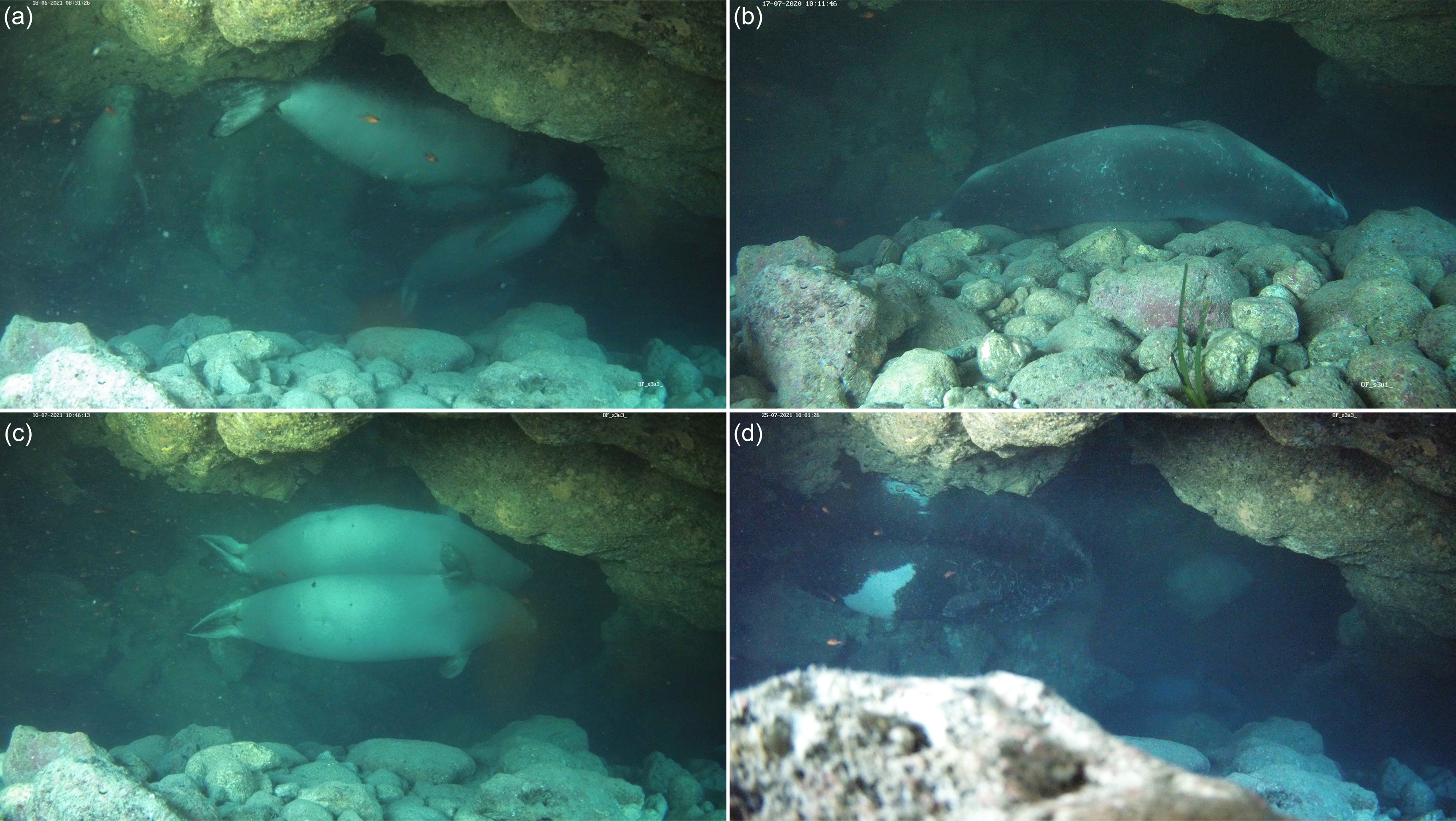
Aquatic sleeping behaviour has been reported for Mediterranean monk seals, both at the sea surface and below on the sea floor; thus they do not necessarily need land to meet their sleep requirements. Moreover, some individuals may lead a predominantly aquatic life during the nonbreeding season (Karamanlidis et al., Reference Karamanlidis, Lyamin, Adamantopoulou and Dendrinos2017). During our observations, seals used the bubble cave mainly to rest, adopting various resting positions (Plate 1): floating, awake at surface; sleeping or lethargic floating at the surface, in horizontal or vertical positions, a behaviour known also as ‘bottling’ (sometimes upside down with their nostrils underwater, and therefore not able to breathe); and sleeping underwater, motionless at the bottom.
Mediterranean monk seals Monachus monachus using the bubble cave: (a) three seals sleeping or resting at the surface; (b) seal sleeping on the sea floor; (c) female sleeping laterally with nostrils underwater while exposing her four nipples and umbilicus to the camera; (d) heavily scarred large black male, with a characteristic white belly patch, sleeping at the surface.
During 1993–2021, six observations of female Mediterranean monk seals and their pups were reported on open beaches in Greece (Dendrinos et al., Reference Dendrinos, Adamantopoulou, Koemtzopoulos, Mpatzios, Paxinos and Tounta2022). On Formicula, a large black male and an adult female were observed hauled out on open beaches, in March 2020 and April 2022, respectively, coinciding with quiet months outside the tourist season (J. Gonzalvo, unpubl. data). Resting in the sun, thermoregulating and drying fur on land is considered the first choice for phocids such as the Hawaiian Neomonachus schauinslandi and Mediterranean monk seal. Therefore, the alternative of resting in darkness, wet, floating or submerged, in a bubble cave seems to be the least appealing choice for the species.
The use of the hidden bubble cave, only accessible through an underwater entrance, instead of the more conspicuous main cave with a small beach where seals could haul out, may be motivated by this less accessible structure offering shelter for the seals to rest during the busy tourist summer period. On Formicula, tourists have been reported to approach monk seals to interact with them and also to visit their resting and pupping caves (Karamanlidis, Reference Karamanlidis2024). On 31 December 2024, a Ministerial Decision (ϒΠEΝ/ΔΔΦΠΒ/123711/3066) was issued, establishing a strict protection regime around Formicula, including a no-entry zone (Notarbartolo di Sciara & Gonzalvo, Reference Notarbartolo di Sciara and Gonzalvo2025).
Mediterranean monk seals do not exhibit a preference for certain cave types for resting, whereas they are more selective when choosing caves for pupping (Karamanlidis et al., Reference Karamanlidis, Pires, Silva and Costa Neves2004). In most cases, monk seal habitat assessments have considered caves that do not have beaches as unsuitable habitat (Gucu et al., Reference Gucu, Gucu and Orek2004; Karamanlidis et al., Reference Karamanlidis, Pires, Silva and Costa Neves2004; Dendrinos et al., Reference Dendrinos, Karamanlidis, Kotomatas, Legakis, Tounta and Matthiopoulos2007). However, bubble caves, such as the one reported here, although not being suitable either for hauling out or pupping, can provide suitable shelter for resting. Moreover, caves with multiple narrow and deep entrances are safer, offering multiple escape routes and restricting human access to the cave’s interior (Dendrinos et al., Reference Dendrinos, Karamanlidis, Kotomatas, Legakis, Tounta and Matthiopoulos2007).
Habitat suitability studies may be neglecting, or simply dismissing, bubble caves by considering them inadequate because of their lack of dry areas. Our observations suggest that these remote, wet, and inconspicuous domes may serve as valuable complementary habitat, offering refuge and resting sites away from human disturbance. It is cause for concern that some of the most suitable caves for Mediterranean monk seals in the region are not frequented by the species because of increased human disturbance (Kıraç & Savaş, Reference Kıraç and Savaş2019).
Considering all the above, and in line with the principle that effective protection of both the Mediterranean monk seal and its terrestrial and marine habitats is a top conservation priority (Karamanlidis, Reference Karamanlidis2024), suitable pupping caves need to be legally and effectively protected from unregulated human disturbance. Less suitable or marginal habitats such as bubble caves should, however, also be included in Mediterranean monk seal habitat suitability assessments, to broaden conservation measures as required.
Author contributions
Study design: JG, JP, fieldwork: AG, JP, CG; data analysis: JG, CA-H, MG, writing: JG, MG.
Acknowledgements
Monk seal research and conservation work by Tethys Research Institute in the Ionian Sea received support from the Monk Seal Alliance, Costas M. Lemos Foundation and OceanCare; the Milan Civic Aquarium and Hydrobiological Station provided logistical support. Work by Octopus Foundation was conducted with support from Smile Wave Fund. Logistical support was also provided by D-Marin Lefkas marina and Odyssey Outdoors Adventures. We thank two anonymous reviewers for their comments.
Competing interests
None.
Ethical standards
This research complied with the Oryx ethical standards. All observations were non-invasive. Tethys Research Institute and Octopus Foundation followed Greek regulations under research permits for 2020 and 2021 (ΨEΤϒ4653Π8-694 and Ψ0964653Π8-907, respectively), issued by the Greek Ministry of Environment and Energy.
Data availability
Data are available from the corresponding author upon reasonable request.


 Open access

