

Introduction
Open Source Intelligence (OSINT) has gained significant attention, particularly in the context of the war in Ukraine.Footnote 1 Scholarly debate and political attention devoted to the subject has never been greater and the field is in consensus on one aspect of OSINT – that it is a transformational (even if not revolutionary) phenomenon in modern armed conflict.Footnote 2 However, this consensus quickly crumbles on selected aspects of the phenomenon, namely its true utility and its ‘integration’ with traditional intelligence methods and capacities.
To contextualise our methodological contribution, it is useful to briefly map the current scholarly discussion on OSINT, particularly concerning its utility and integration with traditional intelligence. We illustrate the application of our framework on the performance of the Russian defence industry during the war in Ukraine.
The first of the diverging OSINT debates is characterised by attempts at ascertaining its utility based on experience in modern conflicts. Apart from some exceptions, scholarship is not aimed at cataloguing or categorising said utility but focuses on individual functions. In this vein, the direct tactical military function of civilian tracking of troop movements is underlined as never before.Footnote 3 Multiple authors focus on its shaping of both domestic and global humanitarian narratives of the conflict.Footnote 4 Others have highlighted the destabilising effects of societal propaganda and OSINT in providing alternative, verified narratives.Footnote 5 The benefits of OSINT for evidence collection and human rights are also significant. Van Beek and RietjensFootnote 6 emphasise the role of OSINF and OSINT in documenting war crimes and human rights violations, providing valuable evidence for international investigations. HogueFootnote 7 discusses the mobilisation of civilian surveillance. In their 2024 edited volume, Van Beek and RietjensFootnote 8 go further and strive to derive OSINT functions mainly from non–peer-reviewed texts. They represent the notable exception in categorisation and identify OSINT utility in four categories: 1) debunking and refuting localised narratives, 2) reshaping perceptions of conduct, 3) informing military troops, and 4) documenting potential war crimes and human rights violations.
The second of these debates revolves around the role and ability of OSINT to reliably integrate with existing intelligence mechanisms or supplement them. HatfieldFootnote 9 offers a critical perspective, arguing that OSINT as a concept is fundamentally incoherent and should be abandoned. He suggests that OSINT served a transitional purpose but now its benefits are outweighed by the confusion it introduces. According to some, this confusion extends to defining the term itself.Footnote 10 Challenges are seen particularly in the tension between the vast availability of information and the need for reliability and legal limitations.Footnote 11 Despite these, integration is seen as possible and even necessary, especially in the two aforementioned levels. ‘Democratisation’ of intelligence through OSINT through the proliferation of publicly available information challenges the traditional role of state intelligence services.Footnote 12 Notably, this integration is theorised mainly in select fields, such as information warfare, human rights, or strike verification,Footnote 13 and reflects a broader trend even predating the Ukraine crisis. Even critical thinkersFootnote 14 acknowledge that there are likely to be select spaces for OSINT to complement traditional intelligence, especially with better processes and technology.Footnote 15 Integration is argued to be vastly improved by OSINT production method standardisation from OSINF.Footnote 16
While the volume of available OSINFFootnote 17 is unprecedented, its transformation into reliable, strategic-level intelligence presents significant methodological challenges. Existing works on the ‘OSINT production cycle’ often rely on undisclosed processes of ‘OSINF analysis’ without elaborating on the internal steps needed to ensure validity and reliability. This is particularly true for complex strategic questions, such as estimating a nation’s wartime defence production, where raw data can be misleading and official statements are often distorted by propaganda. Historically, this challenge is reminiscent of the ‘German tank problem’, where Allied analysts sought to extrapolate production figures from limited battlefield data.Footnote 18
This article addresses this methodological gap directly. We propose and test a structured, transparent framework for transforming raw OSINF into credible strategic intelligence. Our approach is designed to systematically cross-reference and validate three distinct data streams: 1) official government claims, 2) established expert estimates, and 3) an OSINT-based model derived from granular, visually confirmed battlefield losses. By juxtaposing these scenarios, our framework allows for a more accurate projection of an adversary’s capabilities and exposes discrepancies that might otherwise remain hidden. We find that the current level of OSINF is transformable into quality OSINT capable of addressing complex issues such as the performance of a belligerent’s defence industry. For the purposes of our framework, ‘quality’ is determined by the ability of the resulting intelligence model to align with and explain observable, empirical evidence – in this case, visually confirmed battlefield losses – in a way that alternative scenarios (i.e., propaganda or pre-war expert estimates) cannot. This represents a valuable addition to intelligence capabilities under the fog of war at the strategic level.
The article proceeds as follows. The first section introduces the case selection and rationale for applying our framework to a strategic level problem – namely Russia’s defence industrial output. The second section introduces the methodology of OSINF transformation into OSINT and presents the juxtaposition of data points. The subsequent sections provide for the discussion, summary of impact on existing debates, and indication of avenues for further research.
Case rationale
The ongoing war in Ukraine has been described as a conventional war, a large-scale land war, or a war of attrition since late 2022.Footnote 19 It highlights the critical importance of maintaining an industrial base and morale for sustained conflict.Footnote 20 Central to this is the role of the arms industry, whose mobilisation and ability to produce the necessary quantity and quality of weapons is crucial. In the current situation, where Ukraine is dependent on Western support, understanding the performance of the Russian arms industry is vital to gauge Russia’s ability to sustain a war of attrition – yet the tools to ascertain actual production increases are lacking. While the West surpasses Russia’s economic potential, it operates in a peace economy mode, taking incremental steps to increase the capacity of its arms industry. Towards the end of 2023 and into the first half of 2024, Western officials, media, and expert think tanks stated that Russia had shifted to a war economy. Reports suggested that Russia’s arms production had increased substantially and faster than expected.Footnote 21
The performance of the Russian arms industry is perceived as a key factor enabling Russia’s ability to sustain prolonged offensive operations and achieve tactical successes on the battlefield, alongside support by its allies (such as Iran and DPRK). Official Russian data and the accompanying government propaganda signalled the dramatic increase in arms production, with claims that production of the most important land-based weapon systems had increased by 3.5 to 7 times compared to pre-2022 levels.Footnote 22 This data and messaging were reflected in the West and significantly influenced experts, policymakers, and public opinion with an increasing view that the conflict had no military solution since Western defence production alongside Ukraine’s would not be able to match this output, even if more conservative estimates were put forward by experts.Footnote 23
A key question thus arose as to how best gauge the performance of Russia’s defence industry. None of these aspects of the conflict are new. The principles of attrition warfare and industrial mobilisation are recurring themes in military history, epitomised by the Second World War as the first true conflict of mass industrial production of armoured vehicles. It was precisely this context of opaque wartime production that gave rise to novel intelligence challenges, famously encapsulated by the ‘German tank problem’.Footnote 24
Traditionally, such reflection relied on intelligence and analytical work, employing skilled and costly means such as military espionage and intelligence analysts – typically without access to rich reliable data.Footnote 25 However, mass publicly generated (or ‘third-generation’) OSINF, a relatively new phenomenon, has recently come into the spotlight. It is characterised by the work of enthusiasts and investigators operating in an environment of social networks and media, working with publicly available sources. The potential of information flows, in both quantity and density, emanating from personal information devices and civilian satellites, is unprecedented.
The large-scale application of OSINT by non-governmental actors and the general public grew exponentially during conflicts such as the war in Syria and the Donbass conflict. In the current war in Ukraine, the high saturation of IT resources (smartphones, internet connectivity, GPS) in Europe has made OSINF broadly available. OSINF collection groups like Bellingcat, Oryx, Deep State UA, Conflict Intelligence Team, Geoconfirmed, Covert Cabal, and (semi)professional milbloggers (on both sides) have gained prominence, with their often visually confirmed data being widely cited and trusted by prestigious analytical departments. A particular phenomenon of the war in Ukraine is the mass sending of data by the general public for analysis to OSINT groups, noted in the previous academic literature as dubious and problematic cooperation between the public and official institutions or intelligence services.Footnote 26
The application of currently developed OSINF sources to the case of an expected and reported increase in Russia’s defence industrial production performance appears to be an ideal test of OSINT production reliability, relevance, and utility at the strategic level.
Methodological transformation of OSINF to OSINT
The study methodologically transforms OSINF into OSINT in several steps, recognised as standard by core publications.Footnote 27 While it is likely that state intelligence agencies employ their own sophisticated, proprietary methods for similar assessments, the contribution of this paper lies in presenting a transparent, academically rigorous, and replicable framework that can be scrutinised and utilised by the broader expert and policy-making community.
Firstly, we clear the study against two core possible limitations necessary for the validity of the OSINT analysis. Secondly, we established a baseline for Russian defence production capacity and output derived from official and verified pre-war data (such as supply chain capacity, exports, expert publications). This output is narrowed down to heavy land systems, consistent with retaining their core value to waging land war and indicative of the industry’s overall capacity (as distinguished from the capacity to produce drones, or electronic warfare equipment, for example). These systems not only represent significant investments in terms of production and maintenance but also serve as key indicators of the overall health and efficiency of the Russian defence industry. This analysis is of course supported by multiple sources of data, such as The Military Balance by the International Institute for Strategic Studies, which provides information on equipment stocks at the beginning of the conflict, as well as many other think tanks and established research institutes.
Thirdly, data and commentary produced by Russia on the increase in defence production since 2022 is vetted for the expected and reported increases of production rates. These are not only captured directly, but also as onboarded and reported by official statements and expert assessments in Western media throughout early 2024.
Lastly, we accumulate, structure, vet, and analyse data from OSINF sources on trends in the structure of battlefield losses, storage and transfer, and patterns of deployment. The work of OSINF collection groups has gone viral, cited as a source of quality data by prestigious analytical departments.Footnote 28 These sources include the Oryx project, a volunteer yet expert effort to map military equipment losses in contemporary conflicts. Covert Cabal and Highmarsed provide another example by utilising civilian satellite imagery to map movements and changes in Russian equipment depots, allowing inferences about the activation of stored equipment.
The analysis produces three juxtaposing scenarios of production – a propaganda one (A), an expert assessment one (based on expert assessments and extrapolation of sources from step two) (B), and a realistic one (leveraging OSINF) (C). For each step within a scenario, we compute a confidence interval (CI) that quantifies uncertainty by translating qualitative source reliability into a numerical variance estimate, applying a temporal decay adjustment. Confidence interval steps and calculations may be found in Online Appendix I.
Possible limitations
We identify and address two possible impactful limitations of the approach. Firstly, new production might be confounded with reactivation of storage units. And secondly, battlefield losses are only relevant if deployment follows production almost immediately.
As for the novelty of produced materiel, based on linguistic analysis, the term ‘увеличение производства танков’ (increase in tank production) in the provided Russian statements unequivocally refers to the process of manufacturing new tanks. The context and choice of terminology consistently emphasise production activities, as evidenced by phrases such as ‘production increased sevenfold over two years’. If the reports were discussing delivery of tanks to the military, the Russian language would typically employ terms like ‘поставка танков’ (delivery of tanks) or ‘отгрузка танков’ (shipment of tanks). Similarly, if referring to reactivation of stored tanks or their refurbishment, one would expect expressions such as ‘вывод из хранения’ (withdrawal from storage) or ‘модернизация’ (modernisation). The use of ‘производство’ explicitly signifies the creation of new units, and while deep modernisation of older models within a production line might be included under this term, there is no linguistic basis to interpret the statements as referring to reactivation or redeployment of existing tanks. Thus, the statements from Russian officials are best understood as reporting a significant increase in the production rate of new tanks, aligning with the conventional meaning of the terminology employed.Footnote 29
As for the production-to-deployment expectation, which if incorrect would undermine the soundness of the analysis, we find the following patterns convincing and confirmed by practice. Russia’s reliance on deploying all available modern equipment to the frontlines can be inferred from several compelling observations. Since the onset of the conflict, modern systems have been disproportionately represented among losses compared to their pre-war inventory shares. OSINF consistently documents significant losses of advanced platforms like T-90 M tanks, BMP-3 infantry fighting vehicles, and Msta-S self-propelled guns, suggesting extensive deployment. Such systems are prioritised for frontline use due to their force-multiplying capabilities in critical engagements, making their destruction a natural outcome of their operational centrality. This pattern is further corroborated by the documented loss of rare and expensive systems, including the TOS-1 thermobaric flamethrower, Pantsir-S1 air-defence systems, Ka-52 attack helicopters, and Su-30/35 jets or destruction of high-cost systems like Zoopark EW radars and S-400 SAMs.
The extensive use of such systems reflects both operational necessity and the pressures exerted on Russian commanders. Leadership changes and tactical mismanagement have been recurring themes, with commanders deploying elite units and advanced systems recklessly in a bid to achieve immediate objectives. Units like paratroopers,Footnote 30 naval infantry,Footnote 31 and special forces,Footnote 32 traditionally reserved for specialised operations, have been used in conventional infantry roles, further highlighting the extent to which all available resources are committed to combat. The deployment of newly acquired systems from allies, such as Iranian Shahed drones and North Korean ammunition, occurs almost immediately,Footnote 33 demonstrating the acute operational demands faced by Russian forces. This pattern reinforces the conclusion that modern domestically produced systems, such as T-90 M tanks or BMP-3 vehicles, follow a similar deployment timeline.Footnote 34
The strategic reserves deficit becomes even more apparent in major operations. Russian responses to the Ukrainian incursions into the Kursk region were characterised by using improvised forces with minimal support from modern equipment. Despite the strategic and symbolic significance of defending its own territory, Russia was unable to muster reserves that could have decisively checked the Ukrainian offensive. This inability to mobilise heavy land systems when they would have been most effective suggests a clear lack of meaningful reserves. Furthermore, reports of minimally trained conscripts operating sophisticated systems underline the operational demands – that is, Russia is fielding equipment as soon as it becomes available, not waiting to replace lost trained personnel before deployment of new equipment to the frontline.
Immediate deployment of new systems fits with historical high-intensity conflict patterns to sustain operational tempo and momentum. This has been a key feature of Soviet deployment during World War IIFootnote 35 and serves a dual purpose. Not only would withholding such equipment (for any period beyond its relocation and amassing for an offensive) project less strength, but it would also threaten to undermine said momentum.
Transformation of OSINF into production scenarios
This section presents an empirical analysis of Russian military production capacity using Open Source Information (OSINF). To assess the real production and deployment of key weapon systems – main battle tanks (MBTs), infantry fighting vehicles (IFVs), and self-propelled howitzers (SPHs) – we juxtapose multiple production scenarios with battlefield losses and inventory trends.
The core methodological principle of this analysis is the relationship between available units and their respective shares in documented losses. If official claims or expert estimates of production were accurate, the share of newly produced or modernised systems in battlefield losses should reflect their share of total available units at a given time. Discrepancies between these two indicators highlight inconsistencies in reported production levels.
Our model assumes that, on aggregate, all deployed systems face a comparable risk of destruction. While some newer systems may possess theoretically superior armour or defensive systems, this assumption is questionable; in fact, current production models such as the T-72B3 obr. 2022 may be of inferior quality to their pre-war counterparts, as they lack advanced components unavailable due to increasingly strict sanctions and limited domestic industrial capacity. Regardless, our analysis of loss data throughout this paper consistently demonstrates that any potential survivability advantage is nullified by the preferential deployment of these systems to the most intense combat zones and high-risk offensive operations. We therefore do not apply a survivability coefficient, as the empirical evidence – compounded by these potential quality issues – provides no basis to assume higher survivability for newly produced equipment. On the contrary, loss rates for Russia’s more modern equipment are disproportionately high compared to their share of the available fleet.
The calculation of available units follows this structure:
1. Pre-war stock (verified through expert sources such as Military Balance reports).
2. New production estimated on expert sources (B) or OSINF-based (C).
3. Refurbishment and activation of stored units (identified through satellite imagery, OSINF documentation of depot movements, and refurbishing capacity).
4. Deductions for deep modernisations (where older models are extensively upgraded into newer versions).
5. Deductions for documented battlefield losses (using OSINF sources).
6. Calculation of confidence intervals based on the reliability of sources used in steps 1–5.
From this, we derive production scenarios:
Scenario A: Propaganda scenario
This scenario reflects Russian official claims, which depict a dramatic, multi-fold increase in production. However, these claims have been widely discredited and are inconsistent with expert assessments or verified data. The professional analytical community has largely rejected this narrative, recognising that it conflates new production with the reactivation of stored equipment. Given the lack of empirical support for the mass production rates claimed in official Russian statements, the propaganda scenario is not considered in the modelling.
Scenario B: Expert estimated production scenario
For the purposes of our analysis, we label this ‘Scenario B: Expert Estimated Production Scenario’ to distinguish it from official propaganda and our own OSINT-based model. We acknowledge that the expert sources underpinning this scenario, such as reports from the IISS, the Royal United Services Institute (RUSI), the Center for Strategic and International Studies (CSIS), and the US Congressional Research Service, also rely heavily on OSINT. However, our methodology uses a different application of OSINT – leveraging granular, real-time, visually confirmed battlefield loss data – not as a primary source for production estimates but as a dynamic validation tool to test the consistency of these expert assessments against empirical reality on the ground.
To estimate the probable production and availability of Russian military equipment from 2022 to 2024,Footnote 36 we adopt a structured multi-step methodology:
1. Baseline Stock Assessment – establishes the pre-war inventory of weapon systems using verified external sources.
2. Production Estimates – synthesises data from official statements, industry reports, think tank analyses, academic research, and visual assessments, including satellite imagery and battlefield observations.
3. Stockpile Adjustments – accounts for activations from reserves, losses, decommissioning, and wear and tear, ensuring that availability estimates reflect real battlefield conditions.
4. Dynamic Calculation of Available Units – tracks the evolution of fleet composition over time, incorporating documented losses and estimated reinforcements.
This scenario assumes a progressive transformation of fleet composition, where: the production of new units leads to their growing share of total available equipment; and the depletion of older stock results in an increasing presence of modern systems in battlefield attrition reports. Using this approach, we construct a time series projection, modelling how the fleet should evolve if production estimates are accurate. The confidence intervals for these estimates were constructed by translating qualitative reliability of used sources (for the list of sources, see Online Appendix II) into quantitative variance estimates and applying a temporal decay function (decay rate of l = 0.3 is applied; for more details, see Online Appendix I) to account for increasing uncertainty as the estimates extend beyond the last verified data point.
This logic can be expressed with the following general formula, where t represents a given time period (e.g., a year):
 \begin{align*}
Available\,\,Units_{t} & = Stock_{t-1} + Production^{new}_{t+(t-1)} + {Production}^{upgraded}_{t+(t-1)}- Losses_{t+(t-1)}
\end{align*}
\begin{align*}
Available\,\,Units_{t} & = Stock_{t-1} + Production^{new}_{t+(t-1)} + {Production}^{upgraded}_{t+(t-1)}- Losses_{t+(t-1)}
\end{align*}Our empirical analysis applies this principle to data covering the period from February 2022 to mid-2024.
Scenario B juxtaposition to ‘shares in losses’
By comparing the share of each system type in total available units with their proportion in battlefield losses, we can assess whether production estimates align with observed attrition patterns. A key assumption in this validation is that, absent deployment biases, losses should reflect the actual distribution of units in the total force.
Contrary to expectations, the share of newly produced units in battlefield losses remains significantly lower than projected under Scenario B. These inconsistencies necessitate a realigned scenario, where production estimates are recalibrated based on empirical battlefield data.
Scenario C: Realistic production scenario
Scenario C is designed to correct overestimated production assumptions by ensuring that production rates align with documented battlefield losses (see Figure 1). Bayesian inference is applied to adjust production estimates. Prior assumptions about manufacturing capacity are updated with OSINT loss data to infer the most probable production rates. The Bayesian model is further adjusted to account for additional factors, including: limitations on active production lines (only specific models remain in production); deep modernisation programmes, where older units are converted rather than newly built; and OSINF evidence on observed movements of stored equipment. This analysis is applied across three major equipment categories: main battle tanks, infantry fighting vehicles, and self-propelled artillery.
Methodological framework for the transformation of OSINF into strategic intelligence (Scenario C) through the cross-validation of expert estimates (Scenario B) against empirical battlefield loss distributions.

By integrating battlefield attrition data into structured production modelling, this approach establishes a transparent, verifiable method for assessing wartime industrial performance. The confidence intervals were again derived by quantifying the reliability of each source and incorporating a time-based adjustment (decay rate of l = 0.3) to reflect growing uncertainty over time. Due to the predominance of high-confidence sources (Online Appendix II) in this scenario, the battlefield losses are verifiable (see Online Appendix III); the resulting intervals are narrower than in Scenario B.
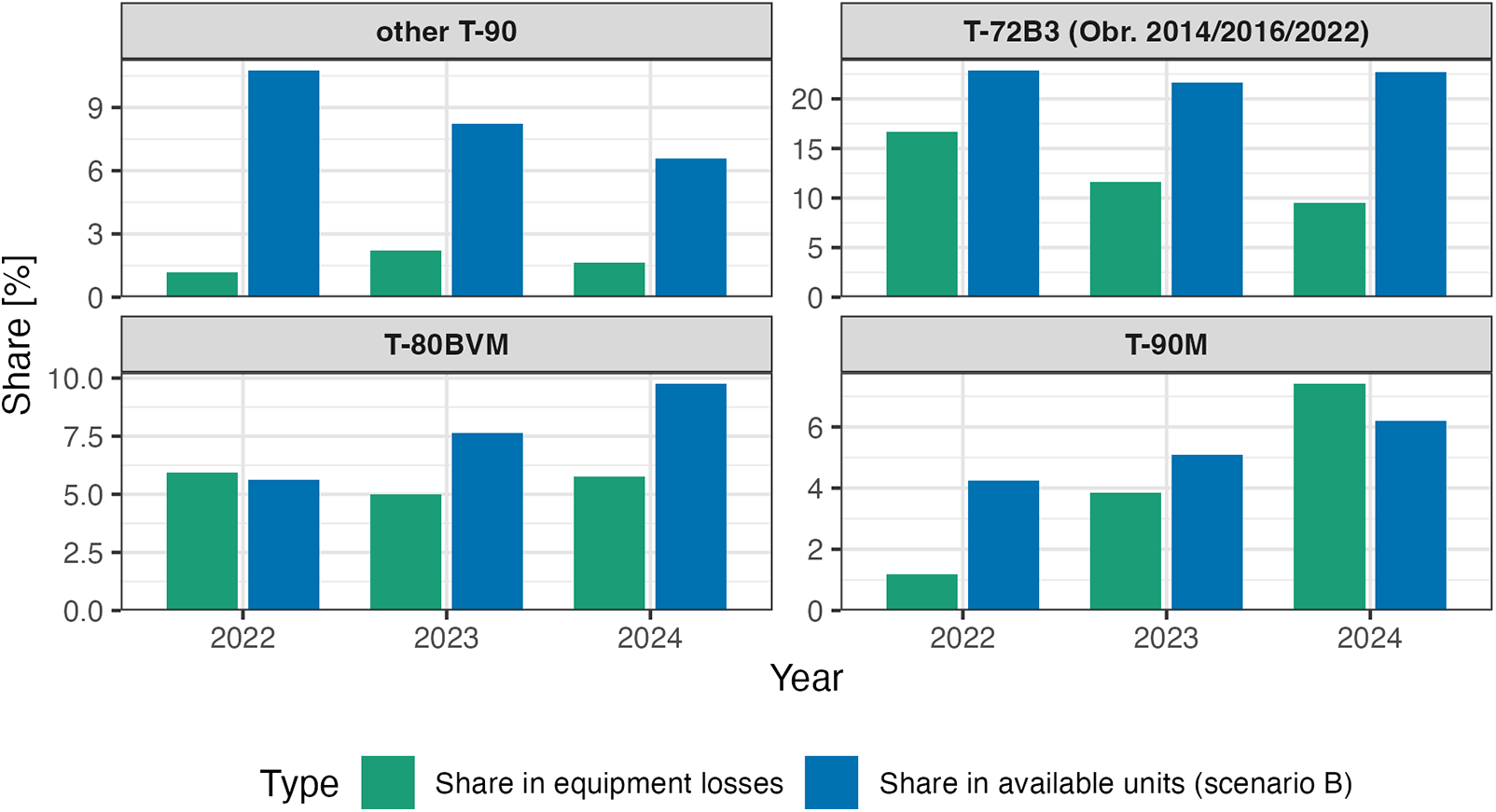
We find that the expert estimated production scenario does not hold up under scrutiny. If its assumptions were correct, the composition of Russian battlefield losses would be markedly different, with newer equipment representing a larger share of total losses See Figures 2, 6, and 10. Instead, battlefield losses continue to be dominated by legacy systems, indicating that new production is significantly lower than estimated. This mismatch in shares is the primary reason for rejecting higher production estimates.
Contrast between MBT type share in losses vs. share among available units if production scenario B is applied.

The realistic production scenario is, therefore, derived as the only one that maintains internal consistency between available units and observed attrition rates.
Russian defence industrial production during the war on Ukraine
Russian defence industry production baseline
An increase in production capacity to gauge performance is impossible without a baseline. We provide a short overview of the defence industrial base to help reader orientation and include production capacity at the start of the conflict.Footnote 37 Baseline production is quantified in Online Appendix III.
The state corporation Rostec oversees many strategically vital Russian arms companies. This analysis focuses on tanks, infantry fighting vehicles (IFVs), armoured personnel carriers (APCs), and self-propelled artillery (SPAs), which are produced by this industrial network. These systems are the basis of the Russian military’s combat capacity; therefore, analysing their production trends is vital.
Main battle tanks (MBTs) are central to modern armoured warfare due to their combination of firepower, protection, and mobility. The Russian military’s reliance on tanks such as the T-90 M, T-80BVM, and T-72B3 highlights their strategic importance. These models represent different generations and technological advancements within the Russian tank fleet. The T-90 M, as the most modern variant, showcases the latest in Russian tank technology used in Ukraine, while the T-80BVM and T-72B3 include significant upgrades of older models, reflecting the industry’s approach to modernising its existing inventory. Analysing these tanks provides insights into production capabilities, modernisation efforts, and the ability to field effective combat units.
One of the largest arms manufactures is Uralvagonzavod (UVZ) in Nizhny Tagil, Sverdlovsk Oblast. As part of Rostec since 2016, UVZ produces modern Russian main battle tanks such the T-14 Armata, T-90 M, and T-72B3. The T-90 M, a modernised T-90 series, had a production rate of seventy units per year in 2021. The T-72B3, a modified T-72, was produced at ninety units per year in 2021. Total tank production by UVZ is 240 units in 2021. T-80BVM production and modernisation are handled by Omsktransmash, another major Omsk producer. This gas turbine–powered T-80 was extensively upgraded. T-80BVM production reached eighty units in 2021. Omsktransmash, like Uralvagonzavod, modernises Russia’s armour; however, it focuses on the T-80 series, whereas UVZ emphasises the T-72 and T-90 families. In 2021, production of these updated tanks (T-72B3, T-80BVM, and T-90 M) was up to 240 units per year, reflecting a determined effort to balance upgrading and new manufacturing.Footnote 38
Infantry fighting vehicles (IFVs) like the BMP-1, BMP-2, and BMP-3 play a crucial role in mechanised infantry operations, offering both transport and combat capabilities. These vehicles are integral to the mobility and protection of infantry units on the battlefield. The BMP-1 and BMP-2 represent older platforms that have undergone various upgrades, while the BMP-3 signifies a more modern approach with enhanced capabilities. Assessing the production and deployment of these vehicles helps gauge the effectiveness of the Russian arms industry’s modernisation programmes and its ability to maintain a diverse and capable armoured fleet.
Kurganmashzavod (KMZ) in Kurgan, Kurgan Oblast, is crucial to Russia’s tracked armoured vehicle manufacture. KMZ produced sixty BMP-3s per year in 2021, one of Russia’s most modern IFVs. Modernised BMP-2s with the Berezhok combat module were produced at sixty per year at the facility. In 2021, the Military Industrial Company’s (VPK) Arzamas Machine-Building Plant (AMZ) in Nizhny Novgorod Oblast produced 300 BTR-82A and BTR-82AM APCs.Footnote 39
Self-propelled artillery systems such as the Msta-S, Msta-SM2, and other 152 mm and 122 mm variants have been the linchpin of the battlefield. They are crucial for both offensive and defensive operations. These systems enable the Russian military to deliver cheap and sustained firepower over long distances, impacting the overall effectiveness of combat operations. With artillery systems, even more so than with previous systems, holding stock back would be counterproductive. Hence, the industry’s capacity to produce advanced artillery systems and maintain their operational readiness under combat conditions is directly reflected in the analysed deployment and attrition of these systems.
The main manufacturer of self-propelled artillery is Uraltransmash in Yekaterinburg, Sverdlovsk Oblast. The 152 mm self-propelled howitzer Msta-S (2S19) has been modernised and is the company’s main product. Production increased for the most advanced model, the 2S19M2 (Msta-SM2). Russia’s Msta-SM2 units in service climbed from thirty-six in 2018 to 350 at the end of 2021, indicating in average seventy-unit per year production rate. Production increased gradually from thirty-six units in 2017 and 2018 to forty-eight units in 2019 and 2020. This shows Russia’s gradual modernisation of self-propelled artillery before military operations escalated in 2022.Footnote 40
Other major Russian defence manufacturers include Kovrov Mechanical Plant and Tula KBP Instrument Design Bureau, which make Kornet-EM and Metis-M1 anti-tank guided missile systems. These systems are vital to infantry support. United Aircraft Corporation (UAC) manufactures strategic bombers like the Tu-160 and Tu-22 M and modern fighters like the Su-57, Su-35, and MiG-35. Major helicopter models include the Mi-28, Mi-35, and Ka-52, produced by Rostec subsidiary Russian Helicopters. KTRV produces air-to-surface and anti-ship missiles like the Kh-35 and Kh-101, while Splav makes MLRS like the BM-30 Smerch and its updated successors.
The assessed baseline is utilised to search for any increase in production in juxtaposition to widely accepted 2024 expert assessments in the West and Russian data suggesting and communicating a multi-fold increase. Our OSINF-based analysis suggests that Russian production levels have not significantly exceeded those of 2021, and the industry struggles to keep pace with battlefield losses. This discrepancy highlights the critical role of OSINT in providing robust, timely, and independent verification of military-industrial performance.
Main battle tanks (MBTS)
The analysis of Russian tank production (all figures and analysis are derived from quantities and intervals available in Online Appendix V) revealed several critical findings regarding the discrepancies between estimated production, documented losses, and deployment patterns. Among the tank types produced, only the T-90 M approached a share of documented losses proportionate to its estimated production levels by 2023. Despite this, the overall number of deployed T-90 tanks, including both modernised and original variants, was significantly lower than expected. Interestingly, these very low shares of older T-90 in losses suggest that almost all T-90 M are conversions of older (but still relatively capable) T-90A tanks and not brand-new units, as was generally expected. This discrepancy highlights constraints in the production and deployment of even this priority model (see Figure 2).
The most striking finding emerged with the T-72B3, and particularly its variant, which is under production: T-72B3 Obr. 2014/2016/2022.
The T-72B3 was expected to serve as the backbone of Russian armoured forces during the war. Given its position as the most cost-effective and mass-producible modernised main battle tank in Russia’s arsenal, its production was expected to vastly outpace that of the more complex T-90 M and unready T-14 Armata. Russian officials and industry reports suggested that production of the T-72B3 would be prioritised, ensuring a large-scale, rapid replacement process for battlefield losses.
However, our analysis reveals a fundamental contradiction: rather than increasing in proportion to other models, the share of T-72B3s (produced as ‘obr. 2014/2016/2022’ as well as the pre-war T-72B3 variant) in documented battlefield losses has significantly declined over time. While the estimated production scenario would expect the share of T-72B3 obr. 2014/2016/2022 variant to represent around 22–3 per cent of all tanks in all analysed time periods, their share in losses declined from 17 to less than 10 per cent. This pattern runs directly counter to expectations if Russian industry were meeting its stated production goals. Instead, a careful examination of documented losses, alongside expected production levels and pre-war stocks, indicates that actual T-72B3 (Obr. 2014/2016/2022) production must have been drastically lower than claimed – possibly ten times lower.
In contrast, older variants of the T-80 and T-72 tanks were substantially overrepresented in documented losses relative to their estimated shares in the available force. This disparity clearly shows heavy reliance on non-modernised variants that were likely minimally refurbished for deployment.
The high proportion of T-64 tanks in documented losses is also explainable by their use by separatist forces. These originated from pre-2022 captures from Ukrainian stocks, as this model was not officially in service in Russia at the start of the invasion. This explanation is hard to verify due to limitations on geolocating unit markings but is consistent with known inventories of Russia’s proxy forces. As for the T-62 type, only about half of the stored units reached deployment. This signals uneven refurbishment, cannibalisation, and continued reliance on outdated stocks. Heavy reliance on aged and ageing tank models shows a clear pattern of production bottlenecks.
Based on these observations, the analysis shows that the actual production of T-90 M tanks likely aligns closely with expert estimates but comes at a significant cost to the T-90A variant. The production of T-80BVM tanks is significantly lower, even at only half of what was previously estimated. Crucially to the capacity of Russia’s defence industry, the production of modernised T-72B3 tanks is found to be dramatically lower than anticipated, with virtually negligible new fielded stock. This finding represents one of the most critical vulnerabilities in sustaining building production volume necessary for Russia’s operational capacity.
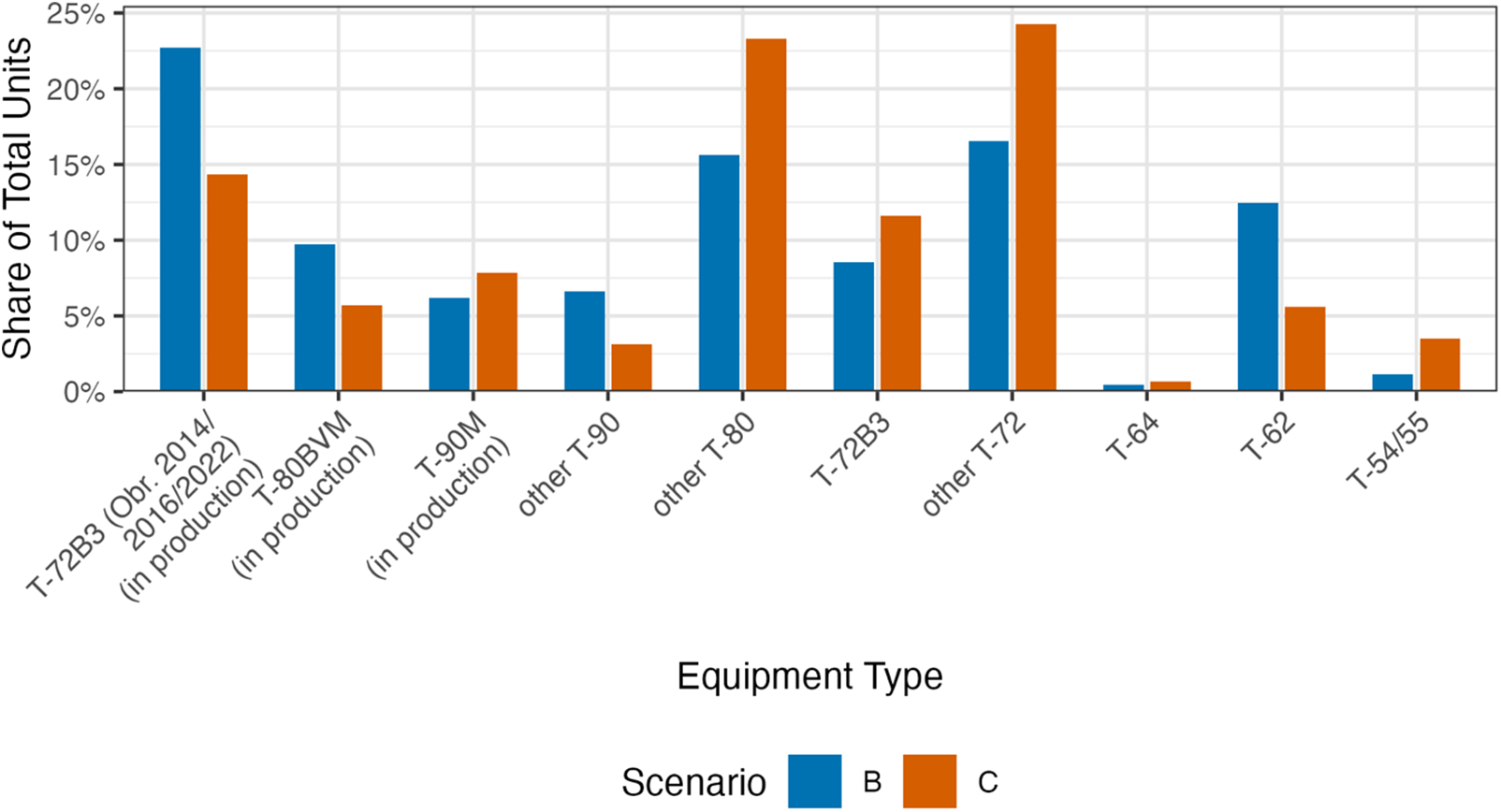
To reconcile these disparities, production assumptions of Scenario B were revised into Scenario C (see Figure 3). The new estimates, outlined under ‘Real Production’, reduced total tank production to approximately 150 units in 2022, 250 in 2023, and 187 in the first half of 2024. These figures reflect levels significantly below expert estimates and reports. This revised level of production aligns with observed loss patterns and provides a more accurate depiction of the structure and limitations of Russian tank production. Total production levels were found to be three times lower than estimates in 2022 and approximately half in 2023 and 2024, resulting in annual outputs of just 150 in 2022 and 300 tanks in 2024. This figure is roughly comparable to the present MBTs production capacities to Western European states or for example to South Korea alone.
Annual production intensity comparison Scenarios B vs. Scenario C.

These findings highlight the overwhelming reliance on refurbished tanks to sustain the deployed force. Tank repair facilities, in contrast to production capabilities, demonstrated significant performance. The disproportionately high shares of losses attributed to non-modernised T-80 and T-72 variants can only be explained by the near-total deployment of tanks withdrawn from storage. This indicates that nearly all usable tanks leaving storage were deployed, with minimal upgrades, likely at the expense of vehicles in poor condition used primarily for spare parts (see Figure 4).
Annual total availability of MBT units with 95 per cent confidence intervals, Scenario B vs. Scenario C.

The reliance on stored equipment is unsustainable in the long term. OSINF data indicate that only several hundred T-80 and T-72 tanks in usable condition remain in storage, and this reserve is rapidly depleting. It remains uncertain whether the Russian defence industry can meaningfully increase production to compensate for this shortfall. However, as of mid-2024, the number of entirely new tanks produced remained minimal, casting significant doubt on the scalability of production in response to ongoing battlefield attrition (see Figure 5).
Shares in resulting composition of MBT forces for 2024 according to scenarios B and C, indicating systems in production.

Infantry fighting vehicles
The official Russian narrative asserts a significant increase in the production of IFVs since the onset of the Ukrainian conflict, claiming a production boost of 3.5–4.5 times compared to pre-2022 levels. Interestingly, this pace of increase of production of the key type – BMP-3 M – was considered by Western sources to be likely.Footnote 41 This assertion would imply an efficient and rapidly expanding arms industry capable of replenishing battlefield losses and maintaining a substantial inventory of modern systems. However, our OSINF-informed analysis shows minimal production levels and very limited results of modernisation efforts. These findings underscore critical limitations in Russia’s defence industry, raising significant concerns about its ability to sustain its IFV fleet in the ongoing conflict. (All figures and analysis are derived from quantities and intervals available in Online Appendix VI.)
The BMP-3 M is central to this analysis, as it is the only modern IFV actively produced (new units and deep modernisations of BMP-3). All other systems under consideration, including the BMP-1AM and BMP-2 M Berezhok, largely represent stopgap measures that rely on necessary upgrades to outdated platforms. These upgrades reflect the urgent need to field available equipment rather than evidence of industrial capability or innovation. But even these modernisations, we believe, are much more limited than generally expected, and the vast majority of equipment deployed to the front by Russia consists of legacy systems that have undergone basic repairs and refurbishment.
Empirical evidence highlights the constrained nature of Russian BMP-3 M production. The expert estimate represents a scenario where the Russian arms industry gradually increases production of the contemporary BMP-3 variant in line with the pre-2022 trajectory, which aimed to replace the BMP-2 in Russian forces. BMP-3 M units are produced as both newly manufactured vehicles and modernised versions of existing BMP-3 stocks. This estimate is far more modest than Russian claims, which would suggest annual production of approximately 420 BMP-3 M units since 2023.
However, even the expert estimate of production contrasts sharply with data presented by analysis of battlefield losses (Figure 6). The documented losses reveal that the BMP-3 M constitutes only a small fraction of Russian IFV losses and, over time, is becoming increasingly rare. While the ‘estimated’ production scenario would expect fast growth of the share of these modern IFV in total IFV forces – from 2.7 per cent in 2022 to 11.4 per cent in 2024, we see a very low share in documented losses of 2.2 per cent in 2022 declining to 0.6 per cent in 2024). Therefore, to adjust to these very low shares in losses, the production of BMP-3 M should be about ten times lower than some 210 units expected by experts. Judging from higher-than-expected shares of older variant BMP-3 in losses, we conclude that the modernisation of BMP-3 to BMP-3 M standard is also not ongoing.
Contrast between IFV type share in losses vs. share among available units if production scenario B is applied.

As with other classes of Russian equipment, the small share of BMP-3 M units in documented losses cannot be attributed to superior battlefield survivability. Indeed, losses of BMP-3s – relatively modern systems – are disproportionately high relative to their share in Russian forces. As observed with other systems, such better systems are deployed into combat in priority and are destroyed in large numbers; overall losses are generally skewed towards relatively more modern systems.
The reliance on pre-war stocks and the poor performance of the Russian arms industry production extends beyond the BMP-3 to other platforms (see Figure 7). The BMP-1AM represents a modest upgrade of the BMP-1. Our data suggest that Russian industry is producing far fewer of these modernisations than the ‘estimated’ scenario predicts. Documented losses indicate a consistent production rate of approximately four units per month. However, since the beginning of the full-scale conflict, Russia has fielded massive numbers of unmodernised BMP-1s (often within separatist forces) despite their obsolescence, which was recognised even at the end of the Cold War four decades ago.
Annual production intensity comparison of Scenario B vs. Scenario C.

Similarly, the BMP-2 M Berezhok modernisation programme has proceeded at a much slower pace than claimed, with only a fraction of BMP-2 stocks upgraded to this standard. This reliance on minimally modernised or repaired legacy equipment, while addressing immediate shortfalls, is unsustainable as the stored IFVs are running out and cannot sustain the long-term demands of the conflict.
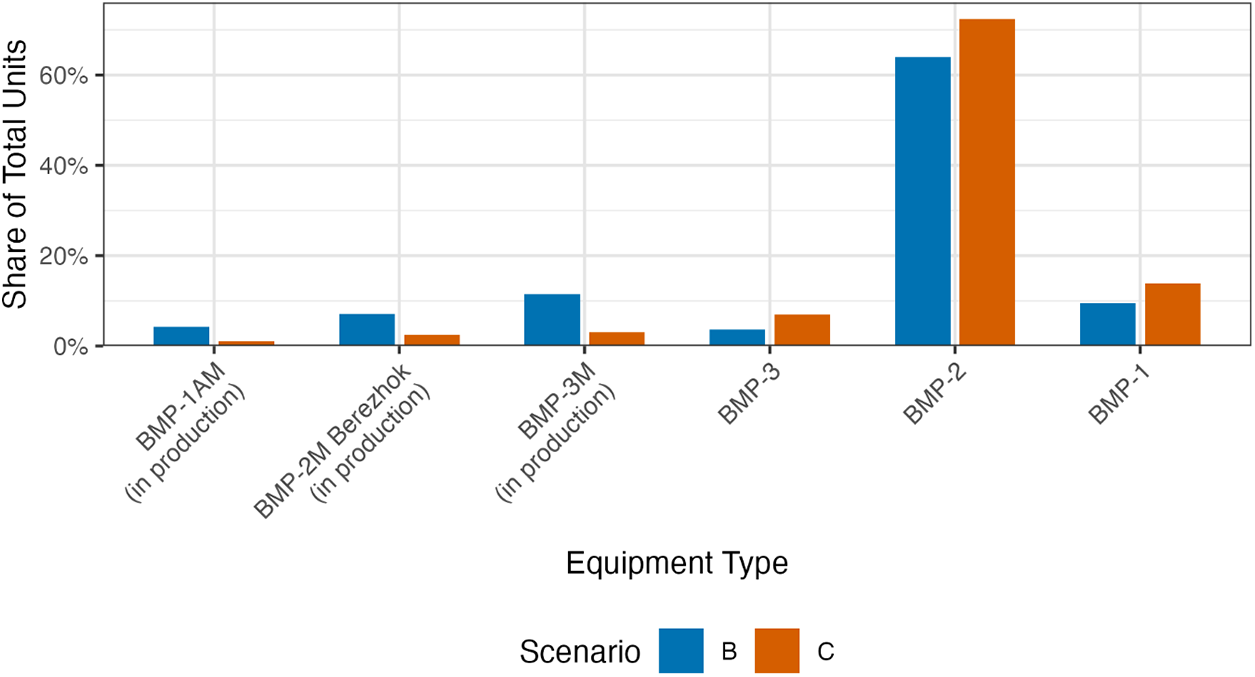
Our analysis of OSINT data for IFVs mirrors findings from our assessment of main battle tanks. It suggests that the Russian arms industry has not only failed to significantly increase production from pre-2022 levels but is also likely producing fewer new or deeply modernised military systems than before the conflict (see Figure 8). Russia’s IFV forces are becoming increasingly bifurcated between a small number of competent systems, such as the BMP-3 M, and a large quantity of obsolete platforms in questionable condition. This operational model is unsustainable in the long term, as stocks of old equipment in usable condition are steadily depleting (see Figure 9).
Annual total availability of IFV units with 95 per cent confidence intervals, Scenario B vs. Scenario C.

Shares in resulting composition of IFV forces for 2024 according to scenarios B and C, with indicated systems in production.

Self-propelled howitzers
The performance of self-propelled howitzers (SPHs) provides a revealing lens through which to examine the operational dynamics and industrial capacity of the Russian Armed Forces during the ongoing conflict. As integral components of artillery operations, SPHs offer mobile and flexible firepower critical to modern combat. The analysis of SPH production, deployment, and losses highlights significant discrepancies between Russian claims, expert estimates, and observable realities, emphasising key vulnerabilities in sustaining protracted artillery engagements. (All figures and analysis are derived from quantities and intervals available in Online Appendix VII.) Data on the baseline production rate of SPHs is scarcer than their counterparts. We likewise acknowledge potential limitations in OSINF observations of system battlefield losses that might occur deep behind the frontlines with problematic visual evidence gathering. However, the evidence is sufficient for the purposes of OSINF transformation, due to preserving the ratio of battlefield losses, which remains intact even with a smaller sample. Furthermore, OSINF evidence of most modern system losses confirms the ability for visual confirmation even deep behind the frontlines.
Before the 2022 invasion, the 2S19 Msta-SM2 was the only actively produced SPH in Russia, created through both new manufacturing and comprehensive upgrades of earlier Msta-S systems. Russia’s official narratives have since claimed a sixfold increase in the production of Msta-S variants by 2023, alongside the mass production of next-generation systems such as the 2S35 Koalitsiya and the wheeled 2S43 Malva. Expert estimate scenarios likewise projected increases. However, our analysis building on OSINF evidence does not corroborate these claims. Instead, production patterns align closely with a scenario of stagnation, or even drop compared to pre-war levels of production, wherein only minimal numbers of Msta-SM2 systems were produced, and the Koalitsiya and Malva systems were fielded in negligible quantities, if at all.
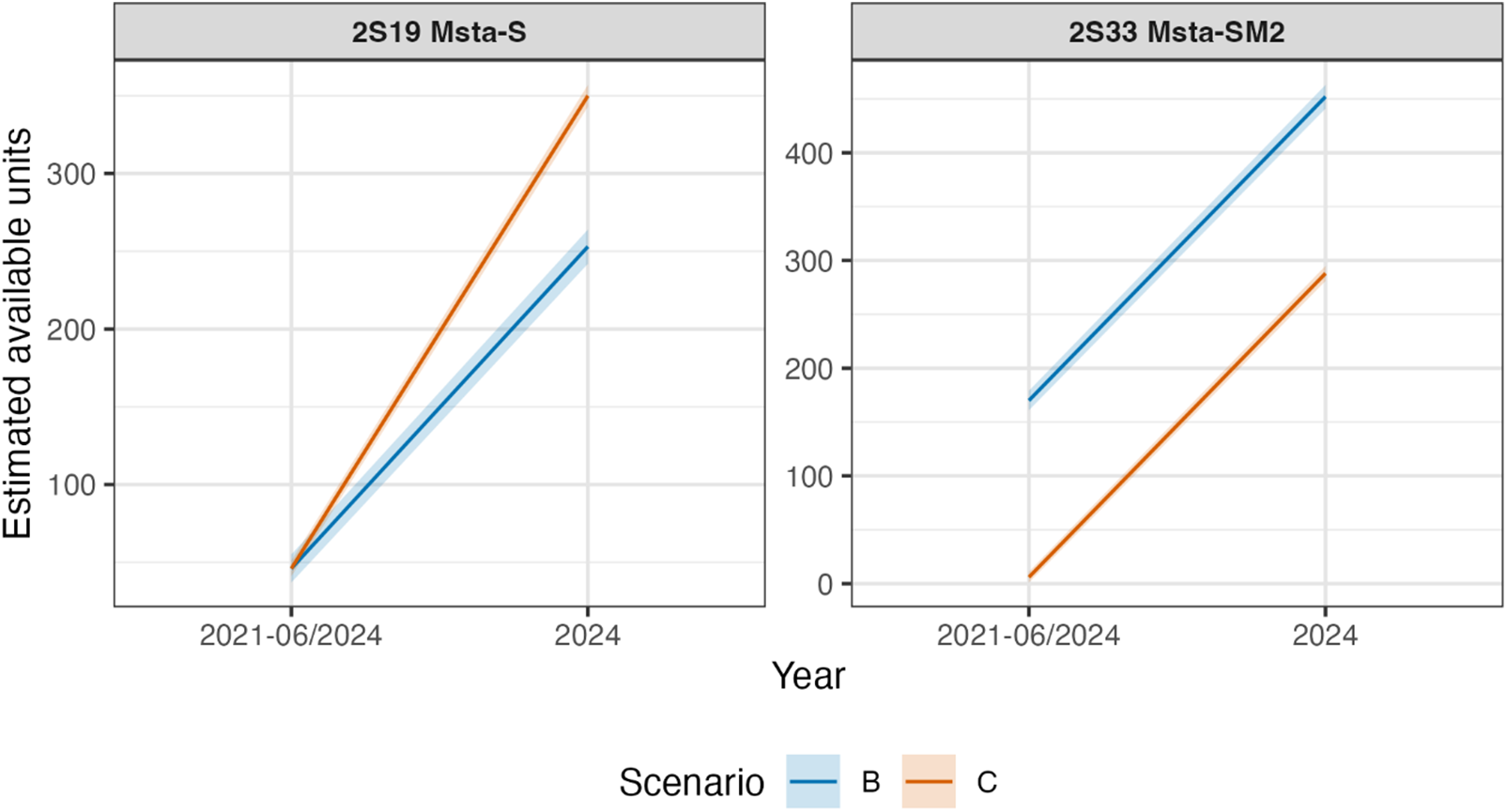
Even the conservative ‘estimate production’ of Scenario B cannot be supported by our analysis of OSINF data. The share of losses of MSTA-SM2 is generally stagnating on less than 7 per cent, while its share in all SPA should be more than double. This discrepancy suggests not only limited wartime production but also potential inflation of pre-war inventory figures for Msta-SM2 systems. While OSINF data on SPH losses may be more limited (due to the operational depth of where losses may occur), the ratio of losses in a smaller sample is still representative as a possible advantage in firing ranges are adjusted for (see Figure 10).
Contrast between SPH type share in losses vs. share among available units if production scenario B is applied.

Patterns of SPH attrition further underscore production and deployment challenges. Losses are heavily skewed towards Russia’s more competent systems, with the 2S19 Msta-S accounting for 29 per cent of all documented SPH losses from 2022 to mid-2024. This figure far exceeds the Msta-S’s proportional share of the arsenal, reflecting its prioritisation in frontline deployments (see Figure 11). The rapid attrition of these systems underscores their pivotal role in Russian artillery operations, albeit at a cost that undermines sustainability. By contrast, the Msta-SM2 accounts for only 5.7 per cent of total SPH losses (2022–4). The limited deployment and destruction of this advanced variant reveals severe production constraints, undermining official assertions of robust and scaled manufacturing during the conflict.
Annual production intensity comparison, Scenario B vs. Scenario C.

More capable legacy systems such as the 2S4 Tyulpan and 2S5 Giatsint-S also show loss rates exceeding their inventory proportions, reflecting their frequent use in high-intensity roles due to the absence of adequate modern replacements. In comparison, older, less capable systems like the 2S1 Gvozdika and 2S3 Akatsiya exhibit loss rates aligned with their inventory shares, indicating their continued but secondary role in operations. Notably, Russian SPHs have sustained disproportionately high losses compared to towed artillery, a pattern that diverges from other modern conflicts. In typical engagements, towed systems incur greater attrition due to their lower mobility and survivability.
The findings reveal critical vulnerabilities in the Russian defence industrial complex. The absence of evidence of meaningful deployments of Koalitsiya and Malva systems, combined with the failure to meaningfully modernise existing Msta-S units into Msta-SM2 configurations, underscores the inefficiencies of Russian production (see Figure 12). The composition of artillery forces in 2024 is therefore significantly worse than even expert estimates (see Figure 13).
Annual total availability of SPH units with 95 per cent confidence intervals, Scenario B vs. Scenario C.

Shares in resulting composition of SPH forces for 2024 according to scenarios B and C, with indicated systems in production.

The empirical analysis of Russian main battle tanks, infantry fighting vehicles, and self-propelled artillery reveals significant discrepancies between official claims and actual production capabilities. The Russian arms industry has not substantially increased its production above 2021 levels and struggles to replace losses, resulting in a decline in the quality of deployed systems. The inconsistencies in the shares of modern equipment like the T-72B3, BMP-2 M Berezhok, BMP-3 M, and 2S19M2 Msta-SM2 in documented losses suggest that the claimed as well as expert estimated production numbers are inflated. The inability to provide competent, reasonably modern types of equipment to cover losses underscores the broader inefficiencies and challenges faced by the Russian defence sector. This OSINT analysis demonstrates that the Russian arms industry’s performance is not meeting the demands of its military operations, highlighting a critical weakness in its ability to sustain long-term conflict.
Conclusion
The empirical analysis of the Russian arms industry reveals a significant gap between official claims, expert estimates, and actual production capabilities. This discrepancy is evident across various categories of military equipment, including main battle tanks, infantry fighting vehicles, and self-propelled artillery. Despite the Russian government’s assertions of dramatic increases in production, our OSINT-based assessment shows that the industry’s output remains far below these inflated claims. The Russian arms industry struggles to replace losses and maintain the quality of its deployed systems, underscoring a critical weakness in its ability to sustain long-term conflict.
The insights gained from this analysis demonstrate the value of applying a structured methodological framework for OSINT in providing robust, timely, and independent verification of military-industrial performance. Unlike traditional intelligence methods, which often rely on classified sources, our approach leverages publicly available data in a transparent and replicable manner. This democratisation of analytical tools allows for a more accountable assessment of complex strategic issues, such as the performance of the arms industry in a conflict zone.
This paper’s primary contribution lies in the development and successful application of a robust methodological tool for the OSINT analyst’s toolbox. The framework of comparing official data, expert estimates, and OSINT-derived loss data provides a powerful way to cut through the fog of war and produce actionable intelligence on complex strategic issues. While the availability of big data presents new opportunities, its true value is only unlocked through rigorous and transparent analytical methods like the one presented here. In essence, our framework provides a twenty-first-century, data-driven solution to the classic intelligence challenge exemplified by the ‘German tank problem’.Footnote 42
It is important to emphasise that this framework is fundamentally about the OSINT process, not just a single data source. While visually confirmed loss data is a key validation component, our methodology’s logic lies in the synthesis of multiple, varied open sources – including state propaganda, expert analyses, commercial satellite imagery, and crowd-sourced battlefield data – into a coherent intelligence product that is more reliable than any single source alone.
Our analysis also provides a critical corrective to the prevailing narrative in many Western expert and media circles, particularly in late 2023 and early 2024. During this period, numerous influential assessments, often citing official sources, painted a picture of a surprisingly efficient Russian defence industry that had successfully transitioned to a full war economy. These views, which effectively aligned with the higher production figures of our Scenario B, contributed to a perception of a massive Russian output that Western production could not match. Our findings directly challenge this alarmist narrative. By demonstrating that actual production levels are closer to our OSINT-validated Scenario C – roughly comparable to the pre-war baseline – our paper suggests that some Western estimates may have uncritically accepted official Russian claims or overestimated Russia’s industrial resilience, potentially influenced by a political desire to mobilise support for increased domestic defence spending.
The implications of these findings are profound for various actors, including states, political leaders, military officials, NATO, army leaders, and intelligence services. The ability to independently verify an adversary’s capabilities is crucial for informed decision-making. Policymakers must recognise the value of methodologically sound OSINT in strategic planning, resource allocation, and narrative control. By leveraging these capabilities, we can develop more effective strategies to support Ukraine and counter Russian aggression. The transparency provided by this approach can also help build public support for necessary policies and initiatives.
In conclusion, our findings not only offer critical insights into the limitations of the Russian arms industry but also demonstrate a valuable and transferable technique for future security and intelligence studies, showcasing the power of rigorous OSINT analysis to reveal the true state of strategic capabilities.
Finally, it is crucial to address the potential policy risks associated with these findings. Acknowledging that the Russian defence industry is currently less capable than often portrayed should not lead to complacency or a reduction of vigilance. A realistic assessment of an adversary’s present vulnerabilities is not a prediction of their future capacity for adaptation, nor does it negate the potential for strategic deception and surprise. Instead, a clear-eyed understanding of these weaknesses is essential for developing effective, long-term strategies to maintain a technological and industrial edge. It also helps in making a more precise case to Western publics that continued, targeted investments in defence and sustained support for Ukraine are not based on fear but are rather necessary, data-driven responses to manage a persistent, albeit demonstrably flawed, adversary.
Supplementary material
The supplementary material for this article can be found at https://doi.org/10.1017/eis.2026.10046.
Acknowledgements
We would like to extend our gratitude to the reviewers and the CENTREPEACE project seminar, which all delivered constructive feedback to strengthen the manuscript.
Funding statement
This work was supported by the Czech Science Foundation under the grant ‘Structural obstacles and opportunities for the integration of post-communist EU member countries into European defence co-operation’, registration number GA22-25205S.
Disclosure statement
No potential conflict of interest was reported by the authors. GPT 4.5 was utilised in text proofing with prompts requesting increased clarity of sentence structure and consistency of wording.
Oldřich Krpec is an associate professor in the Department of International Relations and European Studies, Masaryk University. His research focuses on international political economy, industrial policy, and the strategic aspects of defence production.
Martin Chovančík is an assistant professor in the Department of International Relations and European Studies, Masaryk University. His projects and publications focus on European defence industries, defence cooperation, and their societal and security impacts.
Adriana Ilavská is an assistant professor in the Department of International Relations and European Studies, Masaryk University. Her research focuses on applying advanced quantitative and computational methods to the study of security-related topics.









 Open access

