


The obesity prevalence among adolescents has levelled off over the past 10 years(Reference Ogden, Carroll and Curtin1), suggesting that young people are beginning to implement weight-control strategies. This is further confirmed from several cross-sectional studies documenting that a large proportion of overweight and obese adolescents have begun to change their unhealthy behaviours(Reference Bittner Fagan, Diamond and Myers2, Reference Boutelle, Libbey and Neumark-Sztainer3). One of the strategies followed by those who have successfully lost weight included the intake of a higher-protein diet(Reference Boutelle, Libbey and Neumark-Sztainer3).
We recently examined the effects of consuming a normal v. protein-rich (PR) breakfast on appetite, satiety and subsequent food intake in adolescents(Reference Leidy and Racki4). The higher-protein meal led to reduced appetite and subsequent food intake compared with the normal-protein meal, further supporting the beneficial effects of increased protein intake in young people. Another dietary factor that may alter the beneficial effects of dietary protein is food form(Reference Leidy, Apolzan and Mattes5, Reference Tieken, Leidy and Stull6).
In general, beverages elicit weaker appetitive and/or dietary responses than solid foods(Reference Drewnowski and Bellisle7, Reference Mattes8). Data from our laboratory confirm these findings(Reference Leidy, Apolzan and Mattes5, Reference Tieken, Leidy and Stull6). However, it is presently unclear as to whether food form alters the appetitive and satiating effects of increased dietary protein. When food is provided in the solid form, higher-protein meals consistently decrease hunger, increase satiety and/or reduce subsequent food intake compared with normal-protein solid meals(Reference Westerterp-Plantenga, Nieuwenhuizen and Tome9). Similar findings are reported for higher- v. normal-protein meals consumed as beverages(Reference Westerterp-Plantenga, Nieuwenhuizen and Tome9). The present evidence supporting the differential effects of food form indicates that the appetitive and satiating effects of dietary protein might become weakened when consumed as a beverage. These findings have practical implications with respect to whether replacing a higher-protein meal with beverages is a beneficial strategy during weight loss. The purpose of the present study was to examine the effects of consuming a PR breakfast meal in a beverage (B) v. solid (S) form on perceived appetite, satiety and subsequent food intake in adolescents.
Experimental methods
Participants
Adolescents were recruited from the Kansas City, KS area through email list serves. Eligibility was determined by the following inclusion criteria: (1) age 13–17 years; (2) normal–overweight (BMI percentile 50–94th %); (3) no metabolic diseases; (4) not presently/previously following a special diet. Participants, eight girls and seven boys (age 14 (sem 1) years, BMI percentile 79 (sem 4) %), began and completed all study procedures. Each participant and his/her parents were informed of the study purpose, procedures and risks. Written informed consent/assent was obtained from all participants. The study was conducted according to the guidelines laid down in the Declaration of Helsinki, and all procedures involving human participants were approved by the University's Human Subjects Committee. The participants received $80 for completing all procedures.
Experimental design/study procedures
The present study incorporated a randomized, cross-over design consisting of two, 5 h testing days. On separate days, the participants reported to the laboratory after an overnight fast. Before the breakfast meal ( − 15 min), the participants completed the questionnaires assessing appetite and satiety. At 0 min, the participants consumed a PR breakfast meal as either a PR-B or PR-S meal. This meal was consumed within 20 min. Appetite and satiety questionnaires were again completed every 20 min over the remaining 4 h. At +240 min, the participants were provided with an ad libitum lunch buffet. They consumed this meal within 20 min and ate as much or as little as desired until feeling ‘comfortably full’. Afterwards, they were permitted to leave the laboratory.
Test meals
By design, there were no differences in energy content, macronutrient composition, sugar or fibre content between the PR-B and PR-S meals (Table 1). Further, no differences were observed in the participants' palatability ratings of the meals (Table 1). However, the meals differed in energy density, with the PR-S meal exhibiting a greater energy density compared with the PR-B meal (P < 0·05; Table 1). The meals contained 24 % of estimated daily energy needs for normal–overweight adolescents(10). Both meals contained 38 % of energy as protein, 49 % of energy as carbohydrates and 13 % of energy as fat. The PR-B meal was in the form of a beverage ‘shake’, whereas the PR-S was a solid ‘pancakes and eggs’ meal. Each meal also contained 266 ml of water. The predominate source of protein in each meal was whey (i.e. 47 g/meal, Designer Whey®; NEXT Proteins, Carlsbad, CA, USA).
(Mean values with their standard errors)
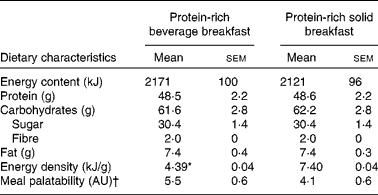
AU, arbitrary units.
* Mean value was significantly different from that of the protein-rich solid meal (P < 0·05).
† Linear scale ranging from 1 (highly unpleasant) to 9 (highly pleasant).
Questionnaires
Computerised questionnaires (AppetiteLog; US Department of Agriculture Laboratory/Western Human Nutrition Research Center, Davis, CA, USA), assessing perceived appetite (comprising hunger, desire to eat and prospective food consumption) and satiety (fullness), were downloaded onto a Palm®-pilot (Zire22; Palm, Inc., Sunnyvale, CA, USA) and completed throughout each testing period. The questionnaires use validated visual analogue scales incorporating a 100 mm horizontal line rating scale for each response(Reference Flint, Raben and Blundell11).
Ad libitum lunch
At +240 min, each participant was provided with an ad libitum lunch buffet in a quiet, self-contained room. The buffet contained a total of 12 552 kJ of commonly eaten foods (i.e. crackers, fruits, vegetables, lunch-meats and string cheese) and 88·7 ml of water. Total food intake was measured by weighing all items before and after the meal. Total energy and macronutrient composition were determined using the Nutrition Data System for Research 2006 (Nutrition Coordinating Center, University of Minnesota, School of Public Health, MN, USA).
Data/statistical analysis
To compare the appetite and satiety responses between meals, hourly and total area under the curve was calculated from the postprandial time points(Reference Wolever and Bolognesi12). Paired t tests were used to examine the effects of food form (i.e. PR-B v. PR-S) on appetite, satiety and lunch energy intake. Data are expressed as means with their standard errors. A P value < 0·05 was considered statistically significant. Analyses were conducted using the Statistical Package for the Social Sciences (version 18.0; SPSS, Inc., Chicago, IL, USA).
Results
As shown in Fig. 1(a) and (b), the line graphs illustrate the appetite and satiety responses completed every 20 min throughout the testing days, whereas the bar graphs depict the area under the curve analyses. Both meals led to immediate reductions in appetite and gradual increases over the remaining 4 h. The PR-S meal led to greater reductions in total appetite v. the PR-B meal ( − 6221 (sem 1171) v. − 3570 (sem 957) mm × 240 min; P < 0·05; Fig. 1(a)). The PR-S meal also led to greater reductions in appetite during postprandial hours 2–4 v. the PR-B meal (Fig. 1(a)). As shown in Fig. 1(b), both meals led to immediate increases in fullness and gradual decreases over the remaining 4 h. Although the fullness responses at each postprandial time point were visibly greater following the PR-S meal v. the PR-B meal, no significant differences in hourly or total area under the curve were observed (Fig. 1(b)). Lastly, the PR-S meal led to approximately 480 kJ less energy consumed at the ad libitum lunch buffet compared with the PR-B meal (1418 (sem 222) v. 1900 (sem 326) kJ; P < 0·05).
Perceived (a) appetite (composite of perceived hunger, desire to eat and prospective food consumption) and (b) satiety (fullness) following the protein-rich solid (PR-S,  ) and beverage (PR-B,
  ) meals in fifteen adolescent boys and girls. * Mean values were significantly different for all comparisons (PR-S v. PR-B): P < 0·05. AUC, area under the curve; VAS, visual analogue scale.

Discussion
We found that although postprandial fullness was not different between the PR meals, the PR-S version led to greater reductions in perceived appetite and less energy consumed at the subsequent meal compared with the PR-B meal. These data indicate that, although the food form of the PR breakfast meals had little, if any, effect on satiety, the appetitive responses were diminished and subsequent food intake was greater when protein was consumed as a beverage v. as a solid meal. The later findings may have practical implications when developing dietary strategies to optimise weight loss and/or improve body-weight management in young people.
Food form has recently received attention due to the strong association between beverage consumption and overweight/obesity, particularly in young people(Reference Drewnowski and Bellisle7). In adults, acute and chronic beverage consumption has led to smaller reductions in appetite, smaller increases in fullness, increased energy intake and weight gain compared with consuming solid foods(Reference Leidy, Apolzan and Mattes5, Reference Mourao, Bressan and Campbell13, Reference DiMeglio and Mattes14). These findings suggest that food form is a critical factor contributing to positive energy balance and obesity.
Meal replacement ‘shakes’, nutrition ‘bars’ and pre-packaged meals have been commercially available for several decades as a strategy to lose weight(Reference LaRosa and Marketdata Enterprises I15). Despite the fact that most of these products contain large quantities of sugar compared with many other energy drinks, sodas and candy bars (i.e. 36–72 g), the daily consumption of these products, when incorporated into a healthy eating plan, has led to initial and sustained weight loss compared with following traditional energy-restriction diets(Reference Heymsfield, van Mierlo and van der Knaap16–Reference Davis, Coleman and Kiel18). Because most of these studies incorporated only meal replacement beverages(Reference Heymsfield, van Mierlo and van der Knaap16–Reference Davis, Coleman and Kiel18), it is unclear as to whether a solid version would elicit greater changes.
Increased protein consumption is another factor reported to improve body-weight management(Reference Westerterp-Plantenga, Nieuwenhuizen and Tome9). PR meals (28–70 g protein/meal) have led to reductions in appetite, increases in satiety and/or reductions in subsequent food intake compared with normal-protein meals in adults(Reference Westerterp-Plantenga, Nieuwenhuizen and Tome9, Reference Halton and Hu19, Reference Leidy, Mattes and Campbell20) and young people(Reference Leidy and Racki4). Increasing evidence suggests that these differences are only observed when protein is consumed as a solid(Reference de Graaf, Hulshof and Weststrate21–Reference Rumpler, Kramer and Rhodes23). Several studies have reported that appetite, satiety and subsequent food intake were not different following the consumption of a PR-B meal v. normal protein solids(Reference de Graaf, Hulshof and Weststrate21, Reference Rumpler, Kramer and Rhodes23). Besides the present study, only Mourao et al. (Reference Mourao, Bressan and Campbell13) directly compared two PR foods, differing only in food form. In this study, forty adults completed three separate testing days in which a standardised lunch meal, consisting of chicken sandwiches, was provided alone or in combination with an energy- and macronutrient-matched PR-B (i.e. milk) or PR-S (i.e. cheese) food. Hourly appetite and satiety responses and daily energy intake were assessed over the remainder of the day. Although no differences in appetite or satiety were observed between food forms, total energy intake was 15 % higher following the consumption of the PR-B compared with the PR-S food. In fact, the participants exhibited no dietary compensation for the beverage and actually consumed more energy than their habitual diet, whereas the consumption of the solid food led to an overcompensation (i.e. consuming less energy than normal)(Reference Mourao, Bressan and Campbell13).
Our present study extends these findings to include (1) adolescents, (2) a stand-alone beverage meal, (3) acute changes in perceived appetite and (4) a tightly controlled ad libitum buffet to assess subsequent food intake. Unlike Mourao et al. (Reference Mourao, Bressan and Campbell13), the PR-B meal in our present study led to smaller reductions in appetite throughout the postprandial period compared with the PR-S meal. The conflicting results may have been due to the differences in the frequency of data collection (i.e. hourly assessment throughout the day v. acute assessment every 20 min). Energy intake was influenced by food form in both studies, resulting in additional energy consumed following the PR-B meal v. the PR-S meal. Taken together, these data support the concept that food form appears to alter the response to increased protein consumption. We are now completing a follow-up study designed to examine the long-term changes in appetite control and body-weight management throughout a 12-week breakfast intervention comparing the PR-B v. PR-S meals in overweight/obese adolescents.
Several limitations exist with our present study design. First, although we controlled for the energy content, macronutrient composition, sugar, fibre content and palatability between the PR meals, we did not control for energy density, which was higher in the PR-S meal (4·39 (sem 0·04) kJ/g) v. the PR-B meal (7·40 (sem 0·04) kJ/g; P < 0·05). Due to the established relationship between satiety and palatability(Reference Drewnowski24, Reference Rolls25), we sought to develop test meals with similar palatability. In prior pilot testing with our study, the PR-B and PR-S meals led to similar palatability responses, which were also confirmed by the participants of the present study. However, in maintaining palatability of the study treatments, energy density was significantly higher in the solid v. beverage meal. According to the literature(Reference Drewnowski24, Reference Rolls25), foods exhibiting a higher energy density are generally less satiating and lead to increased appetite compared with foods that exhibit lower energy densities. Thus, the consumption of the more energy-dense meal in the present study, which was the PR-S meal, should have theoretically led to reduced satiety, increased appetite and increased subsequent energy intake compared with the less energy-dense beverage. The fact that the PR-S meal led to reduced appetite and reduced energy intake suggests that the other properties differentiating beverages and solids exert a greater impact than energy density alone. Along these lines, we also did not measure meal volume which may have influenced the study outcomes(Reference Rolls25). Thus, it is difficult to draw absolute conclusions for food form based on the breakfast meals in the present study.
Although we assessed subsequent ad libitum meal intake, and found significant differences between the PR meals, we did not measure 24 h energy intake. Thus, it is unclear as to whether the differential cumulative intake following the PR-B v. PR-S meal would have continued throughout the remainder of the day. We are currently performing additional studies to measure daily energy intake following the consumption of PR breakfast meals.
Conclusions
Although satiety following both PR meals was not different, the appetitive and dietary responses to the PR-B meal are significantly diminished compared with PR-S versions. These findings suggest that the incorporation of a PR-B into a weight-loss programme may be less effective than a PR-S with respect to appetite control and the regulation of energy intake in young people.
Acknowledgements
The authors would like to thank the study participants for their dedication and compliance and the University of Kansas Medical Center General Clinical Research Center staff for assisting with the testing-day procedures. H. J. L. originated the study, obtained funding and provided research supervision. H. J. L. drafted the manuscript and all co-authors contributed to the data interpretation and finalisation of the manuscript. The present study was funded through the M01 RR023940 NCRR/NIH grant. The authors have no personal or financial conflicts of interest.



