



As a part of a healthier agenda, antioxidant intake has increased in society. Supplementation with polyphenol family members, as flavonoids found in plants(Reference Iwashina38,Reference Myburgh55) , has become common, and its frequent consumption is associated with decreased risk for chronic diseases, such as diabetes and CVD(Reference Ponzo, Goitre and Fadda60,Reference Yamada, Hayasaka and Shibata82,Reference Yang, Yang and Xu83) , also affecting energy metabolism(Reference Bernatoniene, Kopustinskiene and Jakstas8,Reference Kim, Kwon and Choe42) . The effect of polyphenols on glucose metabolism has already been demonstrated by several processes, from the inhibition of the key enzymes in dietary carbohydrate digestion, α-amylase and α-glucosidase, to increased insulin sensitivity and hepatic glucokinase mRNA expression in mice(Reference Kim, Keogh and Clifton44).
Pregnancy is a key developmental period whereby aberrant fetal programming due to a suboptimal maternal environment can increase the risk for the development of a range of disease across the life course(Reference Barker4,Reference Barker, Winter and Osmond5,Reference Fernandez-Twinn and Ozanne24,Reference Hales and Barker29) . Early exposure to unsettled milieu, such as maternal obesity, infection or stress, leads to higher TAG levels and impaired glucose homeostasis in the offspring, resulting in early obesity and cardiac hypertrophy(Reference Fernandez-Twinn, Hjort and Novakovic23,Reference Taegtmeyer, Sen and Vela73) . In addition, a stressful maternal environment increases the risk for neurodevelopmental disorders including schizophrenia, depression and autism(Reference Canetta, Sourander and Surcel12,Reference Murphy, Fineberg and Maxwell54,Reference Xiang, Wang and Martinez81) . When supplemented during pregnancy, flavonoids prevented stress-induced disorders in mouse pups(Reference Toumi, Merzoug and Baudin75) and reduced DNA damage in adult offspring(Reference Vanhees, van Schooten and van Waalwijk van Doorn-Khosrovani77).
Naringenin, the aglycone form of naringin, is a flavanone commonly found in citrus fruits such as tangerines, grapefruits and lemons. It has shown antioxidant capacity and protection against oxidative stress and cognitive impairment(Reference Khan, Khan and Khan41,Reference Wang, Yang and Lin79) . The use and safety of polyphenols during pregnancy remain a subject of debate, since increased consumption of polyphenols during the third trimester of pregnancy was related to negative dynamics of fetal ductus arteriosus(Reference Zielinsky and Busato87,Reference Zielinsky, Martignoni and Vian88) , and the maternal restriction of polyphenol intake blockaded the effect(Reference Zielinsky, Piccoli and Vian90), making polyphenol consumption during pregnancy a cause for concern(Reference Hahn, Baierle and Charao28,Reference Lewicka, Szymański and Rusiecka47) . These findings highlight the importance of experimental animal models to examine the effects of polyphenol supplementation in offspring, principally taking into consideration the critical developmental period and possible longer term outcomes.
In view of the lack of studies showing the effect of redox active substances intake during pregnancy, the objective of this study was to evaluate whether the naringenin supplementation during pregnancy might interfere on tricarboxylic acid (TCA) cycle activity in the cerebellum of rat offspring. Once we verified the significant inhibitory effect of naringenin on dehydrogenases activities, we investigated the mechanism involved using the bioinformatics approach.
Materials and methods
Animals and reagents
Twenty-four adult female (90 d of age) and twelve adult male Wistar rats (60 d of age), with an average weight of 220 and 250 g, respectively, were obtained from the Central Animal House of Departamento de Bioquímica, Instituto de Ciências Básicas da Saúde, Universidade Federal do Rio Grande do Sul, Porto Alegre, RS, Brazil. Animals were maintained in a 12 h light–12 h dark cycle in an air-conditioned constant temperature (22 (sd 1)°C) colony room. The animals had free access to water and a 20 % (w/w) protein commercial chow.
The experiments were approved by the local Ethics Commission (Comissão de Ética no Uso de Animais - Universidade Federal do Rio Grande do Sul) under the number 26542, and followed national animal rights regulations (Law 11.794/2008), the National Institutes of Health Guide for the Care and Use of Laboratory Animals (NIH publication no. 80–23, revised 1996), directive 2010/63/EU, as well as the Animal Research: Reporting of In Vivo Experiments Guidelines for Reporting Animal Research. We further attest that all efforts were made to minimise the number of animals used and their suffering.
All chemicals were obtained from Sigma Chemical Co.
In vivo experimental design
Female rats were randomly divided into two groups (n 8 each): (1) control, receiving vehicle (1 ml/kg by oral administration (p.o.)) and (2) naringenin (50 mg/kg p.o.). The method of oral gavage was introduced to the animals 1 week prior to pregnancy to habituate them to the procedure. The administration of naringenin and/or vehicle was started only after mating (when animals were kept one male per two females per cage), during the morning, first with the administration of the vehicle in the control group and after the naringenin administration in the treated group. Pregnancy was diagnosed by the presence of a vaginal plug. From the 20th day after the onset of pregnancy, we isolated the pregnant dams (one per cage) and the rats were observed twice a day (at 09.00 hours and 18.00 hours), to verify the litter’s birth. The day corresponding to the offspring’s birth is defined as postnatal day 0.
The offspring were left with the mother until postnatal day 7 when both mother and offspring were euthanised by decapitation without anaesthesia. Cerebella was dissected and stored at −80°C until the completion of the biochemical assays. One pup from each litter was used for each assay, in order to eliminate the litter effect.
Naringenin supplementation
Naringenin (50 mg/kg) was suspended in sunflower oil (1 ml/kg), which was used as vehicle, and administered by gavage 5 d/week (Monday to Friday) for the 3 weeks of pregnancy to treated rats. The dose was defined according to its neuroprotective action(Reference Raza, Khan and Ahmad62,Reference Sabarinathan, Mahalakshmi and Vanisree64) and did not interfere on pregnancy rate, gestational weight gain, litter size or weight at birth, as shown previously(Reference August, Maurmann and Saccomori3).
Biochemical assays
Sample preparation
Mitochondrial fraction was isolated from the offspring’s cerebellum as described by Rosenthal et al.(Reference Rosenthal, Hamud and Fiskum63), with slight modifications. Animals were euthanised by decapitation, had their cerebellum rapidly removed and put into ice-cold isolation buffer containing 225 mm mannitol, 75 mm sucrose, 1 mm EGTA, 0·1 % bovine serum albumin (free of fatty acids) and 10 mm HEPES, pH 7·2. The cerebellum was homogenised 1:10. The homogenate was centrifuged for 3 min at 2000 g. After centrifugation, the supernatant was again centrifuged for 8 min at 12 000 g. The pellet was suspended in isolation buffer containing 4 μl of 10 % digitonin and centrifuged for 10 min at 12 000 g. The supernatant was discarded, and the final pellet was gently washed and suspended in isolation buffer devoid of EGTA, at an approximate protein concentration of 2·5 mg/ml.
Determination of citrate synthase activity
Citrate synthase was measured according to Srere(Reference Srere69), by determining 5,5′-dithiobis-(2-nitrobenzoic acid) (DTNB) reduction at λ = 412 nm, and calculated as nmol TNB/min per mg protein. The reaction mixture contained 5 mm potassium phosphate buffer, pH 7·4, 300 mm sucrose, 1 mm EGTA, 0·1 % bovine serum albumin, 5 mm 3-(N-morpholino) propanesulfonic acid (MOPS), 0·1 % Triton X-100, 0·1 mm DTNB, 0·1 mm acetyl-CoA and 0·2 mm oxaloacetate.
Determination of isocitrate dehydrogenase activity
Isocitrate dehydrogenase (IDH) was evaluated according to Plaut(Reference Plaut59), by following NAD+ reduction fluorimetrically at excitation and emission wavelengths of 340 and 466 nm, respectively. The reaction mixture contained mitochondrial preparations, 33 mm Tris-HCl buffer, pH 7·4, 10 µm rotenone, 1·2 mm MnCl2, 0·67 mm ADP, 0·1 % Triton X-100, 0·6 mm NAD+ and 5 mm isocitrate. IDH activity was calculated and expressed as nmol NADH.H+/min per mg protein.
Determination of α-ketoglutarate dehydrogenase activity
The activity of α-ketoglutarate dehydrogenase (α-KGDH) complex was evaluated according to Lai & Cooper(Reference Lai and Cooper46) and Tretter & Adam-Vizi(Reference Tretter and Adam-Vizi76) with some modifications. The incubation medium contained mitochondrial preparations, 1 mm MgCl2, 0·2 mm thiamine pyrophosphate, 0·4 mm ADP, 10 μm rotenone, 0·2 mm EGTA, 0·12 mm coenzyme A-SH, 1 mmα-ketoglutarate, 2 mm NAD+, 0·1 % Triton X-100 and 50 mm potassium phosphate, pH 7·4. The reduction of NAD+ was recorded at excitation and emission wavelengths of 366 and 450 nm, respectively. α-KGDH activity was calculated and expressed as nmol NADH.H+/min per mg protein.
Determination of malate dehydrogenase activity
Malate dehydrogenase (MDH) activity was measured according to Kitto(Reference Kitto45). The incubation medium consisted of mitochondrial preparations, 10 μm rotenone, 0·1 % Triton X-100, 0·14 mm NADH.H+, 0·3 mm oxaloacetate and 50 mm potassium phosphate, pH 7·4. MDH activity was determined following the reduction of NADH.H+ fluorescence at excitation and emission wavelengths of 366 and 450 nm, respectively. MDH activity was calculated and expressed as μmol NADH.H+/min per mg protein.
In vitro experimental design
Naringenin (60 ng/ml) was dissolved in ethanol and added into the incubation medium for the determination of the direct effect on dehydrogenases (α-KGDH and MDH) activities. The α-KGDH complex was evaluated according to Lai and Cooper(Reference Lai and Cooper46) and Tretter & Adam-Vizi(Reference Tretter and Adam-Vizi76), while MDH activity was measured according to Kitto(Reference Kitto45), as described above. Naringenin concentration was used due to the naringenin level demonstrated in blood, minutes after ingestion(Reference Mata-Bilbao Mde, Andres-Lacueva and Roura49,Reference Sun, Zhao and Zuo72) .
Protein determination
Protein concentration was measured by the method of Lowry et al.(Reference Lowry, Rosebrough and Farr48) using bovine serum albumin as standard.
Statistical analysis
Data were analysed by Student’s t test, using GraphPad Prism 6.0 software. Data were considered statistically significant when P < 0·05. Considering α = 0·05 and β = 0·20 (using the biostatistics method(Reference Callegari-Jacques10)), we used a sample size of eight in animal biochemical parameters.
Molecular docking, structural analyses and interaction energy calculation
FORECASTER suite analysis
The bacterial protein structures in distinct conformations obtained from the Research Collaboratory for Structural Bioinformatics Protein Data Bank (http://www.rcsb.org/pdb/home/home.do) were employed in the molecular docking calculations and are listed as the following:
(a) Structures representing IDH: 1J1W, in complex with NADP(Reference Yasutake, Watanabe and Yao86), 2QFV, in complex with NADP(Reference Peng, Zhong and Huang58), 2QFW, in complex with ICT(Reference Peng, Zhong and Huang58), 3MBC, in complex with NADP(Reference Sidhu, Delbaere and Sheldrick68), 1AI3, in complex with NDO(Reference Mesecar, Stoddard and Koshland50), 1CW1, in complex with ICT(Reference Cherbavaz, Lee and Stroud14), 1CW7, in complex with ICT(Reference Cherbavaz, Lee and Stroud14), 1ITW, in complex with ICT(Reference Yasutake, Watanabe and Yao85), 4AJ3, in complex with NADP and ICT(Reference Goncalves, Miller and Carrondo27) and 4AJ8, in complex with NADPH and 1K9(Reference Campos-Acevedo, Garcia-Orozco and Sotelo-Mundo11).
(b) Structures representing MDH: 1BMD, in complex with NAD+(Reference Kelly, Nishiyama and Ohnishi40), 2CMD, in complex with CIT(Reference Hall, Levitt and Banaszak31), 1B8U, in complex with NAD+(Reference Kim, Hwang and Kim43), 1EMD, in complex with NAD+ and CIT(Reference Hall and Banaszak30), 1Y7T, in complex with NADPH(Reference Tomita, Fushinobu and Kuzuyama74), 1BDM, in complex with NAD+(Reference Kelly, Nishiyama and Ohnishi40) and 1IE3, in complex with NAD+ and PYR(Reference Bell, Yennawar and Wright6).
(c) Structures representing SDH: 1YQ3, in complex with FAD and UBQ(Reference Huang, Sun and Cobessi33), 1NEK, in complex with FAD(Reference Yankovskaya, Horsefield and Tornroth84), 1NEN, in complex with dinitrophenol-17 inhibitor ubiquinone binding site(Reference Yankovskaya, Horsefield and Tornroth84), 4YXD, in complex with FTN(Reference Inaoka, Shiba and Sato35) and 1ZOY, in complex with FAD and UBQ1(Reference Sun, Huo and Zhai71).
Naringenin structure was retrieved from the ZINC database (ZINC00001785) in .sdf format.
Molecular docking
Docking calculations were performed on the FORECASTER Suite, including the FITTED docking software, from Molecular Forecaster Inc. It uses a more accurate protein model and is based on a pharmacophore-oriented docking method combined with a genetic algorithm based-docking approach. Proteins, ligands and potential bridging water molecules are described as genes, and a mixed Lamarckian/Darwinian evolution optimises the whole complex. In this step, the ligands present in the crystal structures were identified by the software, creating a binding site. Ligands were then tested to bind in these specific locations, and the score of the docking poses was calculated and compared. The proposed binding to the active pocket of the enzymes was determined as the best-ranked scoring function, representing the conformational structures with the most favourable free binding energy (ΔG). Structural analyses and the proposed binding pose images were created on BIOVIA Discovery Studio 3.5.
Autodock4 analysis
The protein structures of human MDH in distinct conformations obtained from Research Collaboratory for Structural Bioinformatics Protein Data Bank server (www.rcsb.org)(Reference Berman, Westbrook and Feng7) were employed in the molecular docking calculations and are listed as the following: 4WLN, in apo state(Reference Eo, Han and Ahn19), 4WLV, in complex with NAD+(Reference Eo, Han and Ahn20), 4WLF, in complex with l-malate(Reference Eo, Han and Ahn21) and 4WLU, in complex with NAD+ and l-malate(Reference Eo, Han and Ahn22). Naringenin molecule was retrieved from the ZINC database(Reference Irwin and Shoichet36).
The crystals’ asymmetric unit cell contains four subunits (A, B, C and D) exhibiting no significant differences. We arbitrarily chose subunit A to prepare the docking input. The preparation of the molecular structure of naringenin and the validation of protonation state at physiological pH were accomplished using the Marvin Sketch code version 5.5.0.1 (Marvin Beans Suite – ChemAxon). The protonation state of MDH was adjusted according to results obtained from the PROPKA code form PDB2PQR Web Server 2.1.1 (http://www.poissonboltzmann.org/docs/structures-ready)(Reference Dolinsky, Czodrowski and Li17,Reference Dolinsky, Nielsen and McCammon18) .
Molecular docking
Molecular docking was performed using Autodock4(Reference Huey, Morris and Olson34,Reference Morris, Huey and Lindstrom53) after protocol validation through the redocking of NAD+ and malate, as described elsewhere(Reference Halperin, Ma and Wolfson32,Reference Mohammad, Al-Masri and Taha51) . Docking procedure was repeated twenty times, resulting in 400 poses (twenty poses per output). The procedure was set to use a Lamarckian genetic algorithm(Reference Morris, Goodsell and Halliday52), a genetic algorithm with 25 000 000 energy evaluations per run, population size set to 150 and a maximum of 27 000 generations per run. In the end, resulting poses were clustered using a root-mean-square deviation (RMSD) tolerance of 2·0 Å2 using Autodock Tools(Reference Morris, Huey and Lindstrom53,Reference Sanner65) .
Naringenin was used for the docking into the MDH binding pocket within a rigid-protein protocol. Among the clusters formed under a RMSD tolerance of 2·0 Å2, the first pose of the clusters with better binding energy (or with more poses) was analysed to choose the best representative pose. Structures were built using Discovery Studio 4.1 Client and figures prepared using PyMOL 1.3(Reference Schrödinger67). Simulations took into consideration the complexity of the catalytic mechanism involving MDH, which involves conformational changes in the binding cleft due to the binding of NAD followed by l-malate.
Results
Naringenin administration during pregnancy inhibited Krebs cycle dehydrogenases activities in the offspring’s cerebellum
Fig. 1 shows the activities of citrate synthase, IDH, α-KGDH and MDH measured in postnatal day 7 pups’ cerebellum, subjected to maternal naringenin administration during pregnancy. Even though citrate synthase was not affected (t(12) = 0·2986; P = 0·7703) (Fig. 2(a)), the naringenin supplementation during pregnancy was able to decrease IDH (t(10) = 4·388; P = 0·0014), α-KGDH (t(11) = 2·441; P = 0·0327) and MDH activities (t(12) = 2·532; P = 0·0263) evaluated in pups’ cerebellum (Fig. 2(b), (c), and (d); respectively).
Effect of naringenin supplementation during pregnancy on (a) citrate synthase (CS), (b) isocitrate dehydrogenase (IDH), (c) α-ketoglutarate dehydrogenase (α-KGDH) and (d) malate dehydrogenase (MDH) activities in offspring’s cerebellum. Results are mean values and standard errors for n 8 performed in triplicate. Data were analysed by Student’s t test. * P < 0·05; ** P < 0·01.

In vitro effect of naringenin on (a) α-ketoglutarate dehydrogenase (KGDH) and (b) malate dehydrogenase (MDH) activities. Results are mean values and standard errors for n 1 performed in triplicate. Data were analysed by one-way ANOVA followed by Tukey’s test. ***P < 0·001.

Naringenin directly inhibited purified Krebs cycle dehydrogenases
Considering that naringenin supplementation inhibited all the Krebs cycle dehydrogenases in vivo, we wondered whether this polyphenol could interact directly with these enzymes. In order to clarify this aspect, we evaluated the effect of naringenin on commercially available purified enzymes that use NAD+ as a coenzyme. Fig. 2 shows the activities of purified α-KGDH and MDH measured under the in vitro effect of naringenin (60 ng/ml) and its vehicle, ethanol. In vitro incubation with naringenin inhibited both dehydrogenases, KGDH (F 2,15 = 48·69; P < 0·0001) and MDH activity (F 2,15 = 43·53; P < 0·0001), as observed in Fig. 2(a) and (b), respectively.
Naringenin possibly bind to different sites on enzymes structures
To understand the relationship of naringenin and the enzymes tested in vivo and in vitro, and to simulate binding between the enzymes and the flavonoid, we used two different assessment methods, being one of them FORECASTER Suite, and the other Autodock4. By doing this, we could evaluate the possible interaction. The molecular docking method applied on FORECASTER Suite identified the co-crystallised ligands in the enzymes structures, and their respective binding site was extracted and later utilised in a targeted docking with the selected compound. When the protein structure had more than one ligand complexed, the different binding sites were tested on separated docking runs, for example, the interaction was tested on the sites for cofactors and for substrates, making possible to compare the preferred sites on which naringenin could possibly bind. The results in terms of binding free energy (ΔG) value for the binding modes between naringenin, IDH and MDH are listed in Tables 1 and 2, respectively.
Summary of molecular docking experiments of naringenin and bacterial isocitrate dehydrogenase

PDB, Protein Data Bank; ICT, isocitric acid; IK9, 1-[5-(cyclopropylsulfamoyl)-2-thiophen-3-yl-phenyl]-3-[3-(trifluoromethyl)phenyl]urea; NDO, nicotinamide-(6-deamino-6-hydroxy-adenine)-dinucleotide phosphate.
* To convert kcal to kJ, multiply it by 4·184.
Summary of molecular docking experiments of naringenin and bacterial malate dehydrogenase
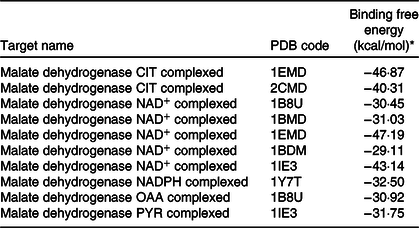
PDB, Protein Data Bank; CIT, citrate; OAA, oxaloacetate; PYR, pyruvic acid.
* To convert kcal to kJ, multiply it by 4·184.
Naringenin exhibited lower binding energy values when the interaction occurred on the cofactor binding sites of the bacterial enzymes IDH (NADP binding site) and MDH (NAD+ complexed), with a calculated energy of −198·32 kJ/mol and −197·44 kJ/mol, respectively.
On Autodock4 molecular docking was possible to compare the energy of interaction of naringenin, l-malate, and NAD+ with the human MDH in distinct conformations. Results are summarised in Table 3.
Summary of molecular docking experiments of naringenin, NAD+ and l-malate on human malate dehydrogenase

PDB, Protein Data Bank.
* To convert kcal to kJ, multiply it by 4·184.
The interaction between human MDH and NAD+ is much stronger than the interaction between MDH and naringenin and MDH and malate, suggesting naringenin is not able to compete straight with NAD+ for the binding site. When structures 4WLN and 4WLV were employed for docking simulations, it was possible to observe that naringenin has the ability to bind on the l-malate site with lower energy (4WLN: −35·31 kJ /mol; 4WLV: −34·48 kJ/mol) than the l-malate itself (4WLN: −34·77 kJ/mol; 4WLV: −33·56 kJ/mol), suggesting that naringenin could replace l-malate molecule in the binding site prior to the binding of NAD+ (Fig. 3).
Overlapping of l-malate (purple), NAD+ (carbon atoms in grey) and naringenin (carbon atoms in white).

Residue interaction
In order to study interactions at the molecular level between the bacterial IDH and MDH and naringenin, docking simulations were performed to describe the presence or absence of protein–ligand interactions and to understand how these interactions are established (hydrogen bonds, hydrophobic, etc.). Another concern was to know in which residues of the protein these interactions are identified.
The results of the docking simulation of bacterial IDH and MDH are shown in Tables 4 and 5, respectively. Referring to IDH and naringenin, four hydrogen bonds were demonstrated with the interacting residues of Lys82, Gly581, Ans85 and Arg145. It was also showed a hydrophobic interaction with Pro84. The distance between the interactions is between 2 and 4·6 Å.
Summary of ligand interactions of naringenin and isocitrate dehydrogenase

Summary of ligand interactions of naringenin and malate dehydrogenase

Regarding MDH and naringenin, five hydrogen bonds were demonstrated with the interacting residues of Asp34, Cit313, Gly11, Arg80 and Asn11. It was also showed two hydrophobic interactions with Arg80 and Ile12. The distance between the interactions is between 2 and 5 Å.
A model of the residue interaction is presented in Fig. 4.
Isocitrate dehydrogenase (a) and malate dehydrogenase (b). Potential hydrogen bonds are dotted in green, and π-interactions are dotted in pink. Residues are shown as sticks and coloured orange. Naringenin is present as sticks in grey colour, oxygens are in red and hydrogens in white.

Regarding human MDH, we found that naringenin can interact in the l-malate binding site (Fig. 5), at the Arg176, Pro99, Gly101, Val102, Ans142 and Gly234 residues. The l-malate interaction in the binding site also occurs through Arg176 and Gly234 residues, but does not share the remaining interaction found with the naringenin, connecting with Arg104, Arg110 and His200 (Fig. 6).
Network of naringenin interactions at the l-malate binding site. Data obtained from the docking of naringenin in the malate dehydrogenase (MDH) apo structure (4WLN). Naringenin is shown in ball and sticks representation, and main interactions are depicted as yellow dashes. The distance between atoms was measured in Å.

Detailed representation of l-malate interactions network in the binding site of malate dehydrogenase (MDH). Data obtained from docking using the MDH apo structure (4WLN). l-Malate is shown in ball and sticks representation, and main interactions are depicted as yellow dashes. The distance between atoms was measured in Å.

Discussion
Nowadays, society claims for healthier habits, including a massive antioxidant supplementation. However, the consumption of high levels of antioxidants, in fact, failed to bring the expected benefits, beyond stimulating carcinogen cell growth and even increasing the risk of cancer(Reference DeNicola, Karreth and Humpton16,Reference Ginter, Simko and Panakova26,Reference Omenn, Goodman and Thornquist57) . Herein, it was aimed to assess whether the naringenin supplementation during pregnancy could impact the mitochondrial metabolism in the cerebellum. Our results showed that naringenin intake during pregnancy produces adaptations in the TCA cycle in offspring’s cerebellum, decreasing IDH, α-KGDH and MDH activities. Polyphenols as naringin (10, 20 and 40 mg/kg), morin (40 mg/kg) and epicatechin (20 mg/kg), at different periods of administration in adult rat (21–56 d), do not change TCA cycle enzymes activities in the heart(Reference Al Numair, Chandramohan and Alsaif1,Reference Jayachandran, Vasanthi and Rajamanickama39,Reference Rajadurai and Prince61,Reference Stanely Mainzen Prince70) . However, banana flavonoids decreased MDH activity in male rat liver, administered at 0·1 mg/kg per d for 45 d(Reference Vijayakumar, Presannakumar and Vijayalakshmi78).
To confirm the effect of naringenin on TCA enzymes, we assessed the in vitro effect of naringenin on commercially available purified dehydrogenases, in order to exclude tissue influences. We used a blood compatible concentration of naringenin in this study(Reference Mata-Bilbao Mde, Andres-Lacueva and Roura49,Reference Sun, Zhao and Zuo72) . A significant reduction on α-KGDH (60 %) and MDH (70 %) was observed, which is comparable to the results obtained in the cerebellum of pups submitted to maternal naringenin administration. Considering that naringenin supplementation during pregnancy reduced specifically the dehydrogenases from TCA cycle, and it was recently found that polyphenols might compete with nicotinamide derivatives by the enzyme site binding(Reference Islam, Sharma and Adem37), we hypothesised that naringenin can surpass the placental barrier(Reference Arola-Arnal, Oms-Oliu and Crescenti2,Reference Cao, Pu and Cao13,Reference Nigam, Bush and Martovetsky56,Reference Schroder-van der Elst, van der Heide and Rokos66) and bind specifically in NAD+ site, inhibiting the TCA cycle dehydrogenases.
To clarify this idea, we tested bacterial and human TCA cycle enzymes on different docking models to evaluate if naringenin could really interact with the protein structures, and the results are strongly correlated with the in vitro and in vivo naringenin effect. We show that both in bacterial and human enzymes, naringenin was able to bind at different enzyme sites, being the binding with the bacterial IDH and MDH most probable at the site of the cofactor NAD+. In the human MDH, the binding seems to occupy the malate site more strongly than the substrate itself in the apo state, being able to prevent or delay the enzymatic reaction. When docking was realised in other states of the enzyme, naringenin also shows binding potential. Binding free-energy values are known to provide an important idea of the affinity in the interaction of proteins to diverse compounds, being well used in the discovery of new drugs(Reference Broomhead and Soliman9,Reference Christ and Fox15) .
The most part of bacterial enzymes interactions have occurred by means of hydrogen bonds and hydrophobic interactions, which make a large contribution to protein–ligand stability(Reference Gholami and Bordbar25,Reference Weng, Fu and Jiang80) , and present maximum 5 Å distance. In human MDH, the interaction with the enzyme at the malate site has demonstrated to share two residues in relation to the substrate bound and this reaction is more favourable to naringenin than to malate, presenting 1·9–3·2 Å distance between interactions.
Taking into account that naringenin could interact with the TCA enzymes prior to the substrate, we have shown that naringenin inhibits the TCA dehydrogenases and may affect the brain mitochondrial energy metabolism, as demonstrated in the in vivo, in vitro and in silico experiments. A recent study has shown that a diet rich in polyphenols in the third trimester of pregnancy cause fetal ductal constriction(Reference Zielinsky, Piccoli and Manica89), and the effect identified is further evidence that high consumption of polyphenols during pregnancy may bring negative adaptations to the fetus.
Conclusion
Maternal diet could affect brain metabolic programming of the fetus. We have demonstrated that naringenin supplementation during pregnancy inhibits TCA cycle dehydrogenases in the cerebellum of rat pups. In vitro experiments confirmed that naringenin reduces TCA cycle dehydrogenases activities, probably acting directly on substrate and cofactor site as demonstrated by the molecular docking approach. Our findings suggest that polyphenols supplementation during pregnancy should be carefully evaluated, considering the interference in essential enzymes for energy metabolism, jeopardising brain development.
Acknowledgements
This work was supported by Conselho Nacional de Desenvolvimento Científico e Tecnológico (CNPq – Universal 442406/2014-2 and INCT 465671/2014-4), and Pró-Reitoria de Pesquisa/Universidade Federal do Rio Grande do Sul (PROPESQ/UFRGS).
All authors had substantial involvement in the study design, data acquisition, analysis and interpretation. In addition, all authors read and approved the final document.
The authors declare that they have no conflicts of interest.



