





1. Introduction
The operator of linear elasticity is one of the fundamental operators of mathematical physics, describing the deformation of an (isotropic) elastic body. The main thrust of this paper is to derive an explicit formula for the second asymptotic term (often called second Weyl coefficient) in the expansion of the eigenvalue counting function for the operator of linear elasticity with mixed boundary conditions on a smooth $d$ -dimensional Riemannian manifold with boundary. This paper complements the analysis performed in [Reference Capoferri, Friedlander, Levitin and Vassiliev7], where the two cases of ‘pure’ Dirichlet and free boundary conditions were examined.
The structure of the paper is as follows.
In §§ 1.1 and 1.2 we introduce setting and notation, before stating the problem and our main results in §§ 1.3.
§ 2 is devoted to the proof of our main result, theorem 1.8. The proof comes in several steps: first we present a streamlined version of the algorithm for the calculation of the second asymptotic term (§§ 2.1); secondly, we reduce the problem at hand to the two-dimensional analogue plus a much simpler $(d-2)$ -dimensional problem by identifying appropriate invariant subspaces (§§ 2.2); lastly, we prove our main result by implementing the algorithm in each invariant subspace separately (§§ 2.3).
In § 3 we examine explicit examples in dimensions two and three. This is an integral part of the paper which serves both as an illustration and a verification of our results. Remarkably, for two- and three-dimensional flat cylinders we write down the full spectrum of the operator of linear elasticity with mixed boundary conditions explicitly, and compute the two-term spectral asymptotics analytically.
1.1. The operator of linear elasticity
Let $(M,\,g)$ be a compact connected smooth Riemannian manifold of dimension $d\ge 2$
 with boundary $\partial M$
 . We denote by $\nabla$
 the Levi-Civita connection and by $\mathrm {Ric}$
 the Ricci curvature tensor.
We define the operator of linear elasticity $\mathcal {L}$ acting on vector fields $\mathbf {u}$
 on $M$
 as
as

Here and further on we adopt the Einstein summation convention over repeated indices. The quantities $\lambda$ and $\mu$
 are real constants known as Lamé parameters, assumed to satisfy the conditions

which guarantee strong convexity, see, e.g., [Reference Agranovich, Amosov and Levitin1, Reference Miyanishi and Rozenblum24]. Furthermore, we assume that the material density of the of the elastic medium $\rho _\mathrm {mat}$ differs from the Riemannian density $\sqrt {\det g}$
 by a constant positive factor.
The principal symbol $\mathcal {L}_\mathrm {prin}$ of $\mathcal {L}$
 readsFootnote 1

which, on account of (1.2), immediately implies that $\mathcal {L}$ is elliptic. Indeed, the eigenvalues of $\mathcal {L}_\mathrm {prin}$
 are
are

Clearly, the operator $\mathcal {L}$ is formally self-adjoint with respect to the $L^2$
 inner product

1.2. Boundary value problems
Consider the potential energy of elastic deformation

associated with the vector field of displacements $\mathbf {u}$ . The quadratic form $\mathcal {E}[\mathbf {u}]$
 is nonnegative for $\mathbf {u}\in H^1(\Omega )$
 and strictly positive for $\mathbf {u}\in H^1_0(\Omega )$
 . Observe that the structure of the quadratic functional (1.5) of linear elasticity is the result of certain geometric assumptions, see [Reference Capoferri and Vassiliev10, formula (8.28)], as well as [Reference Capoferri and Vassiliev9, Example 2.3 and formulae (2.5a), (2.5b) and (4.10e)].
Performing integration by parts in (1.5) one obtains the Green identity for the elasticity operator

where $\mathcal {T}$ is the boundary traction operator defined as

Here $\mathbf {n}$ is the exterior unit normal vector to the boundary $\partial M$
 .
.
Examination of (1.6) supplies appropriate boundary conditions for $\mathcal {L}$ . In the current paper, we will be concerned with the following four sets of boundary conditions.
• Dirichlet boundary conditions:
(1.7)\begin{equation} \left.\mathbf{u}\right|_{\partial M}=0. \end{equation}
• Free boundary conditions:
(1.8)\begin{equation} \left.\mathcal{T}\mathbf{u}\right|_{\partial M}=0. \end{equation}
• Dirichlet-free (DF) boundary conditions:
(1.9)\begin{equation} \left.\left[\mathbf{u} -\left(g_{\alpha\beta}\,n^\alpha u^\beta\right)\,\mathbf{n}\right]\right|_{\partial M}=0\,, \qquad \left.g_{\alpha\beta}\,n^\alpha (\mathcal{T}\mathbf{u})^\beta\right|_{\partial M}=0\,. \end{equation}
• Free-Dirichlet (FD) boundary conditions:
(1.10)\begin{equation} \left.\left[\mathcal{T}\mathbf{u} -\left(g_{\alpha\beta}\,n^\alpha (\mathcal{T} u)^\beta\right)\,\mathbf{n}\right]\right|_{\partial M}=0\,, \qquad \left.g_{\alpha\beta}\,n^\alpha u^\beta\right|_{\partial M}=0\,. \end{equation}


We refer to the boundary conditions DF and FD as mixed boundary conditions. The former (DF) corresponds to Dirichlet boundary conditions being imposed tangentially to the boundary and free conditions imposed in the normal direction to the boundary; the latter (FD) corresponds to free boundary conditions being imposed tangentially to the boundary and Dirichlet conditions imposed in the normal direction to the boundary.
The boundary conditions (1.7)–(1.10) are of Shapiro–Lopatinski type [Reference Krupchyk and Tuomela21] for $\mathcal {L}$ , hence the corresponding boundary value problems are elliptic. This leads to the following four eigenvalue problems for $\mathcal {L}$
 .
.
1. The Dirichlet problem (Dir). The Dirichlet eigenvalue problem consists in seeking $\mathbf {u}\in H^1(\Omega )$
, $\mathbf {u} \ne 0$, and $\Lambda \in \mathbb {R}$ such that
(1.11)\begin{equation} \mathcal{L}\mathbf{u}=\Lambda \mathbf{u} \end{equation}subject to the boundary conditions (1.7). The problem (1.11), (1.7) has discrete spectrum, consisting of discrete eigenvalues
\[ (0<)\Lambda_1^\mathrm{Dir}\le \Lambda_2^\mathrm{Dir}\le \dots \]enumerated with account of multiplicity and accumulating to $+\infty$
.2. The free boundary problem (free). The free boundary eigenvalue problem consists in seeking $\mathbf {u}\in H^1(\Omega )$
, $\mathbf {u} \ne 0$, and $\Lambda \in \mathbb {R}$ satisfying (1.11), subject to the boundary conditions (1.8). The problem (1.11), (1.8) has discrete spectrum, consisting of discrete eigenvalues
\[ (0\le)\Lambda_1^\mathrm{free}\le \Lambda_2^\mathrm{free}\le \dots \]enumerated with account of multiplicity and accumulating to $+\infty$
.3. The Dirichlet-free problem (DF). The Dirichlet-free eigenvalue problem consists in seeking $\mathbf {u}\in H^1(\Omega )$
, $\mathbf {u} \ne 0$, and $\Lambda \in \mathbb {R}$ satisfying (1.11), subject to the boundary conditions (1.9). The problem (1.11), (1.9) has discrete spectrum, consisting of discrete eigenvalues
\[ (0\le)\Lambda_1^{\mathrm{DF}}\le \Lambda_2^{\mathrm{DF}}\le \dots \]enumerated with account of multiplicity and accumulating to $+\infty$
.4. The free-Dirichlet problem (FD). The free-Dirichlet eigenvalue problem consists in seeking $\mathbf {u}\in H^1(\Omega )$
, $\mathbf {u} \ne 0$, and $\Lambda \in \mathbb {R}$ satisfying (1.11), subject to the boundary conditions (1.10). The problem (1.11), (1.10) has discrete spectrum, consisting of discrete eigenvalues
\[ (0\le)\Lambda_1^{\mathrm{FD}}\le \Lambda_2^{\mathrm{FD}}\le \dots \]enumerated with account of multiplicity and accumulating to $+\infty$
.


Remark 1.1 The problems $\mathrm {Dir}$ , $\mathrm {free}$
 , DF and FD also admit a minmax formulation. We refer the interested reader to [Reference Levitin, Monk and Selgas23] for details.
Let us briefly elaborate on the physical meaning of the above eigenvalue problems. The spectral parameter $\Lambda$ appearing in (1.11) has the following interpretation

where $\omega$ is the angular natural frequency of oscillation of the elastic medium. The boundary conditions $\mathrm {Dir}$
 (1.7) describe a body whose boundary is ‘clamped’, i.e., completely prevented from moving, whereas the conditions $\mathrm {free}$
 (1.8) describe the opposite situation, in which the boundary is free to oscillate without restrictions. Mixed DF boundary conditions describe a body that is allowed to deform in the direction normal to the boundary, but is prevented from deforming in the directions tangential to the boundary. Similarly, mixed FD boundary conditions describe a body that is allowed to ‘slide’ along its boundary, but is prevented from deforming in the direction normal to the boundary. Clearly, mixed boundary conditions are physically meaningful and describe realistic scenarios relevant for applications — see also [Reference Levitin, Monk and Selgas23] for further discussions in this respect.
1.3. Statement of the problem and main results
Consider, for each set of boundary conditions $\aleph \in \{\mathrm {Dir},\,\mathrm {free},\, \mathrm {DF},\, \mathrm {FD}\}$ , the corresponding eigenvalue counting function $N_\aleph :\mathbb {R}\to \mathbb {N}$
 defined as

Clearly, the function (1.12) is monotonically non-decreasing in $\Lambda$ and vanishes identically for $\Lambda \le \Lambda _1^\aleph$
 .
.
The study of the asymptotic behaviour of eigenvalue counting functions of the type (1.12) as $\Lambda \to +\infty$ for (semibounded) elliptic operators is a well established area of mathematics, pioneered by Lord Rayleigh's The theory of sound [Reference Strutt and Rayleigh26] in 1877. What started as an investigation prompted by practical questions from physics soon attracted the interest of pure mathematicians, as people realized that the coefficients in these expansions contain geometric invariants (see, e.g., [Reference Levitin, Mangoubi and Polterovich22, Chapter 6]). We refer the reader to [Reference Arendt, Nittka, Peter and Steiner3, Reference Ivrii20, Reference Safarov and Vassiliev27] for historical overviews of the development of the subject.
Before stating our main result, let us summarize, without proof, some known facts concerning (1.12). In what follows $(M,\,g)$ satisfies the conditions from §§ 1.1.
Proposition 1.2 We have

where

is the Weyl constant for linear elasticity, $\operatorname {Vol}_d(M)$ is the Riemannian volume of $M$
 , and $\Gamma$
 is the gamma function.
The one-term asymptotic expansion (1.13) is often referred to as Weyl law. Note that in the special case $d=3$ formula (1.13) was already established, indirectly and on the basis of physical arguments, by P. Debye in 1912 [Reference Debye14]. A rigorous mathematical proof was provided shortly afterwards by H. Weyl [Reference Weyl30]. It is worth emphasizing that the coefficient $a$
 is independent of the choice of boundary conditions.
Let $\mathcal {A}$ be an elliptic semibounded differential operator of even order $2\,m$
 acting between sections of Hermitian $C^\infty$
 vector bundles of dimension $N$
 over a smooth $d$
 -dimensional manifold $M$
 with boundary, supplemented by differential boundary conditions $\mathcal {B}$
 satisfying the (parabolic version of the) Shapiro–Lopatniski conditions [Reference Agranovich and Vishik2]. Then it is known [Reference Greiner16, Theorem 2.6.1] that the trace of the Green kernel $G(x,\,y,\,t)$
 for the boundary value problem

admits a complete asymptotic expansion

where $\mathrm {tr}$ stands for matrix trace. Moreover, all coefficients in (1.15) are locally determined [Reference Greiner16, §2]. We refer the reader to [Reference Grubb18], [Reference Grubb17, §4.2] and references therein for further details and generalizations.
Formula (1.15) allows us to define Weyl coefficients for elliptic operators on manifolds with boundary.
Definition 1.3 For $1\le n\le d$ , we define the $n$
 -th Weyl coefficient for the elliptic boundary value problem $(\mathcal {A},\,\mathcal {B})$
 to be the number

where the $\widetilde {c}_{d-n}$ is the coefficient of $t^{-{d}/{2m}+({n-1})/{2m}}$
 in the expansion (1.15) and $\Gamma$
 is the gamma function.
Remark 1.4 Note that definition 1.3 agrees with the definition of Weyl coefficients in [Reference Avetisyan, Sjöstrand and Vassiliev4, Reference Capoferri6, Reference Capoferri, Levitin and Vassiliev8, Reference Capoferri and Vassiliev11, Reference Capoferri and Vassiliev12] for (pseudo)differential operators on compact manifolds without boundary, where Weyl coefficients are defined to be the coefficients appearing in the complete asymptotic expansion for the mollified derivative of the counting function. Whilst such a complete asymptotic expansion always exists when $\partial M=\emptyset$ (see, e.g., [Reference Ivrii19]), we are unaware of a similar result for manifolds with boundary. This is why in the latter case defining Weyl coefficients is somewhat more delicate.
We should also point out that the standard convention in the literature is to call Weyl coefficients the constants appearing in the asymptotic expansion of the mollified counting function, as opposed to its derivative. The two definitions are, effectively, the same up to integrating factors; as a matter of convenience and consistency with previous papers by the first author, we will stick here with definition 1.3.
Fact 1.5 Suppose that the eigenvalue counting function $N(\Lambda )$ of the elliptic eigenvalue problem

admits a $j$ -term asymptotic expansion

for some $1\le j \le d$ . Then

Remark 1.6 We should like to emphasize that Weyl coefficients (1.16) are defined — and can be computed — irrespective of whether an asymptotic expansion for the eigenvalue counting function of the form (1.17) exists.
Of course, when $\mathcal {A}=\mathcal {L}$ and $\mathcal {B}=\mathcal {B}_\aleph$
 , $\aleph \in \{\mathrm {DF},\, \mathrm {FD }\}$
 , formula (1.15) specializes to read

where the first asymptotic term has been written explicitly in terms of (1.14) — cf. (1.13) and (1.18).
Whilst the existence of a one-term asymptotic expansion (Weyl's law) is always guaranteed — see proposition 1.2 — the validity of a two-term expansion of the form (1.17) for $\mathcal {L}$ with boundary conditions $\mathcal {B}_\aleph$
 , $\aleph \in \{\mathrm {Dir},\, \mathrm {free},\, \mathrm {DF},\, \mathrm {FD}\}$
 , is still an open problem. Nevertheless, such an expansion is known to exist under additional dynamical assumptions on certain branching Hamiltonian billiards on the cotangent bundle $T^*M$
 . We recall the result below, referring the reader to [Reference Vasil'ev29] for additional details and precise statements.
Theorem 1.7 Suppose that $(M,\,g)$ is such that the corresponding billiards is neither absolutely periodic nor dead-end. Then

for any set of boundary conditions $\aleph \in \{\mathrm {Dir},\, \mathrm {free},\, \mathrm {DF},\, \mathrm {FD}\}$ .
.
Theorem 1.7 is a special case of [Reference Vasil'ev28, Theorem 6.1], which is applicable here because the eigenvalues (1.4) of $\mathcal {L}_\mathrm {prin}$ have constant multiplicity as functions of $(x,\,\xi )\in T^*M\setminus \{0\}$
 .
.
We are now ready to state our main result.
Theorem 1.8 Let $(M,\, g)$ be a smooth compact connected $d$
 -dimensional Riemannian manifold with boundary $\partial M$
 , $d\ge 2$
 . The second Weyl coefficient for the elliptic boundary value problem $(\mathcal {L},\, \mathcal {B}_\aleph )$
 , $\aleph \in \{\mathrm {DF},\, \mathrm {FD}\}$
 , is given by

where

The above theorem, whose proof will be given in § 2, warrants a number of remarks.
(i) Formulae for $b_\aleph$
in the case of ‘pure’ boundary conditions $\aleph \in \{\mathrm {Dir},\, \mathrm {free}\}$ were obtained in [Reference Capoferri, Friedlander, Levitin and Vassiliev7, Theorem 1.8]Footnote 2 .(ii) Remarkably, formula (1.21) is very simple and elegant. This is noteworthy and in general not the case for boundary value problems for linear elasticity, in that one would expect the Lamé parameters $\lambda$
and $\mu$ to mix up in a rather complicated way in the second Weyl coefficient, owing to boundary conditions mixing longitudinal and transverse waves. For instance, the expressions for $b_\mathrm {Dir}$ and $b_\mathrm {free}$ contain integrals of inverse trigonometric functions depending on $\alpha :={\mu }/{\lambda +2\mu }$ in a nontrivial fashion, see [Reference Capoferri, Friedlander, Levitin and Vassiliev7, formulae (1.27) and (1.28)]. The underlying reason for (1.21) being so simple is that mixed boundary conditions $\mathrm {DF}$ and $\mathrm {FD}$, unlike $\mathrm {Dir}$ and $\mathrm {free}$, do not mix up components of the vector fields they act upon when one switches to the associated one-dimensional spectral problem — see § 2.1, and formula (2.3) in particular.(iii) Note that
(1.22)\begin{equation} b_{FD}<0< b_{DF} \end{equation}for $d=2$
, whereas
(1.23)\begin{equation} b_{DF}<0< b_{FD} \end{equation}for $d\ge 3$
.(iv) We should like to emphasize that computing the second Weyl coefficient for systems of PDEs is not easy. Indeed, the subject area of two-term asymptotics for elliptic systems has experienced a troubled development, up until the last decade; we refer the reader to [Reference Chervova, Downes and Vassiliev13, Section 11] for a historical overview.
(v) In this paper we prove theorem 1.8 by studying the eigenvalue counting function. There are, of course, alternative approaches to the problem available in the literature, for instance by means of heat kernel techniques — see, e.g., [Reference Branson, Gilkey, Ørsted and Pierzchalski5].




Before moving on to the proof of our main theorem, let us recall a well known fact which will bring about some simplifications in subsequent sections.
Fact 1.9 The first two Weyl coefficients do not feel the geometry of $M$ or of its boundary $\partial M$
 . Therefore, it suffices to determine these coefficients in the case where $M$
 is a smooth domain in $\mathbb {R}^d$
 equipped with the Euclidean metric.
2. Proof of theorem 1.8
This section is concerned with the proof of theorem 1.8. We will break the proof, somewhat long and technical, into several steps.
On account of Fact 1.9, in the remainder of this section we will assume that $M$ is a smooth domain in $\mathbb {R}^d$
 and that $g$
 is the Euclidean metric, $g_{\alpha \beta }=\delta _{\alpha \beta }$
 .
.
2.1. A streamlined algorithm
In order to prove theorem 1.8 we will rely on a constructive algorithm for the second Weyl coefficient due to Vassiliev [Reference Vasil'ev28]. The original results from [Reference Vasil'ev28] (see also [Reference Safarov and Vassiliev27]) apply, strictly speaking, to scalar operators. A roadmap for the generalization to systems was given in [Reference Vasil'ev28, § 6], whereas a detailed exposition of the algorithm for systems was recently provided in [Reference Capoferri, Friedlander, Levitin and Vassiliev7]. For the convenience of the reader, we present below a streamlined version of the latter algorithm, adapted to the special case of the operator of linear elasticity (1.1).
In a neighbourhood of the boundary $\partial M$ we introduce local coordinates $x=(x',\,z)$
 , with $x'\in \mathbb {R}^{d-1}$
 and $z:=\operatorname {dist}(x,\,\partial M)$
 for $x\in \operatorname {Int} (M)$
 , so that $\partial M=\{z=0\}$
 and $z>0$
 inside of $M$
 . Similarly, we adopt the notation $\xi =(\xi ',\,\zeta )\in \mathbb {R}^{d-1}\times \mathbb {R}$
 and $\mathbf {u}=(\mathbf {u}',\, u_d)$
 . Furthermore, we denote by $\mathcal {B}_\aleph$
 the differential operators implementing the boundary conditions (1.9) and (1.10) for $\aleph =\mathrm {DF}$
 and $\aleph =\mathrm {FD}$
 , respectively.
Consider the one-dimensionalFootnote 3 spectral problem

where $\mathcal {L}'$ and $\mathcal {B}_\aleph '$
 are the ordinary differential operators acting on vector functions $\mathbf {u}=\mathbf {u}(z)$
 defined in accordance with

and

The operators (2.2) and (2.3) are obtained from $\mathcal {L}$ and $\mathcal {B}_\aleph$
 , $\aleph \in \{\mathrm {DF},\,\mathrm {FD}\}$
 , by replacing partial derivatives along the boundary with $i$
 times the corresponding component of momentum, $\partial _{x'}\mapsto i\xi '$
 . Furthermore, in the second component of $\mathcal {B}'_\mathrm {DF}\mathbf {u}$
 we dropped terms proportional to $\mathbf {u}'(0)$
 , whereas in the first component of $\mathcal {B}'_\mathrm {FD}\mathbf {u}$
 we dropped terms proportional to $u_d(0)$
 .
.
Suppose $\xi '\ne 0$ .
.
Step 1: Thresholds and continuous spectrum. The principal symbol $\mathcal {L}'_\mathrm {prin}(\zeta )$ of $\mathcal {L}'$
 (recall (1.3)) has eigenvalues

We define the thresholds of the continuous spectrum as the nonnegative real numbers $\Lambda _*$ such that the equation

has a multiple real root for either $k=1$ or $k=2$
 . Formula (2.4) immediately implies that we have two thresholds for (2.1):

Observe that, due to (1.2), we have $\Lambda _*^{(1)}<\Lambda _*^{(2)}$ .
.
Formula (2.5) then implies that the problem (2.1) has continuous spectrum $[\Lambda _*^{(1)},\, +\infty )$ — see, e.g., [Reference Safarov and Vassiliev27, Appendix A]. Furthermore, the thresholds partition the continuous spectrum into two zones $I^{(1)}:=(\Lambda _*^{(1)},\,\Lambda _*^{(2)})$
 and $I^{(2)}:=(\Lambda _*^{(2)},\,+\infty )$
 , where the continuous spectrum has multiplicity $d-1$
 and $d$
 , respectively.
Step 2: Eigenfunctions of the continuous spectrum. Let $\mathbf {v}_k(\zeta )$ , $k=1,\,\dots,\, d-1$
 , be orthonormalized eigenvectors of $\mathcal {L}'_\mathrm {prin}$
 corresponding to the eigenvalue $h_1(\zeta )$
 , and let

be the normalized eigenvector of $\mathcal {L}'_\mathrm {prin}$ corresponding to the eigenvalue $h_2(\zeta )$
 . Let
. Let

for $\Lambda \ge \mu |\xi '|^2$ and $\Lambda \ge (\lambda +2\mu )|\xi '|^2$
 , respectively. Note that the quantities $\zeta _k^\pm (\Lambda )$
 are solutions of $h_k(\zeta )-\Lambda =0$
 . Then, in view of elementary theory of matrix ordinary differential equations, we seek eigenfunctions of the continuous spectrum (or generalized eigenfunctions) for (2.1) in the form

for $\Lambda \in I^{(1)}$ , and in the form

for $\Lambda \in I^{(2)}$ . The complex numbers $c_j^\pm$
 in (2.7) and (2.8) are called incoming (-) and outgoing (+) complex wave amplitudes, and are assumed not to be all zero.
Step 3: The scattering matrix. By imposing that (2.7) and (2.8) satisfy the boundary conditions, one can express the coefficients $c_j^+$ in terms of the coefficients $c_j^-$
 . This defines the scattering matrices $S^{(k)}(\Lambda )$
 , $k=1,\,2$
 , via the identities

and

The matrix $S^{(1)}(\Lambda )$ (resp. $S^{(2)}(\Lambda )$
 ) is a $(d-1)\times (d-1)$
 (resp. $d\times d$
 ) unitary matrix. The way in which the $c_j^\pm$
 are arranged into a $(d-1)$
 -dimensional (resp. $d$
 -dimensional) vector is unimportant and will not affect the quantities computed in the next steps.
Step 4: The phase shift. Compute the phase shift, defined as

where the branch of the multivalued function $\arg$ are chosen in such a way that $\varphi (\Lambda )$
 is continuous in each interval $I^{(k)}$
 , and the shifts $\mathfrak {s}^{(k)}$
 are constants determined by the requirement that the jump of the phase shift at the thresholds satisfy

Here $m_k$ is the multiplicity of the eigenvalue $h_k$
 and $j_*^{(k)}$
 is the number of linearly independent vectors $\mathbf {v}$
 such that

is a solution of the one-dimensional problem (2.1), with $\mathbf {f}(z)=o(1)$ as $z\to +\infty$
 . The threshold $\Lambda _*^{(k)}$
 is called rigid if $j_*^{(k)}=0$
 and soft if $j_*^{(k)}=m_k$
 .
.
Step 5: The one-dimensional counting function. Compute the one-dimensional counting function, defined as

Step 6: The spectral shift function. Compute the spectral shift function, defined as

Then we have the following.
Theorem 2.1 The second Weyl coefficientFootnote 4 is given by

Theorem 2.1 is a specialization to the case at hand of [Reference Vasil'ev29, Theorem 2] (once the latter has been extended to systems).
2.2. Invariant subspaces
Implementing the algorithm from subsection 2.1 as written for an arbitrary dimension $d$ is quite tricky. Rather than applying our algorithm to (1.11), (1.9) and (1.11), (1.10) directly, we shall first simplify the problem by decomposing the general $d$
 -dimensional problem into a two-dimensional analogue plus a much simpler $(d-2)$
 -dimensional problem. The arguments in this subsection can be traced back, in essence, to observations by Dupuis–Mazo–Onsager [Reference Dupuis, Mazo and Onsager15], see also [Reference Capoferri, Friedlander, Levitin and Vassiliev7, Section 3]. The key idea is to decompose elastic waves into two polarized components: one polarized in the plane of propagation and the other normally to it.
To this end, suppose we have fixed $\xi '\in \mathbb {R}^{d-1}$ , $\xi '\ne 0$
 , and define

Let $P^\perp$ be the orthogonal complement of $P$
 in $\mathbb {R}^d$
 . One can easily check the following facts.
Fact 2.2
(i) For every $\zeta \in \mathbb {R}$
the eigenvector $\mathbf {v}_d(\zeta )$ (2.6) is an element of $P$.(ii) For every $\zeta \in \mathbb {R}$
the orthogonal subspaces $P$ and $P^\perp$ are invariant subspaces of $\mathcal {L}_\mathrm {prin}(\xi ',\,\zeta )=\mathcal {L}'_\mathrm {prin}(\zeta )$ — recall (1.3).(iii) The restriction $\left.\mathcal {L}'_\mathrm {prin}\right |_{P^\perp }$
of $\mathcal {L}'_\mathrm {prin}$ to $P^\perp$ has one eigenvalue, $\mu |\xi |^2$, of multiplicity $d-2$.(iv) The restriction $\left.\mathcal {L}'_\mathrm {prin}\right |_{P}$
of $\mathcal {L}'_\mathrm {prin}$ to $P$ has two eigenvalues, $\mu |\xi |^2$ and $(\lambda +2\mu )|\xi |^2$, each of multiplicity $1$.


The decomposition $\mathbb {R}^{d}=P\oplus P^\perp$ induces a corresponding decomposition at the level of vector fields. Let


Proposition 2.3 The vector spaces (2.15) and (2.16) are invariant subspaces for the operator (2.2), compatible with mixed boundary conditions $\mathrm {DF}$ and $\mathrm {FD}$
 . Namely,

and

Proof. A generic element of $\mathbf {P}$ reads
reads

whereas a generic element of $\mathbf {P}^\perp$ reads
reads

where the $\psi _j$ 's, $j=1,\,\dots,\,d-2$
 , are linearly independent columns in $\mathbb {R}^{d-1}$
 orthogonal to $\xi '$
 .
.
Formula (2.17) follows from [Reference Capoferri, Friedlander, Levitin and Vassiliev7, Lemma 3.1(a)].
Substituting (2.19) and (2.20) into (2.3) we obtain


for $\aleph =\mathrm {DF}$ and
and


for $\aleph =\mathrm {FD}$ . Formulae (2.21)–(2.24) imply that mixed boundary conditions preserve our invariant subspaces, so that (2.18) holds. This concludes the proof.
Remark 2.4 The crucial property established by proposition 2.3 is expressed by formula (2.18). An analogue of proposition 2.3 for ‘pure’ Dirichlet and free boundary conditions was proved in [Reference Capoferri, Friedlander, Levitin and Vassiliev7]. That this extends to a mixture of the two is not clear a priori, because both the operator and boundary conditions mix up components in a nontrivial fashion. Indeed, if one, say, imposes different boundary conditions in different directions along the boundary, the statement of the proposition is false.
Let $\Pi _P$ be the orthogonal projection in $\mathbb {R}^d$
 onto $P$
 , and let us define

to be the restriction of the operator $\mathcal {L}'$ with boundary conditions $\aleph \in \{\mathrm {DF},\, \mathrm {FD}\}$
 to the invariant subspaces of its domain $D(\mathcal {L}'_\aleph )$
 induced by (2.15) and (2.16) by combining proposition 2.3 with a standard density argument. It then follows that operator $\mathcal {L}'_\aleph$
 decomposes as

so that, by the Spectral Theorem, we have

In other words, the spectral shift function for the problem (2.1) can be obtained by computing the spectral shift functions for $\mathcal {L}'_{P,\aleph }$ and $\mathcal {L}'_{\perp,\aleph }$
 separately, and adding up the results in the end.
By examining the structure of our equations, it is not hard to see that $\mathrm {shift}_{P,\aleph }$ coincides with the the spectral shift function for the problem (2.1) in the special case $d=2$
 (we will revisit this point more formally in subsection 2.3). Therefore, in view of theorem 2.1 and formula (2.27), the decomposition (2.26) reduces the problem at hand to computing
(i) the spectral shift function for (2.1) in two dimensions and
(ii) the spectral shift function of the restriction of our operator to normally polarized vector fields in arbitrary dimension $d>2$
.

2.3. The proof
We are now ready to prove theorem 1.8.
Due to rotational symmetry, we observe that the spectral shift function will only depend on $\xi '$ via its norm $|\xi '|$
 . Therefore, it suffices to implement our algorithm and determine the spectral shift function in the special case

The general case can then be recovered by rescaling the spectral parameter as

at the very end.
In the next two subsections we will assume that $\xi '$ has been chosen in accordance with (2.28).
2.3.1. Computing $\mathrm {shift}_{P,\aleph }$: the two-dimensional case.

On account of (2.28), the domain of $\mathcal {L}'_{P,\aleph }$ is comprised of vector functions of the form

Furthermore, $\mathcal {L}'_{P,\aleph }$ acts on (2.30) as the one-dimensional operator associated with the full elasticity operator in two spatial dimensions. More precisely, let $\mathcal {L}'_{2,\aleph }$
 be the one-dimensional operator (2.1) associated with the operator (1.1) for $d=2$
 and boundary conditions $\mathcal {B}_\aleph$
 . Then we have

See also Fact 2.2(iv). This implies

The goal of this subsection is then to prove the following.
Proposition 2.5 We haveFootnote 5

and $\mathbb {1}_A$ denotes the characteristic function of the set $A$
 .
.
In order to prove proposition 2.5 let us implement the algorithm from subsection 2.1. The associated one-dimensional spectral problem (2.1) has continuous spectrum $[\mu,\, +\infty )$ , with thresholds

The latter partition the continuous spectrum into two intervals $I^{(1)}=(\mu,\, \lambda +2\mu )$ and $I^{(2)}=(\lambda +2\mu,\, +\infty )$
 of multiplicity $1$
 and $2$
 , respectively.
The eigenfunctions of the continuous spectrum read

for $\Lambda \in I^{(1)}$ and
and

for $\Lambda \in I^{(2)}$ .
.
By imposing that (2.33) and (2.34) satisfy mixed boundary conditions (2.1), (2.3) we obtain the scattering matrices

and

Lemma 2.6 We have the following:


Proof. In accordance with (2.11), for $\Lambda =\Lambda _*^{(1)}$ we seek solutions in the form

for some constants $c_1$ and $c_2$
 . Substituting (2.39) into our boundary conditions one finds that when $\aleph =\mathrm {DF}$
 the function (2.39) satisfies boundary conditions for any $c_1\in \mathbb {R}$
 and $c_2=0$
 , whereas when $\aleph =\mathrm {FD}$
 the function (2.39) only satisfies boundary conditions for $c_1=c_2=0$
 . This gives us (2.37).
For $\Lambda =\Lambda _*^{(2)}$ we seek solutions in the form

for some constant $c$ . Now, it is easy to see that (2.40) satisfies $\mathrm {FD}$
 boundary conditions for any $c\in \mathbb {R}$
 , whereas it satisfies $\mathrm {DF}$
 boundary conditions only for $c=0$
 . This gives us (2.38) and completes the proof.
Lemma 2.7 The operator $\mathcal {L}'_{2,\aleph }$ does not have eigenvalues below or embedded into the continuous spectrum for either set of mixed boundary conditions $\aleph =\mathrm {DF},\,\mathrm {FD}$
 .
.
Proof. For $\Lambda \in (0,\,\mu )$ we seek an eigenfunction in the form

Substituting (2.41) into the $\mathrm {FD}$ boundary conditions we obtain

The latter has a nontrivial solution if and only if

But the characteristic equation (2.42) does not admit solutions in $(0,\,\mu )$ . The case of $\mathrm {DF}$
 is analogous, with no eigenfunctions in $(0,\,\mu )$
 , and we omit the details. All in all, there are no solutions below bottom of the essential spectrum for either set of mixed boundary conditions.
The threshold $\Lambda =\mu$ is not an eigenvalue. Indeed, an eigenfunction of the form

satisfies boundary conditions (2.3) only if $c=0$ .
.
For $\Lambda \in (\mu,\,\lambda +2\mu )$ we seek an eigenfunction in the form

Once again, the latter satisfies either set of mixed boundary conditions (2.3) only if $c=0$ . Therefore, there are no eigenvalues in $(\mu,\,\lambda +2\mu )$
 .
.
Finally, it is easy to see that $\Lambda =\lambda +2\mu$ is not an eigenvalue, and that there are no square integrable solutions of our one-dimensional spectral problem for values of the spectral parameter $\Lambda >\lambda +2\mu$
 .
.
Now, lemma 2.7 implies that the one-dimensional counting function vanishes identically. Therefore, on account of (2.13) and (2.9)–(2.10), combining (2.35), (2.36) with lemma 2.6 one arrives at (2.32).
2.3.2. Computing $\mathrm {shift}_{\perp,\aleph }$: normally polarized waves

Let us now examine our one-dimensional spectral problem restricted to the subspace $\mathbf {P}^\perp$ (2.16). The goal of this subsection is to prove the following.
Proposition 2.8 We have

In order to prove proposition 2.8 let us implement the algorithm from subsection 2.1.
One can easily check that when restricted to normally polarized waves the operator $\mathcal {L}'$ acts as

This implies that the one-dimensional spectral problem (2.1) for $\mathcal {L}'=\mathcal {L}'_{\perp,\aleph }$ has only one threshold

and the essential spectrum $[\mu,\, +\infty )$ has multiplicity $d-2$
 .
.
For $\Lambda >\mu$ the eigenfunctions of the continuous spectrum read

where $(\mathbf {e}_j)_\alpha =\delta _{j\alpha }$ .
.
By imposing that (2.45) satisfy mixed boundary conditions (2.3) we obtain the scattering matrices

where $I_{d-2}$ is the $(d-2)$
 -dimensional identity matrix.
Lemma 2.9 The threshold (2.44) is

Proof. In accordance with (2.11), for $\Lambda =\Lambda _*$ we seek solutions in the form

for some constants $c_j$ , $j=1,\,\ldots,\, d-2$
 . Substituting the latter into (2.3) one immediately sees that (2.48) satisfies $\mathrm {DF}$
 boundary conditions only if all the $c_j$
 's vanish, whereas it satisfies $\mathrm {FD}$
 boundary conditions for any choice of constants $c_j$
 's. Hence, one has (2.47).
Lemma 2.10 The operator $\mathcal {L}'_{\perp,\aleph }$ , $\aleph \in \{\mathrm {DF},\, \mathrm {FD}\}$
 , does not have eigenvalues, either below or embedded into the continuous spectrum.
Proof. For $\Lambda \in (0,\,\mu )$ we seek an eigenfunction in the form

But the latter does not satisfy either set of mixed boundary conditions unless all the constants $c_j$ vanish; therefore, there are no eigenvalues in $(0,\,\mu )$
 .
.
Finally, it is easy to see that there are no square integrable solutions of the one-dimensional spectral problem for values of the spectral parameter $\Lambda \ge \mu$ . Hence, there are no eigenvalues in $[\mu,\,+\infty )$
 either.
As in the previous subsection, lemma 2.10 implies that the one-dimensional counting function vanishes identically. Therefore, on account of (2.13) and (2.9)–(2.10), combining (2.46) with lemma 2.9 one arrives at (2.43).
2.3.3. Putting things together.
Combining proposition 2.5, proposition 2.8, and formulae (2.29), (2.27), (2.31) we obtain

Substituting (2.49) into (2.14) and integrating we arrive at (1.21). This completes the proof of theorem 1.8.
3. Explicit examples
In this section we verify our formulae for the second Weyl coefficients by examining the asymptotics of the eigenvalue counting function for explicit examples: the disk, and flat cylinders in dimensions $d=2$ and $d=3$
 .
.
The choice of examples is motivated by the fact that they possess the following properties.
(i) They allow for separation of variables for the operator of linear elasticity with mixed boundary conditions.
(ii) They satisfy the conditions on branching Hamiltonian billiards from theorem 1.7, so that the two-term asymptotics for the counting function is valid.
(iii) For flat cylinders, variables separate completely and one can write down the full spectrum explicitly. Therefore, unlike in [Reference Capoferri, Friedlander, Levitin and Vassiliev7], we can verify our formulae analytically, using asymptotic expansions for certain number-theoretic series determined by our eigenvalues.
3.1. Two-dimensional examples
3.1.1. The disk.
Let $M\subset \mathbb {R}^2$ be the unit disk and let us work in standard polar coordinates $(r,\,\theta )$
 . Following [Reference Morse and Feshbach25, Chapter XIII] (see also [Reference Levitin, Monk and Selgas23]), we introduce a fictitious third coordinate $z$
 orthogonal to the disk and seek solutions in the form

where $\hat {\mathbf {z}}$ is the unit vector in the direction of $z$
 and $\psi _j$
 , $j=1,\,2$
 , are auxiliary scalar potentials. Substituting (3.1) into (1.11) one obtains that the scalar potentials must satisfy the Helmholtz equations


But now the general solution to (3.2) regular at $r=0$ reads
reads

where the $J_k$ 's are Bessel functions of the first kind. By substituting (3.4) and imposing that (3.1) satisfies $\mathrm {DF}$
 boundary conditions

one obtains the secular equation

For $\mathrm {FD}$ boundary conditions one obtains an analogous formula, which we omit.
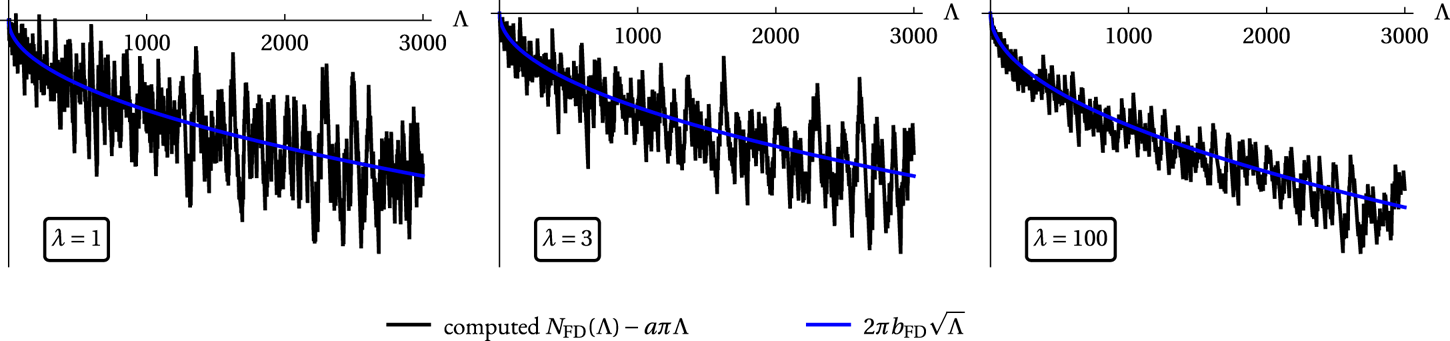
One can use Mathematica to find the zeroes of (3.5) (and the corresponding equation for $\mathrm {FD}$ boundary conditions) numerically and compute the eigenvalue counting function $N_\aleph (\Lambda )$
 , $\aleph \in \{\mathrm {DF},\, \mathrm {FD}\}$
 , for reasonably large values of the parameter $\Lambda$
 .
.
The numerical results are shown in figures 1 and 2.
The DF eigenvalue problem for the disk. In all images $\mu =1$ .
.

The FD eigenvalue problem for the disk. In all images $\mu =1$ .
.

3.1.2. Flat cylinders.
Consider the two-dimensional cylinder $M:=\mathbb {T}\times [0,\,h]$ , where $\mathbb {T}$
 is the one-dimensional torus and $h>0$
 is the height of the cylinder, equipped with coordinates $(x^1,\,x^2)\in [0,\,2\pi )\times [0,\,h]$
 . Of course,

We separate variables by seeking a solution in the form

where $\hat {\mathbf {z}}$ is the unit vector in the auxiliary coordinate $x^3$
 (orthogonal to the $(x^1,\,x^2)$
 -plane) and $\psi _j$
 , $j=1,\,2$
 , are scalar potentials. As in subsection 3.1.1, the scalar potentials satisfy Helmholtz equation (3.2), (3.3). The general solution for $\psi _j$
 , $j=1,\,2$
 , reads

Substituting (3.8) into (3.7) and, in turn, imposing boundary conditions $\mathcal {B}_{\mathrm {DF}}$ yields the secular equation

Similarly, imposing boundary conditions $\mathcal {B}_{\mathrm {FD}}$ yields the secular equation

A careful examination of (3.7)–(3.10) yields the following.
Theorem 3.1 T he eigenvalues of the Dirichlet-free (DF) eigenvalue problem for the operator of linear elasticity on the two-dimensional cylinder are:
(i) Eigenvalues
(3.11)\begin{equation} \frac{k^2\pi^2}{h^2}(\lambda+2\mu), \qquad k=1,2,\dots, \end{equation}with multiplicity $1$
.(ii) Eigenvalues
(3.12)\begin{equation} \frac{k^2\pi^2}{h^2}\mu, \qquad k=1,2,\dots, \end{equation}with multiplicity $1$
.(iii) Eigenvalues
(3.13)\begin{equation} n^2\,\mu, \qquad n=1,2,\dots, \end{equation}with multiplicity $2$
.(iv) Eigenvalues
(3.14)\begin{equation} \left(n^2+\frac{k^2\pi^2}{h^2}\right)\mu, \qquad n,k=1,2,\dots, \end{equation}with multiplicity $2$
.(v) Eigenvalues
(3.15)\begin{equation} \left(n^2+\frac{k^2\pi^2}{h^2}\right)(\lambda+2\mu), \qquad n,k=1,2,\dots, \end{equation}with multiplicity $2$
.


Theorem 3.2 The eigenvalues of the free-Dirichlet (FD) eigenvalue problem for the operator of linear elasticity on the two-dimensional cylinder are:
(i) Eigenvalues
(3.16)\begin{equation} \frac{k^2\pi^2}{h^2}(\lambda+2\mu), \qquad k=1,2,\dots, \end{equation}with multiplicity $1$
.(ii) Eigenvalues
(3.17)\begin{equation} \frac{k^2\pi^2}{h^2}\mu, \qquad k=1,2,\dots, \end{equation}with multiplicity $1$
.(iii) Eigenvalues
(3.18)\begin{equation} \left(n^2+\frac{k^2\pi^2}{h^2}\right)\mu, \qquad n,k=1,2,\dots, \end{equation}with multiplicity $2$
.(iv) Eigenvalues
(3.19)\begin{equation} n^2(\lambda+2\mu), \qquad n=1,2,\dots, \end{equation}with multiplicity $2$
.(v) Eigenvalues
(3.20)\begin{equation} \left(n^2+\frac{k^2\pi^2}{h^2}\right)(\lambda+2\mu), \qquad n,k=1,2,\dots, \end{equation}with multiplicity $2$
.


Observe that the DF (theorem 3.1) and the FD (theorem 3.2) spectra coincide, except for fact that the series of eigenvalues (3.13) in the DF spectrum is replaced by the series of eigenvalues (3.19) in the FD spectrum.
Theorems 3.4 and 3.5 allow us to write down the eigenvalue counting functions $N_{\mathrm {DF}}$ and $N_{\mathrm {FD}}$
 explicitly. They read


Here $\lfloor \,\cdot \, \rfloor$ denotes the integer part (floor function).
Let us verify formula (1.21) by computing the asymptotic expansions of (3.21) and (3.22) as $\Lambda \to +\infty$ .
.
Proposition 3.3 The functions (3.21) and (3.22) admit the following two-term asymptotic expansion:

with sign

Proof. Formula (3.23) follows from (3.22), (3.21), and the estimate

□
On account of (3.6), proposition 3.3 agrees with theorem 1.8 as well as formula (1.22).
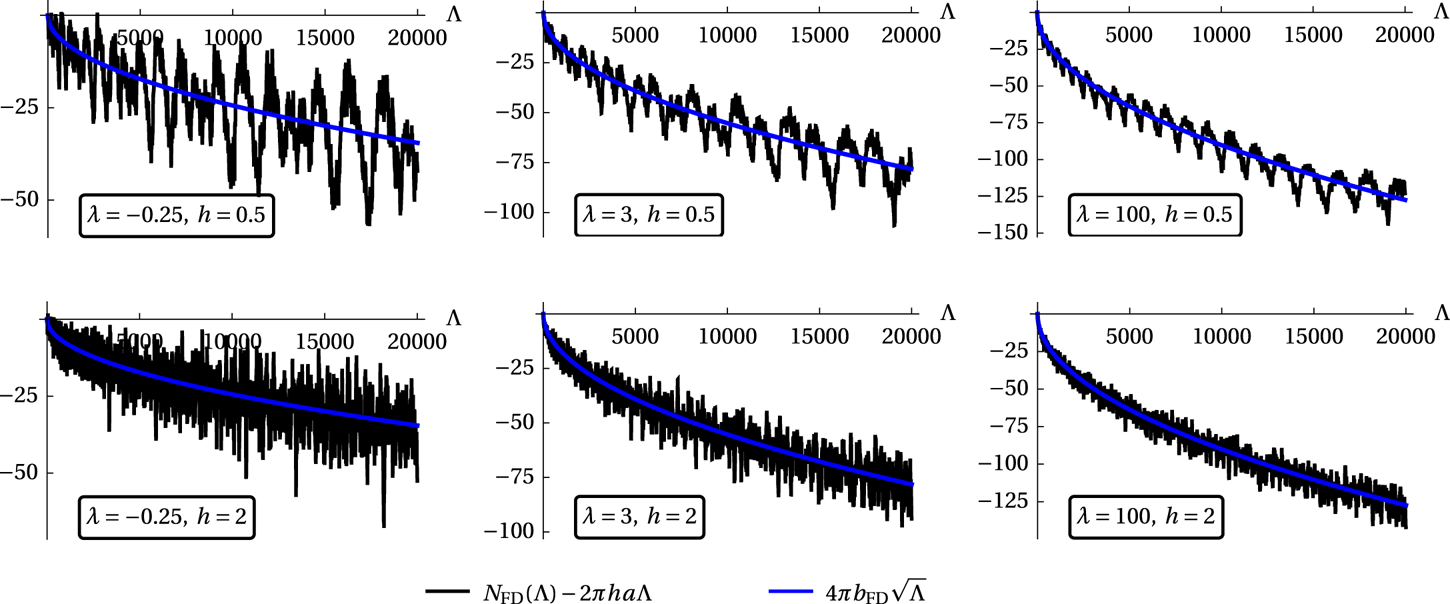
Figures 3 and 4 show a comparison between the actual counting functions (3.21), (3.22) and the two-term asymptotic expansions (3.23), (3.24).
The DF eigenvalue problem for 2D flat cylinders. In all images $\mu =1$ .
.

The FD eigenvalue problem for 2D flat cylinders. In all images $\mu =1$ .
.

3.2. Three-dimensional examples
3.2.1. Flat cylinders.
Consider the three-dimensional cylinder $M:=\mathbb {T}^2\times [0,\,h]$ , where $\mathbb {T}^2$
 is the flat two-dimensional torus with side $2\pi$
 and $h>0$
 is the height of the cylinder, equipped with coordinates $(x^1,\,x^2,\,x^3)\in [0,\,2\pi )^2\times [0,\,h]$
 . Of course,

We separate variables by seeking a solution in the form

where $\hat {\mathbf {z}}$ is the unit vector in the (positive) direction $x^3$
 and $\psi _j$
 , $j=1,\,2,\,3$
 , are scalar potentials. Once again, the scalar potentials satisfy Helmholtz equation (3.2), with $\omega _{1,\Lambda }$
 and $\omega _{2, \Lambda }$
 defined in accordance with (3.3), and $\omega _{3, \Lambda }:=\omega _{2, \Lambda }$
 . The general solution for $\psi _j$
 , $j=1,\,2,\,3$
 , reads

where $n:=\xi _1^2+\xi _2^2$ . Substituting (3.27) into (3.26) and, in turn, imposing boundary conditions $\mathcal {B}_{\mathrm {DF}}$
 at $x^3=0$
 and $x^3=h$
 yields the secular equation

Similarly, imposing boundary conditions $\mathcal {B}_{\mathrm {FD}}$ yields the secular equation

The $\mathrm {DF}$ (resp. $\mathrm {FD}$
 ) spectrum is a subset of the zeroes of (3.28) (resp. (3.29)). A direct examination of solutions of (3.28) and (3.29) yields the following.
Let $r_2:\mathbb {N} \to \mathbb {N}$ be the sum of squares function:

Theorem 3.4 The eigenvalues of the Dirichlet-free eigenvalue problem for the operator of linear elasticity on the three-dimensional flat cylinder are:
(i) Eigenvalues
(3.30)\begin{equation} \frac{k^2\pi^2}{h^2}(\lambda+2\mu), \qquad k=1,2,\dots, \end{equation}with multiplicity $1$
.(ii) Eigenvalues
(3.31)\begin{equation} n\,\mu, \qquad n=1,2,\dots, \end{equation}with multiplicity $r_2(n)$
.(iii) Eigenvalues
(3.32)\begin{equation} \left(n+\frac{k^2\pi^2}{h^2}\right)\mu, \qquad n,k=1,2,\dots, \end{equation}with multiplicity $2r_2(n)$
.(iv) Eigenvalues
(3.33)\begin{equation} \left(n+\frac{k^2\pi^2}{h^2}\right)(\lambda+2\mu), \qquad n,k=1,2, \dots, \end{equation}with multiplicity $r_2(n)$
.


Theorem 3.5 The eigenvalues of the free-Dirichlet eigenvalue problem for the operator of linear elasticity on the three-dimensional flat cylinder are:
(i) Eigenvalues
(3.34)\begin{equation} \frac{k^2\pi^2}{h^2}(\lambda+2\mu), \qquad k=1,2,\dots, \end{equation}with multiplicity $1$
.(ii) Eigenvalues
(3.35)\begin{equation} n\,\mu, \qquad n=1,2,\dots, \end{equation}with multiplicity $r_2(n)$
Footnote 6 .(iii) Eigenvalues
(3.36)\begin{equation} \left(n+\frac{k^2\pi^2}{h^2}\right)\mu, \qquad n,k=1,2,\dots, \end{equation}with multiplicity $2r_2(n)$
.(iv) Eigenvalues
(3.37)\begin{equation} n\,(\lambda+2\mu), \qquad n=1,2,\dots, \end{equation}with multiplicity $r_2(n)$
.(v) Eigenvalues
(3.38)\begin{equation} \left(n+\frac{k^2\pi^2}{h^2}\right)(\lambda+2\mu), \qquad n,k=1,2, \dots, \end{equation}with multiplicity $r_2(n)$
.


Observe that the DF (theorem 3.4) and the FD (theorem 3.5) spectra coincide, except for the additional series of eigenvalues (3.37) in the FD spectrum.
Theorems 3.4 and 3.5 allow us to write down the eigenvalue counting functions $N_{\mathrm {DF}}$ and $N_{\mathrm {FD}}$
 explicitly. They read


Let us verify formula (1.21) by computing the asymptotic expansions of (3.40) and (3.39) as $\Lambda \to +\infty$ .
.
Proposition 3.6 The functions (3.40) and (3.39) admit the following two-term asymptotic expansion:

with sign

Proof. Formula (3.42) follows from (3.40), (3.40), and the estimates

□
On account of (3.25), proposition 3.6 agrees with theorem 1.8 as well as formula (1.23).
Figures 5 and 6 show a comparison between the actual counting functions (3.39), (3.40) and the two-term asymptotic expansions (3.41), (3.42).
The DF eigenvalue problem for 3D flat cylinders. In all images $\mu =1$ .
.

The FD eigenvalue problem for 3D flat cylinders. In all images $\mu =1$ .
.

Acknowledgements
We are indebted to Michael Levitin, Yiannis Petridis and Dmitri Vassiliev for insightful conversations on aspects of this paper, and to Gerd Grubb and Grigori Rozenblum for useful bibliographic suggestions.
MC was partially supported by a grant of the Heilbronn Institute for Mathematical Research (HIMR) via the UKRI/EPSRC and by EPSRC Fellowship EP/X01021X/1. IM was supported by a MAC-MIGS Summer Internship (MAC-MIGS CDT, Maxwell Institute Graduate School, Edinburgh).






 Open access

