

There is a growing interest in the archaeology of light production (eg, Monteith et al. Reference Monteith, Yu, Cai and Zhao2022; Papadopoulos & Moyes Reference Papadopoulos and Moyes2022). The power to illuminate one’s surroundings quickly, safely, and efficiently is often taken for granted but this must have been a key challenge faced by our prehistoric ancestors. The timing of the controlled use of fire is a key question in human evolution. Fire, generating heat and light, extended daylight hours, provided warmth and protection, and enabled technological developments, such as cooking food and producing adhesives for hafting (Roebroeks & Villa Reference Roebroeks and Villa2011). As a focal point for social interaction and cohesion, fires also connected people.
Over time, new resources were used to produce light and heat, as in the case of flammable materials used as torches. Material culture has played an increasing role. Objects used in the production of sustained light, initially through lamps fashioned from stone with fuel and a wick, developed during the Palaeolithic (de Beaune Reference Beaune1987; Pettitt et al. Reference Pettitt, Leluschko and Sakamoto2022). These lamps were widely used in the Eurasian Middle–Upper Palaeolithic when cave art flourished and experimental investigations have confirmed the efficacy of these vessels compared to other forms of illumination (Medina-Alcaide et al. Reference Medina-Alcaide, Cabalín, Laserna, Sanchidrián, Torres, Intxaurbe, Cosano and Romero2019). The ability to illuminate one’s surroundings while on the move probably also facilitated hunting and fishing of a wide range of nocturnal animals.
One class of portable artefact, namely stone and ceramic lamps, has been directly associated with illumination. Perhaps the best examples are those used by Arctic populations, which are well-documented in archaeological, ethnographic, and historical accounts (eg, Hough Reference Hough1898; de Laguna Reference Laguna1940; Grønnow et al. Reference Grønnow, Applet, Odgaard and Gulløv2014). In the western North American Arctic, the oldest stone lamp was found on Kodiak Island and is associated with the Ocean Bay I tradition (from c. 7500 cal bp; Clark Reference Clark1966; Reference Clark, Peregrine and Ember2001). Although there is a possible specimen dating to the early stage of the Anangula tradition (c. 9000–7000 cal bp) on the Aleutian Islands, this has not been verified (McCartney & Veltre Reference McCartney, Veltre and West1996). By contrast, ceramic lamps were introduced during the Norton and Old Bering Sea cultures (c. 2500–1300 cal bp) throughout western and northern Alaska for heat and light (Collins Reference Collins1937; Giddings Reference Giddings1964; Dumond Reference Dumond1969; Griffin Reference Griffin1970).
In the northern North American Arctic, soapstone lamps appeared during the ASTt-derived Paleoinuit tradition Saqqaq culture (c. 2500–800 bc) (Grønnow et al. Reference Grønnow, Applet, Odgaard and Gulløv2014, 403) as small round lamps and continued to be used by Late Paleoinuit Dorset communities (c. 800 bc–ad 1300), and by the following Thule culture (c. ad 600–1500). Ceramic vessels, some of which may have been lamps, appeared briefly in the early Thule culture in the eastern Arctic and then disappeared. Overall, these vessels were essential for providing heat and light throughout the tundra zone where fuel was scarce, particularly during the dark winter months. In the central Canadian Arctic and Greenland, Dorset Paleoinuit perched soapstone pots on inclined rock slabs over stone lamps while Thule and Inuit cultures suspended stone pots over the flame of a soapstone lamp for rendering fat and parboiling marine mammal meat (Grønnow et al. Reference Grønnow, Applet, Odgaard and Gulløv2014; Frink & Harry Reference Frink, Harry, Jordan and Gibbs2019, 158–9). Throughout south-west Alaska, however, stone lamps were used for illumination rather than for cooking, using marine mammal oil as fuel (Fitzhugh Reference Fitzhugh1996). Organic residue analysis has recently demonstrated that aquatic fats or oils had been used as fuel in several stone lamps throughout the North American Arctic (Solazzo & Erhardt Reference Solazzo, Erhardt, Barnard and Eerkens2007; Admiraal et al. Reference Admiraal, Lucquin, Von Tersch, Jordan and Craig2019).
Ceramic analogues of these stone and ceramic lamps are widely documented among hunter-gatherer-fisher communities of the circum-Baltic. In the eastern Baltic they are largely associated with Narva, Porous, and Rzucewo wares, and have been referred to as either ‘oval bowls’, ‘shallow oblong bowls’, ‘elongated bowls’, ‘rounded bowls’, ‘shallow saucer-shaped vessels’, ‘low plates’, ‘oval dishes’, ‘prolonged bowls’, or ‘extended bowls’ (Kilian Reference Kilian1955; Żurek Reference Żurek1954; Rimantienė Reference Rimantienė1989; Reference Rimantienė2005; Timofeev Reference Timofeev, Zvelebil, Domańska and Dennell1998; Bērziņš Reference Bērziņš2008; Saltsman Reference Saltsman2013; Heron et al. Reference Heron, Craig, Lucquin, Steele, Thompson and Piličiauskas2015; Kriiska et al. Reference Kriiska, Oras, Lõugas, Meadows, Lucquin and Craig2017; Oras et al. Reference Oras, Lucquin, Lembi, Tõrv, Kriiska and Craig2017). Others have used the term ‘boat-shaped’, ‘bowl-type’, or ‘navicular’ vessels (Loze Reference Loze1988; Girininkas Reference Girininkas1994; Saltsman Reference Saltsman2016). In the western Baltic, the designation of these shallow oval bowls as ‘blubber lamps’ is in fact directly based on analogy with ethnographic parallels from the Arctic (Mathiassen Reference Mathiassen1935), while Mathiassen (Reference Mathiassen1935), Clark (Reference Clark1936), and Andersen (Reference Andersen1994–1995) have also referred to these vessels as ‘elongated bowls’, ‘oval saucers’, and ‘oval bowls’ respectively. Given their broadly similar form throughout the circum-Baltic (Fig. 1), the term ‘oval bowl’ is used in this study. To date, a limited number of chemical analyses have been conducted on these vessels. Some of these have yielded heat-alteration markers derived from aquatic fats that are presumed to have been combusted (Heron et al. Reference Heron, Andersen, Fischer, Glykou, Hartz, Saul, Steele and Craig2013; Reference Heron, Craig, Lucquin, Steele, Thompson and Piličiauskas2015; Oras et al. Reference Oras, Lucquin, Lembi, Tõrv, Kriiska and Craig2017; Papakosta et al. Reference Papakosta, Oras and Isaksson2019). However, systematic analysis of these intriguing artefacts over their distribution range throughout the circum-Baltic in particular is so far lacking.
Two of the oval bowls sampled in this study. Note the similarities in form despite being recovered from sites situated in Denmark (A: Ronæs Skov; Fd. Nr. BFE) and Lithuania (B: Šventoji 6; Fd. Nr. 17h). Scale: 5 cm (photographs by Gytis Piličiauskas and Harry K. Robson; composite by Harry K. Robson)

The aims of our current study are three-fold: 1) to document the spatial distribution, frequency, mode of deposition, and manufacture of oval bowls in the circum-Baltic; 2) to determine the temporal range of their production and use; and 3) to determine the contents and patterns of oval bowl use from across the region. For the latter, chemical analysis of 115 oval bowls from 25 sites in the circum-Baltic was undertaken and compared alongside molecular and isotopic data from larger pots, many with S-shaped wall profiles and pointed bottoms, which co-occur with the oval bowls and had likely been used for cooking. These data are supplemented with the analysis of a small number of stone lamps from the North American Arctic.
WHERE ARE THEY FOUND?
The majority of sites where oval bowls have been found in the circum-Baltic fall around the 55th parallel. The site of Speichrow 10 in north-eastern Germany is the southernmost find, at 52° north (Wetzel Reference Wetzel, Schier, Orschiedt, Stäuble and Liebermann2021). Oval bowls have a broad geographic range in the circum-Baltic region with findspots in modern-day Estonia, Latvia, Lithuania, Kaliningrad Oblast, northern and north-eastern Poland, northern and north-eastern Germany, Denmark, and southern Sweden (Fig. 2). Oval bowls commonly co-occur with other vessel types, including cooking pots. One hundred and twelve oval bowl find sites have been documented (Table S1) from a range of environmental settings, periods, and pottery-making traditions. These locations appear to be closely associated with waterways, including former water bodies. The majority of sites (n = 68; 526 vessels) are located on or near the coast,Footnote 1 including estuaries, fjords, inlets, islets, and lagoons, although an appreciable number of inland localities (n = 44; 247 vessels) have yielded oval bowls, mostly associated with riverine and lacustrine settings.
Map showing the sites sampled in this study (closed black circles) as well as known oval bowl bearing sites (open black squares) throughout the circum-Baltic. All sites are listed in Table S1 (Harry K. Robson)

There are fewer sites with oval bowls in the eastern (n = 26) than the western Baltic (n = 76), although this may be partly explained by a longer research history and differing excavation priorities in the latter region. Moreover, ten sites are known in modern-day Poland, which is somewhat of a borderland between the two regions. Despite this, at the time of writing there are more oval bowl sherds in the eastern Baltic (n = 437) compared to the western Baltic (n = 245) and Poland (n = 91).
Oval bowls, often found as single vessels, occasionally occur in hunter-gatherer-fisher pottery assemblages east of the circum-Baltic. Some have been recognised at sites in north-west Russia, eg, Veksa 3, the Middle Volga basin, eg, Kalmykovka I, in western Siberia, eg, Barsova Gora II/17 and IV/5, and the Urals, eg, Kushnikovo 8 (Chemyakin Reference Chemyakin2008; Dubovtseva Reference Dubovtseva, Lozovski, Lozovskaya and Vybornov2015; Piezonka et al. Reference Piezonka, Meadows, Hartz, Kostyleva, Nedomolkina, Ivanishcheva, Kosorukova and Terberger2016; Andreev et al. Reference Andreev, Vybornov, Vasilyeva and Somov2016). An ‘elongated’ vessel from Rakushechny Yar in south-west Russia (Bondetti et al. Reference Bondetti, González Carretero, Dolbunova, McGrath, Presslee, Lucquin, Tsybriy, Mazurkevich, Tsybriy, Jordan, Heron, Meadows and Craig2021a) may represent the most southern example from such a context.Footnote 2 To the west of the circum-Baltic no evidence of oval bowls has come to light. This includes the ceramic-using hunter-gatherer-fisher Swifterbant culture that was distributed throughout Belgium, western Germany and the Netherlands, dating from the late 6th to the mid-4th millennium cal bc (Menne & Brunner Reference Menne and Brunner2021).
Oval bowls are found at settlement sites throughout the circum-Baltic (Table 1). Many examples appear to have been discarded near or within hearths and/or alongside other forms of material culture (ie other ceramics, lithics, bone and antler tools), within cultural layers, refuse zones, or dwelling structures (Jaanits Reference Jaanits1965; Loze Reference Loze1988; Reference Loze1992; Rimantienė Reference Rimantienė2005; Bērziņš Reference Bērziņš2008; Hartz Reference Hartz, Lüth and Terberger2011; Kotula Reference Kotula2015). In the western Baltic, they are also frequently recovered from submerged contexts but are seldom found in shell middens.
find spots of oval bowls according to site type in the circum-baltic

Several examples, notably from Denmark, were recovered from the seafloor (Mathiassen Reference Mathiassen1935; Andersen Reference Andersen2009) and may have been accidentally lost from a dugout canoe during fishing (‘eel-flaring’) and/or sealing at night (Hulthén Reference Hulthén1977; Reference Hulthén1980). Alternatively, their presence at these locations may indicate erosion from a cultural layer or refuse zone of now submerged deposits. They are frequently recovered from wetland areas, including peat bogs, rivers, and lakes, and are often single/stray finds, such as those from Kongemose, Nøddekonge, Præstelyngen, Spangkonge, and Åkonge in Denmark (Fischer Reference Fischer1986; Reference Fischer, Fischer and Kristiansen2002; Fischer & Asmussen Reference Fischer and Asmussen1988; Andreasen Reference Andreasen2002), or in considerable numbers (Rimantienė Reference Rimantienė2005; Hartz Reference Hartz2011; Kotula Reference Kotula2015) which may imply further meaning and/or ascribed status. The single/stray finds may indeed represent votive offerings (or ad hoc accidental loss) as has been suggested for the so-called ‘bog pots’ of the Funnel Beaker culture (Koch Reference Koch1998; Robson et al. Reference Robson, Saul, Steele, Meadows, Nielsen, Fischer, Heron and Craig2021).
There is an uneven distribution of oval bowls in the circum-Baltic. They are rare or even absent at many sites; at others they are recovered in substantial numbers (Andersen Reference Andersen2010; Reference Andersen2011; Kriiska et al. Reference Kriiska, Oras, Lõugas, Meadows, Lucquin and Craig2017). Although 112 sites throughout the circum-Baltic have yielded oval bowls, quantitative data is only available for 87 sites (Table S1). The majority (n = 57) are represented by 1–3 oval bowl sherds per site. A further 23 sites are represented by between four and 16 oval bowl sherds per site, whilst only seven sites have between 29 and 114 oval bowl sherds. The occurrence of oval bowls may be under-represented in highly fragmented assemblages since the body sherds can often be difficult to distinguish from those of other vessels.
The frequency of both oval bowl sherds and other pottery containers for several of the sampled sites is compiled in Table 2. The contribution of oval bowl sherds to the ceramic assemblages for the eight sites is low, ranging from 0.2% to 9.5% and rarely exceeding c. 6%. The low number of oval bowls compared to other vessel types may be explained by differences in use-life. According to Bērziņš (Reference Bērziņš2008, 165), oval bowls were ‘subject to much less stress than cooking pots and so would probably have had a longer use life, a factor that could explain their relatively low frequency’. Moreover, taphonomic processes, especially fragmentation, are likely to have affected both their distribution, frequency, and recovery.
frequency of oval bowl sherds vs sherds from other forms of ceramic containers for several of the sampled sites in this study

Sources: Meurers-Balke (Reference Meurers-Balke1983); Loze (Reference Loze1988); Andersen (Reference Andersen2009; Reference Andersen2013); Hartz (Reference Hartz2011); Prangsgaard (Reference Prangsgaard2013); Kotula (Reference Kotula2015); Thielen & Ramminger (Reference Thielen and Ramminger2015)
HOW WERE THEY MADE?
Oval bowls were made by one of two means, either by pinching from a lump of clay or via a combination of pinching and coiling, including the N-technique (van Diest Reference Diest1981; Bērziņš Reference Bērziņš2008; Glykou Reference Glykou2010). There are, however, differences in terms of the raw materials used which appear to be regional but may indeed be temporal. In the eastern Baltic, clay was tempered with crushed shells, plants, rock debris, and/or sand while, in the western Baltic, clay was tempered with feldspar/quartzite, lime, plants, and/or sand (Hulthén Reference Hulthén1977; Kriiska Reference Kriiska, Hackens, Hicks and Lang1996; Dumpe et al. Reference Dumpe, Valdis and Stilborg2011; Povlsen Reference Povlsen2014; Kriiska et al. Reference Kriiska, Oras, Lõugas, Meadows, Lucquin and Craig2017).
In general, the bowls have an oval, elliptical, oblong, or rounded outline terminating in a pointed or rounded end (Fig. 3). In cross-section their bottoms are usually slightly rounded, although some examples with flat bottoms exist (Andersen Reference Andersen2010; Reference Andersen2011). In the eastern Baltic in particular, Rzucewo Ware oval bowls tend to be flat-bottomed. Whilst their walls are straight, they often possess handles or knobs on their sides (Kilian Reference Kilian1955; Żurek Reference Żurek1954; Rimantienė Reference Rimantienė2005; Bērziņš Reference Bērziņš2008). The Rzucewo Ware oval bowls are chronologically younger and are assumed to have been inherited from the preceding Narva culture (see below). The bowls vary in size, from c. 6–30 cm in length and, c. 2–15 cm in width, although there seems to be no fixed relationship between length and width in western Baltic forms (Povlsen Reference Povlsen2014, 148). The walls of the oval bowls are low, with heights not usually greater than 5.5 cm (Prangsgaard Reference Prangsgaard, Henriksen, Martens and Tubæk Naamansen1997[1992], 37; Glykou Reference Glykou2011, 184).
A selection of oval bowls dating to the Ertebølle culture of the western Baltic: A. Wangels (old excavation; Fd. Nr 1); B. Wangels (Fd. Nr 753; KE492); C. Siggeneben-Süd (SIG’75; profil); D. Grube-Rosenhof (1970; Sud gr. 1, 6d; Fd.-Nr 273); E. Wangels (Fd. Nr 317; KE20). Scale: 5 cm (photographs and composite by Harry K. Robson)
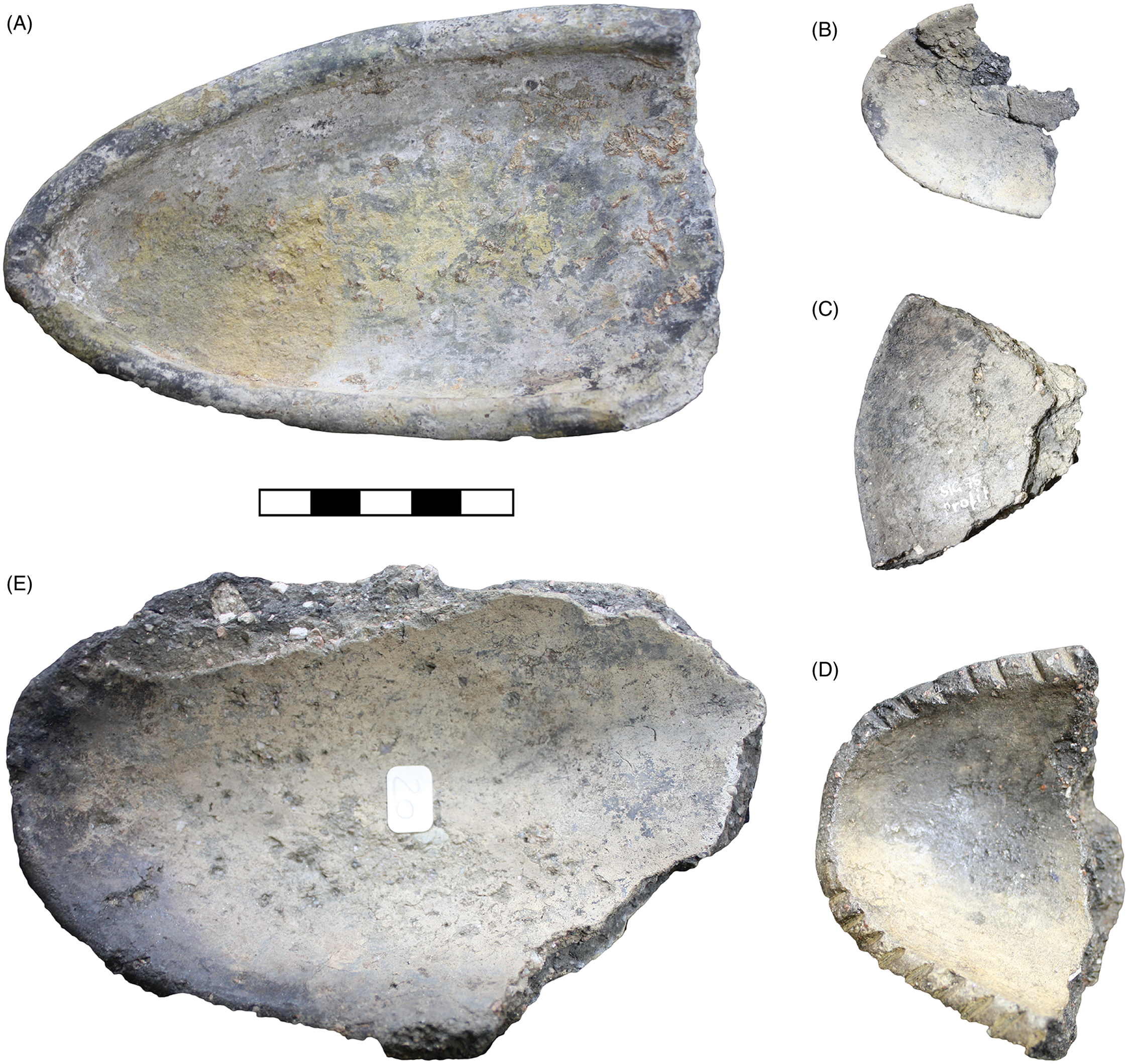
Oval bowls in the eastern Baltic are often decorated on their rims and interiors and include oblique hatches/incisions that were made by a sharp-edged implement, indistinct ‘knot’ impressions, and parallel pitted lines (Timofeev Reference Timofeev, Zvelebil, Domańska and Dennell1998; Bērziņš Reference Bērziņš2008; Kriiska et al. Reference Kriiska, Oras, Lõugas, Meadows, Lucquin and Craig2017). Floral designs are known from several vessels from the Narva culture sites of Osa and Žemaitiškė 3B in Latvia and Lithuania respectively (Girininkas Reference Girininkas1994), while ornamentation is infrequent in the western Baltic (Clark Reference Clark1936; Andersen Reference Andersen2010; Reference Andersen2011; Povlsen Reference Povlsen2014). Occasional finger or finger-nail impressions have, however, been recorded, which are sometimes present along the rim (eg, Fig. 3, D). Indeed, this may be the result of the production process used, ie, pinching and/or coiling (see Glykou Reference Glykou2011). Unusually, at Dąbki 9 in northern Poland c. 50% of the oval bowls are decorated (Kotula Reference Kotula2015).
In a comparison of oval bowls from the western (Grube-Rosenhof in northern Germany) and eastern Baltic (Sārnate in Latvia), Dumpe et al. (Reference Dumpe, Valdis and Stilborg2011, 432–3) highlighted differences in fabric and morphology. Nevertheless, the presence and distribution of carbonised surface deposits on both vessel types indicated a common pattern of use (see below). They suggest that the oval bowls represent a widespread functional type that was shared by different pottery-making traditions.
WHEN DID THEY APPEAR?
The first appearance of oval bowls in the circum-Baltic is uncertain. Although there is a lack of direct dates on these vessels from north-west Russia and the eastern Baltic, oval bowls are synchronous with the large pots with pointed bottoms of the Narva culture in the eastern Baltic (Fig. 4) which emerged during the late 6th–5th millennium cal bc (Liiva & Loze Reference Liiva and Loze1993; Timofeev Reference Timofeev, Zvelebil, Domańska and Dennell1998; Piezonka Reference Piezonka2012; Reference Piezonka2015; Piezonka et al. Reference Piezonka, Meadows, Hartz, Kostyleva, Nedomolkina, Ivanishcheva, Kosorukova and Terberger2016; Kriiska et al. Reference Kriiska, Oras, Lõugas, Meadows, Lucquin and Craig2017; Courel et al. Reference Courel, Robson, Lucquin, Dolbunova, Oras, Adamczak, Andersen, Astrup, Charniauski, Czekaj-Zastawny, Ezepenko, Hartz, Kabaciński, Kotula, Kukawka, Loze, Mazurkevich, Piezonka, Piličiauskas, Sørensen, Talbot, Tkachou, Tkachova, Wawrusiewicz, Meadows, Heron and Craig2020). Several centuries later, from the mid–late 5th millennium cal bc, similar shaped vessels are found in northern Poland and the western Baltic (Fig. 4), concordant with the Late Mesolithic ceramic phase at the site of Dąbki 9 and the late phase of the Ertebølle culture of northern Germany, Denmark, and southern Sweden respectively (Hallgren Reference Hallgren and Knutsson2004; Andersen Reference Andersen2010; Reference Andersen2011; Brinch Petersen Reference Brinch Petersen2011; Povlsen Reference Povlsen2014; Kotula Reference Kotula2015; Courel et al. Reference Courel, Robson, Lucquin, Dolbunova, Oras, Adamczak, Andersen, Astrup, Charniauski, Czekaj-Zastawny, Ezepenko, Hartz, Kabaciński, Kotula, Kukawka, Loze, Mazurkevich, Piezonka, Piličiauskas, Sørensen, Talbot, Tkachou, Tkachova, Wawrusiewicz, Meadows, Heron and Craig2020).
Periodisation of the oval bowls throughout the circum-Baltic, including the pottery-making traditions (italicised) and outlines of examples (Harry K. Robson)

Oval bowls are also known from several sites attributed to the Friesack-Boberg Group in northern and north-eastern Germany (Fig. 4; Table S1), which is an adjacent hunter-gatherer-fisher pottery tradition in the western Baltic dating from the mid-5th to the mid-4th millennium cal bc (Kotula et al. Reference Kotula, Piezonka and Terberger2015; Wetzel Reference Wetzel2015; Reference Wetzel, Schier, Orschiedt, Stäuble and Liebermann2021; Thielen Reference Thielen2020; Wetzel & Beran Reference Wetzel and Beranforthcoming). Although it is generally assumed that production ceased with the introduction of agriculture in the western Baltic (c. 4000 cal bc) and adjoining regions, oval bowls are sometimes found alongside early Funnel Beaker ceramics or other forms of material culture (eg, Dąbki 9 and Wełcz Wielki 10B in northern Poland, Baabe, Siggeneben-Süd, and Wangels in northern Germany, and Syltholm II and XIII in Denmark) and may have been inherited from the potters of the preceding Late Mesolithic. Despite this, unclear stratigraphy has precluded a definitive chronological assignment. The two examples from Dąbki 9 in northern Poland, however, displayed decoration in the form of a single row of irregular stamps on the edge of the rim (Fig. 5), bearing similarities with vessels of the early Funnel Beaker culture at the site, and were manufactured differently than other oval bowls in the ceramic assemblage (Czekaj-Zastawny & Kabaciński Reference Czekaj-Zastawny and Kabaciński2015; Kotula Reference Kotula2015).
Oval bowl with a single row of irregular stamps on the edge of the rim from Dąbki 9 in northern Poland. Scale: 5 cm (photographs by Agnieszka Czekaj-Zastawny; composite by Harry K. Robson)

There are, however, no known examples throughout the entire region that are securely dated to the mid-4th millennium.Footnote 3 Then, they ‘re-appear’ in the eastern Baltic at the end of the 4th millennium and remain in use until the first half of the 3rd (Fig. 4). In general, these later examples (from eg, Sārnate in Latvia and the Šventoji sites in Lithuania) are associated with the coastal hunter-gatherer-fisher communities using Narva Ware/Porous Ware ceramics, which are technologically different to the earlier examples in the eastern Baltic (see Piličiauskas et al. Reference Piličiauskas, Kisieliene, Piličiauskienė, Gaižauskas and Kalinauskas2019, fn. 2). Oval bowls are also known from contexts associated with Rzucewo Ware pottery throughout the eastern/western Baltic boundary area (Gaerte Reference Gaerte1927; Ehrlich Reference Ehrlich1936; Rimantienė Reference Rimantienė1989; Reference Rimantienė2005; Reference Rimantienė2016; Kabaciński et al. Reference Kabaciński, Król and Terberger2011; Saltsman Reference Saltsman2013; Piličiauskas & Heron Reference Piličiauskas and Heron2015). While these younger examples are assumed to have been ‘inherited from the older local coastal cultures’ (Rimantienė Reference Rimantienė2016, 98), the scarcity of radiocarbon dates (see below and the Supplementary Material, Appendix S1) and the low frequency of oval bowls more generally likely explain the apparent hiatus shown in Figure 4. It is conceivable that oval bowls were continuously used throughout this sequence but the evidence is currently absent in certain periods.
A total of 14 radiocarbon dates are known from carbonised surface deposits adhering to oval bowls found at sites in the western Baltic (Table S2). Without making any allowance for radiocarbon reservoir effects, these bowls appear to date mainly to the second and third quarters of the 5th millennium cal bc. If it is assumed that most of the carbon extracted for dating was derived from aquatic organisms, these dates are misleadingly early. A more realistic interpretation places the earliest dates in the third quarter of the 5th millennium, while most date to the earlier 4th millennium (Fig. S1). Full details of the dating methods employed are outlined in Appendix S1.
HOW WERE THEY USED?
Regardless of location and/or vessel size, the interior and exterior surfaces of the oval bowls are often coated with carbonised deposits. These deposits are frequently found on the ends and along the rims (Vankina Reference Vankina1970; Andersen Reference Andersen2011; Dumpe et al. Reference Dumpe, Valdis and Stilborg2011; Povlsen Reference Povlsen2014). Occasionally, either broken or cracked oval bowls have been found (eg, Gudsø Vig, Kolding Fjord, Ronæs Skov, and Teglgård-Helligkilde in Denmark) and the charring present indicates that they continued to be used during this event or were used afterwards (Andersen Reference Andersen2009; Reference Andersen2011). One oval bowl from the site of Sārnate in Latvia had a drilled perforation which indicated to Bērziņš (Reference Bērziņš2008) that it had been repaired by crack-lacing. Oval bowls are usually black, brown, and grey in colour but some examples with a red tan have been identified (Mathiassen Reference Mathiassen1935; Andersen Reference Andersen2011).
Whilst internal protuberances or ridges functioning as wick stands are frequently seen on North American Arctic stone lamps (de Laguna Reference Laguna1940), they are notably absent on circum-Baltic oval bowls, suggesting that if they were used as lamps the wick must have floated on the fuel. Despite a previous claim stating that a moss wick was in a Rzucewo Ware oval bowl from the site of Nida in Lithuania (Rimantienė Reference Rimantienė2016, 97), a re-analysis of the ceramic assemblage has not corroborated the finding. Since the majority of stone lamps in the North American Arctic used moss wicks, which were sometimes mixed with cedar bark or cotton grass (Grønnow et al. Reference Grønnow, Applet, Odgaard and Gulløv2014), similar combustibles may have been available and used throughout the circum-Baltic.
ORGANIC RESIDUE ANALYSIS OF OVAL BOWLS
The analysis of use-derived residues associated with ceramic vessels offers a useful approach to determine the functional properties of oval bowls (Heron et al. Reference Heron, Andersen, Fischer, Glykou, Hartz, Saul, Steele and Craig2013; Reference Heron, Craig, Lucquin, Steele, Thompson and Piličiauskas2015; Oras et al. Reference Oras, Lucquin, Lembi, Tõrv, Kriiska and Craig2017; Papakosta et al. Reference Papakosta, Oras and Isaksson2019). Lipids (ie, fats, oils, and waxes) are readily identifiable using this approach and would be expected to be the major component if the vessels had been used as ‘oil lamps’. Identification of specific molecular biomarkers and comparative analysis of the isotopic characteristics of bulk charred matter or specific lipid molecules has already been widely applied to prehistoric ceramic containers from the circum-Baltic (Craig et al. Reference Craig, Steele, Fischer, Hartz, Andersen, Donohoe, Glykou, Saul, Jones, Koch and Heron2011; Robson Reference Robson2015; Papakosta et al. Reference Papakosta, Oras and Isaksson2019; Courel et al. Reference Courel, Robson, Lucquin, Dolbunova, Oras, Adamczak, Andersen, Astrup, Charniauski, Czekaj-Zastawny, Ezepenko, Hartz, Kabaciński, Kotula, Kukawka, Loze, Mazurkevich, Piezonka, Piličiauskas, Sørensen, Talbot, Tkachou, Tkachova, Wawrusiewicz, Meadows, Heron and Craig2020), providing an ideal comparative dataset. Organic residue analyses of oval bowls from the circum-Baltic have been more limited (Craig et al. Reference Craig, Steele, Fischer, Hartz, Andersen, Donohoe, Glykou, Saul, Jones, Koch and Heron2011; Heron et al. Reference Heron, Andersen, Fischer, Glykou, Hartz, Saul, Steele and Craig2013; Reference Heron, Craig, Lucquin, Steele, Thompson and Piličiauskas2015; Piezonka et al. Reference Piezonka, Meadows, Hartz, Kostyleva, Nedomolkina, Ivanishcheva, Kosorukova and Terberger2016; Oras et al. Reference Oras, Lucquin, Lembi, Tõrv, Kriiska and Craig2017; Papakosta et al. Reference Papakosta, Oras and Isaksson2019).
For this study, we sampled a further 115 oval bowl sherds from 25 archaeological sites, representing a range of environmental settings throughout the region (Table 3). A key aim of the study was to explore the use of oval bowls compared to other vessels, often considered to be cooking pots, from the same or similar assemblage. These data are supplemented with examples of a small number of stone lamps from the site of Adlavik Harbour in Canada as well as Amaknak Island, Atka Island, Nunivak Island, and Kodiak Island (Uyak Bay) in Alaska.
summary of the oval bowl & stone lamp samples analysed in this study

Materials and methods
The samples analysed include powdered ceramic potsherds (n = 63) and carbonised surface deposits (n = 101), often from the same vessel (Table 3). The oval bowls were sampled from some of the earliest pottery producing sites in the region, including for instance, the Narva culture (c. 5500–4500 cal bc) sites of Osa and Zvidze in the eastern Baltic, and the Ertebølle culture site of Grube-Rosenhof in the western Baltic (c. 4500–4000 cal bc). Oval bowls were also sampled from later sites, for example those spanning the transition to agriculture in the western Baltic (ie, Siggeneben-Süd, Syltholm II and XIII, Wangels). A large collection of oval bowls associated with both the Late Mesolithic ceramic phase (c. 4500–4000 cal bc) and the early Funnel Beaker culture (c. 4000–3500 cal bc) were also sampled from the site of Dąbki 9 in northern Poland. Furthermore, several oval bowls from the eponymous sites of Friesack 4 and Hamburg-Boberg (15 and 15-east), which form the Friesack-Boberg Group (c. 4500–3500 cal bc) of northern and north-eastern Germany were sampled. One oval bowl from the Zedmar culture (c. 4500–4000 cal bc) site of Szczepanki 8 in north-eastern Poland was sampled. Since it was atypical for the ceramics of the Zedmar culture in both form and technology, it likely represents an import from the area occupied by the early farmers of the Brześć Kujawski Group of the Lengyel culture (Gumiński Reference Gumiński2011; Reference Gumiński2020). One early Funnel Beaker culture oval bowl from the site of Wełcz Wielki 10B in northern Poland (c. 3500 cal bc) was sampled and is probably a Narva culture influence/inspiration, whilst the Narva Ware/Porous Ware (c. 3200–2700 cal bc) oval bowls from the sites of Šventoji 4 and 6 in the eastern Baltic represent the youngest investigated samples.
For further comparison, eight stone lamps from five archaeological sites in the North American Arctic (Canada and the US) were sampled (Table 3). The samples include two stone lamps from the Early/Late Kachemak (c. 4000–950 cal bp) site of Uyak Bay on Kodiak Island, and three stone lamps from the Aleutian Tradition (c. 2400–900 cal bp) sites of Amaknak Island and Atka Island, all in western Alaska (Solazzo & Erhardt Reference Solazzo, Erhardt, Barnard and Eerkens2007). The youngest stone lamp samples from this region were from the 18th century ad sites of Adlavik Harbour (Labrador) and Nunivak Island (Alaska), associated with the Inuit and Cup’iq respectively (Solazzo & Erhardt Reference Solazzo, Erhardt, Barnard and Eerkens2007). Full details of the methods employed in this study are outlined in Appendix S1.
RESULTS
Elemental and bulk isotope analysis of carbonised surface deposits
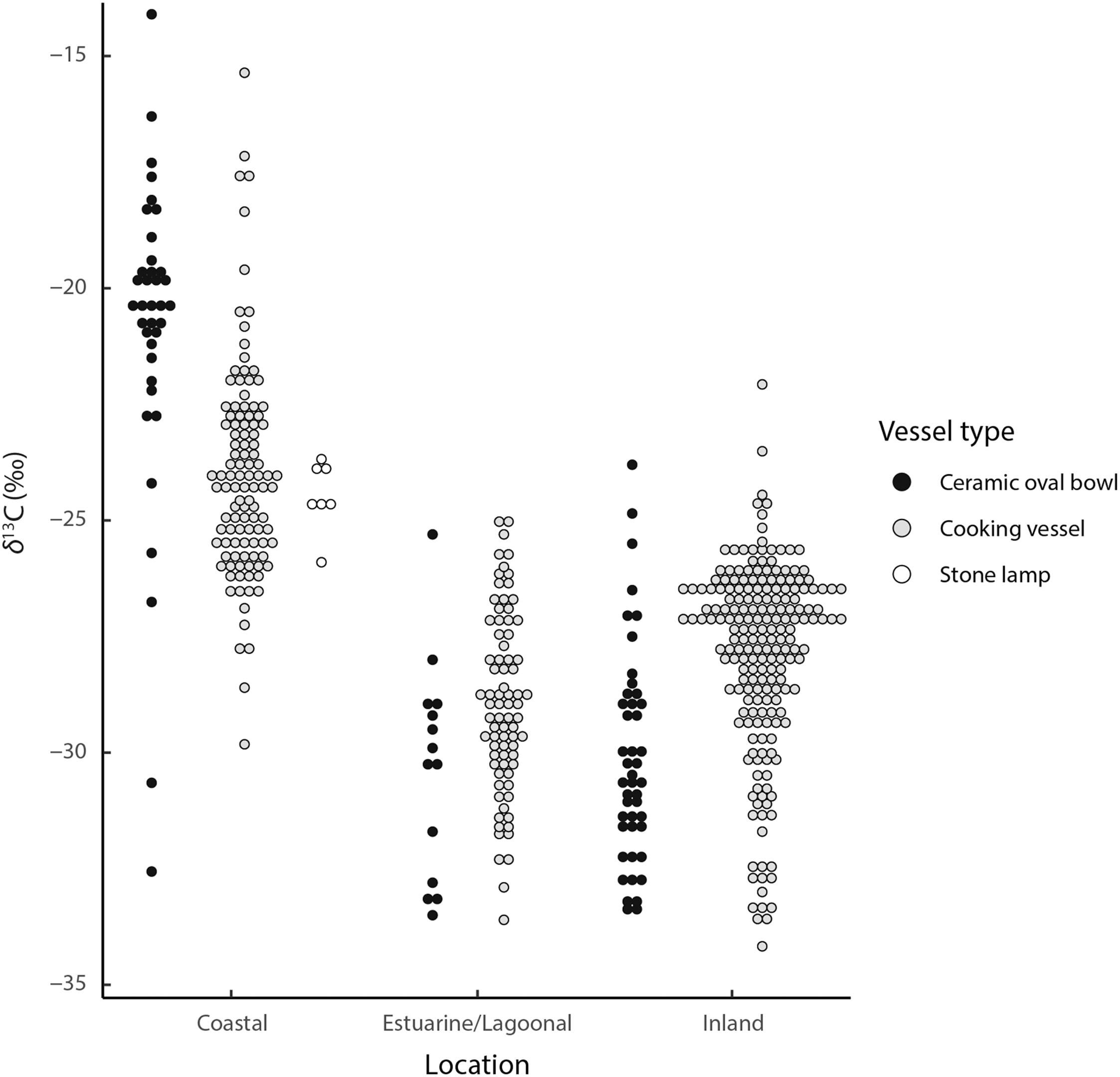
Figure 6 compares the bulk carbon (δ 13C) isotope data of carbonised surface deposits on oval bowls with those from other vessels (hereafter termed cooking pots). At the inland sites from both the eastern and western Baltic,Footnote 4 the range of δ 13C values of oval bowls is significantly lower than the range of δ 13C values of the cooking pots often from the same sites (Wilcoxon rank sum test with continuity correction W = 2011, p = <0.001), consistent with either the processing of a higher proportion of fats or oils, which are depleted in 13C compared to other food constituents (carbohydrates and proteins), and/or freshwater fish, which also tend to be more depleted in 13C. At these sites, it has been shown that the cooking pots were used primarily to process freshwater resources (Craig et al. Reference Craig, Forster, Andersen, Koch, Crombé, Milner, Bailey and Heron2007; Robson Reference Robson2015; Oras et al. Reference Oras, Lucquin, Lembi, Tõrv, Kriiska and Craig2017; Piličiauskas et al. Reference Piličiauskas, Skipitytė and Heron2018; Courel et al. Reference Courel, Robson, Lucquin, Dolbunova, Oras, Adamczak, Andersen, Astrup, Charniauski, Czekaj-Zastawny, Ezepenko, Hartz, Kabaciński, Kotula, Kukawka, Loze, Mazurkevich, Piezonka, Piličiauskas, Sørensen, Talbot, Tkachou, Tkachova, Wawrusiewicz, Meadows, Heron and Craig2020), so the lower δ 13C values in the oval bowls are consistent with fat from freshwater tissues. A similar pattern is also evident in the oval bowls recovered from estuarine/lagoonal sites in the eastern Baltic, consistent with the processing of resources from the nearby Baltic Sea, which are also known to be depleted in 13C (see Robson et al. Reference Robson, Andersen, Clarke, Craig, Gron, Jones, Karsten, Milner, Price, Ritchie, Zabilska-Kunek and Heron2016). In contrast, at coastal sites, a shift to higher δ 13C values in the oval bowls compared to cooking pots is observed (Wilcoxon rank sum test with continuity correction W = 3324, p = <0.001). All these sites are located in the western Baltic where the molecular and isotope data from cooking pots indicates that a wide range of foods was processed, including marine and freshwater as well as terrestrial animals (Craig et al. Reference Craig, Forster, Andersen, Koch, Crombé, Milner, Bailey and Heron2007; Reference Craig, Steele, Fischer, Hartz, Andersen, Donohoe, Glykou, Saul, Jones, Koch and Heron2011; Robson Reference Robson2015; Papakosta et al. Reference Papakosta, Oras and Isaksson2019; Courel et al. Reference Courel, Robson, Lucquin, Dolbunova, Oras, Adamczak, Andersen, Astrup, Charniauski, Czekaj-Zastawny, Ezepenko, Hartz, Kabaciński, Kotula, Kukawka, Loze, Mazurkevich, Piezonka, Piličiauskas, Sørensen, Talbot, Tkachou, Tkachova, Wawrusiewicz, Meadows, Heron and Craig2020). Multi-source food processing in the cooking pots is reflected in the generally lower δ 13C values in the carbonised surface deposits, whereas the higher δ 13C values in the oval bowls is consistent with preferential use of fat or oil from marine resources.
Bulk δ 13C isotope data obtained from carbonised surface deposits adhering to oval bowls and cooking pots throughout the circum-Baltic disaggregated according to location. Stone lamps from the North American Arctic are plotted for comparison, yielding similar δ 13C values to the cooking pots from the coastal sites in the western Baltic (data presented in Tables S3–S6)
Generally, carbonised surface deposits on the cooking pots contained a greater amount of nitrogen than oval bowls (Fig. 7). And the difference in the atomic ratios of carbon to nitrogen (C:N atomic) between carbonised surface deposits in the oval bowls and those from cooking pots is highly significant (Wilcoxon rank sum test with continuity correction W = 28402, p = <0.001). The elevated C:N ratios in the oval bowls are consistent with the presence of higher amounts of lipid and less nitrogen-containing proteinaceous molecules, in keeping with their notional function as ‘oil lamps’. Overall, the difference in bulk δ 13C values combined with higher atomic C:N ratios supports the specialised function of fat or oil processing in oval bowls compared to the cooking pots in the same assemblage, confirming previous observations (Heron et al. Reference Heron, Andersen, Fischer, Glykou, Hartz, Saul, Steele and Craig2013).
Left: atomic C:N ratio data obtained from carbonised surface deposits adhering to oval bowls and cooking pots throughout the circum-Baltic disaggregated according to location; right: kernel density estimate of C:N ratios. The dashed lines show the median values of the cooking pots (left) and oval bowls (right). Stone lamps from the North American Arctic are plotted for comparison (left), yielding similar C:N ratios to the oval bowls throughout the circum-Baltic (data presented in Tables S3–S6)

Lipid biomarker and compound-specific carbon isotope analysis
Additional analysis was undertaken to further investigate the use of the oval bowls. Gas chromatography-mass spectrometry in scanning (102 extracts) and selected ion monitoring (99 extracts) modes was used to identify extracted lipids according to established criteria for the characterisation of archaeological residues (Hansel et al. Reference Hansel, Copley, Madureira and Evershed2004; Evershed et al. Reference Evershed, Copley, Dickson and Hansel2008; Cramp & Evershed Reference Cramp, Evershed, Holland and Turekian2014; Lucquin et al. Reference Lucquin, Colonese, Farrell and Craig2016; Bondetti et al. Reference Bondetti, Scott, Courel, Lucquin, Shoda, Lundy, Labra-Odde, Drieu and Craig2021b). Carbon stable isotope values (δ 13C) of individual mid-chain fatty acids (palmitic, C16:0 and stearic, C18:0) were also obtained from the extracts of 59 oval bowls (n = 70 samples) from the circum-Baltic and eight stone lamps (n = 8 samples) from the North American Arctic (Table S7). This dataset was augmented with published data from 27 oval bowls (n = 32 samples) from the circum-Baltic and a single stone lamp (n = 1 sample) from the North American Arctic (Table S8) as well as data from contemporaneous cooking pots (n = 426 samples) from the circum-Baltic (Table S9). Table S10 summarises the complete molecular and isotopic dataset of the oval bowls analysed in this study.
The presence of biomarkers typically derived from heating aquatic organisms (Bondetti et al. Reference Bondetti, Scott, Courel, Lucquin, Shoda, Lundy, Labra-Odde, Drieu and Craig2021b) were frequently observed in both the oval bowls and cooking pots from sites in the circum-Baltic. These lipids could conceivably include fish, birds feeding on aquatic organisms, aquatic mammals, including beaver and seal, and molluscs. Figure 8 shows the distribution of ω-(o-alkylphenyl)alkanoic acids (APAAs) with 16, 18, 20, and 22 carbon atoms in an oval bowl from the site of Iča in the eastern Baltic and a stone lamp from the site of Uyak Bay in the North American Arctic. These compounds form from prolonged heating of mono- and polyunsaturated fatty acids; the latter are particularly concentrated in the tissues of aquatic organisms (Cramp & Evershed Reference Cramp, Evershed, Holland and Turekian2014). Diastereomers of phytanic acid (SRR and RRR) are also shown and provide further evidence of the presence of aquatic fats (Lucquin et al. Reference Lucquin, Colonese, Farrell and Craig2016). Regardless of the pottery-making tradition and/or environmental context (ie, coastal, estuarine/lagoonal, inland), aquatic fats were identified in a substantial proportion of oval bowls (61/91, 67.0%). Of the eight stone lamps from the North American Arctic, aquatic fats were identified in seven.
Molecular evidence for the processing of aquatic fats in an oval bowl from the circum-Baltic and a stone lamp from North America: (A) chemical structure of APAAs (after Hansel et al. Reference Hansel, Copley, Madureira and Evershed2004); (B & D) partial summed mass chromatograms (m/z 105) showing the presence of APAAs with 16 (*), 18 (+), 20 (open black circles), and 22 (open black squares) carbon atoms in a stone lamp from the North American Arctic (B; sample UB-1), and an oval bowl from the circum-Baltic (D; sample ICA 799-F); (C and E) partial summed mass chromatograms (m/z 101) showing the diastereomers of phytanic acid (SRR and RRR) in the same samples

Figure 9 displays the compound-specific δ 13C data from oval bowls and cooking pots against statistical reference ranges (1σ) calculated from the analysis of modern authentic animal tissue samples from Eastern Europe (see Dolbunova et al. Reference Dolbunova, Lucquin, McLaughlin, Bondetti, Courel, Oras, Piezonka, Robson, Talbot, Adamczak, Andreev, Asheichyk, Charniauski, Czekaj-Zastawny, Ezepenko, Grechkina, Gunnarssone, Gusentsova, Haskevych, Ivanischeva, Kabaciński, Karmanov, Kosorukova, Kostyleva, Kriiska, Kukawka, Lozovskaya, Mazurkevich, Nedomolkina, Piličiauskas, Sinitsyna, Skorobogatov, Smolyaninov, Surkov, Tkachov, Tkachova, Tsybrij, Tsybrij, Vybornov, Wawrusiewicz, Yudin, Meadows, Heron and Craigforthcoming). At the inland sites from both the eastern and western Baltic, the majority of samples from oval bowls and cooking pots plot within the range established for freshwater fats. These results support the bulk δ 13C data and reflect the site locations proximal to inland riverine and lacustrine settings. Here, then, it seems that both oval bowls and cooking pots were used for processing freshwater products but that the bowls contained a greater proportion of fats or oils than the cooking pots, confirming their different function. Despite this, some of the oval bowls and a greater proportion of cooking pots, particularly from western Baltic sites, plot within the ranges of authentic wild ruminant fats and wild non-ruminant fats, hinting at some diversity of use.
δ 13C values of the individual mid-chain length fatty acids (C16:0 and C18:0) obtained from 86 oval bowls (n = 103 samples) throughout the circum-Baltic disaggregated according to location (A, C, E). Data obtained from the North American Arctic stone lamps are also plotted (black circles). For comparison, data obtained from cooking pots throughout the circum-Baltic are plotted (B, D, F; data presented in Tables S7–S9). The statistical reference ranges (1σ) were calculated from the analysis of modern authentic animal tissue samples from Eastern Europe (see Dolbunova et al. Reference Dolbunova, Lucquin, McLaughlin, Bondetti, Courel, Oras, Piezonka, Robson, Talbot, Adamczak, Andreev, Asheichyk, Charniauski, Czekaj-Zastawny, Ezepenko, Grechkina, Gunnarssone, Gusentsova, Haskevych, Ivanischeva, Kabaciński, Karmanov, Kosorukova, Kostyleva, Kriiska, Kukawka, Lozovskaya, Mazurkevich, Nedomolkina, Piličiauskas, Sinitsyna, Skorobogatov, Smolyaninov, Surkov, Tkachov, Tkachova, Tsybrij, Tsybrij, Vybornov, Wawrusiewicz, Yudin, Meadows, Heron and Craigforthcoming). Key: closed, sample with aquatic biomarkers; open, sample without aquatic biomarkers; square, eastern Baltic; circle, western Baltic

(Continued).

At the estuarine/lagoonal sites in the eastern Baltic, a similar pattern is evident with virtually all the samples from oval bowls plotting within the range established for freshwater fats. In contrast, the cooking pots from eastern Baltic sites in estuarine/lagoonal settings exhibit more variability plotting within the ranges of authentic freshwater fats, wild ruminant fats, and wild non-ruminant fats. However, a focus on the processing of aquatic resources in these vessels is supported by the presence of aquatic biomarkers in many of the samples (Heron et al. Reference Heron, Craig, Lucquin, Steele, Thompson and Piličiauskas2015; Oras et al. Reference Oras, Lucquin, Lembi, Tõrv, Kriiska and Craig2017; Cramp et al. Reference Cramp, Król, Rutter, Heyd and Pospieszny2019; Robson et al. Reference Robson, Ritchie, Groß, Lübke, Meadows and Jantzen2019).
At the coastal sites a clear difference emerges. The majority of the oval bowls in the western Baltic and all of the North American Arctic stone lamps are consistent with marine fats and contain aquatic biomarkers. There are, however, some oval bowls from the western Baltic lacking aquatic biomarkers and plotting within the range established for wild non-ruminant fats. As previously reported (ie, Craig et al. Reference Craig, Steele, Fischer, Hartz, Andersen, Donohoe, Glykou, Saul, Jones, Koch and Heron2011; Robson Reference Robson2015; Papakosta et al. Reference Papakosta, Oras and Isaksson2019; Courel et al. Reference Courel, Robson, Lucquin, Dolbunova, Oras, Adamczak, Andersen, Astrup, Charniauski, Czekaj-Zastawny, Ezepenko, Hartz, Kabaciński, Kotula, Kukawka, Loze, Mazurkevich, Piezonka, Piličiauskas, Sørensen, Talbot, Tkachou, Tkachova, Wawrusiewicz, Meadows, Heron and Craig2020), a much wider range of values is evident in the cooking pots from this region with samples plotting within the ranges of authentic wild non-ruminant fats and wild ruminant fats in addition to the ranges established for marine fats and freshwater fats. The wider range of resources in these vessels reflects the differences in the bulk δ 13C values between the two vessel types in the western Baltic and it seems that the oval bowls had a more specialised use associated with marine fats or oils.
As a final confirmation, we compared the bulk δ 13C values of the carbonised surface deposits to the mean δ 13C values of the individual mid-chain length fatty acids extracted from them (Heron et al. Reference Heron, Craig, Lucquin, Steele, Thompson and Piličiauskas2015; Admiraal et al. Reference Admiraal, Lucquin, Von Tersch, Craig and Jordan2020). For an oil rich substance, these values should be similar, as the carbon is derived from the same source, whereas for a substance also containing carbohydrates and/or proteins the values should be different. Normally, the δ 13C values of the individual mid-chain length fatty acids are depleted in 13C compared to the bulk δ 13C value,Footnote 5 which includes the contribution of carbon from other classes of biomolecules. As shown in Figure 10, this is only true of the cooking pots. The oval bowls from the circum-Baltic and North American Arctic stone lamps, regardless of location, generally have a negligible difference between the bulk and individual mid-chain length fatty acid δ 13C values, indicating the residue is predominantly derived from a fat or oil rich substance, in keeping with their function for burning such resources. This is seen clearly in the kernel density estimate of δ 13C offsets in the oval bowls and other vessels (Fig. 10).
Left: δ 13C offsets between the δ 13C values of the individual mid-chain length fatty acids (ie, mean δ 13C16:0-δ 13C18:0) and the corresponding bulk δ 13C values of the carbonised surface deposits from the same sherd (ie δ 13C offset = δ 13C FAmean - δ 13Cbulk) (Heron et al. Reference Heron, Craig, Lucquin, Steele, Thompson and Piličiauskas2015; Admiraal et al. Reference Admiraal, Lucquin, Von Tersch, Craig and Jordan2020). The plot includes the oval bowls and cooking pots from the circum-Baltic and North American Arctic stone lamps disaggregated according to location: right: kernel density estimate of δ 13C offsets (data presented in Tables S7–S9)

DISCUSSION
Organic residue analysis reveals a consistent pattern across the circum-Baltic that distinguishes oval bowls from other vessels in the same assemblage over a period of c. 2000 years. The oval bowls were utilised by hunter-gatherer-fishers for burning fat or oil as fuel for lighting and/or heating. Given that 67% of the vessels yielded APAAs and have compound-specific δ 13C values consistent with marine and freshwater tissues, we suggest that aquatic fats were commonly used as the fuel source in these vessels. Terrestrial animal carcass fats are also likely to have been used but to a much lesser extent. Notably, wild ruminant animal fats, which are readily identifiable in cooking pots of the Ertebølle culture in the western Baltic, are virtually absent in the oval bowls from many of the same sites, or sites located in similar settings. More generally, organic residue analysis has shown that hunter-gatherer-fisher cooking pots, often with pointed bottoms, appear to have been used for processing mixtures of foodstuffs (Craig et al. Reference Craig, Steele, Fischer, Hartz, Andersen, Donohoe, Glykou, Saul, Jones, Koch and Heron2011; Robson Reference Robson2015; Papakosta et al. Reference Papakosta, Oras and Isaksson2019; Courel et al. Reference Courel, Robson, Lucquin, Dolbunova, Oras, Adamczak, Andersen, Astrup, Charniauski, Czekaj-Zastawny, Ezepenko, Hartz, Kabaciński, Kotula, Kukawka, Loze, Mazurkevich, Piezonka, Piličiauskas, Sørensen, Talbot, Tkachou, Tkachova, Wawrusiewicz, Meadows, Heron and Craig2020), including aquatic resources.
Although many uses have been suggested (Table 4 lists some of the proposed uses of archaeological vessels alongside observations made from ethnographic and historical contexts), we hypothesise that oval bowls were used primarily to provide controlled sources of illumination for extended periods of time. Experiments conducted by van Diest (Reference Diest1981) demonstrated that reconstructed oval bowls with seal blubber fuel and a moss wick could burn for several hours. The form of the vessels also allowed them to be lit at both ends. Van Diest (Reference Diest1981) found that when the vessels were used as lamps, patterns of sooting and carbonised surface deposits consistent with those on the oval bowls from the site of Grube-Rosenhof in northern Germany were observed.
proposed uses of oval bowls, including examples drawn from analyses of palaeolithic & north american stone lamps

While the suggestion that oval bowls in the circum-Baltic were used as sources of illumination is not new (Mathiassen Reference Mathiassen1935; Żurek Reference Żurek1954; Bērziņš Reference Bērziņš2008; Heron et al. Reference Heron, Andersen, Fischer, Glykou, Hartz, Saul, Steele and Craig2013; Reference Heron, Craig, Lucquin, Steele, Thompson and Piličiauskas2015; Oras et al. Reference Oras, Lucquin, Lembi, Tõrv, Kriiska and Craig2017; Papakosta et al. Reference Papakosta, Oras and Isaksson2019), the findings presented here and the occurrence of these vessels specifically during the third quarter of the 5th and the earlier 4th millennium cal bc warrants further discussion. The exploitation of aquatic mammals and fish from the Baltic Sea, and riverine and lacustrine settings throughout the region pre-dates ceramic technology. For example, there is widespread evidence for fishing as well as apparatus and mass capture/processing facilities from the late 10th millennium cal bc onwards (eg, Boethius Reference Boethius2016; Robson & Ritchie Reference Robson, Ritchie, Groß, Lübke, Meadows and Jantzen2019; Robson et al. Reference Robson, Boethius, Ritchie, Nilsson Stutz, Peyroteo Stjerna and Tõrvforthcoming). Although difficult to procure, render, and refine, we can presume that both fish oils and marine mammal blubber were readily available and, given their energy content, were highly valued commodities for consumption. Yet, their use exceeded basic subsistence and implies they were available in such quantities that other roles, such as burning for heat or illumination, were incorporated into lifeways.
In the North American Arctic, the use of marine oils for generating heat and light is often explained by the lack of other suitable fuel sources. The same applies to local historical sources. For example, ethnographic sources from the first half of the 20th century from eastern Estonia describe the production of fish oil from fat-rich internal organs and its use for lighting purposes by pouring oil on a small plate and lighting it with a wick (Paurman Reference Paurman1940). At more southerly latitudes wood was readily available, making the use of procured oils for this purpose more perplexing. Here, one can perhaps draw a better analogy with the Roman lamps of the circum-Mediterranean that used olive oil as a combustant; a prized, perishable product that could be produced in such surplus that it was put to a wide diverse range of non-culinary uses and transported far and wide as a luxury commodity (Mattingly Reference Mattingly, Shipley and Salmon1996). Largely sedentary, surplus producing hunter-gatherer-fishers of the circum-Baltic might have had the capacity to produce oil at this juncture in prehistory and with the introduction of ceramic technology, they would have had the means, but what specific need did ‘oil lamps’ fulfil?
As we have noted, the stone lamps of south-west Alaska were used primarily for lighting rather than cooking. In this relatively southern location, warming a dwelling or cooking was less important than providing smoke-less light, which wood could not provide. On the other hand, the need for both warmth and light was extreme in treeless Arctic regions where work had to be conducted in tents or sod houses with little ventilation in order to conserve heat. Although wood was available in the circum-Baltic region, the need for smoke-less light for sewing clothes and other craft production, illuminating social gatherings, story-telling, ritual, and other activities would have been important. One of the functions of the many tiny lifelike soapstone and ivory carvings made by Late Dorset people might have been for lamp-light projection of their shadows on darkened house walls, accompanied by theatrical recitation by shamans or elders of stories and legends.
Parallels between circum-Baltic oval bowls and Arctic stone lamps have been made for decades (eg, Mathiassen Reference Mathiassen1935). The evidence from our study highlights clear similarities in use that centre on the burning of fats/oils. Evidence beyond these contexts is rare. One exception is the study of ‘oval plates’ and cooking pots in a ceramic assemblage from the 10th–16th century ad site of Kame Hills, Manitoba, Canada (Sherriff et al. Reference Sherriff, Tisdale, Sayer, Schwarcz and Knyf1995). Bulk stable isotope analysis of the carbonised surface deposits from the ‘oval plates’ had lower δ 13C values and higher C:N ratios compared to those from the cooking pots. Due to the higher proportion of fat in the deposits on the ‘oval plates’ the authors suggested that they were used as ‘frying pans or … fat-burning lamps’ (Sherriff et al. Reference Sherriff, Tisdale, Sayer, Schwarcz and Knyf1995, 110). Tisdale (Reference Tisdale and Cowan1987, 367) notes that the Kame Hills site is situated in a productive fish-spawning location in an otherwise sparse resource setting, hence aquatic fats were available in abundance for burning in these vessels. Clearly there is potential for distinguishing patterns of use in vessels used by hunter-gatherer-fishers where markedly different vessel forms are present.
With light comes heat, however modest, and there is evidence that this attribute was also utilised in the Arctic. Frink and Harry (Reference Frink, Harry, Jordan and Gibbs2019, 159) note that ‘driftwood racks for drying meat and/or wet clothing were often suspended’ over stone lamps and were a feature during the winter months when ‘wood resources were buried under snow and cooking took place indoors’. Boas (Reference Boas1964, 136) states that rectangular, flat-bottomed cooking pots in the North American Arctic were suspended over the flame of the lamp ‘whose size could be controlled by manipulating the wick with a bone or piece of wood’ (Frink & Harry Reference Frink, Harry, Jordan and Gibbs2019, 159). De Laguna (Reference Laguna1940, 56) suggested that the function of lamps was dictated by size, arguing that larger vessels were used for heating, while smaller examples were used solely for illumination. According to the Eastern Arctic Tunit (Dorset) legends, Dorset people used miniature lamps only a few centimetres in diameter to warm themselves while they waited for seals at the breathing holes. This indicates that different circumstances and motivations may have driven the manufacture and use of these types of vessels in the North American Arctic, many of which could have been utilised in the circum-Baltic.
Ethnographic sources also show that utilitarian and non-utilitarian functions of oval bowls are inseparable. Grønnow et al. (Reference Grønnow, Applet, Odgaard and Gulløv2014, 417–19) highlight the symbolic and spiritual meanings of heat and light during the dark and cold season in the North American Arctic. Writing about the eastern North American Arctic Inuit, they state that ‘both physically and psychologically, the flame of the lamp meant survival, comfort and life’ (Grønnow et al. Reference Grønnow, Applet, Odgaard and Gulløv2014, 403). Historical accounts describe the central place of the lamp in family life. According to Hough (Reference Hough1898, 117), ‘The lamp is peculiarly the possession of the women. Each head of a family must have a lamp, though two or more families may live in the same hut … After the death of a woman her lamp is placed upon her grave’. Inupiat culture in western Alaska is full of stories linking women with lamps, whales, and dwellings, including stories of a woman who tends the life-giving lamp (heart) in the belly of a whale (Kaplan et al. Reference Kaplan, Jordan and Sheehan1984). Ceramic lamps were occasionally used as grave goods or grave markers in the Yukon-Kuskokwim Delta of the western North American Arctic (Broderick & Pratt Reference Broderick, Pratt and Pratt2009, 134). Historical accounts also testify to the use of stone lamps as indoor light sources (Dawson et al. Reference Dawson, Levy, Gardner and Walls2007; Grønnow et al. Reference Grønnow, Applet, Odgaard and Gulløv2014). Recent simulations of illumination levels within Inuit structures indicate that lighting may have been used to make interior spaces appear larger, to enhance the metaphorical associations of dwellings with marine mammals and to facilitate the making and repairing of clothing and tools (Dawson & Levy Reference Dawson and Levy2022).
At the wetland coastal site of Sārnate in Latvia, dating from the late 5th–3rd millennia cal bc, Bērziņš (Reference Bērziņš2008) notes that oval bowls were primarily recovered from the hearth or outer wall of dwellings. He suggested utilitarian roles such as ‘lighting for craft work and other activities undertaken after dark, particularly in winter in the warmth of the fireside. They could have been conveniently placed in the sand along the edge of the hearth. The lamps may have served as a means of maintaining the fire and rekindling the hearth. Presumably, they also provided a convenient way of carrying fire to other locations’ (Bērziņš Reference Bērziņš2008, 164).
The role of oval bowls in portable illumination technology in the western Baltic has been proposed by Hulthén (Reference Hulthén1980). In this context, oval bowls were used for night fishing, such as ‘eel-flaring’ or sealing, particularly from a dugout canoe. De Laguna (Reference Laguna1940, 55) states that (miniature) stone lamps throughout south-western Alaska were also used for drying and heating while on the move both for hunting and travelling, which could be the difference between life and death in Arctic conditions. Non-utilitarian roles for fat-burning oval bowls in the circum-Baltic have been proposed, albeit rarely. Girininkas (Reference Girininkas1994, 235–6) suggested that those in the eastern Baltic symbolised boats and were connected ‘with the belief that the dead were ferried from the world of the living to the world beyond’ (Bērziņš Reference Bērziņš2008, 165), a belief that was expressed much later in Viking Age boat burials and mortuary ritual of West Siberian Nenets and Sami people.
Although light production is a well-established phenomenon during winter months in North American Arctic regions (Hough Reference Hough1898; Lucier & Vanstone Reference Lucier and Vanstone1991; Dawson & Levy Reference Dawson and Levy2022), the manufacture and use of lamps extends to many archaeological, ethnographic, and historical populations in circumpolar contexts. Ethnohistorical studies in the Russian Far East testify to the widespread use of stone and ceramic lamps by coastal and inland populations in the late 19th/early 20th centuries ad (Bogoras Reference Bogoras1904, 184–5; Jochelson Reference Jochelson1905, 565–7). Coastal communities used seal oil as fuel whereas inland herders used fat obtained by boiling crushed reindeer bone (Jochelson Reference Jochelson1905, 565–7). In addition to stone and ceramic, other much less archaeologically visible materials, such as unfired clay, hollowed-out bone, and wood, could have been used. In the North American Arctic there is evidence that lamps were also made from perishable materials, including wood (Lucier & Vanstone Reference Lucier and Vanstone1991, 8–10). One of the most likely prototypes of stone lamps may have developed from birch bark technology, which included all manner of watertight bowls and containers that could have served as oil lamps lit by floating wicks.
CONCLUSIONS
Hunter-gatherer-fishers in the circum-Baltic adopted and used a durable material culture for light production. Once introduced it was sustained for a maximum of c. 2000 years, albeit ‘discontinuously’ throughout the region. Burning animal fat, especially from aquatic species, represents a consistent pattern of use and differentiates oval bowls from other containers in the same pottery assemblages, which were primarily used for preparing meals. Why oval bowls ceased to be used is unknown and especially puzzling given the wide range of utilitarian and non-utilitarian functions these artefacts might have fulfilled, as highlighted above. Recently, however, it has been shown that the function of hunter-gatherer-fisher ceramics is culturally transmitted along with aspects of their production (Dolbunova et al. Reference Dolbunova, Lucquin, McLaughlin, Bondetti, Courel, Oras, Piezonka, Robson, Talbot, Adamczak, Andreev, Asheichyk, Charniauski, Czekaj-Zastawny, Ezepenko, Grechkina, Gunnarssone, Gusentsova, Haskevych, Ivanischeva, Kabaciński, Karmanov, Kosorukova, Kostyleva, Kriiska, Kukawka, Lozovskaya, Mazurkevich, Nedomolkina, Piličiauskas, Sinitsyna, Skorobogatov, Smolyaninov, Surkov, Tkachov, Tkachova, Tsybrij, Tsybrij, Vybornov, Wawrusiewicz, Yudin, Meadows, Heron and Craigaccepted). The tradition of producing oval bowls might have arisen and dispersed through hunter-gatherer-fisher communities in contact with each other and not necessarily across all ceramic producing hunter-gatherer-fisher groups.
These vessels are seldom present in early farmer contexts and each occurrence needs to be interrogated carefully based on stratigraphic and chronological evidence; they rarely exist in areas without a preceding hunter-gatherer-fisher ceramic phase. The persistence of aquatic resource exploitation in the circum-Baltic after the introduction of farming is well documented (Craig et al. Reference Craig, Steele, Fischer, Hartz, Andersen, Donohoe, Glykou, Saul, Jones, Koch and Heron2011; Robson et al. Reference Robson, Saul, Steele, Meadows, Nielsen, Fischer, Heron and Craig2021), which strongly suggests that their disappearance is not associated with major economic change. Together with fat from terrestrial animals, fish oil and marine mammal blubber were surely available to sustain the use of ceramic bowls for illumination, and these products are frequently found in Early Neolithic Funnel Beaker cooking vessels from coastal western Baltic sites. One must also consider the possibility that farming brought about technological changes in heating and lighting, such as the introduction of tallow candles.
The demise of oval bowl production and use could be associated with fundamental changes in lifeways brought about by the introduction of farming. The introduction of agriculture and pastoralism may have significantly altered the ‘taskscape’ (Ingold Reference Ingold1993), the socially constructed space of human activity, which expanded to incorporate new routines associated with animal husbandry and crop cultivation, in addition to hunting, gathering, and fishing. The need for portable illumination, so essential for extending working hours in the darker, winter monthsFootnote 6 and facilitating the procurement of resources away from settlements, might have had less importance when new stores of food could be accessed during the winter, whether ‘on the hoof’ or from granaries. Fundamental changes in the seasonality of tasks at the transition to agriculture in the circum-Baltic require further corroboration but such considerations should include the manufacture and use of artefacts, which themselves may have a seasonal dimension. Finally, further work is needed to examine the more precise function of ‘oval bowls’ and similar shaped vessels described in other agricultural contexts from more southerly latitudes, such as those assigned to the post-LBK Brześć Kujawski Group of the Lengyel culture (second half of the 5th millennium cal bc) in north-central Poland (Grygiel Reference Grygiel2008; Czerniak et al. Reference Czerniak, Marciniak, Bronk Ramsey, Dunbar, Goslar, Barclay, Bayliss and Whittle2016), the Malice culture (first half of the 5th millennium) in Little Poland (Czerniak Reference Czerniak2012), and the ‘ceramic boats’ from the Early Neolithic (second–third quarters of the 6th millennium) site of La Marmotta in Italy (Fugazzola Reference Fugazzola, Asta, Caniato, Gnola and Medas2019).
Acknowledgements:
This study has received funding from the British Academy (postdoctoral fellowship to H.K.R.), the European Research Council (ERC) under the European Union’s Horizon 2020 research and innovation programme (Grant Agreement No. 695539) to C.P.H., the Polish National Science Centre (Grant No. 2017/27/B/HS3/00478) to J.K., and the Estonian Research Council (Grant No. PSG 492) to E.O. We thank Marise Gorton (University of Bradford) and Matthew von Tersch (University of York) for under taking the bulk EA-IRMS analyses; Blandine Courel (British Museum) and Valerie Steele (University of Bradford) for sample preparation and GC-MS analysis; Harald Lübke (ZBSA) for permission to use the unpublished radiocarbon date obtained from an oval bowl from the site of Timmendorf-Nordmole I; Peter Moe Astrup (Moesgård Museum), Valdis Bērziņš (University of Latvia) and Ann-Katrin Meyer (University of Hamburg) for answering the many questions asked concerning the distribution and frequency of oval bowls throughout the circum-Baltic; Ilze Loze (University of Latvia), Søren H. Andersen and Lise Frost (Moesgård Museum) for permission to sample the oval bowls housed in their respective institutions; Stephen Loring and Caroline Solazzo (Smithsonian Institute) for both permission to sample and information pertaining to the stone lamp samples from the North American Arctic; Lena Diana Tranekjer (University of Copenhagen) for providing data from an unpublished Masters Dissertation; Thomas Terberger (University of Göttingen) for assisting in the acquisition of samples from the site of Friesack 4; and Daniel Groß (Museum Lolland-Falster) for answering several queries raised concerning the dating of the Syltholm sites. Lastly, we thank the referees for their insightful queries that helped to improve the manuscript.
SUPPLEMENTARY MATERIAL
To view supplementary material for this article, please visit https://doi.org/10.1017/ppr.2022.12


 Open access

