





A substantial body of work documents the potential deleterious effects of maternal depressive symptoms on offspring mood and behavior (Goodman et al., Reference Goodman, Rouse, Connell, Broth, Hall and Heyward2011), which may be particularly harmful to children’s emotional functioning and development during the first few years of life (Goodman & Gotlib, Reference Goodman and Gotlib1999). Elevated maternal depressive symptoms compromise the quality of the maternal caregiving environment via disrupted mother–child interactions, in which mothers may be more withdrawn, less responsive to child cues, and provide less adaptive models of co-regulation and self-regulation (Bernard-Bonnin & Canadian Paediatric Society, & Mental Health and Developmental Disabilities Committee, Reference Bernard-Bonnin2004; Goodman et al., Reference Goodman, Rouse, Connell, Broth, Hall and Heyward2011). In such environments, young children may learn maladaptive strategies for self-regulation and demonstrate similarly flat, withdrawn, or negative affective states (Bernard-Bonnin & Canadian Paediatric Society, & Mental Health and Developmental Disabilities Committee, Reference Bernard-Bonnin2004), which may place them at increased risk for developing subsequent mental health difficulties.
Yet, children are not solely passive recipients of their environmental context. Just as maternal characteristics influence child socioemotional development, children shape maternal caregiving, and overall well-being (Belsky, Reference Belsky1984). Indeed, extensive developmental theory highlights the inherent bidirectionality of the mother–child relationship (Paschall & Mastergeorge, Reference Paschall and Mastergeorge2016). Empirical support for bidirectional relations, however, is limited. Studies have demonstrated unidirectional effects of maternal depressive symptoms on child functioning (for review see Goodman et al., Reference Goodman, Rouse, Connell, Broth, Hall and Heyward2011), and, less commonly, the unidirectional effects of child temperamental or behavior problems on maternal well-being and parenting (e.g., Hipwell et al., Reference Hipwell, Keenan, Kasza, Loeber, Stouthamer-Loeber and Bean2008; Kiff et al., Reference Kiff, Lengua and Zalewski2011; Luecken et al., Reference Luecken, MacKinnon, Jewell, Crnic and Gonzales2015; Northrup et al., Reference Northrup, Ridley, Foley, Moses-Kolko, Keenan and Hipwell2019; Pardini, Reference Pardini2008).
More recently, support for bidirectional maternal- and child-driven influences on mental health symptoms has been amassed by innovative longitudinal designs. Using cross-lagged panel models, Baker et al. (Reference Baker, Brooks-Gunn and Gouskova2020) found evidence of bidirectional associations between maternal depressive symptoms and child behavior problems among a sample of 3- to 5-year-old children, which Roubinov et al. (Reference Roubinov, Epel, Adler, Laraia and Bush2019) extended in a sample of young children, documenting bidirectional associations as early as child age 18 months. However, despite a theoretical focus on the impact of a mother’s depressive symptoms on her own child’s behavior problems, and a child’s behavior problems on his or her mother’s depressive symptoms, longitudinal cross-lagged panel models do not in fact capture this within-dyad relationship over time (Berry & Willoughby, Reference Berry and Willoughby2017; Hamaker et al., Reference Hamaker, Kuiper and Grasman2015).
The existence and nature of purely within-dyad mother-driven and child-driven influences can be examined with longitudinal statistical modeling approaches that disaggregate data at the between-dyad and within-dyad levels (Berry & Willoughby, Reference Berry and Willoughby2017; Hamaker et al., Reference Hamaker, Kuiper and Grasman2015). Several innovative statistical models have been developed to better align analytic tools with dyadic theory, including Curran et al. (Reference Curran, Howard, Bainter, Lane and McGinley2014) autoregressive latent trajectory model with structured residuals (ALT-SR; Curran et al., Reference Curran, Howard, Bainter, Lane and McGinley2014). The ALT-SR model is a flexible model that speaks to both levels of analysis: between-dyad growth trajectories, which reflect trait-like levels and growth in maternal depressive symptoms and child behavior problems, and the desired within-person autoregressive and within-dyad cross-lagged (or bidirectional) effects between a mothers’ depressive symptoms and her child’s behavior problems over time.
Using an ALT-SR model, Dora and Baydar (Reference Dora and Baydar2020) provided novel evidence in support of within-dyad relations between child behavior problems and maternal depressive symptoms from child age 3 to 5 years, yielding the strongest extant support to-date for dyadic theory. Dora and Baydar (Reference Dora and Baydar2020) framed their recent finding that maternal depressive symptoms were strongly associated with child externalizing behaviors at 3 years of age as support for intervention efforts to occur before these associations are solidified (e.g., before significant within-person stability). Given Dora and Baydar (Reference Dora and Baydar2020) did not find evidence for bidirectional associations after age 5, their results also underscore the importance of examining within-dyad relations early in development. Yet, no empirical work to our knowledge has documented within-dyad, bidirectional associations between maternal and child mental health prior to age 3. Developmental theory suggests that children are particularly susceptible to the effects of maternal depressive symptoms prior to age 3 years, as they are more highly reliant than older children on their mothers to meet their everyday needs (Ainsworth et al., Reference Ainsworth, Blehar, Waters and Wall1978; Bowlby, Reference Bowlby1969, Reference Bowlby1982). Likewise, research suggests that infant behavior and emotions and dyad-level dysregulation can significantly influence maternal mental health during this developmental period (Luecken et al., Reference Luecken, Crnic, Gonzales, Winstone and Somers2019; Troutman et al., Reference Troutman, Moran, Arndt, Johnson and Chmielewski2012; Winstone et al., Reference Winstone, Curci and Crnic2020). Extending the examination of within-dyad relations prior to age 3 years is an advantageous first step towards understanding how these bidirectional associations operate within dyads during a developmentally salient period.
It is also particularly important to understand the bidirectional processes by which mothers and children affect each other’s mental health in challenging social and economic circumstances. The current study evaluates bidirectional relations between maternal and child mental health among low-income Mexican American mother–child dyads. Ethnic minority and low-income women, particularly recent immigrants, are at substantially elevated risk for depressive symptoms (Ertel et al., Reference Ertel, Rich-Edwards and Koenen2011; Gress-Smith et al., Reference Gress-Smith, Luecken, Lemery-Chalfant and Howe2012; O’Hara & McCabe, Reference O'Hara and McCabe2013; Weissman et al., Reference Weissman, Feder, Pilowsky, Olfson, Fuentes, Blanco and Shea2004). For Mexican-origin women living in the USA, high stress levels stemming from exposure to poverty, discrimination, immigration and acculturative challenges, and separation from loved ones can exacerbate the risk of depressive symptoms (Calzada et al., Reference Calzada, Huang, Covas, Ramirez and Brotman2016; D’Anna-Hernandez et al., Reference D’Anna-Hernandez, Aleman and Flores2015; Ponting et al., Reference Ponting, Chavira, Ramos, Christensen, Guardino and Dunkel Schetter2020). Children raised in impoverished Mexican American families are at elevated risk of behavioral and developmental disorders, negative/depressive cognitive biases, and depressive symptoms relative to higher SES white children (Avila & Bramlett, Reference Avila and Bramlett2013; Flores et al., Reference Flores, Fuentes-Afflick, Barbot, Carter-Pokras, Claudio, Lara and Weitzman2002).
Current study
The current study evaluated within-dyad, bidirectional associations between maternal depressive symptoms and child behavior problems from child age 1 to 4.5 years among a sample of 322 low-income, Mexican American mother–child dyads. Primary analyses were conducted using an ALT-SR model (Curran et al., Reference Curran, Howard, Bainter, Lane and McGinley2014), allowing for disaggregation of variance into between-dyad and within-dyad components, which enables desired modeling of purely within-person autoregressive (i.e., stability in maternal depressive symptoms and child behavior problems) and within-dyad bidirectional paths between maternal depressive symptoms and child behavior problems over time. Significant positive concurrent associations between maternal depressive symptoms and child behavior problems were expected at each timepoint. Within-person stability in maternal depressive symptoms and child behavior problems was expected across time, such that women reporting an increase in depressive symptoms at one time point (relative to their personal mean) would continue to report more depressive symptoms at the subsequent timepoint, and children reported to have an increase in behavior problems at one time point (relative to their personal mean) would continue to exhibit more behavior problems at the subsequent timepoint. Moreover, we hypothesized that significant within-dyad, bidirectional relations between maternal depressive symptoms and child behavior problems would emerge as early as child age 1 year; for example, mothers of children with more behavior problems at 1 year would report more depressive symptoms at 1.5 years and children of mothers with more depressive symptoms at 1 year would report more behavior problems at 1.5 years.
Methods
Participants
The current sample consists of 322 mother–child dyads participating in the broader Las Madres Nuevas study of low-income, Mexican American maternal and child health. See Table 1 for full sample demographics at the time of enrollment.
Sample demographics at prenatal visit

Design and procedure
The broader study was approved by the Institutional Review Boards at Arizona State University and Maricopa Integrated Health System. Pregnant women were recruited from prenatal clinics serving low-income and uninsured women. Eligibility criteria included (1) self-identification as Mexican or Mexican American, (2) fluency in English or Spanish, (3) at least 18 years of age, (4) low-income status (self-reported family income below $25,000 or eligibility for Medicaid or Federal Emergency services coverage for childbirth), and (5) anticipated delivery of a healthy, singleton baby without evidence of significant health or developmental problems.
Data for the current analyses were from a prenatal home visit (28–36 weeks gestation; M = 35.4, SD = 2.8) and five laboratory visits. Laboratory visits occurred at 1 year (M = 1.03 years, SD = 0.08), 1.5 years (M = 1.53, SD = 0.09), 2 years (M = 2.06, SD = 0.09), 3 years (M = 3.13, SD = 0.13), and 4.5 years (M = 4.43, SD = 0.15) postpartum. Child age at each time point was normally distributed (skewness ≤ 2; kurtosis ≤ 7), and not correlated with behavior problems (all p’s > .05). Women provided informed consent for participation at the initial prenatal visit. Interviews were conducted in the mother’s choice of English (18%) or Spanish (82%). Interviewers read questions aloud, and women were provided written and graphic depictions of item responses. Women were compensated $50 and small baby gifts (e.g., bibs) at the prenatal visit, and $100 for each laboratory visit and reimbursement for up to $50 in travel expenses.
Attrition
The full sample (322 women) completed the prenatal visit, 265 mother-child dyads (82.2%) completed the 1-year visit, 237 dyads (73.6%) completed the 1.5-year visit, 243 (75.4%) completed the 2-year visit, 215 dyads (66.7%) completed the 3-year visit, and 230 dyads (71%) completed the 4.5-year visit. Missingness across the five visits was occassionally associated with maternal age and maternal country of birth (all p’s < .05). Therefore, maternal age and country of birth were considered for inclusion in the primary model as covariates.
Measures
Maternal depressive symptoms
Women reported on their depressive symptoms at the 1-, 1.5-, 2-, 3-, and 4.5-year laboratory visits using the Center for Epidemiologic Studies Depression Scale (CES-D; Radloff, Reference Radloff1977), a 20-item measure of depressive symptoms experienced in the last week. Women rated the frequency with which they experienced each symptom on a 4-point Likert scale (0 = rarely or none of the time (less than 1 day); 3 = most or all of the time (5–7 days)). Scores range from 0 to 60, with higher scores indicating more severe depressive symptoms. The CES-D has been validated among Mexican American individuals in Spanish (Roberts et al., Reference Roberts, Vernon and Rhoades1989). Internal consistency was acceptable at the 1-year (α = .88), 1.5-year (α = .90), 2-year (α = .91), 3-year (α = .89), and 4.5-year (α = .80) time points.
Infant and toddler behavior problems
Women reported on their child’s behavior problems at the 1-, 1.5-, and 2-year visits using the Brief Infant-Toddler Social and Emotional Assessment (BITSEA; Briggs-Gowan et al., Reference Briggs-Gowan, Carter, Irwin, Wachtel and Cicchetti2004), a 42-item measure of infants’ and toddlers’ mood and behavior throughout the last month. Analyses for the current study used the 31-item behavioral problems subscale, which is the sum of atypical, maladaptive, internalizing, and externalizing problems, and dysregulation subscales. Women rated the degree to which each item is true or how often each item occurs for their infant or toddler on a 3-point Likert scale (0 = not true/rarely; 2 = very true/often). Higher scores indicate more behavior problems. The BITSEA has been validated among a low-income, Hispanic sample (Hungerford et al., Reference Hungerford, Garcia and Bagner2015). The total behavioral problems subscale demonstrated acceptable internal consistency at the 1-year (α = .81), 1.5-year (α = .84), and 2-year (α = .79) visits.
Child behavior problems
Women reported on their child’s behavior problems at the 3- and 4.5-year visits using the Child Behavior Checklist (CBCL/1.5–5; Achenbach & Rescorla, Reference Achenbach and Rescorla2001), a 113-item measure of children’s mood and behavior. The overall measure consists of several subscales; the total behavior problem index is the sum of internalizing behaviors, externalizing behaviors, sleep problems, and other problems. Women rated the degree to which each item is true for their child over the last 2 months on a 3-point Likert scale (0 = not true; 2 = very true or often true). Higher scores indicate more behavior problems. The CBCL has been validated in both English and Spanish (Rubio-Stipec et al., Reference Rubio-Stipec, Bird, Canino and Gould1990). The total behavior problems sum score demonstrated acceptable internal consistency at the 3-year (α = .96) and 4.5-year (α = .95) visits.
To improve model interpretation, the total child behavior problems sum score, which originally ranged from 0 to 200, was proportionally rescaled to correspond to the BITSEA behavioral problems subscale range of 0–62 (rescaled descriptive statistics: M 3 year = 8.76, SD 3 year = 6.60; M 4.5 year = 9.52, SD 4.5 year = 6.75). Support for this approach was gathered by examining existing psychometric work on the BITSEA, which frequently evaluates relations between the BITSEA problem scale and the CBCL total problem score as a measure of both construct and criterion validity. Existing psychometric work provides robust evidence for strong, concurrent, and positive relations among the BITSEA problems subscale and the CBCL total problems scale, with concurrent relations ranging as high as r = .79 among samples of children aged 18–43 months (Briggs-Gowan et al., Reference Briggs-Gowan, Carter, Irwin, Wachtel and Cicchetti2004; Karabekiroglu & Aman, Reference Karabekiroglu and Aman2009; Karabekiroglu et al., Reference Karabekiroglu, Briggs-Gowan, Carter, Rodopman-Arman and Akbas2010; Hungerford et al., Reference Hungerford, Garcia and Bagner2015).
Potential covariates
In addition to maternal age and country of birth identified as potential covariates during attrition analyses, several demographic variables were evaluated as potential time-invariant covariates. Mother–child dyads marked by greater prenatal economic hardship, single-parent status, and higher parity (more children in the home) may be at higher risk for maternal depressive symptoms and child behavior problems (Goodman et al., Reference Goodman, Rouse, Connell, Broth, Hall and Heyward2011; Gross et al., Reference Gross, Fogg, Garvey and Julion2004). At the prenatal visit, women reported their family-level economic hardship using the Economic Hardship Scale (Barrera et al., Reference Barrera, Caples and Tein2001; α = .72), which includes four subscales across domains of financial strain, inability to make ends meet, not enough money, and economic adjustments. Scores on each subscale are converted to z-scores and summed to captured an overall measure of relative economic hardship. Women also reported on their relationship status (coded 0 = not a single parent; 1 = single parent), country of birth (coded 1 = United States; 2 = Mexico), maternal age, and number of other biological children prenatally. Given mixed evidence that child biological sex may impact bidirectional mother–child influences (e.g., Baker et al., Reference Baker, Brooks-Gunn and Gouskova2020; Choe et al., Reference Choe, Olson and Sameroff2014; Goodman et al., Reference Goodman, Rouse, Connell, Broth, Hall and Heyward2011; Jaffee & Poulton, Reference Jaffee, Poulton, Huston and Ripke2006; Roubinov et al., Reference Roubinov, Epel, Adler, Laraia and Bush2019), child biological sex, obtained from medical records (coded 0 = male; 1 = female), was included as an a priori covariate.
Data analysis
Preliminary analyses included evaluation of descriptive statistics, zero-order correlations, and nonnormality (including outliers, skewness, and kurtosis) for primary study variables. Primary analyses were conducted in Mplus v.8.4 (Muthén & Muthén, Reference Muthén and Muthén1998-2017) using ALT-SR (Curran et al., Reference Curran, Howard, Bainter, Lane and McGinley2014), which allowed for assessment of between-dyad and within-dyad sources of variance in maternal depressive symptoms and child behavior problems, and evaluation of desired within-person and within-dyad relations over time, across the first 4.5 years of life. Our model-building strategy followed the recommendations proposed in Curran et al. (Reference Curran, Howard, Bainter, Lane and McGinley2014). First, in two separate models for maternal depressive symptoms and child behavior problems, we identified the optimal function of time (intercept-only, linear, quadratic, and latent basis). Latent basis models do not make assumptions about the slope of the shape of change and allow change to follow a nonlinear trajectory by freely estimating the slope loadings. Unlike traditional growth models, in which the mean slope represents the average rate of change, the mean slope in latent basis growth models indicates the total amount of growth from the first to final time point (Grimm et al., Reference Grimm, Ram and Hamagami2011). Then, we tested the autoregressive paths among the residuals, and evaluated equality constraints (i.e., whether autoregressive relation of the construct at t on t−1 was equal for each set of adjacent time points). Next, we estimated a model for both constructs simultaneously, including tests of between-dyad relations between the latent growth factors for maternal depressive symptoms and child behavior problems and within-dyad relations in these constructs over time, and tested equality constraints on the cross-lagged within-dyad regressions (i.e., regression of maternal depressive symptoms on child behavior problems, and vice versa). Finally, we included exogenous time-invariant covariates for the latent factors. We evaluated change in model fit statistics with increasing model complexity to guide model-building decisions (e.g., change in BIC > 10 is strong evidence in favor of the model with the lowest Mplus BIC value; Kass & Raftery, Reference Kass and Raftery1995). We present the results of the ALT models for each construct separately before presenting results for the final ALT-SR model.
Results
Preliminary analyses
Descriptive statistics and correlations can be found in Table 2. Maternal depressive symptoms at each time point were positively correlated with child behavior problems at every time point, all p’s <.05. Potential outliers on maternal depressive symptoms and child behavior problems at each time point were identified by standardizing primary study variables and evaluating cases more than three standard deviations from the mean. Twenty-five cases were identified across the ten primary study variables. The pattern of results did not change when outlier cases were removed from analyses. Thus, all cases were included in the final analyses.
Descriptive statistics and correlations among primary study variables and potential covariates1
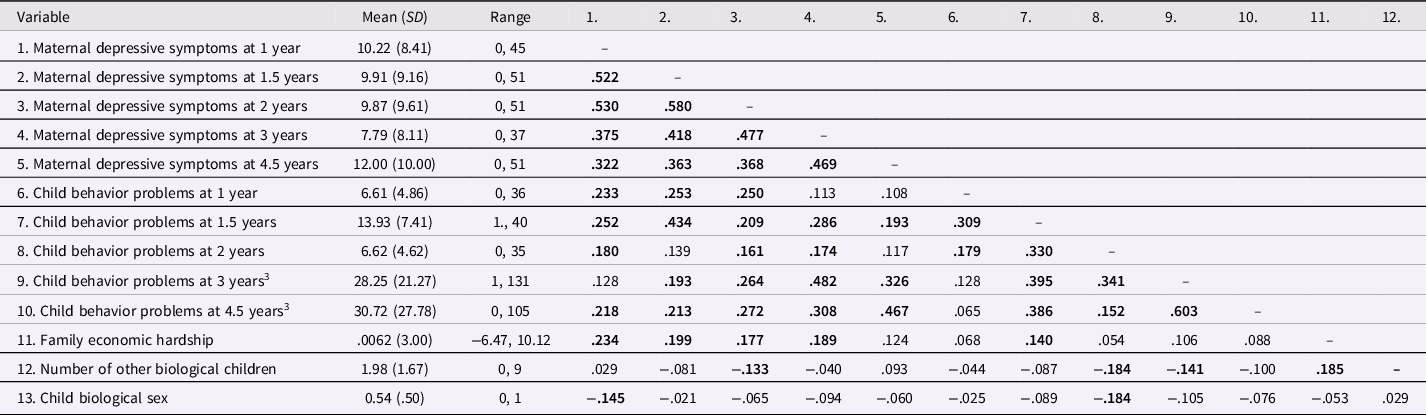
Note. 1Bolded values indicate significant correlations at p < .05. 2Child biological sex, coded 0 = Male, 1 = Female. 3Descriptive statistics reported for nonrescaled values on child behavior problems at 3 and 4.5 years.
Maternal age, maternal country of birth, number of children, prenatal economic hardship, child biological sex, and single-parent status were evaluated as potential covariates. Only number of other children, prenatal economic hardship, and child biological sex were significantly related to the latent level of maternal depressive symptoms and child behavior problems (all p’s < .05); thus, in the interest of parsimony, only those three covariates were included in the full ALT-SR model. A second primary model included maternal country of birth and maternal age as auxiliary variables due to relation with attrition. However, the pattern (estimate direction, significance) of primary paths and overall model fit did not change. An alternative model was evaluated that included maternal country of birth and maternal age as auxiliary variables due to relation with attrition. However, the pattern (estimate direction, significance) of primary paths and overall model fit did not change. Therefore, the final model does not include auxiliary variables.
Variability in interval length between interviews has important implications for latent trajectory models with fixed intervals and conclusions about within-dyad effects across unique developmental stages. To address this concern, the actual time between measurement points for each dyad was calculated. Outliers were then identified based on the actual time interval between each visit by calculating standardized values. Cases were identified as outliers if the standardized value of any time interval between visits was less than −3 or greater than 3. Ten unique cases were identified as outliers on time interval between visits (three cases between 1 and 1.5 years, two cases between 1.5 and 2 years, four cases between 2 and 3 years, and three cases between 3 and 4.5 years). The full ALT-SR model was rerun with these 10 unique cases removed. The significance and direction of the primary model paths remained identical to the model with outliers included. Therefore, these cases were retained in the final model.
Primary analyses
ALT model for maternal depressive symptoms
Table 3 presents the fit indices for various models of trajectories of maternal depressive symptoms. The random intercept model (Model 1), the linear latent growth model (Model 2), and the quadratic latent growth model (Model 3) were similar, as indicated by the Akaike information criterion (AIC) and the Bayesian information criterion (BIC). The latent basis model with between-level variability in growth factors did not converge (Model 4). The latent basis model with between-level variability in the growth factor constrained to 0 (Model 5) emerged as the best fit of the data. This model, which included estimates of growth factors (intercept and slope) for maternal depressive symptoms and between-person variability in the intercepts (initial levels) of maternal depressive symptoms, resulted in significant improvement in model fit relative to the intercept-only model, based on better model fit and lower BIC. Model 5 was then evaluated with fixed (i.e., set to be equal) and unfixed (i.e., free to vary) autoregressive parameters; the models demonstrated similar model fit (see Table 3). The model with unfixed autoregressive parameters was chosen given unequal time between measurement intervals and corresponding hypothesized differences in autoregressive effects.
Comparison of models of intra-individual change in maternal depressive symptoms and child behavior problems

Note. Italicized font represents final model chosen for best fit of the data according to fit indices. 1No convergence, number of iterations exceeded. 2Not positive definite, negative residual variance. 3The latent variable covariance matrix (PSI) is not positive definite. Italicized font represents final model chosen for best fit of the data according to fit indices.
ALT model for child behavior problems
Table 3 presents the fit indices for various models of trajectories of child behavior problems. The linear latent growth model (Model 2) was a better fit of the data than the random intercept model (Model 1), as indicated by the fit indices. The quadratic latent growth model (Model 3) and the latent basis model with between-level variability in growth factors (Model 4) were not positive definite due to negative residual variance. Similar to the model of maternal depressive symptoms, the latent basis model with between-level variability in growth factor constrained to 0 (Model 5) emerged as the best fit of the data. This model, which included estimates of both growth factors (intercept and slope) and between-person variability in intercept (initial levels) of child behavior problems, resulted in significant improvement in model fit relative to the intercept-only model based on model fit statistics and lower BIC. Model 5 was then evaluated with fixed (i.e., set to be equal) and unfixed (i.e., free to vary) autoregressive parameters; the model with unfixed autoregressive parameters was a better fit of the data (see Table 3).
ALT-SR model of maternal depressive symptoms and child behavior problems
A bivariate ALT-SR included the two aforementioned univariate ALT into a single bivariate model and also evaluated (1) the between-dyad associations of maternal depressive symptoms and child behavior problems and (2) the within-person bidirectional predictive relations between maternal depressive symptoms and child behavior problems over time, and (3) the within-dyad concurrent associations between maternal depressive symptoms and child behavior problems (see Table 4; Figure 1). This model was a good fit of the data according to several fit indices, χ2 [N = 322; df = 45] = 78.303, p = .0015, RMSEA = 0.048 {90% CI: 0.029, 0.065}, CFI = 0.947, SRMR = 0.057.
Full model results. Autoregressive latent basis model of maternal depressive symptoms and child behavior problems from child age 1–4.5 years. Covariates shown in gray. Numbers indicate unstandardized estimates, given difficulty interpreting standardized estimates across within- and between-level components. Dashed lines indicate nonsignificant paths. Solid lines indicate significant paths at p < .05. BP = child behavior problems; Econ. = economic; Int = intercept; MD = maternal depressive symptoms; yr. = year. Model fit: χ2 [N = 322; df = 45] = 78.303, p = .0015, RMSEA = 0.048 {90% CI: 0.029, 0.065}, CFI = 0.947, SRMR = 0.057.

Full ALT-SR model estimates

Note. Unstandardized estimates shown. Bolded values represent p-values significant at p < .05 level. BP = behavior problems; i = intercept; MD = maternal depressive symptoms; s = slope. Subscript numbers refer to child age at assessment (i.e., 1, 1.5, 2, 3, and 4.5 years). Covariate effects not included in table. “N/A” indicates p-value not estimated by the model.
Between-dyad results
The intercepts of maternal depressive symptoms (Est = 11.342, SE Est = 0.836, p < .001) and child behavior problems (Est = 8.276, SE Est = 0.512, p < .001) were both significantly different from 0. There was significant variability in the intercept of maternal depressive symptoms (Est = 22.734, SE Est = 4.007, p < .001). There was not significant variability in the latent intercept of child behavior problems (Est = 2.382, SE Est = 2.247, p = .29). The intercept of maternal depressive symptoms was significantly associated with the intercept of child behavior problems (Est = 4.364, SE Est = 2.209, p = .048), indicating that mothers who exhibited higher depressive symptoms had children who exhibited higher behavior problems. Prenatal family economic hardship, number of other biological children in the family, and child biological sex were included as covariates associated with the intercepts of maternal depressive symptoms and child behavior problems. Higher prenatal economic hardship was significantly associated with higher intercept of maternal depressive symptoms (Est = 0.535, SE Est = 0.130, p < .001) and child behavior problems (Est = 0.202, SE Est = 0.077, p = .009). A larger number of biological children was significantly associated with fewer child behavior problems (Est = −0.482, SE Est = 0.143, p = .001). Male children had more behavior problems than female children (Est = −1.066, SE Est = 0.439, p = .015).
The mean of the slope for maternal depressive symptoms (Est = 1.534, SE Est = 0.737, p = .037) was significantly different from 0, suggesting there was a significant (non-zero) increase in maternal depressive symptoms over the study period. However, none of the slope loadings were statistically significant (all p’s > .05), suggesting the significant increase in depressive symptoms was the accumulation of small, incremental change over time. The mean of the slope for child behavior problems was also significantly different from 0 (Est = 2.553, SE Est = 0.531, p < .001). Consistent with a nonlinear pattern of change in child behavior problems, the slope loadings indicated that the proportion of overall change in child behavior problems was highest up to and including 1.5 years (Est = 2.841, SE Est = 0.562, p < .001), followed by a decrease to 2 years (Est = −0.051, SE Est = 0.174, p > .05), and subsequent increase up to and including 3 years (Est = 0.730, SE Est = 0.150, p < .001).
Within-dyad results
Concurrent associations. As expected, at the within-dyad level, maternal depressive symptoms and child behavior problems were significantly associated at 1.5 years (Est = 17.585, SE Est = 3.783, p < .001), 3 years (Est = 18.774, SE Est = 3.345, p < .001), and 4.5 years (Est = 15.231, SE Est = 3.348, p < .001). In other words, at each of these time points, mothers’ deviation from their average level of depressive symptoms was related to children’s deviation from their average level of behavior problems (e.g., if mothers exhibited relatively more depressive symptoms at this time point, their children were more likely to show more behavior problems at this time point).
Autoregressive effects. As expected, at the within-dyad level, the majority of autoregressive paths of maternal depressive symptoms were statistically significant. Higher levels of 1-year maternal depressive symptoms significantly predicted more 1.5-year symptoms (Est = 0.264, SE Est = 0.101, p = .009), which significantly predicted more 2-year symptoms (Est = 0.381, SE Est = 0.090, p < .001). All of the autoregressive paths for child behavior problems across the 4.5 years were positive and statistically significant. One-year child behavior problems significantly predicted 1.5-year problems (Est = 0.358, SE Est = 0.142, p = .012), which significantly predicted 2-year problems (Est = 0.172, SE Est = 0.068, p = .011), which significantly predicted 3-year problems (Est = 0.345, SE Est = 0.130, p = .008), which significantly predicted 4.5-year problems (Est = 0.582, SE Est = 0.075, p < .001).
Bidirectional associations. As expected, evidence of statistically significant within-dyad bidirectional associations appeared starting in infancy. Higher levels of child behavior problems at 1-year significantly predicted higher levels of depressive symptoms in their mother at 1.5 years (Est = 0.285, SE Est = 0.134, p = .034), controlling for earlier levels of maternal depressive symptoms. Higher levels of mother’s depressive symptoms at 2 years significantly predicted higher levels of behavior problems in her child at 3 years (Est = 0.164, SE Est = 0.068, p = .016), controlling for earlier levels of maternal depressive symptoms and child behavior problems. Higher levels of child behavior problems at 3 years significantly predicted higher levels of depressive symptoms in their mother’s depressive symptoms at 4.5 years (Est = 0.385, SE Est = 0.126, p = .002), controlling for earlier levels.
Discussion
Although developmental theory postulates bidirectional relations among maternal and child mental health over time (Davidov et al., Reference Davidov, Knafo-Noam, Serbin and Moss2015; Paschall & Mastergeorge, Reference Paschall and Mastergeorge2016), empirical work has largely documented the deleterious unilateral effects of maternal depressive symptoms on child behavior problems, with little attention to the consequences of child behavior problems on maternal depressive symptoms. Novel statistical methodology allows for assessment of within-dyad, bidirectional associations between maternal and child mental health (i.e., evaluation of the effects of maternal mental health on her own child; evaluation of the effects of child mental health on his or her own mother). Using an ALT-SR model (Curran et al., Reference Curran, Howard, Bainter, Lane and McGinley2014), the current study evaluated the within-dyad, bidirectional associations between maternal depressive symptoms and child behavior problems from child age 1 year to 4.5 years, among a sample of low-income, Mexican American mother-child dyads. The results provide evidence of bidirectional associations as early as child age 1 year. Results also demonstrated substantial within-person stability in maternal depressive symptoms and child behavior problems across time and several concurrent associations between maternal depressive symptoms and child behavior problems.
As hypothesized, we found evidence of within-dyad bidirectional associations between maternal depressive symptoms and child behavior problems across the first 4 years of life. Specifically, a mother-driven bidirectional association emerged from 2 to 3 years. Child-driven bidirectional associations emerged at multiple timepoints, from 1 to 1.5 years and 3 to 4.5 years, highlighting the importance of considering child-directed effects on maternal mental health across early developmental periods. To our knowledge, the current study is the first to document child-directed within-dyad associations as early as 1 year of life. Differential maternal expectations for child behavior across development may partially explain the emergence of child-directed influence during infancy and preschool in the current study. For example, toddlerhood, or the “terrible twos,” may be considered a period during which child behavior difficulties are considered more normative, given children’s increased autonomy, mobility, and language capabilities. In contrast, child behavior problems that onset during infancy or persist into preschool may be more indicative of a child with underlying behavioral difficulty (Alink et al., Reference Alink, Mesman, Van Zeijl, Stolk, Juffer, Koot and Van IJzendoorn2006; Breitenstein et al., Reference Breitenstein, Hill and Gross2009; Luby & Belden, Reference Luby and Belden2012), and thus may be more distressing to maternal mental health. Further, consistent with the developmental psychopathology principle of equifinality, differences in the manifestation of behavioral problems across development (e.g., crying and fussing during infancy versus noncompliance during preschool) may operate through different pathways to increase maternal risk for elevated depressive symptoms.
Contrary to Dora and Baydar’s (Reference Dora and Baydar2020) findings suggesting that mother–child bidirectional associations are limited after age 3, we found evidence of child-driven associations after age 3. Differential sample characteristics may explain these differences. The current sample of mothers primarily consists of unemployed women at home with their children, most of whom were not attending daycare or preschool (only 30% of the children were enrolled in preschool at the 4.5-year timepoint). Only 12% of Dora and Baydar’s (Reference Dora and Baydar2020) sample were employed, yet nearly 98% of their sample were married and families ranged widely in socioeconomic status (compared to the current sample of very low-income women, 30% of whom were married at enrollment). Among dyads consisting of working mothers, mothers with significant spousal support, and/or children with additional childcare providers, child behavior problems may be less disruptive to maternal mental health given less direct and constant time spent with the child or additional supports that buffer deleterious effects.
Our results are particularly relevant to early intervention. First, we found evidence of within-child stability in behavior problems from age 1 to age 4.5 years, such that children exhibiting more behavior problems during infancy continue to exhibit behavior problems throughout toddlerhood and preschool. Early identification of children’s behavior problems may prevent subsequent negative consequences for maternal and child mental health through facilitation of earlier remediation efforts. We also found evidence of within-mother stability of depressive symptoms from child age 1 to 2 years. This individual-order stability may be reflective of depressive symptomatology onset during the perinatal period (before or after the birth of the target child). Recent findings suggest that women reporting more depressive symptoms in the immediate postpartum are more likely to sustain depressive symptoms during the first few years of motherhood (Putnick et al., Reference Putnick, Sundaram, Bell, Ghassabian, Goldstein, Robinson and Yeung2020). Moreover, evidence of within-dyad bidirectional associations underscores the importance of adopting a dyadic approach to alleviating both maternal depressive symptoms and child behavior problems. Indeed, treatment of preschool-onset child depressive symptoms has been shown to reduce maternal depressive symptoms (Luby et al., Reference Luby, Barch, Whalen, Tillman and Freedland2018). Intervention targeting maternal depressive symptoms, as early as pregnancy, may exert a lasting positive influence on her and her children’s mental health and socioemotional functioning (Goodman et al., Reference Goodman, Cullum, Dimidjian, River and Kim2018). Our results also offer support for early-life dyadic interventions (e.g., Parent-Child Interaction Therapy, Attachment and Biobehavioral Catch-up) poised to simultaneously target the mental health of both partners of the dyad.
Importantly, the current sample of mother–child dyads is not a clinical sample. For example, only 27% of mothers (as indicated by a sum score of 16 or higher on the CES-D) and 10.9% of children (as indicated by a T-score of 64 or higher) met criteria for clinically significant depressive symptoms and behavior problems, respectively, at 4.5 years. Within-dyad bidirectionality among the current sample suggests that subclinical levels of child behavior problems and maternal depressive symptoms have the potential to exert effects on the other member of the dyad, across time. Future work may aim to evaluate within-dyad bidirectionality at varying levels of clinically severity, with potential implications for intervention (e.g., intervention targeting child, mother, or dyad). Dyads marked by subclinical levels of child behavior problems and/or maternal depressive symptoms may benefit from different types of intervention than dyads marked by clinical levels.
Results should be interpreted in light of several limitations. The current sample of low-income, Mexican American mother-child dyads addresses an important need for understanding bidirectional processes among populations underrepresented in empirical work, but the uniqueness of the sample may preclude generalizability of the results. It is unknown whether other types of caregiver–child (e.g., father–child, grandparent–child) processes may unfold in a similar bidirectional nature throughout the first few years of life or buffer the strength of bidirectional mother–child effects. Future work may also consider mental health symptom spillover within the broader family unit, such as assessing triadic processes between maternal depressive symptoms, fathering, and child behavior problems (Roubinov et al., Reference Roubinov, Somers and Luecken2021). Additionally, in any time series model, bias may be introduced given the first timepoint is not modeled as a dependent variable, unlike the measurements at subsequent timepoints (i.e., child behavior problems and maternal depressive symptoms at 1 year, in the current study). However, this bias is suggested to be largely reduced by latent centering the mean (Asparouhov et al., Reference Asparouhov, Hamaker and Muthén2018). Given the full model presented in the manuscript accounts for the latent level of child behavior problems and maternal depressive symptoms, bias should be reduced in our model.
Measurement of the same construct over time with different scales is a necessary aspect of developmental research, but has implications for statistical modeling (McArdle et al., Reference McArdle, Grimm, Hamagami, Bowles and Meredith2009). However, other complications arise when using the same items or scale across development (Knight & Zerr, Reference Knight and Zerr2010; Petersen et al., Reference Petersen, Choe and LeBeau2020), given behavioral manifestations of the same psychological construct, such as behavior problems, differ across development. The BITSEA and CBCL are established tools for measuring children’s socioemotional and behavior problems, but encompass different developmental periods. Petersen et al. (Reference Petersen, Choe and LeBeau2020) identify two considerations for determining whether scores on different measures may be meaningfully compared: (1) whether measures can be scaled to have the same range of possible scores, and (2) measurement equivalence over time. We rescaled the CBCL measures of child behavior problems at 3 and 4.5 years so that the range of possible scores is equivalent to the range of possible scores on the BITSEA, an approach supported by existing psychometric work. Further, evidence of within-child stability of behavior problems across both measurement scales suggests they are capturing similar constructs.
All measures in the current analyses were acquired via maternal report, which introduces the potential for within-rater bias, shared-rater variance, and inflated associations (Xerxa et al., Reference Xerxa, Rescorla, van der Ende, Hillegers, Verhulst and Tiemeier2021). Mothers with more depressive symptoms may be more likely to report behavior problems in their children (Goodman et al., Reference Goodman, Rouse, Connell, Broth, Hall and Heyward2011; Hails et al., Reference Hails, Reuben, Shaw, Dishion and Wilson2018), perhaps due to shared method variance or genetic effects. The current model is unable to parse apart such effects. However, the BITSEA, CBCL, and CES-D are well-validated and reliable measures among lower-income and Hispanic/Latinx populations (Hungerford et al., Reference Hungerford, Garcia and Bagner2015; Roberts et al., Reference Roberts, Vernon and Rhoades1989; Rubio-Stipec et al., Reference Rubio-Stipec, Bird, Canino and Gould1990). Common to longitudinal studies (Curran et al., Reference Curran, Howard, Bainter, Lane and McGinley2014), the current study faced real-world constraints of unequal time intervals between assessments (ranging from 6 months to 1.5 years). Future empirical work with similar modeling strategies may aim to balance the consideration of equal spacing between assessments, while also recognizing the logistical limitations of real-world longitudinal data collection.
Our results also point to several promising directions for future research. An investigation into if and how a child’s biological sex affects the strength of bidirectional transactions is warranted. At the between-dyad level, male children were reported by mothers to have more behavior problems at 1 year of age than female children, but our study was unable to evaluate differences in within-dyad bidirectional relations based on child biological sex. Previous work has yielded mixed results regarding mean-level associations between maternal depressive symptoms and child behavior problems (Baker et al., Reference Baker, Brooks-Gunn and Gouskova2020; Choe et al., Reference Choe, Olson and Sameroff2014; Goodman et al., Reference Goodman, Rouse, Connell, Broth, Hall and Heyward2011; Jaffee & Poulton, Reference Jaffee, Poulton, Huston and Ripke2006; Roubinov et al., Reference Roubinov, Epel, Adler, Laraia and Bush2019). Future empirical studies may also aim to evaluate mechanisms underlying bidirectional associations at the within-dyad level, to uncover how both child-directed and mother-direct processes are unfolding over time. Lastly, future work may aim to consider within-dyad bidirectionality across varying timescales. In the current study, mothers were asked to report on depressive symptoms throughout the last week, infant and toddler behavior problems throughout the last month, and child behavior problems throughout the last 2 months. The reference period of maternal report is relevant to the evaluation of how bidirectional associations unfold over time, yet smaller differences may be less relevant in longitudinal studies evaluating bidirectionality across several years. Consistent with prior work, we assessed maternal depressive symptoms and child behavior problems at approximately 1-year intervals. However, the strength of within-person stability and within-dyad bidirectional associations may be stronger across more compressed measurement periods (e.g., every few months, or during a single interaction).
Future work among diverse samples may aim to extend our understanding of culturally-based moderators of bidirectional mother-child association, given the broader cultural context in which mother-child interaction occurs impacts developmental processes during the first few years of life (Garcia Coll et al., Reference Coll, Crnic, Lamberty, Wasik, Jenkins, Garcia and McAdoo1996). Relevant to the current sample, traditional Mexican cultural values that emphasize the primacy of the maternal role (e.g., familismo, marianismo) and a strong mother-child bond can provide critical protective influences on mothers and children in challenging circumstances (Calzada et al., Reference Calzada, Tamis-LeMonda and Yoshikawa2013; Stein & Polo, Reference Stein and Polo2014). Alternatively, a strong mother–child bond could exacerbate the negative impact that one dyad member’s mental health has on the other’s mental health (Calzada et al., Reference Calzada, Tamis-LeMonda and Yoshikawa2013). Child behavior problems may also be more harmful to the mental health of women aligning strongly to values of child compliance, parental respect, and familial harmony. For example, traditional Mexican cultural values of respeto (“respect”) and bien educado (“well-mannered”), emphasize the importance of children’s respect of others, compliance to parents, and proper behavior (Ng et al., Reference Ng, Tamis-LeMonda, Godfrey, Hunter and Yoshikawa2012).
The current study extends existing research on bidirectional processes through the inclusion of more frequent assessments of maternal depressive symptoms and child behavior problems across a more intensive longitudinal period, and distinctively evaluates bidirectional associations beginning at child age 1 year. The study’s analytic approach, ALT-SR, more accurately mirrors dyadic theory by evaluating and delineating bidirectional associations at both within-person and within-dyad levels. The uncovering of child-driven and mother-driven influences within dyads beginning as early as 1 year of age adds support for the use of intervention programs based in dyadic theory during early developmental periods by affirming that both individuals within the dyad exert unique influences on each other’s mental health across early childhood.
Acknowledgments
We would like to thank Jody Southworth-Brown, Kirsten Letham, Anne Mauricio, Monica Gutierrez, and Elizabeth Nelson for their assistance with data collection and management; Dr. Dean Coonrod and the Maricopa Integrated Health System for their assistance with recruitment; and our entire team of interviewers and undergraduate research assistants for their commitment and dedication to this project. We thank the Las Madres Nuevas mothers and children for their participation.
Funding statement
This research was supported by the National Institute of Mental Health (R01 MH083173-01, MH083173-01A1S; PIs Linda Luecken, Keith Crnic, Nancy Gonzales) and the National Institute of Child Health and Human Development (R01 HD083027; PIs Linda Luecken, Keith Crnic, Nancy Gonzales).
Conflicts of interest
The authors have no conflicts of interest to report.


 Open access

