





1. Introduction
Minimalist syntactic theories have long posited a close link between agreement and movement (e.g., Chomsky Reference Chomsky1995, Reference Chomsky and Michael Kenstowicz2001; Carstens Reference Carstens2005; Bošković Reference Bošković2007; Van Urk Reference Urk2015).Footnote 1 The general shape is for “valuation” relationships between a probe and a goal (i.e., instances of agreement qua feature copying) to be followed or preceded by the application of Merge (i.e., movement). This article aims to put forward a theory of the nature of the relationship between feature copying and movement through a case study of the patterns of agreement and word order in Border Lakes Ojibwe (Central Algonquian). This variety of Ojibwe shows a previously unexamined alternation between VOS and VSO word orders. These alternations in the linear order of subjects and objects are argued to be a function of complex interactions between probes on Voice, Infl, and C. The analysis informs the general link between agreement and word order and provides strong evidence in favour of a configurational analysis of the Ojibwe clause.
The VOS/VSO alternation in Ojibwe, as well as the patterns of agreement, are most readily described in relation to the alternation in direct/inverse syntactic argument alignments. Alignment refers to the descriptive ranking of person categories on a Person-Animacy Hierarchy (PAH) along with a scale that ranks higher syntactic positions such as external argument (EA) over lower ones like internal argument (IA). The portions of the relevant scales are given in (1).


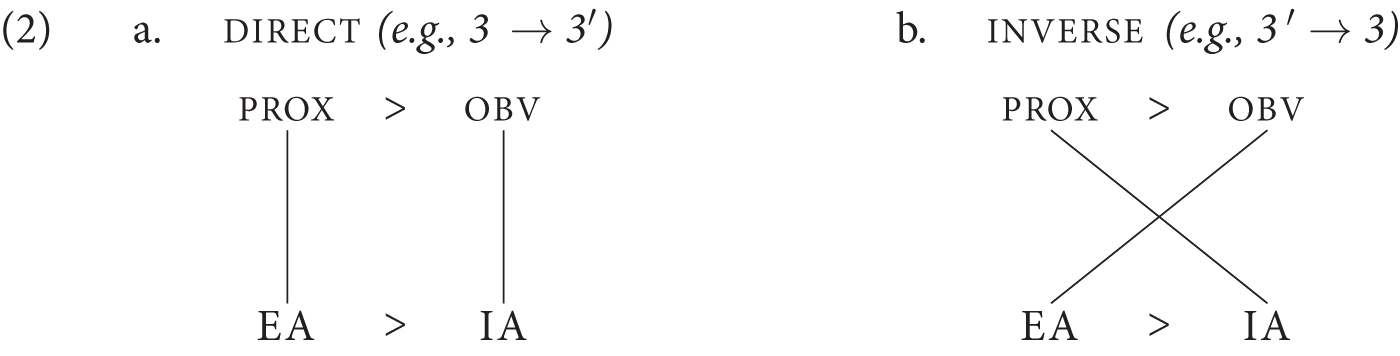
In direct syntactic environments, the alignment of the two scales is high-to-high, as shown in (2a). In inverse syntactic environments, alignment is high-to-low and low-to-high, as shown in (2b).
Turning now to the key word order facts, in direct alignments, where the subject is a “higher ranked” proximate argument and the object is a “lower ranked” obviative argument, VOS occurs preferentially (3a), but VSO is also possible (3b). In inverse alignments, where the object is proximate and the subject obviative, only VSO occurs (3c) – VOS is ungrammatical (3d).
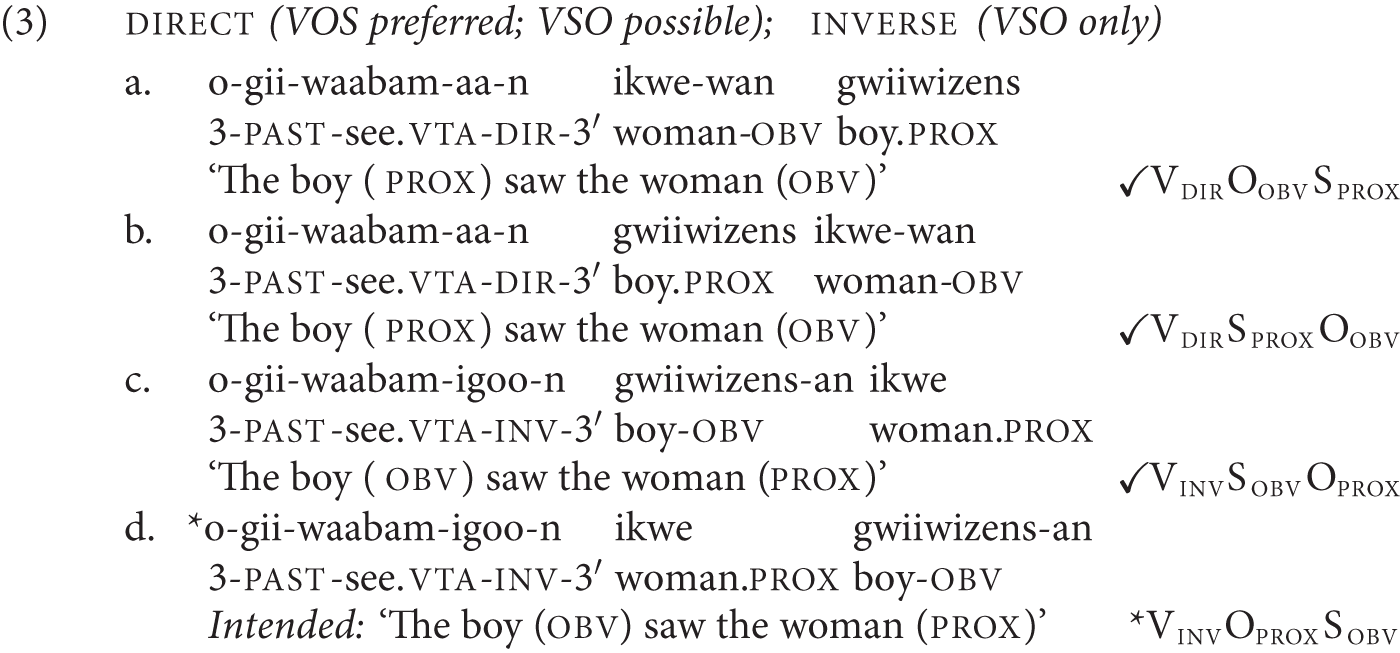
As for agreement, there are probes on Voice, Infl, and C, each of which shows a unique pattern of agreement. I give a brief and dense description here, and a more deliberate description in the coming sections. Voice alternates between a direct marker -aa in direct alignments (3a,b), which indexes the third person object, and the inverse marker -igoo in inverse alignments (3c), which is an impoverished or default form (e.g., Oxford Reference Oxford2019). Infl (o-) shows a canonical omnivorous agreement pattern (Nevins Reference Nevins2011; Preminger Reference Preminger2014) where the higher ranked proximate argument is targeted regardless of whether it is the subject (3a,b) or the object (3c). Finally, C (-n) shows a curious pattern that I dub reverse omnivority, where instead the lower ranked obviative argument is agreed with regardless of whether it is the subject (3c) or object (3a,b). These patterns are the key data that the current analysis seeks to explain in a unified manner.
Ojibwe has many of the canonical properties of a nonconfigurational language as predicted by the Pronominal Argument Hypothesis (Jelinek Reference Jelinek1984) and the Polysynthesis Parameter (Baker Reference Baker1996), including pro- and argument-drop, highly rich agreement and head-marking, seemingly free word order, and discontinuous constituents. Despite this, the empirical findings, and the proposed analysis, bring Ojibwe into a growing body of work that argues Algonquian languages are in fact configurational (e.g., Brittain Reference Brittain2001; Bruening Reference Bruening2001b, Reference Bruening2009; LeSourd Reference LeSourd2006; Hamilton Reference Hamilton2015; Morris Reference Morris2018), in the sense that overt arguments of the verb occupy syntactic argument positions within a hierarchical phrase structure, rather than adjunct positions (Junker Reference Junker2004) or a position in a flat structure (Grafstein Reference Grafstein1984).
The central question of the article is therefore how the syntax is configured to give rise to the combination of agreement and word order patterns shown above. The crux of the account is to establish the representations and operations that drive the alternations between the SO and OS argument orders. I link movement of the arguments to properties of and interactions between  $\phi$-probes on Voice and Infl, and both $\phi$- and $\delta$-probes on C. The major innovations are (i) extending a model of syntactic agree to include a relativized EPP, which allows for the fine-grained regulation of movement in addition to feature copying, and (ii) the adoption of a microparameterized Activity Condition (Chomsky Reference Chomsky, Roger Martin, Michaels and Uriagereka2000, Reference Chomsky and Michael Kenstowicz2001; Oxford Reference Oxford2017a), which leads the probe on Infl to bleed the possible agreement and movement relations on the higher probe on C, capturing reverse omnivority. The proposal is assessed by exploring how indefinite arguments are interpreted with respect to negation. The analysis leads to a critical comparison with previous accounts of agreement and word order in Algonquian and beyond.
2. Ojibwe morphosyntax
Ojibwe is a continuum of closely related dialects spoken around the Great Lakes of North America. At present, there are as many as 90,000 speakers across the dialects. While the dialects are largely mutually intelligible, there are significant phonological, morphological, and syntactic differences (see Valentine Reference Valentine2001 and Sullivan Reference Sullivan2016b for reviews). Within linguistics, the eastern dialects have been the most studied. This literature includes significant descriptive work (e.g., Valentine’s Reference Valentine2001 grammar), as well as wide-ranging theoretical work (e.g., Béjar and Rezac Reference Béjar and Rezac2009; Barrie and Mathieu Reference Barrie and Mathieu2012; Reference Barrie and Mathieu2016; Lochbihler and Mathieu Reference Lochbihler and Mathieu2013, Reference Lochbihler and Mathieu2016; Mathieu Reference Mathieu2013, Reference Mathieu2014; Newell and Piggott Reference Newell and Piggott2014).
In the present article, the dialect of interest is Border Lakes Ojibwe. This is generally classified as part of the Southwestern group, spoken in what is now Northern Minnesota, Northwestern Ontario, and Northern Wisconsin (Sullivan Reference Sullivan2016b). While estimates vary, it is likely that there are not more than 5,000 total speakers. The two speakers consulted come from the geographical area around the US-Canadian border – the Border Lakes region – approximately between International Falls, Minnesota and Thunder Bay, Ontario.
In the remainder of this section, I present three morphosyntactic properties of Ojibwe: the obviation system, the verbal morphology, and the range of available word orders.Footnote 2 Over the course of the discussion, the central facts relevant to the VOS/VSO alternation come into focus.
2.1 Obviation and direct-inverse voice
Obviation is a discourse sensitive system that organizes third-person referents (e.g., Aissen Reference Aissen1997). In Ojibwe, the system is most clearly active with animate nouns – it only plays a peripheral role in nouns in the inanimate class (for details, see Hammerly Reference Hammerly2023). Within a given domain, one referent is designated proximate, a morphologically unmarked distinction (3a), and all others are designated obviative, a distinction marked with the suffix -an in the singular (3b).

How a particular referent is ultimately designated as proximate or obviative remains a largely open question. Obviation is thought to be related to topicality or prominence, but has also been understood as encoding perspective (Russell Reference Russell1996; Bliss Reference Bliss2005; Muehlbauer Reference Muehlbauer2012; Hammerly and Göbel Reference Hammerly and Göbel2019). An approximate description is that the perspective centre or most topical third-person referent is designated proximate, while all other referents are obviative.
Obviative marking is required in constructions where there are multiple animate third persons – most notably possessive constructions and transitive (and ditransitive) verbs. An example of obviative marking with a transitive verb, the focus of this article, is shown in (5).

The sentence in (5) shows a direct alignment: the subject is proximate and the object is obviative. This is most readily understood in contrast to inverse alignments (6), where the subject is obviative and the object is proximate.Footnote 3

These examples show that obviation is not necessarily tied to thematic role. Reversing obviative marking does not change the core propositional meaning of the utterance: both (5) and (6) mean ‘the boy saw the woman’. Informally, the alternation is reported by speakers to be associated with a shift in perspective. Direct alignments, where the subject is proximate, take the perspective of the subject referent. Inverse alignments, where the object is proximate, take the perspective of the object referent. For this reason, speakers will often translate inverse sentences in passive voice (i.e., (6) would be translated as ‘the woman was seen by the boy’).
As evidenced by the examples above, obviation affects the form of  $\phi$-agreement on the verb. This has lead to a variety of proposals that place obviation within the wider theory of person, number, and noun classification (Bliss and Jesney Reference Bliss and Jesney2005; Hammerly Reference Hammerly and Rodcia Ivan2018, Reference Hammerly2020, Reference Hammerly2023; Oxford Reference Oxford2019). For simplicity, I adopt the view that the relationships between $\phi$-features can be described by appealing to a feature geometry (Harley and Ritter Reference Harley and Ritter2002), as shown in (7). Since this article focuses on the third persons, I restrict the discussion to that space. For the interested reader, a more detailed analysis of the feature system of Ojibwe, including issues that arise with the feature geometry, can be found in Hammerly (Reference Hammerly2020, Reference Hammerly2021b, Reference Hammerly2023).
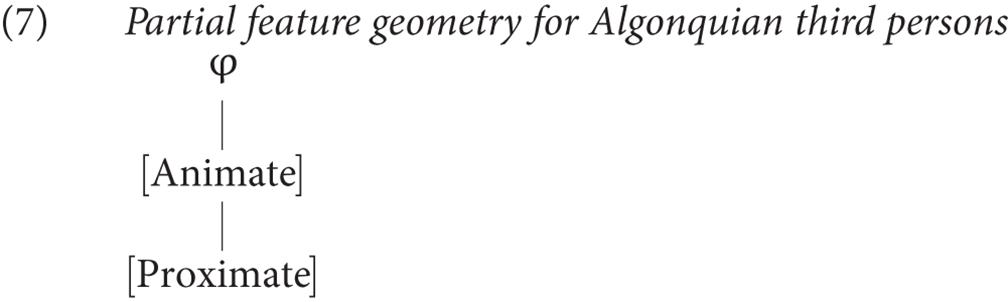
The geometry represents the idea that the presence of more specific features such as [Proximate] entails all less specific features (i.e., [Animate] and  $\phi$). This leads to the representation in (8) for each of the three singular third person categories.

This representation is constrained such that only animate third persons can alternate in obviation status; furthermore, all local persons are inherently proximate. This follows from the entailment relationships enforced by the geometry. For Ojibwe, this is a desirable result: neither inanimate nor local nouns (overtly) alternate in obviation. However, the adopted feature geometry runs into issues with other Algonquian languages such as Innu (Clarke Reference Clarke1982) and Blackfoot (Bliss Reference Bliss2005), which show obviative markers on inanimate nouns. Blackfoot further shows a contrast between proximate and obviative local persons. This has motived alternative feature geometries (Bliss and Jesney Reference Bliss and Jesney2005), as well as proposals to abandon the feature geometry as a syntactic representation altogether (Hammerly Reference Hammerly2020, Reference Hammerly, Alessa Farinella and Hill2021a, Reference Hammerly2023). A full accounting of these issues goes beyond the scope of this article. The upshot is that, while the geometry adopted here cannot be claimed to be universal due to underprediction of the typology of possible obviation systems, it is sufficient to capture the relationships between features in Ojibwe and can be retained for present purposes. Most immediately relevant to note is that the category of obviative is represented by { $\phi$, Animate}, while proximate is represented by { $\phi$, Animate, Proximate}. The fact that the feature sets that define these two categories are in subset-superset relationships is critical to understanding how and when these arguments are targeted by agreement probes. In the next sections, the verbal morphology and patterns of agreement are detailed to set the stage for this account.
2.2 The verbal spine
The verbal morphology of Algonquian is the most intensely studied aspect of the language family (e.g., Nichols Reference Nichols1980, Oxford Reference Oxford2014, and references therein). For the present work, the verbal morphology is both something to be explained via agreement, but also a guide for determining the underlying structure and the landing sites for movement. This follows from Baker’s (Reference Baker1985) Mirror Principle, where inner morphemes are taken to be heads of lower projections.
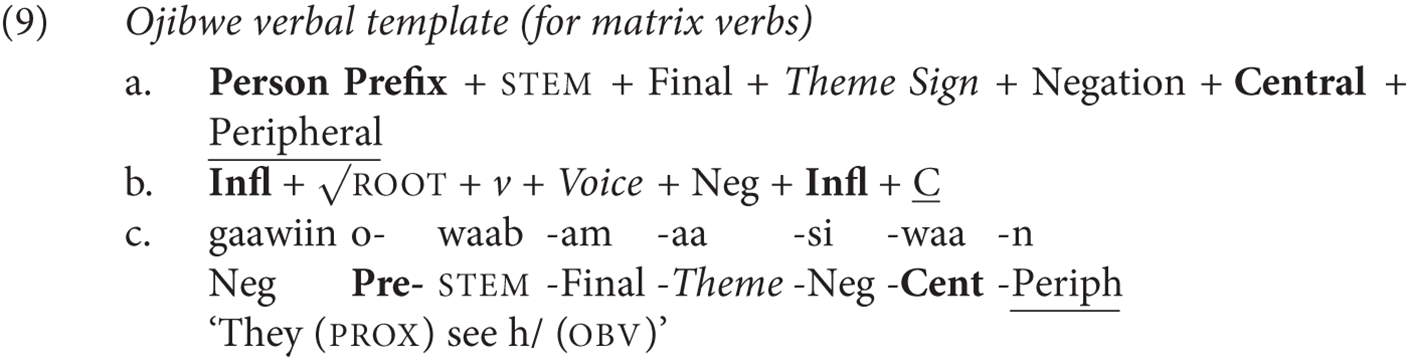
The shape of the proposed structure, shown in (9d), follows most closely the syntax proposed by Oxford (Reference Oxford2019) for the Algonquin dialect of Ojibwe. Oxford focuses on the relationships between the verbal morphology and agreement probes: the theme sign corresponds to a probe on Voice, the central agreement and person prefix to a probe on Infl, and the peripheral agreement to a probe on C (here, corresponding more particularly to Cagr). For reference, the correspondences between the terminology used within the Algonquianist tradition and heads in the phrase structure are given in (9a,b), and exemplified in (9c).
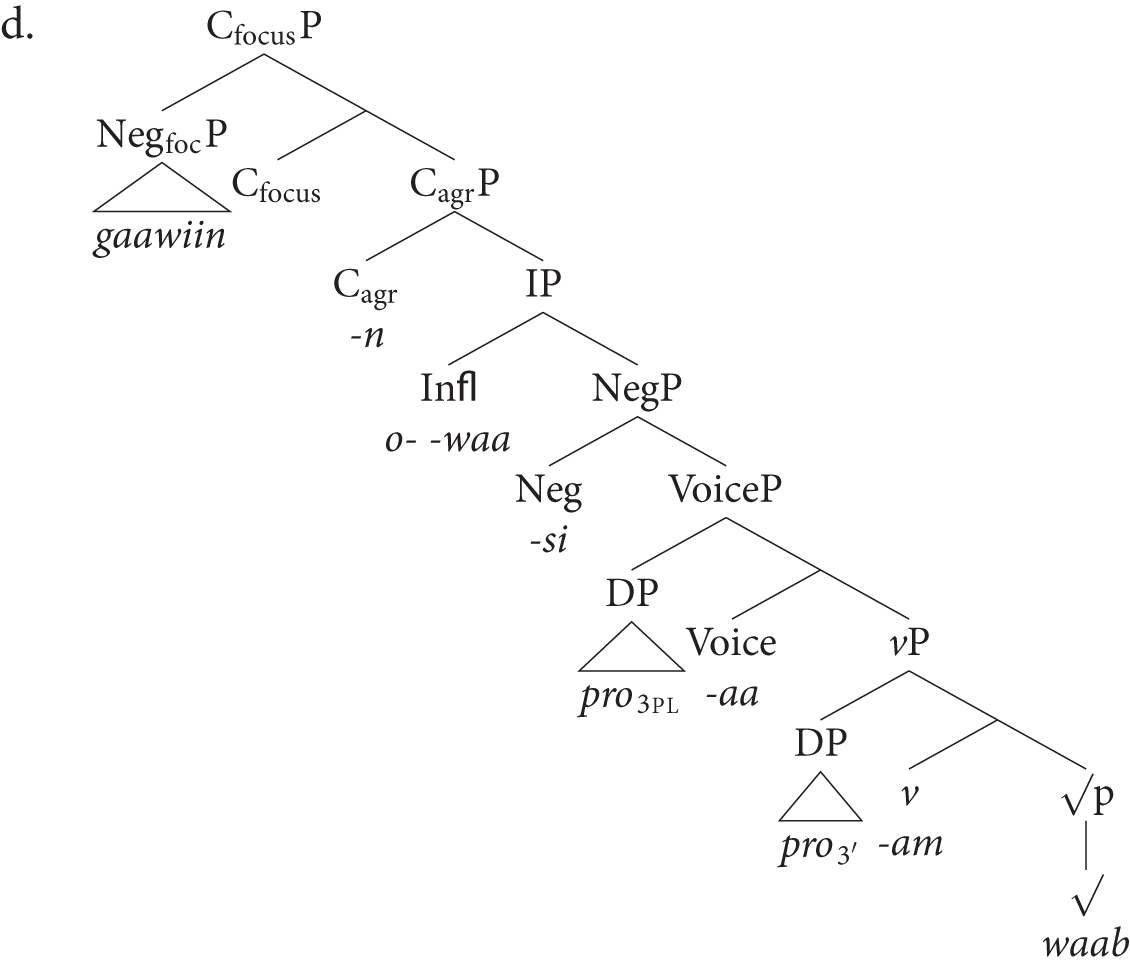
I begin by detailing the properties of the heads along the Ojibwe verbal spine. This provides a number of landmarks to tie the complex morphological structure to familiar syntactic structures.
The root is verbalized via the category defining head v, which is identifiable as the final morpheme from the descriptive literature (Brittain Reference Brittain2003), and also introduces the internal argument, in this example pro. Voice is realized as the morpheme referred to as the theme sign in the descriptive literature, and is the location where the external argument, also pro in the current example, is merged as a specifier (cf. Bruening Reference Bruening2001a, Reference Bruening2005, Reference Bruening2009). I further assume that VoiceP defines a phase boundary (Chomsky Reference Chomsky and Michael Kenstowicz2001, Van Urk Reference Urk2015), rendering its complement inaccessible to operations, a fact which comes into play in the analysis of C agreement.
The middle field is associated with negation and further agreement morphology. The first projection dominating VoiceP is NegP (Tilleson Reference Tilleson2019). Note that negation in Ojibwe matrix clauses is bipartite. I follow Tilleson (Reference Tilleson2019) in placing the semantic force of negation on Neg, with gaawiin being analyzed as a focus negator sitting in Spec,CfocusP. The role of negation is explored further in the discussion of scope in section 4. Following Neg is Infl. I adopt an analysis where Infl does not encode tense, but rather person features (Ritter and Wiltschko Reference Ritter and Wiltschko2014; Zubizarreta and Pancheva Reference Zubizarreta and Pancheva2017). In matrix clauses, Infl is morphologically realized discontinuously as the person prefix and central agreement. Following Oxford (Reference Oxford2019) and Hammerly (Reference Hammerly2020), I assume that this falls in line with wider cross-linguistic patterns of person-number discontinuities accounted for by Harbour (Reference Harbour2008).
The left periphery is expanded in Ojibwe to include a variety of topic and focus projections (Sullivan Reference Sullivan2016b) following the split CP hypothesis of Rizzi (Reference Rizzi1997). I have simplified the left periphery here to include only the central projections at play. The first is CagrP, which shows  $\phi$-agreement and is realized as the peripheral agreement marker, but will also be claimed over the course of the article to house a $\delta$-probe (A $'$-probe) that drives movement of obviative objects. The second is the focus projection CfocusP. As mentioned above, following Tilleson (Reference Tilleson2019), this projection houses the focus negator gaawiin in its specifier.
A final note: the present analysis assumes that the morphemes scattered across the verbal spine are collected into a verbal complex via the cyclic application of head movement (Travis Reference Travis1984) or some other post-syntactic “raising” operation (e.g., as proposed by Harizanov and Gribanova Reference Harizanov and Gribanova2019). Verb raising of this sort has broad backing within the Algonquian family (Halle and Marantz Reference Halle, Marantz, Kenneth Hale and Keyser1993, McGinnis Reference McGinnis and Päivi Koskinen1995, Richards Reference Richards2004, Lochbihler and Mathieu Reference Lochbihler and Mathieu2013), and movement of the verb to the left periphery (i.e., to Cfocus) derives the fact that main clauses in Ojibwe are strongly verb initial, with arguments generally appearing to the right of the verb, unless the discourse context licenses focus/topic movement to the left of the verb.
2.3 Agreement
To review, there are three probes scattered across the Ojibwe verbal spine: Voice, Infl, and C. In (10), I repeat the relevant portion of the morphological template for matrix clauses to aid in the parsing of the coming examples.

I consider the relevant patterns of agreement on Voice, Infl, and C in turn.
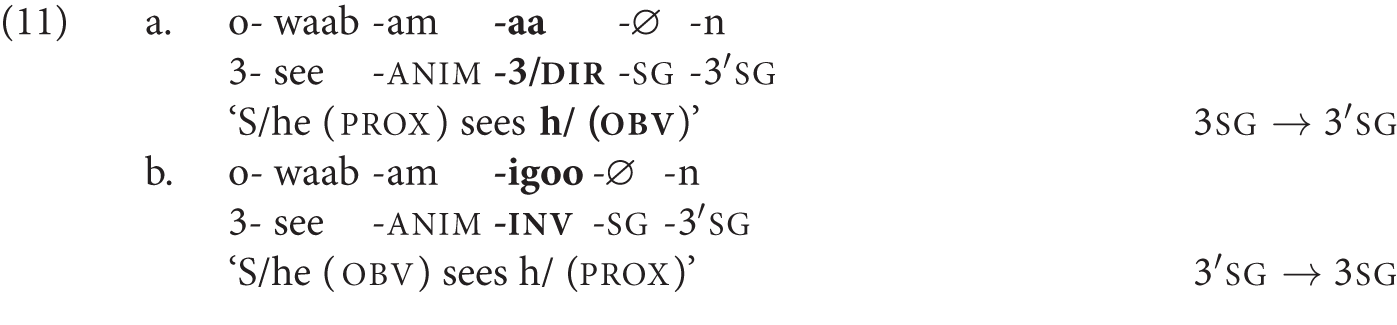
The basic alternation between the direct and inverse on Voice can be seen with the two examples in (11), with the 3sg  $\rightarrow$ 3 $'$sg alignment leading to the “direct” marker -aa, which is recognized here to be a third-person agreement marker with the proximate object, and 3 $'$sg
$'$sg  $\rightarrow$ 3sg leading to the inverse marker -igoo. The inverse marker is analyzed as a “default” or “impoverished” form of Voice (Oxford Reference Oxford2019, Reference Oxford2023). To preview the analysis (which follows the proposal of Oxford Reference Oxford2023), the inverse marker appears in these cases when Voice takes an ergative flavor, which lacks an agreement probe and therefore does not bear any features (hence the appearance of the default morphology).
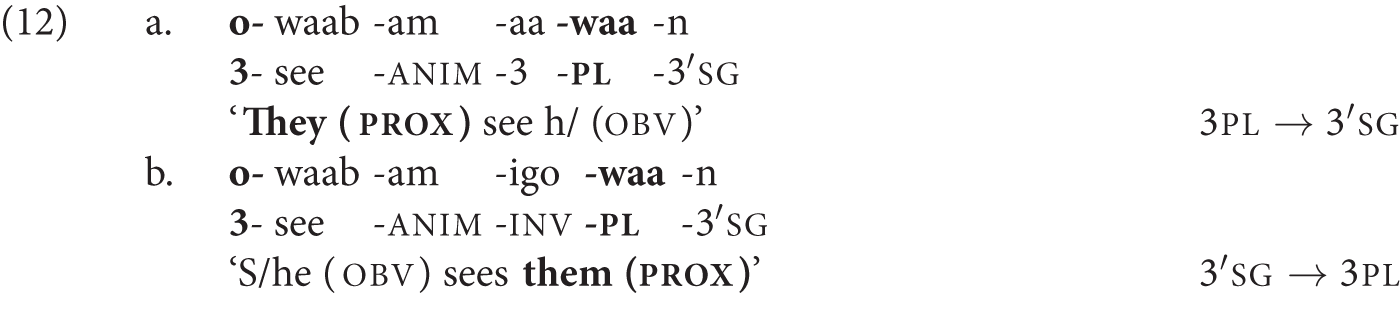
Infl is realized discontinuously as the person prefix + central agreement. In the previous examples, where both arguments were singular, only the person prefix o- appeared in the surface form. Changing only the proximate argument from singular to plural, shown with both direct and inverse alignments in (12), reveals that Infl is agreeing with the proximate argument in both person and number – central agreement is realized in the plural form -waa rather than the null singular form.
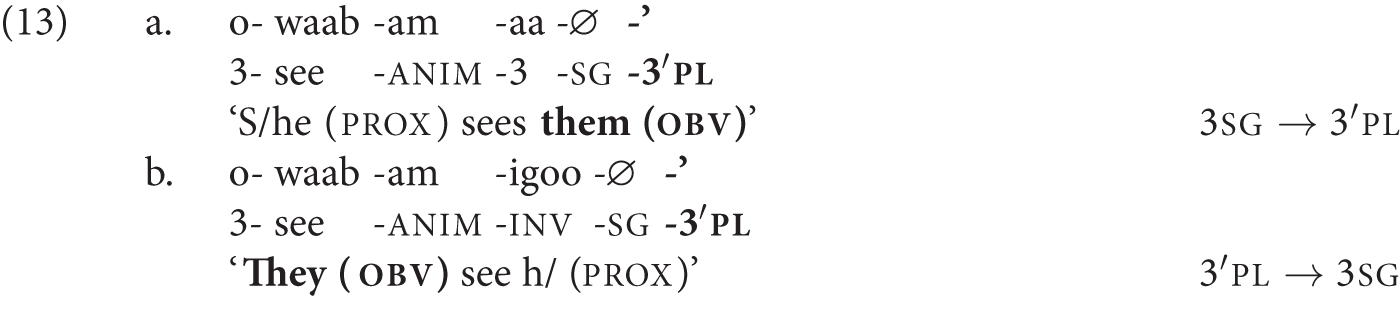
Considering now the patterns with a plural obviative in (13), with a return to a singular proximate argument, we see instead a change the form of peripheral agreement on C, now realized as a glottal stop -’. The number of the obviative argument does not affect Infl agreement in either direct or inverse alignments.
Finally, both the proximate and obviative nouns can be plural, as shown in (14) for both direct and inverse alignments. This results in the expected forms of Infl and C, given what was observed in (12) and (13): Infl appears as o- -waa and C as -’.
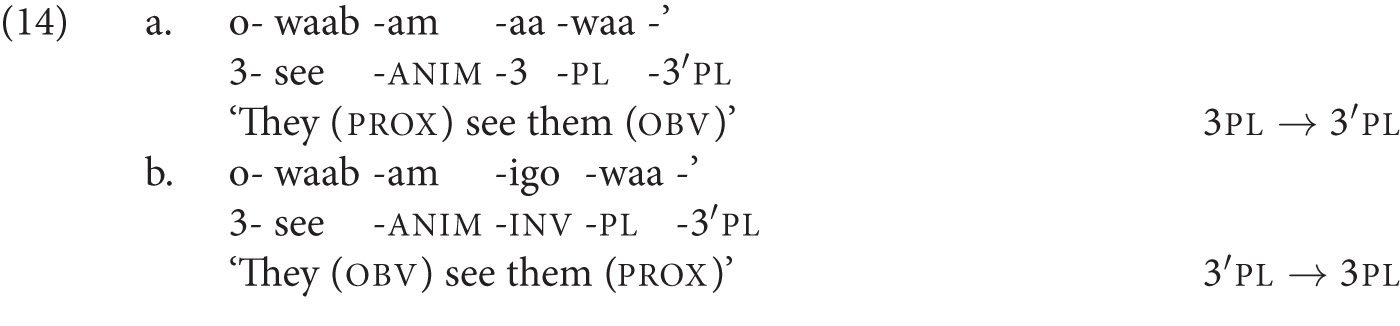
To summarize, Infl omnivorously agrees in person and number with the higher ranked proximate argument. That is, it agrees with the proximate argument regardless of whether it is the EA or IA. In contrast, C omnivorously agrees in person and number with the obviative argument.
The latter pattern on C is particularly striking, given that omnivorous patterns of agreement are generally observed to target “higher ranked” arguments with more marked feature sets such as plurals (Nevins Reference Nevins2011) or participants (Preminger Reference Preminger2014). Here, the previously noted set relation between proximate and obviative arguments is relevant – while it is possible to define a probe that specifically targets proximate arguments (i.e., a probe with [uProximate]), there is no feature that uniquely picks out obviative arguments to the exclusion of proximate (cf. Grishin Reference Grishin2023a, Reference Grishin2023b). This is due to the feature representation advanced in section 2.1, where obviative arguments are defined by a subset of those features that define proximate arguments. As a result, any probe that can target obviative arguments should be equally satisfied by a proximate argument. This raises the question: How could a probe be configured to target a less specific argument over a more specific one?
This initially puzzling pattern of reverse omnivority receives an explanation based in the Activity Condition (Chomsky Reference Chomsky, Roger Martin, Michaels and Uriagereka2000, Reference Chomsky and Michael Kenstowicz2001). To preview the analysis, Infl agrees with and deactivates the proximate argument, leaving only the obviative argument available for agreement on C. In other words, agreement on Infl bleeds the possible goals available to C. Since Infl always agrees with the higher ranked argument, agreement on C appears as a “reversal” of the hierarchy.
2.4 Word order alternations
There are six logically possible word orders for a transitive verb with overt arguments: two verb initial (VOS, VSO), two verb medial (SVO, OVS), and two verb final (SOV, OSV). In Ojibwe, only the verb-final word orders are considered ungrammatical in all contexts. Therefore the question arises as to how each of the four remaining word orders is licensed.
Determining the answer to this question is non-trivial – a fact that is due to both linguistic and extralinguistic factors. For example, determining whether elements have undergone movement within the discourse neutral V1 word orders cannot be tested with methods that have been useful in the Germanic literature, such as the relation of arguments to adverbs, as post-verbal adverbs are highly marked in Ojibwe, if not entirely ungrammatical. For this reason, tests of this sort do not appear. Furthermore, given that pronouns in Ojibwe only occur in non-neutral contexts in pre-verbal positions under topic and focus, the movement of all first- and second- person arguments, and third-person pronominal arguments, is difficult to diagnose. I therefore focus only on the behaviour of overt nominals.
A second set of issues are the extralinguistic factors that influence judgments on word order (for a related discussion around Mayan, see Clemens and Coon Reference Clemens and Coon2018). While there are many fluent speakers of Ojibwe, English has become the default language in many communities, and most L2 Ojibwe learners have English as their L1. The idea that word order is not contentful in Ojibwe is pervasive among L2 learners, and English word orders are often imported to Ojibwe by default. Many L1 speakers are therefore accommodating of non-grammatical word orders, which can still be understood given the information encoded in obviation and direct/inverse agreement. Therefore speakers report that ungrammatical word orders “makes sense”, but upon further questioning reveal that they find the order to be unnatural. Much care was taken in the present article to understand how my consultants distinguish between understandable sentences and those which are grammatically licensed. These judgments were facilitated through discussions about accommodating L2 speech, and operationalizing judgments as being “first speaker speech”, “learner speech”, or “nonsense”.Footnote 4 Learner speech was established as a sentence that was understandable, but was in some way unnatural. Furthermore, the two speakers consulted for this study learned English as a second language in adolescence, and grew up speaking only Ojibwe at home.
Beyond the judgments provided in the current article, a case study on spontaneous speech and word order in Ojibwe by Sullivan (Reference Sullivan2016a) has established the conditions under which different word orders arise. Sullivan showed a single speaker of Ojibwe a series of pictures depicting transitive actions, and asked the speaker to describe what was going on in each of the scenes. Sullivan found that VOS, and to a lesser extent VSO, dominates in naturally elicited speech – a finding consistent with the judgments reported here and the broader findings in the literature, which take VOS to be the ‘basic’ word order of many of the Ojibwe dialects (e.g., Tomlin and Rhodes Reference Tomlin and Rhodes1992, Valentine Reference Valentine2001, Meyer Reference Meyer2013, Dahlstrom Reference Dahlstrom2017). Furthermore, Sullivan showed that verb-medial word orders are associated with the fronting of topicalized, focused, and new subjects and objects, leading to SVO and OVS, respectively. This finding is consistent with analyses where the left periphery is associated with topic and focus positions (e.g., Rizzi Reference Rizzi1997).
The conditions under which VOS versus VSO arise are initially far less straightforward. Sullivan identifies a number of disparate factors that seem to condition this alternation, with the most robust being the focus of the present article: VOS occurs preferentially in direct environments, though VSO can also occur; VSO occurs in inverse environments. This article seeks to link the alternations between OS and SO with the patterns of agreement.
3. A model of agreement and movement
In this section, I detail a novel formulation of the syntactic operation agree. I show that the same basic algorithm can apply to capture both agreement qua feature copying and movement. I cover the basic properties of the system, setting the stage for the account of agreement and word order in Ojibwe.
3.1 Feature copying
agree is not a single operation, but rather the sequence of steps. I propose four components: Search, Match, Copy, and Deactivate. I provide a novel formalization for each step in (15). While this particular formulation is original to the present article, it relies heavily on recent work on agree. These connections are detailed throughout this section.
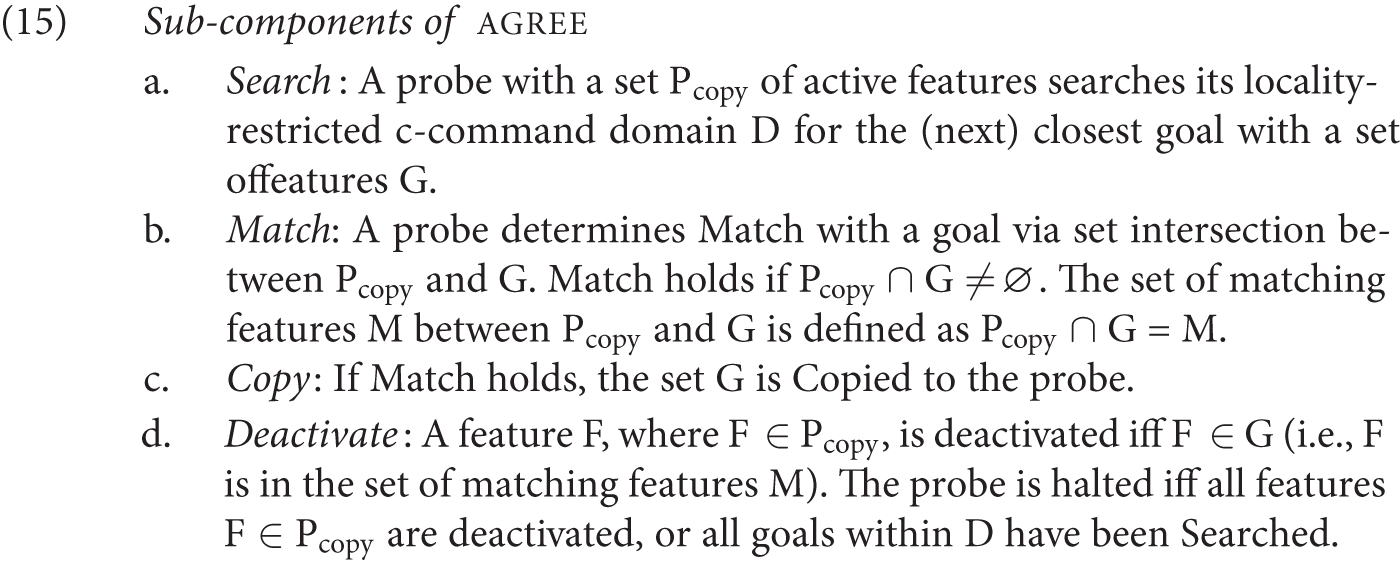
Let us unpack a few of the assumptions that underlie the proposed procedure for agree and the representation over which it operates. I assume a representation where a single set of features (Pcopy, in the above formulation) governs the behaviour of the probe with respect to feature copying. This is, for current purposes, a notational variant of a model that uses so-called “uninterpretable” or “unvalued” features uF to represent the features that a given agreement probe is relativized for (e.g., following Chomsky Reference Chomsky, Roger Martin, Michaels and Uriagereka2000, Reference Chomsky and Michael Kenstowicz2001). I refrain in this article from using the uF notation to define probes for two reasons. First, the ultimate proposal will require clearly distinguishing features that trigger feature copying (Pcopy) versus movement (Pmove), and the uF notatation does not clearly encode that distinction without modification. Second, and perhaps more importantly, the uF notation has been interpreted in various ways since its introduction in Chomsky (Reference Chomsky, Roger Martin, Michaels and Uriagereka2000, Reference Chomsky and Michael Kenstowicz2001), and I hope to avoid that baggage and ambiguity. In the current article, there is no role for unvalued or uninterpretable features in the strictest sense of each term, nor any role for the concept of “valuation” in the sense that a goal “values” a probe. I assume, following Preminger (Reference Preminger2014), that the set of features in Pcopy (and Pmove) are not “derivational time bombs” that cause a crash at the interfaces if not deactived, but rather simply “triggers” for the obligatory application of the agree procedure. If the features that trigger agree are not deactivated prior to the interfaces, then they are simply ignored.
With these first representational assumptions in hand, we can return to direct consideration of the procedure in (15). The first step, Search, is triggered as soon as a probe with a set of features Pcopy is merged into the derivation. This automatically derives the downward searching behaviour of a probe. Following the obligatory operations model of Preminger (Reference Preminger2014), Search occurs no matter what – if there is no Matching goal, then no Copying or Deactivation occurs. If, however, the probe and goal do Match, then the full set of features from the goal is Copied back to the probe, and the individual features that overlap with the goal are Deactivated and are not used to determine Match between a probe and goal on future cycles. It follows, then, that in the case where Pcopy contains features that are not found on G, the non-matching features of Pcopy remain active for future cycles of the procedure. That is, the procedure can leave an active residue in the sense of Béjar and Rezac (Reference Béjar and Rezac2009). The procedure therefore repeats until either all features of the probe have been successfully deactivated via Match, or all potential goals have been found by Search.
Note that I assume a model of the copying component of the procedure where the full set G of the goal is copied back to the probe when Match holds. In other words, agreement is featurally coarse (Preminger Reference Preminger2014, Coon and Keine Reference Coon and Keine2021, Royer and Deal Reference Royer and Deal2023, Hammerly Reference Hammerly2024). The difference from its original formulation is that coarseness is not restricted only to situations of clitic doubling (cf.
Preminger Reference Preminger2014), but rather applies to all instances of  $\phi$-agreement (Coon and Keine Reference Coon and Keine2021, Royer and Deal Reference Royer and Deal2023, Hammerly Reference Hammerly2024).
Let us see how this system works with two hypothetical syntactic configurations, shown in (17). The example utilizes toy features [F] and [G], where it is assumed that the presence of [G] geometrically entails [F]. We can specify a probe for feature copying as in (16), where Pcopy = {F, G}. On the probe itself, I will label these sets with copy:  $\alpha$, where $\alpha$ is a set of features.

With this toy probe defined, let us consider first (17a), where the more specified DP $_1$ with features {F, G} is closer to the probe than the less specified DP $_2$ with features {F}. Note, “ $\Rightarrow$” indicates which particular features of the probe (written on the left side of the arrow) are matched/deactivated on a given cycle of agree (indicated on the right side of the arrow, where each cycle is indicated by a numbered, dashed line between the probe and goal). Here, both features of the probe match with the goal, and therefore both are deactivated in the first cycle of agree. There is thus no motivation to Search DP $_2$, so only the features of DP $_1$ are copied back to the probe. This contrasts with the configuration in (17b), where the same probe leads to multiple sequential (i.e., not simultaneous) agreement relationships. In this case, DP $_1$ only deactivates a single feature of the probe [F], leaving [G] still active to trigger a second cycle of agree. Subsequent agreement with DP $_2$ leads to a match with [G], triggering the copying of DP $_2$’s features to the probe, deactivating that feature, and halting further cycles of agree.
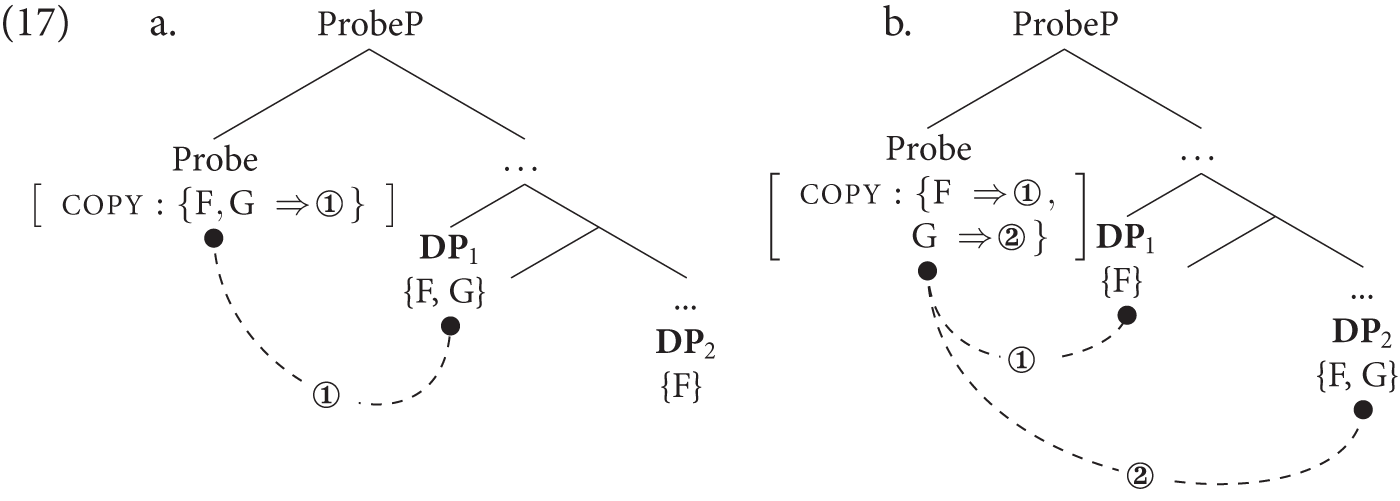
This representation and procedure captures a number of the now well-known properties of agree. First, a single probe can (cyclically) trigger multiple instances of feature copying from different goals within its domain, and this depends on both the particular features of the probe and the syntactic geometry of different arguments (e.g., Béjar Reference Béjar2003, Béjar and Rezac Reference Béjar and Rezac2009, Coon and Keine Reference Coon and Keine2021). Specifically, a probe will engage in further cycles of agree if it continues to have active features and the search domain has not been exhausted. Second, the particular “stopping” conditions of a probe will differ, so not all probes will show such behaviour. For example, a probe [copy: {F}] would be halted by the first goal it encounters in both of the cases sketched in (17), as both DPs share the feature F. Such a probe can be referred to as “flat”. Finally, a probe can be relativized (Rizzi Reference Rizzi1990, Béjar Reference Béjar2003, Preminger Reference Preminger2014) such that it will skip what might a priori be considered a viable target for copying (i.e., show omnivorous behaviour). If we replace the probe in (17) with [copy: {G}], in a configuration like (17a) nothing would change. However, in (17b) the probe would appear to “skip” the more local DP $_1$, as it would fail to match the features of the probe and therefore fail to trigger copying, and thus only copy the features of DP $_2$, which is the first goal within its domain that bears G. Further properties of this basic system will be articulated following the immediately forthcoming discussion of movement.
3.2 The relativized EPP
One of the major insights of the analysis is to tie together the patterns of agreement and movement with a unified system. This is accomplished through a model where movement uses the same basic algorithm as the one specified above for feature copying. However, feature copying in the proposed system will not necessarily be followed by movement – the two types of probes will be specified independently (cf.
Chomsky Reference Chomsky, Roger Martin, Michaels and Uriagereka2000, Reference Chomsky and Michael Kenstowicz2001; Carstens Reference Carstens2005; Bošković Reference Bošković2007; Van Urk Reference Urk2015). Furthermore, the formulation is neutral to the type of movement and agreement relationship involved. Following the featural view of movement proposed by Van Urk (Reference Urk2015), I assume the difference between A- and A $'$-movement stems from the features at play, rather than the particular position to which movement occurs. In this view, A-movement occurs following $\phi$-agreement, while A $'$-movement occurs following $\delta$-agreement (where $\delta$ is a generic term for A $'$-features related to things like wh-movement, focus, topicalization, etc).
I encode the trigger for movement through independent EPP conditions on the probe, which I refer to as the set Pmove or notate with move:  $\beta$, where $\beta$ is a set of features (an analogous notation to what has already been introduced for Copy). This amounts to extending the model detailed in the previous section to include conditions for (internal) Merge. The probe representation is given in full in (18).

The claim is that EPP conditions define which categories can undergo movement to the specifier of the probe and when searching for such a goal stops. Like conditions on copying, EPP conditions can be relativized to seek particular sets of features. Relativization of a probe’s EPP conditions may be different from the conditions on feature copying. There are no extrinsic restrictions on the system, so a probe may have more specific features for copying than move, or vice versa. Similarly, a probe may lack triggers for copying or movement, so engage in agreement without movement, or movement without agreement.
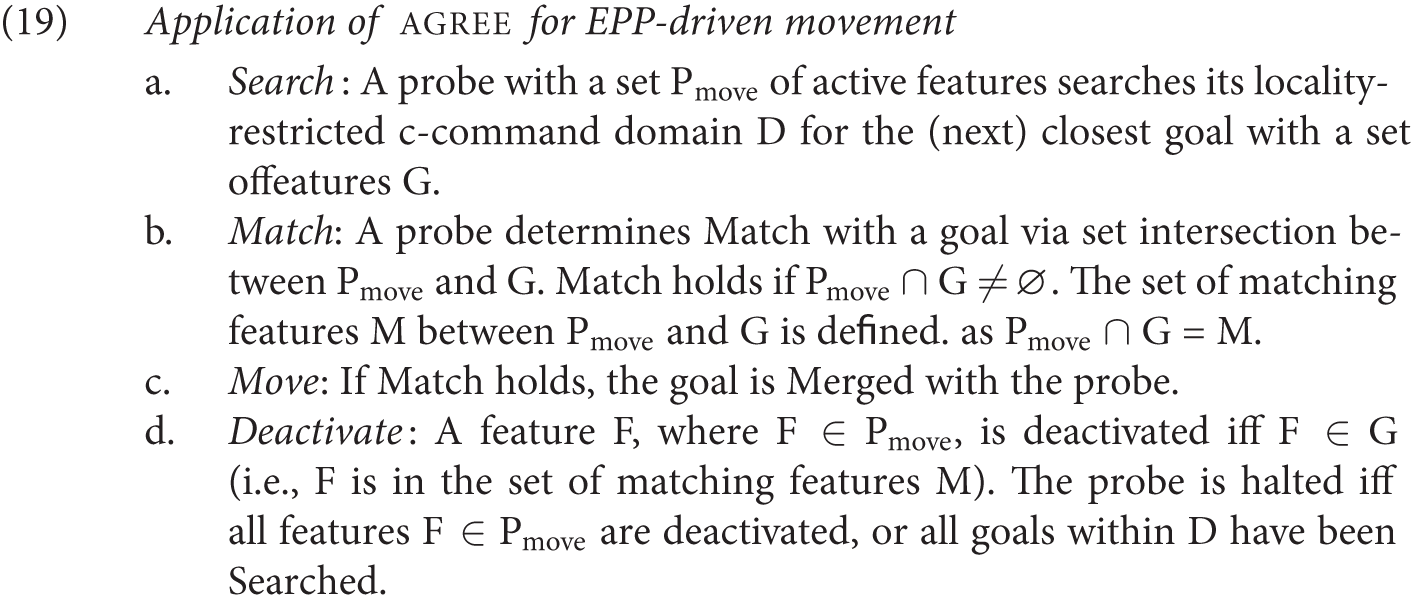
Searching, Matching, and Deactivating can all be done within the previously defined sequence of agree by simply replacing Copy with Move and Pcopy with Pmove. The agree procedure tuned for the EPP is given in (19). Instead of comparing the set on the goal with the set defining the agreement conditions, the EPP conditions are compared. When Search has found the (next) closet goal to the probe, if the goal Matches the conditions of the probe, then internal Merge (Move) is triggered (cf. Copy being triggered when the agreement conditions are met), bringing the goal to the specifier position of the probe. In turn, the deactivation procedure can check the EPP conditions of the probe.
The proposed relativized EPP finds a number of relevant connections and comparisons with previous work. First, there is the recent account of direct/inverse agreement systems by Zubizarreta and Pancheva (Reference Zubizarreta and Pancheva2017), who advance the P(erson)-Constraint, which states that certain projections require a D(P) with a [Participant] feature within their edge (i.e., specifier) position. The authors suggest that for Algonquian languages, this constraint may be formulated such that arguments with a [Proximate] feature (local and proximate third persons) must occupy the edge of certain phrases. Yet other languages require a first or second person – D(P)s with [Author] or [Addressee], respectively – to occupy the edge. In other words, the edge requirement can be relativized to target particular categories. For Zubizarreta and Pancheva, the requirement is formulated as an interface condition – a filter on the derivation following the syntactic component. Setting aside the details, they argue that if a head bears an interpretable participant/proximate feature, then the P-Constraint requires that projection to have a participant/proximate-bearing D(P) in its edge position, or else the structure is ill-formed. The current proposal can derive the consequences of such a filter from the EPP conditions, with no need for a new type of constraint on well-formedness at the interfaces: if the EPP condition of a probe is relativized up to [Part] or [Prox] and an argument with the desired feature is within the Search domain of the probe, movement of a local or proximate argument to the edge of that probe will respectively occur.
A second, more critical comparison is with Carstens’ (Reference Carstens2005) theory of the EPP as a “sub-feature” of uF features in Bantu languages (for an identical proposal couched within the “interaction/satisfaction” model, see Deal Reference Deal2022). This would make the EPP parasitic on the conditions on feature copying, rather than independently specifiable conditions on movement. Deciding whether conditions on EPP satisfaction should be intrinsically linked to the conditions on feature copying is an empirical question; I show that, contrary to Carstens’ (and Deal’s) proposal, the patterns of Ojibwe uniquely support the current model, where the conditions on the EPP can be specified independently of those that govern feature copying. This is discussed further in section 5.3.
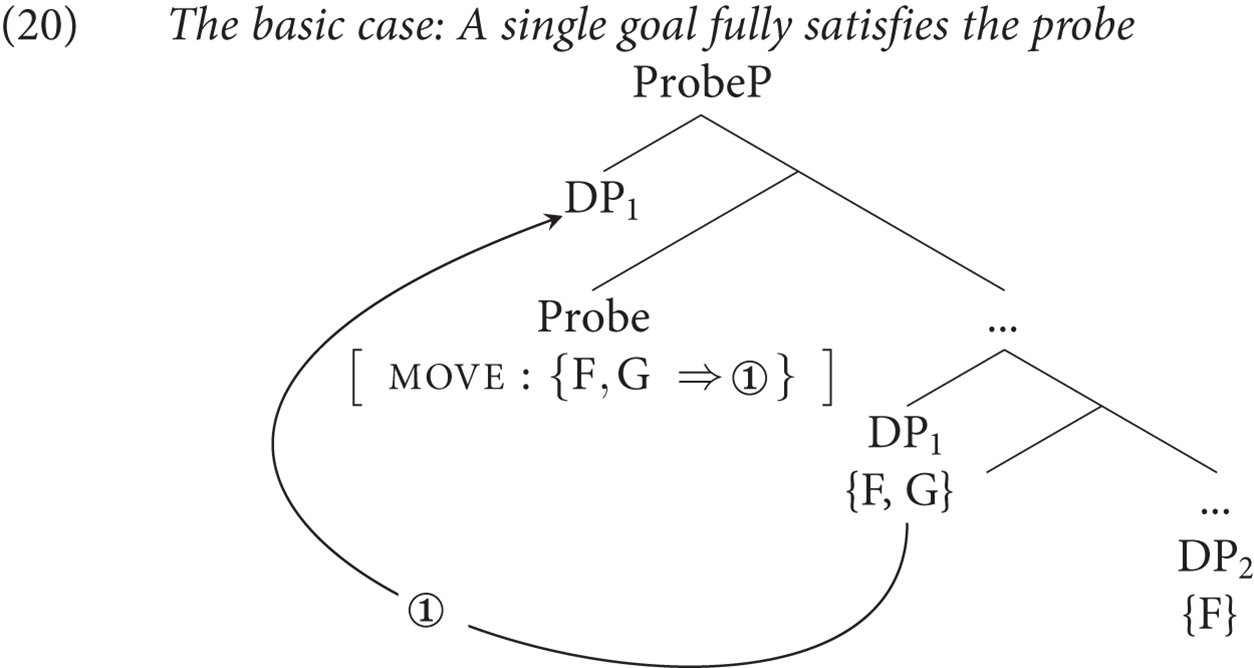
The remainder of this section is dedicated to abstractly detailing the basic aspects of the relativized EPP. I begin by considering the behaviour of a probe of the sort in (18a). In the most basic case, which corresponds to a “direct” alignment where the more featurally specified DP is syntactically higher than the less specified DP, the EPP conditions of the probe are fully satisfied by the closest DP, which is moved to the probe’s specifier. This is shown in (20).
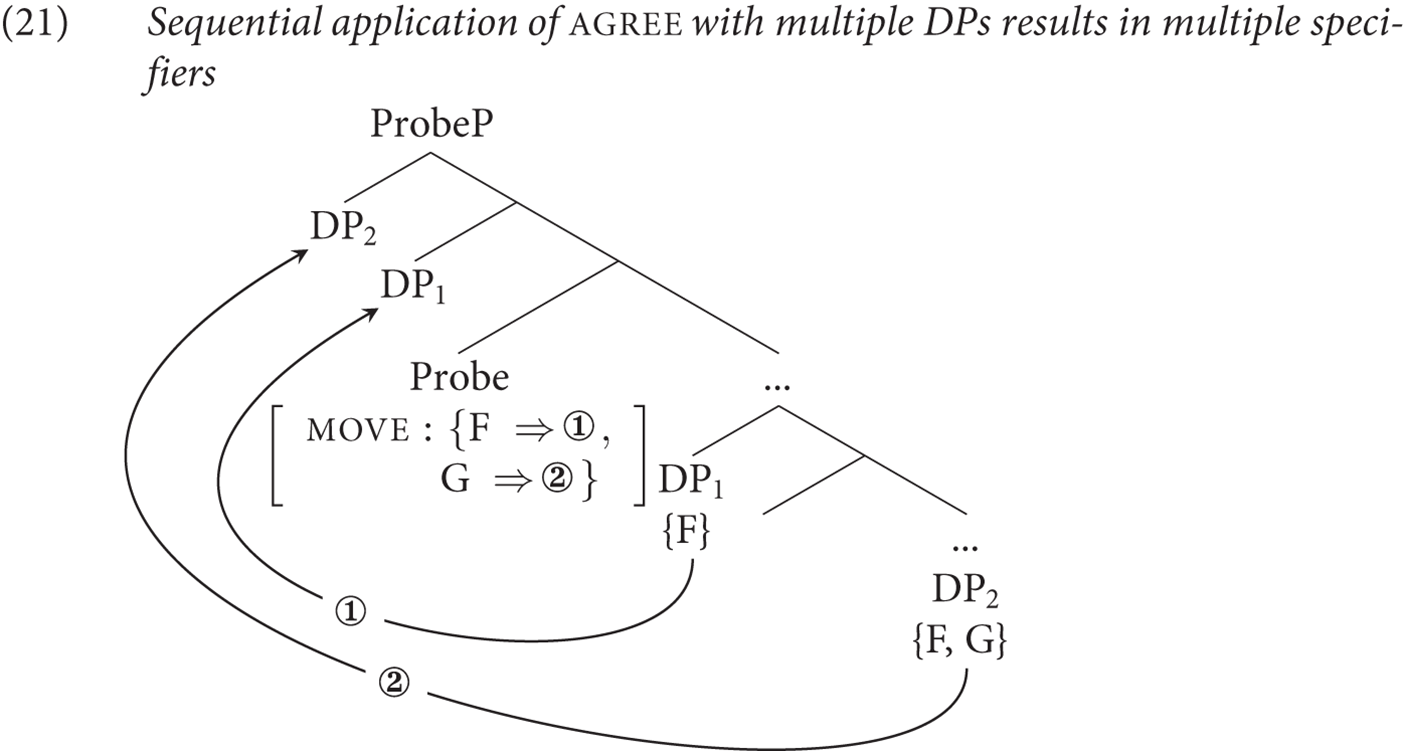
Holding the probe constant, we see that a reverse alignment of arguments (where the less specified DP is now syntactically higher than the more specified DP) adds another layer of complexity, schematized in (21). The initial agree relation only matches with and deactivates [F] within the conditions on the probe. This triggers movement in ①, where the goal DP $_1$ is attracted to the first specifier of the probe, but leaves [G] active, resulting in a second cycle of agree. Given that DP $_2$ matches the still active feature of the probe, it is attracted to the second specifier of the ProbeP, shown in step ②. This results in a multiple specifier configuration (e.g.,
McGinnis Reference McGinnis1998, Hiraiwa Reference Hiraiwa2001, Rackowski and Richards Reference Rackowski and Richards2005).
$_2$ matches the still active feature of the probe, it is attracted to the second specifier of the ProbeP, shown in step ②. This results in a multiple specifier configuration (e.g.,
McGinnis Reference McGinnis1998, Hiraiwa Reference Hiraiwa2001, Rackowski and Richards Reference Rackowski and Richards2005).
With the basic properties of both agreement and movement established, let us now turn to detailing how derivations proceed in the case of multiple specifiers.
3.3 The Best Match principle in agreement and movement
The knock-on effects for further agreement and movement once two potential goals are in a multiple specifier configuration deserves a careful look. Following Oxford (Reference Oxford2019), I adopt the view that multiple specifiers are equidistant from higher heads (see also Hornstein Reference Hornstein2009). This opens the question of how agreement and movement are determined in these cases, given that probes target the closest goal within their c-command domain. I again follow Oxford (see also Coon and Bale Reference Coon and Bale2014, Van Urk Reference Urk2015) in appealing to a Best Match principle in deciding how agreement and movement relations move forward with equidistant goals. I provide a revised formulation in (22), which extends the principle to both agreement and EPP conditions.
(22) Best Match (cf. Coon and Bale Reference Coon and Bale2014, Van Urk Reference Urk2015, Oxford Reference Oxford2019)

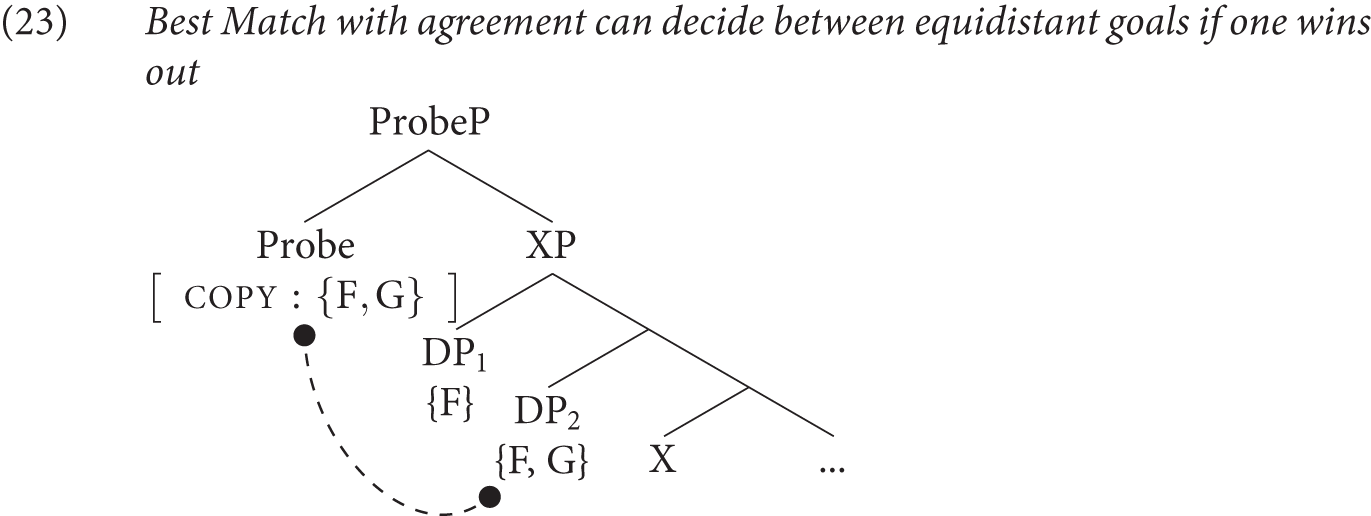
Consider first the consequences for feature copying with the [copy:{F, G}] probe in (23). Here, the probe Searches and finds both of DP $_1$ and DP $_2$ as equidistant goals. In this case, DP $_2$ provides the Best Match for the probe – DP $_1$ lacks the feature [G]. Therefore only the features of DP $_2$ are Copied back to the probe.
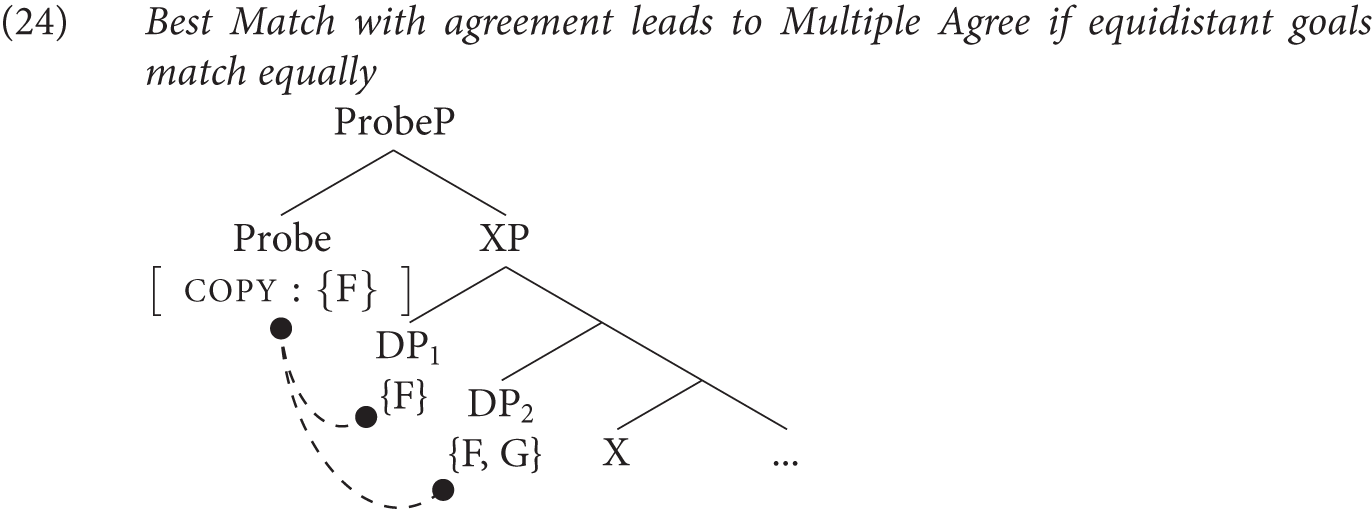
A contrasting situation arises with the less articulated [copy:{F}] probe in (24). Again, both DP $_1$ and DP $_2$ are found during Search to be equidistant goals. However, neither one has an edge with respect to Best Match: both are specified for [F]. This precipitates Multiple Agree, where the features of both DP $_1$ and DP $_2$ are Copied back to the probe (Hiraiwa Reference Hiraiwa2001, Oxford Reference Oxford2019).
This requires the operation governing feature copying to have the ability to copy back two sets of features within a single derivational step. As will be argued in a moment, feature copying contrasts with the operation of internal Merge triggered by the EPP, where the corresponding phenomena “Multiple Move” is derivationally ill-formed cf. Hiraiwa (Reference Hiraiwa2001).
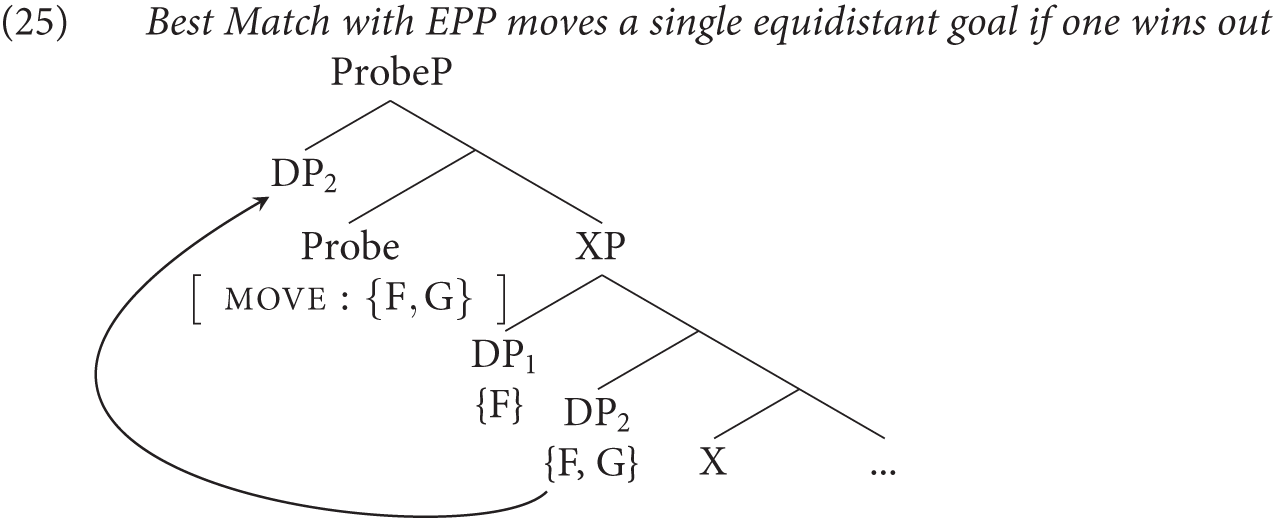
First, consider the case in (25), where the probe is specified for [move:{F, G}]. In this case, DP $_2$ provides the Best Match for the probe, precipitating Movement to Spec,ProbeP.
The final case to consider is in (26), where both DP $_1$ and DP $_2$ are equidistant and equally Matched with the move conditions of the probe. As was the case with the copy conditions, Best Match does not allow the probe to decide between these two arguments. In principle this should trigger Multiple Move, where both arguments are moved to the specifier of the probe at once. However, following the same logic used by Coon and Keine (Reference Coon and Keine2021) to explain the ineffability of clitic doubling in the PCC family of effects, this would require Merge to relate three elements simultaneously (DP $_1$, DP $_2$, and ProbeP). Since Merge is a binary operation that can only relate two elements at a time, this rules out the possibility of Multiple Move. As a result, neither of the arguments move to the specifier of the probe. This will be shown to explain restrictions on A-movement to Spec,IP in Ojibwe.
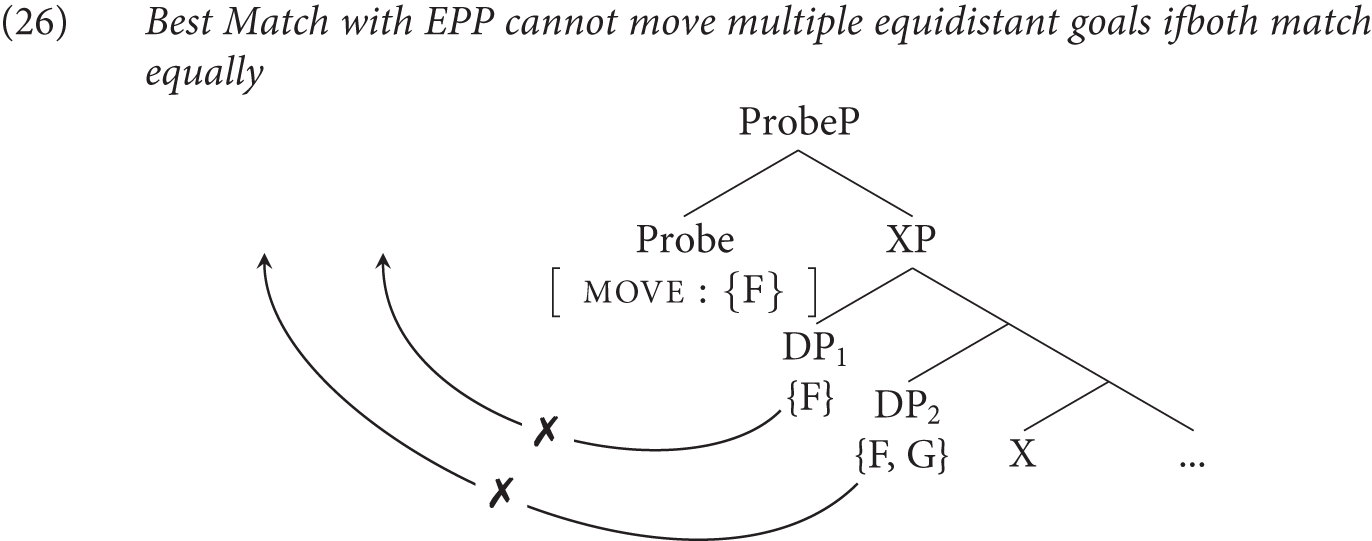
The above logic rests on the assumption that in configurations like (26) the need to find a goal that matches the move conditions of the probe has been satisfied or checked, but the derivation has conspired to make actual movement impossible. So the relevant features have been deactivated, despite the failure to actually move the argument(s). More generally, EPP conditions can be left unchecked or “active” (and the specifier can remain unfilled) without causing a crash in the derivation at the interfaces. That is, there is such a thing as “failed movement”. This makes conditions on movement analogous to the conditions that govern feature copying, where so-called “failed agreement” configurations, which leave some or all copy conditions unchecked, are not lethal to the derivation (Preminger Reference Preminger2011, Reference Preminger2014; Deal Reference Deal, Thuy Bui and Ozyildiz2015).
In any case, the claim that a failure to deactivate EPP conditions (or a failure to move the relevant argument to the specifier of probe) does not result in a derivational crash may come as a surprise, given that many languages (e.g., English) seem to require the insertion of an expletive argument to “rescue” derivations where movement of a lower argument does not occur. A solution can be found by appealing to the logic of the obligatory operations model: if you can meet the conditions of the probe, then you must meet them (but if you try and fail, nothing goes wrong). The relevant point of variation is whether a given language makes available an expletive to be externally Merged. When a language does have an expletive available, this becomes part of the calculus: Expletives are externally Merged with Spec,ProbeP just in case the EPP conditions have not been otherwise satisfied. If a language does not have an expletive available, this position is left unfilled and the EPP conditions remain unsatisfied without causing a crash.
4. Accounting for Ojibwe
This section provides an account of the patterns of agreement and word order in Ojibwe using the model of agree developed in the previous section. To review, there are four agreement slots in Ojibwe, summarized in Table 1.
Agreement with 3sg/pl  $\leftrightarrow$ 3 $'$sg/pl configurations

From the inside out, Voice alternates between a direct marker that indexes the person/obviation of the object, and the impoverished inverse form; Infl omnivorously agrees in person/number with the proximate argument; finally, C omnivorously agrees in person/number with the obviative argument. These patterns all find a principled explanation with the system outlined in the previous section, and motivate the adoption of the Activity Condition (cf. Chomsky Reference Chomsky, Roger Martin, Michaels and Uriagereka2000, Reference Chomsky and Michael Kenstowicz2001) on Infl.
As for word order, direct alignments show an alternation between VOS and VSO word orders, with the former being preferred. With inverse alignments, only the VSO word order is grammatical. The preferred word orders (VOS in direct and VSO in inverse) both place the obviative argument to the left of the proximate argument. This generalization, and the alternation with direct alignments, will be tied to the mixed  $\phi$/ $\delta$ properties of the probe on C, which is crucially fed and bled by interactions from the earlier probes on Voice, and Infl.
Throughout, I provide evidence for the proposal by examining how indefinite arguments take scope with respect to negation under different word orders and alignments. Given that negation is specified above Voice and below Infl and C, this provides a test for whether or not the arguments have indeed escaped the VP. The results bolster the view of the extraction of the object drives the VOS/VSO alternation in the direct alignments, supports the predicted restrictions on A-movement due to the impossibility of Multiple Move out of double specifier constructions, and provides evidence that indefinite proximate arguments are positive polarity items (PPIs).
4.1 Defining our three probes
The present account takes as its starting point the recent proposal by Oxford (Reference Oxford2023), where Voice can appear in one of two varieties: “plain” or “ergative” (see also Hammerly and Mathieu Reference Hammerly2024 for an application of this proposal to conjunct order agreement/movement in Border Lakes Ojibwe, also discussed here in section 5.1). Plain voice (27a) has conditions for both agreement and movement such that it will copy features from and be halted by any  $\phi$-bearing element that it finds, but will only move those with a participant feature. Ergative voice is only specified for a “flat” movement probe, which will move any $\phi$-bearing element within its search domain (i.e., it invariably moves the internal argument), but does not copy any features.Footnote 5 To preview the coming analysis , this lack of features with ergative Voice ultimately leads to the spell-out of the “elsewhere” form, otherwise known as the inverse marker.

Correspondingly, Oxford (Reference Oxford2023) shows that these two varieties of Voice have different distributions that are determined by nominal licensing requirements (I refer the reader to that work for details). The upshot is that direct-aligned clauses where proximate acts on obviative only converge when plain Voice is merged into the derivation, while inverse-aligned clauses where obviative acts on proximate only converge when ergative Voice is merged. I make the same assumption here.
The probe on Infl, shown in (28), has conditions for both agreement and movement. For agreement, Infl will copy features from any  $\phi$-bearing element, but will only be fully deactivated when it finds a goal with a proximate feature. The EPP conditions are completely generic, so the most local $\phi$-bearing goal will undergo movement to Spec,IP. We will see this come to a head when double specifier configurations arise, leading to an impasse as to which equally-matched argument to move.

I further assume that independent order Infl deactivates arguments with which it agrees, bleeding its goals to participate in further agreement relations with higher probes such as C. Much recent work on agreement, going back to the Activity Condition of Chomsky ( Reference Chomsky, Roger Martin, Michaels and Uriagereka2000); Reference Chomsky and Michael Kenstowicz2001), has recognized that certain probes leave their goals open to additionally satisfy a subsequent probe, while others appear to block their goal(s) from entering into further agreement relationships. The proposal is therefore that Infl (in matrix clauses – the so-called “independent order”) in Border Lakes Ojibwe bears such a property. However, it is important to emphasize that the Activity Condition is neither expected to be consistent across languages nor within a single language. This follows straightforwardly if the Activity Condition is a “microparameter”, as proposed by Oxford (Reference Oxford2017a). Indeed, in Border Lakes Ojibwe, recent work by Hammerly and Mathieu (Reference Hammerly2024) has shown that Infl in embedded clauses (the “conjunct order”) does not have a deactivating effect on its goals. As such, we see the microparametrization of the Activity Condition on Infl as a matter of clause type in Border Lakes Ojibwe. As I discuss further in section 5.2, this (micro)parametrization may also be leveraged to explain differences across the Algonquian family in patterns of C-agreement (cf. Grishin Reference Grishin2023a, Reference Grishin2023b).
Finally, C bears two probes, shown in (29). First, a flat  $\phi$-probe, which will copy features from and move the first active $\phi$-bearing XP that it encounters. I assume these conditions are additionally tuned such that feature copying will occur with any $\phi$-bearing element (i.e., not just DPs), while only DPs can be moved. Second, C bears a $\delta$-probe, which triggers A $'$-movement of any DP that bears $\delta$-features (but does not copy those features).

With our probes defined, we can turn to accounting for agreement and word order in Ojibwe.
4.2 Direct alignments
To review what needs to be captured, direct alignments are characterized by an obviative argument in the internal argument (IA) position, and a proximate argument in the external argument (EA) position. Voice surfaces as a third person “direct” marker -aa, Infl indexes the person and number features of the proximate EA, and C indexes the person and number features of the obviative IA. From here, we observe variation in whether such clauses appear with VOS versus VSO word order.
The key proposal to derive the VOS/VSO alternation in direct-aligned clauses is in whether the obviative IA is or is not specified for a  $\delta$-feature. If the obviative IA lacks a $\delta$-feature, then it remains in situ and VSO word order is derived. If the obviative IA is specified for a $\delta$-feature, then it satisfies the conditions of the $\delta$-probe on C, and is moved above the proximate EA to the specifier of CP, deriving VOS word order.
4.2.1 VOS direct
I begin with the derivation of VOS word order in direct-aligned clauses, shown in (30). The full example is repeated in (30a), while the subsequent sub-examples show the derivation from Voice (30b) to Infl (30c) to C (30d).
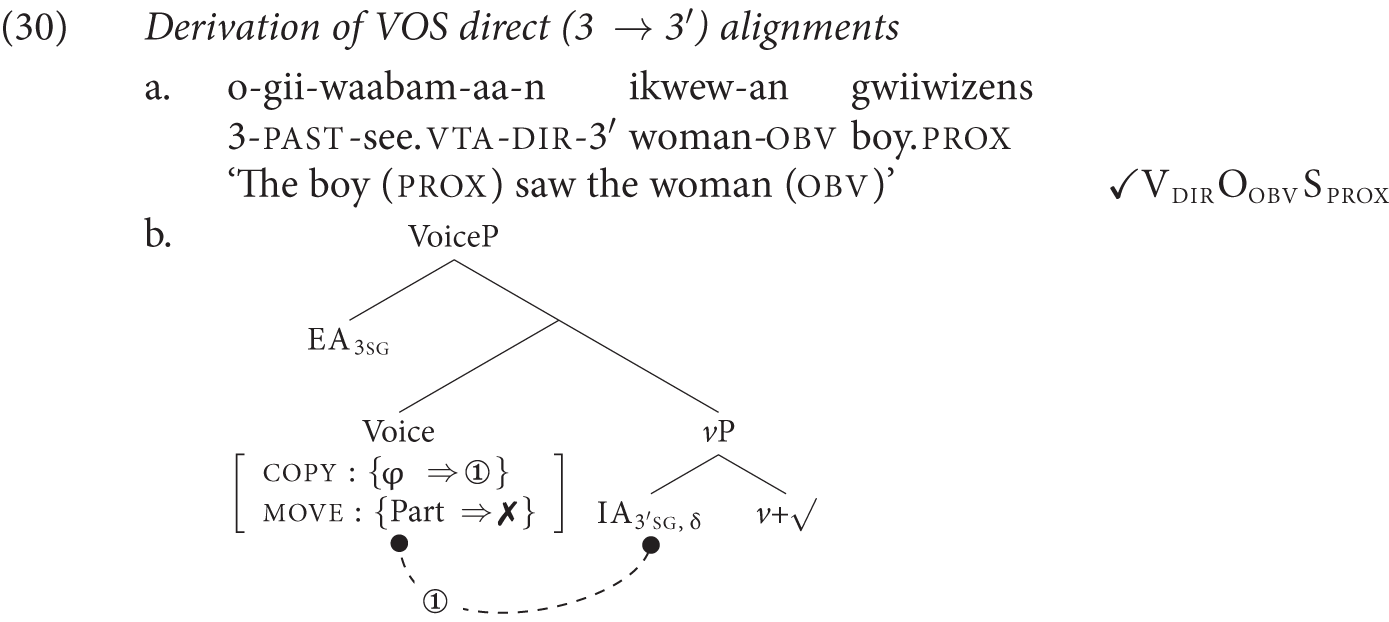
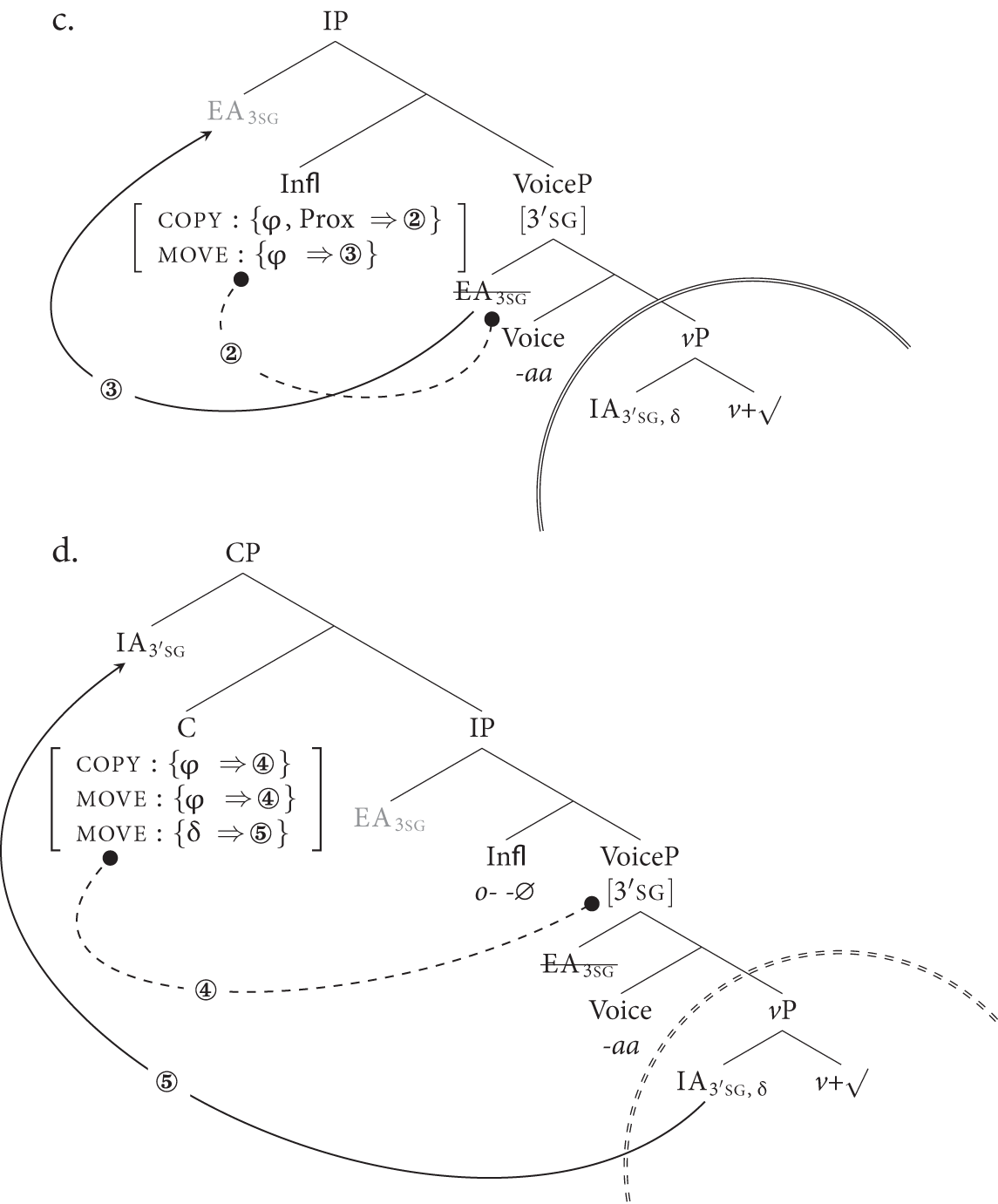
First (step ① in (30b)), plain Voice probes down and finds the obviative IA, which it copies features from, but does not move, as it does not meet the EPP conditions of the probe, which require the specification of [Participant]. Then, Infl probes down (step ② in (30c)) and agrees with the proximate EA. Since the EPP conditions of the probe are met, this triggers movement of the EA to Spec,IP (step ③). Having undergone agreement with independent order Infl, the EA is deactivated and unavailable to subsequent operations (indicated in gray).
C-agreement, shown in in (30d), is more involved. The first step is  $\phi$-agreement with VoiceP (step ④). Given that the EA has been deactivated by Infl, and the IA (at this point) is trapped within the complement of the phase defined by Voice, the closest active $\phi$-bearing element is VoiceP, which previously collected the $\phi$-set of the obviative IA via agreement.Footnote 6 This agreement alleviates the Phase Impenetrability Condition (PIC;
Chomsky Reference Chomsky, Roger Martin, Michaels and Uriagereka2000, Reference Chomsky and Michael Kenstowicz2001) on the VoiceP phase via unlocking (Rackowski and Richards Reference Rackowski and Richards2005, Branan Reference Branan2018, Halpert Reference Halpert2019). This allows the phase complement to be open for subsequent operations, most pertinently A
$\phi$-set of the obviative IA via agreement.Footnote 6 This agreement alleviates the Phase Impenetrability Condition (PIC;
Chomsky Reference Chomsky, Roger Martin, Michaels and Uriagereka2000, Reference Chomsky and Michael Kenstowicz2001) on the VoiceP phase via unlocking (Rackowski and Richards Reference Rackowski and Richards2005, Branan Reference Branan2018, Halpert Reference Halpert2019). This allows the phase complement to be open for subsequent operations, most pertinently A $'$-extraction of the IA.Footnote 7
Given that the  $\phi$-probe on C has [ $\phi$] as a move condition (which will be necessary to account for the inverse alignments, discussed below), there is a question of why VoiceP, which is targeted by the probe, does not move. As previewed above, I assume that the move conditions for this probe only drive movement of nominal XPs (i.e., XPs with the relevant nominal-defining features). This is analogous, for example, to what is assumed for Zulu by Halpert (Reference Halpert2019), where CPs are not moved (infinitival TPs and nominals are optionally moved) despite agreeing with a probe with an EPP feature (see section 5.3 for further discussion). VoiceP, being part of the verbal spine, is not specified for such a feature, and therefore is not moved to this position. However, despite the lack of movement, I assume that the feature [ $\phi$] within the move conditions is still checked and deactivated since the goal contains that feature. As a result, further agreement relations are purely driven by the [ $\delta$] feature within the move conditions of the probe.
Moving forward, step ⑤ is  $\delta$-agreement, which directly targets the obviative IA that bears a $\delta$-feature. This triggers A $'$-movement to Spec,CP. Given that $\delta$-features are optional on DPs (Van Urk Reference Urk2015), these final two steps are, broadly speaking, optional. In derivations where the feature is present on the obviative argument, then the IA is attracted to Spec,CP and undergoes A $'$-movement above the proximate EA, deriving VOS word order. Furthermore, given that the proximate argument has been deactivated by Infl, even if it were specified for a $\delta$-feature, it could never be targeted by the $\delta$-probe on C.
4.2.2 VSO direct
This leads us now to the derivation of the VSO word order in direct alignments, shown in (31). I give a partial derivation of the just the crucial step on C, detailed in text below the example.

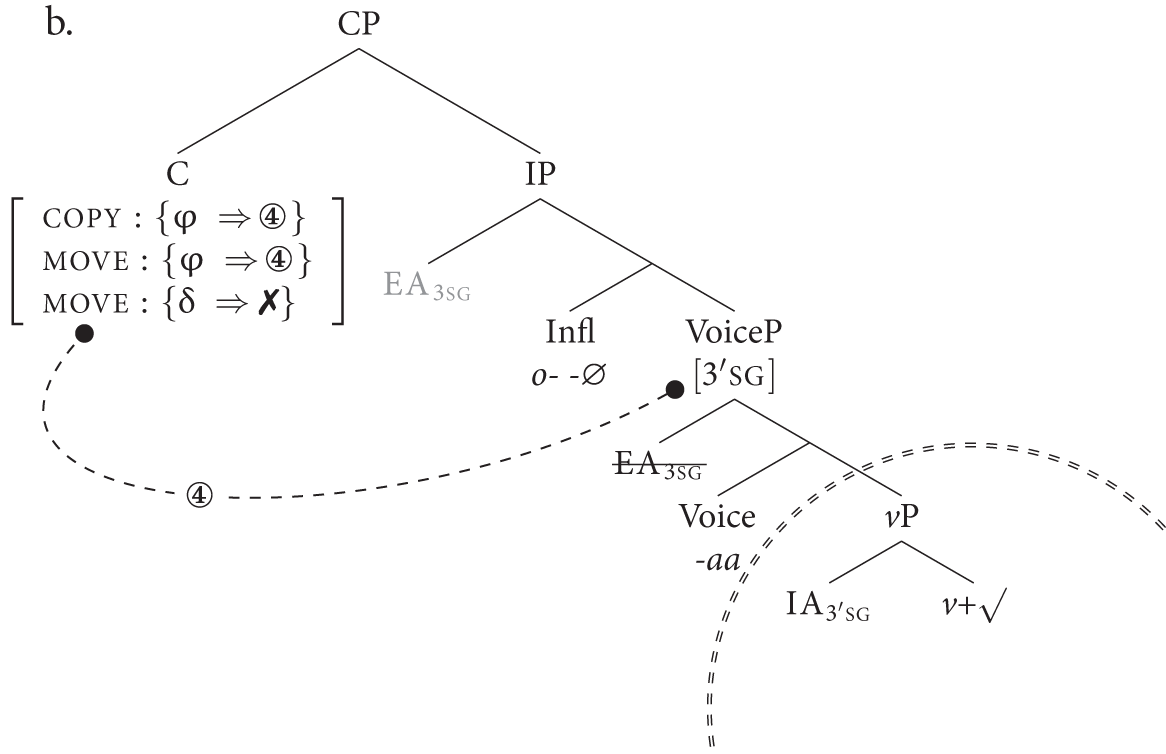
Agreement and movement with Voice and Infl proceed in an identical fashion to what was described in (30b,c) for VOS clauses, with Voice copying the features of the IA, and Infl copying the features of the EA, triggering movement to Spec,IP, and deactivating the argument. Similarly, as shown in (31b),  $\phi$-agreement on C (step ④) targets VoiceP and copies its previously acquired obviative third person features. The difference lies in the fact that the obviative IA does not bear a $\delta$-feature, therefore the IA fails to meet the EPP conditions of the $\delta$-probe on C and remains in situ.
To summarize, whether or not A $'$-movement to Spec,CP occurs (i.e., whether the obviative IA has the optional $\delta$-feature) accounts for the optional VOS/VSO word order alternations in the direct alignments.
4.2.3 Predictions for scope
The proposed movement should be expected to give way to a particular scope relationship between the moved proximate subject and negation, providing a testing ground for the proposal. To reprise the discussion from section 2.2, there are two elements associated with negation in matrix clauses. The first, gaawiin, is a focus negator following Tilleson (Reference Tilleson2019). The second element, the morpheme within the verbal complex -sii, encodes sentential negation, which is located immediately above VoiceP. As a result, the scope of the arguments with respect to negation in each different case provides a critical test for whether there is or is not movement out of the VP.
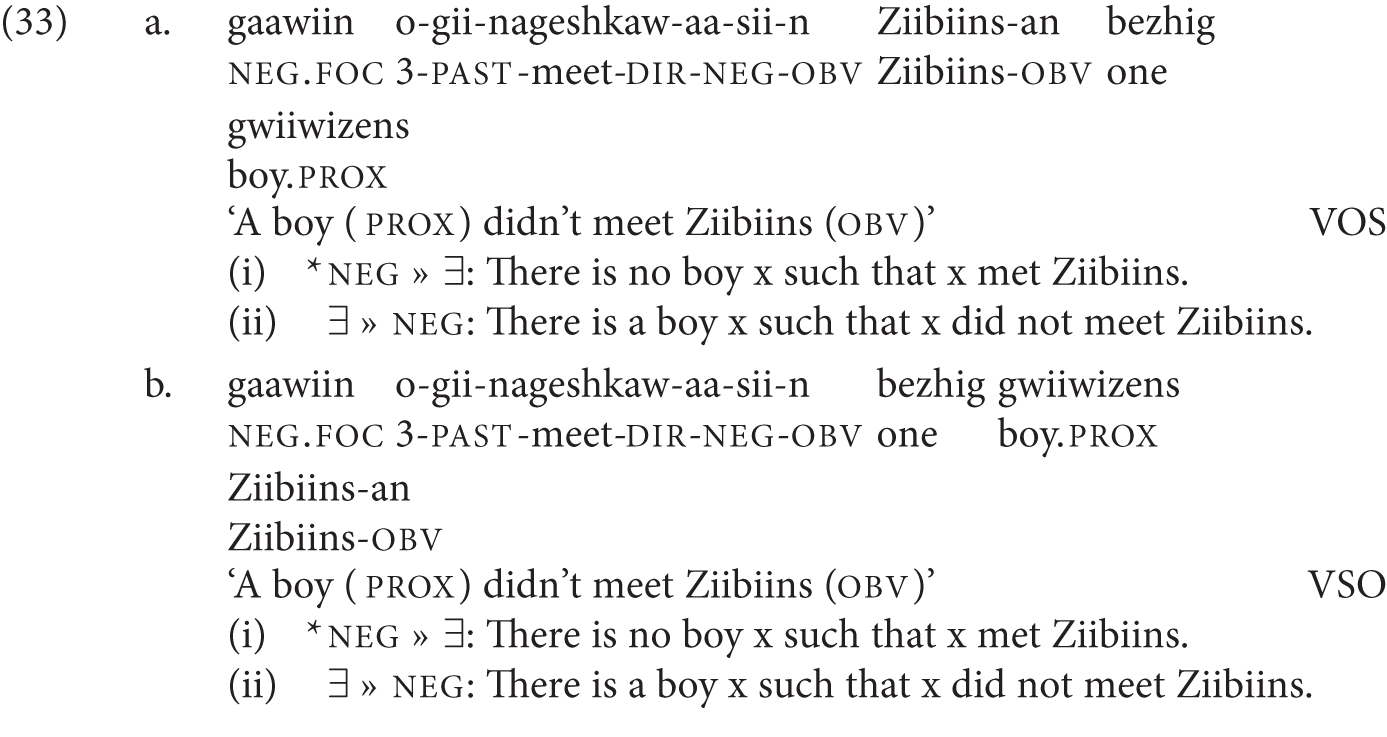
First, we should see that proximate EAs, which were proposed to undergo movement above negation to Spec,IP regardless of word order, take wide scope, as schematized in (32) for the VSO cases (but the same holds for the VOS cases).

The judgments in (33) support this prediction, with indefinite subjects in both the VOS and VSO word orders taking wide scope over negation. The unavailability of the narrow scope reading follows from the general finding that A-movement resists reconstruction.
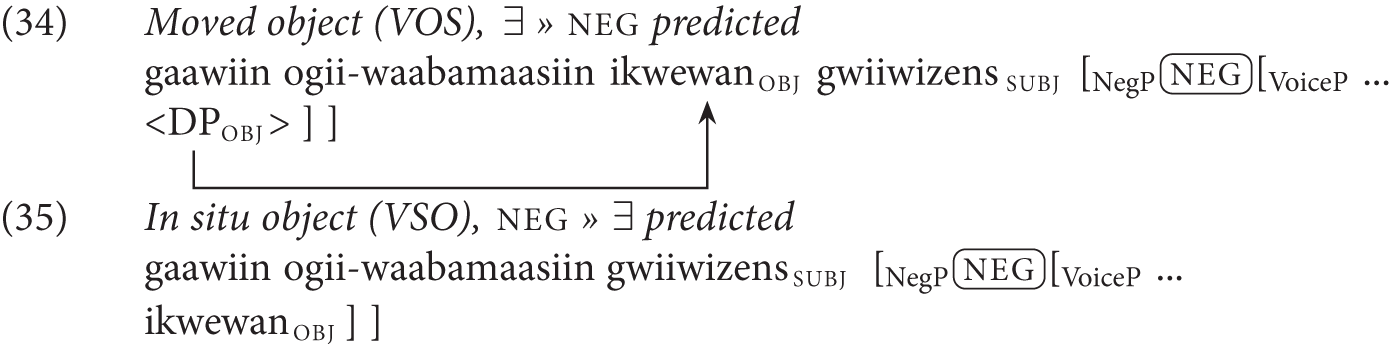
Second, we should see that the different word orders should correspond to different scope relationships between an existential quantifier on the obviative IA and negation. When the object undergoes movement, as proposed in the case of VOS, it should be able to take wide scope, as shown in (34a). In contrast, it should be interpreted with narrow scope when it remains in situ, as in the VSO case schematized in (34b).
Both of these predictions are borne out. In (36), where the indefinite object is moved such that VOS is derived, the indefinite is necessarily interpreted outside of the scope of negation. On the other hand, in (37), when the indefinite object remains in situ, resulting in VSO word order, the indefinite is necessarily interpreted within the scope of negation.
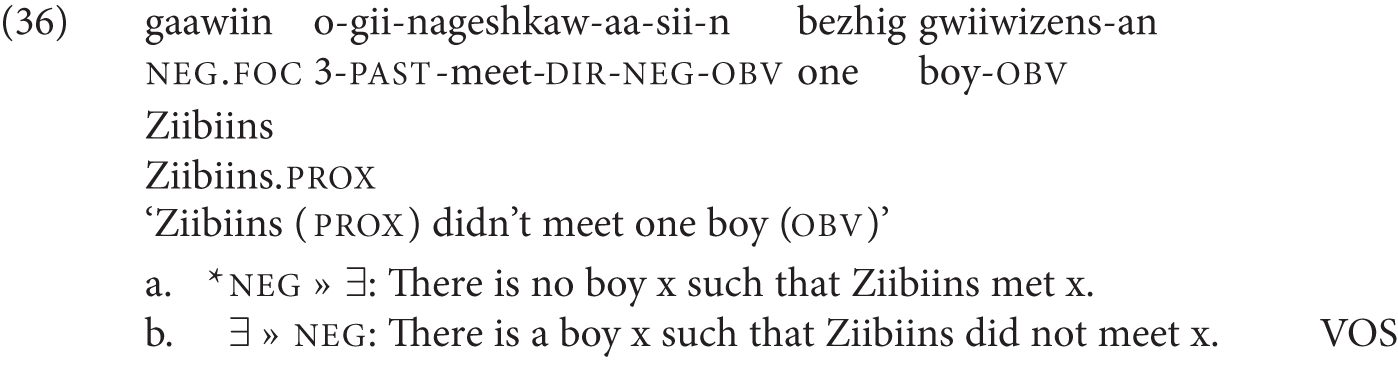
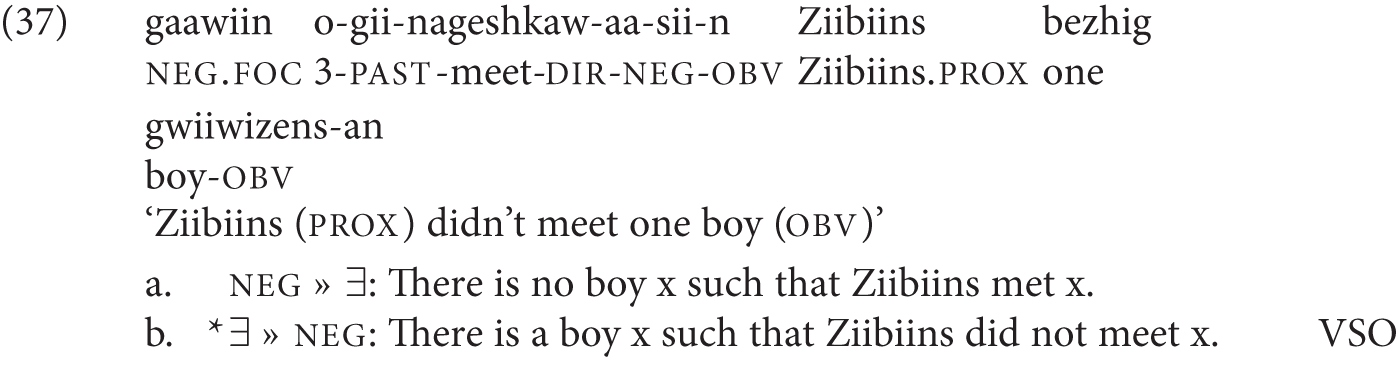
Besides supporting the predictions of the analysis, these data provide evidence that the VOS/VSO alternation is not at all random or due to arbitrarily optional movement: the alternation is associated with interpretative effects that are only visible when scope is relevant. When there is no negation and two definite arguments – the cases that have been discussed in the literature – these effects are not clear, and thus the alternation appears random.
However, given that movement is ultimately the result of a  $\delta$-feature rather than a $\phi$-feature, one may wonder why it is not possible to reconstruct and get a narrow scope reading in (37) – one of the hallmark properties of A $'$-movement is reconstruction. I propose that, in principle, the reconstructed interpretation is possible, but access to this interpretation is blocked by the availability of the in situ counterpart, which can only have the narrow scope reading. This is analogous to the situation with scalar implicatures, where, for example, the meaning of some in a sentence such as some cats like boxes results in the implicature that not all cats like boxes, because use of all provides an unambiguous way of expressing the meaning all cats like boxes. In the case of Ojibwe, the VSO word order unambiguously has a narrow scope interpretation, while VOS is associated with both narrow and wide scope readings. Since there is a more specific alternative to indicate narrow scope, the VOS order is only felicitous under the wide scope interpretation, appearing to block reconstruction.
4.3 Inverse alignments
To review, unlike direct-aligned clauses, only the VSO word order is grammatical in inverse-aligned clauses. As for agreement, Voice appears as the so-called “inverse” form, while Infl and C appear in the same form as direct-aligned clauses, respectively indexing the person and number features of the proximate and obviative arguments. However, with inverse the proximate argument is now the IA and the obviative argument the EA.
4.3.1 VSO inverse
The derivation for the VSO inverse cases is shown in (38).

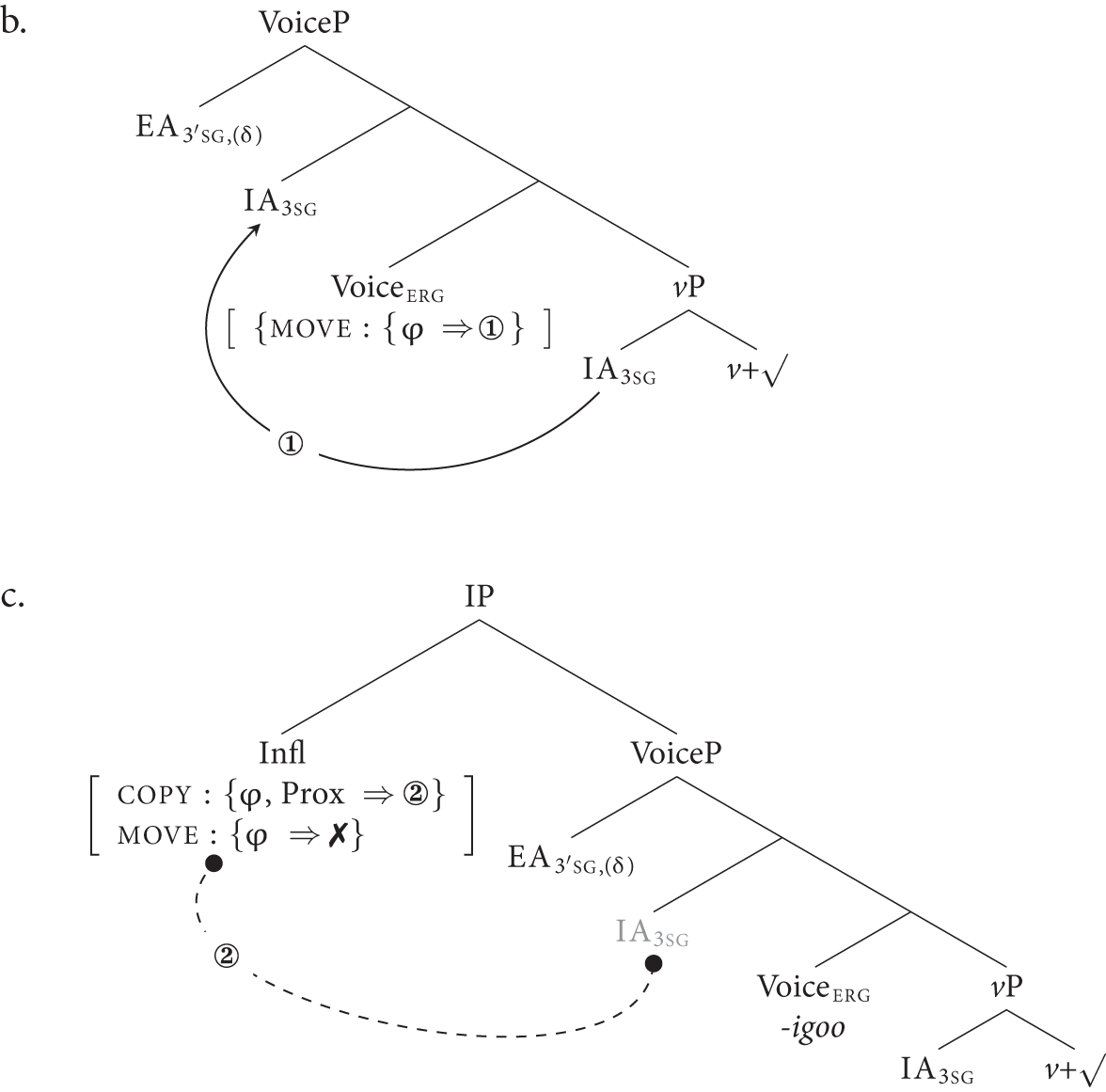
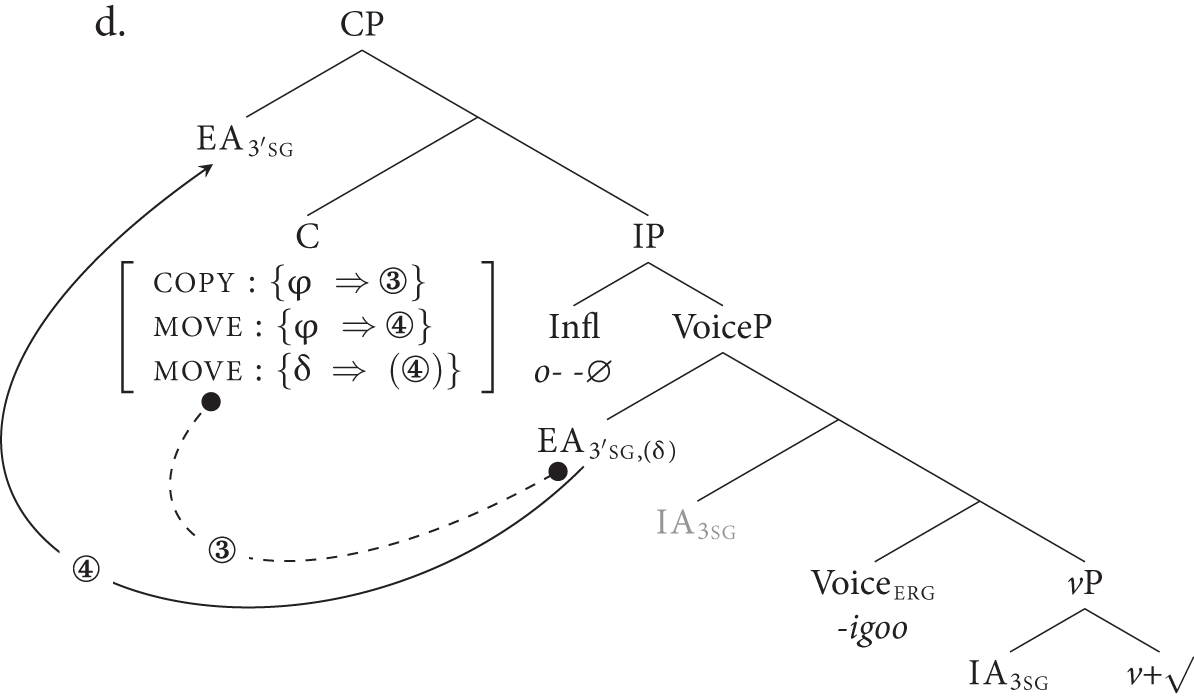
Inverse alignments are marked by the presence of ergative Voice, which lacks an agreement probe, so copies no features. Following Oxford (Reference Oxford2023), this lack of features ultimately leads to the spell-out of the inverse qua elsewhere form -igoo. However, the generic EPP probe on Voice results in the promotion of the IA to the specifier of VoiceP (step ①). This leads to a double-specifier configuration, so both the obviative EA and proximate IA are equidistant from Infl. The conditions on Infl are such that Best Match favours agreement with the proximate IA (step ②), deactivating it as a target for further operations, but is unable to adjudicate between the two for the purposes of movement. Following the ill-formedness of Multiple Merge, neither argument is moved to the specifier of IP. C then probes and finds the obviative EA as the closet goal. The features of the obviative EA are copied by C (step ③), and movement is triggered to Spec,CP (step ④) regardless of whether the obviative EA bears a  $\delta$-feature. As a result, the obviative EA always moves above the proximate IA, deriving the stable VSO word order characteristic of inverse-aligned clauses.
4.3.2 Predictions for scope
Once again, we can falsify or support the present analysis by examining whether an existential operator on each of the arguments can take scope over negation. First, evidence to support a lack of movement of proximate objects to Spec,IP comes from the judgment in (39), where indefinite proximate objects are ungrammatical under both narrow (39a) and wide (39b) scope readings.
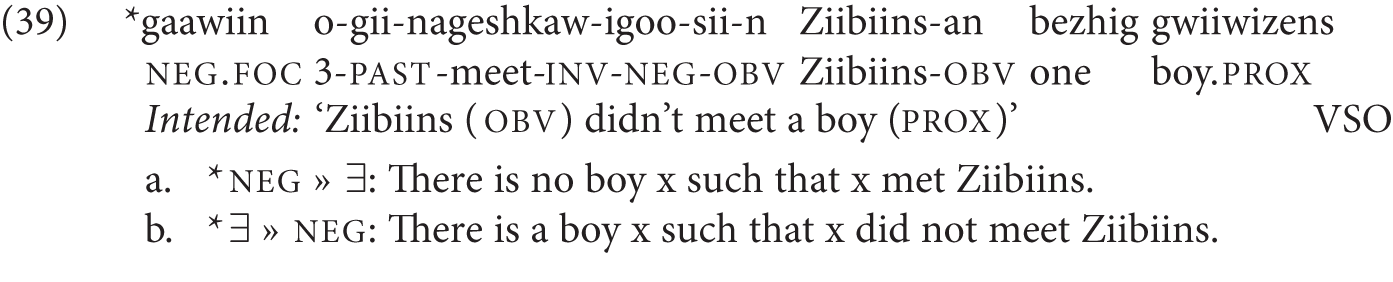
The fact that the wide scope reading in (39b) is unavailable directly supports the hypothesis that proximate IAs remains under the scope of negation, and do not undergo A-movement to Spec,IP, despite the EPP conditions on the probes.Footnote 8 However, the unavailability of the narrow scope reading in (39a) must receive another explanation.
Recall that narrow scope readings are also impossible with indefinite proximate EAs (i.e., in direct-aligned clauses). In other words, it seems there is no context in which indefinite proximate arguments can be interpreted within the scope of negation. In essence, this makes indefinite proximate arguments positive polarity items (PPIs).Footnote 9 When the proximate argument is an EA, it escapes the scope of negation and takes wide scope by movement to Spec,IP. In contrast, proximate IAs are unable to move above negation, and are therefore trapped within its scope. This results in the ungrammaticality reported in (39a). The precise semantic properties that lead to differences in how indefinite proximate and obviative arguments tolerate being within the scope of negation will not be settled here. However, it is cross-linguistically common for certain types of indefinites to behave as PPIs (e.g., Haspelmath Reference Haspelmath1997, Szabolcsi Reference Szabolcsi2004, Fălăuş Reference Fălăuș2018).
Turning now to the obviative EA, we expect that movement to Spec,CP should result in the availability of a wide scope interpretation. As shown in (40), indefinite subjects indeed take wide scope with respect to negation, as predicted by an analysis where they undergo movement to Spec,CP.
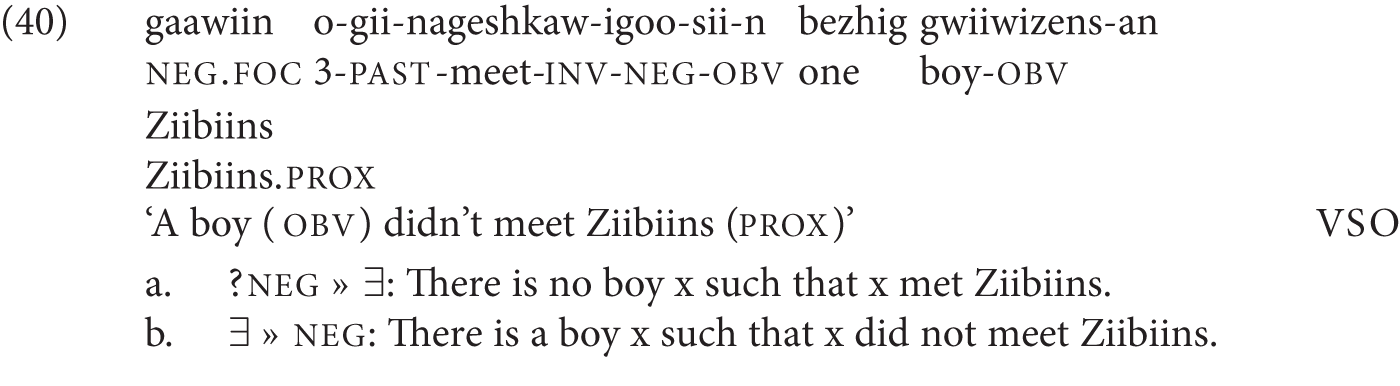
In this case, the marginality of the narrow-scope reading again follows from the nature of A-movement, which is widely recognized to resist reconstruction. However, the mixed nature of the probe, which also contains a  $\delta$-probe that triggers A $'$-movement, might be contributing to the “squishiness” of the judgments (the narrow scope reading was not emphatically ruled out). Further research is required to understand the conditions under which the narrow scope reading may become available, but for now the availability of the wide scope reading provides support for the proposal that the obviative EA moves to a position above VoiceP (i.e., Spec,CP).
4.4 Summary
This section linked VOS/VSO alternations in Ojibwe matrix clauses to interacting patterns of agreement and movement triggered by probes on Voice, Infl, and C. To summarize, the scope possibilities under different word orders, proximate/obviative status, and subject versus object indefinites are given in Table 2, with the proposed final landing site of the relevant argument indicated.
Summary of final landing site and scope judgments given alignment and word order

5. Extensions and comparisons
The previous two sections outlined a general theory to capture the relationship between agree, feature copying, and movement, and applied it to a small corner of the patterns of agreement and word order in Border Lakes Ojibwe. The theory (i) extends agree to apply to movement, capturing relativized EPP effects, and (ii) pinpoints feeding/bleeding of agreement and movement with higher probes to a combination of the behaviour of lower probes and the Activity Condition.
In this section I explore how the system can be applied to capture patterns of agreement and word order in other corners of Border Lakes Ojibwe (section 5.1), to patterns of C-agreement in the Algonquian family beyond Border Lakes Ojibwe (section 5.2), and to form connections to Halpert’s (Reference Halpert2019) analysis of Zulu, where there is further evidence that conditions on probing for the EPP must be separated from conditions for feature copying (section 5.3).
5.1 Extensions within Border Lakes Ojibwe
So far, the present article has focused on patterns of agreement and word order in matrix clauses, known within the descriptive literature on Algonquian as the “independent order”. However, as mentioned in passing earlier, there are differences in the patterns of agreement and indeed word order in embedded clauses, known as the “conjunct order” to Algonquianists. In this section, I sketch how the present system can account for patterns of agreement and word order in embedded clauses. The presented analysis is based on the recent work of Hammerly and Mathieu (Reference Hammerly2024), and the reader is referred to that paper for full details.
In the configurations at play in the present article, which only involve the proximate and obviative third persons, embedded clauses in Ojibwe share significant similarities to matrix clauses: the direct/inverse alternation occurs in the same contexts, and Infl uniformly indexes the person and number of the proximate argument. However, there are two major differences. First, there is a complete lack of C agreement, resulting in a lack of obviative agreement, and thus a lack of contrast (in agreement) with the singular and plural forms of the obviative. The second is Infl is realized only in the central agreement slot – there is no discontinuous realization of person and number with the person prefix. The baseline form, with a singular proximate argument, is shown in (41). As expected, the direct and inverse alternation tracks with the alignment of proximate and obviative arguments (being realized as -aa in (41a) and -igo in (41b)), and the central agreement slot is realized as proximate singular agreement -d.
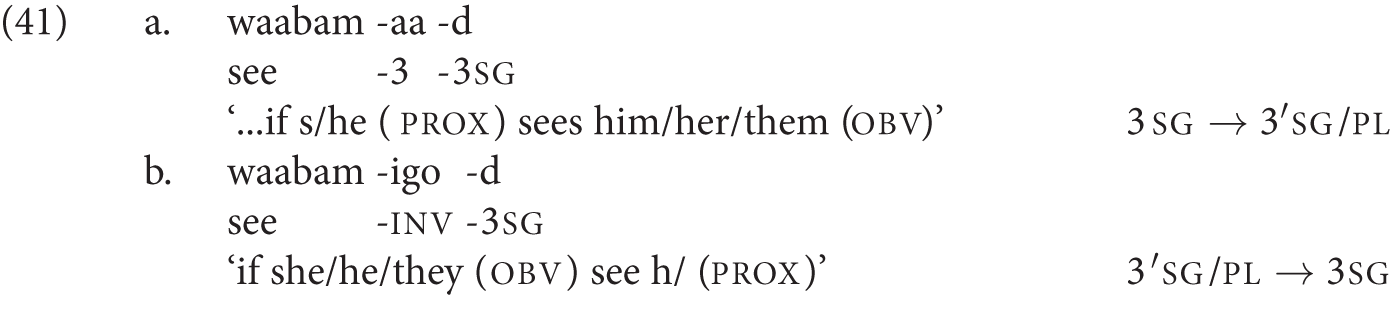
Embedded clauses differ in word order on two fronts, as seen in (42) and (43). First, the verb takes a medial position rather than an initial position. Second, only SVO is licensed in direct alignments, and only OVS is licensed in inverse alignments. In other words, word order always places the proximate argument before the obviative argument, the opposite of the preferences in matrix clauses.
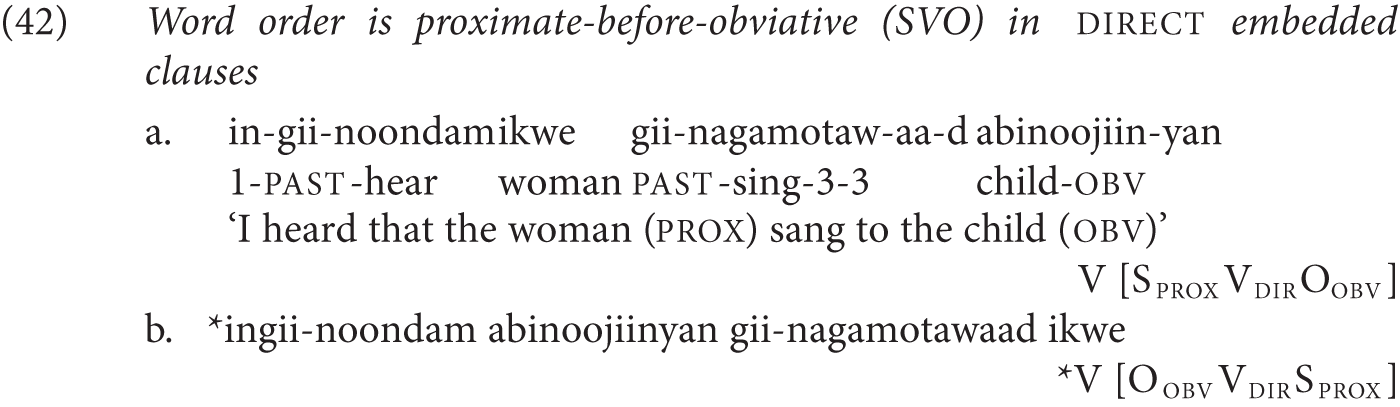
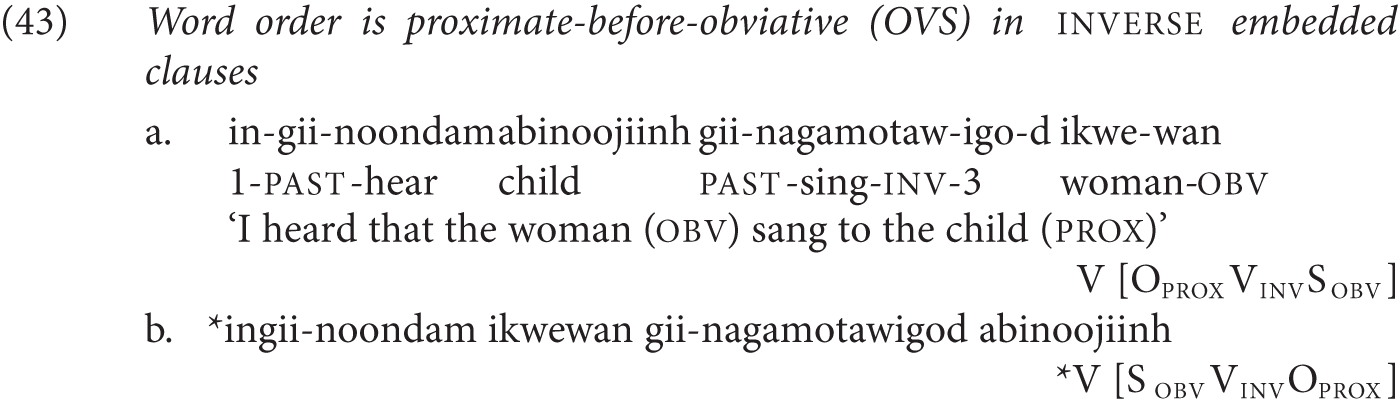
These differences can be straightforwardly accounted for under the present analysis. First, we can assume that verb raising in Ojibwe embedded clauses terminates at Infl rather than C (see also Richards Reference Richards2004, Lochbihler and Mathieu Reference Lochbihler and Mathieu2013). Second, the probe on Infl in embedded clauses can be further articulated such that the move conditions are specified as {Prox}, rather than { $\phi$}. The copy conditions of Infl can remain identical to matrix clauses, and Voice also remains the same. This small change has the consequence of resolving the conflict for Best Match within the move conditions in the inverse alignments, where the EA and IA are in a multiple specifier configuration, and therefore equidistant from the probe. With these more particular move conditions, the proximate IA can outcompete the obviative EA. As a result, the proximate argument undergoes movement to Spec,IP in both direct and inverse alignments, rather than only in direct alignments, as was observed in matrix clauses. Given that the verb stops at Infl, the proximate argument always appears to the left of the verb. The final piece is that embedded clauses in Ojibwe lack peripheral agreement and the corresponding probe on C. Therefore obviative arguments remain within the VP, in a position to the right of the verb. This captures the patterns of agreement and word order in both direct and inverse alignments.
5.2 Extensions across Algonquian
Ojibwe peripheral agreement (C) showed what was termed here as reverse omnivority. However, as Oxford (Reference Oxford2017b) discusses (see also Xu Reference Yadong2023, Reference Yadong2022; Grishin Reference Grishin2023a), C agreement across Algonquian languages shows variation. There are three basic patterns, summarized in (44) with an example language indicated. Note that C agreement never appears when there are only local arguments in the clause (but does appear with “mixed” local/non-local configurations, and always targets the “lower ranked” third person).

The goal of this section is to give clear directions on how such variation may be accounted for within the present framework by way of a discussion of recent work by Grishin (Reference Grishin2023a, Reference Grishin2023b), which has argued explicitly against an account of the phenomenon based on the Activity Condition. I primarily focus on showing that Grishin’s arguments against the Activity Condition are not in fact decisive, and that therefore the present account cannot be ruled out on those grounds. Note, I set aside the Delaware-type languages for reasons of space (for discussion of these patterns in terms of object shift and the Activity Condition, see Hammerly Reference Hammerly, Alessa Farinella and Hill2021a).
Let us first begin with the Ojibwe-specific arguments against the Activity Condition from Grishin (Reference Grishin2023a). The first is related to the phenomenon of long distance agreement (LDA), where agreement probes in the matrix clause targets arguments that originate in the embedded clause. Consider the example in (45), where the proximate embedded subject mooz agrees with Infl in the embedded clause (-d) and Voice in the matrix clause (-aa).
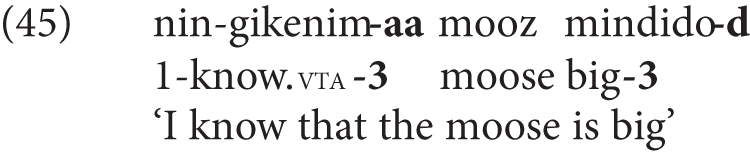
(Hammerly and Mathieu Reference Hammerly2024)
Grishin’s argument is as follows: If Infl deactivates arguments, and the embedded subject mooz is agreeing with Infl on the embedded verb, then that argument should (contra to fact) not be available for agreement in the matrix clause, since it should have been deactivated. Therefore, Grishin states that an account based in the Activity Condition “overgenerates” deactivation. The response is simple (and indeed raised by Grishin himself): There are many differences in the patterns of agreement in matrix and embedded clauses in Ojibwe (see the previous section), and one of them is simply that Infl in embedded clauses is parameterized such that it does not deactivate arguments. In other words, showing that Infl in the conjunct order (i.e., embedded clauses) does not deactivate arguments has no bearing on whether Infl in the independent order (i.e., matrix clauses) deactivates arguments, as argued for in the present article. This simply affirms that the Activity Condition is indeed a microparameter.
Grishin’s second Ojibwe-specific argument comes from cases where, within the same clause, both Infl and C index the same argument. As seen in the examples in (46), this occurs in independent order intransitive clauses with a grammatically inanimate argument (the so-called VIIs). Grishin shows data from Southwestern Ojibwe in Nichols (Reference Nichols1980), which I replace with data confirmed with a speaker from the Border Lakes region in September of 2023 that shows the same pattern. The negative preterit form is chosen, as it most clearly shows the relevant morpheme boundaries and positions.

Infl is appearing as an obviative marker -inii, while C is appearing either in the plural form -iin or the singular form -  $\varnothing$, depending on whether the sole argument of the verb is plural (46a) or singular (46b). The problem for the present analysis should be clear: Since independent order Infl is agreeing (in obviation only) with the sole argument, this should deactivate the argument and bleed agreement with C. Since C clearly is agreeing with the same argument, it cannot be the case that Infl deactivated the argument following agreement. Note, this issue cannot be solved by appealing to microparametrization, as we otherwise need the independent order Infl to be able to deactivate arguments.
The key fact that I leverage to provide an account of this exception is that Infl fails to express full agreement in these cases: That is, Infl only expresses the obviation status of the argument, but not the animacy or number. In previous work (Hammerly Reference Hammerly2020, Reference Hammerly, Alessa Farinella and Hill2021a), I argued in favour of a formulation of the Activity Condition as shown in (47), where the deactivation of arguments is specifically restricted to cases where full agreement obtains:

Applied to the examples in (46), we see that, since Infl fails to express the animacy and number of the argument, so the argument is not deactivated and remains available for agreement with C. Conversely, in patterns of Infl agreement seen for the cases at the core of this article, we always saw the expression of both the person and number of the proximate argument (o- -waa/  $\varnothing$). Therefore, on the formulation in (47) we correctly predict that C will ignore the deactivated proximate argument and agree with the obviative one instead. As discussed in detail in Hammerly (Reference Hammerly, Alessa Farinella and Hill2021a), the pattern of C and Infl agreeing with the same argument when Infl shows less-than-full agreement has multiple examples across the family, further supporting the formulation of the Activity Condition in (47). I refer the reader to that paper for details.
Outside of Ojibwe, Grishin (Reference Grishin2023a) argues that the Activity Condition also undergenerates cases of deactivation in ditransitive clauses. Here, the logic is more fragile, and (contra Grishin’s rhetoric) not at all decisive. The idea is as follows: There are cases where C appears to skip over the goal of a ditransitive and favour agreement with the theme; however, the Activity Condition does not predict that the goal should have been deactivated as a target, as it has agreed with Voice, which does not deactivate arguments, but not Infl, which does. Therefore, this is a case where an argument (appears to be) deactivated, but it has (apparently) not agreed with Infl. This leaves the mystery of how such an argument is ignored by the probe on C.
The issue with Grishin’s reasoning is that it is entirely possible that, for reasons independent of the Activity Condition (e.g., being assigned case) that the goal has become invisible to the probe. It is true that, if the analysis presented is correct, the Activity Condition alone does not predict the patterns in these instances, and therefore does not account for them. However, it does not preclude that there could be other factors at play. In other words, the Activity Condition does not necessarily uniquely determine whether or not a goal is available to a probe, so the data only fails to provide additional support for the Activity Condition, but does not actually provide evidence against the account. In any case, I believe these data require further investigation before they are taken to support or rule out one account or another.
A final (apparent) issue raised by Grishin Reference Grishin2023b, footnote 22, brings us to consider the pattern represented by languages like Blackfoot: As exemplified in (48), in non-local only clauses with a proximate and obviative argument, C always agrees with the proximate argument (-yi below), and Infl also agrees with the proximate argument in both person and number (ots- -oaa below).
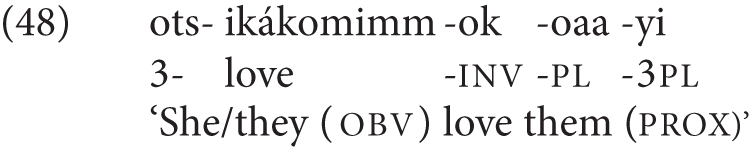
(Blackfoot; Frantz Reference Frantz2017: 62)
Again, at first blush, this appears to be highly problematic for the present account: If full agreement with Infl deactivates arguments, we do not predict that C-agreement should be able to target the same argument. However, if we again recall that the Activity Condition is a (micro)parameter, we in fact predict that a language like Blackfoot should exist: If Infl is configured such that it does not deactivate arguments, then we expect that there should be a language where both Infl and C show full agreement with the same argument. Therefore, we can actually take the pattern as evidence in favour of the predictions of the present account, rather than a problematic case (in the same way the difference between independent and conjunct order Infl in Ojibwe is expected under the microparameterization of the Activity Condition). The same goes for the Meskwaki data discussed by Grishin, where Infl and C both agree with the same obviative argument in clauses where there is more than one obviative argument.
To summarize, I have shown that the arguments against the Activity Condition presented by Grishin (Reference Grishin2023a, Reference Grishin2023b) are not yet decisive, so it remains a viable account of pattern of the peripheral agreement marker on C across the Algonquian language family. That said, and despite the time I just devoted to defending the Activity Condition, the issue is indeed orthogonal to this article’s main contribution: Accounting for the relationship between agreement and movement in Ojibwe and within theories of agree more generally. One could readily re-formulate the present analysis without reference to the Activity Condition (e.g., in the mould of Grishin’s “Expone Outermost”), and this would not disrupt the core proposal of how probes must be configured and relativized for movement and agreement with separate conditions. In the next section, I consider an extension of this core proposal outside of the Algonquian family.
5.3 Zulu hyper-raising and the relativized EPP
The final extension I consider brings us outside of Algonquian, returning to Halpert’s (Reference Halpert2019) analysis of hyper-raising in Zulu (alluded to in section 3.2). Halpert’s analysis covers an array of raising patterns in Zulu and beyond. The key case for current purposes is given in (49), where raising (optionally) occurs out of embedded CPs. In the non-raising counterpart (49a), matrix T (in bold) shows class 17 agreement, which is associated with the features of the embedded CP as a whole. When the embedded subject raises (49b), matrix T agreement (again in bold) can alternate with either class 1 (agreement with the raised argument) or class 17.
(49) Raising in Zulu is optional out of CP complements (Halpert Reference Halpert2019: 142)
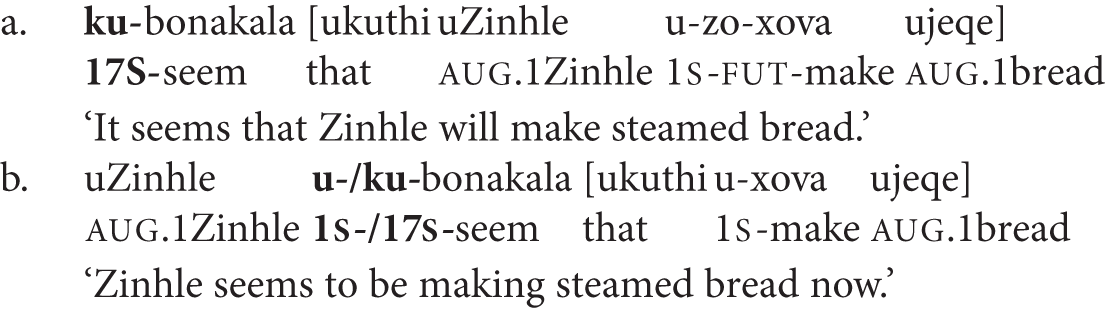
The critical cases are those where raising occurs. Halpert accounts for this in two steps. First,  $\phi$-agreement between matrix T and the finite CP clause, which bears class 17 features, but is unable to move to satisfy the EPP. With the EPP left active following this first agreement relation, the probe searches for the next closest goal, in this case the subject of the embedded verb, triggering copying of the class 1 feature and movement to the specifier of matrix TP.
Halpert notes that this analysis raises a critical question: How is it possible for the probe on matrix T able to continue probing and moving the embedded subject after it (presumably) should have been deactivated by  $\phi$-agreement with the CP? Halpert’s solution is to add an EPP feature into the conditions of the probe. This is an independent feature that can only be checked by locating and moving the right type of XP (in the case of Zulu, infinitival TP or a nominal, but crucially not a CP). So while agreement with CP checks a subset of the probe’s features, it leaves the EPP unchecked. This allows the probe to continue its search, finding and moving the embedded subject, in the interest of satisfying the EPP condition.
We can come to a more general understanding of Halpert’s proposal through the lens of the current article. The system proposed here takes things another step further by treating the EPP as an independent set of conditions rather than a feature within a more general set of probe conditions. The additional advantage over Halpert’s formulation is that this provides a way of formalizing variation in what elements can be moved by the EPP. For Zulu, this provides the means to encode the fact that infinitival TPs and nominals are driven to move, but CPs are not. In turn, the features of CPs can be copied back without precipitating movement to the specifier of the probe. Putting the pieces together in the new system, we can (semi-informally) specify the probe on matrix T that regulates hyper-raising in Zulu as follows:

This probe will copy features from any  $\phi$-bearing element (e.g., CP, TP, DP, NP, etc.), but only move a subset of these types of elements (e.g., TP, DP, NP). This further situates patterns of raising within the wider theories of agreement and movement, which is the key original insight from Halpert’s analysis.
This now brings us to a comparison of Carstens’ (Reference Carstens2005) proposal, from which Halpert (Reference Halpert2019) takes inspiration. To reprise the description from section 3.2, Carstens proposes that the EPP can be a sub-feature of uF features (i.e., uFEPP, which can be re-written as copy: FEPP). Again, note that recent work by Deal (Reference Deal2022) makes an identical proposal, only situated in Deal’s interaction/satisfaction model. The sub-feature theory crucially makes the prediction that all probing is driven by the need to meet conditions on feature copying; so once these conditions are met (i.e., the proper feature within the conditions that dictate feature copying is checked) this must have the downstream effect of deactivating the EPP sub-feature as well. This links feature copying and movement on a one-way street: The search for a matching XP is driven by the features that dictate copying; if a given feature has an EPP sub-property, then the goal is moved to the specifier of the probe in addition to its features being copied. Once the features have been checked/satisfied, probing stops.
The immediate issue with this formulation is that in languages where the features governing agreement have an EPP sub-property, this predicts that all instances of a certain type of feature copying should lead to movement. This over-generates: in Zulu, the features of CP are copied, but the CP is not moved. At the same time, the same probe agreeing with TP or a nominal element triggers movement as well as feature copying. This relativization of movement separate from feature copying cannot be captured by a sub-feature theory.
There are further issues arising from the Ojibwe facts and analysis presented in the current article. First, Ojibwe (and indeed Algonquian more generally) requires a probe on Voiceerg that triggers movement, but not feature copying (Oxford Reference Oxford2023). If all instances of movement are parasitic on feature copying, this decoupling is not predicted. Since the sub-feature theory predicts that all instances of movement should also involve feature copying, such a probe is impossible to formulate.
Finally, in Ojibwe, the plain voice probe is pickier about what it moves compared to what it copies: It will copy features from any  $\phi$-bearing DP, but only move a DP with a [Participant] feature (for detailed motivation for this, see Oxford Reference Oxford2023). Let us unpack why this is problematic for the EPP sub-feature theory like that of Carstens (Reference Carstens2005) or Deal (Reference Deal2022). Recall that, in all current models of agree, such pickiness is captured by relativizing the probe to a particular feature. For example, if a probe is searching for a goal to copy from based on the set of features {G}, and there is a closer goal with just {F}, but a further goal with {F, G}, the probe will “skip” copying features from the closer goal and only copy from the further goal. On the Catstens/Deal-type model, a probe can only be picky about what it moves insofar as it is picky about what it copies, since the EPP sub-feature can only be specified for the set of features that dictate copying (or some subset of those features). That is, a probe can only prefer to move a particular element if it also prefers to copy from that same particular element. Movement can therefore be more general than feature copying on the sub-feature theory, but feature copying cannot be more general than movement. On the other hand, the current analysis, where the two conditions are split, is readily able to capture both types of effects.
6. Against a non-configurational analysis
As discussed in the introduction, one of the leading analyses of word order and argument structure across Algonquian languages has been based in non-configurationality. In this section I discuss these proposals and provide evidence against them.
Ojibwe (along with nearly all Algonquian languages) descriptively displays the hallmarks of non-configurationality proposed by Hale (Reference Hale1983): pro- and argument-drop, apparently free word order, and discontinuous DPs (Grafstein Reference Grafstein1984). Two major accounts based in non-configurationality have been proposed as a result (terminology adopted from Hamilton Reference Hamilton2015): (i) Pronominal Argument Hypothesis (PAH) accounts, where A-positions are associated with  $\phi$-feature indexing affixes sitting in a flat-structure, and (ii) Hybrid accounts, where A-positions are associated with pro in a canonical asymmetrical configuration where the subject c-commands the object. In both cases, overt DPs are adjuncts sitting in TP/IP, which are associated with the elements occupying the A-positions via coindexation.
The most directly relevant account is Junker (Reference Junker2004), who gives a Hybrid account of word order in East Cree. Junker shows that East Cree has the same fundamental word order patterns as those presented here for Border Lakes Ojibwe: VOS is preferred in direct environments, while VSO is preferred in inverse. The structure for VOS direct is shown in (51), which is derived via the direct align constraint of Aissen (Reference Aissen1997) combined with an obviation-based hierarchy and phrase structure hierarchy. These hierarchies align to ensure that proximate DPs are in a higher position in the phrase structure than obviative DPs. When both DPs are linearized to the right, VOS is derived.
(51) Derivation of VOS in direct environments based on Junker (Reference Junker2004)
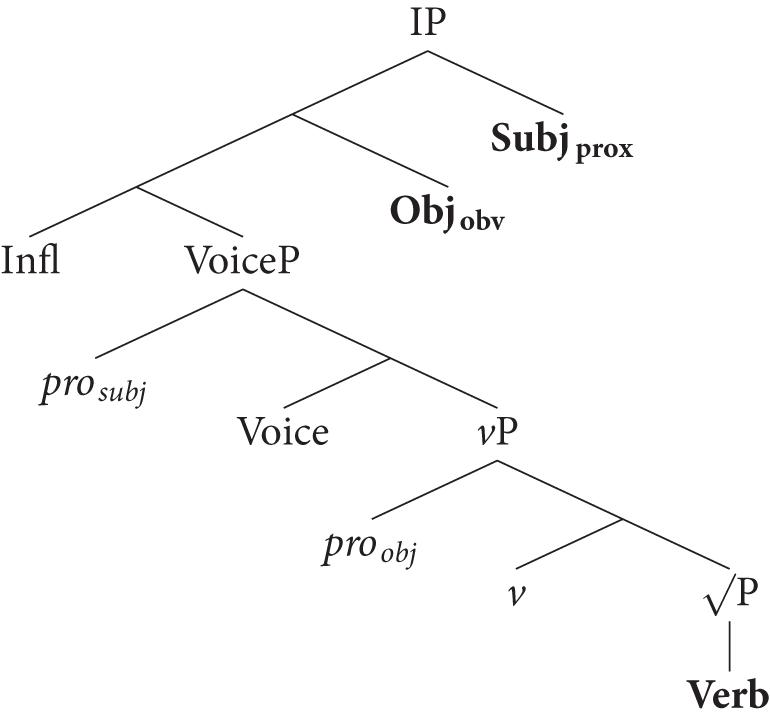
Immediate evidence against the analysis in (51) comes from data that has already been extensively discussed: scope of the overt arguments of the verb with respect to negation. The central thrust of the non-configurational analysis is that DPs are generated as adjuncts within IP, and do not undergo syntactic movement to arrive at their position. Instead, they are fed to linearization constraints that have no effect on the c-command/scope relations between the overt arguments of the verb and negation. This is particularly relevant in the contrast between VOS and VSO in direct environments: there is no way beyond stipulation to capture the wide versus narrow scope readings that respectively arise in these two word orders.
A further issue for non-configurational accounts arises upon consideration of ditransitive constructions, for example in (52).

Non-configurational languages are subject to the Morphological Visibility Condition (MVC; Baker Reference Baker1996: 17), which requires each argument to be licensed by a pronominal element or morpheme in the verb. However, as shown in (52), only one of the obviative arguments is indexed by the verbal morphology (which is identical to the morphology seen with transitive verbs), leaving the other to violate the MVC. The fact that Ojibwe does not obey the MVC is a mark against adopting a non-configurational analysis.
While a non-configurational analysis of Ojibwe is untenable based on the reasoning presented above, it may yet be premature to claim that all Algonquian languages are configurational. Furthermore, even Algonquian languages that are provably configurational, such as Mi’gmaq (Hamilton Reference Hamilton2015) and Ojibwe, have the surface appearance of non-configurationality. As Hamilton (Reference Hamilton2015) suggests, examining the role of discourse-based configurationality (Miyagawa Reference Miyagawa2010, Reference Miyagawa2017) is an important avenue for future research; this article has taken an initial step in that direction for Ojibwe by examining the effects of the A $'$ probe on C.
7. Conclusion
This article set out to establish and analyse the basic facts of Ojibwe clausal syntax. The VOS/VSO alternation, which was described in terms of its relation to direct and inverse argument alignments, was argued to be the function of whether or not movement of obviative arguments to the Spec,CP occurs. In direct alignments, the object can undergo movement deriving VOS word order, or stay in situ deriving VSO. This movement was shown to have semantic effects in the relationship between indefinite objects and negation, and was regulated by the presence or absence of a  $\delta$-feature on the DP. Movement of obviative subjects in inverse alignments was shown to be invariant, leading to rigid VSO. In addition to obviative movement, the scope facts supported an analysis where proximate subjects in direct alignments move to Spec,IP, while restrictions on movement out of multiple specifier configurations led proximate objects in inverse alignments to remain within the VP.
There were two main proposals supported over the course of the analysis. First, the relativized EPP. This was formalized as a condition on probes in the same vein as the conditions that dictate copying. When a goal matches the move conditions of the probe, this triggers movement of the goal to the specifier of the probe. Like the conditions that govern feature copying, EPP conditions were aregued to be violable and subject to different degrees of articulation, accounting for the intricate relationship between agreement and movement within and across languages. The second claim was that the Activity Condition can deactivate arguments when the probe shows “full agreement”, rendering certain goals unavailable for further agreement relations. This was used to explain the curious pattern of reverse omnivority with Ojibwe C agreement, where a lower-ranked argument is preferred for agreement over a higher-ranked one.
The proposal is a particularly marked shift away from non-configurational accounts, contributing to the growing body of work uncovering the agreement and discourse factors that lead to the appearance of non-configurationality. The surfacing of evidence that word order is derived via syntactic movement of the arguments furthers our knowledge of how the Ojibwe clause is organized. These findings have broad impacts on our understanding of agreement and movement, and find a place in the wider typology of how VOS/VSO alternations can be derived in languages of the world.
Acknowledgements
I am most greatly indebted to the speakers who share their knowledge with me and so many others: Nancy Jones and Gordon Jourdain. Special thanks as well to John Nichols, and the staff at OOG at Fond du Lac Tribal College, for support and advice. This work has also benefited from conversations with Brendan Fairbanks, Michael Sullivan, Kyle Johnson, Rajesh Bhatt, Brian Dillon, Ellen Woolford, John Kingston, Stefan Keine, Nico Baier, Claire Halpert, and Kaden Holladay. Feedback received at the 49th Algonquian Conference, NELS 50, the Syntax Workshop at UMass Amherst, s-lab at UC Santa Cruz, and in a colloquium at UBC was integral to pushing this work forward. This research is supported by NSF GRFP (Grant No. 1451512), a fieldwork grant from the Selkirk Linguistic Outreach Fund, and a SSHRC Insight Grant (AWD-024585). All views and errors are my own. This article is a descendant of an unpublished manuscript entitled A verb raising analysis of the Ojibwe VOS/VSO alternation, which can be found on Lingbuzz as Hammerly (Reference Hammerly2021b). The data and facts are exactly the same as presented in that paper, but the analysis has been deeply reworked, and the focus streamlined. For most purposes, this article can be seen as a replacement of those previous accounts.





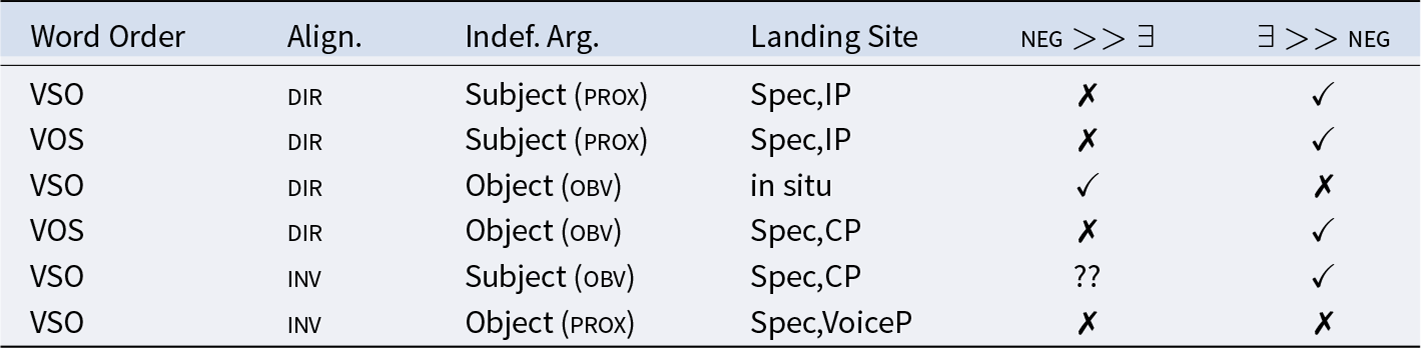

 Open access

