





Policy Significance Statement
This research focuses on the data-driven knowledge from research on the socio-spatial aspects of creativity on university campuses, and provides insights beyond this specific context. This research is significant for policymakers, planners, and designers involved in the (re)development of public spaces. It provides in-depth knowledge of how the socio-spatial aspects are currently applied in practice. Further, it showed a newfound relationship between the three effectiveness aspects: credibility, relevance, and applicability. Practitioners considered the research-generated evidence mostly relevant; however, credibility and applicability varied according to their background knowledge and projects’ phases and roles. In this sense, the integration of socio-spatial aspects of creativity in the evidence-based planning and design of public spaces (on and off campus) depends on an alignment between processes, actors, and institutions.
1. Introduction
In the context of university campuses, the relationship between the physical composition of public spaces and the actions, reactions, and creative expressions that the physical conditions provoke in people is conceptualized in this study as the “spatial affordances for creativity” (Meusburger, Reference Meusburger2009, Reference Meusburger2015; Sailer, Reference Sailer2011) or “socio-spatial aspects of creativity.” Socio-spatial aspects of creativity refer to the extent to which the physical environment of campuses’ public spaces can enhance or hinder campuses’ researching, learning, and teaching activities, people’s development of abilities and ideas, cross-disciplinary discussions, interactions between knowledgeable agents, and the possibilities of identifying and solving problems (Meusburger, Reference Meusburger2009, Reference Meusburger2015).
The phenomenon “socio-spatial aspects of creativity”––operationalized as the causal relationship between the physical environment and creativity––is herein investigated in-depth through humans’ perceptions, sense of place, and its normative relationship with space. Therefore, it is important to understand that creativity emerges and develops in dynamic interaction between the individual and the physical environment (Amabile, Reference Amabile1983; Amabile et al., Reference Amabile, Conti, Coon, Lazenby and Herron1996; Csikszentmihalyi, Reference Csikszentmihalyi2014a,Reference Csikszentmihalyib) and it is influenced by how people perceive a place through its physical features (Meusburger, Reference Meusburger2009; Sailer, Reference Sailer2011; Glǎveanu, Reference Glǎveanu2012). In other words, since the relationship between the physical environment and creativity is intricately bound, research-generated evidence of this relationship must be understood and considered for evidence-based decision and policy making in campus planning and design.
In line with that, multiple studies have explored the effect of the built environment on the uses, perceptions, and behavior of people in public spaces through an empirical or theoretical perspective (Kytta et al., Reference Kytta, Broberg and Kahila2012; Ewing and Clemente, Reference Ewing and Clemente2013; Mehta, Reference Mehta2014; Hadavi et al., Reference Hadavi, Kaplan and Hunter2015; Ghavampour et al., Reference Ghavampour, Del Aguila and Vale2017) and specifically in campuses’ public spaces (Kenney et al., Reference Kenney, Dumont and Kenney2005; Strange and Banning, Reference Strange and Banning2015; Hajrasouliha, Reference Hajrasouliha2017; Soares et al., Reference Soares, Weitkamp and Yamu2020a,Reference Soares, Yamu and Weitkampb, Reference Soares, Venhorst, Weitkamp and Yamu2021). These studies established ideas on how public spaces could be physically improved through strategic guidelines, such as campus design, urban design, or public spaces guidelines.
In reality, however, there are often discrepancies between research evidence and practice (decision-making, planning, and design) for campuses’ public spaces. Habitually, practitioners rely on their own experience, informal investigations, local practice examples, media sources, and rules of thumb more than on academic research (Krizek et al., Reference Krizek, Forysth and Slotterback2009; Taylor and Hurley, Reference Taylor and Hurley2016) and data-driven evidence (Chalikias et al., Reference Chalikias, Tsampoulatidis, Tsalakanidou, Nikolopoulos, Kompatsiaris, Komninos, Doudouliakis, Papastergios, Papafilis and Karkaletsi2020) to make decisions. In this case, practitioners might be unwilling to use research-generated evidence if it is not aligned with determined political agendas (Sager and Ravlum, Reference Sager and Ravlum2005) and the institutions’ (campuses and municipalities) views and interests (Kunzmann, Reference Kunzmann2009; Carmona, Reference Carmona2010, Reference Carmona2015; Dilling and Lemos, Reference Dilling and Lemos2011; Dunn and Laing, Reference Dunn and Laing2017; Duivenvoorden et al., Reference Duivenvoorden, Hartmann, Brinkhuijsen and Hesselmans2021). While practice focuses on solving specific problems, by applying existing knowledge and best practices, research is more formalized and relates to questions posed by the field, rather than by a specific situation (Krizek et al., Reference Krizek, Forysth and Slotterback2009).
As discussed by several international campus design and public spaces studies (European and Anglo-American, e.g., Carmona, Reference Carmona2010, Reference Carmona2015; Den Heijer and Den Heijer, Reference Den Heijer and Den Heijer2011; Fisher, Reference Fisher2016) the research-practice gap becomes aggravated since projects of (re)development of university campuses and public spaces often suffer from institutional fragmentation. This is caused by the fact that their decision and policy-making depend on multiple spheres of governance across diverse (university and government) departments and portfolios (Head, Reference Head2010; Dilling and Lemos, Reference Dilling and Lemos2011; Dunn and Laing, Reference Dunn and Laing2017; Duivenvoorden et al., Reference Duivenvoorden, Hartmann, Brinkhuijsen and Hesselmans2021). Such fragmentation issues are present in the study cases in this research: inner-city campuses and science parks of Dutch cities.
An attempt to overcome such fragmentation issues and the research-practice gap is the evidence-based practice (EBP), which aims to help bridge the gap between traditional practice and formal research. EBP involves the understanding of perceptions of practitioners regarding the effectiveness of (data-based) research-generated evidence related to their habits in planning practice (Davoudi, Reference Davoudi2006; Krizek et al., Reference Krizek, Forysth and Slotterback2009; Pelzer et al., Reference Pelzer, Geertman, van der Heijden and Rouwette2014). In this sense, effective evidence improves EBP (Keen, Reference Keen1980; Hamilton et al., Reference Hamilton, Fu, Guillaume, Badham, Elsawah, Gober, Hunt, Iwanaga, Jakeman, Ames, Curtis, Hill, Pierce and Zare2019), increases the ability of an individual or a group to make decisions, and strengthens the research-practice interface through research-led decision-making in practice (Tennøy et al., Reference Tennøy, Hansson, Lissandrello and Næss2016). In this research, the “research-generated evidence” was generated by multiple sources of theory and data-driven knowledge (analog and digital) on socio-spatial aspects of creativity––operationalized and measured as the causal relationships between the physical environment and creativity (the evidence was extracted from Soares et al., Reference Soares, Weitkamp and Yamu2020a,Reference Soares, Yamu and Weitkampb, Reference Soares, Venhorst, Weitkamp and Yamu2021).
Several studies have been discussing a paradigm shift in urban planning practice and research regarding the combination of analog and digital data sources that can be used as evidence for decision and policy-making. Briefly explained, this paradigm shift addresses the transition from traditional practices (e.g., intuition-based decisions, assemblies, previous policy evaluations, descriptive data, and trend statistics) to more participative, democratic, citizen-oriented, and data-based evidence for decision and policy-making. In line with this, several pieces of research discussed, for instance, that collaborative and participative models of knowledge production can aid evidence-informed policy (Nochta et al., Reference Nochta, Wahby and Schooling2021). Chalikias et al. (Reference Chalikias, Tsampoulatidis, Tsalakanidou, Nikolopoulos, Kompatsiaris, Komninos, Doudouliakis, Papastergios, Papafilis and Karkaletsi2020) and Pantalona et al. (Reference Pantalona, Tsalakanidou, Nikolopoulos, Kompatsiaris, Lombardo, Norbiato, Ferri, Kovats and Haberstock2021) argued that evidence-driven approaches enabled by analog and digital data already available in the city (e.g., data collection, efficient data storage, and data analysis) are useful to assess cities’ economic activity, environmental impact and social consequences of certain policy decisions. Such evidence can inform, advise, monitor, evaluate, and revise the decisions made by policy advisors and urban planners. Liu and Dijk (Reference Liu and Dijk2022) research concludes that the availability of open and big data provides additional and relevant information for evidence-based solutions. However, it cannot yet be replaced by traditional data usage (surveys, statistics). Decision and policy making, involve multistep processes that require combined assessment of analog and digital data-based knowledge. Further, it involves the perceptions of different stakeholders regarding the effectiveness of this data for their practice (Chalikias et al., Reference Chalikias, Tsampoulatidis, Tsalakanidou, Nikolopoulos, Kompatsiaris, Komninos, Doudouliakis, Papastergios, Papafilis and Karkaletsi2020; Nochta et al., Reference Nochta, Wahby and Schooling2021; Pantalona et al., Reference Pantalona, Tsalakanidou, Nikolopoulos, Kompatsiaris, Lombardo, Norbiato, Ferri, Kovats and Haberstock2021).
In this context, prior research on practitioners’ perceptions of the research-practice interface has, for instance, explored analog and digital decision support systems (McIntosh et al., Reference McIntosh, Ascough, Twery, Chew, Elmahdi, Haase, Harou, Hepting, Cuddy, Jakeman, Chen, Kassahun, Lautenbach, Matthews, Merritt, Quinn, Rodriguez-Roda, Sieber, Stavenga, Sulis, Ticehurst, Volk, Wrobel, van Delden, El-Sawah, Rizzoli and Voinov2011; Merritt et al., Reference Merritt, Fu, Ticehurst, El Sawah, Vigiak, Roberts, Dyer, Pollino, Guillaume, Croke and Jakeman2017), planning support systems (Brömmelstroet, Reference Brömmelstroet2013; Pelzer et al., Reference Pelzer, Geertman, van der Heijden and Rouwette2014), environmental management and policy (Cash et al., Reference Cash, Clark, Alcock, Dickson, Eckley, Guston, Jäger and Mitchell2003), the characterization and evaluation of the effectiveness of environmental modeling (Hamilton et al., Reference Hamilton, Fu, Guillaume, Badham, Elsawah, Gober, Hunt, Iwanaga, Jakeman, Ames, Curtis, Hill, Pierce and Zare2019), and the applicability of assessment methods and the effectiveness of knowledge transfer between science and practice (Perrotti, Reference Perrotti2019). Practitioners’ perceptions of the research-practice interface were assessed based on aspects such as credibility, relevance, legitimacy (Cash et al., Reference Cash, Clark, Alcock, Dickson, Eckley, Guston, Jäger and Mitchell2003; Hansson and Polk, Reference Hansson and Polk2018), applicability, accessibility (Dunn and Laing, Reference Dunn and Laing2017), satisfaction, impact (Hamilton et al., Reference Hamilton, Fu, Guillaume, Badham, Elsawah, Gober, Hunt, Iwanaga, Jakeman, Ames, Curtis, Hill, Pierce and Zare2019), feasibility, and usability (Weitkamp et al., Reference Weitkamp, Van den Berg, Bregt and Van Lammeren2012). There is, however, a lack of research that investigates the interrelations between credibility, relevance, and applicability (conceptualized in this study as effectiveness), focusing on campuses’ public spaces.
Following, this research aims to provide empirical evidence regarding how concepts of socio-spatial aspects of creativity are currently applied in practice and if research-generated evidence on socio-spatial aspects of creativity is perceived by practitioners as effective (credible, relevant, and applicable) for the EBP (decision-making, planning, and design) of campuses’ public spaces. We argue that: to be credible, the evidence needs to be perceived as technically and scientifically adequate for its intended use and the sources should be reliable and trustworthy (Hansson and Polk, Reference Hansson and Polk2018); to be relevant, the evidence must address impacts and solutions for practice, also current and unresolved questions (Dunn and Laing, Reference Dunn and Laing2017; Hamilton et al., Reference Hamilton, Fu, Guillaume, Badham, Elsawah, Gober, Hunt, Iwanaga, Jakeman, Ames, Curtis, Hill, Pierce and Zare2019); and to be applicable, the evidence must address contextual problems and provide links to planning practice by laying out elements applicable for decision supports as an aid for discussion (Dunn and Laing, Reference Dunn and Laing2017; Perrotti, Reference Perrotti2019). This research suggests that what might vary among practitioners are the perceptions of credibility and applicability since they seem to depend on national and local institutional goals, practitioners’ habits in planning practice and their projects’ phases and roles related to the (re) development of campuses’ public spaces. Whereas concepts and the evidence on socio-spatial aspects of creativity are highly relevant for the EBP of campuses’ public spaces.
Through a thematic analysis of 16 in-depth interviews with practitioners involved in the (re)development of public spaces of the inner-city campuses and science parks of the Dutch cities Amsterdam, Utrecht and Groningen this study answers the following research questions:
1. To what extent are socio-spatial aspects of creativity currently applied in the decision-making, planning, and design of university campuses?
2. How do practitioners perceive the effectiveness (credibility, relevance, and applicability) of research-generated evidence on socio-spatial aspects of creativity for EBP?
To guide this study, we elaborated and discussed with practitioners four propositions (see Supplementary Appendices A and B). To give context, these propositions are the summary of the research-generated evidence on socio-spatial aspects of creativity extracted from past empirical research (conducted by the authors; Soares et al., Reference Soares, Weitkamp and Yamu2020a,Reference Soares, Yamu and Weitkampb, Reference Soares, Venhorst, Weitkamp and Yamu2021). Such research-generated evidence was generated through data-driven knowledge and multiple disciplinary methodologies (e.g., space syntax analysis, self-reported perceptions in public spaces, statistical analysis, and on-street observations). In other words, the socio-spatial aspects of creativity were operationalized and measured as the relationship between the physical environment and perceived creativity through a normative spatial-analytical approach enriched with qualitative data, such as spatial affordances, perceptions and sense of place. The propositions are the following: (a) Campus design, Urban Design, and Public spaces Guidelines might not be suitable for every campus. Context and individualities matter; (b) the locations of built environment features can influence or inhibit creative encounters; (c) high accessibility or high availability of spaces to walk does not mean high possibilities of creative encounters, and low accessibility does not mean low possibilities of creative encounters; (d) Campuses and Public spaces typology matter for creative encounters between people. The propositions were used as “means” to conduct the interviews, discuss with practitioners their perceptions regarding the effectiveness of evidence on socio-spatial aspects of creativity and most importantly, answer the research questions.
Although we focused on research-generated evidence of “socio-spatial aspects of creativity” in the context of university campuses’, we acknowledge the dynamics and challenges related to the research-practice interface and the actors involved in the (re)development of public spaces in general. Therefore, the added value of this research was, the possibility to understand the interface between the aforementioned research-generated evidence (propositions)––generated through data-driven knowledge and multiple disciplinary methodologies––and their effectiveness for practice, from the perspective of practitioners. Also, the extent to which practitioners are willing to integrate research-generated evidence in their practice. Such insights are important since transforming public spaces into knowledge hubs that enable creativity and creative encounters through the physical environment requires fundamental changes in policy framing and practice. Such changes involve many actors which have diverse objectives and practice knowledge. In this sense, this research is the first step to closing the gap between research-generated evidence and practice and improving the EBP of public spaces.
2. Theoretical Framework
2.1. University campuses’ public spaces and creativity
Conceptually, public spaces are the main stage of urban life, facilitate encounters and the exchange of experiences, are physically accessible to all groups and foster a tolerant urban society through exposure to different people and their traditions (Arendt, Reference Arendt1958; Carr et al., Reference Carr, Francis, Rivlin and Stone1993; Worpole and Greenhalgh, Reference Worpole and Greenhalgh1996; Oldenburg, Reference Oldenburg1997; Mehta, Reference Mehta2007, Reference Mehta2014; Altman and Zube, Reference Altman and Zube2012; Madanipour and Hull, Reference Madanipour and Hull2017). Public spaces act as geographic locales that gather, activate, sustain, identify, and interconnect human beings, experiences, meanings, and events (Seamon, Reference Seamon2018). In the context of university campuses, public spaces are expected to afford face-to-face contacts, informal networks, multidisciplinary cooperation and the constant transfer of tacit knowledge (Asheim et al., Reference Asheim, Coenen and Vang2007; Evers et al., Reference Evers, Gerke and Menkhoff2011; Addie et al., Reference Addie, Keil and Olds2015).
Theoretical and quantitative empirical research on socio-spatial aspects of creativity (Soares et al., Reference Soares, Weitkamp and Yamu2020a,Reference Soares, Yamu and Weitkampb, Reference Soares, Venhorst, Weitkamp and Yamu2021) found scientific evidence on the causal relationship between the physical environment and creativity in line with the spatial affordances, perceptions, and sense of place theories (Gibson, Reference Gibson1979; Chemero, Reference Chemero2003; Meusburger, Reference Meusburger2009, Reference Meusburger2015; Sailer, Reference Sailer2011; Glǎveanu, Reference Glǎveanu2012; Seamon, Reference Seamon2013, Reference Seamon2018). This evidence proved which factors can enhance or hinder creativity in university campuses’ public spaces (Meusburger, Reference Meusburger2009, Reference Meusburger2015; Sailer, Reference Sailer2011). Although the importance of public spaces in cities and campuses is acknowledged in research and practice (Dober, Reference Dober1992; Carmona, Reference Carmona2010; Mehta, Reference Mehta2014; Hadavi et al., Reference Hadavi, Kaplan and Hunter2015; Strange and Banning, Reference Strange and Banning2015; von Schönfeld and Bertolini, Reference von Schönfeld and Bertolini2016; Cannas da Silva and Heitor, Reference Cannas da Silva and Heitor2017; Kim, Reference Kim2019; Mezoued et al., Reference Mezoued, Letesson and Kaufmann2021), public spaces are still undermanaged, fragmented, and overlooked (Magdaniel, Reference Magdaniel2016) in the process of decision-making, planning, and design of campuses. Therefore, if scientific evidence is perceived as effective by practitioners, it could help to bridge the gap between research and practice and to aid policy shaping and physical urban outcomes for campuses’ public spaces.
2.2. Effectiveness of research evidence for the decision-making, planning, and design of public spaces
Research-practice exchange through evidence may and often does increase the effectiveness of EBP (Head, Reference Head2016), for instance, in the decision-making, planning, and design of campuses’ public spaces. Effectiveness is the extent to which practitioners turn to credible, relevant, documented, research-based and applicable evidence in solving their planning problems (Cash et al., Reference Cash, Clark, Alcock, Dickson, Eckley, Guston, Jäger and Mitchell2003; Weitkamp et al., Reference Weitkamp, Van den Berg, Bregt and Van Lammeren2012; Tennøy et al., Reference Tennøy, Hansson, Lissandrello and Næss2016; Dunn and Laing, Reference Dunn and Laing2017; Chalikias et al., Reference Chalikias, Tsampoulatidis, Tsalakanidou, Nikolopoulos, Kompatsiaris, Komninos, Doudouliakis, Papastergios, Papafilis and Karkaletsi2020).
EBP is constituted by the relationship between data and information as it is transformed into knowledge (Davoudi, Reference Davoudi2006; Krizek et al., Reference Krizek, Forysth and Slotterback2009). The use of research-generated evidence for EBP can be conducted through various forms, sources, infrastructure, and methods for its utilization in practice (e.g., policy and governance) (Nochta et al., Reference Nochta, Wahby and Schooling2021; Liu and Dijk, Reference Liu and Dijk2022). For instance, a combination of multiple disciplinary methodologies (e.g., geospatial analysis, online participatory tools, observations) can enable new lines of thinking providing fresh insights and enhancing the validity of the findings as each data source and analysis complements the other (Amaratunga et al., Reference Amaratunga, Baldry, Sarshar and Newton2002). In other words, EBP can accommodate multiple forms of evidence and methods, from jointly defining problems to collaborative approaches and consent-based solutions (Healey, Reference Healey1997; Van Herzele, Reference Van Herzele2004; Krizek et al., Reference Krizek, Forysth and Slotterback2009). However, EBP can only be effective if both scientists and practitioners are fully informed of the nuances of scientific and societal options and requirements for decision-making. Davoudi (Reference Davoudi2006) mentions that facts or information are not per se evidence, as they only become evidence when they are used in conjunction with other facts to prove or disprove a proposition (see propositions in Supplementary Appendix A).
The effectiveness of EBP can be sub-divided into the following three related components: credibility, relevance, and applicability (Table 1). Therefore, the understanding of the interrelations between those three aspects is of importance since scientists may be producing evidence in formats and ways that make it considerably less effective to decision-makers than other types. If the research evidence on socio-spatial aspects of creativity is perceived by practitioners as credible, relevant, and applicable for EBP, it can help the practice-based community (Le Gouais, Reference Le Gouais2021), and most importantly, it might play a role in practitioners’ willingness to integrate such aspects into the decision-making, planning, and design of campuses, including the development and re-development of public spaces.
Effectiveness aspects of EBP

3. Methodology
3.1. The institutional context of Dutch campuses’ public spaces
The public spaces of Dutch inner-city campuses and science parks are embedded in an institutional context. These entities are shaped, developed, and managed through contributions of numerous stakeholders and actors such as public organizations and private entities in interrelated ways and complex arrangements (Madanipour, Reference Madanipour2013; Zamanifard et al., Reference Zamanifard, Alizadeh and Bosman2018). Because they are heterogeneous urban entities with diverse institutional characters and distinct location requirements (Kunzmann, Reference Kunzmann2009), their policy and decision-making processes constantly face institutional fragmentation issues. This consequently causes physical fragmentations on campuses and affects the quality of their public spaces. Such issues are not the focus of this research; however, we provide a brief overview in the following paragraphs.
Regarding fragmentation issues of campuses, planners and decision-makers often increasingly face challenges regarding the demands of the physical campus and the costs, values, and available resources, and at the same time, with changing goals from the multiple stakeholders involved (Den Heijer, Reference Den Heijer and Den Heijer2011). As an example, one cause of institutional fragmentation in Dutch universities was the budgetary limitations and the cut of governmental support for high education in 1995, which made universities search for new funding sources. Den Heijer (Reference Den Heijer and Den Heijer2011) explained that the decreasing public (budget) involvement and funding for universities put pressure on the internal allocation of resources. This affected investments in real estate and other facilities against investments in human resources at the university and faculty level. As consequence, among the methods employed to foster pedagogical activities, the use of the space is perhaps the least understood and the most neglected (Strange et al., Reference Strange, Banning and Delworth2001).
Following, the projects of (re)development of public spaces face similar institutional fragmentation issues. According to the study of van Melik and van der Krabben (Reference van Melik and van der Krabben2016), in the Dutch context, the projects involving “public goods” such as public spaces were traditionally produced and managed by government authorities. However, the past decades have shown that governments were not always successful, as they tend to be inflexible and only slowly adapt to changing circumstances. Additionally, van Melik and van der Krabben (Reference van Melik and van der Krabben2016) mentioned that a change in the attitude toward planning and the role of the public sector seems to have taken place in the Netherlands because of huge financial losses on municipalities’ investments. Therefore, Dutch planning increasingly seems to embrace new forms of “co-production” in planning and urban development with increasing involvement of multiple stakeholders in each public space (re)development project.
3.2. Case selection
We empirically investigated the research-practice interface related to socio-spatial aspects of creativity in the context of university campuses of three Dutch cities: Amsterdam, Utrecht, and Groningen (Figure 1). The choice of study areas regards the following reasons. Firstly, the University of Amsterdam (UvA), Utrecht University (UU), and the University of Groningen (UG) are “multi-campus universities” (Pinheiro and Berg, Reference Pinheiro and Berg2017), which are composed of inner-city campuses and science parks. Such universities offer a diverse combination of disciplines (e.g., media and arts, economics and governance, earth and sustainability, law, natural sciences, and more). Cities that hold inner-city campuses and science parks are commonly found in the Dutch, European and non-European contexts, therefore the insights generated through the cases are representative and generalizable internationally (for an in-depth description of differences and similarities between both campuses, please see Soares et al., Reference Soares, Weitkamp and Yamu2020a). Secondly, observations in situ suggested an interesting outcome: the physical environment affected differently the perceived creativity and uses of public spaces depending on the campus type (Soares et al., Reference Soares, Weitkamp and Yamu2020a, Reference Soares, Venhorst, Weitkamp and Yamu2021). In other words, campuses’ morphological attributes (functions and physical features) play a role in the use and perceptions of people in public spaces, and consequently in enhancing or hindering creative encounters.
(a) Map of the Netherlands, including Amsterdam, Utrecht, and Groningen; (b) location of the inner-city campuses and science park.

3.3. Data collection and participants
It is important to briefly mention that as preparation for the in-depth interviews, research-generated evidence from other empirical studies (conducted by the authors; Soares et al., Reference Soares, Weitkamp and Yamu2020a,Reference Soares, Yamu and Weitkampb, Reference Soares, Venhorst, Weitkamp and Yamu2021) were operationalized into four propositions (Supplementary Appendix A). The propositions focused on the experiences and perceptions of students, university employees, companies’ employees, and campus visitors (on-street questionnaire participants), to understand their perceived creativity concerning the physical environment. Perceived creativity was represented by the acts of socialization, spontaneous encounters, meeting people from outside the campus and places to share knowledge and exchange ideas with others.
The in-depth interviews were conducted with 16 decision-makers, policy officers, planners, and urban designers, and landscape architects (Table 2) from the municipalities of Amsterdam, Utrecht, and Groningen and the University of Amsterdam (UvA), Utrecht University (UU), and the University of Groningen (UG) . We selected the participants based on their involvement in projects of development and re-development of campuses’ master planning and public spaces. We recruited participants by email invitation and identified potential through community outreach, professional contacts, and snowballing.
List of interviewees

The data were collected through online in-depth structured interviews. Each interview comprised of three steps: (a) questions concerning how socio-spatial aspects of creativity are currently applied (abbreviated as CA) in practice; (b) a PowerPoint presentation (Supplementary Appendix B) of selected research-generated evidence of the six study areas, summarized in four propositions (Supplementary Appendix A); and (c) questions were asked about the four propositions to understand the practitioners’ perceptions on the effectiveness (credibility, relevance, and applicability) of socio-spatial aspects of creativity related to their practice. The interviews were conducted online through Google Meets with one or more participants. The average interview length was 60 min (ranging from 50 to 130 min) and followed the same procedure for every interview (Supplementary Appendix C).
3.4. Data analysis
For the data preparation, the interviews were recorded and transcribed using the software ATLAS.ti for qualitative data analysis (ATLAS.ti 8 for Mac). The interview data were analyzed by thematic analysis, which is defined as the process of sorting and categorizing data to make meaning by identifying patterns or themes in the data (Kawulich, Reference Kawulich2017). The advantages of thematic analysis are its theoretical independence and the possibility to be conducted within various ontological frameworks (Boyatzis, Reference Boyatzis1998; Braun and Clarke, Reference Braun and Clarke2006; Terry et al., Reference Terry, Hayfield, Clarke and Braun2017).
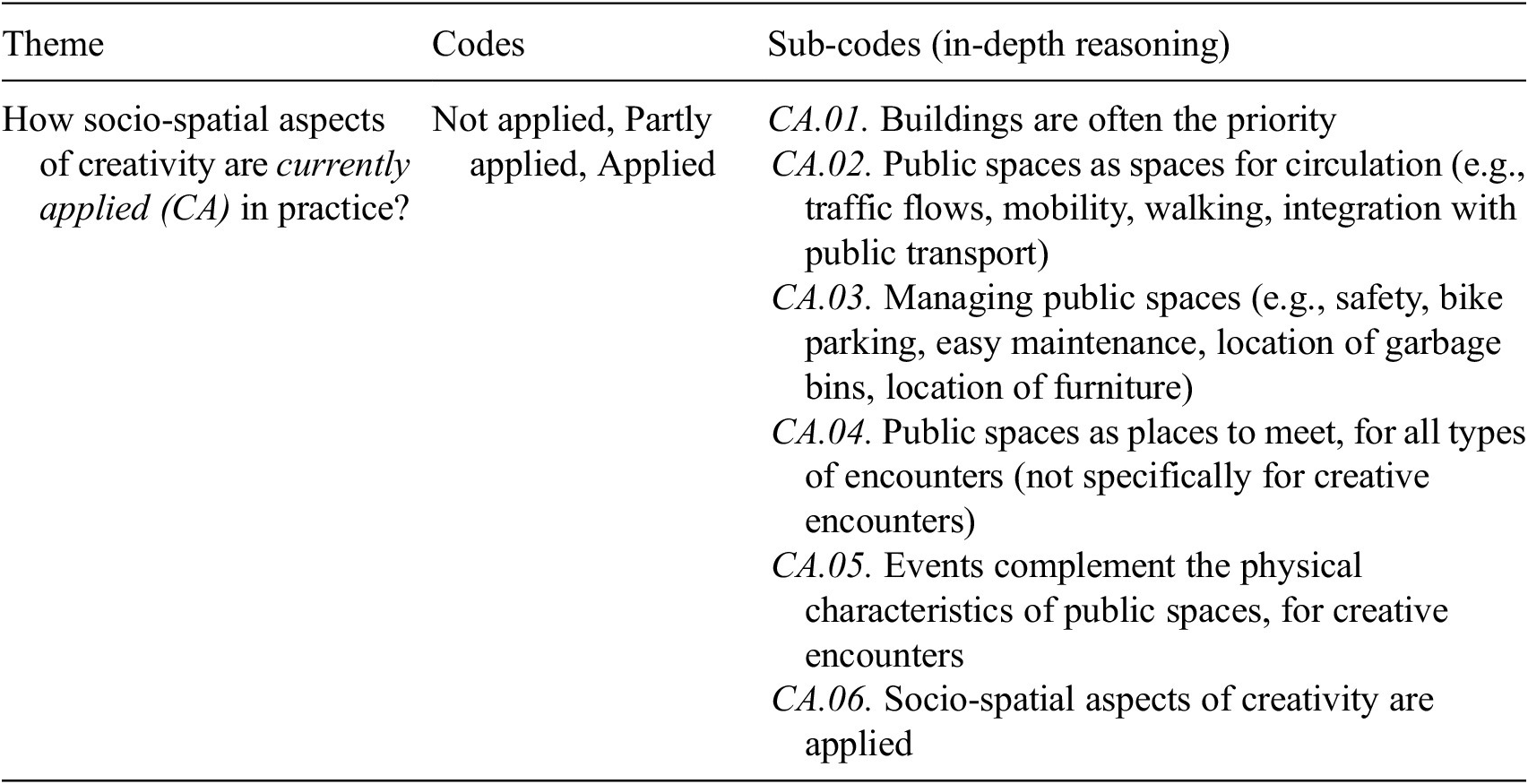
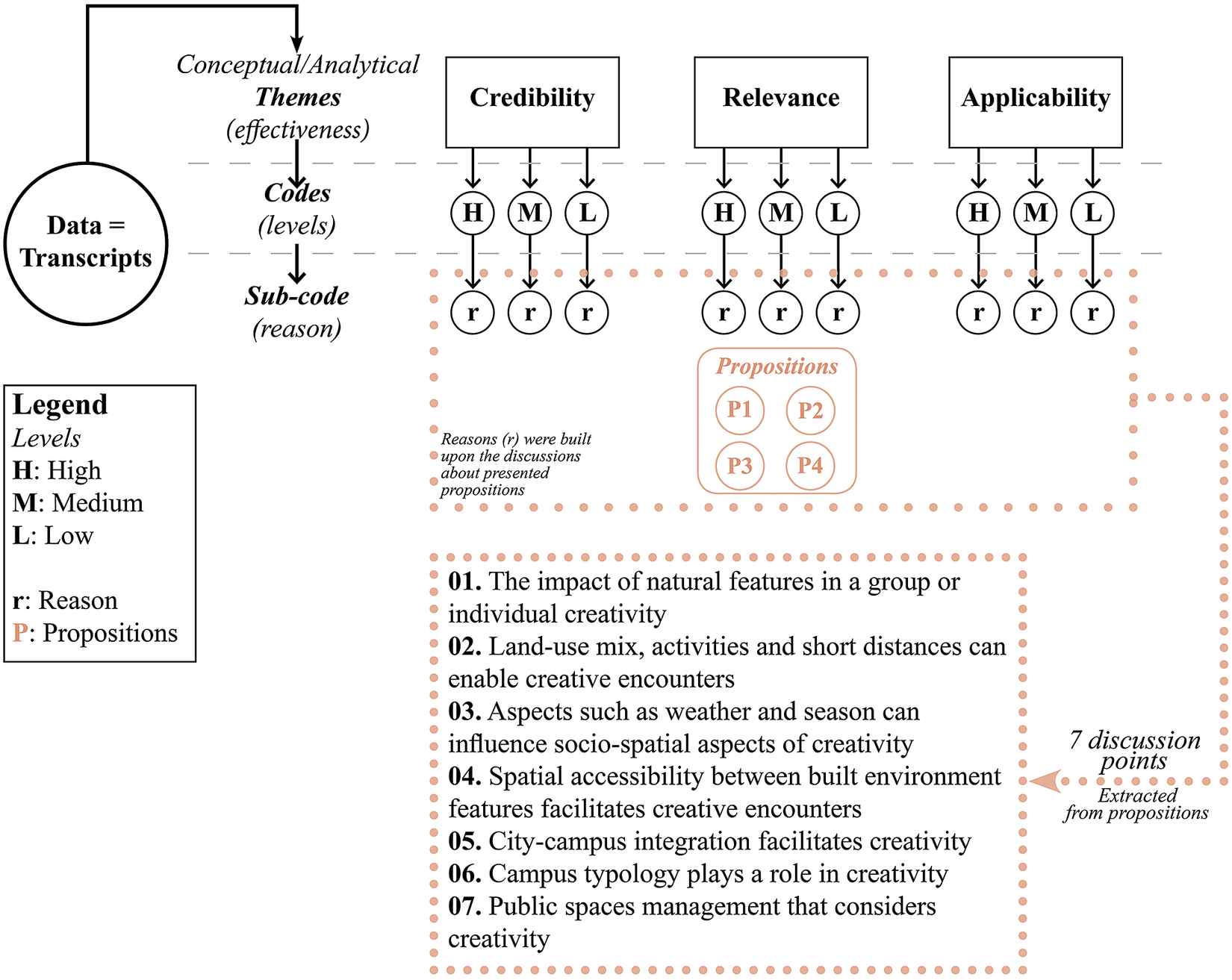
The thematic analysis was divided into two parts, following the two research questions. Therefore, we established two distinct sets of themes, codes, and sub-codes (for the coding scheme of research question 1, see Table 3 and for the coding scheme of research question 2, see Figure 2). The coding hierarchy (based on Kawulich, Reference Kawulich2017) allowed us to “catch” the nuances among practitioners’ perceptions. For both parts of the analysis, every quotation was associated with a code and sub-code and the coding validity was ensured by thorough repeated discussions with research colleagues and cross-sample coding. The points of discussion were presented based on the frequency of quotations, thus the importance that interview participants placed upon them.
Research question 1: Theme, codes, and sub-codes
Research question 2: Flowchart with analytical steps, themes, codes, and discussion points.
Firstly, for research question 1, to understand and illustrate the extent to which socio-spatial aspects of creativity are currently applied (CA) in practice, the interview responses were coded into “applied,” “partly applied,” or “not applied” (Table 3). Furthermore, according to the occurrence of the codes, six main reasons were sub-coded and discussed. The coding strategy provided insights into the status-quo of social-spatial aspects of creativity for practice in the context of campuses’ public spaces and highlighted how practitioners act upon public spaces’ functions, features, and built environment qualities.
Secondly, for the thematic analysis that refers to research question 2, the effectiveness of research evidence on socio-spatial aspects of creativity was explored through the practitioners’ perceptions in line with the studies of Weitkamp et al. (Reference Weitkamp, Van den Berg, Bregt and Van Lammeren2012), Dunn and Laing (Reference Dunn and Laing2017), and Hamilton et al. (Reference Hamilton, Fu, Guillaume, Badham, Elsawah, Gober, Hunt, Iwanaga, Jakeman, Ames, Curtis, Hill, Pierce and Zare2019). As aforementioned, the presented propositions (Supplementary Appendices A and B) were used as means to interview practitioners and to understand the following: (a) perceptions of level of effectiveness (high, medium, and low credibility, relevance, and applicability) of the presented evidence, and (b) the reasons for the perceived levels (Figure 2). We presented the results through seven discussion points; such points were chosen based on the frequency of quotations that described practitioners’ perceptions. Such points serve to illustrate why the research-generated evidence was perceived as having a high, medium or lowly credible, relevant or applicable.
4. Results
This section firstly presents how concepts of socio-spatial aspects of creativity are CA in practice. Secondly, it presents the practitioners’ perceptions of the effectiveness (credibility, relevance, and applicability) of such aspects for practice, through seven discussion points (Figure 2). The discussion points provided an in-depth understanding of the nuanced perceptions, including context-dependent and context-independent factors of socio-spatial aspects of creativity for EBP.
4.1. How are socio-spatial aspects of creativity currently applied in practice?
In this section, we present the results regarding the status quo of the socio-spatial aspects of creativity in practice. Following Table 4, for the theme “how the social-spatial aspects of creativity are currently applied,” quotations grouped according to “applied,” “partly applied” and “not applied” and six reasons were discussed (see codebook, Supplementary Appendix D1). What is striking about Table 4 is that socio-spatial aspects of creativity are mostly “not applied” in practice. The results highlight that practitioners mostly deal with tangible aspects of public spaces, such as locations of street furniture, traffic flows, or management between parties involved in public space projects. Thus, they often generalize public spaces design as “spaces to meet,” insinuating that creativity is not yet a goal. Therefore, intangible aspects, such as the social act of knowledge sharing and exchange of ideas, and their relationship with the physical environment are not yet understood by practitioners.
Results’ summary (GR = Number of quotations) for research question 1

Departing from the understanding that socio-spatial aspects of creativity were acknowledged as important by the majority of practitioners, four main reasons were given why they are not yet applied in practice. Firstly, designing buildings have priority over designing (CA.01) public spaces as a senior policy officer (Participant 6) from the UG mentioned:
We mainly focus on the buildings (…) Look at Zernike campus (Groningen) there are quite a few architectural highlights. Now (…) we are starting to realise that campus is more about public space, so we never thought about it until a few years ago and we are learning.
Secondly, participants (3, 4, 5, 7, 9, 10) approached public spaces as functional mobility and circulation means (CA.02) and focus on their connection with public transport for students. Interviewee 3 explained:
On the campus, mobility is a very strong aspect, especially with public transport because students need (…) all the campuses have to have an urban plan but also plan for the public space so that you have certain zones and (…) how all the different flows go.
Thirdly, interestingly, municipalities’ practitioners (participants 1, 3, 4, 7, 8, 10, 11, 15) handle public spaces from the management and safety perspective (CA.03). They mentioned the importance of the safety of public space users, easy maintenance, furniture locations, bicycle parking and garbage bins. They also take into account the accessibility of public spaces for disabled people. An urban designer from the Utrecht municipality (participant 15), mentioned:
in many cases, the public space comes at the end and we always try to get it more in front. I’m now working on a project for student housing and I think everyone thinks the public space is important, but it’s always in danger because they say of course we have to make a place where people can put their garbage (…) where maybe people that are disabled can put their car.
In line with that, Participant 3 talked about the inner-city campus of Amsterdam:
(…) outdoor areas are 50% is property of the university and 50% is (city) public space. (…) we want to re-design the public space. So, give it actually like new stones. But do not want to see the difference between which areas are from the university and which areas are from the city. It has to be one whole.
Fourthly, some practitioners seem to neither understand nor embrace socio-spatial aspects of creativity for practice. They often generalize public spaces as “spaces to meet” (CA.04) for all types of encounters. An urban planner from Groningen municipality (Participant 5) clarified:
Not very specific (…) the main goal of the Zernikeplein (re-development project at the Zernike Campus) is to have a central point (…) and an attractive area, which you can use for multiple goals (…) stay close to the water, eat your sandwich take breaks and spend some time. We are also going to have a lot of trees just like a park.
Creativity is “partly applied” in practice through the promotion of events (CA.05). Practitioners (2, 8, 12) explain that planning spaces that promote creativity just by the physical environment are a challenge and that on-campus events are fundamental to enhancing creative encounters. Participant 12 mentioned:
It is really difficult to plan the public spaces for encounters and knowledge exchange, by just the physical aspect. For example, at (Amsterdam) science park, there is a Science Park Foundation (…) they promote events in the area. So, I think that is complementary (…) they thought about this aspect of knowledge sharing. And in practice, it’s difficult to target the different groups: education, the business and research institutes.
In contrast, when practitioners apply (CA.06) socio-spatial aspects in their campus strategies, it highlights an integrative approach for planning and designing places for the knowledge economy. A program manager (Participant 16) of the UU mentioned:
(…) we have five guiding principles (…) we would like as a university work across borders (…) to have a transition to open science (…) to build a community where everybody feels welcome. Yeah, and maybe this is the one which is most relevant for the public space (…) we would like to have a public space which aims for encounters and knowledge exchange.
In general, the results illustrate that concepts of socio-spatial aspects of creativity were only addressed at the strategic decision-making level for the area development of Utrecht Science Park. Two main traits were noticed. The first is that the majority of practitioners are focused on locational, functional, or managerial aspects of public spaces; for instance, traffic flows, integration with public transport, or bike parking locations. The second is that public spaces are generalized as spaces to meet. This overlooks the essential utility of university campuses; they are environments for multidisciplinary cooperation which foster contacts and informal networks. Although the planning and design of campuses are the primary ways in which universities articulate their vision of future development (Swearingen White, Reference Swearingen White2003). We observed that, in practice, the relationship between the physical environment and creativity is weakly understood, and therefore not considered by active producers (e.g., campus stakeholders, decision-makers, campus managers, urban planners and designers) of campuses environments. Therefore, practitioners’ perceptions of the effectiveness of research-generated evidence on socio-spatial aspects of creativity for EBP are furthermore discussed.
4.2. Effectiveness of socio-spatial aspects of creativity for evidence-based practice
In this section, we present the effectiveness aspects (credibility, relevance and applicability) concerning seven discussion points translated from the research-generated evidence (propositions) presented to practitioners. As aforementioned, the “research-generated evidence” is composed of diverse data-based sources, forms and knowledge on socio-spatial aspects of creativity found in the six study cases.
The results of the thematic analysis are summarized and presented in Table 5. As previously mentioned, the effectiveness of research evidence for EBP (see Section 2.2) is determined by the interrelations of perceptions regarding the following three aspects: credibility, relevance, and applicability. In this section, the results are presented following the aforementioned aspects of effectiveness and at the same time according to the highest frequency of quotations associated with “levels” (codes) and the seven discussion points (Table 5 and Figure 2). Such discussion points were extracted from the propositions (Supplementary Appendix B) and were the most discussed subjects by the participants.
Results’ summary for research question 02 (GR = Number of quotations)

4.2.1. Credibility
Regarding high credibility, four discussion points were raised by the participants. Firstly, the evidence showing that “Land-use mix, activities and short distances can enable creative encounters” confirms experiences in practice. For instance, Participant 15 mentioned:
When you are talking about this cell where everything comes together. If you did not have done this research and you asked me which place is the most crowded place and most creative space, I would have chosen this place (…) so that’s good.
Participant 12 complemented:
You have you mentioned a lot of (…) different kinds of physical aspects, and I think that if an area has different types of functions (…) and different types of people are using that space that can contribute to not only encounters, but also seeing people who are different (…) So, I can find myself in that in that argument.
Secondly, the “Spatial accessibility between built environment features facilitates creative encounters’ was perceived as credible since it matches both, the observed behaviour of people in campuses” public spaces and the practical experiences of practitioners. Participant 8 explained:
that’s for sure reliable (…) when you have high accessibility (…) you have a proper infrastructure to make encounters possible (…) And especially when you want to have a sustainable infrastructure for a decent campus, you need to make it as natural working as possible instead of always putting loads of energy in organising parties or lectures or whatever.
Thirdly, the “city-campus integration facilitates creativity” is credible since it features that to facilitate creative encounters is important to consider the physical integration between campuses and surroundings thus the integration between indoor and outdoor spaces. Participant 3 added:
Yes, it is credible (…) For instance, there are a lot of gates (in the UvA buildings). And we wanted to get rid of it. The gates are on the property borders (…) the relationship between the inner-city and the UvA (…) we try to realise that, to make a concrete plan to ensure that they will not put gates or doors, but there’s no guarantee. When it’s being built and there are a lot of complaints, there might be a fence in there in a month.
Fourthly, the “campus typology plays a role in creativity” was perceived as credible since it demonstrates that the socio-spatial aspects of creativity vary depending on the type of campus. Participant 7 explained:
And I think in the science park, you can easily meet someone, talk to someone, (…) a student just like you or someone working there (…) When you go to the ‘Universiteitskwartier’ (in the main old city centre of Amsterdam) there are people living [sic], tourists, people passing by. Might be harder to talk to strangers on the streets because you do not know who they are or what they are doing there. I think they are different kinds of meetings and encounters.
Furthermore, “medium” credibility was linked to “Aspects such as weather and season can influence socio-spatial aspects of creativity.” Practitioners perceived the evidence as credible, however, it was claimed that it was not enough to explain the complexity of the “socio-spatial aspects of creativity” phenomenon. For instance, Participant 9 (while observing the presentation, Supplementary Appendix B2) commented:
Yeah, I think it is credible but (…) you can also see on the photo that there are a lot of people, and you can see a door, and you can see a footpath, and you can see a lot of benches and you could see a food truck (…) all those little elements are helping to be a place where people have more creativity (…) what I just said, if it is windy, then this food truck and benches would not be here (…) And then you do not have a spot where you have a lot of creativity (…) Also, sunlight and shadows are helping.
Credibility was contested by practitioners referring to the “The impact of natural features in a group or individual creativity.” They argued that green areas play a role in creativity in an indirect way, for instance when people take a break or for individual creativity. Participant 2 mentioned:
Based on your presentation I cannot judge so fast, how did you exactly measure this––maybe because you compare it with other spaces which are not green, like buildings (…) imagine that you do not have any green spaces and you have no place to relax. Maybe people get very nervous or unhealthy––this could have an indirect negative effect on their creativity.
Participant 12 compare the presented evidence with her practice:
I trust on [sic] the results and design of the research. But (…) maybe (the effect of green in people) it’s not as direct because (…) green contributes to relaxing and encounter. If you are in a relaxed mood, you can daydream and that can also lead to creativity, (…) indirectly.
In sum, on the one hand, for the low credibility of “The impact of natural features in a group or individual creativity” (discussion point 1), we noticed that participants mostly focused on the evidence that suggested that natural features (e.g., green and vegetation) have a low causal relationship on creative encounters on campus (Supplementary Appendix A). We interpreted such low credibility perceptions as (a) competing with other institutional goals, such as sustainability and climate adaptation, which are part of the higher decision and policy-making level (e.g., Dutch national climate adaptation policies, Kennisportaal Klimaatadaptatie, 2018). And (b) the results were not aligned with practitioners’ habits and their observed behaviour of people on campuses. This is not only the gap between research and practice but also the gap between users’ perceptions regarding the use of public spaces and practitioners’ perceptions regarding the execution of their tasks.
On the other hand, results on high credibility showed that “Land-use mix, activities and short distances can enable creative encounters,” “Spatial accessibility” between built environment features facilitate creative encounters, “City-campus integration facilitates creativity” and “Campus typology plays a role in Creativity” (discussion points 2, 4, 5, and 6) were perceived as valid and trustworthy for practice.
4.2.2. Relevance
Concerning high relevance, five main points were discussed by the participants. Firstly, regarding the “The impact of natural features in a group or individual creativity” (discussion point 1), practitioners argued that the implementation of natural features without a concrete purpose might not address current problems, nor have the potential to stimulate creativity. Participant 1 commented:
Yes, absolutely (the evidence is relevant), because (…) you made clear to me, that it depends on what is the preferred use of public space is, I am not saying ‘no trees at all’, but adding green should not be a goal on its own, just like traffic engineers and traffic lanes.
Secondly, practitioners perceived that “Land-use mix, activities and short distances can enable creative encounters” was aligned to habits in practice, addressed addressing questions of interest and was consequently relevant for decision-making. Participant 7 mentioned:
The influence of the built environment… Umm. That’s important to me (…) You look at the students (…) they first want to go live in the city centre (…) you want to meet people, want to go to the pub, to the disco, to whatever the dancing and also to study. And the university should be right in the middle of the centre because then you could do everything with walking distance and in the city, a place where a lot of things come together.
Thirdly, referring to the “Spatial accessibility between built environment features facilitate creative encounters,” Participant 4 highlights the relevance of such research evidence for practice:
Maybe it gives us more insight on which kind of creative encounter matches the high accessibility or the low accessibility, because, for cafes, I guess there should be a high accessibility (…) And there is a meeting space which is very exclusive with more green [sic], water and with low visibility, so maybe you have insights of compositions that can be used for the campus’ guidelines.
Fourthly, the “City-campus integration facilitates creativity” was the most discussed point (G = 19). Practitioner 15 exemplified:
Yes (it is relevant), I think that is what we are trying to do in our plan (…) I was talking about the density for the future of Utrecht. Seventy thousand people are coming (to USP), but they are only there during the day (…) regarding the green areas in the plan, we are saying we want not only to use this for people who are working there or students but also as a recreational area for the rest of the city.
Lastly, regarding “Public spaces management that considers creativity” (discussion point 7), Participant 4 argues that the practical relevance of certain research evidence might vary depending on the aim of the project. The professional remarks management and integration challenges between public (e.g., municipality) and private (e.g., university, companies and research-based) institutions located on campus:
Yeah (it is relevant) and we (…) have a plan as the strategic master plan (…) and we did this whole process together (university and city). It was quite a difficult process (…) We have overall the same goals and ambitions, but we have different interests (…) for instance the municipality wants us to reach their goals, but we do not want to spend our money of education [sic] and research with the goals of the municipality and surroundings. And they want us to plan also for also the people who live there.
Additionally, “medium” relevance was perceived concerning “Aspects such as weather and season can influence socio-spatial aspects of creativity” (discussion point 3) that were missing from the presented propositions. Participant 8 explains:
there is a difference in use depending on the weather (…) if the weather is bad. People stay indoors (…) people from the Italian restaurant (in USP) say: our terrace is wonderful when the weather is good. But as soon as the weather is bad people go to Educatorium.
Overall, the majority of the research-generated evidence presented to practitioners was considered relevant. For instance, Table 5 indicates that “city-campus integration facilitates creativity” was perceived to have the highest relevance (Gr = 17) among practitioners. The results revealed that the presented evidence addresses unsolved issues and questions of interest, and has the potential to be further integrated into policy decisions and societal needs. Further remarkable nuances were found on credibility and applicability, which are approached in-depth in the discussion section.
4.2.3. Applicability
Regarding high applicability, three points were mostly discussed by the interviewees. Firstly, about the “The impact of natural features in a group or individual creativity,” Participant 09 explained:
I think your data (…) can help understanding how campuses work, how people use the campuses and the public space (…) this can help to have more guidelines for how people use those spaces (…) it can be usable (…) for understanding how it works, how to make public spaces and the whole area about being one (concise) campus.
Secondly, practitioners suggested that “Land-use mix, activities and short distances can enable creative encounters” could be applicable for future projects. As an example, Participant 12 says:
there is a lot of what we can learn (…) the use of GIS data or other types of data to have a feeling and knowledge of how people behave in public space, what places they use and where they move (…) I think we can learn from that and maybe even use it as steps in the development of a master plan or a campus development.
Thirdly, concerning “city-campus integration facilitates creativity,” Participant 6 mentioned that the presented evidence provides a novel perspective to understanding campuses’ public spaces:
for (Groningen) city centre (…) I’m also a project manager (…) what we said is that there is only public space and no (private) university space around the buildings. We assumed that did not matter because, since the buildings are in the heart of the city, so there are lots of opportunities nearby. But now we are talking and I think: maybe it’s the other way around (…) Maybe the inner city [public spaces] is more important than the science park.
Additionally, the “Spatial accessibility between built environment features facilitates creative encounters” was perceived as lowly applicable since it did not enhance solutions for improvement of real-world planning practice. Participant 7 stated:
Depends (…) in the inner city, we do not have space and we cannot make any more space (…) I do not think it (the presented evidence) really makes a difference (…) maybe for the science park context (…) for instance, in the west of Amsterdam, we have those suburban areas. They are getting renewed (…) with the dense built environment and there is always the discussion with people living there (…) I think this can be evidence to help prove that it might get better when you change things to make it denser.
In line with that, Participant 3 mentions:
I think to my practice, to a certain extent, it stops my how applicable it is (…) for my project management site (…) but for an urban planner or urban designer seems to be very usable.
Although applicability was the aspect least discussed by practitioners, the results provided some interesting insights. Firstly, for instance, regarding “City-campus integration facilitates creativity,” the thematic analysis revealed that the presented evidence on socio-spatial integration between cities, campuses and their public spaces (Supplementary Appendix A) created awareness among practitioners and was perceived as highly applicable for future EBP of campuses’ public spaces. Secondly, perceptions of low applicability seem to be related to practitioners’ role in the public space projects during the project phase. For example, the “Spatial accessibility between built environment features facilitates creative encounters” (discussion point 4) did not enhance the link to real-world planning practice.
5. Discussion
5.1. The status quo of socio-spatial aspects of creativity in practice
Through the first research question, we explored the extent to which socio-spatial aspects of creativity are currently applied (CA) in practice (Table 4). The results showed that socio-spatial aspects of creativity are “applied” on one Dutch campus (Utrecht Science Park), at the decision-making level (CA.06), and “partly applied” when events are promoted on campuses (CA.05) to facilitate creative encounters. However, such aspects are largely “not applied” based on the following motivations. Although most practitioners and their institutions consider public spaces as fundamental assets for campuses, in practice the buildings and immediate surroundings are often prioritized (CA.01). Hence, we noticed that practitioners approach public spaces from the managerial, functional, and locational perspectives (CA.02 and CA.03), focusing on aspects such as circulation of public transport, bikes and people, safety, and easy maintenance through pavements, and locations of street furniture. Additionally, practitioners tend to generalize public spaces as “spaces to meet” (CA.04), overlooking socio-spatial aspects of creativity. We noticed that (a) the relationship between space and creativity is not considered by active producers of campuses environments (e.g., campus stakeholders, decision-makers, campus managers, urban planners, and designers) and (b) there is a lack of understanding of how students, academic staff, and campus workers interact and the role that the physical environment plays in those interactions.
Overall, these different understandings of “tangible” and “intangible” aspects of socio-spatial aspects of creativity are aligned with our problem statement, which states that depending on the project involvement (project phase and role), practitioners might have limited influence on decisions regarding the spatial development and promotion of creativity on university campuses and in their public spaces (Kunzmann, Reference Kunzmann2009). This thus highlights institutional fragmentations and policy frameworks that seem to reflect the design and use of public spaces (Carmona, Reference Carmona2010, Reference Carmona2015) and how they can enable or inhibit creativity. Such fragmentation seems to challenge the essential role of university campuses’ public spaces (Asheim et al., Reference Asheim, Coenen and Vang2007; Addie et al., Reference Addie, Keil and Olds2015), which are environments designed to foster multidisciplinary cooperation, contacts, and informal networks, by enhancing frequent face-to-face interactions. In addition, current policy frameworks marginally incorporate the idea of socio-spatial aspects of creativity for campus planning; this highlights the challenges of responsibility concerning ownership of space and public space management.
5.2. Interrelations between perceptions of credibility, relevance, and applicability
In this section, we first discuss separately the results following the level of effectiveness (high, medium, and low credibility, relevance, and applicability), focused on the seven discussion points (Figure 2 and Table 5). Furthermore, we discuss the newfound relationships between the three aspects and how it relates to the EBP of campuses’ public spaces. The “Campus typology plays a role in creativity” (discussion point 6), was only perceived as highly credible and the “Public spaces management that considers creativity” (discussion point 7) was only perceived as highly relevant and presented no interrelations between credibility, relevance, and applicability; therefore, they will not be discussed further.
The findings regarding “Land-use mix, activities and short distances can enable creative encounters,” “Spatial accessibility between built environment features facilitates creative encounters,” “City-campus integration facilitates creativity” and “Campus typology plays a role in creativity” (discussion points 2, 4, 5 and 6) were perceived as highly credible for EBP. The presented procedures to collect and analyze data and the research-generated evidence corresponded with the observed behavior and practical experiences of professionals (Cash and Buizer, Reference Cash and Buizer2005; Weitkamp et al., Reference Weitkamp, Van den Berg, Bregt and Van Lammeren2012; Hamilton et al., Reference Hamilton, Fu, Guillaume, Badham, Elsawah, Gober, Hunt, Iwanaga, Jakeman, Ames, Curtis, Hill, Pierce and Zare2019), and therefore had a high acceptance among practitioners. On the contrary, “The impact of natural features in a group or individual creativity” (discussion point 1) was not perceived as credible because it was opposed to (a) national or regional institutional goals, such as environmental sustainability and climate adaptation (e.g., Kennisportaal Klimaatadaptatie, 2018) and (b) the adequacy of the evidence concerning their practical experiences on (re)development of campuses’ public spaces. As aforementioned by Krizek et al. (Reference Krizek, Forysth and Slotterback2009) and Taylor and Hurley (Reference Taylor and Hurley2016), practitioners tend to follow determined guidelines and rely on rules of thumb and past experiences to make decisions, therefore perceptions of credibility seem to be a socially constructed phenomenon (Aumann, Reference Aumann2011). In this sense, when practitioners are challenged with evidence that is not aligned with their practice, they tend to not consider it credible. And at the same time, the alignment between evidence and practice implicates high credibility.
The majority of the discussion points were perceived as highly relevant (discussion points 1, 2, 4, 5) for EBP, according to practitioners. At large, the presented evidence addressed current or pending questions raised by practitioners, reporting their impacts and potential solutions for decision-making, planning, and design of campuses (Dunn and Laing, Reference Dunn and Laing2017). This means that participants were able to interpret what was presented to them; therefore, we observed that the evidence facilitated the communication and interactions between scientists and decision-makers. Such communication can positively enhance practitioners’ ability to translate evidence into actions (Dunn and Laing, Reference Dunn and Laing2017; Hamilton et al., Reference Hamilton, Fu, Guillaume, Badham, Elsawah, Gober, Hunt, Iwanaga, Jakeman, Ames, Curtis, Hill, Pierce and Zare2019).
Results on high applicability (discussion points 1,2,5) were aligned with the studies of Dunn and Laing (Reference Dunn and Laing2017) and Perrotti (Reference Perrotti2019), which mentioned that perceptions of applicability can highlight the usability and direct impact of evidence in practice. The evidence addressed contextual issues, enhancing the link to the planning practice of campuses’ public spaces. Practitioners provided examples of how the evidence could potentially be applicable as decision support; for instance, they objectively identified specific areas on campuses that could subsequently be correlated with increased opportunities for creativity.
The evidence discussed in discussion points 2 and 5 was perceived as effective for the EBP of campuses’ public spaces. Through the interrelations between the three effectiveness aspects, it was observed that the high effectiveness results are aligned with Keen (Reference Keen1980), Tennøy et al. (Reference Tennøy, Hansson, Lissandrello and Næss2016), and Hamilton et al. (Reference Hamilton, Fu, Guillaume, Badham, Elsawah, Gober, Hunt, Iwanaga, Jakeman, Ames, Curtis, Hill, Pierce and Zare2019) who mentioned that effective research-generated evidence improves the research-led decision making for an individual or a group in practice. This also confirms the statement of Head (Reference Head2016), which explained that research-practice exchange through evidence increases the effectiveness of EBP. This is in contrast to discussion point 3 (“Aspects such as weather and season can influence socio-spatial aspects of creativity”) in which practitioners pointed out the missing aspects (e.g., environmental conditions such as weather, wind, shadows) of the evidence and argued that the propositions “need a lot more information to have a reliable conclusion” (Participant 9). This is aligned with Hamilton et al. (Reference Hamilton, Fu, Guillaume, Badham, Elsawah, Gober, Hunt, Iwanaga, Jakeman, Ames, Curtis, Hill, Pierce and Zare2019), who state that if evidence does not address current or unresolved issues, whether that be related to decision-making or scientific research, it cannot be considered successful. This piece of evidence was therefore not perceived as effective for practice, since it needs improvement to be credible, relevant, and applicable.
Although discussion point 4 (“Spatial accessibility between built environment features facilitate creative encounters”) was perceived as credible and relevant, it was not considered applicable, therefore not effective for EBP. Concurring with Hamilton et al.’s (Reference Hamilton, Fu, Guillaume, Badham, Elsawah, Gober, Hunt, Iwanaga, Jakeman, Ames, Curtis, Hill, Pierce and Zare2019) study, we noticed that practitioners were often not sure how to apply the presented evidence in their practice and that the evidence had a different impact on different types of professionals, mostly depending on their role and the project phase (see Table 2). We thus noticed that the application of research-generated evidence is a process embedded in the decision-making phase when the project goals are determined. It seemed that the interface between evidence and practice, by the application of research evidence in public spaces projects, was “out of the scope” for some practitioners since they were mostly working on ongoing projects.
By exploring the interrelationships between credibility, relevance and applicability related to research-generated evidence on socio-spatial aspects of creativity. We found that the high frequency of quotations associated with relevance did not set a standard for credibility and applicability, which were the aspects with the most variations. Perceptions of credibility seem to be related to practitioners’ planning habits that might have been in practice for years (Pelzer et al., Reference Pelzer, Geertman, van der Heijden and Rouwette2014). In this sense, perceptions of credibility might vary according to cooperation between researchers and practitioners from the beginning of the research design (Davoudi, Reference Davoudi2006; Krizek et al., Reference Krizek, Forysth and Slotterback2009; Pelzer et al., Reference Pelzer, Geertman, van der Heijden and Rouwette2014; Tennøy et al., Reference Tennøy, Hansson, Lissandrello and Næss2016). Regarding perceptions of applicability, we noticed that instead of giving examples of how applicable the evidence was for their current practice, practitioners provided examples mentioning other types of professionals or other projects phases (see Section 4.2). This is aligned with Krizek et al. (Reference Krizek, Forysth and Slotterback2009) who mention that academic research based on relevant topics might be perceived as either inaccessible or not directly applicable to practitioners and communities.
In summary, the variations in the credibility and applicability perceptions highlighted that scientists tend to privilege particular ideas of research without the cooperation of practitioners, and at the same time, practitioners might be unwilling to use research evidence if it is not aligned with determined institutional and political agendas (Sager and Ravlum, Reference Sager and Ravlum2005; Carmona, Reference Carmona2010, Reference Carmona2015; Dilling and Lemos, Reference Dilling and Lemos2011; Dunn and Laing, Reference Dunn and Laing2017; Duivenvoorden et al., Reference Duivenvoorden, Hartmann, Brinkhuijsen and Hesselmans2021). In other words, such variations undeniably highlighted the gap between research and practice and institutional fragmentations. In line with Nochta et al. (Reference Nochta, Wahby and Schooling2021), we observed that different professional backgrounds, practice habits and project involvement provoke a relative “distance” between the perceptions of professionals. These different pieces of knowledge rarely interact, and rather than becoming elements of a multifaceted evidence base for the (re)development of public spaces, they represent separate streams of evidence competing for influence over policy decision-making. Therefore, as aforementioned explained by Davoudi (Reference Davoudi2006), the results suggest that the effectiveness of research-generated evidence or data-driven knowledge, generated through multiple disciplinary methodologies is highly dependent on the understanding and communications between researchers and practitioners. This is related to scientific and societal options and requirements for decision and policy-making.
6. Conclusions
The purpose of this study was to investigate through thematic analysis if socio-spatial aspects of creativity are currently applied in practice in the context of the inner-city campuses and public spaces of Amsterdam, Utrecht, and Groningen in the Netherlands. We thus explored and discussed practitioners’ perceptions of the effectiveness (credibility, relevance, and applicability) of research-generated evidence (propositions, Supplementary Appendix A) on socio-spatial aspects of creativity for evidence-based practice (EBP). We conducted interviews with decision-makers, policy officers, planners and urban designers, and landscape architects from the municipalities and universities. The results showed that concepts of socio-spatial aspects of creativity are not yet applied in practice. We further found that the research-generated evidence that was not considered effective, had significant variations between credibility and applicability since they were based on national and local institutional goals, practitioners’ habits in planning practice, and their projects’ phases and roles related to the (re)development of campuses’ public spaces.
The insights generated from our case-study research can be considered generalizable since it was built upon past literature, which explored practitioners’ perceptions regarding research-practice interface through environmental models and other data-based decision-support systems (Cash et al., Reference Cash, Clark, Alcock, Dickson, Eckley, Guston, Jäger and Mitchell2003; McIntosh et al., Reference McIntosh, Ascough, Twery, Chew, Elmahdi, Haase, Harou, Hepting, Cuddy, Jakeman, Chen, Kassahun, Lautenbach, Matthews, Merritt, Quinn, Rodriguez-Roda, Sieber, Stavenga, Sulis, Ticehurst, Volk, Wrobel, van Delden, El-Sawah, Rizzoli and Voinov2011; Weitkamp et al., Reference Weitkamp, Van den Berg, Bregt and Van Lammeren2012; Pelzer et al., Reference Pelzer, Geertman, van der Heijden and Rouwette2014; Merritt et al., Reference Merritt, Fu, Ticehurst, El Sawah, Vigiak, Roberts, Dyer, Pollino, Guillaume, Croke and Jakeman2017; Hamilton et al., Reference Hamilton, Fu, Guillaume, Badham, Elsawah, Gober, Hunt, Iwanaga, Jakeman, Ames, Curtis, Hill, Pierce and Zare2019). Secondly, it both aligned with theoretical studies that explored the relationship between space and creativity (Meusburger, Reference Meusburger2009; Hillier, Reference Hillier2016) and with campus planning and design studies (Dober, Reference Dober1992, Reference Dober2014; Kenney et al., Reference Kenney, Dumont and Kenney2005; Strange and Banning, Reference Strange and Banning2015; Magdaniel, Reference Magdaniel2016).
Although “socio-spatial aspects of creativity” is particularly significant for the planning and design of university campuses, this research provided empirical evidence that can be used for discussion and reflection on public spaces beyond the context of campuses. By discussing with practitioners past empirical research on socio-spatial aspects of creativity (Soares et al., Reference Soares, Weitkamp and Yamu2020a,Reference Soares, Yamu and Weitkampb, Reference Soares, Venhorst, Weitkamp and Yamu2021; see Supplementary Appendix B), this research not only answered the posed research questions but also highlighted the challenges regarding research-practice interface and evidence-based policymaking. Therefore, the scientific relevance of this research is the following. Firstly, we explored the paradigm shift in urban planning practice and research by integrating analog and digital data sources that can be used as evidence for decision and policy-making. Secondly, we observed that although digital and citizen-oriented data sources provide additional and significant information for evidence-based solutions, they cannot yet be replaced by traditional practices and data usage. Thirdly, it provided the first comprehensive assessment of the relationship between credibility, relevance, and applicability (effectiveness aspects) related to evidence-based practice. This assessment established a two-way and iterative engagement between producers (researchers) and users (practitioners) of campuses’ public spaces, which is currently scarce in policy and practice. At last, this research reiterates that to integrate concepts and evidence of socio-spatial aspects of creativity in the transformation of campuses’ public spaces into creative hubs through the physical environment, an alignment on policy framing, researchers, goal achievement and actors involved is crucial.
This research presents the following limitations. Firstly, rather than assuming what is needed in practice, it would have been useful to have practitioners and key stakeholders involved in campuses’ public space projects as of the research design phase. In traditionally funded research, the scope of inquiry is typically set by the researchers and there are many distinctions in how the academic and practice communities approach problems. Secondly, the presented propositions are one strand of evidence, therefore its impact can be limited depending on the politics in play and the power of individual stakeholders. For instance, the aspects that the research-generated evidence has failed to address (e.g., environmental aspects such as weather or season) might change the credibility, relevance, and applicability perceptions. Thirdly, this research lacks the “triangulation” between planning strategies, research-generated evidence, and interviews with practitioners. It would be interesting to conduct an in-depth investigation of policy and strategic planning documents to understand what planners’ intentions regarding public spaces were and if and how creativity was addressed or not.
The avenues for future research are the following. Firstly, according to the interviewees, if there were urban planning and design guidelines developed in line with the presented evidence (propositions), they would have helped with the discussion on what a “public space for creativity” needs to be successful. Achieving evidence-based practice requires the translation of evidence into strategies. Secondly, stakeholders involved in the (re)development of campuses’ public spaces should have participated in the project more closely. They should have been able to evaluate within an adaptive learning and management cycle, in which evaluation occurs both repeatedly in time, and at different levels of a project (e.g., research design, planning of data collection and data analysis, and responding to changes dynamically along the participation process). This can help facilitate more productive engagement, creating spaces for mutual understanding and generating shared objectives. Such evaluation and participation would enhance perceptions of effectiveness on the evidence of socio-spatial aspects of creativity for EBP. Thirdly, for the development of the propositions presented to practitioners, data were collected through on-street questionnaires which focused mostly on perceptions and experiences of public spaces users regarding creativity on campus. What could be further explored are users’ needs and expectations in terms of public spaces on campuses, which would be beneficial for scenario planning.
In summary, our findings create awareness and advocate for the implementation of socio-spatial aspects of creativity in campuses’ planning processes. This research reiterates the gap between academic knowledge production and practice-related knowledge implementation. Such a gap was identified in the decision-making processes and in the space ownership dilemma that results in the fragmented management of public spaces. This research additionally highlights the lack of informed policies and recommendations that ensure that campuses’ public spaces are developed as knowledge hubs that enable creativity and creative encounters through the physical environment. Although practitioners’ perceptions of campuses’ public spaces vary according to their experiences, background, or project role, we noticed that research-generated evidence is a “means” of communication between researchers and practitioners. If perceived as effective, evidence can help EBP, by for instance being integrated into future decision-making, planning, and design, informing and shaping policies, and consequently helping physical urban outcomes. Certain planning subfields could benefit from this research since it brings knowledge generated through research more centrally into planning practice.
Funding Statement
This work received no specific grant from any funding agency, commercial, or not-for-profit sectors.
Competing Interests
The authors declare no competing interests exist.
Author Contributions
Conceptualization: I.S., T.N.V.Q., C.Y., G.W.; Data curation: I.S., T.N.V.Q.; Formal analysis: I.S., T.N.V.Q.; Methodology: I.S., T.N.V.Q.; Supervision: T.N.V.Q., C.Y., G.W.; Writing—original draft: I.S.; Writing––review and editing: I.S., T.N.V.Q., C.Y., G.W. All authors approved the final submitted draft.
Data Availability Statement
Data can be made available to interested researchers upon request by email to the corresponding author.


 Open access


Comments
No Comments have been published for this article.