




When men wish to have things remembered, they set up monuments, and write inscriptions and books, – they draw pictures and take photographs, – in order that these material things may help them, in time to come, to call up the thought of that which they were intended to commemorate.
James Clerk Maxwell, ‘Psychophysik’ (1878)Footnote 1When the University of Cambridge's Cavendish Laboratory of experimental physics was opened in June 1874, it must have presented a stark vision of the future of science to the gathered dignitaries.Footnote 2 The building itself was grand enough, especially its neo-Gothic frontage, impressive carved wooden gates and generous south-facing windows.Footnote 3 But the rooms themselves were surprisingly empty of experimental apparatus. In spite of the long lists of desiderata that the first director, James Clerk Maxwell, had drawn up in preparation, by the time the doors were opened, a laboratory of twenty or so rooms was populated with barely a hundred separate pieces of equipment, many of which were old, or borrowed, or both.Footnote 4
In response to this situation the chief benefactor of the laboratory, William Cavendish, 7th Duke of Devonshire, offered to pay for new instruments, and Maxwell drew up a list of items to be supplied by the firms of Elliott Brothers, William Ladd, Ludwig Oertling and Sir Joseph Whitworth & Co.Footnote 5 By April 1875, when Maxwell prepared his first report to the university on the activities of the laboratory, he could list an extensive array of apparatus.Footnote 6 Amidst this quickly growing collection, however, the following entries stand out:
Presented by the late C. Babbage, F.R.S./Thermometer found by Antinori in the repositories of the Accademia del Cimento.
Presented by Mrs Faraday/Lines of Magnetic Force prepared by Faraday.
Presented by M. Tresca/Model of the Wave-Surface of Fresnel.Footnote 7
These objects were clearly not intended to further the scientific researches of the Cavendish, but nor were they simply curios to be placed on a desk or hidden in a cupboard. Maxwell's second report, the following year, showed that the practice of acquiring historic objects was in fact an important part of the life of the laboratory. A list of some ninety instruments was included alongside the following note:
A large collection of instruments, apparatus and fittings, has been presented to the University by H.W. Elphinstone, M.A., of Trinity College. Most of these belonged to the celebrated William Hyde Wollaston, M.D., of Gonville and Caius College, and many of them are of historical interest.Footnote 8
If this establishes the scale of antiquarianism in the early years of the Cavendish, we need only turn to Maxwell's published and unpublished writings for confirmation of the underlying desire and intentionality. The ‘Thermometer found by Antinori in the repositories of the Accademia del Cimento’, for example, was in fact a seventeenth-century instrument that Maxwell had first heard of through his friend Peter Guthrie Tait. After seeing this instrument Maxwell had written with unbridled enthusiasm to Tait:
Can you tell me the tale of the Florentine thermometers, one of which is in your Apparatus room having glass beads for degrees? Who made them? at what date? Were any ancient observations made with them which have been translated into modern degrees since the discovery of the instrument. When were they lost? Who discovered them again & when? Who wished they had been discovered? Who gave one to the Edin[burgh] Nat Phil. Is there anything in print about it? Information sent to [me] will receive due attention.Footnote 9
With remarkable speed Tait's answers to these queries were incorporated by Maxwell into the chapter on thermometry of his 1871 textbook Theory of Heat. He also tracked down one of the Florentine thermometers that had been presented to Charles Babbage: this was the instrument recorded in the report of 1875, which now took pride of place in the Cavendish's growing historical collections.Footnote 10
Within a year of its opening, then, the Cavendish Laboratory was transformed from a sparsely populated lab to a space full of apparatus, much of which was of antiquarian interest rather than experimental utility. In addition to the thermometer, many other important historical objects were stored in the instrument room on the first floor, alongside teaching models and modern experimental apparatus.Footnote 11
Perhaps surprisingly, this turn to history was common among the new laboratories that rose up in the centre of Cambridge at the end of the nineteenth and the beginning of the twentieth centuries.Footnote 12 In addition to Maxwell's idiosyncratic approach to the past – explored at length below – other modes of collecting were more systematic and were tied to the construction of institutional identity. Some laboratories collected or preserved objects in order to celebrate their great achievements or to commemorate important figures; others consolidated certain styles of instrumental work through the tracing of the ‘evolution’ of a piece of commercial apparatus in use or (even better) developed in the laboratory.
The contexts for this phenomenon were institutional and spatial. The Cavendish Laboratory was situated on a site first developed for scientific museums, and it developed both within and against the framework of the ‘museological’ sciences.Footnote 13 Cambridge's ‘New Museums Site’ was the first large-scale space used by the university for scientific lectures, collections and laboratories; the main suite of museums was opened in 1865.Footnote 14 After the Cavendish, further laboratories were built on the site well into the twentieth century.Footnote 15 However, as others have documented, the museological sciences not only persisted through the laboratory revolution, but they were also considered equally significant and even sometimes inhabited the same spaces.Footnote 16 Bruno Strasser, for example, writes that in the early twentieth century ‘the natural historical way of knowing, based on collecting, comparing, and computing, came to be practiced in the laboratory’.Footnote 17 There is plenty of evidence to support Strasser's thesis in Cambridge. The later Downing Site – which was developed in the early twentieth century specifically in order to cater for new laboratories of botany, agricultural science, parasitology and cryogenics – was ultimately home to more scientific museums than the older New Museums Site. Collections of historical apparatus in laboratories are, of course, distinct from the specific practices of natural-history collections. But, as I argue below, there is in fact a connection between museological science and the historicity of scientific objects.
One distinctive feature of collections of old apparatus in new laboratories – a feature that separates them from our modern sense of a ‘museum’ – is that they did not last.Footnote 18 They were not based on ‘best practice’ or conservation standards, had little public function and oriented themselves to the ever-present rather than the perpetual future.Footnote 19 Endings are therefore multiple and highly contingent. The relationship between materiality and historical understanding is the direct inverse of the relationship between materiality and scientific knowledge. The latter involves the production of apparently stable facts from the fragile and complex materiality of experiment; the former involves the production of fragile and complex histories from the apparently stable materiality of science. Like many of the authors in this issue I draw a distinction between the persistence/demise of objects and the persistence/demise of collections (see especially the essays by Bangham, Curry, Porter and Roque). Objects can and do outlive collections, because the latter are ontologically distinct from the former: a collection is not itself a physical object, nor even an aggregate of physical objects. Rather it is the pattern of objects arranged in space, with ‘pattern’ used in the dual sense of something that exists through its reproductions, and something arranged in a particular way. A collection has meaning by virtue of the ways it is reproduced (catalogues, images, descriptions), and its arrangements (displays in showcases, objects in store). Borrowing from Annemarie Mol, we can say that collections are enacted – they are ‘done’ or constituted by acts of reproduction and arrangement.Footnote 20
Because objects constitute or contribute to historical knowledge, the reproduction and arrangement of collections determine the kinds of history available to actors at different times. Both the collection and its attendant historiography are fragile. This is not to say, however, that the phenomenon of the ‘museum in the lab’ has gone away: the practice of hoarding of old material in laboratories persists to this day, and much remains to be learnt about the way scientists work with and conceive of their past and the history of their subjects, especially through the preservation of material culture.Footnote 21 Yet the collections dealt with in the present essay were transient, and need to be understood in the specific institutional context in which they were amassed.
There are aspects of the historical conjuncture of the late nineteenth century that are specific and were not repeated afterwards. Laboratories were seen as natural repositories of the past precisely because they were spaces in which the future could be constructed. The scientific enterprise was both commemorative and forward-looking; the uncertainty of the future had to be grounded in a sense of history.Footnote 22 The relative lack of contemporary institutions dedicated to the history of science is key to understanding the juxtaposition of history and novelty.Footnote 23 In Cambridge, for example, there was no museum for the history of science until the middle of the twentieth century, and nationally the only relevant museums were the British Museum and the South Kensington Museum (with the Science Museum emerging from the latter in 1909).Footnote 24 From the 1850s on the British Museum had been acquiring historical scientific instruments, but these were almost all early, decorative pieces.Footnote 25 The South Kensington Museum presented a more substantial repository for scientific apparatus;Footnote 26 however, historical materials in fact constituted a small proportion of the total holdings, with contemporary scientific instruments and (especially) industrial apparatus dominating.Footnote 27 Laboratories were therefore amongst the few spaces in which the history of precision instrumentation and experimental inquiry could be represented. In Cambridge this made additional sense given that questions in the history and philosophy of science featured in the examination system – the Natural Sciences Tripos.Footnote 28 The turn to history happens at specific moments in institution building – when space is contested, when financial pressures are great, and when research or teaching regimes change.Footnote 29
The essay is presented in two parts. The first uses a 1936 exhibition of Cambridge's scientific relics as a jumping-off point to survey the range of historical practices in the various Cambridge laboratories. This panoramic approach is intended to show the variety and complexity of pasts that scientists used objects to conjure in the years prior to the exhibition. With very few exceptions, historians have assumed that scientists’ conceptions of the past are straightforward – narrowly progressivist and celebratory – ignoring complex relationships between tragedy and celebration, pure and applied science, teaching and research, iconography and materiality. Commerce and commemoration are two key themes that emerge in my analysis. The second part turns to the Cavendish to explore the highly specific senses of time and memorialization at play in the early years of the laboratory (c.1874–1910), and the way these were transformed over the subsequent generations leading up to the 1936 moment. The key figure here is James Clerk Maxwell, whose turn to history involved a mix of antiquarianism and modernism. The collection of historic instruments he acquired was rich and varied, and was related to the specifically historical nature of work on standards of measurement. Metrology, I argue, is an inherently historical form of scientific practice, as it relies on specific instruments in particular places, and these need to be preserved in order for the system of standards to persist; there is no clear boundary between this necessity and a deeper interest in the history of metrological science. In conclusion I attempt to characterize the meanings and significances of ‘the museum in the lab’, a phenomenon that ought to be understood in terms of the wide range of ‘collections’ present in laboratory spaces.
Looking back from 1936
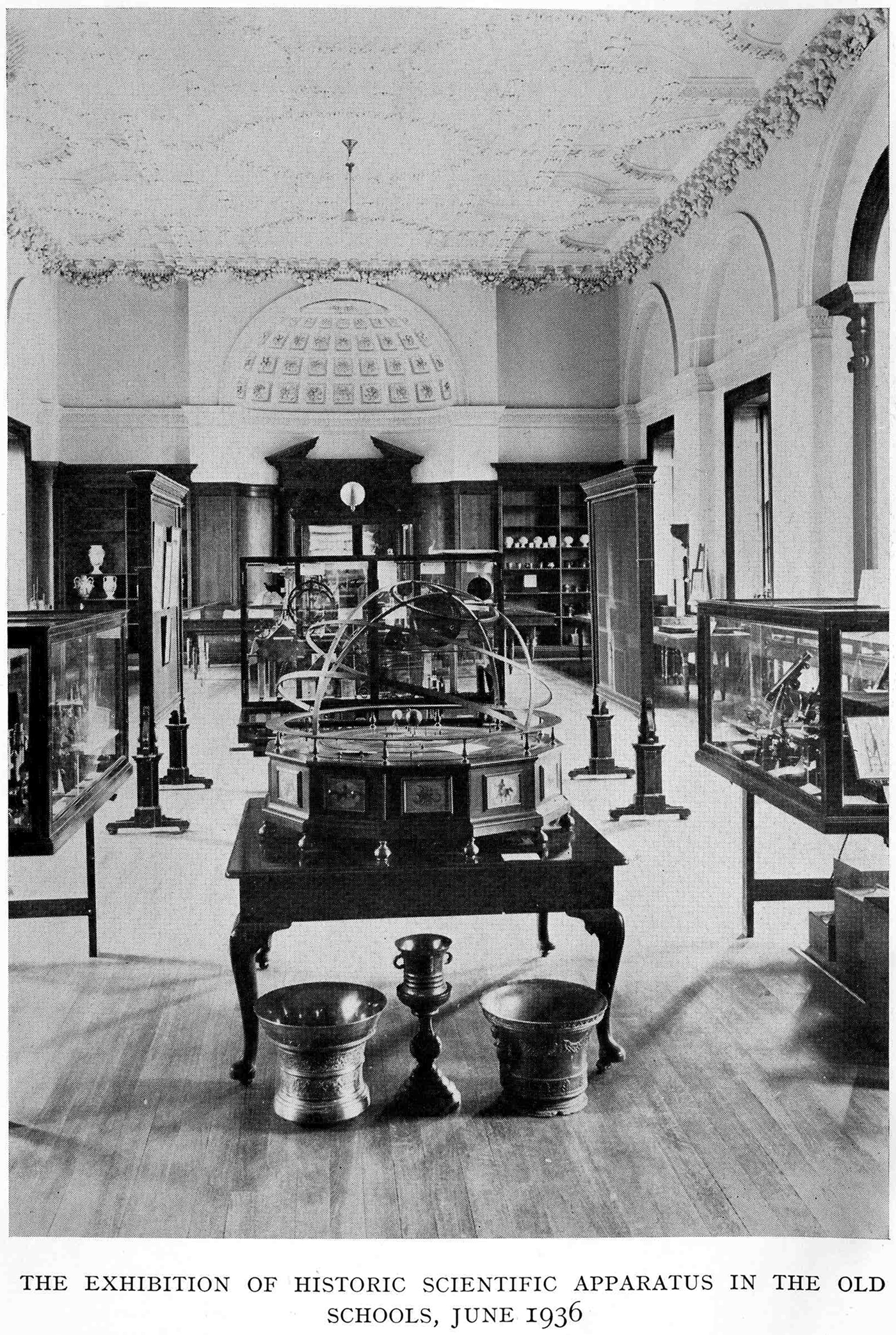
In 1936, under the sponsorship of the Cambridge Philosophical Society, an exhibition of ‘Historic Scientific Apparatus’ was held in the university's ancient administrative buildings, known as the ‘Old Schools’. Around two hundred artefacts illustrative of the history of science were on show – from astrolabes to zoetropes – dating from the thirteenth century to the 1920s (Figure 1).Footnote 30 These instruments, models, manuscripts and images had been gathered up from Cambridge's myriad institutions – its colleges, laboratories, museums – as well as from individual collectors and a handful of other sources. The exhibition had been instigated and largely organized by the historian Robert Gunther, forming a natural counterpart to similar labours at the University of Oxford.Footnote 31
‘The Exhibition of Historic Scientific Apparatus’ held in the Old Schools of the University of Cambridge, 8–23 June 1936. In the foreground can be seen the ‘Grand Orrery’ which now forms the centrepiece of the Main Gallery of the Whipple Museum of the History of Science, University of Cambridge, inv. no Wh.1275. Weights and measures (foreground), pharmacy jars (background, left), and microscopes (display case, near right-hand side) can also be seen. More astronomical instruments are just visible in the display case behind the Grand Orrery. Frontispiece to Robert T. Gunther, Early Science in Cambridge, Oxford: Printed for the author at the University Press, 1937.
The 1936 Cambridge Old Schools exhibition was an important moment in the institutional trajectory of history of science in the United Kingdom.Footnote 32 It formed a natural counterpart to the first series of lectures in the history of science at the university,Footnote 33 and it was the spur for Robert Stewart Whipple's 1944 donation of two thousand historic instruments and books, which marks the origin of the Whipple Museum of the History of Science, from which Cambridge's Department of History and Philosophy of Science developed.Footnote 34 In this sense, 1936 was a conciliatory and creative moment: the point of origin of a whole tradition of historical reflection and material preservation. Indeed, the book that was quickly produced after the exhibition – Early Science in Cambridge – remains a crucial guide to the relics of a pioneering age of scientific research.Footnote 35
But another aspect of the exhibition has passed unnoticed: the evidence it provides of the historical consciousness of the Cambridge laboratories themselves. In addition to the treasures of the Cambridge colleges, Gunther and his Cambridge collaborators had managed to find a surprisingly rich seam of historically important apparatus in the many laboratories that occupied Cambridge's two central scientific sites: the New Museums Site and the Downing Site (Figure 2).
The New Museums Site (north) and Downing Site (south), at the time of the 1936 exhibition. From John Willis Clark, A Concise Guide to the Town and University of Cambridge, Cambridge: Bowes & Bowes, 1936, opposite p. 136. The Cavendish Laboratory is marked in bold; the double line indicates the original (1874) building.
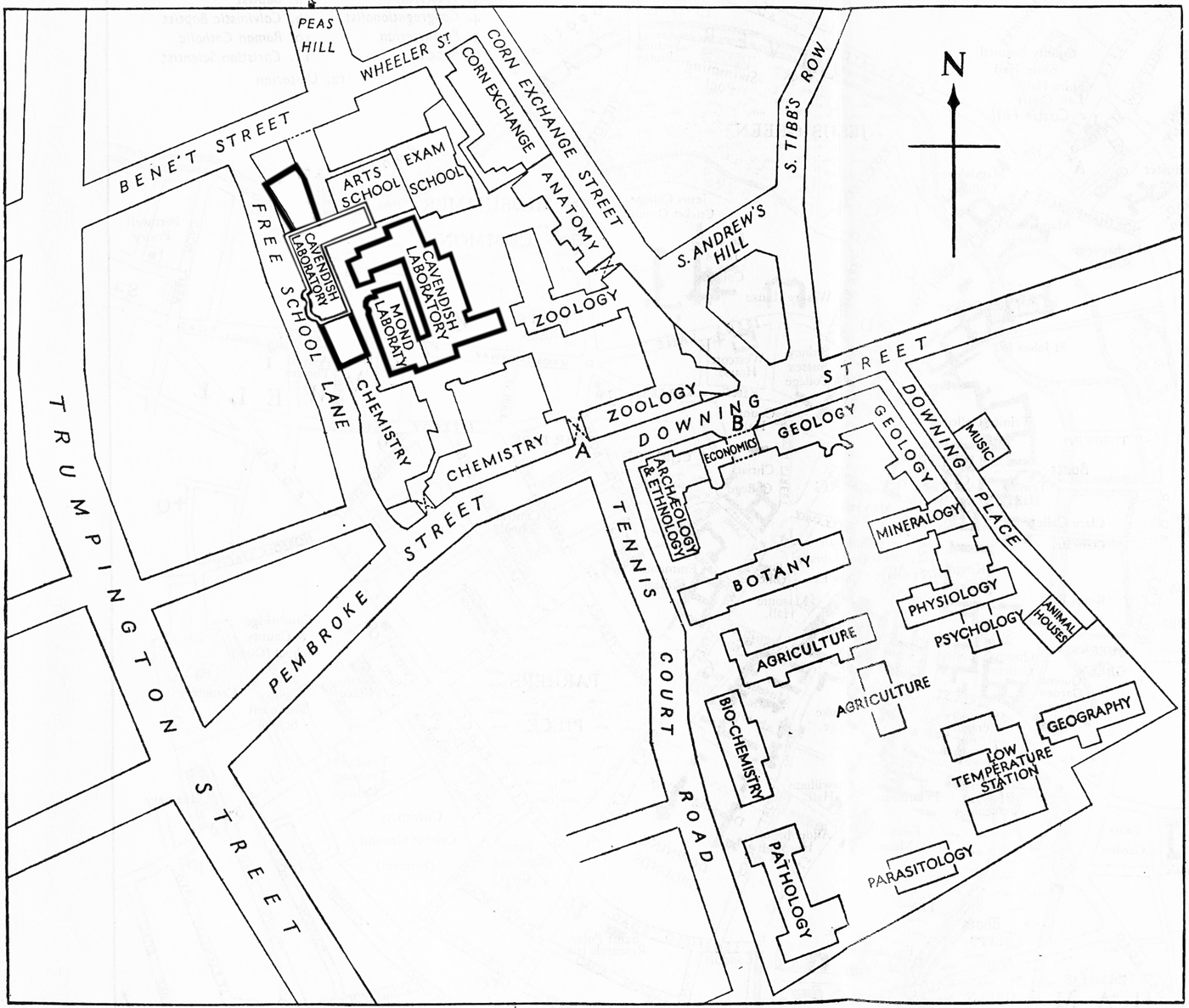
The New Museums Site was the first large-scale space used by the university for scientific lectures, collections and laboratories; the main suite of museums was opened in 1865. The Cavendish Laboratory (experimental physics) joined the museums just under a decade later, and more laboratories were built on the site well into the twentieth century. By the time of Gunther's exhibition in 1936 the laboratories threatened to engulf the original museums, and a new site had been opened across the road, to the south, called the ‘Downing Site’.
The story of these two sites is superficially one of the unimpeded triumph of the one kind of scientific space over another, of the relentless ‘rise of the laboratory’ over the demise of the museum.Footnote 36 Yet Gunther's findings suggest an alternative history, in which acts of collection, curation and display coexisted with the experimental sciences. To these complex scientific locales Gunther brought his tireless energy for hunting through cupboards and finding hidden treasures. The exhibition was in fact only one part in a long process of what Gunther called ‘archaeological’ research into the material relics of science.Footnote 37 By far his most ambitious project was a materially focused survey of the history of science at the University of Oxford. The first volume of this collection of documents and other sources appeared in 1920 with the title Early Science in Oxford, and by the time of the 1936 exhibition in Cambridge Gunther had reached volume ten (of an eventual fourteen). A 1919 exhibition of Oxford's early scientific apparatus had also contributed to the founding of the Museum of the History of Science in 1924.Footnote 38
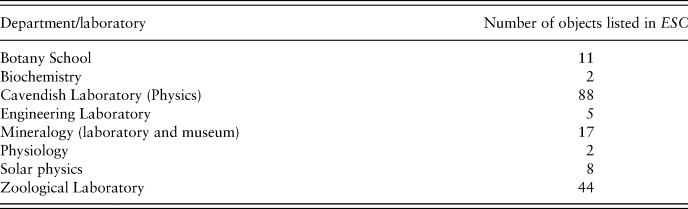
Hence, when in 1934 he wrote to the Cambridge Philosophical Society, it was already with the intention of replicating that achievement, and with the underlying aim of the salvage and preservation of early instruments.Footnote 39 The society's quick and enthusiastic response set in motion a series of surveys of Cambridge's labs and colleges. Gunther himself carried out a number of these research trips, and was assisted by a number of Cambridge scientists, including the botanist Hugh Hamshaw Thomas, physicist J.D. Cockcroft, mineralogist Arthur Hutchinson and astrophysicists F.J.M. Stratton and H.F. Newall. Between them this group identified the two hundred or so objects initially catalogued for the exhibition, along with well over a hundred further items of historic interest.Footnote 40 The volume Early Science in Cambridge (ESC) contains the most comprehensive list of instruments put together by Gunther, extending to some 336 entries, in addition to other artefacts mentioned in passing in the text. Of these, more than half were preserved in Cambridge's laboratories. A breakdown by department of the number of objects can be seen in Table 1.
Distribution of objects at the 1936 exhibition.
Before turning to the objects themselves, it is important to note that the sense of history in new laboratories could be present in a number of ways not specifically tied to objects. For example, on the south-west corner of the Chemical Laboratory, built on the New Museums Site, 1885–1889, was placed a carved plaque showing the family crests of Francis Bacon (1561–1626), Isaac Newton (1642–1727[NS]), William Hyde Wollaston (1766–1828), and J.F.W. Herschel (1792–1871), thus offering a gentlemanly and Cambridge-centric history of science. The Department of Biochemistry – in 1936 still a new discipline, and featuring only two objects in ESC – also had a keen sense of its past, albeit a more cosmopolitan one. Its monumental laboratory, built in 1924, contained within its library four wood carvings illustrating the unification of biology and chemistry in the personages of John Mayow (1641–1679), Thomas Graham (1805–1869), Justus Liebig (1803–1873) and Louis Pasteur (1822–1895). These were chosen by the laboratory's director, Frederick Gowland Hopkins, an ‘evangelist’ for the synthetic discipline of biochemistry who carefully used history in the construction of his ‘modernist’ stance.Footnote 41 Another striking instance is Parasitology – another synthetic and even avant-garde discipline in interwar Cambridge. Here, again, the historical sensibility was iconographic: the director of Parasitology was G.H.F. Nuttall, and by the time of the lab's opening in 1922 he had amassed some three hundred portraits ‘of those who have distinguished themselves in the domain of parasitology’. These were ‘mostly framed and hung chiefly in the well-lit corridors, the grouping being by nations and as far as possible by subjects’.Footnote 42 This is an indication that even new and forward-looking institutions could be visibly tied to the past.Footnote 43
There are, however, differences between this kind of iconographic historical sensibility and the collection of apparatus and the acquisition of old instruments. The most obvious point to make is that with portraits and other iconographic representations it is possible to select forefathers from all of history, but the materials found within a laboratory – or even those that can be acquired from outside – will tend to be unmistakably local, purely random or even insignificant. Turning to Table 1, and Gunther's 1936 exhibition, the pattern that emerges from the instruments that had been preserved in Cambridge's laboratories is of a predominance of objects commemorating some important figure or achievement in the history of the laboratory, and (often related to these) objects consolidating a style of instrumental work through the history of developments in a particular piece of apparatus.
The first category – objects of commemoration – is perhaps the least surprising and most numerous. The Victorian period is well known for the interconnection of its practices of commemoration and material accumulation; the culture of souvenir collecting, based on a generalized ideal of the Grand Tour, is one instance of this.Footnote 44 An exemplary object in this category is Charles Darwin's large achromatic microscope (no 308 in ESC), held at the Botany School, where it had been deposited by Darwin's son Francis. As early as 1909 – the centenary of Darwin's birth – the Botany School had been prominent in the celebration of a scientist who in fact only had an institutional connection to Christ's College, Cambridge. Other famous scientists commemorated by the preservation of their instruments and artefacts included Samuel Pepys (objects at Magdelene College, no 107 in ESC), Isaac Newton (Trinity College, no 172 in ESC) and Adam Sedgwick (Sedgwick Memorial Museum [geology], p. 445 in ESC).
A special instance of commemoration is found in the Zoological Laboratory, which suffered a tragedy at the time of its opening, when Francis Maitland Balfour, the first Cambridge professor of comparative morphology, died in a mountaineering accident. Balfour, though now relatively little known in the history of biology, was, at the time of his death in 1882 at the age of thirty-one, considered a natural successor to Charles Darwin and a leader of the field of experimental embryology. As Helen Blackman has shown, Balfour's death caused a rupture not only in the institutional development of the Zoological Laboratory, but in the moral code of Victorian Cambridge.Footnote 45 In the Zoological Laboratory Balfour's life's work was illustrated by a collection of his microscopes that had been passed down by subsequent holders of the professorship of comparative morphology. At first these microscopes had been given to Balfour's successor, Adam Sedgwick, presumably owing to their utility; later the collection as added to, and by 1936 it is possible to reconstruct the development of his career through the microscope collection, from his studies as an undergraduate to his fieldwork at the Naples Zoological Station and his mature researches into the development of the vertebrae in sharks and rays.Footnote 46
In the comparison of Balfour to Darwin, the obsession with his interrupted career, and the material relics used to commemorate him, we can see some of the ways in which the new Cambridge School of Animal Morphology was consolidated and constructed within the wider scientific community.Footnote 47 The status of the microscope itself is by no means incidental to this process. This is dramatically illustrated in the following testimony from a Cambridge classicist, quoted at length owing to the way in which it ties a vision of science to a vision of gentlemanly conduct, spatially located and bound up with instrumental practice:
I shall never forget the day when I first saw Professor Balfour. I was being taken over the New Museums by a Science friend, and I was feeling very gloomy, for I was thinking to myself, ‘After all, these new and ugly buildings are not Cambridge – not the old, true Cambridge. They are but an overgrowth, an excrescence of the real place.’ At last we came to Balfour's laboratory, and there the Master was pointed out to me bending over a microscope, and surrounded by his pupils … And as I saw those men listening to his words, and working by his side, I felt that they had realised, as few men in Cambridge ever do, the true ideal of University life.Footnote 48
Here the sense of charisma and inspiration is combined easily with the pre-eminence of the microscope as a symbol of disinterested investigation – the typical scientific portrait of the time is of a scientist who has turned away from their work at the microscope and is now looking to the camera.Footnote 49 Balfour's microscopes could stand in for the Zoological Laboratory's lost founding father.
The feature that emerges most clearly from the case of Balfour is the image of disinterested inquiry, with the microscope as its symbol. This is the key to the cultivation of the self-image of the scientist in this period, and is present in the other significant class of historical objects used in the construction of institutional identity: instruments that came to be identified with the research style of a particular lab. Of these, the most distinctive subset are prototypes of instruments that were to go into commercial production. These constituted a large proportion of instruments contributed to the 1936 exhibition by the biological departments. Zoology again provides a good example: the department had played an important role in the development of the microtome, a device permitting regular thin sections to be cut for microscopic work that simultaneously became a standard laboratory tool and permitted standard microscope preparations to be made. The best-known of these was the ‘Caldwell–Threlfall microtome’, which allowed ‘ribbon sections’ to be cut by a repeated action of the blade.Footnote 50 This device had been invented by W.H. Caldwell and Richard Threlfall in 1882, and was a precursor of the commercially successful ‘rocking microtome’ also developed in Cambridge, by Horace Darwin, in 1885.Footnote 51 The status of these academic–commercial collaborations in Cambridge and elsewhere in the late nineteenth century is a large and under-studied subject: there was striking crossover into industry, in particular in the formation of the Cambridge Scientific Instrument Company, which profited from its close connection with Cambridge's laboratories.Footnote 52 The preservation in the Zoological Laboratory of the prototype Caldwell–Threlfall microtome represents the university side of the equation, which involved a careful rhetoric of scientific purity, even as devices were exported around the world, solidifying Cambridge's reputation through commercial means. Richard Threlfall made the case for purity later:
I am sometimes asked why I did not patent the machine. The answer is that, as it was a machine for the furtherance of scientific research and had no commercial application, both Caldwell and I considered that to take out a patent would have been as improper as it would be for a physician to patent a medical discovery.Footnote 53
In addition to the self-effacing tone struck by Threlfall, his account consolidates the collegial self-fashioning of Cambridge science in this period, again with an emphasis on spatial relations. It was the proximity of the Engineering Department and the Zoological Laboratory that allowed Threlfall, a demonstrator in physics at the Cavendish, to improve upon Caldwell's initial designs and bring the new instrument to market. This culture of the sharing of skills, and collaboration over the small distances of the New Museums and Downing Sites, was successfully showcased in the display in 1936 of a wide array of instruments, many of which were commercialized by the Cambridge Scientific Instrument Company.
All of the trends examined here – iconography, commemoration and the preservation of specific instrumental lineages – were also present in the Cavendish Laboratory. But, as we have already seen, Maxwell's collecting went beyond these parochial celebratory themes. In the following section I offer an account of the underlying rationale of the Cavendish's early collections, before showing the ways in which these were subsequently undermined, to the point where, by 1936, only traces of the original impetus to collection remained.
James Clerk Maxwell: the modernist as antiquarian
As is clear from Table 1 above, the Cavendish Laboratory was a prodigious hoarder of old material. By the time of the 1936 exhibition the lab was under the direction of Ernest Rutherford, and was considered to be one of the pre-eminent centres of experimental physics in the world. Ever since the work of its third director, J.J. Thomson, the Cavendish had been famed for its investigations into atomic structure; its self-styled annus mirabilis had come in 1932, when the atom was split by artificial means by E.T.S. Walton and J.D. Cockcroft, and the neutron was discovered by James Chadwick.Footnote 54 By the end of the 1930s, these and other developments led to a situation in which new large-scale apparatus was required, putting ever more pressure on the Cavendish's limited space. This thought may well have been at the back of Rutherford's mind when he used the opening of the 1936 exhibition to call for the establishment of a permanent home for historical material associated with Cambridge research: his own lab ought to be filled with more urgently needed apparatus.Footnote 55 In this way 1936 was a pivotal moment, in which Maxwell's original idea, of a laboratory that was also a repository for historical material, was finally jettisoned.
We have already seen the enthusiasm with which Maxwell acquired antique scientific apparatus, but there were also practical and philosophical propositions involved in this collection. Maxwell was a Cambridge-trained mathematical physicist, who had spent the most productive years of his career at University College London.Footnote 56 Although he was effectively brought out of retirement to head the Cavendish, he was only forty-three years old at the time of its opening. In his preparations for the construction and opening of the laboratory Maxwell undertook three major tasks: the first was to clear the way administratively for the acceptance of this new and controversial institution; the second was to determine the correct layout of a physics laboratory; the third was to ensure that it would be fully stocked with equipment.Footnote 57
Above we saw that in just the second report on the activities of the laboratory, presented to the University Senate on 20 May 1876, Maxwell explained that a large collection of historical apparatus had been donated to the laboratory by H.W. Elphinstone, and that most of the collection had belonged to the physicist–chemist William Hyde Wollaston.Footnote 58 The ‘Wollaston Collection’, as it came to be known, contained around a hundred separate pieces of apparatus. Many of these were to be exhibited much later at the 1936 exhibition, and some are now held at the Whipple Museum of the History of Science. But in 1876 when they arrived at the Cavendish they constituted a large part of its total store of material. The list contains many intriguing entries, amongst them the revolutionary platinum press used by Wollaston; an example of the earliest form of slide rule, called the ‘circles of proportion’ (dating from c.1635); and a host of other miscellaneous instruments. The dominant themes of the collection are industrial chemistry and the history of precision calculation instruments.
One motivation for the acquisition might simply have been Maxwell's uncertainty over his ability to populate the new laboratory with apparatus. For this he had to do a number of things simultaneously: petition the laboratory's backer, the Duke of Devonshire, for funds; establish what kind of apparatus he would need; source the equipment from instrument-makers; and, ultimately, set up a flexible system in which instruments could be made in the lab, and exchanged with other institutions at home and abroad.Footnote 59 A collection like the one donated by Elphinstone could be immensely valuable for the resolutely ahistorical process of ‘cannibalization’, in which parts of instruments were utilized, recombined and built into demonstration or experimental set-ups.Footnote 60 Hence, looking more carefully at Maxwell's phrasing when he reported the donation, we can see that while ‘most’ pieces in the collection had belonged to Wollaston, and ‘many’ were ‘of historical interest’, some clearly fell into neither category. Prisms, micrometers, balances, thermometers and tripods could be used by students in the lab (though the item listed as ‘Locked box without key’ was perhaps not so useful).Footnote 61 But utility can only take us so far in understanding the acquisition of the Wollaston material. Clearly the association with Wollaston himself was central to its identity. This much was made clear when, almost immediately upon its deposit in the Cavendish, a number of pieces were sent to the 1876 Special Loan Exhibition in South Kensington, which exhibited contemporary instruments as well as ‘objects of historic interest from museums and private cabinets, where they are treasured as sacred relics’.Footnote 62 This was a demonstrably ‘historical’ collection, and in order to understand its precise historical meaning for Maxwell and his contemporaries it is necessary to understand the kind of space it inhabited, namely a new physical laboratory built on a site populated with a range of museums.
When Maxwell came to Cambridge to take up the post as head of the Cavendish the dominant method for scientific teaching and research was the systematic collection of objects arranged for public display.Footnote 63 Moreover, this was in no way limited to natural history, but extended to the physical sciences. Scientific collections and museums at Cambridge pre-dated the formal examination structure (the Natural Sciences Tripos) that was introduced in 1851.Footnote 64 Reform of teaching and the material provision of the sciences was to follow the 1852 Royal Commission report on ‘the state, discipline and revenues of the University of Cambridge’, singling out the lack of space for science as a major hindrance to the growth and role in national affairs of the university. Its recommendation, however, was that,
Besides museums containing collections of natural objects, or of such objects prepared for exhibition, and in addition to the apparatus provided for the material illustration of physical subjects in the way of experiments performed before a class, something further is requisite to enable the Student in his hours of private study to digest and utilize the knowledge he has gained at lectures and in reading. Nothing can be suggested having more immediate tendency in this direction than that he should have access [to] a museum of … instruments, in which their construction may be contemplated and studied, and their peculiar contrivances and adaptations examined at leisure …Footnote 65
Nor was this at odds with the ideals of teaching at the time. In 1853 Robert Willis, Jacksonian Professor of Natural Philosophy, drew up a lengthy report on the nature of the projected scientific buildings. First he outlined what a scientific professor required his room for: demonstration and explanation through specimens, apparatus and drawings. He then described the nature of scientific buildings required for Cambridge:
A suite of Rooms, for the formation of a collection of Philosophical apparatus, should be provided to receive models, machinery, and apparatus of all kinds … The University at present possesses no apparatus for physical or mechanical science, with the exception of that employed at the Observatory. In the Natural Sciences, collections have been formed and have become the property of the University, either by private gift or by purchase; and the University has from time to time erected Museums for the reception and display of such Collections, without which its members necessarily lose the advantages of studying them.Footnote 66
Willis had powerful allies in his quest to extend the museological paradigm. As late as 1871 the physicist George Gabriel Stokes could write to the newly appointed Maxwell to inform him that ‘the principal duty of the new professor in the first instance will be to give his advice as to the construction of the proposed physical laboratory and museum’.Footnote 67
The dynamic relationship between the laboratory and the museum was precisely the inverse of our modern notion of these two spaces. By the middle of the nineteenth century the museum was not just in the ascendency – it was the ideal type of scientific spatial organization.Footnote 68 The museum was modernity: representing imperial expansion, metropolitan science and disciplinary division. As Simon Schaffer has argued, in the absence of preconceived notions of what a laboratory was for, its promoters turned to the ‘invention of tradition’ to secure themselves against criticism or censure.Footnote 69
In Cambridge this relationship was quite explicit: Robert Willis's designs for the ‘new museums’ were nothing if not new. In fact, in a tradition-bound university like Cambridge they were so radical that the scheme nearly didn't come off, a main line of argument against the museums being that they lacked ornament and were unduly functional.Footnote 70 Unlike the museums, which were placed at the centre of the site, with no relation to its history, the Cavendish specifically preserved its spatial lineage: built on the site of a medieval friary, the laboratory preserved a Tudor doorway as the internal entrance.Footnote 71 Having passed through heavy, gospel-inscribed wooden doors, under the statue of the Duke of Devonshire, this was the point of ingress.
Building on foundations of tradition, then, the Cavendish would reject the museum ideal, but only partially. Again, this can only be understood in terms of spatial arrangement. In planning the work of the laboratory, Maxwell conceived of an ascending scale: ‘popular lectures and rough experiments for the masses; real experiments for real students; and laborious experiments for first-rate men’.Footnote 72 In terms of laboratory layout, this required a large lecture room, an elementary laboratory and separate research rooms; in terms of equipment, it required demonstration apparatus, plenty of basic instruments and parts and the facilities for making and adapting more advanced pieces of research apparatus. It also entailed a small but profound shift in the spatial arrangement of scientific space. Maxwell changed the arrangement of rooms from the museum ideal of knowledge arranged systematically to the laboratory ideal of experiments arranged functionally:
We shall … arrange our lectures according to the classification of the principal natural phenomena, such as heat, electricity, magnetism, and so on … In the laboratory, on the other hand, the place of the different instruments will be determined by a classification according to methods, such as weighing and measuring, observations of time, optical and electrical methods of observation, and so on.Footnote 73
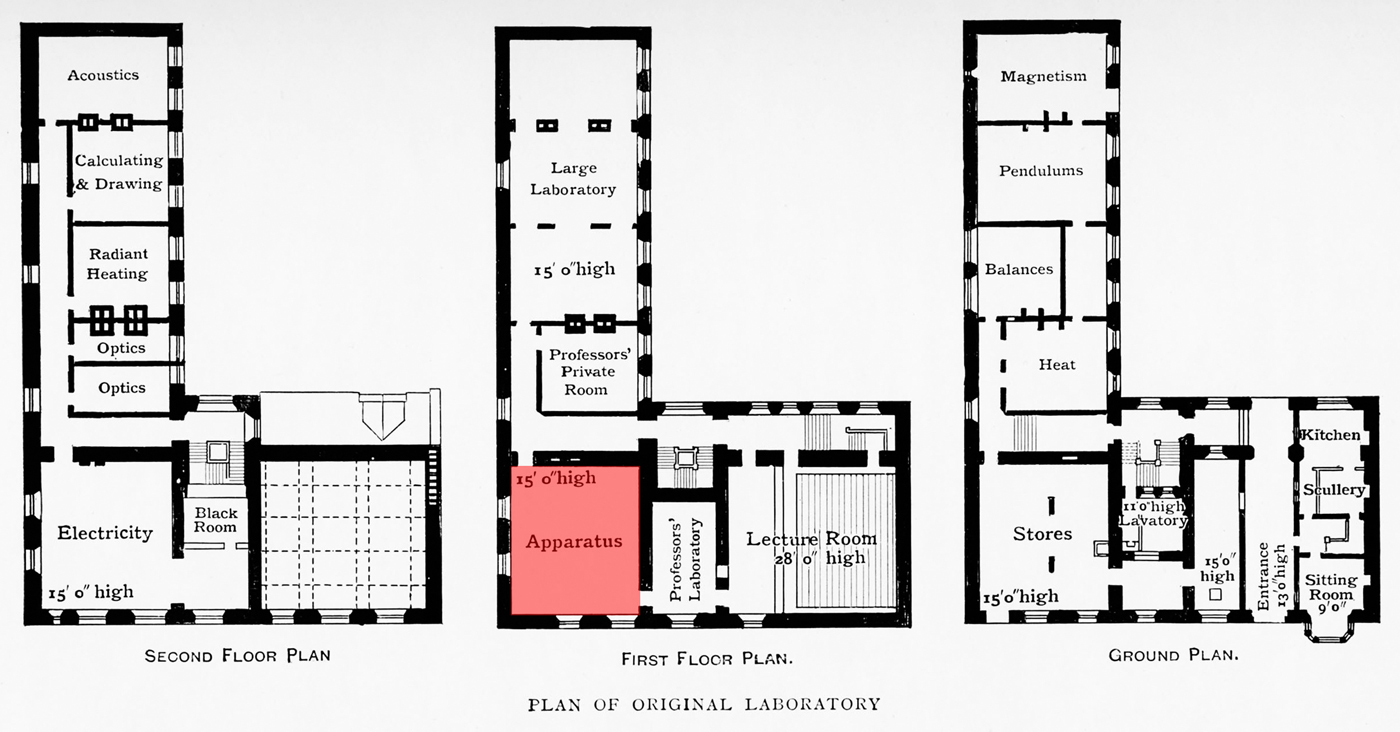
So this was the particular kind of novelty involved in the Cavendish: the museum was repudiated by the arrangement of rooms by function rather than disciplinary subdivision.Footnote 74 Yet the museum remained, through the idea of a store of apparatus systematically illustrating the subject developmentally, and through the presence of historical objects (Figure 3). The relation of history to modernity was complex, however: we can read the space of the Cavendish as a purposefully antiquated aesthetic performance that was nevertheless revolutionary in its arrangement of rooms, and we can see in the systematic and historical lists of instruments that Maxwell produced a remnant of the museological paradigm that dominated the New Museums Site and had informed the planning of the new laboratory.
Floor plan of the Cavendish at the time of its opening in 1874, showing the arrangement of rooms by instrument type. The shaded room in the first-floor plan is the ‘Apparatus Room’, which contained a number of large display cabinets housing contemporary and antique instruments; some of these display cabinets are preserved at the present-day museum of the Cavendish Laboratory.
In addition to these spatial complexities of time and memory, there is also a technical sense in which material accumulated in the laboratory was ‘historical’. As early as 1871, when Maxwell was contemplating the equipment needed in his lab in discussion with William Thomson, it was clear that the British Association for the Advancement of Science would transfer the material held by their Standards committee.Footnote 75 In the first report on the activities of the Cavendish Laboratory, dated 27 April 1875, we find a listing of some thirteen ‘Instruments belonging to the Committee of the British Association on Electrical Standards, deposited in the Laboratory’.Footnote 76 Again the Cavendish here presents us with a strange mix of radical novelty and historicism. Standards of measurement are inherently historical insofar as they are arbitrary: metrology is a system in which the objects of measurement must be preserved so that the system can persist.Footnote 77
By the 1870s, when the Cavendish was opened, the debate over the historicity of standards had reached fever pitch, with Maxwell's contemporary Charles Piazzi Smyth taking the radical position that all standards had been communicated by God to the Israelites, who had instantiated this knowledge in the Pyramids of Giza.Footnote 78 Maxwell took an even more extreme historicist position, placing the origins of standards not in ancient Egypt but at the beginning of Creation, with the God-given establishment of ‘molecular dimension’. As Maxwell put it, ‘the foundation stones of the material universe remain unbroken and unworn’.Footnote 79 This reduced (or perhaps amplified) the work of finding true standards to the work of the physics laboratory: a place of precision measurement and calculation.
In a more pragmatic sense metrology is always historical: new instruments can only be calibrated against older instruments – though older here might refer to the very recent past. The point is that the instruments that make standard measurements have to exist in sequence, to be related to one another in a series. Hence even highly pragmatic textbooks like the Cavendish's own Practical Physics (1885) turned to history in order to introduce modern standards, and Maxwell and Fleeming Jenkin supplied a historical preamble to their technical appendix to the 1873 British Association for the Advancement of Science report on electrical standards appointed.Footnote 80 This kind of attention to material survival shades into the history of metrology, in which Maxwell was intensely interested. This too relies on the material survival of instruments. In fact there is a very strong sense in which the history of metrology consists in the instruments themselves. To put it another way, at any given point, earlier work on standards can only have meaning if the apparatus used survives.
This explains the particular fervour of Maxwell's inquiries to P.G. Tait regarding the Florentine thermometer, quoted at the outset. The history of thermometry could only be understood if the material survived, and so the chance rediscovery in the 1820s of a group of the earliest thermometers provided a remarkable opportunity (Figure 4).
Florentine thermometer, c.1660. Whipple Museum of the History of Science, University of Cambridge, inv. no Wh.1116.

This is how Maxwell accounted for the instrument his 1871 textbook Theory of Heat:
the thermometer may be used to compare the temperature of any two bodies at the same time or at different times, so as to ascertain whether the temperature of one of them is higher or lower than that of the other … For this purpose it would be necessary to carry the same thermometer to different places, and to preserve it with great care, for if it were destroyed and a new one made, we should have no certainty that the same temperature is indicated by the same reading in the two thermometers. Thus the observations of temperature recorded during sixteen years by Rinieri at Florence lost their scientific value after the suppression of the Accademia del Cimento and the supposed destruction of the therm2ometers with which the observations were made.Footnote 81
By acquiring one of the thermometers Maxwell was restoring the ‘scientific’ value of earlier observations, and bridging the gap between his own lab's research and that of the very first generation to make systematic measurements of temperature. This is the most precise sense in which historical apparatus retained meaning in the Cavendish. Maxwell's was a technical collection – of the history of precision measurement and standardization – and it was also a personal collection, full of his own earlier models and contraptions, and closely related to his historical researches into the electrical measurements made by Henry Cavendish in the eighteenth century.Footnote 82 Within the collection, and in the way it related to other instruments in the laboratory, there is continuity with both the syllabus and research culture: while antique standards could be used in explaining the historically situated nature of all standards, models and other pieces of demonstration apparatus could be used in elementary lectures, and as provocations to further research. It is one of the characteristic features of Maxwell's work that simple model making was connected to some of the most advanced questions in Victorian physics.Footnote 83
Physical questions were, for Maxwell, also typically questions of perception. In a late essay entitled ‘Psychophysik’ Maxwell asked whether there could be a true science of consciousness. His answer was that there could not – the Ego, he said, would always just fail to leave a material trace of itself. But, as a true skeptic, this led Maxwell to another kind of reflection, quoted in my epigraph, on just how much of human experience could be recorded and memorialized.Footnote 84
The soul does not survive, Maxwell argued, but the self is an acting thing that leaves traces. This, too, was manifest in the lab in its physical collections. The instrument he used to illustrate this was an Edison phonograph, and he described the way it recorded and preserved the human voice, relating this to the body as a ‘recording’ device for the soul. For Maxwell, single objects could be used as provocations to philosophical, anti-materialist inquiry, in the manner of the older pairing of natural philosophy and natural theology. Continuity with modern physics was provided by the teleological history of precision measurement, which brought natural phenomena under the control and standardization of the experimenter. But Maxwell remained circumspect about the place of the soul in relation to natural inquiry: all phenomena were manifest as traces that could be compared and measured, but the soul itself transcended physical inquiry. The history of measurement was therefore connected to the culture of memorialization: both were physically manifest in objects, and science could not go beyond these material traces. ‘Molecular dimension’ itself could only be registered while the atoms remained unknowable; standards could only be compared; the soul could only leave traces.Footnote 85 Just as Maxwell built the Cavendish laboratory in the image of his country home at Glenlair, so it was only proper that the Cavendish should be fitted out with objects of antiquarian interest. Yet antiquarianism, as many scholars have argued, was not only a gentlemanly pursuit but also a revolutionary activity: the use of the past in the creation of the future.Footnote 86 It was in this sense that Maxwell's antiquarianism was part of his novel conception of the nature and role of physics as a subject of study.
After the opening of the Cavendish, however, Maxwell's own future was curtailed, and he did not have time to ‘set up monuments’ to his own achievements before his death, in 1879, at the age of forty-eight. The immediate task, for those who were closest to Maxwell, and who shared his scientific and institutional ideals, was to finish the job he had started; that is, to complete the programme of establishing electrical standards. This was achieved under the directorship of Lord Rayleigh, whose own instruments were to become legendary within the laboratory and are preserved to this day.Footnote 87 Memorialization of Maxwell himself came quickly and in monumental form, when in 1882 two of his former students edited The Life of James Clerk Maxwell, and more subtly but materially through the display of Maxwell's teaching models and consolidation of the historical collections. Already, however, changes were afoot in the self-conception of the laboratory, and here again Maxwell's memory was to play a central role.
By the beginning of the twentieth century the Cavendish was entering its so-called ‘golden age’.Footnote 88 Specifically, the electrical-standards programme had been supplanted by a series of experimental researches instigated by J.J. Thomson, whose own speciality was the study of electrical discharges through gases, culminating in his discovery of the first subatomic particle, the electron. This important development in the transformation of the Cavendish was also, in part, articulated through the collection and display of material, in particular the combination of ‘evolutionary’ displays of apparatus and the practice of keeping relics of great experiments. By the time of the first historical account of the Cavendish Laboratory, in 1910, we can see the consolidation of the lab's sense of itself at work in a number of ways – some of which went specifically against the grain of Maxwell's own approach. For one thing, the history of the laboratory was now commemorative in one specific respect: it was not to be a history of ‘what work was done, but of how that work came to be done’. Authors contributing to the volume were asked to demonstrate ‘the evolution of the ideas which have inspired physical teaching and research in Cambridge, and the part played in that evolution by the many eminent men who have worked in the Laboratory’.Footnote 89 This was in part in order to make the volume appealing to the general public. But it also served to separate out the key terms of the development of the lab: its underlying ethos, the role of ‘eminent men’ and the evolution of ideas.
In terms of the first of these, Maxwell could now play his role as founding father: his fundamental contribution had been the determination of the nature of the space of the laboratory, as a communal home for experimental science, in contrast to the isolated experiments that had gone on before him. Maxwell had not sought to perpetuate a research programme based on his own discoveries, according to the History, but had rather laid the groundwork for others to ‘follow his own path’; that is, to learn to experiment and think like him, rather than with or against his ideas.Footnote 90
The subtle transformation of Maxwell's founding genius was also effected later in the book through a transformation of the material that he had begun to collect in the 1870s. Chapter 8 of the 1910 History was written by Norman Campbell, a researcher at the Cavendish working primarily on radioactivity. By the time of the History Campbell was already a tyro within the physics community, having written a successful textbook, Modern Electrical Theory, which drew a sharp divide between the ‘old’ physics of mathematical analysis and the ‘new’ experimental physics of the Cavendish. In the History Campbell crossed the boundary between the two epochs with the help of an instrument, the electroscope, whose ‘evolution’ was depicted through a series of instruments going back to the early nineteenth century and culminating in the latest model invented in the Cavendish itself (Figure 5).
A display of electrometers, showing the development of the instrument, from T.C. Fitzpatrick et al., A History of the Cavendish Laboratory, 1871–1910, London: Longmans, Green, and Co., 1910, opposite p. 236.
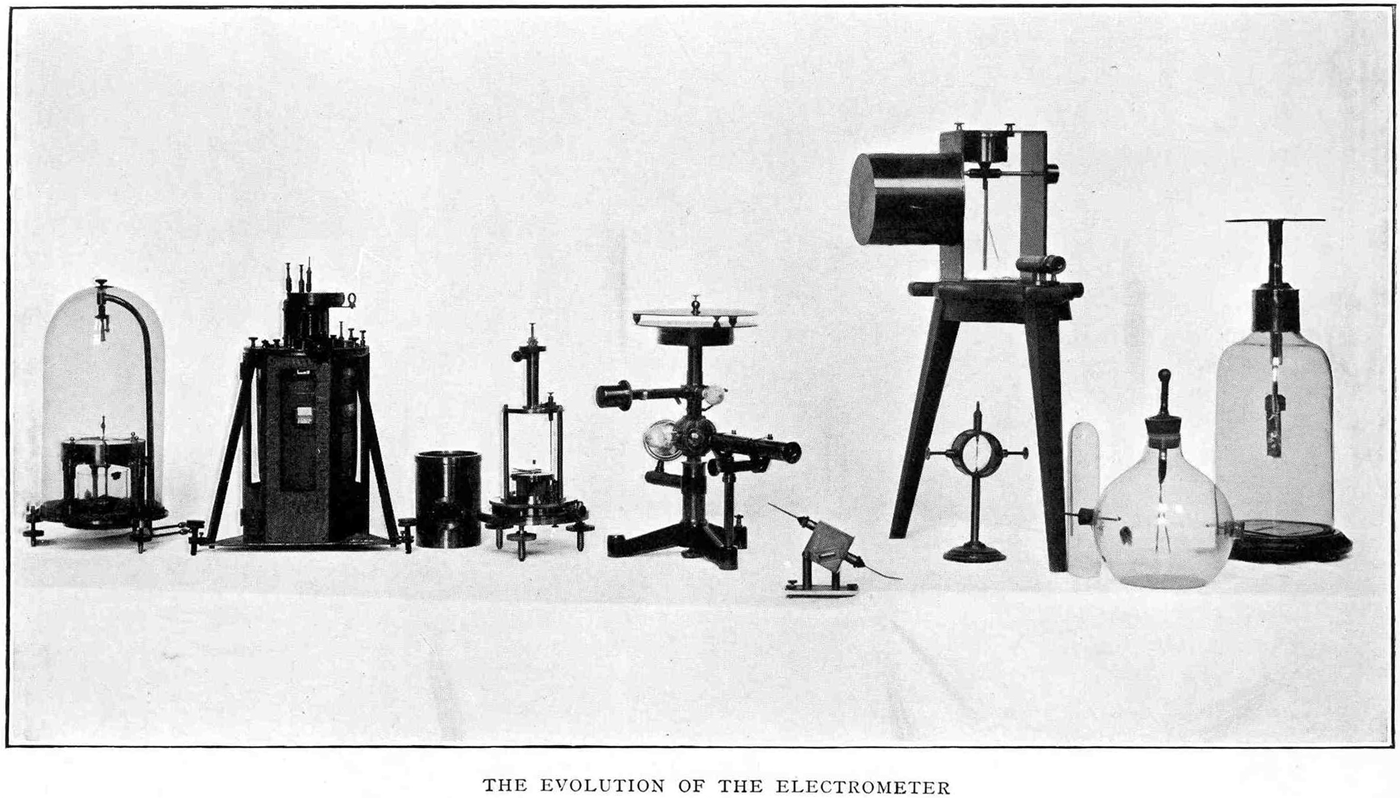
Much of Campbell's chapter is dedicated to charting the specifically novel experimental work in the Cavendish – on the ionization of gases and radioactive phenomena. So it might seem strange for him to illustrate the evolution of an instrument that pre-dated these researches. But in showing continuity, Campbell was here involved in another iteration of the invention of the Cavendish tradition – the bid to show, by material means, that the new programme was legitimate precisely insofar as it was in fact tied to an experimental legacy. This was as much a model for research within the Cavendish as it was a programme for the standardization of laboratory practice elsewhere. Throughout the late nineteenth century the Cavendish worked closely with the Cambridge Scientific Instrument Company to develop standard lab apparatus. This coincided with the self-conscious construction of a laboratory-wide culture of making do with ‘string and sealing wax’.Footnote 91 It was precisely because the Cavendish had made itself independent of outside instrument-makers that it could promote designs based on its own prototypes with an outside instrument-maker (albeit one with close professional ties to the laboratory). Nowhere is this better summarized than in C.V. Boys's lecture on drawing fine quartz threads, which he concludes with the following exhortation:
And now in conclusion, I would only say that if there is anything that is good in the experiments to which I have this evening directed your attention, experiments conducted largely with sticks and string and straw and sealing-wax, I may perhaps be pardoned if I express my conviction that in these days we are too apt to depart from the simple ways of our fathers, and instead of following them, to fall down and worship the brazen image which the instrument-maker hath set up.Footnote 92
But it was Boys himself who was central to the relationship between the Cavendish and the Cambridge Scientific Instrument Company, in particular through the marketing of his radiomicrometer. Hence the preservation of early versions of instruments that had gone into commercial production was a double celebration of the independence of the laboratory: it was independent from outside influence (and from the fees of instrument-makers) and independent as the arbiter of the kinds of instrument that laboratories would need in order to conduct researches similar to those carried out in Cambridge.
Further iterations of the Cavendish's attitude to historical material occurred in the 1930s, when the lab used its history as a fundraising tool and simultaneously advocated for the founding of a separate history-of-science museum, and after the Second World War, when the Whipple Museum was founded and the Cavendish itself set up a permanent display dedicated to the successive eras of its achievements.Footnote 93 At each stage, the Cavendish fashioned its own image by preserving and discarding apparatus. Because of this iterative process it is rarely possible to say precisely when a piece of equipment or old instrument ‘became’ historical. As I argued at the outset, the relationship between objects, collections and historical memory is dynamic, and moments of historical awareness can just as easily be lost as conjured into existence.
As we have seen, very early in the life of the Cavendish, Maxwell acquired a large quantity of historical apparatus. Just as Maxwell looked forward to new developments in his fields, he also looked back to its history. His collection gestured to a relatively standard progressive historiography, to be sure, but it was also idiosyncratic in certain respects. It reached far beyond the confines of local or institutional history, it spoke to a certain materially bound concept of the history of physical standards, and it was a product of a Victorian interest in relics and memorials.Footnote 94 But Maxwell's vision – of a museum within the laboratory, and the marriage of historicity and modernity – was ultimately undone. His collection ended, though it did so in stages: first with his death in 1872, again with the changing needs of the laboratory at the turn of the twentieth century, and then in the middle of the twentieth century, when a museum for the history of science was proposed (1936) and eventually founded (1944–1951).Footnote 95 This gradual process involved the removal of Maxwell's personality from the Cavendish, so that it could be replaced with his persona: the antiquarian philosopher of physics and its history was replaced by a noble founder, a discoverer, a modernist. To memorialize Maxwell, the Cavendish had to discard his museum. What Maxwell became in the eyes of his institutional descendants was as much a process of forgetting as it was of remembering.
Conclusions
As mentioned at the outset, history (or, perhaps better, ‘historicity’) within the experimental sciences is fragile and complex, and the meanings given to objects do not last unchanged. Historical understanding is hard to recover, was often temporary, and did not survive even if antique instruments remained. The Florentine thermometer so beloved of Maxwell was forgotten after his death, re-found by Gunther in preparation for his 1936 exhibition, forgotten again when the Cavendish set up a permanent museum display in the 1950s, and only finally found in the 1970s, when the Cavendish moved to a new location and the thermometer was transferred to the Whipple Museum of the History of Science, where it lives to this day.Footnote 96 Many other objects in the Whipple Museum and other scientific collections have similar histories, though issues of scale mean that it is all but impossible to work backwards from a present collection to more than just a few of the previous collections it masks.
Underlying this instability, however, are two main historical trends: the growth of the institutional history of science and the increased professionalization of the laboratory.Footnote 97 The former resulted in much material being transferred to museums, and expertise gradually shifting from scientists to historians; the latter demanded that collections within labs be closely focused on celebrating heroic figures or experiments, or consolidating instrumental practices and styles of research.Footnote 98 These kinds of historical practice were determined by shifting concepts of space, and were particularly prominent at moments of change, with all of the economic consequences of the growth of the laboratory sciences in the late nineteenth and early twentieth centuries.
It remains to situate this study in relation to the historiography of the laboratory and museum, and the study of scientists’ conceptions of history. Lorraine Daston has given a brief spatial analysis of the latter in her paper ‘The sciences of the archive’. For Daston, the site of memory in the laboratory is the library.Footnote 99 One of Daston's case studies is the new (as of 1974) Cavendish Laboratory building, which was designed with a prominent and central library space. But thinking of history as primarily ‘bookish’ means that the laboratory's memory is necessarily spatially separate from its practical functions. Here I have argued that history and memory can be found scattered throughout the laboratory space, and that under pressure these senses of time deepen and become more visible. The key point is that collections of historical apparatus often overlapped with other kinds of ‘collections’: the array of experimental apparatus carefully curated by the lab technician or demonstrator, the jumble of apparatus kept for training or hoarded for parts, the systematic collection of training materials used in elementary instruction, the unsystematic collection of old apparatus used for the same purpose. This is distinct from, but related to, the kind of history that persists in the experimental sciences, according to Daston, namely that embodied in stockpiles of data, specimens, observations from the past and so on.Footnote 100 The laboratory, in all these activities, is a space of accumulation, and of competing temporalities.
Finally, the question that looms over all discussions of the laboratory has to do with their special status as ‘spaces apart’. Graeme Gooday has pointed out that the laboratory has enjoyed mixed historiographic fortunes in the last couple of decades.Footnote 101 Histories of its ‘rise’ were first undermined in a way that redoubled its authority: i.e. micro-histories and sociological studies of ‘laboratory life’ were premised on the authority and separateness of the lab's spaces and systems of authorization. More recently, Gooday argues, the lab has come to be seen as, if anything, too special, and historical interest has turned to the museum, to the field, to discourse and popularization, to ‘knowledge in transit’ and so on. Gooday's response to this is that we preserve the lab while de-essentializing it, by looking at non-canonical laboratories, experiments in other spaces, and laboratories as just one part in the network of scientific credit and meaning-making. Laboratories, for Gooday, are ‘interstitial entities, drawing their value and meaning from the people and institutions with which they were juxtaposed, opposed, and integrally networked’.Footnote 102 My proposal is that by studying historical practice in the late nineteenth- and early twentieth-century laboratory – as a practice not fully distinct from concepts of antiquarianism, memory and memorialization – we can see just such ‘integral networks’ that bind the laboratory to society. These are networks of affect, commerce and authority: the museum in the lab is the space where a form of sociable materiality can coexist with, augment and contrast with a form of (supposedly) asocial materiality. Typically this juxtaposition is interrogated from the outside in, as it were, from society to the laboratory – but my contention is that the inside of the laboratory was from the beginning already in dialogue with the exterior, though this exterior might just as well lie in the past or future as in the present.


 Open access

