

Thomas Lea Southgate, writing in 1889 on music in English universities since the medieval period, bemoaned the separation of scholarship and art and the resulting lack of real musical training:
The study became scholastic rather than practical. A pedantic acquaintance with the mathematical side of the art was hardly calculated to infuse life into the dry rules, a knowledge of which was quite sufficient to enable a scholar to pose as a musician, and indeed to advance a claim for a degree in the art. Discourses and ‘exercises’ were regarded as of far more importance than the possession of technical skill, and so music, as we now understand the comprehensive appellation, met with little encouragement at the Universities […] Perhaps it is to this stiff scholasticism and artificiality we must ascribe the failure of the Universities to have founded a true English school of music.Footnote 1
Southgate echoes many contemporary writers in his concern about the poor state of English music and the lack of leading composers or an authentic ‘English’ style.Footnote 2 He considers the types of music produced and valued by the universities as part of the problem, being far removed from the popular and successful styles and genres which dominated both opera and orchestral repertoires. Instead, universities drew on the more functional and Anglo-centric traditions of the church anthem, cantata, and oratorio. Here, there was plenty of opportunity for professional success in performing and composition. Although many considered oratorio to be ‘the noblest of all musical genres’, it offered less scope for the stylistic freedom widely considered necessary for development of an English ‘school’.Footnote 3 In his criticism of the conservative, academic style, Southgate touches on many tensions of the period around musical style, status, genre, professional structures, and professional identities. The type of music he described was the musical exercise, a body of musical composition which has received little scholarly attention but rewards detailed study in both analytical and philosophical dimensions.
The musical exercise was a unique form of composition produced for university accreditation in Britain from the sixteenth to the twentieth centuries. In earlier and later times it mirrored widespread compositional trends, but in the nineteenth century it encapsulated an idiosyncratic and often archaic musical style similar to much liturgical music and far removed from popular secular composition.Footnote 4 Exercises took the form of an oratorio, cantata, or other sacred piece, such as a Mass setting. As Susan Wollenberg has noted, this ‘subculture […] clearly manifested its own rituals, common conventions and codes of practice’.Footnote 5 Studying English compositional exercises — in this case drawn from the extensive collection in the University of Oxford archives — helps add nuance to our discourse around Victorian music by exposing the types of music that were valued by the academic establishment, the traditions in which composers were trained, and the skills they were expected to exhibit.Footnote 6 It also raises broader philosophical, musical, and historical questions about value and the traditions of musicological practice. Like an embroidery sampler, the exercises were produced in order to demonstrate skills and craftsmanship, while also giving consideration to overall artistry; the two forms offer similar challenges around evaluation and status as works of art. The style and aesthetic values of the exercise also reflected contemporary priorities in Anglican music. As William J. Gatens notes, Christian art is ‘inherently conservative’, and the peculiar mix of Romantic harmonic and melodic language within archaic forms and structures that is characteristic of Victorian church music reflected the desire to create music that at once reflected reason, morality, and emotion.Footnote 7
The exercises have received prior consideration in the context of musical life in Oxford and the history of music as an academic subject.Footnote 8 Here, however, in addition to giving them more detailed musical attention, I use them as a lens for considering anew issues of value and purpose within historical-musicological study, drawing on both contemporary debates and musical examples to examine the tensions between ‘art’ and ‘science’ in music, while considering the aesthetic challenge of works produced primarily for demonstrating academic skills.
Scholarship on the history of music as an academic subject in English universities during the nineteenth century has largely been focused on the structural and institutional changes that affected music’s academic identity and its status, particularly the addition of elements such as written examinations, music theory, history, and analysis, the inclusion of acoustics, and preliminary or general examination in subjects such as Classics and mathematics.Footnote 9 The development of music as a university subject tended to be inward-looking, concerned with ways in which music could be assimilated to the structures and norms of the universities, particularly their heritage in Classics, mathematics, and the sciences. At the heart of these reforms were concerns over the state, and status, of musical practice within Britain; while Southgate and others discussed the need for an English ‘school’ of composition, others noted the poor level of musical performance and need for reform in the Anglican church.Footnote 10 Given the long-standing connections between English universities and the Church of England, it was the latter concern that fed most prominently into degree reforms in the early and mid-nineteenth century.
The music degrees at Oxford and Cambridge were anomalous within their institutions: without general subject requirements, tuition, or residence, graduates in music alone were of lower status than those who took the BA degree.Footnote 11 Most candidates had little contact with the university beyond the process of submitting and performing the exercise or, as requirements changed, attending for written examinations, and the majority were practising church musicians. Moreover, in contrast with other qualifications which acted as the final assessment of a period of study, music degree candidates were often already established professionals, their qualifications simply affirming a level of skill and knowledge already in use. Thus much of the music to be found in nineteenth-century English universities was separate — deliberately so — from the concerns and traits of secular music performed or composed for public consumption in the same era. The majority of the discussion around university music concerned finding a focus that would render music fit for academia, leading to a tension between what was needed to create an ‘academic’ subject and the skills and attributes most useful for practising musicians.
To the modern-day music historian, the exercises present particular aesthetic and evaluative challenges, particularly where academic concerns appear to take precedence over musical coherence. The study of music in nineteenth-century Britain has seen the successful ‘rehabilitation’ of numerous forms of musical practice which, though shunned by the classical performing or academic canon, provide important insights into the fabric of musical life. From parlour songs to brass and military bands, massed choral singing to music hall, these studies challenge the notion of musical value for music history by examining musical encounters, performances, and contexts, as well as the structures of musical life: economics, careers and professional identity, publishing, musical instruments, and education, for example.Footnote 12 These studies have shown the value of investigating both musical texts and contexts from outside the professional, concert-hall repertoire. Genres and repertoires which have traditionally been excluded from musicological consideration due to their perceived low musical value have been shown to play an important part in understanding the history of music, and, in consequence, have been given new musical consideration.Footnote 13 Studying the musical exercises extends this aesthetic and evaluative challenge further. Moreover, in thinking about how to analyse and engage with the musical exercises as examples of composition, I touch on wider problems of aesthetic value, history, style, and context.
In this article I examine the musical exercise from a number of perspectives, chiefly as musical texts rather than objects of social history. I begin with some of the nineteenth-century debate around the nature of the exercise and its problematic dual status as musical piece and academic demonstration. In the second part of the article I explore two exercises which exemplify the styles and forms of the Oxford exercise in the nineteenth century: William Crotch’s BMus exercise O Sing unto the Lord (1794) and F. A. G. Ouseley’s DMus exercise The Martyrdom of St Polycarp (1854). Next I consider two more unusual examples: William Pole’s BMus exercise The Hundredth Psalm (1860) and his Mass for Double Choir (1867), which formed his DMus exercise. Finally, I discuss the implications of the musical exercises for considerations of musical value, the choices of music history, and the purposes of music studies.
Science and Art in the Musical Exercise
Music exercises were the compositions which formed the entire examinable part of music degrees at the University of Oxford from their inception in the sixteenth century until a change in statutes in 1856 introduced written exams in harmony and counterpoint.Footnote 14 They remained at the core of music degrees at Oxford until well into the twentieth century, although requirements changed and other aspects, such as technical and historical papers, were added. Each exercise was submitted to the Music Professor, who would approve it as acceptable for the degree. Until 1856 for the BMus and 1891 for the DMus, the composer would then travel to Oxford, where they would direct a performance of the new work (at their own expense) and pay a number of small charges in order to receive the degree. The 1856 statute further outlined the type of musical composition required: the BMus exercise would be in four vocal parts, with accompaniment by organ or string band only. The DMus required eight-part vocal writing, with full orchestral accompaniment.Footnote 15 Ouseley’s 1856 reforms further addressed other issues of status and assimilation, establishing both theoretical and practical study of music within the regular routine of the university, organizing the library and collection of instruments, and adding written papers to the requirements for both BMus and DMus.
The change to the nature of the degree did not meet with universal approval, revealing conflicting responses to the imposition of academic requirements on musical composition. A report in the Manchester Courier, reprinted in an abridged form in The Musical World, for example, recorded that
to raise the standard of the Oxford musical degrees, Sir F. A. G. Ouseley requires candidates, in addition to the previous requirements, to work out a fugue in five or eight parts, according to the degree sought, in his presence, and from a subject of his own proposing, a test which will effectually try the merits of the candidate.Footnote 16
The author urged other institutions to follow suit, arguing,
It has long been a matter of complaint that musical degrees have been no sign of merit; and this feeling has been so current, that the highest ornaments of the profession have felt it would be derogatory to them to seek or revive them. Now, however, as far as Oxford is concerned, a degree will mean something.
The anonymous ‘Fife and Drum’, writing to The Musical World in response, argued instead that
a man of genius may take his exercise to Oxford, quail under the sublime ordeal, and sneak away again, with only the world to appreciate what Oxford may chance to scorn, if the said genius be not rich enough in technical lore, and fishy coolness to work out ‘in his presence’ (the Professor’s), and in the required number of parts, a fugue on a subject then to be administered.Footnote 17
Where the Manchester Courier’s author considered the importance of academic merit for the broader musical world, the Musical World’s correspondent noted the increasing separation between the kind of music valued at Oxford and that appreciated by ‘the world’, as well as the distinction between ‘genius’ and the kinds of technical abilities measured by the new regulations.
The success, or otherwise, of the exercise requirements at Oxford and Cambridge was also reflected in correspondence gathered by the University of London at around the same time as the change in the Oxford statutes was enacted. Considering establishing music degrees of its own, the London Convocation tasked a Sub-Committee on Degrees in Music to survey the music profession for its views on the benefits and nature of a new degree. Many notable musicians were scathing of the exercise. Henry Leslie, Principal of the National College of Music, remarked, ‘The Musical Degrees of Oxford and Cambridge are of no value, for they afford no real test of musicianship as it exists in the present day’, while Cipriani Potter, former Principal of the Royal Academy of Music, suggested:
The Degrees in the Universities of Oxford and Cambridge, in my humble opinion, are most unsatisfactory. A young man sends in a scholarly exercise perfectly correct, but without the least proof of talent or genius; the Professors of the University cannot refuse to grant the Degree […] A Degree might be granted to any one who has studied and possesses a knowledge of the philosophical branch, which demands a thorough mathematical knowledge; but this would be quite independent of the practical knowledge, which is often at variance with the mathematical.Footnote 18
George Alexander Macfarren (1813–87), who as Professor of Music was to institute his own changes to the degree syllabus at Cambridge in 1877, noted the changing nature of music as science and art and the altered needs of its profession with respect to education and accreditation. He observed that when music degrees were instituted, music was ‘not, as it is now, a free art’.Footnote 19 Macfarren continued,
The development of the last two centuries has entirely changed the principles of music, and accordingly different qualities from those then requisite are now essential to musicianship. All the reasons that prevail against conferring Degrees in Painting (and these are too obvious to need citation) prevail equally in regard to Music, since it is not his amount of knowledge, but his felicity in its application that constitutes an artist. Whoever is not encouraged to the study of an art by his natural love for it has no right to practise it as a profession, and cannot be served by extraneous encouragement; and the only valid evidence of an artist’s proficiency is afforded by the works he produces.
In his response Macfarren recommends that, should music degrees be created at London, musical aptitude would best be measured via an exercise demonstrating aspects of choral, solo, orchestral, and organ writing, and song, canon, fugue, and symphonic construction. This would be joined by a final exam testing knowledge of acoustics, harmony, counterpoint, instruments, history, and score reading. His concluding suggestion, however, is that instead of degrees by examination, every few years the university should confer a diploma on ‘the one or two musicians who had gained greatest public distinction since the last such period’.Footnote 20
Changes to the status of the exercise at both Cambridge and London provoked further debate about the relationship between academic attainment and artistic value. Cambridge removed the requirement for performance of the exercise for the BMus in 1867 and for the DMus in 1878. The rationale for the BMus change was that the performance requirement restricted the exercise to sacred texts, with performance usually by choir and organ alone. The Syndicate recommended ‘that subjects other than sacred should be open for treatment to the Candidates’ and suggested that, for the DMus, performance should continue ‘with such form of accompaniment as shall be approved by the Professor of Music, and in such place as shall be assigned by the Vice-Chancellor for the purpose’.Footnote 21 The change to the DMus prompted criticism from the University Organist, George Garrett, who argued the performance should be considered ‘the academical publication of the work’.Footnote 22 In its defence, the Chair of the Board of Musical Studies, Gerard F. Cobb, considered ‘the performance of the Exercise is in no sense an Academic necessity’.Footnote 23 Professor Macfarren added that ‘the performances of Doctor’s Exercises I have witnessed were inadequate’, on account of the number of singers being far too low and the instruments being substituted by an organ:
Incomplete performance of an Exercise is, I think, a discredit to the University, because a misrepresentation of the work; it is unworthy of a great institution to place the productions of its graduates officially before the world in a mutilated form, as an economical substitute for a truthful presentation.Footnote 24
The exercises introduced at London in 1877 received further criticism. Henry Heathcote Statham, an architect, organist, and music critic, was despondent about the chances of the new regulations producing ‘one new emotion in music — one new symphony’ or ‘a musical poet’.Footnote 25 Beside the expense of performance of the DMus exercise, Statham suggested it was ‘undesirable on artistic grounds to make public performances of music written to order and as an exercise’.Footnote 26 Furthermore, he argued,
The end of music is poetic expression, and in that no one can be examined: success or non-success can be estimated only by the emotion of the listeners, and that which is to produce emotion must be the product of emotion, which a composition made to order and to illustrate the scientific difficulties of composition hardly ever can be.Footnote 27
On the potential relevance of music composed as an exercise to the rest of English musical life, Statham continued:
Numbers of these test Cantatas are in existence somewhere, and whoever hears them, hears of them, or cares for them? The audience who hear them are only likely to feel, like the organist in Browning’s poem: —
No; let the candidate write his ‘exercise’ in due form, satisfy the examiners, and then, if he is wise, put it in the waste-basket, and never think of it again.Footnote 28
It is clear that the requirements of the exercise — with or without performance — were increasingly seen as at odds with the values of free musical composition. Whether or not the new requirements led to an improvement in standards or in the status of music, many contemporary commentators also saw them as increasingly irrelevant to the day-to-day needs and functions of English music.
John Stainer (1840–1901), Professor of Music at Oxford between 1889 and 1899, addressed the problem of science and art in the exercise in his advice to degree candidates, published in 1897. Stainer recommends studying and analysing musical examples of counterpoint, including the Haydn, Mozart, Beethoven, Mendelssohn, and Spohr string quartets. He suggests:
Some say that Counterpoint is an obsolete and exploded system, only kept alive by pedagogues, and altogether antagonistic to modern thought and feeling. In reply it may be said that the mastery of Counterpoint exhibited by Bach, Mozart, and Mendelssohn (only to mention three out of scores of prominent names) does not seem to have checked their power of expressing tenderness and pathos. The fact is, artistic feeling when really possessed by a candidate will show itself even in working out the driest problems of Harmony or Counterpoint. Examiners can trace its existence immediately, and know that the man has true musical sentiment.Footnote 29
Stainer argued further, ‘It may be true that inspiration cannot be created by plodding, but it is also equally true that even genius cannot dispense with technical study.’Footnote 30
Although at both Oxford and Cambridge it was the written elements of music degrees which saw the greatest change and debate throughout the nineteenth century, the exercise captured the contested place of music in higher education.Footnote 31 The removal of the requirement for exercises to be performed earned Ouseley’s 1856 ‘Musical’ statutes the epithet ‘Unmusical’.Footnote 32 Many writers urged the fundamental incompatibility of academic requirements with artistic value, while others cited the central place of technical acquirement in the revered composers of the past. The exercise stood as a demonstration of technical ability, but particularly while it needed to be performed, it also needed to work as a musical piece. The tension between creating a subject that could be measured and assessed within the structures of the university and one which valued musicality and genius remained. Where Ouseley attempted to assimilate the Oxford degrees to the norms of a liberal education, Stainer moved the degrees closer to a professional qualification; the change is mirrored in Ouseley’s focus on conservative styles and sacred genres and Stainer’s recommendations of Classical chamber music. Throughout the nineteenth century, however, university music continued to be situated in relation to the English choral tradition, and this remained the case in the styles and forms preferred for the exercise.
From the early eighteenth century, the structure of the musical exercise was established as a multi-part work, combining choral and solo sections, including examples of fugue, based on a sacred text, and in the form of an extended anthem, ode, cantata, or oratorio. As Wollenberg has noted, Oxford musical exercises largely shared a common musical language. Exercises from the early and mid-eighteenth century demonstrate ‘strong leaning towards Handelian models’, while many of those from later in the eighteenth century reflect Classical styles and forms; Charles Burney’s 1869 DMus exercise, for example, is ‘clearly allied to the languages of C. P. E. Bach and Haydn rather than to Corelli and Handel’.Footnote 33 From the nineteenth century, in contrast, Wollenberg identifies a dual influence: both the ‘modern’ or ‘post-Baroque’ forms and styles drawing on Haydn, Beethoven, and Mendelssohn, and a tendency to include archaic forms of counterpoint and hymn-like settings.Footnote 34 In addition, Wollenberg notes that nineteenth-century exercises show both considerable attention to, and skill in, orchestration, as well as a ‘stronger emphasis on mood- and word-painting’ than eighteenth-century examples.Footnote 35 For the purposes of this study, twelve exercises from the late eighteenth to the late nineteenth century were studied in detail; five of these are explored in detail over the coming pages.
Two Examples
Two examples of musical exercises drawn from Oxford professors of music illustrate common features of the genre from the beginning and middle of the nineteenth century. William Crotch’s exercises were typical of the late eighteenth century. His BMus exercise O Sing unto the Lord (1794) is described as an ‘anthem’, but in form we would probably identify it as a cantata; the work is written for four soloists (SATB) and chorus (SAATB) with orchestral accompaniment.Footnote 36 The first half of the text is taken from Psalm 96, while the remainder makes use of a range of different psalms (see Table 1)
Table 1 WILLIAM CROTCH, O SING UNTO THE LORD, BODLEIAN MS. MUS. SCH. EX. D37, OVERVIEW
| Text | Psalm | Key | Notable musical features | |
|---|---|---|---|---|
| Introduction | A major | Allegretto: alternates full orchestra with solo sections | ||
| Chorus | O Sing unto the Lord a new song; be telling of his salvation from day to day. | 96. 1–2 | A major | Allegro: primarily homophonic |
| Song (Bass) | He is more to be feared than all Gods — Glory and worship are before him — Power and honour are in his sanctuary. |
96. 4, 6 | A minor C major |
Presto: da capo aria |
| Trio | O worship the Lord in the beauty of holiness. | 96. 9 | E major | Andante, minuet: imitative |
| Chorus | Let the whole earth stand in awe of him. | 96. 9–10 | G minor | Non troppo allegro: homophonic with violin obbligato |
| Tell it out among the heathen that the Lord is king — it is he that hath made the round world so fast that it cannot be moved. | D major |
Allegro: polyphonic with unison moments |
||
| Song (Countertenor) | Let the heavens rejoice, and let the earth be glad; let the field be joyful before the Lord. | 96. 11–12 | B♭ major | Allegro: abridged da capo with violin obbligato |
| Chorus | Let the Sea make a noise, and all that therein is. | 96. 11 | D major | Allegro: unison opening followed by fugue |
| Recitative (Tenor) | Thou didst turn thy face from me and I was troubled — then cried I unto thee, O Lord, and gat me to my Lord right humbly. | 30. 7–8 | D minor | Slow |
| Chorus ‘alla capella’ | My God, my God, look upon me, why hast thou forsaken me, and art so far from my health, and from the words of my complaint — Oh my God I cry in the day time, and in the night season I take no rest — but thou hearest not. | 22. 1–2 | D minor | Larghetto: fugal opening moving to free imitative texture |
| Song (Tenor) | What profit is there in my blood if I go down into the pit — shall the dust give thanks unto thee, or shall it declare thy truth — Hear, O Lord, and have mercy upon me. O Lord be thou my helper. | 30. 9–11 | D major | Larghetto |
| Duet (Treble and Tenor) | The Lord is my strength and my song — he hath turned my heaviness into joy — he hath put off my sackcloth and girded me with gladness. | 118. 14 and elsewhere 30. 12 |
A major | Andante |
| Chorus | Ye that fear the Lord put your trust in the Lord. For the kingdom is the Lord’s, he is the governor among the people. Amen. |
115. 11 and 22. 28 | D major | Largo: homophonic opening Allegro: fugal |
.
After an instrumental introduction Crotch alternates choruses with solos and small ensembles, making use of elementary structures including ternary forms, dance rhythms, recitative, fugue, fugato, and chorale-like textures. The style combines the ‘academic’ aspects of Baroque forms with elements of galant writing, familiar from contemporary compositions. The orchestration is straightforward too: Crotch writes for a string band with continuo (presumably an organ), solo flute, bassoon, horns, and timpani. Many of the solos and choruses employ doubling between voices and accompaniment, interspersed with trio-style instrumental interludes. Nevertheless, it is clear from the solos in the opening section and the violin obbligato in ‘Let the heavens rejoice’ that Crotch was writing for an accomplished band.
The wind instruments allow variety to be introduced into the texture, while the natural horns and timpani are used very sparingly for word-painting effects. The horns and timpani accompany the proclamations in the text ‘Tell it out among the heathen that the Lord is King’ and join the full orchestra for the word ‘noise’ in the passage ‘Let the Sea make a noise’ (Figure 1). Crotch makes other use of Classical topics: in the bass aria ‘He is more to be feared’, for example, the idea of ‘fear’ is depicted with an unsettled rhythm, minor key, and chromatic lines; the contrasting section ‘Glory and worship […] Power and honour’ is set in C major with a clear texture and melodic violin accompaniment. Later, in the chorus ‘Let the whole earth stand in awe of him’, the ‘fear’ topic is reprised in G minor and arpeggiated figures in the string accompaniment.

Figure 1 Chorus, ‘Let the Sea make a noise’. William Crotch, O Sing unto the Lord, composite image with stave designations from the opening of the movement. Reproduced with permission. Special Collections, Bodleian Library, University of Oxford.
As is clear from Table 1, Crotch stays within a demarcated tonal range, particularly at the start and end of the piece. The central sections include some more adventurous tonal relations, from C major to E major and G minor, and then D major to B♭ major and back. It is surprising that the piece does not end in the same key as it began, an anomaly which does not appear to have prevented its success at the exam. The character of the piece as a whole matches the text. With the exception of the reflective trio ‘O worship the Lord’, the first half of the piece features lively movements reflecting both joy and awe; the second half turns to rather darker subject matter indicated by slow tempi, before the fugal finale. The programme of Crotch’s work, carrying the title and contents, is printed, but the score is in manuscript and contains several annotations and corrections; the piece was not published and there is no evidence of further performances.
Crotch’s DMus exercise, Ode to Fancy (1799), is less usual, being a setting of a secular text.Footnote 37 The Ode is an extended poem, and Crotch’s setting is efficient, with limited repetition of text, largely syllabic setting, and the use of whole lines and phrases. As in his BMus exercise, he uses a small Classical orchestra and simple accompaniments, often echoing, doubling, or alternating with vocal lines or expressing the text. In the chorus ‘O Nymph’, for example, during the text ‘Whose rapid wings thy flight convey through air, and over earth and sea’, the rising quaver subject is evocative of flight, while in the treble recitative ‘Tell me ye path’, an obbligato flute captures the warbling nightingale of the text. The bass recitative ‘Now let us louder strike the lyre, for my heart glows with martial fire’ evokes a military topic, with dotted rhythms and arpeggios. Between these points of word-painting, however, the textures are clear, with significant sections of homophony, basic harmonies, and regular phrases. Again, Crotch’s exercise is typical of the period, combining this galant style, elements of Sturm und Drang, and Baroque forms, such as the triple-time, dotted-rhythm section with wide dynamic contrasts which opens and closes the first part of the overture and is followed by a strict fugue.Footnote 38
My second example is drawn from the middle of the nineteenth century. Here we see further the ways in which the genre of the exercise began to inhabit a distinct stylistic character separate from much contemporary compositional practice. F. A. G. Ouseley’s DMus exercise The Martyrdom of St Polycarp was unusual in being published, though this probably reflects Ouseley’s wealth and status rather than evidence of multiple performances.Footnote 39 His exercise was first performed in full in Oxford in November 1855; in size and scope, of course, it reflects the increased demands of the DMus and represents the large oratorio form which became a central focus of music festivals in both sacred and secular contexts by the middle of the nineteenth century.Footnote 40 The text is sacred, but on this occasion the libretto was a new one.Footnote 41 Like Crotch, Ouseley used the exercise as an opportunity to demonstrate his abilities in a variety of musical forms and structures, in particular the technical skills of counterpoint. Unlike Crotch, Ouseley was unusual among music graduates, and public musicians in general, in his upper-class status. Although he presided as Professor of Music at Oxford for thirty-four years, it would have been impossible for a man of his status to pursue a professional career as a performer or composer.Footnote 42
Ouseley employed a large Classical orchestra, including horns and trombones, with the addition of ophicleide and serpent.Footnote 43 In addition, there is an ‘ad lib’ cembalo part, possibly intended for organ or piano in rehearsal or performance, which doubles the orchestral parts, and in certain sections a further organ part. The full texture is used sparingly, with the full orchestra only introduced at key moments and in orchestral interludes, but Ouseley demonstrates accomplishment in writing symphonically for large-scale forces. The use of natural horns and simple, light textures in support of much of the vocal writing evokes a late-Classical or Mendelssohnian effect. Brass instruments are used idiomatically, such as in the grand introduction to the choral recitative ‘Ye Heralds, do your duty’, where horns and trumpets imitate the trumpets of the Herald (Figure 2). Elsewhere, in the chorus of pagans ‘Away with him’, vivid orchestration is more reminiscent of Rossinian textures. Nevertheless, Ouseley’s background in church music is perhaps evident in movements such as the orchestral Symphony towards the end of the work, which, at a steady andante and only 16 bars long, bears close resemblance to a brief organ improvisation.
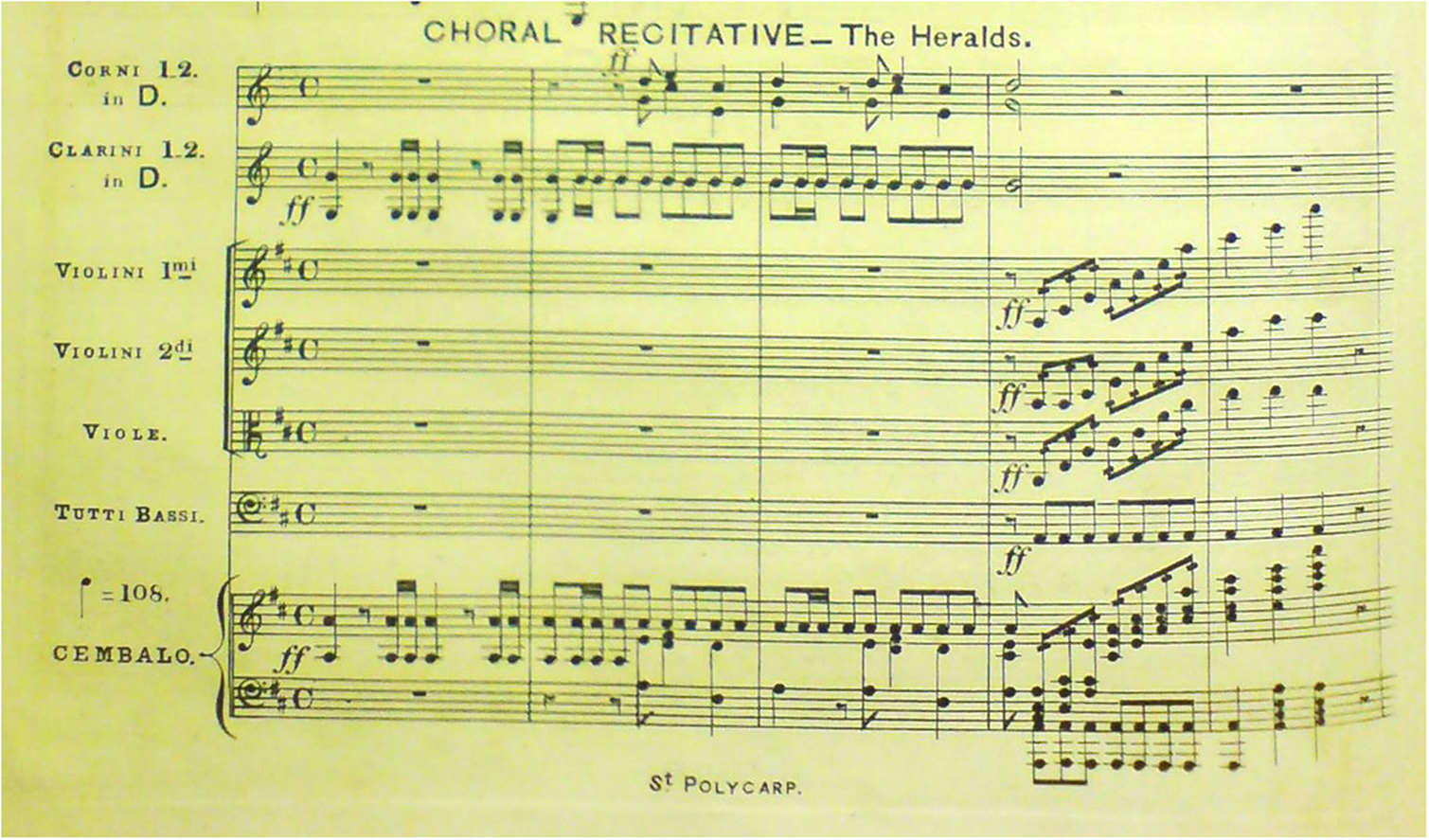
Figure 2 Choral recitative, ‘The Heralds’. F. A. G. Ouseley, The Martyrdom of St Polycarp, p. 98. Reproduced with permission. Special Collections, Bodleian Library, University of Oxford.
The multi-movement oratorio form also provided the perfect setting for displaying key academic skills. Ouseley’s textures include recitative, both accompanied and secco, free and fugal counterpoint, including movements for double choir (Figure 3 shows early entries in the double fugue from the chorus ‘He taught impiety’), and Bachian four-part harmonization in the chorale ‘O Father hear thy children’ and the penultimate chorus ‘He is at peace’. Solo and small ensemble numbers illustrate lyrical vocal setting in ternary structures, often with deft instrumental obbligato accompaniments. The oratorio also allows for plenty of variety in Ouseley’s treatment of instruments and voices, as well as the use of dramatic forms, deploying musical topics such as the instrumental march and appropriate use of instrumentation and vocal setting for word-painting.
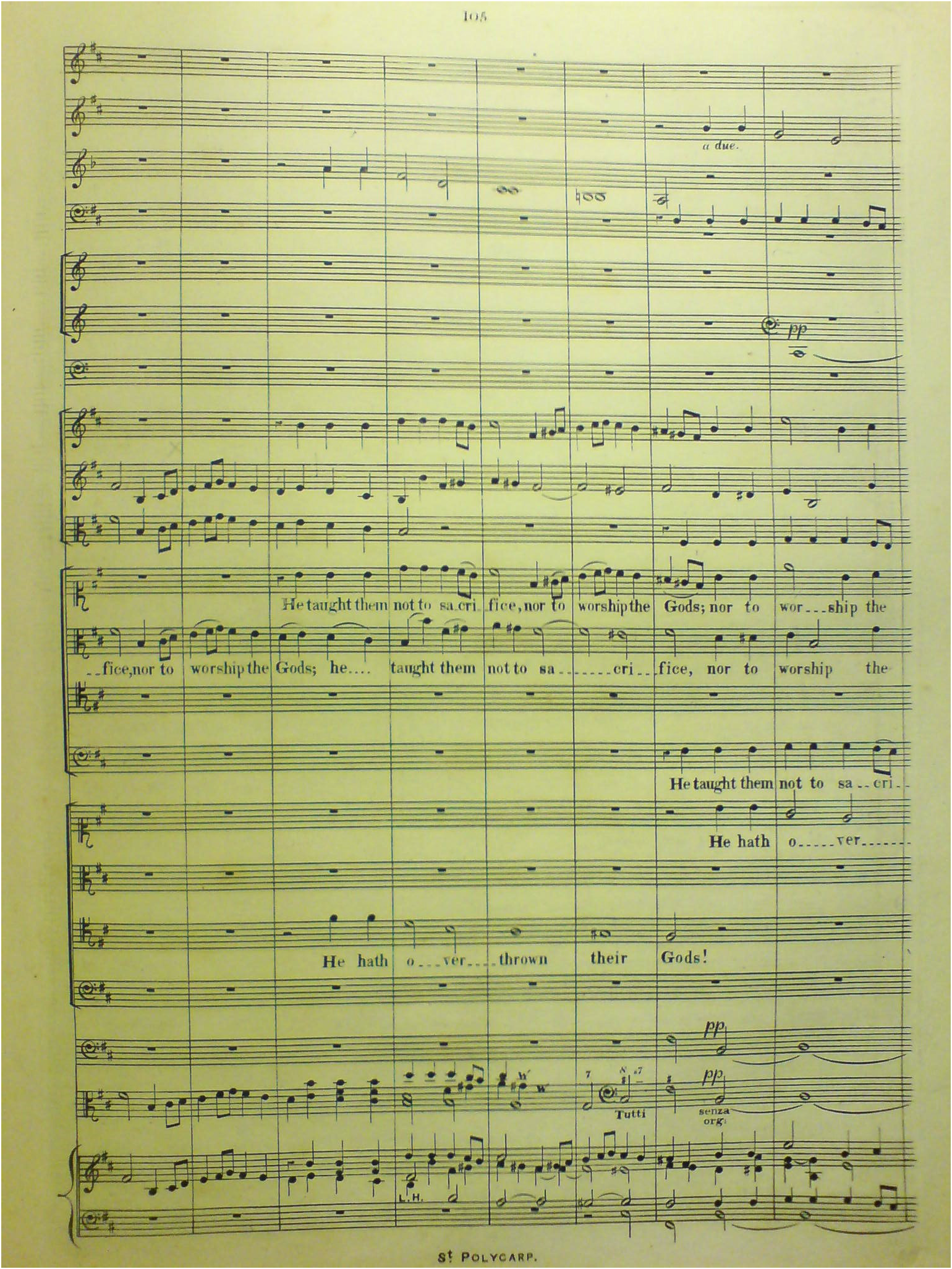
Figure 3 Double fugue entries from the chorus ‘He taught impiety’. F. A. G. Ouseley, The Martyrdom of St Polycarp, p. 105. Reproduced with permission. Special Collections, Bodleian Library, University of Oxford.
Ouseley’s final fugal Amen suggests a more direct model in Handel’s Messiah, which at the time was performed frequently at provincial music festivals and other civic and sacred occasions. Ouseley’s Amen is in the same key as Handel’s, following the same tonal pattern of entries, and adopts a similar melodic shape, albeit with a shorter subject (Figure 4). Following the initial entries, Ouseley develops a complex eight-voice contrapuntal texture, although his final phrases again follow Handel’s model of a grandiose, homophonic conclusion.
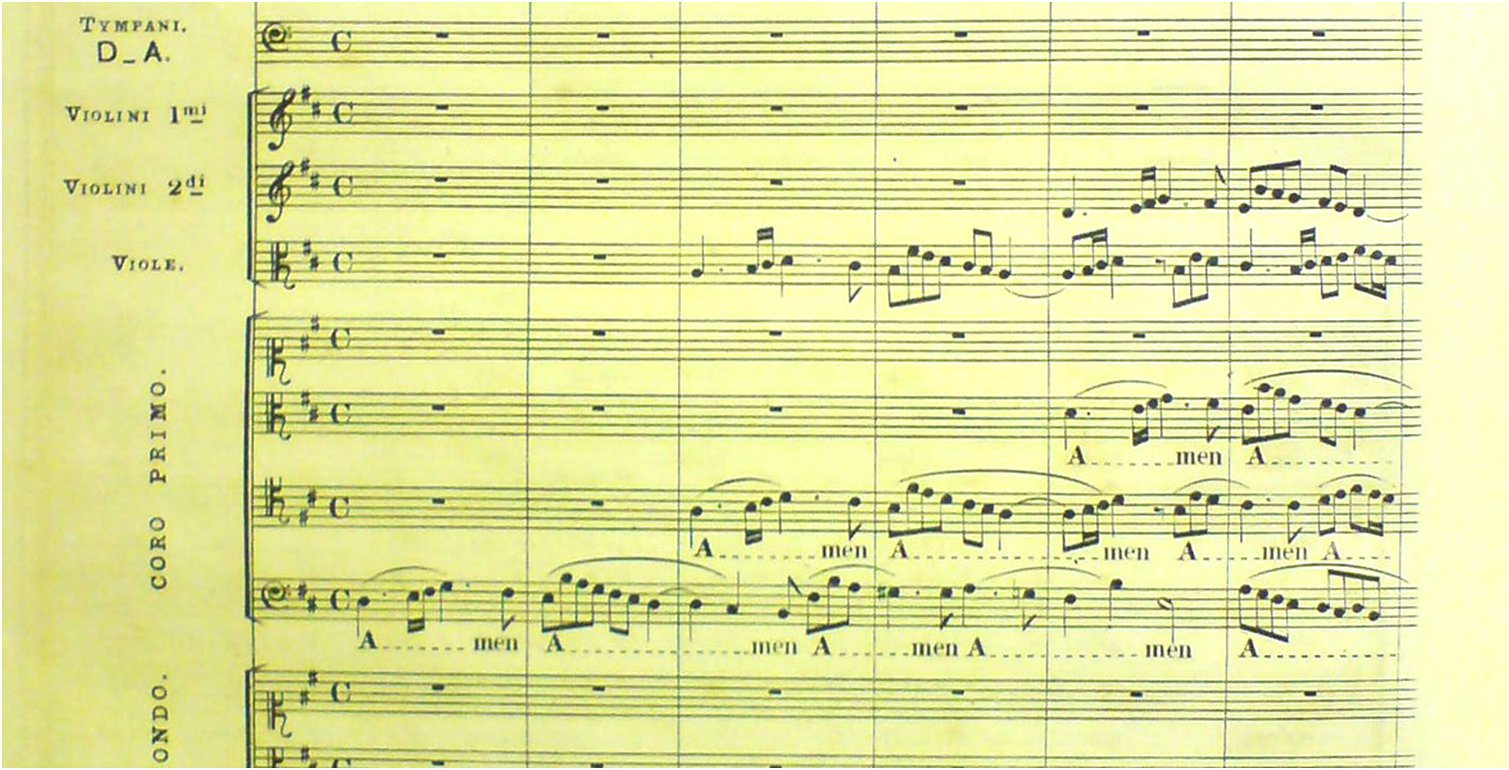
Figure 4 Fugue from Amen. F. A. G. Ouseley, The Martyrdom of St Polycarp, p. 154. Reproduced with permission. Special Collections, Bodleian Library, University of Oxford.
Ouseley’s own writings on music reveal his aesthetic taste to be closely aligned to the kinds of composition evident in his exercise and encouraged by the academic nature of the genre. In particular he advocates ‘sublime’ music and the use of plainsong as a basis, for example in fugal writing. In a lecture on ‘Church Music’ read at the Manchester Church Congress in 1863, for example, Ouseley argued for the continued importance of ancient modal melodies in English cathedral music, giving examples from Farrant and Croft of the sublime style he believed should predominate.Footnote 44 Among his publications are editions of church music from the sixteenth, seventeenth, and eighteenth centuries, including English and Spanish motets, glees, and part songs, and the music of Orlando Gibbons, Thomas Tallis, and Henry Purcell.Footnote 45 His theoretical works included treatises on Harmony (1868), Counterpoint, Canon and Fugue (1869), and Form and General Composition (1875), and he contributed several chapters on the history of English music to Emil Naumann’s History of Music, demonstrating throughout his concern for the preservation of English musical heritage.Footnote 46
The style associated with the ‘sublime’ had, in fact, been a category used in many of William Crotch’s own writings during the early nineteenth century. Crotch borrowed his terminology from the work of mid-eighteenth-century philosophers, including Edmund Burke, whose treatise on the ‘Sublime and the Beautiful’ considered questions of beauty, the senses, pain, love, and poetry.Footnote 47 Although Burke does not investigate art or music, he does touch on the sensations of colour and sound. The hierarchy of emotional response was applied to fine art by Joshua Reynolds and was adapted by Crotch into a doctrine of three musical strata: the sublime, the beautiful, and the ornamental.Footnote 48 Crotch associated the sublime, or grand, with ‘vastness and incomprehensibility’, signifying ‘high, lofty, [and] elevated’, and concluded that ‘the grandest style in music is therefore the sacred style — that of the church and oratorio’.Footnote 49 He divided the sublime style further, into the simple, the terrific, and the intricate, and identified passages in oratorios and other works which encapsulated these elements, suggesting that ‘for instances of the purest sublimity, which is neither terrific nor intricate, we refer to the most ancient Church music’.Footnote 50 The ‘sacred style’, which became synonymous with the academic style of the exercises, adopted these features to the exclusion of anything new, light, or frivolous.Footnote 51
The similarities between the exercises by Crotch and Ouseley illustrate the ideal musical forms expected for the exercise. Academic music by the mid-nineteenth century meant an ossified set of Baroque forms together with Classical styling: between fugues, chorales, and recitatives we see arias and small ensemble pieces that would not be out of place in a late eighteenth-century opera or oratorio. These elements best suited the ‘sublime’ styles identified by Crotch and Ouseley as the highest pinnacle of compositional attainment, as well as the most appropriate for the institutional status of a church or university. This stylistic focus is not surprising from a professional perspective either. Oratorios, particularly the large works performed at Handel festivals and the more recent successes of Mendelssohn as well as indigenous composers, were at the core of a significant sector of public music in England. Choral music formed the basis for the rapidly growing popularity of amateur singing, as well as of the important provincial music festivals which contributed to developing civic pride during the middle and the second half of the nineteenth century.Footnote 52 The works performed at massed choral concerts, important religious and civic events, and daily church and cathedral services made use of the forms and techniques seen in the exercises. Candidates for music degrees were, largely, church organists, who gained the relevant skills through their apprenticeships and a strong tradition of improvisation; fugue, free counterpoint, and chorale textures were key to this. While there was little opportunity for a career as an instrumental composer, choral works were fashionable and popular, particularly when small-scale movements could be extracted and sold as solos or straightforward choruses. Moreover, these styles could easily be taught, codified, and measured – essential criteria for an academic examination.
Thus the musical styles which became central to the composition of academic exercises closely matched the aspirations of most candidates, as well as popular taste and performance tradition. They built on the universities’ connection with employment in the church and the organ-loft destinations of most degree candidates, and catered to a sector of public reception still dominated by Handel’s oratorios and their descendants. It is not easy to trace a direction of influence between compositional practice and the choices of styles for the exercise. A high-status figure such as Ouseley, who held senior positions in both the Anglican and the music worlds, no doubt was in a position to have such an influence. Among his publications are two volumes of Special Anthems for Certain Seasons and Festivals of the United Church of England and Ireland (1861 and 1866) which, Nicholas Thistlethwaite notes, include a significant number of pieces with a ‘conservative approach’ to structure, harmony, and form; at the same time, he identifies the influence of orchestral sonorities on organ accompaniments, a trend perhaps supported by requirements for orchestral writing in the exercises as well as the greater prevalence of orchestral settings at festival services.Footnote 53 Nevertheless, Thistlethwaite argues, Ouseley’s ability to influence was curtailed by the resentment felt by other musicians towards his position as a clergyman and an amateur, his privileging of archaic models from his role at Oxford, and his own compositional styles.Footnote 54 This suggests an uneasy relationship between the styles encapsulated in the exercises and the status of the degrees on the one hand, and the realities of professional work and composition for the Church and elsewhere on the other. Ouseley’s preferred styles may have been echoed in many contemporary compositions and practices, but there was evidently also tension arising from his influential position and stylistic values.
William Pole’s Exercises and ‘Academic’ Music
My final two examples add a different twist to the question of the exercises and ‘academic’ music. In focusing on the degree exercises composed by William Pole (1814–1900), this section illustrates the particularly intensive use of compositional skills demonstrating intellectual application, leading to interesting aesthetic problems. Pole, like the musical polymath George Grove, had a successful public career as an engineer and became Professor of Engineering at the University of London. His interest and accomplishment in music was obviously well known, and in 1875 he was asked by his university to draw up a scheme for degrees in music.Footnote 55 Pole’s BMus and DMus predate this activity; he would have been in the first cohort of Oxford students required under the 1856 statutes to take a written exam as well as produce the compositional exercise.
Pole’s two exercises feature many of the same skills and styles as Crotch and Ouseley demonstrated. However, the ‘academic’ aspects of the pieces are made very obvious, and it is clear that Pole considered the compositions primarily in their role as a demonstration of technical skill rather than as musical works. The BMus exercise, the twenty-minute cantata The Hundredth Psalm, uses the ‘Old Hundredth’ hymn tune throughout as the basis for all the themes.Footnote 56 Table 2 charts the uses of the cantus firmus through the movements according to Pole’s own notes in the score, together with other musical features. Throughout the score, he uses asterisks to mark the notes derived from the psalm tune, and the accompanying printed programme also highlights its use overall, including its appearance in retrograde motion and canon. The work is composed for eight voices, string orchestra, and organ, although there is little independent writing for the vocal parts beyond the final chorale. Much of the vocal counterpoint is accompanied by organ alone, often simply doubling the voices. The piece makes extensive use of Baroque textures, including both fugues and chorales, and is harmonically simple. Most movements are short and through-composed, with little repetition. The manuscript score, which was evidently the copy submitted for examination, is marked using red ink in a number of places with corrections and identification of parallel octaves. Figures 5 and 6 show two sections of the instrumental introduction. The Allegro opening illustrates the use of the psalm tune both in an altered form, in the strings, and in its chorale form, in the organ. This is followed by an orchestral fugue, again based around the notes of the psalm melody.
Table 2 WILLIAM POLE, THE HUNDREDTH PSALM, BODLEIAN MS. MUS. SCH. EX. D105, OVERVIEW
| Text | Notes in the score | Key | Notable musical features | |
|---|---|---|---|---|
| Introduction and Fugue | ‘(The subjects taken from the Psalm Tone.)’ | C major | Allegro: fugue and free counterpoint; harmonized chorale in organ; extended plagal cadential coda | |
| Corale | All people that on earth do dwell… | C major | Allegro: four-part counterpoint in strings; cantus firmus in alto, tenor, and organ | |
| Duetto | The Lord, ye know, is God indeed… | ‘(With accompaniment of Canto Fermo.)’ | G major | Andante: soprano and tenor with organ accompaniment; cantus firmus in viola/cello |
| Corale, Quartett | O enter then His gates with praise… | ‘(Formed from the Psalm Tune by Retrograde Motion.)’ | G major | Moderato: four-part homophonic setting of chorale melody in retrograde |
| Bass Solo | For why, the Lord our God is good… | ‘(Accompanied by Direct Motion.)’ | G major | Bass melody with homophonic organ accompaniment |
| Fugued Interlude | G major to C major | Allegro: short four-part fugue taking the subject from the Introduction | ||
| Motett | O be joyful in the Lord all ye lands… / All people that on earth do dwell… | [with] ‘Accompanying Canto Fermo’; ‘The commencement of each Strophe is formed from the corresponding line of the Psalm Tune’ | C major | Allegro: five-part close imitation. Cantus firmus in Soprano 1 |
| Glory be to the Father… / For why, the Lord our God… | C major | Five-part with cantus firmus in Bass 2 | ||
| World without end / And shall from age to age / Amen | C major | Eight-part polyphony with canon between Alto 2 and Tenor 1. Cantus firmus in Bass 2 | ||
| Full Corale | Praise God from whom all blessings flow… | C major | Eight-part homophonic chorale setting with instrumental accompaniment and interludes |

Figure 5 Introduction (instrumental). William Pole, The Hundredth Psalm, p. 1. Reproduced with permission. Special Collections, Bodleian Library, University of Oxford.
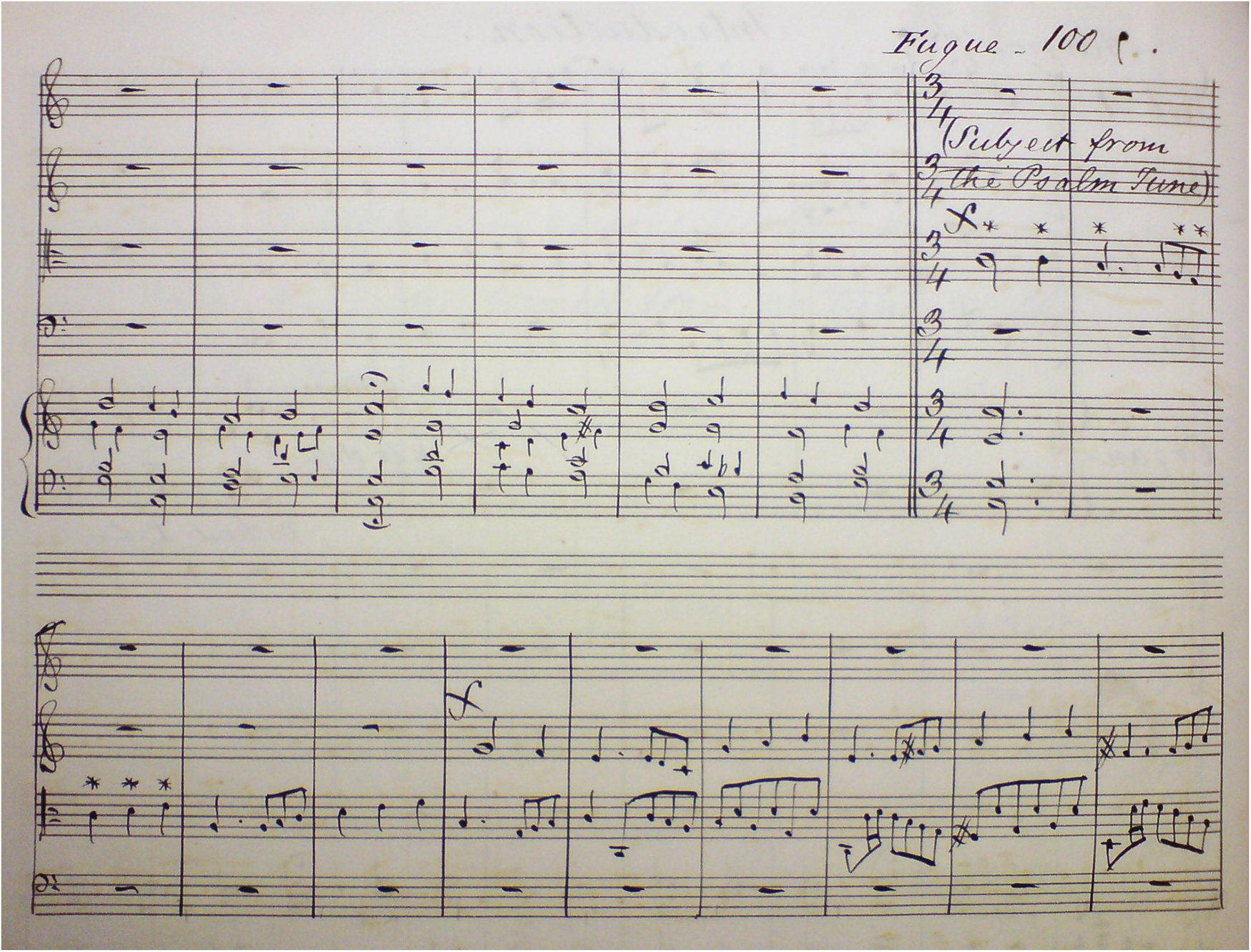
Figure 6 Introduction – fugue (instrumental). William Pole, The Hundredth Psalm, p. 2. Reproduced with permission. Special Collections, Bodleian Library, University of Oxford.
My next example is taken from the opening of the bass solo ‘For why? the Lord our God is good’ (Figure 7). Here, Pole uses the psalm tune in the organ accompaniment, while constructing a vocal line from the same tune in retrograde. Pole’s DMus exercise takes this academic nature several steps further, and is particularly interesting because it moves so far towards being an academic work that its coherence as a musical work is affected.Footnote 57 The exercise is a Mass for double choir, accompanied by full Classical orchestra including horns, three trombones, and timpani. As in the BMus exercise, Pole uses a particular tune as the basis for his piece, reminiscent of Gregorian chant and similar, though not identical, to J. S. Bach’s theme ‘Wir aber sind nicht fleischlich’ in his motet Jesu meine Freude, BWV 227. The tune is relatively short and simple, tonal, and easy to harmonize, but Pole treats it in quite extraordinary ways in the course of the Mass setting. On his title page he declares, ‘This Mass is formed on a Canto Fermo which is introduced in every movement.’ As before, Pole is keen to point out his manipulations of the subject and highlights this with symbols of hands and stars throughout the manuscript (see Figure 8).
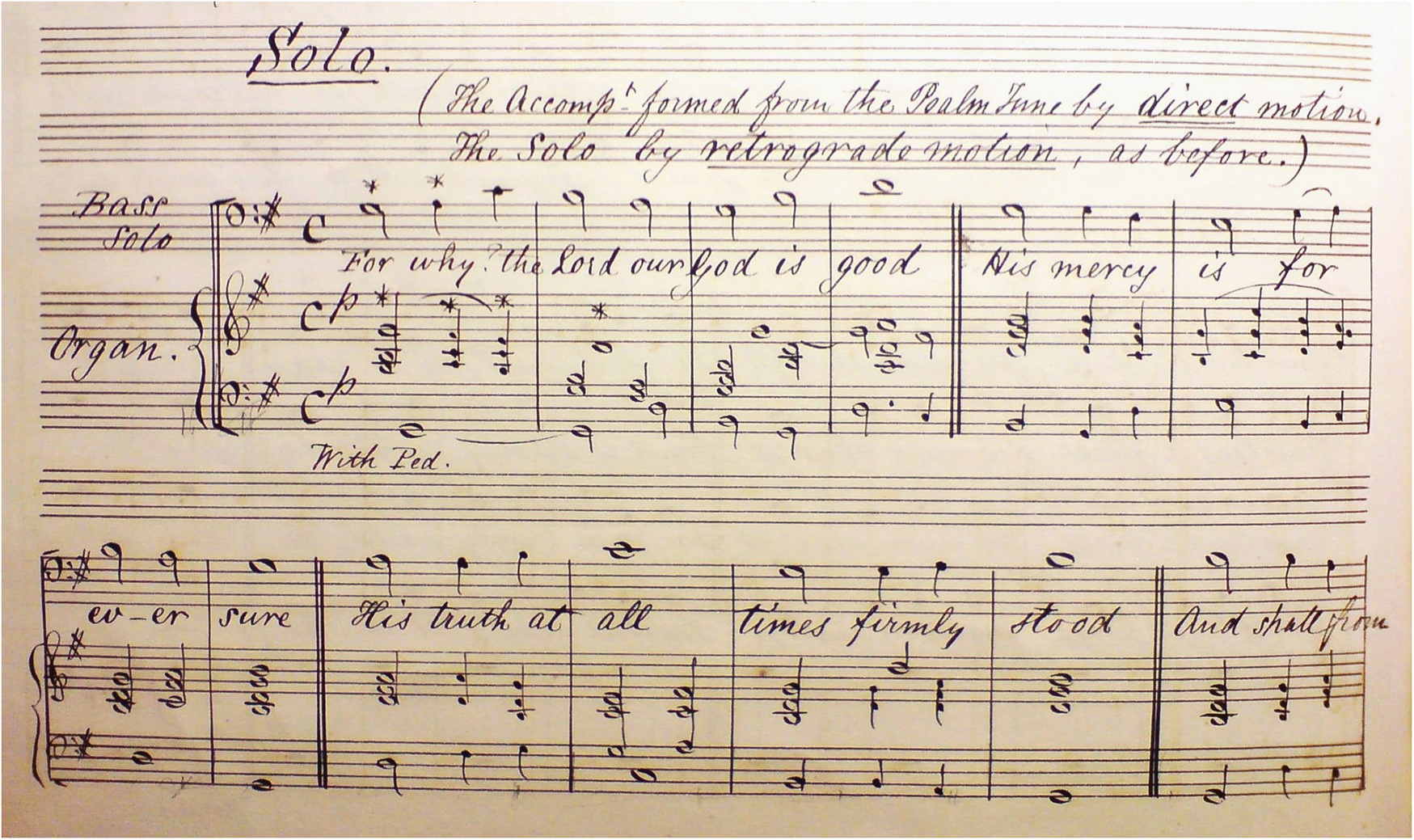
Figure 7 Bass solo, ‘For why? the Lord our God is good’, ‘The accompaniment formed from the Psalm Tune by direct motion. The solo by retrograde motion as before.’ William Pole, The Hundredth Psalm, p. 22. Reproduced with permission. Special Collections, Bodleian Library, University of Oxford.
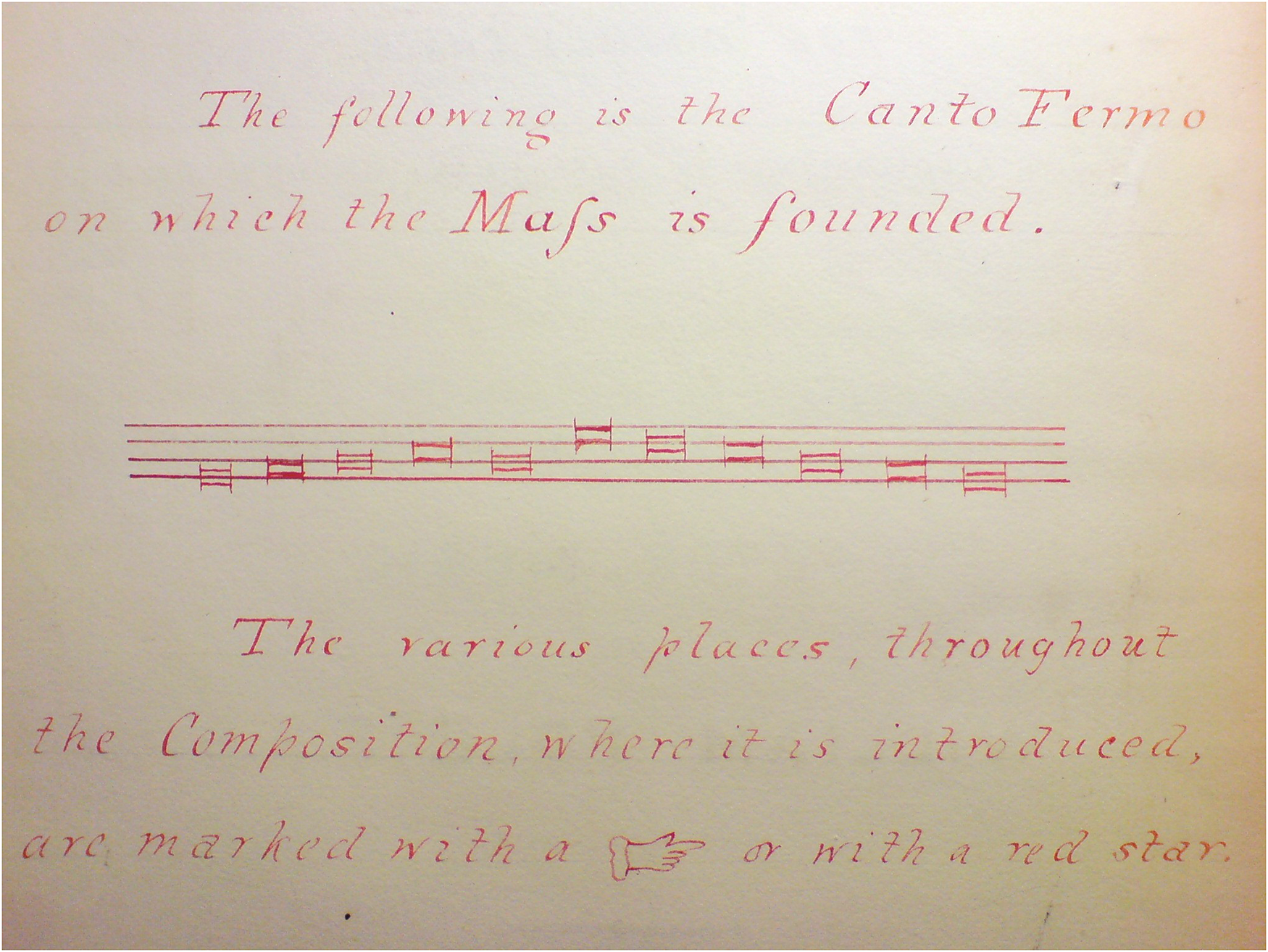
Figure 8 Explanatory page. William Pole, Mass for Double Choir, Bodleian MS. Mus. Sch. Ex. c42. Reproduced with permission. Special Collections, Bodleian Library, University of Oxford.
Alongside its melodic coherence, the work includes a wide array of forms and textures, including sonata and ternary form movements, canon, fugue, extensive free counterpoint, faux plainchant, and homophony. The opening Kyrie, for example, makes use of Mozartean phrases, textures, gestures, and melodies, particularly in its orchestration. It features statements of the cantus firmus in a sonata exposition form; the second Kyrie offers the recapitulatory structure. Between, the Christe is a canon ‘3 in 1, in the 4th and 8ve below; partly by inversion’ based around the cantus firmus, with free counterpoint in the remaining five voices. The Gloria again uses a sonata form with military fanfares and a strong rhythmic drive, contrasting thick textures in the forte choir tuttis with more delicate interludes. The Qui tollis, Quoniam and Sanctus/Benedictus also combine melodic writing with sections of strict counterpoint.
Although the tune forms the basis of the themes in each of the first few movements, the F-major Gratias agimus is the first section where it is really exploited. Pole prefaces the movement with a note to explain:
In this movement I have endeavoured to introduce the Canto Fermo very frequently (see the red stars) without causing monotony, or interfering with the melodial character of the composition. The subject is used not only direct but also inverted and retrograde, and it is further taken in the intervals of each of the Ancient Tonal modes.Footnote 58
The relevant modes are marked under the score in capital letters using red ink.
Pole is true to his word: the movement opens with an extensive orchestral introduction, during which the cantus firmus is heard in solo clarinet, solo tenor, and the cello/bass parts in its usual form, beginning on an A (Phrygian) and a C (prime). From bar 78 Pole begins his more extensive exploration of the modes, for this movement adding an extra note to the cantus firmus in order to include a seventh and thus complete their characterization.Footnote 59 The first two tenor solo phrases are in the Phrygian mode, with the prime form heard in the bass. The bass then accompanies, with the tune in the Ionian and Aeolian modes. There follows a full choir section with the cantus firmus in the bass in the Dorian mode, then in the choir tenor part in the Lydian mode, and finally in the bass in the Mixolydian mode. Pole completes the movement by using the cantus firmus in inverted retrograde motion in the soprano part, in counterpoint with the prime form in the bass. Throughout, despite the challenges of weaving the different modes into the melodic fabric, Pole maintains a relative harmonic simplicity and the overall sense of a ternary form through the return of the initial key and melodic material in the tenor solo at letter H (see Table 3).
Table 3 WILLIAM POLE, GRATIAS AGIMUS FROM MASS FOR DOUBLE CHOIR, BARS 67–96
| Bar number | Rehearsal letter | Voice part of cantus firmus | Mode | |
|---|---|---|---|---|
| 1–4 | F major | clarinet | Phrygian (original form) | |
| 36–39; 44–47 | B | tenor solo | Phrygian (original form) | |
| 54–57; 58–61; 62–65; 66–69 | C | cello/bass | Prime (original form) | |
| 78–81; 86–89 | D | tenor solo | Phrygian | |
| 96–99; 100–03 | E | cello/bass | Prime (original form) | |
| 104–07 | cello/bass | Ionian | ||
| 116–19 | F | D minor | cello/bass | Aeolian |
| 126–30 | cello/bass | Aeolian with chromatic alteration | ||
| 134–39 | cello/bass | Dorian | ||
| 142–46 | tenor section | Lydian | ||
| 153–56; 161–64; 169–72 | H | F major | tenor solo | Phrygian (original form) |
| 173–76 | cello/bass | Mixolydian | ||
| 177–80 | soprano section and cello/bass | Inverted/retrograde and prime | ||
| 195–99 | Coda |
Although Pole maintains the structural integrity of the music via the use of a single melodic subject, his stylistic palette is anything but coherent. The Mass presents a series of movements and sections, some of them very short, in a wide array of styles and textures. It is perhaps not surprising that there was a tension between ‘academic’ and ‘musical’ characters in this kind of composition.
While the Gratias manages to conceal, to some extent, its manipulation of the cantus firmus, the Agnus Dei is immediately more complex (see Table 4 and Figure 9). Pole informs us, ‘In the “Gratias Agimus” the ancient scales are applied only to one part; here they are applied to all.’Footnote 60 Each phrase of the text is allocated a mode, and the settings are not only separate in the copy but in entirely different styles. In something of a faburden setting, the verses alternate, on the one hand, unison choir with organ accompaniment in an altered version of the melody, and on the other, polyphony which Pole describes as ‘with modern harmonies’, scored for double choir and continuo. The first five sections alternate the effect of organ-accompanied plainsong with free polyphony in the Renaissance style; the final section is much more complex, adding in a new melody in canon (Alto 2 and Tenor 2), together with direct (Alto 1), inverted (Tenor 1), retrograde (Soprano 1), and inverted retrograde (Bass 2) forms of the tune in a second, simultaneous canon. There are other points where we can see Pole is interested in composition as an academic exercise. In the Qui tollis he labels a chord which ‘contains every note of the Scale’.Footnote 61 Later, in the extended fugal Amen to the Gloria, an extremely chromatic passage is marked as an allusion to Beethoven’s Eighth Symphony.Footnote 62
Table 4 WILLIAM POLE, AGNUS DEI FROM MASS FOR DOUBLE CHOIR, BARS 160–75
| Text | Mode | Texture |
|---|---|---|
| Agnus Dei | Phrygian | Unison choir with chordal organ accompaniment |
| Miserere nobis | Aeolian (with ‘modern harmonies’) | Polyphonic with organ ‘colle voci’ |
| Agnus Dei | Dorian | Unison choir with chordal organ accompaniment |
| Miserere nobis | Mixolydian (with ‘modern harmonies’) | Polyphonic with organ ‘colle voci’ |
| Agnus Dei | Lydian | Unison choir with chordal organ accompaniment |
| Dona nobis | Ionian (‘modern major’) | Canon, 6 in 2, direct, inverted, and retrograde |

Figure 9 Agnus Dei. William Pole, Mass for Double Choir, p. 160. Reproduced with permission. Special Collections, Bodleian Library, University of Oxford.
Pole’s DMus exercise is particularly interesting in relation to its joint status as musical composition and academic exercise: firstly for its complexity, with academic manipulation of the cantus firmus taken to an extreme, rather to the detriment of musical coherence, and secondly because it is unfinished. A handwritten note at the top of the Dona nobis to the Agnus Dei states: ‘This is merely an adaptation from the “Kyrie”, and as time pressed, the Professor decided it was not necessary to fill in the remainder of the composition. WP.’Footnote 63 The Dona nobis is sketched, and the following Sanctus and Benedictus contain only indications of orchestration beside a soprano part and bass line, and parts written out for full choir.Footnote 64 The note suggests that Pole was in dialogue with Ouseley while completing his work on the exercise, checking that the composition was sufficient to meet the requirements of the degree regulations. We can, therefore, assume that the academic nature of the music, as well as its musical qualities, were aligned with Ouseley’s expectations and values.
Although the requirement for DMus exercises to be performed remained until Stainer’s statute changes of 1891, the unfinished nature of Pole’s 1867 exercise suggests this was not applied in practice. Thus Pole’s Mass really was an academic exercise alone, and the fact that he had not quite got around to filling in the parts or completing the last few sections was not of material consequence. Professor Ouseley could see that he met the criteria and was able to award him the degree.
As an engineer, Pole took a particular approach to the aesthetic problem of science and music.
In a letter to F. G. Edwards, Stainer reveals a little more of Pole’s musical background, including his ‘efforts to introduce music practically unknown’ during the middle of the nineteenth century. Stainer continues,
He used to make MS parts with his own hands and have parties in his house to try Bach’s Cantatas (then not easy to get), also, works by Mozart, & also of the early Italian composers & others. As I used to go there and sing them as a child, I recall the pleasure he gave to many. He was a pioneer in the difficult task of teaching people what they ought to like, and this should not be forgotten.Footnote 65
Pole’s enthusiasm for Handel, in particular, is further evident from his Philosophy of Music, a collection of essays based on lectures given in 1877. Here he describes Handel as ‘this great man, the giant of choral music’, a master of both harmony and counterpoint, citing his ‘sublime masses of harmony’ and ‘wonderfully varied, skilful, and melodious contrapuntal compositions’.Footnote 66 In his introduction to the 1924 edition of Pole’s lectures, Edward J. Dent notes that ‘music for [Pole] is adequately represented by what we call the classics — the period from Bach to Brahms. Handel, Mozart and Beethoven are the composers to whom he most frequently alludes; Wagner is never mentioned.’Footnote 67
Pole considered that aspiring composers needed to understand the principles of composition, as exemplified in the works of the ‘great composers’, before venturing to create their own style or artistic laws.Footnote 68 He considered composition to be ‘much less studied than it ought to be’, and the lectures he gave at the Royal Institution of Great Britain in February and March 1877 examine the principles of composition and their bases in physical and psychological phenomena. Although he dismissed many theoretical systems, suggesting that the ‘constant changes and extension of rules [were] a proof of their artificial and unauthoritative origin’, he was firmly in favour of Baroque counterpoint and noted the ‘desirability of a revival of the interest in it’.Footnote 69 Pole’s exercises are proudly ‘academic’, and his writings similarly expose the importance of archaic styles and values to his work. Although he was active as a church musician, his professional career lay elsewhere, and it was perhaps because of this that he was able to focus quite so exclusively on the academic elements of the exercise. Nevertheless, his degree compositions expose some of the ways in which the tensions between academic and musical values played out in the most extreme cases and the difficulties in dealing with such music from an analytical perspective.
Musical Exercises and Problems of Value in Music History
These are clearly not ‘normal’ pieces of music, and beginning to study them in more detail provokes a number of questions about the nature of analysing and thinking about music which falls outside standard categories of completed works composed for public performance. The exercises were composed and performed under different circumstances from other pieces of music from the time. They are interesting from both analytical and cultural-historical perspectives, but what are the appropriate tools and parameters for approaching them in more detail?
My first two considerations concern questions of compositional ontology. As discussed above, the musical exercises were written as academic demonstrations of particular skills and techniques. Like much music, they were written with a special function, but they were ‘functional’ in an unusual way, being removed from normal spheres of performance. The musical exercise had a very transient existence: most were performed only once, some not at all. Unusually for musical works, they exist primarily for their written, text form rather than their sounding realization. Yet they have been preserved in a more complete form than many works of their type and age. Almost none were published, and none are in the repertoire today, although some extracts from exercises survive as anthems or solos, printed separately and almost entirely removed from their original context.Footnote 70 Ontologically, therefore, the exercises are anomalous among musical compositions. Pole’s BMus exercise, which includes estimated times for performance of each movement, together with a total time to ‘allow for pauses & stops’, has a clear relationship between text and performance (although it may never have been performed). In contrast, Pole’s DMus exercise does not give complete and sufficient instructions for a performance; the work exists ‘on paper’ only and in partial form.
The second consideration relates to the context of academic or educational music. It is not unusual for pedagogical and theoretical papers from prominent composers to generate scholarly interest. Looking in detail at a composer’s youthful productions gives us an insight into education, working methods, and composition approaches; sketch studies and successive editions fall into a similar category. To some extent, we might deal with the exercises in the same way. Extant in the Oxford archives is Parry’s BMus exercise (he was later awarded an honorary DMus at Cambridge), a setting of ‘O Lord thou hast cast us out’ for which his degree was granted in 1866.Footnote 71 While the 18-year-old’s exercise was composed on the same lines as its contemporaries in the 1860s, it already shows greater lyricism and more generosity in the instrumentation. This is perhaps an indication of Parry’s later use of complex counterpoint and a range of stylistic elements. As a work, it generates interest because of his subsequent fame and success, and is part of a narrative leading to that future time.
Yet most of the exercises do not represent a juvenile attempt at composing as part of an ongoing educational scheme. These are not composers who went on to have glittering careers. For most of them, the manuscript exercise is the only remaining musical record of a life in the organ loft, quite possibly composing occasional anthems, certainly improvising, but probably never producing anything as expansive in length or scoring again. Juvenile works produced as part of a developing compositional career are interesting as evidence of the evolving craft which was part of a trajectory towards a mature compositional style; many include the skills of harmony and counterpoint exhibited in the exercises and allow us to see the frameworks of training as well as what was valued by educators and composers. Tracing a composer’s education helps to answer questions about their later stylistic preferences.Footnote 72 Yet works that are part of an educational programme are rarely presented as complete compositions, while juvenile published pieces are finished works, with musical rather than academic values to the fore. The degree exercises include elements of both and are therefore complex in both their ontology and status.
My second set of points concerns the broader context of style. Nineteenth-century English musicians had a particular relationship with music of the past. This was an age where, for the first time, music by dead composers formed some of the most visible and popular public musical performances, Handel being at the core. Both the continued dominance of his oratorios following the Handel Festival of 1784 and the influence of the Concerts of Antient Music (1776–1848) on instrumental music changed the relationship of musical style and composition to the past. William Weber notes the dominance of ‘works by dead composers’ in orchestral and chamber music repertoire by the 1860s.Footnote 73 Within liturgical music, Suzanne Cole recounts the importance of Tallis from the 1840s as ‘Father of English Church Music’, while Purcell’s sacred music also played a prominent role in the historiographical identity of English music.Footnote 74 Edward J. Dent wrote:
The musicians of Pole’s day were brought up in strict obedience to tradition. In even the most remarkable examples of genius it can be observed that tradition, the influence of music previously heard by them, was at times stronger than the creative instinct which sought to find a direct expression of new emotional experience.Footnote 75
Music theorists, some of them influential in the universities, also championed archaic styles. Crotch, for example, argued for the pre-eminence of the musical ‘sublime’, which for him meant fugues, strict counterpoint, and ‘ancient music’. Ouseley took up the same stance: in his 1863 lecture on church music, he emphasized the importance of sublimity, which, in liturgical music at least, meant ‘the music ought to be plain and straightforward, without repetitions of the words, and without anything ornamental or distracting’.Footnote 76 The academic exercises were composed in genres and styles that were quite typical of the prominent and widely performed oratorios, odes, and anthems of the period, and were encouraged by theorists.
The exercises are a reflection of this narrow stylistic window, sharing many of the values embodied by church music of the time yet with the added elements of compositional academicism and virtuosity only found in the most complex anthems or oratorios. Analysing the exercises helps to shed light on the techniques and attributes developed by many musicians in the church music profession, in turn offering a large repertoire of works which sits alongside the services and anthems of parish churches and cathedrals on the one hand, and oratorios and festival pieces on the other. At the same time they help expose potential power struggles in the development of musical style, particularly in the mid-nineteenth century. While writers such as Maurice suggested elevating music’s position via a closer connection with the universities, there was evidently also a resentment felt towards important figures such as Ouseley and his insistence on the conservative style.Footnote 77 The influence of university music professors via degree requirements as part of this struggle was symbolically important, even if few exercises were performed outside their academic context.
The final consideration concerns musical analysis and questions of value. Techniques of musical analysis can be applied to any types of musical work in order to describe and understand the ways in which music is constructed. Yet serious analytical attention also assesses musical value and implies a certain status to the music. It is no coincidence that the types of music history that begin with musical works often privilege certain elite styles and western classical genres, while those which focus on social and cultural contexts have tended to produce a broader span of musics and musical practices.
The question of analysing Victorian music is a particularly thorny one. In a relatively recent article, Stephen Banfield addressed the problem of our interaction with such music, when much research on the period has tended to focus on social histories, economics, institutions, and reception.Footnote 78 Banfield invites us to add criticism into the mix, to employ Kerman’s imaginative reconstruction and re-entering of music, and to ‘make a living case for the music one is writing about’.Footnote 79 As a result, ‘what was once bad Victorian music may now be something else. The trick is to advocate it as something else.’Footnote 80 Serious analytical approaches are required, such as one might use to tackle any music of the western musical canon. Academic music was set in opposition to the kinds of frivolous and sentimental musical outputs described by Banfield, which were so popular with the concert-going public. Yet these ‘serious’ forms — in line with what Banfield calls ‘musical ideals’ — have also evaded musicological scrutiny. Is the problem, then, not in the music but in the way it has been studied?
Banfield might argue that we need to approach the music of the exercises with the same tools and questions as other contemporary repertoire. By doing so we assign value to the music; in other words, if we treat it as if it is worth studying in its own right, we move it from being a historical curiosity to being a corpus of musical creations deserving of our musical, not just historical, attention. At the same time, evaluating BMus and DMus exercises of the 1850s against contemporary orchestral or operatic repertoire produces nothing of use. Franz Liszt’s symphonic poems and the first half of Richard Wagner’s Der Ring des Nibelungen, as well as Tristan und Isolde, were all complete before Pole’s DMus exercise was submitted in 1867. Rather, the exercises need to be analysed using the tools and strategies that might be applied to contemporary church music, ceremonial odes, and oratorios; examples of these types of analysis exist but are reliant on a range of analytical frameworks and descriptive approaches. Close musical contexts are important, not only for determining social and cultural meanings but for developing appropriate analytical tools.
How might the analysis and history of music deal with the problem of science and art in the exercises, and elsewhere? As mentioned in my introduction, the study of music in nineteenth-century Britain has already extended to embrace music created for the popular market and for functional use. The idea of Britain as a ‘Land ohne Musik’, derived from an apparent absence of ‘high art’ music (though British composers were also active in opera and symphonic repertoires throughout the century), has been set aside with detailed and varied studies of a vibrant musical life in many different contexts.Footnote 81 Musicology has begun to deal with the sentimental, the popular, the simple, and the functional within musical texts and to find ways of valuing these different forms of music; the exercises challenge it to deal with the cerebral. In my analyses of the exercises above, I have begun to unpick the balance between science and art, positioning this in relation to musical style and form as well as published theoretical writings. From this approach, it is possible to consider musical style in a deep context.
Of course, the aim of analysis is not simplistically to impart ‘value’ to musical works, and some of the music really isn’t very good. Edmund Fellowes’s BMus exercise from 1895 is a setting of the ‘Hymn of the third choir of Angelicals’ from The Dream of Gerontius. Footnote 82 Fellowes’s final section is a choral fugue, and across two pages towards the end Stainer has scrawled ‘WEAK’. Though Fellowes (1870–1951) went on to contribute to historical study and performance through his editions of early choral music, he never took his DMus, nor is there any indication that he composed any further.Footnote 83 Few of the composers of Oxford exercises offer the kinds of ‘success stories’ celebrated by Banfield, who draws on the examples of Stainer, Balfe, and Ella.Footnote 84 Yet music already pronounced ‘weak’ by an experienced authority is surely still worth our scholarly attention as an example of pedagogic approaches, formal values, and compositional practices. Even music which has had no sounding performance, whether or not one would be possible, remains part of the musical fabric and an element of the warp and weft of musical styles and traits, a clue to nineteenth-century English musical life even if not an active part of it. How do we balance questions of context and musical value, science, skill, and art to evaluate the nature of the musical exercises both as music and as evidence of cultural and intellectual trends?
Questions of value and epistemology often benefit from the distance afforded from a parallel disciplinary viewpoint. The visual arts offer a number of opportunities for such a brief excursion. The title of this article alludes to ‘samplers’, a word more commonly used to reference embroidery pieces produced largely by children or women, demonstrating, like the musical exercises, a range of skills and abilities which nevertheless manage to offer elements of artistic and aesthetic merit. Maureen Daly Goggin’s work on embroidery samplers gives them new cultural significance by exploring questions of meaning, but little work has been done on addressing the artistic value of such pieces.Footnote 85
The place of technical skill in art has received significant commentary stretching back to the nineteenth century in Britain, where the skills associated with craftsmanship were given value by exhibitions and educational schemes after the 1851 Great Exhibition, culminating in the celebration of British workmanship in the Arts and Crafts movement from the 1870s. Nevertheless, fine art and technique were considered separately. R. G. Collingwood, for example, wrote extensively about the relationship between art and craft; on artistic technique, he argued:
The artist must have a certain specialized form of skill, which is called technique. He acquires his skill just as a craftsman does, partly through personal experience and partly through sharing in the experience of others who thus become his teachers. The technical skill which he thus acquires does not by itself make him an artist; for a technician is made, but an artist is born. Great artistic powers may produce fine works of art even though technique is defective; and even the most finished technique will not produce the finest sort of work in their absence; but all the same, no work of art whatever can be produced without some degree of technical skill, and, other things being equal, the better the technique the better will be the work of art.Footnote 86
On the poetry of T. S. Eliot, he similarly suggested, ‘however necessary it may be that a poet should have technical skill, he is a poet only in so far as this skill is not identified with art, but with something used in the service of art’.Footnote 87 However, the exact nature of the difference between art and skill remained unclear, with Collingwood connecting art with emotion and ‘making things, but these things are not material things, made by imposing form on matter, and they are not made by skill’.Footnote 88
The aesthetic problem of functional art presents similar issues. Galleries and museums frequently display objects which were created to be beautiful yet functional, and which now have both historical and artistic value. The phrase ‘visual culture’ has long been adopted by historians of art and artefact in order to broaden the value-laden language of fine art, an ongoing negotiation which has also been shaped by developments in the discipline and beyond. Introducing a volume on textile culture, for example, Jennifer Harris explains:
The status of cloth as an art medium has definitely benefited from a burgeoning interest in non-Western art. In the West textiles have suffered a double whammy, primarily from the distinctions made between fine art and decorative or applied art (the so-called ‘minor’ arts) but also between decorative art and ethnography.Footnote 89
Writing on questions of the value and display of intricate quilts produced by the African American people of Gee’s Bend in Alabama, Karin E. Peterson and Leisa Rundquist make a more direct link between shaping meanings and valuation. Exhibiting the quilts, they suggest, ‘creates value by enhancing visibility, proposing new meanings, and creating new history […] The museum functions as part of the network of cultural valuation that invents and defuses works; lasting reputations are dependent on these organizational systems.’Footnote 90 Yet in undertaking this new valuation, quilts were reshaped under a modernist aesthetic gaze, valued not for their craftsmanship but for their artistic qualities as ‘canvases’.Footnote 91 At the same time, the lives, stories, and places of their creators were minimized, exposing again problematic tensions between the value of art, craft, meaning, and function across past and present. While music does not see quite the dichotomies between fine art and functional artefact, similar shifts in the acceptance of a wider variety of musics as objects of study have been prompted by ethnographic viewpoints, in both non-western and popular musical traditions. These include music with substantial social and cultural functions, and the contextual study of musical practices reflects similar broadenings and revaluations of musical meaning and worth.
There is another tension, however, between the values of the historical ‘museum’ of musical works and those of the ‘museum’ of performance repertoire. Music can be analysed, edited, published, and still remain in the historical museum. But to be sounded means its transference into the performing museum, and, like the contemporary gaze applied to the Gee’s Bend quilts, this gives it a different kind of value. The musical museum functions differently from a museum of art or architecture, however, because musical works stand alone and are maintained through performance. Thus incomplete fragments or works written outside the norms of the classical work concept are difficult to assimilate. This has been seen clearly in the difficulties in introducing works, genres, composers, and traditions which have been neglected, often because of expectations and restrictions in western performing traditions. Therefore, while the musical exercises might be compared with other crafts demonstrating skill and technique, the problems of assimilation and value are somewhat different.
The example of the Gee’s Bend quilts, transferred more broadly to historical musicology, makes clear the role of history as advocacy, as interpretation, and as valuation. From a perspective of advocating for English music within a broader museum of musical works, success stories are important. From a perspective of telling a balanced and detailed narrative of English musical life, however, there is no reason why that narrative should be shaped around successes only. Both musical failures as well as the humdrum, ordinary kind of music that was produced for specific contexts and purposes offer value as academic sources. Yet for that narrative to cross over into the museum of works rather than being interpreted via the cultural ‘background’ of musical life, specific and sustained advocacy for a more inclusive approach needs to be put in place. To be sure, the musical exercises play a part in many of these contextual, cultural stories, from debates around art and science to the nature of the Church and its music, from the development of music as an academic subject to the relationship between ancient and modern in musical style. Yet they also deserve consideration, not as ‘bad Victorian music’ but as interesting and relevant examples of a key musical genre.
Conclusion
It would be easy to dismiss the exercises as something of a footnote in the history of nineteenth-century British music, itself often sidelined as offering little for the modern musical canon. Composed as juvenile or academic pieces, they were not written according to the same values or criteria as much ‘public’ music. In many cases not composed for publication or performance, and in some cases not even complete, perhaps they should be dealt with as social and contextual history, rather than as autonomous musical works. We have already seen the nineteenth-century debate about whether the exercises were really ‘music’ or more like scientific samples. However, I would like to argue that the exercises are an important part of musical history, exhibiting particular stylistic values which formed a key part of the story of English music. On the one hand they are remarkable, on the border between art and artefact, fulfilling a specific purpose; on the other hand they are unremarkable, in many cases pieces of craftsmanship rather than art, not to be counted among the works of genius from which music history is often structured. Instead of fetishizing the new and avant-garde, the successful, and the long-lasting, the kind of musical history which includes the exercises captures and celebrates the ephemeral, traditional, day-to-day musical existence of a large proportion of English music-making throughout the nineteenth century. The study of music in nineteenth-century England needs its success stories, of course. But it also needs a deep and critical engagement with the rich yet largely unremarkable matter of everyday musical life.
Analysing the Oxford musical exercises helps us to understand them in their musical context while giving them some status as works rather than mere historical curiosities. Rather than taking a place in the ‘museum’ of musical works, Victorian music has often been relegated to the curiosity shop or the temporary exhibition.Footnote 92 It is hard to avoid arguing that this is good music for what it is or ‘in its context’, alongside the giants of the classical canon. However, the musical museum should not just show the best but should represent all works, styles, and ideas in the history of music. One of the problems that faces musicology is the conflation of musical values and musicological values, as well as the performing canon and the musicological canon. Much of traditional musicology has been focused on value judgement, supporting the performing canon; more recently, this has rightly turned to the defence of music previously excluded from the performing canon yet worthy of public and critical acclaim. Other forms of canon, and particularly the analytical study of music considered unworthy of public performance, are more problematic given the sounding nature of music as art. Where new genres and contexts have been explored, engaging directly with the music while not advocating for its addition to the performing canon leaves something of a valuative no man’s land.Footnote 93 Musicology should engage not only with ‘the best music’ or ‘music that displays certain aesthetic standards’ within a teleological narrative but with music that is interesting and important according to a wide range of values and ideologies. The nineteenth-century exercises, like the examples of embroidery samples and quilts, offer a challenge to historical musicology, both to reflect (again) on the systems of value that underpin musical and musicological choices and to continue to develop frameworks that combine musical and contextual study to include all musical matter.


 Open access

