





Introduction
In the southern United States, morningglory (Ipomoea spp.), nutsedge (Cyperus spp.), Palmer amaranth [Amaranthus palmeri (S.) Wats.], and sicklepod [Senna obtusifolia (L.)] are some of the troublesome and prevalent weed species in the cotton production system (Webster Reference Webster and Nichols2012). In addition, the development and spread of herbicide-resistant weed species poses a significant threat to cotton production systems (Vulchi et al. Reference Vulchi, Bagavathiannan and Nolte2022). By 2021, 65 unique cases of herbicide resistance had been documented in 12 different weed species. Among these, one of the most economically harmful weeds in U.S. cotton production was Palmer amaranth, which evolved resistance to several sites of action such as microtubule inhibitors, synthetic auxins, acetolactate synthase, and protoporphyrinogen oxidase inhibitors (Heap Reference Heap2023).
Historically, cotton was grown under conventional tillage practices involving moldboard plowing, disking, harrowing, and cultivation. However, greater cost of production, lower product prices, development of herbicide-resistant crops, and other concerns related to soil health, such as soil loss to erosion and decreased soil organic matter content, required the adoption of alternative tillage decisions such as conservation tillage. Some strip-tillage production systems incorporate a row subsoiler to disrupt soil compaction within the crop row only without significantly disturbing the soil surface residue (Raper Reference Raper2007). At the same time, conservation tillage systems often relied more on herbicides for weed control because of limited mechanical options, such as reduced or no tillage. This increased reliance on herbicides accelerated the development of herbicide resistance, particularly if the same herbicides were used repeatedly and were not integrated with other weed management practices. Furthermore, the extensive threat of glyphosate-resistant Palmer amaranth puts substantial constraints on conservation tillage, resulting in inadequate weed control in crop production when adopting this practice (Price et al. Reference Price, Balkcom, Culpepper, Kelton, Nichols and Schomberg2011).
Meanwhile, the adoption of cover crops has consistently increased in the last decade and gained popularity in the southeastern United States (Wallander et al. Reference Wallander, Smith, Bowman and Claassen2021). The area of cover crop was around 4 million ha in 2012 and reached 6.23 million ha in 2017, representing a 50% increase. Furthermore, the anticipated growth is approximately 40 million ha by 2025 in the United States (Hamilton et al. Reference Hamilton, Mortensen and Allen2017). Cover crops with conservation tillage have long been utilized to mitigate soil erosion problems, reduce water runoff losses, and improve water infiltration, soil moisture content, soil organic carbon, and nitrogen cycling over the past few decades (Dabney et al. Reference Dabney, Delgado and Reeves2001; Sainju and Singh Reference Sainju and Singh1997). Cover crops have also been investigated because they can hinder the early-season establishment of weed populations and control weed growth by diminishing light transmission and quality, modifying soil temperature, competing for essential nutrients, and physically suppressing weed emergence (Teasdale and Mohler Reference Teasdale and Mohler2000) and releasing allelopathic chemicals (Sturm et al. Reference Sturm, Peteinatos and Gerhards2018). The level of weed suppression provided by the cover crop is determined by the amount of cover biomass, residue persistence, management practices (Saini et al. Reference Saini, Price and van Santen2006), and cover crop type. Cover crop response can vary according to specific regions and management methods (Schomberg et al. Reference Schomberg, McDaniel, Mallard, Endale, Fisher and Cabrera2006). According to Price et al. (Reference Price, Reeves and Patterson2006), winter cereal cover crops were ineffective in suppressing weed species without including an herbicide treatment, achieving only 60% weed control on average over 3 yr. However, cover crops alone could provide only early-season weed control (Price et al. Reference Price, Balkcom, Duzy and Kelton2012); thus, growers should consider integrating herbicide programs with cover crops for better weed control throughout the crop growing season.
Therefore, we conducted field experiments to evaluate the synergistic effects of six different cover crops, including brassicas, cereals, legumes, and cover crop mixtures, combined with preemergence and postemergence herbicide treatments. The study aimed to integrate cover crops and herbicide programs for effective weed control in southern cotton grown within a conservation system while maintaining cotton lint yield.
Materials and Methods
Location
Field experiments took place in 2021–2022 at three different sites in Alabama, including E.V. Smith (EVS) Auburn University Research and Extension Center, Shorter, AL (Field Crops Unit; 32.4417° N, 85.8974° W), Wiregrass Research and Experimental Station (WREC), Headland, AL (31.166737° N, 85.382148° W), and Tennessee Valley Research and Extension Center (TVREC), Belle Mina, AL (34.683° N, 86.883° W). At the EVS research site, the characteristics of the soil were Compass sandy loam (coarse-loamy, siliceous, subactive, thermic Paleudults), pH 6.2, and 0.8% organic matter. At the WREC site, the soil was a Dothan fine sandy loam (fine-loamy, siliceous, thermic Plinthic Paleudult) with pH 6.0 and 1.1% organic matter. Finally, the soil type at TVREC was Decatur silt loam (fine, kaolinitic, thermic Rhodic Paleudults), pH 6.0, and 2.3% organic matter. The sampling depth for these properties was up to 10 cm deep from the soil surface.
Experimental Design and Treatments
The experimental design was a split plot with three replications of each treatment at each location. Cover crops were considered as the main plot factor, and herbicide treatments were considered in the subplot factor, which was arranged in a randomized complete block design within the subplots. The six cover crop treatments were cereal rye, crimson clover, oat, radish, cover crop mixture, and winter fallow. The cover crop mixture combined cereal rye, crimson clover, radish, and oat. The four herbicide treatments included: (i) pendimethalin at 0.95 kg ai ha−1 (Prowl® H2O; BASF Ag. Products, Research Triangle Park, NC) + fomesafen 0.28 kg ai ha−1 (Reflex®; Syngenta Crop Protection, Greensboro, NC) applied preemergence; (ii) dicamba at 0.96 kg ai ha−1 (Xtendimax; Bayer Crop Science, St Louis, MO) + glyphosate at 1.55 kg ae ha−1 (Roundup Powermax®; Monsanto Company, St. Louis, MO) + S-metolachlor at 1.07 kg ae ha−1 (Dual II Magnum®; Syngenta Crop Protection, Greensboro, NC) applied postemergence; (iii) the preemergence treatment followed by the postemergence treatment; and (iv) a nontreated (NT) check. In total, there were 24 different treatments of cover crops and herbicides at each site.
Crop Management
Cover crops were planted no-till using a JD 7730 and a Great Plains® no-till drill (Great Plains, Salina, KS) with GreenStar GPS (John Deere, Moline, IL) at each location in the second to third week of November 2021. Cover crop varieties and seeding rates were ‘Wrens Abruzzi’ cereal rye at 100 kg ha–1, ‘Cosaque’ oat at 67 kg ha–1, ‘Dixie’ crimson clover with inoculant at 22.4 kg ha–1, and ‘Daikon’ radish at 9.0 kg ha–1. Cereal rye at 33.6 kg ha–1, oat at 22.2 kg ha–1, crimson clover at 6.7 kg ha–1, and radish at 4.48 kg ha–1 were combined for the cover crop mix. All cover crops were drill-seeded at a depth of 2.5 cm with a row spacing of 15 cm. The germination for all cover crops was >80%. Cover crop treatments were fertilized with N at 35 kg ha–1 as ammonium nitrate in spring to maximize biomass production. In the second week of April, the cover crop plots were rolled mechanically using a roller-crimper to level the biomass residue on the soil surface at each location. Just after the mechanical rolling of cover crops, termination was enhanced with an application of glyphosate at 0.91 kg ae ha−1 plus glufosinate (Liberty; Bayer Crop Science, Research Triangle Park, NC) at 0.57 kg ai ha−1.
‘Phytogen 480 F3E’ cotton was planted with a strip-till cultivation system, using 13 seeds m–1 at each site during the second week of May 2022 using a four-row planter equipped with double-disk openers and row cleaners to minimize cover crop residue disturbance. Preemergence herbicides (pendimethalin + fomesafen) were applied just after cotton planting, and postemergence herbicides (dicamba + glyphosate + S-metolachlor) were applied approximately 4 wk after planting of cotton. All herbicides were applied with a CO2-pressurized backpack sprayer equipped with TTI 11004 nozzles (TeeJet, Glendale Heights, IL) at 276 kPa calibrated to deliver 280 L ha−1. Cotton yield was collected from the middle two rows of each plot with a harvesting area of 12 m2 using conventional harvesting equipment altered for small-plot research.
Data Collection
One day before cover crop termination, cover crop biomass samples were collected randomly in a 0.25-m² quadrat per plot by cutting all vegetation above the soil surface. All samples were then placed in a dryer set at 65 C for 72 h; then dry weight was measured and recorded. Cotton stand counts were taken from 1-m-long stands from each of the two center rows 3 wk after planting (WAP). Visible weed control was evaluated 4 and 7 WAP using a scale of 0 to 100%. Weed biomass was collected 7 WAP from a randomly selected 0.25-m2 quadrat within each subplot between the middle two rows. Dry weights were collected following methods described earlier.
Data Analysis
The analysis utilized R statistical software version 3.4.1 and the “agricolae” package (de Mendiburu Reference de Mendiburu2022). Cover crop biomass was subjected to ANOVA to test the impact of different types of cover crops. ANOVA was applied to assess the impact of herbicides and cover crops on relative weed biomass and lint yield. Equation 1 gives the formula to calculate relative weed biomass reduction.
 $$\eqalign{ & {\rm{Weed}}\;{\rm{biomass}}\;{\rm{relative}}\;{\rm{to}}\;{\rm{check}}\;\left( \% \right) \cr & \quad \quad = {{{\rm{Weed}}\;{\rm{biomas}}{{\rm{s}}_{\left( {{\rm{Control}}} \right)}}\; - \;{\rm{Weed}}\;{\rm{biomas}}{{\rm{s}}_{\left( {{\rm{Treatment}}} \right)}}} \over {{\rm{Weed}}\;{\rm{biomas}}{{\rm{s}}_{\left( {{\rm{Control}}} \right)}}\;}} \times 100\; \cr} $$
Control in Equation 1 is winter fallow with NT check. In the model, cover crop and herbicide treatments and locations were considered fixed effects, whereas replication was considered a random variable. As there was significant interaction of locations with treatments (three-way interaction), the data were examined separately for each site. Means were separated using Tukey’s HSD post-hoc comparison test at α < 0.05 to explore the effects of treatments on relative weed biomass reduction and lint yield. Figures were generated using Sigma Plot software (version 13.0; Systat Software, San Jose, CA).
Results and Discussion
Cover Crop Biomass
At TVREC, cereal rye, oat, and cover crop mixture produced biomass of 4,286, 4,112, and 3,508 kg ha–1, respectively (Figure 1A). At WREC, cereal rye, oat, and cover crop mixture produced biomass of 5,638, 4,496, and 5,438 kg ha–1, respectively (Figure 1B). Furthermore, at EVS, cereal rye, oat, and mixture produced biomass of 6,133, 6,150, and 6,069 kg ha–1, respectively (Figure 1C). Overall, cover crop biomass at each location trended similarly, with cereal rye, oat, and the cover crop mixture producing statistically the same biomass at each location, greater than crimson clover and radish. A meta-analysis suggested that cover crop biomass can vary by the location of the study (Osipitan et al. Reference Osipitan, Dille, Assefa and Knezevic2018, Reference Osipitan, Dille, Assefa, Radicetti, Ayeni and Knezevic2019).
Cover crop biomass production at Tennessee Valley Research and Extension Center (A), Wiregrass Research and Experimental Station (B), E.V. Smith Research and Extension Center (C). Means followed by the different Tukey letters showed a significant effect at significance level of 0.05.

Relative Weed Biomass Reduction
Recent research has explained and validated cover crops and herbicides can work together synergistically to reduce weed seed germination, establishment, and survival of weed seedlings by explaining the underlying mechanisms such as physical suppression (Bunchek et al. Reference Bunchek, Wallace, Curran, Mortensen, VanGessel and Scott2020; Wallace et al. Reference Wallace, Curran and Mortensen2019).
TVREC: A significant interaction between cover crops and herbicides (P < 0.001) was observed at TVREC. Palmer amaranth and prickly sida (Sida spinosa L.) were the dominant weeds. Regardless of the cover crop used, relative weed biomass was reduced by herbicide application compared to the NT (Figure 2A). Specifically, following a preemergence + postemergence herbicide application, the reduction in overall relative weed biomass did not differ among cover crops used and provided greater reduction than herbicides alone (Figure 2A). However, cereal rye, crimson clover, oat, and cover crop mixture in combination with all herbicide treatments reduced relative weed biomass 99% (Figure 2A).
Interaction of cover crops and herbicides on relative weed biomass reduction at Tennessee Valley Research and Extension Center (A), Wiregrass Research and Experimental Station (B), E.V. Smith Research and Extension Center (C). Means followed by the different Tukey letters showed a significant effect at significance level of 0.05. PRE, preemergence; POST, postemergence; NT, no treatment.

Considering only postemergence herbicide treatment, cereal rye, crimson clover, oat, and cover crop mixture provided >90% relative weed biomass reduction, which was statistically greater than radish (75%) and winter fallow plots (58%). A mixture of glyphosate and dicamba can provide excellent control of weed species that dicamba alone could not control effectively (Underwood et al. Reference Underwood, Soltani, Hooker, Robinson, Vink, Swanton and Sikkema2017). Glyphosate and dicamba mixture increased the glyphosate-resistant Palmer amaranth control by 40% (Johnson et al. Reference Johnson, Young, Matthews, Marquardt, Slack, Bradley, York, Culpepper, Hager, Al-Khatib, Steckel, Moechnig, Loux, Bernards and Smeda2010). For exclusive preemergence herbicide treatment, cereal rye, crimson clover, oat, and cover crop mixture provided >90% reduction in relative weed biomass, which was significantly greater than radish (79%) and winter fallow (74%). Pendimethalin provided >80% control of glyphosate-resistant Palmer amaranth 3 wk after application (Whitaker et al. Reference Whitaker, York, Jordan and Culpepper2010). Fomesafen controls Palmer amaranth 80% to 98% at 50 d after planting (Barkley et al. Reference Barkley, Chaudhari, Jennings, Schultheis, Meyers and Monks2016). It has been observed that cereal rye and oat with any herbicide application reduced weeds better than preemergence + postemergence in the winter fallow, highlighting the utility of grass cover crops. A meta-analysis of studies conducted from 1990 to 2018 by Osipitan et al. (Reference Osipitan, Dille, Assefa, Radicetti, Ayeni and Knezevic2019) and other literature revealed the superiority of cereals as cover crops for weed suppression because of residue persistence and slower decomposition rate (Hayden et al. Reference Hayden, Brainard, Henshaw and Ngouajio2012; Norsworthy et al. Reference Norsworthy, McClelland, Griffith, Bangarwa and Still2011). Furthermore, the results indicated that cover crops, except radish, when combined with any of the herbicide treatments resulted in significantly greater weed biomass reduction compared to winter fallow with either preemergence or postemergence herbicides.
Among the NT check of cover crops, cereal rye reduced relative weed biomass by 28% as a result of greater residue biomass. High-residue cover crops such as cereal rye and crimson clover effectively controlled weeds and sustained crop yield (Kumari et al. Reference Kumari, Price, Korres, Gamble and Li2023a, Reference Kumari, Price, Korres, Gamble and Li2023b, Reference Kumari, Price, Gamble, Li and Jacobson2024). Similarly, Norsworthy et al. (Reference Norsworthy, McClelland, Griffith, Bangarwa and Still2011) observed that cereal rye exhibited a 34% control of Palmer amaranth.
WREC. Sicklepod and Palmer amaranth were the dominant weeds. In the preemergence + postemergence herbicide treatment, cereal rye, crimson clover, and cover crop mixture provided 96% to 98% relative weed biomass reduction (Figure 2B). With postemergence herbicide treatment, cereal rye, and crimson clover achieved >90% relative weed biomass reduction, whereas winter fallow showed only 75% reduction. Glyphosate mixed with dicamba provided sicklepod control that was effective and more consistent (82% to 98%) 3 wk after application (Leon et al. Reference Leon, Ferrell and Sellers2016). Considering only preemergence herbicide treatment, cereal rye and crimson clover showed a 77% to 79% reduction in relative weed biomass, surpassing all other cover crops. According to Wilcut et al. (Reference Wilcut, Jordan, Vencill and Richburg1997), pendimethalin was ineffective in controlling large-seeded and broadleaf weed species. Moreover, fomesafen does not offer sufficient full-season sicklepod control (Faircloth et al. Reference Faircloth, Patterson, Monks and Goodman2001). The results showed that all cover crops, except radish with only postemergence treatment, exhibited statistically similar weed biomass reduction compared to winter fallow with both preemergence and postemergence treatments. This result favors the adoption of cover crops utilizing a postemergence herbicide for sicklepod control, knowing that cover crops also provide other soil health benefits. A previous study also suggested that cover crops could replace preemergence herbicide application for controlling early-season weeds, whereas late-season weed species can be controlled using postemergence herbicide application as needed (Reddy et al. Reference Reddy, Zablotowicz, Locke and Koger2003). Among NT checks, cereal rye showed a 15% reduction in relative weed biomass, significantly greater than cover crop mixture (8%) and radish (1%). For season-long weed control in the absence of herbicide, the required cover crop biomass threshold use should be approximately 8,000 kg ha–1 (Mirsky et al. Reference Mirsky, Ryan, Teasdale, Curran, Reberg-Horton, Spargo, Wells, Keene and Moyer2013; Reberg-Horton et al. Reference Reberg-Horton, Grossman, Kornecki, Meijer, Price, Place and Webster2012).
EVS. Palmer amaranth was the dominant weed throughout the field. In preemergence + postemergence herbicide treatment, cereal rye, crimson clover, oat, and cover crop mixture resulted in >98% relative weed biomass reduction, whereas winter fallow treatment showed only 73% (Figure 2C). Considering only postemergence herbicide treatment, cereal rye and oat showed statistically greater relative weed biomass reduction (66% to 68%) than crimson clover (53%), radish (58%), and winter fallow (40%). In the case of only preemergence herbicide treatment, cereal rye performed better and effectively reduced weed biomass by 84%, whereas winter fallow showed only 55% reduction. The results indicate that cereal rye with preemergence herbicide application provided better weed biomass reduction than winter fallow with both preemergence + postemergence treatment. Previous research also stated that cereal rye effectively suppressed Palmer amaranth, with 83% less germination than winter fallow (Palhano et al. Reference Palhano, Norsworthy and Barber2018). In this study, clover, mixture, and oat with only preemergence herbicide treatment showed statistically similar weed biomass reduction compared with winter fallow combining both preemergence + postemergence treatment. If growers choose clover and cover crop mixture to gain additional soil benefits, such as N fixation, the use of preemergence application still provides similar Palmer amaranth control compared to fallow with both preemergence + postemergence applications. The management of Palmer amaranth poses challenges once it becomes established in the field because of its robust seedling growth, season-long emergence, rapid seed restoration in the soil, and ability to develop herbicide resistance (Jha and Norsworthy Reference Jha and Norsworthy2009; Norsworthy et al. Reference Norsworthy, Griffith, Griffin, Bagavathiannan and Gbur2014). Additionally, the reduced efficacy of weed control with postemergence treatment compared to preemergence suggests the presence of resistant Palmer amaranth at this site. Among NT checks of cover crops, all cover crops reduced the relative weed biomass in the range of 11% to 17% except radish (1%).
Cotton Lint Yield
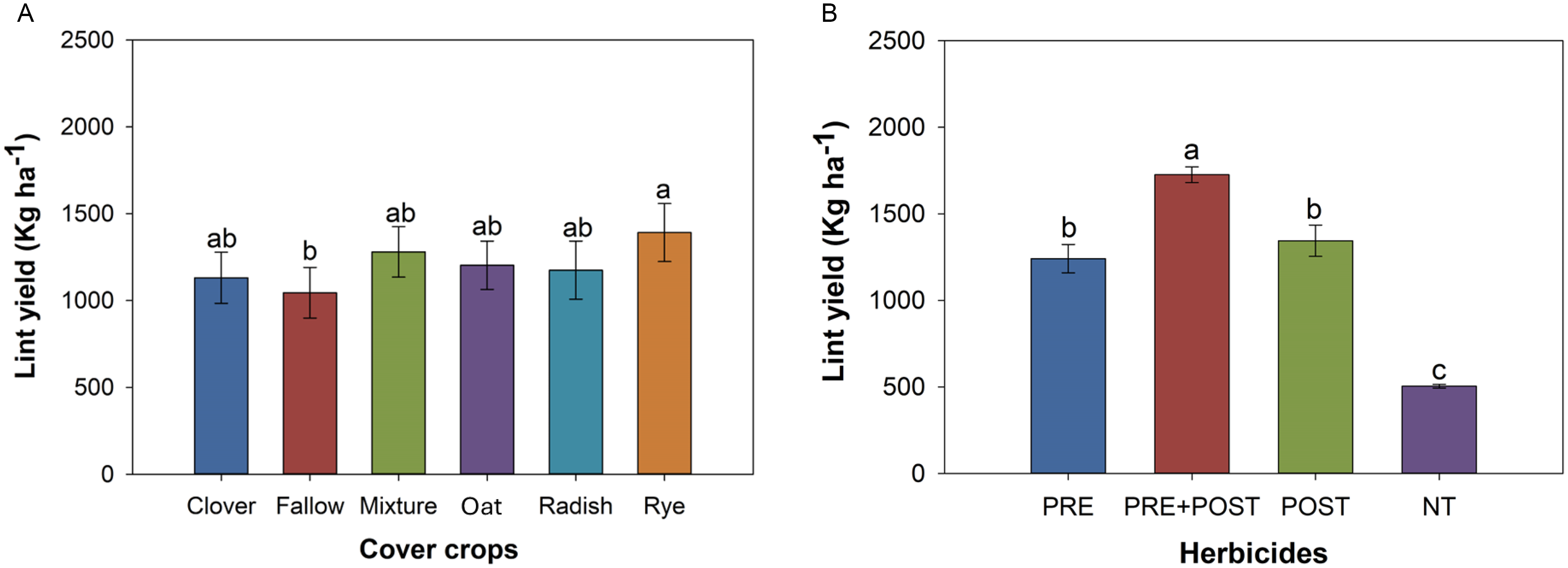
TVREC. The overall effect of cover crop and herbicide was significant (P < 0.001). Among cover crops, cotton in cereal rye plots produced better lint yield (1,392 kg ha–1) compared to winter fallow (1,045 kg ha–1) (Figure 3A). Previous research conducted in Alabama found that cotton planted in cereal rye plots provided more yield benefits compared with winter fallow (Kumari et al. Reference Kumari, Price, Korres, Gamble and Li2023a). The cotton plots receiving both preemergence + postemergence herbicide applications showed the highest lint yield (1,726 kg ha–1) due to season-long weed control, which subsequently enhanced the yield (Figure 3B). The cotton produced the statistically lowest lint yield of 504 kg ha–1 following NT check.
The effect of cover crops and herbicides on lint yield at Tennessee Valley Research and Extension Center. Means followed by the different Tukey letters showed a significant effect at significance level of 0.05. PRE, preemergence; POST, postemergence; NT, no treatment.
WREC . Overall herbicide effect was significant (P < 0.001), whereas there was no cover crop effect (Figure 4A). The cotton plots treated with both preemergence and postemergence herbicides yielded 2,277 kg ha–1, and those treated with only postemergence herbicides yielded 1,900 kg ha–1. These yields were statistically higher than those of the cotton plots treated with only preemergence herbicides (838 kg ha–1) and the NT check (115 kg ha–1) (Figure 4B).
The effect of cover crops and herbicides on lint yield at Wiregrass Research and Experimental Station. Means followed by the different Tukey letters showed a significant effect at significance level of 0.05. PRE, preemergence; POST, postemergence; NT, no treatment.

EVS. The overall effect of herbicide was found to be significant (P < 0.001), whereas no cover crop effect was observed (Figure 5A). The cotton plots that received both preemergence and postemergence herbicide applications achieved the highest lint yield of 860 kg ha–1 (Figure 5B). Cotton produced a lint yield of 768 kg ha–1 following the preemergence herbicide treatment, which was statistically greater than the yield from the postemergence-only treatment at 463 kg ha–1. The cotton plots produced the statistically lowest lint yield of 45 kg ha–1 following NT check. Aulakh et al. (Reference Aulakh, Price, Enloe, van Santen, Wehtje and Patterson2012) found that cotton plots treated with pendimethalin + fomesafen as preemergence herbicides resulted in a greater yield compared to the NT check in a cotton field infested with Palmer amaranth.
The effect of cover crops and herbicides on lint yield at E.V. Smith Research and Extension Center. Means followed by the different Tukey letters showed a significant effect at significance level of 0.05. PRE, preemergence; POST, postemergence; NT, no treatment.

Practical Implications
High-residue cover crops such as cereal rye led to early-season weed suppression only. A combination of cover crops excluding radish, with either pendimethalin + fomesafen (preemergence), dicamba + glyphosate + S-metolachlor (postemergence), or preemergence followed by postemergence, provided greater relative weed biomass reduction than winter fallow with either herbicide treatment. Specifically, cereal rye, crimson clover, oat, and cover crop mixture when treated with pendimethalin + fomesafen (preemergence) followed by dicamba + glyphosate + S-metolachlor (postemergence) herbicides, provided excellent weed control throughout the cotton growing season compared to radish and winter fallow plots.
Integration of suggested high-residue cover crops into herbicide regimes in conservation tillage cotton not only is a better weed management approach but also provides other soil health benefits in the southern United States. Future research should include other herbicide programs with cover crops under different management practices such as crop rotation to provide more options to growers for weed control recommendations.
Acknowledgments
We wish to thank Mr. James Bonnell, USDA ARS NSDL Technician, and staff at the E.V. Smith, Wiregrass, and Tennessee Valley Research and Extension Centers for their technical assistance. No conflicts of interest have been declared.
Funding
This research received no specific grant from any funding agency, commercial or not-for-profit sectors.
Competing Interests
The author(s) declare none.


 Open access

