


Setting the Ecotheatrical Scene: What Can Theatre Do?
The train of thought shaping this experimental essay reaches back to Una Chaudhuri’s landmark 1994 ecocritical provocation. There she described ‘ecological meanings’, in the real or imaginary presence of river effluent, ash-cans and other such detritus on stage, as ‘occluded’, and ‘unremarked’.Footnote 1 At first reading, I thought it likely that such specifically ecological meanings ‘might quite often be there for anyone minded to see them’.Footnote 2 Live theatre, after all, requires the stuff of the planet – flows of energy, matter, and information – situated in and around living bodies.Footnote 3 The very liveness of live theatre implies the possibility of direct access to real-world ecologies and ecological meanings. Nature, the environment, the biosphere (call it what you will) is always literally on stage, no matter what the subject matter of any given play, production or performance.Footnote 4 Live theatre is seen as an ecology, in its own right, in the work of such ecocritics as Theresa J. May (1994 and 2021);Footnote 5 Bonnie Marranca (1996);Footnote 6 Baz Kershaw (2007 and 2016);Footnote 7 Carl Lavery (2016);Footnote 8 and Lisa FitzGerald (2017).Footnote 9 The door is thus open for any spectator to see any live theatre production or performance as a playful co-creation of production, reception,Footnote 10 and the ambient environmental ‘shapeshifter’.Footnote 11
Can it still be the case, in 2025, that ecological meanings on stage are going ‘unremarked’? At first sight, this seems unlikely. Between 2000 and 2014, for example, the award-winning Ashden Directory collated a list of over 700 eco-productions.Footnote 12 The closure of the Directory, and its thought-provoking eco-blog, marked an impressive and ongoing proliferation in the presence of climate change in the arts. Yet, on the evidence of planetary degradation, the nature/culture divide persists. The steady erosion of nine planetary boundaries identified by the Stockholm Resilience Centre suggests an occlusion (on stage and off) of human society’s embeddedness in nature.Footnote 13
Perhaps this is why, in 2025, I find myself returning to Carl Lavery’s 2016 eco-theatrical provocation. His call for papers in a special edition of Green Letters asked, in relation to performance and the environmental crisis, ‘What Can Theatre Do?’ Introducing the collection, Lavery reminds the reader of the importance of the liveness of theatre as ‘something embodied, ephemeral, and affective’. As an ecocritical spectator I see abundant ecological meanings in live theatre, where flows of energy, matter, and ideas ‘create sensations and experiences in the here and now’.Footnote 14 On the basis that nature is (as I argue in my 2020 book) never off the stage (and never mere scenery), what could live theatre do to reveal the environment on stage?
Good nature writing is similar to good theatre, in delivering a vivid, lived experience. The liveness of each reading (which, like live performance, feels different every time) produces ‘embodied, ephemeral, affective’ experiences. Nature writing, like theatre, can seed a kernel in the memory – ‘an outline, a taste, a trace, a smell’ – poised for connection.Footnote 15 What Lavery calls the ‘ecocritical purchase’ of nature writing lies in the close connectivity forged between the reader and nature, through the embodied experience of the writer.Footnote 16 Through nature writing, I discover how it feels to learn (through the eyes of Robin Wall Kimmerer, Michael Malay, Mark Cocker, and many others) to disentangle the logic of how disguise appears in the wild. Perhaps such connections are all the more vibrant because, as a conservation volunteer, I sometimes follow a similar pathway. Out in the field, sweat prickles under my hat, my gaze settles, patterns cohere, and a living presence scrambles into view.Footnote 17
Asking, yet again, whether live theatre could bring humans closer to nature, I experimentally reframe ecocritical spectatorship as nature writing. Could theatre practitioners and their audiences, in the guise of nature writers and nature readers, see more clearly what theatre can do?
What We See When We Look: Nature Writ Large
Do you remember the first time you saw stick insects mimicking twigs, grasshoppers hiding in grassland, or minnows skulking invisibly in the shadows? When you follow the eyes of nature writers as they see wildlife hiding in plain sight, do you rediscover life itself as a creative act of collective memory? In nature writing, as in live theatre, life is a shapeshifter, forming ‘patterns of light and shadow’ in a tangled rainforest.Footnote 18 It is a ‘summer blizzard’ metamorphosing into a whisper of moths in the blink of an eye.Footnote 19 It is a murder of corvids masquerading as ‘a heavy foliage of black’ high up in the tree tops.Footnote 20
In an advancing wave of green, seen from afar in Macbeth, comes an army enwrapped in a leafy disguise, reported by a messenger: ‘I looked toward Birnam, and anon methought / The wood began to move.’Footnote 21 What spectators might collectively recognize, in this intense turning point in the play, is a messenger blinded by what he expected to see. In the camouflage of approaching soldiers carrying leafy branches, he saw witchcraft moving trees. We saw another man, Macbeth, entangled in the bewitching spiders’ web spun by three predatory ‘weïrd sisters’ (1.3.32). In such moments in live theatre, I see nature writ large: masquerade, manipulation, metamorphosis.
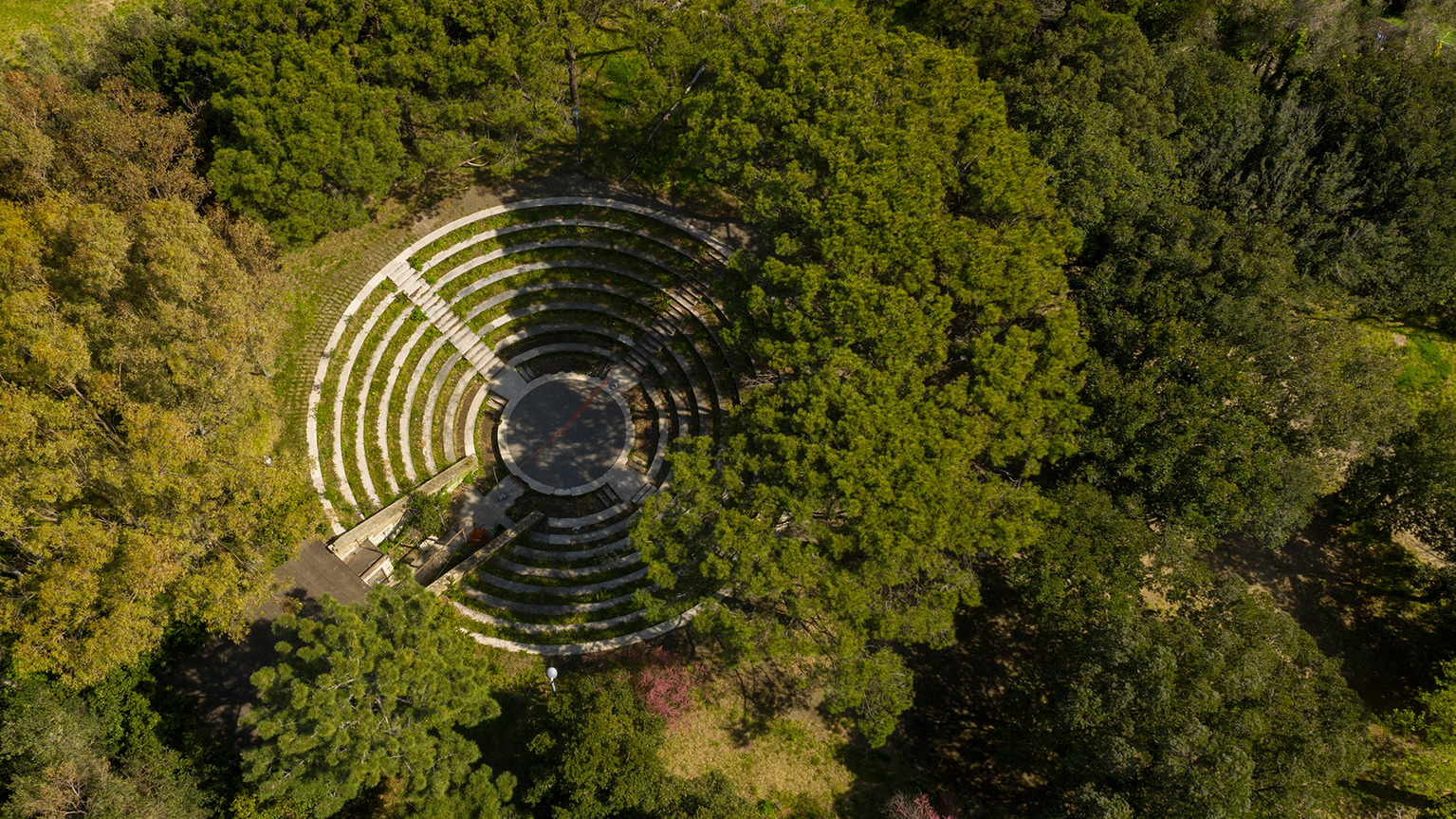
A round stage and a forest on the move in the photograph tap into memories of yet another play in another place (Figure 1). The June 2024 climate change play Kyoto opened with thunder and lightning, and ‘Seven Sisters’ encircling a wellbore.Footnote 22 If you saw this production in Stratford-upon-Avon, you, too, are sure to remember the unrecognizable RSC Swan Theatre thrust stage strikingly reconfigured as a huge, round negotiating table in polished wood. Depending on where you were sitting in the auditorium, you might also recall concentric shades of turquoise rippling under the polished black shoes of the alleged oily manipulator Don Pearlman (villainously played by Stephen Kunken). Perhaps you joined the ring of actors and other spectators with a seat at the table as a collaborator, in the hard-fought climate change conferences of the 1990s.
Trees greening an ancient theatre. Aerial view of the Amphitheatre of Virgiliano Park, Naples (n.d.). Stefano Tammaro/Shutterstock.com.
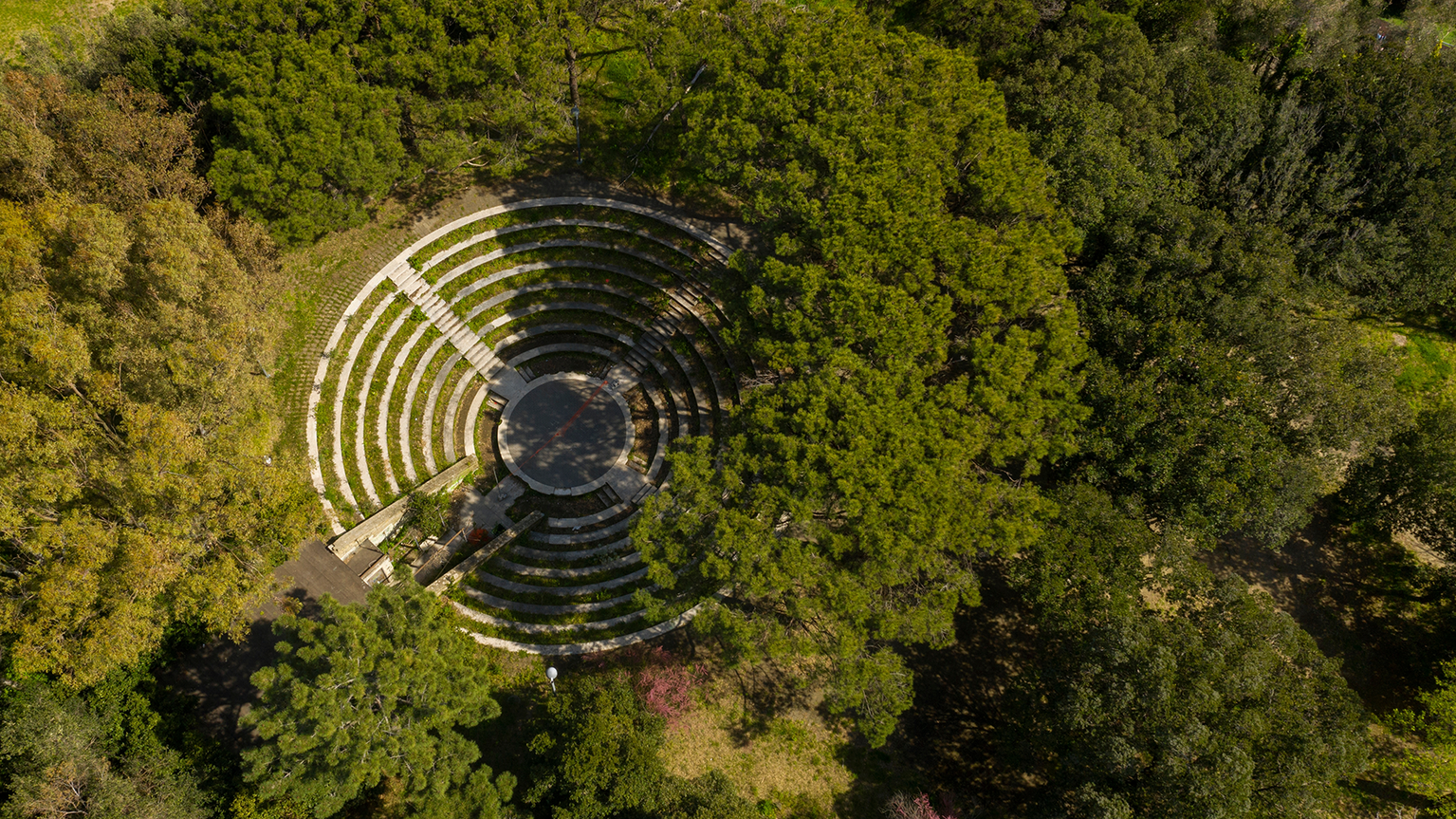
I wonder if your eyes travelled, as mine did, beyond the immediate camouflage of the stage set. Did this Shakespearean ‘wooden O’ remind you of tree rings in ancient forests cut off in their prime?Footnote 23 Did the turquoise shadows at Perlman’s feet call to mind a witches’ cauldron, an ocean gyre, or a slowly spinning global warming storm? Did you see climate negotiators sitting at the feet of the very ancient power they would challenge? When you think back to this enthralling RSC/Good Chance production, perhaps your mind sings the words of the three witches in Macbeth (4.1.10–11):
Double, double, toil and trouble;
Fire burn, and, cauldron bubble.
Designing Theatre: A Cauldron of Bats
I do not know how it feels to fly with a cauldron of bats,Footnote 24 a whisper of moths, or a storytelling of crows. Nor can I know for sure how other spectators experience live performances. However, one thing I know for sure is that I love the feeling of immersion in an audience. When we talk of bats, moths, and crows as a cauldron, a whisper, or a storytelling, such collective nouns capture the essence of live theatre as a collaborative act of memory. Individually and collectively, we spectators collude with theatre practitioners – ‘engineers of the imagination’Footnote 25 – in the joint enterprise of nature writing as theatre, defined as discovering what we see when we look.
In this production of Kyoto, the deceptively simple set delivered brilliant stagecraft and seamless scene shifting. A wellbore, a witches’ cauldron, and a negotiating table cleverly fused together in the imaginary eye of a storm, spun out in cinematographic storytelling. We followed the crafting of the 1997 Kyoto Treaty word by word, right down to the very last red line, full stop, and final clunk of the gavel.Footnote 26 There could be no such thing as behind-the-scenes in this epic, existential fight. Angry, sad, hysterical, confused, resigned, hungry, tired, sometimes downright comical 1990s corridor conversations no longer swirled invisibly in the wings. They were right there with us, sitting around us, sharing snacks, shouting at us to get out of the way, offering us a glass of ginger beer masquerading as alcoholic fizz (‘Go on, you know you want to’). As my description of Kyoto suggests, I was enthralled by this production as a thrilling, immersive take on treaty writing, but that was actually not what I saw when I looked.
Thunder and lightning. A hover, a chorus, a storytelling of tall figures encircling the wellbore sing of ‘the profit our natural resources bring’. Fuels boil and bubble deep down in the cauldron, ‘Where thick black tar transforms to oil’.Footnote 27 Standing closely together, looming large in long, heavy, dark coats, the Seven Sisters (neatly conjoining the oil cartel of yesteryear with the three witches of Macbeth) dominated the stage. The scene was set for them to tower over all of us every time they stood around the wellbore-cauldron or blatantly invaded the negotiating table itself. Standing together, they knew themselves to be an ineluctable force. This brings me to what I saw when I looked: everyone around the table was quite literally moved, mind and body, in these key scenes. Watching myself watching the audience watching a play in this metatheatrical set, I saw our heads move in a collective act of worship. As we unwittingly sat at the feet of the Seven Sisters, looking up, we were the very picture of fossil fuel adoration. In that memorable moment of revelation, produced by a witty alliance of fossil fuel energy and scenography, we were revealed as inescapably in the grip of more than one designing power.Footnote 28
Nature Writing as Text: A Whisper of Moths in the Veins of a Leaf
As I walked home from my local gym through the RSC garden on another day, cooling down after an energetic spin class, a fallen yellow maple leaf still dappled with green caught my eye. I picked it up by the stem, and ran my finger gently along its sawtooth edge. In the veins of a leaf held in the palm of my hand I found a whisper of moths and the words of a play. Later on, warming up with a steaming mug of fresh coffee, and two versions of theatre company Complicité’s Mnemonic (2001 and 2024) side by side, unopened, on the desk in front of me,Footnote 29 I picked up my maple leaf again. I closed my eyes and let my mind travel back, to the summer of 2024, when I took my seat in the Olivier Theatre in London, for Complicité’s long-awaited revival. If you have experienced Mnemonic as a spectator, you might be thinking back, with me, to an unforgettable act of memory, collectively performed.Footnote 30
When I think of nature writing, I think of the world of meaning in a leaf rustling underfoot, a stone carried down a mountain, a seashell whispering in my ear. I think of living things knowing how to act without a playbook, and a murmuration of actors finding their way to the next stage. Moths navigate by the moon, eels find their way to the Sargasso Sea and back, and newly fledged swifts launch themselves into a life on the wing without a rehearsal. In life itself, as a creative act of remembering collectively performed, nature writing finds a meandering pathway through the web. In Mnemonic, Complicité traces the ice-bound trajectory of a human body, living on after its release from the grip of a glacier. When the company first started devising this show, the play-texts I have on the desk in front of me did not exist. Each of the published texts is a mnemonic recalling a Mnemonic, becoming a mnemonic to yet another Mnemonic.
Today, the morning after Halloween, I silence my mobile phone, pick up the 2001 edition of the play-text, and read until I reach Simon McBurney speaking the words I am looking for (on page 7).Footnote 31 Then I close my eyes. I run a finger along the veins of my maple leaf. The prominent stem divides and divides again, eventually fading to a distant filigree of veins whispering through my fingertips. If you do this with me, do you also think of trees in winter tracing beautiful fractals against a blue winter sky? Does your mind jump to a tree of life stretching back through deep time, or do you land closer to home? Guided by Complicité’s memorable words, I see four generations standing behind me, amounting to a few hundred relatives. Travelling back to the first time Shakespeare’s three witches stirred a cauldron on a stormy heath, it seems that my extended family might amount to about one million, five hundred thousand ancestors. I recall, with pleasure, our collective chuckle, in Complicité’s audience on Tuesday, 9 July 2024, at the idea that that we could be related to ‘everyone sitting in this theatre’.Footnote 32 Nature writing is memory held in words on the page in a Complicité play-text, in the veins of a leaf, in the palm of our hands. In live theatre, nature is an electric spark, a whisper, a storytelling humming through the synapses of my brain and now perhaps yours, too.
Text as Nature Writing: Transformation, Evolution, Emergence
When Arctic ice melts, glaciers recede, and permafrost bubbles, a living ecosystem stirs. Plants green the land, worms wriggle in pursuit of ‘odoriferous’ morsels;Footnote 33 the food web branches and sprouts in a process mimicked by memory in the human brain. On the page, in the bookshelf, in a computer file, a play-text is the substrate that connects to living minds and bodies in production and reception. Taking a play-text from page to stage is not unlike warming dormant land. Energy, matter, and ideas, stored in the random black shapes imprinted on paper, are released.
The play-text Mnemonic and the revival of Mnemonic are quite literally acts of memory. Some of the collaborators in Complicité’s revival brought embodied knowledge to the reimagined Mnemonic in the summer of 2024. Having only read the 2001 play-text before turning up at the theatre, I wondered if Simon McBurney would again humorously remark that the matter of his ageing memory had become rather more than ‘a little pressing’ (p. 3). But it wasn’t McBurney – a fleeting tug of regret – but a new actor, Khalid Abdallah, who spoke the words in 2024.Footnote 34 What we saw when we looked was Abdallah travelling through time, sometimes in an apparently ‘illegal’ direction.Footnote 35 I think I saw (but cannot be entirely sure, as the memory fades): Abdallah becoming Simon becoming Virgil becoming Omar becoming the Iceman, performing and reperforming the intricate patterns in Complicité’s choreography.
In an article in the theatre programme, the actor Richard Katz wondered about ‘the less substantial fragments of our reconstruction … the ideas holding everything together’. In nature, as in nature writing, patterns found in rainforest trees, in the warp and weft of avian flight paths, or the ‘creative act … of assembly’ on stage, are themselves the designing power holding creation and re-creation together. Gently held in the veins of a leaf, woven through the soundscape of Mnemonic, was a much loved Complicité collaborator who had passed away suddenly in 2002. McBurney, writing in the theatre programme, describes recordings of her voice as present ‘amongst the intricate patterns we are trying to weave, as we re-make, re-member Mnemonic’: ‘She is here … inextricably part of the pattern of the show, the pattern of our memory, and now yours.’ For its audiences, Mnemonic in performance is a chaotic yet controlled interweave, layer upon layer of crossing pathways forged by humans on the move – questing for knowledge, searching for others, fleeing in fear. In revival it also re-performs the transformation of a puppet chair into old bones; the constant evolution of the ensemble of players; the emergence of new science from fragments shored by the ice for thousands of years.Footnote 36
Science suggested that the puppet master glacier had moved the interred Iceman in the play by 90 degrees over the course of 5,200 years. In the text, the Iceman slowly turns and shifts, in the flow of this glacial designing power. Whenever I return to Complicité’s text,Footnote 37 some pages are a mnemonic, recalling unforgettable scenes. In one such moment, I remember Omar recumbent on the stage floor.Footnote 38 He picked up a stone, turned it, and returned it to the ground. The body of actors, seemingly held in the soft fingers of a magnetic field, moved as one. Mirroring a stone moving in a human hand they became the Iceman, falling, turning, rising, continuing on. The mesmerizing movement of actors’ bodies on stage, flowing as one, is recaptured for me, and now perhaps captured for you, in this morsel of text.
Nature Writing in Performance: Sea Shell Susurrations
I stop, run the fingers of my right hand round a slightly bumpy weathered spiral, hold the shell to my ear, and listen. Continuing on, I follow the path marked by tangled strands of brown kelp left behind by the high tide. In my other hand I feel the tug of a black bin bag billowing and crackling in the wind. It is weighed down by plastic bottles, strands of blue plastic rope, the sole of a shoe. On another beach in another land are car tyres, plastic, crates, metal chains, oil cans, and sundry flotsam and jetsam. The round stage called into being by the whispered nothings of an empty shell was an island strewn with sand and scattered with ‘things where there shouldn’t be’, salvaged by the nine members of the play’s chorus from another way of life. This ‘shoreline of an island, a place where everything and everybody is washed up’, was designed (and so described) by scenographer Rae Smith for the 2021 National Theatre production on the Olivier stage of Kae Tempest’s play Paradise. Footnote 39
Should you be moved, as I was, to explore the ‘National Theatre at Home’ recording of this striking collaboration (in which director Ian Rickson and poet-playwright Kae Tempest worked closely together), you might also discover that it has yet another life. Paradise is a case study on the website of the Theatre Green Book, self-described as a collective of theatre communities who each individually ‘commit to becoming a sustainable theatre-maker’.Footnote 40 Paradise documentation includes a short National Theatre YouTube film (2021) in which Rickson describes his experience of designing theatre in the climate crisis: ‘the dynamics of the play have to be represented in the way you make the play.’Footnote 41 I think his comment applies to every live theatre production on the planet. For this to be possible, a creative team must become a storytelling of crows, a whisper of moths, a murmuration of nature writers, teasing out living ideas hiding in plain sight in a play-text. They must be skilled in the art of looking.
If you explore the Theatre Green Book ‘sustainable production’ case studies further, you might come across another Tempest – Shakespeare’s, in a production directed by Elizabeth Freestone for the RSC in 2023.Footnote 42 Here, too, sundry detritus – oil drums, plastic bottles and flip-flops – are washed up on a storm-ravaged shoreline. One of the RSC blogs describes a litter-picking search on a beach and in local streets, with help from the Stratford-upon-Avon’s litter pickers, Rubbish Friends.Footnote 43 As a spectator, I remember billowing dresses, beautifully stitched (as far as I could see) from black bin bags.Footnote 44 Looking back from this beach to the actor walking on water, on the stage set in Kyoto, I see in my mind’s eye a swarm of plastic fragments travelling thousands of miles through streams, rivers, and seas to the Great Pacific Garbage Gyre.Footnote 45
When I think of plastic, I think of humans joining sand-hopping scavengers on every shoreline; newly fledged swifts launching themselves into a life on the wing amid airborne microplastic pollution; and Amazonian bats ingesting plastic particles in the food they eat and the air they breathe. If, following the veins of a leaf, you imagine branching blood vessels in every nook and cranny of bodies and brains, plastic is there, too. Without a rehearsal, plastic has become an act of memory, collectively performed. Re-use and recycling on stage are an inevitable reminder of the danger, for every living thing on the planet, of drowning in an oversupply of recycled stuff. This RSC production of The Tempest stood in for an entire society in microcosm, struggling to escape from the grip of plastic as a resource-intensive designing power.
Actors and Spectators: A World in a ‘Wooden O’
Think, when we talk of horses, that you see them
Printing their proud hoofs i’th’ receiving earth.Footnote 46
I was at first mystified by The Tempest designer Tom Piper’s RSC blog (2023). He worried that re-using things on stage might risk the audience ‘thinking they are seeing the same thing over and over again’.Footnote 47 As a regular spectator of live theatre, I love seeing, and yet not seeing, the same things time and again. Mimicry, metamorphosis, and transformation are all part of the fun, and the same thing seen again on a stage is never the same.
Of course, I have to admit that I cannot possibly know how it feels to be the people sitting around me in the audience. Nevertheless, I do not think I am alone in following actors, productions, plays, design ideas, and sometimes even specific props, over and over again. I have not attempted to count how many times the three witches and their cauldron must have appeared on stage in four centuries of revivals. Kae Tempest’s play Paradise and this production of The Tempest repeated familiar tropes endlessly recycled in the media – trash, old tyres, plastic bags – to signpost environmental wreckage. In The Tempest, I know I was not the only spectator whose imagination saw shipwreck in artfully weathered wooden planks borrowed by Piper from another production in another theatre.
Re-reading his comment after Kyoto, I found myself returning to the final scene of that play, where the Seven Sisters speak directly to all of us in the audience: ‘You require from us what you want to do. / And we shall provide, for we Sisters are you.’Footnote 48
Just as the physical shape in the wraparound scenography in Kyoto moved mind and muscle in the collaborators sitting round the table, fossil fuels and plastics conjoin in shaping and reshaping absolutely everything we do, whether we know it or not. The challenge described by Piper hints at a theatre industry unconsciously in thrall to a consumer culture in which audiences are expected to demand more and more and more. Perhaps this is as true now as it was in 1994, when Una Chaudhuri wrote of unremarked ecologies, and almost nobody seemed to notice that Caryl Churchill’s 1994 play The Skriker is a climate change polemic.Footnote 49 To the point, one reviewer of Paradise described the ‘make-shift camp’ as a ‘lo-fi’ set, and was moved to explain that, with powerful writing and lead performances, lavish sets and costumes could be done without.Footnote 50
What we see, when we really look, is that an eco-aware theatre is the very opposite of a grim, austere mode of doing without. It is the ‘make-shift’ set seen, yet not seen, again and again. It is a living ‘complicity’ (or complicité) carved out by a whirlwind, an ocean gyre, a global warming storm, and a storytelling of actors and spectators.
Epilogue: The Designing Power We Need to Be
Today, my maple leaf returns me to 1990: I think of exhausted IPCC science pioneers, grappling with the complexities of global warming in their First Assessment Report.Footnote 51 September 1991: here are the two German hikers discovering a body in the Tyrolean Alps.Footnote 52 June 1992: a whirlwind of negotiation leading to the adoption of the United Nations Framework Convention on Climate Change.Footnote 53 1994: for Chaudhuri and Churchill, climate change seemingly goes unremarked. 2024: through the veins of a fallen maple leaf briefly rescued from decomposition, Mnemonic and Kyoto converge in 1997 Japan. Did Mnemonic’s early audiences (of the 1999 production or the 2001 and 2002–3 revivals) notice a fleeting fragment of climate science? In this key moment, Virgil wondered about the cause of the air current that had scattered airborne Saharan dust, darkening (and warming) the snowy surface of the Austrian Alps, thereby releasing the Iceman from his chilly tomb.Footnote 54 In 2024, every single one of the spectators I happened to chat with after the performance saw global warming as the force of nature moving the ice, and the Iceman.
In live theatre, on the page or on the stage, I see a spiralling seashell, a cauldron of bats, a whisper of moths; a whirlpool, an ocean gyre, a tornado; the eye of a storm, a cartel, a coven; a storytelling, a weather system rewriting a play, a murmuration of imaginations in full flight. Nature writing, on the page or the stage, is the designing power we need to see.