





Over the last several decades, Dodge and colleagues’ research on children’s hostile social-information processing has inspired one of the most theoretically influential and empirically supported perspectives on the development of aggression and conduct problems worldwide (e.g., Crick & Dodge, Reference Crick and Dodge1994; Dodge, Reference Dodge1980, Reference Dodge2024; Lansford et al., Reference Lansford, Malone, Dodge, Pettit and Bates2010). Voluminous research, whose review is beyond the scope of this article, has persuasively documented that aggressive children exhibit hostile biases when processing ambiguous social information. Those biases are evident at multiple processing steps, from being hypervigilant toward potentially hostile cues, to attributing hostile intent to others, to prioritizing hostile action plans. Recently, Dodge and colleagues (Dodge, Reference Dodge2024; Dodge et al., Reference Dodge, Bai, Godwin, Lansford, Bates, Pettit and Jones2022) proposed an important shift from this earlier approach, which focused on hostile biases in the separate steps children deploy as they process ambiguous social information, to a more trait-like, general latent construct of “hostile (or defensive) mindset”, conceptualized as a broadly negative worldview that guides their social and emotional functioning.
Since the seminal paper on the key role of abusive, harsh parenting in the origins of children’s hostile mindsets (Dodge et al., Reference Dodge, Bates and Pettit1990), robust empirical evidence has supported the role of harsh control (e.g., child maltreatment, corporal punishment, yelling, and physical and verbal threats) as a risk factor for hostile biases in social information processing and hostile mindset in peer contexts (Dodge, Reference Dodge2006; Nelson & Coyne, Reference Nelson and Coyne2009; Weiss et al., Reference Weiss, Dodge, Bates and Pettit1992). That research has often focused on families and children oversampled for harsh, even abusive discipline, and for children’s externalizing behaviors and conduct problems.
Of note, researchers have also studied other negative parenting aspects as associated with children’s hostile mindsets, such as rejection, unresponsiveness, or intrusiveness (e.g., Bodecka-Zych et al., Reference Bodecka-Zych, Nowakowska, Sarzyńska and Kuczyńska2025; Healy et al., Reference Healy, Murray, Cooper, Hughes and Halligan2015), as well as positive dimensions, such as affective mutuality or insightfulness (Czik et al., Reference Czik, Elizarov and Ziv2025; McElwain et al., Reference McElwain, Booth-LaForce, Lansford, Wu and Dyer2008). For the purpose of the present review, however, we focus on the parental dimension of control, and specifically power assertion, harshness, punitiveness, sometimes referred to as authoritarian discipline, either observed or reported. It is important to keep in mind that in various studies, the constructs of power assertion have varied widely in types and intensity of behaviors they denoted – from mild, firm, or strict verbal control, warnings, rebukes, or minor threats, occasional light spanking, restricting activities, and non-physical punishments, part of typical parenting in virtually all families – to severe or abusive child maltreatment. This complex nature of the concept of power assertion is well known (Hoffman, Reference Hoffman, Higgins, Ruble and Hartup1983; Larzelere et al., Reference Larzelere, Gunnoe, Pritsker and Ferguson2024; Weiss et al., Reference Weiss, Dodge, Bates and Pettit1992).
Generally, the extant evidence has consistently demonstrated that parental increased reliance on power-assertive strategies is associated with increased risk of children forming hostile mindsets. Hostile mindsets have been typically assessed as children’s responses to sequential questions targeting their social-information processing, elicited by vignettes depicting acts of provocation or rejection by peers whose intentions are portrayed as ambiguous.
As examples, Runions and Keating (Reference Runions and Keating2007), using data from the large NICHD study of early child care, reported that mothers’ self-endorsed authoritarian attitudes, assessed in infancy, predicted children’s hostile attributions of intent and aggressive response planning in measures of their mindsets in first grade, although observed negative parenting across the first three years was unrelated to those measures. Ziv and Arbel (Reference Ziv and Arbel2020) reported similar findings, such that mothers’ authoritarian parenting and perception of conflict with their children were related to children’s tendency to generate incompetent social responses, and further mediated the link between mothers’ and children’s hostile attributional biases. Ziv et al. (Reference Ziv, Kupermintz and Aviezer2016) reported that observed maternal negative control in interactions with their 5-year-old children predicted some aspects of children’s hostile social-information processing (maladaptive response evaluation). Gomez et al. (Reference Gomez, Gomez, DeMello and Tallent2001) found that children who perceived their mothers’ discipline negatively had higher scores in several steps of hostile information processing measures a year later. Weiss et al. (Reference Weiss, Dodge, Bates and Pettit1992) found that parent-reported harsh discipline strategies were associated with children’s greater hostile processing biases in two large cohorts of preschool children; in those samples, Dodge et al. (Reference Dodge, Pettit, Bates and Valente1995) found that experiences of physical abuse, reported by the parents, were positively associated with children’s multiple hostile processing biases. Galán et al. (Reference Galán, Choe, Forbes and Shaw2017) found that mothers’ observed punitiveness during interactions with their toddler sons predicted children’s more hostile mindsets at age 10, although the findings were mostly for African American families.
The associations between harsh or power-assertive parenting and children’s hostile mindsets have been typically explained in terms of the consequences of early relational experiences on the process of forming one’s internal models of the social world. Early experiences of threatening, harmful, or harshly punitive discipline impact children’s worldviews and expectations of others, which generalize and naturally lead to vigilance toward others’ potentially threatening actions, attributions of hostile intent to others, and reliance on defensive or aggressive responses (Dodge, Reference Dodge2024; Dodge et al., Reference Dodge, Bates and Pettit1990). Such a perspective closely dovetails and is synergistic with attachment-informed models, in which children’s hostile or benign worldviews are seen as formed in the context of early parent–child relationships and ultimately become broader interpretive filters, generalizing from early experience (Bowlby, Reference Bowlby1969/1982; Bretherton & Munholland, Reference Bretherton, Munholland, Cassidy and Shaver2008; Carlson et al., Reference Carlson, Sroufe and Egeland2004; Dykas & Cassidy, Reference Dykas and Cassidy2011; Dykas et al., Reference Dykas, Ehrlich and Cassidy2011; L. A. Sroufe et al., Reference Sroufe, Coffino and Carlson2010; Thompson, Reference Thompson, Thompson, Simpson and Berlin2021). Indeed, Czik et al. (Reference Czik, Elizarov and Ziv2025) explicitly applied the attachment theory lens to research on origins of children’s hostile biases in social-information processing.
Such a view is certainly conceptually compelling and supported by empirical evidence, and yet, that research opens several research questions that invite a fuller exploration. One, what specific mechanisms account for the effects of power-assertive control on children’s hostile mindsets? Such mediators have not been extensively studied. As the first aim of our work, we test an equifinality hypothesis, which proposes that early parental power-assertive control leads to children’s hostile mindsets via two paths: a diminished ability to understand others’ perspectives, or theory of mind (ToM) skills, and poor regulation capacities. Both ToM and regulation develop within the social context of the parent–child relationship during early years, and they are crucial skills for properly interpreting and reacting to social situations (e.g., Hughes & Leekam, Reference Hughes and Leekam2004; Olson & Lunkenheimer, Reference Olson, Lunkenheimer and Sameroff2009).
Of note, the link between power-assertive parenting and children’s antisocial, aggressive outcomes, although common, is not universal. Multiple studies have indicated that those relations are more nuanced and can be conditioned on other factors. For example, although detrimental in White families, power-assertive parenting may not have negative consequences in Asian or African American families (Chao, Reference Chao1994; Deater-Deckard & Dodge, Reference Deater-Deckard and Dodge1997; Deater-Deckard et al., Reference Deater-Deckard, Dodge, Bates and Pettit1996; Lansford et al., Reference Lansford, Deater-Deckard, Dodge, Bates and Pettit2004; Stacks et al., Reference Stacks, Oshio, Gerard and Roe2009).
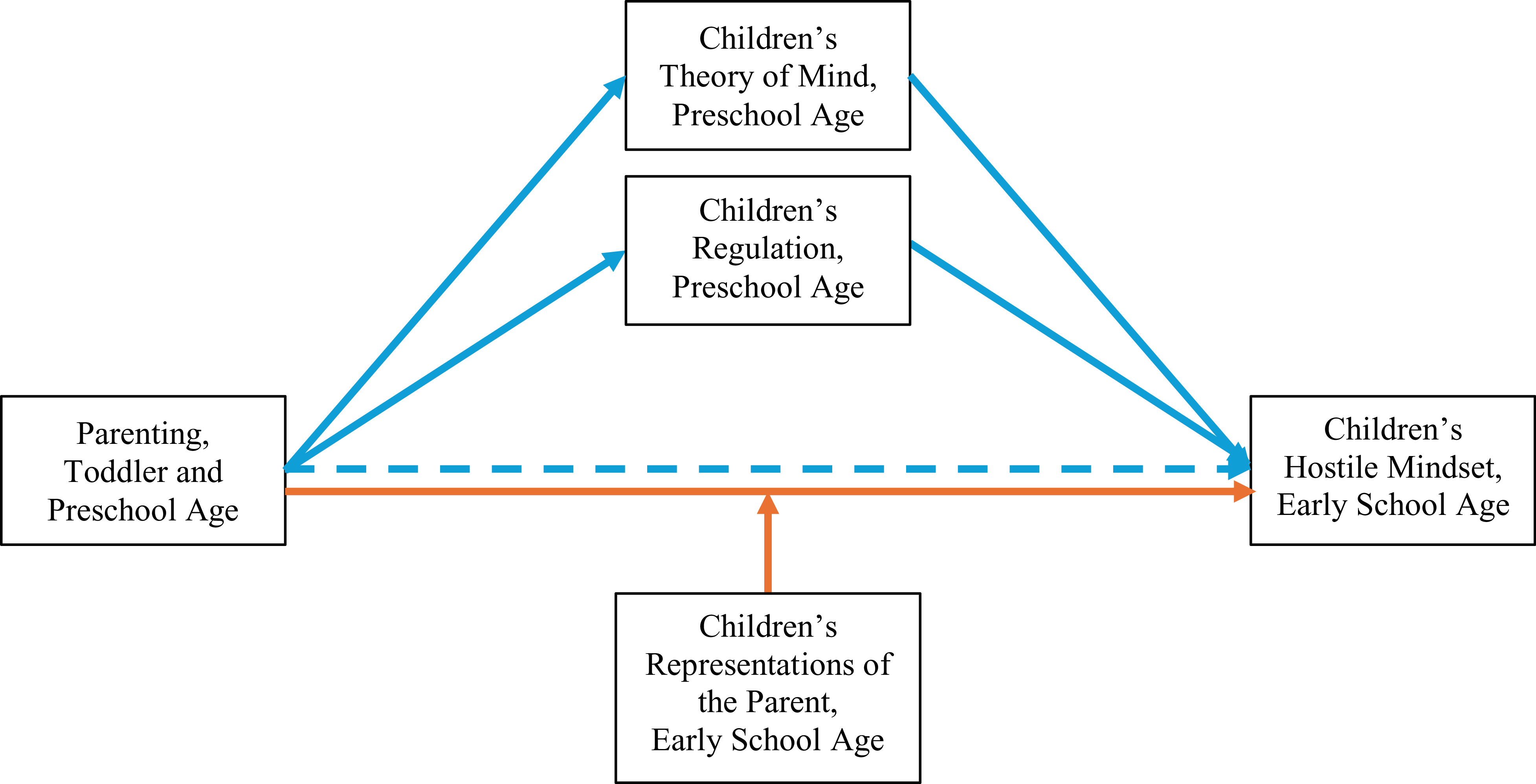
This body of research has inspired our second question: What factors can moderate the effects of negative control on children’s hostile mindsets? Very little research has examined this question. As the second aim, we test a multifinality hypothesis, which proposes that children’s representations of the parent as responsive and reliably providing comfort and effective help in times of stress can buffer the negative effects of parental power-assertive control. We draw on recent findings that have robustly supported such moderation effects in several longitudinal studies that considered a range of socialization outcomes (Herbert et al., Reference Herbert, Kim and Kochanska2026; Kochanska & An, Reference Kochanska and An2024a, Reference Kochanska and An2024b; Kochanska et al., Reference Kochanska, Boldt and Goffin2019). The comprehensive model, inspired by a developmental psychopathology framework (Cicchetti & Rogosch, Reference Cicchetti and Rogosch1996) and integrating equifinality and multifinality, is depicted in Figure 1.
Proposed model of equifinality and multifinality in developmental paths from parenting to children’s hostile mindset. Blue lines represent paths related to equifinality (i.e., parallel mediation via theory of mind and regulation), and orange lines represent paths related to multifinality (i.e., moderation by children’s representations of the parent).

The first aim: equifinality in paths from parenting to hostile mindset, with the child’s ToM and regulation as parallel mediators
Children’s ToM as a mediator of links between parenting and hostile mindset
Parenting and ToM. ToM refers to the ability to understand others’ perspectives and behaviors by attributing mental states (Devine & Hughes, Reference Devine and Hughes2018). Literature linking broadly conceived qualities of parenting with children’s ToM skills is vast, beyond the scope of this article. Multiple studies and reviews have linked various aspects of negative parenting, such as negative affect and harsh control, including maltreatment, to children’s diminished ToM and other aspects of social cognition (Hughes et al., Reference Hughes, Deater-Deckard and Cutting1999; Olson et al., Reference Olson, Lopez-Duran, Lunkenheimer, Chang and Sameroff2011; see also reviews by Luke & Banerjee, Reference Luke and Banerjee2013; Pavarini et al., Reference Pavarini, de Hollanda Souza and Hawk2013).
ToM and Hostile Mindset. Although surprisingly limited, there is also evidence of associations between children’s ToM and their hostile mindsets. Killen et al. (Reference Killen, Mulvey, Richardson, Jampol and Woodward2011), in two studies of children between ages 3.5 and 7.5, found that children who had failed to pass ToM tasks were more likely to attribute hostile intentions and to find harsh punishment acceptable in response to vignettes depicting “an incidental transgressor”. Studying young adults, Koo et al. (Reference Koo, Kim, Seo, Park, Min, Bang, Park, Lee and An2022) found that those with lower ToM skills were more likely to show hostile biases in their interpretations of ambiguous vignettes. However, not all studies have supported associations between ToM and hostile mindsets (van Dijk et al., Reference van Dijk, de Castro, Thomaes and Poorthuis2018).
Children’s regulation as a mediator of links between parenting and hostile mindset
Parenting and Children’s Regulation. Regulation is an extremely broad umbrella term that encompasses multiple phenomena and constructs such as self-control, delay of gratification, inhibitory control, effortful control, executive functions, and many others (Cole et al., Reference Cole, Ram and English2019; Eisenberg et al., Reference Eisenberg, Spinrad, Hernández and Zuffianò2024; Gagne, Reference Gagne2017; Kopp, Reference Kopp1982; Rothbart & Bates, Reference Rothbart, Bates, Damon, Lerner and Eisenberg2006), at times referred to as the “self-regulation universe” (Nigg, Reference Nigg2017). The literature on the role of parenting in the development of regulation is equally massive (Boldt et al., Reference Boldt, Goffin and Kochanska2020; Bridgett et al., Reference Bridgett, Burt, Edwards and Deater-Deckard2015; Corapci et al., Reference Corapci, Susa-Erdogan and Benga2025; Eisenberg et al., Reference Eisenberg, Spinrad, Hernández and Zuffianò2024; Kochanska et al., Reference Kochanska, Murray and Harlan2000; Thompson, Reference Thompson, Damon, Lerner and Eisenberg2006). Although a review is beyond the scope of this article, robust evidence supports a detrimental role of power-assertive parental control on regulation, even in community families, in which control is rarely harsh (Čepukienė & Janulevičė, Reference Čepukienė and Janulevičė2025; Kochanska & Knaack, Reference Kochanska and Knaack2003), although multifinality in those effects has also been documented (Chang et al., Reference Chang, Olson, Sameroff and Sexton2011; J. Kim & Kochanska, Reference Kim and Kochanska2026a; S. Kim & Kochanska, Reference Kim and Kochanska2026).
Regulation and Children’s Hostile Mindset. As mentioned, regulation can encompass a broad variety of phenomena, and many of its aspects have been studied in relation to children’s hostile information processing, generally indicating that better regulation was associated with less hostile and more adaptive mindsets. Most pertinent studies have examined emotion regulation in connection with hostile mindsets, following Lemerise and Arsenio’s (Reference Lemerise and Arsenio2000) proposal that emotion (dys)regulation influenced all steps of children’s social-information processing outlined by Crick and Dodge (Reference Crick and Dodge1994). In their review of pertinent literature, Smeijers et al. (Reference Smeijers, Benbouriche and Garofalo2020) identified four studies that confirmed an association between emotion dysregulation and hostile social-information processing (Calvete & Orue, Reference Calvete and Orue2012; Gagnon et al., Reference Gagnon, McDuff, Daelman and Fournier2015; Helmsen et al., Reference Helmsen, Koglin and Petermann2012; Orobio de Castro et al., Reference Orobio de Castro, Merk, Koops, Veerman and Bosch2005). Colton et al. (Reference Colton, Godleski and Crane2023) found positive links between college students’ self-reported emotion dysregulation and their hostile attributional biases.
Some studies have examined executive function skills as measures of regulation. Caporaso et al. (Reference Caporaso, Marcovitch and Boseovski2021) found that preschool children with better pertinent skills (e.g., working memory, cognitive flexibility) engaged in more adaptive, or less hostile, social-information processing steps.
Parenting, ToM, and regulation as predictors of hostile mindset
Only a few studies have included several factors – ToM, regulation, and parenting – as predictors of children’s hostile mindset. In a group of children oversampled for conduct problems, Choe et al. (Reference Choe, Lane, Grabell and Olson2013) examined their ToM and regulation (using effortful control tasks) at ages 3.5 and 5–6, and hostile mindsets at age 5–6. Better ToM skills robustly predicted lower levels of hostile mindsets. Better regulation was also robustly related to lower hostile mindsets in correlational analyses (although not in complex total models that included several other predictors). Regulation also moderated the effects of ToM on hostile mindsets. However, no parenting measures were considered.
One study, predicting hostile mindsets from ToM and latent profile membership of executive function, revealed complex longitudinal relations depending on the type of hostile mindsets and ToM (i.e., cognitive and affective), executive function profile membership, and child gender (Brandt et al., Reference Brandt, Bondü and Elsner2025). This study, however, did not measure parenting and included older participants (early adolescence at the first time point and late adolescence to emerging adulthood at the second time point).
Using the same sample as Choe et al. (Reference Choe, Lane, Grabell and Olson2013), Lee et al. (Reference Lee, Chang, Ip and Olson2019) examined mother-reported use of harsh discipline, and children’s ToM, regulation, and hostile mindset at age 6. There were significant negative correlations between ToM and hostile mindset and between regulation and hostile mindsets, and positive correlations between maternal reports of harsh control and hostile mindsets. Those relations, however, were not significant in the overall regression with multiple other constructs, including maternal attributional styles regarding child behavior.
Although these studies were very valuable in delineating associations among parenting, children’s ToM, regulation, and hostile mindsets, they did not specifically test formal mediational paths from parenting to ToM and regulation to hostile mindsets. Further, the parenting measures were based on mothers’ reports.
The second aim: multifinality in paths from parenting to hostile mindset, with the child’s representation of the parent as a moderator
Multifinality – one of the key tenets of developmental psychopathology – refers to the assumption that a causal factor may lead to different outcomes and trigger varying developmental paths, depending on other factors or their combinations (Cicchetti & Rogosch, Reference Cicchetti and Rogosch1996). To our knowledge, however, few, if any, studies have applied the multifinality perspective to examine associations between negative parenting and children’s hostile mindsets.
Although detrimental effects of parental physical, hostile, forceful, harshly power-assertive, and abusive control are well recognized (e.g., Dodge et al., Reference Dodge, Bates and Pettit1990; Gershoff, Reference Gershoff2002), there is much less consensus on milder forms of power assertion, non-abusive discipline, routinely practiced by parents in typical, low-risk families during interactions with their young children (Larzelere et al., Reference Larzelere, Knowles, Henry and Ritchie2018; Lin et al., Reference Lin, Ritchie and Larzelere2020; Ritchie, Reference Ritchie1999). Such power assertion may include direct, strong, firm, insistent commands or prohibitions, issued in a “means-business”, decisive tone or in a raised voice, warnings about potential consequences for noncompliance, taking a toy away from a child, use of mild physical pressure to force child attention when insisting on compliance, stopping the child physically from a prohibited behavior, or mild spanking on rare occasions.
As reviewed earlier, research has persuasively indicated that effects of such common forms of power assertion can be substantially moderated by other factors, such as culture or ethnicity. As well, qualities of the parent–child relationship, such as security of attachment, have been shown to moderate effects of power-assertive control (see Bendel-Stenzel et al., Reference Bendel-Stenzel, An and Kochanska2023; S. Kim & Kochanska, Reference Kim and Kochanska2026; Kochanska & An, Reference Kochanska and An2024b; Kochanska et al., Reference Kochanska, Boldt and Goffin2019; Kochanska & S. Kim, Reference Kochanska and Kim2012 for reviews). Research has also supported the moderating role of children’s perception of parental power assertion; in an international large study, effects of harsh discipline were more adverse when children perceived it as being nonnormative than when they perceived it as being normative (Gershoff et al., Reference Gershoff, Grogan-Kaylor, Lansford, Chang, Zelli, Deater-Deckard and Dodge2010; Lansford et al., Reference Lansford, Malone, Dodge, Chang, Chaudhary, Tapanya, Oburu and Deater-Deckard2010). Most recently, informed by the attachment framework, Kochanska et al. (Reference Kochanska, Boldt and Goffin2019) proposed that children’s positive representations of the parent as responsive and reliably providing comfort and effective help in times of stress can substantially defuse or buffer negative effects of parental power assertion. This hypothesis was supported in several studies (Herbert et al., Reference Herbert, Kim and Kochanska2026; Kochanska & An, Reference Kochanska and An2024a).
We extend those findings to the current study to examine whether a similar moderation process can be identified in examining the effects of parental power assertion on children’s hostile mindset. We expected that children’s positive representations of the parent would moderate negative effects of power assertion and thus would account for multifinality, with the effects defused or buffered for children who view their parents as caring, trustworthy, and responsive, but present for children who view their parents as rejecting, unresponsive, and untrustworthy.
The current study
We followed Dodge’s (Dodge, Reference Dodge2024; Dodge et al., Reference Dodge, Bai, Godwin, Lansford, Bates, Pettit and Jones2022) recent model of a trait-like approach to hostile (or defensive) mindset that subsumes the consecutive social-information processing steps. To that effect, we aggregated across children’s responses to questions that targeted the consecutive steps and across several instruments utilizing vignettes depicting instances of harm/provocation and rejection in ambiguous peer contexts.
As mentioned earlier, we know relatively little about effects of parenting on hostile mindsets in low-risk families. In those families, parents routinely use power-assertive control to discipline and regulate behavior of their young children (Ritchie, Reference Ritchie1999; Vittrup et al., Reference Vittrup, Holden and Buck2006), but parental control rarely, if ever, rises to harmful, abusive, or threatening levels. Further, almost all studies have been conducted only with mothers and children, leaving a substantial gap in our knowledge about paternal influence. To address these limitations, we studied a community sample of generally well-functioning families with typically developing children (Children and Parents Study, CAPS), and collected parallel data in mother- and father–child dyads to permit the exploration of the examined processes in the two relationships.
We tested our comprehensive model of paths from early parental control to children’s future hostile mindset. The model encompasses both equifinality (mediation via both ToM and regulation) and multifinality (moderation by children’s representation of the parent). Utilizing observational and interview measures, we assessed parenting at toddler and preschool age, children’s ToM and regulation at preschool age, and children’s hostile mindsets and representations of the parent at early school age.
Method
Participants
CAPS included 200 families in U.S. Midwest (mothers, fathers, and typically developing 8-month-old biological children, 96 girls and 104 boys, born in 2017 and 2018). Parents responded to recruitment flyers, advertisements, posters, and social media posts distributed in various venues frequented by families. They were mostly White, but 20% of families included one or both non-White parents. Supplemental Table S1 presents demographic information.
All data were collected during 2–3.5-hour scripted sessions conducted by experimenters (Es) in a naturalistic university laboratory including a Living Room and a Play Room. We report data collected at age 3, N = 175, 86 girls, 89 boys, at age 4.5, N = 177, 86 girls, 91 boys, and at age 6.5 years, N = 153, 80 girls, 73 boys. Attrition was mostly due to the COVID-19 pandemic; some families chose to provide online data (included in the Ns reported above). The sessions were videorecorded for future coding by multiple teams. Between 15% and 20% of cases were routinely used for reliability, followed by frequent realignments. Parents completed informed consent, and the Institutional Review Board at the University of Iowa approved the study (Children and Parents Study, CAPS, 201701705).
Predictors: mothers’ and fathers’ power-assertive control, age 3–4.5
At age 3 years and at age 4.5 years, parental power assertion was coded in contexts designed to elicit typical control: toy cleanup (10 min) and naturalistic interactions, including introduction to the laboratory (5 min), snack prohibition (5 min), snack (5 min), and play (5 min). For details, see J. Kim and Kochanska (Reference Kim and Kochanska2026a) and S. Kim and Kochanska (Reference Kim and Kochanska2026). Details of coding and data reduction are in Supplement 2. Briefly, we coded parental power assertion for each 30-s segment in toy cleanups and for each 20-s segment in naturalistic interactions, using one of four codes that reflected increasing use of power assertion, from 1 = no control to 4 = forceful, harsh control (reliability, weighted kappas, 0.61–0.92 for toy cleanup and 0.83–0.85 for naturalistic interactions). To create robust scores based on 60 min of coded observations, we weighted and aggregated the scores across both contexts for age 3 and age 4.5, and across both ages, forming one composite power assertion score for each parent. Boys received more power assertion than girls from mothers, boys, M = 0.20, SD = 0.75, girls, M = -0.19, SD = 0.64, t(169) = -3.65, p < .001, and from fathers, boys, M = 0.17, SD = 0.74, girls, M = -0.19, SD = 0.68, t(159) = -3.21, p = .002.
Mediator: children’s ToM, age 4.5
The description is brief, as details are in Kochanska et al. (Reference Kochanska, Bendel-Stenzel, An and Sivagurunathan2025). We used four well-established false-belief tasks (Hughes et al., Reference Hughes, Jaffee, Happé, Taylor, Caspi and Moffitt2005): unexpected contents (Band-Aid Box story), unexpected location (Andy’s Apple and New Toy stories), and belief-desire (Juice story). The tasks employed appropriate pictures, puppets, and props. Coding followed Hughes et al. (Reference Hughes, Jaffee, Happé, Taylor, Caspi and Moffitt2005, pp. 369–370). Coders assigned scores of either 0 or 1 to each critical test question asked per story (the child had to respond correctly to control questions to earn a point). Reliability, kappas, ranged from 0.87 to 1.00. The total ToM score was the sum of scores across tasks. For analyses, we standardized this total score. There was no difference due to child gender.
Mediator: children’s regulation, age 4.5
We used tasks calling for effortful control, or deliberate suppression of the dominant response and performing a subdominant response (Kochanska et al., Reference Kochanska, Murray and Harlan2000; Rothbart & Bates, Reference Rothbart, Bates, Damon, Lerner and Eisenberg2006), in two delay tasks and one set-shifting task (see J. Kim & Kochanska, Reference Kim and Kochanska2026a and Supplement 2, for details of procedures and coding). The two delay tasks were essentially similar, with slightly different details, and both involved the child waiting to open a gift. The set-shifting, Stroop-like task, Day/Night and Snow/Grass, was adapted from Carlson & Moses (Reference Carlson and Moses2001).
Children’s performance correlated across the tasks (ranging from .18, p = .03 to .53, p < .001), with higher scores indicating better regulation, and they were aggregated into a composite of regulation. Girls outperformed boys, girls, M = 0.10, SD = 0.59, boys, M = -0.13, SD = 0.63, t(155) = 2.27, p = .012.
Moderator: children’s representations of the parents, age 6.5
E presented the child with three stories depicting the child with the mother and three with the father. Small doll figures and props (furniture, dishes, trees, etc.) were used in all stories. The mother and father stories were analogous (Heavy pitcher/Hot pizza, Scooter/Teeter-Totter, Centipede/Rat, and a warmup story, Birthday Party, not coded). Originally inspired by MacArthur Story Stems Battery (MSSB; Bretherton et al., Reference Bretherton, Ridgeway, Cassidy, Greenberg, Cicchetti and Cummings1990; Buchsbaum & Emde, Reference Buchsbaum and Emde1990; Holmberg et al., Reference Holmberg, Robinson, Corbitt-Price and Wiener2007; Oppenheim et al., Reference Oppenheim, Emde and Warren1997), the stories were further adapted from Davies et al. (Reference Davies, Coe, Hentges, Sturge-Apple and van der Kloet2018). The parent issued a prohibition or a stern directive to the child (e.g., “Don”t touch hot food”; “Go to bed”), and the child disobeyed and was hurt (burned, injured), or the child became frightened. Having presented the story stem, E asked the child to show and tell what happened next. Details of stories and coding are in Supplement 2.
For each story, we coded Good Representation of the parent, i.e., children’s representations of the parent as responsive and reliably providing comfort and effective help in times of stress, operationalized as depiction of the parent as protective, forgiving, helpful, empathic, reassuring, trustworthy, and competent. We followed several studies that used similar story stems. Those studies defined “positive representation of the parent” as a portrayal of the story parent as protective, providing caregiving, caring, affectionate, warm, or helpful (Toth et al., Reference Toth, Cicchetti, Macfie and Emde1997, Reference Toth, Cicchetti, MacFie, Maughan and Vanmeenen2000). We coded Good Representation from 0 = no evidence, to 1 = some evidence, to 2 = clear evidence, to 3 = strong, somewhat consistent, detailed evidence, to 4 = rich, abundant evidence. Reliability, weighted kappa, was .81. We also coded evidence of the story parent providing comfort (Comforting) as 0 = absent, 1 = present. Reliability, kappa, was .82.
The scores correlated across the three stories for both Good Representations, rs (139) = 0.39–0.65 and rs (123) = 0.36–0.49, ps < 0.001, and Comforting, rs (139) = 0.19–0.50 and rs (123) = 0.26–0.37, ps < 0.05, 0.01 or 0.001, for mother–child and father–child dyads, respectively. Thus, the scores were averaged across the three stories. The two scores correlated, r(139) = .67 and r(123) = .75, both ps < 0.001, for mother and father representations, respectively; they were standardized and aggregated into the score of the child’s positive representation (of each parent). Higher scores denote more positive representations. Girls had more positive representations of their mothers than boys, girls, M = 0.33, SD = 0.62, boys, M = -0.40, SD = 1.04, t(96.86) = 4.92, and of their fathers, girls, M = 0.26, SD = 0.72, boys, M = -0.31, SD = 1.06, t(94.06) = 3.38, both ps < 0.001.
Outcome: children’s hostile mindset, age 6.5
Ambiguous stories
We adapted (with permission) eight stories, each accompanied by a color vignette, from the original battery (Dodge et al., Reference Dodge, Bates and Pettit1990, Reference Dodge, Pettit, Bates and Valente1995; Weiss et al., Reference Weiss, Dodge, Bates and Pettit1992), depicting a child protagonist and another child or children (all matching the participant in gender). The protagonist, to whom E refers as “you” (“imagine that you are …”), is a recipient of a harmful act (in six stories, physical harm, e.g., hit by a ball, tripped and falling, and in two stories, peer rejection, e.g., rebuffed when wanting to join peers in play). The pictures made the intent of the other child(ren) ambiguous by carefully depicting neutral facial expressions. E read each story to the child, and then, pointing to the protagonist, asked the child a series of five consecutive questions (“why do you think the other child [describe behavior]”, “did s/he do this on purpose or not”, “what would be the first thing you would feel”, ‘what would be the first thing you would want to do”, “what would be a good thing to do”).
Coding. For each question, two aspects of the child’s response were coded: Hostile and benign (the latter not considered here). Hostile responses included attribution of intent (“because he wanted to hurt me”, “he hates me”, “on purpose”), feeling angry, wanting to yell, hit, kick, hurt him, and viewing an aggressive response as good. The codes ranged from 0 = no evidence, to 1 = unclear/maybe, or 2 = strong, clear evidence. Reliabilities of coding, weighted kappas, ranged from .65 to .94.
Data reduction. First, for each series of stories (six depicting harm, and two depicting rejection), we computed means for each hostile response across the stories (for each of the five questions). We then averaged those scores across the harm and rejection stories (all correlations were significant at p < .001). Finally, to form the overall composite score of hostile responses in the stories, we averaged those five variables (Cronbach’s alpha = 0.65).
Cartoons
This measure was based on Intention Attribution Test for Children (IAT; Vanwalleghem et al., Reference Vanwalleghem, Miljkovitch, Counsell, Atkinson and Vinter2020). We used a series of 12 (out of 16) cartoon strips, each consisting of three color vignettes, presenting situations in which the child protagonist experiences harm caused by another character whose intention is ambiguous or the act is nonintentional. We followed the procedure from Vanwalleghem et al. (Reference Vanwalleghem, Miljkovitch, Counsell, Atkinson and Vinter2020): Upon the presentation of each strip, E asked the child to imagine that he or she was the protagonist and then asked what happened in the pictures. If the child’s response did not clearly indicate hostile or benign intention attributed to the harm doer, E asked standard follow-up questions, to the point of a forced choice. Responses to each cartoon strip were coded as 1 = hostile attribution, or 0 = non-hostile attribution. We used the sum of the former across the 12 cartoon strips as the overall composite of hostile responses.
Overall hostile mindset score
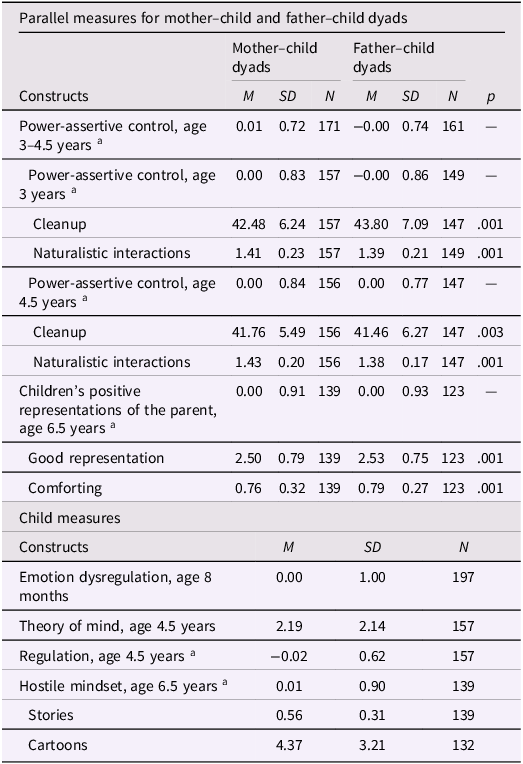
The two hostile response composites – for the stories and the cartoons – correlated, r(132) = .45, p < .001, and they were standardized and combined into an overall hostile mindset score. Boys’ scores were higher than girls, boys, M = 0.26, SD = 1.00, girls, M = -0.20, SD = 0.75, t(137) = -3.11, p = .002. All descriptive data are in Table 1.
Descriptive data for all measures
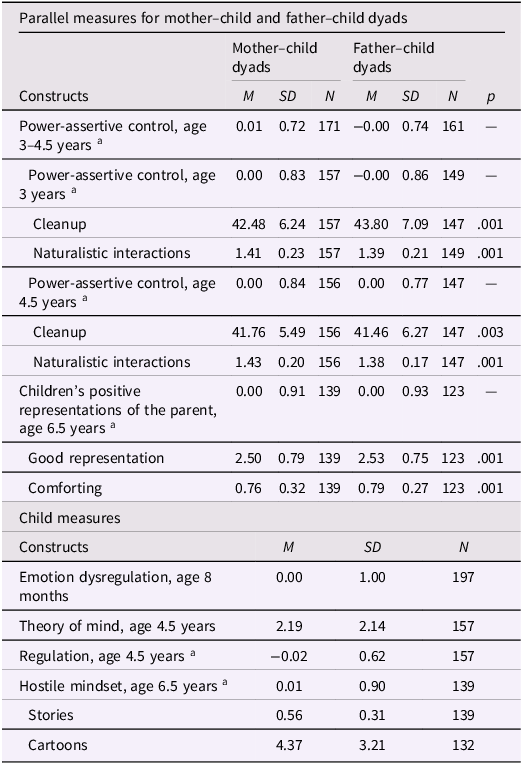
Table 1 Long description
The table presents parallel measures for mother-child and father-child dyads across various constructs. It includes data for power-assertive control at different ages, cleanup, naturalistic interactions, children's positive representations of the parent, and child measures. The table has 15 rows and 10 columns. Column headers are Constructs, Mother-child dyads M, Mother-child dyads SD, Mother-child dyads N, Father-child dyads M, Father-child dyads SD, Father-child dyads N, and p. Row labels include various constructs such as Power-assertive control, age 3-4.5 years, Cleanup, Naturalistic interactions, and more. Each row provides mean (M), standard deviation (SD), and sample size (N) for both mother-child and father-child dyads, along with p-values for statistical significance. Notable trends include differences in cleanup times and naturalistic interactions between mother-child and father-child dyads.
Note. a Composite of standardized constituent items, listed below. P refers to the difference between mother–child and father–child dyads, where applicable.
Covariates
We covaried child gender and children’s emotion dysregulation at 8 months. Emotion dysregulation was assessed during the Car Seat episode from the Laboratory Temperament Assessment Battery (Goldsmith & Rothbart, Reference Goldsmith and Rothbart1999). The child was buckled tightly in a car seat for 60 s, and coders rated their overall emotion regulation based on the levels of distress and the number of emotion regulation strategies on a 5-point scale from 0 = unregulated (no control of distress) to 4 = well-regulated (completely regulates distress and distracts away from the source of distress), adapted from Perry et al. (Reference Perry, Calkins, Dollar, Keane and Shanahan2018). For analysis, we standardized and reversed scores to reflect emotion dysregulation. Reliability, intra-class correlations, ranged from 0.95 to 0.99.
Results
Preliminary analyses
Families that did and did not return at 6.5 years (and were seen in the laboratory) did not differ on any measures, except one: Children who returned had higher ToM scores than those who did not return, M = 2.35 vs. M = 1.33, t(37.34) = -2.52, p = .016. Further, among children who did not return, there were more boys (N = 41) than girls (N = 20); among the children who returned, there were fewer boys (N = 63) than girls (N = 76), χ2 = 8.14, p = .004. The data were considered missing completely at random (MCAR) according to Little’s (Reference Little1988) MCAR test, χ2(15) = 15.32, p = .43 for mother–child dyads, χ2(25) = 27.36, p = .34 for father–child dyads.
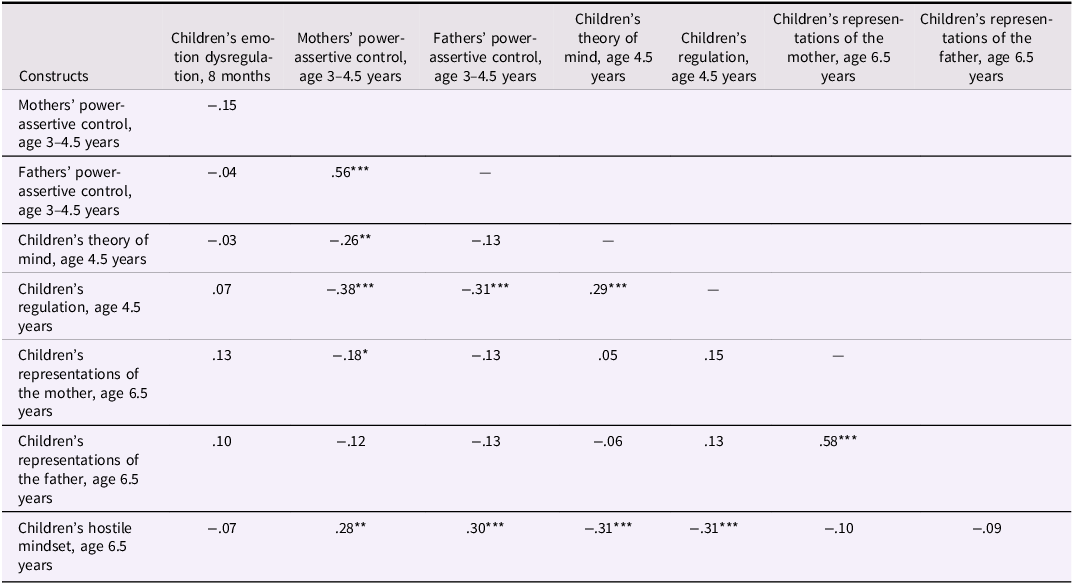
Correlations are in Table 2. Several correlations were similar in mother- and father–child dyads: Children who received more power-assertive control were more poorly regulated and had higher hostile mindset scores. In mother–child dyads only, children who received more power-assertive control had lower ToM skills and less positive representations of the mothers.
Correlations among study variables
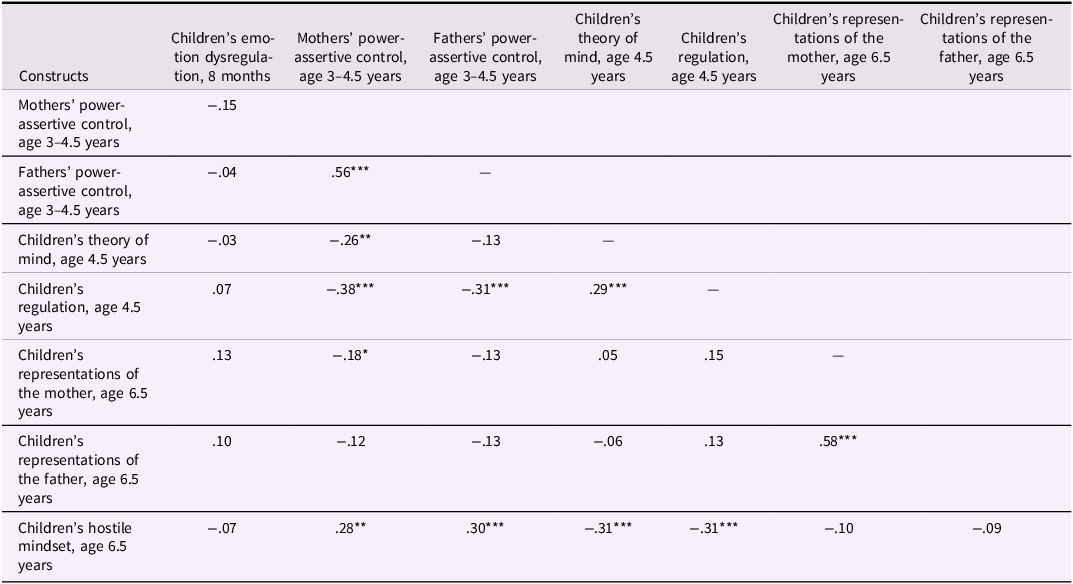
Table 2 Long description
The table presents correlations among several constructs related to children's emotional development and parental control. It includes eight rows and eight columns, with row labels and column headers indicating different variables measured at specific ages. The constructs include children's emotion dysregulation at 8 months, mothers' and fathers' power-assertive control ages 3-4.5 years, children's theory of mind age 4.5 years, children's regulation age 4.5 years, children's representations of the mother and father age 6.5 years, and children's hostile mindset age 6.5 years. Each cell in the table contains a correlation value. Notable correlations include a strong positive correlation between mothers' and fathers' power-assertive control, and negative correlations between children's theory of mind and both mothers' and fathers' power-assertive control. Children's regulation age 4.5 years shows negative correlations with both mothers' and fathers' power-assertive control and a positive correlation with children's theory of mind. Children's representations of the mother and father age 6.5 years are positively correlated with each other and negatively correlated with children's hostile mindset age 6.5 years.
*p < .05, **p < .01, ***p < .001.
The two mediators, ToM and regulation, were positively correlated, and both were associated with lower scores on hostile mindsets. The cross-parent correlations were significant for parental power assertion and children’s representations.
Longitudinal links from parents’ power-assertive control to children’s hostile mindset: testing mediation via children’s ToM and regulation and moderation by children’s representations of the parent
We tested longitudinal mediation and moderation in Mplus 7 (Muthén & Muthén, Reference Muthén and Muthén1998-2012) with 5,000-sample bootstrapping. We used a full information maximum likelihood estimator to handle missing data. Parental power-assertive control at age 3–4.5 was modeled as the predictor, children’s ToM and their regulation at age 4.5 as parallel mediators, allowed to covary, children’s hostile mindsets at age 6.5 as the outcome, and their positive representations of the parents at age 6.5 as the moderator of the relations between the predictor and the outcome. We covaried child gender and emotion dysregulation measured at 8 months. The significance of mediation was tested using a bias-corrected 95% confidence interval (CI). For significant moderation, we probed and plotted simple slopes at 1 SD above and below the mean of children’s positive representations of the parents (Aiken & West, Reference Aiken and West1991).
Mother-child dyads
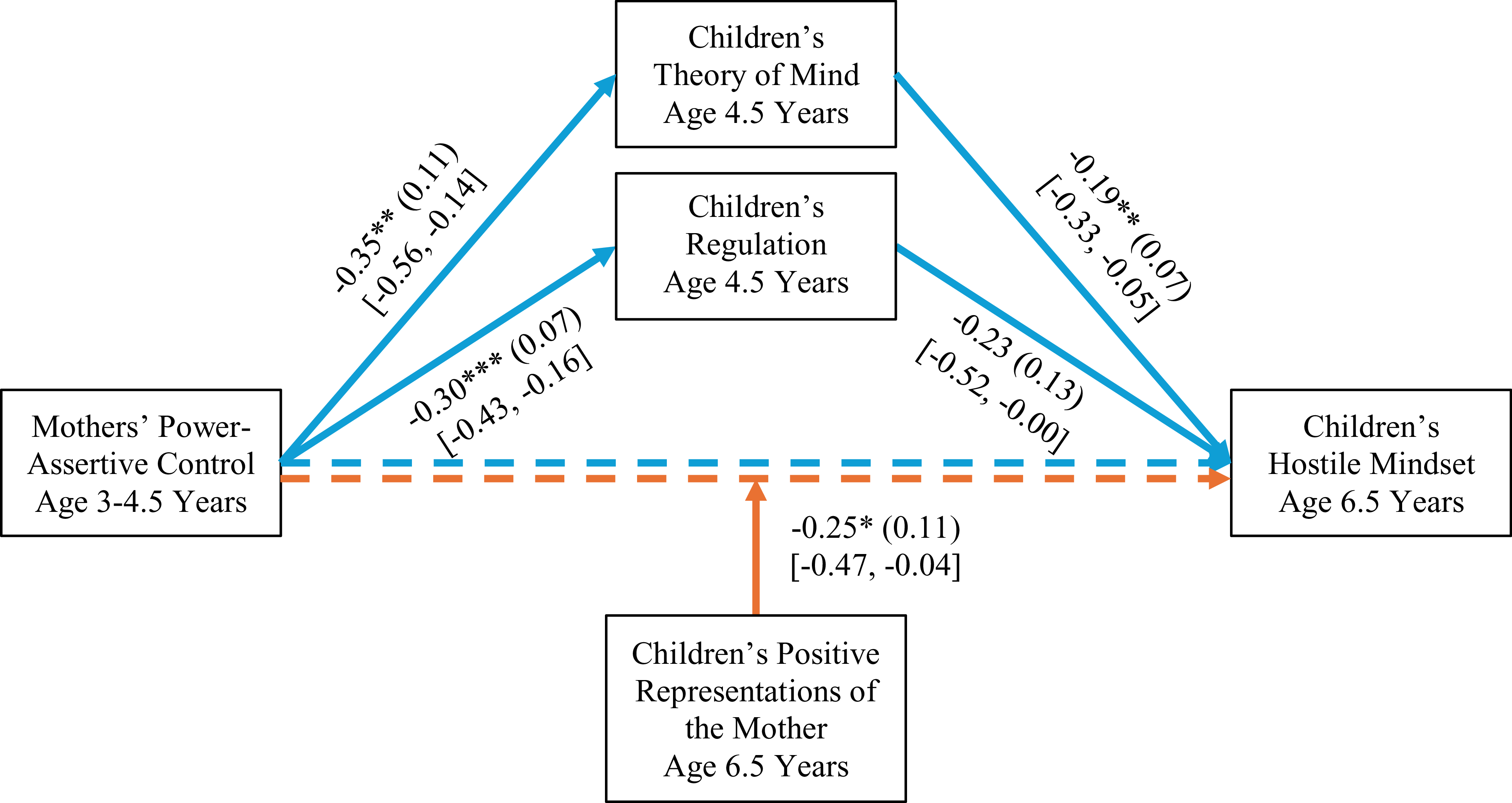
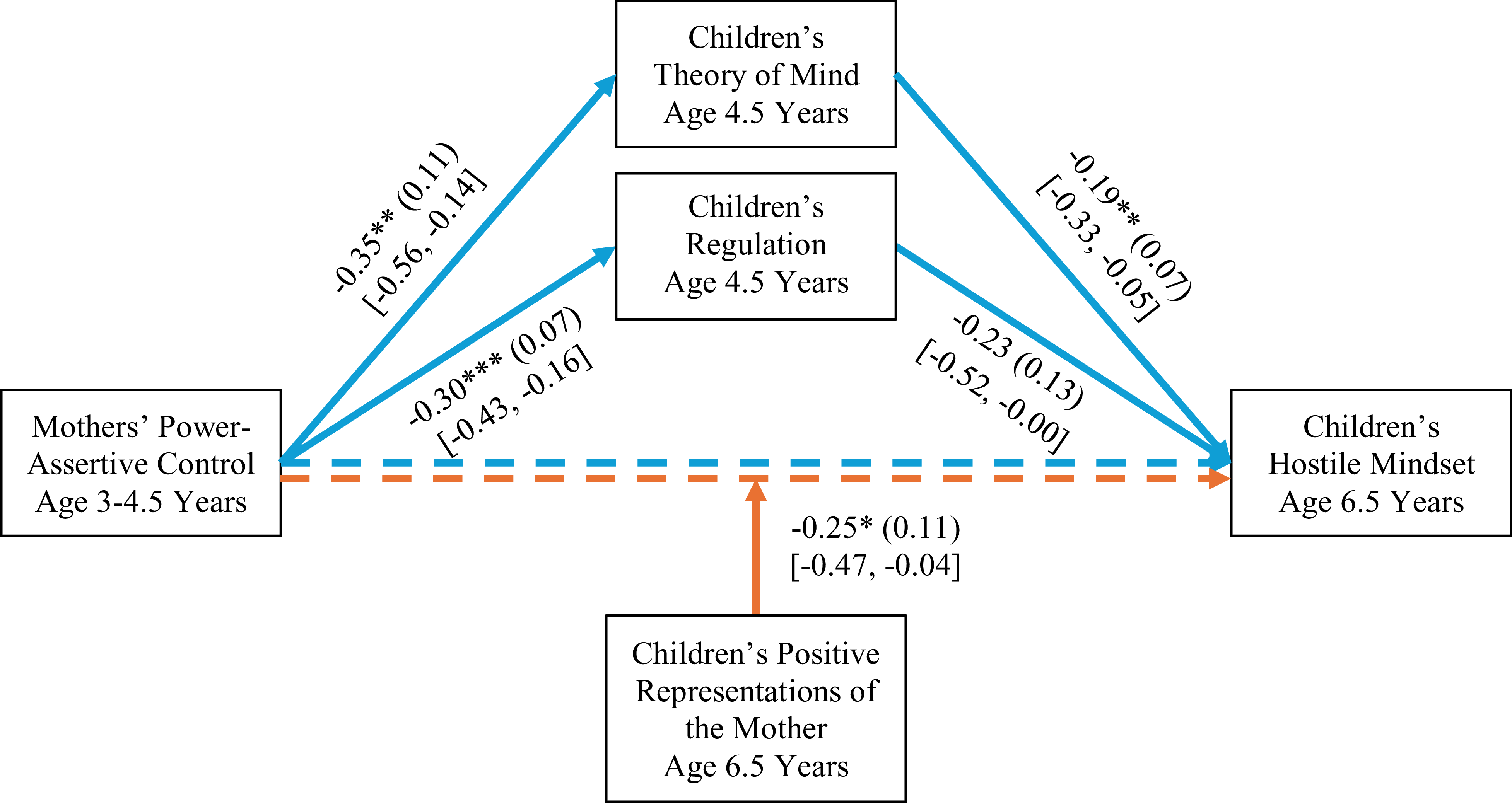
The results are in Figure 2. Children who had experienced more power-assertive control from mothers at age 3–4.5 had poorer ToM and regulation at age 4.5, which in turn led to more hostile mindsets at age 6.5. Although the path from regulation to hostile mindsets slightly missed significance, indirect effects were significant via both mediators, B = 0.07, SE = 0.03, 95% CI [0.02, 0.15] via ToM and B = 0.07, SE = 0.04, 95% CI [0.01, 0.18] via regulation.
Longitudinal links from mothers’ power-assertive control to children’s hostile mindset mediated via children’s theory of mind and regulation and moderated by children’s representations of the mother. Unstandardized coefficients, standard errors in parentheses, and 95% confidence intervals in brackets are presented for significant paths. Children’s gender and emotion dysregulation at 8 months were covaried but are not depicted for clarity. *p < .05, **p < .01, ***p < .001. The relations between mothers’ power-assertive control and children’s hostile mindset were mediated via children’s theory of mind, B = 0.07, SE = 0.03, 95% CI [0.02, 0.15], and via regulation, B = 0.07, SE = 0.04, 95% CI [0.01, 0.18].
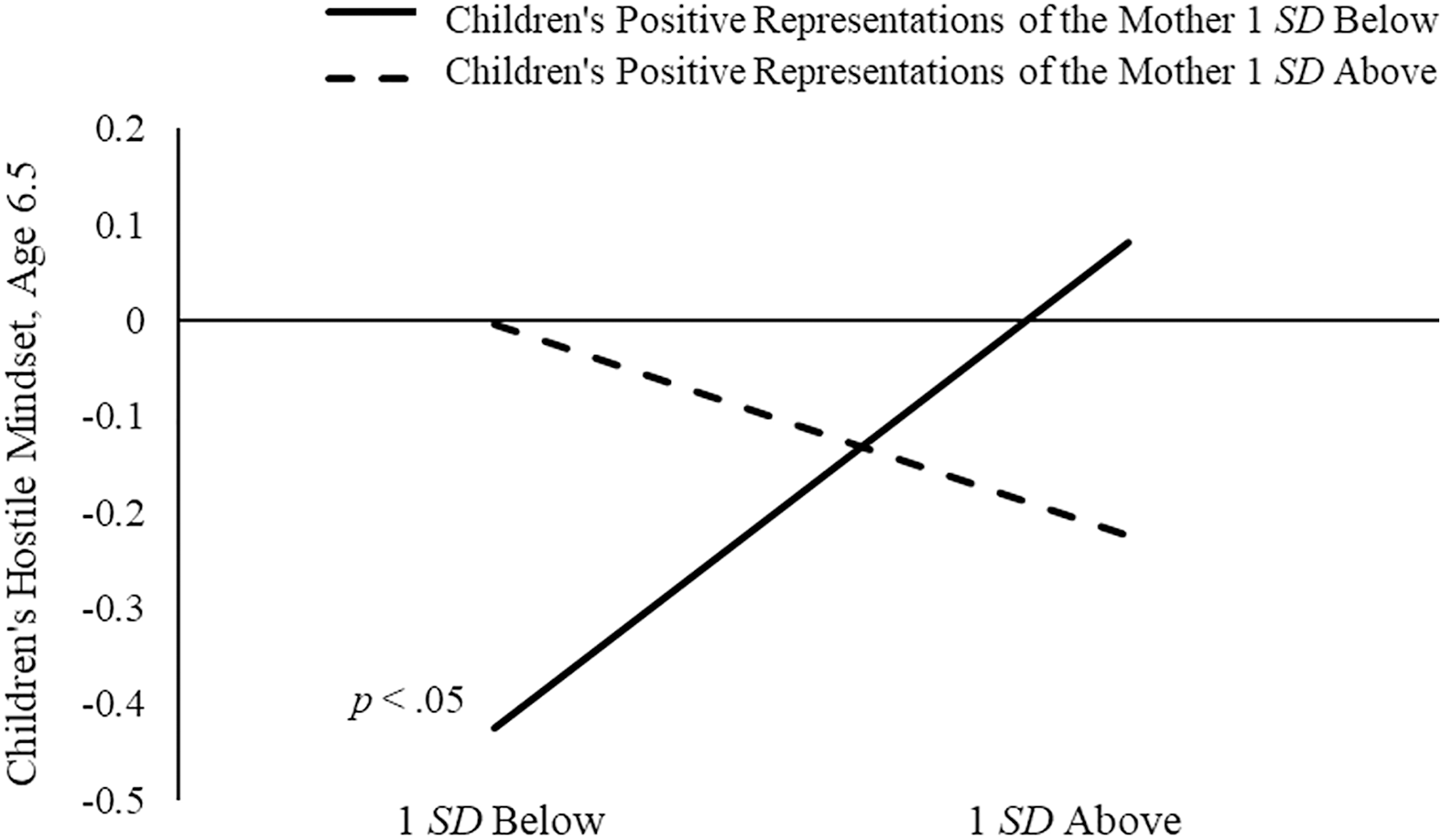
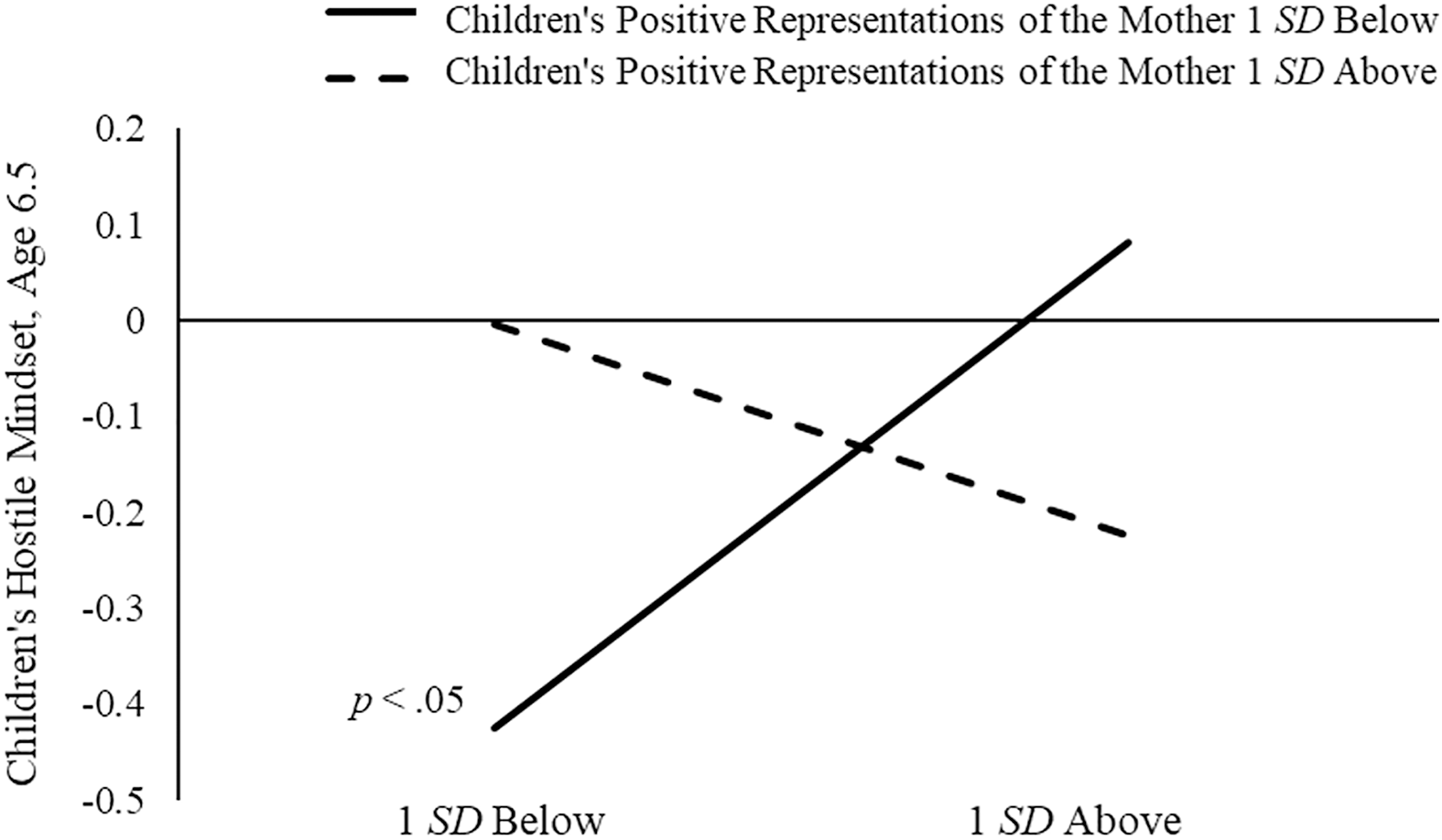
We found significant moderation by children’s positive representations of the mother at age 6.5 (see Figure 3 for simple slopes). Children who had experienced more maternal power assertion had higher hostile mindset scores, but only if they had less positive representations of their mothers, B = 0.35, SE = 0.14, p < .05, 95% CI [0.08, 0.62]; there was no relation between maternal power assertion and children’s hostile mindsets for children whose representations of their mothers were positive. Thus, children’s positive representations of the mother (as accepting, responsive, trustworthy) buffered the negative effects of mothers’ higher power-assertive control on children’s hostile mindsets.
Children’s positive representations of the mother as moderators of the relations between mothers’ power-assertive control and children’s hostile mindset. Simple slopes were plotted holding children’s gender (girls = 0), early emotion dysregulation, theory of mind, and regulation constant.
Father-child dyads
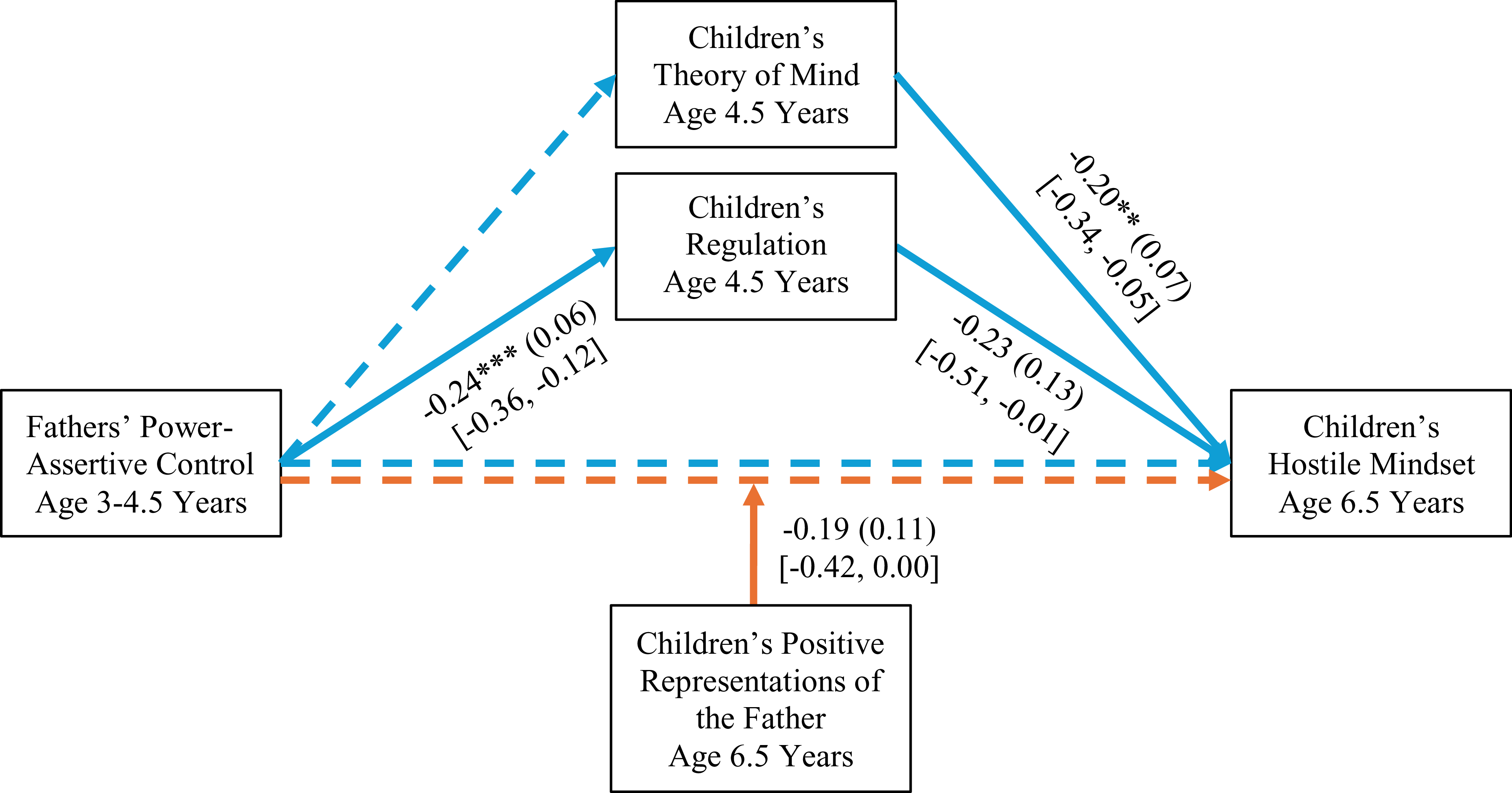
The results are in Figure 4. We found similar patterns of results. Fathers’ higher power-assertive control at age 3–4.5 was related to lower levels of regulation in children at age 4.5, and lower levels of ToM and regulation at age 4 were associated with more hostile mindsets at age 6.5. However, the path from fathers’ power-assertive control at age 3.5–4 to children’s ToM at age 4.5 was not significant. Mediation was significant via children’s regulation, B = 0.05, SE = 0.03, 95% CI [0.01, 0.15]. Children who had experienced more paternal power assertion at age 3–4.5 had lower levels of regulation at age 4.5, which in turn led to more hostile mindsets at age 6.5.
Longitudinal links from fathers’ power-assertive control to children’s hostile mindset mediated via children’s theory of mind and regulation and moderated by children’s representations of the father. Unstandardized coefficients, standard errors in parentheses, and 95% confidence intervals in brackets for significant paths are presented. Children’s gender and emotion dysregulation at 8 months were covaried but are not depicted for clarity. *p < .05, **p < .01, ***p < .001. The relations between fathers’ power-assertive control and children’s hostile mindset were mediated via children’s regulation, B = 0.05, SE = 0.03, 95% CI [0.01, 0.15].

Figure 4 Long description
A diagram representing the longitudinal links from fathers' power-assertive control to children's hostile mindset, mediated and moderated by various factors. The diagram includes several labeled boxes and arrows indicating relationships between these factors. Fathers' Power-Assertive Control Age 3-4.5 Years is connected to Children's Theory of Mind Age 4.5 Years with a path coefficient of -0.24, standard error of 0.06, and 95% confidence interval of -0.36 to -0.12. Children's Theory of Mind Age 4.5 Years is connected to Children's Hostile Mindset Age 6.5 Years with a path coefficient of -0.20, standard error of 0.07, and 95% confidence interval of -0.34 to -0.05. Fathers' Power-Assertive Control Age 3-4.5 Years is also connected to Children's Regulation Age 4.5 Years with a path coefficient of -0.23, standard error of 0.13, and 95% confidence interval of -0.51 to -0.01. Children's Regulation Age 4.5 Years is connected to Children's Hostile Mindset Age 6.5 Years. Additionally, Children's Positive Representations of the Father Age 6.5 Years is connected to Children's Hostile Mindset Age 6.5 Years with a path coefficient of -0.19, standard error of 0.11, and 95% confidence interval of -0.42 to 0.00.
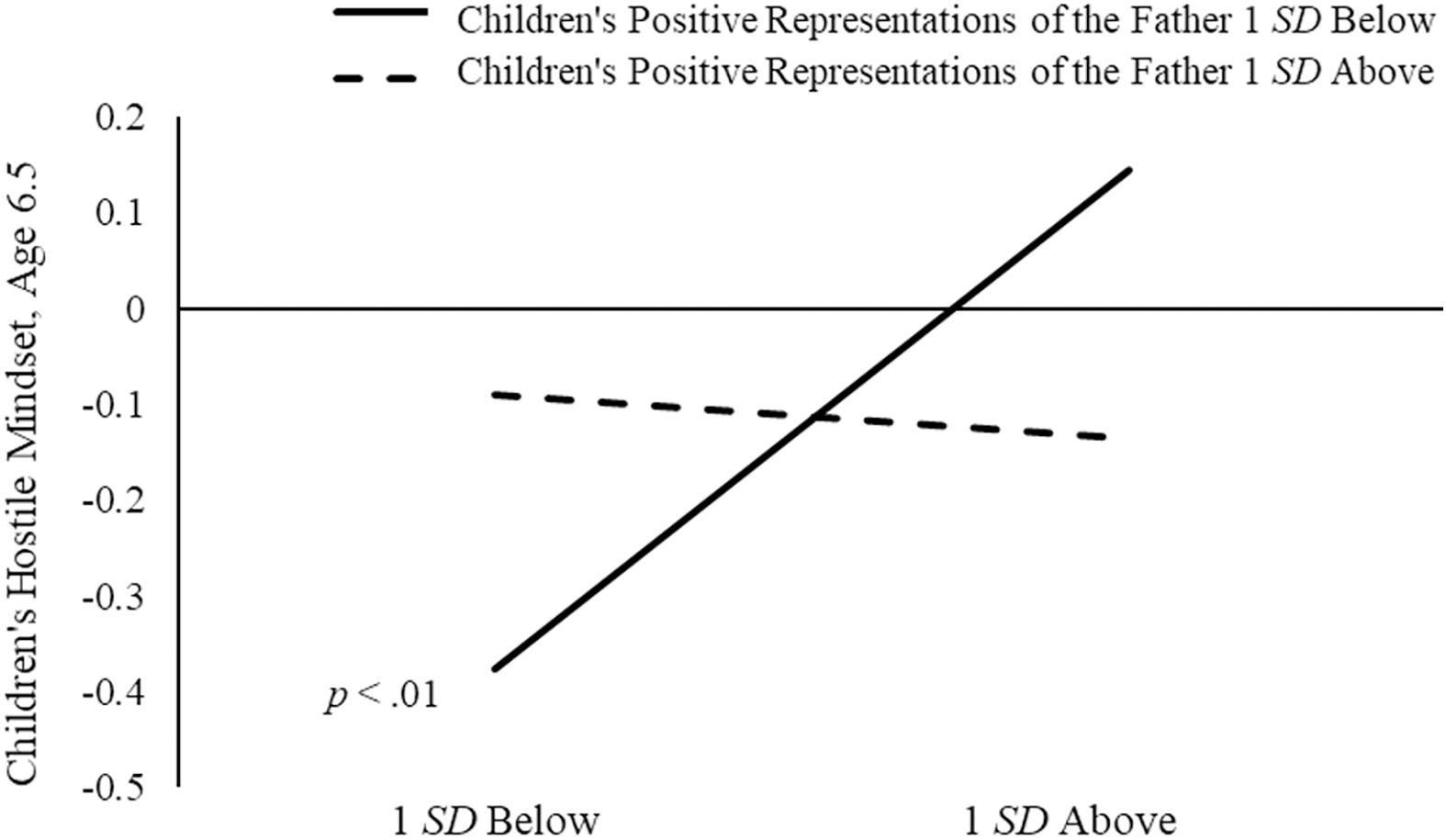
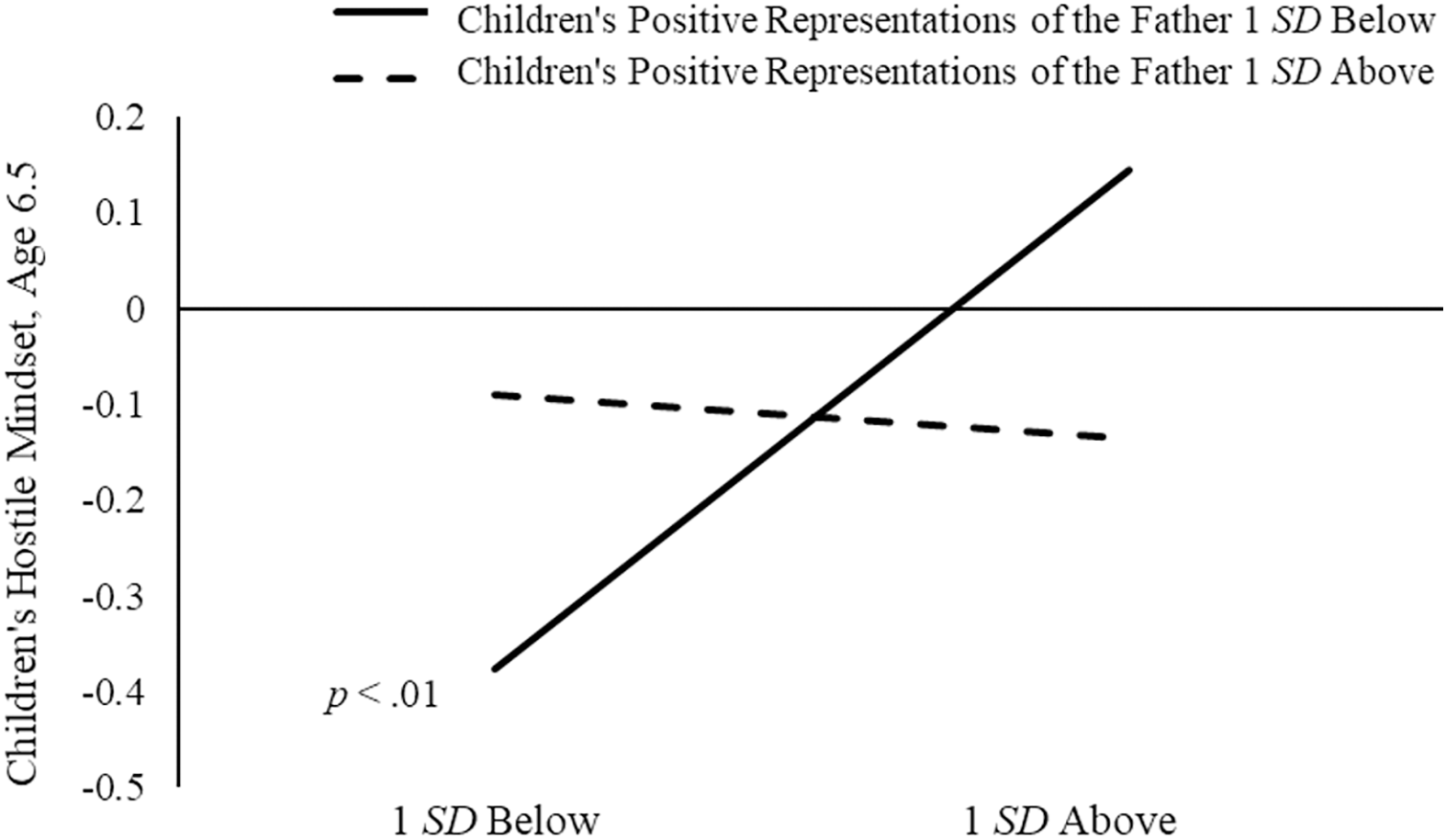
As in mother–child dyads, the effect of fathers’ power-assertive control on children’s hostile mindsets was moderated by children’s positive representations of the father (see Figure 5 for simple slopes). Higher paternal power-assertive control was related to more hostile mindsets only for children with less positive representations of their fathers, B = 0.35, SE = 0.10, p < .01, 95% CI [0.16, 0.56], but not for children with representations of their fathers as responsive and trustworthy, again supporting the buffering effect of children’s positive representations.
Children’s positive representations of the father as moderators of the relations between fathers’ power-assertive control and children’s hostile mindset. Simple slopes were plotted holding children’s gender (girls = 0), early emotion dysregulation, theory of mind, and regulation constant.
Sensitivity analyses
Because we aggregated the power assertion scores (the predictor) across ages 3 and 4.5 to achieve a robust score based on 60 minutes of observations, we also examined whether the mediation results would be comparable for the disaggregated scores, i.e., for parental power assertion at a single time point. To that effect, we estimated two additional mediational models using parental power-assertive control measured at age 3 years only and at age 4.5 years only, with child gender and emotion dysregulation covaried. Across both these models, the patterns of mediation results were similar to the results from our original model with a composite power assertion score. The findings were as follows (the result for the model with the predictor at age 3 first, for the model with the predictor at age 4.5 next): For mother–child dyads, we found significant mediation via both ToM, B = 0.05, SE = 0.03, 95% CI [0.01, 0.12]; B = 0.05, SE = 0.03, 95% CI [0.01, 0.11], and regulation, B = 0.05, SE = 0.03, 95% CI [0.01, 0.14]; B = 0.08, SE = 0.04, 95% CI [0.02, 0.19]. For father–child dyads, we found significant mediation via regulation only, B = 0.04, SE = 0.03, 95% CI [0.004, 0.112]; B = 0.06, SE = 0.03, 95% CI [0.01, 0.15].
Discussion
The model of children’s hostile information processing as a key antecedent of aggression and more broadly antisocial conduct problems, pioneered by Dodge and his colleagues, has long been one of the most influential conceptual frameworks in developmental psychology and psychopathology and beyond. Impressively, it has been supported by evidence collected across multiple cultures (Dodge et al., Reference Dodge, Malone, Lansford, Sorbring, Skinner, Tapanya, Tirado, Zelli, Alampay, Al-Hassan, Bacchini, Bombi, Bornstein, Chang, Deater-Deckard, Di Giunta, Oburu and Pastorelli2015).
Although generally hostile mindsets are rightly seen as maladaptive due to their proximal causal link to aggression, some caveat is warranted, and Dodge’s (Reference Dodge2024) recent reconceptualization of them as “defensive” is instructive. In adverse, unstable, harsh, unpredictable, or violent early environments, being vigilant toward threats and prepared to retaliate may, in fact, be adaptive (Ellis & Del Giudice, Reference Ellis and Del Giudice2019; Ellis et al., Reference Ellis, Sheridan, Belsky and McLaughlin2022; Pollak et al., Reference Pollak, Vardi, Putzer Bechner and Curtin2005). Davies et al. (Reference Davies, Thompson, Coe, Sturge-Apple and Martin2019) demonstrated that in families characterized by caregivers’ intimate relationship instability, preschool children developed a dominant, coercive, and aggressive pattern of response, as assessed by typical vignettes targeting hostile mindsets. In those adverse circumstances, hostile mindsets may serve as unique cognitive protective factors. However, as the child begins to function in expanded social ecologies (peer groups, school), those mindsets undermine adaptive goals by interfering with prosocial, cooperative, socially skillful, or academically successful behavior, and lead instead to social rejection, school failure, and delinquency (Dodge et al., Reference Dodge, Lansford, Burks, Bates, Pettit, Fontaine and Price2003; Lansford et al., Reference Lansford, Malone, Dodge, Pettit and Bates2010).
Scientific success of any theory is measured not only by its large impact and robust empirical support, but also by its heuristic potential. Both are certainly true of Dodge and colleagues’ research on children’s hostile social-information processing: Although impact and supporting evidence keep accumulating, new compelling issues that inspire more research questions also arise. Toward that goal, we asked two questions that explore further the well-established association between power-assertive parenting and the formation of children’s hostile mindset: Can we elucidate specific mechanisms that account for that association, and can we elucidate factors that moderate it?
The first question is one of equifinality in development. We proposed that parental power assertion promotes children’s hostile mindset via two paths or mediators – the child’s diminished abilities to understand accurately others’ perspectives (i.e., ToM) and to regulate their own behavior. The literature has supported links between parenting and each of these mediators and between them and children’s hostile mindsets, but to our knowledge, no study has formally examined the parallel mediation in a longitudinal design.
The second question is one of multifinality in development. Here, we proposed that children’s representations of the parent as either caring, responsive, and reliably providing comfort and help, or rejecting, unresponsive, and unavailable in times of distress and stress can significantly buffer or amplify the effects of power-assertive parenting, even in a sample of families in which power assertion was quite mild.
Our findings largely supported our expectations and were mostly replicated across mother- and father–child relationships. We found evidence of equifinality: As hypothesized, the association between power-assertive parental control and children’s hostile mindset was mediated by children’s ToM skills (for mothers and children) and by children’s regulation skills (for both relationships).
It is unclear why we failed to detect the presence of an indirect effect of fathers’ power assertion on children’s hostile mindset via ToM; note that paternal power assertion, in contrast to maternal, was unrelated to children’s ToM. Empirical evidence on differences in links between various aspects of parenting and children’s ToM across mother- and father–child dyads is sparse and far from consistent (Pavarini et al., Reference Pavarini, de Hollanda Souza and Hawk2013). Goffin et al. (Reference Goffin, Kochanska and Yoon2020) found a significant longitudinal association between mothers’ mind-mindedness in infancy and children’s ToM at preschool age but failed to find a parallel effect for fathers. However, Kochanska et al. (Reference Kochanska, Bendel-Stenzel, An and Sivagurunathan2025), drawing from two studies, reported that in both samples, there were longitudinal associations between father–child mutually responsive orientation and child ToM; but for mothers and children, that link was found in only one of the two samples. Those reports, however, did not include data on power assertion.
It is important to keep in mind that the concept of power assertion is difficult to conceptualize and measure, as it is deeply embedded in cultural contexts (Deater-Deckard et al., Reference Deater-Deckard, Lansford, Malone, Alampay, Sorbring, Bacchini, Bombi, Bornstein, Chang, Di Giunta, Dodge, Oburu, Pastorelli, Skinner, Tapanya, Tirado, Zelli and Al-Hassan2011; Lansford et al., Reference Lansford2022, Reference Lansford2024). Parents’ views on discipline strategies that benefit children, on circumstances that merit the use of parental pressure or power, and their choices of physical, emotional, and verbal control techniques vary depending on the rules and norms prevalent in a given culture, on parental socioeconomic and educational status, and racial and ethnic background. As reviewed earlier, physical discipline techniques may be considered accepted, normative, and benefitting the child in some cultures, and disapproved and even legally prohibited in others. The complexity may be reflected also in children’s interpretations of parental power assertion and control more generally. In cultures where such strategies are normative, children may perceive them as acceptable. In other cultures, for example, relatively educated U. S. samples like ours, children may view even a sharp rebuke or a light slap as harsh, hostile, and mean spirited. This led us to consider children’s representations of the parent as key to understanding multifinality in effects of power assertion.
We indeed found evidence of multifinality, and those findings were replicated across mother- and father–child dyads. As hypothesized, children’s representations of the parent as caring, responsive, and reliably helpful at times of stress buffered the negative effects of power-assertive parenting at toddler and preschool ages on hostile mindsets at early school age. Importantly, those findings align with previous studies that had demonstrated moderating effects of positive relational experiences – and further, specifically experiences assessed at the level of representation – on the relations between parents’ power assertion and children’s various socialization outcomes (Bendel-Stenzel et al., Reference Bendel-Stenzel, An and Kochanska2023; Herbert et al., Reference Herbert, Kim and Kochanska2026; Kochanska & S. Kim, Reference Kochanska and Kim2012; Kochanska & An, Reference Kochanska and An2024a; Kochanska et al., Reference Kochanska, Boldt and Goffin2019). Further, at the broader conceptual level, those findings are synergistic with the recently growing emphasis on the significance of children’s subjective construals of their experiences rather than of “objective” parameters of those experiences (Smith & Pollak, Reference Smith and Pollak2021; L. A. Sroufe & J. Sroufe, Reference Sroufe and Sroufe2025). It appears that the child’s perception or representation of the parent as reliably available, competent, and supportive was an important factor determining whether parental power-assertive control would contribute to the child’s future hostile mindset or worldview.
As a caveat, it is possible that children’s positive representations of parents can only buffer detrimental effects of parental power assertion in families that use mild levels of power, as has been the case in this and earlier studies reporting similar findings (Herbert et al., Reference Herbert, Kim and Kochanska2026; Kochanska & An, Reference Kochanska and An2024a). However, Toth et al. (Reference Toth, Cicchetti and Kim2002), studying maltreated children, likely to have experienced severe harsh discipline, reported similar significant negative correlations between children’s positive perceptions of their mothers and child externalizing problems. Alink et al. (Reference Alink, Cicchetti, Kim and Rogosch2009) reported similar findings, with children’s positive representations of their mothers buffering negative effect of maltreatment on child emotion regulation. Clearly, more research on when, how, and for whom children’s representations of parents serve as significant moderators in socialization processes is needed.
Another important consideration in interpreting the current findings is the possibility of child effects on parenting. Long-standing research has demonstrated that child factors such as difficult temperament and regulatory capacities can shape parental responses and behaviors (e.g., Bell, Reference Bell1968; Klein et al., Reference Klein, Lengua, Thompson, Moran, Ruberry, Kiff and Zalewski2018; J. Kim & Kochanska, Reference Kim and Kochanska2026b; Sanson et al., Reference Sanson, Hemphill and Smart2004). To partially address this concern, we controlled for the effects of children’s emotion dysregulation in infancy, but other child-related factors, including genetic influences, may also contribute to parental power assertion (Shewark et al., Reference Shewark, Ramos, Liu, Ganiban, Fosco, Shaw, Reiss, Natsuaki, Leve and Neiderhiser2021). Admittedly, in future work, more robust measures of “child effects” would be desirable, for example, multi-method assessments of anger proneness or difficult temperament. Those may elucidate more complex dynamics of child characteristics potentially influencing future parenting, as well as children’s regulatory capacities, and finally, also their tendency to develop hostile mindsets.
As well, biological and genetic factors can contribute to the emergence and intergenerational transmission of hostile mindsets. Dodge (Reference Dodge2009) proposed an elaborate model, in which “… in response to possible threat, three systems coactivate: Low monoamine oxidase A (MAOA) activity is associated with a pattern of autonomic arousal and defensive information-processing that is characterized by hypervigilance to hostile cues, hostile attributional biases, selection of self-defensive goals, and the experience of self-righteous anger” (p. 411). Galán et al. (Reference Galán, Choe, Forbes and Shaw2017) empirically demonstrated that MAOA and harsh parenting assessed in early childhood interact to predict children’s hostile social information processing.
Further, parents and children may share genetic disposition toward hostile mindsets. We assessed parents’ hostility using the Aggression Questionnaire (Buss & Perry, Reference Buss and Perry1992), but we found no significant associations between those scores and children’s hostile mindsets. However, future research measuring parents’ and children’s characteristics, including genetically mediated traits, is warranted to further disentangle bidirectional influences between parents and children.
The strengths of this work include all observational measures, parallel data from mother- and father–child dyads, and a longitudinal design, with the outcome assessed at early school age, when hostile mindset is especially important, because it triggers the long-lasting and “snowballing” negative cascades (Dodge et al., Reference Dodge, Lansford, Burks, Bates, Pettit, Fontaine and Price2003; Lansford et al., Reference Lansford, Malone, Dodge, Pettit and Bates2010). The nature of the sample was a limitation, and may limit generalizability to other cultural contexts, as described earlier. Our participants came from community families, relatively homogenous ethnically (although recall that 20% of families were not “White alone” and the sample was well representative of the state from which it was drawn). Children were typically developing, by and large well adjusted; parents used mostly mild and reasonable power assertion tactics when controlling their children’s behavior. Note, however, that the typical and low-risk nature of our sample might be an advantage, given that most studies of hostile mindsets have involved children with elevated levels of aggression.
However, our model did assume that generally, hostile mindsets are not adaptive, given the relatively benign social environments in which our participating children lives. In future research, it will be important to replicate our equifinality-multifinality model of hostile mindsets in families living in difficult circumstances, dealing with challenges such as intimate partner violence, lack of stability, or a high-crime neighborhood. In such harsh circumstances, the processes we outlined may work differently: As mentioned earlier, a hostile or defensive mindset can be adaptive, and consequently, a child who is proficient in reading others’ mental states would be correct in interpreting others’ intentions as hostile and evaluating aggressive responses as desirable.
Like any empirical study of a complex developmental process, this work leaves many unexplored questions. As indicated at the outset, we limited our review to parental power assertion, but other parenting aspects are certainly linked with children’s ToM and emotion regulation, and thus they may also play a role in the unfolding hostile mindsets. Aspects of positive parent–child relationships, such as security, positive mutuality, mutual responsiveness, and especially various forms of parental positive mentalization, have been associated with better ToM skills (e.g., Aubuchon et al., Reference Aubuchon, Libenstein, Moenner, Seguin, Bellerose, Bernier and Beauchamp2023; Hughes et al., Reference Hughes, Jaffee, Happé, Taylor, Caspi and Moffitt2005; Kochanska et al., Reference Kochanska, Bendel-Stenzel, An and Sivagurunathan2025; Licata, Reference Licata, Kristen and Sodian2016; Malcorps et al., Reference Malcorps, Vliegen, Nijssens and Luyten2023; McCormick et al., Reference McCormick, Chary and Deater-Deckard2022; Meins et al., Reference Meins, Fernyhough, Wainwright, Das Gupta, Fradley and Tuckey2002; Pavarini et al., Reference Pavarini, de Hollanda Souza and Hawk2013; Szpak & Bialecka-Pikul, Reference Szpak and Bialecka-Pikul2020) and with better regulation (e.g., Boldt et al., Reference Boldt, Goffin and Kochanska2020; Samdan et al., Reference Samdan, Kiel, Petermann, Rothenfußer, Zierul and Reinelt2020) and would consequently be expected to be linked to children’s less hostile mindsets and more benign worldviews. Many exciting directions of research remain to be explored.
Supplementary material
The supplementary material for this article can be found at https://doi.org/10.1017/S0954579426101333.
Data availability statement
Data are not available. Analysis code is available on request. Methods are available on request. We are unable to share data for individual families. Our consent forms the parents signed clearly preclude any sharing of individual data, even if deidentified. The parents have consented to the data being shared in the aggregate form only, and we are ethically and legally bound to follow this agreement.
Acknowledgments
We greatly appreciate Jennifer Lansford’s generous help with the hostile mindset measures (sharing the materials and providing guidance and permission to adapt them) and Stephanie Vanwalleghem’s permission to use the Intention Attribution Test. We are grateful to all members of Child Lab and to the families participating in our Children and Parents Study.
Funding statement
This study was supported by NIH grants R01HD091047 and R01HD110427 to Grazyna Kochanska. The content is the responsibility of the authors and does not necessarily represent the official views of the National Institutes of Health.
Competing interests
The authors have no conflicts of interest.
Pre-registration statement
This study was not pre-registered. Although we had not pre-registered the current hypotheses and models, we have previously presented relevant findings from our research program in multiple empirical and theoretical papers (many of them cited in the current paper). Additionally, we specified our model in our grant applications, and that information is publicly available.
AI statement
We did not use artificial intelligence tools in preparing this paper.


 Open access

