


Hic bibitur
A doubling, both retrospective and prospective, can act comedically as an opening. In the mid 1550s, forced into isolation by the severity of the plague in Toulouse, the constitutional theorist and doctor of laws Jean de Coras embarked upon the translation of an anonymous Latin text, a Dialogue between the Emperor Hadrian and the Philosopher Epictetus with the addition of an expansive commentary.Footnote 1 Like many in isolation he wished to revert to beginnings and so adopted the foundational theatrical mode of juristic treatise, the dialogue, ‘a form very ancient and significant’ of pedagogic explication, and here a play between the emperor and his nomikos, an adviser on law, in its full sense of speech of the sovereign.Footnote 2 The intercourse, of course, could equally have been between prince and chancellor, doctor of civil law and apprentice at the Inns of Court, a philosopher and a student of common law, or even Cardinal Pole and Sir Thomas Lupset in dense interlocution on whether to replace Anglican common law with the Roman corpus iuris.Footnote 3 What was necessary was a dramatisation, a doubling of the beginning through a series of enigmas posed as questions of origin stranded in the dangerous comedy of definitions. Retrospective resolutions to classical conundrums, the literal legitimacy of social and legal forms needs hindsight, the angel of history, to take a contemporary form and performance.
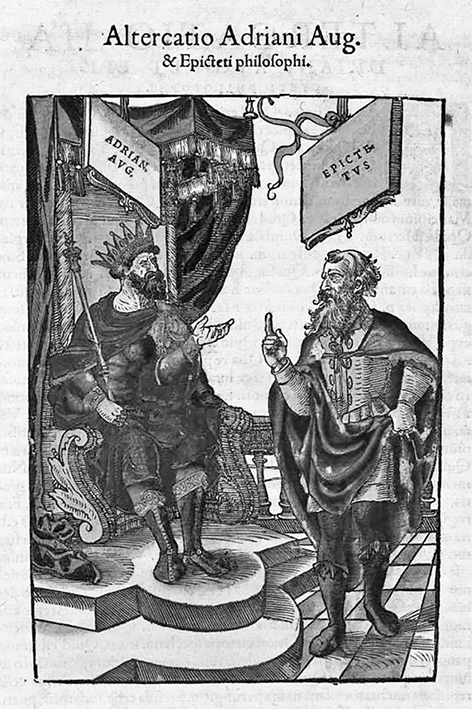
In prospective mode, in review of Peters’ magnum opus, summum, and pandect of performative law up until 1678, the plague years had thrown Coras to contemplation of the future. Another doubling. The initial question in the dialogue, opening for content, is a genuine enigma: What do we see in the body of a pedagogue? The answer is epistola, a letter missive. The question opens the body to knowledge and simultaneously constitutes the subject as a carapace, an envelope and vehicle of epistolisation. The interrogation moves immediately to questions of communication, the encryption of relay and the heavy signifiers of transmission. The next question is thus quid est epistola? and the answer is tacitus nuntius or silent messenger. Mute eloquence, gesture and writing, body and text in this early sense, imitate the naked corporeal carapace, another skin containing a hidden message. In the argot of the era, a hieroglyph and in addition, in the Latin text, an image of the dialogists, emperor and philosopher, which provides a visual portal and access to the exchange.Footnote 4
The image, from Alciatus’ Notitia dignitatum, of Hadrian and Epictetus, the former on his throne, sceptre in the right hand, an open palm welcoming and receiving discourse in his left (see Figure 9.1).Footnote 5 The image shows rather than says what the protagonists in turn indicate through gesture, the chironomia and indigitation, the dactylograms that perform through visual manifestation, staging, and enactment in the colour print of the early text. Epictetus grasps his robe in his left hand and points upward with the index finger of his right, demanding attention and, according to canon XX of the Chironomia, threatening to denounce if attention wanders.Footnote 6 It is a pedagogic image of near equivalence, the standing philosopher is at the same height in this exchange as the sedentary emperor; the teacher is master of the sovereign and vice versa, although the dais, throne, and awning indicate nonetheless a hierarchy, and order of transmission. The imperial scena, the gold cathedra, is a last instance or dignity whereby the image both signifies and conceals that of which it is the representation and doubling. The throne is visually a stage and staging, replete with curtains, fronds, and rod of office. The emperor is after all seated and, it can be added, in the pose of the judge: sedementariam vitam & recte sedendo.Footnote 7 Hadrian is not just sovereign and messenger, vicarius Dei, but also seated and judging. Here then is the crux, a double message, sovereign and didactic, legislative and philosophical, juridical and pedagogical, an amphibological signification which arrives most explicitly in the answer to the third potentially self-reflective question, quid est pictura? Veritas falsa – what is a painting? A false truth. Following the order of enigmas, the naked body, the missive epistle, and the painting are all subject to suspicion, both objects of belief, acts of faith, and modes of fantasy, poetic license, and deception. For performative purposes, all three are surfaces, costumes – hirsute skin, chirograph, and epistle – and then paintings that all figure hidden causes. The body hidden by clothes, the epistolary inscription, and the image share the enigmatic status of enacting in variable forms an absent source. Although diversely so, they are not what they represent, no matter how true their figuration. Body, missive, image – the corporeal bears a message that the letter transmits and the picture depicts so as to manifest a trajectory of transmission through the diverse media of its passage.
Emperor Hadrian and the Philosopher Epictetus, from Alciatus, Notitia dignitatum utraque iuris (1552). Wikicommons.
The false truth of the image is in effect the culmination of the biblical haec imago or ‘this face’, the human similitude of the ineffable and invisible divinity, the unseen cause of causes and message in the envelope that both conceals and relays. Staying with this key topos, the conjunction veritas falsa, it is evident that in the terms argued extensively in Law as Performance, the theatrical characteristics of the legal process fall directly within the trajectory of the dyad of body and missive that combine to form the performative image of law as enigmatically true and simultaneously false.Footnote 8 This thesis gains incremental expression in Peters’ advancing argument as to the affective force of oratorical action and the value created by the impression of reality that legal advocates at their best wield. In her formulation ‘legal performance is at once a technology of representation and a crucial ethical practice’ (86). The jurist’s illusions become reality, or are made, which is to say fabricated into actions and juridical determinations: ‘The advocate’s artful reality effect, heightened through actio, did not offer a mere illusion of reality (as the actor’s did): it made reality appear as real as it really was’ (86). By the end of the book, it is not only the Horatian jus or sauce but the sorcery of law that has become the acting of real life. Illusion, play, and revel resemble legal enactment, and juridical hypokrisis, as the etymon suggests, is itself a form of illusion; it is a performance, a play, a fantasm that ironically shows law in actu and as legis actio. This is how law is ‘actually performed’. This is ‘as real as law gets’ (295). And in twenty-first-century terms of nibbles and bytes, this means the rule of theatre in the modality of theatrocracy unwired, reality on speed (302), true and false in an accelerated imaginal form.
Comedy of Law
There are many exempla in the book, but entry for content, and so we begin with a comedy staged in Tothill Fields, the last trial by combat or duelling decision in the English common law tradition. The fields, which were later to become, appropriately enough, a cricket ground and then or also a prison, themselves provide a trajectory from theatre to law to play, as evinced in Peters’ flamboyant narrative of the melodrama of the contestants mock fighting after they knew that the case had been earlier resolved. The forum for this particular, now faux, property dispute was an open air, public stage, mimetically reproducing, which is to say doubling, re-enacting and so exposing the scenography of ordinary trial. As this is not the theatre of the law court itself, with its architectural confinement and limitations of time and procedure, we are thrown directly into the foolosophy of justice, the serio-ludere of the agon of trial and the definitive trajectory of the triunity of ordo, then lex, then comœdium. What we see, where we start, is with the visibility and audibility of the lawsuit, the audience as it used to be called. Hypokrisis, actio, delivery, and the last term can be punned deconstructively as de-livery, removal of livery, law putting on its costume so as to get undressed by the gaze of the spectator. This is primarily because comedy is the oldest theatrical form, laughter being, according to Addison, an original sin.Footnote 9 The first point to be made is thus that comedy, the ludic enactment, and here re-enactment of law, the legis actio or climactic outcome of legal conflict, is the form that legality necessarily takes. Persons, things, actions are replicated in Coras’ body, letter, and image and these in turn can be conceived and triggered as ordo, lex, comœdium.
In the imaginal context of contemporary transmission, the logical order of juridical progression has to be ludically reversed: Comedy is our introduction to the legal, to the epistolarity of transmission, to the bodies of the players. This is serious. A matter as Selden puts it, instar omnium, the form and formulary of all, by means of ius imaginum or entry of law’s dramatis personae.Footnote 10 The jocastic de-livery, the undressed performance, exposure of the tersichorean art of law in the variable modes of its social presence are inevitably comic. Lenton makes the point best in the epigraphs to his Characterismi: dum vivo video, et dum video rideo (errorem in humanis et terrorem in libris).Footnote 11 To see is to laugh at the pretensions of the costumed animal, the monkey in a toga, and the cachinnating coifed codpiece, the clothed codex conspiring judge. Vision precedes decision. Conflict generates the case, and it is in these all too human escapades, out of the corporeography of adversity, the verbal and gestural articulations of advocacy, that law and the happy hum of order, the capriole and merry dance, are later redacted to the monochrome regimentations of the page. The initial document, transcribed in memory, transmitted orally, recalled visually, is the comedy, the stage play itself, in which the litigants, spectators, assessors and judges come together to perform in a field. It is in this sense that Rosenstock-Huessy suggests that progress in law may well ‘depend on the regulating power of humour’.Footnote 12 Peters too notes the legitimating force, the entry into the family line that such legal ludi on Tothill Fields will relay.
Returning to the complex conjunction veritas falsa as applied to the picture portrayed and to the costumed lawsuit enacted, it is precisely figures of things to which Coras refers in his classically orientated discussion of the Philosopher’s response. Illustrating the answer that Epictetus has given to the question quid est pictura, Zeuxis and Parrhasius are invoked, the painting of grapes that fools the birds, and the curtain that appeared to conceal a work of art but was in fact itself the painting. The figure of truth is both semblance and dissemblance, false and true, comic and serious, and it is this juxtaposition that needs desideration. What is true or at least evident is the manifestation of legality in the agonistic moment that generates the leges actiones, in the performative scene of what in the case of Tothill Fields is a prospective ‘tryal by battail’ and these, according to the legal antiquarian Sir Henry Spelman, referencing Glanvill, are called leges apparentes – laws made visible.Footnote 13 What is it then that appears or is rendered apparent by this vast theatrical scene? For Peters the event collapses the difference between court and stage, trial and combat, because both enact the agon of conflict and its resolution via the medium – comœdium – of the juridical liturgy of a verdict. The mystery or arcanum of legal judgment depends upon the staging of a conflict that will act as the image of a judgment that is invented, which is to say organised and ordained behind the veil of the dramatic agon of dispute. Again, conjunction and disjunction, the alternating current and Janus face of arcanum iuris decked out with coif and cloak, robes, furs and taffeta. A sartorial presence, a costume of colours, livery and delivery, habits of the robes and performative exposure.
One might here recall Nietzsche’s cautel, that truth is a metaphor, an illusion so grounded in practice that we have forgotten its illusory roots.Footnote 14 How then does this scene act ad apparentiam and more specifically how is its falsity a reference to its truth? Peters in paromoion style sides with Parrhasius: This painted cloth, this theatrical staging, is the reality of law. It generates the truth through the fictive process of trial and, as Kantorowicz elaborates, the apposite maxim is fictio figura veritatis, fiction is the figure of truth, the form it takes being veritas falsa, or that law does not die. Hers is a neo-materialist view in which the excessively dramatic character of the mock trial – the ‘battail’ after all never took place because settlement had been agreed one day before – can only have representational purposes. The elaborate staging provides an image of legal relations that corresponds to the force of law, that decisions are always in camera, hidden from view, as with the accord that preceded Tothill Fields, or that otherwise occurs in judicial chambers, or where ex tempore in the unlit theatre of the judicial skull. Performance, in other depiction, is manifestation and outcome, the speeding (publication) of judgment through the spectacle and modality of its theatrical relay. This then is an event, an encounter that in a correspondence theory of knowledge, accurately reflects the legal relation. The performance enacts what is not there, the arcanum iuris, or mysterium, which is, in its very absence, non-existent except in its theatrical apparition. At the same time, reflection distorts, and correspondence to the real, to the event, is an epistolary exchange, body to body, letter to letter, image to image, diffracted through the very means of its conveyance.
At one level the event depicts the triumph of law over trial by combat: Duels are illegal because settlement should be judicial and symbolic rather than exsanguinated and merely theatrical. Ironically an apparent trial by combat was necessary to show that such violence was not to occur. Remaining with the reality of the event, it evidences first the itinerancy of the legal, that law does not, to borrow a phrase, inhabit any specific territory. The trial by combat has no fixed place, no locus or to borrow from Glanvill, duellum non locum habet.Footnote 15 The theatrical presence of law is its presence, its real – the cloth is the picture – and that means historically an atmosphere and aura of juridism that travels with its personnel and their performances. The itinerant court, the assize, is also a verb, a mobile matterphor, meaning a momentary material symbol, a sudden sitting or temporary theatre, that like the trial at Tothill Fields, appears and fades, arrives and then disperses. The significance, the verum, is that of manifestation and not that of duration. The sovereign appears in the person of its judges and other officials. The Emperor Hadrian has left his seat and remained on his throne so as to appear in the vicarious form of his delegates, in his other body, as principal and principle directing the persons, bonds, and comedy – ordo, lex, comœdium – of this particular, itinerant case. The emotion has set the law in motion, to perform the page, while writing; ratio scripta itself is but the stage, the material sign or physical presence of the jural relations to and with which it corresponds.
The second point is thus that performance embodies, and it is that incorporation in actu that creates the corporation of lawyers, the itinerant and expanded personae, the real representatives of the absent sovereign in the symbolic form of a mobile legality. No law without incorporation, manifestation, visible presence. The comedy of being there is necessary, the costumed monkey, the sartorial simian, must appear to invent and instigate the commons and consensus of common law or within the civilian tradition, the ius commune with its regalia and universalia, maxims and mottoes, dicta and dogma. In this rhetorical and performative dimension, it is real presence that might be termed the liturgical transubstantiation of what after all is in practice a Roman Catholic law. The esoterica, the various encryptions, argot and inkpot words of the symbolæographs and other instruments cannot be for lawyers alone but rather the parchment has to become public and become law in the sense of decision which Vico terms certa lex, meaning both scriptum and particularity.Footnote 16 In broader formulation, the performance on Tothill Fields is a scene of determination in which, in the language of Leges Henrici Primi, love conquers law, accord vanquishes combat, a comedy closes, but in the same instance a judicial status and certum is conveyed.Footnote 17 For law even more than for theatre, the show must go on. Something happens, nothing happens. Veritas falsa in the sense that the formal, open air proceedings, preceded by ‘oyez oyez’, re-enact a scene of judgment by way of settlement that had occurred the day before. The theatre of law – but this is always the case – is a repetition, a restaging that makes the juridical arcana present in personam, just as much in the rite of settlement as in prosecution and execution. It is always, in other words, an indexical form of manifestation, a reference to a chain such that being there is also veritas falsa, in the necessary semiotic sense that visual signs are always references, vanishing concatenations that reference absent precedential and experiential forms, and lead from the image to the thing signified, or in the ecclesiastical maxim, ab imagine ad rem significatam.
What the lawyers of the period dubbed anima lex or lex loquens is precisely the scripted performance of the dead letters of the parchment rules. The leges apparentes are the public mobilisation of legality in the bodies of participants and the commonality of the crowd, the common audience of common law. The falsum of the performative image of the proceedings, the fact of its being mere appearance is, ironically perhaps in modern eyes, the invention of a humanist certum in the sense that Quintilian uses and that Vico adapts. While the performance may appear to be a toroid spectacle, a non-event, this misses the point that the encounter itself, in full theatrical couture and custom is gauged to the sensus communis and the old sense of certum, which is that of consensus.Footnote 18 This may not be festa fullorum nor entirely ad jocunditatem, but it is theatrical entertainment, the allure of the spectacle and show that also draws the crowd and makes the instant a synonym of the case. One can borrow from Quintilian and his exhortation to learn Latin from the comic poets – a comicis – because that is the language, the vernacular that the people speak.Footnote 19 Turn it around, speak law, and the falsum of appearance and display, manifests the certum of the case, the particularity of an event, a decision that is made in exemplary style in the public sphere as an apparition of law and as the sensibility of the commons. In customary form, the lawyers have to learn a comicis, just as much as the crowd needs to see and recognise legality. This is, to put a point on it, a two-way street, a dialectic and dialogue in which jurisdictions meet in mutual interdependence: the comedic sensibility as expressed in auctoritates poetarum, as the jurisdiction of poets and philosophers.Footnote 20 Charles Lamb, in his essay on ‘Stage Illusion’, surprises by making the comic point well: ‘It is … a proof of the highest skill in the comedian when, without absolutely appealing to an audience, he keeps up a tacit understanding with them; and makes them, unconsciously to themselves, a party in the scene.’Footnote 21 The necessity of such spectacle and histrionic symbiosis, the pluralisation of the commonality of common law, gains direct expression precisely in the serio-ludere of the Tothill theatrics and the multiple meanings of the comedy that it stages.
Various digressions upon the incertitude of the enthymeme, on the legal rhetoric of the probable, and the falsum of verisimilitude are possible at this point, but it is the integral element of the comedic in both order and law, sensibility and judgment that forms the most important focus of the triune conjunction. Just as the comic is necessary, the apparent is real, and the false is always in relation to the true. This can be elaborated in the juristic maxim fictio figura veritatis, but it is in its rhetorical form that it is encountered in our study as a feature of the ancient rules of law, antiquæ fabulæ, of which Jouvancy provides the following: quid est fabula – est sermo falsus veritatem effigens, hoc est, falsa quidem et fictio narratio est: at sub fabuloso verborum cortice veritas semper latet aliqua, et utilis sensus and translates for current purposes as ‘drama is a discourse that figures the truth, that is to say that it is false and fictive but, under the cover and artifice of words, traces a truth and a useful sense’.Footnote 22 The effigy or portrayal of verdict and veracity, here the staging of peace, through the rites of images, signs, symbols and words, is legally the record of both veritas and judgment, verum et certum, and it is the curiosity of law, its pragmatic edict, to endeavour in performing to deny its social and imagistic lineage, its other likeness and shadow similitude. The picture provides the equity of decision that performs and legitimates in familial and familiar form, relating decision precisely to antiquæ fabulæ, the narrative justification of the juristic tradition. The monotheism of legality, the emphasis on serio and not ludere, leads to the dissimulated fashioning of the juridical in the mode of denial, via the claim of an abyssal distance of the leges actiones from theatre, rite and revel. The imagery of legal ritual and its recording, the bodies that make up comedy, and play a role in their variable linguistic forms are in doctrine supposed to be lost in the monochrome regimentations of the linear page. Repression, however, rules the inscription of instruments and laws whose language is necessarily the bearer of the images of the causes and conflicts that collide symptomatically in the text.
In the classical Roman law of accession, Gaius in his Institutes treats the image, tabula picta, as an exception to the principle of alluvion: ‘If someone has painted upon my panel (tabula), namely an image (veluti imaginem) … the opinion preferred [is] that the panel accedes to the image.’ The Digest is (at one point) in accord.Footnote 23 In an age of pietas, the image, being closer to the spirit or unseen cause, took precedence over the substance and led more directly, and so too in the view of the warring theologians of the Tothill Fields epoch, ab imagine ad rem significatam – from the image to the thing signified.Footnote 24 Taking the comic seriously, exploiting the ludic etymon of the illusive and illusion (in-ludere, in play), a degree of profanation is necessary to recognise the democratising character of thinking law a comicis or in, on, and of the commons. The Tothill duello didn’t happen, save in symbolic legal form, and so is especially comic, with the gladiatorial costumed champion, the thespian Nayler, refusing to return the glove, stating no, demanding the ritual of combat and occasion of play. In this instance otium is negotium, the latter containing the former linguistically and legally. Such equality between comedy and regulation, theatre and law serves as a powerful reminder of the plus ultra of the rule, of the image that subtends and triggers, that precedes and determines what is said and inscribed. As Peters has it, the illusion is real and the real is illusion, but always understood through the ludic and illusive root of the illusory, in apprehension in common and a comicis. Life, one might say, precedes the still life of the legal tableau. The dead letter of the juristic text becomes law only in its performances, both scribal and theatrical, aesthetic and ludic, ordo et comœdium, verum et certum.
The point is that law needs its comedy so as to be embodied, to become real and part of what is common. The body of the populace, which is also to say the mood and the sensibility of the commons, its humour and comicality interact with and invent, open up and open up to the juridical in its more public manifestation. The spectacle, for Peters, has to be both veritas et falsa, and this entails, within a triune tradition, a third and more expansive point. That law still engages in the agonistic procedures, the leges apparentes as conducted symbolically in the palaestra of the courthouse or in the extra-foraneous serio-ludere of Tothill Fields, and this leads to another conflict, as ancient as the Old Testament, the generative antinomy of wit and judgment. Addison, who is not always the best comic guide, in essay 249 published on Saturday, December 15, 1711, as adverted earlier, recounts reading a sermon in which the Roman priest ‘laid it down as a Point of Doctrine, that Laughter was the Effect of Original Sin and that Adam could not laugh before the Fall’.Footnote 25 The dogmatic thesis is that laughter is mad but if we recall the context of the exodus from Eden, it was the necessary jocastic act of sartorial awareness, of putting on raiment, costuming up for social presence and performance. The wittier implication, however, is that laughter confronts the sacred with the profane, rule with invention, verum with certum. Where the Garden was closed and static, an atemporal order of a nebulous law, the exit from such inactuality and stasis is the emblem and exemplum of beginning, just as laughter is the respiratory, facial and pectoral mark of the inauguration, or the inventive beginning of thought.
The purpose of the biblical detour, the reference to the original ban on laughter and the comic, is simply to pose the role of wit as the motor of judgment. Eden is utter boredom, eternal stasis, the absence of events. Comedy is mobility, affect, and the instance of exeunt. Laughter moves, it unsettles, innovates, creates, changes by embracing the breaking of the rule so as to escape the confinement of the precedent. Like dreams for Freud, law is ‘insufferably witty’, because the rule is constantly broken. ‘Joke work’ is the art of expanding the rule beyond its breaking point. The law of performance, that Peters so brilliantly tracks is the record of comic interventions into judgment, of the mobilising contestation of the rule, rebellion at judgment. From Calefurnia mooning the bench, the heretic Jan Hus laughing and mimicking the ecclesiastics who had sentenced him to death, to the filius terrae, clowns, revels and the lord of misrule, to the delightful puns of the fog bound Cambridge wit, Ignoramus, the thrust of legal theatrics is the exception, the mobilising moment of thought that alters or alpers the rule.Footnote 26 The joke, if one can formulate it so, as evident in Tothill Fields as elsewhere in practice, is that the law is everywhere except in law. That sense of the absurd that is the comedic concomitant of any act of law application, the performance of decision in its ritual, liturgical, effectual sense is always also a susurration or smirking breach of the generality, the guffaw that accompanies the unexpected overturning of a word, role, meaning or posture that preceded it.
The jurist as agelast is far from the mark because order and law depend upon comedy and the trinity of ordo, lex, comœdium is an active, inventive and propulsive combination. Borrowing from Sir John Doderidge Knight (spelled here with the elegance of an ‘e’ as fourth letter, although this is sadly not always the case), the language of law is drawn a comicis, from the conversation of the commons, from the dialogic imagination generated by the social use, the history and conflict from which cases emerged and customary norms were drawn.Footnote 27 Law then, though I intend no particular order, is the interactive reformulation of the social symbolic, the symbolæographic inscription of the heavy signifiers of status, role, and relationship into a sociolinguistic system that comedy both propels and parodies, and in breaching, innovates in better and worse forms. Comœdium finds its place in Blount’s Glossography as traveling plays that visit up and down the country, using fables ‘representing, as in a Mirror, the similitude of a civil and private life, beginning for the most part with some troubles, but ending with Agreement or joy’.Footnote 28 The comedy is the imaginative performance of the casuistical, the vaticinate invention of future decisions, while the comediographer, the writer of comedies, is as close to a definition of a lawmaker or poet as legislator as one could devise. What better disarticulation of the case method, of the reporting of judgments, detailing as they do both with the conflict of the parties and its resolution in judicial fiat, than the comediography of law? And both itinerant, the players and the Assize judges, thespians and lawyers traversing their circuits in parallel.Footnote 29
How, finally, does the comedy of the juridical work? It is perceived as a minor genre, a marginal exornation and peripheral drama of gesture and diction appropriate at best to collections of facetiæ, merriments or uncommon laws.Footnote 30 According to Bossuet in his ‘Maxims and Reflections on Comedy’, which is printed just after his much lengthier ‘Funeral Orations’, picking up on Addison’s theme, ‘peals of laughter (les éclats de rire) make one forget the presence of God … and the seriousness of the Christian life’.Footnote 31 The pleasure given via the eyes and ears promote the body while they ‘soften the soul’. Laughter is in effect sacrilegious, a futile, histrionic endeavour, stultiloquium that explicitly profanes the Scriptures. It is in that theological condemnation that the power of the theatrical manifests its critical force. The profane quality of the performance of law is a direct challenge to the legislative hierarchy and to the privileged place of lawyers. As Peters shows in multiple vignettes, in the immaculately detailed substance of her history, performativity necessarily brings the populace into law in inventive acts both of transmission and of revolt. When Jan Hus laughs all the way through his ritual defrocking at the end of his heresy trial, the ambiguous character of the performance of law, of comedic challenge, and of the indexicality of the relay of tradition in visual, which is to say imaginal forms is fully on display.
Far from excluding laughter or always compelling gravitas, ingravescence, the tragic modality of legal actions, the decorum of law has to encompass both the Apollonian and the Dionysian, the sedentary and the terpsichorean, formalism and the comedy of carnival or inversion as in the Hus trial. The theatrical character of law, of trials, but also of architectural, archival, artistic, and now also filmic representations, is essential to the transmission of law as tradition, meaning sensus communis as the commonality of law. It is crucially a manner of passing on not the substance of law but its form, its visible exterior, its gestural and aesthetic or decorous modalities. It is the phantasm of normative citizenship, the fantasy of a shared social reality that is relayed in the repetitive formulae and recognisable manual expressions of legal presence, of delivery as enactment. Performance, one can argue, performs the symptoms of law, meaning that the figures or fictions act out hidden causes, prior decisions, previously archived rules and regimentations. In Tothill Fields, to pursue again the exemplum, the legal settlement and decision on title to the property had been made the day before the performative spectacle of an aborted trial by combat. The enactment was in one sense ‘make believe’ (3) precisely in the sense of fostering credulity, engaging citizenry and in moving things on.
Conclusion
The last point can form the basis of a conclusion, let us say a con-ludere of comediography, in terms of what Law as Performance, ending as it does in 1678, might convey to the contemporary. What is offered is in one sense a critical symptomatology of performance, gauged to the visible movement of legality, and the mobilisation of its presence. What could be termed the aura hysterica of the social is manifested in the style of juridical events that are apprehended most directly in the expressions of pathology that come to public enactment in the mode of trials. These are the optical motors that symptomatically express structural change. In Tothill Fields the end of the trial by battle was enacted for the populace and the dance of the combatants gives ocular expression to the riddle of the death of a particular social form of dispute resolution. That, however, is only a start. The widdershin or dancing backward in front of an audience, the gestural mode and its chironomic forms, the nomograms, dactylograms, and further symbolic gestures, such as the Neapolitan Andrea de Jorio so famously collected, are the perduring dynamic of law’s transmission.Footnote 32 Performance is the mode of setting precedent, the mobile act of scoring decision into public record and social memory. The incidence of the incidental, the supposedly marginal enactment, the histrionics of trial, are in fact the key to the transmission of forms that would otherwise suffer the desuetude of the archive. The law in books, ratio scripta, is the memory of the guild, the argot of lawyers, itself drawn from the spectacle of agonistic trials. It is hard law in the view of the judicial author of three comedic volumes of Miscellany-at- Law, symptomatically subtitled ‘A Diversion for Lawyers and Others’.Footnote 33 While Judge Megarry means that the miscellaneous is incidental and occasional, the comedy of events reminds the attentive of the sense of diversion as change, of direction, of attention, and of humour. The narratives and shows, the performances at trial, the records of comedy – comœdium legalis – are the transport of precedent and the social relay of law. The diversionary belongs to the miscellaneous style, as Shaftesbury so eloquently expatiated, but it is more than that, it is the symptom of the real, the peripheral facet that encrypts author and cause, and at its best is the essence of wit and vehicle of insight.Footnote 34
Performance, to use the old argot, expresses the soul through the body, but lawyers cannot visibly be too histrionic and must not reveal the extent of the affect that invents decision and so propels precedents that otherwise appear to lie dead on the page. They cover up and go sedentary at the moment that law’s art of performance intensifies and threatens to demonstrate the sensible form and imaginal life of legality. Performance historicises and politicises. It breaks out of the closure of the system and pillories the anachronic mode of reason as immaterial and incorporeal. Time, which is of course the medium of change, is operative here comedically. The performance-symptom, the power of law’s comédie humaine is what Aby Warburg named the dynamogram, namely the force of occurrences of survival in the transmission of forms.Footnote 35 It is in seeing the law performed that it becomes both common and alive, reanimated in alternating and changing enactments as law by, with and for us. The dynamogram traces the life of a form, the morphology of figures, the aesthetic of forces and the intensity of affects as they are transmitted through performance. An audience that laughs remembers just as much as the body that is branded or the witness that weeps. The power of the histrionic performance lies in its corporeal and comedic expression, as a litmus of affective force, which the dynamographic history of performance here traces to excellent effect. The decorum of legality has one of its roots in dream and a closer etymon in dignitas, meaning office and perdurance as in that which does not die but rather passes on. The dream of law is its decor, its performativity and the oscillating twitch of its wax nose.
The power of legal action lies in its bringing law to light, to public manifestation, both as spectacle and as inscription in memory. The dynamographic function of the theatrical form is thus to instil both the drama and the sensibility of the legal norm, as sensus communis, legislative act, and comedy of the social form. The life of law, the offices and dignities of the extant tradition are juridical fictions, antique circumbilifabulations, images inherited as licit forms that collide comedically with the present and action. What Peters achieves in Law as Performance is the massive and erudite historical narrative of the mobilisation of Code and precedent, and specifically the moments when theatre challenges the limits of law by making its staging visible. The comediographer depicts the performative passage of laws made visible, alive, comedic in the multiple senses of active, common, comic, becoming imaginal and anachronic survivals, facets of a continuing sensibility that attaches necessarily to the limits of law. For comediography, for the forms that transmit and appear again in these records, in this argument, it is what Warburg terms the seismograph that reaches the level of form and force, the visible movement of invisible agitations, such as those that appear in their paradoxical mode in the drama of Tothill Fields. It is the antinomy of the visible and its unseen cause that instigates the comic punctum, the performative dimension of legality. This is the ludus, the joke, the realisation of the limits of the system and the lawlessness of law which is embedded precisely in laughter, in what is impossible to write or say but that can exist only as the motivating affect and mobile poetics of moving from text to action, from iuris vinculum to legis actio, from lex to comœdium, and in sum and jape from the regimentation of the page to the anarchy of decision.

 Open access