




1. Introduction
Trinidad and Tobago is the last country in the chain of Caribbean islands which make up the Lesser Antilles. Trinidad, the larger of the two islands, was first a Spanish colony (1498–1797), then held by the British from 1802 until gaining independence in 1962. Today, there is a local standard, Trinidadian English (TE), used in most formal domains, alongside Trinidadian English Creole (TEC), a vernacular that is used in day-to-day life by the population. This speech community relationship has more recently been described as English as a Second Dialect (ESD) (cf. Deuber Reference Deuber2014), which is characterised by a high degree of interrelatedness. This interrelatedness has grown alongside access to English medium-education which, in the pre-independence era, was limited to more socially advantaged groups (Winer Reference Winer1993), but has flourished in the post-independence era. Trinidad now boasts a literacy rate of over 98% (UNESCO Institute for Statistics) and a large middle-class. A relatively stable democracy and petrochemical wealth have helped to further aid this population in access to education and resources – the former has been free up to the secondary level for several decades now, and free or subsidised university education has been available to qualifying citizens since the early 2000s (Ministry of Education). Much of the study of language variation on the island has privileged the language of this median grouping – with data collection taking place at institutions like universities or other spaces which favour higher social classes (cf. the ICE-TT project discussed in Deuber Reference Deuber2010b), or as the source for descriptive TEC data (cf. James and Youssef Reference James, Youssef, Kortmann and Schneider2008).
Apart from some studies investigating less-elite users (cf. Winford’s studies below), very little is actually known about speakers who do not easily align with the middle-class described above. So far, Trinidadian grassroots speakers – for our purposes, those who have been ‘disadvantaged’ in that their ‘education, for socio-economic or political reasons, was involuntarily limited to primary school … and who work outside of formal businesses and academic contexts’ (Meierkord Reference Meierkord, Meierkord and Schneider2021, 93) – have not featured prominently in the linguistic description of Trinidad. The following paper sets out to address this gap in the research by, firstly, reviewing the work that has been done on social class in Trinidad, and then, secondly, to use these previous findings (now perhaps outdated) in a comparative description of new interview data from grassroots speakers.Footnote 1 Before this, I will briefly outline the ESD relationship in Trinidad and why it matters for feature use across social class.
1.1 English as a Second Dialect (ESD) in Trinidad
Recent work on English in the Caribbean has noted that the more informal varieties of English have a ‘special character, sharing features with ESL varieties, ENL varieties and Pidgins/Creoles, without really belonging in either of these groups’ (Deuber Reference Deuber2014, 249). Newer research has proposed the label ‘ESD: English as a Second Dialect’ as a better descriptor for the situation in which English operates in the region (cf. Deuber Reference Deuber2014; Hackert et al. Reference Hackert, Laube and Wengler2020). In such a situation, ‘English is the prestige language; its standard form is used in all official functions, but the language employed for spoken/informal uses is a historically related “dialect” … which [together] function in a conventional diglossia’ (Görlach Reference Görlach and Görlach1991, 13). This contrasts with a typical ENL setting (where English is the native and primary language for most of the population, used in all forms of communication and across various registers and styles), or an ESL one (English is used in both international and national contexts, particularly in schools, universities, administration, and as a written language, but there are almost no native speakers).
Due to their interrelatedness and general associations, in Trinidad, the relationship between TEC and TE is not always one of clear boundaries, but rather of overlapping forms, clines and cross-linguistic influence (cf. Youssef Reference Youssef2004; Deuber Reference Deuber2010a; Deuber Reference Deuber2014). Depending on the variable, it is not uncommon for speakers of acrolectal ‘standard’ TE to incorporate or use TEC features and, indeed, the local TE standard is marked by certain features that have their genesis in the Creole itself (cf. Westphal and Wilson Reference Westphal, Wilson, Aceto and Williams2023). In this situation, where both varieties are in such a dialectal relationship, certain features can be stigmatised or have higher frequency depending on their relationships to prestige or style. Such a situation means that frequency of use plays a large part in determining whether a feature can be considered TE or TEC, with individual use being determined by various social factors. At the same time, it is not well understood what variants of class-sensitive variables exist in the lower social classes or their distribution. The purpose here is to highlight ‘frequency’ in comparison to different social classes, since simple and clear-cut boundaries of use are not very common in an ESD setting such as this.
1.2 Language and social class in Trinidad
As an entry point into social class and language in Trinidad, we can take Winford’s (Reference Winford and Cheshire1991) assertion that there is a ‘general pattern of correlation between Creole and lower status on the one hand, and acrolect (English) and higher status on the other’ in the English-official Caribbean, and in Trinidad, ‘which is characterised by a quite fluid social structure … correlations take the form of fine distinctions’ among social classes (572). This classification of class structure in Trinidad was based on income, occupation, and education (Winford Reference Winford1972, 166–176). While Winford acknowledged critiques of these measures of social rank in the Caribbean (cf. Edwards Reference Edwards1984; Rickford Reference Rickford1986), his analyses nonetheless showed a strong link ‘between linguistic behavior and socioeconomic status’ in Trinidad (Reference Winford1992a, 33). In the very few studies (explored below) which have been conducted on this topic in Trinidad, the general pattern of use and association of salient TEC features with lower social class and acrolectal TE with middle/upper class productions and perceptions have been found, though fine-grained analyses have also pointed to more complicated and specific patterns and associations between the varieties and class. Pioneering studies conducted by Winford have shown this, for instance, with questionnaire/attitudinal data from teachers – ‘good speech’ (i.e. TE) was often seen to belong to ‘upper income bracket’ and ‘middle-class’ people, while ‘bad speech’ (i.e. TEC) was associated with ‘uneducated and lower-class people’ (Reference Winford1972, 66). Yet, there was also the perception that speaking Creole was not just limited to the lower classes but served domain-and-context specific uses for middle- and upper-class speakers as well (p. 69).
Winford’s (Reference Winford1978) study on hypercorrected phonological variants showed that prestige forms were more common in higher social classes, but their use increased across all classes in formal registers. In his 1980 study, he found strong correlations between the use of acrolectal forms and higher social class, with all social classes using more of these forms in careful speech. In informal styles, lower social classes were more likely to use TEC forms (though not exclusively). The study also found variation in the use of stigmatised Creole variants, with some features rarely used in careful speech by all respondents, while others were more commonly used. Winford’s (Reference Winford1985) analysis highlighted the importance of domain and style in the Trinidadian language complex, particularly in relation to syntax and perceived diglossia. In his 1992 studies, he compared Black American Vernacular English and TEC, finding similarities in the use of the copula (Reference Winford1992a) and past marking (Reference Winford1992b) among middle-class Trinidadian speakers, but less so among working-class speakers.
Although the studies mentioned are several decades old and may need reassessment in light of changing attitudes towards TEC (Mühleisen Reference Mühleisen2001), no other research of which I am aware has explicitly focused on social class as an independent variable. There have been some studies, though, which have implicated class structure alongside their investigations of language in Trinidad. In her studies on varilingual language acquisition of Trinidadian children, for instance, Youssef (Reference Youssef1991; Reference Youssef1993) has pointed out that more highly stigmatised Creole features were less likely to be selected by children as part of their audience design/expectation depending on their interlocuter’s class. On a pragmatic level, Mühleisen (Reference Mühleisen2011) mentions the use of TEC in ritualised and dramatised behaviours such as swearing across classes: ‘‘cursing,’ in Creole … functions as a safety valve in antagonistic situations even for adult members of the ‘middle class’’ (1463). In Stell’s (Reference Stell2018) recent publication on perceptual dialectology, respondents linked more TE usage to upper-class residential areas (the western suburbs of the capital, Port of Spain) and more TEC usage to disadvantaged urban areas (areas around Port of Spain stretching to the east) and more rural areas located around central Trinidad. Deuber et al. (Reference Deuber, Hänsel and Westphal2021) also found attitudinal associations between some morphosyntactic forms and the (upper) middle-class sociolect referred to as the ‘Convent Accent’ (cf. Ferreira and Drayton Reference Ferreira and Drayton2021).
In the 21st century, an increased interest in standard Trinidadian English has led to some corpus-based studies which, in their analyses of the educated acrolect, have often implicated social class via their focus on prestige/non-prestige forms. In line with the guidelines for The International Corpus of English the Trinidad and Tobago component (ICE-T&T), conversation data was collected from the more informal-styles of ‘educated’ speakers with completed secondary education. As highlighted by the Winford studies, more semi-formal kinds of interaction would predispose Trinidadians to not ‘use their most vernacular speech’, though ‘educated speakers’ most informal type of language use could, ideally, well be represented to a greater extent in a separate corpus of Trinidadian Creole as used by speakers of different social classes’ (Deuber Reference Deuber2010b, 36). In her major work that has gone on to use this corpus data, Deuber (Reference Deuber2014) compares the educated acrolectal use of several morphosyntactic features in ICE-T&T categories with those analysed by Winford (Reference Winford1972; Reference Winford and Richard1980; Reference Winford and Carrington1983; Reference Winford1992a; Reference Winford1992b): copula absence in various environments, past marking, and others. Her comparison of educated Trinidadian English showed a general pattern of alignment between the ICE conversations and Winford’s middle-class uses in terms of frequency and style.
The following analysis draws heavily on the Winford studies and Deuber (Reference Deuber2014) to provide comparisons with new interview data drawn from grassroots speakers since, as this review of the relevant literature has shown, much more work is still needed to fully describe the complex ways in which language and social class in Trinidad interact.
2. Data and analysis
The interview data used for this article comes from DeSilva (Reference DeSilva2024), a PhD project which investigated language change and death in Trinidad Bhojpuri or Hindustani – a koine of Bhojpuri that developed among mostly Indian indentured workers when they were brought by the British to bolster labour in the colony after the end of slavery in 1838 (cf. Winer Reference Winer1993). As part of the data collected for her study, DeSilva conducted semi-informal interviews with respondents about their family histories and experience with the language variety intergenerationally from 2011–2015. Though the study was focused on Bhojpuri, these interviews were conducted in Trinidadian English Creole, which most of her speakers considered to be their first language. Of the four respondents selected for the current article – 2 males: MR (87), HC (98), and 2 females: SB (87), DD (89)Footnote 2 – only DD had some formal schooling in English (up to the fourth standard in primary school). These respondents were originally children of estate workers whoFootnote 3, in the course of their long lives, lived variously in rural to semi-rural to now semi-urban settings. They were generally employed in sugar estates (for the men) or did labour centred within village/home life (for the women). Though it is difficult to say with absolute certainty, their formal education status, general income during working life, occupations, and social networks would make them best comparable to Winford’s ‘working class’ grouping, most likely at the lower end (cf. Winford Reference Winford1972; Reference Winford and Richard1980).
The interviews here comprise an admittedly small sample – about 2500 words that the above speakers, chosen for the present article because these were the informants who met the grassroots criteria related to education and socioeconomic status above, produced in conversation with DeSilva. Such a small data set can be used to identify trends, and analysing short samples of interview interactions to identify trends at the grassroots seems to be quite common in the literature (cf. Schneider Reference Schneider2016; Meierkord Reference Meierkord and Kirkpatrick2020). In larger data sets such as Deuber’s (Reference Deuber2014) ICE-T&T conversations or Winford’s studies, simple percentage counts were employed to highlight trends in overall feature frequencies. Winford himself found it best to ‘infer’ (Reference Winford and Richard1980, 55) the relationship between features and their social significance, even in his larger data set. In this vein, the following discussion will, at first, highlight some exemplary features of TEC use, and second, assess Winford’s (Reference Winford and Richard1980; Reference Winford1997) variables – past marking, copula absence, and aspectual markers – in the current data. Comparison will also be made to Deuber’s (Reference Deuber2014) findings of these forms in educated TE. Apart from easy comparability of features with these studies, these forms were selected because, as Winford points out, they ‘occur fairly frequently in conversation, and therefore provide adequate examples of informants’ usage on which to base judgments about their use on different social levels and in different styles’ (Reference Winford and Richard1980, 55). As will be shown, examples of some of these TEC variants’ high degree of use are indeed quite prevalent (with one exception), even in the small amount of interview data reviewed here.
3. Features at the grassroots
3.1 Data extracts: Describing TEC features in general use
This section provides a sample of two extracts to give a general impression and description of features used throughout the interviews. Some of these are picked up in the section below and compared alongside relevant previous studies.
In example (1) below, respondent MR discusses Indian indentureship and his grandparents’ experience of itFootnote 4:
(1) MR: Umm (.) It have a lot of things for that you know girl, but my grandfather tell me they get fool (.) And they tell him that to come in Trinidad to plant sugarcane. They didn’t tell them that they coming indentured, but when they come here, and like you is their boss and you ruling a part of the land here, then you take all of us here and you make we bound. You make we indentured (.) right? But, they didn’t tell them there in India that they had to come here indentured for five or six years. Is when they come here then they tell them that. So when they indentured now, so somebody [indistinct], somebody in Chaguanas, somebody in Felicity, and they scatter them up.
In extract (2) below, HC begins a story related to his lack of English literacy and the reasons for his family having to move:
(2) HC: Look at me, all the Hindustani I could read, I can’t get a job (.) eh? Cause me ain’t know English. And children what know a little bit, they could get their job (.) eh? I couldn’t sign me name (.) in English. Where I did living, when the rice area come, you ain’t go know that, she go know that. When the rice area come, when they put we out from there. They say, ‘there is rice area, the place go flood, all you go get sick, you have to come out of here.’ That is how, from there, I come there, and these people they living quite down and they come here.
In these two excerpts we can see a range of TEC features (cf. Solomon Reference Solomon1993; James and Youssef Reference James, Youssef, Kortmann and Schneider2008; Winer Reference Winer2008) found throughout the interviews. Notable features shared by both speakers are: no form of the verb to BE before verbs in the present progressive (‘you ruling’, ‘they coming’, ‘they living’); TEC pronoun forms: we (as object) (‘make we bound’, ‘when they put we out’), me (as subject) (‘me ain’t know’), and all you (as second person plural) (‘all you go get sick’); and uninflected past forms (‘they tell him’, ‘they get fool’, ‘they come here’). Additionally, MR uses an instance of TEC existential it have (‘it have a lot’) contrasted with TE there is/are. Contrastively, we see some variation in main verb negation between the two speakers – MR uses the didn’t form (a not uncommon TEC feature shared with TE) while HC uses the more firmly TEC variant ain’t (‘rare’ in Deuber [Reference Deuber2014, 165], but more common for lower working-class speakers in Winford [Reference Winford and Carrington1983]). HC also uses the past marker did (‘Where I did living’) – a feature that is very much associated with conservative TEC use (Youssef Reference Youssef2004, 47–48). Finally, HC also uses three instances of future go (‘you ain’t go know that, she go know that’, ‘all you go get sick’) as opposed to TE future will.
3.2 Comparisons with previous studies: Grassroots speakers, TEC, and tendencies in use
The following section compares features analysed by Winford (Reference Winford and Richard1980; Reference Winford1997) and Deuber (Reference Deuber2014) with examples and tendencies found in the interview data. The features selected here represent 4 of the 5 variables discussed in Winford’s studies (due to space limitations, I treat does and go together, though Winford separates them). Tables are provided where necessary to show comparisons of percentage frequencies for the TEC features across the studies and the current data.
3.2.1 Absence of to BE in present tense progressives
One very salient feature of Trinidadian use – across social classes – is the presence or absence of forms of to BE in finite constructions of the present progressive:
(3) TEC: I running.
TE: I am running.
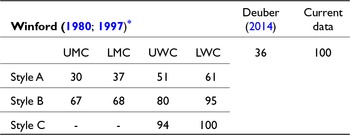
As can be seen in Table 1, Winford’s social class data showed his working class informants with high rates of to BE absence (his most working class respondents had none in these contexts 100% of the time in peer-group interaction), but also showed this to be acceptable in the speech of the middle class (about a third of these used the form in careful style, and two thirds in less careful style). This variable appeared to be less sensitive to formality restrictions, especially in conversations. Deuber’s study found this to also be the case, designating the feature as ‘fairly common’ with 36% use in her acrolectal conversation data (Reference Deuber2014, 143).
Percentages of verbs in the present progressive without to BE

* Note: Style A = more careful interview style; Style B = more casual interview style; Style C = spontaneous peer-group speech
UMC = upper middle class; LMC = lower middle class; UWC = upper working class; LWC = lower working class
In the present data, we find categorical absence for the respondents in the present progressive, with 100% absence of to BE, as exemplified in (4) – (5) below:
(4) DD: I have to teach them the lesson and so forth, so, I speaking English with them.
(5) HC: But when (.) sometime when you talk and you mix up the talk, them there know that you not talking pure.
Our grassroots speakers here clearly align most closely with Winford’s lower working-class respondents. Formality and/or style across all the data suggests that, while the absence of to BE is not heavily stigmatised (such as past marking, see below), it seems to be much more prevalent at the lower end of social use.
Winford noted similar tendencies in his social class data for to BE absence/presence in other environments, such as before adjectives or locatives (Reference Winford and Richard1980, 57), with Deuber also finding some variation of these forms at the acrolectal level (cf. 144–147). Due to space limitations, I will not explore this variable to any greater extent here, but such absence in the current data set is categorical before the few adjectives present in the data as shown in this example from HC: ‘If you want to say in English, and I give you tea to drink and I ask you if it sweet, if I want to ask you in Hindi, you say meetha ba.’
3.2.2 Past tense marking
Comparative analyses of Creoles and their lexifier languages have often focused on inflectional past marking (cf. Farquarson Reference Farquharson, Ansaldo, Matthews and Lim2007). In TEC, as in many other Creole varieties, there is no overt marking for the past either as the productive inflection in regular verbs or in irregular verb ablaut in past contexts:
(6) TEC: I walk yesterday./I run yesterday.
TE: I walked yesterday./I ran yesterday.
Table 2 shows that, unlike with the to BE forms above, past marking has a strongly pronounced class differentiation in the Winford data – middle-class speakers used much higher rates of past marking (especially in careful styles – 81%/85%), while lower class speakers used much higher rates of unmarked past forms (88%/97% in spontaneous styles). Deuber’s acrolectal conversation data likewise showed a low rate (13%) of unmarked past forms on par with Winford’s middle-class’ careful style.
Percentages of TEC uninflected verbs in the simple past
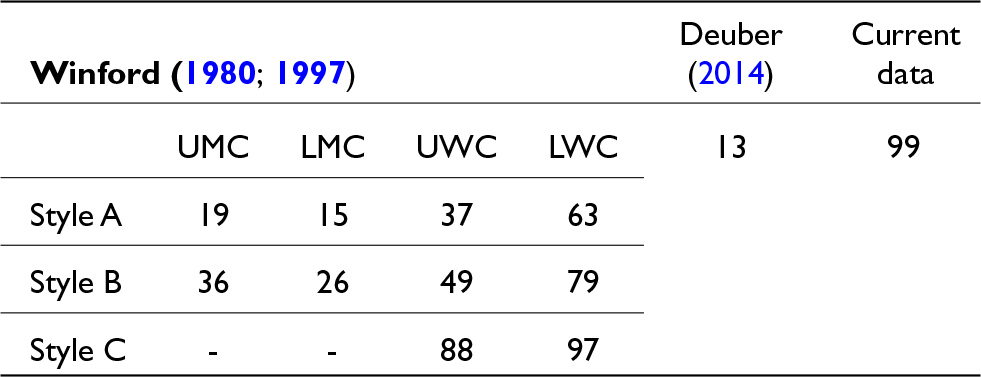
In our data, there is almost complete use of unmarked past forms (there is one mixed exception – DD: I stayed home and pound rice) with 99%, highlighted by these examples:
(7) HC: When the white people come here, and when they talk the twang go a little different and was hard to understand. And when the Indian people talk the same talk in English, we could understand them good.
(8) DD: And sometime me mother speak.
(9) SB: My parents and them die now, I have nobody.
While the overall picture here of social class use is different than that in the previous variable, the relationship between non-past marking and our grassroots respondents is the same – the TEC feature predominates at the lower-end of social class use.
3.2.3 Habitual does and future go
Winford’s findings showed clear, near-categorical distinctions in habitual does and future go between styles for his classes – almost no use in careful style for all respondent classes but increasing use in less careful styles by the working class (see Tables 3 and 4). This suggested that these forms were particularly stigmatised as non-standard, TEC forms. This is supported by the low occurrence of these forms in Deuber (Reference Deuber2014) and why percentage data from her study is not available in Tables 3 and 4. In the case of does, Deuber reports on 18 tokens in her total conversation data, but decides against a quantitative variable analysis – investigating every possible instance where the habitual could be used – for such a small number of tokens. Similarly, she does not report on percentage figures for future go, with 1 token.
(10) Habitual does: TEC: She does sing.
Table 3.Percentages of habitual does


TE: She sings.
(11) Future go: TEC: I go see it next week
TE: I will see it next week.
Though these features were singled out by Winford for study because of their frequency in conversation, in data as small as this we find that this is not always the case.
Percentages of future go

Due to the low occurrence of habitual contexts, it is best not to make generalisations from the 25% (only 1 of 4 instances) seen in Table 3 of does. HC provides this one instance:
(12) Yeah. My children (.) not, not, quite, but they does speak Hindustani.
In contrast, in the only other habitual context, he uses no preverbal marking:
(13) But Bhojpuri is a place in India. Like how, in Trinidad, now you live Harlem, I live Chaguanas, he live Port-of-Spain, you understand?
Future go, on the other hand, is present throughout the data.
We see this in HC’s use, for example:
(14) So it have two ladies. I tell them I can’t sign, ‘If you want me to sign in Hindi, I go sign.’ They say, ‘But who go understand that?’
MR uses go once for conditional futurity (where, in a TE context, would is likely to have been used):
(15) But girl, let me tell you something. If you take 72 cents and go in the grocery or the shop, you go have to get a donkey cart to put the goods.
As shown in Table 4, future go’s use is most comparable to Winford’s lower working-class group, supporting the overall finding that the more stigmatised TEC feature (it is not used at all by the upper middle class) is more readily present at the lower end of social use. There were, however, some few (3 tokens) alternative future marking forms in the data, as in 16:
(16) SB: Nobody wouldn’t understand it
The lack of does in these conversations is not to be taken as an indicator that it may not be ‘prevalent’ in general at the lower class/ grassroots, but as more of an understandable feature of smaller data size. Both the progressive and past marking are more likely to occur in conversation data (cf. Biber et al. Reference Biber, Johansson, Leech, Conrad and Finegan1999; Leech et al. Reference Leech, Hundt, Mair and Smith2009), and so contexts of especially habitual use might have been limited in this small sample. Further study on TEC features at the grassroots would do well to re-examine this feature in larger data sets.
4. Conclusion: TEC features and the grassroots in an ESD situation
The current study has attempted to describe some of the more salient features that are in variation within an ESD situation. Using previous works which have shown the relationship between both social class and style and these selected features, we have seen a clear near-categoricity for some morphosyntactic features as used by these grassroots respondents. Features which align closely with working class respondents in Winford’s (Reference Winford and Richard1980, Reference Winford1997) studies, and which seem to be stigmatised in Deuber’s (Reference Deuber2014) acrolectal TE, have been found to be highly frequent in this interview data. Rather than the more mixed-use that is apparent in more semi-formal interviews presented in those previous studies, we see the consistent use of TEC features among these speakers. We have noted, too, the clines of use that are present in an ESD situation where clear-cut boundaries do not always exist for variables. Moreover, while it is apparent that frequencies of non-standard, TEC forms and TE ones are highly dependent on style in this type of speech community, we have also seen that, for some speakers, such style shifts are not entirely possible given limited access to settings of standard English use. It has long been posited that speakers who range along a continuum of Creole to English use (cf. (Winford Reference Winford1997, 269) are able to command features between the most-Creole use and the acrolect, but for those whose social status and life experiences have not given access to standard or prestige forms, such stylistic shifts may not be completely possible. Winford (Reference Winford1985) has pointed this out in relation to diglossia: ‘in those formal contexts which require the use of the H variety, class differences in syntax are qualitative. The middle classes are distinguished from the working classes by categorical absence of the creole forms which still persist in the speech of the latter’ (352) – our short description here has suggested that this is pronounced with our grassroots speakers.
As more work of a quantitative nature is clearly necessary to further define the grassroots in Trinidad, I would suggest future authors focus on those features which have been variously labelled ‘conservative’, or which show up very rarely (if at all) in standard corpora like ICE-T&T. An example of such a feature is anterior/relative past marker did, which is not found a single time in Deuber’s conversation data setFootnote 5, but is found several times in our data (see [2] above). While necessary work is being undertaken to describe and define the speech of an educated elite, there is still much work to be done at the grassroots in Trinidad since ‘overall descriptive accuracy ultimately demands a concern for a balanced representation of the communicative repertoire of whole speech communities’ (Youssef Reference Youssef2004, 42).
 Ryan Durgasingh is a Research Fellow at Ruhr University, Bochum, and PhD candidate at the University of Münster, Germany, where his work focuses on morphosyntactic variation in Caribbean Englishes. His research interests include stylistics, Critical Discourse Studies, variationist sociolinguistics, and corpus-based approaches to linguistic analysis. His latest co-edited collection with Philipp Meer on variation in standard varieties, Pluricentricity and Pluriareality: Dialects, Variation, and Standards, was recently published in January 2025 by John Benjamins. Email: Ryan.Durgasingh@ruhr-uni-bochum.de


 Open access

