





1. Introduction
Metaphoric expressions are typically held to rely on the capacity of words, bound morphemes, and word combinations to take on two or more meanings, often linked by some form of similarity. For example, when referring to someone as honey, we exploit the notion of sweetness typically associated with the substance made by bees to describe the pleasure of interacting with a loved individual. Likewise, when referring to someone as our hot water bottle, we call upon the most salient properties of a common household object to show that we enjoy their cuddles on a winter night. Some linguistic metaphors (e.g., honey) are conventional phrases commonly reused in one’s speech community. Others (e.g., hot water bottle) are novel and created spontaneously, previously unregistered. Developing the comprehension and production of both conventional and novel metaphoric expressions helps children to go beyond the fairly concrete and basic meanings that feature in their earliest lexicons (Gentner & Boroditsky, Reference Gentner, Boroditsky, Bowerman and Levinson2001); it also equips children with sophisticated inferential skills crucial for their everyday experiences with peers and adults, as well as their educational success.
Most pragmatic theories (e.g., Carston, Reference Carston2002; Glucksberg, Reference Glucksberg2001; Recanati, Reference Recanati2004; Sperber & Wilson, Reference Sperber and Wilson1995; Wilson & Sperber, Reference Wilson and Sperber2012) operate with a fairly narrow view of what constitutes a metaphorical meaning in everyday communication. According to such theories, for a meaning to count as metaphorical, it needs to be the result of a pragmatic process, which involves an ad hoc construction of a novel concept in a given situation, whereas any concepts previously encountered in conventional expressions count as mere polysemes processed and used in a way akin to any other lexical expressions, through access and retrieval (e.g., Glucksberg, Reference Glucksberg2001). However, such a narrow definition does not seem to consider that young children must process conventional metaphors they hear for the first time as novel (creative) uses of language which require some degree of deconstruction to become functional. As the metaphoricity of conventional metaphoric expressions is downplayed, and their role backgrounded, pragmatic theories attribute the emergence of inferential skills to the overall lexicon size. This in turn may explain conflicting research results: some studies show that the lexicon size can predict novel metaphor comprehension (e.g., Van Herwegen et al., Reference Van Herwegen, Dimitriou and Rundblad2013), whereas others do not (e.g., Di Paola et al., Reference Di Paola, Domaneschi and Pouscoulous2019; Pouscoulous & Tomasello, Reference Pouscoulous and Tomasello2020). It is possible that if children’s emerging pragmatic skills were studied in light of conventional metaphors that emerge from child-directed speech, that is, a lexical subset requiring inferential reasoning, the links between such “metaphor-i-cons” and children’s novel metaphor comprehension would be easier to observe.
By strong contrast, conceptual metaphor theory (CMT; e.g., Grady, Reference Grady2005; Lakoff & Johnson, Reference Lakoff and Johnson2008) sees the vast majority of metaphors as conceptual phenomena, making a distinction between how they are realised in speech, and how they are conceptualised in the mind. In this article, we refer to the former as metaphoric expressions (or linguistic metaphors), and the latter as their mappings. Under CMT, both conventional and novel conceptual expressions (i.e., especially those for primary metaphors structured by sensorimotor experiences, such as feeling down) are processed by the underlying mappings developed through repeated early childhood experiences that feature both concrete entities (e.g., experiencing slouching posture, hunched shoulders, lowered head) and abstract notions (e.g., feeling sad) (e.g., Mandler, Reference Mandler, Bloom, Peterson, Nadel and Garret1996). Grady (Reference Grady2005) stresses that such sensimotor bases of primary metaphors make them very different from those that are non-conceptual. He terms the latter as resemblance or analogical metaphors, (e.g., honey), arguing that although novel expressions for resemblance metaphors may be processed by establishing a structural alignment between two represented notions (e.g., honey: child versus syrup) and then projecting inferences (e.g., Gentner et al., Reference Gentner, Bowdle, Wolff, Boronat, Gentner, Holyoak and Kokinov2001), analogy is unlikely to apply to notions central to primary linguistic metaphors (e.g., down, and sad). Resemblance metaphors do seem to be very different in nature: as each of them reflects a link between two entities which does not rely on a mapping exploited by any other expressions, they all seem to have purely linguistic underpinnings. However, the apparent differences between these two types of expressions still await systematic empirical investigation.
For one, the age of onset of metaphor production remains a matter of speculation. So far, we know that the comprehension of both conventional and novel resemblance metaphors in children aged three is lower than that of conventional and novel primary metaphoric expressions matched for familiarity and aptness (Almohammadi et al., Reference Almohammadi, Gaskins and Rundbladforthcoming). We also know that even children as young as three can comprehend some resemblance metaphors and this ability improves with age (Pouscoulous & Tomasello, Reference Pouscoulous and Tomasello2020), alongside the growing abilities of analogical perception (Di Paola et al., Reference Di Paola, Domaneschi and Pouscoulous2019; Pouscoulous & Tomasello, Reference Pouscoulous and Tomasello2020), alternative naming (Di Paola et al., Reference Di Paola, Domaneschi and Pouscoulous2019), and increasing vocabulary size (Van Herwegen et al., Reference Van Herwegen, Dimitriou and Rundblad2013). However, there are currently no studies to report when children below the age of 3 start to produce linguistic primary and resemblance metaphors, possibly because such expressions are difficult to elicit through experimental design, and young children are notoriously difficult to work with using experimental paradigms. Likewise, no studies have investigated empirically the factors that drive children’s production of such expressions. Meanwhile, observational data tell us that children can use linguistic metaphors in early childhood. There are some accounts that give examples of an 18-month-old child wiggling a toy car up her mother’s arm, calling it a snake (Winner et al., Reference Winner, McCarthy, Gardner, Honeck and Hoffman1980); of a 23-month-old coming out of a shower with pointy hair, calling herself a hedgehog; of a 36-month-old sitting in front of piping hot soup and commenting on the smoke dancing (Pouscoulous, Reference Pouscoulous and Matthews2014). Studying the early production of metaphoric expressions could therefore be attempted via corpora of naturalistic interactions between children and their primary caregivers.
As primary conceptual mappings are theorised to be triggered prelinguistically through the acquisition of primary scenes which subsequently facilitate the processing of local instances of linguistic metaphor use (Lakoff & Johnson, Reference Lakoff and Johnson2008; Lakoff & Turner, Reference Lakoff and Turner1989; Turner, Reference Turner1987, Reference Turner1990), we would expect children’s acquisition of linguistic expressions based on primary mappings to follow a fairly similar schedule across individuals, with expressions based on specific mappings (e.g., TIME IS SPACE) emerging around comparable times in all children studied. Furthermore, we would expect the frequencies of metaphoric expressions in caregiver input to play a minimal role in their acquisition. By strong contrast, resemblance metaphors, whose comprehension has been linked to children’s growing lexical skills (e.g., see Di Paola et al., Reference Di Paola, Domaneschi and Pouscoulous2019; Van Herwegen et al., Reference Van Herwegen, Dimitriou and Rundblad2013), should develop in line with children’s own linguistic experience, and reveal links with both the quantity and quality of caregiver input, and children’s own linguistic resources. We also expect significant variation in caregivers’ use of resemblance metaphors, which should translate into significant variation in how they are used by their children.
Studying children’s spontaneous use of metaphors comes with the question of how well children know that the words they use are open to dual interpretation. It is often argued that metaphor knowledge requires a” mental” link between the word’s abstract and concrete meanings (e.g., Steen et al., Reference Steen, Dorst, Herrmann, Kaal, Krennmayr and Pasma2010). For example, when calling someone honey, children would need to know at the very least that the word honey can refer both to a sweet substance and a loved individual. Under the graded salience hypothesis (GSH), the processing of concrete and abstract senses depends on their salience in use, that is, their frequency, familiarity, conventionality, and prototypicality (Giora, Reference Giora1997). We extend Giora’s GSH from metaphor processing to metaphor acquisition and propose that the abstract and concrete senses of words like pumpkin, or honey may likewise be acquired in a different order depending on whether they are more salient in use. Thus, a child raised in a tradition where pumpkins are a common occurrence in fields, shops, and kitchens, would first acquire the concrete sense of the word and only then learn its abstract counterpart. In such cultures, the child may then call upon the notion of a cute round object when addressing someone affectionately as pumpkin (Lakoff & Johnson, Reference Lakoff and Johnson2008; Pragglejaz Group, 2007; Steen et al., Reference Steen, Dorst, Herrmann, Kaal, Krennmayr and Pasma2010). Likewise, however, the child may acquire the abstract sense of the word before its concrete counterpart if the former is more salient in use and use it without understanding its concrete underpinnings (Almohammadi, Reference Almohammadi2017). Depending on each family’s eating habits and linguistic practices, it is easy to imagine that there may also be some within-culture variation in the way different children acquire the two senses of the word. Once the two senses have been acquired, it is also conceivable that children may use both word senses accurately without realising that they are interconnected: the two senses may be transferred holistically and more or less successfully from parental to child language in suggestive conversational contexts. Studying metaphor production through corpora of naturalistic interactions can show us which meanings are prioritised for acquisition and attribute this order to caregiver frequencies. At the same time, however, it is important to bear in mind that production data have a limited capacity for capturing the “mental” link between the two meanings.
In light of the research literature, it appears that studying child metaphor production through naturalistic corpora can address at least five pressing questions. It can demonstrate at what age children start to produce linguistic primary (and other conceptual) metaphors as well as linguistic metaphors rooted in a perceptual resemblance. It can show if primary metaphoric expressions are acquired on a similar schedule, and if resemblance metaphors start to emerge in different proportions in different children. It can also reveal if caregivers’ use of linguistic metaphors can only predict the variation in children’s use of resemblance metaphors, or if it can also predict any potential variation in children’s use of primary metaphoric expressions. Moreover, naturalistic corpora can show how common it is for children to prioritise abstract or concrete meanings of words that can (potentially) be considered metaphorical, and if this order is dictated by the salience of these meanings in the input. Last, they can help us to explain whether cumulative use of both types of conventional linguistic metaphors leads to children’s ability to create novel linguistic metaphors.
Exploring the use of metaphoric expressions in corpora that capture conversations between children and their caregivers requires a systematic approach to data coding and data analysis, for which current methods are unsuitable. The many methods developed to study metaphor use, both software-assisted (Coll-Florit & Climent, Reference Coll-Florit and Climent2019; Fass, Reference Fass1991; Martin, Reference Martin1990; Mason, Reference Mason2004; Berber Sardinha, Reference Berber Sardinha2011) and manual (Cameron et al., Reference Cameron, Maslen, Todd, Maule, Stratton and Stanley2009; Pragglejaz Group, 2007; Steen et al., Reference Steen, Dorst, Herrmann, Kaal, Krennmayr and Pasma2010; Stefanowitsch & Gries, Reference Stefanowitsch and Gries2006) come with a design which is best suited to studying specific (adult) populations and addressing research questions pertinent to them. For example, the Metaphor Identification Procedure (MIP; Pragglejaz Group, 2007), and its successor Metaphor Identification Procedure VU University Amsterdam (MIP-VU; Steen et al., Reference Steen, Dorst, Herrmann, Kaal, Krennmayr and Pasma2010), both of which were created in the context of CMT, are attentive to some of its premises, which have not been explored through much empirical research in the area of metaphor acquisition. Both MIP and MIP-VU see linguistic conceptual metaphors as mappings of selected qualities from the more concrete source domain (SD) to the more abstract target domain (TD), and each instance of linguistic metaphor use as evidence of activating the concrete concepts. However, as mentioned before, there is some evidence that young metaphor users may not invoke the basic concept from the SD when using linguistic metaphors (Almohammadi, Reference Almohammadi2017). Although they understand ambiguous words (Srinivasan & Snedeker, Reference Srinivasan and Snedeker2011) and meaning shifts (Falkum et al., Reference Falkum, Recasens and Clark2017), children who use linguistic metaphors may thus not be aware that they have more than one meaning.
Another influential method is Metaphor Identification through Vehicle terms (MIV) (Cameron et al., Reference Cameron, Maslen, Todd, Maule, Stratton and Stanley2009). MIV was developed in the context of Pragmatic Theory: it focuses on linguistic metaphors encountered in complex discourse and developed collaboratively by multiple speakers. According to Cameron et al. (Reference Cameron, Maslen, Todd, Maule, Stratton and Stanley2009), for a stretch of language to be metaphorical, it must meet two conditions: (a) it must contain incongruity with the rest of the discourse, and (b) such incongruity must be resolvable with a transfer of meaning. To identify linguistic metaphors, one needs to identify a vehicle for the metaphor (e.g., you are such an early bird), which is either semantically or pragmatically incongruous with the topic of the text (e.g., talking about when people start their day) and to determine whether connections can be made between the meaning of the vehicle and the contextual topic. The most attractive aspect of MIV, which stands it in contrast with MIP and MIP-VU, is its capacity to focus mainly on metaphors that stretch beyond single lexical units, whereas it excludes most prepositions and delexicalised verbs. However, with its focus on multiword units, MIV is more suited to the analysis of complex discourse types rather than child utterances, which can be initially very short.
Despite their undisputed popularity, MIP(-VU) and MIV are thus suited to the study of metaphor use primarily among competent adult speakers who have achieved the endpoint of their metaphor acquisition and whose metaphor knowledge is similar to that of any other speakers of the same language (e.g., Steen et al., Reference Steen, Dorst, Herrmann, Kaal, Krennmayr and Pasma2010, p. 7). As these methods are currently not sufficiently tailored to working with child language, in this article, we propose a novel usage-based approach to metaphor identification and analysis in child speech (UBAMICS). Although its coding procedure is indebted to MIP and MIP-VU (Pragglejaz Group, 2007; Steen et al., Reference Steen, Dorst, Herrmann, Kaal, Krennmayr and Pasma2010), its originality lies in two main areas. First of all, to capture the earliest metaphor productions, our coding scheme has been designed to distinguish metaphoric expressions from other similar phenomena, such as pretence and overextensions, and to code for metaphors that may initially contain only some (not all) aspects of metaphor knowledge available to adult speakers. To show how metaphor knowledge develops over time, we recommend that the coding scheme is applied to longitudinal interactional data. Second, to test if linguistic primary and resemblance metaphors emerge on a similar schedule across different children studied, our coding manual makes a distinction between these two metaphor classes, and a further distinction between mappings for conceptual metaphors.
Moreover, to show whether caregiver speech only impacts the acquisition of resemblance metaphors, or if it also paves the way for the acquisition of primary metaphoric expressions, we propose that the data coded by means of our procedure is submitted to input–output analyses. This approach is rooted in usage-based theory (UBT) which posits that “the speaker’s linguistic system is fundamentally grounded in ‘usage events’, i.e., a speaker producing or perceiving language” (Barlow & Kemmer, Reference Barlow and Kemmer2000, p. VIII; see also Bybee, Reference Bybee2010; Croft, Reference Croft2001; Langacker, Reference Langacker1987; Tomasello, Reference Tomasello2003). To test input–output effects in metaphor acquisition, our approach will rely on two features of input that have been shown to drive language development. The first is priming, a basic learning mechanism, based on the propensity to store memory traces from immediate discourse (Kirjavainen & Theakston, Reference Kirjavainen and Theakston2011; Koch et al., Reference Koch, Quick and Hartmann2020; Rowland et al., Reference Rowland, Chang, Ambridge, Pine and Lieven2012). Koch et al. (Reference Koch, Quick and Hartmann2020) examined the speech of German-speaking children aged two in terms of priming effects and showed that by the age of three, once children’s utterances become long and more productive, children emancipate themselves from the input and become more creative with their language choices. These results suggest that priming eases the processing of structures that have been activated before, especially those less entrenched in the speaker’s memory (e.g., Schmid, Reference Schmid2020). We suggest that priming may also offer a steppingstone for the acquisition of specific classes of conventional linguistic metaphors just like it does for the acquisition of early constructions. We will show how our coding procedure allows us to distinguish between linguistic metaphors which are merely repeated after the parent and those “crafted” independently.
The second feature of input to facilitate language acquisition is frequency: the more frequently children hear a given word, phrase, or category of linguistic items, the more likely they are to prioritise it for acquisition (Bybee, Reference Bybee2010; Tomasello, Reference Tomasello2003). When applied to metaphor acquisition, linguistic metaphor frequencies found in the input are expected to reveal a difference between primary metaphoric expressions, which are in theory driven by qualitative non-linguistic experience, and resemblance metaphors, which are expected to be driven by the quantity and quality of caregiver input. Although, in theory, primary metaphoric expressions have little to do with the linguistic input, this has not been empirically confirmed; the use of UBAMICS can thus reveal whether child-directed speech contributes to their acquisition (see, e.g., Littlemore, Reference Littlemore2019). Studying frequency-driven input–output relations in metaphor production can also address other research questions. If there is variation in children’s use of linguistic metaphors, it can be examined in light of potential variation in linguistic metaphors used by their respective caregivers. Frequency-based analyses can help us to explain how common it is for children to prioritise abstract or concrete meanings of words that can (potentially) be used metaphorically, and to attribute this trajectory to the frequencies of meanings in child-directed speech. Last, children’s use of novel linguistic expressions for both conceptual and resemblance metaphors can be studied in light of the cumulative use of conventional linguistic metaphors. These types of analyses demand that data for each child are analysed separately in light of their different linguistic circumstances.
In this article, we will discuss the coding scheme developed for transcript analyses, explain how to overcome the challenges of identifying linguistic metaphors in child speech, and report our inter-annotator reliability scores. By analysing a corpus of one child selected from the CHILDES database, we will then show how the coding scheme can be applied to longitudinal interactional data to study the acquisition of metaphoric expressions. Our analysis will address three of our research questions, showing (a) at what age the child starts to use different types of metaphors, (b) to what extent linguistic input predicts the acquisition of linguistic primary (and other conceptual) metaphors, as well as resemblance metaphors and (c) whether it affects how concrete and abstract meanings are acquired. In the subsequent discussion, we will propose how access to more data can help to address our other questions.
2. The usage-based approach to metaphor identification in child speech
Our usage-based approach to metaphor identification in child speech owes most of its features to MIP (Pragglejaz Group, 2007) and MIP-VU (Steen et al., Reference Steen, Dorst, Herrmann, Kaal, Krennmayr and Pasma2010), because both MIP and MIP-VU include even the most basic types of linguistic metaphors (encoded in delexicalised verbs and prepositions), which can help us to capture the origins of metaphoric speech. Although words only gain metaphoricity if examined in the context, we expect few metaphors stretching beyond the boundaries of words because the speech of children aged two is dominated by one-word utterances, and their utterance length develops only gradually over the third year of life (Brown, Reference Brown1973).
UBAMICS breaks down linguistic metaphor identification into six main steps:
-
1) Read the transcript to understand what it is about.
-
2) Decide what makes a word (i.e., the basic unit of analysis). Some collocations (e.g., phrasal verbs and idioms) are analysed on a par with individual words as long as they encode only one metaphor. Decide if the word, or its part, is metaphor related, that is, it has been used with a contextual meaning that is different from its basic meaning. Determine the contextual meaning of the given metaphor-related word (MRW). In some cases, where the metaphor is clearly observed on the level of affixes, it can be coded as such (e.g., to overspend, in the afternoon). This should extend the use of UBAMICS to more synthetic languages in which primary metaphors are often disguised in longer words containing multiple morphemes. For example, the Polish perfective aspect verb zaśpiewać ‘to sing’, which indicates one-time completion of the act, can be analysed as made up of an imperfective verb stem śpiewać ‘sing’, which does not specify completion of the act, and a metaphor-related prefix za ‘after/behind’ which some interpret as initiating an action by crossing a boundary (Tabakowska, Reference Tabakowska, Cuyckens, Berg, Dirven and Panther2003).
-
3) Determine the basic meaning of the MRW using a dictionary (The Macmillan English Dictionary for Advanced Learners and The Longman Dictionary of Contemporary English). MIP-VU sees basic meanings as those which are more concrete, human-oriented, and more specific.
-
4) Decide if there is a sufficient difference between the two meanings, disregarding, at least initially, whether the child has a grasp of these two meanings, and the order in which they were acquired. Include, at least initially, all instances of metaphors where the child may, or may not, have understood what they are saying (e.g., recasts of parental turns such as I’m not a parrot). Further tests can be performed at a later stage to determine whether children who produce MRWs also have their basic sense equivalents in their productive lexicons. Further tests can also confirm to what extent children can use MRWs independently (i.e., not as recasts of parental turns).
-
5) Decide if these two meanings can be related by some form of similarity, or what CMT would refer to as a mapping between two different domains.
-
6) Exclude non-metaphorical overextensions, pretence, and words where the link between the concrete and abstract form is obscured by some form of phonological modification.
The latter three language features are very common in speech, especially that of very young children. First of all, some words in child speech may be used in a seemingly metaphorical way because the child is yet to acquire a range of vocabulary and she has no choice but to refer to a carpet as grass, for example (Billow, Reference Billow1981; Winner, Reference Winner1979). As adult metaphors also help to express ideas difficult to explain using more literal language, we argue that only metaphorical extensions should be included, whereas non-metaphorical extensions are excluded (Voeniatou, Reference Voeniatou1987). These tend to be easy to discern, as metaphorical extensions are based either on the distinctions between two entities which are fairly distinct from each other, including both their abstract features (e.g., calling someone a monkey means that they are a lively and mischievous individual) and concrete features (e.g., calling someone a giraffe means they are a tall individual, or one with a long neck). Meanwhile, non-metaphorical extensions are based on the concrete features of entities that are fairly close to each other (e.g., referring to a meerkat as a monkey suggests that the child may not know the distinction between the two).
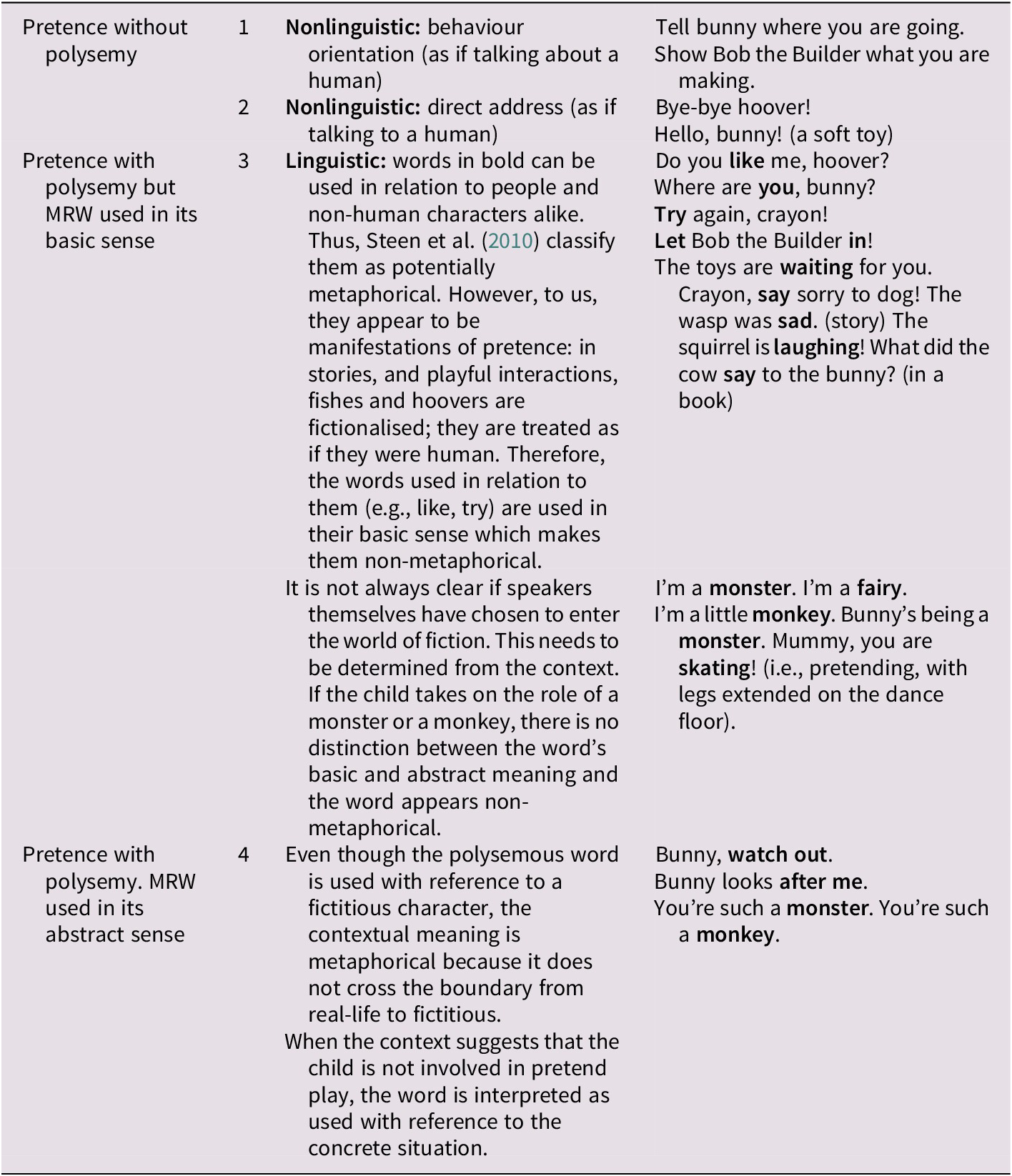
Second, pretence is very common in child language (e.g., Kavanaugh & Harris, Reference Kavanaugh, Harris, Bolter and Tamis-Le Monda2001). Like metaphor, pretence brings inanimate entities to life: both may present cases of non-literal language use, both are elaborate and complex, thus they may rely on the same cognitive processes (Pouscoulous, Reference Pouscoulous2011, p. 82). However, as is shown in Table 1, pretence and metaphor are somewhat different: only metaphor requires that the MRW be used in its abstract sense. Thus, to exclude cases of potential pretence in a systematic manner, it is important to adhere to a procedure of a) identifying word polysemy and b) distinguishing between the word’s basic and contextual meanings (Table 1). We exclude from analysis all cases of non-linguistic pretence which do not rely on polysemy (Table 1, rows 1 and 2). Where polysemous words are used in their basic sense (row 3), they are deemed non-metaphorical. For example, where the child says Do you like me, hoover?, she seems to enter the world of fiction, treating the hoover as a character able to hear, understand and respond to human speech. Therefore, the word like is seen as used in its basic sense (i.e., as if the hoover were capable of liking people). By contrast, where fictional characters are described by words in a sense which is distinct from their basic meaning (row 4), the words should be categorised as metaphorical. For example, a child may ask a bunny to watch out, where the word watch is used to refer to paying attention rather than seeing, both real-life qualities. Even though this word is used in relation to a fictitious character, in this example the polysemy does not cross the boundary between what is real and what is not.
How to distinguish pretence from metaphor in the corpus (polysemy in bold)
Third, as UBAMICS examines transcripts of speech, it deals with spoken forms of language, and needs to consider how such language is produced and heard in the given situation. Some spoken forms may lose their polysemous character in speech. For example, where spoken forms are systematically contracted (e.g., I’m gonna go), their correspondence with their concrete counterparts is lost (gonna = going to), and they are excluded from analyses. Other spoken forms which include non-target pronunciation (e.g., Lickle instead of Little) are included because they are considered either as personal speech variations, or as temporary features of child speech and mere attempts at target-like pronunciation.
Steen et al. (Reference Steen, Dorst, Herrmann, Kaal, Krennmayr and Pasma2010, p. 72) also point out that in conversation analysis many aborted utterances may need to be disregarded if the context surrounding word use is unclear. In child language, this is exacerbated by the fact that some turns are presented as partly unintelligible. Some of these utterances could be clarified in future research if video recordings were available, particularly considering that children, more than adults, rely on gestures as a gap-filling strategy, both to name and request objects. Access to video recordings would allow researchers to access earlier stages of language acquisition and to explore multimodal metaphor use which combines gestures with the first words used.
Furthermore, unlike MIP or MIP-VU, UBAMICS does not code for some linguistic ontological metaphors such as container (e.g., in a choir) and substance metaphors (e.g., a lot of thinking) to make the process of metaphor identification less time-consuming, enabling analysis of multiple datasets recorded longitudinally over several years of development. Also, unlike MIP-VU, UBAMICS does not code for metaphoric expressions which have been either replaced with a pronoun (e.g., To embark on such a step is not necessarily to succeed immediately in realising it [the process of embarking on such as step]), or omitted through ellipsis (But he is! [an ignorant pig]). This is to capture the actual instances of linguistic metaphor use in the corpora, rather than their implied or potential use. Moreover, unlike MIP or MIP-VU, our approach does not require that words be of the same grammatical category in order to be compared. They merely need to have the capacity to fill the same slot within the utterance. For example, baby carrot can be analysed as a ‘small carrot’ even though baby is a noun and small is an adjective. This reflects the key assumption of UBT that children become aware of formal linguistic categories gradually in the process of acquisition as words of the same category tend to be used in the same slots (Tomasello, Reference Tomasello2003).
To facilitate quantitative analyses of input–output relations in metaphor acquisition, we propose to determine linguistic metaphor frequencies by adding up their numbers in each transcript of hourly interaction in child and adult speech. This is different from MIP or MIP-VU which have been designed to examine metaphor frequencies in written discourse, and which do so by calculating the total number of metaphorically used words and units out of the total number of words and units used in each text. MIP and MIP-VU style of determining the relative frequency can be adopted as an alternative; however, this process will be more time-consuming, as it will need to be implemented at the level of morphemes, rather than words and units, especially in more synthetic languages where metaphors are often disguised in longer words containing multiple morphemes.
3. The coding manual for UBAMICS
In this section, we present the coding manual developed for the analysis of linguistic metaphors in child speech. In the process of metaphor identification, all metaphors are coded at two levels: first for metaphor class, and then for metaphor mapping. The category of metaphor class allows us to cluster metaphors that share some broad features (e.g., all primary metaphors reflect basic relations between concrete entities and abstract notions). The category of metaphor mapping allows us to capture more specific characteristics within all metaphor classes (e.g., primary metaphors of time such as TIME IS SPACE or TIME IS MOTION). Personification and metonymy–metaphor combinations are the only two metaphor classes that are not associated with metaphor mappings.
As our approach is heavily indebted to MIP and MIP-VU, and by extension also CMT, we advocate working with the Master Metaphor List (MML, Lakoff et al., Reference Lakoff, Espenson and Schwartz1991), which can help to confirm whether the identified linguistic example can indeed be considered an instance of conceptual metaphor use. If a linguistic expression is not included on the MML, researcher intuition should be used to estimate its potential correspondence with the listed mappings. Otherwise, if the metaphor appears to rely on some form of similarity, either physical (e.g., Sarah is a giraffe, i.e., tall) or relational (Sarah is such a monkey, i.e., playful, and mischievous), it should be regarded as a resemblance metaphor (for more discussion of these metaphor types, see, e.g., Winner, Reference Winner1997).
We divide conceptual metaphors into six classes:
-
1) Primary metaphors, that is, single- or multi-word orientational metaphors to do with space, motion, and direction, which are encoded in verbs, adverbs, adjectives, and prepositions, or combinations thereof (e.g., Let us make a snowman when winter comes = TIME IS MOTION (see Grady, Reference Grady2005)), and any other ontological metaphors which provide more complex mappings than just container and substance (e.g., This is just brilliant! = GOOD IS LIGHT).
-
2) Verbs of perception, Footnote 1 that is, single- or multi-word metaphors built around verbs of perception, or verb phrases (e.g., You get hurt because you never listen = OBEYING IS LISTENING; for specific mappings cf. Ibarretxe-Antuňano, Reference Ibarretxe-Antuňano, Speed, O’Meara, Roque and Majid2019).
-
3) Personification, that is, single- or multi-word ontological metaphors usually encoded in nouns, verbs, and adjectives, or phrases built around them, which attributed human qualities to non-human entities (e.g., The traffic light says stop).
-
4) Structural metaphors, that is, single- or multi-word metaphors which reflect complex systems of universal beliefs (e.g., Stop fighting with your friends = ARGUMENT IS WAR).
-
5) Metonymy–metaphor combinations, that is, single- or multi-word formations where, in addition, a given concept is referred to by the name of something closely associated with that concept (e.g., My nose is running [i.e., the mucus, not nose (metonymy)], is moving very fast, but not running [i.e., using legs (metaphor)] (see also Radden, Reference Radden, Dirven and Pörings2002)).
-
6) Novel conceptual metaphoric formations, that is, single- or multi-word examples, which are not familiar to the coder, but which can be paired up with a well-established mapping (e.g., You are sugary = PLEASURE IS SWEET).
Although most metaphors are likely to be captured by the proposed conceptual metaphor classes and mappings, there is also a need to account for those metaphors which are not rooted in sensimotor experience, but instead reflect a resemblance between the SD and the TD. When coding for resemblance metaphors, we distinguish between three different classes:
-
1) Nominal A-to-B metaphors, that is, nominal metaphors encoded in single nouns or noun phrases which reflect a certain attitude to, or perception of, another person (e.g., petal, pumpkin, tennis ball, monster, dragon).
-
2) Other resemblance metaphors, that is, any other metaphors grounded in a perceptual similarity which are encoded in single words other than nouns or noun phrases, or phrases built around them (e.g., catch a bus, pop into the office, hold on a minute).
-
3) Novel resemblance metaphoric formations, single- or multi-word metaphors, which are not familiar to the coder, but which evoke some form of perceptual similarity (e.g., Your hair is worms).
Beyond the conceptual and resemblance metaphors, we follow MIP-VU (Steen et al., Reference Steen, Dorst, Herrmann, Kaal, Krennmayr and Pasma2010) and use two additional codes to account for phenomena whose use should be examined in relation to metaphor acquisition.
-
1) MRW direct, that is, when an expression is used directly and its use may potentially be explained by some form of cross-domain mapping to a more basic referent or topic in the text (e.g., like a diamond in the sky). Some studies show that direct metaphors, or ‘similes’, can be understood earlier in life than normal metaphors because the metaphorical word is introduced with an explicit marker (Siltanen, Reference Siltanen2009) and because similes are more literal than metaphors (Katz et al., Reference Katz, Cacciari, Gibbs and Turner1998; Searle, Reference Searle1979) but this needs be verified for metaphor production.
-
2) MFlag, that is, a word which functions as a signal that a cross domain mapping may be at play. Potential markers of analogy include like, as, compare, comparison, comparative, same, similar, analogy, analogue, regard as, conceive of, see as, imagine, think, talk, behave as if and so on. Unlike MIP-VU, UBAMICS also uses this code for words such as chocolate button and fishfinger, which contain some element of comparison, in that they either remind us of objects from other domains or have been created in their likeness. In these examples, instead of the well-established markers of analogy (e.g., like), the concrete notions of chocolate and fish support the interpretation of the whole phrase. Coding for markers of analogy can potentially help us to examine the relationship between the productive use of linguistic analogy and the acquisition of resemblance metaphors (Pouscoulous & Tomasello, Reference Pouscoulous and Tomasello2020; Di Paola et al., Reference Di Paola, Domaneschi and Pouscoulous2019).
As like is a marker used for both MRW Direct and MFlag, it is important to understand how its use differs in both contexts. Its use is coded as MRW Direct if followed by an MRW; if the word to follow it is not related to metaphor, like is coded as MFlag. It is also important to mention that although we expect most linguistic metaphors produced by children to be single-word, the classes proposed here (e.g., personification) could be further subdivided into single- and multi-word classes, most likely when studying data from older children.
Once all the linguistic metaphors have been identified, child metaphors should be re-examined to eliminate words and word combinations merely repeated after the caregiver who used them verbatim with the same meaning in one of the previous 10 turns (e.g., MOT: You’re such a monkey; CHI: I’m not a monkey), or any metaphors self-primed by those which the child repeated after the caregiver (e.g., any instances of I’m not a monkey the child produced repeatedly after the previous one). Also, names of books, shows, and characters from stories (e.g., Storm in a teacup, Wacky Warehouse, Bare Necessities, Little Red Riding Hood), as well as nursery rhymes (e.g., Like a diamond in the sky, Reach out for the stars) should be eliminated. In compiling an inventory of metaphors produced independently by each child, each linguistic metaphor production should be evaluated in light of the previous 10 caregiver turns to ensure it had not been primed, and in light of the previous recording to ensure it had been used independently at least once before and is on the way to becoming a more permanent feature of the child’s “metaphor-i-con”. Adopting this approach means that the first 10 lines of each recording, and the first recording in each corpus, should be disregarded from analysis.
At the next step, it is important to calculate overall metaphor types and tokens to examine the composition of each sample representing a given metaphor class and mapping. As the study of metaphor use is about meaning rather than form, we consider as metaphor type any morpheme or word, and all its grammatical variations, which are associated with one specific meaning; we consider as metaphor token each and every single instantiation of the given mapping or class. For example, when examining the class of primary metaphors, and the mapping of TIME IS MOTION, we take all grammatical versions of the verb come (as in The time has come) as instantiations of one metaphor type, and all grammatical variations of the verb arrived (as in Spring has arrived at last) as instantiations of another metaphor type. Meanwhile, the overall numbers of expressions for both metaphor types (e.g., come, came, coming, arrive, arrived, arriving) contribute to the overall number of metaphor tokens for this particular mapping. Distinguishing between type and token frequencies can help us to show how varied children’s metaphor pools are with respect to each metaphor class, or mapping.
Last but not least, all MRWs (e.g., Come here, honey) should be counted separately from their concrete equivalents (e.g., Drink some milk and honey) and compared against each other to justify the order of acquisiton of meanings in child’s own language.
4. Applying UBAMICS to Eleanor’s data
This section illustrates how UBAMICS works on corpus data available in the CHILDES Talkbank. The corpus analysed here is referred to as ‘Eleanor’ and it forms part of the MPI-EVA-Manchester corpus of interactions with English-speaking children, raised in the UK (e.g., Lieven et al., Reference Lieven, Salomo and Tomasello2009). The child nicknamed Eleanor was recorded at the ages of 2;0 (2 years) -3;1 (3 years and 1 month) on a dense sampling schedule: for 1 or 2 hours, five times a week in the first and last 4 weeks, and for 2 hours a week of every remaining month of the period. The corpus data consist of dyadic or triadic interactions between the child and her primary caregivers, totalling 179 recordings (179 hours). Metaphor is infrequent in conversation (Berber Sardinha, Reference Berber Sardinha2011; Steen et al., Reference Steen, Dorst, Herrmann, Kaal, Krennmayr and Pasma2010), which is why the use of densely sampled corpora increases the chances of metaphor detection and helps to make any claims of input–output relations more credible.
To establish the reliability of our coding scheme, transcripts based on the whole 179-hour corpus were coded independently by two coders, who were in regular contact about the coding procedure (i.e., unclear definitions in the code book were discussed without reference to examples from the corpus). When the results were compared for coding reliability, all checks showed near 0.97 agreement (Cohen’s kappa), with the largest disagreement within the category of sensory verbs (10%, i.e., 53 out of the total 540 metaphors not agreed on). This score is higher than either that of MIP (0.62 to 0.72 (Pragglejaz Group, 2007)) or MIP-VU (0.70 to 0.96 (Steen et al., Reference Steen, Dorst, Herrmann, Kaal, Krennmayr and Pasma2010)). The main reason for such a high score is that child data, and by extension also child-directed speech, are very basic so there were many linguistic metaphors used repeatedly whose occurrence seemed straightforward in classification. For example, the highly frequent metaphors such as There you go and Come on were coded in almost every single case as a combination of two elements: There (ACHIEVING A PURPOSE IS ARRIVING AT DESTINATION) and go (ACTION IS MOTION) or come (ACTION IS MOTION) and on (FUTURE IS ONWARDS). Following Steen et al. (Reference Steen, Dorst, Herrmann, Kaal, Krennmayr and Pasma2010), the latter example was only coded as non-metaphorical when it clearly reiterated the concrete verb spelled out elsewhere in the transcript (i.e., where Come on was used straight after Come!).
4.1. Metaphors identified in Eleanor’s speech
In total, 16,158 linguistic metaphors were identified in the corpus, of which 3,281 were produced by Eleanor. The remaining 12,877 metaphors were generated by her primary caregivers, her mother and father, as well as her aunts, uncles, cousins, and other children who occasionally came to visit and whose speech was all collapsed under the general term of ‘child directed speech.’ When primed metaphors were excluded from Eleanor’s spontaneous language use, the size of her productive” metaphor-i-con” was reduced to 2,784 metaphors. The proportions of unprompted productions seemed to increase in the first 9 months of the data sampling but clearly this trend was unstable, and there were times where the child relied more on repetitions (Figure 1).
Metaphors produced independently by Eleanor.

Appendices A–D further show the overall type and token frequencies of linguistic metaphors from different metaphor classes captured in Eleanor’s language during the data sampling. Also, examples are given to illustrate what types of linguistic metaphors Eleanor was capable of producing in the context of spontaneous conversation. Overall, the data show that some systematic metaphor production can already be captured at the age of two. The distinction between the use of conceptual and resemblance metaphors in Eleanor’s speech is very clear: Eleanor produced spontaneously 2,599 conceptual metaphors (93%) and 54 resemblance metaphors (2%) between the ages of 2;00 and 3;01, as well as 131 MFlags (5%). There are many classes of primary metaphoric expressions that Eleanor could already produce on her second birthday, with some produced regularly from the beginning of data sampling (see e.g., ACTION IS MOTION, MORE IS UP). At the same time, there are many primary metaphoric expressions which emerged only during the data sampling, and whose use was initially sporadic (e.g., FUNCTIONAL IS UP, GOOD IS LIGHT). Meanwhile, resemblance metaphors were used irregularly between the second and third birthday: nominal metaphors were extremely rare in production and the only subcategory where production was systematic from the start was that of ‘other’ resemblance metaphors usually encoded in verbs. Direct comparisons between UBAMICS and MIP or MIP-VU are not possible, as we have applied our manual to examine how metaphor frequencies compare across different metaphor types, whereas MIP and MIP-VU have compared frequencies of metaphors to those of non-metaphorical words. The data captured in Appendices A–D additionally show that UBAMICS is a useful tool for coding the speech of children aged two and onwards for at least three reasons. The tool reveals metaphor in high numbers; by distinguishing between the different metaphor classes, it also captures contrasts in their usage frequencies. Last but not least, it captures all metaphors produced by the child, both those used with and without the support of caregiver input.
At the following step, we show the use of all the metaphors produced independently by Eleanor and all the metaphors produced by her primary caregivers, starting with metaphor classes. Figure 2 shows that most of Eleanor’s metaphors have fallen into the same three classes that were most frequently heard in child-directed speech.
Linguistic metaphors recorded in child-directed and child’s own speech (by class).
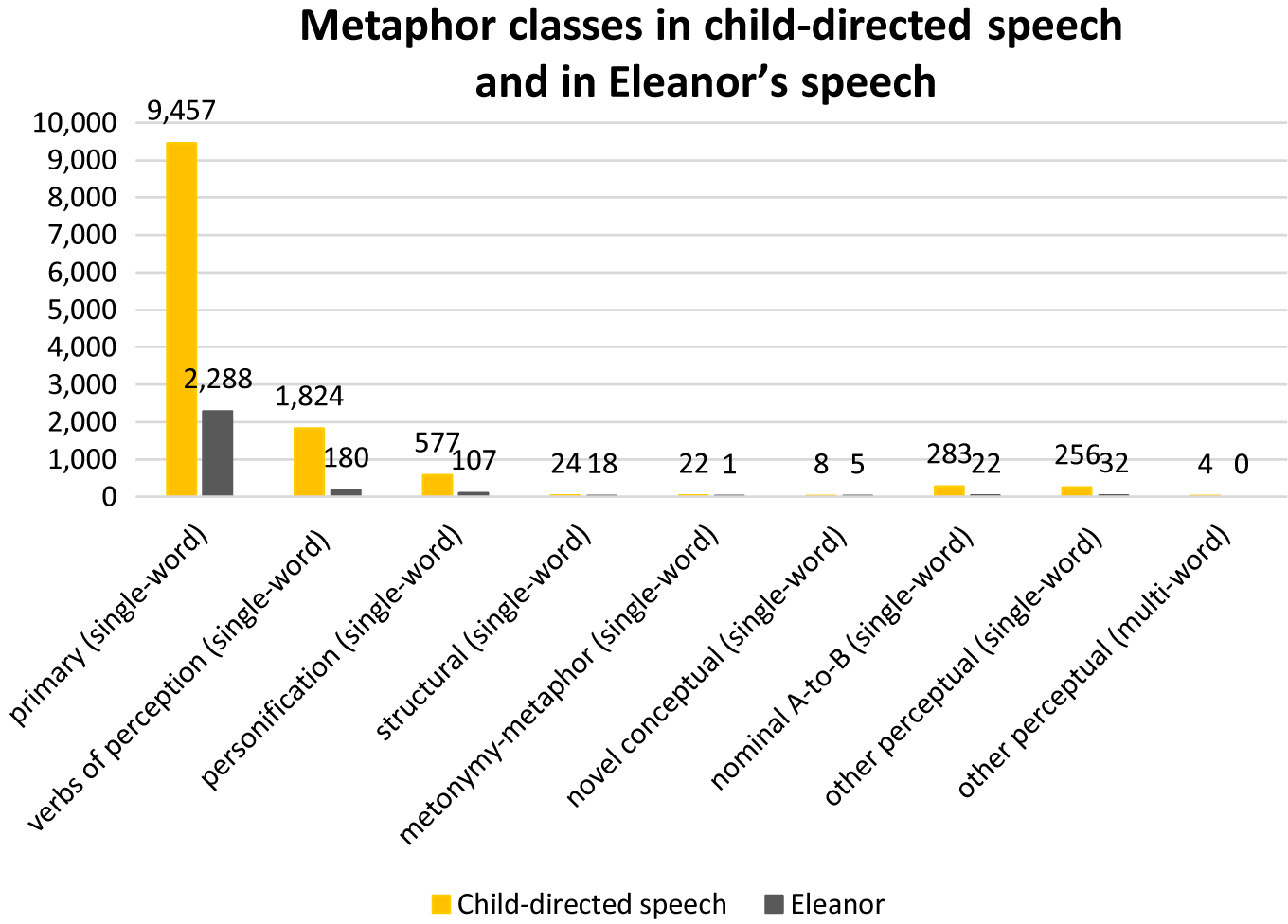
Figure 3 additionally displays the 15 most frequent metaphor mappings in adult speech (from the most frequent on the left to the least frequent on the right) and the frequencies of the corresponding linguistic metaphors in Eleanor’s speech. The ACTION IS MOTION metaphor is the most frequent in both child-directed speech and in the child’s own speech, and there are further similarities between caregiver and child speech, but there are also some inconsistencies, likely caused by the complexity of some concepts. For example, the metaphor TIME IS SPACE is often invoked by the caregivers but less frequently adopted by the child herself, and so is the metaphor FINDING OUT IS SEEING.
Linguistic metaphors recorded in child-directed and child’s own speech (by mapping).

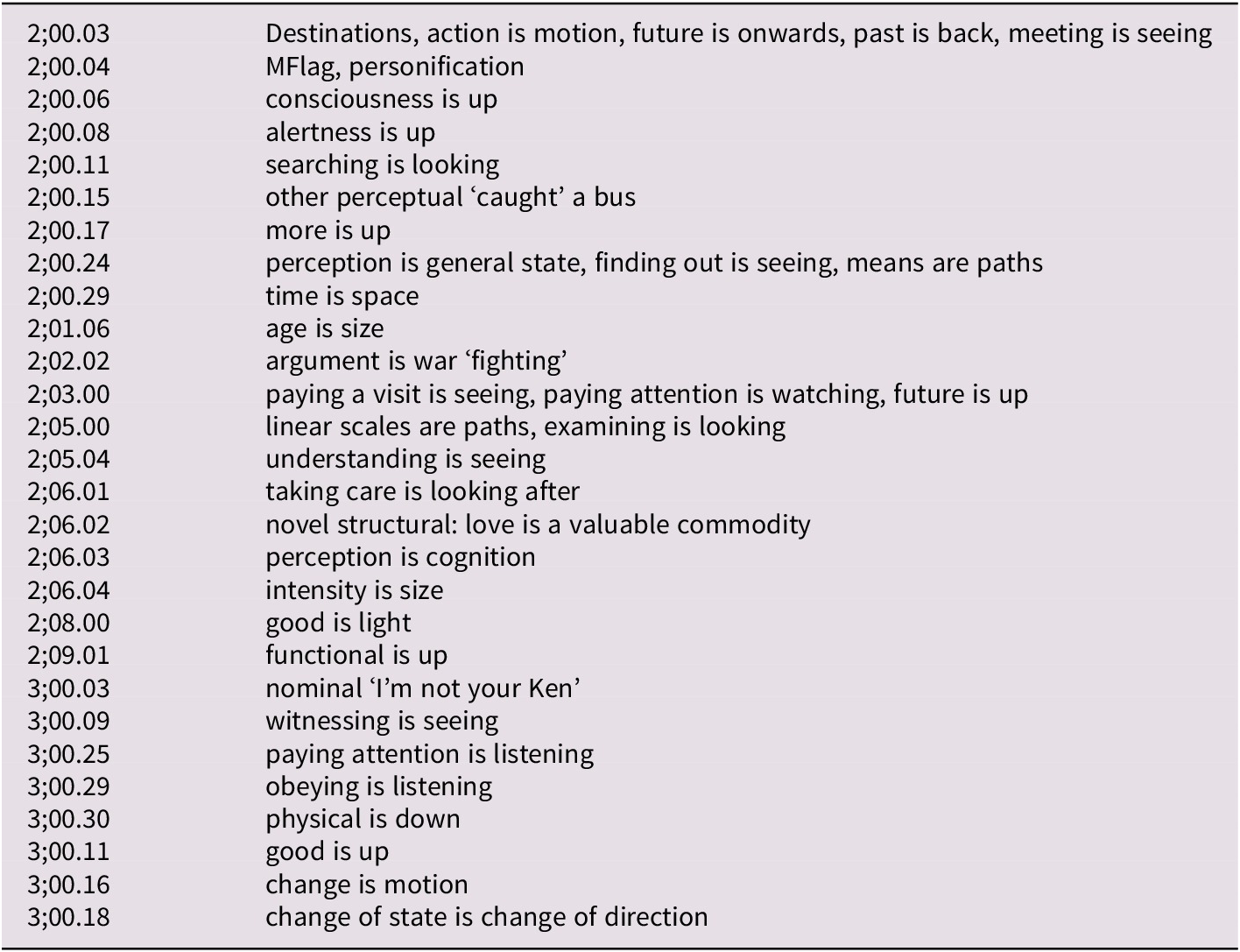
A closer look at the order of acquisition (Appendix E) shows that of the six most frequent metaphors in child-directed speech, four were already used spontaneously by Eleanor at the age of 2;00.03, whereas the two she had not acquired by that stage included TIME IS SPACE, and FINDING OUT IS SEEING, the same two which she used infrequently despite their high frequencies in caregiver input.
The last step of our analyses shows a sample of seven metaphoric expressions emerging in child speech in light of a) their concrete word equivalents, and b) the caregiver distribution of meanings (Table 2). This specific sample has been compiled from the pool of metaphors that emerged after the age of 2;06.00, as this allowed us to trace metaphorical meanings to their concrete equivalents in prior use. Personification could not be included in the sample as all its manifestations emerged in Eleanor’s language before the age of 2;06.
Selected productive metaphors and their concrete and abstract meanings

The results show that Eleanor acquired concrete meanings of some words first (e.g., look, up, gone, bunny) and then extended her knowledge of these words by developing an additional abstract sense for the same word form. However, other metaphors (bet, fair) were acquired even though the child did not have concrete meanings of the MRWs in her productive lexicon. In all cases, the word meanings were developed in the order of their frequency of input, with concrete meanings often, but not exclusively, acquired first.
5. Discussion
In this article we argue that UBT and methods can help us to build a reliable approach to metaphor identification and analysis in child speech (UBAMICS). We present the coding manual and show how it can be applied to longitudinal interactional data, such as those stored on the CHILDES TalkBank, to study frequency-driven input–output relations in the acquisition of linguistic metaphors. Eleanor’s data, for one, support the use of our approach from the age of two, and the study of input–output relations in linguistic metaphor acquisition.
In answer to our first question, the data show that Eleanor could produce some conceptual metaphoric expressions consistently already from the age of two, but the use of resemblance metaphors emerged later and was much less frequent. The former dominated Eleanor’s “metaphor-i-con” even though our study excluded ontological container and substance metaphors for reasons of feasibility. If they had been included, resemblance metaphors would have likely become an insignificant fragment of Eleanor’s “metaphor-i-con”, which is an important observation, considering the disproportionate weight they are given in the research literature (e.g., Di Paola et al., Reference Di Paola, Domaneschi and Pouscoulous2019; Pouscoulous & Tomasello, Reference Pouscoulous and Tomasello2020). In answer to our second question, both linguistic conceptual and linguistic resemblance metaphors were responsive to the properties of child-directed speech, an observation that could have a great impact on the theory, if studied more systematically. Once the primed expressions had been excluded, our results showed that most of the metaphor classes produced by Eleanor fell into the categories that were most frequently heard in child-directed speech. With some exceptions, the primary metaphoric expressions categorised based on specific meanings (mappings) were also acquired in a manner consistent with their input frequencies. In answer to our third question, a sample of seven metaphors that emerged after the age of 2;06.00 also showed that the acquisition of their meanings was driven by their input frequencies: some metaphorical meanings were acquired to complement already established concrete word meanings, and others were developed even though concrete equivalents were missing from child speech. These data should be quantified in any future research to confirm if children’s tendency to learn concrete words first is driven by their cognitive preferences (e.g., Gentner & Boroditsky, Reference Gentner, Boroditsky, Bowerman and Levinson2001) or merely by the properties of the language addressed to them.
There are several other ways in which the use of UBAMICS can help us to understand the mechanisms involved in metaphor acquisition. First and foremost, data from multiple case studies can capture if children acquire metaphoric expressions on a similar or different schedule; any potential variation in children’s metaphor production can then be studied in light of variation in metaphor use in their respective caregivers. Also, data from older children can show the links between children’s abilities to use conventional and novel linguistic metaphors. As Eleanor only used seven novel conceptual metaphors, and they all fell into the mapping LOVE IS A VALUABLE COMMODITY, it is impossible to make any generalisations based on this restricted sample. To capture more regular use of novel metaphors, future studies should examine the language used by slightly older children, and possibly also in contexts that require more creative use of language than everyday interactions around mealtimes and playtimes.
Future studies of child metaphors can also provide data for the advancement of the theory of metaphor acquisition. Peňa (Reference Peňa2008) worked with adult corpus data to provide a proposal for the interdependency of the different levels of image-schemas (i.e., mappings): directly embodied but highly schematic representations of spatial and force-dynamic relations. Image schemas are highly ephemeral mental processes altered immediately and incessantly, especially when co-occurring with other experiential gestalts. Under this proposal, image-schemas are organised taxonomically into different levels of genericity and interrelated by their conceptual dependency, logical entailment, and enrichment. For example, it is understood that the basic schema of BOUNDED REGION provides a blueprint for other higher level experiential patterns such as CONTAINER and SURFACE. In turn, CONTAINER lends its structural make-up and conceptual material to FULL–EMPTY. As the way these cognitive constructs manifest themselves in language provides clues as to the way they are related to each other, studying real instances of language use can prove invaluable in deriving hypotheses about the properties of image-schemas (Hampe, Reference Hampe2005). Authentic language use can show how the speaker’s linguistic system is abstracted from usage events, how it is being operated on and structured by usage, and how it is influenced by contextual factors (Barlow & Kemmer, Reference Barlow and Kemmer2000 cited in Hampe (Reference Hampe2005)). We want to argue that studying child metaphor longitudinally can provide clues as to how image schemas develop in children over time to give rise to more complex conceptual constructs.
The next steps in the investigation are to establish how metaphors are used by other English- and non-English-speaking children, and to explore whether there are any language-specific patterns with regards to the emergence of metaphor use in children acquiring different languages. UBAMICS operates on the level of words and morphemes, and as such it has the capacity to account for metaphor production both in more analytic languages, such as English, and in more synthetic languages, such as Polish or German, which combine multiple grammatical morphemes within single words. In crosslinguistic studies, it is important to ask how the fact that Polish and German are more synthetic, whereas English is more analytic, impacts the acquisition of metaphoric expressions. Are linguistic metaphors encoded in separate words with the capacity to occur in various parts of utterances (e.g., the friendship broke down; break it down) easier to acquire than those which are always parts of other words (e.g., rozpadła, ‘broke down’)? We already know that words are prioritised for acquisition when they are presented to children individually rather than as part of longer utterances (Brent & Siskind, Reference Brent and Siskind2001; Gaskins, Reference Gaskins2020). The study of metaphor acquisition could help us to determine whether a similar trend also holds for metaphorical meanings, that is, whether the acquisition of metaphorical meanings is also easier if they are introduced in single words, as opposed to parts of words that fuse several semantic and grammatical morphemes.
Finally, as UBAMICS has been designed to apply to different types of languages, it also has the capacity to account for metaphor acquisition in bilingual children. When applied to the corpora of interactions between young bilinguals and their primary caregivers, it would work best in scenarios where children hear their two languages at home, each from a different caregiver (the so-called one-parent-one-language scenarios). This linguistic constellation could help us to determine any input–output effects in bilingual children’s acquisition of linguistic metaphors, which are otherwise impossible to capture in scenarios where one language is acquired at home and the other one in the community. The most telling data is expected from children who display asymmetrical development in their two languages: in theory, if primary metaphoric expressions are developed primarily through the acquisition of primary scenes, where the quantity of linguistic input is relatively unimportant, bilinguals dominant in one language should develop productive use of metaphors such as TIME IS SPACE on a similar schedule in both their languages, and at a similar time as their monolingual peers. For both linguistic resemblance and linguistic conceptual metaphors, metaphor frequencies in parental speech should be examined in relation to the child’s production of these expressions in both their languages to determine any potential input–output effects in acquisition.
There are also two limitations of UBAMICS which could be overcome in future work. In our current project, ontological metaphors fell outside the scope of our study. However, there is some evidence of cross-linguistic variation in their use (e.g., Bowerman & Choi, Reference Bowerman, Choi, Bowerman and Levinson2001; Sinha & López, Reference Sinha and De López2000) which justifies including them in future studies that involve single research participants. Likewise, we only focused on metaphors if they were encoded in words of the same grammatical category (e.g., both child and hot water bottle are noun phrases, but essentially and essence are not), or those which could fill the same slot in an utterance (e.g., baby carrot), and metaphors which could be found in words clearly divided into morphemes (e.g., unlike the word include, which would be excluded from analysis). Any future work could rectify these shortcomings, especially if UBAMICS were to be applied to highly inflected languages. In the future, UBAMICS could be extended to the study of other types of figurative language, such as metonymy, hyperbole, and litotes. It could also be extended to video-recorded interactional data collected in other contexts, including school-based instruction, to move beyond linguistic data and examine the impact of non-verbal interaction of the emerging metaphor use.
6. Conclusion
Metaphor acquisition frameworks have emerged mostly from research in metaphor comprehension, with the onset of metaphor production largely undocumented, and unexplained. Specifically, little is known about what classes of linguistic metaphors children use first in their early productions and how such metaphors are acquired. UBAMICS, the approach to child metaphor identification we propose in this article, offers a new lens for the exploration of early metaphors – one which examines their links with parental language. As metaphors are difficult to elicit through experimental design, and young children are notoriously difficult to work with using experimental paradigms, we argue that our approach presents a unique avenue for accessing the language of such very young children. There are many existing corpora of child language use which offer a wealth of data to be explored using our approach. These, in turn, have the potential to fill some missing pieces in the puzzle of metaphor acquisition. In this article, we have presented preliminary findings from one child, Eleanor, whose spontaneous metaphor production was captured between the ages of 2;0–3;1. We show a large discrepancy in the numbers of linguistic primary and linguistic resemblance metaphors used by the child, and some potential preliminary links between metaphor frequencies in child and caregiver speech.
In future research, UBAMICS can capture several phenomena concerning metaphor use. It can compare the onset of both conventional and novel metaphor use in a range of monolingual children; it can also show the extent to which metaphor acquisition milestones are universally observed across languages. In bilingual acquisition, it can be used to highlight which metaphors emerge in both languages at the same time, and which are acquired first in children’s stronger language. Subsequently, the frequency of child metaphors can be linked to that of metaphors used by their primary caregivers. Such input–output analyses will allow us to test the predictions of the current metaphor acquisition theories and draw clearer lines between metaphor classes. More rigorous research in metaphor acquisition can thus determine what type of educational tools, embodiment or language based, should be recommended to grow metaphor use in young speakers.
Competing interest
The authors declare no competing interests.
Funding statement
This research was funded by a Leverhulme Trust Early Career Fellowship awarded to the first author of this article (ECF-2020-229).
Appendix A. Primary metaphors in Eleanor’s speech between 2;0–3;1

Appendix B. Metaphors encoded in verbs of perception in Eleanor’s speech between 2;0–3;1

Appendix C. Other conceptual metaphors in Eleanor’s speech between 2;0–3;1

Appendix D. Perceptual metaphors, MFlags and MRW Direct in Eleanor’s speech between 2;0–3;1

Appendix E. Order of metaphor acquisition in Eleanor’s language


 Open access

