




In April of 1908, Qasim Amin (b. 1863) passed away at the untimely age of forty-four.Footnote 1 In eulogizing Amin, one prominent writer, Labiba Hashim, praised him and his work in tones that would become familiar to observers over the next century. Hashim, herself an experienced journalist in the burgeoning women's press, highlighted the aspect of Amin's legacy she most admired: mainly his activism on behalf of women.Footnote 2 In this telling, Amin's major accomplishment was the publication of his two most famous books: Tahrir al-Marʾa (The Liberation of Women) in 1899 and al-Marʾa al-Jadida (The New Woman), published the following year. Both were widely read at the turn of the twentieth century and sparked a frenzied public debate about the role of women in Egyptian society.Footnote 3 Hashim's admiring tribute credited Amin for waging “a fierce battle in pursuit of women's liberation, from captivity toward freedom.”Footnote 4 And while she included some basic biographical information about his life, Hashim framed most of her remembrance around the challenges women continued to face, acknowledging that Amin died before his hopes had been realized and that there was still much to accomplish.Footnote 5 She also did not shy away from addressing what made Amin's books controversial at the time of their publication: his call to the ending of the face-veiling and seclusion of middle- and upper-class women.Footnote 6 Hashim's sincere hope was that other men would continue this fight against the tradition of seclusion; Amin, after all, had shown them the path “to achieve the height of glory and perfection.”Footnote 7 She ended her eulogy with quotes from al-Marʾa al-Jadida—a way to memorialize the writer Amin was with the words he wrote.Footnote 8
That Amin would be remembered as such a champion of women is perhaps not surprising. To this day, in popular histories and culture, Amin's name is nearly synonymous with the early push for women's rights, and it is not uncommon to hear him referred to as the “father of Egyptian feminism” in English or as muḥarrir al-marʾa (liberator of women) in Arabic.Footnote 9 However, researchers have been justifiably skeptical about the driving impetus of Amin's proposals for Egyptian women.Footnote 10 As a result, scholars have made important strides over the last several decades in contextualizing Amin's contributions and bringing to the fore other activists and writers—many of whom were women—who advocated for changes to their societies.Footnote 11 In light of these reassessments, Amin has become a less prominent, if more contested figure in the history of Egyptian feminist movements.Footnote 12 Even though he is still the “liberator of women” in the popular Arabic press, among academics he is almost never referred to as the “father of Egyptian feminism” without qualification.Footnote 13
However, Amin's position as the progenitor of a proto-Egyptian feminism was not self-evident in the years after his books were published, nor even upon his death in 1908. It turns out that Hashim's depiction of Amin, while familiar today, was atypical in its own day. From a close examination of the period after Amin's death, a more complicated picture emerges of his status as a champion of women's activism or as the man who freed women of their social restraints. In many early profiles of Amin, the potential impact of his work on women is noticeably absent.
Rather, in the earliest stages of Amin's legacy, most male supporters of Amin sought to cast him as one of them—first and foremost as a writer, thinker, and reformer with a broad social agenda. Within this framing of his legacy, Amin's two most famous books were evidence of his intellectual prowess and commitment to national reform, not necessarily a call to an actionable agenda on behalf of women. In fact, as we shall see, both Tahrir al-Marʾa and al-Marʾa al-Jadida were overshadowed in these remembrances in favor of his work on the Egyptian University and a less well-known (at least today), posthumously published book entitled Kalimat li-Qasim Bey Amin (Aphorisms of Qasim Amin).
Ultimately, this other image of Amin served the interests of certain male elites on both intellectual and political fronts. Broadly, the idea of Amin as a quintessential writer and thinker tracked the concerns of many who were heavily involved in the intellectual and linguistic renaissance that has become known as the Arabic Nahda. For these intellectuals—who ascribed to diverse ideological leanings—Amin's biography provided an invaluable articulation of their core reformist commitments. Meanwhile, for political figures associated with Amin, his life provided a useful exemplar for the type of political activism they believed was necessary for Egypt's advancement. This recalibration of Amin's legacy allowed his eulogists to highlight his literary style, his varied intellectual pursuits, and his approach to social reform above all else. When (and if) eulogists did consider the “woman question” (qaḍiyyat al-marʾa), most were quick to declare Amin's activism a “victory,” by focusing on the least controversial of his proposed reforms: the education of women. Among these writers, interest in the reform of women's status was a marker of the stature of a man as a reformer and thinker because of what it said about the ethos of his intellectual and political projects, not what it could do for women.
This alternative legacy is part of larger historical trends. Historians have long noted that the “woman question” was a vehicle to articulate, among other things, ideas about modernity, colonialism, class concerns, masculinity, and social reform (of the family and beyond).Footnote 14 In other words, reforming women's social roles was seldom about women themselves. To say this is no great revelation. However, what interests me here is how this inversion was so thoroughly accepted even then: there was little illusion among Amin's contemporary Egyptian audiences that his work was about women's liberation.Footnote 15 Most of these early eulogists were, from the onset, consciously focused on the various other reformist projects that Amin could represent, rather than the cause for which he would eventually become most famous.
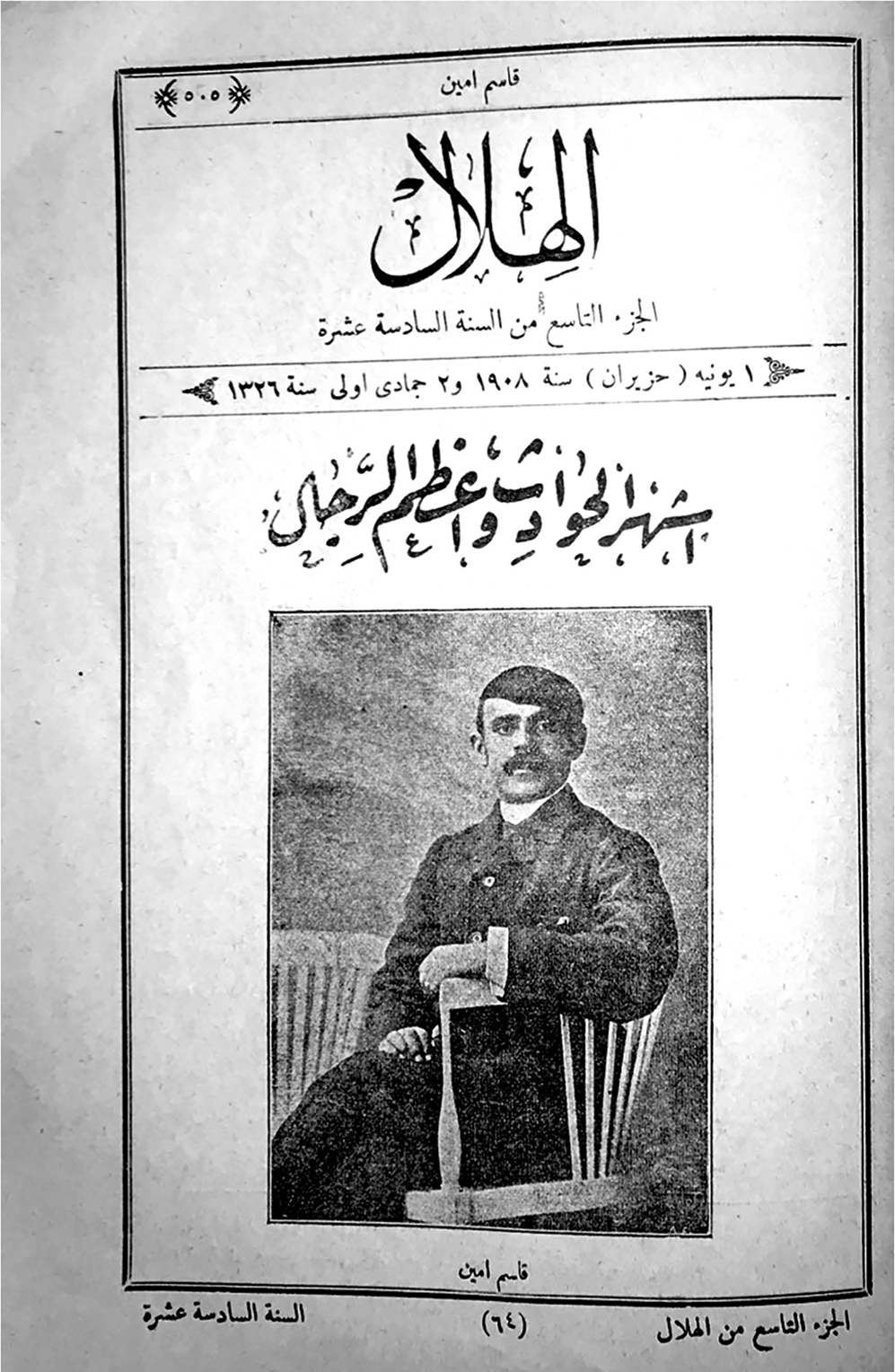
To examine this early legacy, this article will focus on Arabic-prose eulogies, commemorations, speeches, and biographical sketches that appeared in newspapers and journals after Amin's death in 1908 (Fig. 1).Footnote 16 The publications surveyed here reflect a subset of the diverse Egyptian press of the time: the major dailies al-Ahram (The Pyramids), al-Jarida (The Newspaper), al-Liwaʾ (The Banner), al-Muʾayyad (The Supporter), and al-Muqattam (The Mokattam), as well as the two famous monthly literary journals, al-Muqtataf (The Collection) and al-Hilal (The Crescent), and the leading Islamic reformist publication, Muhammad Rashid Rida's al-Manar (The Lighthouse). I have also drawn on relatively lower-circulation periodicals, such as al-Jamiʿa (The Gatherer), Majallat Sarkis (Sarkis Journal), and al-Muhit (The Ocean), which published full articles on Amin upon his death. Women were also actively publishing and writing during this period, albeit in different tones than used by most of their male contemporaries. Figures such as Malak Hifni Nasif commented on Amin and his ideas, and both Labiba Hashim's Fatat al-Sharq (The Young Woman of the East) and the newly established al-Jins al-Latif (The Gentle Sex, 1908–25) by Malaka Saʿd eulogized Amin at length.
Al-Hilal's cover page on Qasim Amin, June 1, 1908.
This focus on published eulogies, funeral commemorations, and speeches does have its limitations. Quite simply, they represent views of those who admired Amin enough to memorialize his life, often in the most effusive ways possible. After all, as Salah Hassan has noted, “eulogies and written tributes more generally affirm the importance of the deceased, asserting the continuing relevance of their lives even in death. But, beyond praising the individual who is the subject of the tribute, eulogies are also about the author, whose bond with and commitment to the deceased is confirmed by the text.”Footnote 17 In much the same way, the eulogists examined here were self-selecting; they were sympathetic by design. But, even as they articulated a supposedly exemplary life and legacy, what they privileged and what they ignored reflect the priorities of their particular 1908 worldview. Put simply, if somewhat redundantly, how they chose to praise Amin gives us a sense of what they thought was praiseworthy. In most cases, this was his personal characteristics and status as a social thinker and reformer, and not his potential impact on the lives of Egyptian women. Given that Amin's previous stances were not universally accepted, one can easily imagine how another source base—one not based in elite literary circles—could produce a thoroughly different narrative about the same man. It is worth acknowledging the particularity of this myth building from the outset and examining it on its own terms: as an expression of one alternative to the legacy that would later predominate.
Qasim Amin and His Work
Qasim Amin's lifetime spanned a period of significant political and social change in Egypt.Footnote 18 The year Amin was born, 1863, Ismaʿil Pasha (r. 1863–79) took the reins of the country as the fifth ruler in the dynasty established by Mehmet Ali Pasha earlier in the century. By 1881, when Amin was studying in France to complete his law training, the Egyptian state, after years of crushing debts, was under the fiscal control of its European creditors. The Egypt that Amin returned to in 1885 was contending with a British occupation and experiencing the increased stirrings of nationalist and anti-colonial movements that would only accelerate in the early twentieth century as the British presence began to weigh on social, economic, and civic life.
During this period, the Nahda also fueled a flood of translations and new publications as well as a revival of classical Arabic literature. Educated men and women began reassessing the nature of Arab society and the classical and Islamic heritage, while contemplating new visions of modernity and reform particularly in light of growing colonial impositions and nationalist movements.Footnote 19 They added to their rich Arabic canon new European literature on positivism, cultural evolution, education, political freedom, and even the role of national cultures in the success or failure of a society.Footnote 20 Amin made his own contributions to this heady political milieu by writing articles for the daily paper al-Muʾayyad on various social issues and publishing a book refuting the anti-Egyptian and anti-Muslim views of a prominent European visitor.Footnote 21
In this environment, the contours of what become known as the “woman question” began to take shape. By the time the Nahda was in full swing in the late nineteenth century, the role of women in Egyptian society was being debated in various journals and newspapers, among leading female writers, and in the women's press.Footnote 22
In Tahrir al-Marʾa, Amin elaborated on these already circulating ideas, explicitly linking the progress of a given society to the status of its women. In what Kenneth Cuno has called the “family ideology” of the era, Amin echoed the sentiment that women were the bedrock of the Egyptian family, the reform of which was necessary for the nation.Footnote 23 On this front Amin saw much to improve: he critiqued the lack of women's education, marriage and divorce practices, and the veiling and seclusion of upper-class women. He also took a rather dim view of Egyptian women in their present circumstances, critiquing their roles as mothers and wives. Although many of his proposals had been broached in other forums, a confluence of factors seems to have made Amin's work unusually contentious.Footnote 24 Here was a book dedicated to the “woman question,” written by a Muslim man, who was a distinguished judge and who was well known to the intellectuals of his day.Footnote 25 Amin's book did receive some favorable reviews from journals such as Jurji Zaydan's al-Hilal and Alexandra Avierino's Anis al-Jalis, and there was no shortage of commentators willing to defend him on one point or another.Footnote 26 But on the other side, several prominent men, among them Talʿat Harb, Muhammad Farid Wajdi, and Shaykh Bulaqi of al-Azhar, took to the press to assail his ideas, particularly on the issue of face-veiling/seclusion (ḥijāb).Footnote 27 For some of these opponents, his views represented a dangerous abdication to European influence and, for others, a willful misreading of Islamic texts.Footnote 28 Regardless, critics seemed to agree that Amin's ideas were an existential threat to Egyptian culture and religion.
Amin was undeterred by the maelstrom and, a year later, published al-Marʾa al-Jadida, in part as a rebuttal to his detractors, but also as an amplification of his argument that Muslim societies had to follow the path laid out by Europe if they wished to succeed. According to one observer, the debate over his works ran hot for a year or two, before burning itself out.Footnote 29 Amin then turned his attention to other issues, mainly the establishment of Egypt's first university.
In terms of writing, after his famous foray into the spotlight, he seems to have confined most of his energies to a private journal, or notebook, of “thoughts.” This collection consisted of aphorisms on various social and political issues and ranged from art and religion to love and redemption; some were short and succinct, others were longer expositions or stories.Footnote 30 On the whole, most of the entries were Amin's personal, and often caustic, musings on Egyptian life and society. If there were any thematic threads to this collection, they would be the hypocrisy of so-called educated society and the idea of political and intellectual freedom. Meanwhile, only a handful of aphorisms echoed stances from his books, mainly pointing out the injustice of Egyptian divorce traditions.Footnote 31 Rather, women, as well as men, appeared as caricatures in his morality tales. These aphorisms in some ways echoed his earlier depictions of Egyptian women: women who veiled but still provocatively dressed, or who made a scene during funerals, or who could (ideally) serve as objects of beauty and happiness in a marriage. His experience in the public eye also seems to have left its mark. The vicissitudes of public opinion and the necessity that writers speak their mind were recurring topics. It is perhaps ironic that after he had stayed out of the literary limelight for so long, it was this work, as we shall see, that played a major role in the crafting of Amin's early legacy.
The Politics of Eulogizing Amin
The biographical genre has long been a productive space for writers to rearticulate values and ideals. Biographical sketches (tarājim) have been a mainstay of the Islamic tradition, almost since its inception. Likewise, eulogies and poetic panegyrics were the regular subject of poets and writers alike. By the late nineteenth century, biographical sketches of eminent men and women were regularly featured in journals and newspapers. For their audiences, biographies of prominent men and women served myriad purposes as exemplars—some in deeply gendered, allegorical, and/or symbolic terms.Footnote 32
In this regard, Amin's legacy became a constructive space within which to articulate an explicitly modern ideal, particularly for the intellectual and writing classes. In the spirit of the Nahda, Amin was viewed as the quintessential intellectual figure: a man who was concerned with reform and society—women included—but whose legacy spoke to more fundamental concerns, or at least those deemed more fundamental to the mostly male readership of the day. In eulogies he was most frequently referred to as a thinker (mufakkir), a reformer (muṣliḥ), a writer (kātib), as well as a patriot (waṭanī). For example, the Coptic landowner and political activist Akhnukh Fanus eulogized Amin as a thinker-reformer (muṣliḥan mufakkiran).Footnote 33 Muhammad Rashid Rida counted Amin among the well-known social reformers of his time (min al-muṣliḥīn al-ijtimāʿiyyīn) in addition to being a deep thinker and effective writer.Footnote 34 A letter from the Higher School's Club described Amin as “one of the geniuses undertaking the intellectual renaissance (al-nahḍa al-ʿilmiyya) and working to spread social and civilizational principles.”Footnote 35 Al-Muʾayyad, under its founding editor Shaykh ʿAli Yusuf, also grieved Amin's death as a national loss, citing Amin as “among the greatest fighters for reforming the social body” (min akbar al-mujāhidīn fī iṣlāḥ al-hayʾa al-ijtimāʿiyya).Footnote 36 On the whole, Amin was seen as an example of modern thinking, writing, and activism on behalf of his country and people—more so than on behalf of women specifically.
Those most closely invested in reshaping Amin's legacy also had a political incentive. The year 1908 was a politically sensitive moment. The British occupation had suffered a political and moral blow with the events and aftermath of the Dinshaway incident in 1906 and the subsequent retirement of Lord Cromer as high commissioner.Footnote 37 The international economic crisis of 1907 also did not help matters, hitting the Egyptian economy hard over the next few years.
Meanwhile, nationalist party politics was coming into its own. The famous nationalist leader Mustafa Kamil had led on a largely populist and anti-British platform. His Hizb al-Watani (Nationalist Party), formally founded in 1907, was strident in its demands for constitutional representation and full independence from the British. Another group—to which Amin belonged—had coalesced in 1907 into the Umma (People's) Party. They shared many of the same goals as Kamil's group for a constitutional government, but drew more heavily on intellectuals and economic elites (e.g., landowners and rural notables). The Umma Party also tended to be more interested in European-style reforms and ideas, more tolerant of the British presence, and more secular in outlook.Footnote 38 On occasion, these political differences were on display in the coverage of Amin's death as rival newspapers (and the parties/factions they supported) attempted to score rhetorical or political points.Footnote 39
Yet, despite these differences, newspapers across the political spectrum cast Amin as a writer and thinker worthy of note, irrespective of his previous positions. This is probably most stark in the case of the Watani Party paper, al-Liwaʾ, in 1908, under its editor Shaykh ʿAbd al-ʿAziz Jawish. The paper had not been reluctant to criticize Amin in ways small and large in the past.Footnote 40 Nevertheless, the unsigned April obituary contained unqualified praise for Amin's recent work on the university project and framed the 1899/1900 controversy this way:
He wrote two books in Arabic, Tahrir al-Marʾa and al-Marʾa al-Jadida, that summarized his opinions on this serious matter. There was a lot of talk about them in the clubs and newspapers discussed them for many days, among them al-Liwaʾ. It is what made him become known for [his] strength of example, quickness of mind, and rare integrity and other characteristics that gave him a high place in the hearts of those who knew him . . . in addition to the soundness of his thought, his steadfastness on his opinions, and other assets that only come together in great men.Footnote 41
The significance of these books, while not minimized, was redirected toward the greatness of their author, not the cause they purportedly championed.
Given this environment, many eulogists pointedly avoided excerpting from his two most famous books. Of the eulogies surveyed here, only those published by Labiba Hashim and Jurji Zaydan included extended quotes from Tahrir al-Marʾa or al-Marʾa al-Jadida.Footnote 42 The pro-British newspaper al-Muqattam was the only publication to take the occasion of Amin's death to republish a long section from al-Marʾa al-Jadida, which drew from the chapter entitled “al-Tarbiya wa-l-Hijab” (Upbringing and Seclusion).Footnote 43 However, even in doing so, al-Muqattam's editors may have wanted to soften the hard edges of the debate on women: the reprint renamed the chapter “al-Tarbiya wa-l-Taʿlim” (Upbringing and Education) and excised the chapter's opening paragraph, which contained a direct criticism of seclusion. In service of their political leanings, the editors did keep Amin's blistering critique of the political, social, and scientific underdevelopment of Islamic civilizations, particularly in comparison with the achievements of the West.Footnote 44
Yet, al-Muqattam aside, on the whole, there seemed to be an attempt to reconcile Amin's previous positions with the nationalist ethos of the moment. This was perhaps most notable in al-Jarida, the party organ for Amin's own Umma Party, and in the writings of its editor, Ahmad Lutfi al-Sayyid. In the days after Amin's death, two front-page articles were published on Amin and, although neither article included a byline, the first-person accounts they contain make it clear that Lutfi al-Sayyid was the author. Like others, Lutfi al-Sayyid focused on Amin's drive to understand Egypt's problems, philosophical stances, and character, as well as his advocacy for the reform of women and the Egyptian family.Footnote 45 But more so than other publications, these articles also directly sought to address critiques of Amin on two fronts: his religious faith and his patriotism. In this telling, Amin was as much a defender of religion as of social reforms and science. As evidence, Lutfi al-Sayyid cited Amin's personal principles and his 1894 defense of Egyptian and Islamic practices, particularly regarding women, in Les Égyptiens: réponse á M. le duc d'Harcourt.Footnote 46 In addition, Lutfi al-Sayyid affirmed that Amin's ideas about women had ultimately been in service of the Egyptian family, the reform of which was the first stepping-stone to the freedom and independence of the nation as a whole.Footnote 47 And while some (unnamed) people claimed that Amin's ideas about women were English in origin and aided the British occupation, Amin had only ever wished to improve Egyptian society.Footnote 48 Lutfi al-Sayyid also recounted a personal conversation with Amin in which the latter recognized the growing nationalist feeling as the “hope for the future” and ultimate path to independence.Footnote 49 Unlike some disinterested older elites and scholars, Amin was cast as a man of conviction who used his pen in service of his patriotic and religious convictions, as much as his social reformist ones.Footnote 50
Al-Jarida was not the only publication that sought to cast Amin in this light. Several publications seeking to appeal to educated, patriotic audiences chose to focus on nationalist/reformist projects, such as the new university, and Amin's intellectual spirit more than what had been Amin's divisive advocacy on behalf of women.
The University Man
The idea for the first university-level institution in Egypt was already circulating when, in 1906, a committee was formed to begin in earnest to raise private funds for the endeavor.Footnote 51 Amin was a founding member and served as secretary and vice president and eventually headed the committee. He was an active spokesperson of the project and worked to solicit donations. By early 1908, the university committee was in full swing in preparation for the much-anticipated opening and was making regular headlines with plans and rhetoric connecting the intellectual project of the university to the nationalist aspirations of the day. Amin's last visits and speeches were on behalf of the university, which opened its doors in December 1908—eight months after his death.
Amin's last formal public speech, just one week before his death, laid out the vision for an Egyptian university in both nationalistic and intellectual terms. It was covered widely by the major daily papers.Footnote 52 Two leading journals, al-Muqtataf and al-Jamiʿa, quoted from it at length in their eulogies.Footnote 53 The overriding premise of the speech was that the university would be a place of inquiry and be deeply committed to “knowledge for knowledge's sake.”Footnote 54 Unlike the older and well-established professional schools in Egypt, this new university would focus on subjects such as history, literature, and philosophy. Its students, these “sons of Egypt,” would be the “leaders of public opinion . . . guiding [Egypt] to success and leading to her progress.”Footnote 55 Amin celebrated those he considered at the pinnacle of Egyptian reformist projects: the intellectual elites who would drive the much-needed revival of the future nation. It should be noted that women, as potential attendees or beneficiaries of the university, were not mentioned by Amin or the commentators on his speech.Footnote 56 It was not only a project for Egypt's intellectual future, but it was also a future that was tacitly gendered as male.
Amin's contribution to the university project was also a major theme at the public commemoration of his life held on June 5, 1908, in Cairo.Footnote 57 The event was hosted by Prince Ahmad Fuʾad, who had been tapped as the royal representative and president of the university, and the first speaker was Ahmad Zaki, secretary of the university committee and adjunct secretary to the Egyptian cabinet.Footnote 58 Zaki's eulogy painted Amin as a man dedicated to “guiding the community to the principles of true progress” (irshād al-umma ilā ʿawāmil al-irtiqāʾ al-ṣaḥīḥ), primarily through his work on behalf of the university.Footnote 59 Amin had worked tirelessly to raise money, despite the economic difficulties of the times, and had brought together the interested parties to make the university a near reality. This was portrayed as a moment of unity in service of a true nationalist project, with Amin at its forefront. Personifying the university, Zaki said the university wishes “mercy on its first martyr in its service and it hopes that it will live up to its mission—that is, forming countless men who will fill the hole that has appeared with the death of Qasim Amin.”Footnote 60 Similarly, other eulogists that day portrayed Amin's dedication the university project as an extension of his commitment to the Egyptian people.Footnote 61
In contrast with Hashim's eulogy, these oral commemorations tended to elide or minimize Amin's writing on the “woman question.” For example, of the five speeches prepared for the June 5 event in Cairo, only one mentioned Tahrir al-Marʾa and al-Marʾa al-Jadida at any length.Footnote 62 The rest focused on Amin's university work, personal character, writing ability, and juridical work. Of course, eulogists were clearly well acquainted with the events of 1899 and 1900, and many recounted the uproar his books caused. However, Amin's legacy was about many things, well beyond the objective of female empowerment.
Scholar, Thinker, and Writer
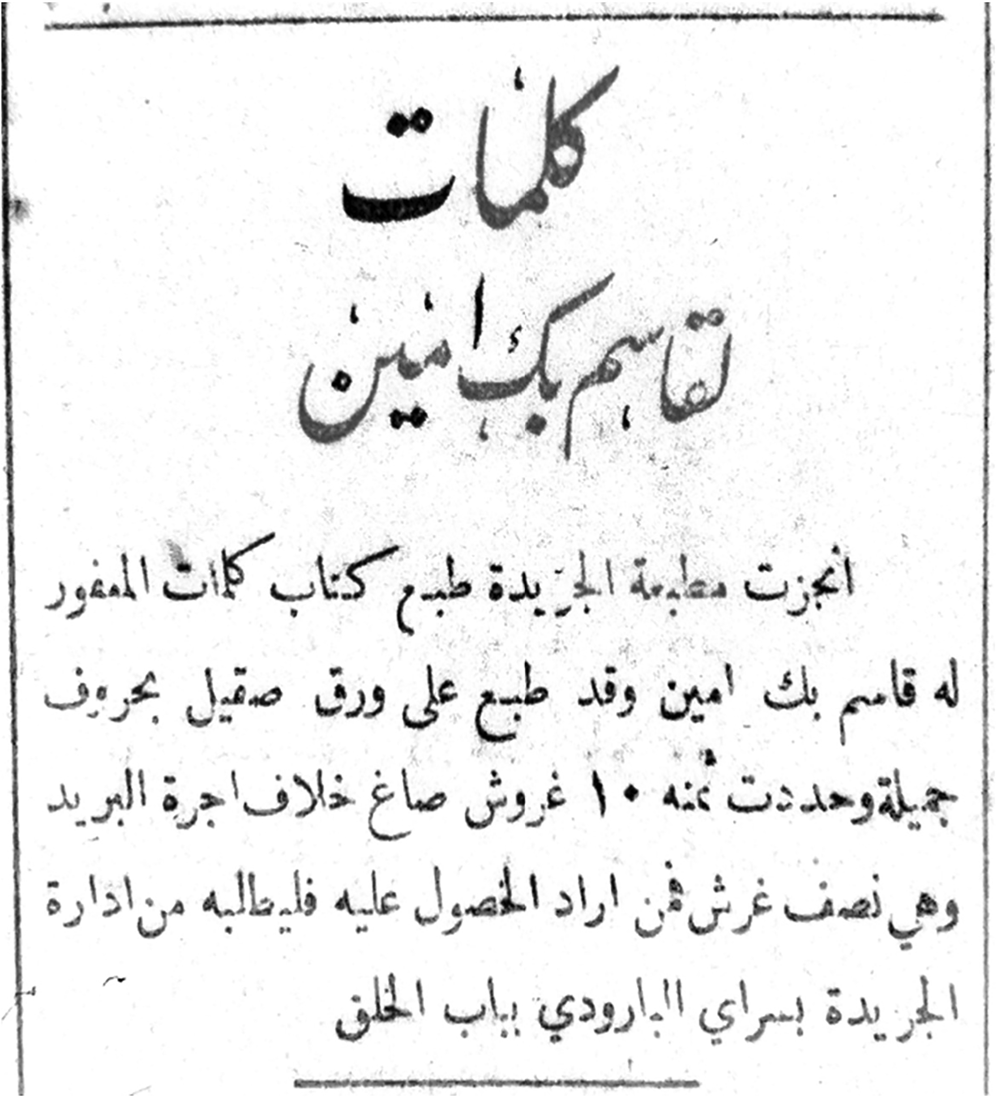
Rather than his potentially divisive positions on the “woman question,” eulogists soon had something else to focus on: the newly uncovered aphorisms that were published under the title Kalimat li-Qasim Bey Amin. Upon Amin's death, Lutfi al-Sayyid asked Saʿd Zaghlul to procure from the family a copy of the journal Amin had used to note down his thoughts. With the help of another of Amin's acquaintances, ʿAtif Barakat, al-Jarida's press published a small book of 103 aphorisms exactly one month after Amin's death, on May 21.Footnote 63 To publicize the booklet, the press not only sent out copies to other newspapers and journals, but also advertised and published excerpts from the book in the daily paper (Fig. 2).Footnote 64 The excerpts chosen by al-Jarida spoke to Amin's views on religion, science, and morality, as well as his commentary on the literary and intellectual classes of the time. Demonstrating a canny understanding of public interest in this new work, all fifteen of the aphorisms al-Jarida selected would appear in at least one other publication over the next few months. Also, foreshadowing the minimization of the “woman question,” none of the excerpts mentioned women at all. It was this alternative legacy that al-Jarida's editors cited as proof that Amin was among “the great thinkers” (kibār al-mufakkirīn) of his time.Footnote 65 What had served as a sort of personal journal was now published as a window into the inner workings of a true reformer, intellectual, and servant of the nation.
Advertisement for the Kalimat in al-Jarida, June 2, 1908.
It made an impression. Between May and June 1908, three journals published eulogies that featured the aphorisms prominently and two speeches at the June 5 event quoted from them.Footnote 66 Meanwhile, once the book became available, al-Muʾayyad published excerpts of fifteen aphorisms over two days and al-Muqattam provided a shorter excerpt of five.Footnote 67 Even al-Liwaʾ, which had a more subdued coverage of Amin's death, praised the Kalimat as “proof of the merit of the deceased and the clarity of his vision.”Footnote 68 In total, fifty-eight of Amin's aphorisms were quoted in eight different publications.Footnote 69 Most aphorisms were cited only once or twice, but eighteen appeared three or more times.Footnote 70 One of the most oft-quoted aphorisms seemed to hint at a détente that many of these eulogists sought; it began: “The fanaticism of the people of religion and the arrogance of the people of science is the source of the apparent conflict between religion and science. It is not correct that there is a true difference between them, now or in the future.”Footnote 71 Amin then went on to give each side its due—science for its drive toward discovery, and religion for its understanding of the unknowable. This conciliatory tone struck a chord with six different publications.Footnote 72
Several journals also used the Kalimat directly in their eulogies of Amin as a way to highlight the qualities and aspects of his legacy they most admired. For example, ʿIwad Wasif's monthly journal, al-Muhit, began by praising Amin as a true patriot and reformer (al-muṣliḥ al-ḥaqīqī, al-waṭanī al-ḥaqīqī) who was attacked for his two famous books because of his audacious questioning of tradition.Footnote 73 Then, as the eulogy turned to Amin's character and judicial work, quotes from the Kalimat were used to explicate Amin's views on forgiveness and the purpose of moral education. The author ended the eulogy by claiming that Amin's thoughts on science, religion, freedom, true love, and the Arabic language were all proof that his death was “a true loss felt by those who know the value of true men [al-rijāl al-ḥaqīqiyyīn].”Footnote 74 The journal then provided a reprint of the first thirty-four aphorisms from the book.
Meanwhile, al-Ahram, which did not publish a full-length feature article upon the death of the author of Tahrir al-Marʾa, decided to do so when it received a copy of the Kalimat. Footnote 75 The unsigned article sidestepped Amin's previous works saying that “whether he was correct or not,” Amin's opinions were well known and “we will not look at that teaching as a whole, nor will we offer to speak about it.”Footnote 76 Rather, the article chose to feature Amin's “ideas for reforming many of the issues facing the community [umma] and its morals,” using his musings in the Kalimat as a framework. According to al-Ahram, the Kalimat spoke to audiences who were “searching for the thinking man, like Qasim Amin, who has perceptive vision.”Footnote 77 In its excerpts from the book, al-Ahram focused on a theme dear to many of the writers of this period: writers themselves.Footnote 78 The article quoted a widely cited aphorism highlighting Amin's critique of the status quo: “In Egypt, everyone who knows how to read and write is called worthy; if he studied something of science, he becomes a distinguished scholar; and if he excels in some cleverness or displays it, he is counted a genius.”Footnote 79 Amin's remedy for this mediocrity was also cited: “The writer who loves his art publishes his thoughts as they are. He publishes the whole truth, no more, no less. And he does not accept to alter it, or change it, or back down from even one letter.”Footnote 80 In particular, the notion of asserting the truth in opposition to popular opinion was seen as a sign of a courageous writer. It seems that writers themselves were partial to the idea that they, at their most noble, could serve as reformers and fierce truth-tellers.
With less commentary, but a clear subtext of social critique, the June issue of the monthly Majallat Sarkis simply prefaced a selection of twenty-nine aphorisms with the following: “The best of what can be read and memorized, that it may be a lesson for the current generation in Egypt.”Footnote 81 Salim Sarkis, the editor, had a long history of publishing, often clashing with government officials on issues of free speech and press freedom, before he started his namesake journal in 1905.Footnote 82 When reprinting Amin's Kalimat, Sarkis included sayings on true friendship, one on divorce, and several praising the increased patriotism of recent years. He also reprinted nearly all the aphorisms that dealt with publishing, Arabic language reform, and the idea of freedom of thought.Footnote 83 For example, Sarkis quoted Amin's words: “Real freedom requires expressing every opinion, spreading every school of thought, and promoting every idea.”Footnote 84 The dream of a freer intellectual climate required men who could rise to the occasion. And while Amin held out hope for the intellectual output of the new university, he also had this scathing critique of the status quo:
In Egypt, there is not a complete scholar of all human knowledge nor one who specializes in a branch of learning and understands it completely. There is not among us a philosopher of general fame nor a writer of great repute like those that lead public opinion in the other nations, guiding them to prosperity and progress. Without them, in their place, a nation only has ignorant councilors and conniving politicians. The unvarnished truth is that all of Egypt's freedom, order, and justice exists and continues to exist only because of the work of foreigners and despite her own people.Footnote 85
The lesson Sarkis wanted to impart was that the writers, thinkers, and reformers of his era could do much to nurture and achieve true freedom and progress. For both Amin and Sarkis, it was the intellectuals who could lead the way.
Even eulogies that did not directly use the Kalimat echoed themes that put writing and intellectualism at the fore. The well-established journal al-Muqtataf opened its unsigned remembrance of Amin with a long meditation on “the true measure of men” (qadr al-rijāl al-ḥaqīqī) and “the intrinsic value that expresses itself in their writing and their teachings” and whether it could stand the test of time.Footnote 86 “If a person has published written words,” it concluded, “then it is the measure of his esteem. It by itself will be a guarantee of his everlasting memory if it is deserving of timelessness.”Footnote 87 More than one writer noted that Amin's style—and how he deployed it—contributed to his capacity to reach the hearts and minds of his audience. The prominent lawyer Ibrahim al-Hilbawi noted that Amin's ability to express his thoughts to the public in clear Arabic was exceptional among a generation of students who went to government schools (at a time when Arabic language instruction was weak) and then did most of their advanced education in Europe.Footnote 88 Even Muhammad Rashid Rida, writing in his journal, al-Manar, found Amin's words “effective and powerfully appealing, making him among the best Arabic writers, despite his sparse study of its arts.”Footnote 89 This was high praise from Rashid Rida, who was a Muslim religious scholar by training. For these writers, writing was not simply a mode of communication: it was the way a man made a mark on the world.
For those interested in the intellectual projects of the era, how Amin came to his ideas was also central to his biography. Here, they found in Amin the example of an innovative thinker who, unlike many other authors of the day, did not simply copy or regurgitate other people's ideas.Footnote 90 However, the exact contours of what was “rational” and “independent” depended on the ideological leanings of the journalists themselves. For example, Jurji Zaydan saw in Amin an exemplar of freedom of thought (ḥurriyyat al-fikr), defined by Zaydan as an inquiry that was dispassionately in pursuit of the truth—free from the burden of tradition and habit.Footnote 91 Rashid Rida praised Amin's “independence of thought, quality of opinion, purity of mind, and expansiveness of imagination” among other qualities.Footnote 92 For Rashid Rida, as a religious reformer, Amin was a philosopher who was able to reimagine possibilities for Muslim societies.Footnote 93 Others saw in Amin's thinking a more radical shift. Farah Antun, the proprietor of al-Jamiʿa and a staunch secularist, read Amin's works as a complete repudiation of the old Islamic civilization in favor of the “true civilization” (al-madaniyya al-ḥaqīqiyya) of the modern world.Footnote 94 In Antun's reading, Amin had clearly elevated scientific and social ideals over religious ones and, in doing so, demonstrated that the path forward was paved by science and rationality.Footnote 95 Regardless of how Amin was perceived—as a moral philosopher or secular social scientist—the originality of his thought represented a new kind of intellectual for a new world.
A focus on Amin's intellectual and literary feats overshadowed even the most vigorous defenses of Amin's earlier proposals for reforming the status of women. For example, eulogizing his friend of fifteen years and fellow lawyer, Hasan Murad sought to bolster Amin's argument that reforming women—and by extension the Egyptian family—was necessary for modern society.Footnote 96 But just as the role of women was important insofar as it served the society, so too was the role of the writer. Murad could scarcely separate the mission from the man; Amin's reforming impulses proved he was a philosopher and thinker of the highest order. His books, while notable for their diagnosis of Egyptian society, were “evidence of his noble ideology and proof of his high station in writing and rhetoric.” After all, according to Murad, Amin believed that it was the duty of writers to “think and speak freely on every subject that can benefit the society in which he lives.”Footnote 97 Amin was just such a writer.
These emphases—on moral courage, independence of thought, and an elite literary ethos—contrast with many issues in the Kalimat that were not as widely quoted or commented upon. For example, Amin's reflections on romantic love and the occasional reference to his time in Paris—musings that provided fodder for future biographies—seemed to hold little interest to this 1908 audience. Furthermore, of the few aphorisms that dealt with injustice toward women, chiefly regarding divorce, almost none were cited in these eulogies.Footnote 98
The “Woman Question” and Women
The “woman question” was certainly on the mind of writers of this period— the daily papers actively published competing articles on the proper role of women in Egyptian and/or Muslim society, face-veiling, and the like. Yet, when it came to Amin, the one issue related to women that drew the consistent attention of his eulogists was that of education. Unlike seclusion, veiling, and divorce and marriage practices, all of which were controversial in 1899, the value of female education had gained substantial ground by 1908.Footnote 99 It was also a notion that worked well with the kind of intellectual and political ideal being developed as Amin's legacy: here was a daring, independent, and intelligent man. He needed an equally intelligent woman at his side (if not quite as independent or daring). In particular, references to Amin's dedication to the upbringing (tarbiya) or refinement (tahdhīb) or enlightening (tanwīr) of women, and by extension families, were a way for eulogists to acknowledge his ideas without directly addressing the more controversial issues in his two books on women.Footnote 100 Zaydan noted that at least “there was a desire among people to educate their girls and open new schools for that purpose.”Footnote 101 Others shared Amin's hope for “a happy time when Eastern women would be educated and become like the upright women of the West in terms of education and upbringing.”Footnote 102 To this end, several eulogies cited Amin's final public words on the day he died. He had visited a local club and welcomed a group of female European students, and he expressed his wish that one day Muslim women would be able to attend such a gathering side by side with their male counterparts.Footnote 103
The June 5 eulogy delivered by the Lebanese Maronite lawyer Dawud ʿAmmun directly spoke to the issue of education as a moral and civilizational imperative. Echoing other eulogists, ʿAmmun asserted the centrality of female education to social reform, mostly by way of the formative role mothers could play in raising the morals and education of their children and, thereby, society as a whole.Footnote 104 For ʿAmmun, Amin's two books on women were evidence of Amin's patriotism and reformist spirit. In fact, ʿAmmun's speech was the only one that day to directly suggest that Amin had sought to “liberate women in opposition to public opinion in Egypt and the rest of the Islamic countries.”Footnote 105 But here, too, it was not about women. For ʿAmmun, women's education was important insofar as it could serve the “social body” (al-hayʾa al-ijtimāʿiyya). As was the case with other eulogies, the potential impacts of Amin's work on the lives of women was largely absent.
The male writers who came closest to addressing Amin's influence on the lives of women were Zaydan and Lutfi al-Sayyid, although with markedly different conclusions. Lutfi al-Sayyid's eulogy of Amin contained a rather laudatory vision of the last decade of reforms.Footnote 106 Women had been freed from their prisons due to Amin's two books: they had newfound equality between themselves and their husbands in their domestic lives, and their fathers were eager to educate them.Footnote 107 In fact, women owed a debt of gratitude to their liberator (muḥarririhinna), Qasim Amin.Footnote 108 In return, women were supposed to fulfill their duty to their community (umma)—presumably by strengthening the Egyptian family, the core foundation of society. This focus on education and the family was consistent with readings of Amin's work that were neutered of more controversial issues.
Zaydan was equally admiring but more sanguine about the results. Unlike others who broadly proclaimed Amin “a candid voice that rang out throughout the East”(ṣawt ṣārikh fī rubūʿ al-sharq), Zaydan called him more specifically “the champion of the Muslim woman and the evangelist of family reform” (naṣīr al-marʾa al-Muslima wa-l-dāʿī ilā iṣlāḥ al-ʿāʾila).Footnote 109 In his assessment of these reforms, Zaydan included a detailed account of Amin's arguments about veiling and seclusion, polygamy, and divorce. Zaydan also directly evoked “emancipatory” rhetoric by saying that Amin saw the enslavement of women and “took it upon himself to free her,” although Amin did not expect to see results in his own lifetime.Footnote 110 In actuality, Zaydan painted a rather bleak picture of the immediate aftermath of the 1899 controversy: only a few people publicly defended Amin and, after a year or two, interest in his ideas waned. The only aftereffect seems to have been the increased interest in girls’ schooling and education. Zaydan expected that it would take years for people to digest Amin's ideas, but he did predict that women would one day look back on Amin with appreciation, and his name would be “etched in lights” upon the social history of the East.Footnote 111
Zaydan's somewhat prophetic vision of Amin's future place in some feminist circles was also foreshadowed in one final eulogy, this one penned by a woman. In July 1908, Malaka Saʿd started a journal entitled al-Jins al-Latif.Footnote 112 Her second issue (in August) led with an article addressed “To the Spirit of Our Dearly Deceased: Qasim Amin.”Footnote 113 She began by thanking Amin for his work in fighting to free Egyptian women from their bonds and prisons of ignorance. She then gave an assessment, not of Amin's work, but of Egyptian men. It was not pretty. They sought their own improvement, but not that of women; they believed women were created to serve men as housekeepers and slaves; they did not realize that women were the ones who would raise the next generation, for good or for ill. Furthermore, unlike many male eulogists, who painted a rosy educational picture, she called Egyptians to task for their lack of dedication to educating women: “The Egyptian man firmly believes that if a woman is educated, she is corrupted. . . . Just look at how many of today's men call for the necessity of not educating women.”Footnote 114 Echoing Labiba Hashim, Saʿd evoked Amin's life, not as a theoretical ideal, but rather as a call to further action: “O noble men, have you understood the value of the beloved deceased and lived up to your duty toward him?” As she concluded her remembrance, Saʿd addressed women whom she saw as too complacent and unwilling to help those “who are fighting for your freedom.” In a stance that presaged the strategies female activists would adopt over the next few decades, Saʿd urged women to take a lesson from the nationalist movement by working for independence and by “running behind men in the path to freedom.”Footnote 115
Even in their admiration, not all female writers were so unflinchingly positive about Amin's suggestions for women. One writer of this period, Malak Hifni Nasif (d. 1918), did not eulogize Amin directly but did use the occasion of his death to recommend that Egypt start a national cemetery to honor men who had worked to improve the nation. In Amin's case, she hoped that he would one day be recognized by the Egyptian masses as someone who “fought for social progress and promoting the situation of women.”Footnote 116 As an educator and prolific writer herself, Nasif agreed with the overall notion of female empowerment and education and was particularly attuned to the injustices of Egyptian marriage practices. However, she was less impressed with the suggestion that women should unveil, writing in an article soon after Amin's death: “We do not follow the opinion of a person who commands us to veil, nor the opinion of the one who tells us to unveil based on what one person wrote or the other said.”Footnote 117 Rather, she advocated, “give women the best education, raise them well, teach the new generation, and correct your own morals so the umma becomes better behaved. Then, leave women to choose what is best for them and for the good of the umma.”Footnote 118 Here again, the impetus was on men to improve themselves for the sake of society. So, while Amin's death was a way for some of his male contemporaries to celebrate an example of a modern reformer and writer—for Saʿd and Nasif, as with Hashim—it was an opportunity to call for a more active and concrete reformist platform on behalf of women. For these women, Amin's legacy was about them.
Conclusion
Speaking to a group of students from the Egyptian University in 1917, Lutfi al-Sayyid was pleased to report that although Amin had bravely faced a barrage of criticism some eighteen years earlier, the essential truth of his ideas had spread: “Today we know of no man in the country who opposes the education of women.”Footnote 119 The battle had been won, apparently. Another admirer of Amin, Muhammad Haykal, echoed this strain of self-congratulatory thinking more than a decade later.Footnote 120 In his 1929 biographical sketch of Amin, Haykal imagined that if Amin were alive he would be amazed by the “feminist awakening” (al-nahḍa al-nisawiyya) of the day, the relative freedoms women enjoyed, and the legal reforms that had not yet (but surely would) come to pass.Footnote 121 Haykal then announced the logical conclusion of Amin's legacy: had Amin lived until 1929, he undoubtedly would have left “the field of ‘the woman’ and her liberation to run its natural course. And he would turn his thoughts to other important fields of social reform that Egypt today is in dire need of.”Footnote 122 The message was clear: Amin had demonstrated the power of intellectual inquiry, reformist zeal, and impassioned writing.Footnote 123 As a result, essential reforms to the status of women in Egyptian society had come to pass. It was time to move on to other pressing social needs. Of course, activists, including those who founded the Egyptian Feminist Union in 1923, had other ideas: suffrage, education, and reforms to child custody, marriage, and divorce law were all on their agenda, and would be for many decades.Footnote 124
The early construction of Amin's life shows us several things. First, looking at the reception of his work in the 1908 moment, we see that many were happy to use Amin's legacy to advance political and/or social agendas quite apart from the “woman question.” To those interested in commemorating his life, he could be cast as a secular social reformer, a nationalist fighter, or a religious defender, depending of the ideological or political leanings of the eulogist. Yet, despite these differences, the figure of Amin—as a brave thinker, fearless critic, and persuasive reformer—allowed for a kind of fraternal solidarity after the divisive days of 1899 and 1900.Footnote 125 He embodied a reformist ethos so many of his contemporaries saw as indispensable for the future of Egypt. Insofar as it served these aims, the relatively uncontroversial idea of women's education was easy to laud. It could be easily folded into the various reformist and nationalistic projects of a socially conscious, intellectual, patriotic male elite—certainly, more so than contentious notions about women's social freedoms more broadly.
The view from 1908 also suggests the degree to which Amin's legacy has always been curated. Commentators and writers, newspaper men and women, and the organizers of scripted commemorations shaped Amin's legacy as they saw fit. For a few sympathetic male writers and several female writers, Amin was a model of the kind of helper and fighter needed for women's rights to truly progress. Yet, notably absent is the moniker that would eventually become synonymous with him. Amin was occasionally a champion (naṣīr) of women or someone who sought to liberate women, but rarely, if ever, the “liberator of women.” Over the next century, this legacy would morph several more times in the pages of biographies, textbooks, newspapers, and journals and through conferences, more commemorations, and even a TV miniseries. But nothing about this 1908 moment suggested that the designation of the “father of Egyptian feminism” or the “liberator of women” was predetermined. For a time, Qasim Amin was neither.
Acknowledgments
I wish to thank the participants of Denison's History Forum and Georgetown's Paper Workshop for allowing me to present earlier versions of this paper and providing feedback; the three reviewers and Dr. Joel Gordon for their thoughtful engagement and suggestions; and Susan Rice, Afaf Abdel-Hadi Abdel-Razek, and Souzan Elkest for their extraordinary help with locating materials and research support.


 Open access

