


Introduction
Blue pigments are conspicuously absent from the Palaeolithic record. Mineral and organic colourings were exploited by both Neanderthals and Homo sapiens but have appeared limited to the use of only black and red-yellow hued pigments deriving from charcoal, manganese dioxides and a variety of ochres (iron oxides). These are well-documented across different continents for a plethora of activities. In the European Middle Palaeolithic (c. 300 000–40 000 years ago), Neanderthals seem to have used ochres and manganese dioxide for not only functional purposes, such as compound adhesives (Schmidt et al. Reference Schmidt, Iovita, Charrié-Duhaut, Möller, Namen and Dutkiewicz2024) or for fire-lighting (Heyes et al. Reference Heyes, Anastasakis, De Jong, Van Hoesel, Roebroeks and Soressi2016), but additionally for symbolic practices, potentially and controversially (White et al. Reference White2020) including producing parietal art (cave/rock art; Pike et al. Reference Pike2012; Hoffmann et al. Reference Hoffmann2018). In Homo sapiens, pigment use emerged at least 100 000 years ago (Henshilwood et al. Reference Henshilwood, d’Errico and Watts2009) and has been associated to the emergence of ‘behavioural modernity’, perceived as a hallmark of cognitive complexity (d’Ericco Reference D’errico2003; Dapschauskas et al. Reference Dapschauskas, Göden, Sommer and Kandel2022). There was a diverse range of symbolic activities across the globe for which Homo sapiens used pigments, from parietal and portable art (Aubert et al. Reference Aubert2014; Cuenca-Solana et al. Reference Cuenca-Solana2016), decorating the body (Medina-Alcaide et al. Reference Medina-Alcaide, Garate Maidagan and Sanchidrián Torti2018; Velliky et al. Reference Velliky, Porr and Conard2018) to funerary practices (Pettitt et al. Reference Pettitt, Richards, Maggi and Formicola2003; Siddall Reference Siddall2018). Ochre use, in particular, exemplifies the deep knowledge of pigments held by Palaeolithic peoples. Ochre has been documented to have been processed in different ways in the African and Levantine Middle Stone Age (c. 300 000–25 000 years ago) and the European Upper Palaeolithic (c. 40 000–12 000 years ago) to produce variations in its colour vibrancy (Hovers et al. Reference Hovers, Ilani, Bar-Yosef and Vandermeersch2003; Sajó et al. Reference Sajó2015; Velliky et al. Reference Velliky, Porr and Conard2018), utilised as part of compound adhesives (Lombard Reference Lombard2007; Kozowyk et al. Reference Kozowyk, Langejans and Poulis2016; Schmidt et al. Reference Schmidt, Iovita, Charrié-Duhaut, Möller, Namen and Dutkiewicz2024) and for its antimicrobial properties to tan and preserve animal hides (Watts Reference Watts2002; Rifkin Reference Rifkin2011).
Given the abundance, artistic complexity and technological prowess needed to manipulate black and red hues, the absence of other colours, such as blue and green, is notable. The intensity of pigment use throughout the Upper Palaeolithic appears contradictory to a restricted use of charcoals, manganese dioxide and ochres, and raises important questions regarding the absence of blue pigments (Pettitt et al. Reference Pettitt, Leluschko, Sakamoto, Papadopoulos and Moyes2022). There has been an implicit assumption that this limited pigment selection was driven by a lack of access to materials other than red and black pigments. Ochres and manganese dioxide were readily available from surface outcrops in the landscape at the time, and charcoal would have been a quotidian byproduct of pyro-technology (Barnett et al. Reference Barnett, Miller and Pearce2006; Siddall Reference Siddall2018). There has been some speculation about whether there was also a deliberate preference for these kinds of pigments, particularly red ochre, driven by their salience to the visual system (Wreschner et al. Reference Wreschner1980; Hovers et al. Reference Hovers, Ilani, Bar-Yosef and Vandermeersch2003; Hodgskiss Reference Hodgskiss2014), the ethnographically documented symbolic connotations of red hues (Velo & Kehoe Reference Velo, Kehoe, Foster and Botscharow1990; Watts Reference Watts2002; Hovers et al. Reference Hovers, Ilani, Bar-Yosef and Vandermeersch2003; Knight Reference Knight2013; Hodgskiss Reference Hodgskiss2014) or their elevated visibility in cave environments illuminated by red-shifted firelight (Pettitt et al. Reference Pettitt, Leluschko, Sakamoto, Papadopoulos and Moyes2022). Yet, it has also been argued instead that blue-hued pigments may in fact have been more salient than red or black pigments to Palaeolithic peoples due to its wavelength and potential connotations with important resources such as water (Janik Reference Janik2020). This makes the absence of blue pigments even more perplexing. To date, only one case of a copper-based blue-green pigment has been recorded for the Palaeolithic from decorated anthropomorphic figurines at the site of Mal’ta in Siberia (c. 19 000–23 000 BP; Lbova & Volkov Reference Lbova and Volkov2020). No blue pigment use has been previously recorded in the European Palaeolithic.
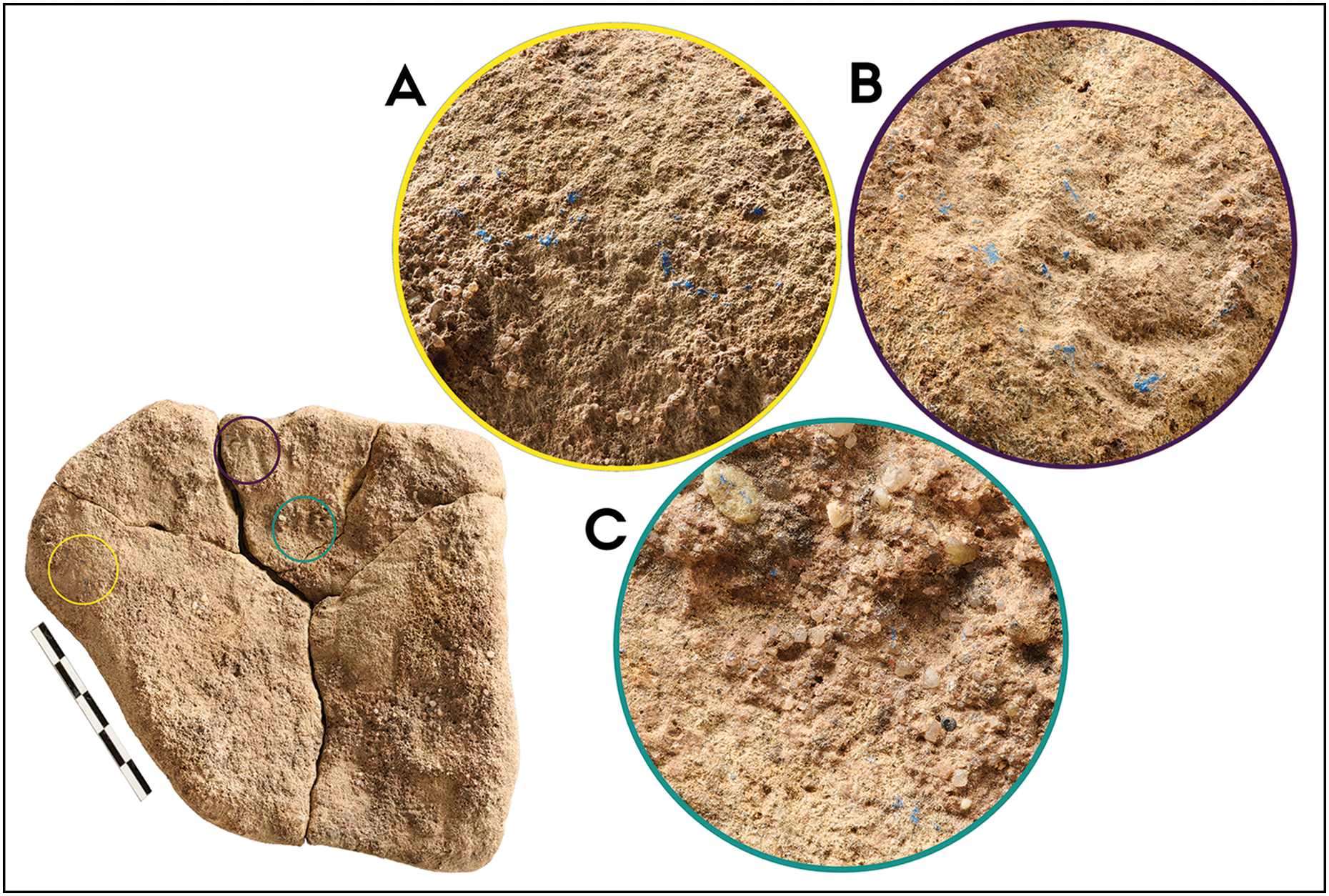
We document here the first and earliest example of blue pigment use from the European Upper Palaeolithic. The blue pigment was identified on a stone artefact with a concave, bowl-like morphology (Figure 1)—originally interpreted as an open-circuit lamp (cf. de Beaune Reference de Beaune1987a)—from the Final Palaeolithic (c. 14 000–11 700 BP) open-air site of Mühlheim-Dietesheim (Germany). The traces of blue residue are present on one surface of the artefact only, and we used a suite of archaeometric approaches to determine its chemical composition and crystalline structure. This novel documentation of blue pigment use during the Upper Palaeolithic has significant implications for understanding artistic behaviours during this period, encouraging a deeper consideration for why blue pigments have not been previously identified within Upper Palaeolithic contexts.
The three areas of blue residue present on the sandstone layer of the stone artefact from Mühlheim-Dietesheim. Area A, due to its more accessible location on a flatter area of the sandstone, was the primary focus of archaeometric analyses. Scale bar is 50mm (figure by authors).

Site background
Mühlheim-Dietesheim sits on the southern bank of the River Main. Sandwiched between Franconia and the Swabian Jura to the south, the Rhineland to the west and the Thuringian Basin in the east, this region—broadly corresponding to the southern part of the German Federal State of Hesse—is characterised by a relative dearth of Palaeolithic sites (Fiedler Reference Fiedler1994), including those dating to the very end of the Pleistocene. Small Final Palaeolithic sites have, however, been identified both downstream of Mühlheim-Dietesheim (Loew Reference Loew2005) and nearby (Rosenstein Reference Rosenstein1992).
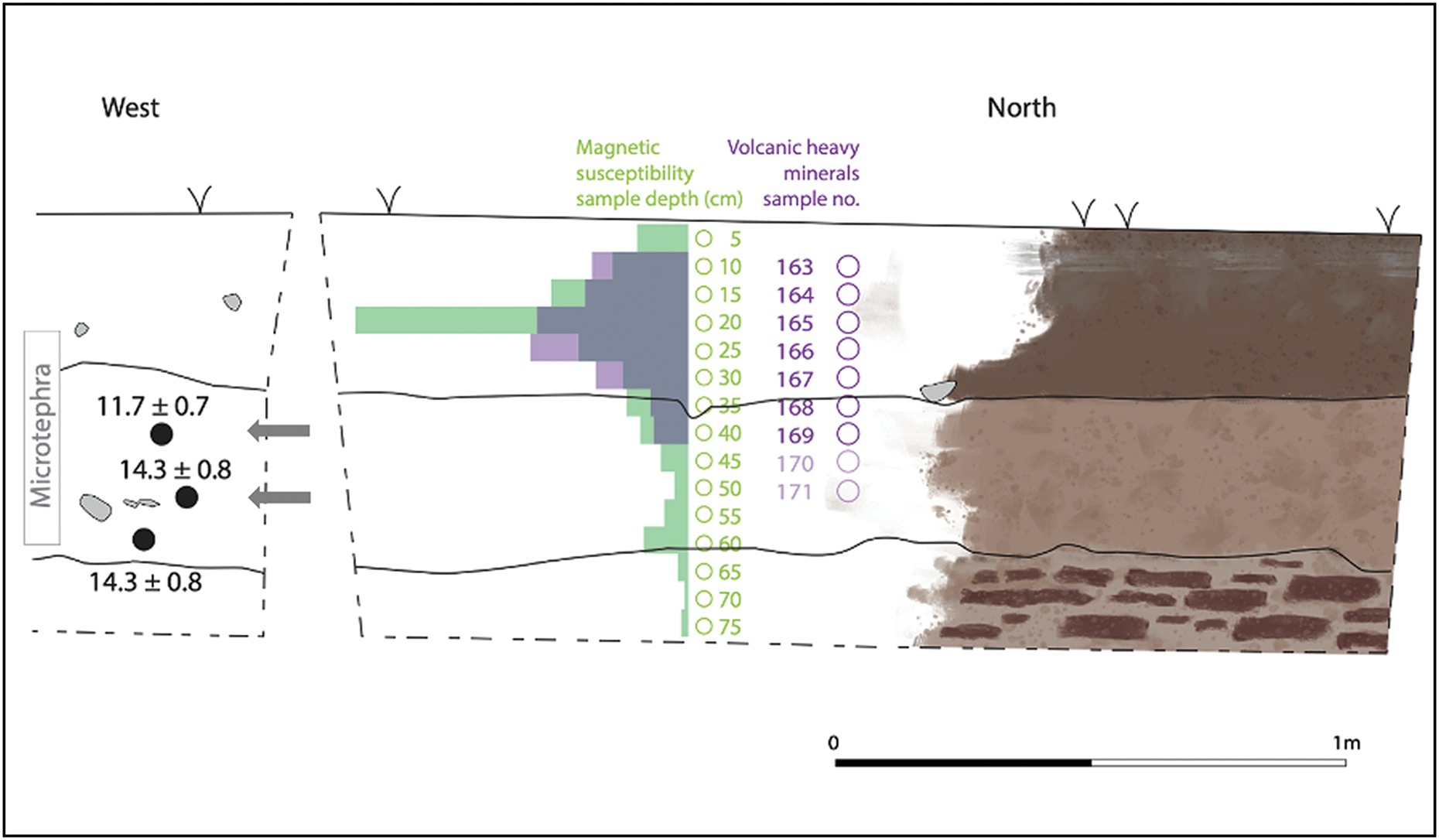
While the area surrounding Mühlheim-Dietesheim was previously under cultivation, there has been no or only occasional ploughing in the past four decades. The stone artefact derives from investigations conducted between 1976 and 1980, during which a total area of 63m2 was excavated yielding a Final Palaeolithic assemblage and revealing the typically ephemeral stone lining of a possible tent structure, as well as associated working areas (Fruth Reference Fruth1979, Reference Fruth1994). In 2023 and as part of the European Research Council-funded CLIOARCH project (Riede et al. Reference Riede, Hussain, Timmreck and Svenning2020), a 6m2 keyhole excavation was conducted in the immediate south-eastern continuation of the original excavation area (Riede et al. Reference Riede, Pedersen, Birndorfer and Steffens2024). The keyhole trench exposed a new profile which confirmed the relative intactness of the find layer and allowed for multiproxy geochronological investigations (Figure 2; see also online supplementary material (OSM) section 1.1). The spatially circumscribed, single-component human occupation at Mühlheim-Dietesheim pre-dates the 13 006±9 cal BP eruption of the Laacher See volcano (Reinig et al. Reference Reinig2021) whose continentally widespread isochronous ashfall (Riede et al. Reference Riede, Bazely, Newton and Lane2011) is reflected in elevated magnetic susceptibility readings and an enrichment of volcanically derived heavy minerals immediately above the main find distribution. Together with newly obtained optically stimulated luminescence (OSL) dates, these observations constrain the upper and lower age estimates to between c. 14 000 and 13 000 years ago (OSM section 1.2). The Laacher See eruption and its manifold socioecological impacts appear to have led to a settlement hiatus in the wider region (Riede Reference Riede2016).
Compound stratigraphy for Mühlheim-Dietesheim, with the sample locations for OSL dating, measurements of magnetic susceptibility and heavy minerals analysis. The main find distribution is located between the upper two OSL dates (indicated by arrows) and clearly below the elevated magnetic susceptibility and volcanic heavy minerals readings (figure by authors).

As part of our recent investigations, archaeological finds from the original excavations were revisited. These predominantly consist of lithics made from a variety of regionally available materials—chiefly lydite, chalcedony and Baltic flint—which link the site to major contemporaneous settlement areas in the Middle Rhine region to the west as well as sites in Franconia further east along the River Main and its catchment, in addition to more northerly areas (Riede Reference Riede2016). The site itself is located close to a historical fishing and fording area and may represent a bridgehead for small human groups moving along and across the River Main. Notably, the archaeological finds included the stone artefact investigated here and a small (<10mm long) piece of ochre, that was also possibly locally sourced based on the presence of nearby ochre outcrops. The stone artefact has a natural concave, bowl-like morphology which resulted in its original interpretation as an open-circuit lamp and had been on display at the Stadtmuseum Mühlheim.
Methods
Traces of blue residue are present on the stone artefact from Mühlheim-Dietesheim in small, isolated areas on the concave surface of the artefact (Figure 1); they are absent from the breakage seams and on the reverse side. To characterise the composition and crystalline structure of the blue residue, and to determine whether it resulted from the processing of a blue pigment, we deployed a suite of archaeometric methods: micro- and x-ray florescence (µXRF/XRF); scanning electron microscopy coupled with electron dispersive spectroscopy (SEM-EDS); particle induced x-ray emission (PIXE); Fourier transform infra-red spectroscopy (FTIR); fibre optic reflection spectroscopy (FORS); multicollector inductively coupled plasma mass spectrometry ((MC-)ICP-MS); and multiband imaging. These different methods, often used in various combinations of one or more, each constitute best practice for the identification of Palaeolithic pigments (Chalmin et al. Reference Chalmin, Menu and Vignaud2003; d’Errico et al. Reference D’errico, Salomon, Vignaud and Stringer2010; Lbova Reference Lbova2019) and have been used to identify blue pigments in other archaeological and historic contexts (Bruni et al. Reference Bruni, Cariati, Casadio and Toniolo1999; Uda Reference Uda, Uda, Demortier and Nakai2005; Sánchez Del Río et al. Reference Sánchez Del Río, Martinetto, Solís and Reyes-Valerio2006).
Given the novelty of finding blue residue in a Palaeolithic context, this extensive suite of methods was deployed in order to obtain the highest resolution possible from the sparse areas of blue residue, and to verify the results provided by any one method. Non-invasive in situ methods (µXRF/XRF, PIXE, SEM-EDS) were first utilised to both investigate the geological properties of the stone matrix and determine the elemental composition of the blue residue to confirm that it did not have a modern origin (e.g. accidentally marked with modern ink during cataloguing). Once these methods indicated that the blue residue was copper-based, more intensive investigation using a combination of in situ and minimally destructive methods were used to identify the mineral (FTIR, FORS, multiband imaging) and its provenance ((MC-)ICP-MS). Due to the superficial and sparse nature of the blue residue, only miniscule samples were taken for FTIR and (MC-)ICP-MS analyses from areas of the blue residue that appeared to be more substantial, deriving from area A (Figure 1: area A). Lipid residue and microfossil analyses were also conducted on the upper, concave surface of the artefact encrusted with a sandstone layer to determine whether there were animal fats or combusted plant materials preserved on the artefact that may indicate its function (for a detailed description of the methods and protocols, see OSM).
Results
Elemental composition
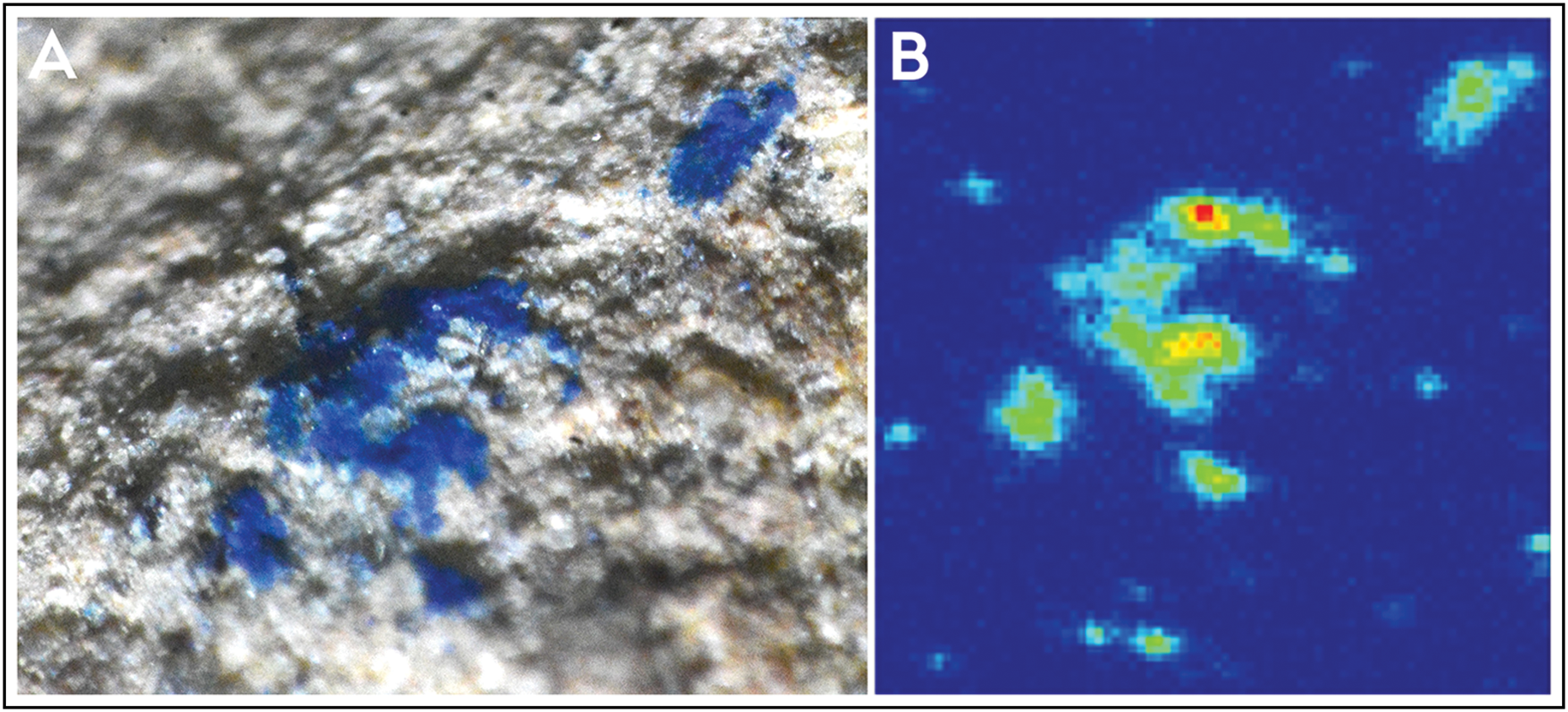
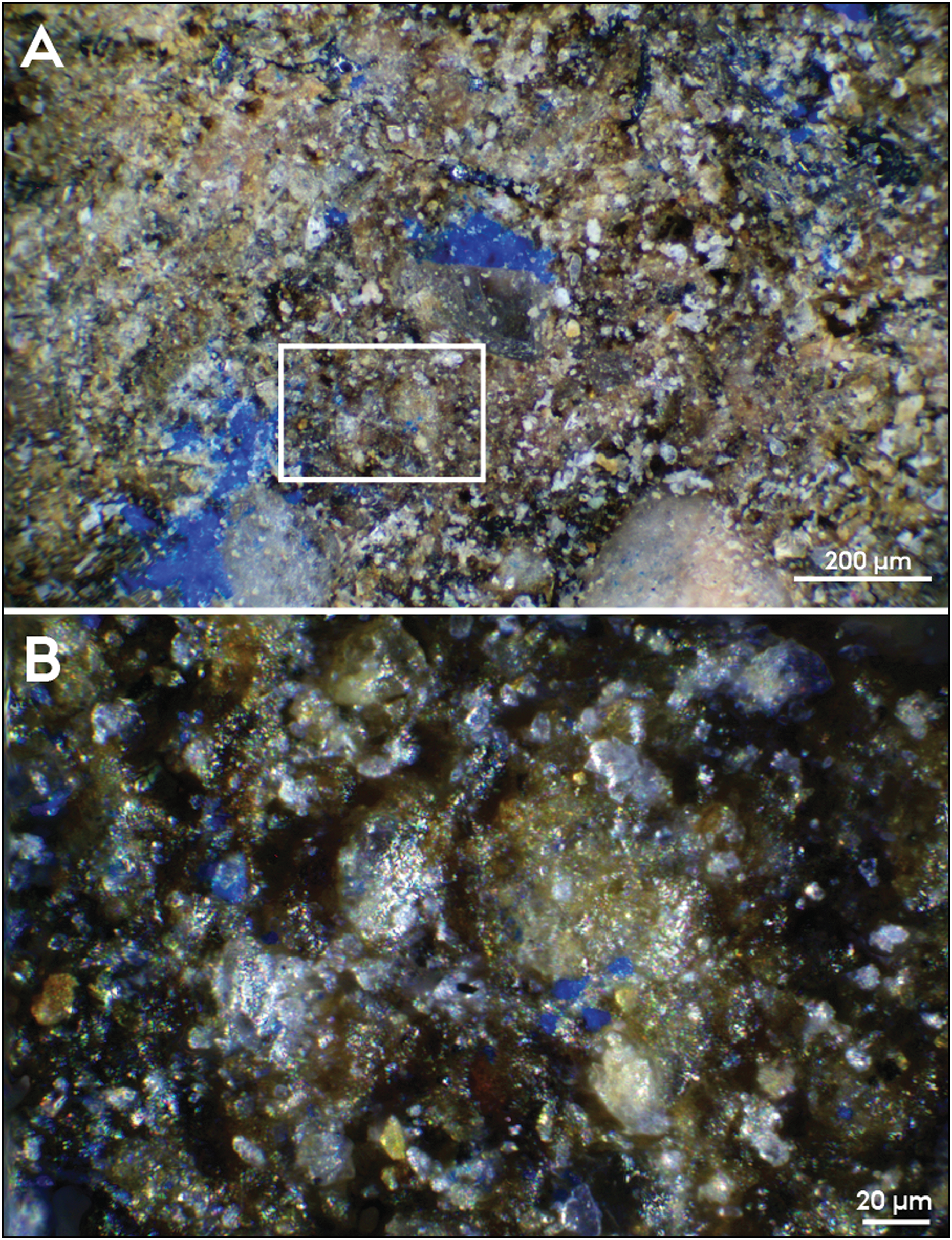
The results of the µXRF, XRF and PIXE provided the elemental composition of the blue residue. The µXRF analyses of the surrounding stone matrix and the blue residue were conducted using a 25µm spot size (with 25µm intervals; OSM section 2.3). This established that the stone matrix is predominantly igneous with a sedimentary layer on the upper surface and confirmed an elevated presence of copper (Cu) aligning precisely with the areas of blue residue. XRF maps of areas of the blue residue situated towards the outer edge of the artefact further confirmed the presence of copper corresponding only to the areas of the blue residue. The PIXE analysis consisted of an in-depth evaluation of the larger area of blue residue (Figure 1: area A). A total of 17 PIXE measurements were obtained, consisting of nine small maps of variable sizes depending on the size of the target area of blue residue and two maps of the stone itself, taken both from an area adjacent to the blue residue and on the reverse side of the artefact (see OSM section 2.6 for sampling locations and map sizes). The µXRF, XRF and PIXE measurements confirm the presence of copper as the main element in the blue residue, alongside other elements that appeared to correspond to the underlying stone matrix (i.e. silica, calcium, iron; see OSM). The copper clearly corresponded only to the areas of the blue residue, with the morphology of copper distribution in the maps consistent with the morphology of the target area of blue residue and little-to-no copper occurring on the reverse side of the artefact (Figure 3; OSM section 2.6). XRF maps also reveal traces of copper in the sandstone layer adjacent to blue areas, suggesting that the blue residue was originally distributed over a greater area of the stone, and microscopic imaging confirms the presence of tiny specks of blue residue adjacent to the visible concentrations (Figure 4). This both confirms that the copper presence identified derives from the blue residue and indicates that there has been some degree of degradation to the blue residue.
Results from the PIXE analysis, showing one of the mapped areas of blue residue (A) and the corresponding copper heatmap for this area (B). The map is 2000 × 2000µm2, with a pixel size of 25 × 25µm (figure by authors).

Microscopic image of nano-sized specks of blue residue, directly adjacent to visible concentrations that correspond to area A in Figure 1. B shows the area in the white rectangle under greater magnification (figure by authors).

Mineral identification
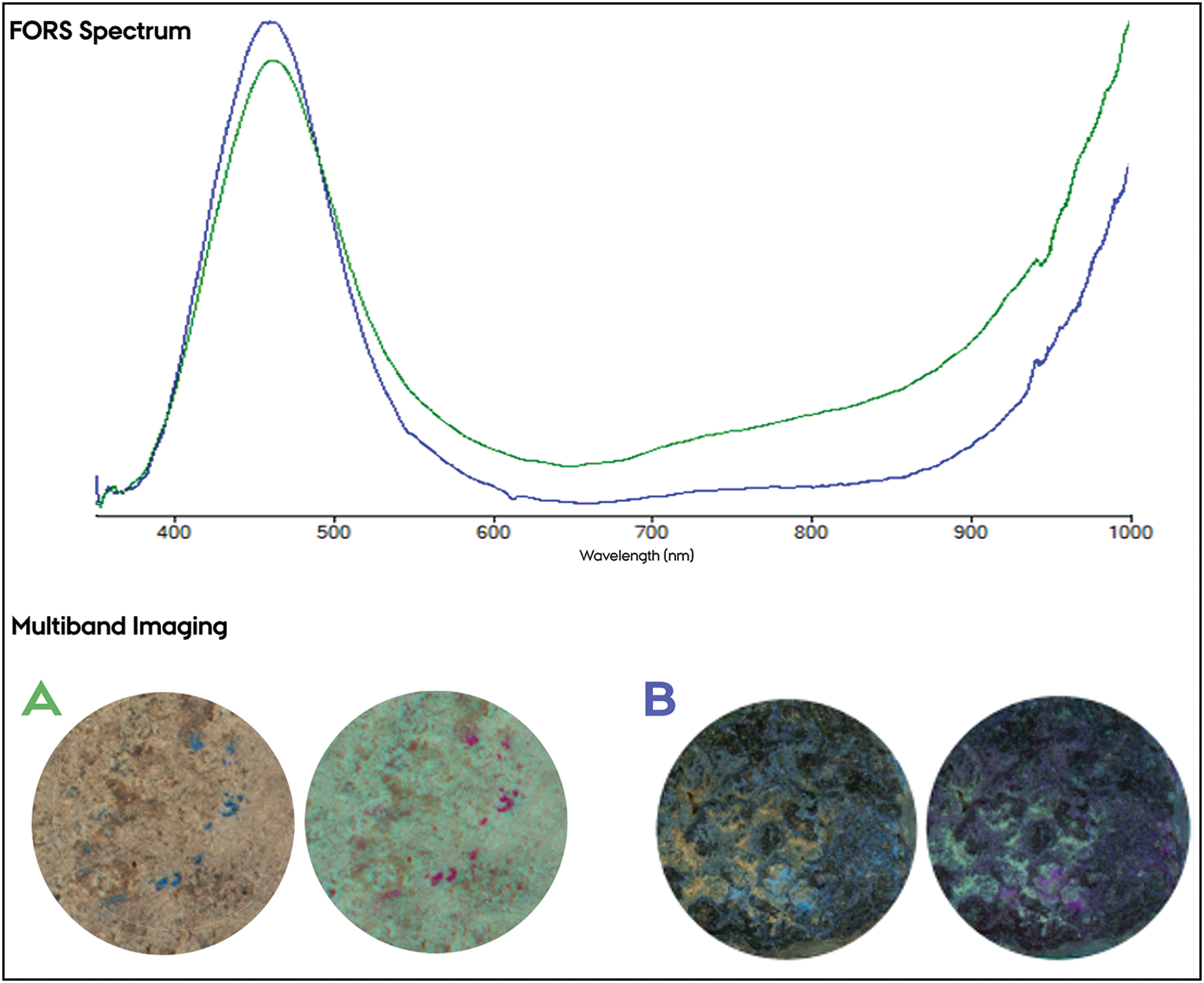
Together, FTIR, FORS and multiband imaging reveal the copper-based mineral responsible for the blue residue to be azurite (rather than modern-day ink), with each method producing results consistent with known references (see OSM sections 2.7–2.9). FTIR shows peaks indicative of azurite at 1508, 1465 and 1421cm-1, representing carbonate (CO3 -2) stretching vibrations not found in other copper-based blue pigments. Multiband imaging and FORS showed results consistent with known azurite references (Figure 5). The FORS spectrum showed the same profile as spectra from an azurite reference with characteristic reflectance at 460nm (Figure 5), again clearly distinct from other blue pigments such as indigo, ultramarine and Egyptian blue (see OSM). Multiband imaging also shows a characteristic false colour shift from blue to purple, typical for known azurite references, while other blue pigments tend to have a false colour shift to shades of red (Figure 5). No visible-induced infra-red luminescence indicative of Egyptian blue or Han blue was detected. Multiband imaging was also able to provide an overview of the entire area of blue pigment on the stone artefact, showing the same response in all images and thus supporting the idea that there is one pigment present and not a mixture.
FORS spectra showing the spectrum obtained from the blue residue (green line) in comparison to a spectrum from a known azurite sample (blue line). Multiband imaging below similarly shows the colour change of the blue residue (A) is characteristic of azurite (B) (figure by authors).

The application of multiple methods allows us to confidently identify the blue residue as azurite. While azurite has been known to spontaneously form in sandstone from copper-rich deposits (Woodward et al. Reference Woodward, Kaufman and Schumacher1974), the superficial nature of the residue, the lack of copper identified on a control point of the stone and the presence of the residue on top, and not within, the sandstone coating all indicate that the azurite did not form naturally within this layer, but instead is anthropogenic in origin. The heterogeneous nature of the distribution of blue across the stone artefact also supports an anthropogenic origin for the azurite residue. Since no copper or azurite was detected on the reverse side of the object, it is unlikely that a taphonomic process or modern handling practice caused the blue residue; in these cases, one would expect a more homogeneous distribution of the azurite.
Discussion
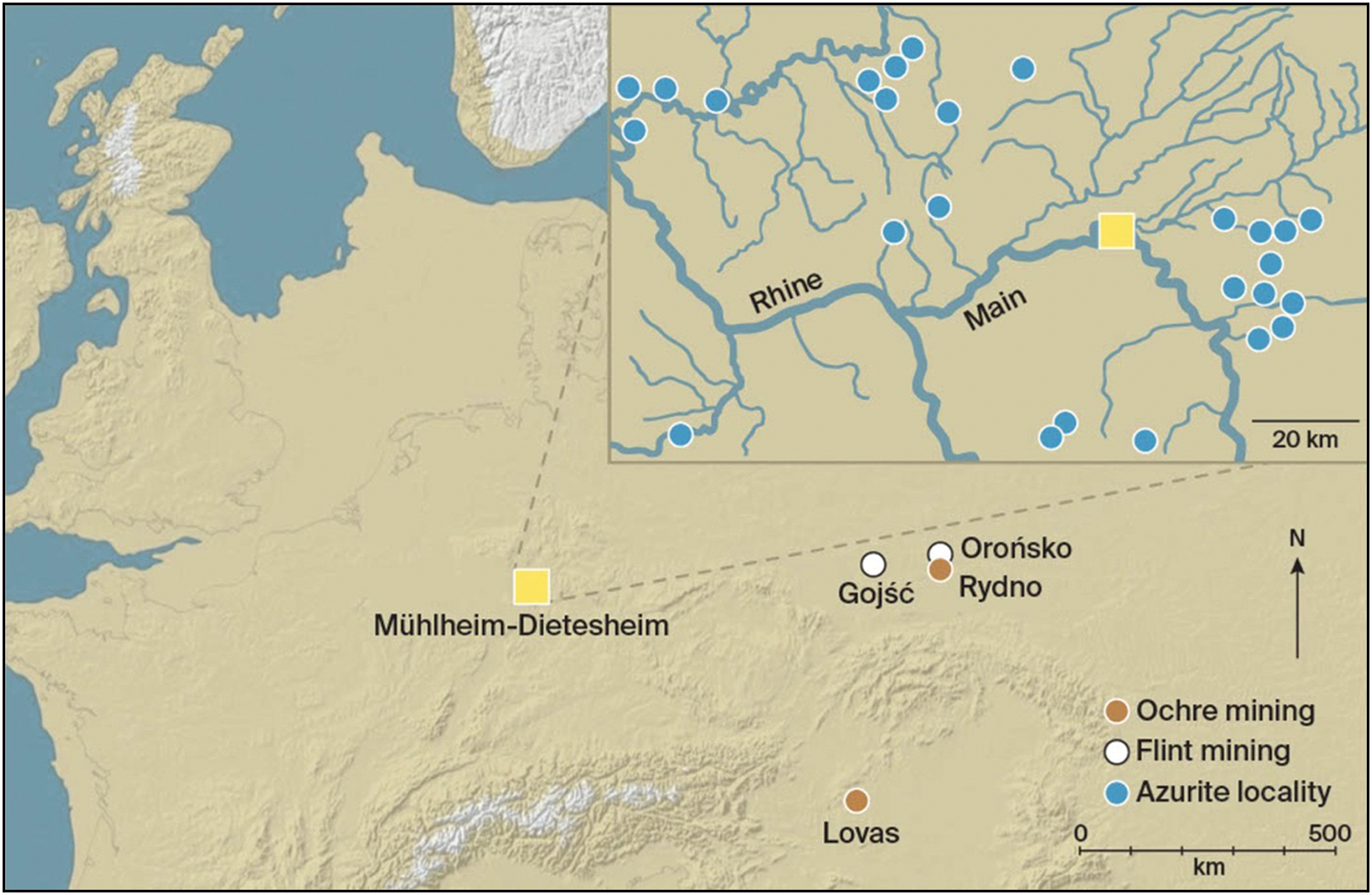
The identification of blue residue on the stone artefact from Mühlheim-Dietesheim as azurite raises important questions regarding the provenance of the pigment and the implications of blue pigment use in the context of Upper Palaeolithic artistic practices. Azurite is a mineral formed through secondary weathering of copper ore and is commonly found in near-surface deposits throughout Europe (Figure 6). Lead isotope analysis, employing (MC-)ICP-MS on a small sample of the azurite, demonstrates that the residue on the stone artefact is consistent with local geologies in the Rhine-Main River valley system when compared to reference data of lead and copper mineralisations, suggesting the azurite was sourced regionally (OSM section 2.11). The closest such deposit can be found approximately 20km south-east of Mühlheim-Dietesheim, following the River Main. Tool-stone provenancing from the site attests to foragers moving along the River Main and into this area of high azurite occurrence (Sauer Reference Sauer2016). While azurite can be collected from surface deposits, it is also plausible that it may have been intentionally extracted; near-surface mining for specific, often colourful, tool-stone and ochres is known from the Magdalenian (c. 20 000–14 000 years ago) and subsequent Final Palaeolithic in Europe (Ginter Reference Ginter, Kozlowski, Gurba and Zaliznyak1999; Floss et al. Reference Floss, Blumentritt, Hoyer, Huber, Velliky, Conard, Floss and Pastoors2018; Osipowicz et al. Reference Osipowicz, Kerneder-Gubała, Bosiak, Makowiecki and Orłowska2019; Trájer Reference Trájer2022). Even when not actively mined, lithic raw materials may have been selected in part for their variable and evocative colours (cf. Nyland Reference Nyland2020; Hess & Riede Reference Hess and Riede2021). At Hohle Fels, for example, extensive ochre extraction and its use in parietal art during the Magdalenian attests to the extensive prospecting knowledge held by Upper Palaeolithic populations (Floss et al. Reference Floss, Blumentritt, Hoyer, Huber, Velliky, Conard, Floss and Pastoors2018), yet the evidence for pigment use at these sites is also limited to red hues. The evident availability of near-surface azurite deposits and the emerging evidence for shallow mining in the Final Palaeolithic suggests that limited accessibility to blue pigments is not a satisfactory explanation for its absence in the Palaeolithic art record of Europe.
Map of the local area around Mühlheim-Dietesheim, showing known nearby azurite localities in the Rhine-Main River valley system and contemporaneous Final Palaeolithic ochre and flint mining sites from central Europe (figure by authors).

The presence of the azurite on the stone artefact may tentatively be assumed to have occurred due to pigment processing activities, with the stone possibly being used to support grinding activities to process the azurite into a powder, as a surface to mix the azurite with binding materials to create a paint or to contain an azurite paint mixture. The presence of ochre at Mühlheim-Dietesheim also lends support to pigment processing activities occurring at the site. Sandstone has been previously documented as being used in this context for ochre processing, both as a tool to directly grind the ochre and surface supports for grinding or paint mixing activities (Velliky et al. Reference Velliky, Porr and Conard2018; Langley & O’Connor Reference Langley and O’Connor2019). The distribution of the pigment on these ‘palettes’ can be variable but usually corresponds to areas that were subject to intensive grinding activities (i.e. use edges; smoothed areas of the stone). The distribution of azurite on the artefact from Mühlheim-Dietesheim similarly appears to correspond to locales where the sandstone layer has been removed, towards the outer rim, although clear anthropogenic striation marks are absent. Our PIXE results do, however, indicate that the azurite residue may have originally covered a greater surface area. Additionally, the lack of an identifiable crystalline structure to the azurite (OSM section 2.4) may suggest it was instead suspended in a paint mixture, with the stone artefact possibly used to contain or mix the azurite paint.
The presence of azurite processing from an unassuming stone artefact at the open-air site of Mühlheim-Dietesheim is, at present, unique but may also indicate that the use of blue pigments may have been more widespread than suggested by currently available evidence—at least during the latest phases of the European Palaeolithic. It is possible that similar objects derived from comparable contexts (de Beaune Reference de Beaune1987b) that have not yet received significant attention may also exhibit the presence of blue residue, particularly given the accessibility and relative abundance of azurite in Pleistocene Europe. In this light, the lack of blue pigments in the Palaeolithic art corpus may suggest that there was selectivity over the use contexts of different hues of pigments during this period. In later prehistoric periods, the use of azurite as a pigment has been documented in specific contexts not strictly related to art production. Prior to our research, one of the earliest known uses of azurite derived from the Neolithic site of Çatalhöyük but was not associated with the wall paintings that characterise the site (Siddall Reference Siddall2018). Instead, azurite was deposited within the burials of female individuals, either as lumps originally contained within an organic pouch, or present on wooden containers with associated pigment applicators (e.g. small bone implements), with suggestions that azurite may have been used for cosmetic purposes (Radivojević et al. Reference Radivojević, Rehren, Farid, Pernicka and Camurcuoğlu2017; Schotmans et al. Reference Schotsmans2022). Blue pigment has also been documented on the hair and eyes of Bronze Age anthropomorphic female figurines in Greece, perhaps reflecting the use of blue pigment for body decoration (Hoffman Reference Hoffman2002; Hendrix Reference Hendrix2003), and within bone tubes in burial contexts in both the late Neolithic and Bronze Age, again implying a cosmetic use for azurite (Mina Reference Mina2009). While far apart in space and time, the presence of blue pigment on these figurines from Greece echoes the placement of a copper-based pigment on the heads and limbs of the decorated anthropomorphic figurines from Mal’ta in Siberia (Lbova & Volkov Reference Lbova and Volkov2020). Other functional uses of azurite are also known from Chalcolithic and Bronze Age contexts but primarily pertain to copper-smelting activities (Valério et al. Reference Valério2023).
Based on our evidence of azurite use at Mühlheim-Dietesheim, the absence of blue hues in the Palaeolithic portable and parietal art corpus and, given that functional uses of azurite for copper smelting did not occur in the Upper Palaeolithic, we suggest that this blue pigment was used for activities that are invisible in the archaeological record. It is possible that the use of azurite was therefore restricted to activities such as body decoration or dyeing organic materials used in clothing—but, importantly, that it was not used for portable or parietal art in the European Upper Palaeolithic. It is notable that this early evidence of blue-pigment use derives from a geographical and temporal context that otherwise has a relative paucity of Palaeolithic art, with the art corpus known from the wider region predominantly pre-dating the Final Palaeolithic (Hahn Reference Hahn1972; Floss et al. Reference Floss, Blumentritt, Hoyer, Huber, Velliky, Conard, Floss and Pastoors2018). Thus, we tentatively suggest that azurite use at Mühlheim-Dietesheim can be contextualised within shifts in artistic traditions sensu lato that occurred during the Final Palaeolithic, which not only involved a downturn in the production of parietal art but may have also involved an engagement with more diverse materials and pigment hues.
Conclusion
We hypothesise that azurite was likely used in the Upper Palaeolithic to a much greater extent than hitherto assumed, based on its presence at Mühlheim-Dietesheim and its likely accessibility in the landscape. It is possible that azurite use was restricted to activities that do not preserve well in the archaeological record; blue pigments were evidently not used to decorate cave walls nor portable art objects in the European Palaeolithic but may instead have been used to decorate the body. Our results encourage a critical consideration of the use of colour during the Upper Palaeolithic to determine why certain hues were used—or not used—for different artistic practices.
Acknowledgements
We would like to thank the ERC CoG project CLIOARCH (PI: Felix Riede, grant number: 817564), through which ongoing research on the site of Mühlheim-Dietesheim is being conducted. Financial support by the Access to Research Infrastructures activity in the Horizon 2020 Programme of the EU (IPERION HS Grant Agreement n.871034) institutions that supported the IPERION Horizon Scheme-funded access: Synchrotron SOLEIL, Centre de Recherche et de Restauration des Musées de France and the Heritage Laboratory of the Swedish National Heritage Board. We gratefully acknowledge the onsite assistance of Richard Plackinger who originally discovered the site, and thank Peter Steffens (Landesamt für Denkmalpflege Hessen, Außenstelle Darmstadt) who kindly facilitated our fieldwork.
Funding statement
This research was funded by the Access to Research Infrastructures activity in the Horizon 2020 Programme of the European Union (IPERION HS Grant Agreement no. 871034) and the European Research Council Consolidator Grant project CLIOARCH (PI: Felix Riede, grant number: 817564). IW is supported by the European Research Council Consolidator Grant project ‘eSYMb: The Evolution of Early Symbolic Behaviour’ (grant number: 101044626).
Author Contributions: using CRediT categories
Izzy Wisher: Conceptualization-Equal, Funding acquisition-Equal, Investigation-Lead, Methodology-Equal, Visualization-Lead, Writing - original draft-Lead, Writing - review & editing-Lead. Thomas Birch: Conceptualization-Equal, Funding acquisition-Equal, Investigation-Lead, Methodology-Equal, Writing - review & editing-Equal. Rasmus Andreasen: Conceptualization-Equal, Investigation-Lead, Methodology-Equal, Visualization-Equal, Writing - review & editing-Equal Elyse Canosa Investigation-Equal, Resources-Equal, Visualization-Equal, Writing - review & editing-Supporting Sara Norrehed Investigation-Equal, Resources-Equal, Visualization-Equal, Writing - review & editing-Supporting. Solenn Reguer: Investigation-Equal, Resources-Equal, Visualization-Equal, Writing - review & editing-Supporting Quentin Lemasson Investigation-Equal, Resources-Equal, Visualization-Equal, Writing - review & editing-Supporting. Ester Oras: Investigation-Equal, Resources-Equal, Visualization-Equal, Writing - review & editing-Supporting. Kristiina Johanson: Investigation-Equal, Resources-Equal, Visualization-Equal, Writing - review & editing-Supporting. Tim Kinnaird: Investigation-Equal, Resources-Equal, Writing - review & editing-Supporting. Thomas Birndorfer: Investigation-Equal, Resources-Equal, Writing - review & editing-Supporting. Jesper Pedersen: Investigation-Equal, Resources-Equal, Writing - review & editing-Supporting. James Scott: Investigation-Equal, Resources-Equal, Writing - review & editing-Supporting. Christof Pearce: Investigation-Equal, Resources-Equal, Visualization-Equal, Writing - review & editing-Supporting. Felix Riede: Conceptualization-Equal, Funding acquisition-Equal, Investigation-Lead, Methodology-Equal, Resources-Equal, Visualization-Equal, Writing - original draft-Equal, Writing - review & editing-Equal.
Online supplementary material (OSM)
To view supplementary material for this article, please visit https://doi.org/10.15184/aqy.2025.10184 and select the supplementary materials tab.


 Open access

