




To Pino Rosolini
All we can say to express our gratitude to him
is that there are not enough words to express it.
1. Introduction
This paper provides a contribution to the foundation of constructive mathematics by showing the existence of constructive quasi-toposes, validating an effective principle à la Church and continuity principles à la Brouwer.
To understand the relevance of our contribution, we recall that there is a large variety of different, and often mutually incompatible, approaches to constructive mathematics. Broadly, constructive mathematics can be conceived as mathematics developed by replacing the usual classical underlying logical reasoning with Brouwer’s intuitionistic logic. Significant examples of approaches to constructive mathematics that are incompatible with classical mathematics include Markov’s constructivism and Brouwer’s intuitionism (see, e.g., Bridges and Richman (Reference Bridges and Richman1987); Troelstra and van Dalen (Reference Troelstra and van Dalen1988)). Markov’s constructivism emphasizes the effectiveness of constructive functions by presupposing the validity of the formal Church Thesis $\textsf{CT}$
, that all number-theoretic functional relations are computable. Instead, Brouwer’s intuitionism privileges the continuity of constructive functions on the continuum by presupposing the validity of Bar Induction, a local continuity principle called
$\textsf{CT}$
, that all number-theoretic functional relations are computable. Instead, Brouwer’s intuitionism privileges the continuity of constructive functions on the continuum by presupposing the validity of Bar Induction, a local continuity principle called $\textsf{LCP}$
which implies that all functions between real numbers are continuous (see Troelstra and van Dalen (Reference Troelstra and van Dalen1988)), and an instance of the axiom of choice
$\textsf{LCP}$
which implies that all functions between real numbers are continuous (see Troelstra and van Dalen (Reference Troelstra and van Dalen1988)), and an instance of the axiom of choice $\textsf{AC}_{Baire}$
on the Baire space.
$\textsf{AC}_{Baire}$
on the Baire space.
These two mathematical approaches are not only incompatible with classical mathematics but also incompatible with each other; it is well known from Troelstra and van Dalen (Reference Troelstra and van Dalen1988) and Dummett (Reference Dummett2000) that over Heyting arithmetic with finite types, Brouwer’s Fan Theorem, which is a consequence of Bar Induction, is inconsistent with the formal Church Thesis $\textsf{CT}$
.
$\textsf{CT}$
.
Here, we want to show that it is possible to reconcile Brouwer’s intuitionistic principles with a weakened form of effectiveness without necessarily renouncing both effective and continuity principles altogether (except for some form of choice) as advocated by Bishop (Reference Bishop1967). Actually, Bishop aimed to develop constructive mathematics in a way that was also compatible with the classical one. Such an aim was pushed even further in the works of Maietti and Sambin (Reference Maietti and Sambin2005) and Maietti (Reference Maietti2009) with the introduction of the Minimalist Foundation. Indeed, such a foundation was built purposely to formalize mathematics compatibly with the most relevant constructive and classical mathematical approaches, including classical predicativism (see Maietti and Sabelli (Reference Maietti and Sabelli2024); Contente and Maietti (Reference Contente and Maietti2025)).
In this work, we prove that there exists a much less radical reconciliation between Markov’s constructivism and Brouwer’s intuitionism than Bishop’s by employing category theory. Indeed, we build two quasi-toposes that validate Brouwer’s continuity principles $\textsf{Bar Induction}$
,
$\textsf{Bar Induction}$
, $\textsf{LCP}$
, and
$\textsf{LCP}$
, and $\textsf{AC}_{Baire}$
, together with an effective principle called the Type-theoretic Church Thesis, for short
$\textsf{AC}_{Baire}$
, together with an effective principle called the Type-theoretic Church Thesis, for short $\textsf{TCT}$
, which states that all morphisms of the considered quasi-topos are computable. Logically, this means that if Heyting arithmetic with finite types is enriched with a type of power objects, Brouwer’s continuity principles are consistent with the principle
$\textsf{TCT}$
, which states that all morphisms of the considered quasi-topos are computable. Logically, this means that if Heyting arithmetic with finite types is enriched with a type of power objects, Brouwer’s continuity principles are consistent with the principle $\textsf{TCT}$
stating that only number-theoretic functions arising as lambda-terms of the function type are computable.
$\textsf{TCT}$
stating that only number-theoretic functions arising as lambda-terms of the function type are computable. $\textsf{TCT}$
is weaker than
$\textsf{TCT}$
is weaker than $\textsf{CT}$
because it does not imply that all number-theoretic functions are computable. And the mentioned extension of Heyting arithmetic with finite types is nothing else than the generic calculus of what we call here arithmetic CC-strong triposes. Furthermore, it is important to underline that all this presupposes that Brouwer’s choice sequences are identified with number-theoretic functional relations as advocated in Maietti and Sambin (Reference Maietti and Sambin2013).
$\textsf{CT}$
because it does not imply that all number-theoretic functions are computable. And the mentioned extension of Heyting arithmetic with finite types is nothing else than the generic calculus of what we call here arithmetic CC-strong triposes. Furthermore, it is important to underline that all this presupposes that Brouwer’s choice sequences are identified with number-theoretic functional relations as advocated in Maietti and Sambin (Reference Maietti and Sambin2013).
The two built quasi-toposes are intuitionistic since they are built by adopting intuitionistic Zermelo-Fraenkel set theory $\mathbf{IZF}$
from Friedman (Reference Friedman1977), extended with Brouwer’s continuity principles as meta-theory. The first quasi-topos, called
$\mathbf{IZF}$
from Friedman (Reference Friedman1977), extended with Brouwer’s continuity principles as meta-theory. The first quasi-topos, called $\mathbf{Asm}_i$
, is an intuitionistic rendering of the quasi-topos of assemblies
$\mathbf{Asm}_i$
, is an intuitionistic rendering of the quasi-topos of assemblies $\mathbf{Asm}$
, originally defined as a full subcategory of the effective topos in Hyland (Reference Hyland1982). As a by-product,
$\mathbf{Asm}$
, originally defined as a full subcategory of the effective topos in Hyland (Reference Hyland1982). As a by-product, $\mathbf{Asm}_i$
is no longer boolean as
$\mathbf{Asm}_i$
is no longer boolean as $\mathbf{Asm}$
, where by boolean quasi-topos we mean a quasi-topos whose internal logic of strong subobjects satisfies classical logic. The second quasi-topos is built as the elementary quotient completion
$\mathbf{Asm}$
, where by boolean quasi-topos we mean a quasi-topos whose internal logic of strong subobjects satisfies classical logic. The second quasi-topos is built as the elementary quotient completion $\mathscr{Q}_{\mathbb{P}{\Gamma}}$
of the strong subobject doctrine
$\mathscr{Q}_{\mathbb{P}{\Gamma}}$
of the strong subobject doctrine $\mathbb{P}{\Gamma }$
of the intuitionistic rendering of partitioned assemblies in Robinson and Rosolini (Reference Robinson and Rosolini1990).
$\mathbb{P}{\Gamma }$
of the intuitionistic rendering of partitioned assemblies in Robinson and Rosolini (Reference Robinson and Rosolini1990).
In Maietti et al. (Reference Maietti, Pasquali and Rosolini2019), it was shown that these two quasi-toposes are equivalent when adopting the classical $\mathbf{ZFC}$
set theory as a meta-theory. Here, we show this is no longer the case when working within
$\mathbf{ZFC}$
set theory as a meta-theory. Here, we show this is no longer the case when working within $\mathbf{IZF}$
. In particular, the intuitionistic rendering of
$\mathbf{IZF}$
. In particular, the intuitionistic rendering of $\mathbf{Asm}$
loses some projectivity properties.
$\mathbf{Asm}$
loses some projectivity properties.
Finally, we notice that no non-trivial elementary topos (whether formalized in a classical or intuitionistic meta-theory) can model $\textsf{TCT}$
and Brouwer’s continuity principles altogether. The reason is that any topos validates the Axiom of Unique Choice
$\textsf{TCT}$
and Brouwer’s continuity principles altogether. The reason is that any topos validates the Axiom of Unique Choice $\textsf{AC!}$
, which strengthens
$\textsf{AC!}$
, which strengthens $\textsf{TCT}$
to become
$\textsf{TCT}$
to become $\textsf{CT}$
, which in turn contradicts Brouwer’s continuity principles. All this lets us conclude that our genuine quasi-toposes provide two different universes where to reconcile effectiveness à la Markov with continuity à la Brouwer.
$\textsf{CT}$
, which in turn contradicts Brouwer’s continuity principles. All this lets us conclude that our genuine quasi-toposes provide two different universes where to reconcile effectiveness à la Markov with continuity à la Brouwer.
As future work, we intend to employ such quasi-toposes to show the consistency of the Minimalist Foundation in Maietti (Reference Maietti2009) and Coquand-Huet’s Calculus of Constructions with $\textsf{TCT}$
and all Brouwer’s intuitionistic principles.
$\textsf{TCT}$
and all Brouwer’s intuitionistic principles.
The paper is organized as follows.
In Section 2, we lay out the categorical preliminaries on quasi-toposes and on various completions of suitable triposes. In particular, we focus on what we call arithmetic CC-strong triposes, of which we describe the internal language in the style of that for toposes in Lambek and Scott (Reference Lambek and Scott1986), and we use it to formulate $\textsf{TCT}$
. In Section 3, we introduce Brouwer’s continuity principles. In Section 4, we specify our meta-theory. In Section 5, we build the intuitionistic quasi-topos of assemblies, which is defined as the elementary quotient completion of strong subobjects over partitioned assemblies; we show that they can not be equivalent and that they validate both
$\textsf{TCT}$
. In Section 3, we introduce Brouwer’s continuity principles. In Section 4, we specify our meta-theory. In Section 5, we build the intuitionistic quasi-topos of assemblies, which is defined as the elementary quotient completion of strong subobjects over partitioned assemblies; we show that they can not be equivalent and that they validate both $\textsf{TCT}$
and the mentioned Brouwer’s continuity principles.
$\textsf{TCT}$
and the mentioned Brouwer’s continuity principles.
2. Categorical preliminaries on quasi-toposes and triposes
Loosely, a quasi-topos is a generalization of the notion of topos that requires a classifier just for strong monomorphisms, which in general do not coincide with all monomorphisms.
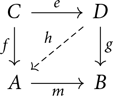
Definition 1.
In any category, a strong monomorphism is a monomorphism $m: A \to B$
such that, for each epimorphism
$m: A \to B$
such that, for each epimorphism $e: C \to D$
and each pair of arrows
$e: C \to D$
and each pair of arrows $f: C \to A$
and
$f: C \to A$
and $g : D \to B$
with
$g : D \to B$
with $g\circ e = m \circ f$
, there exists a unique arrow
$g\circ e = m \circ f$
, there exists a unique arrow $h : D \to A$
making the following diagram commute.
$h : D \to A$
making the following diagram commute.
Definition 2.
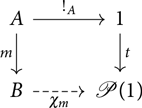
In any finitely complete category, a strong-subobject classifier is an object $\mathscr{P}(1)$
together with an arrow
$\mathscr{P}(1)$
together with an arrow $t : 1 \rightarrow {\mathscr{P}(1)}$
from the terminal object to it such that for each strong monomorphism
$t : 1 \rightarrow {\mathscr{P}(1)}$
from the terminal object to it such that for each strong monomorphism $m : A \rightarrow B$
there exists a unique arrow
$m : A \rightarrow B$
there exists a unique arrow $\chi _m : B \rightarrow {\mathscr{P}(1)}$
making the following a pullback square.
$\chi _m : B \rightarrow {\mathscr{P}(1)}$
making the following a pullback square.
Definition 3.
A quasi-topos is a finitely complete, finitely cocomplete, locally Cartesian closed category with a strong-subobject classifier. A quasi-topos is said to be solid if the unique map $0\to 1$
from an initial object
$0\to 1$
from an initial object $0$
to a terminal one
$0$
to a terminal one $ 1$
is a strong monomorphism (or equivalently, it has disjoint coproducts; see Johnstone (Reference Johnstone2002)).
$ 1$
is a strong monomorphism (or equivalently, it has disjoint coproducts; see Johnstone (Reference Johnstone2002)).
We also recall the notion of a weak dependent product from Birkedal et al. (Reference Birkedal, Carboni, Rosolini and Scott1998) and Carboni and Rosolini (Reference Carboni and Rosolini2000), which will be useful in the sequel. To give such a definition, we make use of the following notation: for any finitely complete category $\mathscr{C}$
and any arrow
$\mathscr{C}$
and any arrow $g: J\rightarrow I$
, we denote the pullback functor
$g: J\rightarrow I$
, we denote the pullback functor
 \begin{equation*}g^\ast (\!-\!): \mathscr{C}/I\rightarrow \mathscr{C}/J \end{equation*}
Definition 4.
In a finitely complete category $\mathscr{C}$
, a weak dependent product of an arrow
$\mathscr{C}$
, a weak dependent product of an arrow $f\colon X\to J$
along a map
$f\colon X\to J$
along a map $g\colon J\to I$
consists of an arrow
$g\colon J\to I$
consists of an arrow $\Pi _g(f): Z\rightarrow I$
and an arrow
$\Pi _g(f): Z\rightarrow I$
and an arrow $ev: J\times _I Z\rightarrow X$
such that the following diagram commutes
$ev: J\times _I Z\rightarrow X$
such that the following diagram commutes
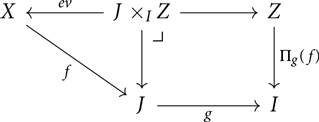
where the right square is a pullback; moreover, we require the above diagram to be weakly terminal in the category of diagrams with such a shape, namely, for any other diagram of the form
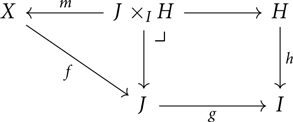
where the right square is a pullback, there exists an arrow $n: H\rightarrow Z$
such that
$n: H\rightarrow Z$
such that $h=\Pi _g(f)\circ n$
and
$h=\Pi _g(f)\circ n$
and $m= ev \circ g^\ast (n)$
.
$m= ev \circ g^\ast (n)$
.
Whenever the arrow $e$
exists and it is unique, then we say that
$e$
exists and it is unique, then we say that $\Pi _g(f): Z\rightarrow I$
and
$\Pi _g(f): Z\rightarrow I$
and $ev: J\times _I Z\rightarrow X$
gives a dependent product of
$ev: J\times _I Z\rightarrow X$
gives a dependent product of $f\colon X\to J$
along
$f\colon X\to J$
along $g\colon J\to I$
.
$g\colon J\to I$
.
Finally, recall that if $\mathscr{C}$
has dependent products for all map
$\mathscr{C}$
has dependent products for all map $f\colon X\to J$
along any other
$f\colon X\to J$
along any other $g\colon J\to I$
then it is locally Cartesian closed.
$g\colon J\to I$
then it is locally Cartesian closed.
In our treatment, we will rely on suitable notions of triposes, as introduced by Hyland et al. (Reference Hyland, Johnstone and Pitts1980) and Pitts (Reference Pitts2002), to organize the internal logic of a quasi-topos. We start by recalling the notion of first-order doctrine validating first-order intuitionistic logic with equality; then, we recall a strengthening of the notion of tripos, called strong tripos, introduced in (Maietti et al. Reference Maietti, Pasquali and Rosolini2023, Def. 2.21).
Let $\mathbf{Heyt}$
be the category of Heyting algebras and Heyting-algebra homomorphisms.
$\mathbf{Heyt}$
be the category of Heyting algebras and Heyting-algebra homomorphisms.
Definition 5.
A first-order (intuitionistic) doctrine on a finite product category $\mathscr{C}$
is a contravariant functor
$\mathscr{C}$
is a contravariant functor $P:\mathscr{C}^{{\kern2.1pt}\textrm{op}}\to \mathbf{Heyt}$
equipped with the following structure:
$P:\mathscr{C}^{{\kern2.1pt}\textrm{op}}\to \mathbf{Heyt}$
equipped with the following structure:
-
• for each projection $\pi : A \times B \to A$
in
$\mathscr{C}$
, the functor
$P_\pi : P(A) \rightarrow P(A \times B)$
has a left adjoint functor
$\exists _\pi$
and a right adjoint functor
$\forall _\pi$
(not required to be morphisms in
$\mathbf{Heyt}$
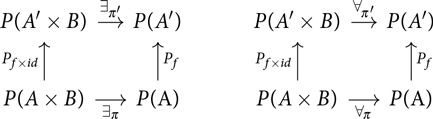
); moreover, these adjoints satisfy the following Beck-Chevalley condition: for any projection
$\pi : A \times B \to A$
and any map
$f : A' \to A$
, the following diagrams commute;
$\pi : A \times B \to A$
in
$\mathscr{C}$
, the functor
$P_\pi : P(A) \rightarrow P(A \times B)$
has a left adjoint functor
$\exists _\pi$
and a right adjoint functor
$\forall _\pi$
(not required to be morphisms in
$\mathbf{Heyt}$
); moreover, these adjoints satisfy the following Beck-Chevalley condition: for any projection
$\pi : A \times B \to A$
and any map
$f : A' \to A$
, the following diagrams commute;
-
•
$P$
is elementary, that is for every object
$A$
in
$\mathscr{C}$
, there is an element
$\delta _A$
in the fiber
$P(A\times A)$
such that for every arrow
$e$
of the form
$\langle \pi _1,\pi _2,\pi _2\rangle :X\times A\rightarrow X\times A\times A$
in
$\mathscr{C}$
, the assignment
for
\begin{equation*} \exists _{e}(\alpha ) := {P_{\langle \pi _1,\pi _2\rangle }}(\alpha )\wedge _{X\times A\times A}{P_{\langle \pi _2,\pi _3\rangle }}(\delta _A) \end{equation*}
$\alpha$
in
$P(X\times A)$
determines a left adjoint functor to
\begin{equation*}{P_{e}}:P(X\times A\times A)\rightarrow P(X\times A).\end{equation*}














Definition 6.
A strong tripos $P : \mathscr{C}^{{\kern2.1pt}\textrm{op}}\to \mathbf{Heyt}$
is a first-order doctrine with power objects; namely, for any object
$P : \mathscr{C}^{{\kern2.1pt}\textrm{op}}\to \mathbf{Heyt}$
is a first-order doctrine with power objects; namely, for any object $A$
of
$A$
of $\mathscr{C}$
, there is another object
$\mathscr{C}$
, there is another object ${\mathscr P}(A)$
and an element
${\mathscr P}(A)$
and an element $\in _A$
in the fiber
$\in _A$
in the fiber $P(A\times \mathscr{P}(A))$
such that for every object
$P(A\times \mathscr{P}(A))$
such that for every object $B$
in
$B$
in $\mathscr{C}$
and
$\mathscr{C}$
and $\rho$
in
$\rho$
in $P(A\times B)$
, there exists a unique morphism
$P(A\times B)$
, there exists a unique morphism $\chi _\rho : B\rightarrow \mathscr{P}(A)$
satisfying
$\chi _\rho : B\rightarrow \mathscr{P}(A)$
satisfying ${P_{id \times \chi _\rho }}(\in _A)=\rho$
.
${P_{id \times \chi _\rho }}(\in _A)=\rho$
.
We can strengthen the notion of a strong tripos to that of a CC-strong tripos by requiring function spaces in its base category. This stronger notion has great conceptual relevance. In fact, it is sufficiently expressive to formulate, on the one hand, the effective axiom $\textsf{TCT}$
in Section 2.4 by defining lawlike sequences as elements of some function space; and, on the other, Brouwer’s continuity principles in Section 3 by defining choice sequences as elements of some power-object. This double treatment diverges essentially from that of Troelstra and van Dalen (Reference Troelstra and van Dalen1988), where both lawlike and choice sequences are defined using the same arrow type, and it is the key to guarantee consistency. Finally, CC-strong triposes will help us in Section 5 to identify by contrast the amount of common structure shared between the quasi-topos of assemblies and that of sets of its meta-theory.
$\textsf{TCT}$
in Section 2.4 by defining lawlike sequences as elements of some function space; and, on the other, Brouwer’s continuity principles in Section 3 by defining choice sequences as elements of some power-object. This double treatment diverges essentially from that of Troelstra and van Dalen (Reference Troelstra and van Dalen1988), where both lawlike and choice sequences are defined using the same arrow type, and it is the key to guarantee consistency. Finally, CC-strong triposes will help us in Section 5 to identify by contrast the amount of common structure shared between the quasi-topos of assemblies and that of sets of its meta-theory.
Definition 7.
A CC-strong tripos $P : \mathscr{C}^{{\kern2.1pt}\textrm{op}}\to \mathbf{Heyt}$
is a strong tripos whose base category
$P : \mathscr{C}^{{\kern2.1pt}\textrm{op}}\to \mathbf{Heyt}$
is a strong tripos whose base category $\mathscr{C}$
is Cartesian closed. The exponential object between two objects
$\mathscr{C}$
is Cartesian closed. The exponential object between two objects $A$
and
$A$
and $B$
of
$B$
of $\mathscr{C}$
will be denoted by
$\mathscr{C}$
will be denoted by $A\rightarrow B$
, and its evaluation map as
$A\rightarrow B$
, and its evaluation map as $\textrm{ev} : A\times (A\rightarrow B) \to B$
.
$\textrm{ev} : A\times (A\rightarrow B) \to B$
.
Remark 8. Let $P : \mathscr{C}^{{\kern2.1pt}\textrm{op}}\to \mathbf{Heyt}$
be a first-order doctrine. Let us denote a strong predicate classifier for
$P : \mathscr{C}^{{\kern2.1pt}\textrm{op}}\to \mathbf{Heyt}$
be a first-order doctrine. Let us denote a strong predicate classifier for $P$
an object
$P$
an object $\mathscr{P}(1)$
in
$\mathscr{P}(1)$
in $\mathscr{C}$
and an element
$\mathscr{C}$
and an element $\in _1$
in the fiber
$\in _1$
in the fiber $P({\mathscr{P}(1)})$
such that for every object
$P({\mathscr{P}(1)})$
such that for every object $A$
in
$A$
in $\mathscr{C}$
and
$\mathscr{C}$
and $\alpha$
in
$\alpha$
in $P(A)$
, there is a unique morphism
$P(A)$
, there is a unique morphism $\chi _\alpha : A\rightarrow {\mathscr{P}(1)}$
satisfying
$\chi _\alpha : A\rightarrow {\mathscr{P}(1)}$
satisfying ${P_{\chi _\alpha }}(\in _1)=\alpha$
.
${P_{\chi _\alpha }}(\in _1)=\alpha$
.
Observe that, if the base category $\mathscr{C}$
is Cartesian closed, then for
$\mathscr{C}$
is Cartesian closed, then for $P$
to be a (CC-)strong tripos, it is sufficient to require the existence of such a predicate classifier; indeed, for each object
$P$
to be a (CC-)strong tripos, it is sufficient to require the existence of such a predicate classifier; indeed, for each object $A$
of
$A$
of $\mathscr{C}$
, we can then define
$\mathscr{C}$
, we can then define $\mathscr{P}(A)$
as the exponential
$\mathscr{P}(A)$
as the exponential ${\mathscr{P}(1)}^A$
and the predicate
${\mathscr{P}(1)}^A$
and the predicate $\in _A$
in the fiber
$\in _A$
in the fiber $P(\mathscr{P}(A) \times A)$
as
$P(\mathscr{P}(A) \times A)$
as $P_{\textrm{ev}}(\in _1)$
. Conversely, if
$P_{\textrm{ev}}(\in _1)$
. Conversely, if $P$
is a strong tripos, a predicate classifier is easily obtained as the power object
$P$
is a strong tripos, a predicate classifier is easily obtained as the power object $\mathscr{P}(1)$
of the terminal object.
$\mathscr{P}(1)$
of the terminal object.
For example, in a quasi-topos $\mathscr{C}$
, the strong-subobject classifier coincides with a predicate classifier of the doctrine of the strong subobjects of
$\mathscr{C}$
, the strong-subobject classifier coincides with a predicate classifier of the doctrine of the strong subobjects of $\mathscr{C}$
.
$\mathscr{C}$
.
As we already mentioned, the main example of such triposes is the functor of strong subobjects of a quasi-topos.
Proposition 9.
Strong subobjects of a quasi-topos $\mathscr{C}$
define a CC-strong tripos
$\mathscr{C}$
define a CC-strong tripos
 \begin{equation*}sSub_{\mathscr{C}}: \mathscr{C}^{{\kern2.1pt}\textrm{op}}\to \mathbf{Heyt}\end{equation*}
associating to each object $A$
of
$A$
of $\mathscr{C}$
the Heyting algebra of isomorphism classes of strong monomorphisms over
$\mathscr{C}$
the Heyting algebra of isomorphism classes of strong monomorphisms over $A$
.
$A$
.
Proof. This is a particular case of the more general result presented in (Frey Reference Frey2015, Lemma 4.13), stating that the strong-subobjects functor associated with a q-topos, a generalization of the notion of quasi-topos, is a tripos. Notice that in the specific case of a quasi-topos, we obtain a CC-strong tripos because, by definition, a quasi-topos is Cartesian closed (while q-toposes are not required to be Cartesian closed in general).
We now define additional structure on a strong tripos sufficient to validate Peano’s axioms for arithmetic. In particular, we require the existence of a natural numbers object in the base category, the definition of which we recall from Lambek and Scott (Reference Lambek and Scott1986).
Definition 10.
In any category $\mathscr{C}$
with binary products, a parameterized natural numbers object (for short, NNO) is an object
$\mathscr{C}$
with binary products, a parameterized natural numbers object (for short, NNO) is an object $\textsf{Nat}$
together with two arrows
$\textsf{Nat}$
together with two arrows ${\textrm{0}}:1\to \textsf{Nat}$
and
${\textrm{0}}:1\to \textsf{Nat}$
and ${\textrm{succ}}:\textsf{Nat}\to \textsf{Nat}$
such that for every object
${\textrm{succ}}:\textsf{Nat}\to \textsf{Nat}$
such that for every object $A$
and
$A$
and $X$
in
$X$
in $\mathscr{C}$
and every pair of arrows
$\mathscr{C}$
and every pair of arrows $b : A\to X$
and
$b : A\to X$
and $g: X\to X$
, there exists a unique arrow
$g: X\to X$
, there exists a unique arrow $\textrm{rec}_{b,g}:\textsf{Nat} \times A\to X$
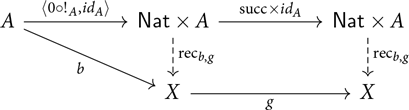
such that the following diagram commutes.
$\textrm{rec}_{b,g}:\textsf{Nat} \times A\to X$
such that the following diagram commutes.
Definition 11.
An arithmetic (CC-)strong tripos is a (CC-)strong tripos $P : \mathscr{C}^{{\kern2.1pt}\textrm{op}}\to \mathbf{Heyt}$
such that:
$P : \mathscr{C}^{{\kern2.1pt}\textrm{op}}\to \mathbf{Heyt}$
such that:
-
(1)
$\mathscr{C}$
has a parameterized natural numbers object
$(\textsf{Nat},{\textrm{0}},{\textrm{succ}})$
satisfying
$P$
-induction; namely, for every
$A$
in
$\mathscr{C}$
and
$\varphi$
in
$P(A\times \textsf{Nat})$
the following holds in
$P(A)$
.
\begin{equation*} P_{\langle id_A,0 \rangle }(\varphi ) \wedge \forall _{\pi _A}(\varphi \Rightarrow P_{id_A \times \textrm{succ}}(\varphi )) \leq \forall _{\pi _A} \varphi \end{equation*}
-
(2)
$P$
is extensional (Maietti et al. Reference Maietti, Pasquali and Rosolini2023, Def. 2.6); namely, for every pair of parallel arrows
$f,g:X\to A$
in
$\mathscr{C}$
, it holds that
$f$
is equal to
$g$
as arrows of
$\mathscr{C}$
if and only if
$\top =P_{\langle f,g \rangle }(\delta _A)$
in the fiber
$P(X)$
.


Remark 12. Proposition 9 lifts to the case arithmetic quasi-toposes, namely quasi-toposes with an NNO.
We conclude this section by collecting both first-order doctrines and arithmetic strong triposes into a corresponding 2-category.
Definition 13.
Let $\mathbf{FoD}$
denote the 2-category having first-order doctrines as objects and the following 1-arrows and 2-arrows:
$\mathbf{FoD}$
denote the 2-category having first-order doctrines as objects and the following 1-arrows and 2-arrows:
-
• a 1-arrow from any first-order doctrine
$P:\mathscr{C}^{{\kern2.1pt}\textrm{op}}\to \mathbf{Heyt}$
to any other
$R:\mathscr{D}^{{\kern1pt}\textrm{op}}\to \mathbf{Heyt}$
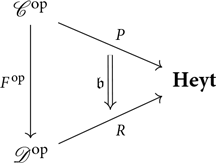
is given by a pair
$(F,\mathfrak{b})$
where
-
−
${F}\colon \mathscr{C}\to \mathscr{D}$
is a functor preserving finite products;
-
−
${\mathfrak{b}}\colon P\Rightarrow {R\circ F^{\textrm{op}}}$
is a natural transformation preserving right and left adjoints such that for every object
$A$
of
$\mathscr{C}$
\begin{equation*} \mathfrak{b}_{A\times A}(\delta _A)=R_{\langle F\pi _1,F\pi _2 \rangle }(\delta _{FA})\end{equation*}
-
-
• a 2-arrow from a 1-arrow
$(F,\mathfrak{b}):P \to R$
to any other
$(G,\mathfrak{c}) : P \to R$
is a natural transformation
$\theta \colon {F}\Rightarrow {G}$
such that for every
$A$
in
$\mathscr{C}$
and every
$\alpha$
in
$P(A)$
, we have
\begin{equation*}\mathfrak{b}_A(\alpha )\leq R_{\theta _A}(\mathfrak{c}_A(\alpha )).\end{equation*}










Definition 14.
Let $\mathbf{asTr}$
denote the locally full 2-subcategory of
$\mathbf{asTr}$
denote the locally full 2-subcategory of $\mathbf{FoD}$
whose objects are arithmetic strong triposes. The 1-arrows are those pairs
$\mathbf{FoD}$
whose objects are arithmetic strong triposes. The 1-arrows are those pairs $(F, \mathfrak{b})$
in
$(F, \mathfrak{b})$
in $\mathbf{FoD}$
such that
$\mathbf{FoD}$
such that $F$
preserves power objects and the NNO, and such that for each object
$F$
preserves power objects and the NNO, and such that for each object $A$
of
$A$
of $\mathscr{C}$
 \begin{equation*} \mathfrak{b}_{A\times \mathscr{P} (A)}(\in _A)=R_{\langle F\pi _1,F\pi _2 \rangle }(\in _{FA}). \end{equation*}
2.1 Logical notation and the initial arithmetic strong tripos
In this section, we first introduce some logical notation to reason within a first-order doctrine as a syntactic calculus as done in (Maietti et al. Reference Maietti, Pasquali and Rosolini2019, Section 3). Then, we present a finitely axiomatized calculus suitable to define the free arithmetic strong tripos. We won’t introduce an analogous calculus for arithmetic CC-strong triposes since, for our purposes, the logical notation introduced for them will suffice for our purposes.
Let $P:\mathscr{C}^{{\kern2.1pt}\textrm{op}}\to \mathbf{Heyt}$
be a first-order doctrine. We denote any element
$P:\mathscr{C}^{{\kern2.1pt}\textrm{op}}\to \mathbf{Heyt}$
be a first-order doctrine. We denote any element $\alpha$
in the fiber
$\alpha$
in the fiber $P(A_1\times \ldots \times A_k)$
through the formal expression
$P(A_1\times \ldots \times A_k)$
through the formal expression
 \begin{equation*} x_1:A_1,\ldots ,x_k:A_k\mid \alpha (x_1,\ldots , x_k) \end{equation*}
to emphasize its dependencies. In particular, an element of $P(1)$
will be called a sentence. Analogously, we write
$P(1)$
will be called a sentence. Analogously, we write
 \begin{equation*} x_1:A_1,\ldots ,x_k:A_k\mid \alpha _1(x_1,\ldots , x_k),\ldots , \alpha _n(x_1,\ldots , x_k)\vdash \beta (x_1,\ldots , x_k) \end{equation*}
to mean that $ \alpha _1\wedge \ldots \wedge \alpha _n\leq \beta$
holds in the fiber
$ \alpha _1\wedge \ldots \wedge \alpha _n\leq \beta$
holds in the fiber $P(A_1\times \ldots \times A_k)$
, and we call sequent such an expression. We say that an element
$P(A_1\times \ldots \times A_k)$
, and we call sequent such an expression. We say that an element $\alpha$
in
$\alpha$
in $P(A)$
is true if
$P(A)$
is true if $\top _A \leq \alpha$
, and we will write
$\top _A \leq \alpha$
, and we will write $P \models \alpha (x)$
to denote that a sentence
$P \models \alpha (x)$
to denote that a sentence $\alpha$
is true.
$\alpha$
is true.
If $\alpha$
is an element in the fiber
$\alpha$
is an element in the fiber $P(A_1 \times \cdots \times A_k)$
and
$P(A_1 \times \cdots \times A_k)$
and
 \begin{equation*} f_i : B_1 \times \cdots \times B_h \to A_i \qquad i = 1,\ldots ,k \end{equation*}
are arrows of $\mathscr{C}$
, then the element
$\mathscr{C}$
, then the element $P_{\langle f_1,\ldots ,f_k \rangle }(\alpha )$
will be written as
$P_{\langle f_1,\ldots ,f_k \rangle }(\alpha )$
will be written as
 \begin{equation*} y_1 : B_1,\ldots ,y_h : B_h \,|\, \alpha (f(y_1,\ldots ,y_h),\ldots , f_k(y_1,\ldots ,y_h)) \end{equation*}
Moreover, in this situation, the composition of functions $(g \circ f)(y_1,\ldots ,y_h)$
will be written as
$(g \circ f)(y_1,\ldots ,y_h)$
will be written as $g(f(y_1,\ldots ,y_h))$
, and we will simply write
$g(f(y_1,\ldots ,y_h))$
, and we will simply write $y_i$
in place of the
$y_i$
in place of the $i$
-th projection.
$i$
-th projection.
The element $\delta _A$
in the fiber
$\delta _A$
in the fiber $P(A\times A)$
will be written as
$P(A\times A)$
will be written as $x:A,y:A\mid x =_A y$
.
$x:A,y:A\mid x =_A y$
.
Given $x : A , y : B \mid \phi (x,y)$
, we write
$x : A , y : B \mid \phi (x,y)$
, we write $x : A \mid \exists _{y:B}\phi (x,y)$
and
$x : A \mid \exists _{y:B}\phi (x,y)$
and $x : A \mid \forall _{y:B}\phi (x,y)$
to denote the elements
$x : A \mid \forall _{y:B}\phi (x,y)$
to denote the elements $\exists _{\pi _1}\phi$
and
$\exists _{\pi _1}\phi$
and $\forall _{\pi _1}\phi$
of
$\forall _{\pi _1}\phi$
of $P(A)$
, respectively. As an additional shorthand for quantifier, suppose we have elements
$P(A)$
, respectively. As an additional shorthand for quantifier, suppose we have elements $x : A , y : B \mid \phi (x,y)$
and
$x : A , y : B \mid \phi (x,y)$
and $y : B \mid \beta (y)$
; then we set
$y : B \mid \beta (y)$
; then we set
 \begin{align*} \begin{array}{l} x : A \mid \exists !_{y:B}\phi (x,y) :\equiv \exists _{y:B}\phi (x,y) \wedge \forall _{y:B}\forall _{y':B}(\phi (x,y) \wedge \phi (x,y') \Rightarrow y =_B y')\\ x : A \mid \forall _{y:\beta }\phi (x,y) :\equiv \forall _{y:B} (\beta (y) \Rightarrow \phi (x,y)) \\ x : A \mid \exists _{y:\beta }\phi (x,y) :\equiv \exists _{y:B} (\beta (y) \wedge \phi (x,y)) \end{array} \end{align*}
and, similarly, we sometimes write $x : A , y : \beta \mid \phi (x,y)$
for
$x : A , y : \beta \mid \phi (x,y)$
for $x : A , y : B \mid \beta (y) \Rightarrow \phi (x,y)$
.
$x : A , y : B \mid \beta (y) \Rightarrow \phi (x,y)$
.
Finally, if $P$
is a strong tripos, the element
$P$
is a strong tripos, the element $P_{\langle \pi _2, \pi _1 \rangle }(\in _A)$
in the fiber
$P_{\langle \pi _2, \pi _1 \rangle }(\in _A)$
in the fiber $P(A \times \mathscr{P}(A))$
will be written as
$P(A \times \mathscr{P}(A))$
will be written as $a:A,U:\mathscr{P}(A) \mid a \in _A U$
. Moreover, given two elements
$a:A,U:\mathscr{P}(A) \mid a \in _A U$
. Moreover, given two elements $V : \mathscr{P}(A) , y : B \mid \phi (V,y)$
and
$V : \mathscr{P}(A) , y : B \mid \phi (V,y)$
and $x : A \mid \beta (x)$
, we write
$x : A \mid \beta (x)$
, we write
 \begin{equation*} y : B \mid \phi (\{ x : A \mid \beta (x) \},y) \end{equation*}
as a shorthand for $ y : B \mid \forall _{V : \mathscr{P}(A)}(\;\forall _{x : A}(x \in _A V \Leftrightarrow \beta (x))\; \Rightarrow \;\phi (V,y)\;)$
.
$ y : B \mid \forall _{V : \mathscr{P}(A)}(\;\forall _{x : A}(x \in _A V \Leftrightarrow \beta (x))\; \Rightarrow \;\phi (V,y)\;)$
.
We now define the internal language of arithmetic strong triposes as a slight extension of the pure intuitionistic type theory calculus $\mathscr{L}_0$
introduced in Lambek and Scott (Reference Lambek and Scott1986, Section 1, Part II). Recall that
$\mathscr{L}_0$
introduced in Lambek and Scott (Reference Lambek and Scott1986, Section 1, Part II). Recall that $\mathscr{L}_0$
is a simply typed, higher-order logic whose basic types include the unit type
$\mathscr{L}_0$
is a simply typed, higher-order logic whose basic types include the unit type $1$
, the type of natural numbers
$1$
, the type of natural numbers $\textsf{Nat}$
, and the sentences classifier
$\textsf{Nat}$
, and the sentences classifier $\mathscr{P}(1)$
(called
$\mathscr{P}(1)$
(called $\Omega$
in Lambek and Scott (Reference Lambek and Scott1986, Section 1, Part II)); and whose type formers are the product type
$\Omega$
in Lambek and Scott (Reference Lambek and Scott1986, Section 1, Part II)); and whose type formers are the product type $A \times B$
and the powerset
$A \times B$
and the powerset $\mathscr{P}(A)$
. The propositions and the sequents of
$\mathscr{P}(A)$
. The propositions and the sequents of $\mathscr{L}_0$
are written as in the logical notation above.
$\mathscr{L}_0$
are written as in the logical notation above.
Definition 15.
Let us call Higher-order Arithmetic Type Theory, for short $\mathbf{HaTT}$
, the extension of
$\mathbf{HaTT}$
, the extension of $\mathscr{L}_0$
obtained by introducing eliminator terms for the natural numbers type and the product type:
$\mathscr{L}_0$
obtained by introducing eliminator terms for the natural numbers type and the product type:
-
(1) for any types
$B$
and
$X$
, and any terms
$ b(x) : B$
and
$g(x,y) : B$
with
$x:X$
and
$y: B$
, we introduce a new term
where
\begin{equation*} \textsf{rec}_{b,g}(x,n) : B \end{equation*}
$y:X$
and
$n: N$
, together with the following axioms
\begin{equation*} x: X \mid \top \vdash \textsf{rec}_{b,g}(x,0) =_B b(x) \qquad x: X, n : \textsf{Nat} \mid \top \vdash \textsf{rec}_{b,g}(x,\textsf{succ}(n)) =_B g(x,\textsf{rec}_{b,g}(x,n)) \end{equation*}
-
(2) for any product type
$A \times B$
, we introduce new terms
with
\begin{equation*} \pi _1(z) : A \qquad \pi _2(z) : B \end{equation*}
$z : A \times B$
, together with the following axioms
\begin{equation*} x : A , y : B \mid \top \vdash \pi _1(\langle x ,y \rangle ) =_A x \qquad x : A , y : B \mid \top \vdash \pi _2(\langle x ,y \rangle ) =_B y \end{equation*}


The theory $\mathbf{HaTT}$
induces the syntactic arithmetic strong tripos.
$\mathbf{HaTT}$
induces the syntactic arithmetic strong tripos.
 \begin{equation*} \textsf{Prop}_{\mathbf{HaTT}} : \textsf{Ty}_{\mathbf{HaTT}}^{\textrm{op}}\to \mathbf{Heyt} \end{equation*}
The base category $\textsf{Ty}_{\mathbf{HaTT}}$
has the types of
$\textsf{Ty}_{\mathbf{HaTT}}$
has the types of $\mathbf{HaTT}$
as objects; an arrow between two types
$\mathbf{HaTT}$
as objects; an arrow between two types $A$
and
$A$
and $B$
is a term
$B$
is a term $t(x) : B$
with
$t(x) : B$
with $x : A$
up to propositional equality, i.e., two terms
$x : A$
up to propositional equality, i.e., two terms $t(x)$
and
$t(x)$
and $s(x)$
are considered equal if
$s(x)$
are considered equal if $x : A \mid \top \vdash t(x) =_B s(x)$
. The functor
$x : A \mid \top \vdash t(x) =_B s(x)$
. The functor $\textsf{Prop}_{\mathbf{HaTT}}$
maps a type
$\textsf{Prop}_{\mathbf{HaTT}}$
maps a type $A$
into the Heyting algebra
$A$
into the Heyting algebra $\textsf{Prop}_{\mathbf{HaTT}}(A)$
of terms of type
$\textsf{Prop}_{\mathbf{HaTT}}(A)$
of terms of type $\mathscr{P}(1)$
with one free variable in
$\mathscr{P}(1)$
with one free variable in $A$
ordered by
$A$
ordered by $\vdash$
.
$\vdash$
.
Proposition 16.
The syntactic arithmetic strong tripos is a bicategorical initial object in the 2-category of arithmetic strong triposes; namely, for any other arithmetic strong tripos $P\,:\,\mathscr{C}^{{\kern2.1pt}\textrm{op}}\to \, \mathbf{Heyt}$
, the category
$P\,:\,\mathscr{C}^{{\kern2.1pt}\textrm{op}}\to \, \mathbf{Heyt}$
, the category $\mathbf{asTr}(\textsf{Prop}_{\mathbf{HaTT}},P)$
is equivalent to the terminal one.
$\mathbf{asTr}(\textsf{Prop}_{\mathbf{HaTT}},P)$
is equivalent to the terminal one.
Proof. Given any arithmetic strong tripos $P : \mathscr{C}^{{\kern2.1pt}\textrm{op}}\to \mathbf{Heyt}$
, there exists an arrow in
$P : \mathscr{C}^{{\kern2.1pt}\textrm{op}}\to \mathbf{Heyt}$
, there exists an arrow in $\mathbf{asTr}$
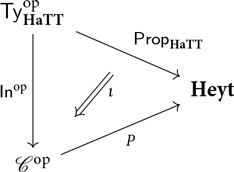
which is defined by employing the following interpretation function of $\mathbf{HaTT}$
into
$\mathbf{HaTT}$
into $P$
. Firstly, for any type
$P$
. Firstly, for any type $A$
of
$A$
of $\mathbf{HaTT}$
, we define an object
$\mathbf{HaTT}$
, we define an object $[\![A]\!]$
of
$[\![A]\!]$
of $\mathscr{C}$
recursively on the type structure in the obvious way. Then, by recursion on the term structure, we simultaneously define:
$\mathscr{C}$
recursively on the type structure in the obvious way. Then, by recursion on the term structure, we simultaneously define:
-
• for any term
$x_1 : A_1 , \ldots , x_n : A_n \mid t(x_1,\ldots ,x_n) : B$
an arrow
\begin{equation*} [\![ t ]\!] : [\![ A_1 ]\!] \times \cdots \times [\![ A_n ]\!] \to [\![ B ]\!] \; \text{of $\mathscr{C}$} \end{equation*}
-
• for any proposition
$x_1 : A_1 , \ldots , x_n : A_n \mid \varphi (x_1,\ldots ,x_n)$
an element
\begin{equation*} [\![ \varphi ]\!]_{\mathscr{P}(1)} \text{ in the fiber } P([\![ A_1 ]\!] \times \cdots \times [\![ A_n ]\!]). \end{equation*}




In particular, the interpretation of a variable $[\![ x_i ]\!]$
is defined as the
$[\![ x_i ]\!]$
is defined as the $i$
-th projection out of the product. Substitution is interpreted using the action of
$i$
-th projection out of the product. Substitution is interpreted using the action of $P$
on arrows; for example, given two terms
$P$
on arrows; for example, given two terms $a(x) : A$
and
$a(x) : A$
and $u(x) : \mathscr{P}(A)$
with
$u(x) : \mathscr{P}(A)$
with $x : X$
, the interpretation of the proposition
$x : X$
, the interpretation of the proposition $x : X \mid a(x) \,\varepsilon \, u(x)$
is defined as
$x : X \mid a(x) \,\varepsilon \, u(x)$
is defined as $ P_{\langle [\![ a ]\!] , [\![ u ]\!] \rangle }(\in _{[\![ A ]\!]})$
.
$ P_{\langle [\![ a ]\!] , [\![ u ]\!] \rangle }(\in _{[\![ A ]\!]})$
.
By induction, it is possible to check that the interpretation function is sound, namely that, for any two propositions $\varphi$
and
$\varphi$
and $\psi$
, one has that
$\psi$
, one has that $\varphi \vdash \psi$
implies
$\varphi \vdash \psi$
implies $[\![ \varphi ]\!]_{\mathscr{P}(1)} \leq [\![ \psi ]\!]_{\mathscr{P}(1)}$
. Therefore,
$[\![ \varphi ]\!]_{\mathscr{P}(1)} \leq [\![ \psi ]\!]_{\mathscr{P}(1)}$
. Therefore, $[\![ - ]\!]_{\mathscr{P}(1)}$
is a Heyting-algebra morphism and, together with the interpretation
$[\![ - ]\!]_{\mathscr{P}(1)}$
is a Heyting-algebra morphism and, together with the interpretation $[\![ - ]\!]$
on types and terms, they determine a morphism of
$[\![ - ]\!]$
on types and terms, they determine a morphism of $\mathbf{asTr}$
as follows:
$\mathbf{asTr}$
as follows:
 \begin{align*} \textsf{In}(A) & :\equiv [\![ A ]\!] \\ \textsf{In}(t : A \to B) & :\equiv [\![ t ]\!] \\ \iota _A(\varphi ) & :\equiv [\![ \varphi ]\!]_{\mathscr{P}(1)} \end{align*}
Given any two other 1-arrows $(F,\gamma )$
and
$(F,\gamma )$
and $(G,\delta )$
from
$(G,\delta )$
from $\textsf{Prop}_{\mathbf{HaTT}}$
to
$\textsf{Prop}_{\mathbf{HaTT}}$
to $P$
, we can show by induction that there is a unique 2-arrow
$P$
, we can show by induction that there is a unique 2-arrow $\eta$
between them and that such
$\eta$
between them and that such $\eta$
is an isomorphism.
$\eta$
is an isomorphism.
A simple observation relating the previous initiality result with the logical notation of an arithmetic strong tripos $P$
is the following. Given a proposition
$P$
is the following. Given a proposition $\varphi$
of
$\varphi$
of $\mathbf{HaTT}$
, its interpretation
$\mathbf{HaTT}$
, its interpretation $[\![ \varphi ]\!]_{\mathscr{P}(1)}$
in
$[\![ \varphi ]\!]_{\mathscr{P}(1)}$
in $P$
coincides with
$P$
coincides with $\varphi$
read as a proposition in the logical notation of
$\varphi$
read as a proposition in the logical notation of $P$
.
$P$
.
Definition 17.
Let $\lambda {\mathbf{HaTT}}$
be the extension of
$\lambda {\mathbf{HaTT}}$
be the extension of $\mathbf{HaTT}$
with function types, denoted with the symbol
$\mathbf{HaTT}$
with function types, denoted with the symbol $\to$
, and governed by the same rules for function types in Girard et al. (Reference Girard, Taylor and Lafont1989, Section 3.1), including the related equations on p. 16 formulated through the equality predicate.
$\to$
, and governed by the same rules for function types in Girard et al. (Reference Girard, Taylor and Lafont1989, Section 3.1), including the related equations on p. 16 formulated through the equality predicate.
The language of $\lambda {\mathbf{HaTT}}$
enjoys an initiality result analogous to that for
$\lambda {\mathbf{HaTT}}$
enjoys an initiality result analogous to that for $\mathbf{HaTT}$
but with respect to arithmetic CC-strong triposes. Since we will not use this result in this paper, we do not state it. In the following, we will employ the language
$\mathbf{HaTT}$
but with respect to arithmetic CC-strong triposes. Since we will not use this result in this paper, we do not state it. In the following, we will employ the language $\lambda {\mathbf{HaTT}}$
to state an effective principle compatible with Brouwer’s continuity principles, which will be validated in the quasi-toposes we are going to build.
$\lambda {\mathbf{HaTT}}$
to state an effective principle compatible with Brouwer’s continuity principles, which will be validated in the quasi-toposes we are going to build.
2.2 The elementary quotient completion
In this section, we recall the definition of equivalence relation relative to a doctrine and the related notion of elementary quotient completion of an elementary doctrine introduced by Maietti and Rosolini (Reference Maietti and Rosolini2013). For simplicity, here we restrict the exposition to the case of first-order doctrines. In the following, fix a first-order doctrine $P:\mathscr{C}^{{\kern2.1pt}\textrm{op}}\to \mathbf{Heyt}$
.
$P:\mathscr{C}^{{\kern2.1pt}\textrm{op}}\to \mathbf{Heyt}$
.
Definition 18.
A $P$
-equivalence relation over an object
$P$
-equivalence relation over an object $A$
of
$A$
of $\mathscr{C}$
is an element
$\mathscr{C}$
is an element $\rho$
of
$\rho$
of $P(A\times A)$
such that:
$P(A\times A)$
such that:
-
(1)
$x : A , y : A \mid x =_A y \vdash \rho (x,y)$
-
(2)
$x : A , y : A \mid \rho (x,y) \vdash \rho (y,x)$
-
(3)
$x : A , y : A , z : A \mid \rho (x,y) , \rho (y,z) \vdash \rho (x,z)$



When no confusion arises, we shall refer at $P$
-equivalence relations simply as equivalence relations, without specifying the doctrine
$P$
-equivalence relations simply as equivalence relations, without specifying the doctrine $P$
.
$P$
.
Note that, in any first-order doctrine, for any object $A$
in the base, the elements
$A$
in the base, the elements $\delta _A$
are equivalence relations.
$\delta _A$
are equivalence relations.
Definition 19.
The quotient of a $P$
-equivalence relation
$P$
-equivalence relation $\rho$
on an object
$\rho$
on an object $A$
is an arrow
$A$
is an arrow $q:A \to C$
in
$q:A \to C$
in $\mathscr{C}$
such that
$\mathscr{C}$
such that $x : A , y : A \mid \rho (x,y) \vdash q(x) =_C q(y)$
, and for every arrow
$x : A , y : A \mid \rho (x,y) \vdash q(x) =_C q(y)$
, and for every arrow $g : A \to Z$
with
$g : A \to Z$
with $x : A , y : A \mid \rho (x,y) \vdash g(x) =_Z g(y)$
, there is a unique arrow
$x : A , y : A \mid \rho (x,y) \vdash g(x) =_Z g(y)$
, there is a unique arrow $h: C \to Z$
such that
$h: C \to Z$
such that $g = h \circ q$
.
$g = h \circ q$
.
A quotient as above is called stable when, for every arrow $f: C' \to C$
in
$f: C' \to C$
in $\mathscr{C}$
, there is a pullback
$\mathscr{C}$
, there is a pullback
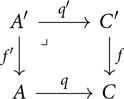
in $\mathscr{C}$
and the arrow
$\mathscr{C}$
and the arrow $q' : A' \to C'$
is a P-quotient.
$q' : A' \to C'$
is a P-quotient.
Let $f : A \to B$
be an arrow in
$f : A \to B$
be an arrow in $\mathscr{C}$
, its
$\mathscr{C}$
, its $P$
-kernel
$P$
-kernel $\textrm{ker}(f)$
is the
$\textrm{ker}(f)$
is the $P$
-equivalence relation
$P$
-equivalence relation $x : A , y : A \mid f(x) =_B f(y)$
. A quotient
$x : A , y : A \mid f(x) =_B f(y)$
. A quotient $q : A \to C$
as above is called effective if its
$q : A \to C$
as above is called effective if its $P$
-kernel is
$P$
-kernel is $\rho$
.
$\rho$
.
Definition 20.
Given a first-order doctrine $P:\mathscr{C}^{{\kern2.1pt}\textrm{op}}\to \mathbf{Heyt}$
and a
$P:\mathscr{C}^{{\kern2.1pt}\textrm{op}}\to \mathbf{Heyt}$
and a $P$
-equivalence relation
$P$
-equivalence relation $\rho$
over
$\rho$
over $A$
in
$A$
in $\mathscr{C}$
, the Heyting algebra of descent data
$\mathscr{C}$
, the Heyting algebra of descent data $\mathscr{D}es(\rho )$
is the sub-Heyting algebra of
$\mathscr{D}es(\rho )$
is the sub-Heyting algebra of $P(A)$
consisting of those
$P(A)$
consisting of those $\alpha$
such that
$\alpha$
such that
 \begin{equation*} x : A , y : A \mid \alpha (x), \rho (x,y) \vdash \alpha (y) \end{equation*}
For $f:A\to B$
in
$f:A\to B$
in $\mathscr{C}$
, the map
$\mathscr{C}$
, the map ${P_{f}} : P(B)\to P(A)$
takes values in
${P_{f}} : P(B)\to P(A)$
takes values in $\mathscr{D}es(\textrm{ker}(f))$
. We shall say that
$\mathscr{D}es(\textrm{ker}(f))$
. We shall say that $f$
is of effective descent if
$f$
is of effective descent if $P_f:P(B)\to \mathscr{D}es(\textrm{ker}(f))$
is an isomorphism.
$P_f:P(B)\to \mathscr{D}es(\textrm{ker}(f))$
is an isomorphism.
In particular, this means that the functor $P_f$
is of effective descent type as defined in Barr and Wells (Reference Barr and Wells1984).
$P_f$
is of effective descent type as defined in Barr and Wells (Reference Barr and Wells1984).
Definition 21 (elementary quotient completion). Given a first-order doctrine $P:\mathscr{C}^{{\kern2.1pt}\textrm{op}}\to \mathbf{Heyt}$
, we call
$P:\mathscr{C}^{{\kern2.1pt}\textrm{op}}\to \mathbf{Heyt}$
, we call $\mathscr{Q}_P$
the category whose objects are pairs
$\mathscr{Q}_P$
the category whose objects are pairs $(A,\rho )$
with
$(A,\rho )$
with $A$
in
$A$
in $\mathscr{C}$
and
$\mathscr{C}$
and $\rho$
a
$\rho$
a $P$
-equivalence relation over
$P$
-equivalence relation over $A$
. An arrow
$A$
. An arrow $[f]: (A,\rho )\to (B,\sigma )$
is an equivalence class of arrows
$[f]: (A,\rho )\to (B,\sigma )$
is an equivalence class of arrows $f:A\to B$
in
$f:A\to B$
in $\mathscr{C}$
such that
$\mathscr{C}$
such that $x : A , y : A \mid \rho (x,y) \vdash \sigma (f(x),f(y))$
; two arrows
$x : A , y : A \mid \rho (x,y) \vdash \sigma (f(x),f(y))$
; two arrows $f, g : A \to B$
are in the same equivalence class if and only if
$f, g : A \to B$
are in the same equivalence class if and only if $x : A \mid \top \vdash \sigma (f(x),g(x))$
holds.
$x : A \mid \top \vdash \sigma (f(x),g(x))$
holds.
The elementary quotient completion of $P$
is defined as the functor
$P$
is defined as the functor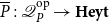 $\overline {P}:\mathscr{Q}_P^{\textrm{op}}\to \mathbf{Heyt}$
, where
$\overline {P}:\mathscr{Q}_P^{\textrm{op}}\to \mathbf{Heyt}$
, where
 \begin{equation*} \overline {P}(A,\rho ) := \mathscr{D}es(\rho )\qquad \overline {P}_{[f]}:={P_{f}} \end{equation*}
Maietti and Rosolini (Reference Maietti and Rosolini2013) proved that the assignment on arrows of $\overline {P}$
in the definition above does not depend on the choice of representatives and that
$\overline {P}$
in the definition above does not depend on the choice of representatives and that $\overline {P}$
is a first-order doctrine. Moreover, it is immediate to see that
$\overline {P}$
is a first-order doctrine. Moreover, it is immediate to see that $\overline {P}$
has stable, effective quotients: the quotient of an equivalence relation
$\overline {P}$
has stable, effective quotients: the quotient of an equivalence relation $\sigma$
over an object
$\sigma$
over an object $(A,\rho )$
is given by the arrow
$(A,\rho )$
is given by the arrow $[id_A]:(A,\rho )\to (A,\sigma )$
.
$[id_A]:(A,\rho )\to (A,\sigma )$
.
2.3 The regular and exact completions of arithmetic strong triposes
The regular and exact completions of a Lex category presented in Carboni (Reference Carboni1995) and Carboni and Vitale (Reference Carboni and Vitale1998) were recognized to be instances of more general free constructions, namely, the regular and exact completions of an existential elementary doctrine in Maietti and Rosolini (Reference Maietti and Rosolini2015) and Maietti et al. (Reference Maietti, Pasquali and Rosolini2017). Here, we observe that the regular completion $\textrm{Reg}(P)$
applied to a strong tripos
$\textrm{Reg}(P)$
applied to a strong tripos $P$
produces a topos, and this has an NNO when
$P$
produces a topos, and this has an NNO when $P$
is an arithmetic strong tripos. Furthermore,
$P$
is an arithmetic strong tripos. Furthermore, $\textrm{Reg}(P)$
coincides also with the tripos-to-topos construction by Hyland et al. (Reference Hyland, Johnstone and Pitts1980) and Pitts (Reference Pitts2002).
$\textrm{Reg}(P)$
coincides also with the tripos-to-topos construction by Hyland et al. (Reference Hyland, Johnstone and Pitts1980) and Pitts (Reference Pitts2002).
In the following, it is enough to recall the notions of regular and exact completions for first-order doctrines by using the logical notation of the involved doctrines after reminding the definition of the 2-category of Heyting categories.
Definition 22. (Johnstone (Reference Johnstone2002)). Let $\mathbf{HeytCat}$
denote the following 2-category:
$\mathbf{HeytCat}$
denote the following 2-category:
-
• its objects are Heyting categories, namely regular categories
$\mathscr{C}$
such that their subobject functor
$Sub_{\mathscr{C}} : \mathscr{C}^{{\kern2.1pt}\textrm{op}} \to \mathbf{Pos}$
is a first-order doctrine.
-
• A 1-arrow between two Heyting categories
$\mathscr{C}$
and
$\mathscr{D}$
is a regular functor
$F : \mathscr{C} \to \mathscr{D}$
such that
$(F,\mathfrak{f})$
is a 1-arrow between
$Sub_{\mathscr{C}}$
and
$Sub_{\mathscr{D}}$
in
$\mathbf{FoD}$
, where
$\mathfrak{f}_A([m : M \to A]) := [F(m) : F(M) \to F(A)]$
. -
• a 2-arrow between two 1-arrows
$F,G : \mathscr{C} \to \mathscr{D}$
is just a natural transformation between functors.






Definition 23.
The regular completion of a first-order doctrine $P : \mathscr{C}^{{\kern2.1pt}\textrm{op}}\to \mathbf{Heyt}$
, is the category
$P : \mathscr{C}^{{\kern2.1pt}\textrm{op}}\to \mathbf{Heyt}$
, is the category $\textrm{Reg}(P)$
defined as follows:
$\textrm{Reg}(P)$
defined as follows:
-
• the objects of
$\textrm{Reg}(P)$
are pairs
$(A, \alpha )$
, where
$A$
is an object of
$\mathscr C$
and
$\alpha$
is an element of
$P(A)$
; -
• a morphism of
$\textrm{Reg}(P)$
between two objects
$(A, \alpha )$
and
$(B, \beta )$
is an element
$\phi$
in
$P(A\times B)$
such that
$ x: A\mid \alpha (x) \vdash \exists !_{y : B} (\phi (x,y) \wedge \beta (y))$
holds.



Proposition 24.
For any first-order doctrine $P$
, the category
$P$
, the category $\textrm{Reg}(P)$
is a Heyting category, and the assignment
$\textrm{Reg}(P)$
is a Heyting category, and the assignment $P\mapsto \textrm{Reg}(P)$
extends to a 2-functor
$P\mapsto \textrm{Reg}(P)$
extends to a 2-functor
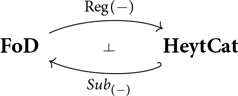
which is left biadjoint to the inclusion of the 2-category $\mathbf{HeytCat}$
of Heyting categories in the 2-category
$\mathbf{HeytCat}$
of Heyting categories in the 2-category $\mathbf{FoD}$
of first-order doctrines acting as
$\mathbf{FoD}$
of first-order doctrines acting as $\mathscr{C}\mapsto Sub_{\mathscr{C}}$
.
$\mathscr{C}\mapsto Sub_{\mathscr{C}}$
.
Proof. By definition, the subobjects functor over a Heyting category is a first-order doctrine. Then, the subobjects doctrine $Sub_{\textrm{Reg}(P)} : \textrm{Reg}(P)^{\textrm{op}}\to \mathbf{Heyt}$
of the regular completion of first-order doctrine
$Sub_{\textrm{Reg}(P)} : \textrm{Reg}(P)^{\textrm{op}}\to \mathbf{Heyt}$
of the regular completion of first-order doctrine $P : \mathscr{C}^{{\kern2.1pt}\textrm{op}}\to \mathbf{Heyt}$
is a first-order doctrine analogously to the proof of Johnstone (Reference Johnstone2002, Lemma 1.4.10, Section D 1.4) since the regular completion of a syntactic first-order doctrine coincides with Johnstone’s notion of syntactic category (Johnstone Reference Johnstone2002, Section D 1.4, p. 841) as observed in Maietti and Trotta (Reference Maietti and Trotta2024, Ex. 4.14).
$P : \mathscr{C}^{{\kern2.1pt}\textrm{op}}\to \mathbf{Heyt}$
is a first-order doctrine analogously to the proof of Johnstone (Reference Johnstone2002, Lemma 1.4.10, Section D 1.4) since the regular completion of a syntactic first-order doctrine coincides with Johnstone’s notion of syntactic category (Johnstone Reference Johnstone2002, Section D 1.4, p. 841) as observed in Maietti and Trotta (Reference Maietti and Trotta2024, Ex. 4.14).
To prove the universal property, first recall that the $\textrm{Reg}(\!-\!)$
construction is left biadjoint to the inclusion of the 2-category elementary and existential doctrines in the 2-category of regular categories (Maietti et al. Reference Maietti, Pasquali and Rosolini2017, Thm. 3.3). Then observe that the action of
$\textrm{Reg}(\!-\!)$
construction is left biadjoint to the inclusion of the 2-category elementary and existential doctrines in the 2-category of regular categories (Maietti et al. Reference Maietti, Pasquali and Rosolini2017, Thm. 3.3). Then observe that the action of $\textrm{Reg}(\!-\!)$
on the morphisms of elementary and existential doctrine sends morphisms of first-order doctrines into morphisms of Heyting categories. Finally, the unit of this adjunction, in the case of first-order doctrines, is a morphism of first-order doctrines, while the counit is an iso.
$\textrm{Reg}(\!-\!)$
on the morphisms of elementary and existential doctrine sends morphisms of first-order doctrines into morphisms of Heyting categories. Finally, the unit of this adjunction, in the case of first-order doctrines, is a morphism of first-order doctrines, while the counit is an iso.
Definition 25. (Exact completion of a first-order doctrine). Given a first-order intuitionistic doctrine $P : \mathscr{C}^{{\kern2.1pt}\textrm{op}}\to \mathbf{Heyt}$
, its exact completion is the category whose objects are pairs
$P : \mathscr{C}^{{\kern2.1pt}\textrm{op}}\to \mathbf{Heyt}$
, its exact completion is the category whose objects are pairs $(A, \rho _A)$
, where
$(A, \rho _A)$
, where $A$
is an object of
$A$
is an object of $\mathscr C$
and
$\mathscr C$
and $\rho _A$
is a symmetric and transitive
$\rho _A$
is a symmetric and transitive $P$
-relation, that is it is an element of
$P$
-relation, that is it is an element of $P(A\times A)$
satisfying the following conditions:
$P(A\times A)$
satisfying the following conditions:
-
(1)
$x : A , y : A \mid \rho (x,y) \vdash \rho (y,x)$
-
(2)
$x : A , y : A , z : A \mid \rho (x,y) , \rho (y,z) \vdash \rho (x,z)$


Morphisms between two objects $(A, \rho _A)$
and
$(A, \rho _A)$
and $(B, \rho _B)$
are elements
$(B, \rho _B)$
are elements $\phi$
of
$\phi$
of $P(A\times B)$
that preserve the
$P(A\times B)$
that preserve the $P$
-equivalence relations
$P$
-equivalence relations $\rho _A$
and
$\rho _A$
and $\rho _B$
, that is they satisfy the following conditions.
$\rho _B$
, that is they satisfy the following conditions.
-
(1) (well-defined)
$x: A, y: B \mid \phi (x,y)\ \vdash \rho _A (x,x)\ \wedge \ \rho _B(y,y)$
-
(2) (totality on reflexive elements)
$x: A\mid \rho _A(x,x) \vdash \exists _{y : B}\, (\ \phi (x,y) \ \wedge \ \rho _B(y,y)\ )$
-
(3) (preservation of
$P$
-relations)
$x_1: A, x_2: A, y_1: B, y_2:B \mid \phi (x_1,y_1)\wedge \rho _A (x_1,x_2) \wedge \rho _B(y_1,y_2) \vdash \phi (x_2, y_2)$
-
(4) (functionality)
$x_1: A, y_1: B, y_2:B \mid \phi (x_1,y_1)\ \wedge \ \phi (x_1, y_2) \vdash \rho _B(y_1,y_2)$





Remark 26. The fact that the exact completion of an elementary existential doctrine in Maietti and Rosolini (Reference Maietti and Rosolini2015, Def.2.2) restricts to a completion of first-order doctrines into exact categories whose subobjects functor is a first-order doctrine was originally proved in Pitts (Reference Pitts2002, Theorem 3.6). Furthermore, $\tau _{P}$
is called a tripos-to-topos construction when
$\tau _{P}$
is called a tripos-to-topos construction when $P$
is a tripos as recalled in the mentioned reference.
$P$
is a tripos as recalled in the mentioned reference.
From Maietti and Rosolini (Reference Maietti and Rosolini2015) and Maietti et al. (Reference Maietti, Pasquali and Rosolini2017), we know that the exact completion of an elementary existential doctrine can be decomposed into the regular completion and the ex/reg-completion $\mathscr{C}_{ex/reg}$
of a regular category
$\mathscr{C}_{ex/reg}$
of a regular category $\mathscr{C}$
to an exact category in the sense of Carboni (Reference Carboni1995). Hence, we get the following lemma:
$\mathscr{C}$
to an exact category in the sense of Carboni (Reference Carboni1995). Hence, we get the following lemma:
Lemma 27.
The exact completion $\textrm{Ex}({P})$
of a strong tripos
$\textrm{Ex}({P})$
of a strong tripos $P$
is equivalent to
$P$
is equivalent to $(\textrm{Reg}(P))_{ex/reg}$
, namely, the ex/reg completion of the regular completion of
$(\textrm{Reg}(P))_{ex/reg}$
, namely, the ex/reg completion of the regular completion of $P$
.
$P$
.
Now, we are ready to observe that the regular completion of a arithmetic strong tripos is indeed a topos with an NNO, which coincides with its tripos-to-topos construction:
Theorem 28.
If $P : \mathscr{C}^{{\kern2.1pt}\textrm{op}}\to \mathbf{Heyt}$
is an arithmetic strong tripos, then
$P : \mathscr{C}^{{\kern2.1pt}\textrm{op}}\to \mathbf{Heyt}$
is an arithmetic strong tripos, then $\textrm{Reg}(P)$
is a topos with an NNO, and the embedding
$\textrm{Reg}(P)$
is a topos with an NNO, and the embedding $P\hookrightarrow Sub_{\textrm{Reg}(P)}$
is a morphism of arithmetic strong triposes. Moreover,
$P\hookrightarrow Sub_{\textrm{Reg}(P)}$
is a morphism of arithmetic strong triposes. Moreover, $\textrm{Reg}(P)$
coincides with the exact completion
$\textrm{Reg}(P)$
coincides with the exact completion $\textrm{Ex}({P})$
of
$\textrm{Ex}({P})$
of $P$
.
$P$
.
Proof. The proof follows from Lambek and Scott (Reference Lambek and Scott1986, Thm. 12.5). Indeed, it is enough to observe that the category denoted by $T(\mathfrak{L})$
associated with a type theory
$T(\mathfrak{L})$
associated with a type theory $\mathfrak{L}$
in Lambek and Scott (Reference Lambek and Scott1986, Sec. 11, p. 186) is precisely the regular completion of the syntactic strong tripos associated with this (higher-order) type theory. This category is proved to be a topos (with a natural numbers object) (Lambek and Scott Reference Lambek and Scott1986, Thm. 12.5). Hence, given an arbitrary arithmetic strong tripos
$\mathfrak{L}$
in Lambek and Scott (Reference Lambek and Scott1986, Sec. 11, p. 186) is precisely the regular completion of the syntactic strong tripos associated with this (higher-order) type theory. This category is proved to be a topos (with a natural numbers object) (Lambek and Scott Reference Lambek and Scott1986, Thm. 12.5). Hence, given an arbitrary arithmetic strong tripos $P$
, we can mimic the mentioned proof by Lambek and Scott to conclude that
$P$
, we can mimic the mentioned proof by Lambek and Scott to conclude that $\textrm{Reg}(P)$
is a topos with an NNO.
$\textrm{Reg}(P)$
is a topos with an NNO.
The fact that the canonical embedding $P\hookrightarrow Sub_{\textrm{Reg}(P)}$
is a morphism of arithmetic strong triposes follows by definition of the power objects in
$P\hookrightarrow Sub_{\textrm{Reg}(P)}$
is a morphism of arithmetic strong triposes follows by definition of the power objects in $\textrm{Reg}(P)$
and by the fact that the regular completion preserves the structure of first-order doctrine.
$\textrm{Reg}(P)$
and by the fact that the regular completion preserves the structure of first-order doctrine.
Finally, the tripos-to-topos construction $\textrm{Ex}({P})$
of
$\textrm{Ex}({P})$
of $P$
coincides with
$P$
coincides with $\textrm{Reg}(P)$
since by lemma 27
$\textrm{Reg}(P)$
since by lemma 27 $\textrm{Ex}({P})$
coincides with
$\textrm{Ex}({P})$
coincides with $(\textrm{Reg}(P))_{ex/reg}$
, which is
$(\textrm{Reg}(P))_{ex/reg}$
, which is $\textrm{Reg}(P)$
, because
$\textrm{Reg}(P)$
, because $\textrm{Reg}(P)$
is an exact category, being a topos, and the exact completion of a regular category in Carboni (Reference Carboni1995) is idempotent.
$\textrm{Reg}(P)$
is an exact category, being a topos, and the exact completion of a regular category in Carboni (Reference Carboni1995) is idempotent.
Corollary 29. The regular completion establishes a biadjunction between arithmetic strong triposes and toposes with an NNO:
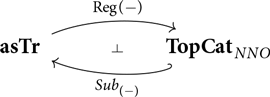
where $\mathbf{TopCat}_{NNO}$
denotes the 2-category of toposes and logical functors (preserving their NNO).
$\mathbf{TopCat}_{NNO}$
denotes the 2-category of toposes and logical functors (preserving their NNO).
Proof. As recalled in Proposition 24, the regular completion provides a biadjunction between the 2-category of first-order doctrines and the 2-category of Heyting categories.
By Theorem 28, we know that it sends an arithmetic strong tripos into a topos with an NNO, and that the unit of the adjunction is a morphism of arithmetic strong triposes. Then, observe that the subobjects functor of a topos with an NNO is an arithmetic strong tripos. Indeed, it is a strong tripos because the base category is a topos, and it is arithmetic by Maietti et al. (Reference Maietti, Pasquali and Rosolini2019, Prop. 3.3) because the base category has, in particular, a parameterized natural number object.
Moreover, the count of the adjunction is, in general, an isomorphism. So, to conclude, it is enough to observe that the regular completion sends morphisms of strong triposes into morphisms of toposes, because, by definition, a morphism of arithmetic strong triposes preserves power objects and the natural numbers object.
Corollary 30.
The regular completion $\textrm{Reg}(\textsf{Prop}_{\mathbf{HaTT}})$
of the initial arithmetic strong tripos
$\textrm{Reg}(\textsf{Prop}_{\mathbf{HaTT}})$
of the initial arithmetic strong tripos $ \textsf{Prop}_{\mathbf{HaTT}}$
is the free topos with an NNO.
$ \textsf{Prop}_{\mathbf{HaTT}}$
is the free topos with an NNO.
Proof. It follows from Proposition 16 together with Corollary 29. Indeed, for any topos $\mathscr{T} \,$
we have
$\mathscr{T} \,$
we have
 \begin{equation*} \mathbf{TopCat}_{NNO}(\textrm{Reg}(\textsf{Prop}_{\mathbf{HaTT}}),\mathscr{T})\simeq \mathbf{asTr}(\textsf{Prop}_{\mathbf{HaTT}},Sub_{\mathscr{T}})\simeq 1. \end{equation*}
Remark 31. Corollary 29 says that the tripos-to-topos construction is a free construction into the category of toposes with an NNO (and logical functors) when applied to arithmetic strong triposes. Observe that localic and realizability triposes are not arithmetically strong tripos. Our main relevant example of arithmetic strong tripos is the doctrine of strong subobjects of the quasi-topos of assemblies within the effective topos in Hyland (Reference Hyland1982).
2.4 Two versions of the Church’s Thesis
Let $P : \mathscr{C}^{{\kern2.1pt}\textrm{op}} \to \mathbf{Heyt}$
be an arithmetic CC-strong tripos, and let
$P : \mathscr{C}^{{\kern2.1pt}\textrm{op}} \to \mathbf{Heyt}$
be an arithmetic CC-strong tripos, and let $A$
and
$A$
and $B$
be two objects of
$B$
be two objects of $\mathscr{C}$
. An important distinction to notice is the one between functions from
$\mathscr{C}$
. An important distinction to notice is the one between functions from $A$
to
$A$
to $B$
as arrows
$B$
as arrows $f : A \to B$
of the base category
$f : A \to B$
of the base category $\mathscr{C}$
, which we will call operations, and functions as functional relations, that is, total and single-valued relations in the internal logic of
$\mathscr{C}$
, which we will call operations, and functions as functional relations, that is, total and single-valued relations in the internal logic of $P$
. We reserve the name function for the notion of functional relation, which can be defined internally as a proposition
$P$
. We reserve the name function for the notion of functional relation, which can be defined internally as a proposition $x : A , y : B \mid \phi (x,y)$
such that the sentence
$x : A , y : B \mid \phi (x,y)$
such that the sentence $ \textsf{Fun}(\phi ) \, :\equiv \,\forall _{x : A}\exists !_{y : B}\, \phi (x,y)$
is true.
$ \textsf{Fun}(\phi ) \, :\equiv \,\forall _{x : A}\exists !_{y : B}\, \phi (x,y)$
is true.
This distinction is genuine. In fact, given an element $x : A ,y : B \mid \phi (x,y)$
, the following sentence, called Axiom of Unique Choice, is not necessarily true.
$x : A ,y : B \mid \phi (x,y)$
, the following sentence, called Axiom of Unique Choice, is not necessarily true.
 \begin{equation} \textsf{Fun}(\phi ) \Rightarrow \exists _{f : A \to B}\forall _{a : A}\,\phi (a,\textrm{ev}(f,a)) \end{equation}
With this distinction in mind, we define two versions of the formal Church Thesis, one for functions, simply called (formal) Church Thesis $\textsf{CT}$
, and one for operations, called the Type-theoretic (formal) Church Thesis
$\textsf{CT}$
, and one for operations, called the Type-theoretic (formal) Church Thesis $\textsf{TCT}$
, as the following sentences
$\textsf{TCT}$
, as the following sentences
 \begin{align} & \forall _{\rho : \mathscr{P}(\textsf{Nat} \times \textsf{Nat})}(\;\forall _{x : \textsf{Nat}}\exists !_{y : \textsf{Nat}}\,(\langle x,y\rangle \in _{\textsf{Nat}\times \textsf{Nat}} \rho ) \; \nonumber\\ & \quad \Rightarrow \; \exists _{e : \textsf{Nat}}\forall _{x : \textsf{Nat}} \exists _{y : \textsf{Nat}}(\textsf{T}(e,x,y) \wedge \langle x, \textsf{U}(y) \rangle \in _{\textsf{Nat} \times \textsf{Nat}} \rho )\;) \end{align}
 \begin{equation} \forall _{f : \textsf{Nat}\rightarrow \textsf{Nat}} \exists _{e : \textsf{Nat} }\forall _{x : \textsf{Nat}}\exists _{y : \textsf{Nat} }(\textsf{T}(e,x,y) \wedge \textsf{U}(y) =_{\textsf{Nat}} \textrm{ev}(f,x)) \end{equation}
where, in both cases, $\textsf{T}(e, x, y)$
is the Kleene predicate expressing that
$\textsf{T}(e, x, y)$
is the Kleene predicate expressing that $y$
is the encoding of the computation history of the computable function encoded by
$y$
is the encoding of the computation history of the computable function encoded by $e$
on input
$e$
on input $x$
, and
$x$
, and $\textsf{U} : \textsf{Nat} \to \textsf{Nat}$
is the arrow encoding the output extraction of a computation.
$\textsf{U} : \textsf{Nat} \to \textsf{Nat}$
is the arrow encoding the output extraction of a computation.
Observe that in the regular completion $Reg(\mathscr{Q})$
in Section 2.3 applied to a quasi-topos
$Reg(\mathscr{Q})$
in Section 2.3 applied to a quasi-topos $\mathscr{Q}$
, the exponential objects of two objects embedded from
$\mathscr{Q}$
, the exponential objects of two objects embedded from $\mathscr{Q}$
are given by the set of functional relations in
$\mathscr{Q}$
are given by the set of functional relations in $\mathscr{Q}$
between these two objects.
$\mathscr{Q}$
between these two objects.
3. Brouwer’s continuity principles
In general, the unique choice axiom $\textsf{AC!}$
does not hold in quasi-toposes, as it happens in foundations such as the Minimalist Foundation of Maietti and Sambin (Reference Maietti and Sambin2005); Maietti (Reference Maietti2009). The non-validity of
$\textsf{AC!}$
does not hold in quasi-toposes, as it happens in foundations such as the Minimalist Foundation of Maietti and Sambin (Reference Maietti and Sambin2005); Maietti (Reference Maietti2009). The non-validity of $\textsf{AC!}$
in such contexts allows to employ the two concepts of number-theoretic functional relation and operation to identify Brouwer’s notion of choice sequence with that of functional relation, as done in the context of axiomatic set theory in Rathjen (Reference Rathjen2005), and that of lawlike sequence with that of operation (see Section 2.4). We refer to Troelstra and van Dalen (Reference Troelstra and van Dalen1988) for all the explanations about Brouwer’s use of these notions.
$\textsf{AC!}$
in such contexts allows to employ the two concepts of number-theoretic functional relation and operation to identify Brouwer’s notion of choice sequence with that of functional relation, as done in the context of axiomatic set theory in Rathjen (Reference Rathjen2005), and that of lawlike sequence with that of operation (see Section 2.4). We refer to Troelstra and van Dalen (Reference Troelstra and van Dalen1988) for all the explanations about Brouwer’s use of these notions.
Here, we employ the notion of choice sequence to state Brouwer’s principles in the language of doctrines in terms of the spatiality of suitable locales following Fourman and Grayson (Reference Fourman and Grayson1982). Such locales will be defined inductively, employing notions from the predicative and constructive approach to locale theory known as formal topology, following Maietti and Sambin (Reference Maietti and Sambin2013).
Intuitively, in formal topology, one starts with a set $A$
of formal basic opens and a cover relation
$A$
of formal basic opens and a cover relation $a \vartriangleleft V$
between elements
$a \vartriangleleft V$
between elements $a \in A$
and subsets
$a \in A$
and subsets $V \in \mathscr{P}(A)$
, meaning that the basic open
$V \in \mathscr{P}(A)$
, meaning that the basic open $a$
is covered by the family of basic opens
$a$
is covered by the family of basic opens $V$
. Such a cover induces a closure operator
$V$
. Such a cover induces a closure operator
 \begin{align*} \vartriangleleft (\!-\!) &: \mathscr{P}(A) \to \mathscr{P}(A) \\ \vartriangleleft (V) &:\equiv \{ x \in A \mid x \vartriangleleft V \} \end{align*}
which always forms a complete suplattice with respect to the inclusion order. When the cover satisfies a convergence property (Coquand et al. Reference Coquand, Sambin, Smith and Valentini2003; Maietti and Valentini Reference Maietti and Valentini2004; Ciraulo et al. Reference Ciraulo, Maietti and Sambin2013), the fixed points of $\vartriangleleft (\!-\!)$
define a locale.
$\vartriangleleft (\!-\!)$
define a locale.
In Coquand et al. (Reference Coquand, Sambin, Smith and Valentini2003), the authors introduced a powerful method to generate constructive and predictive examples of formal topologies by defining covers inductively generated from a given set of axioms. Relevant examples of inductively-generated formal topologies include Cantor and Baire formal topologies since Brouwer’s principle of Fan theorem and monotone bar induction can be equivalently formalized as the spatiality of Cantor formal topology and that of Baire formal topology, respectively, as originally stated by Fourman and Grayson (Reference Fourman and Grayson1982).
In the following, fix an arithmetic strong tripos $P : \mathscr{C}^{{\kern2.1pt}\textrm{op}} \to \mathbf{Heyt}$
; all the definitions in this section will be given relative to it, and in particular within the many-sorted logic
$P : \mathscr{C}^{{\kern2.1pt}\textrm{op}} \to \mathbf{Heyt}$
; all the definitions in this section will be given relative to it, and in particular within the many-sorted logic $\mathbf{HaTT}$
describing the internal language of the initial arithmetic strong tripos of Section 2.1. In the following by a
$\mathbf{HaTT}$
describing the internal language of the initial arithmetic strong tripos of Section 2.1. In the following by a $P$
-set, we mean an element
$P$
-set, we mean an element $\alpha$
of
$\alpha$
of $P(A)$
for some object
$P(A)$
for some object $A$
, denoted by the formal expression
$A$
, denoted by the formal expression $\{ x : A \mid \alpha (x) \}$
. It is easy to define the following constructors on
$\{ x : A \mid \alpha (x) \}$
. It is easy to define the following constructors on $P$
-sets: Cartesian product
$P$
-sets: Cartesian product $\alpha \times \beta$
; powerset
$\alpha \times \beta$
; powerset $\mathscr{P}(\alpha )$
; comprehension
$\mathscr{P}(\alpha )$
; comprehension $\{x : \alpha \mid \varphi (x) \}$
by another element
$\{x : \alpha \mid \varphi (x) \}$
by another element $\varphi \in P(A)$
; and lists
$\varphi \in P(A)$
; and lists $\textrm{List}(\alpha )$
. The latter is defined by expressing a functional relation with finite support. It is precisely the list constructor that motivates us to switch from objects in the base category to (formal) comprehensions to define the intended notion of set; in fact, notice that we do not have list objects in the base. Finally, an object
$\textrm{List}(\alpha )$
. The latter is defined by expressing a functional relation with finite support. It is precisely the list constructor that motivates us to switch from objects in the base category to (formal) comprehensions to define the intended notion of set; in fact, notice that we do not have list objects in the base. Finally, an object $A$
of
$A$
of $\mathscr{C}$
will be identified with the
$\mathscr{C}$
will be identified with the $P$
-set
$P$
-set $\{x : A \mid \top \}$
.
$\{x : A \mid \top \}$
.
The following definitions relativize the definitions of function and operation introduced in Section 2.4 to $P$
-sets and formalize the corresponding notions of sequence. Recall from Section 2.1 that by
$P$
-sets and formalize the corresponding notions of sequence. Recall from Section 2.1 that by $\forall _{x : \alpha } \varphi (x)$
, we mean
$\forall _{x : \alpha } \varphi (x)$
, we mean $\forall _{x : A}(\alpha (x) \Rightarrow \varphi (x))$
, and similarly for the existential quantifier.
$\forall _{x : A}(\alpha (x) \Rightarrow \varphi (x))$
, and similarly for the existential quantifier.
Definition 32.
Let $\{ x : A \mid \alpha (x) \}$
and
$\{ x : A \mid \alpha (x) \}$
and $\{ x : B \mid \beta (x) \}$
be
$\{ x : B \mid \beta (x) \}$
be $P$
-sets. The
$P$
-sets. The $P$
-set of functions between the two is defined as follows.
$P$
-set of functions between the two is defined as follows.
 \begin{equation*} \textsf{Fun}(\alpha ,\beta ) :\equiv \{ \ \rho \ : \mathscr{P}(\alpha \times \beta ) \mid \forall _{x : \alpha } \exists !_{y : \beta } \langle x,y \rangle \in _{A \times B} \ \rho \}. \end{equation*}
Moreover, if $P$
is an arithmetic CC-strong tripos, the
$P$
is an arithmetic CC-strong tripos, the $P$
-set of operations between the two is defined as
$P$
-set of operations between the two is defined as
 \begin{equation*} \textsf{Op}(\alpha ,\beta ) :\equiv \{\, f : A \to B \mid \forall _{x : A}(\alpha (x) \Rightarrow \beta (ev(f,x))) \} \end{equation*}
Definition 33.
A choice sequence on a $P$
-set
$P$
-set $\alpha$
is an element of
$\alpha$
is an element of $\textsf{Fun}(\textsf{Nat},\alpha )$
(recall that we identify
$\textsf{Fun}(\textsf{Nat},\alpha )$
(recall that we identify $\textsf{Nat}$
with the
$\textsf{Nat}$
with the $P$
-set
$P$
-set $\{x : \textsf{Nat} \mid \top \}$
).
$\{x : \textsf{Nat} \mid \top \}$
).
Remark 34. In case $P$
is an arithmetic CC-strong tripos satisfying
$P$
is an arithmetic CC-strong tripos satisfying $\textsf{TCT}$
, a lawlike sequence on a
$\textsf{TCT}$
, a lawlike sequence on a $P$
-set
$P$
-set $\alpha$
is an element of
$\alpha$
is an element of $\textsf{Op}(\textsf{Nat},\alpha )$
.
$\textsf{Op}(\textsf{Nat},\alpha )$
.
Remark 35. Note that in Troelstra and van Dalen (Reference Troelstra and van Dalen1988), the notion of choice sequence on $\textsf{Nat}$
is identified with that of a type-theoretic function
$\textsf{Nat}$
is identified with that of a type-theoretic function $f: \textsf{Nat} \rightarrow \textsf{Nat}$
, while in Rathjen (Reference Rathjen2005), it is with that of a functional relation.
$f: \textsf{Nat} \rightarrow \textsf{Nat}$
, while in Rathjen (Reference Rathjen2005), it is with that of a functional relation.
We now formalize the definitions of Baire and Cantor formal topologies in our impredicative setting, following the notation of Maietti et al. (Reference Maietti, Maschio and Rathjen2021). Both topologies are instances of the more general notion of tree formal topology. Given a $P$
-set
$P$
-set $A$
, arising from an object of the base category
$A$
, arising from an object of the base category $\mathscr{C}$
, the tree formal topology relative to it is represented by the following cover on lists of
$\mathscr{C}$
, the tree formal topology relative to it is represented by the following cover on lists of $A$
.
$A$
.
 \begin{equation*} l : \textrm{List}(A) , V : \mathscr{P}(\textrm{List}(A)) \mid l \vartriangleleft _{tr(A)} V \end{equation*}
Such a cover is impredicatively defined as the smallest one satisfying the following sentences
 \begin{align*} & \forall _{l : \textrm{List}(A)}\ \ ( \, l \vartriangleleft _{tr(A)} \{ s : \textrm{List}(A) \mid \exists _{a : A}\, s =_{\textrm{List}(A)} \textsf{cons}(l,a) \} \,) \\ & \forall _{l : \textrm{List}(A)}\forall _{s : \textrm{List}(A)} \ \ (l \sqsubseteq s \Rightarrow l \vartriangleleft _{tr(A)} \{ s \}) \end{align*}
where $l \sqsubseteq s$
means that the list
$l \sqsubseteq s$
means that the list $s$
is an initial segment of the list
$s$
is an initial segment of the list $l$
, formally defined as
$l$
, formally defined as
 \begin{equation*} l\sqsubseteq s \,:\equiv \, \exists _{t: \textrm{List}(A)} ( l =_{\textrm{List}(A)} [s , t] ) \end{equation*}
and $[-,-] : \textrm{List}(A) \times \textrm{List}(A) \to \textrm{List}(A)$
is the concatenation operation of two lists, and
$[-,-] : \textrm{List}(A) \times \textrm{List}(A) \to \textrm{List}(A)$
is the concatenation operation of two lists, and $\textsf{cons}(l,a)$
is the list constructor adding an element
$\textsf{cons}(l,a)$
is the list constructor adding an element $a$
to the list
$a$
to the list $l$
.
$l$
.
Definition 36.
The formal topology of the Baire space $\vartriangleleft _{Baire} \,:\equiv \, \vartriangleleft _{tr(\textsf{Nat})}$
is the tree topology on
$\vartriangleleft _{Baire} \,:\equiv \, \vartriangleleft _{tr(\textsf{Nat})}$
is the tree topology on $\textsf{Nat}$
.
$\textsf{Nat}$
.
The (formal topology of the) Cantor space $\vartriangleleft _{Cantor} \,:\equiv \, \vartriangleleft _{tr(2)}$
is the tree topology on the boolean
$\vartriangleleft _{Cantor} \,:\equiv \, \vartriangleleft _{tr(2)}$
is the tree topology on the boolean $P$
-set defined as
$P$
-set defined as $2 :\equiv \{ x : \textsf{Nat} \mid x = 0 \vee x = 1\}$
.
$2 :\equiv \{ x : \textsf{Nat} \mid x = 0 \vee x = 1\}$
.
We then recall the notion of a formal point for the tree formal topologies of the form $\triangleleft _{tr(A)}$
since each formal point of such a topology describes the graph of a sequence toward the set
$\triangleleft _{tr(A)}$
since each formal point of such a topology describes the graph of a sequence toward the set $A$
defined as a functional relation, namely a choice sequence on
$A$
defined as a functional relation, namely a choice sequence on $A$
.
$A$
.
Definition 37 (Formal point of tree topology). Let $A$
be a
$A$
be a $P$
-set. We define what it means for an element
$P$
-set. We define what it means for an element $\Psi : \mathscr{P}(\textrm{List}(A))$
to be a formal point of the formal topology
$\Psi : \mathscr{P}(\textrm{List}(A))$
to be a formal point of the formal topology $\vartriangleleft _{tr(A)}$
, and we collect them in a
$\vartriangleleft _{tr(A)}$
, and we collect them in a $P$
-set denoted
$P$
-set denoted $Pt( \triangleleft _{tr(A)} )$
and defined as follows.
$Pt( \triangleleft _{tr(A)} )$
and defined as follows.
 \begin{align*} & \Psi : \mathscr{P}(\textrm{List}(A)) \mid Pt_{tr(A)}(\Psi ) :\equiv \exists _{l : \textrm{List}(A)}\, l \in _{\textrm{List}(A)} \Psi \ \\ & \quad \wedge \forall _{ l_1,l_2 : \textrm{List}(A)}\ (\, l_1 \in _{\textrm{List}(A)} \Psi \, \wedge \, l_2 \in _{\textrm{List}(A)} \Psi \ \Rightarrow \ \exists _{s : \textrm{List}(A)}\ (\, s\in _{\textrm{List}(A)} \Psi \,\wedge \, s\sqsubseteq l_1\, \wedge \, s \sqsubseteq l_2\, ) \ \, ) \\ & \quad \wedge \forall _{l: \textrm{List}(A)}\ (\, l\in _{\textrm{List}(A)} \Psi \, \Rightarrow \, (\, \forall _{s: \textrm{List}(A)} \, l \sqsubseteq s\, \Rightarrow \, s \in _{\textrm{List}(A)} \Psi \, )\ \, )\\ & \quad \wedge \forall _{l: \textrm{List}(A)}\ (\, l\in _{\textrm{List}(A)} \Psi \, \Rightarrow \, \exists _{a: A}\ \textsf{cons}(l,a) \in _{\textrm{List}(A)} \Psi \, ) \end{align*}
Now note that choice sequences on $A$
are exactly the formal points of the tree formal topology over
$A$
are exactly the formal points of the tree formal topology over $A$
.
$A$
.
Proposition 38.
Formal points $Pt_{tr(A)}$
of the tree formal topology relative to a
$Pt_{tr(A)}$
of the tree formal topology relative to a $P$
-set
$P$
-set $A$
are in bijection with the choice sequences on
$A$
are in bijection with the choice sequences on $A$
.
$A$
.
Proof. Given a formal point $\beta$
, we can associate a functional relation
$\beta$
, we can associate a functional relation $\phi _\beta$
to it using the following predicate
$\phi _\beta$
to it using the following predicate
 \begin{equation*} n : \textsf{Nat} , a : A \mid \ \ \phi _\beta (n,a) \, :\equiv \, \exists _{l : \textrm{List} (A)}\, ( \ a=_{A}l_{n+1} \ \ \&\ \ l \in _{\textrm{List}(A)} \beta \ ) \end{equation*}
where $l_n$
is the
$l_n$
is the $n$
-th component of the list
$n$
-th component of the list $l$
; in fact, the above predicate satisfies the following
$l$
; in fact, the above predicate satisfies the following
 \begin{equation*} \beta : \mathscr{P}(\textrm{List}(A))\ \mid \ \beta \in _{\mathscr{P}(\textrm{List}(A))} Pt(\vartriangleleft _{tr(A)}) \Rightarrow \textsf{Fun}(\phi _\beta ) \end{equation*}
Conversely, given a relation $x : \textsf{Nat} , y : A \mid \phi (x,y)$
, consider the
$x : \textsf{Nat} , y : A \mid \phi (x,y)$
, consider the $P$
-set
$P$
-set
 \begin{equation*} \beta :\equiv \{ l : \textrm{List}(A) \mid \forall _{n : \textsf{Nat}}\ (\ n+1\leq \textsf{lh}(l) \Rightarrow \phi (n, l_n ) \ )\} \end{equation*}
where $\textsf{lh}(l)$
represents the length of the list
$\textsf{lh}(l)$
represents the length of the list $l$
. It associates with each functional relation a formal point, in the sense that it satisfies the following.
$l$
. It associates with each functional relation a formal point, in the sense that it satisfies the following.
 \begin{equation*} \textsf{Fun}(\phi ) \Rightarrow \ \{ \, l : \textrm{List}(A) \mid \beta (l) \, \} \in _{\mathscr{P}(\textrm{List}(A))} Pt(\vartriangleleft _{tr(A)}) \end{equation*}
Remark 39. An alternative proof follows after noting, as observed in Sigstam (Reference Sigstam1995), that any tree formal topology on $A$
is the exponential formal topology of the discrete formal topology of natural numbers on the discrete topology on
$A$
is the exponential formal topology of the discrete formal topology of natural numbers on the discrete topology on $A$
(see Maietti (Reference Maietti2005) for a constructive and predicative construction of exponentiation). Therefore, its formal points are in bijection with functional relations, being all these continuous. This explains why formal points of Cantor and Baire topologies are related to Brouwer’s choice sequences as defined in Definition 32.
$A$
(see Maietti (Reference Maietti2005) for a constructive and predicative construction of exponentiation). Therefore, its formal points are in bijection with functional relations, being all these continuous. This explains why formal points of Cantor and Baire topologies are related to Brouwer’s choice sequences as defined in Definition 32.
Now, we are ready to formulate Bar Induction as spatiality of the tree formal topology on a given $P$
-set
$P$
-set $A$
, as originally pointed out in Fourman and Grayson (Reference Fourman and Grayson1982, Theorem 3.4). We underline that this formulation of Bar Induction was one of the motivations behind the birth of formal topology in Sambin (Reference Sambin1987, Reference Sambin, van Atten, Boldini, Bourdeau and Heinzmann2008) within a predicative foundation.
$A$
, as originally pointed out in Fourman and Grayson (Reference Fourman and Grayson1982, Theorem 3.4). We underline that this formulation of Bar Induction was one of the motivations behind the birth of formal topology in Sambin (Reference Sambin1987, Reference Sambin, van Atten, Boldini, Bourdeau and Heinzmann2008) within a predicative foundation.
Definition 40.
The principle ${\textsf{BI}}{(A)}$
of Bar Induction in topological form relative to a tree formal topology
${\textsf{BI}}{(A)}$
of Bar Induction in topological form relative to a tree formal topology $tr(A)$
is the following sentence:
$tr(A)$
is the following sentence:
 \begin{align*} & \forall _{l : \textrm{List}(A)}\ \forall _{V : \mathscr{P}(List(A))} \\ & \qquad (\ \forall _{\Psi : Pt_{tr(A)}}(l \in _{\textrm{List}(A)} \Psi \Rightarrow \exists _{s: \textrm{List}(A)}( s \in _{\textrm{List}(A)} V \wedge s \in _{\textrm{List}(A)} \Psi )) \quad \Rightarrow \quad l \vartriangleleft _{tr(A)} V \ ) \end{align*}
This formulation of ${\textsf{BI}}{(A)}$
essentially means the spatiality of the tree formal topology since the topology put on the formal points of the tree
${\textsf{BI}}{(A)}$
essentially means the spatiality of the tree formal topology since the topology put on the formal points of the tree $\textrm{List}(A)$
, which are its choice sequences, coincides with the point-free one. The main consequence is that we can reason on the topology of choice sequences by induction on finite sequences, being the point-free one inductively generated.
$\textrm{List}(A)$
, which are its choice sequences, coincides with the point-free one. The main consequence is that we can reason on the topology of choice sequences by induction on finite sequences, being the point-free one inductively generated.
As shown in full detail in Gambino and Schuster (Reference Gambino and Schuster2007) and in Maietti (Reference Maietti2012) within the Minimalist Foundation of Maietti (Reference Maietti2009), Bar Induction on the Baire formal topology ${\textsf{BI}}{(\textsf{Nat})}$
corresponds to Brouwer’s monotone bar induction, as well as Bar Induction on the Cantor formal topology
${\textsf{BI}}{(\textsf{Nat})}$
corresponds to Brouwer’s monotone bar induction, as well as Bar Induction on the Cantor formal topology ${\textsf{BI}}{(2)}$
corresponds to the Fan theorem. Hence, we use the following names:
${\textsf{BI}}{(2)}$
corresponds to the Fan theorem. Hence, we use the following names:
Definition 41.
We call $\textsf{Bar Induction}$
the principle
$\textsf{Bar Induction}$
the principle ${\textsf{BI}}{(\textsf{Nat})}$
stating the spatiality of the Baire space and
${\textsf{BI}}{(\textsf{Nat})}$
stating the spatiality of the Baire space and $\textsf{Fan}$
the principle
$\textsf{Fan}$
the principle ${\textsf{BI}}{(2)}$
stating the spatiality of the Cantor space.
${\textsf{BI}}{(2)}$
stating the spatiality of the Cantor space.
As shown in Dummett (Reference Dummett2000):
Lemma 42.
In any arithmetic strong tripos $P$
it holds that
$P$
it holds that $P \models \textsf{Bar Induction} \Rightarrow \textsf{Fan}$
.
$P \models \textsf{Bar Induction} \Rightarrow \textsf{Fan}$
.
Proof. Apply the argument in (Maietti Reference Maietti2012, Prop.3.19).
Proposition 43.
In any arithmetic strong tripos $P$
, the formal Church Thesis
$P$
, the formal Church Thesis $\textsf{CT}$
is inconsistent with the Fan theorem
$\textsf{CT}$
is inconsistent with the Fan theorem $\textsf{Fan}$
, that is it holds that
$\textsf{Fan}$
, that is it holds that $P \models \textsf{CT} \wedge \textsf{Fan} \Rightarrow \bot$
.
$P \models \textsf{CT} \wedge \textsf{Fan} \Rightarrow \bot$
.
Proof. Apply Kleene’s argument in Troelstra and van Dalen (Reference Troelstra and van Dalen1988, Section 7.6, Chapter 4, p. 220).
In addition to Bar Induction, we will consider two other principles that characterize Brouwer’s intuitionism, namely the local continuity principle and a choice principle for the Baire space.
Definition 44.
Brouwer’s local continuity principle, for short $\textsf{LCP}$
, states that any total relation from the formal points of the Baire space to natural numbers is continuous.
$\textsf{LCP}$
, states that any total relation from the formal points of the Baire space to natural numbers is continuous.
 \begin{align*} & \forall _{\Psi : Pt(\vartriangleleft _{Baire})}\ \exists _{n : \textsf{Nat}} \ \ \rho (\Psi ,n) \Rightarrow \ \forall _{\Psi : Pt(\vartriangleleft _{Baire})}\ \exists _{n,m : \textsf{Nat}} \forall _{\xi : Pt(\vartriangleleft _{Baire})} \\ & \qquad (\, \exists _{l : \textrm{List}(\textsf{Nat})}(\textsf{lh}(l) =_{\textsf{Nat}} m \wedge l \in _{\textrm{List}(\textsf{Nat})} \Psi \wedge l \in _{\textrm{List}(\textsf{Nat})} \xi )\ \Rightarrow \ \ \rho (\xi , n) \,) \end{align*}
The above principle is called $\textsf {WC-N}$
on p. 209 of Troelstra and van Dalen (Reference Troelstra and van Dalen1988).
$\textsf {WC-N}$
on p. 209 of Troelstra and van Dalen (Reference Troelstra and van Dalen1988).
Definition 45.
Choice for Baire space, for short ${\textsf{AC}}_{Baire}$
, states that any total relation
${\textsf{AC}}_{Baire}$
, states that any total relation $\Psi : Pt(\vartriangleleft _{Baire}),$ $n : \textsf{Nat} \mid R(\Psi ,n)$
between the Baire space and natural numbers contains the graph of a choice function.
$n : \textsf{Nat} \mid R(\Psi ,n)$
between the Baire space and natural numbers contains the graph of a choice function.
 \begin{align*} \forall _{\Psi : Pt(\vartriangleleft _{Baire})}\exists _{n : \textsf{Nat}}\ \ \rho (\Psi ,n) \Rightarrow \exists _{\phi : \textsf{Fun}(Pt(\vartriangleleft _{Baire}),\textsf{Nat})}\ \forall _{\Psi : Pt(\vartriangleleft _{Baire})}\forall _{n : \textsf{Nat}}\ ( \ \langle \Psi ,n \rangle \in \ \phi \Rightarrow \ \ \rho (\Psi ,n)\ ) \end{align*}
Finally, we recall the following relevant fact about functions between real numbers defined as Cauchy sequences.
Theorem 46 (Brouwer’s continuity). In any arithmetic strong tripos $P$
, it holds that
$P$
, it holds that $\textsf{Bar} \ \textsf{Induction} +\textsf{LCP}$
implies that all functional relations between real numbers are uniformly continuous.
$\textsf{Bar} \ \textsf{Induction} +\textsf{LCP}$
implies that all functional relations between real numbers are uniformly continuous.
Proof. See (Troelstra and van Dalen Reference Troelstra and van Dalen1988, Theorem 3.6, Chapter 6, p. 306).
4. Our intuitionistic meta-theory and the category
${\mathbf{Set}}_{\textit{i}}$

Let $\mathbf{IZF}_{\textsf{BP}}$
be the extension of Intuitionistic Zermelo-Fraenkel Set Theory (Friedman, Reference Friedman1977) with Brouwer’s principles
$\mathbf{IZF}_{\textsf{BP}}$
be the extension of Intuitionistic Zermelo-Fraenkel Set Theory (Friedman, Reference Friedman1977) with Brouwer’s principles $\textsf{Bar Induction}$
,
$\textsf{Bar Induction}$
, $\textsf{LCP}$
, and
$\textsf{LCP}$
, and $\textsf{AC}_{Baire}$
. Realizability models of
$\textsf{AC}_{Baire}$
. Realizability models of $\mathbf{IZF}$
extended with these principles can be constructed using Kleene’s second algebra by adopting the techniques in (Friedman Reference Friedman, Mathias and Rogers1973; Rosolini Reference Rosolini1982; McCarty Reference McCarty1984; Rathjen Reference Rathjen2005). We are going to use
$\mathbf{IZF}$
extended with these principles can be constructed using Kleene’s second algebra by adopting the techniques in (Friedman Reference Friedman, Mathias and Rogers1973; Rosolini Reference Rosolini1982; McCarty Reference McCarty1984; Rathjen Reference Rathjen2005). We are going to use $\mathbf{IZF}_{\textsf{BP}}$
as the meta-theory in which to formalize our quasi-toposes.
$\mathbf{IZF}_{\textsf{BP}}$
as the meta-theory in which to formalize our quasi-toposes.
Define the large category $\mathbf{Set}_i$
whose objects are sets in
$\mathbf{Set}_i$
whose objects are sets in $\mathbf{IZF}_{\textsf{BP}}$
and the morphisms are functional relations in
$\mathbf{IZF}_{\textsf{BP}}$
and the morphisms are functional relations in $\mathbf{IZF}_{\textsf{BP}}$
, and denote by
$\mathbf{IZF}_{\textsf{BP}}$
, and denote by
 \begin{equation*}\mathbb{P}: {\mathbf{Set}_i}^{\textrm{op}}\to \mathbf{Heyt}\end{equation*}
the powerset functor. It associates to any set $A$
its powerset
$A$
its powerset $\mathbb{P}(A)$
and to any set-theoretic function
$\mathbb{P}(A)$
and to any set-theoretic function $f : A \to B$
, the inverse image function
$f : A \to B$
, the inverse image function $\mathbb{P}_f \equiv f^{-1} : \mathbb{P}(B)\to \mathbb{P}(A)$
.
$\mathbb{P}_f \equiv f^{-1} : \mathbb{P}(B)\to \mathbb{P}(A)$
.
Such a functor is, of course, an arithmetic CC-strong tripos. Two essential, although trivial, observations can be made about it. Firstly, truth in its logical notation (as specified in Section 2.1) coincides with truth in the meta-theory; namely, $\mathbb{P} \models \varphi (x)$
holds if and only if the obvious externalization of
$\mathbb{P} \models \varphi (x)$
holds if and only if the obvious externalization of $\varphi$
is true in
$\varphi$
is true in $\mathbf{IZF}_{\textsf{BP}}$
. Secondly, notice that
$\mathbf{IZF}_{\textsf{BP}}$
. Secondly, notice that $\mathbb{P}$
coincides with the functor of subobjects of the topos
$\mathbb{P}$
coincides with the functor of subobjects of the topos $\mathbf{Set}_i$
.
$\mathbf{Set}_i$
.
5. The intuitionistic quasi-toposes of assemblies
Here, we build two intuitionistic quasi-toposes validating both the effective principle $\textsf{TCT}$
and Brouwer’s intuitionistic principles
$\textsf{TCT}$
and Brouwer’s intuitionistic principles $\textsf{Bar Induction}$
,
$\textsf{Bar Induction}$
, $\textsf{LCP}$
, and
$\textsf{LCP}$
, and $\textsf{AC}_{Baire}$
. One quasi-topos is built by formalizing in
$\textsf{AC}_{Baire}$
. One quasi-topos is built by formalizing in $\mathbf{IZF}_{\textsf{BP}}$
the quasi-topos of assemblies
$\mathbf{IZF}_{\textsf{BP}}$
the quasi-topos of assemblies $\mathbf{Asm}$
within the Effective topos introduced in Hyland (Reference Hyland1982). The other quasi-topos is built as the elementary quotient completion of the subdoctrine of strong subobjects on the full subcategory of
$\mathbf{Asm}$
within the Effective topos introduced in Hyland (Reference Hyland1982). The other quasi-topos is built as the elementary quotient completion of the subdoctrine of strong subobjects on the full subcategory of $\mathbf{Asm}$
with partitioned assemblies, denoted
$\mathbf{Asm}$
with partitioned assemblies, denoted $\mathbf{PAsm}$
and also formalized within
$\mathbf{PAsm}$
and also formalized within $\mathbf{IZF}_{\textsf{BP}}$
. It is worth recalling that both the notions of assembly and partitioned assembly were originally introduced in Carboni et al. (Reference Carboni, Freyd, Scedrov, Main, Melton, Mislove and Schmidt1988), while partitioned assemblies have been used in Robinson and Rosolini (Reference Robinson and Rosolini1990) to show that Hyland’s effective topos is an exact completion of a Lex category.
$\mathbf{IZF}_{\textsf{BP}}$
. It is worth recalling that both the notions of assembly and partitioned assembly were originally introduced in Carboni et al. (Reference Carboni, Freyd, Scedrov, Main, Melton, Mislove and Schmidt1988), while partitioned assemblies have been used in Robinson and Rosolini (Reference Robinson and Rosolini1990) to show that Hyland’s effective topos is an exact completion of a Lex category.
We then show that our two quasi-toposes can not be proved to be equivalent in $\mathbf{IZF}_{\textsf{BP}}$
. This is in contrast with what happens when they are formalized in the classical meta-theory
$\mathbf{IZF}_{\textsf{BP}}$
. This is in contrast with what happens when they are formalized in the classical meta-theory $\mathbf{ZFC}$
(Zermelo-Fraenkel Set Theory with the Axiom of Choice), where they are equivalent, as shown in Maietti et al. (Reference Maietti, Pasquali and Rosolini2019). In particular, it turns out that the intuitionistic rendering of
$\mathbf{ZFC}$
(Zermelo-Fraenkel Set Theory with the Axiom of Choice), where they are equivalent, as shown in Maietti et al. (Reference Maietti, Pasquali and Rosolini2019). In particular, it turns out that the intuitionistic rendering of $\mathbf{Asm}$
loses some projectivity properties.
$\mathbf{Asm}$
loses some projectivity properties.
5.1 Categories and doctrines of assemblies
We begin by formalizing the category of assemblies and partitioned assemblies over $\mathbf{IZF}_{\textsf{BP}}$
and by deriving some fundamental properties regarding their structure.
$\mathbf{IZF}_{\textsf{BP}}$
and by deriving some fundamental properties regarding their structure.
Therefore, all the constructions in this section are assumed to be formalized in $\mathbf{IZF}_{\textsf{BP}}$
unless explicitly stated otherwise.
$\mathbf{IZF}_{\textsf{BP}}$
unless explicitly stated otherwise.
Definition 47.
An assembly over $\mathbf{IZF}_{\textsf{BP}}$
is a pair
$\mathbf{IZF}_{\textsf{BP}}$
is a pair $(A,\Vdash _A)$
, where
$(A,\Vdash _A)$
, where $A$
is a set, called support, and
$A$
is a set, called support, and $n \Vdash _A a$
is a total relation, called realizability, between the set of natural numbers
$n \Vdash _A a$
is a total relation, called realizability, between the set of natural numbers $\mathbb{N}$
and
$\mathbb{N}$
and $A$
, that is a relation such that for all
$A$
, that is a relation such that for all $a \in A$
there exists an
$a \in A$
there exists an $n \in \mathbb{N}$
such that
$n \in \mathbb{N}$
such that $n \Vdash _A a$
, and in this case we say that
$n \Vdash _A a$
, and in this case we say that $n$
realizes
$n$
realizes $a$
.
$a$
.
The category $\mathbf{Asm}_i$
of intuitionistic assemblies has assemblies over
$\mathbf{Asm}_i$
of intuitionistic assemblies has assemblies over $\mathbf{IZF}_{\textsf{BP}}$
as objects; a morphism of assemblies
$\mathbf{IZF}_{\textsf{BP}}$
as objects; a morphism of assemblies $(A,\Vdash _A) \to (B,\Vdash _B)$
consists of a function
$(A,\Vdash _A) \to (B,\Vdash _B)$
consists of a function $f : A \to B$
such that there exists a natural number
$f : A \to B$
such that there exists a natural number $e \in \mathbb{N}$
satisfying the following condition. Whenever
$e \in \mathbb{N}$
satisfying the following condition. Whenever $n \Vdash _A a$
holds, if follows that
$n \Vdash _A a$
holds, if follows that $\{e\}(n)$
is defined and
$\{e\}(n)$
is defined and $\{e\}(n) \Vdash _B f(a)$
holds too, where we denoted by
$\{e\}(n) \Vdash _B f(a)$
holds too, where we denoted by $\{e\}(n)$
the value (if any) of the recursive function coded by
$\{e\}(n)$
the value (if any) of the recursive function coded by $e$
on argument
$e$
on argument $n$
. In such a case, we will say that the number
$n$
. In such a case, we will say that the number $e$
tracks
$e$
tracks $f$
, in symbols
$f$
, in symbols $e \Vdash _{fun} f$
.
$e \Vdash _{fun} f$
.
Identity and composition are inherited from the usual ones in $\mathbf{Set}_i$
.
$\mathbf{Set}_i$
.
We call $\mathbf{PAsm}_i$
the full subcategory of
$\mathbf{PAsm}_i$
the full subcategory of $\mathbf{Asm}_i$
of partitioned assemblies, whose objects are those assemblies
$\mathbf{Asm}_i$
of partitioned assemblies, whose objects are those assemblies $(A,\Vdash _A)$
such that for each
$(A,\Vdash _A)$
such that for each $a \in A$
there exists a unique
$a \in A$
there exists a unique $n \in \mathbb{N}$
satisfying
$n \in \mathbb{N}$
satisfying $n \Vdash _A a$
.
$n \Vdash _A a$
.
Lemma 48.
Both $\mathbf{Asm}_i$
and
$\mathbf{Asm}_i$
and $\mathbf{PAsm}_i$
are lextensive, that is they have finite limits and stable disjoint finite coproducts, and they both have an NNO. Furthermore,
$\mathbf{PAsm}_i$
are lextensive, that is they have finite limits and stable disjoint finite coproducts, and they both have an NNO. Furthermore, $\mathbf{Asm}_i$
has all finite colimits, and it is locally Cartesian closed, while
$\mathbf{Asm}_i$
has all finite colimits, and it is locally Cartesian closed, while $\mathbf{PAsm}_i$
has weak dependent products in the sense of Def. 4.
$\mathbf{PAsm}_i$
has weak dependent products in the sense of Def. 4.
Proof. We refer to van Oosten (Reference van Oosten2008, Theorem 1.5.2) for a detailed proof regarding the structure of $\mathbf{Asm}_i$
, which also works in a constructive meta-theory as
$\mathbf{Asm}_i$
, which also works in a constructive meta-theory as $\mathbf{IZF}_{\textsf{BP}}$
.
$\mathbf{IZF}_{\textsf{BP}}$
.
Firstly, we just recall the definitions of binary products and binary coproducts both in $\mathbf{Asm}_i$
and in
$\mathbf{Asm}_i$
and in $\mathbf{PAsm}_i$
. The binary product of two (partitioned) assemblies
$\mathbf{PAsm}_i$
. The binary product of two (partitioned) assemblies $(A,\Vdash _A)$
and
$(A,\Vdash _A)$
and $(B,\Vdash _B)$
is given by
$(B,\Vdash _B)$
is given by $(A\times B, \Vdash _{A \times B})$
with
$(A\times B, \Vdash _{A \times B})$
with $\mathbf{p}(n_1,n_2)\Vdash _{A\times B}(x,y)$
whenever both
$\mathbf{p}(n_1,n_2)\Vdash _{A\times B}(x,y)$
whenever both $n_1\Vdash _A x$
and
$n_1\Vdash _A x$
and $n_2\Vdash _B y$
hold, where
$n_2\Vdash _B y$
hold, where $\mathbf{p}$
is the recursive encoding of a pair of natural numbers. The coproduct of two (partitioned) assemblies
$\mathbf{p}$
is the recursive encoding of a pair of natural numbers. The coproduct of two (partitioned) assemblies $(A,\Vdash _A)$
and
$(A,\Vdash _A)$
and $(B,\Vdash _B)$
is given by the assembly
$(B,\Vdash _B)$
is given by the assembly $(A+B,\Vdash _{A+ B})$
, with
$(A+B,\Vdash _{A+ B})$
, with $\mathbf{p}(0,n) \Vdash _{A+ B} \iota _A(x)$
whenever
$\mathbf{p}(0,n) \Vdash _{A+ B} \iota _A(x)$
whenever $n \Vdash _{A} x$
, and
$n \Vdash _{A} x$
, and $\mathbf{p}(1,n) \Vdash _{A+ B} \iota _B(y)$
whenever
$\mathbf{p}(1,n) \Vdash _{A+ B} \iota _B(y)$
whenever $n \Vdash _{B} y$
.
$n \Vdash _{B} y$
.
It is easy to check that $\mathbf{Asm}_i$
inherits coequalizers from those of
$\mathbf{Asm}_i$
inherits coequalizers from those of $\mathbf{Set}_i$
, where the realizers of an equivalence class of a quotient are the union of the realizers of its representatives.
$\mathbf{Set}_i$
, where the realizers of an equivalence class of a quotient are the union of the realizers of its representatives.
Furthermore, $\mathbf{Asm}_i$
is locally Cartesian closed, since the dependent product of a morphism
$\mathbf{Asm}_i$
is locally Cartesian closed, since the dependent product of a morphism $g\colon (Y',\Vdash _{Y'})\to (Y,\Vdash _Y)$
along
$g\colon (Y',\Vdash _{Y'})\to (Y,\Vdash _Y)$
along $f\colon (Y,\Vdash _Y)\to (X,\Vdash _X)$
is given by the first projection map
$f\colon (Y,\Vdash _Y)\to (X,\Vdash _X)$
is given by the first projection map $\pi _1: (E,\Vdash _E)\rightarrow (X,\Vdash _X)$
where
$\pi _1: (E,\Vdash _E)\rightarrow (X,\Vdash _X)$
where
 \begin{equation*}E:\equiv \{(x, h)|\,x \in X, h : (f^{-1}(x),\Vdash _{Y|{f^{-1}(x)}})\rightarrow (Y',\Vdash _{Y'}) \text{ in }\mathbf{Asm}_i \text{ s.t. } g\circ h= id _{f^{-1}(x)}\}\end{equation*}
and $n \Vdash _E (x,h)$
iff there exists an
$n \Vdash _E (x,h)$
iff there exists an $m \in \mathbb{N}$
such that
$m \in \mathbb{N}$
such that $n= \mathbf{p}(m,e)$
,
$n= \mathbf{p}(m,e)$
, $m \Vdash _X x$
, and
$m \Vdash _X x$
, and $e\Vdash _{fun} h$
hold.
$e\Vdash _{fun} h$
hold.
Instead, in $\mathbf{PAsm}_i$
only weak dependent products in the sense of Def. 4. exist: given two morphisms of partitioned assemblies
$\mathbf{PAsm}_i$
only weak dependent products in the sense of Def. 4. exist: given two morphisms of partitioned assemblies $f\colon (Y,\Vdash _Y)\to (X,\Vdash _X)$
and
$f\colon (Y,\Vdash _Y)\to (X,\Vdash _X)$
and $g\colon (Y',\Vdash _{Y'})\to (Y,\Vdash _Y)$
their weak dependent product is given by the first projection map
$g\colon (Y',\Vdash _{Y'})\to (Y,\Vdash _Y)$
their weak dependent product is given by the first projection map $\pi _1: (E,\Vdash _E)\rightarrow (X,\Vdash _X)$
where
$\pi _1: (E,\Vdash _E)\rightarrow (X,\Vdash _X)$
where
 \begin{equation*}E:\equiv \{(x, h ,e) \mid x: X, h : (f^{-1}(x),\Vdash _{Y|{f^{-1}(x)}})\rightarrow (Y',\Vdash _{Y'}) \text{ in }\mathbf{PAsm}_i \text{ s.t. } g\circ h=id_{f^{-1}(x)}, e\Vdash _{fun} h\}\end{equation*}
and $n \Vdash _E (x,h,e)$
iff there exists an
$n \Vdash _E (x,h,e)$
iff there exists an $m \in \mathbb{N}$
such that
$m \in \mathbb{N}$
such that $n= \mathbf{p}(m,e)$
and
$n= \mathbf{p}(m,e)$
and $m \Vdash _X x$
hold. Indeed,
$m \Vdash _X x$
hold. Indeed, $\mathbf{PAsm}_i$
can not have function spaces because of the undecidability of function extensionality, see Maietti et al. (Reference Maietti, Pasquali and Rosolini2019, Remark 4.10).
$\mathbf{PAsm}_i$
can not have function spaces because of the undecidability of function extensionality, see Maietti et al. (Reference Maietti, Pasquali and Rosolini2019, Remark 4.10).
Finally, observe that $(\mathbb{N}, \Vdash _{\mathbb{N}})$
where
$(\mathbb{N}, \Vdash _{\mathbb{N}})$
where $m\Vdash _{\mathbb{N}} n :\equiv m=n$
is an NNO both in
$m\Vdash _{\mathbb{N}} n :\equiv m=n$
is an NNO both in $\mathbf{Asm}_i$
and in
$\mathbf{Asm}_i$
and in $\mathbf{PAsm}_i$
.
$\mathbf{PAsm}_i$
.
The interplay between assemblies and sets is key to deriving our main results. In the following, we start the investigation of such a relationship, which will culminate in Theorem 60 in the next section.
Definition 49. Let the global section functor be the functor
 \begin{equation*} {\Gamma } :\equiv \mathbf{Asm}_i( \mathbf{1}, -) : \mathbf{Asm}_i\ \to {\mathbf{Set}_i} \end{equation*}
which is the forgetful functor assigning the set $A$
to each assembly
$A$
to each assembly $(A, \Vdash _A\!)$
.
$(A, \Vdash _A\!)$
.
Similarly, we consider its restriction to partitioned assemblies.
 \begin{equation*} {\Gamma } :\equiv \mathbf{PAsm}_i( \mathbf{1}, -): \mathbf{PAsm}_i\ \to {\mathbf{Set}_i} \end{equation*}
Definition 50.
Let $\nabla : {\mathbf{Set}_i}\ \to \mathbf{PAsm}_i$
be the functor, called canonical embedding, which sends a set
$\nabla : {\mathbf{Set}_i}\ \to \mathbf{PAsm}_i$
be the functor, called canonical embedding, which sends a set $A$
to the assembly
$A$
to the assembly $(A, \Vdash _{\nabla })$
, where
$(A, \Vdash _{\nabla })$
, where $n \Vdash _{\nabla } a$
iff
$n \Vdash _{\nabla } a$
iff $n = 0$
, and sends any map
$n = 0$
, and sends any map $f: A\to B$
to itself (which is tracked by the code of the identity recursive function).
$f: A\to B$
to itself (which is tracked by the code of the identity recursive function).
We also call $\nabla : {\mathbf{Set}_i}\ \to \mathbf{Asm}_i$
the composition of
$\nabla : {\mathbf{Set}_i}\ \to \mathbf{Asm}_i$
the composition of $\nabla$
above with the inclusion of
$\nabla$
above with the inclusion of $\mathbf{PAsm}_i$
within
$\mathbf{PAsm}_i$
within $\mathbf{Asm}_i$
.
$\mathbf{Asm}_i$
.
Proposition 51.
The forgetful functor ${\Gamma }: \mathbf{PAsm}_i \to {\mathbf{Set}_i}$
is left adjoint to the canonical inclusion functor
${\Gamma }: \mathbf{PAsm}_i \to {\mathbf{Set}_i}$
is left adjoint to the canonical inclusion functor $\nabla \colon {\mathbf{Set}_i}\hookrightarrow \mathbf{PAsm}_i$
, as well as
$\nabla \colon {\mathbf{Set}_i}\hookrightarrow \mathbf{PAsm}_i$
, as well as ${\Gamma }: \mathbf{Asm}_i \to {\mathbf{Set}_i}$
is left adjoint to
${\Gamma }: \mathbf{Asm}_i \to {\mathbf{Set}_i}$
is left adjoint to $\nabla \colon {\mathbf{Set}_i}\hookrightarrow \mathbf{Asm}_i$
. Each of these adjunctions is a mono-localization, namely, a reflection such that the left adjoint preserves finite limits and the unit is monic.
$\nabla \colon {\mathbf{Set}_i}\hookrightarrow \mathbf{Asm}_i$
. Each of these adjunctions is a mono-localization, namely, a reflection such that the left adjoint preserves finite limits and the unit is monic.
Proof. The proof follows the same line used by Menni (Reference Menni2000, Sec. 2.3.2 and Sec. 7.3).
Proposition 52.
Both the doctrine $sSub_{\mathbf{Asm}_i}\colon \mathbf{Asm}_i^{\textrm{op}}\to \mathbf{Heyt}$
of strong subobjects on assemblies and the doctrine
$sSub_{\mathbf{Asm}_i}\colon \mathbf{Asm}_i^{\textrm{op}}\to \mathbf{Heyt}$
of strong subobjects on assemblies and the doctrine $sSub_{\mathbf{PAsm}_i}: \mathbf{PAsm}_i^{\textrm{op}}\to \mathbf{Heyt}$
of strong subobjects on partitioned assemblies are equivalent to the power-object functor
$sSub_{\mathbf{PAsm}_i}: \mathbf{PAsm}_i^{\textrm{op}}\to \mathbf{Heyt}$
of strong subobjects on partitioned assemblies are equivalent to the power-object functor $\mathbb{P}$
of
$\mathbb{P}$
of $\; {\mathbf{Set}_i}$
composed with the corresponding forgetful functor
$\; {\mathbf{Set}_i}$
composed with the corresponding forgetful functor ${\Gamma }$
. Furthermore, they both admit a predicate classifier, or equivalently, both
${\Gamma }$
. Furthermore, they both admit a predicate classifier, or equivalently, both $\mathbf{PAsm}_i$
and
$\mathbf{PAsm}_i$
and $\mathbf{Asm}_i$
have a strong-subobject classifier.
$\mathbf{Asm}_i$
have a strong-subobject classifier.
Proof. First, observe that from Proposition 51 we can deduce from Menni (Reference Menni2000, Lemma 7.4.3) that both $\mathbf{PAsm}_i$
and
$\mathbf{PAsm}_i$
and $\mathbf{Asm}_i$
have a stable epi/regular-mono factorization system induced by that in
$\mathbf{Asm}_i$
have a stable epi/regular-mono factorization system induced by that in $\mathbf{Set}_i$
, where epis/regular monos of this factorization system in
$\mathbf{Set}_i$
, where epis/regular monos of this factorization system in $\mathbf{PAsm}_i$
are sent to epis/regular monos in
$\mathbf{PAsm}_i$
are sent to epis/regular monos in $\mathbf{Set}_i$
by
$\mathbf{Set}_i$
by ${\Gamma }$
, and the poset of monos of this factorization system on a (partitioned) assembly
${\Gamma }$
, and the poset of monos of this factorization system on a (partitioned) assembly $(A, \Vdash _A)$
is in bijection with
$(A, \Vdash _A)$
is in bijection with $\mathbb{P}{\Gamma }^{\textrm{op}} (A, \Vdash _A)=\mathbb{P}(A)$
. Since regular monos are strong, we have a factorization system with strong monos and epis. Hence, we conclude that the strong monos of the factorization system include all strong monos.
$\mathbb{P}{\Gamma }^{\textrm{op}} (A, \Vdash _A)=\mathbb{P}(A)$
. Since regular monos are strong, we have a factorization system with strong monos and epis. Hence, we conclude that the strong monos of the factorization system include all strong monos.
Finally, a strong-subobject classifier both in $\mathbf{PAsm}_i$
and
$\mathbf{PAsm}_i$
and $\mathbf{Asm}_i$
is given by
$\mathbf{Asm}_i$
is given by $\nabla (\mathbb{P}(1))$
in analogy to what happens when adopting a classical meta-theory as pointed out in Menni (Reference Menni2000) after Def. 2.3.10.
$\nabla (\mathbb{P}(1))$
in analogy to what happens when adopting a classical meta-theory as pointed out in Menni (Reference Menni2000) after Def. 2.3.10.
Now, as it happens in Hyland (Reference Hyland1982) and van Oosten (Reference van Oosten2008), where the category of assemblies is formalized in a classical meta-theory, we are ready to conclude the following.
Corollary 53.
The category $\mathbf{Asm}_i$
is an arithmetic solid quasi-topos.
$\mathbf{Asm}_i$
is an arithmetic solid quasi-topos.
Now, we build another quasi-topos by taking the elementary quotient completion $\overline {(\mathbb{P}{\Gamma }^{\textrm{op}} )}:\mathscr{Q}_{\mathbb{P}{\Gamma }^{\textrm{op}} }^{\textrm{op}}\ \to \ \mathbf{Heyt}$
of the doctrine
$\overline {(\mathbb{P}{\Gamma }^{\textrm{op}} )}:\mathscr{Q}_{\mathbb{P}{\Gamma }^{\textrm{op}} }^{\textrm{op}}\ \to \ \mathbf{Heyt}$
of the doctrine $\mathbb{P}{\Gamma }^{\textrm{op}} : \mathbf{PAsm}_i^{\textrm{op}}\to \mathbf{Heyt}$
on partitioned assemblies, which is the doctrine of strong subobjects on
$\mathbb{P}{\Gamma }^{\textrm{op}} : \mathbf{PAsm}_i^{\textrm{op}}\to \mathbf{Heyt}$
on partitioned assemblies, which is the doctrine of strong subobjects on $\mathbf{PAsm}_i$
.
$\mathbf{PAsm}_i$
.
To show that the base category $\mathscr{Q}_{\mathbb{P}{\Gamma }^{\textrm{op}} }$
is an arithmetic quasi-topos, we need to rely heavily on the results of Maietti et al. (Reference Maietti, Pasquali and Rosolini2023).
$\mathscr{Q}_{\mathbb{P}{\Gamma }^{\textrm{op}} }$
is an arithmetic quasi-topos, we need to rely heavily on the results of Maietti et al. (Reference Maietti, Pasquali and Rosolini2023).
Theorem 54.
The category $\mathscr{Q}_{\mathbb{P}{\Gamma }^{\textrm{op}} }$
is an arithmetic solid quasi-topos, and the doctrine
$\mathscr{Q}_{\mathbb{P}{\Gamma }^{\textrm{op}} }$
is an arithmetic solid quasi-topos, and the doctrine $\overline {{\mathbb{P}{\Gamma }^{\textrm{op}} }}: \mathscr{Q}_{\mathbb{P}{\Gamma }^{\textrm{op}} }^{\textrm{op}}\to \mathbf{Heyt}$
is equivalent to its strong subobjects doctrine denoted
$\overline {{\mathbb{P}{\Gamma }^{\textrm{op}} }}: \mathscr{Q}_{\mathbb{P}{\Gamma }^{\textrm{op}} }^{\textrm{op}}\to \mathbf{Heyt}$
is equivalent to its strong subobjects doctrine denoted $sSub_{\mathscr{Q}_{\mathbb{P}{\Gamma }^{\textrm{op}} }}$
.
$sSub_{\mathscr{Q}_{\mathbb{P}{\Gamma }^{\textrm{op}} }}$
.
Proof. From Theorems 7.10 and 7.14 of Maietti et al. (Reference Maietti, Pasquali and Rosolini2023), we know that the quotient completion of a doctrine is the strong subobject doctrine of an arithmetic quasi-topos if and only if the starting doctrine is an arithmetic hyper-tripos, namely, an elementary existential doctrine with a weak predicate classifier and full weak comprehensions and comprehensive diagonals, such that its base category has a natural numbers object and weak pullbacks, it is slice-wise weakly Cartesian closed, and it has finite distributive coproducts. Moreover, we recall from Maietti et al. (Reference Maietti, Pasquali and Rosolini2023, Prop. 6.44 and 7.4) that a hyper-tripos $P$
always has
$P$
always has $P$
-disjoint coproducts, and hence, its quotient completion has
$P$
-disjoint coproducts, and hence, its quotient completion has $\overline {P}$
-disjoint coproducts (in the case
$\overline {P}$
-disjoint coproducts (in the case $P$
is the strong subobject, we obtain disjoint coproducts).
$P$
is the strong subobject, we obtain disjoint coproducts).
Hence, to prove that $\mathscr{Q}_{\mathbb{P}{\Gamma }^{\textrm{op}} }$
is an arithmetic quasi-topos, it is sufficient to prove that the doctrine
$\mathscr{Q}_{\mathbb{P}{\Gamma }^{\textrm{op}} }$
is an arithmetic quasi-topos, it is sufficient to prove that the doctrine $\mathbb{P}{\Gamma }^{\textrm{op}}$
has the listed structure.
$\mathbb{P}{\Gamma }^{\textrm{op}}$
has the listed structure.
First, recall that $\mathbb{P}{\Gamma }^{\textrm{op}}$
is a first-order doctrine with full comprehensions and comprehensive diagonals. From Lemma 48 we know that
$\mathbb{P}{\Gamma }^{\textrm{op}}$
is a first-order doctrine with full comprehensions and comprehensive diagonals. From Lemma 48 we know that $\mathbf{PAsm}_i$
is lextensive, with an NNO and weak dependent products, which implies its slice-wise weakly Cartesian closure in the sense of Def. 6.9 in Maietti et al. (Reference Maietti, Pasquali and Rosolini2023) as follows. Since
$\mathbf{PAsm}_i$
is lextensive, with an NNO and weak dependent products, which implies its slice-wise weakly Cartesian closure in the sense of Def. 6.9 in Maietti et al. (Reference Maietti, Pasquali and Rosolini2023) as follows. Since $\mathbf{PAsm}_i$
has pullbacks, any slice category
$\mathbf{PAsm}_i$
has pullbacks, any slice category $\mathbf{PAsm}_i/(A, \Vdash _A)$
has finite products. Hence, to show that each dependent projective
$\mathbf{PAsm}_i/(A, \Vdash _A)$
has finite products. Hence, to show that each dependent projective $f: (B, \Vdash _B) \to ( A, \Vdash _A)$
is weakly exponentiable in
$f: (B, \Vdash _B) \to ( A, \Vdash _A)$
is weakly exponentiable in $\mathscr{Q}_{\mathbb{P}{\Gamma }^{\textrm{op}} }/( A, \Vdash _A)$
for partitioned objects
$\mathscr{Q}_{\mathbb{P}{\Gamma }^{\textrm{op}} }/( A, \Vdash _A)$
for partitioned objects $(B, \Vdash _B)$
and
$(B, \Vdash _B)$
and $(A, \Vdash _A)$
, it is enough to show that any
$(A, \Vdash _A)$
, it is enough to show that any $f: (B, \Vdash _B) \to ( A, \Vdash _A)$
is weakly exponentiable in
$f: (B, \Vdash _B) \to ( A, \Vdash _A)$
is weakly exponentiable in $\mathbf{PAsm}_i/ ( A, \Vdash _A)$
.
$\mathbf{PAsm}_i/ ( A, \Vdash _A)$
.
More in detail, a weak exponential of $g\colon (Y,\Vdash _Y)\to (A,\Vdash _A)$
over
$g\colon (Y,\Vdash _Y)\to (A,\Vdash _A)$
over $f\colon (X,\Vdash _{X})\to (A,\Vdash _A)$
is given by the first projections
$f\colon (X,\Vdash _{X})\to (A,\Vdash _A)$
is given by the first projections $\pi _1: E\rightarrow X$
where
$\pi _1: E\rightarrow X$
where
 \begin{equation*}E:=\{(x, h ,e)|\,x: X\ , \ h\colon (f^{-1}(x),\Vdash _{A |{f^{-1}(x)}})\ \rightarrow \ (g^{-1}(x),\Vdash _{A |{g^{-1}(x)}}) \text{ in }\mathbf{PAsm}_i\; \ , \ e\Vdash _{fun} h\}\end{equation*}
and $n \Vdash (x,h,e):= \ n= \textsf{pair}(m,e) \ \& \ m \Vdash _X x$
.
$n \Vdash (x,h,e):= \ n= \textsf{pair}(m,e) \ \& \ m \Vdash _X x$
.
Lastly, by Proposition 52, we know that $\mathbf{PAsm}_i$
has a strong-subobject classifier, and hence,
$\mathbf{PAsm}_i$
has a strong-subobject classifier, and hence, $\mathbb{P}{\Gamma }^{\textrm{op}}$
has a predicate classifier as pointed out in Remark 8. This concludes the proof that
$\mathbb{P}{\Gamma }^{\textrm{op}}$
has a predicate classifier as pointed out in Remark 8. This concludes the proof that $\mathscr{Q}_{\mathbb{P}{\Gamma }^{\textrm{op}} }$
is an arithmetic quasi-topos.
$\mathscr{Q}_{\mathbb{P}{\Gamma }^{\textrm{op}} }$
is an arithmetic quasi-topos.
Finally, the fact that $\mathscr{Q}_{\mathbb{P}{\Gamma }^{\textrm{op}} }$
is solid, namely that the unique map
$\mathscr{Q}_{\mathbb{P}{\Gamma }^{\textrm{op}} }$
is solid, namely that the unique map $0\to 1$
is a strong monomorphism, follows easily from Proposition 52 and the definition of
$0\to 1$
is a strong monomorphism, follows easily from Proposition 52 and the definition of $\overline {{\mathbb{P}{\Gamma }^{\textrm{op}} }}$
.
$\overline {{\mathbb{P}{\Gamma }^{\textrm{op}} }}$
.
In Maietti et al. (Reference Maietti, Pasquali and Rosolini2019), it was proved that the two quasi-toposes $\mathbf{Asm}_i$
and
$\mathbf{Asm}_i$
and $\mathscr{Q}_{\mathbb{P}{\Gamma }^{\textrm{op}} }$
are equivalent when they are formalized in a classical meta-theory such as ZFC, with a crucial use of the axiom of choice. Now, we show that such an equivalence fails to be proved when working within our intuitionistic meta-theory.
$\mathscr{Q}_{\mathbb{P}{\Gamma }^{\textrm{op}} }$
are equivalent when they are formalized in a classical meta-theory such as ZFC, with a crucial use of the axiom of choice. Now, we show that such an equivalence fails to be proved when working within our intuitionistic meta-theory.
Firstly, let $\overline {\nabla }\colon {\mathbf{Set}_i} \to \mathscr{Q}_{\mathbb{P}{\Gamma }^{\textrm{op}} }$
denote the functor sending an object
$\overline {\nabla }\colon {\mathbf{Set}_i} \to \mathscr{Q}_{\mathbb{P}{\Gamma }^{\textrm{op}} }$
denote the functor sending an object $A$
to
$A$
to $((A,\Vdash _\nabla ),\delta _A)$
, where
$((A,\Vdash _\nabla ),\delta _A)$
, where $\delta _A$
is the equality relation on
$\delta _A$
is the equality relation on $A$
, namely the functor obtained by composing the canonical embedding
$A$
, namely the functor obtained by composing the canonical embedding $\nabla \colon {\mathbf{Set}_i}\to \mathbf{PAsm}_i$
with the canonical embedding of
$\nabla \colon {\mathbf{Set}_i}\to \mathbf{PAsm}_i$
with the canonical embedding of $\mathbf{PAsm}_i$
into
$\mathbf{PAsm}_i$
into $ \mathscr{Q}_{\mathbb{P}{\Gamma }^{\textrm{op}} }$
.
$ \mathscr{Q}_{\mathbb{P}{\Gamma }^{\textrm{op}} }$
.
Lemma 55.
The functor $\overline {\nabla }$
preserves regular epimorphisms and finite coproducts.
$\overline {\nabla }$
preserves regular epimorphisms and finite coproducts.
Proof. Both these facts are straightforward due to the nature of objects and arrows of $\mathscr{Q}_{\mathbb{P}{\Gamma }^{\textrm{op}} }$
. Indeed, recall that the coproduct
$\mathscr{Q}_{\mathbb{P}{\Gamma }^{\textrm{op}} }$
. Indeed, recall that the coproduct $((A,\Vdash _A),\rho )+((B,\Vdash _B),\sigma )$
in
$((A,\Vdash _A),\rho )+((B,\Vdash _B),\sigma )$
in $\mathscr{Q}_{\mathbb{P}{\Gamma }^{\textrm{op}} }$
is defined as the object
$\mathscr{Q}_{\mathbb{P}{\Gamma }^{\textrm{op}} }$
is defined as the object $((A+B,\Vdash _{A+B}),\rho \boxplus \sigma )$
, where
$((A+B,\Vdash _{A+B}),\rho \boxplus \sigma )$
, where $\rho \boxplus \sigma :\equiv \exists _{\iota _A\times \iota _A}(\rho ) \vee \exists _{\iota _B\times \iota _B}(\sigma )$
, see for example (Maietti et al. Reference Maietti, Pasquali and Rosolini2023, Theorem 6.42). Hence, we have that
$\rho \boxplus \sigma :\equiv \exists _{\iota _A\times \iota _A}(\rho ) \vee \exists _{\iota _B\times \iota _B}(\sigma )$
, see for example (Maietti et al. Reference Maietti, Pasquali and Rosolini2023, Theorem 6.42). Hence, we have that
 \begin{equation*} \overline {\nabla }(A+B) = ((A+B,\Vdash _\nabla ),\delta _{A+B}) \cong ((A,\Vdash _\nabla ),\delta _A)+((B,\Vdash _\nabla ),\delta _B) = \overline {\nabla }(A)+\overline {\nabla }(B) . \end{equation*}
Similarly, one can check that the functor $\overline {\nabla }\colon {\mathbf{Set}_i} \to \mathscr{Q}_{\mathbb{P}{\Gamma }^{\textrm{op}} }$
preserves regular epis.
$\overline {\nabla }\colon {\mathbf{Set}_i} \to \mathscr{Q}_{\mathbb{P}{\Gamma }^{\textrm{op}} }$
preserves regular epis.
Theorem 56.
The categories $\mathscr{Q}_{\mathbb{P}{\Gamma }^{\textrm{op}} }$
and
$\mathscr{Q}_{\mathbb{P}{\Gamma }^{\textrm{op}} }$
and $\mathbf{Asm}_i$
can not be proven to be equivalent by
$\mathbf{Asm}_i$
can not be proven to be equivalent by $\mathbf{IZF}_{\textsf{BP}}$
(and hence by
$\mathbf{IZF}_{\textsf{BP}}$
(and hence by $\mathbf{IZF}$
).
$\mathbf{IZF}$
).
Proof. By contradiction, assume that there is an equivalence of categories $F\colon \mathscr{Q}_{\mathbb{P}{\Gamma }^{\textrm{op}} }\to \mathbf{Asm}_i$
. Recall that, by the characterization of the quotient completions in (Maietti et al. Reference Maietti, Pasquali and Rosolini2023, Thm. 5.5), the subcategory of
$F\colon \mathscr{Q}_{\mathbb{P}{\Gamma }^{\textrm{op}} }\to \mathbf{Asm}_i$
. Recall that, by the characterization of the quotient completions in (Maietti et al. Reference Maietti, Pasquali and Rosolini2023, Thm. 5.5), the subcategory of $sSub_{\mathbf{Asm}_i}$
-projectives objects of
$sSub_{\mathbf{Asm}_i}$
-projectives objects of $\mathbf{Asm}_i$
is equivalent to that of
$\mathbf{Asm}_i$
is equivalent to that of $\overline {(\mathbb{P}{\Gamma }^{\textrm{op}} )}$
-projectives, that is to that of partitioned assemblies.
$\overline {(\mathbb{P}{\Gamma }^{\textrm{op}} )}$
-projectives, that is to that of partitioned assemblies.
Now fix an arbitrary proposition $\varphi$
, and consider the partitioned assembly
$\varphi$
, and consider the partitioned assembly $(Bool,\Vdash _{Bool})$
with equivalence relation
$(Bool,\Vdash _{Bool})$
with equivalence relation $\rho _\varphi (x,y) : \equiv x=y \vee \varphi$
, where
$\rho _\varphi (x,y) : \equiv x=y \vee \varphi$
, where $Bool$
is the set
$Bool$
is the set $\{ \textsf{true}, \textsf{false}\}$
and the unique realizers for its elements are
$\{ \textsf{true}, \textsf{false}\}$
and the unique realizers for its elements are $0 \Vdash _{Bool} \textsf{false}$
and
$0 \Vdash _{Bool} \textsf{false}$
and $1\Vdash _{Bool} \,\textsf{true}$
. Now we can consider in
$1\Vdash _{Bool} \,\textsf{true}$
. Now we can consider in $\mathbf{Set}_i$
the quotient
$\mathbf{Set}_i$
the quotient $Bool/\rho _\varphi$
and its regular epi
$Bool/\rho _\varphi$
and its regular epi $q\colon Bool\to Bool/\rho _\varphi$
. By Lemma 55, the functor
$q\colon Bool\to Bool/\rho _\varphi$
. By Lemma 55, the functor $\overline {\nabla }\colon {\mathbf{Set}_i} \to \mathscr{Q}_{\mathbb{P}{\Gamma }^{\textrm{op}} }$
preserves coproducts and regular epis, and hence
$\overline {\nabla }\colon {\mathbf{Set}_i} \to \mathscr{Q}_{\mathbb{P}{\Gamma }^{\textrm{op}} }$
preserves coproducts and regular epis, and hence $(F \circ \overline {\nabla })(q)$
is a regular epi in
$(F \circ \overline {\nabla })(q)$
is a regular epi in $\mathbf{Asm}_i$
with a
$\mathbf{Asm}_i$
with a $sSub_{\mathbf{Asm}_i}$
-projective codomain equivalent to
$sSub_{\mathbf{Asm}_i}$
-projective codomain equivalent to $( Bool/\rho _\varphi , \Vdash ')$
for some relation
$( Bool/\rho _\varphi , \Vdash ')$
for some relation $\Vdash '$
given by the equivalence
$\Vdash '$
given by the equivalence $F$
, after observing that the strong subobject determined by
$F$
, after observing that the strong subobject determined by $\varphi$
is preserved by the equivalence with its logical structure.
$\varphi$
is preserved by the equivalence with its logical structure.
We can consider now the identity map $id$
(with the track of the constant computable function)
$id$
(with the track of the constant computable function) $id :( Bool/\rho _\varphi ,\Vdash ' )\rightarrow ( Bool/\rho _\varphi , \Vdash _{all})$
where
$id :( Bool/\rho _\varphi ,\Vdash ' )\rightarrow ( Bool/\rho _\varphi , \Vdash _{all})$
where $\Vdash _{all}$
is the relation
$\Vdash _{all}$
is the relation $n\Vdash _{all}x$
for every natural number
$n\Vdash _{all}x$
for every natural number $n$
and every
$n$
and every $x$
of
$x$
of $Bool/\rho _\varphi$
. Furthermore, consider the following regular epi, sending an element of
$Bool/\rho _\varphi$
. Furthermore, consider the following regular epi, sending an element of $Bool$
into its equivalence class.
$Bool$
into its equivalence class.
 \begin{equation*} p : (Bool, \Vdash _{Bool})\rightarrow ( Bool/\rho _\varphi , \Vdash _{all}) \end{equation*}
Since $(Bool/\rho _\varphi , \Vdash ')$
is projective, there exists a unique arrow
$(Bool/\rho _\varphi , \Vdash ')$
is projective, there exists a unique arrow $f$
in
$f$
in $\mathbf{Asm}_i$
making the following diagram commute.
$\mathbf{Asm}_i$
making the following diagram commute.
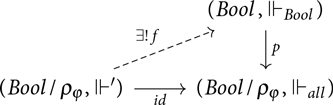
In particular, we have that $p\circ f=id$
in
$p\circ f=id$
in $\mathbf{Set}_i$
. Now, observe that
$\mathbf{Set}_i$
. Now, observe that $f([\textsf{true}]) = f([\textsf{false}])$
is true if and only if
$f([\textsf{true}]) = f([\textsf{false}])$
is true if and only if $\rho _\varphi (\textsf{true}, \textsf{false})$
holds, if and only if
$\rho _\varphi (\textsf{true}, \textsf{false})$
holds, if and only if $\varphi$
holds; since the equality between booleans is decidable, we have that
$\varphi$
holds; since the equality between booleans is decidable, we have that

holds in $\mathbf{IZF}$
, and hence also
$\mathbf{IZF}$
, and hence also $\varphi \vee \neg \varphi$
. Since
$\varphi \vee \neg \varphi$
. Since $\varphi$
is arbitrary, we would conclude that the law of excluded middle is valid in
$\varphi$
is arbitrary, we would conclude that the law of excluded middle is valid in $\mathbf{IZF}$
, which is a contradiction.
$\mathbf{IZF}$
, which is a contradiction.
The same argument applies if working within $\mathbf{IZF}_{\textsf{BP}}$
.
$\mathbf{IZF}_{\textsf{BP}}$
.
Although distinct, the two quasi-toposes of assemblies are crucially related in the following way
Definition 57.
Define $Q:\mathscr{Q}_{\mathbb{P}{\Gamma }^{\textrm{op}} } \to \mathbf{Asm}_i$
as the functor sending an object
$Q:\mathscr{Q}_{\mathbb{P}{\Gamma }^{\textrm{op}} } \to \mathbf{Asm}_i$
as the functor sending an object $((A, \Vdash _A), \rho )$
of
$((A, \Vdash _A), \rho )$
of $\mathscr{Q}_{\mathbb{P}{\Gamma }^{\textrm{op}} }$
into the quotient
$\mathscr{Q}_{\mathbb{P}{\Gamma }^{\textrm{op}} }$
into the quotient $(A/\rho , \Vdash _\rho )$
with
$(A/\rho , \Vdash _\rho )$
with $ n \Vdash _{\rho } [a] :\equiv n \Vdash _A a$
, after recalling that
$ n \Vdash _{\rho } [a] :\equiv n \Vdash _A a$
, after recalling that $\rho$
yields an equivalence relation on
$\rho$
yields an equivalence relation on $A$
in
$A$
in $\mathbf{Set}_i$
.
$\mathbf{Set}_i$
.
Proposition 58.
The doctrine of strong subobjects in $\mathscr{Q}_{\mathbb{P}{\Gamma }^{\textrm{op}} }$
is equivalent to the composition of the doctrine of strong subobjects in
$\mathscr{Q}_{\mathbb{P}{\Gamma }^{\textrm{op}} }$
is equivalent to the composition of the doctrine of strong subobjects in $\mathbf{Asm}_i$
with the functor
$\mathbf{Asm}_i$
with the functor $Q^{\textrm{op}}:\mathscr{Q}_{\mathbb{P}{\Gamma }^{\textrm{op}} }^{\textrm{op}} \to \mathbf{Asm}_i^{\textrm{op}}$
.
$Q^{\textrm{op}}:\mathscr{Q}_{\mathbb{P}{\Gamma }^{\textrm{op}} }^{\textrm{op}} \to \mathbf{Asm}_i^{\textrm{op}}$
.
Proof. It follows from the fact that $\mathbf{Set}_i$
is an exact category whose quotients are of effective descent type as defined in Definition 20.
$\mathbf{Set}_i$
is an exact category whose quotients are of effective descent type as defined in Definition 20.
Remark 59. Notice that the functor $Q:\mathscr{Q}_{\mathbb{P}{\Gamma }^{\textrm{op}} } \to \mathbf{Asm}_i$
has a right adjoint
$Q:\mathscr{Q}_{\mathbb{P}{\Gamma }^{\textrm{op}} } \to \mathbf{Asm}_i$
has a right adjoint $\Sigma : \mathbf{Asm}_i \longrightarrow \mathscr{Q}_{\mathbb{P}{\Gamma }^{\textrm{op}} }$
defined as follows: for any assembly
$\Sigma : \mathbf{Asm}_i \longrightarrow \mathscr{Q}_{\mathbb{P}{\Gamma }^{\textrm{op}} }$
defined as follows: for any assembly $(A, \Vdash _A)$
we associate the object
$(A, \Vdash _A)$
we associate the object $(\Sigma _A, \rho _\Sigma )$
where
$(\Sigma _A, \rho _\Sigma )$
where $\Sigma _A$
is the partitioned assembly whose support is
$\Sigma _A$
is the partitioned assembly whose support is
 \begin{equation*} \{ (a, m) \mid a\in A, m \in \mathbb{N} \text{ s.t. } m\Vdash _A a\ \} \end{equation*}
and $n \Vdash _{\Sigma _A}(a, m) :\equiv m=n$
, while
$n \Vdash _{\Sigma _A}(a, m) :\equiv m=n$
, while $\rho _\Sigma ( (a,m), (a',m')) :\equiv a=a'$
. Indeed, we can define a natural bijection
$\rho _\Sigma ( (a,m), (a',m')) :\equiv a=a'$
. Indeed, we can define a natural bijection $\mathbf{Asm}_i (Q(A,\Vdash _A),\rho ),(B,\Vdash _B))\cong \mathscr{Q}_{\mathbb{P}{\Gamma }^{\textrm{op}} }( ((A,\Vdash _A),\rho ),\Sigma (B,\Vdash _B))$
by associating
$\mathbf{Asm}_i (Q(A,\Vdash _A),\rho ),(B,\Vdash _B))\cong \mathscr{Q}_{\mathbb{P}{\Gamma }^{\textrm{op}} }( ((A,\Vdash _A),\rho ),\Sigma (B,\Vdash _B))$
by associating $g(a)= (f([a]), \{e\}(n_a))$
to a morphism
$g(a)= (f([a]), \{e\}(n_a))$
to a morphism $f: Q ((A,\Vdash _A),\rho )\to (B,\Vdash _B)$
with track
$f: Q ((A,\Vdash _A),\rho )\to (B,\Vdash _B)$
with track $e$
. Conversely, it associates
$e$
. Conversely, it associates $f([a])= \pi _1\circ g(a)$
for any
$f([a])= \pi _1\circ g(a)$
for any $a$
in
$a$
in $A$
to any
$A$
to any $g: ((A,\Vdash _A),\rho )\to \Sigma (B,\Vdash _B)$
, where
$g: ((A,\Vdash _A),\rho )\to \Sigma (B,\Vdash _B)$
, where $\pi _1\colon \Sigma _B\to B$
is the function sending
$\pi _1\colon \Sigma _B\to B$
is the function sending $(b,m)\mapsto b$
. Of course, after Theorem 56 this adjunction can not be an equivalence.
$(b,m)\mapsto b$
. Of course, after Theorem 56 this adjunction can not be an equivalence.
5.2 Effectiveness and continuity principles validated
First, recall that Proposition 52, Theorem 54, and Proposition 58 together express the commutativity up to natural isomorphisms of the following diagram of functors.
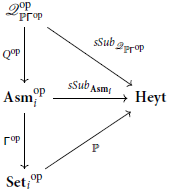
Moreover, observe that the diagram above can be read as a composition of arithmetic strong tripos 1-arrows. We can then show how the higher-order arithmetic of the meta-theory reflects into the quasi-toposes $\mathbf{Asm}_i$
and
$\mathbf{Asm}_i$
and $\mathscr{Q}_{\mathbb{P}{\Gamma }^{\textrm{op}} }$
.
$\mathscr{Q}_{\mathbb{P}{\Gamma }^{\textrm{op}} }$
.
Theorem 60. (transfer principle). If a sentence formulated in the language of $\mathbf{HaTT}$
is true in
$\mathbf{HaTT}$
is true in $\mathbf{IZF}_{\textsf{BP}}$
, then it is true in
$\mathbf{IZF}_{\textsf{BP}}$
, then it is true in $sSub_{\mathbf{Asm}_i}$
and
$sSub_{\mathbf{Asm}_i}$
and $sSub_{\mathscr{Q}_{\mathbb{P}{\Gamma }^{\textrm{op}} }}$
.
$sSub_{\mathscr{Q}_{\mathbb{P}{\Gamma }^{\textrm{op}} }}$
.
Proof. By the initiality of the arithmetic strong tripos $\textsf{Prop}_{\mathbf{HaTT}}$
(Proposition 16), we know that the following commutes, where the unlabeled vertical arrow is the isomorphism obtained by specializing the lower triangle of Diagram 1.
$\textsf{Prop}_{\mathbf{HaTT}}$
(Proposition 16), we know that the following commutes, where the unlabeled vertical arrow is the isomorphism obtained by specializing the lower triangle of Diagram 1.
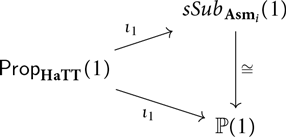
It is therefore immediate to conclude that $\mathbb{P} \models \varphi (x)$
if and only if
$\mathbb{P} \models \varphi (x)$
if and only if $sSub_{\mathbf{Asm}_i} \models \varphi (x)$
for any sentence
$sSub_{\mathbf{Asm}_i} \models \varphi (x)$
for any sentence $\varphi (x)$
expressed in
$\varphi (x)$
expressed in $\mathbf{HaTT}$
. An analogous proof can be carried out for the arithmetic strong tripos
$\mathbf{HaTT}$
. An analogous proof can be carried out for the arithmetic strong tripos $sSub_{\mathscr{Q}_{\mathbb{P}{\Gamma }^{\textrm{op}} }}$
using the outer triangle of Diagram 1.
$sSub_{\mathscr{Q}_{\mathbb{P}{\Gamma }^{\textrm{op}} }}$
using the outer triangle of Diagram 1.
It is worth noting that Theorem 60 is very general but it does not hold if we replace the initial arithmetic strong tripos with the initial arithmetic CC-strong tripos. This is because the forgetful functor ${\Gamma }$
does not preserve exponentials. As an immediate corollary, we obtain:
${\Gamma }$
does not preserve exponentials. As an immediate corollary, we obtain:
Corollary 61.
In the arithmetic strong triposes $ sSub_ {\mathbf{Asm}_i}$
and
$ sSub_ {\mathbf{Asm}_i}$
and $sSub_{ \mathscr{Q}_{\mathbb{P}{\Gamma }^{\textrm{op}} }}$
the Brouwer’s principles
$sSub_{ \mathscr{Q}_{\mathbb{P}{\Gamma }^{\textrm{op}} }}$
the Brouwer’s principles $\textsf{Bar Induction}$
,
$\textsf{Bar Induction}$
, $\textsf{LCP}$
, and
$\textsf{LCP}$
, and $\textsf{AC}_{Baire}$
are true.
$\textsf{AC}_{Baire}$
are true.
Proof. From Theorem 60, since both $\textsf{Bar Induction}$
,
$\textsf{Bar Induction}$
, $\textsf{LCP}$
, and
$\textsf{LCP}$
, and $\textsf{AC}_{Baire}$
can be written in the language of
$\textsf{AC}_{Baire}$
can be written in the language of $\mathbf{HaTT}$
, and they are true (actually, they are axioms) in
$\mathbf{HaTT}$
, and they are true (actually, they are axioms) in $\mathbf{IZF}_{\textsf{BP}}$
.
$\mathbf{IZF}_{\textsf{BP}}$
.
Finally, we can show that assemblies model the Type-theoretic Church Thesis.
Theorem 62. $\textsf{TCT}$
is true in both the arithmetic strong triposes
$\textsf{TCT}$
is true in both the arithmetic strong triposes $ sSub_ {\mathbf{Asm}_i}$
and
$ sSub_ {\mathbf{Asm}_i}$
and $sSub_{ \mathscr{Q}_{\mathbb{P}{\Gamma }^{\textrm{op}} }}$
.
$sSub_{ \mathscr{Q}_{\mathbb{P}{\Gamma }^{\textrm{op}} }}$
.
Proof. In the meta-theory, define the predicate $Comp$
over the function space
$Comp$
over the function space $\mathbb{N} \to \mathbb{N}$
as
$\mathbb{N} \to \mathbb{N}$
as $Comp(f) :\equiv (\exists e \in \mathbb{N} )e \Vdash _{fun} f$
. Then,
$Comp(f) :\equiv (\exists e \in \mathbb{N} )e \Vdash _{fun} f$
. Then, $\textsf{TCT}$
is interpreted in both
$\textsf{TCT}$
is interpreted in both $ sSub_ {\mathbf{Asm}_i}$
and
$ sSub_ {\mathbf{Asm}_i}$
and $sSub_{ \mathscr{Q}_{\mathbb{P}{\Gamma }^{\textrm{op}} }}$
as the following sentence of the meta-theory
$sSub_{ \mathscr{Q}_{\mathbb{P}{\Gamma }^{\textrm{op}} }}$
as the following sentence of the meta-theory
 \begin{equation*} ( \forall f \in \{ g \in \mathbb{N} \to \mathbb{N} \,|\, Comp(g) \} ) \ Comp(f) \end{equation*}
Remark 63. Observe that in Corollary 4.9 of Maietti et al. (Reference Maietti, Pasquali and Rosolini2019) it is proved that the doctrine of strong subobjects in the classical category of assemblies $\mathbf{Asm}$
inherits the validity of
$\mathbf{Asm}$
inherits the validity of $\textsf{TCT}$
from the doctrine of strong subobjects on
$\textsf{TCT}$
from the doctrine of strong subobjects on $\mathbf{PAsm}_i$
.
$\mathbf{PAsm}_i$
.
After Theorem 56, such an explanation survives within an intuitionistic meta-theory, as $\mathbf{IZF}$
, only to explain why
$\mathbf{IZF}$
, only to explain why $sSub_{ \mathscr{Q}_{\mathbb{P}{\Gamma }^{\textrm{op}} }}$
inherits the validity of
$sSub_{ \mathscr{Q}_{\mathbb{P}{\Gamma }^{\textrm{op}} }}$
inherits the validity of $\textsf{TCT}$
.
$\textsf{TCT}$
.
We end this section by proving negative results, showing on the one hand the necessity in our treatment of considering genuine quasi-toposes instead of arbitrary toposes, and, on the other, the poor behavior of the regular completion with respect to the structures we are interested in.
The following proposition is what motivates the search for genuine quasi-toposes validating these principles.
Proposition 64.
There exists no non-trivial arithmetic topos validating $\textsf{TCT}+\textsf{Bar Induction}$
, and even more with also
$\textsf{TCT}+\textsf{Bar Induction}$
, and even more with also $\textsf{LCP} +\textsf{AC}_{Baire}$
.
$\textsf{LCP} +\textsf{AC}_{Baire}$
.
Proof. Any topos validates the Axiom of Unique Choice $\textsf{AC!}$
as shown by using its internal language in Maietti (Reference Maietti2005). Therefore, if a topos would validate
$\textsf{AC!}$
as shown by using its internal language in Maietti (Reference Maietti2005). Therefore, if a topos would validate $\textsf{TCT}+\textsf{Bar Induction}$
, it would also validate
$\textsf{TCT}+\textsf{Bar Induction}$
, it would also validate $\textsf{CT}$
, and hence the falsum by Lemmas 42 and 43.
$\textsf{CT}$
, and hence the falsum by Lemmas 42 and 43.
Proposition 65.
The regular completions of the arithmetic strong triposes $sSub_{\mathbf{Asm}_i}$
and
$sSub_{\mathbf{Asm}_i}$
and $ sSub_{ \mathscr{Q}_{\mathbb{P}{\Gamma }^{\textrm{op}} } }$
are both equivalent to
$ sSub_{ \mathscr{Q}_{\mathbb{P}{\Gamma }^{\textrm{op}} } }$
are both equivalent to $\mathbf{Set}_i$
and the free topos with a NNO
$\mathbf{Set}_i$
and the free topos with a NNO $\textrm{Reg}(Init)$
embeds into them, that is there is a faithful functor from
$\textrm{Reg}(Init)$
embeds into them, that is there is a faithful functor from $\textrm{Reg}(Init)$
to
$\textrm{Reg}(Init)$
to $\mathbf{Set}_i$
 \begin{equation*}\textrm{Reg}(Init) \hookrightarrow \textrm{Reg}(sSub_{\mathbf{Asm}_i})= \textrm{Reg}( sSub_{ \mathscr{Q}_{\mathbb{P}{\Gamma }^{\textrm{op}} } })={\mathbf{Set}_i}.\end{equation*}
Theorem 66.
There exists a CC-strong tripos $P : \mathscr{C}^{{\kern2.1pt}\textrm{op}}\to \mathbf{Heyt}$
for which the embedding into its regular completion
$P : \mathscr{C}^{{\kern2.1pt}\textrm{op}}\to \mathbf{Heyt}$
for which the embedding into its regular completion $\textrm{Reg}(P)$
does NOT preserve the Cartesian closed structure.
$\textrm{Reg}(P)$
does NOT preserve the Cartesian closed structure.
Proof. Thanks to Proposition 65 both $sSub_{\mathbf{Asm}_i}\colon \mathbf{Asm}_i^{\textrm{op}}\to \mathbf{Heyt}$
and
$sSub_{\mathbf{Asm}_i}\colon \mathbf{Asm}_i^{\textrm{op}}\to \mathbf{Heyt}$
and $sSub_{\mathscr{Q}_{\mathbb{P}{\Gamma }^{\textrm{op}} }}\colon \mathscr{Q}_{\mathbb{P}{\Gamma }^{\textrm{op}} }^{\textrm{op}}\to \mathbf{Heyt}$
provide examples of CC-strong triposes whose regular completion is
$sSub_{\mathscr{Q}_{\mathbb{P}{\Gamma }^{\textrm{op}} }}\colon \mathscr{Q}_{\mathbb{P}{\Gamma }^{\textrm{op}} }^{\textrm{op}}\to \mathbf{Heyt}$
provide examples of CC-strong triposes whose regular completion is $\mathbf{Set}_i$
and whose embedding into it fails to preserve the Cartesian closed structure of their bases. Indeed, if it did, then
$\mathbf{Set}_i$
and whose embedding into it fails to preserve the Cartesian closed structure of their bases. Indeed, if it did, then $\textsf{TCT}$
would hold in
$\textsf{TCT}$
would hold in $\mathbf{IZF}_{\textsf{BP}}$
. Moreover,
$\mathbf{IZF}_{\textsf{BP}}$
. Moreover, $\textsf{CT}$
would also hold, since exponentials are interpreted in
$\textsf{CT}$
would also hold, since exponentials are interpreted in $\mathbf{IZF}_{\textsf{BP}}$
as sets of functional relations. However, this would lead to a contradiction, since Brouwer’s principles of
$\mathbf{IZF}_{\textsf{BP}}$
as sets of functional relations. However, this would lead to a contradiction, since Brouwer’s principles of $\mathbf{IZF}_{\textsf{BP}}$
are inconsistent with
$\mathbf{IZF}_{\textsf{BP}}$
are inconsistent with $\textsf{CT}$
by Lemmas 42 and 43.
$\textsf{CT}$
by Lemmas 42 and 43.
Remark 67. From what we have shown here, we can conclude that the calculus $\lambda {\mathbf{HaTT}}$
is not complete with respect to toposes. Indeed, a calculus that extends
$\lambda {\mathbf{HaTT}}$
is not complete with respect to toposes. Indeed, a calculus that extends $\lambda {\mathbf{HaTT}}$
and enjoys such completeness property must satisfy the Axiom of Unique Choice
$\lambda {\mathbf{HaTT}}$
and enjoys such completeness property must satisfy the Axiom of Unique Choice $\textsf{AC!}$
. One possible extension is the dependently typed calculus
$\textsf{AC!}$
. One possible extension is the dependently typed calculus $\mathscr{T}_{\mathbf{Topos}}$
by Maietti (Reference Maietti2005), where the axiom of unique choice is not postulated, but rather derived from the identification of propositions with mono-types.
$\mathscr{T}_{\mathbf{Topos}}$
by Maietti (Reference Maietti2005), where the axiom of unique choice is not postulated, but rather derived from the identification of propositions with mono-types.
6. Conclusion
We have built two intuitionistic quasi-toposes $\mathbf{Asm}_i$
and
$\mathbf{Asm}_i$
and $\mathscr{Q}_{\mathbb{P}{\Gamma }^{\textrm{op}} }$
validating Brouwer’s continuity principles, including Bar Induction, the local continuity principle
$\mathscr{Q}_{\mathbb{P}{\Gamma }^{\textrm{op}} }$
validating Brouwer’s continuity principles, including Bar Induction, the local continuity principle $\textsf{LCP}$
, and an instance of choice
$\textsf{LCP}$
, and an instance of choice $\textsf{AC}_{Baire}$
. The striking property is that they also validate a restricted form of Church’s Thesis
$\textsf{AC}_{Baire}$
. The striking property is that they also validate a restricted form of Church’s Thesis $\textsf{TCT}$
, expressing that all morphisms of the considered quasi-topos are computable. This is possible because Brouwer’s choice sequences are interpreted as number-theoretic functional relations. Furthermore, within these quasi-toposes the validity of these continuity principles is inherited from the meta-theory
$\textsf{TCT}$
, expressing that all morphisms of the considered quasi-topos are computable. This is possible because Brouwer’s choice sequences are interpreted as number-theoretic functional relations. Furthermore, within these quasi-toposes the validity of these continuity principles is inherited from the meta-theory $\mathbf{IZF}_{\textsf{BP}}$
due to the particular nature of their doctrine of strong subobjects. Only the quasi-topos
$\mathbf{IZF}_{\textsf{BP}}$
due to the particular nature of their doctrine of strong subobjects. Only the quasi-topos $\mathscr{Q}_{\mathbb{P}{\Gamma }^{\textrm{op}} }$
retains the projectivity originally proved for the classical version of
$\mathscr{Q}_{\mathbb{P}{\Gamma }^{\textrm{op}} }$
retains the projectivity originally proved for the classical version of $\mathbf{Asm}_i$
in Maietti et al. (Reference Maietti, Pasquali and Rosolini2019).
$\mathbf{Asm}_i$
in Maietti et al. (Reference Maietti, Pasquali and Rosolini2019).
These universes show that it is possible to reconcile Markov’s constructivism with Brouwer’s intuitionism without renouncing to all the effective and continuity principles stipulated in these approaches. In particular, they show that Heyting arithmetic with finite types extended with power objects, as those in the generic calculus of arithmetic CC-strong triposes is consistent both with Brouwer’s continuity principles and $\textsf{TCT}$
.
$\textsf{TCT}$
.
As future work, we want to show the consistency of both principles within predicative settings including the two-level Minimalist Foundation (Maietti Reference Maietti2009), and even richer setting including Coquand-Huet’s Calculus of Constructions (Coquand and Huet Reference Coquand and Huet1988) by modeling them in either of two quasi-toposes depending of the need of projectivity we will have.
Acknowledgments
This work heavily relies on the analysis done in Maietti et al. (Reference Maietti, Pasquali and Rosolini2019). The first author is very grateful to Fabio Pasquali and Pino Rosolini for their very fruitful cooperation. We acknowledge very useful discussions with Samuele Maschio on the specific topics of this paper. We are very grateful to Giovanni Sambin for sharing his view on Brouwer’s continuity principles. Finally, we thank the reviewers for their very useful suggestions.
The first author is affiliated with the INdAM national research group GNSAGA.
The second author has been supported by a Lumina quaeruntur fellowship (LQ300092101) from the Czech Academy of Sciences.
Competing interests
The authors declare that they have no competing interests.


 Open access

