



Several developing countries have implemented policies in an attempt to reduce or eliminate malnutrition among children, with a focus on those aged less than 5 years. Among the most frequent policies implemented are cash transfers or conditional cash transfers (CCT), in-kind transfers, mothers’ training on health and nutrition issues, infrastructure improvements and vouchers for food( Reference van den Bold, Quisumbing and Gillespie 1 ). In the majority of successful programmes, a combination of interventions is implemented jointly, thus creating uncertainty about exactly which aspect of the policy yielded which result. To the best of our knowledge, few studies have disentangled the separated effect of each component( Reference Fiszbein and Schady 2 ). One strategy often used that combines different interventions are CCT programmes. In this kind of programme, cash transfers are generally combined with mothers’ training, nutritional supplement, and/or health-care centre improvements. The research presented herein is the first study to disaggregate the separated effects of each intervention in the Ecuadorian context.
As stated by Torres( Reference Torres 3 ), Ecuador’s persistent malnutrition and increasing overweight and obesity are a cause for concern( Reference Freire, Silva-Jaramillo and Ramirez-Luzuriaga 4 – Reference Freire, Ramírez and Belmont 6 ). According to the National Survey of Health and Nutrition of Ecuador( Reference Freire, Ramírez and Belmont 6 ), 30 % of schoolchildren are estimated to be overweight, while 15 % of them are undernourished. Torres also stressed that health, nutrition and food are scarcely mentioned in the Ministry of Education’s curriculum update( 7 ) and quality standards( 8 ). The consequence of this omission is that the main goal of Ecuador’s School Feeding Progamme (Programa de Alimentación Escolar)( 9 ) has the purpose only of improving student attendance while supplementing children’s nutrition. However, this intervention is currently done with a focus on energy intake via fortified cookies and oatmeal, disregarding dietary variety.
The lack of dietary variety is one of the sources of malnutrition in Ecuador. Minimum food diversity, defined as the consumption of at least four food groups during the 24 h before the survey, was found to be reached by only 63·8 % of breast-fed children between 6 and 23 months old, while this went up to 82·0 % for non-breast-fed children( Reference Freire, Ramírez and Belmont 6 ). Similar results were found for frequency of food intakes, with 60·0 % of breast-fed and only 37·4 % of non-breast-fed children reaching the minimum frequency defined in the survey. Combining the two, dietary variety and frequency of food intakes, results in the so-called minimum acceptable diet, which also shows very low values in Ecuador: 43·4 % for breast-fed children and only 17·8 % for non-breast-fed children.
Interventions are designed in many countries to combat malnutrition. Most of the existing literature evaluating interventions such as cash transfers, vouchers and nutrition training are focused on economically deprived populations in developed economies. However, malnutrition is a more pressing issue in Latin America than in developed economies, which explains why CCT programmes are an important component of social policy. Since the initial experiences with CCT in Brazil and Mexico in the second half of the 1990s, most Latin American countries currently run some kind of CCT programme and usually in conjunction with other interventions as a means of reducing poverty and improving human capital. In this regard, CCT programmes provide cash transfers to poor families conditional on the children of these families attending school and/or visiting health-care centres. The attractiveness of these programmes is their potential to combine short- and long-term poverty reduction strategies. The cash transfers reduce short-term poverty, while long-term poverty is curtailed as children of poor families acquire different habits that result in improved human capital. Abundant research is available on the impact of such programmes on human development outcome variables( Reference Fiszbein and Schady 2 ). In most of the cases, results show positive effects of CCT programmes on both education and health outcome variables, as well as on reducing poverty and income inequality.
There is a growing number of studies evaluating the impact of such interventions, although they are not conclusive regarding their effectiveness. Yablonski and O’Donnell( Reference Yablonski and O’Donnell 10 ) conducted a survey of case studies worldwide and concluded that, in general, there was evidence that supported the use of cash transfer schemes for improving malnutrition. A few years later, another review( Reference An 11 ) analysed twenty experiences in developed economies that included the use of vouchers and other interventions. Only six of the studies were found to have a positive impact when using vouchers for improving dietary variety.
In developed economies, many of the studies have tested only one intervention. In the USA different studies( Reference Dimitri, Oberholtzer and Zive 12 – Reference Herman, Harrison and Afifi 14 ) have shown how vouchers did increase consumption and improved variety in the diet. In the case of the UK, no conclusive results were found. In some cases changes in consumption or purchasing behaviour were not observed( Reference Buyuktuncer, Kearney and Ryan 15 ), while in other cases both quantity and variety of food were improved by interventions based on vouchers( Reference Burr, Trembeth and Jones 16 , Reference McFadden, Green and Williams 17 ).
There are cases in which more than one intervention was tested, usually including nutritional training or advice and the use of vouchers. Again, the results of the different studies are not conclusive. In one case in the USA( Reference Anderson, Bybee and Brown 18 ) both vouchers and education had a positive effect on consumption of fruits and vegetables, but it was the combination of both that resulted in higher impact. In one case in France( Reference Bihan, Castetbon and Mejean 19 ), even though the authors did not differentiate results for each intervention, they concluded that vouchers could be a complementary measure to simply giving advice. In a follow-up of that study( Reference Bihan, Méjean and Castetbon 20 ), however, the authors did measure the differential impact for each intervention and found that vouchers contributed to lowering the risk of low consumption of fruits and vegetables, but they found no difference with the group that received advice only. Finally, in a randomised exercise conducted in New Zealand with 1104 supermarket shoppers, the research showed no relationship between education and healthier purchases, but it did find a relationship between discounts and healthy food purchases( Reference Blakely, Ni Mhurchu and Jiang 21 , Reference Ni Mhurchu, Blakely and Jiang 22 ). In general terms, the literature shows in the case of developed economies that vouchers have had an impact on dietary diversity, whereas the impact of nutritional education or training is not that clear.
In the case of developing economies, Gentilini( Reference Gentilini 23 ) reviewed several studies tackling the issue of cash transfers v. in-kind food transfers, leading to the conclusion that although there was relative effectiveness in these interventions, average impacts depended on the context, measurement and programme design.
There is evidence of the positive impact of CCT on nutrition, specifically on stunting, anaemia, weight gain, preventive care visits, chronic malnutrition in infants, dietary diversity and Hb counts in the Latin American context. In his evaluation of the impact of Mexico’s PROGRESA initiative on children’s stunted growth and anaemia, Gertler’s( Reference Gertler 24 ) findings not only revealed no significant impact on children’s increased height, but also that the treatment group was 25·5 % less likely to be anaemic than the control group. The same data were interpreted by Behrman and Hoddinot( Reference Behrman and Hoddinott 25 ) who found no positive and, in some cases, even negative impacts on nutritional indicators. A positive impact on nutrition indicators was also found by Maluccio and Flores( Reference Maluccio and Flores 26 ) in their analysis of the Nicaraguan CCT (Red de Protection Social). The same positive impact was found in a case in Honduras( Reference Siega-Riz, Estrada Del Campo and Kinlaw 27 ), in which Siega-Riz et al. reported improvements in micronutrients among participants with respect to the control group. Attanasio et al.( Reference Attanasio, Gómez and Heredia 28 ) evaluated the impact of the Colombian CCT on nutritional indicators. They found a positive and significant impact on chronic malnutrition of about −6·9 percentage points for those aged 24 months or less. One important point of the latter paper is that the authors found a positive impact on dietary diversity. However, there is also evidence of no impact of such interventions. In review of the Honduran PRAF CCT programme, Morris et al.( Reference Morris, Flores and Olinto 29 ) did not find a significant impact on children’s nutritional status. The same occurred when evaluating the impact of the Brazilian programme (Bolsa Alimentacion)( Reference Morris, Olinto and Flores 30 ); the authors found no evidence of weight difference between children belonging to programmes and those excluded from them at the time of enrolment. Paxson and Schady( Reference Paxson and Schady 31 ) evaluated the impact of the Ecuadorian CCT programme (Bono de Desarrollo Humano) on nutritional indicators among children between 3 and 7 years old. Their study showed no significant effects on children’s malnutrition rates.
One limitation of most of the studies presented above is that the effects of the different components of the programmes are not easily identified and very often not even measured. One exception is the paper by Hidrobo et al.( Reference Hidrobo, Hoddinott and Peterman 32 ). These authors considered the comparative costs and nutritional outcomes of offering participants cash, food vouchers or food transfers. All three modalities were found to significantly improve the quantity and quality of food consumed. However, the study did not analyse nutritional and health training. Hidrobo et al.’s analysis showed that offering food transfers was the least cost-effective method while food vouchers were the most cost-effective.
Building on the variety of studies presented above, our hypothesis is that food vouchers have a differentiated impact when compared with training in terms of cost-effectiveness. The rationale behind the hypothesis is that malnutrition is often, although not only, determined by budgetary constraints of households, which prevent them from having access to a diversified diet, which in turn drives nutritional problems in children such as those described above for Ecuador.
This is thus the contribution of the present paper, as we differentiate the effects of two components of a nutritional programme by using an experimental design. In our study, we randomly assigned households to one of the following three groups: (i) food voucher; (ii) voucher plus training in health and nutrition; and compared them with (iii) a control group which received none of the above. This design permitted us to differentiate the effects of each component of the different interventions.
Methods
Experimental design and interventions
Three groups of approximately 200 households per group were randomly selected in three provinces in Ecuador, two from the Sierra region (Carchi and Chimborazo) and one from the Coastal region (Santa Elena). Power estimates as well as sample size were computed using the Optimal Design software, working with a power of 80 %, at 5 % significance and with a minimum detectable effect of 0·25 (sd). The baseline survey was conducted between September and November 2013 prior to a follow-up survey for each of the three groups one year later.
The first group of households (T1) was assigned to receive a monthly food voucher of $US 40. The second group of households (T2) was assigned to receive the same $US 40 voucher, plus training on health and nutrition issues.Footnote * Finally, the third group (C) served as the control and did not receive intervention. Analysis of the three groups yielded the following impacts:
 $$\openup -6pt\eqalignno{ &{\rm T1}-{\rm C}\,{\equals}\,{\rm the}\,{\rm impact}\,{\rm of}\,{\rm the}\,{\rm food}\,{\rm voucher;} \cr & {\rm T2}-{\rm C}\,{\equals}\,{\rm the}\,{\rm impact}\,{\rm of}\,{\rm the}\,{\rm food}\,{\rm voucher}\,{\rm and}\, {\rm training\, ;}\,{\rm and} \cr & {\rm T2}-{\rm T1}\,\,\left( {{\rm T3}} \right)\,{\equals}\,{\rm the}\,{\rm impact}\,{\rm of}\,{\rm training}{\rm .} $$
Two different outcome variables were analysed for each of the three groups: (i) per capita energy consumption at household level; and (ii) dietary diversity. Each of these variables is described below.
Per capita energy consumption at household level
Following Hidrobo et al.( Reference Hidrobo, Hoddinott and Peterman 32 ), household food consumption aggregates were constructed from the amounts of foods eaten at home and outside the home over a 7 d period. Weekly household values of food consumption were then converted to monthly values, which were subsequently converted to household per capita values by dividing the total by the number of household members. Results are robust to using adult equivalent values. Energy intake was constructed from the amounts of foods consumed at home (from purchases, own stock or in-kind payments). The amount of food consumed for each item was multiplied by its energy content to obtain kilocalories consumed( 33 ). Total weekly household energy values were then converted to daily amounts and divided by household size to obtain energy intake per person per day. The median energy intake for forty distinct food items was used to determine the per capita energy consumption.
Dietary diversity
The present study used the Food Consumption Score (FCS)( 34 ), which considers the number of days that the household consumed the corresponding food group (staples, pulses, vegetables, fruit, meat and fish, milk and dairy, sugar and honey, oils and fats), multiplied by the number of days of the food group’s weighted frequencies. The sum of the total categories was obtained to create a simple proxy indicator.
Model specification
Taking advantage of the panel data, the treatment effect was estimated using the following econometric specification:
 $$Y_{{i1}} \,{\equals}\,\alpha {\plus}X'_{{i0}} \beta _{0} {\plus}\beta _{1} T_{i} {\plus}\beta _{2} Y_{{i0}} {\plus}{\varepsilon}_{i} ,$$
where Y i1 is the outcome of interest for child i at follow-up; the sub-index 1 is for the follow-up and 0 for the baseline; T i are indicators that equal 1 if the household is in the corresponding treatment arm and 0 otherwise; β 1 is the corresponding impact estimate; X′ is a vector of control variables at baseline; and Y i0 is the outcome of interest at baseline.
Three specifications were reported. First, the basic specification only included dummies for the corresponding treatment. For each type of intervention several treatments were used, as well as dummies for comparing different interventions. T1 and T2 stand for each different type of intervention. T3 (T2–T1) takes the value of 1 for voucher plus training and 0 for voucher. Finally, T0 takes the value of 1 for all of the treatment groups and 0 for the control group.
The second specification included, as a control variable, the value of the outcome variable at baseline. The third specification included the basic specification plus control variables at the household and head of household level. The age of the household head and number of years of schooling, and dummies for being female and indigenous were included at this level. Finally, the number of children by age grouping (0–5 years old, 6–14 years old) and the number of other household members by age grouping (15–44 years old, 45–65 years old and older than 65 years) were also considered.
The differences between random assignment and the real treatment impelled the use of an instrumental variable estimation, where treatment was instrumented by the original random assignment. As is accepted in the field, the study presumed that the original random assignment is a good instrument if two conditions were met: (i) if the instrument is a good predictor of the real treatment; and (ii) if the instrument meets the ‘exclusion restriction’, which means that the only way of affecting the outcome variable is through programme participation.
Regarding the first condition, Table 1 introduces the results of the regression between the instrument and the real treatment. In all cases the coefficient was highly significant and with values larger than 0·9. The F value for the instrument was significant in all cases.
Ordinary least-squares regression results between the treatment arms and random assignment in the experimental design differentiating the effects of food vouchers and training in health and nutrition on consumption and dietary diversity among approximately 200 randomly selected households per group in three provinces in Ecuador
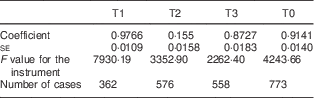
T1=monthly food voucher of $US 40; T2=the same $US 40 voucher plus training on health and nutrition issues; T3=T2–T1 (=the impact of training); T0=1 for all of the treatment groups and 0 for the control group.
By using random assignment as the primary instrument, our estimates represent the local average treatment effect. This means that it represents the impact on those people who received the intervention because they were randomly assigned to participate in the programme.
Data and baseline characteristics
Table 2 introduces the results for the baseline survey. Results from baseline showed no systematic differences between each treatment arm and the control group, or among the different treatment arms. More specifically, no differences were found between T1 and C, between T2 and C, or between T1 and T2. We found only a significant difference between T1 and T2 in the number of members aged 45–64 years old at household level. The lack of significant differences indicates that the randomisation worked properly. However, to get more precise estimations and to correct for possible differences in baseline, all variables included in Table 1 were incorporated as control variables in the more complete specification used in the econometric models.
Baseline variables in the treatment arms and control group in the experimental design differentiating the effects of food vouchers and training in health and nutrition on consumption and dietary diversity among approximately 200 randomly selected households per group in three provinces in Ecuador
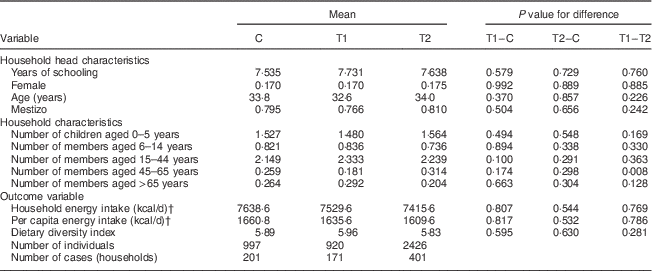
C=control, no intervention; T1=monthly food voucher of $US 40; T2=the same $US 40 voucher plus training on health and nutrition issues.
† To convert to kJ/d, multiply kcal/d value by 4·184.
Results
To analyse results, the impact on per capita consumption and total household consumption (in logs) was evaluated (Table 3). No significant impacts were found when using the log of per capita consumption in energy terms as the dependent variable. However, when the log of total consumption at household level in energy terms was considered, the dependent variable had a significant impact on household consumption of T2 (voucher plus training). There were no other significant impacts found for the rest of the treatment arms.
Impact of treatments on energy consumption (logs; two-stage least-squares estimates) in the experimental design differentiating the effects of food vouchers and training in health and nutrition on consumption and dietary diversity among approximately 200 randomly selected households per group in three provinces in Ecuador
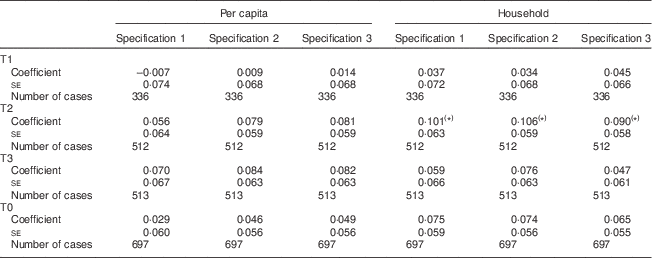
T1=monthly food voucher of $US 40; T2=the same $US 40 voucher plus training on health and nutrition issues; T3=T2–T1 (=the impact of training); T0=1 for all of the treatment groups and 0 for the control group.
Specification 1 includes dummies for the corresponding treatment. Specification 2 includes, as a control variable, the value of the outcome variable at baseline. Specification 3 includes Specification 2 plus control variables at the household and head of household level.
(*)Significant at the 10 % level.
Table 4 reports the results for dietary diversity. The diversity dietary index takes values between 1 and 8 with larger values indicating more dietary diversity. Results showed a significant and positive impact of all interventions on dietary diversity. The impact of T1 and T2 were 0·4 and 0·3, respectively. However, there was no difference in impact across the different intervention arms. This important finding means that the voucher represents the most cost-effective intervention in relation to dietary diversity.
Impact of treatments on dietary diversity (two-stage least-squares estimates) in the experimental design differentiating the effects of food vouchers and training in health and nutrition on consumption and dietary diversity among approximately 200 randomly selected households per group in three provinces in Ecuador
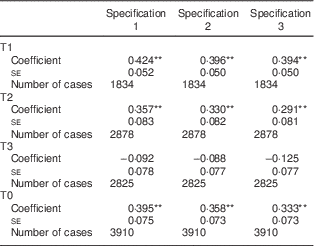
T1=monthly food voucher of $US 40; T2=the same $US 40 voucher plus training on health and nutrition issues; T3=T2–T1 (=the impact of training); T0=1 for all of the treatment groups and 0 for the control group.
Specification 1 includes dummies for the corresponding treatment. Specification 2 includes, as a control variable, the value of the outcome variable at baseline. Specification 3 includes Specification 2 plus control variables at the household and head of household level.
**Significant at the 1 % level.
Discussion and conclusions
Policy measures oriented to reduce malnutrition in children are present in most developing countries, especially in Latin America. They are usually expensive programmes that include different sorts of interventions, including cash transfers, food vouchers and nutritional education or training. However, in many cases the differentiated outcomes of each intervention are not measured, leading to poor results regardless of the amount of money invested. In this regard, the main implication of our findings is that these countries, where budgetary constraints are more important than in developed countries, should focus their interventions on providing conditional food vouchers to households. Such vouchers have a positive impact on dietary diversity at a lower cost than vouchers plus training. This does not mean education is not important, as we discuss below.
In terms of public policy, our findings suggest at least two areas of work. The first is to study how to integrate and expand the voucher programmes to the entire population in order to have a significant impact. One way to easily implement this would be by modifying the current Ecuadorian CCT – the Human Development Bond( 35 ) – which is a subsidy for low-income households by attaching it to certain obligations. In 2013, about 1 million households benefited from these at $US 35 per month. The bond could be converted into food vouchers, tradable for certain food items that would guarantee dietary diversity within the 1 million households that are current beneficiaries. This would reverse some of the nutritional problems found in Ecuador and discussed in the present paper’s introduction. This change would be consistent with previous research that showed the need for modifying the design of the bond as it had modest impacts on children’s nutritional status in Ecuador( Reference Paxson and Schady 31 , Reference León and Younger 36 ).
The second is to analyse why training programmes have such a low impact on dietary diversity in Ecuador and elsewhere, as shown in the present study and the studies highlighted. Torres( Reference Torres 3 ) notes that there is a great potential for food and nutrition education at schools, if a holistic perspective is applied that considers food’s social, economic, cultural, historical, environmental and even emotional and sensory connections. This could be enlarged to include education on production systems and procurement, with links to their impact upon labour conditions and the environment. According to Torres, such an initiative would easily fit with the Ecuadorian Development Plan, called the National Plan for Good Living( 37 ), and with its key concept of good living. In this way, the School Feeding Programme described above should not be restricted to improving student’s attendance and providing nutritional supplements, but rather engage in also providing nutritional education to children, probably by including these topics in the curriculum. This would guarantee further impact of training programmes once parents are included. Last, these measures would be even more effective if the country had, as in many other countries, a national institute of research on food and nutrition, which is currently missing.
Although the literature covered herein on interventions to reduce malnutrition have focused mainly on cash transfers and vouchers, most of the studies that also covered nutritional education and training reached the same conclusion as the present study: training has moderate or no effect in improving dietary diversity( Reference Bihan, Méjean and Castetbon 20 – Reference Ni Mhurchu, Blakely and Jiang 22 ). Only in certain developed countries does training have a moderate impact( Reference Anderson, Bybee and Brown 18 , Reference Bihan, Castetbon and Mejean 19 ). With regard to cash transfers and food vouchers, some studies showed no impact, as in the case of Honduras( Reference Morris, Flores and Olinto 29 ), Brazil( Reference Morris, Olinto and Flores 30 ) and Ecuador( Reference Paxson and Schady 31 ), while most of the cases showed positive impacts. This is the case in both developed( Reference Yablonski and O’Donnell 10 – Reference Herman, Harrison and Afifi 14 , Reference Burr, Trembeth and Jones 16 – Reference Anderson, Bybee and Brown 18 , Reference Bihan, Méjean and Castetbon 20 ) and developing economies( Reference Maluccio and Flores 26 – Reference Attanasio, Gómez and Heredia 28 ). Our study contributes further in that its findings show food vouchers have a positive impact on dietary diversity.
The major strength of our study is the differentiation of the relative impact of each intervention, which, as we saw above, is usually not present in the literature. Regarding limitations, our study analyses the impact on dietary diversity only, and therefore the nutritional status of children is not covered. Although we had collected evidence on this issue, the size of the sample was not big enough to offer conclusive results and for that reason we decided not to include it here.
Future research in Ecuador could fill knowledge gaps in at least two different ways. On the one hand, it could include an evaluation of interventions on nutritional status of children, requiring bigger sample sizes than the one used here. On the other hand, it could focus on designing changes to the current CCT programme (the Human Development Bond), so that food vouchers are used instead of cash transfers, in a more cost-effective way.
In conclusion, after evaluating the separated impact of food voucher programmes and vouchers plus training on consumption and dietary diversity in different regions of Ecuador, the following main results were found:
-
1. Dietary diversity alone was found to be influenced by the food voucher programme, as well as the training.
-
2. The study did not find any significant impact of the interventions on consumption.
-
3. Surprisingly, the training showed similar magnitude of impacts with no significant differences with respect to the food voucher programme on dietary diversity.
-
4. The nutritional status of children should also be evaluated in future analyses of these types of intervention.
-
5. Ecuador could dramatically increase the impact of current CCT programmes if food vouchers were distributed instead of cash transfers, being a more cost-effective measure, as it would increase dietary diversity for more than 1 million households at no extra cost with respect to the budget of the current programme.
-
6. Based on these results, we conclude that the most cost-effective intervention in the case of Ecuador is the voucher programme.
Acknowledgements
Acknowledgements: The authors would like to thank the associate editor and three anonymous reviewers for their comments that have greatly improved the work presented here. Financial support: This work was supported by the World Food Programme in Ecuador and by the Spanish Ministry of Science and Innovation (grant number HAR2013-47182-C2-1-P). The funders had no role in the design, analysis or writing of this article. Conflict of interest: None. Authorship: J.P. formulated the research question, designed the study, carried it out, analysed the data and wrote the article. J.R.-M. drafted the article, revised it critically and edited it. Ethics of human subject participation: This study was conducted according to the guidelines laid down in the Declaration of Helsinki and all procedures involving human subjects/patients were approved by the FLACSO Ethics Committee. Written informed consent was obtained from all subjects/patients.



