

Introduction
Overweight and obesity rates continue to rise worldwide, prompting many countries to implement policies and interventions to stimulate healthier food choices (Malik et al., Reference Malik, Willet and Hu2020; WHO, 2022). In the Netherlands, for example, such interventions often involve the provision of information (e.g., the Wheel of Five by the Netherlands Nutrition Centre, see Feunekes et al., Reference Feunekes, Hermans and Vis2020) and guiding citizens towards healthier food options (e.g., Nutri-Score on pre-packaged products in supermarkets, Ter Borg et al., Reference Ter Borg, Steenbergen, Milder and Temme2021). However, while interventions that rely on informing people can effectively change behaviour (Cecchini and Warin, Reference Cecchini and Warin2016), their impact can be limited (Temple, Reference Temple2020), because they are based on the assumption that people have unlimited capacity to weigh information and make rational choices (Kuehnhanss, Reference Kuehnhanss2019; Van Bavel, Reference Van Bavel2020). In practice, people are not always able to resist unhealthy temptations in their environment despite intentions to eat healthily (Stok et al., Reference Stok, de Vet, Wardle, Chu, De Wit and De Ridder2015; WHO, 2022). For example, nearly one-third of Dutch adults report unplanned purchases of unhealthy snack foods on a daily to weekly basis (CBS, 2022). Although snacking is not necessarily unhealthy, without compensation for the associated increase in calorie intake such (unplanned) snacking will likely contribute excess energy intake and overweight (Mattes, Reference Mattes2018). Realising that food choices may not be rational, ‘nudges’, i.e., non-coercive interventions relying on behavioural insights (Thaler and Sunstein, Reference Thaler and Sunstein2009), may be considered to support individuals in resisting temptations. Many examples exist, such as providing information about relevant others’ consumption as a form of social proof (Salmon et al., Reference Salmon, De Vet, Adriaanse, Fennis, Veltkamp and De Ridder2015; Venema et al., Reference Venema, Kroese, Benjamins and de Ridder2020), but to some, such nudges are seen as manipulative (Hausman and Welch, Reference Hausman and Welch2010; Hansen and Jespersen, Reference Hansen and Jespersen2013) or paternalistic (Sugden, Reference Sugden2017). More intrusive interventions, such as taxation or the use of financial (dis)incentives also seem successful in encouraging healthier food choices (Nuffield Council on Bioethics, 2007; Brambila-Macias et al., Reference Brambila-Macias, Shankar, Capacci, Mazzocchi, Perez-Cueto, Verbeke and Traill2011; Temple, Reference Temple2020), but implementing such intrusive approaches may spark public debate and opposition from food corporations, lobbyists and consumers (Nuffield Council on Bioethics, 2007; Temple, Reference Temple2020; Espinosa and Nassar, Reference Espinosa and Nassar2021; Eykelenboom et al., Reference Eykelenboom, Van Stralen, Olthof, Renders and Steenhuis2021).
In line with this heterogeneity in the acceptability of different interventions, the effectiveness of such interventions differs between subgroups as well (Mcgill et al., Reference Mcgill, Anwar, Orton, Bromley, Lloyd-Williams, O’Flaherty, Taylor-Robinson, Guzman-Castillo, Gillespie and Moreira2015; Colchero et al., Reference Colchero, Popkin, Rivera and Ng2016; Thorndike et al., Reference Thorndike, Riis and Levy2016; Higgs et al., Reference Higgs, Liu, Collins and Thomas2019; Egnell et al., Reference Egnell, Talati, Galan, Andreeva, Vandevijvere, Gombaud, Dréano-Trécant, Hercberg, Pettigrew and Julia2020). For example, interventions that influence the price of unhealthy food appear to be most effective for people with low incomes (Mcgill et al., Reference Mcgill, Anwar, Orton, Bromley, Lloyd-Williams, O’Flaherty, Taylor-Robinson, Guzman-Castillo, Gillespie and Moreira2015; Colchero et al., Reference Colchero, Popkin, Rivera and Ng2016) and people with a higher education benefit more from information-based interventions (Nuffield Council On Bioethics, 2007). People may also experience negative effects from interventions, possibly hidden by a positive average effect (Varadhan and Seeger, Reference Varadhan and Seeger2013). For example, calorie labelling could result in choosing foods with higher calories among people with a binge eating disorder (Haynos and Roberto, Reference Haynos and Roberto2017); promoting healthier food choices through incentives or taxation may cause the ‘crowding-out effect’ (Frey and Oberholzer-Gee, Reference Frey and Oberholzer-Gee1997), where intrinsic motivation to consume healthy food can be crowded-out by extrinsic motivation; and social norm nudges could backfire due to the ‘boomerang-effect’ where those already engaging in the desirable behaviour regress to undesirable behaviour due to the social norm message (Cho and Salmon, Reference Cho and Salmon2007). These heterogenous treatment effects suggest that one-size-fits-all interventions that are equally effective for everyone are unlikely to exist. Instead, we may need to tailor interventions, i.e., differentiate interventions based on individual characteristics, contexts and needs (Varadhan and Seeger, Reference Varadhan and Seeger2013; Cohen et al., Reference Cohen, Ashar and Derubeis2019).
Moving beyond one-size-fits-all interventions through tailoring, however, comes with a set of analytical, practical and ethical challenges. Analytical challenges include determining how to tailor interventions to individuals’ characteristics, context and needs. In some studies, tailoring is operationalised through measurement of theory-relevant characteristics used to assign interventions (e.g., Lustria et al., Reference Lustria, Noar, Cortese, Van Stee, Glueckauf and Lee2013); e.g., economic theory can help to develop interventions to match the recipients’ time preferences (Woerner, Reference Woerner2021) or risk preferences (González-Jiménez, Reference González-Jiménez2024). Alternatively, data-driven machine-learning algorithms can be used to tailor interventions to an individual’s characteristics or context (Opitz et al., Reference Opitz, Sliwka, Vogelsang and Zimmermann2024), often employing ‘just-in-time adaptive interventions’ to provide the best intervention at the right moment (Nahum-Shani et al., Reference Nahum-Shani, Smith, Spring, Collins, Witkiewitz, Tewari and Murphy2018). Practical challenges revolve around the need for reliable data on personal or contextual characteristics, as otherwise the assignment of interventions may be ineffective due to measurement errors. Finally, ethical concerns may be raised when policymakers determine what will work best for whom without the involvement of recipients (Nuffield Council on Bioethics, 2007), or relegate that decision to data-driven algorithms in contexts where some individuals may be algorithm-averse (Burton et al., Reference Burton, Stein and Jensen2020). Given these challenges, a potentially more feasible way of tailoring interventions is enabling individuals to choose their own interventions.
Enabling choice may be relevant, as similar to effectiveness, preferences for food policies also tend to differ between people (Morley et al., Reference Morley, Martin, Niven and Wakefield2012; Lancsar et al., Reference Lancsar, Ride, Black, Burgess and Peeters2022; Dieteren et al., Reference Dieteren, Bonfrer, Brouwer and Van Exel2023). For example, less intrusive interventions (e.g., calorie labelling) are favoured over incentives or taxation on average (Dieteren et al., Reference Dieteren, Bonfrer, Brouwer and Van Exel2023), but some individuals are in favour of all intervention types or none at all. Yet, it is unclear if providing people with their preferred intervention leads to better effectiveness. On the one hand, choice can provide people with a sense of autonomy, one of the driving forces of intrinsic motivation according to the self-determination theory (Deci and Ryan, Reference Deci and Ryan2008), which subsequently may lead to a higher effectiveness of the chosen intervention. Choice can also be a tool that helps individuals find out what works for them, enabling a process of explorative self-experimentation (Fedlmeier et al., Reference Fedlmeier, Bruijnes, Bos-de Vos, Lemke and Kraal2022). On the other hand, choice-based interventions could result in people choosing an ineffective measure for themselves, for example, due to low awareness of the lack of self-control that might cause unplanned snacking (Hey and Lotito, Reference Hey and Lotito2009), or a tendency to opt for an ineffective but attractive intervention (akin to the search for quick fixes for weight loss, that often do not lead to long-term success, e.g., Franz (Reference Franz2001)). Current evidence points mostly towards positive effects: a meta-analysis by Carlisle et al. (Reference Carlisle, Ayling, Jia, Buchanan and Vedhara2022) found that choice-based interventions show reduced dropout and increased adherence compared to interventions not offering choice for a wide range of health behaviours. The effect of choice-based interventions on behavioural change, however, is still unclear (Carlisle et al., Reference Carlisle, Ayling, Jia, Buchanan and Vedhara2022). Another gap in existing research is that studies exploring the effect of choice on behavioural change have mostly focused on different versions of the same intervention (i.e., different types of financial incentives, Woerner et al., Reference Woerner, Romagnoli, Probst, Bartmann, Cloughesy and Lindemans2025; Lipman et al., Reference Lipman, Boderie, Been and Van Kippersluis2026; Lipman, Reference Lipman2024), but it is not clear what the effect of choice is between different interventions altogether (e.g., between financial incentives or information).
Therefore, this study investigates the effectiveness of different types of interventions used to promote healthier food choices and examines the impact of allowing individuals to choose their own intervention compared to being randomly assigned an intervention without choice. For this purpose, three interventions, demonstrated to be effective in earlier work, were selected and implemented to promote healthier food choices in a field experimentFootnote 1: (i) providing information on calorie labelling (Cecchini and Warin, Reference Cecchini and Warin2016), (ii) financial incentives (Purnell et al., Reference Purnell, Gernes, Stein, Sherraden and Knoblock-Hahn2014) and (iii) social norm nudges (i.e., providing information about others’ food choices, Robinson et al., Reference Robinson, Thomas, Aveyard and Higgs2014). The field experiment was implemented on Dutch university campuses, where 839 respondents were offered a choice between healthier and unhealthier snacks – with interventions in place to promote healthier snack choices in a doubly randomised control trial design (Delevry and Le, Reference Delevry and Le2019). That is, respondents were assigned to a random condition or choice condition, where in the former they are randomly assigned to different interventions (or a no-intervention control) and in the latter they themselves chose from the same interventions. This design enables the identification of three basic contrasts, which are each explored separately. First, within the randomly assigned respondents receiving interventions, we identify if each of the interventions is effective, as within this group effectiveness will not be affected by self-selection of individuals into different types of interventions (Contrast 1: Randomly assigned interventions). Second, by comparing snack choice between respondents who were randomly assigned an intervention and those who chose interventions, we identify the overall effect of choosing interventions (Contrast 2: Choice vs Random). Third, by comparing the characteristics of those choosing interventions to those randomly assigned the same interventions, we can identify if people with specific characteristics choose specific interventions. Furthermore, we compare the effectiveness between chosen and assigned interventions within intervention types (Contrast 3: Chosen vs randomised interventions).
Methods
Ethics approval for this study was provided by the first author’s institutional Research Ethics Review Committee (reference: ETH2223-0476).
Pilot study
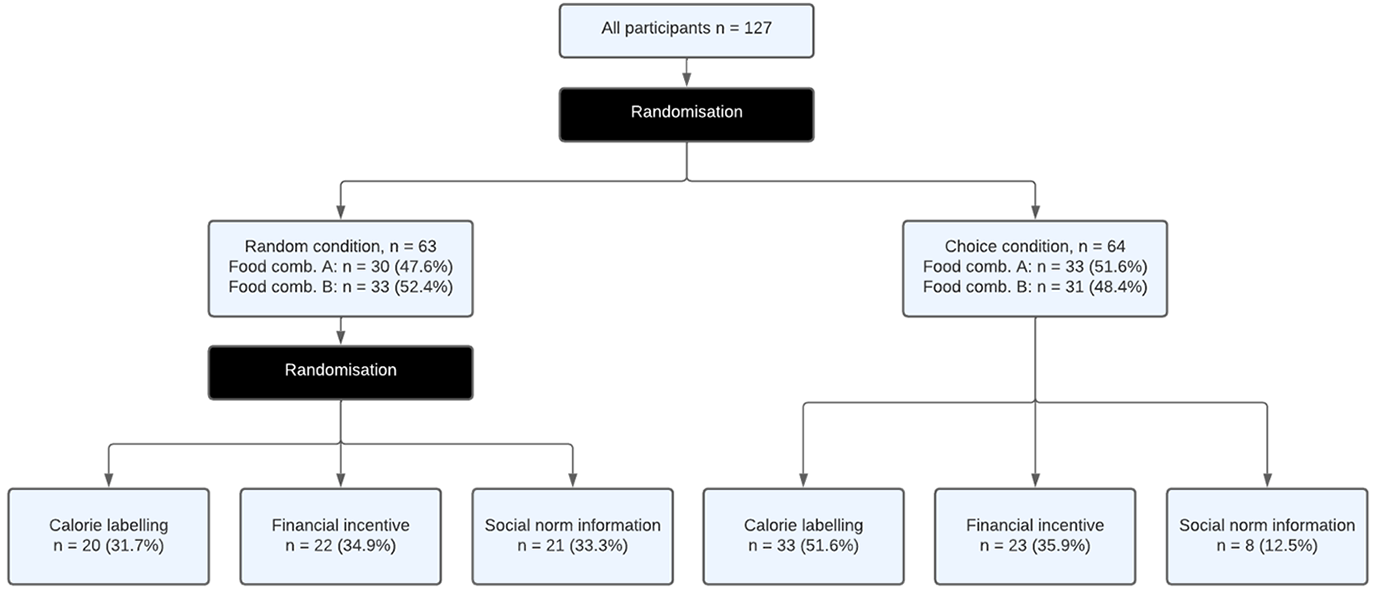
We conducted a pilot study between April and May 2023, with 127 students recruited on university campuses in Rotterdam and Delft at places where people have lunch. The pilot aimed to assess the feasibility of the intervention design and to refine the implementation before the main experiment. Respondents were randomly assigned to one of two combinations of food items. The snacks used were (i) Food combination A: a single mandarin vs a snack-sized (18 g) candy bar (e.g., Mars), with an approximate price of ∼€0.20; and (ii) Food combination B: 70 g of grapes (packaged in plastic bags) vs a small bag of Lay’s potato chips (40 g), with an approximate price of ∼€0.40. If needed due to dietary preferences, pairings were manually assigned. The pilot used a doubly randomized control trial design, i.e., respondents were randomly assigned to a random and a choice condition, which determined if they would be randomly assigned interventions or chose between them (see Figure 1). After providing informed consent, respondents reported how hungry they were and stated their hypothetical preference between the snacks they were assigned. Respondents were informed that the Dutch government may consider different interventions on food choice and that one of the discussed interventions would be implemented (random condition) or instead ‘Imagine if we would implement an intervention to encourage you to pick the healthier option. Which of the following interventions would be most effective for you?’ (choice condition). Respondents in the choice condition chose one of the three interventions (described as shown under ‘Label’ in Table 1). Then, all respondents chose a snack with a random or chosen intervention in place. Respondents received the snack item that they picked in this second choice, as well as receiving €0.10 if they were assigned or chose financial incentives (and chose healthier snacks).
Doubly randomised control trial design used in pilot study.
Operationalisation of calorie labelling, financial incentive and social norm nudges for Food combinations A and B
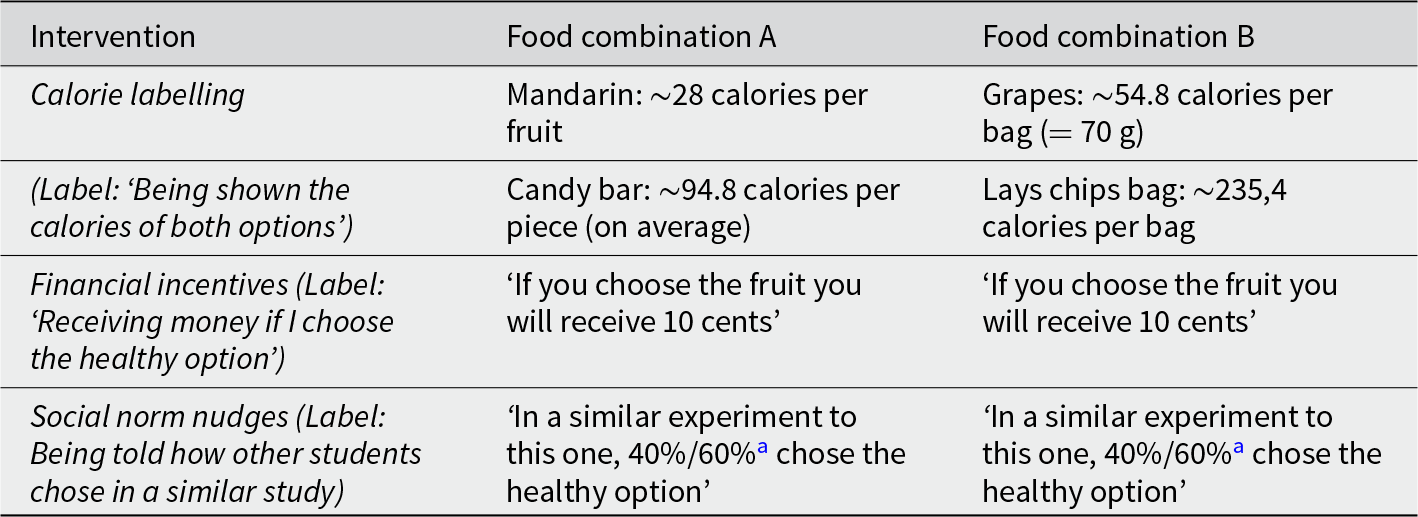
a Note: In the pilot, the social norm nudge was based on a previous study by Zhang et al. (Reference Zhang, Attema and Brouwer2024), who ran a laboratory-based study on snack choice with students in Rotterdam and found ∼40% healthy snack choices. In the main study, the social norm nudge was updated based on the pilot results, in which ∼60% of respondents chose healthy snacks.
The pilot data indicated that the food combinations and interventions were feasible and generated reasonable variation in snack preferences. Most respondents initially preferred the healthier option: 56.2% for Food combination A and 77.2% for Food combination B. As shown in Figure 1, all three interventions – calorie labelling, financial incentives and social norm nudges – were chosen by respondents in the choice condition, suggesting perceived relevance across the sample. However, interventions had limited overall impact. A majority (64.5%; 82 out of 127) chose the healthier snack both in the initial hypothetical choice and in the incentivised choice following an intervention. Only one respondent changed their choice after receiving a randomly assigned intervention, whereas 11 out of 64 (17%) in the choice condition switched to the healthier option after choosing an intervention. These findings should be interpreted cautiously, as the study had a small sample size and lacked an incentivised control group. The initial, unincentivised choice was used as a baseline, which may have inflated the number of respondents not changing snack preferences once interventions were used. Several design improvements were implemented in response. The main study introduced a no-intervention control group to enable clearer causal comparisons. Additionally, many respondents in the pilot did not accept the €0.10 financial incentive when it was handed to them, likely because the transaction costs outweighed its perceived value. While increasing the incentive might improve uptake, it would risk exceeding the value of the food items. Instead, in the main study, the incentive was physically attached to the healthier snack to reduce friction and increase salience.
Field experiment
Experimental design and procedure
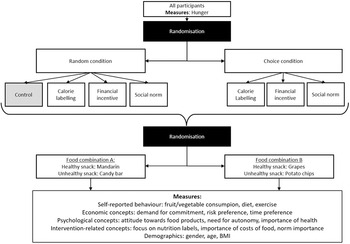
Figure 2 shows the experimental design used for the field experiment: a doubly randomised trial including a control condition (see also Appendix A for full details). Note that the control condition was implemented in the random arm, i.e., some respondents were randomly assigned no intervention. To avoid offering respondents the opportunity to opt-out, we decided not to include a no-intervention control in the choice condition. The experimental procedure was similar to that of the pilot study, albeit the field experiment included additional measures to explore a set of characteristics that may be associated with self-selection into different interventions (see ‘Measures’). Given that a control condition was included, no hypothetical choice between food items was included. The framing used to introduce (choice between) interventions remained identical. The interventions as well as the choice between them were described using the wording shown in Table 1.
Design and included measures for the field study.

Sample (size) and recruitment
The sample size for the field study was informed by the results of the pilot. That is, based on an a priori power analysis run with the pwr package in RStudio, with a recommended statistical power of 0.8, a significance level of 0.05 and a small to medium effect size (Cohen’s h = 0.40),Footnote 2 the analysis recommended a minimum sample size of n = 98 based on binomial tests (with two populations). As such, we decided to recruit 800 respondents, equally distributed across the random and choice condition. This ensured that approximately 100 respondents would be allocated to each of the interventions and no-intervention control, providing slightly higher power than the pilot suggested was necessary. In line with the pilot, recruitment took place on university campuses in Rotterdam, Leiden and The Hague. Data collection took place between October and December 2023, was paused in January 2024 (to avoid New Year’s resolutions affecting snack choices) and was resumed in February 2024. Unfortunately, given that participation was anonymous, we were unable to exclude respondents who completed the pilot study (or to avoid double-participation in the main study).
Measures
Some respondents may choose to eat their snack immediately while filling out the remaining survey. Therefore, before making their snack choices, respondents reported their hunger (on a scale from 1: Extremely hungry to 9: Extremely full). All other measures were completed after the respondent chose and received their snack, in the following order: self-reported behaviours, a set of concepts broadly clustered as economic, psychological and intervention-related and finally basic demographics, which included age (in years), gender, weight and height. We chose to obtain these measures (except hunger) after snack choices, to avoid spillovers from the measures on the main outcome (proportion of healthy snacks), as it is conceivable that, e.g., reporting on health behaviours makes respondents more inclined to choose healthily. Note that, as we provided no other incentive for survey completion than the snack individuals’ chose, we intended for the survey to be possible to be completed within 5–10 minutes and therefore used short measures.
Self-reported behaviours
We obtained self-reported measures of diet quality (‘How healthy would you rate your current diet?’ with the answering scale ranging from 1: Very unhealthy to 7: Very healthy), fruit and vegetables consumption (‘How often do you eat fruit/vegetables’ with answering scale ranging from 1: Never to 5: At least once a day) and exercise (‘How often do you exercise on average [e.g., sport or physically active pastime?]’ with the answering scale ranging from 1: Never to 5: More than 5 hours per week). These questions were adapted from the European Health and Behaviour Survey (Wardle and Steptoe, Reference Wardle and Steptoe1991).
Economic concepts
First, demand for commitment was measured, in line with questionnaire-based methods implemented in Lipman et al. (Reference Lipman, Boderie, Been and Van Kippersluis2026). That is, respondents were asked:
Imagine you have made plans to invest some amount of effort on a task you would normally not enjoy much, but has benefits in the future, for example: exercising, doing taxes, going to the doctor/dentist. To make sure you actually stick to your plan next week, you are offered to pay a small deposit. That is, you can pay €5 that you will receive back in full if you indeed stick to your plan (i.e., go exercise, do the taxes, visit the doctor), but is lost if you forget or postpone. Would you pay this deposit?
Respondents could respond on a 5-point answering scale (1: Yes, absolutely, 2: Yes, probably, 3: I’m not sure, 4: No, probably not and 5: No absolutely not). Respondents with scores of 1 and 2 are considered to have a demand for commitment. Furthermore, three statements were included to measure economic preferences, adapted from (Drichoutis and Vassilopoulos, Reference Drichoutis and Vassilopoulos2021). That is, we measure risk preference (I am generally a person who is fully prepared to take risks) and time preferences (I am generally an impatient/impulsive person), each scored on a scale from 1 to 5 (Strongly disagree to Strongly agree).
Psychological concepts
Attitudes towards the food products were measured with the following question: ‘Based on taste, how would you rate the healthy/unhealthy option that was provided to you’, scores from 1: Very distasteful to 7: Very tasteful. Need for autonomy was measured with a scale inspired by the Health Causality Orientations Scale developed in Altendorf et al. (Reference Altendorf, Van Weert, Hoving and Smit2019). It asked respondents on a scale from 1 to 5 (Strongly disagree to Strongly agree) how much they agreed with the following statements: (i) If I had to change my behaviour to get healthier, I would motivate myself; (ii) If I had to change my behaviour to get healthier, I would ask family and friends to motivate me; (iii) If I had to change my behaviour to get healthier, I would ask an expert to motivate me; and (iv) If I had to change my behaviour to get healthier, I would wait to get motivated eventually. The agreement on the first statement captures autonomy orientation, i.e., the need for autonomy. The second and third statements signal controlled orientation, and the fourth statement signals impersonal orientation. Finally, health motivation was measured by asking respondents, following Croker et al. (Reference Croker, Whitaker, Cooke and Wardle2009), their agreement, on a scale from 1 to 5 (Strongly disagree to Strongly agree), to the statement: ‘The effect of fruit and vegetables on my health is important to me.’
Intervention-related concepts
A single statement related to individuals’ potential preference for or response to each of the three interventions was adapted from earlier work, with respondents reporting their agreement on a scale from 1 to 5 (Strongly disagree to Strongly agree). For simplicity, we will interpret these as susceptibility to the interventions. The statement capturing susceptibility to calorie labelling was ‘I spend time looking at nutritional labels while shopping for my food’, adapted from Ellison et al. (Reference Ellison, Lusk and Davis2013). The statements capturing susceptibility to financial incentives and social norms were: ‘The cost of fruit and vegetables is important for me’ and ‘The amount of fruit and vegetables other people eat is important to me’. Both statements were adapted from Croker et al. (Reference Croker, Whitaker, Cooke and Wardle2009).
Data-analysis
We first reported descriptive statistics for the sample, and tested if randomisation was successful by comparing sample demographics across the random and choice condition. In these comparisons (as well as in subsequent analyses in the Appendix), respondents randomly assigned no intervention (i.e., control) are included among the random condition respondents. In all subsequent analyses, even though respondents randomly assigned no-intervention control were randomised to the random condition, we treated this subset as a baseline to which we compare the effectiveness of both chosen and randomly assigned interventions, and never included them among the random respondents in comparisons of intervention effectiveness. The remainder of the data analysis follows the three contrasts enabled by the doubly randomised control trial. To test Contrast 1 (Randomly assigned interventions), we compiled choices across Food Combinations A and B and used Chi-squared tests to determine if the proportion of healthier choices differed between respondents in the no-intervention control condition and those randomly assigned interventions. We also explored subgroup effects for randomly assigned interventions, which are reported in Appendix B. Contrast 2 (Choice vs Random) was also tested with Chi-squared tests, testing if the proportion of healthier choices differed between respondents who chose interventions or were randomly assigned an intervention. Finally, Contrast 3 (Chosen vs randomised interventions) was studied with two sets of analyses. First, we compared outcomes on the measures included between respondents choosing one of the three interventions in the experiment using a set of univariate tests (i.e., ANOVAs or Chi-squared tests). We rely on univariate tests due to the relatively large number of measures compared to the sample size, which limits the interpretability of multivariate regression models. These univariate analyses provide an indication of which types of individuals self-select into particular interventions, but cannot rule out that some measures may capture similar variation. In the final analyses, we compare intervention effectiveness between respondents who self-selected and those who were randomly assigned. That is, we report the results for Chi-squared tests comparing the proportions of healthier choices between respondents in the random and choice condition within each intervention. To examine whether having a choice, rather than self-selection by specific respondent types, influences intervention effectiveness, we conducted logistic regressions for each intervention. Snack choice (unhealthier vs healthier) was the dependent variable, with random vs choice condition as the independent variable. We controlled for all characteristics significantly associated with self-selection in univariate analyses.
Results
Sample demographics
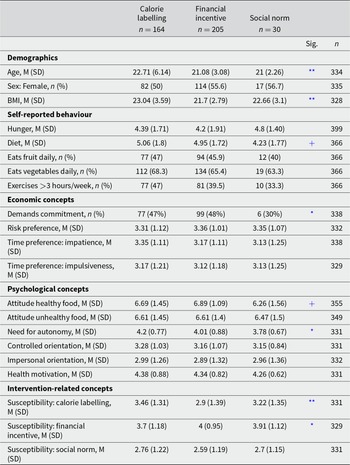
Descriptive statistics for the full sample are shown in Table 2, indicating a slight overrepresentation of younger and female respondents. Generally, respondents consume fruits and vegetables on a daily basis, get a reasonable amount of exercise and have a healthy body mass index (BMI). Interestingly, average attitude towards healthier food is more positive than towards unhealthier food. Respondents report a small but significant difference between the two food items (t(725) = 4.28, p < 0.001). In line with the timing of the data collection (around lunchtime), respondents were on average neither hungry nor full. Importantly, randomisation appeared successful, as no differences were observed in these sample demographics (i.e., none of the measures reported in Table 2 differed between respondents randomised to the choice or random condition including control). It is worth noting that more missing data are observed for questions asked later in the survey, indicating that a minority of respondents did not complete all questions and quit the study after receiving a snack. This is particularly pronounced for the demographics collected, with approximately 16% of the sample missing data on age, gender and BMI (note that Appendix C explores question-by-question attrition by condition and finds little to no evidence of differences in attrition between conditions).
Sample demographics (including split by condition)

a Note: Complete observations reported for the full sample to illustrate missingness across the different survey questions. For attrition by question and condition, see Appendix C.
Distribution across conditions and interventions
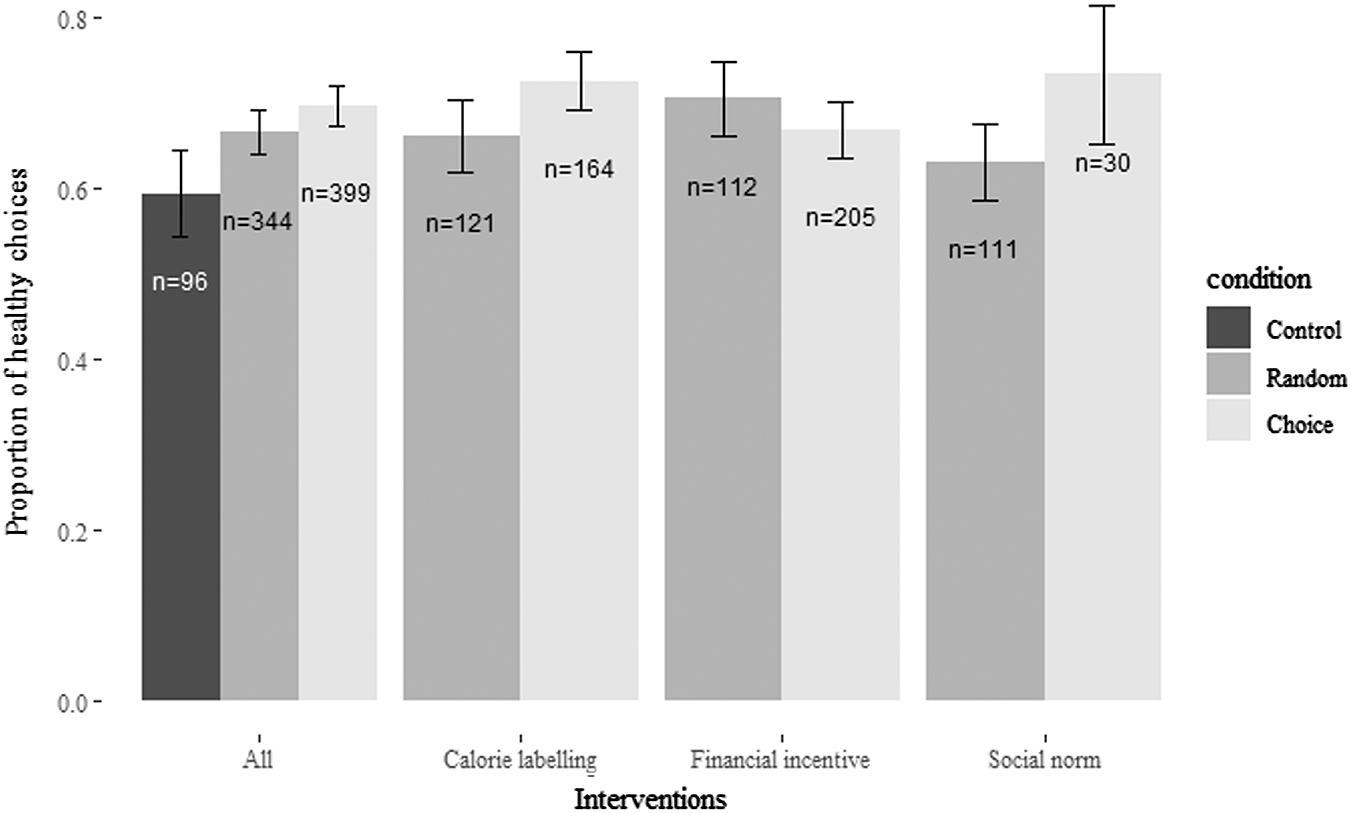
Figure 3 summarises the main descriptive results of the study, i.e., it shows how respondents were distributed across the interventions depending on their condition, as well as the proportion of healthier snacks chosen in the study (the minimum detectable effect size and choice frequencies across conditions are reported in Table D1 in Appendix D). Even though we randomly assigned respondents to the random and choice conditions, the sample was slightly skewed towards respondents in the random condition (which includes the no-intervention control). However, we found no evidence against independence with a Chi-square test (p = 0.16). Within the random condition, respondents were, as expected, roughly equally distributed across interventions (and control). The number of respondents in the no-intervention control group appears smaller, but we found no evidence against independence (Chi-square = 2.92, p = 0.43), suggesting the distribution of respondents was random as expected. Respondents in the choice condition were most inclined to choose a financial incentive, followed by the calorie labelling intervention. Only a few respondents (30 out of 399) self-selected into social norm nudges. As shown in Appendix C, throughout the survey, significantly more respondents in the choice condition dropout (note that this difference is not significant for the main dependent, i.e., snack choice).
Proportion of healthier snack choices by condition and intervention, with error bars indicating standard errors.
Contrast 1 (Randomly assigned interventions) and Contrast 2 (Choice vs Random)
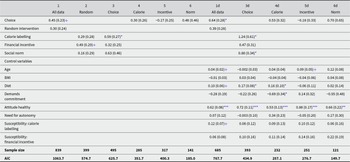
Overall, the majority of participants chose healthier snacks (see Figure 3), although snack choice depended on self-reported hunger.Footnote 3 Chi-squared tests comparing the effectiveness of each intervention within the random arm to the no-intervention control group provide no evidence against independence (Chi-squared values <2.37, all p-values >0.12), suggesting that randomly assigned interventions did not affect snack choices.Footnote 4 It is worth noting, however, that individuals randomly receiving small financial incentives, calorie labelling and social norm nudges were approximately 11, 7 and 4 percentage points more likely to choose a healthier snack than those in the no-intervention control. A logistic regression suggests that the effect of financial incentives approaches statistical significance (see Table 4 – Model 2).Footnote 5 Visual inspection of Figure 3 suggests that the proportion of healthier choices slightly increases from the control (59.4%) to the random condition excluding control (66.6%) and to the choice condition (69.7%). The difference in effectiveness between the choice and random conditions (excluding control) is not statistically significant (Chi-squared = 3.83, p-value = 0.15). Similar conclusions are reached when comparing the proportion of healthier choices between the control and random condition (Chi-squared = 1.41, p-value = 0.23). When comparing the proportion of healthier choices between respondents in the no-intervention control group and those receiving chosen interventions, some (marginally significant) evidence against independence is found (Chi-squared = 3.29, p-value = 0.07). This suggests respondents are more likely to choose healthier snack items when they can choose their own intervention, compared to no intervention at all (a result substantiated by logistic regressions reported in Table 4 – Model 1). In Appendix E, we report analyses examining potential mechanisms underlying the beneficial effect of choice (compared to no-intervention control) – specifically, whether the act of choosing itself promotes healthier decisions, or whether participants self-select into interventions with higher conditional average treatment effects.
Contrast 3 (Chosen vs Randomised interventions)
Table 3 shows results of univariate analyses for all demographics with the chosen intervention as the dependent variable. We find evidence for selection effects for the following variables: age, diet, demand for commitment, attitude towards the healthier food, need for autonomy and susceptibility to calorie labelling and financial incentives. As can be seen in Table 3, respondents selecting incentives and social norms seem younger than respondents selecting calorie labelling. Financial incentives are selected by those with a lower-than-average BMI and calorie labelling is selected by those with a higher-than-average BMI. The (small) group of respondents selecting social norms has a relatively low diet quality, is unlikely to demand commitment, has the least positive attitude towards healthier food and has the lowest need for autonomy. Self-rated susceptibility seems to follow selection into interventions: respondents who select calorie labelling agreed that they looked at calorie labels when shopping, and respondents with the highest agreement that the price of food is important are inclined to select into financial incentives.
Descriptive and frequency statistics for respondents choosing calorie labelling, financial incentives and social norm nudges

+ Note: *, **, *** signify p < 0.10, < 0.05, < 0.01 and < 0.001, respectively, in ANOVA tests (for continuous variables, reported with M [SD]) and Chi-squared tests for nominal/ordinal variables (reported with %).
In order to explore the mechanisms through which choice influences effectiveness of interventions, we ran logistic regressions in which all concepts above were also included as independent variable and thus controlled for (see Table 4). These analyses suggest that respondents choosing calorie labellings (Model 3 and also after controlling for demographics in Model 3d) and social norms (only after controlling for demographics in Model 3d) are significantly more likely to choose healthier foods. We find no evidence for differences between chosen and randomly assigned interventions (Models 4–6). For all models, the sign and significance of effects of choice do not change/diminish between models (Models 1, 3–6) with and without demographics respectively (Models 1d, 3d–6d). Some main effects related to the demographics are worth mentioning (for more insight into effects of control variables on snack choice, see Appendix B). Older respondents were more likely to select healthier food items. This trend is marginally significant when using all data (Model 1d), and when comparing respondents receiving financial incentives (Model 5d). Those with healthier diets were marginally significantly more likely to choose healthier snacks when using all data (Model 1d), and significant when comparing respondents receiving calorie labelling interventions (Model 4d). Demand for commitment is negatively associated with healthier food choice (in most models), significantly so only for respondents selecting the calorie labelling interventions (Model 4d). Unsurprisingly, positive attitudes towards healthier food are a strong and significant predictor in all models. Finally, we find a marginally significant result indicating that respondents who more strongly agree that they look at calorie labels tend to choose a higher proportion of healthier snacks (susceptibility: calorie labelling).
Logistic regressions with the healthier food choice as dependent variable

AIC, Akaike Information Criterion.
+ Note: *, **, *** signify p < 0.10, < 0.05, < 0.01 and < 0.001, respectively. Models 1(d)–3(d) use the control condition as baseline. Models 4(d)–6(d) are run on respondents who received one of the three interventions and take randomly assigned interventions as baseline.
Discussion
This study investigated the effectiveness of three types of interventions (calorie labelling, financial incentives and social norm nudges) in promoting healthier snacking, comparing the outcomes of interventions when they were chosen by participants vs randomly assigned. In a field experiment conducted on university campuses, we found that the majority of respondents (∼60%) prefer healthier over unhealthier snacks, even without interventions. Overall, chosen interventions (marginally) significantly increased the proportion of healthier snack choices compared to no-intervention control, whereas randomly assigned interventions increased the proportion of healthier choices but not significantly so. This result is in line with earlier work showing beneficial effects of choice-based interventions (Carlisle et al., Reference Carlisle, Ayling, Jia, Buchanan and Vedhara2022; Lipman et al., Reference Lipman, Boderie, Been and Van Kippersluis2026). Interestingly, whereas earlier work suggested that choice-based interventions have less respondent dropout and higher adherence (Carlisle et al., Reference Carlisle, Ayling, Jia, Buchanan and Vedhara2022), we find some evidence for differences in attrition between the choice and random condition in the opposite direction (i.e., more dropout in choice condition). A potential explanation for this discrepancy lies within the short duration of our field experiment, which involved only a single snack choice. If, as in most lifestyle interventions, chosen interventions are implemented on longer timeframes, the autonomy this enables and its associated increase in motivation may stimulate longer-term adherence. Alternatively, the specific intervention choices presented may not have resonated with all respondents (as found in Dieteren et al. (Reference Dieteren, Bonfrer, Brouwer and Van Exel2023), where certain groups of respondents opposed all types of listed interventions), potentially undermining the positive effect of adherence for choice.
In the (pilot and) field experiment reported in this article, we relied on interventions shown to be effective in promoting individuals’ healthier food choices. Our study, through its random condition, adds to this evidence base, as comparing randomly assigned interventions to the no-intervention control allows estimating a causal effect related to the interventions (Contrast 1). Indeed, when we randomly assigned these interventions to respondents to promote healthier snack choices, the proportion of healthier snack choices was higher for all three interventions. Yet, this difference was only (marginally) significant for the financial incentive intervention, suggesting that the causal effects of calorie labelling and social norms are either negligible or too small for our study to detect (see also Appendix D for minimum detectable effect sizes). Previous work aligns with our positive result for financial incentives to change dietary behaviour, whereby higher effects are found for larger incentives (Purnell et al., Reference Purnell, Gernes, Stein, Sherraden and Knoblock-Hahn2014). The financial incentive used in our study was small in absolute terms (previous work has used amounts such as $14 per percentage of weight loss after a few months, e.g., Purnell et al., Reference Purnell, Gernes, Stein, Sherraden and Knoblock-Hahn2014, compared to the €0.10 we relied on). However, respondents were only making a single snack choice between products priced €0.20 or €0.40, meaning that the financial incentive was a considerable intervention in relative terms. It is worth exploring how larger (e.g., €1), but perhaps even more so, how smaller financial incentives for healthier snack choices affect decision-making (e.g., €0.01). Understanding the effect of smaller financial incentives for healthier food choices, particularly when used over a prolonged timeframe (such as those used by Bachireddy et al. (Reference Bachireddy, Joung, John, Gino, Tuckfield, Foschini and Milkman2019) for physical activity), will be relevant for extending our results to practice.
The lack of effects for the randomly assigned calorie labelling and social norm nudge interventions contrasts with previous work. Two potential explanations may account for the lack of effects for randomly assigned calorie labelling. First, respondents might have had difficulty to put calorie content into perspective and to determine whether the given amount represents a high caloric value (for an unhealthier snack), especially since only calorie information was provided without additional nutritional details. As such, a traffic light system has been shown to be more effective in promoting healthy choices through food labelling (Cecchini and Warin, Reference Cecchini and Warin2016). Second, due to the small serving size the respondents were offered, respondents might have overestimated the calories in the unhealthier snack beforehand, which could have influenced them to opt for the unhealthier choice since the caloric content was lower than the expected amount (Tangari et al., Reference Tangari, Bui, Haws and Liu2019). Similarly, two potential explanations might have led to the ineffectiveness of the social norm nudge. First, the proportion choosing the healthier option in the social norm message was relatively low at 60%, compared to previous studies that used percentages such as 80% (Robinson et al., Reference Robinson, Thomas, Aveyard and Higgs2014). Second, a boomerang effect may have influenced some respondents, leading respondents to react against perceived pressure to conform to the social norm message by choosing the opposite behaviour (Cho and Salmon, Reference Cho and Salmon2007).
Our study, by offering respondents the option to choose between interventions, also allows studying the type of interventions respondents select into and believe will help them make healthier choices (i.e., Contrast 3). While less intrusive interventions are generally favoured (Nuffield Council on Bioethics, 2007; Lancsar et al., Reference Lancsar, Ride, Black, Burgess and Peeters2022; Dieteren et al., Reference Dieteren, Bonfrer, Brouwer and Van Exel2023), most respondents in this study chose the more intrusive intervention, i.e., financial incentive. Two possible explanations may account for this choice. First, earlier work studying preferences for intervention types usually explores this within the context public policy, and, as such, involves implementation of interventions on long timeframes (Lancsar et al., Reference Lancsar, Ride, Black, Burgess and Peeters2022; Dieteren et al., Reference Dieteren, Bonfrer, Brouwer and Van Exel2023). This experiment is framed on a much shorter timeframe, i.e., it asks respondents what intervention would help them for one snack choice. This also implies that respondents themselves immediately profit from incentives, which may not be the case with public policy. Second, allowing respondents to choose may have provided them with a sense of control, making them more open to interventions that they might not consider desirable when imposed. Choosing more intrusive interventions might also be linked to respondent characteristics. For example, although not statistically significant, respondents selecting calorie labelling had the highest mean need for autonomy. On the other hand, financial incentives were more commonly chosen by respondents who demand commitment, suggesting that those with demand for commitment may recognise their need for a more intrusive intervention.
Using our doubly randomised control design, we can directly compare the effects of the same intervention when it is self-selected vs randomly assigned (against no-intervention control), both with and without controlling for characteristics that predict choice. A set of regression analyses suggests that after controlling for demographics associated with the choice of intervention, chosen calorie labelling and social norm nudges significantly promote healthier food choices (compared to no intervention control), whereas we find no evidence for beneficial effects of chosen financial incentives. Collectively, these results suggest that (i) the overall beneficial effects of choice are driven by respondents choosing calorie labelling and social norms interventions, and (ii) characteristics associated with selecting into interventions do not (fully) explain the beneficial effects of choice. When we compare the effects of each intervention for the random and choice condition, we find no significant differences between intervention effectiveness (both with and without controlling for demographics). However, the signs of the coefficients suggest that selecting calorie labelling and social norms may indeed increase the propensity to choose healthier snacks but this propensity decreases when respondents choose financial incentives. Note that our study is likely not sufficiently powered to identify these differences, even though they seem economically significant.
Financial incentives show a marginally significant effect in the random condition but no significant effect when chosen, suggesting that self-selecting this intervention does not enhance its effectiveness. This result has a few potential explanations. First, characteristics that we did not include in our survey may be associated with choosing financial incentives, which are also associated with unhealthier snack choices. An example could be socio-economic status (SES), which has been found to affect preference for and effectiveness of incentives (Mantzari et al., Reference Mantzari, Vogt, Shemilt, Wei, Higgins and Marteau2015; Resnik, Reference Resnik2015) as well as high propensity to consume unhealthier foods (Hulshof et al., Reference Hulshof, Brussaard, Kruizinga, Telman and Löwik2003). As such, without controlling for such characteristics, potential beneficial effects of choice may be masked as these respondents would have higher baseline propensity to choose unhealthily. Second, this may be a consequence of respondents strategically selecting into an intervention that they stand to gain from. Regardless of individuals’ characteristics, financial incentives may still provide a compelling reason to change behaviour if the potential upside is large enough (note that the exact amount was not specified when respondents chose interventions). In fact, (self-interested) economic rationality would predict that all respondents prefer this intervention, as calorie information is freely available and social norm nudges are of little relevance to a rational actor aiming to maximise utility. When, as our pilot suggested, the financial incentive was considered to provide little motivation (if transaction costs were non-zero, many people opted out of the incentive), people may instead stick with ‘normal snacking’ and choose an unhealthier snack.
Our results show that self-selected interventions (marginally) significantly increased healthy snack choices while randomly assigned interventions do not and provide some insight into the mechanisms behind this effect. However, overall we find no difference in effectiveness between chosen and randomly assigned interventions, as chosen interventions are only round 3% more effective, which is considerably smaller than the minimum detectable effect size this field experiment is powered for (see Appendix D). This suggests that while choice may provide a modest benefit, the study was underpowered to detect such a small effect reliably, meaning the lack of a statistically significant difference between random and choice conditions does not imply that choice has no effect. In exploring the mechanisms of choice, we primarily examined the role of self-selection by identifying characteristics associated with intervention choice and including these as covariates in subsequent analyses. Since controlling for observed self-selection does not alter our conclusions, one interpretation is that the benefit of choice stems from increased autonomy. However, several alternative explanations warrant consideration. First, unobserved factors may still influence self-selection despite our controls. Second, participants who chose their intervention might have felt compelled to act consistently with their choice. To test this, we predicted likely intervention selections for randomly assigned participants using a multinomial model trained on the choice group, then compared healthy snack choices between those matched and mismatched to their predicted selection. Results (Appendix E) indicate that receiving an intervention that was predicted to be selected without explicitly choosing is associated with healthier choices, suggesting that alignment, rather than the act of choosing itself, may partly explain the effect. This result is in line with findings by Delevry and Le (Reference Delevry and Le2019). Third, those in the choice group may have selected into interventions with inherently higher effectiveness. For example, financial incentives were both the most popular and most effective intervention in the random group. We explored this in Appendix E by reweighting outcomes in the random group to match the choice group’s intervention distribution. This modestly improved overall effectiveness but did not eliminate the gap in effectiveness compared to respondents in the choice condition, suggesting that intervention selection plays a role but does not fully account for the advantage of choice.
This study has several limitations that can be addressed in future work. First, the convenience sample of university students severely limits external validity, as students generally eat too many unhealthy snacks (Stok et al., Reference Stok, De Vet, De Ridder and De Wit2016), but also have characteristics associated with healthier food choices, such as higher education levels (Hulshof et al., Reference Hulshof, Brussaard, Kruizinga, Telman and Löwik2003). Students are also generally more influenced by social norms compared to older adults (Nuffield Council On Bioethics, 2007; Mcgill et al., Reference Mcgill, Anwar, Orton, Bromley, Lloyd-Williams, O’Flaherty, Taylor-Robinson, Guzman-Castillo, Gillespie and Moreira2015; Stok et al., Reference Stok, De Vet, De Ridder and De Wit2016). Collectively, these findings caution against extrapolating our finding that healthy snacks are generally preferred over unhealthy snacks, as well as cautiously interpreting the evidence we provide for intervention effectiveness in the random condition. An even more pressing concern would be if the effects of choosing interventions are different in young, predominantly female and highly educated individuals. Some evidence supporting this notion is found in Coles et al. (Reference Coles, Fletcher, Galbraith and Clifton2014), who show women benefit from choice whereas men benefit from being assigned a single option. We believe exploring effects of choice as a tool for tailoring in different demographic groups (e.g., SES and age) understudied topic, which is especially important given the considerable inequality in health outcomes and health behaviour across demographic groups (Mackenbach et al., Reference Mackenbach, Valverde, Artnik, Bopp, Brønnum-Hansen, Deboosere, Kalediene, Kovács, Leinsalu and Martikainen2018). Therefore, policymakers aiming to use choice should carefully consider potential equity effects of choice.
Second, although a-priori sample size calculations based on a pilot study informed the target sample size, the effects from the pilot were considerably larger than those observed in the field study. Consequently, our study is likely insufficiently powered, especially since every respondent only provided a single binary decision. However, some of these null results may hold economic significance, as, e.g., 6–8 percentage point reductions in unhealthier snacking would make a meaningful difference in population health if it can be realised long-term. Third, most behavioural interventions including choice applied in practice will involve the opportunity to choose multiple options simultaneously, rather than just a single option from a discrete list, or allow recipients to experiment with different options before settling on their final intervention (Fedlmeier et al., Reference Fedlmeier, Bruijnes, Bos-de Vos, Lemke and Kraal2022). Our one-shot field experiment, in our view, provides a lower bound and short-term view of the effectiveness of choice as a tool for tailoring, therefore limiting the policy-relevance of our results. Future work should explore the effects of repeated opportunity to choose interventions as well as bundles of multiple interventions.
Fourth, unfortunately, we did not randomise the order in which respondents were shown interventions when choosing between them (neither in the field experiment nor pilot), suggesting that the selection of interventions may be affected by order effects. Yet, the most popular intervention differed between the pilot and main experiment, whereas the order remained constant. This suggests that order effects could have influenced the chosen interventions, but do not completely drive them. Fifth, to explore heterogeneity in respondents’ chosen interventions, we selected brief self-reported measures used in earlier work. Some of these may not be an optimal proxy of the construct we aimed to measure. For example, we adapted from previous work the following statement related to the susceptibility to incentives: ‘The cost of fruit and vegetables is important for me.’ However, receiving money for choosing fruit is conceptually different from considering its price when shopping. Future work may further explore the characteristics we find (not to be) associated with intervention choice with dedicated measures.
Sixth, we were unable to set up the study to completely avoid double participation. However, we believe that the risk of double participation is small, as data for the main experiment were collected by a single experimenter who may have been recognisable to respondents, and the population of potential respondents is large as the universities from which respondents were recruited collectively had approximately 75,000 students registered. Double participation risks may have been largest after the break we implemented in January to avoid New Year’s resolutions affecting our study, so to see if these respondents drive our results we explored the robustness of our main results against excluding the data obtained from February onwards and found that our conclusions were unaffected (see Appendix F). Seventh, all measures obtained to explore heterogeneity in chosen interventions were obtained after respondents chose between healthier and unhealthier snacks. This implies that the chosen snack and the conditions in the experiment could have affected outcomes on the measure, which raises concerns about their validity as a predictor in subsequent analyses. However, as shown in Appendix C, only 2 out of 20 measured characteristics differ between the random (including control) and choice condition, suggesting that spillovers on these measures due to our experimental design are limited.
Finally, an important limitation, that limits the generalisability of our results, is that we did not measure respondents’ prior intentions to eat healthier and/or change snacking behaviour. It is conceivable that beneficial effects of choice may depend on whether individuals desire to change their behaviour in the first place, and real-world applications of choice would likely involve respondents with a prior intention to change their behaviour. We did collect information on a related concept: health motivation. In Appendix F, we report our main results while distinguishing between those that assigned lower and higher importance of the effect of fruits and vegetables on their health, which suggests our conclusions do not depend on the importance respondents assign to healthy eating.Footnote 6 Many of these limitations can be avoided by replicating and/or extending our study of choice-based personalisation in mHealth interventions, e.g., as part of co-created or co-designed interventions (Jessen et al., Reference Jessen, Mirkovic and Ruland2018; Verbiest et al., Reference Verbiest, Corrigan, Dalhousie, Firestone, Funaki, Goodwin, Grey, Henry, Humphrey and Jull2019).
In conclusion, this study provides evidence that allowing individuals to choose their own interventions can slightly increase healthier snack choices compared to no intervention, whereas randomly assigned interventions do not significantly affect the proportion of healthier choices. Potentially, this effect occurs because the chosen intervention aligns with their personal characteristics and preferences, but in our study, controlling for those characteristics did not diminish beneficial effects of choice. Self-selected and randomly assigned interventions might impact the effectiveness of specific interventions differently, indicating heterogeneous effects and suggesting that introducing freedom of choice is not universally beneficial. Why some individuals (e.g., those choosing incentives) experience little benefit from choice remains an open question that future work should study carefully.
Supplementary material
To view supplementary material for this article, please visit https://doi.org/10.1017/bpp.2026.10036.
Acknowledgements
Dr Lipman’s work is supported through the Smarter Choices for Better Health initiative.
OA Funding statement
Open access funding provided by Erasmus University Rotterdam.
Open access funding provided by Leiden University.
Competing interests
The authors declare none.






 Open access

