

Introduction
Women are disproportionately affected by climatic changes. Moreover, the social organisation of productive and reproductive labour shapes their disproportionate vulnerability to climate risks (UN Women 2022). At the same time, despite relatively high economic growth, the Indian economy has had to contend with slow structural transformation and inadequate creation of good and sustainable employment, so that over 80% of the workforce is informally employed (State of Working India 2018). In contrast to other developing economies and despite decline in fertility and expansion of female education, women’s labour force participation rateFootnote 1 in India was low and on a broadly declining or stagnant trend from the 1980s until 2017–2018 (Klasen Reference Klasen2019; Goldar and Aggarwal Reference Goldar and Aggarwal2024). Since then, women have been largely entering the paid workforce in distress-driven agricultural self-employment, prompted by the slowdown in the Indian economy before and during the pandemic (State of Working India 2023). Even with the increase, the female labour force participation rate in India was the lowest among the G20 economies in 2021 (Fernandez and Puri Reference Fernandez and Puri2023). This paper raises the key question as to whether these two issues – low rates of women’s participation in paid work and its interactions with climatic changes – can be addressed through more active government intervention in the context of the Indian economy.
Women’s relatively low participation in paid employment compared to men has been explained in traditional economic models as a rational choice as it allows women to specialise in housework in which they are relatively more productive. However, this discussion has been effectively contested by feminist economics analyses (Benería et al Reference Benería, Berik and Floro2015). The traditional analysis overlooks discriminatory practices in the household and in the labour market and the consequent historical undervaluation of women’s labour (Benería et al Reference Benería, Berik and Floro2015). There are wide-ranging benefits to expanding public employment for women, such as attaining gender equality in paid work, improving job security, pay, and relative quality of working conditions, and improving conditions for collectivisation (Sinha et al Reference Sinha, Ghosh, Gupta and Gupta2020).
Mainstream economic analyses also view climate change as a market failure, which can be addressed by minimising government intervention (Chomsky and Pollin Reference Chomsky and Pollin2020). However, there is a strong case for more forceful government intervention to address the climate crisis (Chomsky and Pollin Reference Chomsky and Pollin2020). As Christophers (Reference Christophers2024) argues, investment decisions are driven by expected profit, and the relative profitability of fossil fuels-based energy production indicates the need for more, and not less, government intervention and support in the clean energy transition. Further, although there is great potential to create employment opportunities for women in the clean energy sector, this can only create transformative changes in women’s lives with socially progressive policies, such as state intervention to create accessible, high-quality public services (Baruah Reference Baruah2015).
Towards this end, I consider the transformative potential of a gendered and green job guarantee programme in India directed towards five sectors: education, health, public transport – or universal basic services (UBS) – as well as climate mitigation and adaptation activities. Public provisioning of basic services can redirect the economy towards prioritising human well-being within planetary limits (Gough Reference Gough2019). A UBS proposal estimated that a modest expansion in the public education and health systems in India by hiring in vacant positions and eliminating the infrastructural shortfall, can create more than 2 million jobs (Abraham et al Reference Abraham, Thampi, Pande and Basole2019). Recognising and regularising the employment of ‘honorary workers’ and contractual workers in these sectors, which include significant proportions of women workers, can improve the quality of work for another 3 million workers (Abraham et al Reference Abraham, Thampi, Pande and Basole2019). Public provisioning of education and health services is also argued to implement national emissions strategies better than market systems (Gough Reference Gough2019). With respect to transport, an expansion of public transportation systems can potentially lead to reduced use of private transportation and consequent reductions in emissions. Such systems can also increase women’s access to employment opportunities and paid work participation (Lei et al Reference Lei, Desai and Vanneman2019; Vakulabharanam and Motiram Reference Vakulabharanam and Motiram2023). UBS with a job guarantee cannot only address economic insecurity but can also resolve the contradictions between social and ecological objectives (Hickel Reference Hickel2023). As for the other two sectors of climate action in the proposal, the urgent need for expansion in climate mitigation and adaptation activities in India to meet emissions targets and build adaptive capacity, has been highlighted (Pollin and Chakraborty Reference Pollin and Chakraborty2015; Thampi Reference Thampi2023). As compared to investing in fossil fuel-based energy production, green energy investments create more gender equitable employment (Azad and Chakraborty Reference Azad and Chakraborty2018). As such, this article explores the gendered and environmental implications of a job guarantee programme directed towards these five sectors.
Through this paper, I make the following contributions. First, the literature on the interactions between women’s work and the climate crisis and the gendered and environmental impacts of the existing rural employment guarantee in India, are reviewed. Secondly, the framework of a gendered and green job guarantee programme is advanced as a form of government intervention towards addressing issues in women’s work and climate action in India. Thirdly, the gender-disaggregated employment effects and budgetary implications of such a programme are estimated, and potential sources of finance are suggested.
The next section conducts a stocktake of the literature on gendered livelihoods, the interactions with climatic changes, and the rural job guarantee programme in India, in addition to a brief discussion of the international experiences of such programmes. The review of literature motivates the proposal for a gendered and green job guarantee programme, and the implications of such a programme for women’s work and climate action are then discussed. The fourth section discusses the sources of data and methodology. Next estimates and discussion of the gender-disaggregated employment effects and budgetary implications of the proposed programme are offered. The final section discusses the findings and potential sources of financing the programme and concludes with the limitations and prospects for further research.
Stocktaking: gendered and green livelihoods and job guarantee programmes
The climate crisis and gendered working lives
Severe climatic changes are expected in India by the end of the twenty-first century, such as a sharp increase in the frequency and duration of heat waves, the variability of monsoon rainfall, and a rise in the average temperature as compared to the 1976–2005 baseline period (Krishnan et al Reference Krishnan, Sanjay, Gnanaseelan, Mujumdar, Kulkarni and Chakraborty2020). Extreme weather shocks have gendered effects, including the withdrawal of women from the paid workforce due to increased domestic work (Fruttero et al Reference Fruttero, Halim, Broccolini, Coelho, Gninafon and Muller2023). Climate-related hazards decrease access to resources such as water and increase the burden of unpaid household labour on women, particularly in households that rely on farming or agricultural labour (Rao et al Reference Rao, Prakash, Hans, Patel, Hans, Rao, Prakash and Patel2021). A systematic review of 60 published studies on the impact of climate change on women workers revealed that women face distinct challenges in adapting to climate-related shocks because of their care responsibilities, differential access to resources, discrimination in the labour market, as well as cultural barriers (Jain et al Reference Jain, Tewathia and Barik2023).
However, a policy review of 28 state action plans on climate change in India revealed that, although gender is explicitly mentioned as a mediator of vulnerability and adaptive capacity to climate shocks, such concerns are unevenly operationalised (Singh et al Reference Singh, Solomon and Rao2021). There is an urgent need to improve the adaptive capacity of women through secure and sustainable livelihoods, and potential response strategies include diversification into non-agricultural livelihood opportunities (Jain et al Reference Jain, Tewathia and Barik2023).
The job guarantee programme in India and international contexts
It is in this context that the experiences of job guarantee programmes in India and international contexts are considered. In Argentina, the 2002 Plan Jefes employment guarantee created productive assets (Wray Reference Wray2006). By 2005, almost 75% of Plan Jefes workers were women, and the majority of them were from the poorest income quintile, so much so that the programme was renamed to ‘Plan Jefes y Jefas Hogar Desocupados’ or ‘Programme for Unemployed Male and Female Household Heads’ (Narayan Reference Narayan2022b). Elsewhere, such as in South Africa and the United States, public job creation in the provisioning of care services has been estimated to result in pro-poor income growth patterns (Antonopoulos and Kim Reference Antonopoulos and Kim2011). Similarly, a study of a proposed job guarantee programme in Greece estimated that paid employment could have been provided to between 22% and 64% of the unemployed in 2012, depending on the scale of the programme (Antonopoulos et al Reference Antonopoulos, Adam, Kim, Masterson and Papadimitriou2014). Based on the experience of the Productive Safety Nets Programme in Ethiopia, affirmative action for women may be needed to see differential patterns in women’s participation in public works than in the general labour market (Quisumbing and Yohannes Reference Quisumbing and Yohannes2005). The implication of such policy principles validates the design of India’s rural job guarantee programme which reserves one-third of the jobs for women, as well as proposals to give priority to women in a national urban programme (Drèze Reference Drèze2021; Narayanan and Abraham Reference Narayanan and Abraham2024). The international experiences, particularly in developing country contexts, reflect the potential of job guarantee programmes to create employment that benefits women and marginalised groups, expand provisioning of care services, and create productive assets. These experiences offer additional strength to the proposal advanced in this paper.
In India, the existing Mahatma Gandhi National Rural Employment Guarantee Act (MGNREGA) 2005 ensures the legal right to work in rural areas through the guarantee of 100 days of employment in a year to one member of each registered household. Along with the legal entitlement to the right to food, the right to work reinterpreted the fundamental right to life as the right to live with human dignity, as opposed to its earlier interpretation as non-interference of the state with individual liberty (Mander et al Reference Mander, Parulkar and Aggarwal2018). The local authority issues a job card to the registered household, and the job card lists all adult members who are eligible to work under the programme. One of the listed members can apply for work, and it is to be provided within 15 days and within five kilometres of the village. The list of works is to be decided by local councils after open village meetings, and social audits are to be held twice a year. If work/wages are not provided within two weeks of request/ work, the worker is entitled to compensation. As of October 2024, MGNREGA had created 44.20 billion person-days of work at an expenditure of around INR 228.25 (approximately 2.70 USD) per person per day (Government of India 2024a).
Private sector wages are estimated to have increased as a result of the implementation of MGNREGA, and the programme has benefited even non-participants of the programme (Imbert and Papp Reference Imbert and Papp2015; Berg et al Reference Berg, Bhattacharyya, Rajasekhar and Manjula2018). However, implementation issues as well as a general withdrawal of the state from providing social security (Paliath Reference Paliath2023) have resulted in a cut in the budget for the programme to around 0.2% of the GDP in the union budget 2023–2024, which was a 34% cut over the revised estimates of the previous year’s budget. Nevertheless, there is evidence of the benefits of the programme for women’s work and environmental conservation, as well as in improving adaptive capacity, and estimated employment creation (as discussed below) which, in turn, could strengthen support for the proposed gendered and green job guarantee programme.
The MGNREG Act provides for reservation of one-third of the jobs for women and includes gender-sensitive provisions such as equal wages, availability of work for pregnant and lactating women, provision of basic worksite facilities including crèches, worksites within five kilometres of the applicant’s residence, priority to women to be appointed as work supervisors, and support in opening bank accounts. There is a more equal social composition of MGNREGA workers in terms of gender and caste (Drèze and Khera Reference Drèze and Khera2017; Basole and Jayadev Reference Basole, Jayadev, Ocampo and Stiglitz2018), and it has consistently been the case that 50% or more of the workers are women (Narayan Reference Narayan2022a). Field surveys of MGNREGA women workers in six states in 2008 revealed that these women were able to access better employment opportunities at minimum wages locally with relatively safe working conditions (Khera and Nayak Reference Khera and Nayak2009). There is also evidence of a large number of bank accounts being opened after the implementation of the programme, which may allow women greater control over financial resources (Chopra Reference Chopra2019).
However, the provision of worksite facilities such as childcare facilities, as stated in the Act, is not always met, and this hampers women’s work participation (Narayanan Reference Narayanan2008; Khera and Nayak Reference Khera and Nayak2009). There are also reports of pregnant and lactating women being refused work at worksites (Chopra Reference Chopra2019). The nature of work is also deeply gendered and often guided by gendered norms, with men engaging in digging, which is paid a higher wage, while women are involved with more lowly paid moving soil (Chopra Reference Chopra2019).
The MGNREG Act also refers to natural resource management as a focus area and lists public works for groundwater recharge, watershed management, renovation of water bodies and irrigation channels, and afforestation (Government of India 2005, 2024b). Some of the listed works on rural infrastructure directly relate to adaptation measures to extreme weather events, such as flood control, storm water drains, and cyclone shelters (Government of India 2005, 2024b). Others include essential infrastructure, such as sanitation facilities, anganwadi centres, and foodgrain storage structures, all of which could be constructed using environmentally sustainable materials and methods (Government of India 2005, 2024b).
Studies of MGNREGA works in different parts of India report environmental benefits such as groundwater recharge, improved water availability, reduction in soil erosion, and improved tree cover (Sharma Reference Sharma2010; Ministry of Rural Development 2012; Esteves et al Reference Esteves, Rao, Sinha, Roy, Rai, Rao, Sharma, Rao, Patil, Murthy, Srinivasan, Chaturvedi, Sharma, Jha, Mishra, Singh, Rakhroy, Rai, Sharma, Schwan, Basu, Guerten, Porsché, Ranjan, Tripathy and Ravindranath2013). An assessment of the wells constructed under MGNREGA in the state of Jharkhand revealed that a majority of the surveyed users found the wells to have had useful benefits in terms of water availability, cultivation, and diets (Aggarwal et al Reference Aggarwal, Gupta and Kumar2012). In a study of Kaimur district in Bihar, a majority of the MGNREGA works were identified as ‘green jobs’ (ILO 2010). However, natural resource-based works are increasingly less under MGNREGA (Bhaskar et al Reference Bhaskar, Shah and Gupta2016).
Thus, the works under the job guarantee programme in India have supported women’s work and advanced environmental conservation and climate adaptation measures, even though the quality of the programme has been questioned. There is a reported ‘unmet’ demand for work, which prevails to a greater extent in the poorest states (Dutta et al Reference Dutta, Murgai, Ravallion and van de Walle2012). Delays in payments, or even non-payment, of wages or compensation have also been reported (Aggarwal et al Reference Aggarwal, Gupta and Kumar2012; Narayanan et al Reference Narayanan, Dhorajiwala and Golani2019). The effectiveness of implementation varies across states, including for the urban employment guarantee programmes in Kerala and Himachal Pradesh (Chathukulam et al Reference Chathukulam, Joseph, Rekha, Balamurali and George2021; Choragudi Reference Choragudi2022).
Nevertheless, the urgent need for an urban employment guarantee programme to address the livelihoods crisis in India has been recognised (Chandrasekhar and Ghosh Reference Chandrasekhar and Ghosh2021), and proposals for an urban employment guarantee programme in India have been developed (Basole et al Reference Basole, Idiculla, Narayanan, Nagendra and Mundoli2019; Drèze Reference Drèze2020, Reference Drèze2021). Basole et al (Reference Basole, Idiculla, Narayanan, Nagendra and Mundoli2019) proposed the creation of a National Urban Employment Guarantee Programme with a legal right to work for the residents of small- and medium-sized towns. Informed by these proposals, the Bhagat Singh National Urban Employment Guarantee Bill 2022 was tabled in Parliament. Through this paper, I contribute to the discussions on the need for an expanded and strengthened job guarantee programme by proposing a framework that prioritises women’s work and climate action.
Proposal: a gendered and green job guarantee programme
Is there a case for an expanded and strengthened job guarantee programme? A job guarantee programme can secure livelihoods, unlike the market system which cannot guarantee continuous work for all those who seek it (Skidelsky Reference Skidelsky2019). As Minsky (Reference Minsky2008 [1986]) noted, only the government can separate the availability of employment opportunities from profitability. Minsky (Reference Minsky2008 [1986], 343) also notes the potential for government employment guarantee programmes to ‘yield outputs that advance well-being, even though the outputs may not be readily marketable’. This includes ‘public services, environmental improvements … as well as the creation and improvement of human resources’ (Minsky Reference Minsky2008 [1986], 347). Motivated by this discussion, this paper proposes expanding the job guarantee to a gendered and green programme directed towards five sectors: education, health (where women constitute significant proportions of the workforce), and public transport – or UBS – as well as climate mitigation, and climate adaptation activities. An expansion of these sectors through such a programme has the potential to generate guaranteed and secure employment, estimates for which are discussed below.
Although the idea of UBS was not developed with the intention of addressing the issues of women’s work or the climate crisis, the gendered and environmental benefits of investing in public provisioning of basic services have been highlighted. In the UK, a UBS programme has been recommended with the objectives of meeting basic needs directly, as well as promoting equality and environmental sustainability (Social Prosperity Network Report 2017; Coote and Percy Reference Coote and Percy2020). UBS can support women in unpaid care work and childcare through the health and education systems (Büchs Reference Büchs2021), and thereby enable women’s greater participation in paid work. UBS can also be explicitly designed to promote environmental sustainability, such as by prioritising renewable energy sources of electricity (Büchs Reference Büchs2021). Public provisioning of basic services can enable a just decarbonisation of the economy and strengthen the capacity of communities to adapt to or cope with disasters and extreme weather events (Gough Reference Gough2019).
Earlier studies have included public transport among climate mitigation activities (Pollin and Chakraborty Reference Pollin and Chakraborty2015; Azad and Chakraborty Reference Azad and Chakraborty2023) I analyse it here as a separate sector to highlight its additional role in promoting women’s paid work. Aside from potential reduced use of private transportation and the consequent reductions in emissions, the expansion of public transportation facilities can improve women’s labour force participation. In rural India, an improvement in transportation infrastructure is found to increase women’s participation in non-agricultural employment. Thus, government investment in transportation is recommended to increase women’s access to employment opportunities (Lei et al Reference Lei, Desai and Vanneman2019). Certainly, improving public transportation systems in Indian cities in order to increase women’s paid work participation is a major recommendation following the observations from a field survey which demonstrated that women’s paid work participation is higher in cities and city zones where transportation facilities are better (Vakulabharanam and Motiram Reference Vakulabharanam and Motiram2023).
I also consider the gendered implications of investing in climate action. A climate mitigation programme, with renewable energy expansion and increase in energy efficiency, creates more jobs for women than an equivalent amount of investment in the fossil fuel industries (Azad and Chakraborty Reference Azad and Chakraborty2018). In this paper, I update these estimates (after separating public transport) for employment creation under climate mitigation activities in the job guarantee programme. There are, to my knowledge, no available estimates for women’s employment creation through climate adaptation activities in India. Earlier work estimates the overall employment creation through such activities (Thampi Reference Thampi2023), and I extend this work to estimate the gender-disaggregated employment figures under the gendered and green job guarantee.
Data and methodology
For estimating job creation, the 2022 input–output table (IOT) for India from the Asian Development Bank (ADB) database was used along with the Periodic Labour Force Survey (PLFS) 2023–24. The PLFS is a nationally representative employment survey conducted by the Ministry of Labour and Employment. The survey collects information on the educational status, usual activity status, industry, and nature of work of each member of the sampled household, among other employment-related information.
The methodology to estimate job creation through the input–output framework is based on Miller and Blair (Reference Miller and Blair2022). The work participation rates, disaggregated by sector and sex and estimated using PLFS 2023–24 data, were multiplied with the population projections for July 2023 (Technical Group on Population Projections 2020) to estimate the number of workers across industries. These figures were then divided by the levels of output across industries to yield the employment-output coefficients of industries. I calculated the simple employment multipliers by multiplying the employment-output coefficients with the Leontief inverse matrix of the IOT for India. The number of direct jobs generated through stimulating economic activity in the same industry and the number of indirect jobs generated through stimulating demand in other industries supplying intermediate inputs, were estimated.
A synthetic job guarantee sector that includes the five priority sectors was constructed. The sectors are education, health, public transport (or UBS), and climate mitigation and adaptation activities. The education and health sectors are available in the IOTs. However, the other three activity types are not directly captured in IOTs, and synthetic sectors were constructed for each of these. The synthetic sector for climate mitigation included the expansion of renewable energy sources and increases in energy efficiency, and the weights for this sector and for public transport were applied as in Pollin and Chakraborty (Reference Pollin and Chakraborty2015). The synthetic sector for climate adaptation was constructed and associated weights were applied as in Thampi (Reference Thampi2023). The synthetic climate adaptation sector included five representative activities, namely, safe houses (in case of disasters); cooling centres or winter shelters (in case of extreme heat or cold); seawalls (to adapt to sea level rise); water storage reservoirs (in case of drought); and mangroves or wetlands (to adapt to the risk of flooding).
Employment creation: a gendered and green job guarantee programme
In this manuscript, I propose an expanded and strengthened job guarantee programme directed towards women’s work and climate action. The activities in the job guarantee programme are to be channelled into UBS (namely, education, health, and public transport) and climate mitigation and adaptation activities. In this section, I discuss the gender-disaggregated employment estimates created through this programme.
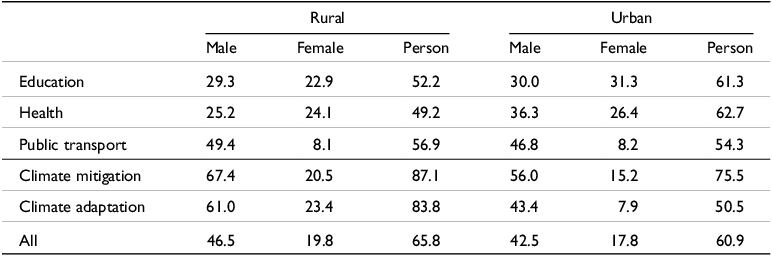
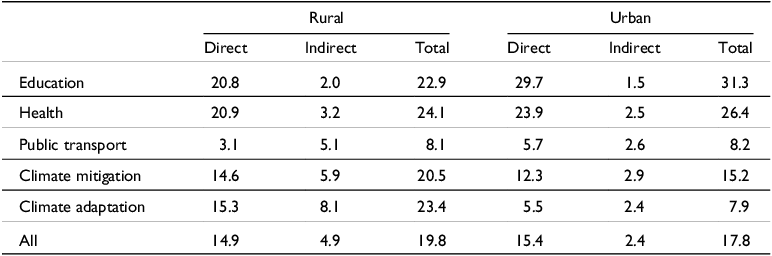
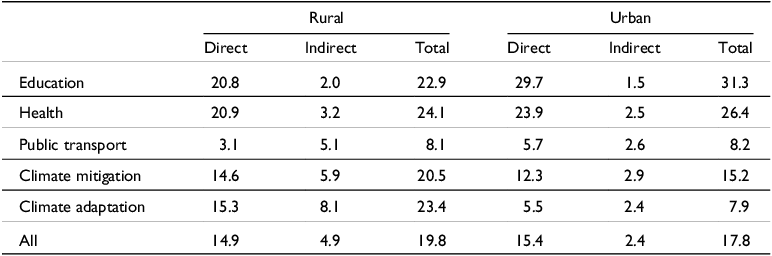
Investing USD 1 million in the gendered and green job guarantee programme, equally divided between the five sectors, would create around 66 jobs in rural areas and 61 jobs in urban areas (Table 1). The other core thrust of the programme is on increasing women’s paid work participation. As such, the gender-disaggregated employment creation by investing in the programme has been estimated, separately for rural and urban areas. Investing USD 1 million in the programme would create around 20 jobs for rural women and 18 jobs for urban women (Table 2). The employment estimates for men are 2.3 times higher than for women in rural and urban areas. Although the number of jobs is higher for men, the programme creates much more gender-equitable employment than an equivalent amount of investment in a fossil fuel-based energy programme – in which male employment creation is 4.5 times higher than for women in rural areas and 5.1 times higher in urban areas.
Table 1. Estimated employment creation with gendered and green job guarantee programme in India

Source. Calculated using ADB 2022 input–output table and PLFS 2023–2024.
Note. Weights for climate adaptation, mitigation, and public transport as used in Thampi (Reference Thampi2023).
Table 2. Estimated direct and indirect employment creation for women with gendered and green job guarantee programme in India
Source. Calculated using ADB 2022 input–output table and PLFS 2023–2024.
Note. Weights for climate adaptation, mitigation, and public transport as used in Thampi (Reference Thampi2023).
Of the 20 employment opportunities created for women in rural areas, 15 are direct jobs created by stimulating demand in the same sector and 5 are indirect jobs created in related sectors supplying intermediate inputs (Table 2). Of the 18 jobs for urban women, around 15 are direct jobs and the rest are indirect jobs. In rural areas, all of the sectors in the programme, apart from public transport, contribute 20 jobs or more to women’s employment. In urban areas, the education and health sectors create the highest number of employment opportunities for women with 31 jobs and 26 jobs, respectively. This is to be expected as the input–output analysis builds on existing employment multipliers, and high proportions of women workers in non-agricultural employment are currently employed in these sectors. The figures for overall employment creation analysed below indicate that climate mitigation and adaptation activities also have the potential to contribute significantly towards increasing women’s paid work participation.
In the next step, I assess the required budget to implement the gendered and green job guarantee programme. The recommendation in official reports is to increase public education spending to 6% (Ministry of Education 1966; Ministry of Human Resource Development 2020), but the current spending is only around 4%. The recommendation in health manifestos of civil society organisations such as Reclaiming the Republic, Jan Swasthya Abhiyan, Alliance of Doctors for Ethical Healthcare, and Vikalp Sangam, is to increase public spending on health to 3% of the GDP from its current proportion of around 1% (the latest such document is Jan Swasthya Abhiyan 2024). An overall spending of 3.7% of GDP on public and private transport is recommended (Mohan Reference Mohan2016), and the current spending is 1.7% (The Economist 2023). In this paper, I therefore propose that half of the gap between the recommended and actual spending be devoted to the expansion of public transport. The annual adaptation costs for climate hazards in India are estimated to be around 1.5% of the GDP (ESCAP 2022). In estimating job creation, I assess that at least this amount would need to be spent on climate adaptation activities under the job guarantee programme. The need is to spend an equivalent 1.5% of the GDP on climate mitigation activities (Pollin and Chakraborty Reference Pollin and Chakraborty2015; Azad and Chakraborty Reference Azad and Chakraborty2018). As per these recommendations, the spending on education and health would need to be increased by 2% of GDP each, the spending on public transport by 1% of GDP, and the spending on climate adaptation and mitigation by 1.5% of GDP each. This would amount to 8% of GDP.
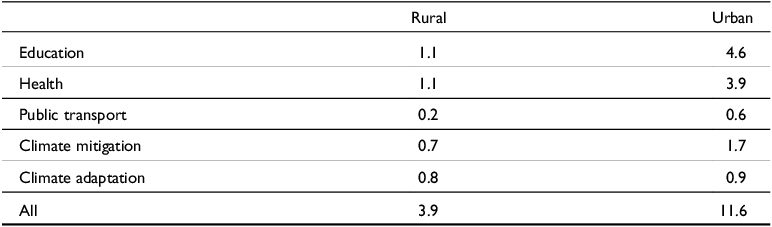
Such a programme would thus result in the creation of an estimated 36 million jobs. This accounts for around 6% of the workforce as of 2023. Of this, around 6 million jobs are created for women in rural areas, which accounts for 4% of the rural female workforce (Table 3). In urban areas, 5.6 million jobs are estimated to be created for women, accounting for 11.6% of the urban female workforce. On the whole, the gendered and green job guarantee programme is estimated to create 11.6 million employment opportunities for women, which accounts for 5.8% of the overall female workforce as of 2023.
Table 3. Estimated overall employment creation for women as shares of rural/ urban female workforce (%) with gendered and green job guarantee programme in India

Source. Calculated using the estimates in Table 2, and the GDP of 2023 as reported in the World Development Indicators databank.
Note. Based on policy recommendations for increase in sectoral allocations, this proposal allocates increases of 2% of GDP each to education and health, 1% to public transport, and 1.5% each to climate mitigation and climate adaptation.
The education and health sectors create new employment opportunities for women to the extent of 2.2% of the rural female workforce and as much as 8.4% of the urban female workforce. Investing in climate mitigation and adaptation activities can also contribute significantly to women’s employment creation, together accounting for 1.5% of the rural female workforce and 2.5% of the urban female workforce. Although expanding public transportation systems may not directly create equivalent numbers of jobs for women, the benefits of such an expansion for increasing women’s access to employment opportunities and labour force participation have been noted in Section 3. Thus, an expansion of UBS, climate mitigation, and climate adaptation under guaranteed public employment would be a strong move forward for women’s sustainable livelihoods, in addition to its benefits for climate action and improving human development outcomes.
Discussion and conclusion
The Sustainable Development Goals have emphasised the achievement of gender equality in Goal 5, productive and decent work for all in Goal 8, and urgent action to address climate change in Goal 13 (United Nations 2015). This article has explored the interlinkages between these three goals and proposes a gendered and green job guarantee programme to advance these goals in the context of India.
The Indian economy has been characterised by low rates of women’s labour force participation, despite high economic growth, a decline in fertility, and advances in female education (Klasen Reference Klasen2019). Even the recent increase in women’s participation rate in the labour force has been largely in distress-driven agricultural self-employment (State of Working India 2023). At the same time, climatic changes are expected to disproportionately affect women with an increase in their domestic work burden as well as agricultural work after male household members migrate to urban areas as an adaptive strategy (Rao et al Reference Rao, Lawson, Raditloaneng, Solomon and Angula2019). In this paper, I argue that a gendered and green job guarantee programme, focussed on UBS, climate mitigation, and adaptation activities, can improve women’s work participation and promote climate action.
A stocktaking reveals the intersections between gendered livelihoods and the climate crisis in the Indian context. The gendered and environmental impacts of the existing rural job guarantee programme are discussed, along with the implementational issues. The experiences of other job guarantee programmes in international contexts offer additional strength to the proposal. The stocktaking also identifies the transformative potential of investing in UBS, climate mitigation, and climate adaptation activities for increasing women’s paid work participation, promoting environmental sustainability, and improving human development outcomes.
The gendered and green job guarantee programme prioritises education, health, public transport (or UBS), climate mitigation, and climate adaptation activities. I estimate that the programme would result in the creation of 36 million guaranteed jobs, which accounts for 6% of the workforce as of 2023. Of these jobs, women’s employment opportunities constitute 11.6 million. The number of guaranteed jobs created for women accounts for 4% of the rural female workforce and 11.6% of the urban female workforce. Thus, a gendered and green job guarantee programme in India has the potential to address the interlinked issues of women’s work and climatic changes.
Following policy recommendations to increase spending on each of these sectors, the programme is estimated to cost 8% of the GDP as of 2023. The programme can be financed partly through a wealth tax system. Globally, a minimum tax on the super-wealthy has been recommended by the Independent Commission for the Reform of International Corporate Taxation (Stiglitz and Ghosh Reference Stiglitz and Ghosh2024). India is among the most unequal countries in the world, and tax justice plans that only tax the wealth and inheritance of the super wealthy in India (constituting 0.04% of the adults in the country) have been estimated to generate annual revenues to the extent of 2.73% (baseline variant), 4.59% (moderate variant), or 6.08% (ambitious variant) of the GDP (Bharti et al Reference Bharti, Chancel, Piketty and Somanchi2024). These revenues could be large enough to nearly double the combined public education and health budgets (Bharti et al Reference Bharti, Chancel, Piketty and Somanchi2024). Additionally, Annex II or developed countries, as identified by the United Nations Framework Convention on Climate Change, have obligations, on the basis of historical emissions and current capabilities, to contribute towards financing climate action in developing economies. At the 29th Conference of the Parties, India was strongly critical of the USD 300 billion finance deal advanced by developed countries (Carbon Brief 2024). This proposed deal fell far short of the projected need of emerging markets and developing countries (other than China) for external finance of at least USD 1 trillion per year by 2030 (Bhattacharya et al Reference Bhattacharya, Songwe, Soubeyran and Stern2024). The need for climate financing from such countries can be further justified and supported with the design and implementation of the gendered and green job guarantee programme.
The input–output method adopted in this study faces the limitation that it does not account for changes over time in the production structure. As noted in earlier studies, it is however assumed that relative elasticities across sectors stay broadly similar (Azad and Chakraborty Reference Azad and Chakraborty2023). In addition, the quality of work in terms of earnings, working conditions, and social security benefits is not captured in the exercise itself. However, a government job guarantee programme has the potential to transform the quality of work through regulations and requirements in minimum wages and working conditions. Further research could carefully explore the design and effective features of job guarantee programmes in international contexts from the perspectives of women’s work and climate action, and such studies could be used to inform the design of the gendered and green programme in India.
Tcherneva (Reference Tcherneva2020, 3) notes that ‘Job Guarantee is a policy of care, one that fundamentally rejects the notion that people in economic distress, communities in disrepair, and an environment in peril are the unfortunate but unavoidable collateral damage of a market economy’. This study explores and estimates the potential for such a policy of care for women and for the environment in India.
Acknowledgements
I thank the two anonymous reviewers and the guest editors, Anne Junor and Yuvisthi Naidoo, for their detailed and constructive comments that greatly improved the manuscript. Feedback from colleagues at the Political Economy Research Institute and the Levy Economics Institute during presentations of earlier versions of this manuscript is also gratefully acknowledged. Any remaining errors are my own.
Anjana Thampi is an assistant professor of economics at Jindal Global Law School, O. P. Jindal Global University, India. Her recent and ongoing projects include job creation through climate adaptation, gendered inequalities in wealth, and the impact of food provisioning programmes in India.