





1 Introduction
If it is better never to have been, then is it better to cease to be? This question arises from the anti-natalist notion that it is better never to have existed. Immediately, the answer seems intuitive: if life is so bad as to suggest it is better not to experience it in the first place, then why not “return” to that state of non-existence? Yet, once born, perhaps there are good reasons to stay alive, if only to delay a worse fate; as philosopher–poet al-Ma’arri states, “Refrain from procreation, for its consequence is death” (Häyry and Sukenick, Reference Häyry and Sukenick2024, 17). This, in essence, pertains to the connection between anti-natalism and pro-mortalism.
In academic philosophy, the most prominent anti-natalist is David Benatar (Reference Benatar2006).Footnote 1 Benatar argues that it is better never to have been due to (i) an axiological asymmetry between never having existed and existing,Footnote 2 and (ii) an awful quality of life for most people.Footnote 3 Yet, Benatar maintains that his anti-natalism does not imply pro-mortalism since death is bad for two reasons: it deprives us of future good things, and it annihilates us.
So far, suggestions that Benatar’s anti-natalism does imply pro-mortalism have sought to deny the viability of deprivationism (and, latently, annihilation) via the Epicurean view of death, which argues that death is neither good nor bad for us due to its non-experiential nature (McGregor and Sullivan-Bissett, Reference McGregor and Sullivan-Bissett2012; Sullivan-Bissett, Reference Sullivan-Bissett2022). Despite these challenges, Benatar (Reference Benatar2022) maintains that his anti-natalism does not imply pro-mortalism, retaining the view that deprivationism and annihilation can explain well the badness of death.Footnote 4
In this paper, I’ll go a step further. I will presuppose the badness-of-death theories – deprivationism and annihilation – that Benatar uses to deny pro-mortalism. But even so, I’ll demonstrate that Benatar’s anti-natalism still implies pro-mortalism, rendering death, most of the time for most people, if not always and for all, good overall. To demonstrate this, I’ll split the paper into two parts. The first will discuss deprivationism and its relation to anti-natalism; the second will discuss annihilation.Footnote 5
2 Part I – Deprivationism (instrumental value)
2.1 (A)symmetry
Deprivationism suggests that death is bad because it deprives us of good things we would have had if not for death. My death tomorrow would be bad because it would deprive me of finishing this paper. Benatar uses deprivationism to argue that his anti-natalism does not imply pro-mortalism, despite the anti-natalist argument that never existing is better than existing. This suggests there is an asymmetry between prenatal non-existence and posthumous non-existence.Footnote 6
In other words, the argument goes, before one is born, one cannot be deprived of good things in life since one does not exist as a subject who can be deprived. This reasoning allows Benatar to derive an argument for anti-natalism. In contrast, once one is born, existing as a subject with interests, death can deprive one of more good things. Thus, Benatar claims, the argument for anti-natalism – prenatal non-existence is better than existence – holds without the invocation of pro-mortalism – non-existence via death is not necessarily better than existence.
Yet, upon further examination, Benatar’s non-existence asymmetry appears tenuous. To demonstrate this, I’ll first describe the deprivationist method in more detail and then lay out Benatar’s second anti-natalist argument – the quality-of-life (QoL) argument – to see whether the benefits of life are enough to show that death is an overall deprivation, rather than an instrumental blessing.
Consider the deprivationist value of B’s death. First, take B’s life at a particular point in time, t. Then, compare two scenarios: (i) B’s life continues, as expected, after t, versus, (ii) in a counterfactual scenario,Footnote 7 B dies at t, and their life does not continue thereafter. In scenario (ii), we assess whether B’s death is overall good or bad based on the value they would have had in (i) had they not died. For example, assume death has a well-being value of zero,Footnote 8 so a life with an overall value above zero is good, and a life with an overall value below zero is bad.
Suppose the value B expects after t, if their life continues in (i), is negative overall (say, –100 units). In this case, B’s death in (ii) would be good overall, preventing negative value from transpiring. In other words, B’s life is not worth continuing after t. Conversely, if B’s future value after t is positive overall (say, 100 units), their death in (ii) would be bad overall, as it would deprive them of positive value overall; therefore, their life would be worth continuing after t.
2.2 Quality of life and subjective appraisals
With the deprivationist method detailed, let us examine Benatar’s QoL argument, which details the value of people’s lives and shows how some lives are better than others. Benatar (Reference Benatar2006, 92, Reference Benatar2017, 67) suggests that “even the best lives … [are] actually very poor,” and a “charmed life is so rare that for every one such life there are millions of wretched lives.” For example, Benatar argues we ought to regret the daily experiences of hunger, thirst, weariness, tiredness, itches, headaches, and minor illnesses; the frequent frustrations, irritations, and dissatisfactions; the experience of self-deprecation, false acclamation, grief, anxiety, and depression; and the widespread diseases and viruses.
Many will find this outlook pessimistic. I shall not assess whether Benatar’s QoL perception is accurate; I will only illustrate that, assuming it is accurate, it follows that, despite deprivationism, death is good for the person who dies. This is because the not-so-rosy assessment – that even the best lives are very poor (Benatar, Reference Benatar2017, 67) – means that unless one is a rare outlier for whom life is not very poor, one’s quality of life likely corresponds with overall negative value after t. Of course, one will have fulfilled desires, achievements, and love. But, equally, such goodness, according to Benatar, is exceeded by its counterpartsFootnote 9 – unfulfilled desires, failure, and heartbreak (Benatar, Reference Benatar2006, 70–71). As a result, death would not deprive one of a good life but instead spare one from a bad life overall.
However, we should aim to identify the best life under the QoL argument. This will, at least, show us whether any lives are worth continuing. To do so, we must identify the value of death when it occurs at the worst possible time. Benatar (Reference Benatar2017, 130) states, “as one ages beyond one’s prime, the badness of death gradually diminishes … because death deprives one of less.”Footnote 10 So, there is a prime in one’s life at which point death would be worst because it deprives one of the most. In old age, one has passed one’s prime and is more likely to suffer from decrepitude and various age-related ailments (Benatar and Wasserman, Reference Benatar and Wasserman2015, 50–69). Therefore, one’s prime is when one has plenty of interests, is most likely free from physical ailments, and has the capacity to fulfil desires.
However, that dying in one’s prime is the worst time to die does not imply that death would be bad overall. It only suggests that some deaths are worse than others. Further, it does not negate the prime-indiscriminative harms that Benatar describes, such as illness, hunger, irritation, frustration, and potential psychological issues.
Still, perhaps we can strengthen the prime case further – a benefit-of-the-doubt endeavour – by idealising a prime life with even less harm after t. That is, envision a prime life also free from prime-indiscriminative harms, such as those detailed as well as chronic conditions and interpersonal strife. Could we suggest that a person living such a life has it good enough for death to be bad overall?
Such a prime and harm-free life stands the best chance of being worth continuing. However, to get to this point, we’ve focused on an implausible category of lives – those in their prime without the many harms that Benatar says are prevalent in all of us. Thus, whilst we can say it is worse to die in one’s prime than in old age, the kind of prime life we’re searching for to demonstrate a bad death overall is unrealistic, particularly under the pessimistic QoL argument.
At this point, it seems that all lives are not worth continuing under Benatar’s QoL. However, there are further considerations that might make a difference. Consider that, regarding personal value, we might differentiate between how we perceive things as going and how things are actually going.
Benatar describes the QoL argument as an “objective” assessment of life – how things actually are.Footnote 11 However, the fact that we can perceive things differently can affect how things actually are. In other words, if we perceive life as better than it actually is, then life will actually be better. As Benatar states, “Thinking that one’s life is better than it actually is can make it better than it would otherwise be … whereby a positive subjective assessment actually improves one’s objective wellbeing” (Benatar, Reference Benatar2017, 70; Benatar and Wasserman, Reference Benatar and Wasserman2015, 44). These perceptions are “subjective appraisals.” I’ll now focus on their role since they might improve one’s quality of life, perhaps to such an extent that death would be bad overall.
Subjective appraisals can be more optimistically or pessimistically biased. For example, consider tendencies towards optimism. Many readers will disagree with the QoL argument, believing their lives to be much better. This, too, is what Benatar predicts, stating it is the result of psychological biases that gear us towards a more positive outlook.Footnote 12 They include (1) the Pollyanna Principle, which is “a tendency towards optimism” (Benatar, Reference Benatar2006, 64–65).Footnote 13 (2) Adaptation and fulfilment of desires, such that if one’s life is going poorly, one will lower their expectations to more feasibly obtainable goods (Benatar Reference Benatar1997, 352–353; Reference Benatar2006, 67–72; Benatar and Wasserman, Reference Benatar and Wasserman2015, 42–43).Footnote 14 And (3) comparisons, where one evaluates one’s life quality vis-à-vis others (Benatar, Reference Benatar2006, 68–69; Benatar and Wasserman, Reference Benatar and Wasserman2015, 43–54).Footnote 15
Whether these biases are truly present in QoL assessments is beside the point.Footnote 16 The key question is whether these biases, as positive subjective appraisals, could make a sufficient difference to one’s quality of life to imply that death would be an overall deprivation, despite the “objective” QoL assessment. For example, suppose one’s value after t is −20 units in quality; however, a positive subjective appraisal provides the value of 30 units. Therefore, one’s value after t would be 10 units overall; thus, one’s life would be worth continuing.
This possibility of subjective appraisals influencing one’s quality of life and, ipso facto, relationship to death warrants further exploration. This exploration is made possible by Benatar’s discussion of a threshold for a life worth continuing. There are, Benatar claims, three ways of standing in relation to the threshold. I will lay these out below and discuss their implications for pro-mortalism.
-
i) Those that even in the absence of the [subjective appraisal] feedback loop, are above the threshold that renders a life prudentially worth continuing.
-
ii) Those sufficiently beneath this threshold that the [subjective appraisal] feedback loop does not render life prudentially worth continuing (even if one cannot see that oneself).
-
iii) Those whose objective quality, absent the subjective over-estimation, is just below the threshold. In these cases, the effect of the subjective assessment on the objective quality might be sufficient for death not (yet) to be in one’s interests (Benatar, Reference Benatar2022, 148).Footnote 17
If one is above the threshold, their life is overall good (worth continuing). If one is below it, their life is overall bad (not worth continuing). So, in which category do people find themselves? As things stand, following the QoL argument, we know that people fall below the threshold for a life worth continuing. In turn, this rules out (i). Therefore, people are either in (ii) or (iii).
In paying attention to (iii), we get a greater sense of the role of subjective appraisals. First, subjective appraisals play an influencing role, albeit a limited one.Footnote 18 That is, if one’s life is really bad, such that they fall into (ii), then a cheery outlook will not make a sufficient difference to flip the value of death from good to bad. However, if people fall into (iii), then, granted a positive outlook, they might rise above the threshold. If so, we can say their deaths would be bad.
Now, the overwhelming impression from the QoL argument is that most lives are markedly poor. Indeed, part of the reason Benatar argues that most, if not all, people should not procreate is not because life is slightly worse than good enough but rather because it is much worse than we generally (wish to) believe. If so, it is implausible to suggest that the quality of people’s lives is anything but (ii). As such, no matter how upbeat one is about life, one’s death would be good.
Still, the benefit of the doubt might suggest that some lives are in (iii). For this, envision that those just below the threshold are in their prime. Thus, should those in their prime positively evaluate their life, they might surpass the threshold, and so their deaths might be bad.
“Might” points towards several conditions, including that one is in one’s prime, free from many (unavoidable) harms, and sufficiently biased towards a positive outlook. Thus, we’re narrowing the scope significantly, not just regarding the ideal-yet-unrealistic prime life but also the optimistic requirement of subjective appraisals. Moreover, even on this generous view, it still seems that one would be barely above the threshold and have a life barely worth continuing. In other words, death would only be a slight deprivation.Footnote 19
Therefore, if life is as bad as suggested in the QoL argument, death is good for most, if not all, of us. The scenario in which death might be bad relies on several contingencies unlikely to be realised by many people, if any. That is, one must be in one’s prime with heightened positive values and an unrealistic lack of negative ones, and one’s subjective appraisals must also be sufficiently positive. Even then, it still seems a life barely worth continuing.
2.3 A return to procreative asymmetry
When we last spoke of the procreative asymmetry, I suggested it avoided a pro-mortalist outcome. However, the discussion we’ve had since implies that both Benatar’s procreative asymmetry and QoL arguments lead to pro-mortalism. Recall the asymmetry’s avoidance of pro-mortalism: Existence necessitates harm, so it is better never to have been. The question, then, becomes if existence is harmful, why not cease to be and return to the harmless state of non-existence? The reason is that there is an asymmetry between the two states of (prenatal and posthumous) non-existence because death deprives one of interests.
One might believe that this deprivation of interests, regardless of the quantity or quality of the interests, is sufficient for the asymmetry to avoid a pro-mortalist outcome. In other words, the very fact that death deprives implies that it is bad for us. However, this is a weak argument to block pro-mortalism.
First, to avoid a pro-mortalist outcome here, we must use an overly simplistic form of deprivationism, in which we do not refer to good and bad values overall. That is, all we’re doing is assessing whether any single deprivation exists. However, this does not fully capture the deprivationist method, which requires that we assess the good and bad values overall. To see why, suppose the benefits of life were shallow compared to its harms, such that one had a nice meal once a week but walked on hot coals the rest of the time. In that case, we would surely focus on whether death would be a deprivation overall, not just the simple fact that death would deprive one of a nice weekly meal. Therefore, for deprivationism, we have to attend to good and bad values overall. Contextually, this is achieved by supplementing the asymmetry with the QoL argument. In doing so, we can see that the asymmetry also implies pro-mortalism.
Second, the asymmetry argument alone is, in Benatar’s (Reference Benatar2012, 146) words, “insufficient to yield the anti-natalist conclusion.” That is, the argument for anti-natalism is stronger when the asymmetry and QoL arguments are combined. Without the QoL argument, the asymmetry argument only demonstrates that to exist is to experience harm. However, the argument against coming into existence is weak without the qualification of just how harmful existence is. Thus, for a stronger anti-natalist view, the asymmetry has to be supplemented with the QoL argument. And when it is, as stated, we attain a pro-mortalist outcome.
3 Part II – Annihilation (final value)
3.1 Introduction
Thus far, we have considered death’s badness regarding its deprivationist role, where I’ve argued that death is overall good through the lens of Benatar’s anti-natalism. In The Human Predicament (Reference Benatar2017), however, Benatar goes beyond merely deprivationism as a (potential) explanation of death’s badness. As he states,
It is entirely possible that death is bad for more than one reason. It could be that the badness of death is, at least sometimes, overdetermined.
One possibility we should consider is that death is bad in large part because it annihilates the being who dies (Benatar, Reference Benatar2017, 102, italics added).
Thus, the conclusion reached in Part I may not be absolute if we take seriously the claim that the badness of death can be overdetermined. In doing so, we must move from deprivationism to annihilation. Philosophically, annihilation is less developed than deprivationism. According to Benatar, annihilation is best understood as a particular conception of death. Consider two possible conceptions: psychological death and biological death. Psychological death refers to the irreversible end of “personal conscious experience,” including the permanent cessation of “memories, consciousness, attachments, values, beliefs, desires, goals, and perspectives” (Benatar, Reference Benatar2017, 120). Biological death is technically clinical death, the cessation of vital biological functions.Footnote 20 Importantly, psychological death can occur prior to biological death, such as in a permanent comatose state, where one’s conscious self has permanently ceased, but one remains alive biologically.
Benatar (Reference Benatar2017, 109) describes annihilation as psychological death. There are intuitive reasons for this understanding, particularly when assessing its badness. For example, a young child’s or adult’s death is often perceived as worse than an infant’s, the latter of whose personal conscious experience is either non-existent or not yet developed enough to render death a severe loss for them (Benatar, Reference Benatar2017, 131).Footnote 21
3.2 Badness and value
The discussion of annihilation and pro-mortalism might quickly run into a dead end. This is because Benatar’s framing of annihilation’s value is ambiguous. Importantly, at one point, Benatar suggests it makes no difference “whether we see [annihilation] as the deprivation of an additional good or as a further loss over and above any deprivations it may cause” (Benatar, Reference Benatar2017, 110).
Contra Benatar, we now know that it does make a difference how we understand the value of annihilation, because if annihilation’s value is not distinct from deprivationism’s, then the former collapses into the latter, and we have an absolute pro-mortalist outcome. Thus, to get the discussion of annihilation off the ground, it is favourable to frame annihilation as axiologically distinct from deprivationism.
To do so, consider two important forms of value: instrumental value and final value. Instrumental value is value as a means to an end, whereas final value is value for its own sake, not as a means to an end. These forms of value detail a fittingness or an attitude that is appropriate to take towards the valuable thing in question (Garcia and Braun, Reference Garcia and Braun2022, 7). For example, it is fitting to value a pair of scissors for its instrumental ability to cut paper, whereas it is fitting to value a sunset for its own sake, not (merely) because it is instrumental in leading to something else valuable (Korsgaard, Reference Korsgaard1983, 172).
Now, deprivationism is tied to instrumental value: It is fitting to value death based on its depriving role. Can we say the same for annihilation? In other words, is it fitting to value annihilation for the same reasons as deprivationism, such that it is good or bad instrumentally? Recall that the charitable take is to distinguish annihilation from deprivationism. Thus, in the following, I’ll discuss the potential badness of annihilation by assessing arguments related to its final (dis)value, meaning, unlike deprivationism,Footnote 22 it is fitting to value annihilation as bad for its own sake, not merely as a means to another end.Footnote 23
3.3 Ego death
Perhaps annihilation is bad because it is the loss of the self, or what I’ll call “ego death,” and all it entails, such as the loss of “memories, values, beliefs, perspectives, hopes” (Benatar, Reference Benatar2017, 104). This fact, we might say, provides final disvalue to annihilation, for which it is fitting to value annihilation with correspondingly negative attitudes, such as, quite intuitively, fear and despair.
Yet, at the same time, this reasoning seems deprivationist. That is, we’re fundamentally talking about annihilation’s (dis)value in regards to what it takes away – deprives – even if we’re incurring an additional value – final (dis)value – in accordance with what the taking-away entails and how we should perceive it. In other words, talk of the badness of annihilation because it entails the loss of the self appears to imply badness in deprivation. Indeed, an existing theory of deprivationism, the General Deprivation Account (GDA), notes that it is bad to be deprived of “perception, desire, activity, and thought” (Behrendt Reference Behrendt2019, 190–191; Nagel, Reference Nagel2012, 2). Therefore, we can account for ego death as part of deprivationism via the GDA.
3.4 Good-natured annihilation
Imagine a venerated painting degraded beyond repair. Suppose there is no possibility of repairing the painting. In that case, it might be better to destroy it than to leave it in disarray. Perhaps it is more dignifying or respectful to the painter to do so. Yet, even though it would be better to destroy the painting than leave it, its destruction – its annihilation – is not good. Instead, its annihilation is merely the “lesser of two bads,” so it is still regretful (Benatar, Reference Benatar2017, 107).
If the same reasoning applies to humans, then we might say that, even if death is better than continued living (due to the failed deprivationist defence), the annihilation of a person is still bad and regretful. Indeed, regret might constitute a fitting attitude for annihilation’s final disvalue. If so, then we recognise something bad in annihilation, even if death was better for the person overall.
Granting this argument, does such an outcome affect the pro-mortalist conclusion? It seems fairly inconsequential to the overall pro-mortalist evaluation, giving regret to a badness that is, as Benatar admits, outweighed by greater considerations of what is good. In other words, we can say that something of value is lost when it is annihilated (be it a painting or a person), but it is still better that the thing in question is annihilated, owing to the undesirability of continued existence. Moreover, that is a generous conclusion, for it is not clear that the reasoning is sound. Through the anti-natalist lens, ought we consider the annihilation of a person akin to a venerated painting, seemingly highly valued works of art or natural beauty that are better to have than not to have? Instead, anti-natalist reasoning, be it the asymmetry or QoL argument, might imply that it is more accurate to relate people to things with drastically different values, such as statues of Joseph Stalin or Pol Pot, whose destruction does not evoke feelings of regret and for which it would have been better never to have been.Footnote 24
Benatar is honest about the connection being speculative. Perhaps neither the annihilation of statues of dictators nor venerated paintings accurately reflects the disvalue of a person’s annihilation. In any case, even if taken generously, the reasoning does not change the pro-mortalist outcome.
3.5 Mourning and rituals
Benatar also suggests that mourning demonstrates the badness of annihilation, even in cases when death was preferable to continued living. For example, consider a person in a hopeless situation and experiencing ongoing suffering. That we would not celebrate this person’s death but, despite their situation, mourn for them reveals something uniquely bad about death. This bad, Benatar (Reference Benatar2017, 109) suggests, “is the annihilation of the one who died.”
It is difficult to unpack this sentiment in a relatively short space, for the intuition reveals many complex behaviours related to grief and loss. For one, we might mourn such a loved one’s death because of how their passing is a fundamental loss to ourselves. At the same time, we might reasonably believe that their passing, as a relief from incessant suffering, was good for them.
Benatar (Reference Benatar2017, 107–108) pre-empts this line of reasoning by presenting the case of someone insensate and comatose with no hope of recovery. In such a case, he argues, their actual, biological death should not lead to mourning since the person was already “lost” when it became clear that their comatose situation was hopeless and irreversible. Thus, to mourn at their biological death implies something unique about annihilation.
However, Benatar’s argument fails to address the (potential) badness of annihilation. This is because it pertains to biological death, which is different from annihilation, which is psychological death. Thus, even if it’s the case that we mourn at one’s biological death even after they have died psychologically, we’re mourning something other than one’s annihilation as understood.
Still, there could be cases of mourning one’s psychological death rather than biological death. For example, it might be that family and friends become most grief-stricken when a loved one enters an irreversible comatose state, thus having died psychologically but not biologically. Does this aid Benatar’s claim? If we do mourn one’s psychological death, then there is, indeed, something unique about annihilation. However, without further qualification, we return once again to the reasons for mourning, for which we might be stricken by the loss to ourselves rather than necessarily how death was bad for the person who died, which is the consideration of this paper. Thus, even applying this reasoning, Benatar needs to do more to show why mourning one’s annihilation (psychological death) is necessarily tied to the badness of the death for the person who died.
3.6 Limbo man
The final argument that might demonstrate the badness of annihilation pertains to Frances Kamm’s (Reference Kamm1998) Limbo Man. Limbo Man differentiates from deprivationism by focusing on the decision to delay annihilation for no reason other than a preference to delay the end, even when doing so yields no tangible benefit.
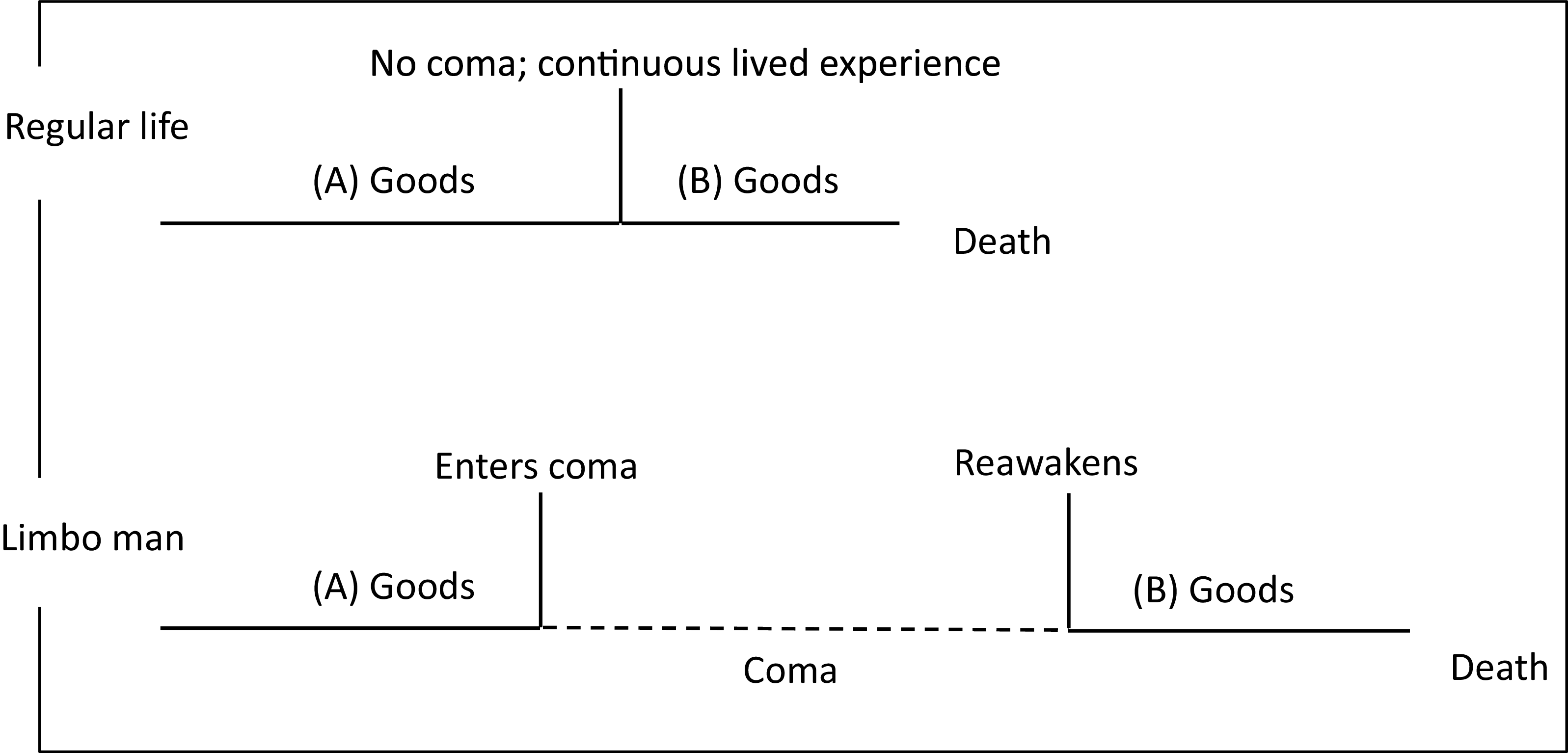
Limbo Man (Figure 1) has two choices. First, Limbo Man can live life as normal until death – a regular life, as it were. Alternatively, partway through life, Limbo Man can enter a coma. This coma will delay Limbo Man’s ageing and pause their conscious experience until they reawaken to experience the remainder of their life before death. This alternative offer – entering a coma – offers a longer lifespan by delaying death, even though the increased duration of life is not consciously experienced, and no additional goods are gained compared to the regular life (Kamm, Reference Kamm1998, 49–50). Additionally, the coma does not alter the life experiences Limbo Man would otherwise have had (Benatar, Reference Benatar2017, 106). For instance, everything valuable, such as family members, friends, and important circumstances, pauses so that Limbo Man does not miss out on anything valuable.
Limbo Man (Kamm, Reference Kamm1998, 50).
Note: Limbo Man also produces a prenatal and posthumous non-existence asymmetry since “prenatal nonexistence does not foreclose the possibility of the continuation of life once begun,” whereas posthumous non-existence does (Kamm, Reference Kamm1998, 49). Moreover, Kamm (Reference Kamm1998, 51) argues that Limbo Man would not have the preference to exist earlier in a comatose, non-experiential state. That is, there’s no desire to extend one’s life “backwards” non-experientially, whereas once alive, there’s a desire, according to Limbo Man, to extend one’s life into the future non-experientially.

Thus, Limbo Man enters the coma solely to delay annihilation, a preference that demonstrates the badness of annihilation even when there is no additional deprivation in death.
Since we could prefer to postpone things being all over, even if this did not increase the total amount of goods we had in our life, we must be trying to avoid something about death other than that it diminishes the amount of goods of life we have [i.e., deprivationism] (Kamm, Reference Kamm1998, 19).
Limbo Man, then, suggests that death’s badness is not fully explained by deprivationism but also by annihilation. Does this successfully demonstrate annihilation’s badness, and if so, does it alter the pro-mortalist conclusion?
I’m sceptical that Limbo Man presents any significance, particularly regarding our pro-mortalist concerns. First, entering the coma to delay annihilation is a preference, perhaps one grounded in fear, a response to the terror of death (Kamm, Reference Kamm1998, 52–53). Indeed, Limbo Man might suitably demonstrate annihilation’s final disvalue – it is fitting to disvalue annihilation because it is the end of one’s life (personal conscious experience), entailing a unique and terrifying fact: no more of anything! However, that one enters the coma as a personal preference has no tangible axiological implications.Footnote 25 As such, whereas death’s badness via deprivationism demonstrates genuine axiological authority in showing which outcome (death or no death) generates more or less value, Limbo Man does not do so, demonstrating instead that avoidance of annihilation is merely a preference.Footnote 26
Furthermore, the axiological authority of deprivationism over annihilation is demonstrated when Kamm (Reference Kamm1998, 52) offers a different choice: Suppose you’re offered the choice between (a) entering a coma or (b) continuing life as normal but receiving slightly more goods before death. As such, the total amount of goods in (b) is slightly more than in (a), even though in (b), death comes sooner temporally. Accordingly, the prudent option is (b) since it implies a life with a greater amount of goods, thus avoiding the deprivation in (a), even though death happens sooner in (b). This highlights that the deprivation of additional goods in (a) is worse than the “badness” of dying sooner in (b). In sum, while Limbo Man might illustrate a fitting attitude of fear toward annihilation, it lacks the axiological grounding to demonstrate annihilation’s badness as equal to or greater than the badness of deprivation. Thus, even as a badness of death distinct from deprivationism, annihilation fails to negate a pro-mortalist outcome.
Finally, to return to an earlier point, it’s ambiguous whether annihilation is distinct from deprivationism. Starting with Benatar, there is arguably indifference as to whether annihilation should be something distinct from deprivationism or represent the further deprivation of an additional good. In theory, either view could work: Whether an additional deprivation or an independent bad, if the badness of annihilation were bad enough, it could change the pro-mortalist outcome to the extent that anti-natalism does not imply pro-mortalism absolutely. However, this is not so. Instead, on the strongest account – Limbo Man – annihilation is preferably delayed, perhaps inducing a final disvalue of fear or terror, owing to what it entails. However, as showcased by a modification to Limbo Man, this preference or attitude is outweighed by considerations of deprivationism. As such, given the conclusion in Part I, annihilation fails to modify (or block) the existing pro-mortalist outcome.
4 Conclusion
In this paper, I’ve provided an answer to the anti-natalist–pro-mortalist question. To my knowledge, no other work has addressed the question to the same extent and scope as I have here. I hope to have thus furthered and informed the discussion, setting up future discussions in anti-natalist literature about its relation to, for example, extinction and suicide. Moreover, I hope to have developed the annihilation theory of the badness of death, detailing how it possesses value and how we might understand its badness in itself and in relation to deprivationism and anti-natalism. In all, I have argued that Benatar’s anti-natalism implies pro-mortalism, such that if it is true that it is better never to have been, then it is better to cease to be.Footnote 27

 Open access

