


Japan is one of the world’s fastest-aging societies. According to government projections, the country’s population decreased by 4 million people in the past decade (Ministry of Internal Affairs and Communications 2024) and will decrease by another 40 million as the country grays during the next 40 years (National Institute of Population and Social Research 2023). By the end of this period, people aged 65 and older will comprise almost 40% of the population (Japan Ministry of Health, Labour and Welfare 2023). This extraordinary contraction will undercut Japan’s productivity, market power, and welfare state—in summary, national prosperity and socioeconomic stability.
Whereas other aging, high-income societies have offset fertility declines by admitting substantial numbers of immigrants, Japanese government officials have been reluctant to increase immigration flows (Akashi Reference Akashi2014; Kalicki Reference Kalicki2021; Kingston Reference Kingston2012; Peng Reference Peng2016; Roberts Reference Roberts2018) because they perceive Japanese voters as wary of crime and social instability or unsympathetic to the country’s demographic challenges (Arudou Reference Arudou2015; Burgess Reference Burgess2010; Ishida Reference Ishida2016). Japan’s immigration policy has been characterized as “constrained” (Boucher and Gest Reference Boucher and Gest2018), “illiberal” (Chung Reference Chung2019; Strausz Reference Strausz2006), “restrictive” (Chung and Tian Reference Chung and Tian2025), at migrants’ “expense” (Tian Reference Tian2019), and “in transition” (Kalicki Reference Kalicki2021). Even Japan’s most significant liberalization of its immigration regime, when the government of former Prime Minister Shinzo Abe opened a new class of visas for industries facing blue-collar labor shortages in April 2019, admission was on a temporary basis with limited outlets to permanent residency or citizenship for holders of limited visa types (Milly Reference Milly2020). As of June 2024, only 3.58 million foreign residents (在留外国人, zairyūgaikokijin; i.e., all those without Japanese nationality) in Japan were on mid-term, long-term, and special permanent-resident visas (Japan Ministry of Law 2024). These individuals are concentrated in Honshū, particularly Tōkyō (458,000), but no single prefecture has a population that is more than 3% foreign residents; the national average is 1.75% (Ministry of Internal Affairs and Communications 2024). Although Japanese municipalities with higher numbers of noncitizen, foreign residents have been adopting multiculturalist policies (Green Reference Green2021), the word “immigrant” (移民, imin) still implies a negative, controversial connotation (Kashiwazaki Reference Kashiwazaki2013).
Observational studies in other countries show greater support for immigration among people affected by population aging, which suggests that exposure to information about the consequences of demographic decline may encourage openness to greater flows.Footnote 1 In Australia, voters who are most concerned about the country’s aging population expressed significantly stronger support for immigration than others (Betts Reference Betts2006, 26). In Latvia, a municipality-level survey found that individuals in areas with lower birth rates were more favorable to immigration (Ivlevs Reference Ivlevs2012, 956). Cross-nationally, researchers identified higher support for immigration in countries with declining birth rates (Facchini, Margalit, and Nakata Reference Facchini, Margalit and Nakata2022, 684). In Europe, the greatest support for more immigration to address population aging is among those who are urban, childless, and university-educated (Ceobanu and Koropeckyj-Cox Reference Ceobanu and Koropeckyj-Cox2013, 681). In one experimental design, even a brief presentation of information about demographic trends encouraged European respondents to be more open to immigration (Gest et al. Reference Gest, Gigante, Kaptanoğlu, Kysel and Núñez2024).
However, the Japanese public is more acutely aware of population aging than people in other countries.Footnote 2 Various institutions are trying desperately to boost native fertility rates, and millions of septuagenarians continue to work full-time jobs (Cabinet Office of Japan 2024). However, given the supposed widespread anti-immigration views, Japanese voters are perhaps less cognizant that immigrant admissions can help address demographic imbalances.Footnote 3 Although Japanese people have broadly restrictive views on citizenship and ethnicity (Befu Reference Befu2001; Lie Reference Lie2001; Liu-Farrer Reference Liu-Farrer2020), researchers lack a clear understanding of how conservativism about the settlement of newcomers interacts with Japanese pragmatism—especially in the context of popular dissatisfaction with workplace environments and labor norms. When Facchini, Margalit, and Nakata (Reference Facchini, Margalit and Nakata2022) presented Japanese respondents with a number of short prompts that presented migration as a solution to a particular social or economic problem, sentiment about immigration durably improved.
Previous studies that revealed some openness to increased flows in Japan (Kage, Rosenbluth, and Tanaka Reference Kage, Rosenbluth and Tanaka2022) found it to be contingent on an immigrant’s race (Nagayoshi Reference Nagayoshi2011), nationality (Igarashi and Nagayoshi Reference Igarashi and Nagayoshi2022), skill, occupation, and whether immigration is viewed through a cultural or economic lens (Davison and Peng Reference Davison and Peng2021). Taken together, this body of research challenges the perception that Japanese voters are monolithically xenophobic and uncompromising in their immigration attitudes. It also introduces the possibility that the Japanese understanding of aging and immigration trends may be moderated by socialization with foreigners in urban environments or by differential exposure to the benefits of higher flows attributable to an individual’s age or socioeconomic status. In contrast, opposition may be intensified by greater adherence to cultural traditions in rural contexts (Goldin Reference Goldin2024), suggesting a rural-versus-urban divide among the national population. However, there still is little known about how views may change as Japan’s population aging intensifies and even less about which demographic and ideological subgroups are persuadable.
This study used multiple methods to investigate how demographic trends affect public attitudes toward immigration. In a survey experiment on a nationally representative sample of 1,000 Japanese voters, we evaluated the impact of exposure to demographic information about the severity of population aging, labor shortages, and their public implications. Although we acknowledged that the social and economic characteristics of foreign residents may influence the perceptions of Japanese natives, we used the more neutral term of reference, gaikokujin (外国人, foreigner) in the survey. This narrowed the scope of our intervention and avoided any potential biases introduced for this examination. Despite Japanese conservativism, the treatment produced a 10% difference in support between treated and untreated participants. Whereas urban respondents exhibited a more positive attitude toward immigration following the treatment, elderly and rural respondents became less likely to support new arrivals. To better understand why, we conducted interviews and found that some subgroups viewed population decline as increasing susceptibility to foreign influence. When these subgroups were presented with the treatment, their concerns about social cohesion relative to foreigners were amplified. In contrast, urban interviewees demonstrated less concern for social cohesion, in some cases inviting foreign influence on rigid workplace environments—but not to ensure population stability. Taken together, this research provides a new understanding of Japan’s unique perceptions of immigration policy relative to peer countries, which may foreshadow political developments in Western democracies that are becoming increasingly xenophobic and increasingly older.
DATA AND METHODS
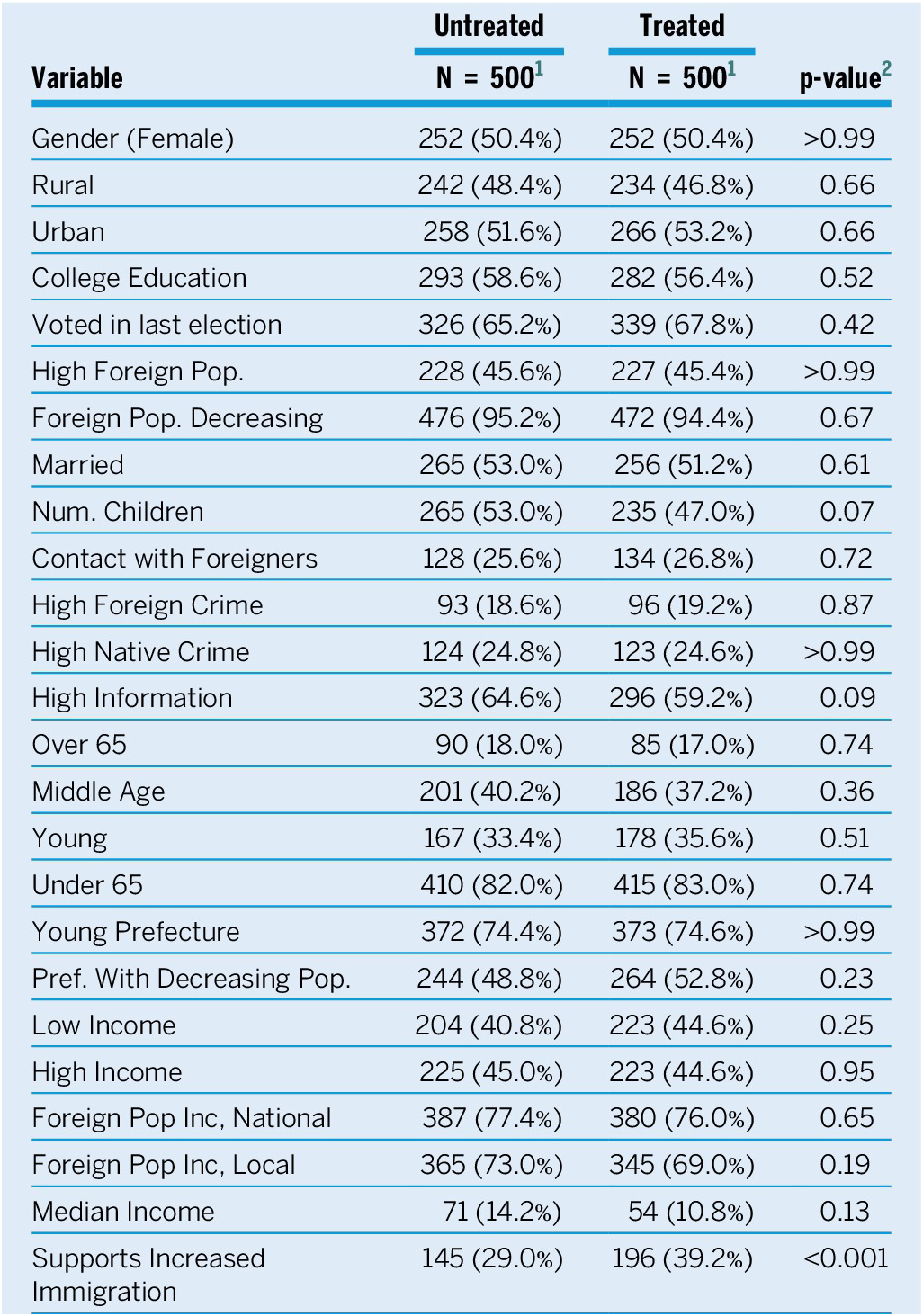
In November 2023, we fielded a survey experiment with an online sample of 1,000 Japanese voters recruited by Ipsos Japan to be nationally representative of the native-born Japanese population (Gigante and Gest Reference Gigante and Gest2025). Pretreatment demographic data were collected from all participants, including information about their knowledge of national and local immigration trends during the past 25 years, as well as their level of personal contact with immigrants (e.g., regular contact and friendships). We randomly assigned respondents to one of two conditions. In the first condition, participants were asked to read a passage that used accurate government statistics to argue for increased immigration flows into Japan to counteract population aging and forestall economic decline. The prime is available in online appendix A. In the second condition, a pure control, respondents were not presented with a passage. As shown in table 1, treatment and control groups were largely similar across demographic indicators. After exposure to the treatment (or control), we asked for respondents’ immigration-flow preferences on a five-point Likert scale (i.e., question 7 on the survey; see online appendix F). This was recoded as a binary indicator with respondents coded as 1 if they supported higher flows and 0 if they did not.
Table 1 Descriptive Statistics, Control, and Treatment Groups
1 n (%)
2 Pearson’s Chi-squared test
Using a linear-probability model with robust standard errors, we analyzed the effect of the treatment on this dependent variable, a binary indicator of support for greater immigration (Aldrich and Nelson Reference Aldrich and Nelson1984; Foremny Reference Foremny2020; Leeper and Robison Reference Leeper and Robison2020; Manekin and Wood Reference Manekin and Wood2020; Ono and Zilis Reference Ono and Zilis2022; Ricks Reference Ricks2020). To ensure the robustness of the effectiveness of the demographic information treatment and to confirm the treatment’s effect on attitudes toward immigration, we also used ordinary least squares, logit, and ordinal logit regressions, with and without inverse probability weights, with both a three- and a five-level dependent variable. Across all models, the treatment effect was statistically significant and positive. Detailed results for these models are in online appendices B, C, and D. After we confirmed the effect of the prime, we tested the interaction effects of the treatment on other hypothesized variables that previously were found to affect immigration attitudes: social contact, age, income, and rural or urban geography.
Based on the statistical findings, we conducted four months of interview-based fieldwork to understand the social, economic, and political dynamics underpinning the effects that we observed—in particular, the divergent responses to the prime among Japanese native-born citizens of different ages and residential environments. Interviews took place in Ōizumi, Gunma prefecture, and Tōkyō, Japan’s capital—diversifying regions with different geographic environments. Tōkyō is Japan’s largest city and the economic heart of the country. It hosts the largest number of foreign residents by a margin of more than 2:1 compared to the next most diverse prefecture. Nevertheless, immigrants comprise a small proportion of the capital’s population at slightly more than 2.5%. Despite their higher total numbers, foreigners live mostly separate lives from their native-born neighbors.
About 200 kilometers northwest of Tōkyō, Ōizumi initially was selected as a site due to its high proportion of foreign residents, as revealed in our data and government statistics. It is a rural region consisting of small, demographically homogeneous, agrarian towns in the wide plain between Saitama and Tochigi. Ōizumi is the former site of an American military base and, before the end of the World War II, few people lived there. Since that period, work at the repurposed military factories have anchored a robust local economy, and Ōizumi attracts far more foreigners than many other places in Japan. Foreign residents comprise 1% of Gunma’s total prefectural population and 21% of Ōizumi’s 41,000 people are immigrants. Whereas in recent years, migrants from Peru, Indonesia, and Vietnam have been increasingly common, more than half of all migrants in Ōizumi are of Brazilian origin. We recognized that migrants in Ōizumi and Tōkyō differ in terms of education, wages, demographics, and other characteristics. These differences could influence the type of migrants that native residents typically encounter. Given the consistency of opinions about migration in the context of population stability across both rural and urban settings, our findings suggest that the individual characteristics of migrants may not be a significant factor shaping native views in these different contexts or that respondents were not sensitive to the differences.
In total, we interviewed 30 respondents with different gender, age, location, and socioeconomic attributes. In all of the interviews, we used a standardized topic guide and an unstandardized, conversational approach to ensure that respondents were at ease during discussions that lasted between 40 minutes and 2 hours. The full topic guide and survey are included in online appendices F and G.
SURVEY RESULTS
First, we report the mean results for the treatment and control groups with regard to our dependent variable of interest: a binary indicator of support for increasing immigration. We then visualize the average marginal effect of the treatment and present these results with heterogeneous treatment effects using interactions with the treatment on statistically significant variables of interest.
Figure 1 displays differences in the mean outcome of the dependent variable between treated and control groups. The average probability that respondents in the treated cohort supported increased immigration flows was approximately 10 percentage points higher than that of the control group. Treated respondents, on average, supported increased immigration at a rate of 39.2% (95% confidence interval: 35%–44%) compared to 29% (95% confidence interval: 25%–33%) among control respondents. This effect was statistically significant and remained robust across all model specifications (see online appendices B, C, and D).
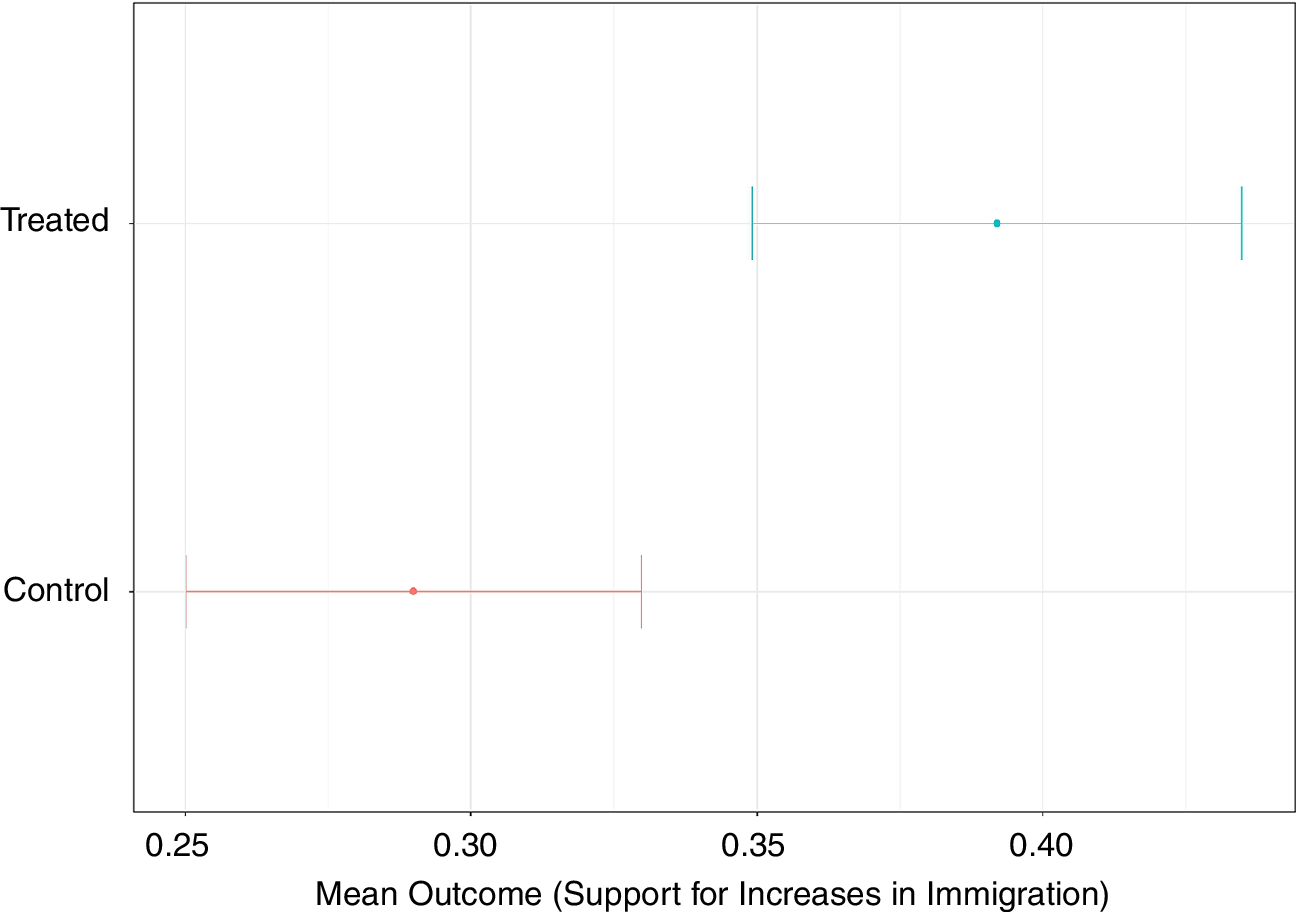
Figure 1 Difference in the Predicted Probability for Support for Increased Immigration
Figure 2 reports conditional average treatment effects hypothesized to moderate the effect of the aging prime (for full results and for nonsignificant results, see online appendices B and C). According to the figure, the conditional average treatment effect was highest when interacted with those respondents who reside in urban environments (0.16; p<0.001). Rural respondents were unaffected by the prime.Footnote 4 This effect was similar when we compared older and younger respondents: elderly respondents older than 65 also were unaffected by the information prime, whereas younger respondents were more likely to support increased levels of immigration after receiving the prime (0.14; p<0.001).Footnote 5 Contrary to our hypotheses, these results were not associated with a stronger acquaintance with foreign-born people because self-reported contact with foreigners was statistically insignificant. Those without contact were more likely to be persuaded by the prime (0.1; p<0.01), but it is important to note that the estimates were similar (i.e., 0.1 and 0.09 for those without and with contact, respectively). Moreover, we cannot state that there was a difference in the response to the treatment between respondents with regular contact with foreign people and those with no contact.Footnote 6

Figure 2 Conditional Average Treatment Effects
According to a series of correlation tests, located in either a rural or an urban environment was not associated with variables such as educational attainment and income. Although it is not reported in the figures, people living in regions with an above-average native crime rate also were more likely to support increased migrant flows than those in a region with a lower crime rate (confidence interval: [0.32, 0.08], p<0.001). This finding was not driven by correlations with any other associated factor. Likewise, age effects were not correlated with any other variables. Although these effects may not be statistically significant from one another, the results suggest that these different groups are responding to the prime in divergent ways.
These findings are simultaneously noteworthy and perplexing. On the one hand, sentiment about immigration elsewhere has been observed to be among the most rigid public attitudes (Kustov et al. Reference Kustov, Laaker and Reller2021), let alone in Japan. Japan is one of the world’s most conservative democracies—not necessarily ideologically or religiously but rather culturally conservative. Status is derived from preservation, heritage, and longevity. Disruptive forces are viewed conventionally with suspicion because the meticulous maintenance of stability is prized above almost all else. After all, this is an archipelago that for centuries deliberately limited foreign influence. Even today, thousands of businesses have been operated by the same family—often in the same manner—for generations. Politically, Japan has been ruled by a single party for almost the entirety of its 80-year postwar history. In this cultural context, immigrants represent an existentially disruptive force, and it is notable that a short informational presentation about population aging could produce an aggregate effect on public opinion.
On the other hand, few clues remain about what drives the divergent responses to the prime among younger and older people and among those in urban and rural environments. Clearly, these subgroups interpret population aging and immigration in divergent ways that cannot be fully understood with statistical methods. To examine the mechanics behind the survey results, we conducted four months of interview-based field research.
FIELDWORK RESULTS
In our fieldwork, we sought to understand how Japanese adults perceive immigration independently and, separately, how they perceive immigration in the context of population aging. Before we raised the subject of demographic decline, almost none of our interviewees had perceived immigration policy through the lens of population stability, even those supportive of increasing flows. Rather, immigration principally is understood as necessary to some extent but contingent on the demographic attributes and economic qualifications of a migrant. This was true across urban, rural, and age groups. However, when immigration was placed in the context of population stability, perceptions and opinions diverged. Consistent with our survey results, a divide separated the image of immigrants in the view of urban and rural respondents, independent of their level of contact with foreigners. Indeed, across interviewees, few had foreign-born friends; even those with deeper connections did not necessarily support increasing migration sufficiently to affect population growth or without significant discretion.
…when immigration was placed in the context of population stability, perceptions and opinions diverged. Consistent with our survey results, a divide separated the image of immigrants in urban and rural respondents, independent of their level of contact with foreigners.
In Ōizumi, respondents expressed significant concern, albeit not hostility, about the challenges of integrating migrants and the growing number of foreign residents in their small town. In an interview with a retired 40-year-old mother of two primary schoolchildren—a rarity in a town with a predominantly elderly population—she said she used to study Chinese and had a very good Chinese friend, with whom she often would have lunch. However, her friend “did not take part in community events with other Japanese people.” Nevertheless, she resisted supporting any assimilation policy. “It is better if we could live together peacefully,” she said, rather than “imposing” Japanese culture on migrants. Her perspective reflects broader concerns about assimilation, or dōka (同化, どうか), a term with a strong negative connotation because of its association with Japan’s imperial and colonial policies during World War II.
Across both urban and rural contexts, respondents consistently rejected assimilation policies, emphasizing instead the importance of multicultural coexistence (tabunka kyōsei, 多文化共生, たぶんかきょうせい). The 40-year-old interviewee continued:
I imagine, in the future, that foreign mothers and Japanese mothers will come into conflict [in school settings], and I worry about the effects this will have on local education. Foreign mothers do not speak Japanese, and it is very difficult to communicate with them. In such scenarios, I see two factions emerging, foreign and Japanese mothers, and they will not be able to work together, or they will come into conflict [over issues of education].
Despite these concerns, she remained supportive of foreign residents moving into her neighborhood, adding that such problems could be overcome with time and better Japanese-language education. When asked if the arrival of more foreigners was positive or negative, she simply replied with a tone of sober pragmatism, “I think the situation in Ōizumi represents the future of Japan.” This perspective illustrates both the tension between support for multicultural coexistence and the practical difficulties of implementing such policies in smaller, rural regions that stand to experience a faster pace of demographic change.
Other interviewees were more explicit in their opposition and were keenly aware of shifting demographics. One man in his 60s, who is active at the local community center and who has lived in Ōizumi his entire life, argued strongly that if more foreigners come to the town, Japanese families will leave. “Frankly, I am not happy about the current [number of foreign residents in the town]. Only the foreign population is increasing, while the Japanese population is decreasing.” This affected the decisions of Japanese residents to stay and have families, he said. “If something is not done, then I fear more people will leave, and the town will disappear.” This view—that Japan’s culture is unique, worth defending, and under threat from immigration—was far more common in Ōizumi than in Tōkyō. This opinion was surprising, given that immigrants significantly contributed to the financial and demographic viability of the town. Nevertheless, immigration in the context of population stability was not viewed positively.
Other Ōizumi interviewees were less optimistic concerning neighborhood safety concerns. “Knife crime has increased dramatically since I was younger,” said a 60-year-old handyman who proudly has lived in Gunma all of his life. “There are some areas of town that are more dangerous than before, and this was definitely caused by Brazilians.” He quickly added that he personally had not had any negative experiences with foreigners; on the contrary, he often visited Filipino hostess clubs and was fluent in Tagalog. “The town’s social order decreased noticeably from when I was a kid,” he said. “Foreign people do not know how to follow rules, such as how to properly dispose of garbage; the town has definitely gotten dirtier.”
Although most interviewees in Tōkyō parroted their rural counterparts’ fears regarding social order, crime, and norms, many expressed greater faith in the adaptability of foreigners. In an interview with a married, well-traveled software engineer in glitzy, commercial Ginza, he stated, “I worry about crime and how my neighborhood will be affected” but “these are small issues that can be fixed with better education. We will have to change our culture to accept more migrants but, overall, accepting more people is both positive and necessary.”
A 50-year-old father who hoped to emigrate to the United States one day added, “Japanese work culture is very strict, and some aspects of Japanese culture are strange. I think foreign people can help us change those aspects.” Nevertheless, he rejected the idea that immigration policy could or should address the demographic crisis. “I think Japan should accept more foreigners, primarily high-skilled foreign workers, but Japan should not try to become America”—a reference to the ethnic diversity of the United States. Instead, and in a sentiment expressed often by others, he argued that population stability is an “impossibility” at present, and the government should focus more on policies designed for a “soft-landing”—that is, policies that shield Japan from the worst effects of demographic decline.
All interviewees were aware that Japan faced serious demographic challenges and many were resigned to the government projections. Employed respondents blamed public mismanagement and a lack of support for workers, families, and young people. Whereas some elderly interviewees believed that the government should focus on policies that make it easier for Japanese natives to raise children, others balked at such an idea. “It is not fair that society places all this pressure on women,” stated a 19-year-old Tōkyō university student. “Having children is a personal choice, and it is offensive that both society and government think they can just buy people.” Simultaneously, and although she had foreign friends, she added, “I do not want the government to use foreign people as a way to ignore natives and our problems. I worry that by accepting more foreigners, the government will simply continue to not address the concerns of natives.”
DISCUSSION
How does the context of severe aging affect Japanese immigration attitudes? There are different perceptions of Japanese fragility and adaptability—of both immigrants and localities—in urban and rural contexts. Older and rural Japanese respondents understand Japanese norms and identity to be fragile and unsustainable in the face of increased migration and decreased numbers of Japanese citizens. In contrast, urban residents—although they may share concerns about foreigners’ integration—appear to be reassured by the weight of Japanese tradition and the continuing homogeneity of its largest cities. The metropolitan areas anchored by Tōkyō, Ōsaka, and Nagoya easily diffuse and absorb different cultures. Conversely, residential segregation and the predominance of natives shield most residents from the perceived negative effects of increased immigration. Smaller towns do not have this sense of imperviousness. In rural regions, concentrations of foreigners are conspicuous, and local authorities lack the resources and cultural capital to facilitate interaction and reinforce the native sense of security—despite the disproportionate reliance on foreign labor in agricultural and industrial towns such as Ōizumi.
However, if our urban interviewees did not see immigration as a solution to severe population aging, why were they persuaded by the informational prime? The answer is related to their heightened concern about Japan’s economic competitiveness. In Tōkyō—already a fast-paced, expensive, and driven metropolis—its ambitious residents are more sensitive to economic trends that affect their competitiveness. Many report experiences with a toxic work culture that has altered their calculations about marriage and childrearing. The prospect of an aging society triggers fears that Japan’s economic stagnation and social contortions might only intensify. In this Darwinist view, many interviewees stressed that Japanese companies and work culture must evolve or be left behind by the rest of the world. Young, urban respondents view aging as a failure to adapt to new circumstances. They strongly prefer that the population stabilize without the assistance of immigrants’ fertility. However, they believe that a limited amount of immigration would bring new ideas and global standards that pressure companies and the government to reform the structure of Japanese life.
The prospect of an aging society triggers fears that Japan’s economic stagnation and social contortions might only intensify.
This political perspective is unique in the world of immigration policy but so is the severity of Japan’s population aging. The country’s top-heavy distribution has mobilized Japanese voters to perceive its demographic balance as almost beyond repair. This has caused many Japanese voters to turn their attention to strategies for sustaining social and economic stability in a shrinking society. Others believe, however, that population aging should not be a call for immigrants as demographic reinforcements but rather as a broader social revolution that addresses work–life balance, gender roles, and the sustainability of Japanese cultural norms in a global economy.
The country’s top-heavy distribution has mobilized Japanese voters to perceive its demographic balance as almost beyond repair.
Supplementary material
To view supplementary material for this article, please visit http://doi.org/10.1017/S1049096525101431.
ACKNOWLEDGMENTS
The authors thank Ipsos Japan; The Japan Foundation; Professors Naoru Koizumi, Lucas Nunez, Kaoru Izumi, Tyler Renny, Ryo Nakai, Hiromi Fukuyama, Toru Naito, and Hikaru Ogawa; and the kind people of Minami-Ōizumi for their assistance with this article.
DATA AVAILABILITY STATEMENT
Research documentation and data that support the findings of this study are openly available at the PS: Political Science & Politics Harvard Dataverse at https://doi.org/10.7910/DVN/L6YKNR.
CONFLICTS OF INTEREST
The authors declare that there are no ethical issues or conflicts of interest in this research.



