

INTRODUCTION
The title's quote illustrates, in a drastic but often encountered manner, recurring sentiments expressed in the public discourse on a new variety or style of German, which I call Kiezdeutsch ‘(neighbour)hood German’ here, a term that is used in public debate as well. In the above quote, Kiezdeutsch is denied the status of German dialect and characterised as the broken speech, ‘babble’, of a migrant out-group. In this article, I show that the debate from which such statements come provides us with an interesting means of access into the dynamics of linguistic and social boundaries, patterns of inclusion and exclusion, and their interaction with standard language ideologies.
Kiezdeutsch emerged in urban Germany, in particular among the especially dynamic group of adolescent speakers, and is characterised by a linguistically diverse speech community, encompassing multilingual speakers with a range of different heritage languages (alongside the majority language German) as well as monolingual German speakers. Modern Germany in general is a multilingual country, and this is particularly true for urban areas. While language use in families is not documented in census surveys for Germany, the Federal Statistical Office includes data on ‘migrant background’: according to the definition employed, someone is of ‘migrant background’ if s/he her/himself or at least one parent immigrated to Germany after 1949 or does not have German citizenship. Data on migrant background can hence indicate potentially multilingual families. According to the German census, about one fifth of the population as a whole has a migrant background, and approximately 31% of minors in Germany live in a family with a migrant background, with a higher proportion in urban areas: in cities of over 500,000 inhabitants, nearly every second child (46%) grows up in a family with a migrant background (data from 2009 and 2010, released by the German Federal Statistical Office).
Hence, experiences with multilingualism are a widespread phenomenon in the linguistic reality of young speakers in Germany today, and the new ways of speaking that multilingual urban speech communities support form an important and central, rather than peripheral, part of contemporary German. In contrast, the public debate has long been characterised by marginalisation and, initially, exotisation.
The focus of this article is a public debate on Kiezdeutsch that peaked in 2012 and centres, as illustrated by the quote in the title, around the notion of Kiezdeutsch as a ‘dialect’. This framing makes the debate a particularly interesting domain of research since it connects the discussion of linguistic diversity with questions of linguistic ownership: who will and who will not be accepted as a legitimate speaker of a German dialect? This discussion hence offers a vantage point on the way linguistic value systems interact with social inclusion vs. exclusion, shaping power relations and ultimately helping to support and reassert positive self-images of privileged groups.
While the particular interaction we can observe here might be specific to Germany, public debates that became heated and condemnatory can be found elsewhere, with new linguistic developments in multilingual urban neighbourhoods receiving much public attention in the last decades. In sociolinguistics, such developments have been characterised, among others, as multiethnolects (Quist Reference Quist2008), new dialects (Cheshire, Kerswill, Fox, & Torgersen Reference Cheshire, Kerswill, Fox and Torgersen2011), ethnic dialects (Du Bois Reference Du Bois and Metzler2013), or new urban vernaculars (Rampton Reference Rampton and Deppermann2013). While their status as systematic varieties, styles, or clusters of linguistic resources in communicative practices has been the subject of some controversy,Footnote 1 there is general agreement that what we find here is a creative use of language that reflects speakers’ choices in particular communicative and social contexts,Footnote 2 rather than a sign of linguistic poverty or some form of language decay. By contrast, the picture drawn in public debates is mostly negative, and discussions of such linguistic practices are dominated by disapproval and concern.
The phenomenon of these urban vernaculars is comparatively novel, and while it has received considerable attention in the sociolinguistic discussion over the last decades, only a few studies so far have focussed on the public debate, besides those that touch on this topic while primarily targeting other aspects, such as language use or media stylisations (e.g. in comedy).Footnote 3
For Germany, Androutsopoulos (Reference Androutsopoulos, Franceschini and Haubrichs2011) shows that media representations, including those that involve linguist ‘experts’, construct a heteroethnic contrast to an imagined homogenised majority society and its language. His analyses of medial stylisations of multiethnolectal speech, Türkendeutsch ‘Turks’ German’ (Androutsopoulos Reference Androutsopoulos2001, Reference Androutsopoulos, Fandrych and Salverda2007, Reference Androutsopoulos, Franceschini and Haubrichs2011), indicate that they follow a widespread standard language ideology in the media and realise negative stereotypes of nonstandard, foreign language use and ‘broken German’. Kotthoff (Reference Kotthoff, Lewandowska-Tomaszczyk and Pulaczewska2010) describes similar patterns for the stylisation in German comedy shows.
In what follows, I investigate such discursive patterns in more detail in a case study on the current debate in Germany. I first provide some background on relevant terms in the public discourse on Kiezdeutsch and then describe the data and methodology I use for my investigation. On this basis, I identify four key topoi in the debate and then show how they come together in an underlying narrative on who is a legitimate speaker of a German Dialekt, involving ‘us’/‘them’ dichotomies at social and ‘ethnic’ levels and a particular construction of standard German as Hochdeutsch ‘High German’. The final section summarises my findings.
THE GERMAN DEBATE ON KIEZDEUTSCH AS A DIALECT: SOME BACKGROUND
This section provides some background on two pairs of terms that help to understand the context of the debate on Kiezdeutsch, illuminating what Garrett (Reference Garrett2010:103) calls the distinctive ‘linguistic climate’ for language attitudes.
Kanak language vs. (neighbour)hood German
At the beginning of the debate, in the late 1990s and early 2000s, a dominant label for the new German vernacular used in multiethnic neighbourhoods was Kanak Sprak, which combines a pejorative expression for foreigners, Kanak, with Sprak, a truncation of Sprache ‘language’. The term Kanak originally refers to indigenous inhabitants of New Caledonia. In German, it has developed into a xenophobe epithet whose usage would normally be socially sanctioned. In the 1990s, the term was introduced into mainstream political discussion by Feridun Zaimoğlu, who used it in political novels and interview collections as an attempt to reclaim the pejorative expression Kanake within political movements of Germans with migrant, mostly Turkish, backgrounds.Footnote 4 However, the term did not lose its xenophobic associations (cf. Androutsopoulos Reference Androutsopoulos, Fandrych and Salverda2007 on language ideology aspects). Furthermore, based on its lexical semantics alone, even independently of the pejoration involved, it supports a marginalisation through Othering at two levels: (a) of the speakers themselves as foreign (Kanak) and (b) of their way of speaking as a different language (Sprak). Taken together, this seems to have made it particularly suitable for usage in public discourse, where it was quickly appropriated and broadly used (in some cases also in academic writing), making the expression Kanak, which outside this compound would be taboo as a xenophobe slur, acceptable here.
Over the last years, Kanak Sprak has gradually been replaced by Kiezdeutsch, a label introduced in Wiese (Reference Wiese2006) as an alternative to Kanak Sprak. As mentioned above, Kiezdeutsch literally means ‘(neighbour)hood German’, including with Kiez [ki:ts] an informal, positively associated Berlin dialect term for a neighbourhood. While labelling linguistic practices can carry risks of homogenising something in a way that might support delimination and even segregation (cf. Jaspers Reference Jaspers2008; Androutsopoulos Reference Androutsopoulos, Franceschini and Haubrichs2011; Cornips, Jaspers, & de Rooij Reference Cornips, Jaspers and de Rooij2015), I believe that the replacement of Kanak Sprak by Kiezdeutsch can in fact counteract exclusion (cf. Muyskens & Rott Reference Muyskens, Rott, Siemund, Gogolin, Schulz and Davydova2013). This is not only because it is a term adopted from the community that can contribute to empowering speakers (cf. Wiese Reference Wiese2006, Reference Wiese2013). Its semantics also places this way of speaking and their speakers within the majority in-group: it positions it within general everyday communication in an informal neighbourhood setting (Kiez-), and it explicitly references it as a part of German (-deutsch).
This said, naming a linguistic practice will always have at least some essentialising effects. In this case, however, naming identified rather than reified a particular phenomenon, a systematic, new addition to the range of German (Wiese Reference Wiese2013 provides a detailed discussion), and at the time Kiezdeutsch was introduced, the act of labelling—and the essentialising this might bring with it—had already happened, with Kanak Sprak firmly entrenched in the public discussion. Kiezdeutsch was introduced to replace this existing label, rather than create one ex nihilo, thus counteracting the strong negative associations of the initial label.
An indication of the destigmatisation and inclusion that the new term Kiezdeutsch promotes in contrast to the previous one, is the strong opposition it gets from self-appointed ‘language guardians’ such as the right-wing German Verein für Sprachpflege, which follows a purist, monoethnically, and monolingually oriented agenda. The following quote from its publication Deutsche Sprachwelt (2009, issue 36, front page) illustrates this. Under the headline ‘Stammer-German as an accomplishment? Linguists admire an aberration of our language’, Thomas Paulwitz, the association's president, complains about the use of Kiezdeutsch instead of Kanak Sprak.Footnote 5
(1) [H. Wiese] uses the word ‘Kiez’ (neighbourhood), which by now is positively associated, and thus creates a pleasant ambience, which is hardly possible with the word ‘Kanaksprak’.
A further illustration of the positive revaluation associated with Kiezdeutsch comes from the following quote, taken from a report on public radio that sets the term in contrast to Türkensprache ‘Turks’ language’ and links up the ethnic separation implied by the latter with an additional devaluation along social-class divisions (‘middle-class children’ vs. ‘Kiezdeutsch speakers’), a pattern that we investigate in more detail below (WDR radio, September 23, 2012).
(2) [its speakers] call it ‘Kiezdeutsch’ and talk about a dialect. But wouldn't middle-class children call that ‘Turks’ language’?
An additional interesting aspect of this statement is the contrast it makes between the linguistic classifications believed to be used by the speakers themselves and the ‘middle-class children’: according to this statement, the former see Kiezdeutsch as a dialect, while the latter regard it as a different (‘Turks’) language. This adds a third contrast in addition to the ethnic and social dichotomies observed here. The refutation that is put in the putative ‘middle-class children's’ mouth here points to a conflict between their view of what constitutes a German dialect and what constitutes Kiezdeutsch—a clash that I believe provides an important blueprint for the dichotomies that became evident in the debate. In the following section, I briefly describe some background on the specific use of such terms as Dialekt ‘dialect’ and Hochdeutsch ‘High German’, as a term for standard German, in Germany. This provides a basis for the investigation into the ‘dialect’ discourse on Kiezdeutsch, which reveals an underlying narrative associating the two in a manner that excludes Kiezdeutsch and its speakers along social and ‘ethnic’ deliminations.
Hochdeutsch and German dialects
In Germany, the label Hochdeutsch ‘High German’ is commonly used for an idealised standard variety, which, like standard languages in other countries, is regarded as the basis for ‘proper usage’ and is associated with middle and upper class language use (Milroy & Milroy Reference Milroy and Milroy1999; cf. Vogl Reference Vogl and Vogl2012 for an historical overview of standard language ideologies in Europe; Mattheier Reference Mattheier and Wimmer1991, Davies Reference Davies and Hüning2012 for a detailed discussion of Germany). Standard language ideology seems to be particularly powerful in Germany, with strongly restrictive and puristic tendencies (cf. von Polenz Reference von Polenz1988; Durrell Reference Durrell1999; Davies Reference Davies and Hüning2012).
The Hoch- in Hochdeutsch initially refers to its status as a High rather than Low German variety, where high and low relate to geographical altitude, namely the more mountainous character of the High German dialect region, which is towards the South, and the flatter, lower landscape in the North, which is home to the Low German dialects (or rather, in a lot of cases, used to be home to them, since Low German dialects have mostly been displaced by High German ones, due to the strong influence of standard German). Outside linguistics, the term has, however, undergone a reinterpretation from a geographic characterisation to a qualitative ranking: in general usage, Hochdeutsch is commonly understood to refer to a ‘higher’ form of language, a culturally elevated Hochsprache ‘High language’ superior to other forms of German. This reinterpretation establishes a particularly powerful case of standard language ideology and, as I show below, supports a narrative on standard language that provides an important conceptual frame in the discourse on multiethnolects.
The term Dialekt ‘dialect’ in Germany has traditionally been primarily associated, in both public discourse and academic writings, with the regional varieties that historically formed the background for the emergence of standard German. Accordingly, Auer (Reference Auer, Kortmann and van der Auwera2011), for instance, in a European overview of dialect vs. standard scenarios, proposes
to reserve the term ‘(traditional) dialects’ for the varieties under the roof … of a standard variety which preceded the standard languages and provided the linguistic material out of which the endoglossic standard varieties developed. (Auer Reference Auer, Kortmann and van der Auwera2011:487)
To some degree, however, this contradicts the actual usage of this term even in traditional German dialectology, namely where German ‘language island’ varieties are concerned, that is, varieties that emerged outside Germany as a result of colonialisation and emigration. Such varieties did not necessarily precede the standard language but have often developed later, with a basis that could then involve the standard variety as well as different traditional dialects, as spoken in the German-speaking emigré communities in question. So, if a precedence and source relation to the standard variety were necessary for a dialect, these should then not qualify. Nevertheless, they are usually included in German dialectology, for example, as deutsche Dialekte[n] im Ausland ‘German dialects abroad’ in a standard handbook on Dialektologie (Besch, Knoop, Putschke, & Wiegand Reference Besch, Knoop, Putschke and Wiegand1982).
Similarly, in public discourse, there seems to be no obstacle to accepting such varieties as dialects of German. When an article on Texas German appeared in the popular German news magazine Spiegel Online/UniSPIEGEL that portrayed it as a relatively young German Dialekt with some new grammatical and lexical characteristics and some language mixing involved, this did not cause any kind of public antagonism. As Hans Boas, the linguist on whose work the article was based (cf. Boas Reference Boas2009), describes the reactions to the article, ‘there was no outrage, just positive comments throughout’ (Boas, p.c.).
This contrasts sharply with the strong and overwhelmingly negative reactions an article in the same magazine received that suggested Kiezdeutsch might be a dialect of German—again, with some new grammatical and lexical characteristics and some language mixing involved. In fact, the Spiegel article on Texas German was even quoted, in full, in the internet forum of the ‘language guardian’ association Verein Deutsche Sprache, and discussed there as an interesting case of German abroad.Footnote 6 This contrast is even more striking in view of the strong ties that Kiezdeutsch has to ongoing German language use, compared to Texas German, which is largely cut off from mainstream development in Germany.
This suggests that in public discourse in Germany, it is not so much the actual historical relation of precedence and linguistic source for standard German that is essential to the concept of Dialekt, but rather a cultural association with German tradition that seems to involve some sort of ius sanguinis, a kinship relation based on a perceived ethnic commonality with its speakers.
Accordingly, it is, for example, a popular narrative to recall one's surprise when someone regarded as a member of a non-German out-group (e.g. because of physical attributes such as skin colour or dark hair) speaks a traditional regional dialect of German: this is considered highly comical, indicating a strong cognitive dissonance. In the case of Kiezdeutsch, a similar dissonance became evident in a lot of the rejections of this vernacular as a dialect, and accordingly of its speakers as German dialect speakers.
The debate initially centred on a linguistic description of Kiezdeutsch as a dialect that was suggested in order to capture its status as a systematic and integral part of German and part of a broader repertoire for its speakers, and its structural and sociolinguistic parallels to traditional German dialects (cf. Wiese Reference Wiese2009; Freywald et al. Reference Freywald, Mayr, Özçelik and Wiese2011; Wiese Reference Wiese2012, Reference Wiese2013). In accordance with Rampton's (Reference Rampton and Deppermann2013) argument for a ‘reclaim’ of the English term vernacular, German Dialekt also helps to
normalise the kind of urban speech we are examining, moving it out of the ‘marked’ margins, not just in sociolinguistic study but maybe also in normative public discourse. (Rampton Reference Rampton and Deppermann2013:78)
When in February 2012 a monograph (Wiese Reference Wiese2012) was published that summarised research results on Kiezdeutsch as a dialect in an accessible manner comprehensible for nonspecialist readers, this was quickly picked up in the public debate in Germany. The discussion was accompanied (and cross-fertilised) by a media firestorm that involved several press agencies, major national newspapers and weekly magazines, public TV and radio news, as well as tabloids and entertainment-oriented sections of popular media, and was also taken up by media in some other European countries, such as Austria (Wiener Zeitung, Der Standard), the UK (The Economist), and Turkey (Hürriyet, Milliyet, Radikal).
Similarly to what Pooley (Reference Pooley and Ayoun2008) reports for France, there were also a few linguists who entered the public debate with negative depictions of this new urban vernacular and its speakers. One of them is illustrated by the quote in (3) below, taken from a guest article in Frankfurter Allgemeine Zeitung (a large national newspaper) by a professor of linguistics and German as a foreign language.
(3) Ms. Wiese swipes the term ‘dialect’ for an adolescent way of speaking where swaggering plays a large role. Why? She wants to cadge its prestige, since dialects enjoy esteem. … ‘Kiezdeutsch’, however, is neither a dialect nor a sociolect, but rather a transitorial specialised language that is based on influences of other languages, and errors in German. … It is not a case for dialectology, but instead for language psychology and error analysis. (H. Glück, in Frankfurter Allgemeine Zeitung, April 4, 2012)
What is striking in this statement is the close link between negative structural statements and social devaluation. The description of linguistic characteristics as ‘errors’ and their association with ‘other languages’ is not backed by linguistic examples or references to research results. It is, however, introduced by a postulation that ‘swaggering plays a large role’ in this way of speaking, and a refusal to grant it the ‘prestige’ or ‘esteem’ that dialects are seen to enjoy. The fact that the characterisation of Kiezdeutsch as a German dialect prompts such heated rejections, and in this case one from a linguist (although this largely remained an exception), gives a first indication of how strongly such a characterisation conflicted with some widespread and deep-rooted assumptions on ‘genuine’ German and its delineation. This guest article found a wide circulation as an expert rejection of Kiezdeutsch as a dialect, in particular by ‘language guardian’ associations participating in a ‘complaint tradition’ in the sense of Milroy & Milroy (Reference Milroy and Milroy1999), where it fitted well into purist and exclusionary attitudes towards German. It also entered educational domains: among others, it was quoted in full in a widely used school book for upper schools (students aged sixteen through eighteen), as a linguistic discussion of Kiezdeutsch.Footnote 7 In contrast to this, a press release by the German Linguistics Association, DGfS, around the same time,Footnote 8 which emphasised that linguistic varieties/styles such as Kiezdeutsch follow systematic rules, are part of a larger repertoire, and do not represent ‘wrong’ German, was largely ignored in the public debate.
VOICES OF OUTRAGE: CORPUS DATA FROM THE PUBLIC DEBATE ON KIEZDEUTSCH
For my investigation into this debate, I use as an empirical basis KiDKo/E, a corpus that is accessible as a supplement to the KiezDeutsch-Korpus (KiDKo), which assembles linguistically annotated, transcribed recordings of spontaneous peer-group conversations among adolescents in urban neighbourhoods. While KiDKo itself thus captures natural speech data, KiDKo/E provides data on linguistic attitudes. In the present section, I introduce this corpus and then briefly describe the methodology used for analysing the corpus data.
KiDKo/E
KiDKo/E assembles two kinds of reactions to media reports on Kiezdeutsch: (i) seventy-six emails that were sent to me after such reports, and (ii) 1,367 postings on the respective media websites. The data has been anonymised, edited, and turned into a searchable corpus format, and is generally accessible for research purposes via the corpus website (http://www.kiezdeutschkorpus.de).
The emails cluster in two main waves. The first wave, with twenty-five emails sent in May and June 2009 was probably triggered by a report on a German website coming from the extreme right, pi-news ‘politically incorrect news’,Footnote 9 after a talk I gave on Kiezdeutsch at the Akademientag, an annual public presentation of the German Academies of Sciences. The second main wave, with fifty-one emails, was received in 2012, after the publication of a book on Kiezdeutsch as a German dialect (Wiese Reference Wiese2012, see above), and subsequent media reports on the topic.
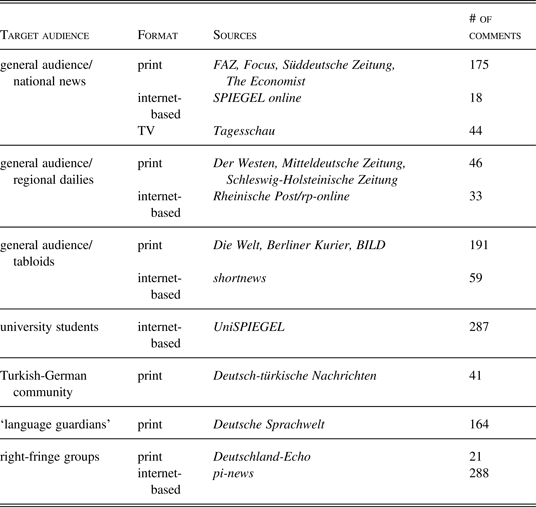
The internet comments in the corpus were obtained from the article on pi-news from May Reference Nortier and Svendsen2009, and from media websites during the period January to April 2012, when the most recent discussion on Kiezdeutsch peaked in the media (triggering the second waves of emails). Data was collected for this period from websites found by searching for Kiezdeutsch. They contain reports plus individual comment postings (hence, an internet format similar to traditional ‘letters to the editor’). Together, this yielded postings to a cross-section of media, as listed in Table 1.
Characteristics of media sources in KiKDo/E.

In comparison to data from media reports proper, which are frequently a focus of discourse studies, the data that this corpus provides is more informal and less controlled. It offers expressions of opinions that have not undergone external editing except, in the case of comments (in contrast to emails), that imposed by the site owners: some of the postings were blocked by moderators, presumably because the content was too drastically xenophobe, as some of the postings complaining about such blockings suggest.
In addition to a much lesser degree of external editing, we can also expect less self-editing by the writers. Most of the emails were sent anonymously, and comments are usually posted under nicknames, which can be used expressively to support certain social roles (cf. Lindholm Reference Lindholm, Herring, Stein and Virtanen2009), but typically do not reveal the poster's identity. As a result, authors of emails and readers’ comments do not encounter the kind of social control they would have to expect in open communication, such as in face-to-face interaction or in signed letters to the editor, and they need to monitor their communication much less than journalists composing media articles. And while news reports usually adopt a neutral habitus, with evaluations tending to be more oblique, emails and readers’ comments are typically overtly evaluative; they express opinions and pass judgments related to a report on a particular event.
In the case of readers’ comments, in particular, this can lead to interactive communications, with posters responding to each other's comments. This makes readers’ comments somewhat similar to focus group discussions that are often used to investigate linguistic attitudes: like them, they are fairly informal, without an assigned leader, are centred around a certain theme, and can go in different directions as the discussion proceeds. And like focus-group discussions, they have an additional audience outside the group. In the case of readers’ comments, however, the additional audience plays a much stronger role: all postings are open to the general public, hence although posters might react to somebody else's comment, that person will not be their sole addressee. Accordingly, posters are also much more likely to ignore previous comments and/or start a new thread, something reinforced by the fact that, unlike in focus groups, speakers are anonymous and usually not known to each other.
Email communication can be interactive as well, and in general it tends to be so, but in the case of unsolicited hate mail, emails often remain one-sided. This is also true of such instances in the corpus data: emails of this kind (unlike signed, nonaggressive ones) were not answered, but merely saved and added to the corpus.
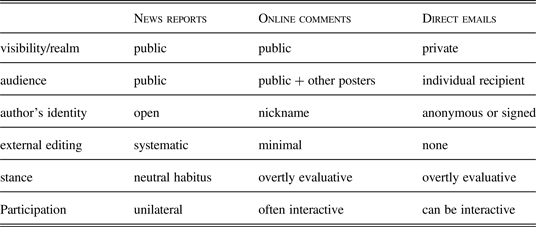
Table 2 gives an overview of the parallels and differences between news reports in the media and the two kinds of data used here: readers’ comments and direct ad personam emails.
Comparison of news reports and KiKDo/E data types.
As this overview indicates, we can expect less social control, less editing, and thus a more direct expression of attitudes when we go from left to right in the table. This comparative directness in readers’ comments and, even more pronounced, in emails gives us a special means of access to opinions and sentiments elicited in the discussion of language-related topics.
However, an important aspect we have to keep in mind with this kind of data is that the advantage we gain by obtaining spontaneous productions also means that the ‘voices of outrage’ we find here come from a self-selected group that might not be representative of the discussion in general—which, of course, is true for media reports as well. In order to reduce skewed effects, when quantifying, I distinguish in my analyses between different relevant subsets of postings. While doing so, we have to bear in mind, though, that the primary target group of a website or print medium does not describe all of the users posting comments there. So, in the case of pi-news, for instance, there were several comments posted by people who were in opposition to the website and criticised its right-wing and often racist agenda. In a different venue, the discussion of the Economist article was not exclusively British, but also involved writers who identified themselves as being from Germany.
Some notes on methodology
In order to analyse the discourse patterns that emerge from the KiDKo/E data, I first identify key topoi in the debate and then analyse narrative structures in the debate that provide the integration for these topoi.
In this enterprise, I take a broad view of ‘discourse’ that encompasses practices in social and linguistic interaction that are driven by negotiating an overarching topic that is under (usually controversial) discussion. This view accords, for instance, with Reisigl & Wodak (Reference Reisigl, Wodak, Wodak and Meyer2009:89) who define ‘discourse’ as ‘a cluster of context-dependent semiotic practices that are situated within specific fields of social action’, that are ‘related to a macro topic’ and ‘linked to the argumentation about validity claims’. As such, discourse reflects, involves, and (re)constructs interpretations and evaluations of social and cultural reality (cf. Jäger Reference Jäger2004). As part of a discourse, different discourse strands centre on specific themes under the umbrella of the macro topic. These strands can be overlapping and are often interlinked with each other.
‘Topoi’ in the sense I am using here are related to the main discourse topic and subsumed under it. They are argumentative motifs that represent recurring, often dominant claims in a discourse. Typically, they have a conditional or causal structure, which is not necessarily explicit, but can show in rephrasing (e.g. in the form ‘If someone speaks like this, s/he …’) (cf. Reisigl & Wodak Reference Reisigl, Wodak, Wodak and Meyer2009).
In order to identify such topics and narrative structures, I followed a procedure similar to thematic analysis (e.g. Agar Reference Agar1983; Woolard Reference Woolard1989). Starting with a careful reading of the corpus material as a whole, I did a content analysis to identify recurring themes. In the next step, these themes were manually coded for all corpus entries. On this basis, I identified the key topoi for this discourse as those that occurred most frequently over the different postings and emails.
FOUR CENTRAL TOPOI
In the present section, I present the general picture manifested in Germany's public debate on Kiezdeutsch and then examine key topoi revealed in comments on media websites and in emails.
Negative vs. positive postings
In order to pick up the general atmosphere of the debate, I coded, in addition to the coding of recurring themes, all individual corpus entries as negative versus neutral or positive. A posting was coded as ‘negative’ if it contained an explicit or implicit devaluation of the way of speaking under discussion—be it referred to as Kiezdeutsch, by other labels, or via language examples—and/or its speakers. It was coded as ‘neutral/positive’ if the poster did not contain such a devaluation or even took an explicit stand against it. Although such data can give us only an indirect route to negative language attitudes (cf. Garrett, Coupland, & Williams Reference Garrett, Coupland and Williams2003; Garrett Reference Garrett2010), it indicates the general tendency of the debate. This tendency was predominantly negative: altogether, the proportion of positive postings was only 8.7%, with none in the emails of the first wave: these emails would mostly qualify as ‘hate mail’, with strong aggressive undertones, including insults and some personal threats, while those from the second wave cover a broader spectrum, with about a quarter of them (twelve out of fifty-one) including positive evaluations, supportive episodic data from the senders’ own experiences in working with adolescents in urban neighbourhoods, or questions about dialects and language variation.
The following quotes give examples of neutral or positive comments.Footnote 10
(4) Kiezdeutsch is totally unproblematic. Bavarians, South Germans, and Swiss speak a dialect, too, and nevertheless write in correct German. (KiDKo/E, letter to pi-news, 05/26/2009)
(5) During my school years in the 50 s, people already talked ‘silly’. As long as teachers and parents impart a reasonable German, it did not cause any harm. (KiDKo/E, letter to Schleswig-Holsteinische Zeitung, 27/03/2012)
As these quotes illustrate, in such comments speakers often express a contrast between ‘correct’ or ‘sensible’ German and other ways of speaking that are downgraded in comparison, a difference in evaluation that they share with negative comments.
If we look at the negative postings, which make up the bulk of the data, we can identify a number of themes that recur across emails and different categories of comments and centre around four main topoi that relate to the cross-national picture sketched in the introduction:
(i) ‘Broken language’—Kiezdeutsch is a deficient version of German.
(ii) ‘Language decay’—As a result, it threatens the integrity of German.
(iii) ‘Opting out’—Speakers refuse to integrate into the larger society.
(iv) ‘Social demolition’—As a result, they threaten national cohesion.
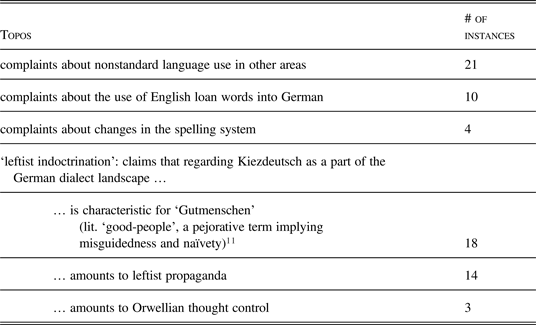
In addition to these four main topoi, there were a number of other topoi that did not appear with a high frequency and have not been taken into account in the current study, but might be interesting for further investigations. Table 3 lists some examples.
Some minor topoi in KiKDo/E.
In some cases, additional topoi appeared as the discussion in a particular venue developed in further directions, for instance, on the website of The Economist, the discussion at one point moved to general cultural ‘assimilation’ (including choice of TV programs), and to heritage language programs at schools and bilingual education.
The four key topoi identified from the corpus data can be organised onto two levels, forming two parallel pairs. The first pair, ‘Broken language’ and ‘Language decay’, targets the linguistic level itself and reflects a negative evaluation of Kiezdeutsch and its impact on German, while the second pair, ‘Opting out’ and ‘Social demolition’, targets a more general social level, relating the negative evaluation of the speakers’ language use to issues of social and societal integration.
The following quotes illustrate the combination of the four different topoi identified here.
(6) This is not a dialect, but simply the unwillingness to integrate or (even worse) laziness to learn one's own language properly. (KiDKo/E, letter to Bild, 17/02/2012)
(7) To call this chavvy babble a language is an absolute disqualification as a scientist. … Through my job, I have a lot to do with (failed) adolescent migrants and also with German-background adolescents, and I see every day how the Germans adjust to this Arab-Turk-Kurd language. In some cases, there are no ‘normal’ dialogues possible anymore because the basic lexicon is already deleted. (KiDKo/E, Email, 29/02/2012)
The contrast constructed in the email between ‘migrants’ and ‘German-background’ adolescents, and the depiction of ‘Germans adjusting to an Arab-Turk-Kurd language’ implies a conceptualisation of Kiezdeutsch speakers as non-German, illustrating a powerful social and linguistic dichotomy that I treat in more detail below (in the section ‘Us’/‘them’ dichotomies). The alloethnic construction of Kiezdeutsch speakers as ‘foreigners’ or ‘migrants’ can also account for some parallels with the public debate on immigration in Germany: Wengeler (Reference Wengeler2003), for instance, identifies a central topos of assimilation/conformation (Anpassungstopos) in that debate, and Geisen (Reference Geisen, Mecheril, Dirim, Gomolla, Hornberg and Stojanov2010) analyses integration as a political ‘leitmotif’, providing a close fit to the second topoi pair in the Kiezdeutsch debate. Let us now have a closer look at the data on the four main topoi.
‘Broken language’ and ‘Language decay’
The two related topoi of ‘Broken language’ and ‘Language decay’ identify a key semiotic domain in the postings, appearing in nearly a quarter (22.5%) of the data. They are particularly common in emails, where they make up 44.1% of the messages, and in tabloids (33.2% of tabloid postings).
The devaluation implied in the topoi is realised both at the level of the linguistic system and at that of the speakers. At both levels, Kiezdeutsch is contrasted to ‘High German’, which is constructed as a superior form of language and thus as an indication of higher competence, and as a more desirable part of speakers’ repertoires.
The topos of ‘Language decay’ is associated with characterising Kiezdeutsch as ‘reduced’ and ‘primitive’ and denying it the status of a proper language. It is rejected as part of German, and characterising it as a German dialect is sometimes considered as an attack on the German language as a whole, or on ‘High German’ in particular. (8) gives an illustration:
(8) to call these gutter sentences a new dialect is an insult to the German language without parallel. (KiDKo/E, letter to shortnews, 09/02/2012)
In order to refute such a ‘dialect’ characterisation, some posters resort to linguistic terminology for alternative classifications such as ‘pidgin’, ‘sociolect’, ‘argot’, ‘slang’, ‘jargon’, and ‘patois’, which are considered more appropriate since they are taken to define more primitive forms of language, associated with lower social classes (cf. Bourdieu Reference Bourdieu1982:51 on the use of terms like ‘jargon’ and ‘petit-nègre’ in linguistic devaluation—translated as ‘slang’ and ‘pidgin’ in the 1992 English edition).
Besides lack of competence, posters allege that speakers use Kiezdeutsch because they are ‘careless’, ‘slack’, or ‘lazy’, and do not want to make the time and effort to speak ‘proper language’. A frequently made connection that fits in with this, is that between language and culture. In this context, a number of posters devaluate Kiezdeutsch as a form of language that belongs to earlier stages of human evolution, with references to ‘Stone Age’ and ‘Neanderthals’, in contrast to ‘High German’, with its Hochsprache ‘high/exalted language’ association. The devaluation of Kiezdeutsch as less cultured leads to concerns that it will negatively affect national culture in Germany, which is, in this context, repeatedly described as the land of Dichter und Denker ‘poets and thinkers’, a popular motif that transports a positive national self-image of Germany as a land of culture, including an appropriately ‘High language’.
‘Opting out’ and ‘Social demolition’
The two connected topoi of ‘Opting out’ and ‘Social demolition’ that centre around integration and social cohesion appear in over 10% of the postings, with a marked increase in emails, in particular in those from the first, 2009, wave, where they appear in 40% of the data, compared to 20% in the second, 2012, wave. This difference might be due either to the different points in time of the two waves, or to a higher proportion of emails from the extreme right in the first wave.
A recurrent assumption is that the use of Kiezdeutsch is an indication either of speakers’ inability or of their unwillingness to integrate in the majority society. In the second case, Kiezdeutsch appears as a rejection of ‘High German’ and the value placed on it. This lack of integration is regarded as a threat to the larger society, with several posters voicing Armes Deutschland ‘Poor Germany’, a popular motif lamenting putative national declines.
Example (9) gives an illustration with a posting to The Economist (the poster is probably of US background) that links this putative unwillingness to integrate with ethnic and religious devaluations.
(9) I guess that this ‘Turkish phenomenon’ in Germany has something to do with either a fanatic Turkish nationalism or with their self-detaching Islam religion, which often forbids that their children visit and play with ‘infidels’ (non-Muslim children) after school. However, either explanation is dangerous for the cohesion and solidarity needed in any nation-state. (KiDKo/E, letter to The Economist, 12/02/2012)
A narrative showing up repeatedly in this context is that there might be a plan to teach Kiezdeutsch at schools (similar to some media representations of the Ann Arbor case on AAVE, cf. Labov Reference Labov1982:194), which one should battle against in order to defend educational and linguistic standards.
The topos of ‘Social demolition’ gives rise in some cases to the picture of a hostile take-over of the German ‘High Language’, national values, or Germany as a whole. This picture draws on a particular Othering of Kiezdeutsch speakers that is also involved in the other topoi identified here, a social exclusion based on widespread ‘us’/‘them’ dichotomies. These dichotomies feed into an underlying narrative that brings together the four topoi identified here.
WHO OWNS A DIALEKT?
Perhaps the most interesting aspect of the debate investigated here is the way in which it reveals a key narrative on what it means to ‘speak German’ and to own a German Dialekt—a narrative that targets concepts of standard language, dialect, and their speakers, and sheds a special light on the complex relationship between language and identity and on the projection of social deliminations onto the linguistic plane.
‘High German’ and its dialects
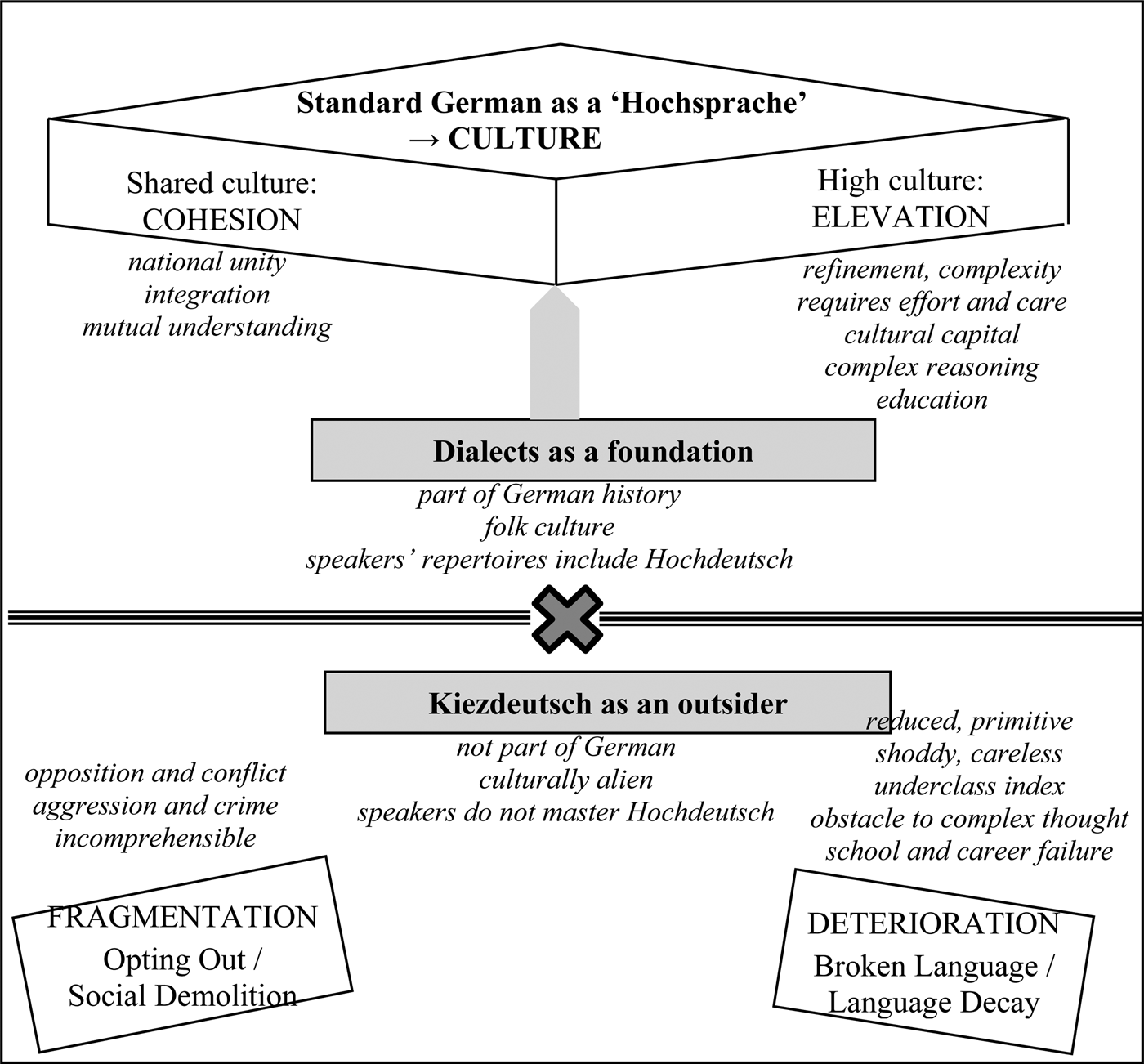
The construction of standard German as Hochdeutsch ‘High German’, and an elevated Hochsprache ‘high/elevated language’ that I mentioned in the background section above feeds into the debate on Kiezdeutsch by providing a marked contrast for it and, by doing so, links up social and linguistic dichotomies. In the corpus, we find frequent references to Hochdeutsch where it serves as a characterisation of what Kiezdeutsch is not, both at the level of language varieties and of speakers’ repertoires. Together with a view of traditional dialects as a historical basis for this ‘high language’, this perspective ousts Kiezdeutsch—and its speakers—from the realm of ‘German’.
A key to this view is the notion of Hochdeutsch as a higher, exalted language that is closely associated with a positive notion of ‘culture’ in two senses. First, Hochdeutsch is constructed as a buttress for a shared culture and for national unity, a vehicle to overcome fragmentation that supports communication and understanding across German regions. This association of Hochdeutsch with ‘culture’ links up with the topoi set of ‘Opting out’ and ‘Social demolition’: against this background, speaking Kiezdeutsch is seen as a refusal to partake in such a shared culture and thus as a threat to social cohesion, an unwillingness to integrate that suggests conflict and aggression. This accounts for themes such as ‘aggression’ and ‘violence’, and relates to the motif of ‘Poor Germany’.
Second, Hochdeutsch is constructed as a sign of a high culture, of cultural elevation, refinement, and complexity, with posters talking about ‘cultivated high language’, and ‘polished’ or ‘immaculate High German’. This notion of standard German relates to the motif of ‘Poets and thinkers’. It presents Hochdeutsch as something that does not come naturally, but requires effort and care, and provides a valuable cultural capital for those who master it.Footnote 12 Accordingly, linguistic change is regarded as a threat to those who own this capital, as is grouping Hochdeutsch with other varieties of German, which would challenge its superior status.
The contrast of this elevated language form with nonstandard forms links up with the topoi set of ‘Broken German’ and ‘Language decay’, and subsequent themes of educational failure, unemployment, and welfare costs, and with characterisations of Kiezdeutsch as reduced and primitive. The following post to a tabloid relates the rejection of Kiezdeutsch to putative indignations by Goethe and Schiller, two classical authors popularly regarded as something like high guardians of German culture and ‘proper’ language.
(10) That is not a dialect, but rather the dissolution of our German language. Goethe and Schiller would turn in their graves. (KiDKo/E, letter to Die Welt, 13/02/2012)
The cultural refinement associated with Hochdeutsch expands to the cognitive domain, where this more complex and refined form of language is regarded as supporting correspondingly refined thoughts and complex reasoning. Again, this is then by way of contrast negated for Kiezdeutsch, leading to the view of Kiezdeutsch as a cognitive obstacle.
The concept of Dialekt described in the background section allows posters to associate this view of Hochdeutsch with German dialects without including Kiezdeutsch here: a Dialekt is described as something that serves as a foundation for Hochdeutsch, is used alongside Hochdeutsch by its speakers, has a long history in German, and is part of German folk culture. In contrast to this, Kiezdeutsch is then constructed as being outside such a culture: it is not part of German since it does not look back at a long history, has not contributed to the rise of Hochdeutsch, and is old only in the sense of reflecting a more primitive stage of language (the ‘Stone Age’ theme). It will thus not be part of a repertoire that encompasses Hochdeutsch, but instead causes ‘semilingualism’.
This contrasts sharply with the opposite judgment of such varieties as Texas German (mentioned in the background section), which developed outside Germany and did not provide a basis for Hochdeutsch either. Hence, while posters frequently require a Dialekt to be part of the historical foundation for Hochdeutsch when denying Kiezdeutsch this status, this does not seem to be at the core of the rejection. Rather, the key element seems to be a perceived belonging to a German in-group involving, as mentioned above, a ius sanguinis perspective that includes speakers of, for example, Texas German, but excludes Kiezdeutsch speakers.
The following quotes illustrate this line of reasoning and demonstrate the ethnicisation and ousting of Kiezdeutsch that is associated with this.
(11) Hochdeutsch ‘lords’ over all dialects as a unifying, common language. … In the case of ‘Kanak-Sprak’ there is no superordinate Hochdeutsch, but ‘migrantics’. While a Saxonian or Bavarian or … can talk to you in Hochdeutsch with a respective accent, the ‘Kanak-Sprak’ artists cannot. (KiDKo/E, letter to Schleswig-Holsteinische Zeitung, 27/03/2012)
(12) I thought I did not hear properly how you paid homage to this gobbledygook, ennobled this babble and actually acknowledged it as kin to the German language. One can certainly fetch goats from the mountains in Anatolia with it or park camels in Arabia. But calling this a German dialect I find totally absurd! (KiDKo/E, Email, 21/02/2012)
The construction of German dialects and of standard German as Hochdeutsch we find in the debate hence interacts closely with ‘us’/‘them’ dichotomies deliminating members of a perceived in-group from speakers of Kiezdeutsch.
‘Us’/‘them’ dichotomies
The relevant dichotomies operate at two levels: (i) at a general level of social strata, where Kiezdeutsch speakers are constructed as socially inferior, belonging to a lower social class, and (ii) at more specific levels of ‘ethnicity’, where they are constructed as belonging to an alloethnic out-group. At both levels, Kiezdeutsch is pushed to a realm of Otherness and indexically associated with speakers that are perceived as inferior. This social exclusion is widespread in the corpus data, with 17.5% of the postings overall including explicit characterisations falling into this semiotic domain. The following quotes give examples from comments to German and UK national news and a tabloid.
(13) What I associate ‘Kiezdeutsch’ with: – uneducated, primitive male adolescents – disposition towards violence; aggression, cursing – dark, fierce mugs – machismo, contempt of women – swanking with outer appearances (gold chains, car …) – hatred of the educated and those that have achieved a certain prosperity through their own work – hatred of Jews and queers. (KiDKo/E, letter to Fokus Online, 12/02/2012)
(14) If a language gets corrupted by incorporating a host of foreign words it can hardly be called ‘dialect’. Fact is that this ‘Kiez'patois is predominantly used in a low class environment, and if mainstream teenagers find it fashionable they will latest [sic] wake up at their first job interview. (KiDKo/E, letter to The Economist, 13/02/2012)
(15) Oh, if they only knew how they mark themselves, through language, body art, and clothing, as belonging to the lowest caste. A life style at the level of minimal wage, Hartz IV [social benefits] is predetermined this way.KiDKo/E, letter to (Bild, 18/02/2012)
As these examples from different domains illustrate, the dichotomythat is constructed here is evident across subcorpora, with particularly highnumbers in emails (in 36.8% of the messages), comments to tabloids (24.8% oftabloid postings), and comments to right-fringe media (21.4%). Interestingly,we also find reference to this dichotomy in positive postings. The followingquote from an email gives an example where this is ironically broken.
(16) I find it almost sensational that it should be linguistics, of all disciplines, that changes my view of these young people who always need to spit on the street. (KiDKo/E, Email, 03/03/2012)
In general, the status deprecation of speakers is realised throughthemes such as underclass (e.g. ‘mob’, ‘riffraff’, ‘low caste’,‘ghetto’, ‘gutter language’), poverty (e.g. ‘poor’, ‘Hartz IV’), loweducation (e.g. ‘uneducated’, ‘education-adverse milieu’), aggressionand law-breaking (e.g. ‘aggressive’, ‘criminal’, ‘delinquent’), and lowculture (e.g. ‘uncivilised’, ‘primitive’, ‘uncultivated’), the latter two often associated with an opposition to liberal values, similarly as reported for debates in France, Sweden, and the UK (cf. Pooley Reference Pooley and Ayoun2008; Milani Reference Milani2010; Kerswill Reference Kerswill and Androutsopoulos2014, respectively).
In a number of cases, the social ousting of Kiezdeutsch speakers is reinforced by posters expressing strong emotional and physical responses of social aversion, describing Kiezdeutsch as ‘repugnant’, ‘ghastly’, ‘creepy’, ‘disgusting’, and ‘vomit’-inducing.
The construction of Kiezdeutsch speakers as aggressive is frequently supported by putative language examples made up by the posters, which are dominated by curse words and threats. In particular in the emails, but also in some of the postings to media sites, such ‘Kiezdeutsch’ usage allows the posters to break linguistic taboos and use violent threats, insults, and slurs (e.g. ‘bitch’, ‘pussy’, ‘old shit’, ‘I fuck you, slut’, ‘Piss off, or I put you into hospital’). Examples (17) and (18) give illustrations from an email and a posting to a regional newspaper.
(17) Ey, are ya fucking handicapped? Kanaksprak is so not cool, cos get you no real job, ya know? Ey, know-whadda-mean? Only real gay professor title for social-fuck-thing like you! But what the shit, tax potato [Kartoffel ‘potato’ ~ derogatory term for Germans] will pay for it! Ey, fuckya and kind greetings, [name] (KiDKo/E, Email, 29/02/2012)
(18) Ya know, that bitch Heike understands concretely … :-) (KiDKo/E, letter to Der Westen, 29/01/2012)
These appropriations of Kiezdeutsch constitute a special case of ‘crossing’ (cf. Rampton Reference Rampton1995): in this case, posters use the voice of a fabricated ‘Other’ in order to behave in a way that would usually be taboo, thus emphasising the construction of this ‘Other’ as outside the boundaries of their social group.
In line with this social demarcation of Kiezdeutsch speakers, the regional association of traditional German dialects is often contrasted with a locus for Kiezdeutsch that is identified not as a particular geographical region, but rather as generally areas with a low social status. In (19), this is combined with an alloethnic characterisation of Kiezdeutsch as ‘Turks’ German’.
(19) Dialects are characterised by the fact that they are spoken in particular regions. Turks’ German, euphemised as ‘Kiezdeutsch’, however, is spoken in run-down areas where education and the ability to integrate are slight. (KiDKo/E, letter to UniSPIEGEL, 29/03/2012)
The ethnic dichothomy that is also involved here, is a recurring theme in the data. Speech communities supporting Kiezdeutsch undergo an alloethnic reinterpretation, with speakers constructed as ‘foreigners’, ‘migrants’, or as belonging to specific non-German ethnicities. The construction of such ‘ethnic’ boundaries presumably further reinforces the themes of ‘aggression’ and ‘law-breaking’ mentioned in connection with social dichotomies above: as, for example, Jäger (Reference Jäger2004) describes, in public discourse in Germany there is a strong association of ‘foreigners’ and immigration with criminality, with Ausländerkriminalität ‘foreigner-delinquency’ a frequent buzzword.
In the corpus data, the alloethnic demarcation is used as a particularly strong rejection of Kiezdeutsch as a dialect, overruling social demarcations, as illustrated in the following posting to a regional newspaper.
(20) Kiezdeutsch is not a dialect, it is not even proletarians’ German! Something like that can at best be called Tarzan German. (KiDKo/E, letter to rp-online, 22/04/2012)
The xenophobic undertones that are prevalent in this domain are particularly visible in the labels promoted by posters in rejection of Kiezdeutsch, often also involving ‘us’/‘them'dichotomies targeting social class, such as ‘Turk-prole dialect’ (KiDKo/E, letter to rp-online, 22/04/2012), ‘ghetto-style-migrant-German’ (KiDKo/E, letter to Bild, 17/02/2012), or ‘Kanak blathering’ (KiDKo/E, letter to Deutschland-Echo, 29/01/2012). The following quote makes a causal connection between dialect ownership and the affiliation to German ‘tribes/peoples’ (Volksstämme), from which Kiezdeutsch speakers are excluded as Turks.
(21) Bavarians and Swabians are German tribes and therefore have their own dialect. Kiezdeutsch, better Turks’ German, stands for a lack of willingness to integrate. (KiDKo/E, letter to UniSPIEGEL, 29/03/2012)
The (allo-)ethnic conceptualisation generally centres around Turkish, Arabic, and Kurdish backgrounds—sometimes contrasted to Asians as ‘model minorities’—and is often associated religiously, with a negative view of Islam up to islamophobia. The latter relates to a more general prejudice against Islam in Germany: according to the most recent Religion Monitor survey of Bertelsmann Foundation, ‘many Germans regard Islam … as something foreign, alien, and threatening’ (Pollack & Müller Reference Pollack and Müller2013:60), with around half of the respondents perceiving it as a threat, rather than an enrichment. Example (22) combines the rejection of Kiezdeutsch as a dialect with a devaluation of Muslims.
(22) This is quite simply not a dialect, but solely due to the inability of muslims to learn the German language. (KiDKo/E, letter to pi-news, 26/05/2009)
A further ideological underpinning for the dichotomy observed here is the linguistic exclusion of multilingual speakers from a ‘German’ in-group, in particular of those with heritage languages that are assigned a low market value. First, a ‘migrant background’ is seen as a basic obstacle to German competence, with assumptions of ‘double semilingualism’ pervasive in the public debate, in education, and even in the medical sector,Footnote 13 and a strong ideological association of ‘migrant background’ with ‘in need of special language support’ (cf. Scarvaglieri & Zech Reference Scarvaglieri and Zech2013 for a functional-semantic analysis of Migrationshintergrund ‘migrant background’ in German, and for corpus data on co-occurrences with, among others, ‘support’ and ‘language support’).
Second, naming practices tend to deny genuine ‘Germanness’ for some immigrants and their descendants. While immigrants from Russia who can claim a pre-war German ancestry are known as ‘Russia Germans’ (Russlanddeutsche), residents of Turkish descent are commonly called ‘German Turks’ (Deutschtürken) even if they belong to the second or third generation living in Germany, a term that marks them as a kind of Turks, rather than a kind of Germans, given that nominal compounds in German are right-headed.Footnote 14 This seems to be restricted to immigrants to Germany, and in particular to those of Middle Eastern background, while, for example, the term ‘German Americans’ (Deutschamerikaner) is used to identify German immigrants to the US.
Taken together, the kind of exclusion evident in such patterns provides an ideological reinforcement for the topoi on language and integration observed in the corpus, feeding into a narrative that we can now identify as a central theme in the devaluation of Kiezdeutsch: what counts as German, who is a legitimate speaker of German, and, crucially, of ‘High German’, what is, accordingly, a German dialect and who owns it?
CONCLUSIONS
This study of a recent German debate indicates that the public discourse on such new urban dialects as Kiezdeutsch provides us with a special window into the way standard language ideologies interact with social dichotomies: the overwhelmingly negative attitudes and ideologies evident in such discourse link up constructions of standard and nonstandard language with particluar deliminations of social in- and out-groups. In the case of Germany, the Dialekt framing of the debate on Kiezdeutsch that this article focused on puts a special spotlight on the dichotomies at work here.
As our investigation showed, demarcations involving social class, ‘ethnicity’, and religion feed into the construction of Kiezdeutsch speakers as members of an alien out-group, and this exclusion closely interacts with a perspective on dialects that relates Dialekt ownership to perceived ethnic kinship relations and claims them as the cultural and linguistic property of the ‘German’ in-group. Kiezdeutsch is marginalised as a negative counterpart to such dialects, which are linked, as a historical and ‘folk cultural’ foundation, to a standard variety that is perceived as a superior form of language, closely associated with positive values of cultural elevation and cultural unity.
Figure 1 summarises the overall picture that emerges here.
A standard language narrative on Hochdeutsch vs. Kiezdeutsch.
Kiezdeutsch on the one hand and Hochdeutsch and its dialects on the other hand thus present themselves as two sides of a coin. They are linked in an argumentative structure that crucially builds on a contrast of linguistic and social identity, a contrast that helps speakers who conceive of themselves as German majority speakers, to reaffirm a prestige that they might perceive as threatened by multiethnic urban communities. To reject Kiezdeutsch as part of German can then reflect a proxy racism: a projection of ‘ethnic’ and xenophobic demarcations and exclusions onto the linguistic plane.
The Dialekt framing of the Kiezdeutsch debate in Germany put a special spotlight onto this kind of proxy racism, but as the studies, for example, on Rinkeby Swedish and Spanglish discourse in Sweden and the US, respectively, indicate, the German debate does not constitute a singular case (Stroud Reference Stroud2004; Zentella Reference Zentella, Flores and Rosaldo2007). Language seems to be one of the final hide-outs where openly racist remarks are still socially acceptable in modern society, and as such, it is a very powerful domain for the construction of social out-groups. Taking a professional responsibility of involvement seriously as, for example, suggested by Labov (Reference Labov1982),Footnote 15 as linguists we should contribute to exposing such projections, not only in academic writing, but if possible also in public discourse and in such key domains as education and public policy.”
APPENDIX: GERMAN ORIGINALS OF THE EXAMPLES QUOTED IN THE TEXT
(1) … bedient sie sich des mittlerweile positiv besetzten Wortes „Kiez“ (Stadtteil) und schafft damit eine angenehme Grundstimmung, die mit dem Wort „Kanaksprak“ kaum möglich ist.
(“Stammeldeutsch als Errungenschaft? Sprachwissenschaftler bewundern eine Fehlentwicklung unserer Sprache”)
(2) Sie nennen es „Kiezdeutsch“ und sprechen von einem Dialekt. Aber würden Mittelschichtskinder das nicht als „Türkensprache“ bezeichnen?
(3) Frau Wiese kapert den Terminus „Dialekt“ für eine jugendliche Sprechweise, in der Angeberei eine große Rolle spielt. Warum? Sie möchte an seinem Prestige schnorren, denn Dialekte genießen Ansehen. … „Kiezdeutsch“ aber ist weder ein Dialekt noch ein Soziolekt, sondern eine transitorische Sondersprache, die auf Einflüssen anderer Sprachen und auf Fehlern im Deutschen beruht. … Es ist kein Fall für die Dialektologie, sondern für die Sprachpsychologie und die Fehleranalyse.
(“Sachtemang mit dit Kiezdeutsche. Heike Wiese Thesen über Jugendsprache gründen sich auf Sozialarbeit, aber haben keinen Halt in der Linguistik” [‘Keep yer horses with dat Kiezdeutsch. Heike Wiese's theses about youth language are grounded on social work, but do not have a basis in linguistics’])
(4) Kiezdeutsch ist völlig unproblematisch. Bayern, Süddeutsche, und Schweizer reden auch Dialekt und schreiben dennoch richtiges Deutsch.
(5) auch zu meiner Schulzeit in den 50ern wurde auf dem Schulhof schon „appeldwatsch“ geschnackt. Solange die Lehrer und das Elternhaus ein vernünftiges Deutsch vermitteln, hat es nicht geschadet.
(6) Das ist kein Dialekt, sondern lediglich die Unlust sich zu integrieren oder (noch schlimmer) die Faulheit die eigene Sprache richtig zu lernen.
(7) Dieses Assigestammel als Sprache zu bezeichnen ist eine absolute Disqualifikation als Wissenschaftler…. Ich habe beruflich sehr viel mit (gestrauchelten) jugendlichen Migranten und auch deutschstämmigen Jugendlichen zu tun und sehe jeden Tag, wie sich die Deutschen an die Arab-Türk-Kurdensprache anpassen. Teilweise sind gar keine „normalen“ Dialoge mehr möglich, weil der grundlegende Sprachschatz schon gelöscht ist.
(8) diese Gossensätze als neuen Dialekt zu bezeichnen ist eine Beleidigung der deutschen Sprache ohne gleichen
(10) Das ist kein Dialekt sondern der Zerfall unsere Deutschen Sprache. Goethe und Schiller würden sich im Grabe umdrehen.
(11) Über allen Dialekten “thront” hochdeutsch als verbindende, gemeinsame Sprache. In den Schulen wird hochdeutsch gelehrt, evtl. mit einem örtlich unterschiedlichen Akzent. Bei “Kanak-Sprak” gibt es kein übergeordnetes hochdeutsch sondern “migrantisch”. Während ein Sachse oder Bayer oder … sich mit Ihnen auf hochdeutsch mit dem entsprechenden Akzent unterhalten kann, können dies die “Kanak-Sprak”-Artisten nicht
(12) Ich dachte ich höre nicht richtig, wie Sie diesem Kauderwelsch huldigten, dieses Gebrabbel adelten und es tatsächlich der deutschen Sprache anverwandt anerkannten. Sicher kann man damit in Anatolien Ziegen vom Berg holen oder in Arabien Kamele einparken. Dieses aber einen deutschen Dialekt zu nennen halte ich für völlig abwegig!
(13) Womit ich “Kiezdeutsch” assoziiere: – Ungebildete, primitive männliche Jugendliche – Gewaltbereitschaft, Aggressivität, Pöbelei – düstere, grimmige Visagen – Machotum, Frauenverachtung – Protzerei mit Äußerlichkeiten (Goldkettchen, Auto…) – Hass auf die Gebildeten und auf diejenigen, die sich durch eigene Arbeit einen gewissen Wohlstand geschaffen haben – Hass auf Juden und Homos.
(15) Ach, wenn sie doch nur wüssten, wie sie sich durch Sprache, Körperkunst und Kleidung zur untersten Kaste gehörend kennzeichnen. Eine Lebensführung auf Niveau Mindestlohn, HartzIV wird so vorprogrammiert.
(16) Dass ausgerechnet Sprachwissenschaft meine Sicht auf die jungen Leute, die immer ausspucken müssen, verändert, finde ich beinahe sensationell.
(17) Ey, bissu voll krass behindert? Kanaksprak is voll nich cool, weil kriegst du keine richtige Job, weisdu? Ey, weis-wie-isch-mein? Höchstens voll schwule Professorentitel für Sozialfickdings, wie Du! Aber scheißegal, zahlt ja Steuerkartoffel! Ey figgdisch und schöne Grüße.
(18) Weischt du, das Bitch Heike versteht konkret … :-)
(19) Dialekte zeichnen sich dadurch aus, dass sie in bestimmten Regionen gesprochen werden. Das als “Kiezdeutsch” verharmloste Türkendeutsch wird dagegen in heruntergekommen Gegenden gesprochen, wo die Bildung und die Integrationsfähigkeit gering sind.
(20) Kiezdeutsch ist kein Dialekt,es ist noch nicht mal Proletendeutsch! Sowas nennt man höchstens Tarzandeutsch.
(21) Die Schwaben und Bayern sind deutsche Volksstämme und haben deshalb ihren eigenen Dialekt. Kiezdeutsch, besser wäre Türkendeutsch, steht für mangelnde Integrationsbereitschaft
(22) Das ist schlicht und ergreifend kein Dialekt sondern einzig und allein der unfähig der Muslime geschuldet die deutsche Sprache zu erlernen.

 Open access

