





Introduction
Strawberry is a major crop in the United States, with the fresh strawberry market valued at US$18.19 billion in 2019 and a projected growth to US$27.82 billion by 2031 (Samtani et al. Reference Samtani, Rom, Friedrich, Fennimore, Finn, Petran, Wallace, Pritts, Fernandez and Chase2019; Skyquestt 2024). In the United States, the southern states of Alabama, Georgia, North Carolina, South Carolina, and Virginia collectively rank third in fresh market strawberry production, after California and Florida. In a survey conducted on strawberry production practices in Virginia, growers were queried regarding the most significant category of pest that poses a threat to their crop, and 31% of respondents identified weeds as the primary threat (Christman and Samtani Reference Christman and Samtani2019). In Virginia, most growers use the annual hill production (AHP) system with plasticulture, in which plug plants are transplanted in the fall (September to the first week of October) fruits are harvested in the subsequent spring (Flanagan et al. Reference Flanagan, Samtani, Manchester, Romelczyk, Johnson, Lawrence and Pattison2020; Samtani et al. Reference Samtani, Rom, Friedrich, Fennimore, Finn, Petran, Wallace, Pritts, Fernandez and Chase2019). The AHP system consists of a raised bed of soil covered with plastic mulch with drip tape below for irrigation and spring fertigation. Typically, growers who adopt the AHP system will fumigate beds, and the choice of fumigant depends on the pest type that needs to be controlled (Lalk et al. Reference Lalk, Bi, Zhang, Harkess and Li2020; Poling Reference Poling, Krewer and Smith2005). Weeds, particularly those that emerge in the plant hole or through the plastic mulch, can reduce strawberry yield and lower fruit quality (Benlioğlu et al. Reference Benlioğlu, Boz, Yildiz, Kaşkavalci and Benlioğlu2005). Methyl bromide (MB), the most effective preplant soil fumigant against weeds and other pests, was banned under the Montreal Protocol due to its ability to deplete the ozone layer (Ajwa et al. Reference Ajwa, Klose, Nelson, Minuto, Gullino, Lamberti and Lopez-Aranda2003; Backstrom Reference Backstrom2002). Furthermore, MB is associated with other negative effects, such as those on soil biodiversity, groundwater contamination, and human health (López-Aranda et al. Reference López-Aranda, Domínguez and Miranda2016; Mei et al. Reference Mei, Amaradasa, Chretien, Liu, Snead, Samtani and Lowman2021; Noling and Becker Reference Noling and Becker1994). Although the AHP system faces many challenges, one such challenge is finding alternative solutions to effectively replace MB fumigation.
Alternative fumigants currently being used to control weeds in the AHP system include chloropicrin (Pic), metam sodium, or a combination of Pic and 1,3-dichloropropene (1,3-D) (Fennimore and Boyd Reference Fennimore and Boyd2018). Chloropicrin is effective against soilborne fungal and bacterial pathogens but is less effective against nematodes and weeds. Furthermore, 1,3-D and metam products are effective against weeds and nematodes, but regulations on their use are increasing, including the need for untreated buffer areas, the creation of a fumigation management plan before application, and worker safety precautions (Noling and Becker Reference Noling and Becker1994; Samtani et al. Reference Samtani, Derr, Conway and Flanagan2017). Fewer farmers are willing to fumigate due to human health risks and the cost of application; therefore, alternative types of fumigation are needed to control pests, including weeds, and to maintain crop health and yields.
Sustainable weed management refers to the use of practices and techniques that minimize the negative impacts of weeds on agricultural systems, while promoting environmental, economic, and social sustainability (Sims et al. Reference Sims, Corsi, Gbehounou, Kienzle, Taguchi and Friedrich2018). Therefore, complete weed management, with minimal ecological hazards, is required (Esposito et al. Reference Esposito, Crimaldi, Cirillo, Sarghini and Maggio2021). Soil solarization (SS) is an alternative strategy to fumigation that has been used to control soilborne pests by using solar energy to increase the soil temperature to levels that are lethal to these pests (Camprubí et al. Reference Camprubí, Estaún, El Bakali, Garcia-Figueres and Calvet2007; Monteiro and Santos Reference Monteiro and Santos2022). Solarization can be achieved by covering moistened soil with a clear polyethylene tarp for a specified duration. The soil temperature under the tarp will increase substantially above the ambient air temperature, thereby providing adequate weed control (Gill and Garg Reference Gill and Garg2014). Increased soil temperatures due to SS can range from 37 C to 55 C at a depth of 15 cm, which can kill most soilborne pests (Jacobs Reference Jacobs2019; Samtani et al. Reference Samtani, Derr, Conway and Flanagan2017). Annual weeds are more easily controlled by SS than perennial weeds; however, the efficacy of this method depends on the weed species, the plastic tarp used, the duration of exposure, day length, and depth of the seed in the soil (Rubin et al. Reference Rubin, Cohen and Gamliel2007). Several weeds, including annual bluegrass (Poa annua L.), redroot pigweed (Amaranthus retroflexus L.), wild radish (Raphanus raphanistrum L.), and wild chamomile (Matricaria recutita L.), were controlled with 100% efficacy using SS in Turkey (Boz Reference Boz2004). The effectiveness of SS can be increased by applying various organic soil amendments such as mustard seed meal (MSM), composts, crop residues, and green and animal manures, which contribute to specific pathogen suppression mechanisms (Bidima et al. Reference Bidima, Chtaina, Ezzahiri, El Guilli and Barakat2022; Gamliel et al. Reference Gamliel, Austerweil and Kritzman2000). Incorporation of organic compounds with SS has been shown to improve the efficiency of SS in controlling soilborne pests by producing toxic compounds and increasing soil temperature by 1 to 3 C (Rubin et al. Reference Rubin, Cohen and Gamliel2007).
Mustard seed meal, a byproduct of the mustard oil extraction process, contains glucosinolates. When applied to moist soil, MSM normally undergoes enzymatic hydrolysis to produce isothiocyanates, thiocyanate, nitriles, and other chemicals (Borek and Morra Reference Borek and Morra2005; Borowy and Kaplan Reference Borowy and Kaplan2020). In a 2-yr trial, MSM was applied to strawberries at a rate of 64.4 g/m2, which decreased weeding time in one year but had no impact in the second year (Miller Reference Miller2006). The biomass of wild oat (Avena fatua), Italian ryegrass (Lolium multiflorum), redroot pigweed (Amaranthus retroflexus), and prickly lettuce (Lactuca serriola) were all decreased by MSM application at a rate of 2,000 kg ha−1 (Handiseni et al. Reference Handiseni, Brown, Zemetra and Mazzola2011). Eight weeks after treatment, MSM applied alone to the soil surface of containers at 113, 225, and 450 gm−2 reduced the number of annual bluegrass seedlings by 60%, 86%, and 98%, respectively, and the number of common chickweed (Stellaria media L.) seedlings by 61%, 74%, and 73%, respectively (Boydston et al. Reference Boydston, Anderson and Vaughn2008). We know of no previous study to have investigated the effectiveness of SS and MSM in Virginia. Thus, this study aimed to assess the efficacy of SS and MSM with different treatment periods in providing weed control and maintaining fruit yield relative to fumigated and untreated controls in an annual hill strawberry plasticulture production system.
Materials and Methods
Site and Treatment Descriptions
A field study was conducted at the Southern Piedmont Agricultural Research and Extension Center (AREC) in Blackstone, VA (37.0830°N, 77.9736°W), in sandy loam soil during the 2013/14 and 2014/15 growing seasons, using a randomized complete block design consisting of eight treatments and four replicates. Each block comprised eight adjacent beds, 10 m long and 20 cm high, with a bed-top width of 80 cm. The beds were oriented north-south. The center 4.6-m length of each bed was used for strawberry plug transplanting and data collection and will be referred to as a plot from here on.
Based on soil test recommendations, preplant fertilizers were applied at the time of bed formation in both years. The fertilizer volumes applied to plots receiving MSM treatments were adjusted to account for the nutritional composition (6% N) of the MSM. All plots received 78 kg ha−1 of nitrogen (ammonium and nitrate nitrogen), 78 kg ha−1 of P2O5, and 235 kg ha−1 of K2O. Preplant treatments included applying pelletized MSM (1,120 kg ha−1, MustGro™; Mustard Products & Technologies, Inc., Saskatoon, SK, Canada), followed by covering the soil with either black virtually impermeable film (VIF) (1.25 mil; TriEst Ag Group, Greenville, NC) or a clear embossed polyethylene tarp (1 mil; Robert Marvel Plastic Mulch, Annville, PA) 4 or 8 wk before transplanting (WBT), or a clear tarp without MSM 4 or 8 WBT. 1,3-D + Pic (188 kg ha−1, 1,3-dichloropropene + Pic, 40:60 by weight) was applied at 3 WBT and covered with VIF, which was included as a grower standard control. An untreated control (UTC) covered with black VIF was also included (Table 1).
Preplant treatments applied in this study, their tarp type, abbreviations used in figures, application rate and dates of the treatment application a .
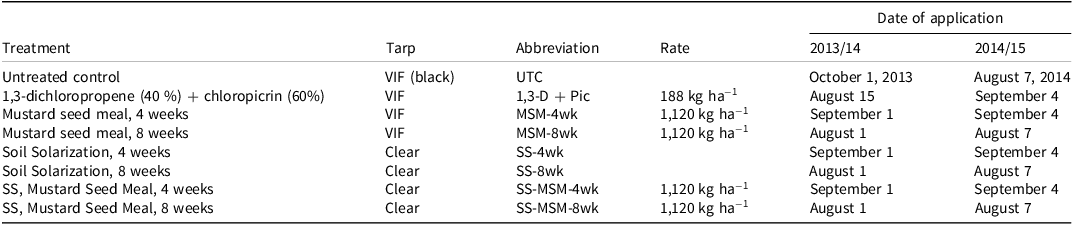
a Abbreviations: MSM, mustard seed meal; Pic, chloropicrin; SS, soil solarization; UTC, untreated control; VIF, virtually impermeable film.
In both years, soil temperatures were recorded at 10-min intervals during the treatment period at depths of 5, 15, and 30 cm in the solarized and nonsolarized beds using temperature probes (U12-015; Hobo Data Loggers, Onset Computer Corporation, Bourne, MA). For SS and UTC plots, the temperatures in 2013 were recorded from September 7 through October 3, 2013, for a 4-wk period, and from August 1 through October 1, 2013, for an 8-wk period. For the 2014/15 growing season, the temperature was recorded from September 4 through October 3, 2014, for a 4-wk period for all treatments, and from August 7 through October 3, 2014, for an 8-wk period. On October 2, 2013, and October 2, 2014, Italian ryegrass [Lolium perenne ssp. multiflorum (Lam.) Husnot] was seeded at a rate of 280 kg/ha−1 prior to punching holes for transplanting strawberries to improve drainage, provide a grass walkway, and reduce weed growth in the furrow space. ‘Chandler’ strawberry (Aaron’s Creek Farms Plant Nursery, Buffalo Junction, VA) was transplanted on October 2, 2013, and October 3, 2014, in staggered double row with 30 cm between rows and 30 cm between plants within each row. Beds were irrigated and fertigated using a single 15-mil drip line with 30.5-cm emitter spacing (Berry Hill Irrigation, Buffalo Junction, VA) the following spring after the first bloom. Plots were fertigated weekly using calcium nitrate fertilizer to provide 7.8 kg/ha−1 nitrogen and 1.4 kg/ha−1 Epsom salt. During the strawberry season, Italian ryegrass was regularly mowed to maintain a height of 8 cm, to avoid overshadowing the strawberry plants. When the temperature dropped below −9 to −12 C, which is critical for protecting the crown (Nestby and Bjørgum Reference Nestby and Bjørgum1999), strawberry plants were protected with a 40 gm−2 floating row cover (Atmore Industries, Atmore, AL).
Data Collection
Weed density was observed after strawberry plugs were transplanted under a 1.5-m-long, 0.8-m-wide monitoring window covered with a clear tarp on bed tops (Figure 1). For treatments with a 1.25-mil black VIF tarp, the weed monitoring window was made by replacing the black tarp with a 1-mil clear tarp to distinguish the treatment effect from the suppressive effects of the black plastic tarp (Samtani et al. Reference Samtani, Derr, Conway and Flanagan2017; Zavatta et al. Reference Zavatta, Shennan, Muramoto, Baird, Koike, Bolda and Klonsky2014). For data collection, weeds were counted by species, and the cumulative total weed density was calculated by summing the numbers of all species in each plot. Weed evaluation dates for both growing seasons were determined when weeds covered more than 50% of the monitoring window area in the UTC. During the 2013/14 growing season, weed count data were recorded 9 wk after transplanting (WAT), 18 WAT, and 27 WAT. For the 2014/15 growing season, emerging weeds were counted at 7 and 24 WAT. Weeds growing on the bed shoulders were not counted but were hand-weeded at each weed evaluation date.
An illustration of the weed monitoring window in black tarp (left) and clear tarp (right) on bed tops measuring 1.5 m long and 0.8 m wide. Twenty strawberry plants in the yield section were used for yield collection (Credit: Alana Martin).

The plant vigor of all plants in each plot was graded on a scale of 0 (all plants died in the plot) to 10 (all plants were extremely vigorous). Plant vigor ratings were recorded monthly for each plot from November to April and averaged for each growing season. Separate plant canopy diameter measurements (width × length) were obtained for each plant in the plot on March 21, 2014, and April 15, 2015, for the two growing seasons.
In May, strawberry fruits were collected weekly from 20 plants outside the designated weeding window area. Deer browsing of strawberry foliage was observed in some plots during the first growing season, compromising yield data. In the second growing season, the fruits were sorted into marketable and nonmarketable categories for each plot. Fruits weighing <10 g were considered nonmarketable. Infected, rotten, overripe, damaged, or misshapen fruits were also considered nonmarketable. Total yield was calculated by adding the weights of the marketable and nonmarketable fruits. Cumulative berry yield data from each plot were summed over all harvests, divided by the number of plants in each plot, and presented as marketable, nonmarketable, and total yield per plant.
Data Analysis
Before performing ANOVA, the data were examined for normality of residuals and transformed as needed. A log (x + 1) transformation was used to achieve normality of residuals for all individual weed species and cumulative weed counts and cumulative weed counts. Normalized data were subjected to ANOVA at P ≤ 0.05, with the growing season, block, and treatments treated as independent variables. Data were analyzed with growing seasons and treatments as fixed effects and block as random effect, using generalized linear mixed models in JMP 14 software (SAS Institute Inc., Cary, NC). The separation letter is based on the transformed least-squares mean value; however, the back-transformed mean values are presented. For weed density, crop vigor rating, stand count, and canopy diameter data, if the interaction between the growing season and treatment was significant, the data were assessed separately for each growing season. Additionally, yield data for the second season were independently analyzed. Multiple comparisons were conducted using protected Fisher’s LSD method.
Results and Discussion
Soil Temperatures
The soil temperature at 5 cm depth underneath a clear tarp (SS plots) was slightly higher (Table 2) in the 2013/14 growing season than in the 2014/15 growing season, except for SS-4wk, which was similar for both years. Other studies have indicated that weed seeds, plants, insects, and plant pathogens such as nematodes and fungal pathogens, may be eliminated by maintaining the soil temperature above 40 C (Monteiro and Santos Reference Monteiro and Santos2022), which was achieved in this study. For the SS-4wk and SS-8wk treatments, the time above 40 C was higher in 2013/14 than in 2014/15, consistent with a study that was conducted in Virginia Beach, VA (Samtani et al. Reference Samtani, Derr, Conway and Flanagan2017). For both growing seasons, the total time above 40 C at the 5-cm depth was greater in SS-4wk and SS-8wk than in untarped plots (Table 2). The highest soil temperatures for the SS-4wk and SS-8wk plots during the 2013/14 growing season were 44.7 C, and 48.9 C, respectively; temperature differences were ≥7 C and ≥11.1 C higher than in the untarped treatments. The soil temperature difference was ≥8.7 C for the SS-4wk period and ≥6.5 C for the SS-8wk period, compared with untarped plots for the 2014/15 growing season. For both growing seasons, the mean soil temperature was approximately 5 C higher than that in the untarped plots. The clear plastic film or tarp that was used in the SS plots allowed solar radiation to flow through the film while trapping heat and raising soil temperatures, which may be lethal for weeds (D’Addabbo et al. Reference D’Addabbo, Miccolis, Basile, Candido and Lichthouse2010). The maximum air temperatures during the preplant SS treatment period, as retrieved from the Weather Underground website, were almost similar at 36 C and 37 C during the 2013/14 and 2014/15 growing seasons, respectively (Weather Underground 2023).
Soil temperature collected at a 5-cm depth during the 4-wk and 8-wk soil solarization treatment periods, in beds with no tarp or a clear tarp in annual plasticulture strawberry production in Blackstone, Virginia.

a Replication of the untreated control bed without a tarp was left uncovered until the start of the treatment to measure the soil temperature.
b Abbreviation: SS, soil solarization.
c For 2013, data were obtained from August 1 through October 1, 2013, for the 8-wk SS and from September 7 through October 3, 2013, for the 4-wk SS treatments. In 2014, data were obtained from August 7 through October 3, 2014, and from September 4 through October 3, 2014, for the 8-wk and the 4-wk SS plots, respectively.
Weed Density
Annual ryegrass (Lolium multiflorum L.), speedwell (Veronica filiformis S.), common chickweed, and cudweed (Gnaphalium L.) were the predominant weed species in both growing seasons. Other weed species, including wild onion (Allium ascalonicum L.), dwarf cinquefoil (Potentilla canadensis L.), and purple dead nettle (Lamium purpureum L.), were counted during the 2013/14 growing season. For the 2014/15 growing season, bittercress (Cardamine breweri S.), flatweed (Hypochaeris radicata), fescue sedge (Carex festucacea S.), seaside bittercress (Cardamine angulata H.), and carpetweed (Mollugo L.) were less abundant. The growing season by treatment interaction was not significant for all dominant weed species and cumulative weed count, and only treatment effects were observed (Table 3). The SS-MSM-8wk and SS-8wk plots exhibited a significantly lower density of annual ryegrass than the UTC, SS-4wk and 1,3-D + Pic plots, which may be due to the longer time the soil remained above 40 C (Table 2). Speedwell weed density was lowest in MSM-8wk, SS-8 wk, SS-MSM-8wk, and 1,3-D + Pic plots compared with density in the UTC plots. Common chickweed density was lower in the 1,3-D + Pic, MSM-8wk, SS-8wk, and SS-MSM-8wk plots than in the UTC, SS-4wk, and SS-MSM-4wk plots in both growing seasons (Table 3). The weed density of cudweed was lowest in the SS-MSM-8wk plots than all other treatments. Cudweed density was the highest in UTC but was not significantly different from weed density in the SS-4wk plots, which may be in part due to the potential for continued wind seed dispersal and germination of cudweed seeds after treatment in the planting hole (Nichols et al. Reference Nichols, Verhulst, Cox and Govaerts2015). Total weed density (the sum of all species) was lowest in the SS-MSM-8wk plots, followed by the SS-8wk, MSM-4wk, MSM-8wk and 1,3-D + Pic plots. The results of this study are consistent with earlier research suggesting that SS can effectively suppress a variety of weed species, including perennial grasses and chickweed (Elmore Reference Elmore1991; Elmore et al. Reference Elmore, Roncoroni and Giraud1993; Khan et al. Reference Khan, Srivastava, Ghorai and Singh2003; Samtani et al. Reference Samtani, Derr, Conway and Flanagan2017). In this study, the 1,3-D + Pic treatment was moderately effective in controlling weeds. Other studies have shown that the combination of 1,3-D and Pic can provide good pathogen control but limited weed control (Samtani et al. Reference Samtani, Derr, Conway and Flanagan2017; Sande et al. Reference Sande, Mullen, Wetzstein and Houston2011). Overall, MSM treatment alone provided weed control effectiveness similar to that of 1,3-D + Pic, indicating that MSM alone has moderately effective weed control activity. Other studies have reported that several weed species, including annual bluegrass and common chickweed, can be controlled by the addition of MSM products to the soil surface (Boydston et al. Reference Boydston, Anderson and Vaughn2008). The mode of action of MSM products involves the release of thiocyanate in the presence of myrosinase enzyme and water, which may account for some of the observed phytotoxicity of small weeds (Borek and Morra Reference Borek and Morra2005). In both growing seasons, the SS-4wk treatments had the highest weed density, whereas the lowest weed density was observed in the SS-MSM-8wk treatment among all other weed-control treatments. Weed density assessments were performed in a “window” location in this study. Therefore, the black tarp in grower fields is expected to have an additive effect with the fumigant to provide more effective weed control than was demonstrated in this study.
Cumulative weed counts across the 2013/14 and 2014/15 growing seasons in Blackstone, VA, as affected by preplant treatments in annual plasticulture strawberry production a,b,c .

a Abbreviations: MSM, mustard seed meal; SS, soil solarization; UTC, untreated control; 1,3-D + Pic, 1,3-dichloropropene (40 %) + chloropicrin (60%).
b Treatments are defined as follows: MSM-4wk, MSM applied 4 wk preplant; MSM-8wk, MSM applied 8 wk preplant; SS-4wk, SS applied 4 wk preplant; SS-8wk, SS applied 8 wk preplant; SS-MSM-4wk, MSM and SS applied 4 wk preplant; SS-MSM-8wk, MSM and SS applied 8 wk preplant.
c Means within a column followed by the same letter are not significantly different based on Fisher’s protected LSD (α = 0.05). The weed data comes from a 1.5 × 0.8 m−2 fixed quadrat window and was converted to per square meter.
There is increased interest in alternative, nonchemical techniques due to inefficiency and growing concerns about the effects of fumigant usage on humans and the environment in strawberry production systems (Lamers et al. Reference Lamers, Mazzola, Rosskopf, Kokalis-Burelle, Momma, Butler, Shennan, Muramoto and Kobara2014). The combination of SS and MSM could play an important role as a sustainable technique for weed control in Virginia’s annual plasticulture strawberry production system, particularly in organic production systems (Monteiro and Santos Reference Monteiro and Santos2022; Wang et al. Reference Wang, Gu, Niu and Baumann2015). However, the duration of SS varies depending on location due to several factors, such as soil temperature, solar radiation, and the temperature necessary to kill weed seeds. Generally, a longer period of SS would be required for effective weed control.
Crop Vigor Ratings
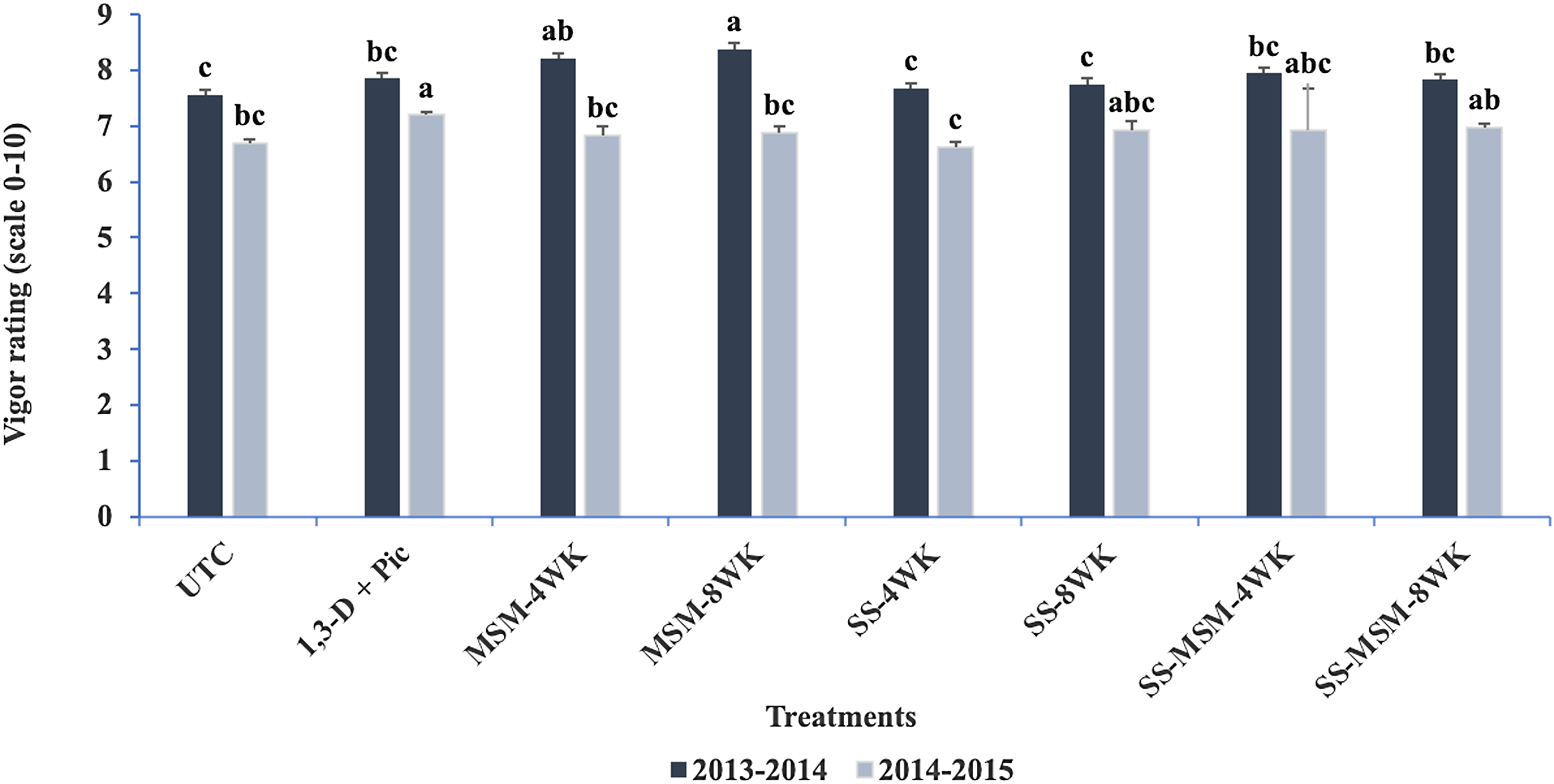
Crop vigor ratings were analyzed separately by growing season due to a significant interaction between growing season and treatment (P = 0.0125). Preplant application of MSM without solarization increased crop vigor ratings in the 2013/14 growing season compared to SS and 1-3-D + Pic treatments or the UTC (Figure 2). However, MSM without solarization did not increase crop vigor ratings compared to the UTC in the 2014/15 growing season. Ratings from both SS-MSM treatments were similar to those from the MSM-4wk treatment in 2013/2014 and 1,3-D + Pic treatment in 2014/2015. Crop vigor ratings for strawberry plants treated with solarization alone were statistically similar to those of the UTC in both growing seasons. Crop vigor ratings from the use of MSM alone were higher than those from the 1,3-D + Pic treatment in the 2013/14 experiment but were lower in the 2014/15 trial. In the 2014/15 growing season, plants treated with 1,3-D + Pic exhibited significantly higher vigor ratings compared with the UTC, and the plants that received the SS-MSM-8wk, SS-8wk, and SS-MSM-4wk treatments had vigor rating indices that were statistically similar to those of the 1,3-D+Pic plots in the 2014/15 growing season (Figure 2). For vigor rating improvement, MSM products serve as an excellent source of nutrients, providing 30% crude protein, phosphorus ranging from 0.7% to 0.8%, potassium of 0.8% to 1.1%, 0.7% calcium, 0.6% magnesium, sulfur of from 0.8% to 1.7%, 6.4% lignin, 2.1% total extractable polyphenols, a carbon to nitrogen ratio of 14, and a lignin to nitrogen ratio of 1.1, all of which may help to improve strawberry plant growth (Balesh et al. Reference Balesh, Zapata and Aune2005; Banuelos and Hanson Reference Banuelos and Hanson2010). The overall average vigor index for all treatments in the 2013/14 growing season was significantly higher than that in the 2014/15 growing season. Leaf spots and browning along leaf margins were diagnosed during the second growing season, contributing to a lower vigor rating (Figure 2). Strawberry stand counts did not differ among all the treatments for either growing season (data not shown).
Crop vigor rating is indicated by an index ranging from 0 (all plants are dead) to 10 (all plants are vigorous and no disease) and averaged for each season. All strawberry plants in each plot were evaluated visually. Abbreviations: MSM, mustard seed meal; SS, soil solarization; UTC, untreated control; 1,3-D + Pic, 1,3-dichloropropene (40 %) + chloropicrin (60%). Treatments are defined as follows: MSM-4wk, MSM applied 4 wk preplant; MSM-8wk, MSM applied 8 wk preplant; SS-4wk, SS applied 4 wk preplant; SS-8wk, SS applied 8 wk preplant; SS-MSM-4wk, MSM and SS applied 4 wk preplant; SS-MSM-8wk, MSM and SS applied 8 wk preplant. Values in the bar graph are presented as mean with standard error. Treatment means for each growing season with the same letters are not significantly different based on Fisher‘s LSD at α = 0.05.
Plant Canopy Diameter
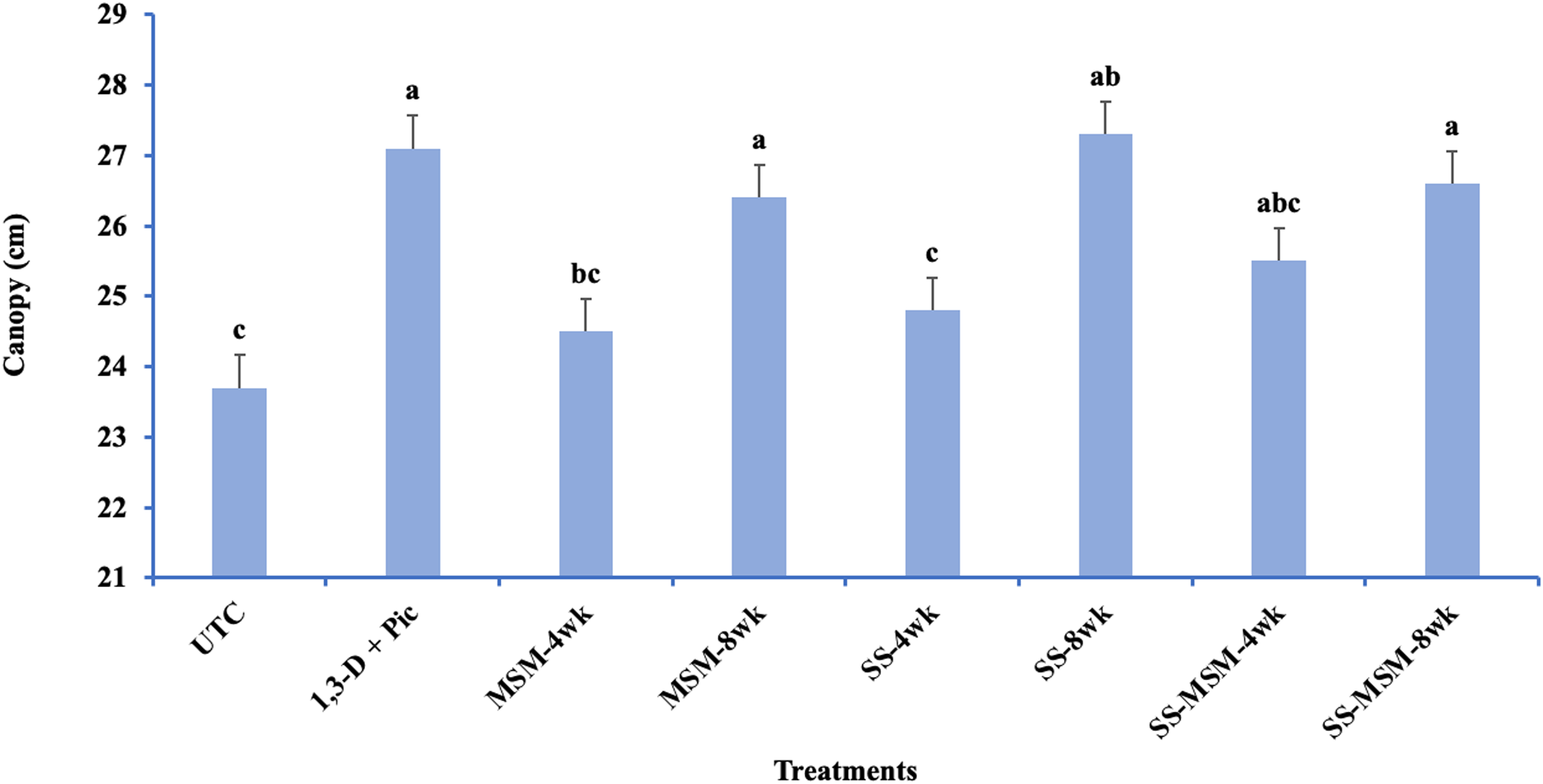
Only the treatment main effect was significant for the plant canopy (Figure 3). The plots treated with 1,3-D + Pic, MSM-8wk, SS-8wk, and SS-MSM-8wk produced significantly higher canopy diameters than those in the UTC and SS-4wk plots (Figure 3). Plant diameters were similar to that of the UTC when preplant SS and/or MSM treatments were applied for only 4 wk versus 8 wk. These findings are consistent with other studies that show solarized treatments with temperatures above 40 C are important for increasing strawberry canopy volumes to levels similar to those associated with the application of 1,3-D + Pic (Jacobs Reference Jacobs2019). Plant diameter is an important indicator for strawberry plants because of its positive correlation with fruit yield, regardless of the cultivar and production system (Kim et al. Reference Kim, Kim and Fennimore2021; Salamé-Donoso et al. Reference Salamé-Donoso, Santos, Chandler and Sargent2010).
Main treatment effect on plant canopy diameter of strawberries in the 2013/14 and 2014/15 growing seasons Abbreviations: MSM-4wk, mustard seed meal applied, 4 wk preplant; MSM-8wk, mustard seed meal applied, 8 wk preplant; SS-4wk, soil solarization, applied 4 wk preplant; SS-8wk, soil solarization, applied 8 wk preplant; SS-MSM-4wk, soil solarization and mustard seed meal applied 4 wk preplant; SS-MSM-8wk, soil solarization and mustard seed meal applied 8 wk preplant; UTC, untreated control; 1,3-D + Pic, 1,3-dichloropropene (40%) + chloropicrin (60%). Treatment means with the same letters are not significantly different based on Fisher’s LSD at α = 0.05. Data were collected on 20 plants per replicate. Values presented are mean with standard error.
Crop Yield
The growing season by treatment interaction was significant (P = 0.022) for total, marketable, and nonmarketable yields. However, significant plant foliage damage by deer was observed in the experimental plots during the 2013/14 growing season, resulting in no significant treatment differences in both marketable and total yields (data not shown). Therefore, yield results are only presented for the 2014/15 growing season, when plots treated with 1,3-D + Pic produced a significantly higher total yield than all other treatments. The marketable yield resulting from the 1,3-D + Pic treatment was significantly higher than that of the UTC and all other treatments, except for SS-MSM-8wk (Table 4). Yield was lower from the SS-4wk treatment than from the UTC due to weed competition with the crop plant for nutrients, and this finding was consistent with those of a previous study (Samtani et al. Reference Samtani, Derr, Conway and Flanagan2017). In other studies, strawberry yield increased by 12% compared with the UTC during a SS-10wk treatment period, and the yield of pickling cucumber (Cucumis sativus L.) was higher in the SS-6wk plots than in the UTC plots (Keinath Reference Keinath1995). In addition, the results described in the present study are consistent with those of other studies stating that 1,3-D and Pic (at a 61:33 ratio) increased strawberry yield over an UTC or SS with chicken manure (de los Santos et al. Reference de los Santos, Medina, Miranda, Gómez and Talavera2021).
Cumulative marketable and total strawberry yield in 2014/15 growing season in the Blackstone, VA, as affected by preplant treatments in annual plasticulture strawberry productiona,b .
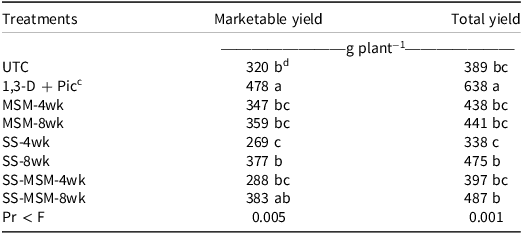
a Abbreviations: MSM, mustard seed meal; SS, soil solarization; UTC, untreated control; 1,3-D + Pic, 1,3-dichloropropene (40 %) + chloropicrin (60%).
b Treatments are defined as follows: MSM-4wk, MSM applied 4 wk preplant; MSM-8wk, MSM applied 8 wk preplant; SS-4wk, SS applied 4 wk preplant; SS-8wk, SS applied 8 wk preplant; SS-MSM-4wk, MSM and SS applied 4 wk preplant; SS-MSM-8wk, MSM and SS applied 8 wk preplant.
c 1,3-D + Pic (40:60 by weight) was shank fumigated at 188 kg ha−1.
d Means in the same column with the same letter are not statistically different using the least significant difference at P< 0.05. P-value presented is of the treatment main effect.
The efficacy of SS may be enhanced when incorporated with MSM products to provide adequate alternative soil disinfestation and improve plant growth. However, other studies have suggested that the application of MSM alone could be problematic due to the lack of sufficient temperature to generate active compounds to control soil pests (Kim et al. Reference Kim, Kim and Fennimore2021). The addition of organic amendments, such as MSM with SS, enhances pest control and increases soil temperature by 1 to 3 C (Rubin et al. Reference Rubin, Cohen and Gamliel2007). Furthermore, the application of MSM with SS improved the plant canopy because MSM products contain 4.5% nitrogen, 33.6% protein, 16.6% lipid, and 5.5% carbohydrate (Dai and Lim Reference Dai and Lim2015). However, MSM with SS did not result in significant yield improvements compared with that from a UTC and 1,3-D + Pic-fumigated soil (Conti et al. Reference Conti, Villari, Faugno, Melchionna, Somma and Caruso2014).
In summary, the combination of SS+MSM-8wk reduced weed densities and increased crop vigor, and plant diameter was comparable to or greater than that of the 1,3-D + Pic treatment. However, MSM and SS alone were more variable, sometimes improving weed control, plant vigor, and yield, but sometimes not. Geographic location, soil conditions, weather, tarp thickness, treatment period, and bed orientation might affect the SS efficiency. The longer duration of SS-8wk was more effective than SS-4wk for weed control.
Practical Implications
Weeds, especially those that appear through the plant hole or plastic mulch, could lower strawberry yield due to competition with strawberries for nutrients, sunlight, and moisture. Managing weeds is a big challenge for growers transitioning from traditional farming to organic farming. Weed control is primarily achieved through two methods: mechanical management employing specific agricultural techniques, or application of herbicides. However, the increasing prevalence of herbicide-resistant weeds, escalating costs of herbicides, and potential contamination of water sources with these chemicals have raised significant public concerns. Consequently, restrictions on herbicide usage have been enforced to address these concerns (Datta and Knezevic Reference Datta and Knezevic2013). In response, weed scientists are actively researching alternative and integrated approaches to weed management, aiming to reduce reliance on herbicides and mitigate their adverse impacts. The current study identified that SS+MSM applied at 8 wk can provide efficient control of many weed species in strawberry production systems and improve plant health compared with an UTC. This treatment could serve as an alternative weed management practice to chemical herbicides in strawberry production systems. Organic producers, small farms, and growers facing weed problems in buffer areas may find SS+MSM a useful weed management tool. However, the following challenges exist in adopting this technology, including the limited effectiveness of SS in geographic areas with little sunshine and high rainfall. In addition, SS involves keeping land out of production for several weeks, which may disrupt the usual cropping cycle (Abouziena and Haggag Reference Abouziena and Haggag2016). The cost, product quality, and efficacy of MSM for weed control could vary from year to year.
Funding
The Virginia Department of Agriculture and Consumer Services provided partial funding for this study.
Competing interests
No conflicts of interest have been declared.


 Open access

