

Introduction
In our present times Languages and Humanities seem to be neglected in lieu of Science and Technology courses, and both teachers and parents redirect students towards courses that are said to make them more employable. This utilitarian view of education does not always provide the expected results and, in the short to medium term, ends up having nefarious consequences in the way humanity sees itself and how it supports humanist values. Whenever we ignore our past and look at it as if it were something useless and without relevance, we end up being, in a sense, overwhelmed with an admirable but ephemeral new world, where everything is illusory and without support. It is in this respect that the teaching of Latin in Portugal, as has been the case in other European countries, has been relegated to the old and the outdated, supposedly without any practical usefulness.
Contemporary society and the decision-making powers, rooted in educational policies, consider the teaching of classical languages as something that should be restricted to an elite and as something that is unnecessary to students that need tools to enter the job market. Thus, in Portugal, consecutive Decree-Laws have marginalised and reduced the teaching of classical languages to one option, out of many, in the field of Languages and Humanities. The Science and Technology students, as well as the Visual Arts or Socio-economic Sciences students do not have the opportunity to choose Latin in their path through secondary education. These curricular choices which are followed in schools on behalf of the Ministry of Education reveal a deep lack of knowledge of these languages’ journey and their importance in the following areas. Learning Latin and Greek allows one to read, in its original form, founding texts, treaties that changed the world, revolutionary scientific works, and an entire patrimony that reveals to us the human thought from ancient times to the present. Knowing the etymology of words is knowing the archaeology of the human thought, questioning values that rule over us and understanding the journey that humanity has gone through.
At a time when the new team of the Ministry of Education and the Directorate-General for Education are trying to reform teaching and built a ‘Profile for the 21st Century Students’, where values and attitudes are essential questions and subjects linked to citizenship are integrated, the languages that brought us democracy, republic, citizenship and social mobility are still being sidelined.
The decline of classical languages in schools in Portugal today
The situation of classical languages in Portugal is catastrophic and, if nothing is done by the entities that have the power to change the educational policies, there is a risk they can disappear from the Portuguese education system.
In 1996 around 13000 students took the national Latin exam, and the subject was already weakening by then. However, 20 years later in 2016 only 34 students took the national Latin exam throughout the entire country. The decrease in the number of Latin students in secondary education in the last two decades almost led to the extinction of the teaching of this language in the Portuguese education system. However, the problem around teaching Latin is not restricted solely to the reduced number of students, but is part of a more profound and structural issue.
Various factors contributed to this situation. First of all there is the fact that the subject solely appears as an option in secondary school in the field of Languages and Humanities and competes directly with subjects such as Geography, Portuguese Literature, English, French, German, Spanish and Applied Mathematics for Social Sciences. Secondly, despite the fact that the national curriculum integrates Latin in a wide array of options, the final national Latin exam is not a mandatory requirement to access any university course. In the field of Classical Studies, it is reduced to being an option and any student can enrol into Classical Studies without having had Latin or Greek in their subject pathway.
The third factor is the teacher supply. In Portugal, to have a teaching job, ever since the entry into force of the Bologna process, a university student must possess a degree in their subject specialism and hold a professionalising Master's degree. In the first year of this Masters, they are required to take a set of subjects related to the intended scientific field, to specific didactics and the field of Educational Sciences. In the second year, the future teacher has to undertake a pedagogical internship during one school year without receiving any payment, where two advisers, one in the school where they will be an intern, who supervises the practical component in a classroom context, and another at the university, who follows the scientific and theoretical component, supervise them. At the end of those two years, the future teacher must write a report on Supervised Teaching Practice and proceed to defend it at the university in front of a jury composed of several university teachers in the area and supervising teachers from primary and secondary education. A university student can only become a qualified teacher after going through this path to teach in public and private Portuguese schools.
Teachers can specialise in three teaching levels: 1st Cycle, 2nd Cycle, and 3rd Cycle and Secondary education. The 1st Cycle of primary education lasts for four years and is for children aged six to nine. The 2nd Cycle of primary education lasts for two years, for children aged 10 and 11, while the 3rd Cycle of primary education lasts for three years for children aged 12 to 14. Secondary education lasts for three years for teenagers aged 15 to 17. At the end of Secondary education, the student is subjected to a specific examination that contributes to their final grade point average. These examinations are a mandatory requisite for entrance to university.
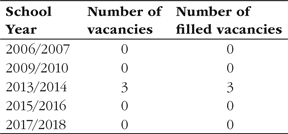
Until 2013, all university students who intended to start a teaching career and wanted to teach Latin and Greek had to enrol into a professional Masters course titled ‘Masters in Teaching Portuguese and Classical Languages in the 3rd Cycle of Elementary Education and in Secondary Education’. This way, universities combined the professionalisation in Teaching Classical Languages (Greek and Latin) with Teaching Portuguese. Therefore, there professionalisation in the area of classical languages continued and teachers had a greater likelihood of getting a job in teaching Portuguese, as teaching of Latin and Greek was residual. Consequently, the conjunction of these two subjects gave the teacher a deepened knowledge of their mother tongue, as Portuguese is a Romance language, and allowed the renewal of teacher training in the field of classical languages. In 2014, with Decree-Law 79/2014 the structure of this training was altered, changing its name to ‘Masters in Teaching Portuguese in the 3rd Cycle of Primary Education and in Secondary Education and Latin in Secondary Education’. Thus, the ability to gain a professional qualification in Greek was removed, the amount of teaching of Latin was reduced and a new area solely in teaching Portuguese was created: ‘Masters in Teaching Portuguese in the 3rd Cycle of Primary Education and in Secondary Education’. This change makes it possible for professionalising teachers in Latin only for secondary education, removing the 3rd Cycle professional qualifications and roundly excluding the possibility of having professionalised teachers in Portugal teaching Greek. Furthermore, the division of the professional qualifications of subjects into separate Portuguese and Latin areas may lead to future teachers choosing only Portuguese teaching as an option, taking into consideration the statistics of Latin teacher vacancies in the country (as well as their own personal and academic investment), as can be seen in Table 1 below.
| Group 310 (Latin and Greek) teachers' employment in public teaching establishments in Portugal (General Directorate of Education, 2017).
Today it can be seen that the 2014 changes have had a direct repercussion in the initial training of Latin teachers. The numbers prove the calamitous state of the initial teacher training and a complete abandonment of an investment on behalf of the universities that provide them. This can be seen in Table 2 below with the number of students enrolled in the first curricular year of the ‘Masters in Teaching Portuguese in the 3rd Cycle of Primary Education and in Secondary Education and Latin in Secondary Education’ in the 2016/2017 school year (data collected from the individual institutions concerned by the author in 2017).

It can be seen that in the entire Portuguese territory there are six future Latin teachers being trained in 2017. In the short to medium term, this situation will become unsustainable, as universities are spending thousands of euros in teachers’ salaries in Masters courses with only one student. Thus, the universities’ own teaching could be compromised, as it risks the continuity of this training area.
A further issue is that which is related to training the university teachers that lecture the classes in the area of specific didactics. It also shows the academic value that the field of didactics and pedagogy has had in the academic community along the years. There are no doctorates in Teaching of Classical Languages in Portugal, so the teachers who lecture those classes do not have any training in that area and many might have never done a pedagogical internship in a secondary school as their entire path may have always been connected to the scientific component.
In the last few years, with the introduction of the external evaluation of Masters courses, universities were forced to look for students who wanted to take a PhD in the field of specific didactics or looked to capitalise on the human resources they had. This led some university teachers to invest in activities connected to initial and continuous teacher training and writing scientific articles on didactics. This situation reveals the lack of consistency in the field of specific didactics and shows the lack of recognition and scientific value that is attributed to it.
Continuous teacher training in classical languages has been abandoned or, except for some rare adventures, done in the form of a congress or colloquium.
In an era where significant learning activities are theorised over and teaching methodologies are being rethought, teacher training is still being carried out in completely expositive courses where teachers have a passive role. Is it not time to start combining theory and practice? Shouldn't teachers themselves take an active role in sharing experiences and reflecting on their own practices? Shouldn't specialists in teaching and pedagogy, with ample field experience which leads teachers to rethink their methodologies and acquire or improve their knowledge and skills, follow this training? Isn't it widely known that only by improving practice can you properly intervene in a classroom and in the educational community and improve the quality of students’ knowledge? Do isolated activities, lacking continuity, such as congresses and colloquia that feed curricula make teacher training efficient and benefit teaching classical languages in the Portuguese education system? It seems to me that it is urgent to make a plan for the continuous training of classical languages teachers that can update their knowledge and provide them with tools that can be adapted to their context and can motivate students to learn those languages. Until this happens, nothing will change, and students’ lack of motivation and teachers’ lack of interest will keep being perpetuated.
The number of students that are enrolled in Latin in secondary school is not promising either. The subject of Latin in the 10th Grade of Secondary School has 80 enrolled students, 46 of them belonging to Escola Secundária Sebastião e Silva, where the headmaster made the subject mandatory for all Humanities students. The status of Greek teaching is even more alarming and the number of students is around 11 in the entire country. With this scenario and these numbers it becomes increasingly awkward to suggest there is Latin and Greek being taught throughout the country at all.
Classical languages and culture in the primary school
However, in an attempt to revive the teaching of Classical Languages, in 2015 the former Minister of Education, Nuno Crato, in collaboration with various partnering entities, decided to allow schools, if they wanted, to integrate into their curriculum from the1st Cycle the new subject ‘Introduction to Classical Languages and Culture’ (ICLC). This subject is optional and each school can choose to integrate it or not in their curriculum.
The following guidance can be read on the Directorate-General of Education website:
Recognizing the relevance of classical languages and culture in training children and youth, the School Groups/Non-grouped Schools can take into consideration said component, integrating it in Educational Projects as a ‘School offer’. To achieve said component – hereby designated as Introduction to Classical Languages and Cultures – each School Group/Non-grouped School will structure and develop its own program, in accordance with its Educational Project (Directorate-General of Education, 2015).
This political measure opened a bigger possibility for the learning of Classical Languages in the Portuguese Public Educational System, especially in primary education in Portuguese public schools. In the last few years, the number of national and international private schools has grown exponentially in the country. These schools have replicated the curriculum of their countries of origin and integrated Latin as a subject since primary education, some in the 1st Cycle. As a result it had only been in private schools that there was the possibility to integrate Latin as a subject in curricula starting from primary education. With the ICLC this possibility was now extended to public schools.
In 2011 several years before, however, there had been some isolated cases in public schools. These included the project Pari Passu, developed by the 2nd Cycle in Escola Secundária Rodrigues de Freitas in the city of Porto, and the Latin Free Course, using the methodology from the Cambridge Latin Course, in Escola Secundária de Pedro Nunes in Lisbon, for 3rd Cycle and Secondary education students.
Various integration formats of studying Classical Languages and Cultures in Portuguese public schools have been surging in the two years after the possibility of integrating the subject was allowed through the ICLC. Some public school teachers, by resilience and resistance, as they noticed their schools were not adhering to this experiment, therefore decided to start clubs, study groups and other similar methods in their non-contact time, working pro bono for the school and their students. However, the difference that still exists between the number of students that learn Latin in private schools and in public schools must be highlighted. While in a private school, the school management has complete liberty to implement Latin or Greek in its curricular offer and can do it, in public schools there are limitations, usually from every front, and it can be complicated to integrate the subject, despite the Ministry offering the possibility.
Where will the teachers come from?
Beyond the possibility to teach Latin and Greek to primary education students, there is also the gap between the educational policies from the Ministry of Education and initial teacher training. The same Ministry that placed the possibility of learning Latin and Greek in primary education removes the possibility of entering the job market for teachers professionalised in primary education by eliminating the teaching professionalisation in this study cycle. As has been mentioned above, future teachers will be professionalised solely in Latin in Secondary education and will do their internship only in this cycle. There they will develop didactic issues and their pedagogical practices, rooted in studies and methodologies developed for that study cycle. To add to that, they now see the possibility of entering the job market, in public or private schools, to lecture in a subject that they never had any kind of training or experience in.
If a teacher does not have full command of the materials about which they lecture, how will they be able to teach them? And what about pedagogical practice? Without having had a classroom context experience, how will a future teacher be able to adjust, select and define strategies for a subject that requires specific pedagogical and didactic knowledge for certain age ranges? Can the validating authorities assume that teachers are didactically competent to teach this subject? These are questions of some complexity and they cannot be answered with generalities. They demand a scientific responsibility and a serious investigation.
However, the problem with teachers’ initial training is just the tip of the iceberg. We also need to take into consideration that the training of teachers who are at the moment teaching this subject is unknown, as teaching the subject is not confined to classical language teachers. Any teacher in any area, without having had Latin or Greek in their training, can teach the subject. When it comes to continuous training, the problem is even more complex, taking into consideration that most teachers have not taught Latin for over a decade or have simply never taught it. It should be noted that, despite the changes to the Masters in teaching classical languages which started in 2015, there are no records of internships developed by active teachers in primary education previous to the change, with the rare exceptions of internships implemented in free courses or observing and teaching supervised classes in primary education. It was carried out in this way because it was not considered relevant as the number of Latin students in primary education was minimal. Now, it becomes a pertinent and pressing question, as it takes into consideration that public schools have the possibility of integrating the subject of ICLC in this study cycle.
In effect, the following questions arise: what training do teachers have to teach classical languages and cultures in primary school? And, if there isn't a specific program, which programmatic content is taught? How are contents planned and what are the reasons behind choosing the teachers who teach them? How are these contents applied in a classroom context? It should be noted that the instructions given by the Ministry of Education are vague and open up the possibility of countless different practices.
In the official page that the Ministry of Education dedicates to ICLC, the content is organised in two general topics, a term used by the Ministry itself, the first being ‘Civilisation and culture’ and the second ‘The inheritance of classical languages: We all speak Latin and Greek’. The former is limited to mythology, gods, heroes, and the presence of Greco-Roman culture in our everyday life and, in the latter, we find Latin expressions with current usage, etymologies, day-to-day words, reference to syntactic structure and building short sentences. There is no mandatory program, but programmatic instructions. Thus, there is no methodology in language teaching, but there are very sparse indications that seem to be deemed as necessary to access the knowledge of Latin. However, even though there is no specific program and the programmatic instructions are very vague, the following instruction for linguistic knowledge has been published: ‘Engage in expression (written, oral, corporeal, musical…) of knowledge related to classical languages and culture’ (Directorate-General of Education, 2017).
How can a student engage in written and oral production in a language if they only know words and build small sentences? Is it through Latin expressions of current usage that you have access to classical languages? In short in each school each teacher can interpret and teach the subject as they wish. In itself, this option is not completely prejudicial, because it allows teachers to integrate the subject in the context where it is inserted. However, there is a risk that the subject becomes merely a gathering of vague terms, rooted in frugal expressions, mythology and curiosities at a curricular level. Yet the Ministry advises that the subject is structured in a logic of progression in learning of culture and of language. The question remains: which methodology is to be applied in learning the Latin language?
If one analyses the programs and the programmatic content of the different training actions, congresses or lectures that have been announced ever since the possibility of integrating this subject in schools came up, it can be determined that the beneficiaries are mainly teachers who belong to various subjects: ICLC does not require a specific group of teachers. In this way there is a presumed path on behalf of the university institutions that develop these initiatives, by legitimising that teachers from diverse areas can teach the subject.
In the first instance, it is immediately understood that the organising institutions, in general, stated that there are not enough recruitment Group 310 (Latin and Greek) teachers to feed these initiatives, and that therefore the universities and schools should help themselves with teachers who are interested in teaching ICLC whether they had Latin and Greek in their academic training or not.
If this is the case, then if any teacher in any disciplinary area, can teach Latin or Greek regardless of having had them in their academic training or not, then what is the motivation for future young teachers to professionalise themselves at all in these subjects?
Shouldn't we rethink the goals in introducing this subject in the Portuguese educational system? Shouldn't we act in conformity with those goals? Do we only want students in primary education to have access to classical culture and some notion of classical languages? Do we want students to choose Latin in the field of Languages and Humanities in secondary education? Do we want more students graduating in Classical Studies in universities? Do we want more teachers professionalised in the area of Classical Languages and, consequently, more teachers specialised in teaching that subject? All these questions are interconnected and, to be able to alter the national panorama, a strategic plan should be developed. Strategies can be continuously rethought, but there will only be more Classical Studies students at universities and candidates to teacher training in classical languages if there are job opportunities at schools and there have to be more students studying Latin and Greek so that there can be jobs for these teachers.
One of the ways to contribute to this increase in the number of job vacancies for classical languages teachers would be by creating a subject program – even if open to diverse methodologies – with teaching content that demanded the specific training of specialised teachers in the area. Only in this way would the search for staff in the area of initial and continuous teacher training increase. This training would always have to be connected to the renewal and development of pedagogical practices taking into consideration students’ motivation, appealing to new technologies and using orality as a teaching tool.
There is, however, an undisputed truth. Despite the catastrophic situation and the disparate situation of Latin teaching in public and private education in Portugal, classical language teachers themselves have been the driving force, often at financial and personal cost, that has kept Latin teaching connected to its oxygen. These teachers are the ones who can keep Latin teaching in some schools, despite knowing that, if other serious measures are not taken, death is nearby and that the end is inevitable. They are the ones who look their students in the eye and understand what is being denied to them, the ones who try to tackle the difference, ever more accentuated, between public and private students, taking the knowledge of the classical language, culture and mythologies to students of all socio-economical classes, by believing only school and knowledge allow for full social mobility and that the cradle cannot determine the intellectual and social class one belongs to. These teachers are spread throughout the entire Portuguese territory, including Madeira and the Azores archipelago islands. They are teachers who saw their core training being a missed opportunity and were conditioned, for decades, to teach solely Portuguese. It is on their resilience and resistance that it can be affirmed that there is still Latin teaching in Portugal.


 Open access

