





1. Introduction
Economic modelling builds on the assumption that agents choose what they prefer. That means, within the model, preferences are an expression of an individual ordering of possible (expected) outcomes and agents are the sovereigns of their own welfare. Moreover, for the theory to have empirical content, it has to be assumed that the underlying preferences are stable, at least to some extent (cf. Becker Reference Becker1976). Otherwise, no meaningful forecasts or welfare judgements could be made and all behaviours could simply be rationalized as an expression of instantaneous preferences. Little would be gained. Fortunately, substantial evidence suggests that decision-makers’ preferences, beliefs and resulting behaviours contain stable and systematic elements (e.g. Amir and Levav Reference Amir and Levav2008; Carlsson et al. Reference Carlsson, Johansson-Stenman and Nam2014; O’Grady Reference O’Grady2017; Restrepo and Vaisey Reference Restrepo and Vaisey2024). However, there is also abundant evidence on the apparent inconsistency of individual choices (e.g. Tversky and Kahneman Reference Tversky and Kahneman1986; Camerer Reference Camerer2003; DellaVigna Reference DellaVigna2009; Thaler Reference Thaler2015). A challenging natural question arising from this empirical tension is to what extent individuals really are the sovereigns of their own welfare, as suggested by the model.
Notably, questions about decision-maker sovereignty have given rise to much debate about third-party interventions in decision-making in recent years in connection with nudging (cf. Thaler and Sunstein Reference Thaler and Sunstein2008; Hausman and Welch Reference Hausman and Welch2009; Thaler Reference Thaler2015; Whitman and Rizzo Reference Whitman and Rizzo2015; Infante et al. Reference Infante, Lecouteux and Sugden2016; Sugden Reference Sugden2017; Sunstein Reference Sunstein2018; Kemper and Wichardt Reference Kemper and Wichardt2024a). Introduced in 2008, nudging builds on the observation that the decisions people make tend to be influenced by seemingly minor details of their decision environment. Observing this and arguing that such deviations may be harmful to the individual, nudging intends “[to] influence choices in a way that will make choosers better off as judged by themselves” (Thaler and Sunstein Reference Thaler and Sunstein2008: 5, italics in original) by appropriately changing such details without altering available options.
Since its introduction, the idea has gained considerable attention not only in academic but also in political circles (see Leggett Reference Leggett2014, for a discussion and references) as it suggests that tangible changes are available through seemingly innocuous means. The part of the idea that has given rise to much debate is the one expressed in italics – “better off, as judged by themselves” – as it presumes that it is possible to assess from the outside what decision-makers would have wanted despite not choosing it when they could have. Put simply, if decision-makers are perfect sovereigns of their welfare, they always make the best possible choices given their options, rendering third-party interventions inefficient. If decision-makers are prone to errors, third-party interventions may indeed improve their chances of making better decisions according to their own assessment. Yet, even if we allow for the theoretical possibility of errors, how can we judge which choices are based on ‘true’ preferences and which are erroneous within the common model of preferences (cf. Hausman and Welch Reference Hausman and Welch2009; Whitman and Rizzo Reference Whitman and Rizzo2015; Infante et al. Reference Infante, Lecouteux and Sugden2016; Häußermann Reference Häußermann2019; Špecián Reference Špecián2019; Kemper and Wichardt Reference Kemper and Wichardt2024a; Colin-Jaeger and Dold Reference Colin-Jaeger and Dold2025; Fabian and Dold Reference Fabian and Dold2025)?
Arguing along these lines Špecián (Reference Špecián2019), for example, warns of a paradox inherent in paternalistic thinking, in which paternalists must first prove their ability to identify other preferences than those agents currently follow while ensuring that these preferences are the authentic, true preferences that individuals would ideally want to have but fail to do so. Similarly, Kemper and Wichardt (Reference Kemper and Wichardt2024a) highlight an analogous issue in the definition of welfare, which must inherently be tied to subjective aspects of preferences. As long as choices are taken as a sovereign expression of the agent’s preferences and all preferences are on equal footing, this problem is difficult to overcome as, within the standard model framework, there is no way of prioritizing one set of preferences inferred from choices over another. Accordingly, the standard model itself provides no reason to argue for one choice being a proper one and another one being an an error requiring correction through interference.
Yet, proponents of such external interventions, particularly nudging, keep emphasizing that nudging is not meant to be paternalistic (e.g. Thaler Reference Thaler2015).Footnote 1 In fact, Thaler writes “A point that critics of our book seem incapable of getting: we have no interest in telling people what to do” and immediately continues “We want to help them achieve their own goals” (Thaler Reference Thaler2015: 325, italics in original). But even if we assume that it may be practically possible to help people in this way, how can we judge what people want based on a sound theoretical framework?
In the present paper, we propose a modification of the common model of preferences which leaves room for external judgements about individual benefits. In doing so, we start from the observation that (part of) the tension in the debate arises from the fact that standard arguments about preferences offer no inherent hierarchy. Moreover, we note that Thaler in the quote cited above does not mention preferences at all but instead refers to goals (see also Sen Reference Sen1985). In fact, goals and goal-directed behaviour are standard terms in the psychological literature (see, for instance, Deci and Ryan Reference Deci and Ryan2000 or Dold et al. Reference Dold, Van Emmerick and Fabian2024, for prominent examples and additional references). Notably, the distinction between goals and preferences, we believe, offers a possible way out of (at least part of) the dilemma as goals are easy to imagine being hierarchically ordered.
The proposed conceptual model of preferences is built on the notion that decision-makers follow different types of goals. For the sake of argument, we consider two types of goals, namely terminal and instrumental goals. By assumption, terminal goals represent more fundamental objectives like living a long and healthy life, while instrumental goals correspond to more intermediate objectives directed towards reaching terminal goals, like eating healthily. Individual preferences, then, are derived from the instrumental goals relevant in a certain context (regarding contextual effects on behaviour, see also Bergh and Wichardt Reference Bergh and Wichardt2018; Dold Reference Dold2018; Delmotte and Dold Reference Delmotte and Dold2022; Kemper and Wichardt Reference Kemper and Wichardt2024b). Thus, intuitively, instrumental goals can be understood as a complexity-reducing mediator between terminal goals and daily-life decision-making. What is important to note is that the conceptual move to consider hierarchical ordering of goals now allows for both: stable behavioural patterns directed towards terminal goals and context dependent deviations from these patterns (which can still be best responses to circumstances).
In order to exemplify this point, consider an agent, say Alfons, with terminal goals ‘social connectedness’ and ‘long and healthy life’. Moreover, assume that Alfons’s corresponding instrumental goals are education, social activities, healthy eating and exercising. In such a situation, it seems reasonable to expect that a long-term observation of Alfons would show comparably stable patterns towards education, meeting people, eating healthily and exercising regularly. Yet, if observed in a specific context with friends who favour fast food, it still seems reasonable to assume that Alfons would join them in their choice of food in order not to stand out (considering that a single deviation from healthy eating could be relatively inconsequential).
Similarly, taking up the much quoted cafeteria example of Thaler and Sunstein (Reference Thaler and Sunstein2008), urgent contextual needs such as hunger paired with inattention may well lead Alfons to pick the cake in the cafeteria instead of the salad, if the latter is placed less prominently. Yet, neither choice would have to be considered a mistake in the respective instance as it might be the best Alfons can do given the circumstances. However, in both cases, third-party intervention could arguably help Alfons make better choices as judged by himself. In the first case, for example, publicly promoting healthy eating and encouraging acceptance of those who choose to eat more healthily might weaken the pressure on Alfons to copy his friends’ behaviour or even motivate his friends to change.Footnote 2 In the latter case, swapping the positions of salad and cake in the cafeteria, as suggested by Thaler and Sunstein (Reference Thaler and Sunstein2008), might already be enough to encourage Alfons to choose the salad, which could be argued for as being in line with his (terminal) goals.
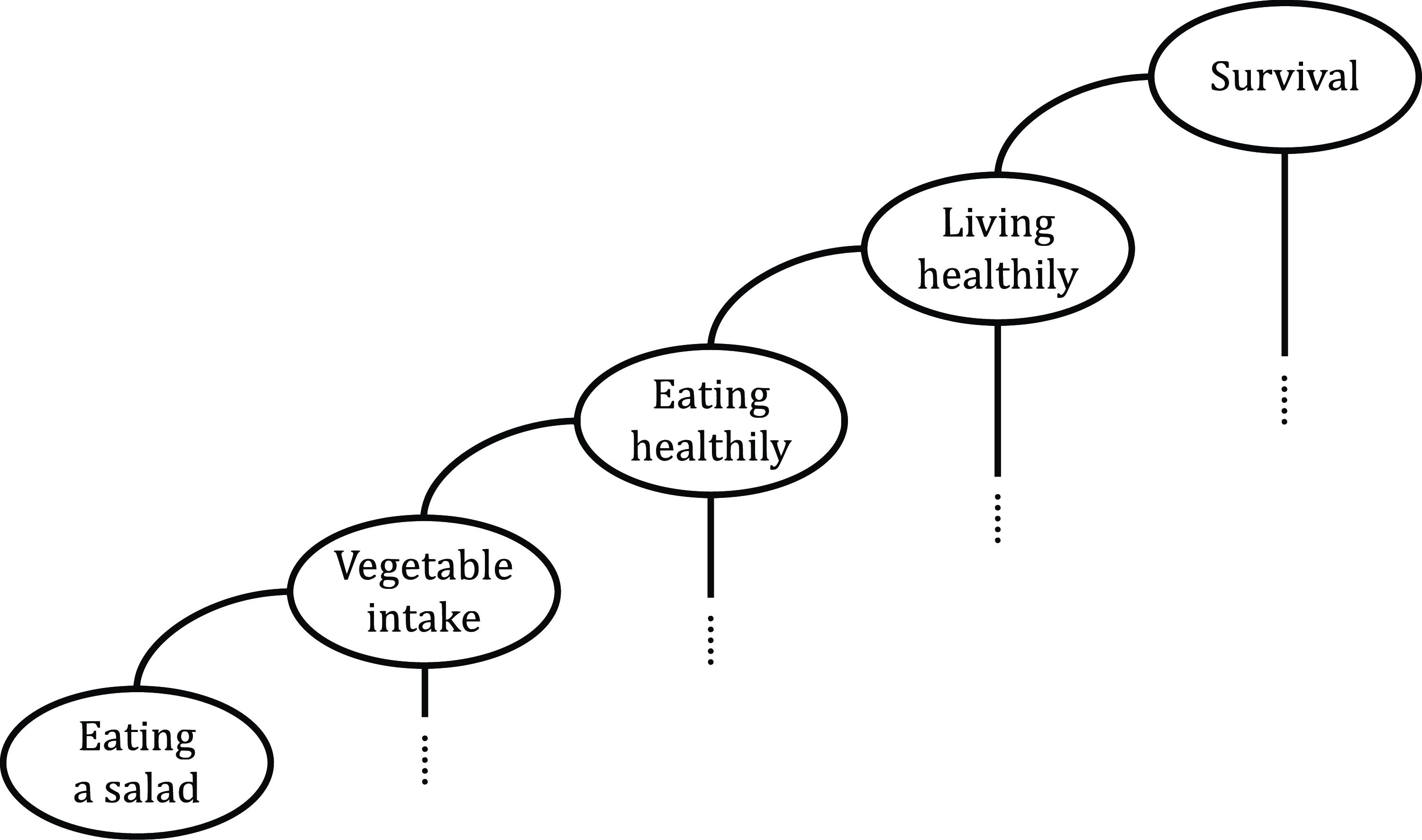
The simple but crucial point to note is that the hierarchy of goals allows for judging actual choices as, in fact, the best possible in the specific situation (referring to preferences derived from instrumental goals) as well as providing a basis for arguing that third-party interventions may be beneficial from Alfons’s broader perspective (in view of corresponding terminal goals). The room for improvement comes from accepting the agent’s bounded rationality in the process of creating actual preferences. As terminal goals are inherently complex to follow, agents decompose these complex tasks into simpler parts by creating instrumental goals, which serve as intermediaries. These instrumental goals can be more easily evaluated by agents once put into a specific decision context. This way, an agent can implicitly acknowledge the broader goal of a long and healthy life by following instrumental goals, such as eating healthily and increasing vegetable consumption (see also Fabian and Dold Reference Fabian and Dold2025 for a similar example). Figure 1 illustrates how a more complete ordering may look like. This, however, may lead to occasional misalignments due to discrepancies between what seems best now and what would be better from a broader perspective.
Contribution of eating a salad to survival. While we consider only two levels in our model, there can be more and each of the higher goals can have multiple goals that contribute to them (as illustrated here; additional lines indicating possible further avenues).

Thus, the proposed solution to the paternalistic paradox identified by Špecián (Reference Špecián2019) lies in recognizing that decision-makers may have terminal goals which are inherently complex to follow, making it nearly impossible for agents to determine how individual actions affect their terminal goals. Consequently, agents decompose these complex tasks into simpler parts by creating instrumental goals, which serve as intermediaries. This way, it becomes easier for agents to evaluate specific choices by judging how different options would satisfy these intermediate goals, thereby still helping them to achieve their terminal goals, while accepting some suboptimal choices as a price for complexity reduction. For example, to survive, agents may recognize the need for eating healthily, leading to the intermediate goal of increasing vegetable consumption, as depicted in Figure 1. Eating a salad contributes to the instrumental goal of increasing vegetable intake, which in turn contributes to eating healthily, ultimately contributing to survival. Yet, as we have seen above, contextual aspects may lead the agent to deviate from pursuing certain goals (locally) – e.g. because of other instrumental goals being deemed more relevant in the moment (i.e. a misalignment of goals). In these cases, there can be room for paternalists – parents, friends, policymakers, etc. – reasonably justifying interventions in the agents’ decision environment (as put by Thaler Reference Thaler2015: 325; italics in original) “to help them achieve their own goals”.
While we are confident that the proposed perspective on preferences mitigates the paradox described by Špecián (Reference Špecián2019), it should be clear that it does not solve all the problems there are. First of all, the argument requires a sound and reliable analysis of long-run patterns in behaviour to infer what we refer to as terminal goals. This in itself is not without the risk of mistakes, and failure to do so properly could result in paternalists harming the very individuals they aim to help. Moreover, decision-makers need not recognize that they are deviating from their terminal goals so that interventions could trigger psychological reactance (e.g. Rains Reference Rains2012), causing agents to resent the perceived intrusion on their autonomy.Footnote 3 Finally, different decision-makers may prioritize their terminal goals differently, requiring tailored types of interventions, as flat, one-size-fits-all interventions are unlikely to benefit everyone. Given these challenges, we conclude that, while efficient paternalism is theoretically possible, it is fraught with practical difficulties that make it challenging to implement successfully (i.e. to the benefit of the agents). Thus, even if seen from the perspective presented in this paper, many interventions will still not be as innocuous as suggested by Thaler and Sunstein (Reference Thaler and Sunstein2008).
The rest of the paper is structured as follows: in section 2, we introduce the conceptual model and present a more detailed argument supporting its key components as well as general behavioural implications. Section 3 considers possible applications of the argument, both specific to the nudging debate (section 3.1) and to broader paternalistic interventions (section 3.2). Section 4 concludes.
2. Preferences, Goals and Behaviour
This section is split into two parts: a motivation of the conceptual model (section 2.1) and a discussion of general behavioural implications (section 2.2).
2.1 The Conceptual Model
As a first step, consider a decision-maker whose behaviour can be conceptualized as following a distinct hierarchy (of sets) of goals from which preferences are derived.
2.1.1 Basic terminology
To avoid definitional issues, we follow the theory of revealed preferences (Samuelson Reference Samuelson1938, Reference Samuelson1948) in that we assume that decision-makers choose what they prefer.Footnote 4 However, these preferences are tied to the moment and the context of decision-making. Thus, when decision-makers choose one action over another in some context, this does not imply that they would do so across different contexts. Accordingly, by definition, there is no way of reliably inferring future preferences from current behaviour. If an agent makes a particular choice, this choice is considered to be preferred over all other options available at that specific moment – not more and not less. This means that, within the model, it is impossible for decision-makers to act against their preferences at the time of decision-making.
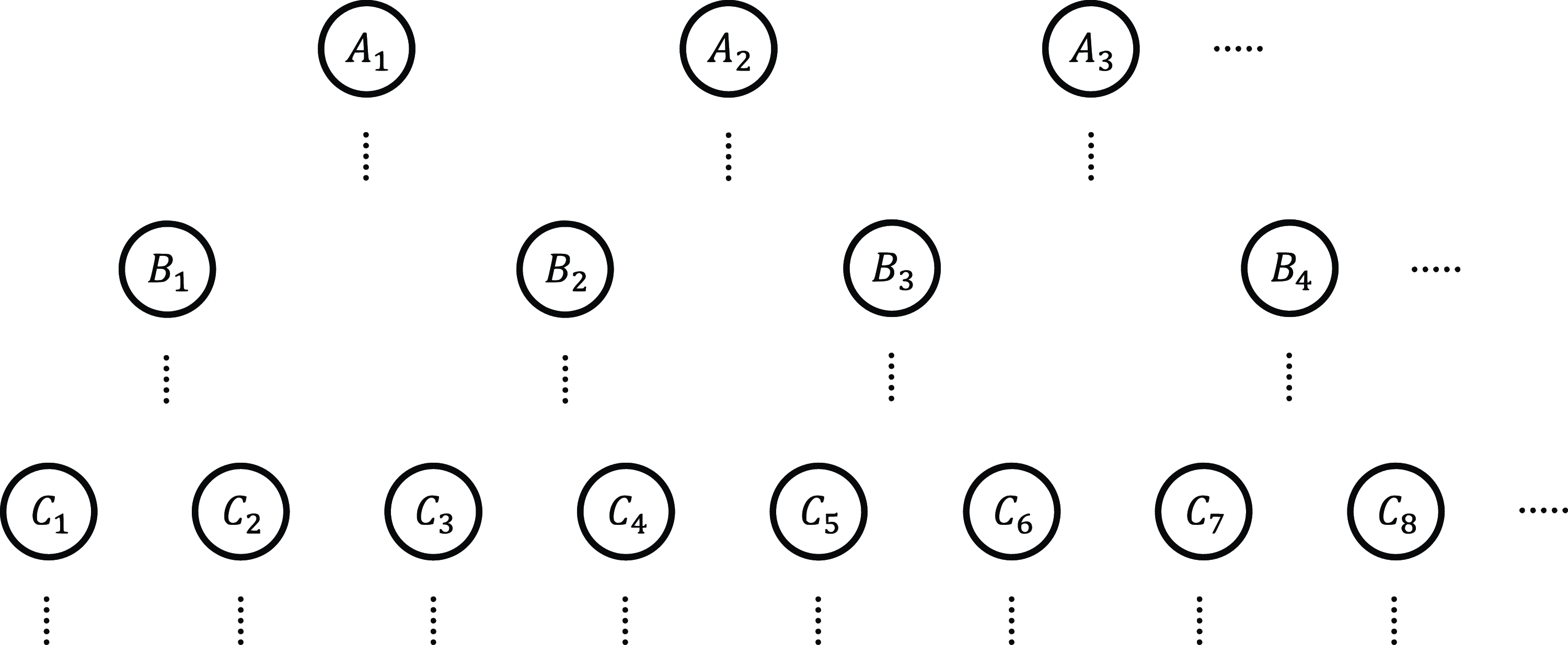
Unlike previous conceptions, we do not take these (contextual) preferences as fundamental but as derived from the agent’s goals, where goals can be conceived of as answers to the broader, context-independent question of what the agent wants to achieve in their life. Examples would be social connection, a long and healthy life, joining a sports club, or obtaining a more interesting job (where the first two examples refer to more general long-term goals while the latter are more specific and short term). Yet, in contrast to preferences, we assume that goals are hierarchically ordered reflecting the importance the agents assign to them in their life; cf. Figure 2.
Illustration of a goal hierarchy; different letters indicating different levels of the hierarchy and lower levels being more specific (in the model, reduced to two levels).

2.1.2 Terminal and instrumental goals
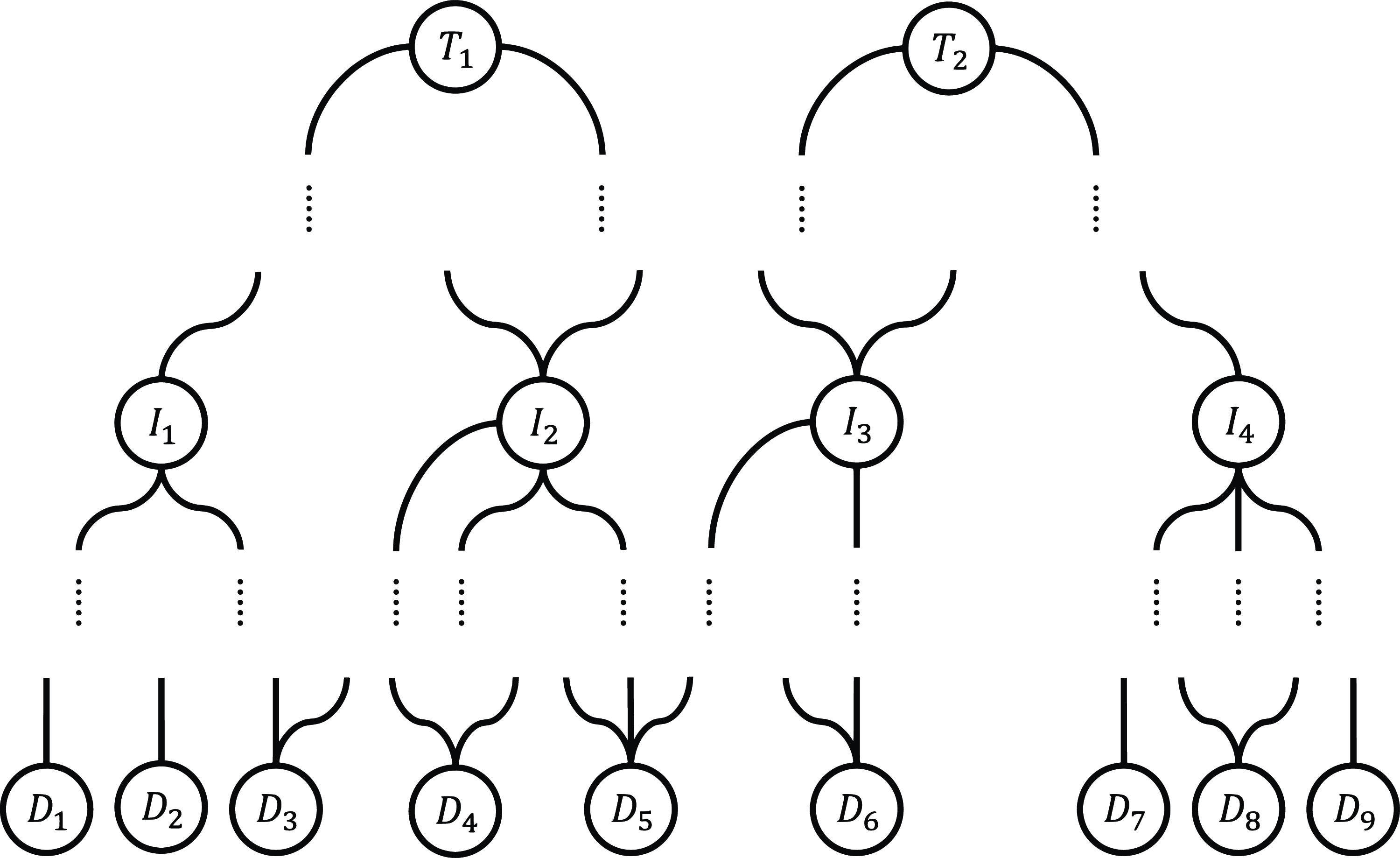
For the sake of argument, we restrict attention to a two-level hierarchy and assume that goals can be categorized as either terminal or instrumental (cf. Brandtstädter and Lerner 1999; Bostrom Reference Bostrom2012; Ford and Ford Reference Ford and Ford2019); we consider only one level of instrumental goals since additional levels are redundant for the purposes of our analysis. In this terminology, terminal goals represent fundamental, long-term objectives, such as living a long and healthy life, while instrumental goals correspond to intermediate, more specific steps, such as eating healthily or exercising regularly guiding actual behaviour; cf. Figure 3.
Illustration of goal hierarchy, focusing on the connection between terminal goals and a decision level mediated by intermediate goals in between (in the model, reduced to two levels). Letters signify the level of goals (T for terminal, I for intermediate) and (D) reflecting decision relevant preferences, respectively.

Intuitively, the hierarchical structure reflects the fact that the complexity of life in combination with the agents’ limitations (e.g. Cowan Reference Cowan2010) renders it impossible for real-life agents to always perfectly assess the contribution of all available actions to their different fundamental goals, an observation that is compatible with abundant empirical evidence (e.g. Camerer Reference Camerer2003; Thaler Reference Thaler2015). In that sense, the present model can be conceived of as a model of bounded rationality. Thus, instrumental goals provide cognitive shortcuts for otherwise rational decision-makers, breaking down complex decisions into smaller, manageable tasks. Finally, actual preferences are tied to the lowest level of goals in the hierarchy (see also Fabian and Dold Reference Fabian and Dold2025).
To exemplify this point, consider an agent with a terminal goal of a long and healthy life. The overarching goal of maintaining good health, for example, is not just about eating vegetables, but encompasses a wide range of behaviours, including regular but not excessive exercise (e.g. Meyer et al. Reference Meyer, Taranis, Goodwin and Haycraft2011; Ruegsegger and Booth Reference Ruegsegger and Booth2017), a balanced diet emphasizing food synergy (e.g. Jacobs and Tapsell Reference Jacobs and Tapsell2013), appropriate legume intake (e.g. Polak et al. Reference Polak, Phillips and Campbell2015), and moderate meat consumption (e.g. Biesalski Reference Biesalski2005), along with stress management (e.g. McEwen Reference McEwen2008) and finding meaning in life (Hooker et al. Reference Hooker, Masters and Park2018). Evaluating how specific actions contribute to this broad objective in every single context is arguably complex, even if we neglect issues arising from potentially conflicting terminal goals (see section 2.2 for a discussion).
Take, for instance, the act of eating a salad: although there is likely a connection between eating healthily and increased survivability (Polak et al. Reference Polak, Phillips and Campbell2015), without deeper analysis, the precise nature of this connection is difficult to assess for the average agent even in terms of expected outcomes, let alone in every possible context.Footnote 5 Given the difficulty of evaluating the impact of single actions on terminal goals, agents benefit from choosing more manageable goals that have clearer links to higher-level objectives. Consequently, a rational response of cognitively limited agents is to create instrumental goals. By breaking down high-level goals into specific, measurable tasks, agents can more easily monitor their progress and make efficient choices without overwhelming their cognitive capacities. Thus, by following the (lowest level of) instrumental goals, agents respond rationally to a complex environment while acknowledging their own constraints.
2.1.3 About goals
Regarding the division of goals into two levels, it should be noted that the focus on two is chosen simply for the ease of exposition of the main argument. As indicated in the introductory example (cf. Figure 1), a more differentiated structure would be easy to motivate. The basic argument, however, would remain the same. What is important for the subsequent discussion, though, is that agents may have multiple terminal goals and that goals and their relative importance for decision-makers are likely to be idiosyncratic. In that sense, goals can, for example, be viewed as linked to personality, which describes how individuals generally act, while goals explain why they act as they do.
Considering the suggested relationship between personality and terminal goals also squares well with the idea of multiple terminal goals. For example, evolutionary theorists suggest that individual differences within species are linked to variations in personality traits (e.g. Nettle Reference Nettle2006; Cote et al. Reference Cote, Dreiss and Clobert2008; Gosling Reference Gosling2008). In this context, the framework of the Big Five irreducible personality traits (e.g. Roberts and Robins Reference Roberts and Robins2000; McAdams and Pals Reference McAdams and Pals2006; Raggatt Reference Raggatt2006) provides a compelling argument for the existence of multiple terminal goals. Similarly, studies on human goal structures show that individuals typically have between three and five significant terminal goals and further substantiate the existence of a hierarchical organization of goals (e.g. Chulef et al. Reference Chulef, Read and Walsh2001; Talevich et al. Reference Talevich, Read, Walsh, Iyer and Chopra2017). Furthermore, Rokeach (Reference Rokeach1973) identified eighteen terminal values that people may hold, which is relevant to our discussion, as values can also be interpreted as goals (e.g. Schwartz Reference Schwartz1992). In either case, terminal goals can be understood as representing fundamental, desirable aspects of life.
To provide some specific examples, goals which could reasonably be grouped as terminal would be truth-seeking (e.g. Grimm Reference Grimm2008), fairness (e.g. Loewenstein et al. Reference Loewenstein, Thompson and Bazerman1989; Tabibnia et al. Reference Tabibnia, Satpute and Lieberman2008; McAvoy et al. Reference McAvoy, Kates-Harbeck, Chatterjee and Hilbe2022), procreation (e.g. Bühler Reference Bühler1964), survival (e.g. Kaplan and Gangestad Reference Kaplan and Gangestad2015), social prestige (e.g. Zakharenko Reference Zakharenko2016), and social relatedness (e.g. Hicks and King Reference Hicks and King2009).Footnote 6 Once again, what is important for the present discussion is not the exact specification or grouping of goals but their hierarchical structure (and that the cardinality of terminal goals is larger than one).
2.1.4 Goal hierarchy, context and decision-making
Finally, there are some additional aspects of our model which require brief commenting.
First of all, we (implicitly) assume that the number of goals increases with each level further down in the goal hierarchy. The necessity for this follows immediately from the underlying idea of complexity reduction. If the number of goals remained constant, agents would merely exchange one set of goals for another. If the number of goals was smaller on lower levels than on higher ones, the information embedded in those goals would increase rather than decrease. Accordingly, for compatibility with the underlying intuition, the number of goals has to increase with each level further down in the hierarchy.
Moreover, once a specific choice in a specific context is considered, agents may be faced with the problem of trade-offs between multiple goals at the same level. They can solve this, for example, by weighting goals (and neglecting those which are not relevant for the decision at hand, i.e. assigning zero importance to them in the weighing). These trade-offs between relevant goals apply across all levels of the goal hierarchy and may lead to different outcomes for different decision-makers. For instance, Socrates sacrificed his own survival by refusing to escape his sentence in order to convey a message about upholding what is right (cf. Barker Reference Barker1977). War heroes often prioritize camaraderie and collective survival over their own lives (cf. Atran et al. Reference Atran, Sheikh and Gomez2014). Others may trade their lives for an idea or to secure the financial stability of their family, as seen in cases where individuals time their deaths to maximize inheritance (cf. Kopczuk and Slemrod Reference Kopczuk and Slemrod2003). Contrary to that, some people may prioritize personal pleasures over social prestige (cf. Baumeister and Scher Reference Baumeister and Scher1988). Therefore, different agents can prioritize distinct goals, resulting in different trade-offs. Moreover, even for a single agent, what is driving behaviour in one context need not be the same in another context.
Yet, while behaviour may seem inconsistent between two different contexts, the model would suggest stable general patterns in behaviour directed towards terminal goals. Thus, observing that behaviour is commonly found not to be entirely random but exhibiting some degree of stability (Amir and Levav Reference Amir and Levav2008; Carlsson et al. Reference Carlsson, Johansson-Stenman and Nam2014; O’Grady Reference O’Grady2017; Restrepo and Vaisey Reference Restrepo and Vaisey2024), the model would provide a conceptual rationale for such recurring patterns as well as for the apparent (local) instability of behaviour.
To wit, within the model decision-makers have two levels of goals and context-specific preferences over available outcomes derive from the lowest level of goals (appropriately weighting relevant goals); see Figure 3 for illustration.
2.2 Behavioural Aspects
Equipped with the conceptual idea and some motivation, we move on to explore the broader implications of the proposed model for behaviour. In particular, we discuss the connection between contextual preferences and different, possibly conflicting goals.
2.2.1 Alignment and misalignments of goals
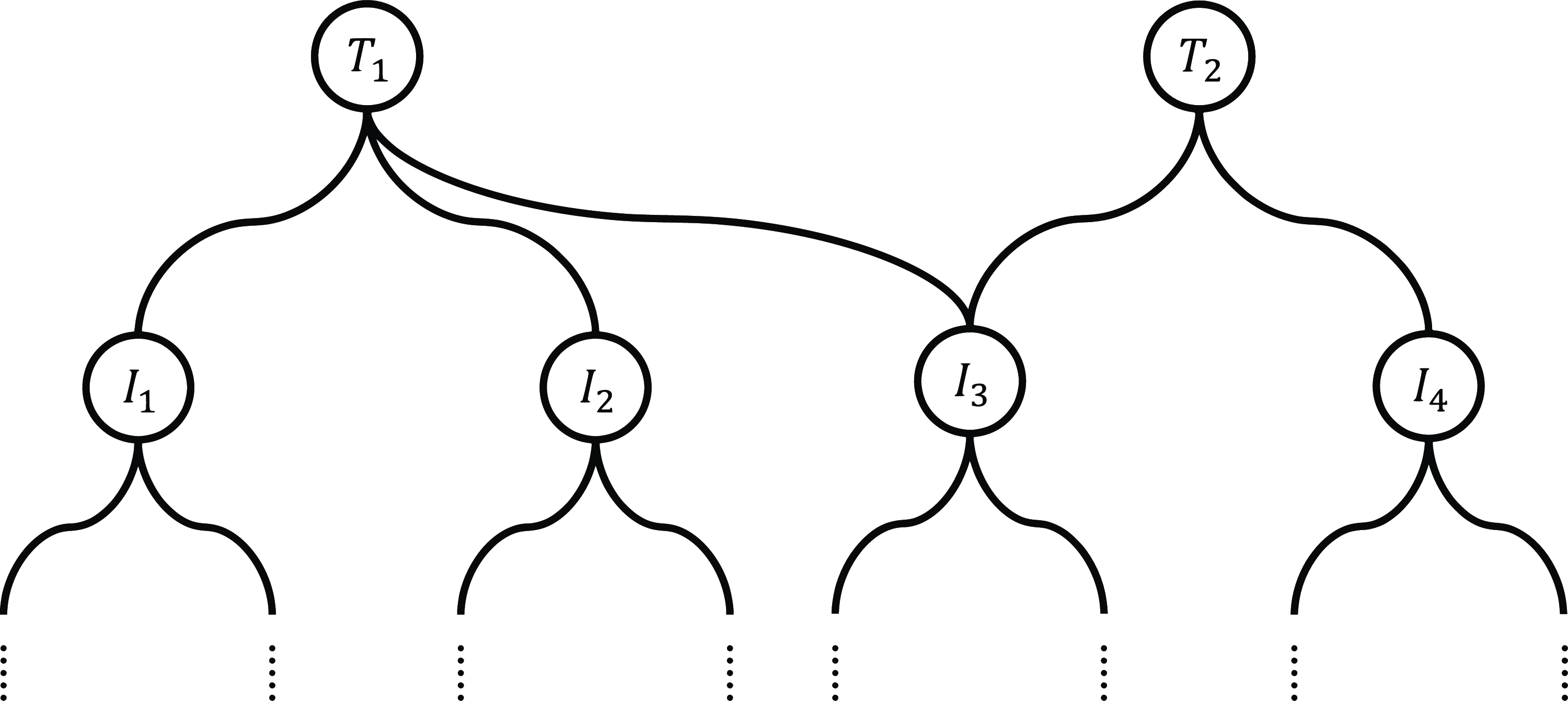
First of all, it is important to recognize that instrumental goals can serve more than one terminal goal. For example, engaging in team sports would serve both social connection and a long and healthy life; see Figure 4 for illustration. However, instrumental goals derived from different terminal goals may also come into conflicts leading to decisions being in line with one terminal goal but not the other – such as in the introductory example of eating a salad (healthy eating and long and healthy life) while being with friends who are ordering fast food (social connection).Footnote 7 Moreover, depending on circumstances, instrumental goals may even induce contextual preferences for behaviour with different short-term and long-term effects for corresponding terminal goals. For instance, a specific group of agents focused on maintaining good health may develop routines that benefit one aspect of health while harming another – such as drinking alcohol in the evening to relieve stress (e.g. Sillaber and Henniger Reference Sillaber and Henniger2004), which may aid short-term stress reduction but damage internal organs in the long run.
Illustration of a case where one instrumental goal serves two different terminal goals. As in the example, ${T_1}$
could be social connection,
${T_1}$
could be social connection, ${T_2}$
health and
${T_2}$
health and ${I_3}$
joining team sports.
${I_3}$
joining team sports.

To manage such trade-offs, we again assume that for each choice agents put relative weights on their instrumental goals according to contextual stimuli (for a discussion of contextual effects on decision-making, see also Bergh and Wichardt Reference Bergh and Wichardt2018; Dold et al. Reference Dold, Van Emmerick and Fabian2024; Kemper and Wichardt Reference Kemper and Wichardt2024b; Colin-Jaeger and Dold Reference Colin-Jaeger and Dold2025; Fabian and Dold Reference Fabian and Dold2025). Thus, in the drinking example, agents may conclude that in view of the current situation stress relief outweighs concerns about visceral health. Accordingly, drinking alcohol would contribute more to local optimization (achieving immediate stress relief) than it does to harming long-term health (liver damage, etc.), possibly even leading to habit formation through developing physical dependence. Similarly, in the eating with friends example, agents may prioritize not offending their friends over eating healthily as it is (locally) judged to be more rewarding.Footnote 8
What is important for the present argument is that instrumental goals may cause such conflicts to emerge and that behaviour, therefore, need not always be aligned with terminal goals and that such non-alginments are not necessarily a sign of irrationality.
2.2.2 Dynamic misalignments
A further source of structural inconsistencies, which deserves a brief mention, stems from dynamic changes in the agent’s life; for example, resulting from significant life events that may prompt agents to reassess their priorities (cf. Ojanen et al. Reference Ojanen, Aunola and Salmivalli2007). In fact, research on the Big Five personality traits indicates that these can evolve over time, often following identifiable trends (cf. Mroczek and Spiro Reference Mroczek and Spiro2003; Roberts and Mroczek Reference Roberts and Mroczek2008). Additionally, Conway and Williams (Reference Conway and Williams2008) emphasize that shifts in how individuals perceive themselves are closely linked to changes in their goals. Moreover, Bühler (Reference Bühler1964) provides direct evidence of goals evolving over time, often in discernible patterns.Footnote 9 Thus, as terminal goals evolve, even small changes in their weighting can necessitate substantial adjustments throughout the goal hierarchy.Footnote 10 Recall that instrumental goals are thought of as complexity-reducing intermediaries to achieve terminal goals. Thus, if a change in the agent’s circumstances induces adjustments in (the relative importance of) terminal goals, this may imply temporary misalignments between instrumental and terminal goals, as well as an adjustment process.
While we do not explicitly consider learning, it is important to acknowledge the possibility of such changes and the resulting need for adaptation. In fact, Bostrom (Reference Bostrom2012) interprets misalignments between terminal and instrumental goals as a sign of irrationality. However, this is not the only possible interpretation as, for example, a mere lack of self-knowledge (Tirole Reference Tirole2002) may contribute to these misalignments. Additionally, decision-makers may be uncertain about how certain instrumental goals serve their terminal goals and may be in a phase of exploring alternatives (Cohen et al. Reference Cohen, McClure and Yu2007), something Bostrom (Reference Bostrom2012) also acknowledges; Fabian and Dold (Reference Fabian and Dold2025) consider the case of agents learning their preferences, which can be interpreted as understanding which instrumental goals support which terminal goals. Moreover, adjustments are not without cost, as they require time and cognitive resources to observe, evaluate and establish new goals (Grahek et al. Reference Grahek, Leng, Musslick and Shenhav2023). As a result, goal adjustments are not instantaneous. Once again, what is important here is that there are perfectly rational reasons for many temporary misalignments and seeming inconsistencies in behaviour.
2.2.3 Resulting patterns
The preceding observations suggest that while decision-makers use goal structures to deduce preferences and to simplify their decision-making processes, these structures inherently produce misalignments between different goals. Depending on the context of a decision, these may occasionally lead to decisions which, upon more deliberate reflection, may not be in the interest of the agent’s broader terminal goals. Put differently, the proposed conceptual model of goal hierarchies and preferences is compatible with some degree of seeming behavioural ‘inconsistencies’ showing in single instances as well as with more consistent overall behavioural patterns. As we argue below, it is the possibility of seeming inconsistencies that provides grounds for justifications for paternalistic interventions.
3. Discussion
In this section, we discuss implications of the proposed conceptual model for policy topics related to paternalistic interventions of various sorts. The purpose of this discussion is to illustrate why a more detailed conception of preferences as derived from goals is helpful to mitigate some of the tension in the debate. As a first step, we take up the nudging debate (3.1), before moving on to paternalistic interventions more generally (3.2), and addressing remaining practical challenges (3.3).
3.1 Nudging
First, we consider the claims made by Thaler and Sunstein (Reference Thaler and Sunstein2008) in connection with nudging, in particular, their argument that influencing the behaviour of others can enhance their welfare as judged by themselves.
3.1.1 Nudging – better off as judged by themselves
As already emphasized in the Introduction, the crucial claim made by Thaler and Sunstein (Reference Thaler and Sunstein2008) in connection with their proposal to change decision environments is that such interventions are thought “[to] influence choices in a way that will make choosers better off as judged by themselves” (Thaler and Sunstein Reference Thaler and Sunstein2008: 5; italics in original). It is this claim which has fuelled much of the critical debate around nudging (e.g. Hausman and Welch Reference Hausman and Welch2009; Whitman and Rizzo Reference Whitman and Rizzo2015; Infante et al. Reference Infante, Lecouteux and Sugden2016; Sugden Reference Sugden2017; Kemper and Wichardt Reference Kemper and Wichardt2024a). As a central aspect of nudging is to not change available options, the debate essentially revolves around the question on what grounds an external person can determine what would have been better for an agent to do according to their own judgement despite the fact that they did not choose to do so.
Note that in order to answer such a question, two sets of preferences have to be considered: one that reflects the behaviour agents currently exhibit, and another representing how they would have preferred to behave but did not. It is in this context that Špecián (Reference Špecián2019) highlights a seemingly contradictory challenge for libertarian paternalists: they must identify normatively binding preferences that differ from the current (revealed) preferences of the agents, while ensuring that these preferences are still derived from relevant aspects of the agents’ preferences.Footnote 11 If, within the model, preferences are assumed to be stable, this challenge is difficult to master. Even if we think of agents as possessing two selves, one for actual decisions and one with an eye on broader developments but each with its own notion of well-being (cf. Thaler and Shefrin Reference Thaler and Shefrin1981), the difficulties would merely be shifted to a different level. Eventually, both would motivate preferences from their own perspective and would do so for good reason. Hence, any internal compromise reached for a specific decision would be difficult for external parties to challenge without questioning the agent’s autonomy.
However, once preferences are conceptualized as derived from hierarchically ordered goals, which provide rough guidance for behaviour, it is possible to overcome these methodological difficulties and to rationalize both: a high degree of consistency in individual behaviour (being constantly directed towards certain agent-specific terminal goals) as well as occasional contextual inconsistencies (stemming from contextual misalignments of different instrumental goals). In fact, according to the argument presented in section 2, behaviour can exhibit clearly discernible patterns if observed over a longer period and across different contexts, while locally appearing much more erratic. Moreover, as we assume that terminal goals represent what agents ultimately seek to achieve, relying on the general patterns to interfere with local behaviour (e.g. to nudge agents) would not impose external values. Thus, inasmuch as paternalists would refer to such general patterns in combination with a model of preferences along the lines outlined in the previous section, they may indeed have reason to argue that they intend to improve the agents’ welfare as judged by themselves.
In that sense, the proposed model of preferences bridges Thaler and Sunstein (Reference Thaler and Sunstein2008) perspective with the theory of revealed preferences (Samuelson Reference Samuelson1938, Reference Samuelson1948), as the normatively binding preferences are revealed as a latent trend around which the observed preferences revolve. Over time, these normatively binding preferences are revealed through the choices agents make, i.e. they are embedded within the patterns of observed behaviour. Thus, the long-run trend gives reason to argue for local interventions – meddling with contextual preferences – being consistent with the agent’s broader goals (as Thaler Reference Thaler2015 argues).
3.1.2 Broader implications for paternalistic interventions
Before moving on, it is worth noting that the above argument is not restricted to nudging or libertarian paternalism (as nudging is often referred to). While nudging aims to intervene without changing available options, which might sound particularly innocuous, the central problem is essentially the same for all paternalists in general. What is eventually intended is a change in observable behaviour of an agent and the argument to support such interventions is that they would improve the situation of the acting agent according to their own values. Accordingly, as long as a model of preferences allows one to argue that some immediate behaviour is not in line with the agent’s broader goals and that this deviation is worth correcting, it offers a possible justification for interventions. Indeed, the strength of this justification would depend on the plausibility of the model and the reliability of various steps of the argument (cf. section 3.3).
3.2 Beyond Nudging
A specific form of paternalistic interventions, which deserves a brief mention here, relates to policies designed to address changes in people’s lives that are arguably not sufficiently considered by decision-makers on their own. Examples include mandatory or socially incentivized retirement savings (e.g. Thaler and Benartzi Reference Thaler and Benartzi2004; Ashraf et al. Reference Ashraf, Karlan and Yin2006; Gugerty Reference Gugerty2007; Kast et al. Reference Kast, Meier and Pomeranz2018), obligatory health insurance (e.g. Twigg Reference Twigg1999; Erlangga et al. Reference Erlangga, Suhrcke, Ali and Bloor2019; Durizzo et al. Reference Durizzo, Harttgen and Tediosi2022), or generally incentivized healthy lifestyle (e.g. Gruber and Mullainathan Reference Gruber and Mullainathan2005; Giné et al. Reference Giné, Karlan and Zinman2010; Schwartz et al. Reference Schwartz, Mochon and Wyper2014). In such cases, a possible argument against these measures is that decisions should be left to individuals, as they are presumed to know what is best for themselves.Footnote 12 Such an argument, however, would rely on the traditional conception of preferences, which would not allow for what we might refer to as locally rational mistakes.
Within the present model, a possible rationale in favour of such interventions would involve changes in terminal goals that may occur over time. While we do not consider such changes or learning within the model, it seems reasonable to assume that terminal goals such as health, old age finances, or health of children either change in their relative importance with age or are not considered at all, as long as they are not relevant (see e.g. Austad Reference Austad1997; Kaplan Reference Kaplan1997). Such changes in terminal goals, however, would necessitate adjustments within the goal hierarchy which are likely to take time. In view of this, it may be reasonable to help people adapt to the new circumstances. For example, policies could promote information campaigns about preventive health examinations (e.g. Suk Reference Suk2011), including vouchers as a libertarian intervention, or implement obligatory health insurance (e.g. Durizzo et al. Reference Durizzo, Harttgen and Tediosi2022) or incentivized pension savings (e.g. Gugerty Reference Gugerty2007).
Note that the argument would once again be based on the structural conception of preferences proposed in the present paper. The only difference to the argument provided around nudging is that the focus here is not on contextual misalignments for single agents but on general life-cycle developments common to most people. In essence, however, it is again the fact that the hierarchical structure of the model allows for prioritizing one type of judgement over another, a feature that is absent in the common model of preferences and drives our argument.
3.3 Remaining Practical Issues
Finally, we want to emphasize that all paternalistic interventions face practical problems related to the assessment of terminal goals and establishing appropriate restrictions to guide agents toward achieving those goals.
For example, a plausible strategy for paternalists would be to observe past behaviour of decision-makers and to infer a latent trend. Yet, even assuming that terminal goals do not change over time, estimating a trend from any set of data is rarely free of possible measurement and estimation errors. Consequently, paternalists are still methodologically limited in their ability to correctly assess terminal goals, with the obvious consequences for welfare judgements. What is more, even assuming terminal goals to be correctly established, policymakers still have to tailor interventions to suit individual needs. Failure to do so obviously risks creating interventions that successfully alter behaviour but fail to efficiently move agents closer to their terminal goals (cf. Špecián Reference Špecián2022).
Note that also eliciting agents’ preferences – after some reflection – in a neutral state where no interference of the decision context is possible (e.g. Beshears et al. Reference Beshears, Choi, Laibson and Madrian2008; Allcott and Sunstein Reference Allcott and Sunstein2015), is not perfectly reliable if terminal goals are to be established.Footnote 13 Consider, for example, agents who regularly eat cake in a cafeteria. While the agents may indeed have a long and healthy life as a terminal goal, they may also experience a temporary need for the stress relief provided by the indulgence – which in turn may be good for their overall health due to the local stress relief. In line with the earlier example of drinkers (cf. Sillaber and Henniger Reference Sillaber and Henniger2004), these agents may rationally consider the short-term benefits of stress relief to outweigh the long-term harm to health (caused by sugar and saturated fats). Yet, even if in a neutral state, agents may still present a socially acceptable narrative (or even a narrative they like themselves) to gain social credit (Simler and Hanson Reference Simler and Hanson2017). Therefore, we would argue that, as different instrumental goals are relevant in different contexts, also a neutral state is just one specific context (a very unnatural one). Instead, we believe that taking the average of observed preferences across multiple contexts provides a more balanced and accurate reflection of agents’ terminal goals, as it captures the diversity of circumstances in which decisions are made.
Last but not least, since agents themselves may not be able to recognize the long-term ramifications of their short-term choices or potential improvements, they may still perceive external interventions as harmful per se; for example, due to psychological reactance (cf. Rains Reference Rains2012; Schütze et al. Reference Schütze, Spitzer and Wichardt2025). Since agents in the moment of the decision, by definition, believe that they are making the best choice available, the benefit of any third-party intervention can only be acknowledged ex post. This feature is intrinsic to the goal hierarchy.
To wit, it is important to note that both terminal goals and appropriate measures needed to help agents achieve them are likely to differ among decision-makers, making it nearly impossible to design a flat intervention that suits everyone. Thus, while single interventions may be good for agents on average (or the majority of agents, etc.), they are unlikely to benefit all individuals uniformly and may even harm some. Accordingly, even if we knew what would be good for each individual, constructing an uncontentious social intervention would still be problematic.
4. Concluding Remarks
In this paper, we have proposed a conceptual model of preferences centred on the interaction between terminal and instrumental goals. As we have argued, the model offers a structured framework to rationalize (some) seeming inconsistencies in decision-making and to support arguments in favour of paternalistic interventions.
More specifically, the model utilizes a distinction between terminal goals, which correspond to fundamental life-defining objectives, and instrumental goals, which serve as intermediate steps to achieve these overarching aims. Intuitively, instrumental goals are thought of as a complexity-reducing mediator between terminal goals and context-specific preferences. In that sense, the model integrates human-bounded rationality into a conceptual model of preferences. As we have argued, this allows for contextual misalignments and “errors” which may be worth correcting – even from the perspective of the agent themselves. Thus, within the model, there is a way to prioritize one perspective on decisions over another because terminal goals are what guides instrumental goals. Accordingly, the model offers a methodological basis to argue for paternalistic interventions as, within the model, behaviour aligned with terminal goals provides a normatively binding benchmark that paternalists can adhere to.
While the proposed conceptual model of preferences offers a theoretical justification for paternalistic interventions, whether in terms of nudges or hard interventions, several practical challenges remain. For one thing, interventions would have to rely on estimations of long-term trends in behaviour to identify terminal goals – with the common uncertainties inherent in any data-based estimation. Also, preferences and goals will differ between individuals and, hence, “one-size-fits-all” policy measures will still be difficult to argue for. Thus, also arguments based on goals and preferences as proposed in this paper would not grant paternalists all the liberty they might desire. Yet, conceiving of preferences as being derived from a hierarchy of goals does give a methodological foundation for arguments in favour of interventions “mak[ing] choosers better off as judged by themselves” (Thaler and Sunstein Reference Thaler and Sunstein2008: 5; italics in original).
Acknowledgements
We are grateful to Jan Krause, Ulrich Schmidt, an anonymous reviewer and a seminar audience at the Kiel Institute for the World Economy for helpful comments and discussions. Wichardt thanks the Arne Rydes Stiftelse for financial support. Krautwurm thanks the Kiel Institute for the World Economy for its hospitality and The Internal Grant Agency of Prague University of Economics and Business for supporting his work [VSE IGS F4/39/2025]. The usual disclaimer applies.
Petr Krautwurm is a PhD candidate at the Prague University of Economics and Business. His interdisciplinary research focuses on the area of philosophical and methodological questions about economics; such as second-order preferences, precommitments, and implications for paternalism.
Philipp C. Wichardt is a Professor of Economics at the University of Rostock and a research fellow of the CESifo Munich and the Kiel Institute for the World Economy. His interdisciplinary research focuses on the social and psychological determinants of individual decision-making. It has been published in various different fields of the social sciences.


 Open access

