


1. Introduction
As traditional manufacturing processes are not suitable for complex geometries (some geometric shapes are for instance limited due to their complexity regarding possible operation with subtractive process), metal additive manufacturing (MAM) technology appeared as revolutionary for manufacturing parts through material deposition layer by layer (Reference Blakey-Milner, Gradl, Snedden, Brooks, Pitot, Lopez, Leary, Berto and Du PlessisBlakey-Milner et al., 2021). As part of resources preservation, MAM has emerged among the new technologies for sustainability, increasing productivity while reducing resource consumption through waste minimization and offering optimized and light-weighted designs (Reference Nyamekye, Lakshmanan, Tepponen and WestmanNyamekye et al., 2024). It is also common that some additive manufacturing processes are suitable to make prototypes, due to their capacity to manufacture parts similarly to end-use parts.
A very common idea among studies assessing environmental contributions of MAM technology, that it is less impactful than traditional technology due to their ability to manufacture parts with the just-needed material quantity and then reduce power and material consumption (Reference Bekker and VerlindenBekker & Verlinden, 2018), (Reference Kokare, Shen, Fonseca, Lopes, Machado, Santos, Oliveira and GodinaKokare et al., 2024). However, a lot of impact factors were not mentioned while assessing the environmental impacts of such technology (for instance the presence of special equipment required for safety and health, material extraction, etc). Therefore, there is a dire need for a methodology of assessment that would consider not only the impacts coming from component building but also from the component use. Furthermore, this methodology proposes to balance mechanical performances and environmental impact to support decision making of an acceptable trade off regarding metal/technology. It is based on process parameters and enables to respond to mechanical requirements while, considering the environmental impacts that may be generated throughout the process.
Section 2 is dedicated to an overview about last research work in sustainable manufacturing based on MAM, it is established to identify gaps leading to inaccurate results. It is followed by a literature review on recent work regarding mechanical characterisation of MAMed parts. Then, section 3 presents a mapping leading to the definition of a new methodology for environmental impact assessment that also satisfies mechanical requirements of the final part. Then the best trade-off regarding metal/process can be identified. In section 4, a case study is applied to a given additive manufacturing technology combining metal injection molding and fused filament fabrication (FFF). This combination is particularly helpful for prototyping and is used to validate the proposed method. Finally, conclusion and future work are presented, to detail next steps for research work leading to the development the proposed method.
2. State of the art
2.1. Mechanical proprieties of MAM parts
The process of successive material deposition impacts material properties of the part. Printing strategy is dependent on the machine type as well as on the processing and post-processing parameters. A layered approach can also lead to direction dependence in the material properties. Therefore, the material properties of the part can also depend on the orientation and position of the part in the build space during processing. This is an advantage to designers, where process parameters can be manipulated and chosen to respond to required material properties (Reference Lee, Sagong, Jung, Kim and KimLee et al., 2023).
However, mechanical properties have to be assessed along different directions, as illustrated by the study performed by (Reference Kokare, Shen, Fonseca, Lopes, Machado, Santos, Oliveira and GodinaKokare et al., 2024), dedicated to a low-alloy steel using wire arc additive manufacturing. There are several standards for testing mechanical properties. So far, there are no specific standards for AM, but some existing standards have been accepted. ASTM has produced ASTM F3122 which serves as a guide to existing standards or variations of these standards that can be applied to determine the mechanical properties of materials used for AM, according to (Reference CrockerCrocker, 2019). Powder quality has also an impact on final material properties (Reference Morcos, Shoukr, Sundermann, Dobrowolski, Barta, Jain, Arróyave, Karaman and ElwanyMorcos et al., 2023). (Reference Bidare, Abdullah, Jiménez and EssaBidare et al., 2023) discussed the reusability of powder not affected by the binder in binder jetting process on metallic powder, and showed that it is possible to reuse this powder obtained after depowdering, thus lowering the impact of this technology through material saving. It is also possible to reuse defective parts by transforming them into metal powder.
(Terrenoir, Reference Terrenoir2024) proposed a decision support model to help with the choice of process parameters resulting in both required mechanical properties and sustainability of process. However, the environmental impact parameters considered were electrical consumption and shielding gas, which may not be significant as other impact factors were neglected (impacts related to material sourcing, end of life of the part, etc).
2.2. Environmental sustainability of MAM technology
Different strategies exist for the assessment of the environmental sustainability of MAM technologies. Some studies compared the sustainability of additive manufacturing and subtractive technologies: (Reference Paris, Mokhtarian, Coatanéa, Museau and ItuarteParis et al., 2016) carried out a comparative study of the impacts generated by metal additive manufacturing and subtractive manufacturing processes to obtain a 13-blade aeronautical turbine using Ti6Al4V with the electron beam melting process. The sustainability assessment was carried out with 10 environmental indicators. The results of the analysis showed that electron beam powder process was more eco-friendly than the subtractive process when the geometry of the part required strong material removal. (Reference Jiang, Liu, Li, Cong and ZhangJiang et al., 2019) compared the laser additive manufacturing with computer numerical control machining for the production of gears. They concluded that the subtractive approach was more impactful.
Other studies compared the impact of different additive technologies. (Reference Raoufi, Manoharan, Etheridge, Paul and HaapalaRaoufi et al., 2020) conducted a comparative study between metal injection molding and binder jetting process to manufacture a 316L stainless steel microreactor plate. It was concluded that environmental impacts per part reduce significantly for the metal injection molding process when production volume increases, as impacts due to solvent and mold are shared across more parts, which is not the case for binder jetting where impacts are mainly due to raw material and utilities.
Another strategy to discuss the environmental impact of MAM technology is to focus on an optimized structure in order to compare the impacts of the process parameters. (Reference Shah, Hadjipantelis, Walter, Myers and GardnerShah et al., 2023) assessed the environmental impact of WAAM technology and assessed the environmental impact of mass reduction, deposition rate, and electricity mix. It was concluded that the best results in terms of environmental impacts were obtained with the lowest deposition rates. In fact, high deposition rate led to high wire feed speed and therefore to high welding energy, even if it reduced the manufacturing time and consumables (shielding gas, lubricants, etc). (Reference Priarone, Campatelli, Montevecchi, Venturini and SettineriPriarone et al., 2019) evaluated environmental impacts of manufacturing a part with its substrate, proceeding by a calculation of CO2 emissions and electrical energy consumption. In their assessment, they integrated the consumption of protective gas and material but did not take into account the production stage of the protective gas, as well as the treatments applied to parts (post-processes) employed to reach the required mechanical properties. With the aim of minimizing environmental impacts associated to these processes, an in-depth study of their impact indicators should be made in order to help the choice of the pair metal/process that responds to green process requirement. (Reference Mrabet, Gaha, Marteau, Louhichi and EynardMrabet et al., 2022) mentioned aspects leading to higher environmental impacts that were not considered in previous studies, through an Ischikawa diagram, which is helpful to identify the process parameters to consider in their study.
Other studies focused on specific stages. For example, (Reference Kokare, Oliveira and GodinaKokare et al., 2023) used the ReCiPe Endpoint (H) method to compare the environmental impact of the production of steel wire, steel bar and steel powder. They concluded that the production of a 1 kg of steel wire is a little more impactful than the production of 1 kg of steel bar but have less impact than the production of a 1 kg of steel powder. This difference was due to the environmental costs of wire drawing and atomization processes. In most of the environmental assessment studies, the material deposition stage is generally the least impactful. Usually, the preparation of the raw material and its shaping are the most impactful (Reference Kokare, Godina, Oliveira and Camarinha-MatosKokare et al., 2022). (Reference Van Sice and FaludiVan Sice & Faludi, 2021) also underlined that most studies included direct impacts from material processing such as energy consumption but overlooked the impacts of consumables such gas, etc.
(Villamil et al., Reference Villamil, Nylander, Hallstedt, Schulte and Watz2018) proposed a sustainability life cycle assessment tool that is useful to assess the sustainability of a technology, and identify challenges and strategies to improve process, through an organised workshop aiming to collect information about impact of AM process from participants. This tool can be applied to any technology but results are highly dependent on team members’ knowledge and these results remain qualitative.
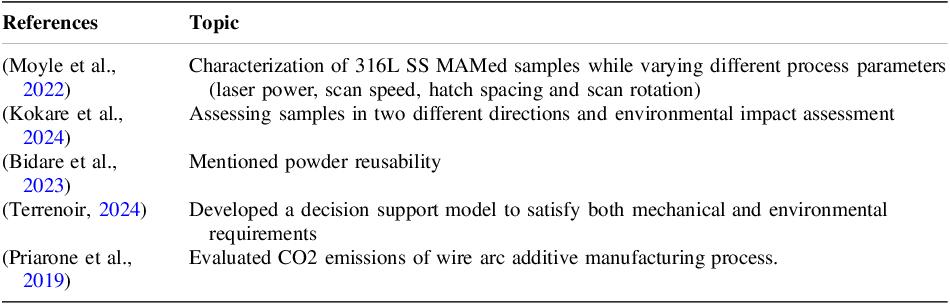
The aforementioned studies only evaluated some environmental impact aspects. In addition, not overall process steps were considered, which is not significant as some impacts could be due to steps that were not included in the study. Furthermore, the number of studies leading a parallel evaluation of environmental impacts and optimized mechanical properties, is very limited. Table 1 provides an overview of some recent studies evocating both aspects: mechanical and environmental performances of MAM processes.
Overview of recent studies evaluating both aspects

3. Proposal
The proposed methodology is based on mechanical requirements of the part and the environmental impacts generated by the 3D metal printing. In fact, the choice of the best pair metal/process is done generally starting from mechanical behaviour of the part (loads to be supported, tensile strength etc), regardless of the environmental contributors as shown in (Figure 1). To change this trend, we aim to propose an environmental impact assessment tool that enables to calculate impacts from a previously constructed and prepared database for a MAM process. Depending on assessment results, two cases are possible, either the choice is validated as environmental impacts does not exceed allowed values, or mechanical behaviour will be covered by very high environmental impacts. In this last case, the choice metal/process should be revised and a new combination metal/process should be proposed so that it meets both requirements (mechanical and environmental).
Proposed method

The environmental impact assessment tool uses process parameters, previously collected from existing researches, machines related datasheets etc. Process parameters represent data flow for part manufacturing. (Figure 2) illustrates process decomposition into steps (starting generally by raw material sourcing). PS stands for sustainability parameters: they may be consumables (oil, special gases, lubricants, etc), energy requirements, process requirements (exhaust systems, ventilation, etc), material consumption etc. PMC stands for parameters related to mechanical characteristics of the parts. Numbers refers to parameters index, to show the correlation between sustainability and mechanical parameters. One PS parameter may be linked to one or more PMC parameters. For example, the “printing speed” which is a PMC parameter (as it has an impact on mechanical proprieties of the part) is related to the PS parameter “printing duration”, which can highly impact environmental assessment results.
Link between mechanical properties and process data

4. Case study applied to FFF-MIM based technology
A specific case study is applied to Fused Filament Fabrication (FFF) associated with Metal Injection Molding (MIM). This combination is part of the additive manufacturing processes related to material extrusion. It consists in building parts by selectively depositing molten material (through a heated nozzle) layer by layer. Feedstock is a filament made of a polymer and heavily loaded with metallic powder. The wire is heated and melted onto the build plate and then the part is built by adding layers (Metal FFF 3D Printing: a step-by-step guide for process and considerations, 2024). At the end of this step, a green part is obtained. Then, this green part is placed into a debinding station in which a solvent eliminates the primary binder. Finally, the sintering step transforms the part after debinding into a fully metallic part. During this step the temperature is gradually increased in order to remove the rest of the binder and fuse the metal powder. Therefore, the parts will have a metallic density of more than 97%. The closer the temperature is to the melting point of the material, the more the metal particles fuse to create a solid metal part. This technology is mainly used for prototyping.
To validate the proposed model in the academic context, the FFF technology was chosen as an example to generate life cycle assessment results and test the mechanical properties of the printed parts. Also, there is a strong similarity between the deposition principle of metal additive manufacturing and the raw material preparation processes used in FFF technology. Indeed, this latter combines two steps that are also found in MAM processes: powder atomization (powder that charges the filament) and the extrusion of the filament itself (Reference Seleznev, Roy-Mayhew and FaustSeleznev et al., 2023).
Experiments were conducted with Markforged 3D MetalX stations (the printing station, debinding station and sintering station). Additionally, tensile tests were performed on 12 specimens in order to carry out a comprehensive analysis, which is outlined below.
4.1. LCA related to FFF-MIM-based process
The overall process is evaluated through process requirements, from raw material sourcing to the end of sintering step. The LCA starts from the powder atomization step, as shown in (Figure 3).
Evaluated steps for FFF-MIM process

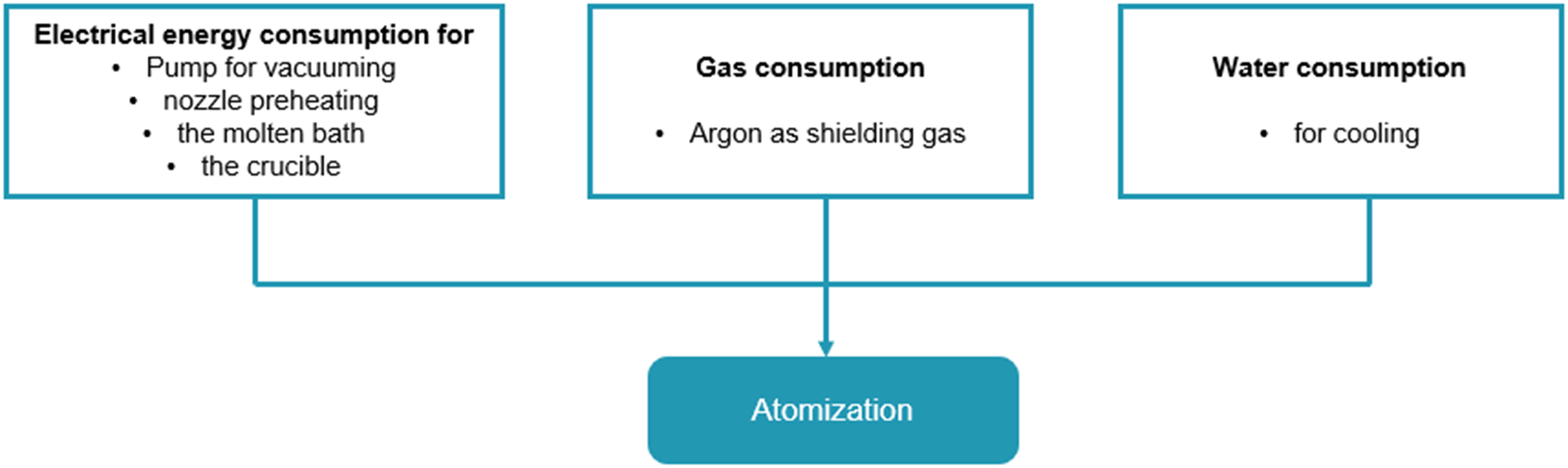
According to (Reference Le BourhisLe Bourhis, 2014), to produce metallic powder, metallic raw material is melted in an autoclave placed under vacuum. Autoclave is connected to the atomisation chamber by a crucible that is equipped with an atomization nozzle, which is preheated to create powder. In the atomization chamber (where metal transforms into fine droplets) an inert gas (Argon) is used to avoid oxidation phenomenon. Also, a water-cooling system is required to cool the autoclave to prevent overheating of the system and to avoid overheating of the metal. (Figure 4) shows dataflow for this step.
Data flow for atomization process

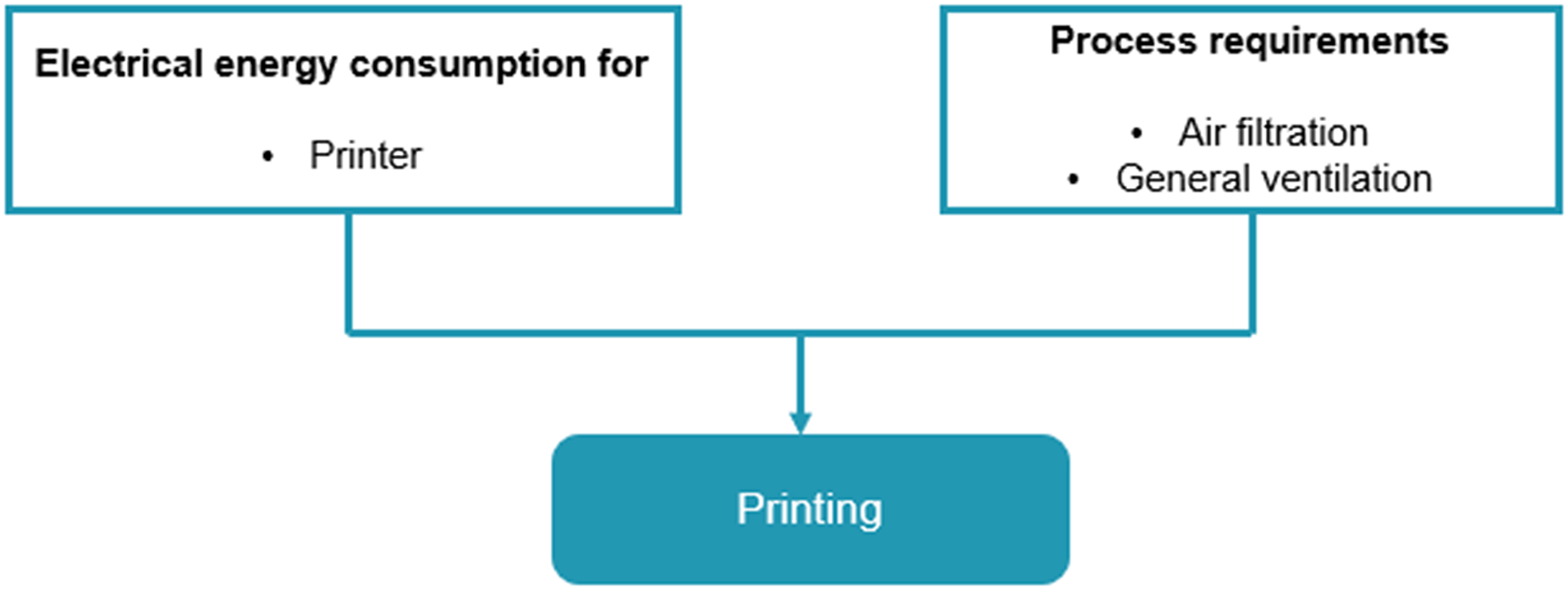
Next the printing step is carried out. The Metal X melts the thermoplastic and releases fumes when printing. This is why it must be used in a well-ventilated area. According to (norsemensafety, 2024) general ventilation of the room is recommended but no exhaust system is required. Air filtration is necessary to prevent metal dust transportation. Dataflow for LCA of the printing step is developed in (Figure 5).
Data flow for printing step

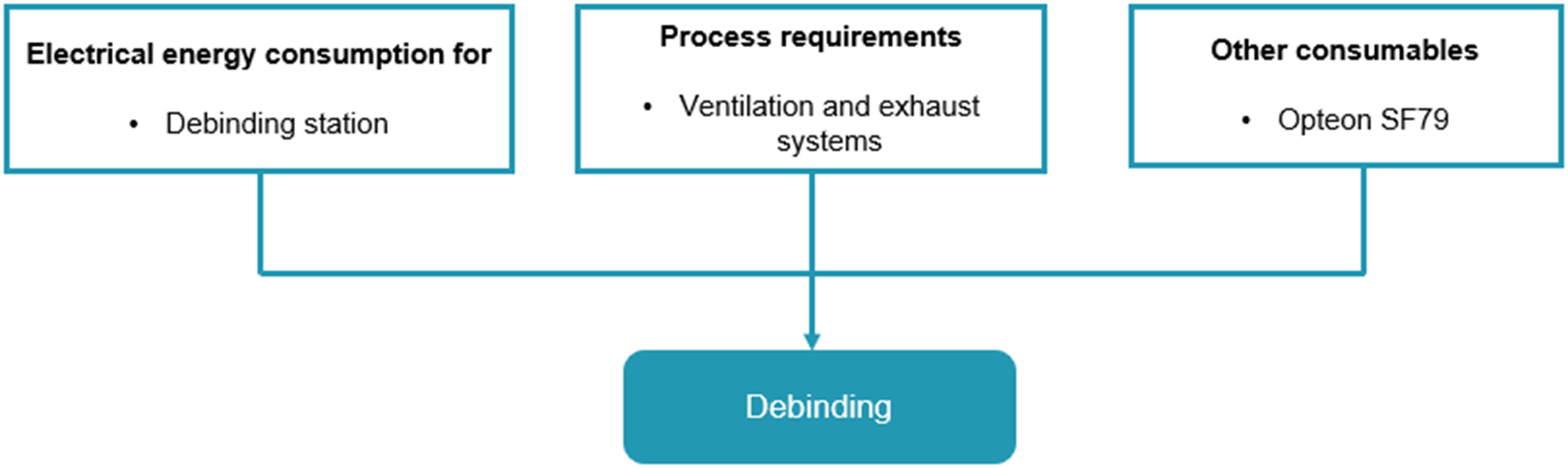
In the debinding step, Opteon SF79 is used as solvent to remove the binder from the green part. The machine is filled with 8.5 gallons of solvent. Before the initial installation of the system, the initial filling of the unit must be covered with 5 gallons. The solvent bath requires ventilation and exhaust systems to extract fumes and mitigate health risks from solvent vapors and thus respect safety standards in the workplace (Figure 6) (Metal FFF 3D Printing: a step-by-step guide for process and considerations, 2024).
Data flow for debinding step

The structure of the part after this step is semi-porous. It will then require sintering.
A shrinkage of approximately 4% was observed between the green part and the brown part (after debinding).
The last step is sintering. The Markforged Sinter-2 is a furnace with a maximum temperature of 1300°C, designed for small production volumes. It uses a carbon-free retort to ensure that the quality standards of the parts and the alloy composition are respected for the finished parts.
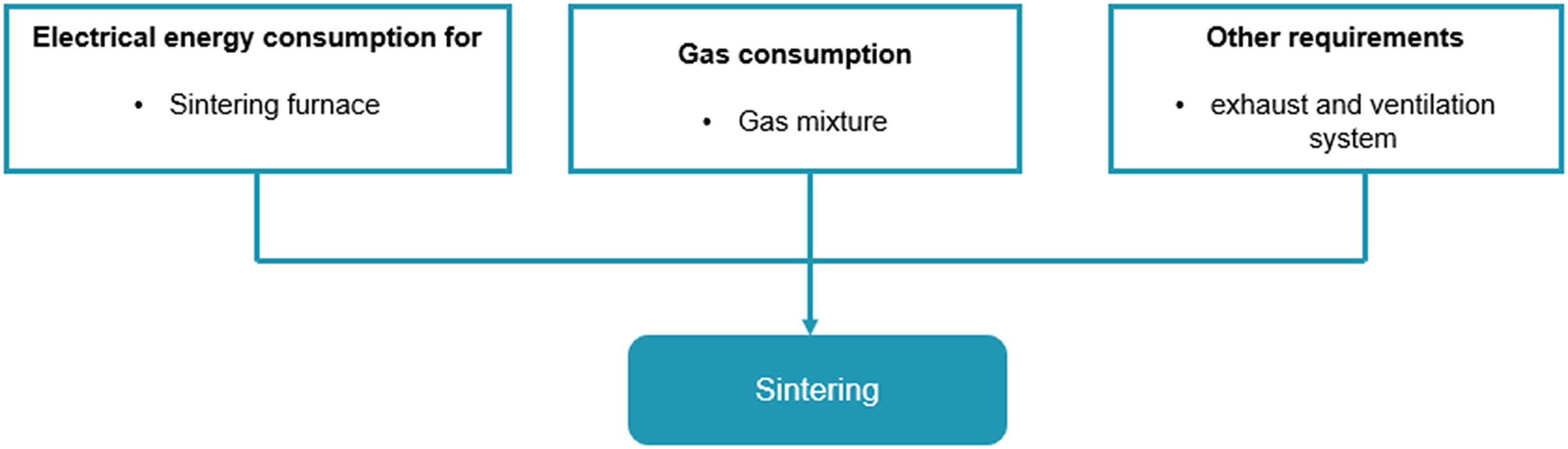
Sinter-1 furnace works in inert environments due to the nature of feedstock material: gas mixture with 2.9% hydrogen and 97.1% argon nominal (Metal FFF 3D Printing: a step-by-step guide for process and considerations, 2024), (MetalX manual, 2018).
The sintering machine requires an exhaust system (Figure 7).
Data flow related to sintering process

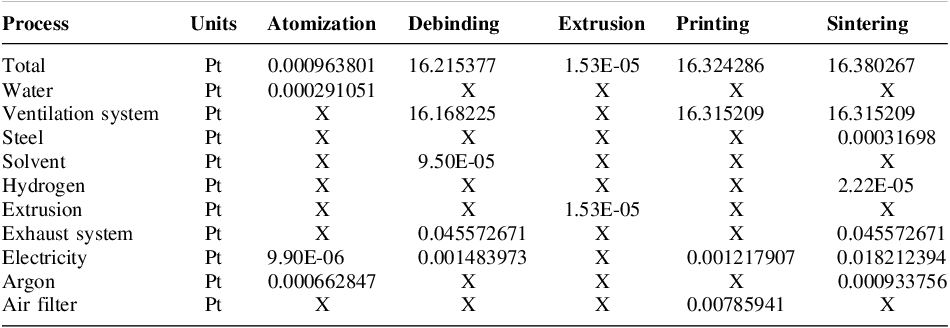
The data mentioned in previous sections was calculated using existing formula in literature: (Reference Le BourhisLe Bourhis, 2014) for atomization process and from Markforged 3D metalX related datasheet for printing, debinding and sintering. Durations of each step were also measured during the experiments to ensure accuracy and immediate data collection. For instance, data related to different consumptions in the process chain (solvant quantity, water consumption, argon, and different process requirements) were implemented in an LCA software (Simapro). (Table 2) shows the final results of the assessment. Results highly depend on data availability and knowledge of each process step.
Total contributions across the different process steps

Results show that the main contributor to environmental impact is the ventilation system, required in the workplace. Also, it is shown that the highest electrical energy consumption is the sintering step due to the duration of this step.
Markforged stations mentioned above may also require adequate environments with controlled humidity and room temperature.
4.2. Mechanical characterization of printed specimens
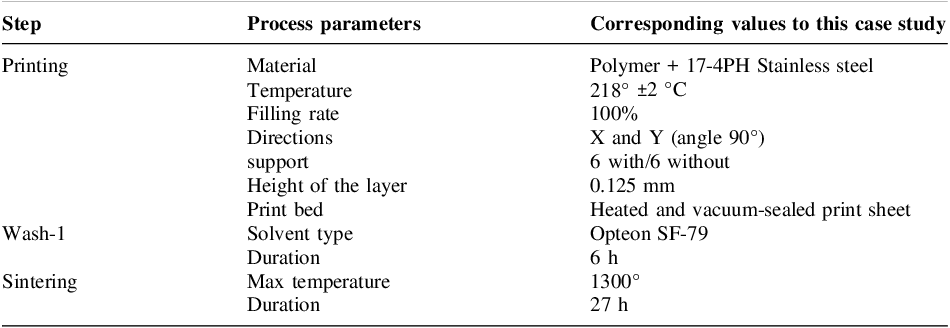
To assess the mechanical behaviour of the specimens produced by FFF-MIM process, tensile tests were carried out. (Table 3) presents data related to the steps of printing, debinding and sintering.
Related data to the case study

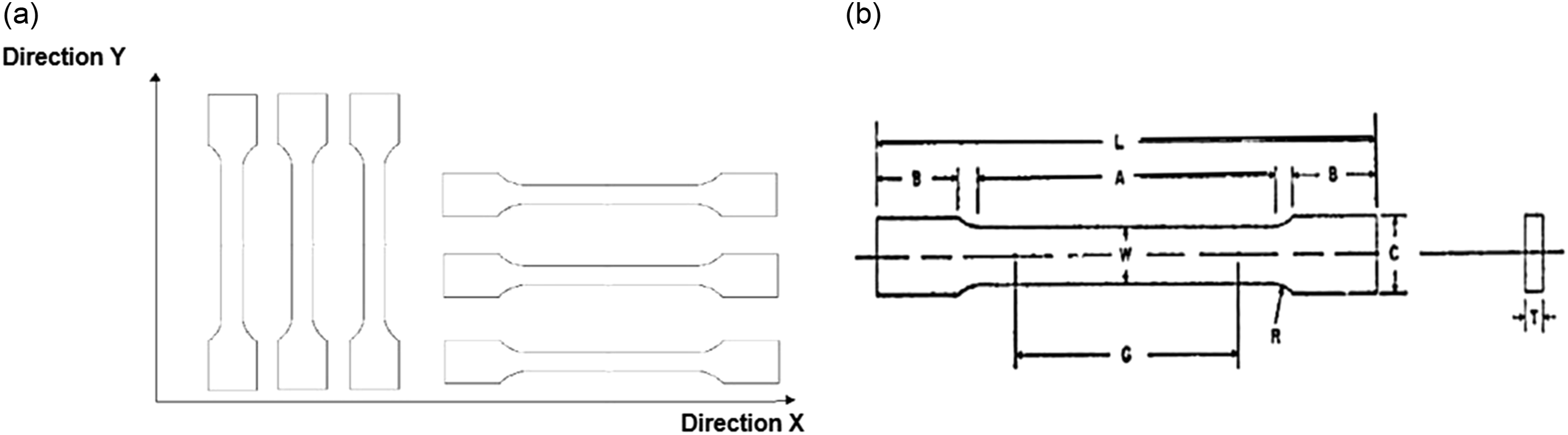
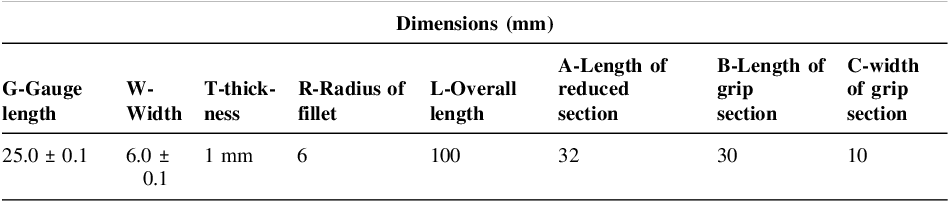
Six test specimens were printed along the X-direction and six along the Y-direction. In the case of this study, it was more optimal to design them according to a subsize specimen model (Figure 8 and Table 4). Which is suitable to the size of the furnace (small furnace) and also helps optimize the number of specimens to be printed.
a) Scheme of the specimens printed along the X- and Y-directions b) Schematic representation of the specimen geometry

Dimensions of the specimens

Regarding the printing parameters, the height of the layer was 0.125 mm and the number of layers was fixed to 8, with total filling. To see the effect of presence or not of supports, six specimens were printed with supports and six without. The support was separated from the part by a layer of ceramic which is also printed, and that can be easily removed at the end of the process. All the results are presented in (Table 5).
Related data to the case study

The obtained results show an average Young’s modulus for the specimens printed along X of 153 GPa (standard deviation: 4.49 GPa), while the average Young’s modulus for the specimens printed along Y is 155 GPa (standard deviation: 6.3 GPa). The identified Young’s modulus is lower than the Young’s modulus of stainless steel (approximately equal to 210 GPa). The average tensile strength was found to be 831 MPa for both directions with a standard deviation of 17.71 MPa along the X direction and 18.63MPa along the Y direction. In the present case, the direction of printing does not have an impact on the mechanical properties.
(Gong et al., Reference Gong, Snelling, Kardel and Carrano2019) found a Young’s modulus of 152 GPa for Ultrafuse 316L when using a similar technology, which is close to the Young’s modulus found in the case study. However, they identified very different values of ultimate tensile strength for the parts printed upwards (100 MPa) and the samples printed flat and on edge (453 MPa).
It is important to note that this technology is mainly used for prototyping, thus the low Young’s modulus values are not a limit to its application.
5. Conclusion and future work
This study proposed a methodology that balanced mechanical performances and environmental impact to support decision making of an acceptable trade off regarding metal/technology. A case study applied to a FFF-MIM process showed that debinding, printing and sintering has a large environmental impact. It was mainly explained by the effect of the ventilation system.
Mechanical properties of the produced parts were also examined. The mechanical properties were lower than the ones found with conventional manufacturing processes but this process, mainly used for prototyping, remains a valuable tool for conducting studies or experiments that can be applied to MAM technology. Moreover, the high recyclability of the manufactured parts can have a positive impact on Life Cycle Assessment results.
At this stage, the proposed model, applied to the FFF-MIM process, could also be applied to MAM processes that rely on the same fundamental principle (eg. having the same shape of raw material, similar process requirements, etc)
As future work, configurable parameters are planned to allow adjustments according to the specific requirements of each technology. This adaptability ensures that the methodology remains useful for various MAM techniques.
Also, contributions from the raw material origin (recycled or reused material) will be investigated. From a sustainability point of view, it is important to assess if it is better to proceed using recycled metal. A thorough study is also required to ensure the conformity of mechanical performances, without forgetting about environmental sustainability
Finally, the design step is the most critical as decisions about material choice, process flow, tools, etc are made (Reference Chtioui, Gaha and BenamaraChtioui et al., 2023). The work of (Reference Gräßler and HesseGräßler & Hesse, 2023) who presented a method to select design guidelines in order to enhance material circularity will be a valuable starting point for our research. In following work, decision support tool will be developed allowing the selection of best compromise starting from the early stages of design, based on already known data related to MAM process and metals. This will be helpful for industries, leading to the best compromise sustainability and mechanical requirements.





 Open access

