




1. Introduction
Most Norwegian dialects have been known to have a productive three-gender system consisting of masculine, feminine, and neuter.Footnote 1 Research on urban dialects has uncovered what seems to be an ongoing loss of the feminine grammatical gender (see, among others, Lødrup Reference Lødrup2011a, Rodina & Westergaard Reference Rodina and Westergaard2015, Busterud et al. Reference Busterud, Lohndal, Rodina and Westergaard2019). A recent cross-dialectal study of seven different Norwegian dialects from Bodø, Mo i Rana, Kristiansand, Trondheim, Stavanger, Egersund, and Lyngdal has revealed that this change affects both rural and urban dialects (van Baal et al. Reference van Baal, Eik, Lohndal and Solbakken2024, Solbakken et al. Reference Solbakken, Eik, van Baal and Lohndal2024). The pattern observed in these earlier studies is that feminine gender markers are replaced by masculine gender markers, resulting in a two-gender system with common and neuter genders. This development is in line with the process of standard Swedish and Danish, where the masculine and feminine gradually merged into a common gender centuries ago (Enger Reference Enger, Bandle, Braunmüller, Jahr, Karker, Naumann and Teleman2005).
This article reports on a study of the use of grammatical gender in the Voss dialect, a dialect from Western Norway. The Voss dialect is known to have more gender cues in the morphology than most of the previously studied urban dialects, including a clearer distinction between the masculine and the feminine in the nominal system.Footnote 2 If a system characterized by numerous feminine gender cues blocks or constrains the ongoing loss (a hypothesis presented by van Baal et al. Reference van Baal, Solbakken, Eik and Lohndal2023), we can expect to see it in the Voss dialect. The noun and gender system of the dialect will be outlined in section 2.3. This article presents the results of an experimental production study conducted in 2022 of the spoken language of 64 participants from three age groups, all living in Voss. The study elicited grammatical gender agreement on indefinite articles, adjectives, and possessives in all three genders in the singular, as well as indefinite and definite forms of the nouns. The results show that the feminine gender is a stable feature in the language of adults, but is becoming vulnerable in the language of children and adolescents. This article will discuss the properties affected and potential factors driving this change. Questions that will be addressed are (i) whether rich morphology is a preventing factor in the ongoing change, and if not, (ii) which parts of the gender system are affected.
The article is organized as follows: Section 2 provides some relevant background on grammatical gender, the Voss dialect, previous research, and the research questions. Section 3 covers the methodology, while the results from the study are presented in section 4 and discussed in section 5. Concluding remarks are provided in section 6.
2. Background
2.1 Gender
We define grammatical gender according to Hockett: “Genders are classes of nouns reflected in the behavior of associated words” (Hockett Reference Hockett1958:231, Corbett Reference Corbett1991:1). Thus, gender is expressed on agreeing words such as adjectives, determiners such as articles and possessives, and pronouns in Norwegian. Traditionally, Norwegian has three genders: masculine, feminine, and neuter. The relationship between gender and declension in Norwegian, and whether the definite suffix is a gender marker, is a long-standing discussion in Norwegian linguistics (see, among others, Enger Reference Enger2004, Reference Enger, Bonami, Boyé, Dal, Giraudo and Namer2018, Svenonius Reference Svenonius, Shih and Gribanova2017, Lohndal & Westergaard Reference Lohndal and Westergaard2016, Reference Lohndal and Westergaard2021, Lundquist et al. Reference Lundquist, Rodina, Sekerina and Westergaard2016, Solbakken et al. Reference Solbakken, Eik, van Baal and Lohndal2024, Haug Reference Haug2025). The main emphasis of this discussion will be on the findings concerning indefinite articles, adjectives, and possessives in the singular. However, a brief discussion of the use of the definite suffix and its role in this shift will also be presented. The relationship between gender and pronouns is somewhat complex and outside the scope of this article, and will thus not be discussed here. In this article, the expression “traditional feminine nouns” means feminine nouns according to the Nynorsk dictionary and the traditional Voss dialect (which are consistently uniform).
2.2 Gender in Norwegian
In Norway, dialects are widely spoken, and most individuals use their dialect in all aspects of society. Norwegian also has two written languages, Bokmål and Nynorsk. The written languages are mutually intelligible, and around the age of 13–14, pupils must learn to read and write both. The Bokmål is clearly the majority written language. For schoolchildren in Norway, the written language is chosen by the municipality. In 2024, 11.2 percent of pupils had Nynorsk as their preferred written language.Footnote 3 Most of these municipalities are situated in the western part of Norway. Voss is one of those municipalities. The Voss dialect shares many similarities with the written language Nynorsk, and all the participants in this study have Nynorsk as their preferred written language.
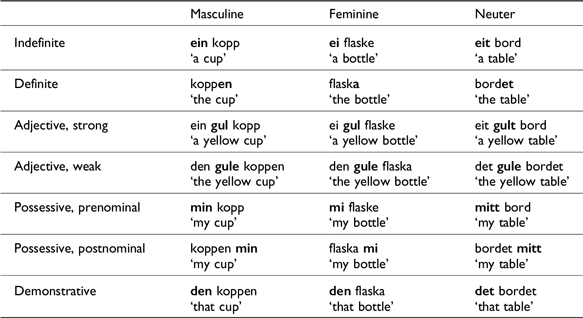
In most contemporary Norwegian dialects, gender distinctions have been neutralized in the plural form. However, in the singular, gender is still expressed through determiners and possessives. A distinction between masculine and feminine on the one hand, and neuter on the other, remains, which is particularly evident in the use of demonstratives and strong adjectives, as illustrated in the line “adjective, strong” in table 1. Table 1 illustrates the gender system with examples from the written language Nynorsk, where three genders are compulsory, as in many traditional Norwegian dialects. The gender markers and the definite suffix of the nouns are in bold in table 1.
An idealized Norwegian gender system in the singular, illustrated with written Nynorsk

The system in table 1 is somewhat idealized. The second row (definite) in the table does not, according to traditional understanding, illustrate gender, but declension (cf. Hockett Reference Hockett1958). It is included to illustrate a 1:1 relation between gender and declensional suffix; masculine nouns end in -en, feminine -a, and neuter -et.
As seen in table 1, Norwegian has both prenominal and postnominal possessives. Prenominal possessives are followed by nouns in the indefinite form (1), and postnominal possessives follow a definite noun (2).


The difference between the two constructions is partly a question of style, partly a question of two somewhat different grammatical constructions, and the postnominal use is the most frequent in spoken Norwegian (Anderssen & Westergaard Reference Anderssen and Westergaard2010:2580, Lødrup Reference Lødrup, Butt and Holloway King2011b:341). In unmarked contexts, we would use the postnominal construction, as in example (2). The prenominal possessive is used in many Norwegian dialects, including Voss, primarily in expressions of contrastiveness, hence emphasis. Examples like the construction in (1) are used to emphasize that it is my cup (and not yours, for example). In constructions like example (1), the possessive would also have prosodic prominence. We also find the prenominal possessive used in formal writing, mainly in Bokmål. The possessives will be discussed further in section 2.4.
Most nouns have the same gender across the Norwegian dialects, and the nouns used in my experiment have the same gender in both Nynorsk and the Voss dialect. Presumably due to a substantial degree of arbitrariness in gender assignment in Norwegian, the gender system appears to be acquired fairly late. A study of gender assignment in the Tromsø dialect demonstrated that the participants had 90 percent accuracy in use of the neuter gender at the age of 7 (Rodina & Westergaard Reference Rodina and Westergaard2015).
If we look at the diachrony of Norwegian gender, we find a development towards masculine being the default gender regarding assignment, in terms of it being the most numerous one. The neuter gender has remained relatively stable in percentage terms, while the feminine gender is gradually becoming proportionately less numerous. Based on dictionaries, Conzett (Reference Conzett2016) compares the gender distribution of the nouns in Old NorseFootnote 4 and Modern Nynorsk. The feminine had fewer members than the masculine already in Old Norse, and we know from the diachrony that there is a development towards more syncretism between feminine and masculine gender markers. While the three genders were distributed more equally in Old Norse, the distribution in Nynorsk in 2001 shows a decline of the feminine gender and an increase of the masculine (Conzett Reference Conzett2016:224). Conzett’s findings are presented in table 2.
Historical distribution of nouns by gender in Norwegian

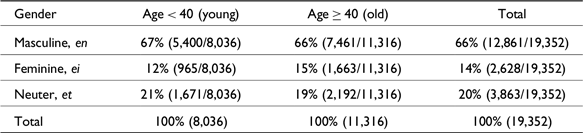
Table 2 shows the distribution of the three genders in dictionaries, and the tendency is that the feminine gender decreases percentage-wise and the masculine increases. Furthermore, corpus data from the Nordic Dialect Corpus confirms this tendency. The Nordic Dialect Corpus Footnote 5 contains spoken language of 438 speakers selected from 111 places in Norway, recorded between 2006 and 2012. When examining the percentage distribution of the three genders as reflected in the use of indefinite articles, we observe that the masculine form is utilized substantially more than the feminine and neuter forms. I did a corpus search of the distribution of the indefinite articles as follows: I searched for en, determiner masculine, country: Norway, and age groups; (a) < 40, (b) ≥ 40. When using the Bokmål form in the search, for example, the masculine indefinite article en, one gets all the dialectal realizations of the article, such as ein, ain. I then followed the same procedure for ei, feminine, and et, neuter. The results are presented in table 3.
Indefinite articles, Nordic Dialect Corpus

The number of tokens is given in parentheses. The table clearly shows that the masculine indefinite article is the most used, and also that the feminine article, ei, is seldom in use. We must keep in mind that this is not an overview of the nouns, but the use of indefinite articles in a spoken corpus. The differences between the age groups are probably not significant. The picture undoubtedly shows little use of the feminine article, compared to the masculine and neuter articles. This might also indicate that in the oral input of language learners, the feminine gender in its indefinite form is even less prominent than in the dictionaries referred to in table 2.
2.3 The Voss dialect
The Voss dialect is spoken by more or less the whole municipality of Voss (approximately 16,000 inhabitants), including some, but not all, of the immigrants. The status of the Voss dialect is known to be high among the people living in Voss (Akselberg Reference Akselberg2002). The official written language of the municipality is Nynorsk.
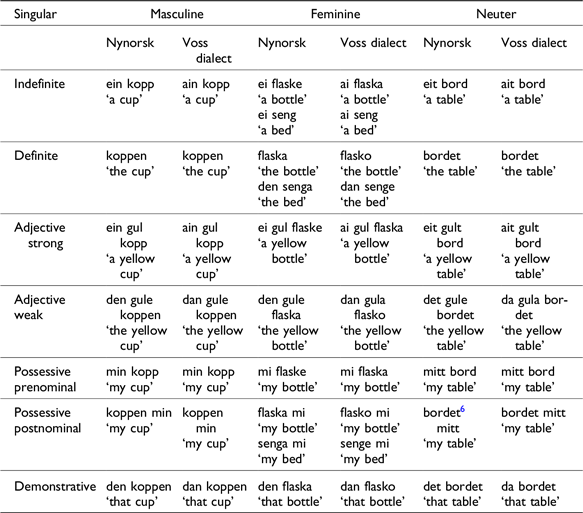
The Voss dialect has a three-gender distinction on indefinite articles and possessives (Aasen Reference Aasen1848, Vidsteen Reference Vidsteen1884, Heggstad Reference Heggstad1932, Akselberg Reference Akselberg, Akselberg, Bødal and Sandøy2003), in line with the Nynorsk system provided in table 1. Table 4 is a comparison between the Nynorsk system and the system of the Voss dialect. Table 4 illustrates that the systems are mainly alike but with some differences in the phonological realization of, for example, indefinite articles and determiners. The Voss dialect and the Nynorsk examples are all written in Nynorsk orthography, but with dialectal realization of the vowels. To show the difference in the declension of strong and weak feminine nouns in the singular in the Voss dialect, I have added a strong feminine noun, seng (‘bed’), in places where the declension between weak and strong is notable. In Nynorsk, there is no difference.
Gender and declension in the Voss dialect compared to Nynorsk

Table 4 demonstrates a large similarity between forms in Nynorsk and the Voss dialect. Both Nynorsk and the Voss dialect show a three-gender opposition in the use of the indefinite article and the possessive. Regarding the demonstrative, both Nynorsk and the Voss dialect demonstrate syncretism between masculine and feminine, den (‘that’) as opposed to neuter, det (‘that’). In the following, I will stress the differences. Table 4 illustrates that in the use of adjectives agreeing with nouns in the definite form, the weak adjectives show a difference between the Nynorsk and the Voss dialect. Nynorsk has gule. m/f/n (‘yellow’) in all three genders, while the Voss dialect has an opposition between the masculine on the one hand and feminine and neuter on the other hand, thus we get gule .m (‘yellow’) and gula. f/n (‘yellow’). This is a feature that the Voss dialect shares with other southwestern Norwegian dialects, while most Norwegian dialects have a syncretism between masculine and feminine in the attributive weak adjectives. I would also like to stress the different phonological realization of the unstressed -a suffix in the indefinite form of feminine nouns in the Voss dialect, ai. f jenta.(f)Footnote 7 (‘a girl’) as opposed to Nynorsk -e, ei. f jente.(f) (‘a girl’).
As mentioned in earlier literature, this final -e is argued to be a feminine gender cue in Norwegian (Trosterud Reference Trosterud2001, among others). In dialects where weak (disyllabic) feminines end in -e, we also find weak (disyllabic) masculine and neuter nouns ending in -e, and these classes are productive. A study of gender assignment on pseudonouns in Norwegian found that -e is a cue for feminine gender; however, the rule is probabilistic and not categorical (Urek et al. Reference Urek, Lohndal and Westergaard2022). In the Voss dialect, if the unstressed vowel is a cue for feminine gender, the cue is final -a, and this is mainly used for feminine nouns (excepting a small and unproductive set of neuter nouns, auga ‘eye’, nyra ‘kidney’, and hjarta ‘heart’), and final e is used for masculine nouns. Thus, the indefinite suffix is a stronger gender cue in the Voss dialect than in many other Norwegian dialects.
Regarding the use of postnominal possessives, we find a system with a syncretism between strong feminine nouns and neuter, where the suffix -e is followed by either mi (fem) or mitt (neuter), for example, senge. f.def mi. f (‘my bed’) and huse. n.def mitt. n (‘my house’). This syncretism will be further discussed in section 5.2.
Urban jumping (Chambers & Trudgill Reference Chambers and Trudgill1980, Sandøy Reference Sandøy1998) has been suggested as a pattern for the spread of the loss of the feminine gender in Norwegian, and a reason why the development from three to two genders appeared to have progressed further in Trondheim than in Tromsø (Busterud et al. Reference Busterud, Lohndal, Rodina and Westergaard2019). Lundquist et al. (Reference Lundquist, Rodina, Sekerina and Westergaard2016) found that the feminine gender was more stable in the rural town of Sortland than in the city of Tromsø. Van Baal et al. (Reference van Baal, Eik, Lohndal and Solbakken2024) studied the loss of the feminine gender in several Norwegian dialects. They conclude that it is “not a big city phenomenon” (van Baal et al. Reference van Baal, Eik, Lohndal and Solbakken2024:25). If the notion of “urban jumping” is relevant to the development in the Voss dialect, we would expect forms we know from the closest big city to Voss, namely Bergen. The Bergen dialect has had a two-gender system since the Hanseatic period, and there has been extensive contact between Voss and Bergen for centuries. Previous research has not found evidence that the dialect has been affected by the two-gender dialect of Bergen (Akselberg Reference Akselberg1995, Reference Akselberg, Akselberg, Bødal and Sandøy2003). Akselberg (Reference Akselberg1995, Reference Akselberg, Akselberg, Bødal and Sandøy2003) investigates the dialect of Voss, and both studies are based on recordings of “natural” oral production. Akselberg’s studies mention that the Voss dialect has a feminine gender, and also that the opposition between strong and weak feminine declension is kept in the Voss dialect (Akselberg Reference Akselberg, Akselberg, Bødal and Sandøy2003:214). Forms from Bergen and Oslo are alike when it comes to gender markers, like en (indefinite article) and min (possessive masculine), thus it is difficult to track their origin. In a recent study of gender and declension in the Voss dialect using some of the same data as in this article, I found very little use of “Bergen forms” in the nouns’ suffixes, both indefinite and definite. For example, the definite form of traditional feminine nouns all end in -en in the Bergen dialect, such as flasken and sengen (‘the bottle’, ‘the bed’). In the plural, the Bergen forms end in -ar in the indefinite form, guttar. m.pl, jentar. f.pl, husar. n.pl. The results demonstrate very little use of these forms in the feminine nouns in the Voss dialect (for more details and discussion, see Haug Reference Haug2025).
2.4 Previous research
The decline of the feminine gender in Norwegian has been widely discussed and investigated over the last decades. Apart from the studies mentioned in the introduction, research has also made significant contributions to various other aspects of the ongoing gender loss. Most previous studies focus on the use of the indefinite article and the possessive in the singular, the clearest clues for gender marking, and in some dialects, the last remnants of gender marking. A general finding is that the feminine indefinite article ei is replaced by the masculine indefinite article ein/en and that the prenominal feminine possessives mi, di (‘my, your’) are replaced by the masculine forms min, din (‘my, your’). The definite suffix (often realized as -a), which correlates with the feminine determiner in traditional three-gender dialects, is still widely used on (traditionally) feminine nouns, and the definite suffix -en, traditionally associated with masculine nouns, is used to a lesser extent (Lødrup Reference Lødrup2011a, Rodina & Westergaard Reference Rodina and Westergaard2015, Busterud et al. Reference Busterud, Lohndal, Rodina and Westergaard2019, Busterud et al. Reference Busterud, Lohndal, Rodina and Westergaard2020, van Baal et al. Reference van Baal, Eik, Lohndal and Solbakken2024). The decline of the feminine gender is reported to occur first in the younger age groups and more prominently in urban areas than in rural areas.
Regarding semantic or morphological cues, Busterud et al. (Reference Busterud, Lohndal, Rodina and Westergaard2019:142) found “no clear difference in gender marking between feminine nouns.” They tested both weak (disyllabic) and strong feminines, and feminine nouns denoting animates referring to feminine persons, conducting an experimental study in the Trondheim dialect. Regarding these aspects, they found no significant differences, and they further suggest that “the whole class of feminine nouns is affected simultaneously” (2019:142). Rodina & Westergaard (Reference Rodina and Westergaard2015) report on an experiment regarding the grammatical gender of the dialect in Tromsø, involving 70 participants in five age groups. Their study found no difference in the feminine gender between strong and weak nouns, yet there was a slight difference in that feminine nouns denoting female persons showed more feminine agreement than other feminine nouns (Rodina & Westergaard Reference Rodina and Westergaard2015:173).
While the prenominal possessive mi, di, si. f (‘my, yours, her/his/their’) is replaced by the masculine forms min, din, sin. m, the postnominal possessive mi, di, si is replaced to a much lesser extent (Rodina & Westergaard Reference Rodina and Westergaard2021, Solbakken et al. Reference Solbakken, Eik, van Baal and Lohndal2024). This raises a problem in understanding the retained use of postnominal mi, di, si when the other gender markers have been replaced; see section 5.1
Previously studied dialects prior to van Baal et al. (Reference van Baal, Eik, Lohndal and Solbakken2024) are all dialects with syncretism in all three genders in the weak form, for example, gule. m.n.f; thus, the adjectival agreement has not been analyzed as a factor in the shift. However, as mentioned in section 2.1, in the Voss dialect, as in a few other dialects,Footnote 8 there is a distinction between masculine on the one hand and feminine and neuter on the other: gule. m and gula. f/n. Solbakken (Reference Solbakken2025) has studied adjectival agreement in three Norwegian dialects that have the same adjectival distinction as in the Voss dialect: Stavanger, Egersund, and Lyngdal (van Baal et al. Reference van Baal, Solbakken, Eik and Lohndal2023, van Baal et al. Reference van Baal, Eik, Lohndal and Solbakken2024). Solbakken finds that the adjectival a is disappearing for both feminine and neuter agreement in the dialect, but to a greater extent for those adjectives agreeing with feminine nouns than those agreeing with neuter nouns. Solbakken (Reference Solbakken2025) argues that losing the adjective suffix -a before feminine nouns is due to both losing the feminine gender and, at the same time, undergoing a general process of simplification, in that all three genders get the adjective ending in -e. The -a preceding feminine nouns is thus facing “pressure” from two processes simultaneously, gender loss and a simplification process, which might explain why the weak feminine adjectives are losing more agreement than weak neuter adjectives.
Many Norwegian dialects exhibit syncretism between the gender markers for masculine and feminine nouns, as illustrated in table 1 and discussed in section 2.2. This syncretism is probably an important factor making the feminine gender vulnerable (see, e.g., Rodina & Westergaard Reference Rodina and Westergaard2015).
A question concerning the ongoing loss is whether a rich gender morphology makes a dialect more stable in preserving the feminine gender. The idea is that more gender cues make the system more stable. The GenVAC projectFootnote 9 produced a “matrix” of factors as a heuristic to investigate the potential role that rich morphology may have regarding the feminine gender. The project ended up with five different features of nominal morphology that distinguish the feminine gender from the masculine gender, and one feature that provides additional morphology for two classes of feminine nouns (van Baal et al. Reference van Baal, Solbakken, Eik and Lohndal2023:24–25):
-
1. Indefinite article: ei jente (‘a girl’) vs. en gutt (‘a boy’)
-
2. Definite suffix: jenta (‘the girl’) vs. gutten (‘the boy’)
-
3. Weak feminine nouns ending in -a: ei jenta (‘a girl’) (vs. weak masculine nouns in -e, en kjole (‘a dress’).
-
4. Gender-specific plural endings: jente(r) (‘girls’) vs. gutta(r) (‘boys’)
-
5. Gender-specific declension for weak adjectives: den fina jenta (‘the nice girl’) vs. den fine gutten (‘the nice boy’)
-
6. A difference between strong and weak declension of the feminine nouns: den jentå (‘that girl’) vs. den skåle (‘that bowl’)
These cues are not solely gender cues according to the definition by Hockett, as many of the cues concern declension. All these forms are tested in my data collection, but I only report on features 1, 2, 3, 5, and 6 in this article, leaving out the plural declension.
2.5 Research questions and predictions
Previous research has led to two contrasting predictions regarding the impact of linguistic changes on the Voss dialect. On one hand, it is suggested that the dialect may demonstrate resistance to change due to the rich morphology (following van Baal et al. Reference van Baal, Solbakken, Eik and Lohndal2023). On the other hand, given that Voss is a Norwegian dialect, it is reasonable to assume that if many Norwegian dialects are affected, and the change is spread via contact, we would expect the Voss dialect to be affected as well. This article discusses the following research questions:
-
1. Does rich morphology make the Voss dialect resistant to a change in the gender system? Do more gender cues play a role?
-
2. Which parts of the gender system are affected? Is there a directionality in the change?
The Voss dialect “scores” six out of six on the scale of factors distinguishing feminine and masculine gender, indicating a dialect rich with nominal gender morphology. The Voss dialect is interesting for testing whether more cues make the system more reluctant to change.
In this article, I claim that there is a directionality in the shift, and in that sense, the change is systematic. The role of rich morphology seems not to be strong enough to block the change, but may constrain the shift’s pace. The article will also briefly discuss potential factors driving the loss of the feminine gender in the Voss dialect. The change is probably driven by a combination of both so-called internal and external factors.
3. Informants and method
For the data collection on gender production, I used a production experiment developed by the GenVAC project (Lohndal et al. Reference Lohndal, van Baal, Eik and Solbakken2023). In this section, I will briefly explain the selection of informants, inclusion, and exclusion criteria, the tasks, and the procedure of the experiments used in my study.
3.1 Informants
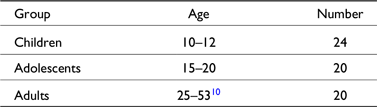
Since the change is reported to occur first in the language of young speakers (recall section 2.4), it seems that age is a crucial factor in the loss; thus, three age groups were included: children, adolescents, and adults, as illustrated in table 5. The children were recruited via their schools, the adolescents via their schools and my network, and the adults through my network.
Informants

The inclusion criteria were that all the participants had to live in Voss at the time of testing, have Norwegian as their only first language, have no language impairment, and they should speak the local dialect. For the adults, the criteria were that they should have been born and raised in Voss, and for the children and adolescents, I also included participants who had lived most of their lives in Voss (to include children who lived somewhere else for a couple of years).
Previous studies of the dialect (Heggstad Reference Heggstad1932, Akselberg Reference Akselberg1995) have attested more archaic forms in the periphery of the municipality than in the center: thus, half of my participants lived in the central area, and the other half in the more rural parts of the municipality. I found no significant variation between the periphery and the center regarding the use of feminine gender; I will therefore not divide the participants due to this geographical difference in this article.
The age of the children in my study was chosen such that they were tested well after the crucial age of learning the gender system. Recall that all the participants in Voss have Nynorsk as their preferred written language. At the age of 13–14, pupils in Voss start learning to write Bokmål in school. Thus, choosing this age would also be beneficial for comparing speakers before and after they begin learning to write Bokmål at school.Footnote 11 This will not be discussed in this article, but see Haug (Reference Haug2025).
3.2 Method
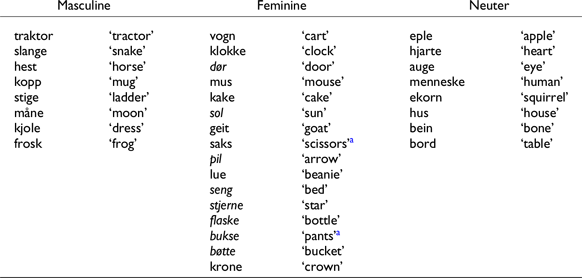
The study used oral production tasks to investigate gender agreement in articles, adjectives, and possessives. It also tested the definite suffix of the noun, to be able to compare the relation between gender and declension. All in all, 32 noun phrases were tested: 8 masculine nouns, 8 neuter nouns, and 16 feminine nouns (8 weak and 8 strong). A picture task was chosen as the most suitable method to obtain a substantial amount of individual and comparable oral data from participants. The tests had already been successfully used on other Norwegian dialects (van Baal et al. Reference van Baal, Solbakken, Eik and Lohndal2023, Reference van Baal, Eik, Lohndal and Solbakken2024, Solbakken et al. Reference Solbakken, Eik, van Baal and Lohndal2024); an advantage of using a test already developed is not only the fact that it has been proven to be a valid method, but also that the dataset from Voss becomes comparable to datasets of other dialects of Norway. A list of the test items is provided in Appendix 1.
In addition to the tests presented above, the participants performed a production task of pronouns and were asked questions about language use and preferred written language. A few participants also had a semi-spontaneous conversation, which was recorded. The findings from these tasks will not be reported in this article, except for the reported use of preferred written language (in section 2.3).
3.3 Procedure
The experiments were carried out individually with the researcher (me) present. I am a native speaker of the dialect. I also transcribed and coded the data.
The participants were exposed to pictures on a screen and asked to describe what they saw and what disappeared (see below). An explanation of each procedure was given to the participants; they were shown how to do it and then practiced the task on one or more test items before the experiment started. The demonstration was based on neuter nouns to avoid priming of masculine and feminine forms. The participants were shown colored pictures of various concrete nouns in the three genders: 16 feminine (8 strong and 8 weak), 8 masculine, and 8 neuter. Experiment 1 elicited indefinite and definite forms of the nouns and adjectives in the singular. The elicitation questions for Experiments 1 and 3 and the target responses are illustrated below:
Experiment 1: Indefinite and definite nouns and adjectives in the singular
(picture of a red soap and a green soap simultaneously shown on the screen)

(the green soap disappears)

Experiment 3: Possessives
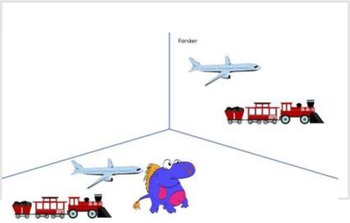
Experiment 3 elicited the use of prenominal and postnominal possessives in the singular. The participant and the researcher played a game where an animal named Knut stole items, sometimes from the participants and sometimes from the researcher (see figure 1 and figure 2).
Possessive stimulus, picture 1.

Possessive stimulus, picture 2.

Researcher: Kva stal Knut? (‘What did Knut steal?’)
Expected responses:

Half of the participants were instructed to produce only prenominal possessives first and then switch to using postnominal possessives. The other half started with only postnominal possessives and then switched to using the prenominal possessives. This approach was adopted to prevent the priming of one form or construction over the other (see Busterud et al. Reference Busterud, Lohndal, Opsahl, Rodina and Westergaard2025), to keep the two constructions apart, and also because it was difficult to design tasks that made participants produce the two different constructions naturally (Rodina & Westergaard Reference Rodina and Westergaard2021, van Baal et al. Reference van Baal, Solbakken, Eik and Lohndal2023:35, Solbakken et al. Reference Solbakken, Eik, van Baal and Lohndal2024).
4. Results
In this section, the results from the gender markers indefinite article, adjectives, and possessives, as well as the use of the definite suffix in the definite singular, will be presented. A look at the individual data reveals that no individual in the dataset has a consistent two-gender system, with common and neuter; however, many children and adolescents have what we can call a vulnerable feminine gender, or a hybrid system. In the following section, I present results from the various gender markers, one by one.
4.1 Indefinite article
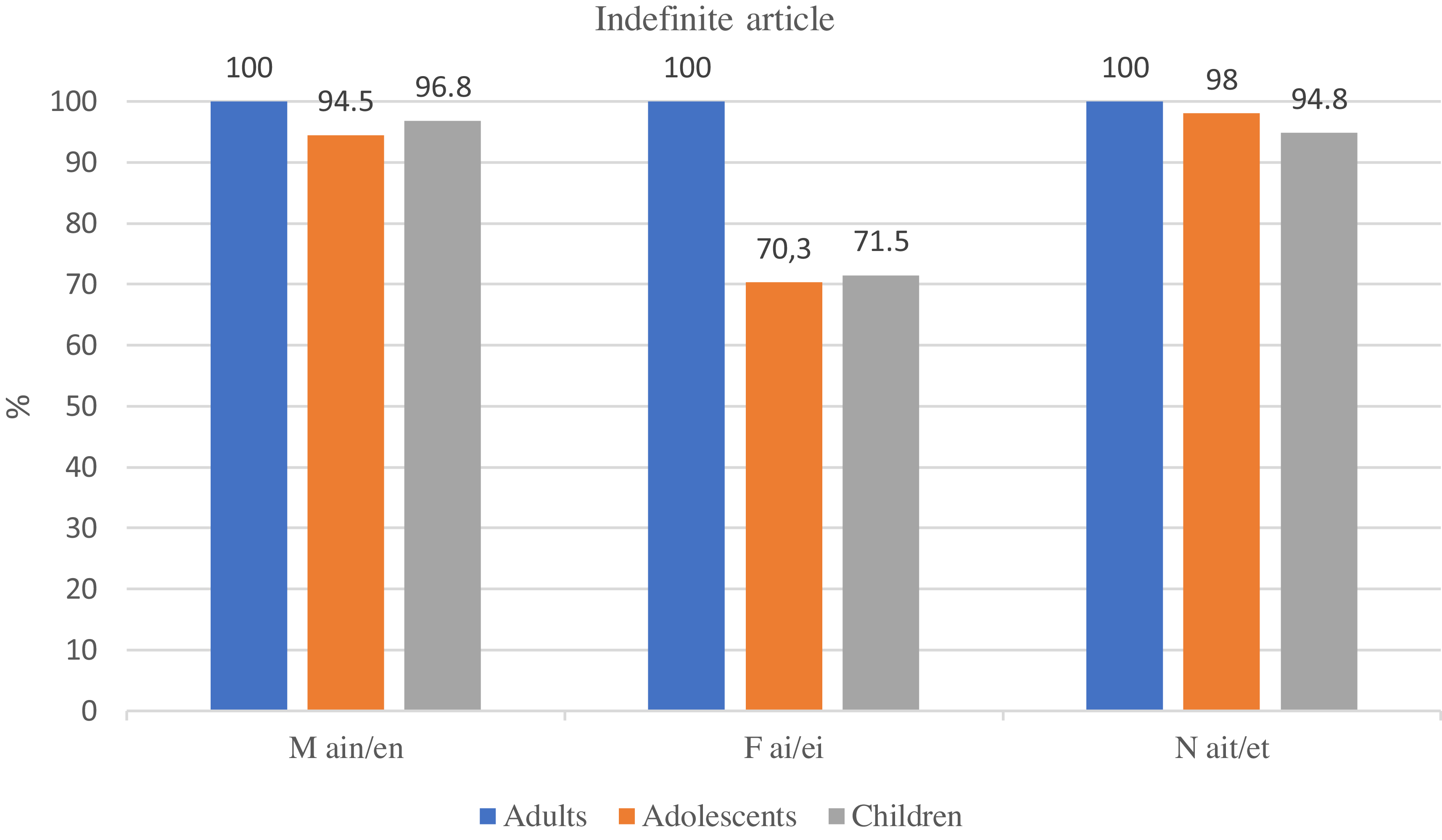
Figure 3 depicts the use of indefinite articles for masculine, feminine, and neuter nouns across all groups. The adults all have traditional use of the articles in all three genders, while the younger groups replace the feminine article ai with the masculine ain/en (see figure 3) to various degrees, ranging from 6.2 to 97 percent individual use.
Indefinite article across all groups.
M ain/en = masculine noun follows a masculine indefinite article, F ai/ei = feminine noun follows a feminine indefinite article ai/ei, N ait/et = neutral noun follows a neutral indefinite article. Age groups are represented by different color columns.

Figure 3 illustrates that all adults consistently use the indefinite article in a traditional manner across all three genders. The overall tendency is that the most notable difference is the target-like production of the feminine article between the adults on the one hand, and the adolescents and the children on the other hand. Looking at the individual data, there are as many as roughly two-thirds (31/43 participants) of children (n=13) and adolescents (n=18) who produce masculine articles with traditional feminine nouns, resulting in phrases like ain. art.indef.m blå. adj.c vogn (‘a.m blue cart’), instead of the traditional/expected ai. art.indef.f blå. adj.c vogn (‘a.f blue cart’). The remaining 15 participants used 100 percent of the traditional feminine indefinite article, ai.
It is also worth mentioning that 72 percent (287/398) of the indefinite masculine articles produced with feminine nouns have the traditional dialectal form ain, for example, ain. m.art.indf kvit klokka (AS_1) ‘a white watch’, and 27 percent (107/398) have the Bokmål/Oslo dialect pronunciation en, en. m.art.indf gul seng (AS_7) ‘a yellow bed’.Footnote 12 The use of ain vs. en will be further discussed in section 5.3
4.2 Possessives
As mentioned in section 2, the Norwegian possessives in the singular agree with the noun’s gender. The prenominal precedes a noun in the indefinite form, and the postnominal follows a noun in the definite form. Examples (3) and (4) are written in Nynorsk but with the dialectal realization of the vowels.


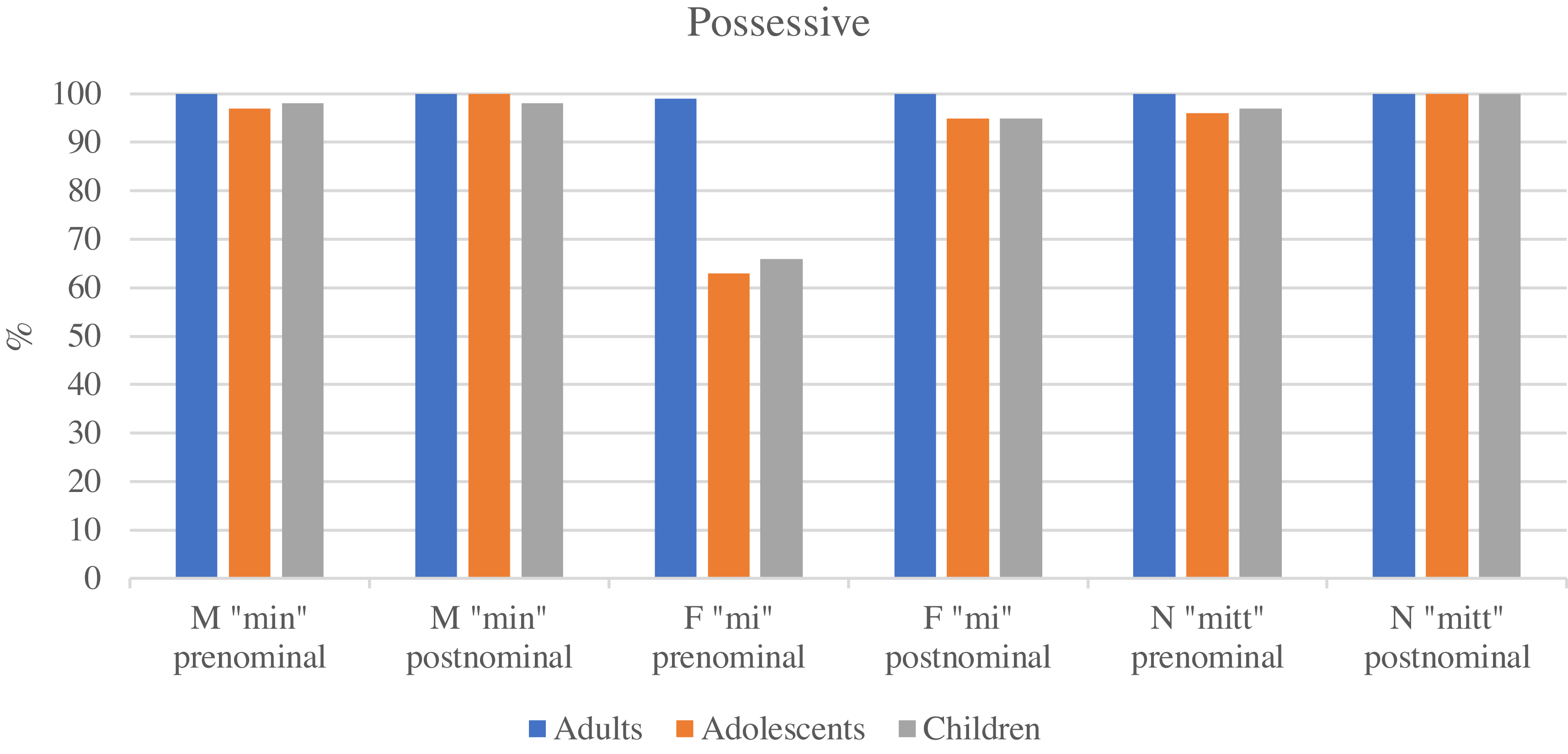
Figure 4 illustrates the results from the possessive test, the use of possessives agreeing with nouns in the three genders.
Possessive.
M = masculine noun, F = feminine noun, N = neuter noun

The use of masculine and neuter both prenominally and postnominally ranges above 95 percent in all three age groups. In the feminine, we see a decreasing use of the prenominal
feminine mi in the two younger age groups: 63 percent use in the adolescent group, 66 percent use in the child group. The innovative use of the masculine possessive with feminine nouns is more pronounced in the prenominal context than in the postnominal context. In the postnominal position, we find 95 percent use of the traditional mi in both the younger groups.
A closer examination of possessive forms used with feminine nouns reveals that all instances of nonfeminine possessives involve min, which is traditionally associated with masculine nouns. All the tokens (15/483) of postnominal masculine possessives agreeing with traditional feminine nouns appear after the use of the definite suffix -en, traditionally associated with (though not strictly an exponent of) masculine gender (see section 2.2). There are no tokens of the traditional suffix associated with feminine nouns followed by the masculine possessive:
* flaska min, and no tokens of the traditional suffix associated with masculine nouns followed by a feminine possessive, *flasken mi.
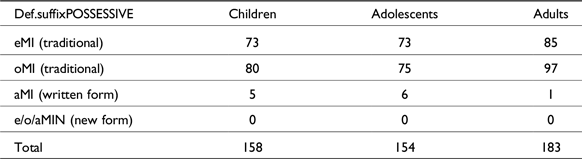
If we investigate the use of suffixes and postnominal possessives with feminine nouns, we find that most of them have the traditional system. The endings are either -o (weak suffix) or e (strong), followed by the feminine postnominal possessive. There are a few tokens of the new suffix -a (the suffix used in Bokmål, Nynorsk, and many Norwegian dialects, but not traditionally in the Voss dialect). The distribution is presented in table 6.
Definite suffix and postnominal possessive, feminine gender

The table illustrates that the use is mainly traditional and has few innovations. There are no tokens of suffixes associated with feminine nouns followed by a masculine possessive.
4.3 Adjectives
Recall that the Voss dialect has traditionally had an opposition in the singular of the suffixes on attributive adjectives agreeing with definite masculine nouns -e, on the one hand, and neuter and feminine nouns -a on the other, so that adjectives agreeing with masculine nouns end in -e, as in:

and attributive adjectives agreeing with definite feminine and neuter nouns end in -a:


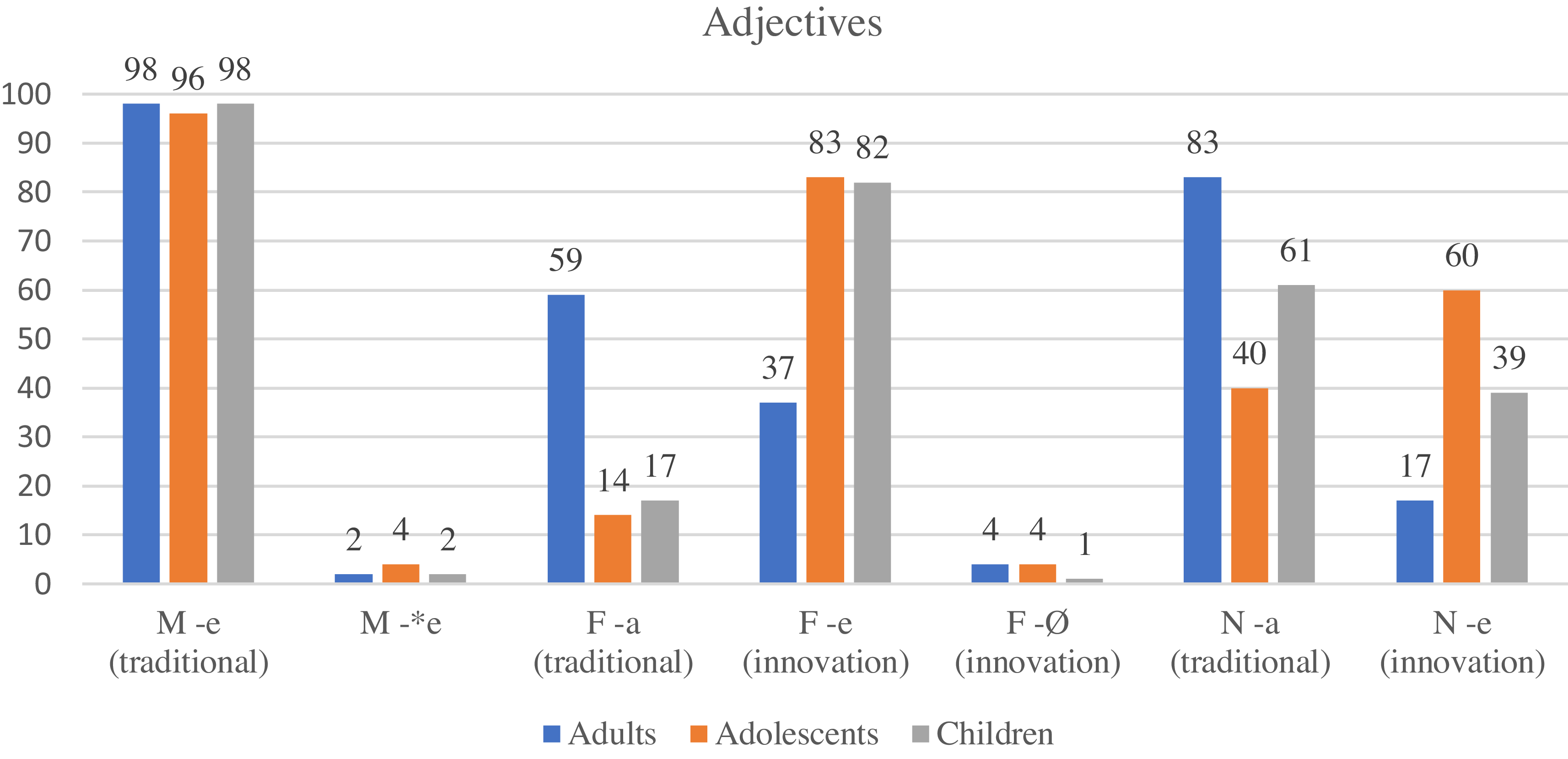
The results for the adjectival inflection are presented in figure 5.
Weak adjectives in the singular, percentage distribution.

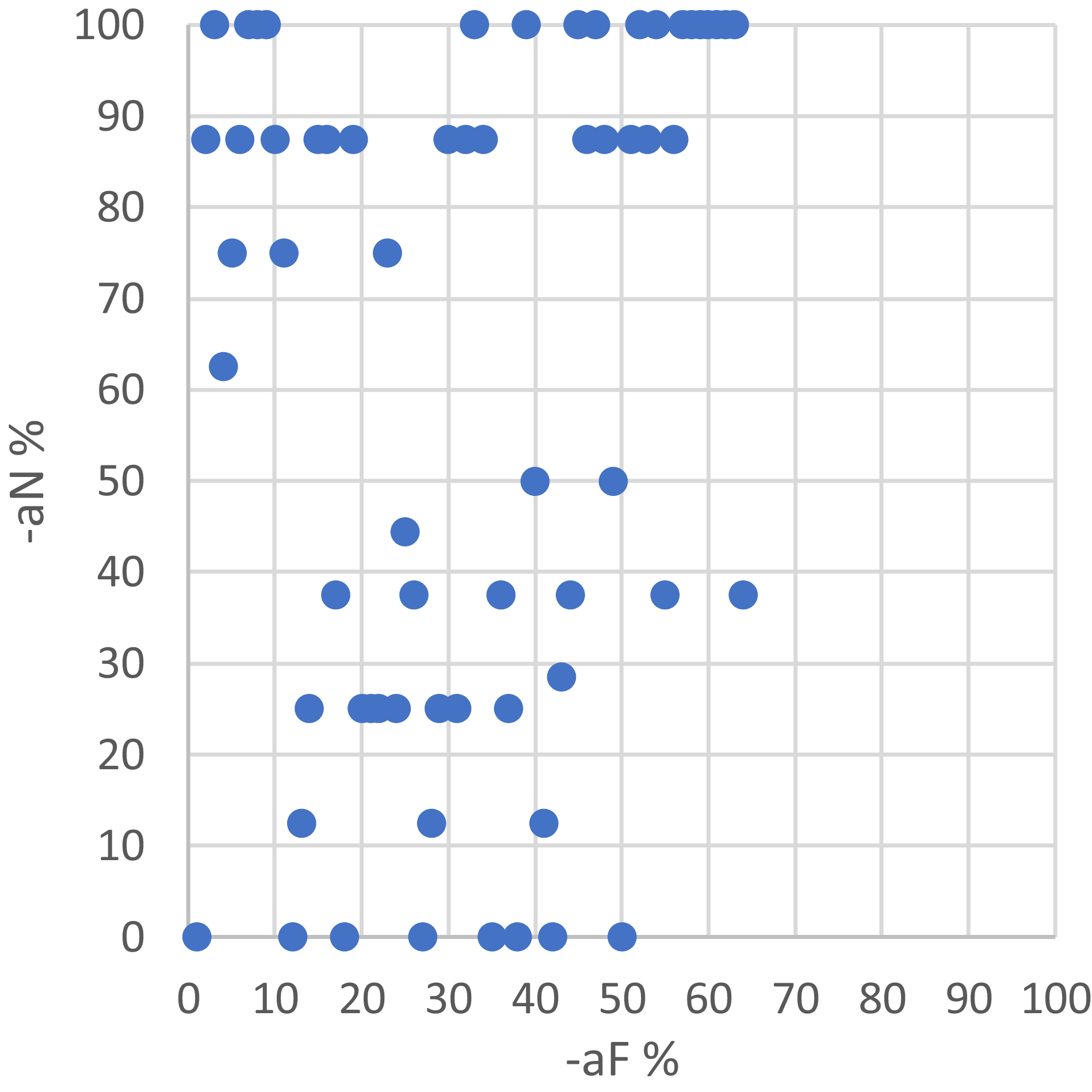
Figure 5 demonstrates that all three age groups exhibit a traditional adjectival agreement with masculine nouns. It also illustrates a few occurrences of Ø-ending in adjectives, both for masculine and feminine (columns M-*e and F-Ø). These indicate instances where, for example, blå ‘blue’ is used instead of blå-e, as in den blå hua instead of den blåe hua. Footnote 13 Age is a crucial factor in the use of adjectival endings, showing that adults use more traditional forms than younger age groups in both the feminine and neuter genders. In the singular, the results show that the weak adjective ending -a, traditionally used in the feminine and neuter, is more stable in the adult group (59 percent of the feminine nouns, 83 percent for neuter nouns) than in the two younger groups, where the adolescents use the traditional -a in 14 percent of the feminine nouns and 40 percent of the neuter nouns, while the children use the traditional -a in 17 percent of the feminine nouns and 61 percent of the neuter nouns (see figure 5). The traditional -a is thus preserved to a greater extent in the neuter form than in the feminine form, across all three age groups. Only one individual uses -a with feminine nouns to a higher degree than -a with neuter nouns. I conducted a one-tailed t-test for each of the age groups and obtained the following results: children (p=6,9106E-07), adolescents (p=4,9063E-05), and adults (p=4,7104E-05). The results demonstrate statistical significance. The individual use of -aF and -aN is demonstrated in figure 6.
Individual use of -aF and –aN.

One dot represents one individual. The axes shows percentage use of -a agreeing with neuter (aN) or feminine (-aF) nouns. Figure 6 demonstrates that the -aN is used to a higher degree than the -aF. The figure demonstrates that no individual uses weak adjectival ending -a in 100 percent of the tokens, while for the neuter gender, 15 individuals use it in 100 percent of the tokens.
4.4 Definite suffix
The findings in this section are from the double definite forms. The results from the Voss dialect show that the suffix associated with feminine nouns remains stable in the double definite forms, even when the masculine indefinite article is used with the same noun in the indefinite phrase. This is depicted in table 7.
Definite suffix on feminine nouns, all age groups

The results in table 7 are from both weak and strong feminine nouns. The feminine definite suffix is retained in its traditional form in 90 percent (897/1002) of the tokens. The suffix -en, associated with masculine nouns, is only used when the speaker uses the masculine article ain (dialectal pronunciation) or en (Bokmål, and/or urban dialect pronunciation) for that noun. This is an interesting finding that will be further discussed in section 5.1. The results show some use of the innovative ending -a as a definite suffix. The use of the definite suffix -a is associated with the written languages and many Norwegian dialects, but traditionally not with the Voss dialect. This innovation is observed in 6.2 percent (64/1002) of the tokens and is used by participants with a vulnerable feminine gender as well as those who consistently use the traditional feminine article. Children who display a system with traditional feminine gender do not use this a suffix. At first glance, this could be a sign of a merger between the strong and the weak endings on feminine nouns, but I believe that is not the case; rather, it is an influence from the written languages.
The suffixes of the weak nouns have been argued to be a cue for the feminine gender in Norwegian (Trosterud Reference Trosterud2001, Halse Reference Halse2004). In the indefinite form, the weak feminine nouns end in a, as opposed to many other dialects and the written Norwegian languages, where they end in e. As mentioned in section 2.3, the Voss dialect has an opposition in the definite declension in the singular between strong and weak feminine nouns. Strong feminine nouns end in -e, for example, senge ‘the bed’, while weak feminine nouns end in -o, for example, flasko ‘the bottle’, in the definite form. For the Voss dialect, it means that indefinite nouns ending in -a have a strong cue for ending in -o in the definite form.Footnote 14 In the dataset, 50 percent of the feminine nouns are strong and 50 percent are weak. The distribution of the innovative masculine indefinite article to traditional feminine nouns is illustrated in table 8.
Distribution of masculine articles to feminine nouns, divided into strong and weak nouns

Table 8 illustrates that the masculine article is more frequent on strong feminine nouns than weak ones. In this dataset from the Voss dialect, weak feminine nouns seem to be more resistant to the ongoing loss of feminine gender.
The results also show (not illustrated in the table here) that the definite suffixes of strong and weak feminines remain stable, with no interchange of suffixes between the strong and weak forms, that is, no use of the ending -o on strong feminine nouns, and no -e on weak feminine nouns.
Both the development of the prenominal masculine possessive and the introduction of the suffix on the adjective, -e (traditionally associated with masculine nouns), demonstrate a strong positive correlation with the decline of the feminine indefinite article. To test the significance of the use of masculine indefinite article, ain/en, and the use of the prenominal possessive, min/din, with traditional feminine nouns, I did a Spearman’s rank test on the results from the children and the adolescents (44 participants), leaving out the adults, who all had the traditional system. I tested the individual uses of the two variables, indefinite article ain/en and prenominal possessive min/din. The test showed a strong and significant correlation of 0,769 with a p-value of < 0,001.
To summarize the results of the use of feminine gender markers and the definite suffix, the dataset reveals a difference in the use of feminine gender between age groups. All the adults have a traditional three-gender system, except for weak adjectives. The children and the adolescents have replaced some of the feminine indefinite articles, possessives, and most adjective suffixes with masculine gender markers to various degrees, across individuals. The innovations in the different gender markers seem to be interconnected and not random.
5. Discussion
The results from the Voss dialect demonstrate that the feminine gender is vulnerable in the language of children and adolescents in this study. This is in line with previous research (e.g. Rodina & Westergaard Reference Rodina and Westergaard2015, Busterud et al. Reference Busterud, Lohndal, Rodina and Westergaard2019, Reference Busterud, Lohndal, Rodina and Westergaard2020, van Baal et al. Reference van Baal, Solbakken, Eik and Lohndal2023), all concluding that the change is most prominent in the language of children and adolescents. None of the individuals in this dataset has a complete two-gender system, and the adults have a 100 percent traditional three-gender system. However, 66 percent of the individuals in the two younger age groups display a combination of masculine and feminine agreement in the indefinite articles, prenominal possessives, and weak adjectives with feminine nouns. The adult group is more or less the same generation as the parents of the younger participants; thus, the dataset reveals that feminine gender is vulnerable in children and adolescents despite having parents who use the traditional feminine gender. The same result was found in Rodina & Westergaard (Reference Rodina and Westergaard2021) in a study of the Tromsø dialect. In the following section, I discuss whether rich gender marking makes the dialect more resistant to the change (section 5.1) and which parts of the gender system are affected (section 5.2), and in section 5.3, I discuss potential causes of the change.
5.1 Does rich morphology make the dialect resistant to a change in the gender system? Do more gender cues play a role?
Since the results display a change in the grammatical agreement of traditionally feminine nouns among the children and the adolescents in this study, it is clear that dialectal features, or any other factor, are not blocking the ongoing shift. The change we find in this dialect is recent and has not affected the language of the adults. Whether the rich morphology makes the dialect more resistant than other dialects is still unanswered and will be discussed in the following paragraphs.
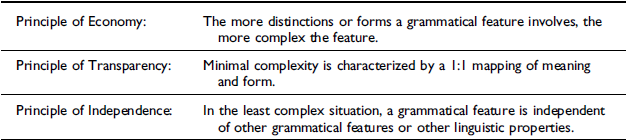
It is challenging to measure whether the richness in the morphological system of a dialect plays a role in attrition and language change. How is that measurable? As most urban dialects have a less complex morphological system than rural dialects in Norwegian (Bugge & Neteland Reference Bugge and Neteland2022), there is a danger of confounding the two aspects of linguistic and social factors. It is probably easier to discuss the stability of rich gender morphology in the dialect. If it remains stable even though we find loss of feminine gender markers, does this mean that rich morphology is not a stabilizing factor? A premise for this discussion of richness in the nominal system is that a rich morphology provides numerous gender cues and must not be confounded with high complexity. The notion of linguistic complexity can be understood through principles of economy, transparency, and independence (Audring Reference Audring, Di Garbo, Wälchli and Olsson2019), while richness is rather a question of the number of gender cues, and I follow Audring in this article. Complexity is here restricted to descriptive complexity, leaving out relative complexity, that is, difficulty (Audring Reference Audring, Di Garbo, Wälchli and Olsson2019:22). Audring’s definitions of economy, transparency, and independence are presented in table 9.
Principles of economy, transparency, and independence, according to Audring (Reference Audring, Di Garbo, Wälchli and Olsson2019:22–23)

A shift from three to two genders could be a process of simplification driven by principles of economy, since there will be fewer gender categories and gender markers at the endpoint of the change. However, it violates the principle of transparency since the relation between gender and declension does not follow a principle of one form–one meaning, especially before the endpoint of the change, where we would have a lot of variation and various forms, but also later, when the relation between gender and declension gets blurred, and the redundancy will be more ambiguous. As pointed out by Enger & Sims-Williams (Reference Enger and Sims-Williams2021:143): “a reduction of agreement does not necessarily entail simplification, and what might look like simplification from close up can be complication from the perspective of the whole grammar.”
If we include gender markers like indefinite articles, possessives, adjective suffixes, and declension suffixes, the Voss dialect has many more gender cues than, for example, the urban dialects that show more syncretism. More cues could make it easier for the language user to retain the gender because of the redundancy (information expressed more than once). Recall the matrix in section 2 where the Voss dialect had 6 out of 6 factors that could potentially make the gender more stable.
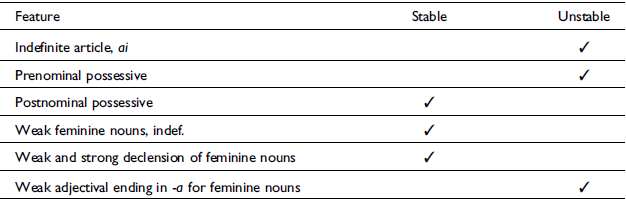
We have now established that the feminine gender in the Voss dialect is vulnerable. If we find that the morphological richness is retained more or less unchanged, it would seem safe to assume that the role of the morphological system is of lesser importance. If we look at the features that are stable and unstable in the participants’ language with a vulnerable feminine gender, we find a difference in which features are stable and which are not. I have defined a feature as stable when there are no or very few innovations. The overview in table 10 is a simplified visualization of the results presented earlier.
Morphological features and their stability in the Voss dialect

If we compare the results from this table with the directionality of the change, we do, of course, see that the stable factors are the ones that will presumably change late in the process. In addition, table 10 demonstrates that inflection is more stable than gender.
An aspect that remains unchanged is the division between strong and weak (disyllabic) feminine declension; all the strong feminine nouns end in -e, for example, senge (‘the bed’), in the definite form, and all the weak feminine nouns end in -o, for example, flasko (‘the bottle’), in the definite form. The dataset does not include any instances of strong feminines with weak declension, or vice versa. A possible merge between the two declensions could be the use of -a (used for definite feminine nouns in Bokmål, Nynorsk, and several Norwegian dialects), den flaska (‘the bottle’), den senga (‘the bed’) instead of -o, den flasko (weak) or -e, den senge (strong). The use of -a is at 6.4 percent (64/1002), used by participants in all the age groups: 6 children, 8 adolescents, and 4 adults. No participant uses this form solely, but one of the adults uses it for 94 percent of the tokens (15/16), and this individual accounts for 23 percent of the tokens in total. The use is most likely not due to the loss of the feminine gender, but rather a result of the impact of the written form and/or the dialects of Oslo and its surroundings. The reason is that the -a is mainly used by participants with a traditional three-gender system, and to a larger extent in the adult group than in the child group.
In the indefinite form, the weak feminine nouns end in -a in the dialect, whereas they end in -e in most urban dialects and Bokmål. The dataset reveals 5.8 percent (59/1009) tokens of weak feminine nouns ending in -e in the indefinite form, while the majority end in the traditional -a. (Note: this information is not represented in any of the tables.) These tokens are predominantly associated with a limited number of participants. Furthermore, I did not identify any systematic pattern in terms of lexical or morphological features for the use of -a, in contrast to the clearer pattern in the application of gender markers on strong and weak feminine nouns.
A consistent feature is the definite suffix -o on weak feminine nouns. This suffix is solely used on weak feminine nouns, for example, flask-o (F).DEF, and could therefore be a cue that makes the declension stable.
In the use of gender markers, we see that weak feminine nouns use more of the traditional feminine article ai than strong feminine nouns. This supports the idea that unstressed -a in the Voss dialect is a cue for feminine gender and therefore more resistant to the decline of the gender marker than strong feminine nouns. Thus, the indefinite suffix on weak feminine nouns is a gender cue for the indefinite article. This is also in line with findings from Swedish that disyllabic nouns ending in an unstressed -a were feminine in the old system, when Swedish had three genders (Källström Reference Källström1996:158).
5.2 Which parts of the gender system are affected?
Recall from section 2.3 that the feminine gender is exposed on indefinite articles, prenominal and postnominal possessives, and weak adjectives in the Voss dialect. These findings call for an investigation into whether the shift is directional or not. The fact that the change is not yet fully developed in the Voss dialect allows us to look for tendencies in the ongoing process. Most of the results are in line with previous research on other Norwegian dialects in that the change is more prominent in younger age groups and that prenominal markers are more affected than postnominal markers. Another fact that seems to be true for all dialects is that it is the feminine gender that is being lost, and that both the masculine and neuter genders seem mainly unaffected, except for the masculine acquiring new members. There are no signs of vulnerability in the gender agreement of masculine nouns in my study, yet masculine gender is gaining new members from the feminine gender.
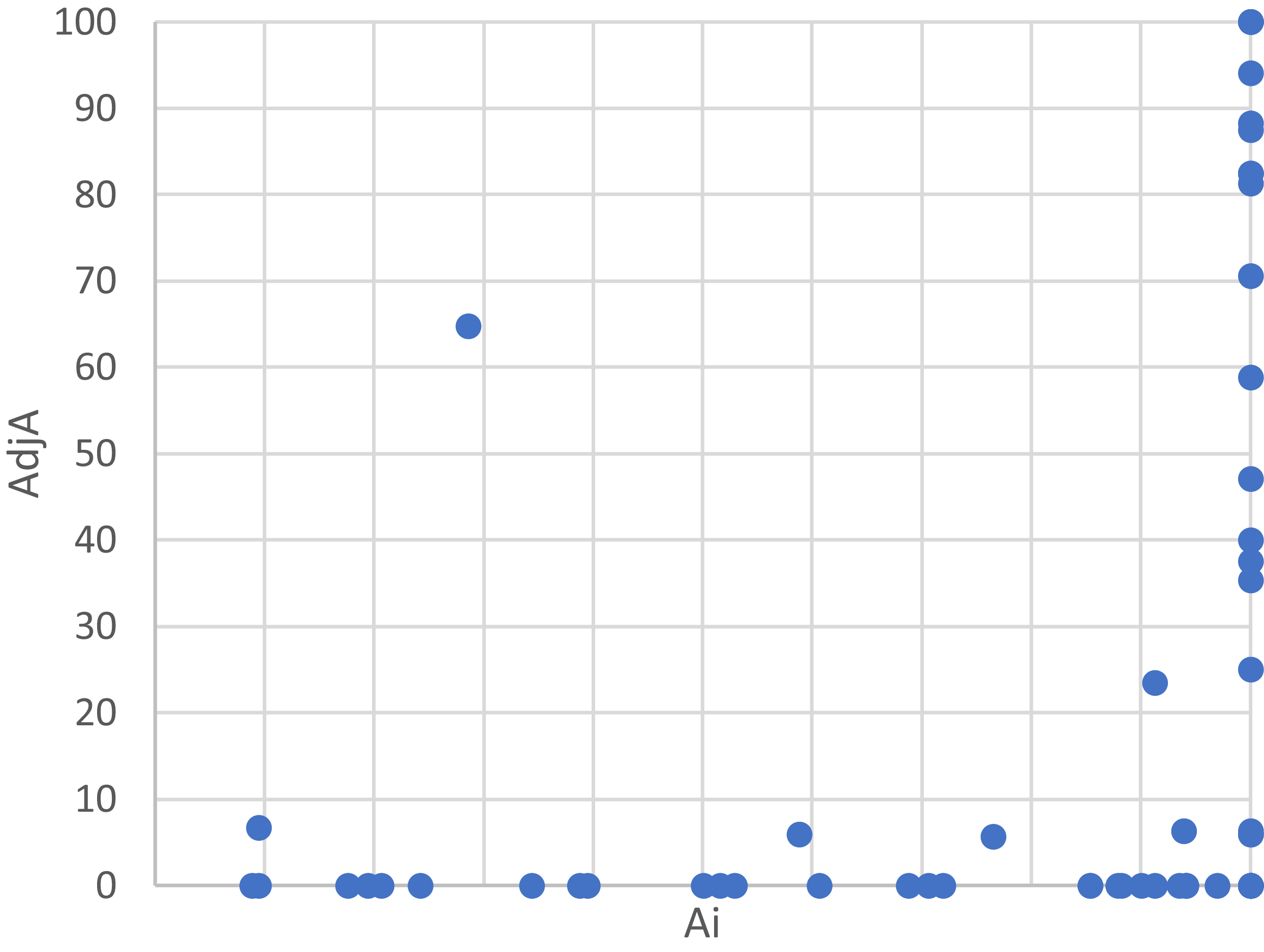
Among the gender markers in this study, the weak adjectives have been the most affected by the change. Recall that traditionally weak adjectives in the Voss dialect ended in -a prenominally with feminine and neuter nouns: dan gula flaskoF (‘the yellow bottle’), da gula huseN (‘the yellow house’), and ended in -e with masculine nouns: dan gule koppenM (‘the yellow cup’). The traditional suffix -a is increasingly being replaced by -e in all age groups, in all three genders, and by participants using both the traditional three-gender system and those with a vulnerable feminine gender. The distribution of the traditional adjective suffix -a with feminine nouns is as follows: adults 59 percent, adolescents 14 percent, and children 17 percent. Except for Solbakken (Reference Solbakken2025), this is a factor that has not been investigated before; earlier dialects that have been studied all have syncretism between all three genders in the weak adjectives. In the adult group in my study, the only notable gender innovation is the adoption of the adjective ending -e (historically the masculine weak adjectival ending), with 37 percent use of this innovative form. Figure 7 illustrates the use of the traditional weak adjective -a and the feminine indefinite article ai.
Use of indefinite feminine article ai and weak adjective ending –a.

Figure 7 illustrates the correlation between the use of the adjectival ending -a and the use of the indefinite article ai. One dot represents one speaker. Individual use of the indefinite article with feminine nouns is divided between the traditional feminine ai and the innovative ain/en (traditionally the masculine article); the same applies to the use of the traditional weak adjectival ending -a and the innovative -e (historically associated with masculine nouns). No individual uses 0 percent of the feminine indefinite article, but as many as 37 participants use 0 percent of the weak adjectival ending -a. The figure indicates that, except for one outlier, those who use a, use the feminine indefinite article ai as well. Only one individual uses the adjectival ending -a to a larger extent than the indefinite article ai.
If we consider the change gradual and the data from the adult group as “a step back” in time, we can speculate whether the adjective must be neutralized between the feminine and masculine before the rest of the gender markers follow. There are also a few tokens (2 percent, 11/492) of the traditional feminine/neuter adjectival suffix -a being used on adjectives agreeing with masculine nouns. I analyze these few tokens as experimental noise.Footnote 15 In the Voss dialect, we find 13 percent (69/445) use of the traditional adjective ending -a with feminine nouns used by participants with a vulnerable gender. However, the predominant trend aligns with Solbakken’s study of adjectives in Stavanger, Egersund, and Lyngdal in that there seems to be an implicational hierarchy in that the -a is used in three-gender systems and not by participants with a vulnerable feminine gender, or a hybrid system, as Solbakken calls it (Solbakken Reference Solbakken2025).
In the neuter, we see that the weak adjectives, to some extent, are affected, in that the traditional neuter form -a is being replaced by its masculine counterpart -e (17 percent). This is only half as much as with the feminine gender (37 percent). This difference between the agreement in feminine and neuter is comparable to findings from dialects of other so-called a-mål dialects, studied by Solbakken (Reference Solbakken2025). Solbakken explains the difference in feminine and neuter agreement as being due to two parallel developments: One is the loss of the feminine gender; the other is a development of the nominal system in which all three genders get adjectival -e due to a general process of simplification. Since the feminine marker is being targeted by two developments, it is more fragile than the neuter, which is only being targeted by the general simplification. My findings support Solbakken’s (Reference Solbakken2025) hypothesis.
The use of prenominal and postnominal possessives with masculine and neuter nouns is mostly traditional in my dataset. For feminine gender, there is a difference in the pre- and postnominal use of feminine possessives with traditional feminine nouns. The use of postnominal possessives is mostly traditional across all three age groups, ranging from 95 to 100 percent traditional use, for example, flasko. (f) mi. f (‘my bottle’), senge.(f) mi. f (‘my bed’). The use of prenominal possessives is traditional in the adult group, but in the younger groups, we see that the masculine form is replacing the feminine prenominal possessive in 37 percent of the tokens in the adolescent group and 34 percent of the tokens in the children’s group (see figure 4). For example, mi. f seng. (f) (‘my bed’) is being replaced with min. m seng. (f). We do not find tokens of the traditional suffix associated with feminine nouns with masculine postpossessive, for example, *flasko. (f) min .m, or *senge. (f) min .m. This development aligns with previous studies (e.g. Lødrup Reference Lødrup2011a, Rodina & Westergaard Reference Rodina and Westergaard2021, Solbakken et al. Reference Solbakken, Eik, van Baal and Lohndal2024). The use of masculine prenominal possessives with traditional feminine nouns correlates largely with using the indefinite masculine article with traditional feminine nouns (0,85 Pearson’s correlation). It seems that these two markers are interconnected and that they change more or less at the same time in my dataset. This is in line with results from other recent studies on gender loss in Norwegian dialects, such as Solbakken et al. (Reference Solbakken, Eik, van Baal and Lohndal2024).
In my dataset, I have the following examples from participants with a vulnerable feminine gender:


Examples (8) and (9) demonstrate a hybrid system with a masculine prenominal and a feminine postnominal possessive. The definite suffixes associated with feminine nouns are -o (weak feminine nouns) and -e (strong feminine nouns). The suffix -e is also the default neuter definite suffix.Footnote 16
Speakers seem to lose the distinction between feminine and masculine in the prenominal position, while it is kept in the postnominal position. A core question is how this difference in prenominal and postnominal use can be analyzed. It seems as if the postnominal use depends on the definite suffix, so that in many Norwegian dialects, we have -a followed by the feminine possessive mi. There have been various analyses of how to understand the difference in the pre- and postnominal possessive, and also how to understand the different development. Lødrup (Reference Lødrup, Butt and Holloway King2011b) argues that the postnominal could be regarded as a suffix in a two-gender dialect like the Oslo West dialect; thus, it is stable. The most prominent analysis has been suggested by Svenonius (Reference Svenonius, Shih and Gribanova2017), who analyzes the postnominal possessive mi in a two-gender dialect as an allomorph of the masculine form min, depending on the form of the definite suffix. As I see it, the results from the Voss dialect challenge Svenonius’ analyses (but see Solbakken et al. Reference Solbakken, Eik, van Baal and Lohndal2024 for a different approach regarding a similar dialect to the Voss dialect, the Egersund dialect). In the Voss dialect, there is no 1:1 relation between the definite suffix and the use of postnominal possessives. Recall from section 2.3 that there is syncretism between strong feminine nouns and neuter nouns in that they both can end in the suffix -e. The postnominal possessive following -e can be realized as either mi (fem) or mitt (neuter). It is a moot point whether the form of the possessive is phonologically conditioned, given that the suffix -e precedes both feminine and neuter possessives. And this goes for participants with both a traditional feminine gender and those with a vulnerable feminine gender.
Recall that prenominal and postnominal possessives are both grammatical in Norwegian but serve different purposes. While the postnominal use is the default in most Norwegian dialects, the prenominal is often used contrastively (Anderssen & Westergaard Reference Anderssen and Westergaard2010: 2578, but see Lødrup Reference Lødrup, Enger, Faarlund and Ivar Vannebo2012 for a different view). There is also dialectal variation in the use of the prenominal possessive. In the Voss dialect, it is mainly contrastive and hence emphatic, while in other dialects, such as that of Kristiansand, it does not have to mark contrast. The use of the “markedness” of the prenominal possessives is perhaps related to the dialect, and it would be interesting to look at that feature in future studies. It could also be that we should regard the postnominal possessive as a gender marker as long as the feminine gender is vulnerable, and that the difference in prenominal and postnominal use is a question of the change being directional. Since the postnominal is related to the definite suffix, it cannot change before the suffix changes.
The relation between gender and declension is strong. Most of the studies on the loss of the feminine gender in Norwegian have demonstrated that the definite suffix is stable and does not necessarily change in accordance with the use of the indefinite article. A recent study of the two sociolects in Oslo (Busterud et al. Reference Busterud, Lohndal, Opsahl, Rodina and Westergaard2025), Oslo East and Oslo West, demonstrates an increased use of the ending -en (previously associated with masculine nouns) with previously feminine nouns. For (previously) feminine nouns, Busterud et al. found no use of ei and mi, and the suffix -en (previously associated with masculine nouns) was being used on traditional feminine nouns in 50.3 percent in Oslo East and 72.7 percent in Oslo West, in the language of the 12-year-old children (Busterud et al. Reference Busterud, Lohndal, Opsahl, Rodina and Westergaard2025: 13). The results from the Voss study show that the suffix en (previously ‘masculine’) is only used after two phrases with the masculine article. Hence, we can speculate whether the development in the Voss dialect will undergo a shift in the declension class marker as well if the dialect ends up as with two genders.
An argument against the shift being socially systematic could be that the use is distributed to a very different degree among individuals; for example, in the use of masculine indefinite articles with traditional feminine nouns, we see individual use ranging from 6.2 to 97 percent. This shift happens at a different pace among the individuals in the younger groups. The results from Voss depict a small difference between children and adolescents, in that the loss seems to have gone slightly further in the adolescent group. Most other studies have shown a clear trend in which the loss is most significant among children (Busterud et al. Reference Busterud, Lohndal, Rodina and Westergaard2019, van Baal et al. Reference van Baal, Eik, Lohndal and Solbakken2024).
Nevertheless, the results from Voss demonstrate what seems to be a directionality in the shift as the various gender markers are not affected simultaneously or to the same extent. Based on the findings, we can speculate that the change is not random, structurally, but has this directionality:
Weak adjective – prenominal possessive and indefinite article – definite suffix –postnominal possessive
5.3 What are the potential factors driving this change?
A main concern in the discussion of the loss of the feminine gender in Norwegian dialects is whether this loss is driven by internal or external factors or a combination of both. Jakobson proposed that “a language accepts foreign structural elements only when they correspond to its own tendencies of development” (1962[1938]:241).Footnote 17 The vulnerability of the feminine gender is a trend that can be traced back to Old Norse and has persisted over time. As demonstrated in section 2.2, we observed that the feminine gender has gradually lost members to the masculine gender. Internal factors most likely play a role in this phenomenon. Van Epps et al. (Reference van Epps, Carling and Sapir2021) suggest that:
The Scandinavian gender system may be inherently predisposed toward absorption of the feminine gender into the masculine gender. While many Scandinavian varieties still robustly uphold this distinction, our data show that feminine nouns are more susceptible to changing gender. In addition, the feminine gender has fewer members than the masculine gender (just as the neuter does). There is also a similarity between masculine and feminine in their form as well as in their semantics (both are assigned to animate nouns …). These observations indicate that the feminine gender has a weaker standing in the language varieties we investigated, and thus is more susceptible to pressure to change. (van Epps et al. Reference van Epps, Carling and Sapir2021: 309)
This fits well with the diachrony of the Voss dialect (and probably other Norwegian dialects as well). It was documented to have more gender-specific forms 140 years ago (Vidsteen Reference Vidsteen1884:28–29). Another example that suggests that an internal formal factor is at play is the fact that weak feminine nouns are more resistant to the ongoing loss than strong feminine nouns are: 60.5 percent of the masculine articles agreeing with feminine nouns were used with strong feminine nouns, and 39.5 percent with weak feminine nouns. The feminine nouns in general are not equally divided between strong and weak, as they are in this dataset, but the proportions are estimated to be approximately 55 percent strong and 45 percent weak (Conzett Reference Conzett2007:33). In Old Norse, the proportions were 60 percent strong and 40 percent weak (Beito Reference Beito1986:15). The difference is not huge, but it is there. Nouns ending in an unstressed e are often feminine in Norwegian (see, among others, Faarlund, Lie & Vannebo Reference Faarlund, Lie and Ivar Vannebo1997, Trosterud Reference Trosterud2001, Enger Reference Enger2002, Opsahl Reference Opsahl and Opsahl2009). Nevertheless, Van Epps et al. (Reference van Epps, Carling and Sapir2021) found that the Old Norse weak/strong inflection was an important factor for gender change in Scandinavian, but not a factor strong enough in Norwegian to cause gender change (van Epps, Carling, & Sapir Reference van Epps, Carling and Sapir2021:289). Beito (Reference Beito1986) claims that the strong nouns are the most numerous and productive. However, the weak feminine nouns are more productive than the weak masculine nouns (Beito Reference Beito1986:112). My results demonstrate a difference between the weak and the strong feminine nouns. Weak feminine nouns are maybe the prototypical feminine, and especially in the Voss dialect, where we have seen a clear predictability from the endings of indefinite -a to definite -o. I would expect the “core” to be the most resistant to change and gender shift. My dataset is in line with this hypothesis.
The change could be due to contact, as most innovations spread through contact. The innovative forms we observe originate from both the traditionally used masculine forms in this dialect, for example, ain. m.det.art, and forms found in the dialect of Oslo and nearby, as well as the written language, Bokmål, for example, en. m.det.art.
If the gender shift is solely due to contact with the Bergen dialect, Oslo dialect, or Bokmål, I would guess that the use of the indefinite article would mostly be pronounced as /en/. However, what we are seeing is 73 percent (287/394) use of the dialectal realization /ain/ and 27 percent (107/394) use of /en/. This fact demonstrates that it is the gender system that is changing. However, use of the realization en is higher for feminine nouns than for masculine nouns (27 percent for feminine nouns, 13 percent for masculine nouns). This could be an argument for contact as a factor in the ongoing change, and the results demonstrate once again that the change is caused by both internal and external factors. We can also speculate whether the indefinite article is being targeted by two ongoing processes as a consequence of loss of the feminine gender: the use of en, due to dialect contact and/or leveling, and the use of ein for traditional feminine nouns.
The input language of the children and adolescents comes not only from the parents and the language community in Voss, but also from Bokmål and urban two-gender dialects. In the questionnaire that followed the experiment, participants were asked about differences in language use by children and adolescents, and elderly people in the community. When asked about differences in the language of the different age groups, no participant mentioned the use of masculine gender markers for traditional feminine nouns. This suggests that the change is relatively recent, the tolerance for this shift is likely high, and the likelihood of being corrected by older speakers is probably very low. It may also be, as an anonymous reviewer points out, that it is something that speakers pay little attention to or that isn’t noticeable enough to be picked up in the metalinguistic comments.
6. Conclusion
The decline of the feminine gender can be attributed to a combination of formal and internal factors and contact phenomena. I suggest that the decline of the feminine gender is a gradual change that started in Old Norse by losing members to the masculine gender. The last phase has begun in the younger age groups from Voss, in line with the development of several Norwegian dialects. Since the Voss dialect is somewhat richer in morphology than most other affected dialects and still demonstrates the loss, I suggest that the richness does not prevent the loss of the feminine gender. Whether it is slowing the process is difficult to track, and can not be confirmed by my dataset. Because of the signs of the change starting in the younger age groups, I believe acquisition plays a crucial role in the development, in that the input for the younger groups comes not only come from their parents and adults in general, but also from their peers and the two written languages. Yet it is somewhat surprising that the change seems to have gone a bit further in the group of adolescents than in the children in Voss. The reason could be that the two groups are very close in age, but also that if the change is caused by contact, the adolescents are more exposed to contact and less affected by the language of their parents (which does have a consequent traditional system). A core question is why this change is happening now and at this pace. The role of dialect contact in a broader sense must be taken into consideration. The increased use and exposure to the written language Bokmål and the Oslo dialect are probably factors that have accelerated the change. The feminine gender is targeted by several ongoing processes, both internal and external.
Appendix 1. List of nouns used as test items






 Open access

