




The Goddess-centered art with its striking absence of images of warfare and male domination, reflects a social order in which women as heads of clans or queen-priestesses played a central part. Old Europe and Anatolia, as well as Minoan Crete, were a gylany.* A balanced, nonpatriarchal and nonmatriarchal social system is reflected by religion, mythologies, and folklore, is supported by the continuity of the elements of a matrilineal system in ancient Greece, Etruria, Rome, the Basque, and other countries of Europe.
*Riana Eisler in her book The Chalice and the Blade (1987) proposes the term gylany (gy. from ‘woman,’ an- from andros, ‘man,’ and the letter l between the two standing for the linking of both halves of humanity) for the social structure where both sexes were equal.
Marija Gimbutas, Reference Gimbutas1989, The Language of the GoddessIntroduction
On April 29–30, 2021, the Lithuanian Institute of History held an international virtual conference: ‘Maria Gimbutas in Lithuania and the World. A Centenary Commemoration’. Several scholars from Lithuanian, German, North American, British, Turkish and Polish academic institutions paid tribute to the 100th birthday of Lithuanian archaeologist Marija Gimbutas (1921–94) in their presentations. UNESCO’s 2020–21 anniversaries list included Marija Gimbutas’s birthday, alongside Nazi resistance fighter and founder of the White Rose movement, Sophia Magdalena Scholl (100th) and Ludwig van Beethoven (250th). What Marija Gimbutas, Sophia Scholl and Ludwig van Beethoven have in common is not only their fame but also their profound societal and intellectual impact.
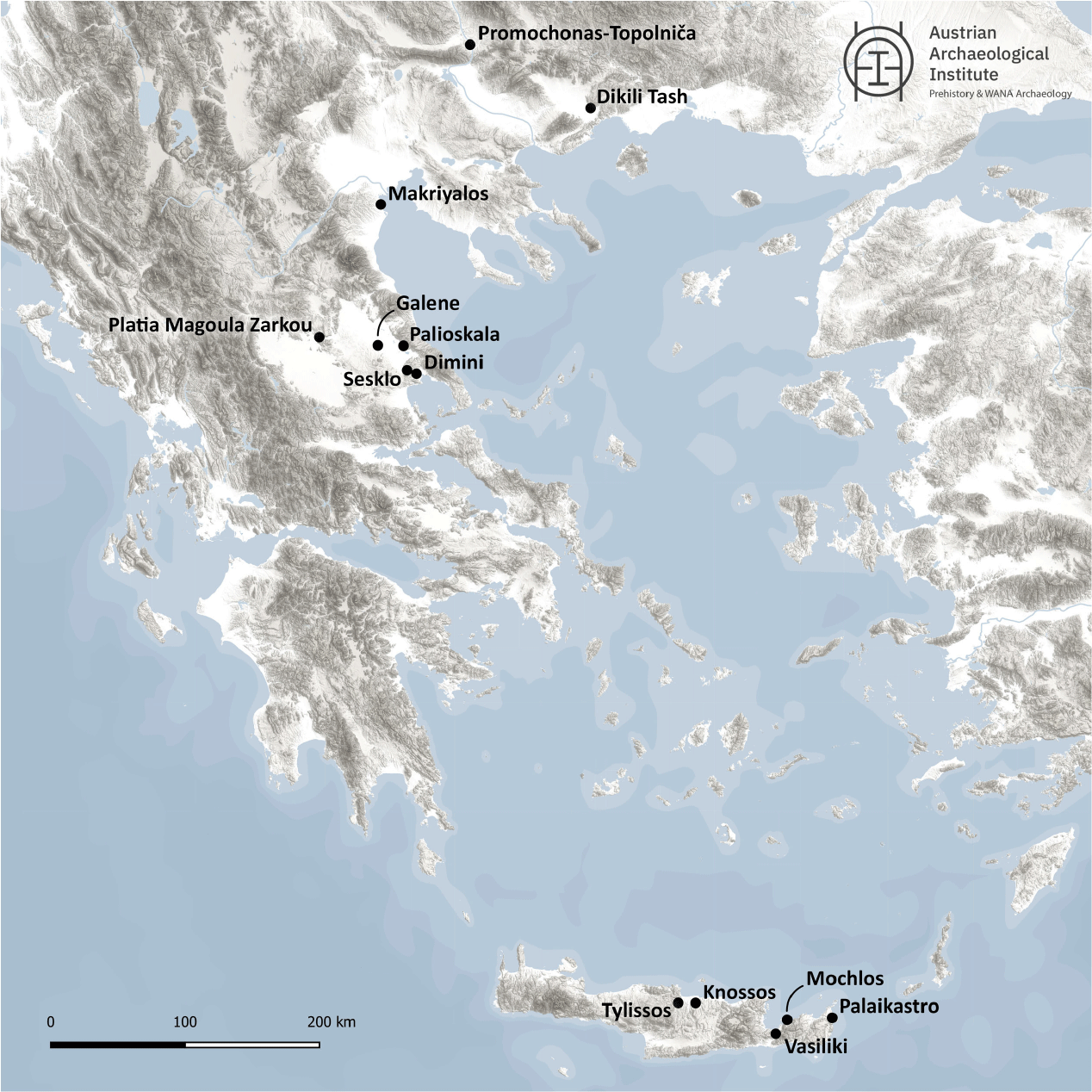
However, among prehistorians and archaeologists more broadly, there can be slight or considerable irritation associated with Marija Gimbutas, who elicits criticism from scholars of all genders alike. For example, at the April 2021 virtual conference, international speakers (mostly male archaeologists) engaged with and openly criticized several of Gimbutas’s interpretations in their presentations. In contrast, Lithuanian organizers, mostly female scholars of archaeomythology, celebrated their fellow citizen’s academic achievements within a male-dominated field (cf. Kehoe Reference Kehoe2022). At the end of each critical presentation, they thanked the male speakers and summarized the previous presentations in contradictory ways, only to finish on a positive note about Gimbutas that disregarded any dissenting perspectives.Footnote 1 This stark polarization between mostly the male and female groups of experts, and between two different disciplines, namely archaeology and archaeomythology, is also important in regard to interpretations of prehistoric kinship and gender relations in archaeology. This I will address through the case study of sedentary groups in the Aegean Neolithic and the Early Bronze Age (8,500–5,000 B.P.; Fig. 1). I propose that the dismissal of Gimbutas’s theories of the Mother Goddess, while remaining open to a possibility for Neolithic, gender-egalitarian communities that she proposed, is crucial for new understanding of kinship in the Aegean prehistory and beyond. This will prevent retelling old stories in new ways, which I will subsequently elaborate upon in more detail.
Location of Neolithic and Early Bronze Age sites mentioned in the text (M. Börner and S. Cveček).

To advance the understanding of prehistoric kinship practices and ways of socio-political organization among sedentary groups in Aegean prehistory, this article discusses discourses on kinship, gender and female rule through the lens of socio-cultural anthropology. It proposes a shared language anchored in a discipline in which concepts of matrilineal kinship and matriarchal societies initially were developed, transformed, reevaluated and further elaborated. Despite recent attempts to address the social status of women in the Aegean without socio-cultural anthropology competencies (see Risch Reference Risch, Meller, Gronenborn and Risch2018), gender and kinship should be treated as two sides of the same coin while being critically distinguished from female rule. As I argue, employing anthropological terms and definitions for the appropriate analysis of prehistoric settings, with or without ancient DNA data, remains crucial.
On the basis of the Aegean case study, it can be observed that perceptions of a matrilineal past, unjustly a priori linked with female rule, were not only enthroned in the 19th and 20th century and dethroned in the 1960s and 1970s but, crucially, also rethroned more recently. I will demonstrate that an ethnographically informed unified analysis of gender and kinship remains indispensable for understanding Aegean prehistory. This ‘region’ has been chosen for exploration due to longstanding archaeological attempts at understanding kinship and gender (see Mina Reference Mina2008; Reference Mina2015; Driessen Reference Driessen, Letesson and Knappett2017; Reference Driessen, Schoep, Tomkins and Driessen2011; Reference Driessen2010; Souvatzi Reference Souvatzi2017; Risch Reference Risch, Meller, Gronenborn and Risch2018; Relaki and Driessen Reference Relaki and Driessen2020), preceding the recent ancient DNA studies of biological relations and social belonging (see Skourtanioti et al. Reference Skourtanioti, Ringbauer, Gnecchi Ruscone, Bianco, Burri, Freund, Furtwängler, Gomes Martins, Knolle, Neumann, Tiliakou, Agelarakis, Andreadaki-Vlazaki, Betancourt, Hallager, Jones, Kakavogianni, Kanta, Karkanas, Kataki, Kissas, Koehl, Kvapil, Maran, McGeorge, Papadimitriou, Papathanasiou, Papazoglou-Manioudaki, Paschalidis, Polychronakou-Sgouritsa, Preve, Prevedorou, Price, Protopapadaki, Schmidt-Schultz, Schultz, Shelton, Wiener, Krause, Jeong and Stockhammer2023). The article exclusively focuses on domestic contexts while excluding burial records. The latter is not available for all periods, namely the Neolithic and the Early Bronze Age (8,500–5,000 B.P.) in the Aegean. Therefore, at present, burial records are not suitable for a diachronic comparison in this ‘region’. Moreover, the article also does not seek to re-evaluate, re-examine or re-analyse specific archaeological contexts referred to in the text. Instead, it exclusively focuses on already published archaeological interpretations of those contexts to identify crosscutting themes and changes in discourse on kinship, gender and female rule among sedentary prehistoric communities in the Aegean.
The article sets the stage for the following investigation by introducing short socio-cultural anthropological definitions of kinship and gender terms as well as key differences between them. These terms comprise matrilineal descent, matrilocal residence, matrifocal household, matriarchy and gynecocracy. They will help elucidate three false assumptions and two facts regarding kinship and gender in Aegean prehistory. The three distinctive processes that I term enthroning, dethroning and rethroning of female leadership (unjustly a priori linked with matrilineal descent) I trace through two sets of examples, first, through multiple lines of evidence that include the environment (e.g., horticulture and tell settlements) and, second, through sociality (e.g., figurines and the absence of men). Independently from each other, multiple lines of evidence considered in this study explain why both Gimbutas’s notion of gender-egalitarian societies and socio-cultural anthropological insights should be consulted to avoid the process of rethroning, namely a priori associating matrilineal descent with female rule. The latter can be observed in a few recent case studies that reinstate Victorian ideas of female leadership in prehistory in new ways.
Matrilineal descent, matrilocal residence, matrifocal household and matriarchal society
For a socio-cultural anthropologist, tracing discourses of kinship and gender among sedentary groups in Aegean prehistory is a difficult task with little or no definitional clarity. More often than not, scholars use terms interchangeably, without sufficiently addressing the differences between them. For example, ‘genealogy’ has been used interchangeably with descent (e.g., Kotsakis Reference Kotsakis2014), although the two terms denote two different processes (see below). Moreover, they also a priori associate matrilineal descent or matrilocal residence with female rule (e.g., Risch Reference Risch, Meller, Gronenborn and Risch2018). It cannot be justified that studies of kinship in Aegean prehistory are rare (Prevedorou Reference Prevedorou2015), considering a longstanding interest in the topic (Mina Reference Mina2015; Driessen Reference Driessen, Letesson and Knappett2017; Reference Driessen, Schoep, Tomkins and Driessen2011; Reference Driessen2010; Souvatzi Reference Souvatzi2017; Risch Reference Risch, Meller, Gronenborn and Risch2018; Relaki and Driessen Reference Relaki and Driessen2020). However, to prevent misunderstandings, it is important to provide short definitions of a few basic kinship and social status concepts that have been established within socio-cultural anthropology.
Following definitional clarity is important for three reasons. First, establishing conceptual differences between terms will allow us to address distinct phenomena, such as descent and residence (as dimensions in kinship), and matriarchy and patriarchy (as references to the status of women and men in society). Second, this helps to pinpoint the most common misuses of these basic concepts within archaeological literature. Third, this will highlight that matrilineal kinship may exist in many different socio-political forms. Neither matrilineal descent nor matrilocal residence guarantees a leading role of women in societies with matrilineal kinship. It may, however, provide a basis for what socio-cultural anthropologists have addressed as a sex-egalitarian (or, in contemporary terms, a gender-egalitarian) society (Schlegel Reference Schlegel1977; Reference Schlegel1979). In sum, distinguishing between these basic concepts allows us to avoid fitting all societies with matrilineal descent into a unified category. A clear, definitional overview of basic kinship concepts may then serve as a tool that helps us describe indigenous worldviews with more precision (Parkin [1997] Reference Parkin2003: 8).
Matrilineal descent = unilineal descent through the female line
Within socio-cultural anthropology, matrilineal descent refers to a type of unilineal descent that emphasizes a link to one parent at the expense of the other. Matrilineal descent is traced through maternal ancestors, which more often than not implies the transmission of household property and titles through a female line while still including the father as a member of a household or family group (Schneider and Gough Reference Schneider and Gough1961: vii). In societies with matrilineal descent, only daughters will transmit descent further into future generations, while in societies with patrilineal descent, it is exclusively sons through which descent is transmitted. Unilineal descent groups can also be referred to as clans or lineages. Lineages are descent groups in which links between all members of a descent group are known and traceable, while in clans – which are usually much larger – such links are unknown (Parkin [1997] Reference Parkin2003: 18).
Not all non-state sedentary societies prioritize a particular line of descent. Anthropologists refer to those that give both parents equal importance and hence trace descent from both parents as practising a bilateral or cognatic descent (Parkin [1997] Reference Parkin2003: 15). In a 19th-century evolutionary fashion, it once was proposed that groups with matrilineal descent (assumed to be hunter-gatherers) were succeeded by groups with patrilineal descent (farmers), followed by human settings with bilateral descent, allegedly an ultimate marker of ‘civilization’. Today, however, it is well-known that a vast majority of ethnographically documented hunter-gatherers follow bilateral and not matrilineal descent. Nevertheless, depending on the selective advantages in specific environmental settings, hunter-gatherer groups in principle may be organized through either matrilineal, patrilineal or bilateral kinship (Martin Reference Martin2018).
Matrifocal household ≠ matrilineal descent
Matrilineal descent is not coterminous with matrifocal, female-headed households. Societies may combine matrilineal descent with matrifocal households that are ‘centered on a woman and her children’, whereas fathers are intermittently present within such households (Godelier Reference Godelier2011: 568). For example, whereas Trobrianders combined matrilineal descent with avunculocal residence – i.e., by living together with the mother’s brother (Malinowski Reference Malinowski1929) – Hopi combined matrilineal descent with matrilocal residence (i.e. by husbands) and female-headed/matrifocal households (Schlegel Reference Schlegel1979). Matrilineal descent hence should be distinguished from matrilocal residence. Matrilocal or uxorilocal residence refers to the post-marital residence in the wife’s native group, home or village, in contrast to a husband’s patrilocal or virilocal residence as an organizational pattern (Parkin [1997] Reference Parkin2003: 31). A matrifocal, female-headed household, therefore, may or may not prevail within any matrilineal descent system. For example, among the matrilineal Hopi, women were the household heads, which often is seen as a defining feature of matrifocal households (Schlegel Reference Schlegel1979). In comparison, it was men (the mother’s brother) who were the household heads among matrilineal groups residing in the Trobriand islands (Malinowski Reference Malinowski1929). Moreover, a matrilocal residence does not necessarily overlap with matrilineal descent, similar to how patrilocal residence does not necessarily imply a patrilineal descent. Societies with matrilocal residence can also be organized along bilateral or cognatic descent, a system in which descent is traced through both parents.
Matriarchy ≠ matrilineal descent
Matrilineal descent and its counterpart, patrilineal descent, should also not be confused with matriarchy and patriarchy (Barnard and Spencer Reference Barnard and Spencer2002: 472). Within mainstream socio-cultural anthropology, matriarchy is used to refer to the rare examples of domination and ultimate authority by female members of society (Barnard and Spencer Reference Barnard and Spencer2002: 915). Most scholars trace the conceptual origin of ‘matriarchy’ back to J. J. Bachofen’s work Das Mutterrecht/Mother Right (Reference Bachofen1861). However, Bachofen distinguished between his kin-related term Mutterrecht (‘mother right’), addressing matrilineal descent, and a socio-political term Gynaikokratie (‘gynecocracy’), denoting female rule. The term ‘matriarchy’, in fact, was coined a decade later by E. B. Tylor in The Matriarchal Family System (1896) to refer to a matrilineal system among the Minangkabau of West Sumatra (Sanday Reference Sanday and Callan2018).
Today, some socio-cultural anthropologists speak of matriarchy as a cosmological, social and ritual order that ‘pivots around female-oriented symbols’ supported by ‘gift giving and ritual acts coordinated by women…grounded in this order’ (Sanday Reference Sanday and Callan2018: 6). Such an understanding of matriarchy denies the necessity of ultimate female rule yet acknowledges the importance and independence of women in economic and ritual spheres. In contemporary analyses, except for treatises on academic history, matriarchy is not a mainstream concept among socio-cultural anthropologists. Moreover, scholars have argued that the Greek archos refers to political hierarchy. Therefore, the real contrast to ‘patriarchy’ is not ‘matriarchy’ but ‘gender-egalitarian’ social orders. In addition, versions of matriarchy defended by scholars such as Heide Goettner-Abendroth are not aligned with socio-cultural anthropological insights.Footnote 2
Patriarchy/male dominance ≠ human universal
Several socio-cultural anthropologists have argued that men dominated in all human societies, regardless of the presence or absence of classes (Schneider and Gough Reference Schneider and Gough1961: viii; Ortner Reference Ortner, Rosaldo and Lampher1974; Haaland and Haaland Reference Haaland and Haaland1995; Eller Reference Eller2006). As Schneider and Gough put it: ‘the generalized authority of women over men, imagined by Bachofen, was never observed in known matrilineal societies, but only recorded in legends and myths. Thus, the whole notion of matriarchy fell rapidly into disuse in anthropological work’ (Schneider and Gough Reference Schneider and Gough1961: viii). As seen from the example of the Hopi, the rule of patriarchy does not necessarily apply to all societies with matrilineal descent. For example, the Hopi combined matrifocal households, in which women owned a house, and land, and were able to make important decisions on their own, with egalitarian relations between women and men in the matters that concerned the community as a whole.
The Hopi council, where such communal decisions were made, consisted of both elderly women and men (Schlegel Reference Schlegel1979). Initially described for Hopi ‘sex-egalitarian’ relations between men and women, the so-called diarchy dynamics (Hoskins Reference Hoskins and Gewertz1998) have been observed among other sedentary groups, such as in eastern Indonesia. Therefore, in cases where both men and women participate equally in religious and economic spheres, diarchy or gender-egalitarian relations represent an alternative to patriarchal regimes among non-state, sedentary societies.Footnote 3 For example, among the Hopi, being gender-egalitarian implies ‘equivalence’ of different tasks, not necessarily the sameness of all tasks. Considering that ‘no sociopolitical order is single sexed’ (Sanday Reference Sanday and Callan2018: 6), also not all ethnographically known socio-political orders among sedentary farming societies are patriarchal (see also de Beauvoir Reference De Beauvoir and Aumüller2000; Patou-Mathis Reference Patou-Mathis and Singh2021).
Three false assumptions and two facts
After this initial overview of a few kinship terms (such as matrilineal descent and matrilocal residence) as well as terms of the status of women and men in a society (such as matriarchy, patriarchy and matrifocal households), it is now important to focus on three important assumptions about societies with matrilineal descent. These will be crucial for critically assessing existing interpretations of prehistoric material evidence that is taken to support or refute the existence of matrilineal kinship among sedentary groups in Aegean prehistory.
The first assumption concerns Bachofen’s idea (utilized somewhat later by Engels and Gimbutas) that female figurines and female symbolism are evidence for a gynecocracy in which women play a dominant role in domestic and public spheres of social life. The second assumption concerns Morgan’s belief (shared by Engels) that matrilineal societies are remnants of a prior matriarchal era. The third assumption relates to an allegedly necessary link between matrilineal descent and matriarchy. All these assumptions have already been refuted long ago by socio-cultural anthropologists (Fluehr-Lobban et al. Reference Fluehr-Lobban, Aptheker, de Raedt, Krader, Landes, Löffler, Makarius, Pollock, Schott and Smith1979: 343). Neither the prevalence of female symbolism and its early dating for the Neolithic as compared with the Early Bronze Age nor the existence of matrilineal descent may indeed guarantee a co-existing gynecocratic socio-political order. However, matriarchal social arrangement may be possible. I subscribe to Peggy Reeves Sanday’s minority position that a matriarchal socio-political order may be only supported if women play a leading role in economic, religious and social spheres of life without implying a necessary female rule (Sanday Reference Sanday and Callan2018: 6). Such a conception of matriarchy may continue to have some value also for archaeology and crucially differs from Bachofen’s imagined gynecocratic socio-political organization in which women rule over men.
Beyond these three false assumptions, there are two important empirical facts and discussions concerning kinship and gender among sedentary groups in Aegean prehistory. The first concerns the possibility that matrilineal descent may have existed among sedentary groups in Aegean prehistory since matrilineal kinship may have been more widespread than in recent centuries (Gough Reference Gough, Glazer and Waehrer1977: 167; Graeber and Wengrow Reference Graeber and Wengrow2021: 220). Based on a cross-cultural comparison, matrilineal descent is less likely to be found in hunter-gatherer-forager groups and (plough-based) agricultural societies but more commonly documented in horticultural societies, where the work of women is key for subsistence (Keesing Reference Keesing1975; Goody Reference Goody1976; Fluehr-Lobban et al. Reference Fluehr-Lobban, Aptheker, de Raedt, Krader, Landes, Löffler, Makarius, Pollock, Schott and Smith1979). Such more or less sedentary, farming and possibly horticultural societies may have also existed during the Neolithic and Early Bronze Age in the Aegean and adjacent regions, including southeastern Europe and Anatolia. Therefore, matrilineal descent should be kept as a substantial possibility for these periods and regions, alongside patrilineal and bilateral descent. Matrilineal descent should be treated neither as a stage of social evolution nor as a collateral necessity for female rule. It is a kinship practice that may coincide with certain material traits, such as horticulture and larger dwelling spaces, and that may certainly be inferred from prehistoric archaeological evidence (Ensor Reference Ensor2013; Reference Ensor2017; Reference Ensor2021; Frieman and Brück Reference Frieman and Brück2021). To understand kinship in prehistory, however, we must consider kinship and gender simultaneously and conduct a unified analysis.
The second fact concerns gender and hence inter-gender relations. This addresses the existence of gender-egalitarian societies, as well as the possibility of matriarchy (cf. Sanday Reference Sanday and Callan2018) among sedentary groups in Aegean prehistory. The ethnographic evidence for groups with egalitarian gender relations mostly concerns mobile hunter-gatherer groups that constitute a marginal proportion within the Ethnographic Atlas (Murdock Reference Murdock1967). Nevertheless, some of the sedentary farming groups with comparatively balanced gender relations also include the Hopi and Navajo (Schlegel Reference Schlegel1986; Reference Schlegel1979), as well as sedentary groups in eastern Indonesia (Hoskins Reference Hoskins and Gewertz1998). For example, the Hopi, with matrilineal descent, matrifocal households and balanced gender relations in communal life, lacked cattle but herded sheep and goats. Their households were matrifocal, so Hopi women were the owners of houses and products of agricultural labour. Women took a large part in the redistribution processes and were in charge of economy, whereas men were in control of ritual knowledge (Whiteley Reference Whiteley1998: 85). Therefore, the ethnographic record provides evidence for balanced, or what Alice Schlegel addressed as ‘sexually egalitarian’ (Reference Schlegel1979), relations between genders, or what Janet Hoskins (Reference Hoskins and Gewertz1998) called ‘diarchy’ among sedentary groups. Gender-egalitarian relations do not presume the peaceful co-existence of men and women in prehistory (cf. Tringham and Conkey Reference Tringham, Conkey, Goodison and Morris1998; Eller Reference Eller2006), but rather egalitarian, complementary relations between all genders, different from the binary dynamics found in patriarchal socio-political orders. In fact, it has been recognized that the ‘Hopi is a hierarchical society. But the terms of its hierarchy are constituted within a particular cultural cast that is ineffectively accommodated by Western formalist models’ (Whiteley Reference Whiteley1998: 82). On the basis of several ethnographic examples of gender-egalitarian matrilineal societies (Schlegel Reference Schlegel1986; Reference Schlegel1979; Hoskins Reference Hoskins and Gewertz1998; Sanday 2002; Reference Sanday and Callan2018), which may be also addressed as systems of ‘diarchy’ (Hoskins Reference Hoskins and Gewertz1998), we must postulate that similar constellations of societies with gender-egalitarian relations (between all genders) with matrilineal descent may be a possibility for sedentary groups in the Aegean prehistory. Equally likely is the existence of matriarchal societies, in which women played a leading role in social, religious and economic spheres, similar to women among the Minangkabau residing in the highlands of West Sumatra, Indonesia (Sanday Reference Sanday2002; Reference Sanday and Callan2018), without implying a female rule.
A certain socio-political order inferred from a particular archaeological context should be carefully examined and considered in how far this context and socio-political order are representative of the region, not to speak of the whole period. Based on the study of prehistoric figurines, a preview of how certain interpretations of gender and kinship have been inferred, overturned and re-instated in the Aegean sedentary prehistory will be exemplified in what follows.
Enthrone, dethrone, rethrone?
In south-east Europe and south-western Asia, figurines are abundant within Neolithic archaeological deposits. Figurines have been considered to be of special interest since the beginning of archaeological research in these areas, yet they raise many questions. On a global scale, prehistoric figurines have been studied through several different approaches (see Insoll Reference Insoll2017; Nanoglou and Mavridis Reference Nanoglou and Mavridis2024). The same can be said for Aegean prehistory. Figurines have been studied as prehistoric art (Zervos Reference Zervos1957), as early forms of written language (Chourmouziadis Reference Chourmouziadis1973), as remains of prehistoric religion (Evans Reference Evans1921; Childe Reference Childe1925; Mellaart Reference Mellaart1967; Gimbutas Reference Gimbutas1982), through the theory of repetition (Orphanidis Reference Orphanidis and Kypraiou1992; Reference Orphanidis and Papathanassopoulos1996), as miniatures and anthropomorphs (Bailey Reference Bailey2005), as indicators of prehistoric gender relations (Mina Reference Mina2008; Hodder and Meskell Reference Hodder and Meskell2011; Risch Reference Risch, Meller, Gronenborn and Risch2018), as agents’ embodied identities and experiences (Nanoglou Reference Nanoglou2010) and – in exceptional cases – as the material depictions of prehistoric households (Gallis Reference Gallis1985; Alram-Stern Reference Alram-Stern, Alram-Stern, Gallis and Toufexis2022; Cveček Reference Cveček2022). Despite the diversity in studying prehistoric figurines, the idea of Mother Goddesses, which seemingly attests to the prehistoric religion of a female fertility cult, remains among the most infamous interpretations of prehistoric figurines (Mellaart Reference Mellaart1967; Gimbutas Reference Gimbutas1982). This body of research initially enthroned Neolithic women as the key figures of religion and fertility for early and late Neolithic farmers in the Aegean world, among others. As I will show, the process of rethroning women to leading positions in prehistory is an ongoing process, and not solely a thing of the past.
On all sides of the Aegean Sea, the initial late-19th-century and early-20th-century interpretation of figurines as Mother Goddesses has been severely questioned on the basis of the figurines themselves, the archaeological context of the figurines, the later historical evidence and anthropological parallels (Ucko Reference Ucko1962; Reference Ucko1996; Hamilton Reference Hamilton1996a; Reference Hamilton1996b). Mother Goddesses as a fertility cult were dethroned for Neolithic Crete since there was no indication of the existence of any deity connected with fertility (Ucko Reference Ucko1962). In historic Egypt, there is a clear polytheistic cosmogony, and the Earth was always a male deity (Franfort 1958 cited in Ucko Reference Ucko1962). For Anatolia, the pivotal role in promoting the Mother Goddess narrative was played by the Çatalhöyük excavation. James Mellaart (Reference Mellaart1967), the initial excavator at the site, interpreted female figurines found at Çatalhöyük as representing the belief in a female goddess. This interpretation was dethroned by Ian Hodder’s long-term excavation of the site, uncovering new ‘male’ and ‘female’, as well as animal figurines. The Mother Goddess narrative was furthermore challenged through the evidence for equal dietary practices between men and women at Çatalhöyük (Pearson et al. Reference Pearson, Grove, Özbek and Hongo2013) and the abundance of male-centric symbolism that was common also elsewhere in Anatolia during the Neolithic period (Hodder and Meskell Reference Hodder and Meskell2011). However, recent studies at Çatalhöyük pointed toward egalitarian relations (Hodder Reference Hodder2022), closely resembling the Gimbutas’s image of the Old World during the Neolithic. Furthermore, other studies at Çatalhöyük supported the lack of evidence for institutionalized or lasting social inequality (Twiss et al. Reference Twiss, Bogaard, Haddow, Milella, Taylor, Veropoulidou, Kay, Knüsel, Tsoraki, Vasić, Pearson, Busacca, Mazzucato and Pochron2024) and attested genetic connections between houses via the maternal line (Yüncü et al. Reference Yüncü, Küçükakdağ Doğu, Kaptan, Kılıç, Mazzucato, Güler, Erker, Katırcıoğlu, Chyleński, Vural, Sevkar, Atağ, Altınışık, Küçük Baloğlu, Bozkurt, Pearson, Milella, Karamurat, Aktürk, Sağlıcan, Yıldız, Kopetkin, Yorulmaz, Kazancı, Aydoğan, Karabulut, Gürün, Schotsmans, Anvari, Rosenstock, Byrnes, Biehl, Orton, Lagerholm, Gemici, Vasic, Marciniak, Atakuman, Erdal, Kırdök, Pilloud, Larsen, Haddow, Götherström, Knüsel, Özer, Hodder and Somel2024). For the Aegean mainland, a quantitative study of Neolithic sexed figurines from Thessaly showed that phalli and vulvae are more or less equally represented, proposing that a gendered asymmetry was not a prominent structuring principle in the past (Nanoglou Reference Nanoglou2010).
This important body of research complemented feminist critiques of Mother Goddess interpretations of miniature figurines (Meskell Reference Meskell1995; Goodison and Morris Reference Goodison and Morris1998; Tringham and Conkey Reference Tringham, Conkey, Goodison and Morris1998; Talalay Reference Talalay2000; Reference Talalay2007). It aided dethroning most of the misconception of the Mother Goddess religion and/or fertility cult in the Aegean prehistory. However, we should distinguish between dethroning Mother Goddesses and their religion from dethroning the leading position of women as they are two separate processes. The process of dethroning Mother Goddesses, however, coincided with dethroning women from leading religious, economic and political positions in prehistory.
Systematic approaches to dethroning the Mother Goddess cult and deconstructing gender and kinship in Aegean prehistory have been recently complemented by the reconstruction of Neolithic and Early Bronze Age ways of life. Authors have proposed that a binary conception of gender persisted from 5,000 B.P. onwards, whereas less-binary ‘contextual gender’ existed during the European Neolithic period (Robb and Harris Reference Robb and Harris2018). Others recently have ascribed a leading role to women both within households and in public life in early Aegean mainland farming societies (Risch Reference Risch, Meller, Gronenborn and Risch2018), as well as during the Neolithic and Early Minoan periods in Crete (Driessen Reference Driessen, Schoep, Tomkins and Driessen2011; Reference Driessen2010), that resemble Bachofen’s gynecocratic order. For example, Roberto Risch proposed for the Aegean Neolithic period that ‘significant elements exist in the material record that express the relevance of women, rather than men, in the political sphere’ (Risch Reference Risch, Meller, Gronenborn and Risch2018: 60). However, let us recall Schneider and Gough’s thesis (Reference Schneider and Gough1961: vii) that Bachofen’s imagination of female rule over men ‘was never observed in known matrilineal societies, but only recorded in legends and myths’. Therefore, it seems hardly likely that societies in which women were more dominant in all social spheres than men were common in Aegean prehistory. Risch (Reference Risch, Meller, Gronenborn and Risch2018) claims that women ruled over men not explicitly but rather indirectly; his interpretation strips agency from men and ascribes it mostly to women in the political sphere.
Moreover, abundant finds of supposedly female figurines have also been used to support the argument that Neolithic farming groups were matriarchal (Graeber and Wengrow Reference Graeber and Wengrow2021). Without referring to any anthropological work,Footnote 4 Graeber and Wengrow (Reference Graeber and Wengrow2021: 219) defined matriarchy as a setting ‘in which the role of mothers in the household similarly becomes a model for, and economic basis of, female authority in other aspects of life (which does not necessarily imply dominance in a violent or exclusionary sense), where women as a result hold a preponderance of overall day-to-day power’. The latter definition only partially resembles Marija Gimbutas’s (Reference Gimbutas1989: xx) original interpretation that Neolithic societies in the Aegean reflect the ‘balanced, nonpatriarchal and nonmatriarchal social system’, which she initially proposed in The language of the goddess. Gimbutas used the term ‘gylany’ to refer to equality between men and women (Reference Gimbutas1989: xx), which she borrowed from Austrian-born social systems scientist and cultural historian Riane Eisler. Eisler (Reference Eisler1988) differentiated between ‘partnership’ societies, characterized by gender equality, peace and sustainability, and ‘dominator’ societies, characterized by sexism, war, ecological destruction, and unsustainability. Quoting the work of Gimbutas, Eisler (Reference Eisler1988) proposed that the shift occurred around 6,000 B.P. in Old Europe.
I agree that ideas of prehistoric religion and gender from Gimbutas and Eisler are polemic. Marija Gimbutas was one of the pioneer scholars in archaeomythology, which combined archaeology, folklore, religious history and philology (Brami Reference Brami, Heyd, Kulcsár and Preda-Bălănică2021). However, Ruth Tringham (Reference Tringham2023) recently called for distinction between Marija Gimbutas’s early work (e.g., Gimbutas Reference Gimbutas1956; Reference Gimbutas1965), also considered to be ‘highly respected works in the culture history tradition of archaeology’, and the later work that focused on the interpretation of the Neolithic farmers as ‘the goddess-centered people’ (e.g., Gimbutas Reference Gimbutas1982). I believe a further distinction is needed. Instead of discarding the entire opus of Gimbutas’s later work (e.g., Gimbutas Reference Gimbutas1991), we should reconsider some of her archaeological interpretations dealing with kinship, gender and female rule as they may still hold some merit. At the same time, we should remain critical of Gimbutas’s archaeomytological work that is not archaeologically grounded. This will allow us to avoid restating, reformulating and reinterpreting the position of women among sedentary groups in Aegean prehistory in very similar ways to Gimbutas’s while strategically avoiding references to her work, signalling bad scientific practice. Concerning Aegean prehistory, modified versions of women playing a leading role – independently from Gimbutas’s thought – live on today. This process I address as the rethroning of women to leading positions in prehistory or, simply, retelling an old story in new ways. Why this is so and why it should be treated carefully or avoided will be discussed below.
Enigmas of the past
In The myth of matriarchal prehistory: Why an invented past won’t give women a future, Cynthia Eller (Reference Eller2006), among others, traces the emergence of a second-wave feminist ideology, including the Mother Goddess hypothesis. She summarizes historical and archaeological evidence for and against matriarchal prehistory and explains why an invented past is something feminists should be cautious about. She concluded that the argument about (pre)history providing evidence for a matriarchal past, including cases where matriarchy is denoted as gender-egalitarian relation, is a myth (Eller Reference Eller2006). Eller (Reference Eller2006) deconstructed this myth while denying the possibility of gender-egalitarian, matrilineal societies, which has been equated with an ‘invented past’ in her title (see Dashu Reference Dashu2005: 188). Regarding prehistory, Eller (Reference Eller2006) rightly builds her argument upon feminist critiques of interpreting prehistoric female figurines as Mother Goddesses (Meskell Reference Meskell1995; Goodison and Morris Reference Goodison and Morris1998; Tringham and Conkey Reference Tringham, Conkey, Goodison and Morris1998; Talalay Reference Talalay2000; Reference Talalay2007). Nevertheless, as will be shown below, Eller’s (Reference Eller2006) narrow perception of universal, exclusively male-dominated societies in the past and present, obscures alternative possibilities. These may include, for instance, societies with matrilineal descent, which may be compatible with male-centric and patriarchal households or symbolism or being more gender-egalitarian. Such societies have been documented in the recent and more distant past (Sanday Reference Sanday and Callan2018; Reference Sanday2002; Patou-Mathis Reference Patou-Mathis and Singh2021). Therefore, patriarchy and male-centric ways of being in the world are not the only human possibility.
Cynthia Eller builds upon archaeological literature, aiming at deconstructing quasi-feminist ideology in the interpretation of prehistoric evidence. Several archaeologists have contributed to such debates since the 1990s (Meskell Reference Meskell1995; Hodder Reference Hodder2004; Nanoglou Reference Nanoglou2010; Hodder and Meskell Reference Hodder and Meskell2011). Predating feminist attempts in archaeology, in the 1980s, feminist socio-cultural anthropology scholars called for a unified study of gender and kinship since neither concept can be understood on their own (Yanagisako and Collier Reference Yanagisako, Collier, Collier and Yanagisako1987). This holds true for all human societies, documented ethnographically and/or archaeologically.
This article advocates for the necessity of corresponding approaches towards a unified socio-cultural anthropological analysis of gender and kinship in archaeology. Such a unified analysis will be reviewed here for the archaeological record of sedentary communities in Aegean prehistory, covering the Neolithic and the Early Bronze Age periods to ask why scholars have argued for or against the existence of matrilineal descent and egalitarian gender relations during the Neolithic and Early Bronze Age periods in the Aegean. Which pools of evidence have authors used to support their claims and why? How do their conclusions comply with socio-cultural anthropological knowledge?
The Aegean prehistory is particularly suitable for addressing such questions for both theoretical and empirical reasons. First, kinship and gender have puzzled and continue to puzzle specialists, despite the challenges they pose. Second, interpretations of gender and kinship have already drawn extensively from ethnographic, cross-cultural insights, an approach that is neither preferred nor common today. Third, the empirical evidence of gender in Aegean prehistory generated generalist theories, surpassing a particular site, culture area, or geographic region. The most obvious among those are the infamous interpretations of Neolithic female figurines. The evidence for the existence of shared beliefs in a Mother Goddess and peaceful relations between biological sexes (Gimbutas 1982; Reference Gimbutas1991) sparked much debate in the 1990s when the interpretation of a Mother Goddess was dethroned (see Meskell Reference Meskell1995; Tringham and Conkey Reference Tringham, Conkey, Goodison and Morris1998; Bailey Reference Bailey2005).
The same line of evidence, however, namely that of miniature prehistoric figurines, has been reused to reconstruct gender relations in the past. For example, figurines were taken as a case in point to support the existence of ‘cooperative affluent societies’ in which women played the leading role within households and beyond (Risch Reference Risch, Meller, Gronenborn and Risch2018). Such societies were supposedly characteristic of the Neolithic societies of the Aegean, the Iberian and the Near East. This example shows that Victorian ideas, such as Bachofen’s imagined gynecocracy, remain to find parallels within European Marxist archaeology in re-fashioned and rebranded ways. At the same time, this highlights a need for studying kinship, alongside gender and social inequality in prehistory, while also considering socio-cultural anthropological insights (Cveček Reference Cveček2024).
What distinguishes Marija Gimbutas from Sophia Magdalena Scholl and Ludwig van Beethoven is the fact that her achievements are entirely dismissed by the discipline in which she excelled. The aversion to quoting Gimbutas, recently discussed by Ruth Tringham (Reference Tringham2023: 7) created an epistemological space that seems like a tabula rasa. Instead of dismissing Gimbutas’s work in archaeology in its entirety (see also Tringham Reference Tringham2023), we should critically engage with it, to prevent the trend of rethroning old interpretations in new ways. For example, it has already been noted that Ucko’s ‘attack on Mother Goddess theories have left an indelible mark, anyone wishing to be regarded as a serious scholar finding it now almost impossible to mention them other than critically’ (Hamilton Reference Hamilton1996a: 283). Two decades after Hamilton’s writing, the situation has not changed much. Miniature figurines – not Mother Goddesses – as well as houses and settlement patterns, subsistence practices and the inferred absence of men have served to support the occurrence of matrilineal descent and leading roles of women in Aegean sedentary prehistory.
Horticulture with matrilineal descent and agriculture with patrilineal descent
Initially, the discussion of kinship and gender roles among sedentary communities in Aegean prehistory was centred on transformations dating to the sixth millennium B.P. Among others, the fourth millennium has been viewed as a period of transformation in terms of the secondary products ‘revolution’ in which Neolithic communities practising horticulture were supposedly replaced by communities relying on agriculture (Sherratt Reference Sherratt, Hodder, Isaac and Hammond1981). Drawing upon the work of socio-cultural anthropologists such as Roger M. Keesing (Reference Keesing1975), Jack Goody (Reference Goody1976) and George Peter Murdock (Reference Murdock1967), who showed that matrilineal societies mostly rely on horticulture, Andrew Sherrat (1981) proposed that changes in the mode of production coincided with a shift in kinship in the Old World. He argued that ‘societies based on matrilineal lineages are…likely to have been typical of early agricultural communities in the Old World’, whereas plough agriculture, introduced around 6,000 B.P., led to patrilineal kinship (Sherratt Reference Sherratt, Hodder, Isaac and Hammond1981: 279). Surprisingly – or not – Andrew Sherratt’s interpretation coincided with Marija Gimbutas’s despite the diverging paths they had taken to arrive at this conclusion. Overlooking their agreement, in conducting this research, I have been told by a senior specialist that, unlike Gimbutas, Andrew Sherratt was at least ‘a respected archaeologist’. Without explaining this comment, the remark implied that Andrew Sherratt could be excused for his misinterpretation of the Neolithic kinship since he, unlike Gimbutas, has otherwise proven to deliver solid work.
Andrew Sherratt and Marija Gimbutas reached the same conclusion regarding kinship in the Aegean Neolithic from entirely different starting points. Unlike Sherratt, who followed up-to-date socio-cultural anthropological knowledge, Marija Gimbutas was influenced by the 19th-century evolutionist scholars who claimed that humanity’s deep sedentary past was necessarily matrilineal (Morgan Reference Morgan1871; Spencer Reference Spencer1882; Bachofen [1861] Reference Bachofen1948). She also endorsed Riane Eisler’s (Reference Eisler1988) The chalice and the blade as ‘a notable application of science to the growth and survival of human understanding’. Gimbutas used these insights to reassert the available archaeological evidence at the time. She argued that the Neolithic civilization of Old Europe was mostly ‘peaceful, sedentary, matrifocal, matrilineal, and sex egalitarian’ (Gimbutas Reference Gimbutas1991: 352), whereas ‘mixed agricultural-pastoral economy and a classed patriarchal society’ took place around 6,000 B.P. (Gimbutas Reference Gimbutas1991: 365). She reached these conclusions through the examination of dwelling spaces, miniature figurines, subsistence patterns and burial records available at the time.
That matrilineal descent and the inheritance of land through women may have been a common practice in Old Europe before the domestication of the horse has also been supported by socio-cultural anthropologists. Provided that, in hunter-gatherer-forager societies, gathering is mostly a female activityFootnote 5 and that women most likely domesticated crops, the system of rights to long-term labour investment must have been in place, ensuring that the harvest would be owned by those who did the work (i.e. women; Haaland and Haaland Reference Haaland and Haaland1995). From a socio-cultural anthropological perspective, the argument based on subsistence (horticulture) has been evaluated to be much sounder than that based on the presence of (female?) figurines necessarily reflecting a political or family structure headed by women (Haaland and Haaland Reference Haaland and Haaland1995: 113). Nevertheless, we must consider that matrilineal descent and the inheritance of land through women was not the only option in Old Europe. Another socio-cultural insight into the prehistory of Asia Minor has associated the likelihood of patrilineal kinship for societies with large domestic animals (Gingrich and Schweitzer Reference Gingrich and Schweitzer2014). This observation has been made persistently in ethnographic and linguistic literature (Aberle Reference Aberle, Schneider and Gough1961). For example, the results of a phylogenetic study among Bantu-speaking groups showed that adopting cattle led to the loss of matrilineal descent, and its replacement by either patrilineal or mixed descent (Holden and Mace Reference Holden and Mace2003). Marija Gimbutas was not necessarily aware of these socio-cultural anthropological associations between subsistence and kinship, but some of her conclusions were not necessarily and inherently wrong from today’s socio-cultural anthropological perspectives.
What tells can tell us about kinship
A wide variety of dwelling perspectives, namely architectural practices and relations between humans and non-humans (cf. Ingold Reference Ingold2005), characterize Aegean sedentary prehistory. Apart from cave sites, most of the Neolithic and Early Bronze Age settlements comprise tell sites or magoulas that can be contrasted with large, extended settlements (Kotsakis Reference Kotsakis and Halstead1999) or ‘pseudo tells’, built on top of a hill that would imitate a tell (Nanoglou Reference Nanoglou2008: 150–151). Much has been written about tells that can be considered ‘monument[s] of social genealogy and memory’ (Earle and Kristiansen Reference Earle, Kristiansen, Earle and Kristiansen2010: 15), explicitly or implicitly hinting at the importance of kinship. For example, Neolithic tell settlements have been interpreted as religious centres and buildings on tell sites as dwellings for matrilineal stem families (Gimbutas Reference Gimbutas1991: 326). A more careful interpretation, without reference to definite kinship practice, has been more often made regarding the long, continuous inhabitation and rebuilding of houses on the same spot. This practice potentially indicated household ownership ‘probably through genealogy’ (Kotsakis Reference Kotsakis and Halstead1999: 73), whereas genealogy was seemingly less stressed in the flat, extended sites (Kotsakis Reference Kotsakis and Halstead1999: 74).
Regarding the use of ‘genealogy’ within archaeology, we should carefully distinguish it from the descent. Genealogy always includes a formalized (through writing or verbally, e.g., poetry), memorized, ‘top-down’ narrative. Therefore, when there is no socio-political top, such as in the case of the Aegean Neolithic, there can be no top-down narrative or genealogies. In contrast, the descent is always a localized and bottom-up narrative (Parkin [1997] Reference Parkin2003; Gingrich, Heiss and Kommer Reference Gingrich, Heiss and Kommer2021). Therefore, the long, continuous inhabitation and rebuilding of houses on the same spot may imply a bottom-up practice and awareness of transmission across generations of larger amounts of property. Precisely for this reason, unilineal rather than cognatic or bilineal lines of transmission are most common among ‘simple’ sedentary economies.
The initial associations between tells and lineages have been further elaborated upon for Neolithic Thessaly by Stella Souvatzi (Reference Souvatzi2017). She based her conclusions on the archaeological analysis of kinship (Ensor Reference Ensor2021; Reference Ensor2013), which utilizes cross-cultural associations between descent, residence and material culture to infer kinship practices from archaeological evidence. One such cross-cultural anthropological association is between large dwellings (above 80 m2) and the matrilocal residence among sedentary groups (Ember Reference Ember1973; Divale Reference Divale1977; Porčić Reference Porčić2010; Hrnčiř et al. Reference Hrnčiř, Duda, Šaffa, Květina and Zrzavy2020). Smaller dwellings could indicate conjugal family residences that could be linked with either patrilineal or bilateral descent among sedentary groups. Another cross-cultural association concerns the arrangement of the settlement. A settlement organized surrounding a central open space or a communal or ceremonial structure could be associated with unilineal descent (i.e. matrilineal or patrilineal), whereas informal or unplanned settlement indicates bilateral descent (Chang Reference Chang1958; Ensor Reference Ensor2013; Reference Ensor2021). These have been inferred as cross-cultural associations, which does not imply that exceptions to these “rules” or associations do not exist.
On the basis of these anthropological insights, Souvatzi (Reference Souvatzi2017: 117) proposed that the Aegean Neolithic tell sites, due to their spatial continuity and ordered layouts around central spaces, ‘meet the cross-cultural criteria for unilineal descent groups’, both matrilineal and patrilineal. She interpreted rows of large dwellings at Dikili Tash (c. 8,500–6,200 B.P.) as the material remains of matrilocal residence and matrilineal descent group. Small dwellings surrounding a courtyard at Sesklo A (c. 7,800–7,300 B.P.) according to Souvatzi indicate patrilocal residence and patrilineal descent, whereas small, conjugal family dwellings arranged in concentric circles surrounding a central courtyard suggest a lineage at Dimini (c. 6,800–6,500 B.P.). At Palioskala (seventh millennium B.P.), large, matrilocal-sized dwellings surrounding a communal structure according to Souvatzi (Reference Souvatzi2017) suggest matrilocal residence and matrilineal descent, whereas, at Makri, a central area with communal storage surrounded by dwellings indicates a unilineal descent group.
In contrast to tell settlements, the flat, extended sites, according to Souvatzi (Reference Souvatzi2017), indicate bilocal residence and bilateral descent. Bilateral descent has been inferred from Sesklo B (c. 7,800–7,300 B.P.), a flat site close to the ‘pseudo tell’ of Sesklo A, informally clustered dwellings, Makriyalos I (c. 7,200–6,900 B.P.) pithouses and smaller pits dispersed over 50 hectares, as well as Promochonas-Topolniča and Galene, with widely spaced and informally arranged pithouse dwellings. Souvatzi’s (Reference Souvatzi2017) interpretation of kinship practices in the Aegean Neolithic showed that kinship was not homogeneous. Neither matrilineal nor patrilineal descent alone could characterize the Aegean Neolithic kinship practices. According to her, Neolithic kinship patterns allegedly were fluid, non-directional and inherently heterogeneous.
Nevertheless, Souvatzi’s dualistic tendency in the analysis of kinship practices at tell settlements, versus kinship at flat, extended Neolithic sites needs to be carefully re-considered through anthropological eyes. Souvatzi downplays any importance or possibility for unilineal descent on the flat, extended sites. She argues that at flat sites, the fixation of dwelling spaces to one place – as observed in tells – was non-existent since dwellings were short-lived and randomly scattered across the settlement space. Therefore, she concluded that flat, extended sites indicate ‘a more fluid social organization’ (Souvatzi Reference Souvatzi2017: 188), with little support for unilineal descent. The same argument has been put forward by Kostas Kotsakis (Reference Kotsakis2014), who proposed that flat, extended settlements lack the monumentality of the tell sites that paved the way for the household as a basic social unit of the Neolithic society. Therefore, at flat sites, ‘the lineage and descent [are]… less stressed’ (Kotsakis Reference Kotsakis2014: 74). He then proposes that the tell sites indicate the emerging ideology of the household and its individual continuity, whereas the flat settlements ‘preserve an ancestral ideology of communality’ (Kotsakis Reference Kotsakis2014: 56–57).
Kotsakis and Souvatzi rightly point towards lineages as a possible corporate group organization above the household; however, they unjustly downplay the possibility of lineages in flat, extended sites. The alleged incompatibility of flat, extended Aegean Neolithic sites with unilineal descent is an analytical construct that cannot be supported by ethnographic insights. There are many ethnographic examples where flat extended sites with ‘unplanned’ settlement layouts were combined with unilineal descent systems. For example, the Tikopia built their sago-palm-roofed houses in rows (not in concentric circles). Houses were not fixed in place but could move across space in different generations, although Tikopia followed a patrilineal descent (Firth Reference Firth1983: 345). Therefore, it is erroneous to presuppose that only a continuous rebuilding of houses may indicate unilineal descent.
Outside mainland Greece, the large size of dwellings indicating matrilocal residence (Peregrine Reference Peregrine2001) has been also utilized for inferring matrilocal and matrilineal houses in Neolithic and Early Minoan Crete. Driessen (Reference Driessen, Schoep, Tomkins and Driessen2011) refers to the large, multi-roomed structures at LN I house at Katsambas (>65 m2), the LN II house below the West Court at Knossos (>50 m²), and the FN I and FN IV houses below the Central Court at Knossos (up to 100 m²) for the Neolithic period and the large houses at EM Tylissos and Palaikastro (block Chi), EM II buildings beneath the West Court at Knossos, the Red House at Vasiliki and possibly Mochlos. He interpreted these structures as Established Houses, loci for important socio-political and economic activity, and a remarkable longevity of perpetual rights and duties along the female lines (Driessen Reference Driessen, Schoep, Tomkins and Driessen2011). After a decade of dealing with Houses (with a capital ‘h’), the anthropological notion of house societies (sociétés ‘à maisons’; Lévi-Strauss Reference Lévi-Strauss and Modelski1982) has been crucially scrutinized against the archaeological record and proven to be a useful analytical unit in Crete (Relaki and Driessen Reference Relaki and Driessen2020).Footnote 6
Another interpretation has been put forward for the Minoan prepalatal societies. Maria Mina (Reference Mina2015: 191) proposed they were characterized by diversity and fluctuation. Gender roles may have been differentiated but complementary (Mina Reference Mina2015: 191), resembling a gender-egalitarian setting. She also distinguished between heterararchy and homoarchy for the prepalatial Minoan societies that can be differentiated across kinship lines. In her model, ‘kinship ties (biological/institutionalized)’ only played a role in societies organized in homoarchy. In contrast, in heterarchical societies, kinship ties were seemingly non-existent (Mina Reference Mina2015; Fig. 1). This is surprising, considering the socio-cultural anthropological insight that kinship is a cross-cultural phenomenon that crosscuts both state and non-state societies (McKinnon and Cannell Reference McKinnon and Cannell2013). Dismissing any importance of kinship for sedentary groups in the prehistoric Aegean is another argument misaligned with ethnographic knowledge.
From a cross-cultural perspective, unilineal descent can be identified by (1) residential groups surrounding a settlement’s plaza and/or ceremonial structure or (2) settlements with multiple segments, each comprising numerous adjacent residential groups (Ensor Reference Ensor2021: 132). We can infer matrilineal descent when the archaeological settlement layout indicates a unilineal descent and when residential groups arranged within it conform to the cross-cultural pattern for matrilocal residence (dwellings larger than 80 m2; Ensor Reference Ensor2021: 132). There are several possibilities for identifying bilateral descent since this type of descent can be combined with matrilocal, patrilocal, bilocal or neolocal residence (Ensor Reference Ensor2021: 133; Fig. 6.1).
Following this methodology, Driessen (Reference Driessen, Schoep, Tomkins and Driessen2011) is correct in associating the large houses with matrilocal residence for Neolithic and Early Minoan Crete. However, the inference of matrilineal descent cannot be made from matrilocal residence and therefore should be treated with caution since bilateral descent at these sites could be equally likely. Moreover, Driessen’s calculation of the size of the house floor has been previously criticized (see Mina Reference Mina2015), which implies a certain difficulty in applying anthropological proxies to archaeological contexts. Following the review of both factors linked with ecology, namely modes of production and settlement planning, the evidence of female figurines and the inferred absence of men will be revisited in the next section.
Female figurines: from gender-egalitarian to ‘cooperative affluent societies’
The mistaken prevalence of female figurines in the Greek Neolithic imaginary (Nanoglou Reference Nanoglou2010) is another pool within the archaeological evidence that has been utilized in support of either female-centric or matrilineal societies. The interpretation that these female figurines represent the religion of the Mother Goddess (Gimbutas Reference Gimbutas1982) has caused considerable debate and is beyond the scope of this contribution. Nevertheless, it is important to note that, since the Mother Goddess was dethroned (Haaland and Haaland Reference Haaland and Haaland1995; Meskell Reference Meskell1995; Eller Reference Eller2006), it has been more recently proposed that Neolithic society may have been much more phalli-centric than previously thought (Nanoglou Reference Nanoglou2010). This, however, may not necessarily be incompatible with a matrilineal descent, since ‘patriarchal’ authority may be found in societies organized along patrilineal as well as matrilineal descent (Haaland and Haaland Reference Haaland and Haaland1995). How (female?) figurines have been used to support matrilineal descent in Aegean prehistory will be described hereafter.
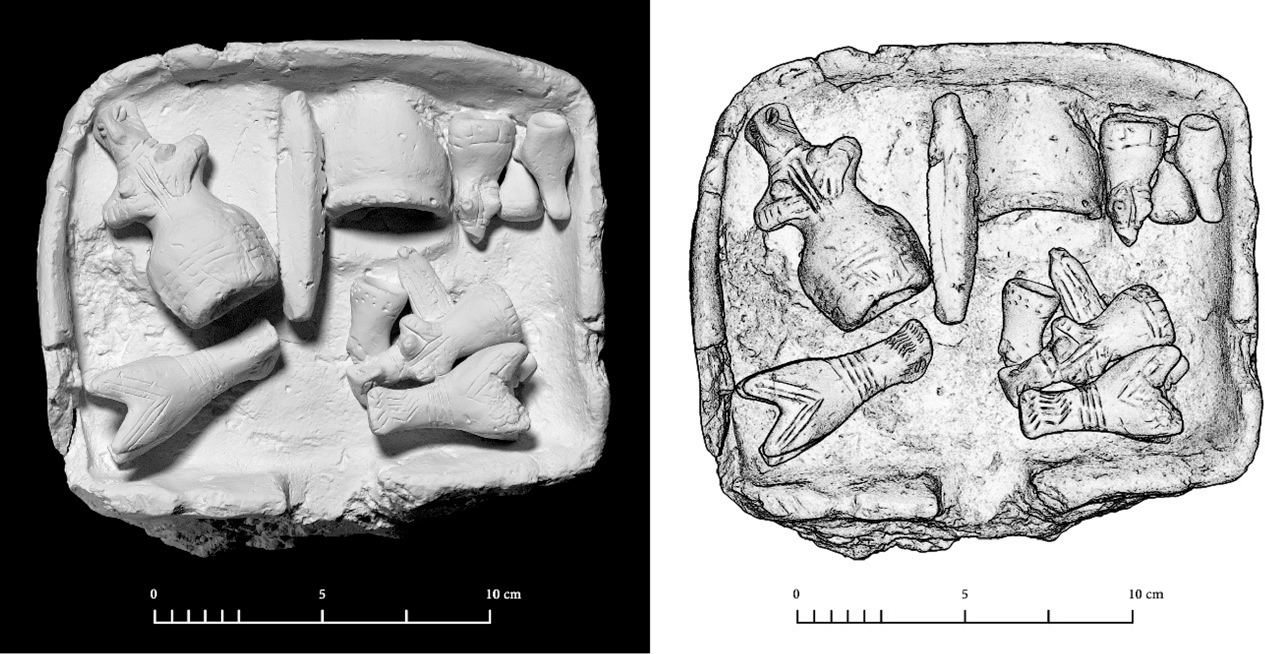
In a large comparative study, Roberto Risch (Reference Risch, Meller, Gronenborn and Risch2018) recently coined the term ‘cooperative affluent societies’ to describe socio-political arrangement for the Neolithic and Chalcolithic periods in the Near East, the Aegean and Iberia. According to him, in ‘cooperative affluent societies’, women were leading political figures (Risch Reference Risch, Meller, Gronenborn and Risch2018: 53, 55). To support his idea of ‘cooperative affluent’ societies that were supposedly matrilocal and matrilineal (Risch pers. comm. 2019), he used the Platia Magoula Zarkou house model (Fig. 2) as an illustrative example and a solid piece of evidence for the Neolithic Thessaly. As the female figurines in this house model are depicted in a size larger than the male figurines, he concluded that women were obviously leading political figures in these societies. Moreover, the Platia Magoula Zarkou house model has also been used to support the emergence of first house societies in prehistoric Europe (Borić Reference Borić and Jones2008).
3D depiction of the Platia Magoula Zarkou house model (after Alram-Stern Reference Alram-Stern, Alram-Stern, Gallis and Toufexis2022, fig. VI.27–37c).

On the basis of a detailed restudy of the Platia Magoula Zarkou house model, using a three-dimensional (3D) scanner (Alram-Stern Reference Alram-Stern, Alram-Stern, Gallis and Toufexis2022), Risch’s conclusions have been challenged from both archaeological and socio-cultural anthropological perspectives (Cveček Reference Cveček2022). The larger size of ‘female’ figurines in comparison to ‘male’ ones in this particular house model does not necessarily represent the living experience of dwellers at Platia Magoula Zarkou. Therefore, the relation between clay effigies and the existence of matrilineal reality at Neolithic Platia Magoula Zarkou cannot be supported on the basis of the size of sexed figurines (Alram-Stern Reference Alram-Stern, Alram-Stern, Gallis and Toufexis2022; Cveček Reference Cveček2022). Moreover, the house model depicts dynamics within the house that cannot be easily extended and projected to dynamics beyond the house, onto the public domain (Cveček Reference Cveček2022). Therefore, there is no reason to assume women had a leading role both within and outside of the house during the Neolithic at Platia Magoula Zarkou.
Another more recent case of using female figurines as supporting evidence for matrilocal residence and matrifocal Houses comes from Crete. Jan Driessen (Reference Driessen, Schoep, Tomkins and Driessen2011) compared the examples of ‘Goddess’ figurines from Early Minoan IIB Fourno Korifi, the female vessel figurine from the Mesara tombs (Koumasa) and the Trapeza Cave or the Early Minoan III Mochlos and Malia with later miniature frescoes from Knossos, where women were closely associated with the public and the social rather than the domestic (Olsen 1998: 391, cited in Driessen Reference Driessen, Schoep, Tomkins and Driessen2011). Supported by other lines of evidence, such as farming, warfare, architecture, seals and burials, he argued for a matrifocal ‘House’ as a long-living stable group that constituted an essential component of Minoan community organization (Driessen Reference Driessen, Schoep, Tomkins and Driessen2011; Reference Driessen2010). These two examples from the Late Middle Neolithic Thessaly and the Late Neolithic and Early Minoan Crete exemplify how scholars have reached their conclusion about the importance of women in public and (less so) domestic spheres. The false assumption that female figurines and female symbolism are evidence for matriarchy, in which women play a dominant role in domestic and public spheres of social life, persists within archaeology, despite its anthropological refutation long ago (see Fluehr-Lobban et al. Reference Fluehr-Lobban, Aptheker, de Raedt, Krader, Landes, Löffler, Makarius, Pollock, Schott and Smith1979: 343). Lastly, the critical evidence for the long-term absence of co-resident men within archaeological contexts to infer matrilineal societies will be examined.
The absence of men for trade and warfare
Another cross-cultural indicator for matrilocal residence has been ascribed to the absence of men over longer periods (Helms Reference Helms1970; Divale Reference Divale1984). To maintain a functioning household, closely related women would reside together, while men would be married in from the broader geographic area; however, the matrilocal residence does not necessarily imply matrilineal descent. Matrilocal residence is equally compatible with bilateral descent (Helms Reference Helms1970) or with double descent, the latter being observed from the 19th and 20th century Aegean dynamic trading communities. In those communities situated around the Aegean Sea, where seafaring was a male expertise that resulted in longer periods of absence and frequent deaths in the sea, houses and land were transmitted through a female line, while names and titles were transmitted through a male line (Goody Reference Goody1990: 450–454). That would also be the case if we consider seafaring in prehistory to be a seasonal practice (Broodbank Reference Broodbank2013). Without considering the possibility of double or bilateral descent for the Minoan Crete, Driessen (Reference Driessen, Schoep, Tomkins and Driessen2011) proposes that men might be absent from their residence due to their involvement in the construction of public works, which would necessarily suggest matrilineal descent in his opinion.
Another anthropological reference that infers patrilineal or matrilineal descent concerns the occurrence of warfare. Without providing any reference, Driessen (Reference Driessen, Schoep, Tomkins and Driessen2011) refers to a statistically significant association between internal warfare with close neighbours (warfare with groups of the same society) and patrilineal descent, whereas external warfare with distant communities (with groups of different societies) is more frequent in matrilineal societies (see Ember, Ember and Pasternak Reference Ember, Ember and Pasternak1974). He then concluded that the absence of intra-regional warfare, the large size of buildings, the inter-regional contacts and repeated seal imaginary do fit with a hypothesized matrilineal system for Pre- and Protopalatial Crete. Without referencing anthropological cross-cultural insights, Marija Gimbutas also used the absence of warfare during Neolithic times to infer peaceful relations between biological sexes (Gimbutas 1990; Reference Gimbutas1991). In her words, ‘peaceful, sedentary, matrifocal, matrilineal, and sex egalitarian’ characterized Old Europe (Gimbutas Reference Gimbutas1991: 352).
In context of Late Minoan III period, Driessen (Reference Driessen, Letesson and Knappett2017) refers to the work of Sanday (Reference Sanday2002) and her definition of matriarchy. He concluded that the archaeological evidence for this period suggests ‘a spatially segregated but complementary gender system in which the tasks, dealings and cult practices of men and women were seemingly relatively balanced. Men and women seem to some extent to have led separate lives and activities, both socially appreciated and matching’ (Driessen Reference Driessen, Letesson and Knappett2017: 97). Does this not resemble Gimbutas’s proposal of ‘balanced, nonpatriarchal and nonmatriarchal social system’ (Reference Gimbutas1989: xx) for the Old Europe?
Despite some similarities between Marija Gimbutas’s thoughts and today’s insights into the Aegean Neolithic and Early Bronze Age periods, an aversion to quoting Gimbutas among both male and female archaeologists is apparent and widely accepted. The established academic practice creates an epistemological space for new insights that are, as I argued here, not entirely new. Multiple lines of evidence considered in this study, independently from each other, explain why both, aspects of Gimbutas’s theories and socio-cultural anthropology’s core insights should be consulted to avoid the process of rethroning, namely reinstating the old interpretations in new ways.
Conclusion
The reconstruction of prehistoric kinship relations remains challenging; yet, it is crucial for understanding how persons negotiated their interactions with each other and with the world. Whether this happens through matrilineal or patrilineal descent, via bilateral corporate groups, or through houses (with or without a capital ‘h’), it is kinship that also grants peaceful access to goods in societies without writing, primarily through inheritance and marriage. Archaeologists need to accept a few socio-cultural anthropological insights to understand the importance of kinship analysis in visualizing how social relations were formed in prehistory as well as reconsider some of the earlier archaeological thought. As I showed in this contribution, matrilineal descent should be considered as one among several possibilities among sedentary groups in Aegean prehistory under specified socio-environmental conditions. The existence of gender-egalitarian societies is equally likely if we understand these egalitarian relations in some analogy to those of the Hopi. Such constellations could have co-existed with other types of kinship practices and gender relations in space and time during the Neolithic and Early Bronze Age in the Aegean as well as the adjacent regions, including southeastern Europe and Anatolia.
As I aimed to show, Marija Gimbutas’s enthroning of the Mother Goddess hypothesis has had a twofold impact. First, the debates around her contested theories crucially advanced archaeological thought and methodology and demonstrated a paramount need for feminist perspectives in archaeology. Second, the resistance to Gimbutas’s way of thinking about gender roles in prehistory simultaneously hindered a serious and continuous discussion of kinship practices among sedentary groups in Aegean prehistory. Kinship and gender are not culture-free concepts but social constructs. If we are to learn more about kinship and gender in Old World prehistory, a gender-egalitarian picture of the Neolithic beyond what Gimbutas argued for in her writing must be carefully reassessed through discourses of gender and kinship along a unified analysis, without a priori assuming female leadership in these contexts or peaceful co-existence of genders in prehistory.
At the same time, concepts such as ‘matrilineal’ and ‘matrilocal’, commonly used as tools for describing kinship practices should not only be limited to studies of ancient DNA.Footnote 7 They should also find their way into interpretative archaeology, supported through ethnographically grounded reasoning. By seeking out new meanings and deploying ethnographically informed concepts of gender and kinship to prehistory, we may better understand human possibilities – those of the past, present and future. The Aegean case study only showcases how certain misleading interpretations may be not only dethroned, but also rethroned, should scholars conduct archaeology without, rather than with, socio-cultural anthropology, and without recognizing the entire spectrum of earlier work. The aversion to referencing the work of Marija Gimbutas and other marginalized voices creates an epistemological space that seems like a tabula rasa, but it is not.
Within archaeological scholarship, Gimbutas’s work has been disparaged and ignored, and yet it can be argued that some of her ideas are still relevant. The disparagement is, at least in part, sexist (especially when one looks at some of the older discussions). A notable omission is that, while archaeologists have argued (on the whole, rightly) that her methodologies are weak (e.g., Meskell Reference Meskell1995; Tringham and Conkey Reference Tringham, Conkey, Goodison and Morris1998; Talalay Reference Talalay2000; Reference Talalay2007), there is another pertaining issue. That is the way in which Gimbutas’s work is taken up uncritically by feminist writers, many of them involved in a modern Goddess religion, which has been pictured by the introductory vignette. It could be argued that this unique aspect to the reception of her work further creates division and antipathy in discussion between archaeologists and other scholars and writers. After three decades of critical engagement with Gimbutas’s work in archaeology, however, it is timely that anyone wishing to be regarded as a serious scholar (Hamilton Reference Hamilton1996a: 283), who actively works against preexisting biases, should come to a reconciliation with her work. Today, quoting Gimbutas does not imply agreeing with her archaeomytological work, her Mother Goddess hypothesis or her conception that the Aegean Neolithic period was a peaceful paradise. Instead, it would display a good scholarly practice.
Supplementary material
To view supplementary material for this article, please visit https://doi.org/10.1017/S1380203824000059.
Acknowledgements
Research for this article was funded by the Austrian Academy of Sciences Postdoc-Track (85076) and ATHENS (2020) Fellowships. Revisions and responses to the three comments were completed during the European Union’s Marie Skłodowska-Curie Action (101108084) “X-KIN: Exploring Patterns of Prehistoric Kinship from Socio-Cultural Anthropological Perspectives”. I am grateful for the generous research support provided by the Austrian Archaeological Institute (OeAI) and the Library of the British School at Athens during my three-month research stay at the OeAI in Athens in the autumn of 2021. Special thanks to Jan Driessen, Kostas Kotsakis, Roberto Risch, and Stella Souvatzi for their valuable discussions on this topic, as well as to Eva Alram-Stern, Andre Gingrich, and Stratos Nanoglou for their constructive feedback on earlier drafts of this article. I also greatly benefitted from feedback and comments on my reply piece from Eva Alram-Stern, Andre Gingrich, Barbara Horejs, William A. Parkinson, Walter Scheidel, and Anna Wessman. I extend my gratitude to Eva Alram-Stern for permitting the inclusion of the Platia Magoula Zarkou 3-D model and to Mario Börner for creating the map. For English language editing, I am indebted to Dana McKelvey and the Editing Press. Finally, I sincerely thank the two engaged reviewers whose comments and suggestions significantly improved this article, as well as the editors, Eva Mol and Artur Ribeiro, for their tireless editorial work.

 Open access

