





Introduction
Velvetleaf, common ragweed, common lambsquarters, wild mustard, barnyardgrass, giant foxtail, and green foxtail interference can substantially reduce corn yield (Beckett et al. Reference Beckett, Stoller and Wax1988; Bosnic and Swanton Reference Bosnic and Swanton1997; Knake and Slife Reference Knake and Slife1962; Scholes et al. Reference Scholes, Clay and Brix-Davis1995; Sibuga and Bandeen Reference Sibuga and Bandeen1980; Weaver Reference Weaver2001). Corn production systems across several US states and Canadian provinces require effective control of these weed species, as they are numerous across many corn production regions (Van Wychen Reference Van Wychen2020). One strategy to avoid corn yield loss from weed interference is to apply an effective and well-timed postemergence herbicide; however, corn yield loss can occur in situations under prolonged weed interference when the application of the postemergence herbicide is delayed (Carey and Kells Reference Carey and Kells1995; Cox et al. Reference Cox, Hahn and Stachowski2006; Myers et al. Reference Myers, Curran, Vangessel, Majek, Scott, Mortensen, Calvin, Karsten and Roth2005).
The efficacy of postemergence herbicides can be improved with the addition of an activator adjuvant (Harbour et al. Reference Harbour, Messersmith and Ramsdale2003; Langdon et al. Reference Langdon, Soltani, Raeder, Robinson, Hooker and Sikkema2020). The herbicide used and the target weed species dictate the most effective adjuvant. For example, nonionic surfactant was a better adjuvant than crop oil concentrate for hemp sesbania [Sesbania herbacea (Mill.) McVaugh] control with chlorimuron, but for purple nutsedge (Cyperus rotundus L.) control, crop oil concentrate was better (Jordan Reference Jordan1996; Jordan and Burns Reference Jordan and Burns1997). Harbour et al. (Reference Harbour, Messersmith and Ramsdale2003) found that 2,4-D amine activity was enhanced similarly by four different surfactants for the control of kochia [Bassia scoparia (L.) A.J. Scott] and Russian thistle (Salsola tragus L.), but bromoxynil efficacy was not improved on either weed species with any of the surfactants evaluated in the study. In contrast, only one surfactant enhanced control of Russian thistle, and two surfactants enhanced the control of kochia with glyphosate (Harbour et al. Reference Harbour, Messersmith and Ramsdale2003). Foramsulfuron + atrazine controlled several broadleaf weed species similarly when applied with either methylated seed oil (MSO) or crop oil concentrate; however, MSO was superior to crop oil concentrate for the control of giant foxtail, fall panicum (Panicum dichotomiflorum Michx.), and waterhemp [Amaranthus tuberculatus (Moq.) J.D. Sauer] (Bunting et al. Reference Bunting, Sprague and Riechers2005). Testing of several adjuvants with an herbicide across a range of weed species should be conducted to identify the most effective adjuvant.
Tolpyralate + atrazine is a postemergence herbicide that can provide >90% control of several of the most prevalent broadleaf and grass weed species in corn production systems in Ontario, Canada (Metzger et al. Reference Metzger, Soltani, Raeder, Hooker, Robinson and Sikkema2018). Tolpyralate + atrazine efficacy can be improved with the addition of MSO Concentrate® (Anonymous 2017; Langdon et al. Reference Langdon, Soltani, Raeder, Robinson, Hooker and Sikkema2020). Langdon et al. (Reference Langdon, Soltani, Raeder, Robinson, Hooker and Sikkema2020) reported that when MSO Concentrate® was added to tolpyralate + atrazine, the control of velvetleaf, common lambsquarters, barnyardgrass, and green foxtail was improved at 8 wk after application (WAA); however, common ragweed and wild mustard control was not improved.
There is little information in the peer-reviewed literature that compares the enhancement of tolpyralate + atrazine efficacy when applied with several different proprietary adjuvants besides some initial research by Langdon et al. (Reference Langdon, Soltani, Raeder, Robinson, Hooker and Sikkema2020). Therefore, the objective of this study was to evaluate six adjuvants with tolpyralate + atrazine to determine the most effective adjuvant to add to tolpyralate + atrazine for the control of four annual broadleaf and two annual grass weed species in corn.
Materials and Methods
Four field trials were conducted in 2020 and 2021 at the University of Guelph research fields in Ridgetown, ON, Canada [Ridgetown Campus (42.45º N, 81.88º W)] and near Exeter, ON, Canada [Huron Research Station (43.32º N, 81.50º W)] (Table 1). The field trials were managed under conventional tillage practices and were fertilized prior to corn seeding to meet corn requirements. Corn was seeded to a population of 85,000 seeds ha–1 at a 5-cm depth with spacing between rows at 75 cm. Glyphosate-resistant corn hybrids were planted. DKC42-04RIB® (Bayer CropScience Canada Inc., Calgary, AB) was planted at the Huron Research Station. DKC42-60RIB® and DKC39-97RIB® (Bayer CropScience Canada Inc., Calgary, AB) were planted in 2020 and 2021, respectively, at Ridgetown Campus. Plot length was 8 m at Ridgetown Campus and 10 m at the Huron Research Station. The plots were four corn rows (3 m) wide. Four blocks were in the randomized complete block design trials. Table 1 provides further information pertaining to soil characteristics, corn planting and harvest dates, and treatment application information.
Year, location, soil characteristics, corn planting and harvest dates, herbicide application dates, and corn development stages at application for four field trials at Ridgetown Campus (in Ridgetown, ON, Canada) and at the Huron Research Station (near Exeter, ON, Canada) in 2020 and 2021.

a Soil core taken to a depth of 15 cm and subsequent analysis at A&L Canada Laboratories Inc. (London, ON) were used to determine soil characteristics.
b Abbreviations: OM, organic matter.
A CO2-pressurized backpack sprayer was used to administer herbicide applications at a spray volume of 200 L ha–1 at 240 kPa through four ULD120-02 spray nozzles (Pentair, New Brighton, MN) that were at 50-cm spacing. A nontreated control plot and a weed-free control were in each block. The weed-free control plots were kept weed-free with an application of bicyclopyrone/mesotrione/S-metolachlor/atrazine (Acuron® Herbicide, 7.1/28.5/257/120 g ai L–1; Syngenta Canada Inc., Guelph, ON) applied preemergence at a rate of 2,230 g ai ha–1. Glyphosate (Roundup WeatherMAX®, 540 g ae L–1; Bayer CropScience Canada Inc., Calgary, AB) at 900 g ae ha–1 was applied postemergence if needed, it was followed by hand weeding as required in weed-free control plots.
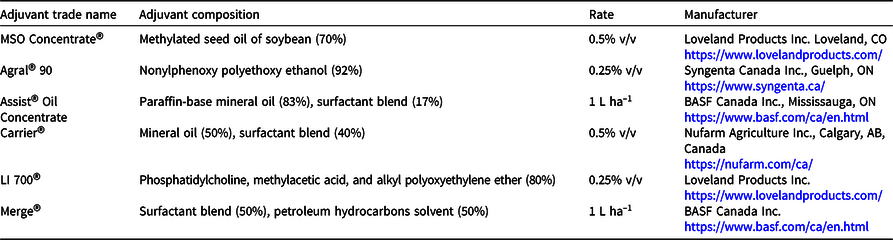
The treatments consisted of a mixture of tolpyralate (Shieldex® 400SC Herbicide, 400 g ai L–1; ISK Biosciences Corp., Concord, OH) at 30 g ai ha–1 and atrazine (AAtrex® Liquid 480, 480 g ai L–1; Syngenta Canada Inc., Guelph, ON) at 560 g ai ha–1 applied without adjuvant or with MSO Concentrate®, Agral® 90, Assist® Oil Concentrate, Carrier®, LI 700®, or Merge® to assess corn injury and weed control efficacy. These adjuvants were chosen to be tested with tolpyralate + atrazine because they represent common adjuvants used in Ontario, Canada. Supplemental adjuvant information is found in Table 2 for details on adjuvant composition, rate, and manufacturer. Treatments were applied postemergence to 10-cm weeds. Depending on trial location, trials had velvetleaf, common ragweed, common lambsquarters, wild mustard, barnyardgrass, and foxtail species (collectively green and giant foxtail) naturally occurring.
Adjuvant trade name, adjuvant composition, adjuvant rate, and adjuvant manufacturer for the study of the enhancement of tolpyralate + atrazine efficacy for the control of several annual weed species in Ontario, Canada in 2020 and 2021.
Assessments of corn injury were taken 1, 2, and 4 WAA. A percentage score (0 to 100%) for corn injury was rated, with greater numbers indicating greater corn injury. Weed control by weed species was assessed 2, 4, and 8 WAA as a percentage estimate of aboveground biomass reduction relative to the nontreated control plot. At 8 WAA, the weeds present in two, 0.5-m2 quadrats in each plot were counted and clipped at the soil surface to gather the density and aboveground biomass of each weed species. The biomass was placed in paper bags, dried to constant moisture in a kiln dryer, then weighed to determine dry biomass of each weed species in each plot. A small-plot combine harvested the center two corn rows of each plot when the corn reached harvest maturity. The corn grain yields were adjusted to 15.5% moisture for statistical analysis.
Statistical Analysis
The GLIMMIX procedure in SAS version 9.4 (SAS Institute Inc., Cary, NC) was used to analyze weed control, weed density, weed dry biomass, corn injury, and corn yield. Statistical tests were conducted at a significance level of α = 0.05. The fixed effect was treatment, and the random effects included environment (collectively site and year combinations), block nested within the environment, and the treatment-by-environment interaction. Data were pooled across environments for statistical analysis. Transformations were used when appropriate, and distributions used for statistical analysis were those that best met the assumptions that residuals were random, independent of treatment and design effects, homogeneous, and followed a normal distribution about a mean of zero. To confirm that these assumptions were met, studentized residual plots and the Shapiro-Wilk test statistic were visually assessed. Common ragweed, wild mustard, and foxtail species control at all assessment timings was arcsine square root–transformed for analysis and then back-transformed for result presentation. Velvetleaf, common lambsquarters, and barnyardgrass control data at all assessment timings were not transformed, as the model residuals were normally distributed. Density and dry biomass data for each weed species were analyzed with a log-normal distribution. The omega method of back-transformation (M Edwards, Ontario Agricultural College Statistics Consultant, University of Guelph, personal communication) was used for the presentation of results when a log-normal distribution was used. Corn injury and yield were analyzed with a normal distribution. Letter codes were used to identify statistically significant differences of least square means that were obtained from the Tukey-Kramer multiple-comparison test.
Results and Discussion
Velvetleaf
Velvetleaf was present at Ridgetown Campus in 2020 and 2021, so the results are presented from two site-years. The adjuvants tested with tolpyralate + atrazine did not improve velvetleaf control at 2, 4, and 8 WAA (Table 3). In contrast, Langdon et al. (Reference Langdon, Soltani, Raeder, Robinson, Hooker and Sikkema2020) reported that the addition of MSO Concentrate® improved velvetleaf control with tolpyralate + atrazine. Similar to the results from this study, previous research has documented >90% control of velvetleaf with tolpyralate + atrazine applied with MSO Concentrate® (Langdon et al. Reference Langdon, Soltani, Raeder, Robinson, Hooker and Sikkema2020; Metzger et al. Reference Metzger, Soltani, Raeder, Hooker, Robinson and Sikkema2018). Consistent with control data, the density and dry biomass reduction of velvetleaf did not differ between tolpyralate + atrazine applied without an adjuvant or with adjuvants. The low density of velvetleaf compared to other weed species in this study may have contributed to the lack of differences between the different treatments for control, density, and dry biomass data. Control, density, and dry biomass data for velvetleaf was generally more variable than other weed species in this trial, as the densities of velvetleaf plants within each plot were not as consistent as other weed species. Interference among weed species may have had a role in the variability, as velvetleaf may have exhibited opportunistic growth in plots where other weed species of higher densities were controlled. The density and dry biomass reduction of velvetleaf were 78% to 93% and 92% to 98%, respectively, with tolpyralate + atrazine applied with or without adjuvants.
Influence of adjuvants with tolpyralate + atrazine on velvetleaf control at 2, 4, and 8 wk after application (WAA), density, and dry biomass in corn from two field trials in Ontario, Canada in 2020 and 2021.

a All treatments listed except the weed-free and nontreated control included tolpyralate at a rate of 30 g ai ha–1 and atrazine at a rate of 560 g ai ha–1.
b Means within the same column followed by the same lowercase letter do not statistically differ according to the Tukey-Kramer multiple-range test at α = 0.05.
Common Ragweed
Common ragweed control data were pooled across four site-years of data. At 2, 4, and 8 WAA, tolpyralate + atrazine applied with MSO Concentrate® controlled common ragweed similarly to tolpyralate + atrazine applied with Agral® 90, Carrier®, Assist® Oil Concentrate, or Merge® (Table 4). Consistent with previous research by Langdon et al. (Reference Langdon, Soltani, Raeder, Robinson, Hooker and Sikkema2020) and Metzger et al. (Reference Metzger, Soltani, Raeder, Hooker, Robinson and Sikkema2018), tolpyralate + atrazine + MSO Concentrate® controlled common ragweed >90% at 2 and 4 WAA. At 2 WAA, common ragweed control with tolpyralate + atrazine + LI 700® was inferior to all adjuvants except Agral® 90. At 4 and 8 WAA, LI 700® did not improve the control of common ragweed with tolpyralate + atrazine. At 4 WAA, Merge® and MSO Concentrate® were the only adjuvants to enhance control of common ragweed better than LI 700® when applied with tolpyralate + atrazine. Merge® was the only adjuvant used with tolpyralate + atrazine that enhanced control of common ragweed better than the use of LI 700® with tolpyralate + atrazine at 8 WAA. Among the different adjuvants tested with tolpyralate + atrazine, all reduced common ragweed density and dry biomass similarly. The density and dry biomass reduction of common ragweed with tolpyralate + atrazine applied with adjuvants was 67% to 95% and 59% to 97%, respectively. Tolpyralate + atrazine applied with MSO Concentrate® or Merge® reduced common ragweed dry biomass 97% and 96%, respectively; they were the only adjuvants applied with tolpyralate + atrazine to reduce the dry biomass of common ragweed better than tolpyralate + atrazine applied without an adjuvant.
Influence of adjuvants with tolpyralate + atrazine on common ragweed control at 2, 4, and 8 wk after application (WAA), density, and dry biomass in corn from four field trials in Ontario, Canada in 2020 and 2021.

a All treatments listed except the weed-free and nontreated control included tolpyralate at a rate of 30 g ai ha–1 and atrazine at a rate of 560 g ai ha–1.
b Means within the same column followed by the same lowercase letter do not statistically differ according to the Tukey-Kramer multiple-range test at α = 0.05.
Common Lambsquarters
Common lambsquarters data were pooled across four site-years. At 2 WAA, control of common lambsquarters with tolpyralate + atrazine applied with MSO Concentrate®, Merge®, Carrier®, Assist® Oil Concentrate, or Agral® 90 was similar (Table 5). Previous research reported that common lambsquarters control with imazamox was similar when applied with Agral® 90 or MSO (Blackshaw Reference Blackshaw1998). At 2 WAA, LI 700® was inferior to all the adjuvants except Assist® Oil Concentrate. At 4 and 8 WAA, the use of LI 700® did not improve common lambsquarters control with tolpyralate + atrazine; however, all other adjuvants improved control of common lambsquarters with tolpyralate + atrazine to a similar extent. Greater control of common lambsquarters with tolpyralate + atrazine was attained when Merge® was used instead of LI 700® at 4 WAA. At 8 WAA, common lambsquarters control with tolpyralate + atrazine + adjuvant was similar among all adjuvants tested. Previous research has also reported >90% control of common lambsquarters with tolpyralate + atrazine applied with MSO Concentrate® and that the addition of the MSO Concentrate® improved control (Langdon et al. Reference Langdon, Soltani, Raeder, Robinson, Hooker and Sikkema2020; Metzger et al. Reference Metzger, Soltani, Raeder, Hooker, Robinson and Sikkema2018). In support of the control data, the various adjuvants did not differ in their enhancement of tolpyralate + atrazine for density and dry biomass reduction of common lambsquarters. Tolpyralate + atrazine reduced common lambsquarters density 71%; the co-application of tolpyralate + atrazine with MSO Concentrate®, Merge®, or Agral® 90 reduced common lambsquarters density 98% to 99%, which was greater than when no adjuvant was used. Tolpyralate + atrazine + LI 700® did not reduce common lambsquarters density compared to when no adjuvant was used. Tolpyralate + atrazine + Merge® reduced common lambsquarters dry biomass 99.7%; Merge® was the only adjuvant co-applied with tolpyralate + atrazine that improved the reduction of common lambsquarters biomass compared to the no adjuvant treatment.
Influence of adjuvants with tolpyralate + atrazine on common lambsquarters control at 2, 4, and 8 wk after application (WAA), density, and dry biomass in corn from four field trials in Ontario, Canada in 2020 and 2021.

a All treatments listed except the weed-free and nontreated control included tolpyralate at a rate of 30 g ai ha–1 and atrazine at a rate of 560 g ai ha–1.
b Means within the same column followed by the same lowercase letter do not statistically differ according to the Tukey-Kramer multiple-range test at α = 0.05.
Wild Mustard
Wild mustard was evaluated at the Huron Research Station in 2020 and 2021, so the results presented are from two trials. Wild mustard control with tolpyralate + atrazine followed similar trends to velvetleaf control, as the adjuvants tested did not improve control at any assessment timing (Table 6). Control of wild mustard with tolpyralate + atrazine with or without adjuvants was 87% to 98%, 91% to 99%, and 94% to 100% at 2, 4, and 8 WAA, respectively; these results are consistent with previous research (Langdon et al. Reference Langdon, Soltani, Raeder, Robinson, Hooker and Sikkema2020; Metzger et al. Reference Metzger, Soltani, Raeder, Hooker, Robinson and Sikkema2018). In agreement with control data, the density and dry biomass of wild mustard was similar when tolpyralate + atrazine was applied with or without adjuvants. The dry biomass of wild mustard was reduced 98% to 100% with tolpyralate + atrazine applied with or without adjuvants.
Influence of adjuvants with tolpyralate + atrazine on wild mustard control at 2, 4, and 8 wk after application (WAA), density, and dry biomass in corn from two field trials in Ontario, Canada in 2020 and 2021.

a All treatments listed except the weed-free and nontreated control included tolpyralate at a rate of 30 g ai ha–1 and atrazine at a rate of 560 g ai ha–1.
b Means within the same column followed by the same lowercase letter do not statistically differ according to the Tukey-Kramer multiple-range test at α = 0.05.
Barnyardgrass
Barnyardgrass data were pooled across four trials. Control of barnyardgrass with tolpyralate + atrazine plus MSO Concentrate®, Merge®, or Carrier® was similar (Table 7). Tolpyralate + atrazine efficacy on barnyardgrass was enhanced with the addition of MSO Concentrate®; this finding was also reported by Langdon et al. (Reference Langdon, Soltani, Raeder, Robinson, Hooker and Sikkema2020). Agral® 90 and Assist® Oil Concentrate were inferior to Merge® but similar to MSO Concentrate® and Carrier® for barnyardgrass control with tolpyralate + atrazine at 2, 4, and 8 WAA. At 2 and 4 WAA, LI 700® enhanced the control of barnyardgrass the least of the adjuvants evaluated with tolpyralate + atrazine. Similarly, Jordan et al. (Reference Jordan, Vidrine, Griffin and Reynolds1996) reported that LI 700® was inferior to MSO for the enhancement of clethodim activity on barnyardgrass. The density and dry biomass reduction of barnyardgrass was similar when tolpyralate + atrazine was applied without an adjuvant or with an adjuvant. Generally, the density and dry biomass data gathered over the course of this study were more representative of the visible control data for the broadleaf weed species evaluated than for the grass weed species. The similar barnyardgrass density and dry biomass among the different treatments may be attributable to (i) greater tillering of barnyardgrass in plots where greater control of broadleaf weeds occurred and (ii) the variability of barnyardgrass among plots. The density and biomass data were obtained from two randomly placed 0.5-m2 quadrats per plot, so placement of the quadrats may have contributed to some of the variability. Therefore, the relative efficacy of each treatment may be better associated with the visible control data rather than the density or dry biomass data.
Influence of adjuvants with tolpyralate + atrazine on barnyardgrass control at 2, 4, and 8 wk after application (WAA), density, and dry biomass in corn from four field trials in Ontario, Canada in 2020 and 2021.

a All treatments listed except the weed-free and nontreated control included tolpyralate at a rate of 30 g ai ha–1 and atrazine at a rate of 560 g ai ha–1.
b Means within the same column followed by the same lowercase letter do not statistically differ according to the Tukey-Kramer multiple-range test at α = 0.05.
Foxtail Species
Foxtail species data were pooled across four trials. At 2 WAA, tolpyralate + atrazine applied with MSO Concentrate® or Merge® controlled foxtail species better than when tolpyralate + atrazine was applied with Assist® Oil Concentrate, Agral® 90, or LI 700® (Table 8). Similar to this study, Langdon et al. (Reference Langdon, Soltani, Raeder, Robinson, Hooker and Sikkema2020) reported that tolpyralate + atrazine efficacy was improved with the addition of MSO Concentrate®. At 2, 4, and 8 WAA, tolpyralate + atrazine applied with Merge® controlled foxtail species similarly to when tolpyralate + atrazine was applied with MSO Concentrate® or Carrier®, but greater than when tolpyralate + atrazine was applied with Assist® Oil Concentrate, Agral® 90, or LI 700®. Similarly, Harker (Reference Harker1992) reported that green foxtail control was greater when sethoxydim was applied with Merge® instead of LI 700® or Agral® 90. The density and dry biomass reduction of foxtail species was similar among the different adjuvant treatments with tolpyralate + atrazine. Similar to barnyardgrass data, the lack of differences among the different treatments for foxtail species density and dry biomass reduction may be due to (i) foxtail species tillering more in plots where greater control of broadleaf weeds occurred and (ii) the variability of foxtail species among plots. Therefore, the density and dry biomass data for foxtail species may not be as representative of the efficacy of the treatments as the visible control data. Future studies should evaluate the efficacy of the treatments on grass weed species in the absence of broadleaf weed interference.
Influence of adjuvants with tolpyralate + atrazine on foxtail species control at 2, 4, and 8 wk after application (WAA), density, and dry biomass in corn from four field trials in Ontario, Canada in 2020 and 2021.

a All treatments listed except the weed-free and nontreated control included tolpyralate at a rate of 30 g ai ha–1 and atrazine at a rate of 560 g ai ha–1.
b Means within the same column followed by the same lowercase letter do not statistically differ according to the Tukey-Kramer multiple-range test at α = 0.05.
Corn Injury and Grain Yield
Corn injury did not exceed 5% at 1 WAA (Table 9). At 1 and 2 WAA, tolpyralate + atrazine applied with MSO Concentrate®, Agral® 90, or LI 700® caused less corn injury than tolpyralate + atrazine applied with Merge®. At 1 and 2 WAA, corn injury with tolpyralate + atrazine applied with Assist® Oil Concentrate or Carrier® was similar to tolpyralate + atrazine applied with Merge®. Corn injury was transient and was 0% at 4 WAA (data not presented).
Influence of adjuvants with tolpyralate + atrazine on corn injury at 1 and 2 wk after application (WAA) and corn grain yield from four field trials in Ontario, Canada in 2020 and 2021.

a All treatments listed except the weed-free and nontreated control included tolpyralate at a rate of 30 g ai ha–1 and atrazine at a rate of 560 g ai ha–1.
b Means within the same column followed by the same lowercase letter do not statistically differ according to the Tukey-Kramer multiple-range test at α = 0.05.
Weed interference caused a 65% corn yield loss (Table 9). Tolpyralate + atrazine applied with Agral® 90, Assist® Oil Concentrate, Carrier®, MSO Concentrate®, or Merge® resulted in corn yield that was similar to corn kept weed-free for the entire season. Similarly, Carey and Kells (Reference Carey and Kells1995) found that an herbicide application made to 10-cm weeds reduced weed interference so that corn yield was similar to corn kept weed-free for the entire season. Corn yield loss with tolpyralate + atrazine applied without an adjuvant or with LI 700® was 37% and 31%, respectively.
In summary, weed species differed in their response to tolpyralate + atrazine applied with or without adjuvants. The adjuvants tested with tolpyralate + atrazine did not improve control of velvetleaf and wild mustard. The use of MSO Concentrate®, Merge®, or Carrier® with tolpyralate + atrazine controlled common ragweed, common lambsquarters, barnyardgrass, and foxtail species similarly or greater than when tolpyralate + atrazine was applied with LI 700®, Agral® 90, or Assist® Oil Concentrate. The most appropriate adjuvant to use with tolpyralate + atrazine depends on the weed species; however, the use of MSO Concentrate®, Merge®, or Carrier® with tolpyralate + atrazine is warranted, as corn producers are often challenged with a complex of weed species including many of the weed species evaluated in this study. Future research should investigate the efficacy of tolpyralate + atrazine applied with adjuvants on weed species that were not evaluated in this study.
Acknowledgments
We thank Christy Shropshire and Todd Cowan for their technical support, Dr. Michelle Edwards for her statistical support, the University of Guelph, Ridgetown Campus summer staff for their field support, and ISK Biosciences Inc., Grain Farmers of Ontario, and the Ontario Agri-Food Innovation Alliance for the funding to conduct this research. No conflicts of interest have been declared.


 Open access

