



Day-care centres are educational institutions that serve children younger than 3 years of age. Their main purpose is to promote a child’s cognitive development and to support families with working parents( Reference Chauhan 1 – 3 ).
Families of children attending day-care facilities expect such institutions to secure their children’s right to a healthy diet that is appropriate to the particular needs of each age group( Reference Melhuish 2 ). The food provided in a school environment should improve the child’s ingestion of energy and nutrients( Reference Melhuish 2 , Reference Abizaki, Buxton and Kwara 4 ), as adequate nutrition in the early years guarantees proper growth and development, cooperating for a lifetime of improved health( 5 ). The National School Feeding Program (Portuguese acronym, PNAE) is a Brazilian public policy for food and nutrition safety, responsible for appointing the necessary parameters to serve meals in day-care centres and schools. This programme determines that children staying full time in educational institutions (7 h/d) must have at least 70 % of the children’s nutritional needs met by a school feeding policy( 6 , Reference Sonnino, Torres and Schneider 7 ).
Previous research has measured the amounts of energy and nutrients offered by schools through methodologies based on food composition tables( Reference Falcão Gomes, Costa and Schmitz 8 – Reference Fung, Mcisaac and Kuhle 10 ) as well as qualitative approaches( Reference Lee and Oh 11 – Reference Durão, Andreozzi and Oliveira 13 ). The use of these tools may be appropriate for diet planning and evaluation. However, it is fragile, as a complete food composition table covering variations in recipes, ingredients and cooking procedures cannot be currently found in Brazil. Therefore, when laboratory analysis methods and standardised techniques recommended by organisations such as AOAC International (formerly known as Association of Official Analytical Chemists) and the Adolfo Lutz Institute (IAL) are used to determine meals’ nutritional composition, biased sources are eliminated from the food composition tables, such as those caused by ingredients replaced during food preparation, vegetable seasonality or type of animal feeding( 14 – 16 ). Therefore, one of the main advantages in performing laboratory analyses, as opposed to the use of composition tables, is to provide a measure of the actual amount of nutrients in food samples.
Considering the important role of day-care facilities in guaranteeing the nutritional needs of children attending full time, the objective of this study was to determine, through laboratory analysis, the nutritional composition of both served and consumed meals in municipal day-care centres of the metropolitan area of Curitiba, Paraná, Brazil, and to evaluate whether it complies with the minimum parameters established by the PNAE and the dietary reference intakes (DRI) values for each age group.
Methods
Sampling
A cross-sectional, analytical and observational study was performed in Colombo, Paraná, Brazil. Out of the thirty-eight municipal day-care facilities serving children from 7 to 36 months of age, four were selected through stratified cluster sampling and random drawings proportional to the number of children enrolled. During the study’s period, the city served a total of 816 children, distributed among geographical areas, or sectors: the main area, Maracanã and Guaraituba, receiving 367, 215 and 234 children, respectively. The random drawings matched the percentages of children enrolled in each sector, with 2 day-care institutions selected for the region with the largest number of enrolled children, the main area. Therefore, each of the three sectors corresponded to 48, 29 and 23 %, respectively, of the total number of children enrolled. A total of 120 samples were collected and analysed in triplicate for eight different parameters, resulting in the performance of 2880 laboratory analyses. Thus, selecting a larger number of schools was not effective, because of the high costs and complexity involved in these laboratory analyses.
For 20 d, the six daily served meals were collected on 5 non-consecutive days from each day-care centre. Considering that each institution had the same weekly menu, as prescribed by a nutritionist, this sampling method represented the weekly menu offered by each institution and the monthly menu provided by the city. A total of 120 meal samples were collected (6 meals/d×5 d/week×4 day-care centres=120 samples). A summary of the methodology is provided in Fig. 1.
Research flow chart. PNAE, National School Feeding Program; DRI, dietary reference intakes.

Ethical aspects
This study’s project was approved by the Committee on Ethics in Research in Human Beings of the Health Sciences Sector of the Universidade Federal do Paraná (Portuguese acronym, UFPR), CAAE no. 11460612.8.0000.8.0000.0102, and authorised by the Department of Education, Culture and Sport of the city.
Samples collection and preparation
At food distribution, samples of approximately 300 g were collected, stored in labelled polypropylene packages, refrigerated at a temperature of 7–10°C and transported to the Food Analysis Laboratory of the Nutrition Department of UFPR for preparation and analysis. Food samples of solid or thick consistency, such as rice, beans, meat and soups were dehydrated at 40–55°C for 24–48 h in a drying oven with air circulation until they reached humidity levels <10 %( 14 ). Liquid samples such as milk, porridge and tea were analysed from the humid base.
Determination of the average served and consumed and food waste
The portion size averages were determined by direct weighing( Reference Rodrigo and Bartrina 17 ) of dishes served. At least six dishes ready for consumption were weighed to compute the mean of portions served to the children, separated by age group: children from 7 to 11 months of age (group A) and children from 12 to 36 months of age (group B). After ingestion of meals, the food that was not consumed was weighed from at least six dishes to obtain the mean of the ingested portion. Thus, we obtained an average served portion and an average consumed portion for each of the 120 meals included in this study.
From the average served and consumed portions of each of the 120 meals, we obtained the average rest-ingestion, according to the following equation:
 $$\rm RI \,{\equals}\, (DA\,{\times}\!100\,/\,PS_{1} ),$$
where RI is the average rest-ingestion (g), DA the average waste (g) and PS1 the average portion served (g).
 $$\rm DA \,{\equals}\, (PS_{1} {\minus}PC_{1} ),$$
where PS1 is the average portion served (g) and PC1 the average portion consumed (g).
Chemical composition of the samples and total energy values
A chemical composition analysis for each meal was performed through proximate analysis of the collected samples (n 120) for determination of moisture (g/100 g), ash (g/100 g), proteins (g/100 g), lipids (g/100 g) and dietary fibre (g/100 g), in accordance with the methodology recommended by the Official Methods of Analysis of AOAC International (2000). Na (mg/100 g), Ca (mg/100 g), and Fe (mg/100 g) were analysed according to IAL’s methodology( 16 ). Carbohydrates (g/100 g) were calculated by difference( 16 ). The total energy value (J (kcal)) was computed according to Atwater’s conversion( Reference Osborne and Voog 18 ). In order to convert kilocalories into joules (J), we multiplied results by 4186. The use of local recipes was not necessary as differences in formulations were identified by laboratory techniques.
Comparative analysis between served nutrients and National School Feeding Program’s official parameters
The average content of each nutrient offered by the school feeding programme was computed as a simple average of the nutrient’s daily supply, as expressed by the following equation:
 $${\rm Average\ supply\ of\ nutrient}\ y\,{\equals}\mathop{\sum}{{{\rm nutrient}\ y\ {\rm supplied\ in\ the\ 20\,d}} \over {20}}} .$$
Average values were calculated with the results obtained from the physicochemical analyses (energy, carbohydrates, proteins, lipids, Dietary fibre, Na, Ca and Fe) and compared with each nutrient’s recommended value advocated by the PNAE( 6 ) for each age group (Table 2).
Comparative analysis between consumed nutrients and the Institute of Medicine’s dietary reference intake values
A mean content value for each actually consumed nutrient was computed as the simple average of the nutrient’s daily intake, as shown in the following equation:
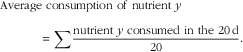 $$\eqalignno{ {\rm Average}&{\ \rm consumption\ of\ nutrient}\ y\, \cr \qquad &{\equals}\, \mathop{\sum}{{{{\rm nutrient}\ y {\rm\ consumed\ in\ the\ 20\,d}} \over {20}}.}} $$
Averages were calculated with the results of the physicochemical analysis of actually consumed meals and were compared with the DRI( 19 – 22 ), considering that the school feeding programme must provide at least 70 % of its full-time students’ nutritional needs( 6 ) (Table 1). Energetic values were computed considering the recommended macronutrient energy values for each age group( 20 – 21 ).
Recommendations of nutrients established by the National School Feeding Program (PNAE) per day for full-time period, nutritional needs recommended by the Institute of Medicine, and 70 % of the nutritional needs, according to the age group

DRI, dietary reference intakes; –, values not established for the age group.
* Brazil Ministry of Education and Culture( 6 ).
† RDA for Fe( 19 ), carbohydrates for group B( 20 ), proteins( 20 ) and Ca for group B( 22 ); estimated energy requirements for energy value( 20 ); tolerable upper intake levels for Na( 21 ); adequate intakes for carbohydrates for group A( 20 ), Ca for group A( 22 ) and food fibres for group B( 20 ).
‡ Value calculated from the energy from macronutrients recommended for the age group.
§ Value obtained from 30 % of the total energy content calculated for the age group.
|| Stipulated maximum value for Na in school feeding.
Statistical analysis
Data sets were organised using Microsoft Excel ® spreadsheets, and statistical analysis were performed using IBM SPSS ® Statistics for Windows, version 19.0( 23 ). Descriptive statistics were produced with a distribution of frequencies, and Student’s t and Mann–Whitney tests were run to compare served and consumed amounts of nutrients. The level of significance was α=0·05 for all analyses.
Results
The portion size served during the six meals was, on average, 788 g/d; however, only 607 g/d on average was consumed, generating a refusal of 181 g/student per d and an average rest-ingestion of 23 %. There was no significant difference in offered portion sizes (g) between groups A and B (P=0·793), except for lunch meals in the second school semester (P=0·047).
The most frequently served meals in day-care centres are described in Table 2. Porridge was served as a breakfast meal on all of the 20 d of evaluation, and as an afternoon snack in 45 % of the evaluated days (n 9). At lunchtime, rice, beans and meat (beef or chicken) were served on 75 % of the days (n 15), and at dinner pasta, soup and potatoes, with meat representing the most frequent meal, offered on 85 % of the evaluated days (n 17).
Most frequently served meals by the school feeding for groups A and B (Numbers and percentages)

Breakfast was served from 07.30 to 08.30 hours. Morning snack was served from 09.30 to 10.30 hours. Lunch was served from 11.00 to 12.00 hours. Tea was served after lunch (around noon). Afternoon snack was served from 13.30 to 14.30 hours and dinner from 16.00 to 16.30 hours.
The average daily amount of nutrients served for both group A (7–11 months) and group B (12–36 months) children and a comparison with the parameters established by the PNAE are shown in Table 3. The served nutritional composition met PNAE’s parameters for energy, carbohydrates, proteins, Na and Ca in group A and proteins, Na and Ca in group B. Considering Na levels, the recommended amount sets a maximum value for children. Thus, a percentage <100 % of the recommended value meets the criteria. For all other nutrients, the current legislation appoints the minimum values that must be fulfilled by the school feeding system.
Average daily amount of nutrients provided to the children and comparison with the parameters established by the National School Feeding Program (PNAE)

PNAE, National School Feeding Program; VET, total energy content; –, values not established for the age group.
* Brazil Ministry of Education and Culture( 6 ).
† P values obtained with the comparison of average daily consumption between groups. The superscript letters on the P values correspond to the statistical tests applied, according to the variable’s behaviour: λ indicates non-parametric behaviour and the use of Mann–Whitney test, whereas ψ indicates that the variables presented normal distribution, having applied the Student’s t test.
‡ Minimum values recommended for energy offer and nutrients in school feeding.
§ There are no recommended values for offer of dietary fibre for group A.
|| Stipulated maximum value for Na in school feeding.
A comparison by age group of the average daily amount of served and consumed nutrients is presented in Table 4. The average nutritional composition of offered meals presented statistical differences when compared with the consumed meals (P<0·05), except for lipids in group A and dietary fibre, Ca and Fe in both groups, especially with regard to energy amounts.
Comparison of nutrient content consumed in meals with the recommendation of the Institute of Medicine for children aged 7–11 months (group A) and 12–36 months (group B)

DRI, dietary reference intakes; VET, total energy content; –, values not established for the age group.
* RDA for Fe( 19 ), carbohydrates for group B( 20 ), proteins( 20 ) and Ca for group B( 22 ); estimated energy requirements for energy value( 20 ); tolerable upper intake levels for Na( 21 ); adequate intakes for carbohydrates for group A( 20 ), Ca for group A( 22 )and dietary fibre for group B( 20 ).
† Were considered as adequate the nutrients that met 70 % or more of the DRI of the children for VET, carbohydrates, proteins, lipids, dietary fibre, Ca and Fe and maximum 70 % of DRI for Na.
‡ P value obtained with the comparison of average daily consumption between groups. The superscript letters on the P values correspond to the statistical tests applied, according to the variable’s behaviour: λ indicates non-parametric behaviour and the use of Mann–Whitney test, whereas ψ indicates the variables presented normal distribution and the use of Student’s t test.
§ Value obtained from the energy from macronutrients recommended for the age group.
|| Value obtained from 30 % of the VET calculated for the age group.
¶ There is no DRI established for dietary fibre and Na for group A.
Table 5 presents a comparison between consumed nutrients and Institute of Medicine’s (IOM) recommended values for children of 7–36 months of age. For group A children, a minimum of 70 % of their nutritional needs was met by the school feeding system with regard to carbohydrates, proteins and Ca. For that age group, fibre and Na reference values do not exist. The nutritional needs of group B children were satisfied with respect to proteins and Na content; the school feeding programme provided <50 % of the DRI for lipids, fibre and Fe.
Comparison of the average daily amount of nutrients served and consumed by age group

* Non-parametric behaviour and the use of Mann–Whitney test.
† Normal distribution and the use of Student’s t test.
Discussion
School meals and the National School Feeding Program
No statistically significant difference was found between the evaluated age groups regarding schools meal portions sizes and nutritional composition. Menu composition was the same for both groups for 95 % of the meals (n 114), even though the nutritional needs of group B (12–36 months) are greater than those of group A (7–11 months), and PNAE’s directives( 6 ) establish that meals must be adequate to the needs of each age group.
Meals offered to children in group A presented higher amounts of energy and carbohydrates than those established by the PNAE, possibly due to an excessive consumption of porridge. The dish was a mix of powdered milk, starch (rice, maize and infant wheat cereal) and refined sugar, and was served on all the evaluated days. In contrast, even though group B’s nutritional needs were higher than group A’s needs, the same nutritional content of energy and carbohydrates was supplied to both groups. Thus, the offer of those nutrients to group B infants did not meet PNAE’s minimum standards. This issue could have serious implications on the overall nutritional health of group B children, given the high energetic content offered to group A due to the sugar content in the served tea (n 19) and the presence of processed food items such as noodles at dinner. In addition, the energetic and nutritional needs of children in their early years are larger than in any other life stage. A research study( Reference Vilela, Oliveira and Pinto 24 ) observed ingestion of high-energy foods by more than 32 % of the evaluated children younger than 2 years, and another study found that soda and processed juices were offered before the child’s 1st year to over half of the evaluated children( Reference Longo-Silva, Toloni and Menezes 25 ). This is a problem not restricted to day-care facilities, and requires recommendations regarding the appropriate nutrition and energy content for children in this life period.
Regarding consumed portions, food consumption of group B children was lower in the second school semester, as the educators began to take the children to have their meals at the school cafeteria, following recommendations established by the Diretriz Municipal de Educação ( 26 ). Thus, children were encouraged to eat by themselves instead of being fed by the educators. This situation was found on 55 % of the days, when a decrease in portion sizes was observed, with consequent enlargement of food waste and failure in meeting group B’s nutritional needs. Such a situation could have been less severe if a larger amount of time was available for meal consumption and if there was a closer encouragement of the children during this transition phase.
The offer of lipids was also insufficient for both age groups. This low lipid intake pattern was also observed in household meals intended for breast-fed infants and analysed in laboratory( Reference Weber and Morais 27 ). A restriction in adults’ intake of fats may be influencing the preparation of children’s meals, contrary to what has been recommended by paediatric organisations( Reference Kleinman 28 , 29 ), which advise against fat and cholesterol restrictions during the first 2 years of an infant’s life. Thus, lipid consumption should provide approximately 30 % of energy intake, which will guarantee adequate consumption and prevent consumed proteins to be used for energy production. Fat ingestion is linked to satiation and represents an essential source of energy and liposoluble vitamins, as well as essential fatty acids used in the synthesis of long-chain unsaturated fatty acids( 20 ).
The offered protein and Ca contents followed PNAE’s recommendations for both age groups. For those nutrients, the observed adequacy may have occurred because of a high frequency of porridge and other milk-based preparations, as milk is a protein- and Ca-rich ingredient. Milk-based meals were offered every day at least at breakfast. In 13 d (65 %), children consumed milk-based meals in their morning snack (yogurt) or afternoon snack (porridge, sweetened powdered milk, powdered milk with addition of sugar, powdered chocolate and sweet rice). Although the protein content was above the recommended value, a more concerning issue was the Fe content for both groups. It did not comply with PNAE’s recommended minimum value, and consumption of organ meats (such as liver and kidney) was not observed. Beef meats were offered in small portion sizes, and thus were inadequate for children of both age groups. This food item provides great quantities of Fe of high bioavailability. Furthermore, a substantial offer of milk and milk-based items was found, which are products with a low Fe content( 30 ), and when ingested in excess could interfere with the absorption of Fe content from other food items because of its interaction with Ca( 31 ).
The small supply of fruits and vegetables on the menu resulted in non-compliance of the offered amount of dietary fibre with the Program’s reference values( 41 ). This is possibly due to the supply of approximately 115 g of fruits and 50 g of vegetables/child per week, not reaching PNAE’s recommended minimum of 200 g/student per week. Information on dietary fibre consumption for children under 2 years of age is scarce( 20 ). A limited ingestion of fruits and vegetables by children is attested by recent Brazilian studies( Reference Valmórbida and Vitolo 32 – Reference Pedraza, Queiroz and Gama 34 ); one study( Reference Valmórbida and Vitolo 32 ) indicates that early feeding practices, parental education, family income and consumption of high sugar content beverages at 12–16 months are the main explanatory factors. Unfortunately, a similar situation was reported by research studies more than a decade ago in Brazil. Since 2001, these studies( Reference Cruz, Santos and Carvalho 35 ) reveal a restricted consumption of fruits and vegetables in children in day-care institutions, circumstances also confirmed by additional studies in 2003( Reference Spinelli, Goulart and Santos 36 ), 2005( Reference Castro, Novaes and Silva 37 ) and 2006( Reference Barbosa, Carvalho and Franco 38 ). Recent studies( Reference Muniz, Zanini and Schneider 39 , Reference Monticelli, Souza and Souza 40 ) involving adolescents have likewise reported this reality, demonstrating that this is a persistent issue throughout the years in this population.
The Brazilian legislation that establishes standardised parameters for school feeding has been continuously updated( 6 , 41 ); however, such alterations have shown little impact in improving compliance with the established goals, considering the reduced consumption of fruits and vegetables that was observed in the cited work. The inefficiency of school feeding policies is not restricted to Brazil’s context and has been reported in other countries as well. A research study( Reference Bauhoff 42 ) based in Los Angeles (USA) found that government policies have been ineffective in reducing the evaluated children’s BMI, possibly due to a lack of regulations of meal content outside of school grounds. The authors observed, however, a significant decrease in soda and fried foods consumption at school. Thus, we must not simply criticise non-compliance with government school feeding regulations or the school’s and family’s role in producing healthy eating habits, but attempt to motivate communication between school and families, in order to provoke changes in the children’s and adolescents eating habits, as well as the government recommendations. Therefore, we hope to find studies with a modified situation in the next decade.
One result that stands out is with regard to Na content found in the meals of both groups. Despite Na content in foods having met the values recommended by the PNAE (maximum 1400 mg/d), this reference value needs further consideration. A previous legislation( 41 ) recommended a Na level of up to 400 mg/d, which is currently considered adequate for a single meal( 6 ), reaching a level of 1400 mg Na/d for three or more meals per day in both age groups. Any full-time student may be provided up to 1400 mg of Na/d, whether an infant or adolescent. No tolerable upper intake limit (UL) has been established for children under 1 year of age, and the WHO recommends that salt may not be added to these children’s food( 43 ). Therefore, PNAE’s reference values need to be revised, for they should determine a maximum Na intake of 1050 mg/d for children under 36 months of age, which represents 70 % of the UL for children of 1–3 years, as indicated by the IOM( 20 ).
An aggravating factor regarding the amounts of Na in meals from the studied day-care centres was the offer of dishes and processed products with high Na content. The presence of noodles and biscuits with high-fat content is contrary to PNAE’s guidelines on healthy eating( 6 ) and corroborates other studies( Reference Portella, Morais and Morais 44 ), which indicate that the high Na offered in schools has become a public school health problem, and therefore requires the government’s attention. These findings are even more relevant when noting an increase in blood pressure caused by high Na intake, predisposition to chronic diseases in this age group and during adult life( 45 , 46 ). Thus, the offer of meals with high Na content in a school environment can contribute to acquiring poor eating habits and the development of diseases, especially due to an increased consumption of processed foods, presented by the Consumer Expenditure Survey( 47 ).
School meals and dietary reference intakes
Assessment of nutritional composition of the consumed meals showed no statistically significant difference between age groups. The amount of carbohydrates actually consumed met 70 % of the DRI in both groups. However, energy value reached only 62 % of the daily needs of children in group A (7–11 months), most likely due to a small supply of lipids and the types of energetic foods consumed by the children, as discussed earlier in this article.
Low intake of lipids in both age groups contributed to a negative impact in the amount of energy supplied to the children. These are concerning results as lipid consumption is essential for obtaining energy and absorption of fat-soluble vitamins and PUFA. However, previous studies with children of the same age range have found the same pattern of food consumption in educational institutions and households( 48 , Reference Gray, Reyes and Conners 49 ). As care for children up to 3 years of age is crucial for their health throughout their life, because of its effects on physical and cognitive development( Reference Melhuish 2 , 5 ), the school feeding programme must guarantee adequate intake of lipids for children’s proper neurological development. An increase in the offer of lipids in school meals is needed, as this nutrient’s recommended daily intake value for children of 1–3 years of age is 30–40 % of the total energetic value, which is higher than the percentage recommended for adults( 20 ).
Consumed amounts of protein exceeded by 60 % for group A and 36 % for group B of the daily nutritional requirements. Official agencies stress the importance of adequate protein intake during infancy in order to prevent malnutrition and ensure children’s proper growth and development( 5 ). However, high rates of protein consumption can lead to the overloading of the kidneys and liver, loss of Ca in urine and obesity, becoming the source of health complications( Reference Gray, Reyes and Conners 49 – Reference Diethelm, Günther and Schulze 51 ). When an even distribution of macronutrients according to energy values is found, a high protein diet may prevent malnutrition. However, in the case of low lipid intake, as found in this study, proteins may be diverted as a source of energy, which could affect the children’s growth and development( Reference Bonotto, Schneider and Santos 52 , Reference Brenner, Meyer and Hostetter 53 ).
Recommended DRI values for dietary fibre and Na for group A’s age range are non-existent, due to a lack of conclusive studies( 20 , 21 ). For group B, consumption of dietary fibre was lower than 50 % of the DRI value, which can be explained by the low consumption of fruits and vegetables. Na content corresponded to 61 % of the recommended value, which is in line with DRI’s and PNAE’s appointed values, that is, Na content must be at most 70 % or 1050 mg/d. However, as these results have not been investigated in household consumption, they could be greater.
Children in group A had a high Ca intake (147·8 % of the DRI for the age range) and low Fe content (16·7 % of the DRI for the age group), thus indicating risk of anaemia( 29 ). In contrast, the amounts of Ca actually consumed by group B did not reach 70 % of the DRI, even with the frequent offer of milk-based preparations. For group B, Fe was another nutrient that failed to reach 70 % of the DRI. Unlike other nutrients, Fe intake decreased with age when the two groups were compared. Even so, the meals consumed by group B did not provide 70 % of the DRI, a concerning factor in the development of anaemia and cognitive impairment of the individuals.
The PNAE determines instructions for the whole country, and thus does not take into account local differences in dietary habits. Hence, one limitation of this study is that results cannot be extended to the entire nation. The number of schools investigated in this study, although limited because of laboratory analyses’ high costs and execution times, has been selected to meet rigorous criteria for statistical design and number of enrolled students according to the city regions. Positive aspects of this study include the period of sampling and laboratory analysis of all meals daily consumed for 4 consecutive weeks and covering the quarterly menu of the municipality. In addition, the results from the chemical analysis of meals through the direct weighing of served and consumed portions are more reliable and represent the actual food consumption, besides comparing them with the specific guidelines of the PNAE and the DRI.
Although a statistically significant difference was not observed between nutrients and their recommended values, an important difference was found when served and consumed amounts were compared for carbohydrates, proteins, lipids, energy and Na, which was likely caused by the high rates of food waste found. Actions need to be taken by the day-care centres in order to minimise such waste, so that children consume the whole food portion offered by the schools.
In conclusion, school feeding programmes in the evaluated municipal day-care centres partially met the PNAE guidelines and nutritional needs of their children, with better results for the age group 7–11 months (group A). The small supply of lipids and Fe and the high intake of simple carbohydrates decrease the quality of food intake and compromise the premises established by the PNAE. Corrective actions need to be employed in order to improve the quality of the meals and meet the nutritional recommendations for each age group.
Acknowledgements
The authors acknowledge the Department of Education, Culture and Sport of Colombo, Paraná, Brazil, for authorising sample collection at the day-care centres participating in this study.
The article is part of the first author’s Master’s dissertation and was funded by CNPq process no. 552448/2011-7. The funding agencies had no role in the design and analysis of the study or in the writing of this article.
The authors’ contributions are as follows: A. R. worked in all stages of the research, such as project design, analysis and interpretation of the data and writing of the manuscript; A. R. and D. L. F. S. worked on data collection and the laboratory analysis. S. M. S. proofread the manuscript; M. A. O. A. and S. M. R. F. guided all steps of the research, such as project design, collection, analysis and interpretation of the data, manuscript idealisation and revision of the final text. All the authors read and approved the final version of the manuscript.
The authors declare that there are no conflicts of interest.



