

‘Scriabin […] where does he come from?’
‘For, frankly, is it possible to connect a musician like Scriabin with any tradition whatsoever? Where does he come from? And who are his forebears?’ So exclaimed Igor Stravinsky, and the quizzical stance towards his fellow Russian has adhered like an impudent Post-it note to an unknowing classmate’s back.Footnote 1 Now, 110 years after his untimely death, Scriabin, or ‘arrogancy personified’, is still readily perceived as a composer who is not quite part of any single tradition whatsoever, even perhaps as one who rejected all that came before for his personalized and narrow world view alone.Footnote 2 One could quite easily ask a question of similar tone and content to Stravinsky’s exclamation regarding Scriabin’s musical descendants, given how few they are in number and how under-told their stories are in mainstream music history.Footnote 3 Thus we confront a figure cordoned off from music history on both sides: an isolated wackadoodle whose inheritance and legacy have been hermetically sealed from the traditions before and after him. The enigmatic late works are those most adduced as evidence of Scriabin’s impermeable status.
Perhaps one reason for this airtight position is the steadfast obsession in the literature on matters of harmony, by far the most explored (perhaps over-explored) parameter of the composer’s music across the last century. Scriabin’s pitch resources have proven idiosyncratic in their basic architecture and in their employment; few other composers’ literatures are as awash with discussions of what should be considered structural harmony notes and what should not.Footnote 4 With this background in mind, I wish to heed the recent calls of Kenneth Smith and Vasilis Kallis to shift focus; in doing so, I draw Scriabin into firmer contact with both a musical tradition before and a musical tradition after him.Footnote 5
To achieve this, scholarly lenses must pivot from harmony to form, at least at first. Specifically, sonata form will be considered, that most venerable of models by the turn of the twentieth century at the very time when Scriabin conceived his single-movement sonatas. My central thread, proceeding from Smith’s rousing essay on these works, will be that Scriabin’s mature sonatas exhibit two characteristics, which are connected in important ways.Footnote 6 Firstly, I will reinforce Smith’s notion that Scriabin employs sophisticated notions of ‘two-dimensional sonata form’, as defined by Steven Vande Moortele and first pioneered by Franz Liszt.Footnote 7 Secondly, I will suggest that Scriabin employs, in tandem with this Lisztian inheritance, a distinctly Stravinskian approach: a ‘stratification’ (after Edward Cone’s famous 1962 essay) of his structural components.Footnote 8 Smith’s work has briefly drawn attention to Scriabin’s Lisztian and Stravinskian sonata facets, though their interrelationship as well as the reason(s) behind their uptake and treatment remain far from fully explored.Footnote 9 In a sense, this article is itself two-dimensional: an original presentation of research and an extension of and counterpoint to several of Smith’s positions. I intend to examine not just how Scriabin’s mature sonatas are Lisztian-Stravinskian, but why.
By focusing on form, we may draw a connection from Scriabin both backwards in time to the earlier model of Liszt’s B-minor Sonata and forwards to Stravinsky’s oeuvre more generally (and into the broader aesthetic of montage and fragmentation that pervades twentieth-century music), suturing Scriabin to composers in traditions that both precede and succeed him. Regarding both connections, the findings below are far from solely analytical. Rather, in stitching Scriabin back into mainstream musical history through form, there is evidence to suggest that his connections to Liszt and Stravinsky were notable and concrete, and thus are capable of nurturing contemporary analytical scholarship. Scriabin was closely associated in various capacities with the Liszt disciple Alexander Siloti during his late period. Stravinsky, despite barbed comments in later life, was a Scriabin enthusiast as a young composer who expressed awe at the structure of the Seventh Sonata and heard, with a cheerful reception, the three final sonatas in draft form. Both of these historical threads serve as a prompt and a base for the close readings nested within two subsequent analytical case studies. Thus I aim to dispel the age-old notion of Scriabin’s late sonatas as stylistically anomalous, instead returning them to their contexts by forging both biographical and analytical connections to Stravinsky and Liszt.
Scriabin’s Sonatas
For Scriabin, sonata form provided the framework for a pursuit of design and redesign lasting more than three decades. The first three sonatas (op. 6, 1892; op. 19, 1892–97; op. 23, 1897–98) are cast in a commonplace harmonic language for the late-nineteenth century and belong to Scriabin’s early, Chopin-esque period. Though pre-emptive of many features germane to later works — the presto tempos of their final movements notwithstanding — the three early sonatas break little ground in terms of structural innovation.Footnote 10 The same can be said of Scriabin’s fourth foray into the genre (op. 30, 1903), despite its increasingly Wagnerian harmonic bent.
Twenty-two opus numbers later (an op. 50 was not set due to numerical superstition), the inertia of Scriabin’s sonata style was broken with the watershed Fifth Sonata (op. 53, 1908), a work quite clearly conceived as a compositional critique of the Fourth.Footnote 11 We will revisit this intertextual idea in due course. Five ‘late sonatas’ followed the Fifth, each taking various aspects of its structure as a model, and all the while Scriabin’s harmonic resources developed from the diatonicism and proto-Mystic Chord nature of the Fifth’s P and S zones, respectively, through to his late language. There, particularly in the final trio of concurrently composed sonatas, octatonicism, acousticism, whole-tone schema, hexatonic relations, superscalar ‘dances’ and interminglings of all these structures occur in tandem with Scriabin’s most striking formal experimentation.
Though the present article will touch on all the sonatas from the Fourth to the Tenth, I will dwell particularly on two works. The first is the Fifth Sonata, Scriabin’s initial single-movement enterprise in the genre; his second and fourth forays had only reached the status of the duad. I will detail how Scriabin’s Lisztian-Stravinskian strategies within the Fifth Sonata serve as a potent self-critique, a recomposition even, of the Fifth’s immediate predecessor from 1903, and will substantiate existing set-theoretical and poetic readings by Baker and Hull. The second sonata I shall pay particular attention to is the Eighth (op. 66), for two reasons. Firstly, the Sixth, Seventh, and Tenth Sonatas have each experienced scholarly exposure, in studies by Cheong, Kallis, and Smith.Footnote 12 Secondly, the Eighth Sonata exhibits the most sophisticated of Lisztian-Stravinskian strategies grafted onto sonata form within Scriabin’s output, dwarfing the (also underexplored) Ninth for quantity of interesting material. The Eighth Sonata also contains a far more abstruse array of pitch resources than the predominantly octatonic and acoustic Ninth.Footnote 13 With these pitch resources resistant to explication, formal considerations can shed clearer light on the unusual sound world of op. 66, assisting the subsequent unravelling of its harmonic enigma. By focusing on the first and last single-movement sonatas that Scriabin completed, I hope to show precisely how the composer’s Lisztian-Stravinskian structural treatments began in 1908 and reached their exquisite zenith just five years later.
Lisztian? Stravinskian?
For the benefit of readers not closely acquainted with the two disparate branches of literature used below, it is now worth defining precisely what is meant when asserting Lisztian and Stravinskian characteristics in Scriabin’s sonata forms. Lisztian characteristics are, in the present article, sonata form-specific, and entail the consolidation of sonata form and (multi-movement) sonata-cycle principles into a single, continuous design. Previously referred to as ‘double-function form’, Lisztian ‘two-dimensional sonata form’ was used in the music of Strauss, Schoenberg, Zemlinsky, and several other composers post-1850.Footnote 14 For Vande Moortele, key tenets of a two-dimensional sonata include the ability of formal units to partake in one formal dimension (if in the sonata-form dimension only, these are deemed ‘exocyclic’; if in the sonata-cycle dimension only, these are deemed ‘interpolated movements’) or both dimensions (both sonata cycle and sonata form). A further ability is thus potentialized: sonata forms can themselves be contained within larger sonata forms (a ‘local sonata form’ versus an ‘overarching sonata form’).Footnote 15 Furthermore, in instances of non-coincidence between units, as regards their position in the two dimensions, there is capacity for a degree of ‘integration’, often bridged through inter-thematic correspondences. Two-dimensional technologies deliberately avoid a normative system of regulations, a charge sometimes levelled against Hepokoski and Darcy’s ‘Sonata Theory’.Footnote 16 Instead, a thread of flexibility runs through Vande Moortele’s monograph, one that builds on the notion of formal hierarchy developed in Caplin’s Classical Form, eschewing a pronouncement of dictums in favour of a Swiss army knife for analysis of complex post-1850 sonatas.Footnote 17
Quite unlike the Lisztian formal features, Stravinskian characteristics are far from sonata form-specific. Nor are they specific to Stravinsky.Footnote 18 Rather, here I invoke the long-held notion that Stravinsky’s music, as exemplar, maintains formal constituents that exhibit a high degree of ‘consistency, identity and distinction’ from one another, an ‘insulation’ and discreteness that generate a fragmented and discontinuous surface aesthetic.Footnote 19 Since Cone theorized a tripartite model of ‘stratification, interlock, synthesis’, a large literature awash with lively debate on this structural topic has emerged, including but not limited to studies by Somfai, Straus, Van den Toorn, Hasty, Kramer, Taruskin, Cross, Rehding, and Horlacher; scholars from both sides of the Atlantic have established, debated, and re-established the notion that Stravinsky’s music is constructed, broadly, in ‘block’ form.Footnote 20
I will not wade into many of the more rarefied wranglings that have played out in this literature over the last six decades. It suffices to say that there is some debate over whether surface impressions of Stravinskian discontinuity mask deeply logical coherence in musical structure, perhaps even in developmental trajectory — do the blocks ‘build’, as Horlacher’s 2011 study suggests?Footnote 21 It also bears mentioning that there is great debate regarding Cone’s notion of synthesis, particularly with the literature so often focused on the Symphonies of Wind Instruments (1920, revised 1947), the concluding chorale of which has caused more theoretical ruckus than perhaps any other Stravinsky passage. With these two debates in mind, we shall see that Scriabin’s use of discrete musical blocks exhibits, as might be expected from a harmonic innovator, a unique take on their interplay with development and synthesis, a strategy that never loses sight of Lisztian two-dimensional integration, yet all the while staging a surface aesthetic of Stravinskian disintegration. An understanding of structural depth that marries Vande Moortele’s and Cone’s approaches will be required, ever with one eye on the novel harmonic approaches Scriabin took from 1908.
Interim Stocktaking
The remainder of this article proceeds in four parts. Firstly, biographical connections are explored, between Liszt and Scriabin and between Scriabin and Stravinsky. Readers may feel that this first section resembles something of an old-fashioned influence study, a neat daisy chain of links between individuals and their life circumstances relevant to our enquiry. Ultimately, such biographical connections lay only a base, and a prompt, for subsequent analytical work; they are not strong enough to sustain an argument for ‘influence’ alone. Thus two analytical case studies are presented: the Fifth Sonata, using modified Schenkerian tools, germane to Scriabin study since at least the 1980s, and technologies from across the landscape of the ‘new Formenlehre’;Footnote 22 and the Eighth Sonata, using a similar range of form-focused gadgetry and some modest scalar transformational work allied to recent Scriabin scholarship. It should be emphasized that embrace of these analytical tools does not mean that I prescribe their theoretical superstructures; it is not suggested (or extrapolated) that Scriabin’s sonata forms entail a ‘deformation’ or a ‘misprision’ of Classical sonata models, for instance.Footnote 23 Instead, I favour an eclectic approach, with analytical utility placed before theoretical anxiety. A soundbite from the early writings of Derrick Puffett comes to mind: ‘One should be free to borrow any procedure that may be useful, without having to commit oneself to a party line.’Footnote 24 In short, in these sections, close reading comes first and foremost. Readers may sense a slight preference for ‘bottom-up’ approaches to form in the engagement with theory; the ‘top-down’ language of Sonata Theory is nevertheless used most below, purely because Scriabin’s large-scale conformity to the ‘Type 3’ Mozartian paradigm identified in Hepokoski and Darcy’s Elements is so prevalent.
Delineation between the three sections outlined above is kept sharp because the material is rather dense; each distinct method demands a certain space. After this intentional polarization between history and analysis, a fourth section unites the streams of the article, drawing together biographical and analytical strands to suggest that the two modes of enquiry nurture and complement one another. While I am mindful that early biographical work falls short of a complete explication of influence, I offer further thoughts on the motivations behind Scriabin’s embrace of a Lisztian-Stravinskian sonata fusion, namely a preference for miniaturism, where harmony is deeply affiliated to micro-gesture, and notions of harmonic ‘Russianness’ likely inherited from Rimsky-Korsakov that lend themselves to ‘blocky’ formal architecture, also a supposed ‘Russian’ hallmark. It is not my intention to suggest that Scriabin is a direct way station between Liszt and Stravinsky, but rather that Scriabin’s place in the fin-de-siècle allowed him to draw on an array of multifaceted collective knowledge. In essence, influence is replaced by a broader, networked, and richer sense of ‘inheritance’, one shared across generations, compositional proclivities, and national identities.
Biographical Connections: An Old-Fashioned Influence Study?
Liszt’s connection to Scriabin and Scriabin’s connection to Stravinsky would, at first, seem to be a pair of inter-composer bridges in the realm of the self-explanatory. Scriabin, versed in all the highs of nineteenth-century pianism, knew Liszt’s output well. Stravinsky, who as a student moved in similar social circles to Scriabin, must have been as well acquainted with his works as the elder Russian was alienated from everyone else’s. Musicological literature has not, however, embraced these connections as much as one might think. There is no sustained study of Liszt’s music and its effect on Scriabin.Footnote 25 Most enquiries confine themselves to single-sentence mentions of pianistic technique,Footnote 26 and connections to earlier composers often focus on Scriabin’s early-period Chopin imitations and middle-period aesthetic of post-Wagnerian desire, sidestepping the New German influence of Liszt altogether. This occurs despite Stravinsky’s relevant recollection that Scriabin continually argued for ‘a Chopin-Liszt line as against a German tradition’.Footnote 27 Casting Scriabin’s late works as oddities altogether closed off from the history of music is a curious situation given that Liszt was amongst the first composers to cultivate the scalar maximal intersections that have become such a feature of recent Scriabin scholarship.Footnote 28 The most damning mentions of Liszt in Scriabin study are those that are purely biographical, and often are negative sidenotes at that: Scriabin injured his hand practising the Réminiscences de Don Juan and Balakirev’s Islamey, resulting in a profound artistic crisis and the conception of his First Sonata.Footnote 29 Scriabin–Stravinsky connections have seen a little more exploration in the literature, though Pople, Taruskin, Walsh, and Holloway all tell and retell the same story: ‘unrequited love — hate with issue only in revenge’ on Stravinsky’s part.Footnote 30
Let us clear up the threads. First, to the Scriabin and Stravinsky question: this is a relatively transparent connection, though one laden with more than a little of the quotational baggage often encountered in studies of the ageing Stravinsky. Moreover, existing accounts differ in the small details. In this article, I intend to retell, in crystallized form, the story produced by Pople, Taruskin, Walsh, and Holloway, this time highlighting the place of Scriabin’s sonatas in the story. Discrepancies between the various existing accounts are also ironed out.
In Stravinsky’s Memories and Commentaries, Scriabin’s character, image, and music receive a dressing-down not unlike those which the established theosophist himself frequently subjected composers to. ‘I never wished to cultivate his company […] he had no insight at all […] Scriabin was “morbid” […] an arrogant-looking man with thick blond hair and a blond barbiche’; the venom is potent, seeping from Stravinsky’s pages and coagulating about the text that surrounds his barbs.Footnote 31 Such curdling is a feature of almost all of Stravinsky’s late writings and lecturings on Scriabin.
Notwithstanding Scriabin’s well-documented dislike of virtually all music associated with Rimsky-Korsakov post-1907, Taruskin notes that it was almost certainly the poisonous tongue of Leonid Sabaneev, specifically the 1925 publication of his Reminiscences of Scriabin and its record of Scriabin’s snap judgement of the Rite of Spring, that swung Stravinsky from youthful devotee to elder grumbler.Footnote 32 Indeed, Stravinsky was nothing short of a Scriabin obsessive in his youth. Pople presumes that the pair met at least once during the 1906/07–1907/08 seasons in the Rimsky-Korsakov residence;Footnote 33 Faubion Bowers suggests that Stravinsky ‘tagged along with his teacher’ for the May 1907 expositions of Le Poème de l’extase in Paris;Footnote 34 Taruskin posits that a meeting had to wait until 1909, a year Pople also regards as a virtual certainty for meeting given that the Russian premiere of l’extase coincided with that of Stravinsky’s Chant funèbre in St Petersburg.Footnote 35 The precise date does not matter; we can be sure that the two composers had some interaction in these years and that the general mood was one of admiration from younger to elder and that this was unreciprocated. By 1913, after at least four years without contact, and in which a letter to Florent Schmitt gushed that ‘only Scriabin attracts my attention’, Stravinsky met the elder Russian by chance, at a train station en route to Switzerland. Attempts were made by the younger composer to host Scriabin in Clarens. Scriabin declined, and six days later was subjected to a seven-hour imposition by his devotee as Stravinsky made his own day trip to Ouchy. Scriabin was to complain about the visit’s length in a letter to Tatyana Schloezer.Footnote 36
Though Scriabin was either fatigued or annoyed, or both, by the nature and length of Stravinsky’s call, the younger composer seemed to have made the very most of his seven hours at the edge of Lake Geneva. He had purchased copies of the Sixth and Seventh Sonatas in transit to Lausanne, and lauded the latter when he invited Scriabin to Clarens, showing a favourable opinion that Pople, Taruskin, and Holloway all note as having lasted into old age. The Ouchy meeting was doubly productive from Stravinsky’s perspective. Scriabin’s final three sonatas were in proof at the time, and a letter to Maximilian Steinberg makes it clear that Scriabin played them; Stravinsky not only appreciated their contents but wished to examine them further: ‘We spoke of many interesting things, and he played excerpts for me from his new sonatas. I like them; one must have a look at them in their entirety.’Footnote 37
Stravinsky’s under-discussed fascination with the late sonatas is one of many links between the two composers that help construct a wide web of references. Scholarship has thus far focused on tangible, even explicitly hearable, connections, eschewing the more general structural premises explored below. White, Pople, and Taruskin, for instance, note the similarities between the allegro volando from Le Poème de l’extase and the principal theme from the Danse de l’Oiseau de feu. Footnote 38 For Walsh, Scriabinist ecstasy seems to cut across works; the original version (1908/09) of The Nightingale’s first act was ‘so redolent of the Poème’ that Stravinsky crossed out and then reinstated his solo violin part.Footnote 39 Pople also identifies concordances between the second of Scriabin’s Études, op. 65, and material from the Rite of Spring (rehearsal mark 94), whilst Taruskin singles out Stravinsky’s 1905 Sonata in F♯ minor, which appears to be modelled, in terms of movement plan and some chromatic bass harmonizations, on Scriabin’s Third and Fourth Sonatas, respectively.Footnote 40 In short, the links are plentiful, and most in circulation appear to occur in the sonata sphere. For our present enquiry, which is limited by space, it seems reasonable to assume that Stravinsky’s love of Scriabin between at least 1907 and 1913 (though almost certainly longer-lived in both directions, and likely until Sabaneev’s Reminiscences) was rather centred on Scriabin’s sonatas, and, to an extent, his final two tone poems. These were the theosophist composer’s major and cutting-edge works of the day, after all. Given their close acquaintance, temporally and stylistically, with Le Poème de l’extase, it may also be reasonably assumed that all of Scriabin’s sonatas from the Fifth (l’extase’s companion piece) until the Tenth were in Stravinsky’s orbit, both enjoyed and closely considered by the younger Russian. The situation is complicated, however, by the fact that some of the close stylistic links — verging on quotation — noted above emerged in both composers’ works independently, perhaps the result of a ‘common ancestor’ (Rimsky?) or as a still more complex product of ‘convergent evolution’.Footnote 41 Pople, commenting on the problem of direct composer–composer parallels, resigns himself to the following position: ‘Neither historical nor analytical scholarship can conceive of settling such questions beyond all reasonable doubt.’Footnote 42 Influence, in such terms, is a ‘notoriously slippery business, one whose results are apt to seem arbitrary and impressionistic’, as another esteemed music analyst has noted.Footnote 43 Craft, however, offers a softer and more circumspect conclusion; although ‘influence’ is his chosen vocabulary, a more general tone akin to shared ‘inheritance’ permeates the following: ‘My ignorance of Scriabin’s music at this time, along with a tendency to take I. S. too much at his own word, are the reasons for my failure to recognise the considerable influence of Scriabin on the early Stravinsky.’Footnote 44 Speaking about all of Stravinsky’s oeuvre, Craft hits upon the fact that a more general stylistic link between the two composers may be salient. Perhaps the most obvious candidates for this are the starkly juxtaposed musical blocks germane to Scriabin’s sonatas (though rather less relevant to his miniature output; those pieces have less duration to play with) and their potential bleed through into Stravinsky’s output through the latter’s own unique prism. Perhaps Stravinsky acquired some of his hallmark discontinuity from the sole Russian Wagnerian, a curious thought sure to throw assertions of the differing degrees of ‘Russianness’ in both composers back up into the air.Footnote 45 The subsequent analyses will demonstrate just how Stravinskian Scriabin’s sonatas truly are.
Before any analysis, though: to the Liszt–Scriabin connection, which merits a bulkier historical enquiry and an embrace of novel sources. During the composition of all of the mature sonatas excluding the Fifth, Scriabin was closely connected to Liszt’s greatest active disciple in early twentieth-century Russia, Alexander Siloti. James Baker traced this potential lineage in a tantalizing postlude to his article on the limits of tonality in Liszt’s late music:
Among these [Liszt’s] disciples was the pianist Alexander Siloti, who returned to Russia after Liszt’s death to teach at the Moscow Conservatory. There he met Alexander Scriabin, then a student at the Conservatory, who was nine years his junior and who, like Siloti before him, had studied piano with Nikolai Zverev […] It is thus perhaps more than coincidental that Scriabin’s music exhibits many of the structural features of Liszt’s experimental works […] Of all the early atonalists, Scriabin has the strongest claim as heir to Liszt’s innovations.Footnote 46
Let us retrace our steps to the mid-1880s, to the Hofgärtnerei hotel in Weimar, Liszt’s part-time residence and base of operations for his world-famous masterclasses and salon.Footnote 47 Amongst the revolving entourage of hopeful young pianists passing through Liszt’s doors, the still-teenage Siloti, a student of Nikolai Rubinstein, arrived in 1883. Siloti almost immediately acquired status as one of Liszt’s favoured disciples, swiftly progressing to the ‘second level’ of the salon, where the master gave individual lessons to gifted pupils, alone, in casual dress, and for strictly no fee.Footnote 48 By late 1883, Liszt had provided Siloti with a letter of recommendation, something he seldom afforded to even his favourite students. By 1884, Siloti had founded the Leipzig Liszt Society and was mentored through the launch of his conducting career — with Liszt’s A-major Piano Concerto, no less, at his podium debut.Footnote 49 By 1885, Siloti was preparing editions of Liszt’s works, suggesting his own edits to the fourteenth Hungarian Rhapsody, and had been affectionately nicknamed ‘Silotissimus’ by Liszt, such was the strength of both the social and the professional relationship between student and teacher.Footnote 50 Siloti’s time with Liszt was intense but brief; in July 1886, pneumonia claimed the already ailing elder composer. Nonetheless, Siloti left Weimar a thoroughly established conductor and pianist. He would not forget Liszt’s mentorship.
The year 1886 was also when Siloti first met Scriabin. Upon return to Russia, Siloti encountered Scriabin through the fearsome pedagogue Zverev, and recalled the moment in considerable detail: ‘A little cadet, very modest, cute, a face resembling a frog. This was Sasha, Scriabin, aged fourteen. He played us a scherzo, Chopin’s B minor and then his own C minor etude, op. 2, no. 1.’Footnote 51 This fleeting meeting marked the beginning of the extended Scriabin–Siloti relationship. From 1888 to 1891, Siloti held positions in the Moscow Conservatory piano faculty, during the same period in which Scriabin was a piano and composition student. Both pianists furthered their international performance careers throughout the 1890s before returning to Russia: Siloti to St Petersburg in 1900 and Scriabin to Moscow in 1898, then travelling intermittently to Paris, Switzerland, and the United States before joining Siloti semi-permanently in St Petersburg by 1909. From this point onwards, the Scriabin–Siloti alliance reached its zenith through two primary dimensions: the close social interactions between the Scriabin and Siloti families and the role that Scriabin’s music was afforded in the groundbreaking St Petersburg ‘Siloti Concerts’ that Siloti and his family conceived, curated, and — crucially — financed.Footnote 52
Though the Siloti Concerts spanned some fourteen years, from 1903 to 1917, Scriabin’s music featured in fourteen evenings across four concert seasons, from 1911 until 1916.Footnote 53 Even with the exclusion of four Scriabin memorial concerts in Season 13, no composer trumped Scriabin for soloistic or repertorial primacy; 80 per cent of the concerts his music appeared in either featured the composer himself as a soloist or were concerts exclusively of his music. The esteem in which Siloti held Scriabin was undoubtedly in part due to Scriabin’s business value as a defector from Serge Koussevitzky’s rival Moscow series some 420 miles south.Footnote 54 Indeed, Scriabin’s cutting-edge works were those Siloti most often programmed; Prometheus (complete with clavier à lumières) represented a personal favourite, as did the Poème de l’extase and the striking late piano sonatas.Footnote 55
The concerts also offered Scriabin a place within Siloti’s broader dual mission of innovation and education. The inspiration for the series was almost certainly the curatorial work of Siloti’s old mentor Liszt, who, within his Weimar period and beyond, had sought to present undiscovered classics alongside the cutting-edge new music of the day.Footnote 56 Siloti’s ambitions were strikingly similar. Liszt’s music almost always played a dominant role within every season; the very first work programmed was, in fact, the Faust Symphony, a declaration of allegiance to his old teacher and cementing him within the canon.Footnote 57 Siloti also made a point of encouraging St Petersburg’s composition students to attend his events, brokering countless introductions between the youngsters and several visiting artists (including figures then world-renowned, from Fauré to Grainger). Regarding new music, the concerts gave Russian or local premieres of swathes of composers: Rachmaninov, Debussy, Franck, Grieg, Prokofiev, and many more. Scriabin himself received eleven St Petersburg premieres.Footnote 58
For Scriabin, the significance of Siloti’s concerts cannot be overstated. These events immersed him in an intellectual climate orientated towards the music of Liszt and other canonized composers whilst simultaneously functioning as a vehicle for Silver Age Russia’s most cutting-edge musical offerings. Most importantly, though, in addition to providing Scriabin with a creative vessel saturated with surroundings sure to stimulate innovation, Siloti afforded his composer colleague the financial stability to write freely following the success of the 1911 recitals, brokering a publishing agreement with Boris Jurgenson by 1912. The deal would be sweetened further; Siloti appointed Willem Mengelberg as conductor of the Royal Concertgebouw, Amsterdam, and stipulated that he commission several Scriabin works.Footnote 59
This generosity filtered into a social dimension between the two families. Scriabin and Tatyana were frequent guests at the Siloti salon in St Petersburg, from 1911 at No. 9, 12th Line, Vasily Island, and from 1913 in the new Siloti household at No. 14, Kryukov Canal.Footnote 60 In 1986, Kyriena Siloti recalled these interactions favourably; Scriabin was ‘father’s friend’, and recollections abound of ‘tennis with Casals, chess with Lyadov, Theosophy with Scriabin […] boating with Glazunov in the summer balanced by tobogganing with Schoenberg in a wintry December’. Evidently, the Siloti salon was a seedbed for close relationships in which intellectual conversation interwove with the social activity of the city’s musical intelligentsia. Indeed, Vera Siloti’s letter of 12 November 1911 affirms what a congruous fit the two families proved to be for each other in this social dimension, a fact realized by her husband midway through their first joint holiday:
A very close relationship quickly formed between me and the Scriabins; there has never been a time that we weren’t together and friends. On the second day, he [Siloti] said to me at the table […] ‘Why hadn’t this happened before?’Footnote 61
Two further letters exchanged between Tatyana and the Silotis affirm the strength of the Scriabin–Siloti connection. Firstly, Tatyana’s letter to Vera from March 1912 outlines the completion and performance of Scriabin’s Seventh Piano Sonata, before expressing a yearning that the Silotis might hear the work and see them soon:
We are terribly happy that it means we will be visiting your area and be able to spend a few happy hours together […] We will have a few musicians gathering at ours today to listen to the Seventh Sonata; it is a great shame that you aren’t with us. You cannot imagine how much we fondly remember and reminisce about you! […] It’s great that St Petersburg is yet to come.Footnote 62
Secondly, Tatyana’s letter of 1 March 1915 outlines an extensive forthcoming family holiday plan: ‘A trip along the Volga — starting on 17 April in Rybinsk and ending on 2 May in Astrakhan, hopefully skipping a stop at Volsk.’Footnote 63
Blood poisoning claimed Scriabin less than one week before such a venture was due to begin. Nonetheless, these letters serve as a clear indication of just how close the Scriabin–Siloti family ties ran, so candid was Tatyana’s desire to see her friends and to divulge such precise details of their vacation. This relationship stretched far beyond Scriabin being a mere Siloti business asset. Importantly for the present study, it seems inconceivable that the topic of Liszt would not have arisen in conversation during such close interactions. The Silotis always set their dinner table with one extra seat for Liszt, a tradition that daughter Kyriena continued to abide by as late as her 1986 interviews with Barber.Footnote 64 Furthermore, the year that Scriabin and Siloti began their concertizing relationship, 1911, was when Siloti first compiled the original version of My Memories of Liszt, a laudatory set of memoirs recounting his three formative years in Weimar.Footnote 65
As there so often is with written sources and questions of influence, there is an absence of explicit evidence within Siloti’s letters and memoirs pertaining to conversations about Liszt with Scriabin. However, no Liszt disciple was deeper in the elder composer’s counsel than Siloti in the 1880s and thus most privy to many of Liszt’s private compositional and artistic outpourings. Similarly, no individual within fin-de-siècle Russia was more devoted to furthering Liszt’s legacy than Siloti, and arguably no one was so commercially and socially intertwined with Scriabin (by 1910 particularly, his delusions of grandeur and a prickly personality had exerted their toll on many of Scriabin’s friendships).Footnote 66 It seems implausible that Siloti would not have discussed both Liszt and his music with one of his closest compatriots.
It also seems likely that Scriabin would have been amenable to such discussions, a quite remarkable supposition given his dislike of virtually every composer that came before him (not even Chopin escaped such treatment by the end). As a student and a professor, Scriabin had long admired Liszt, even professing enthrallment by his ‘magical sonorities’.Footnote 67 Maria Nemenova-Luntz, Scriabin’s student, also recalls her teacher’s strong preference for Liszt over Beethoven — ‘No Beethoven, I can’t face it today. Give me Liszt!’ — whilst Scriabin was frequently deemed amongst the most noteworthy of Liszt interpreters at the keyboard: ‘He could make all that was real flower from that music […] I think few have ever heard such Liszt.’Footnote 68
One final source provides a tantalizing insight into Siloti’s attitude towards Scriabin’s music. Sent by Vera Siloti to her sister Alexandra on 23 June 1911, the letter provides an account of Siloti’s reacquaintance with Liszt’s A-major Piano Concerto, the same piece that had launched his conducting career twenty-seven years prior.Footnote 69 However, Vera also notes her husband’s programming considerations for the concerto, potentially casting his performance alongside Scriabin’s Prometheus. One might note the similarities between the Liszt concerto, where all constituent ‘movements’ are played attacca, and the continuous design of Scriabin’s 1910 tone poem and its earlier cousin Le Poème de l’extase. Footnote 70 Though fleeting, perhaps this lone epistolary mention of Liszt’s and Scriabin’s music side by side displays Siloti’s awareness of a kinship between the oeuvre of his old mentor and his younger eccentric colleague. Was Siloti correct in this brief consideration of Liszt and Scriabin as two sides of the same coin? The two analyses below indicate what similarities Siloti’s musical intuition might have detected in Scriabin’s treatment of form.
To summarize the historical portion of this article, Stravinsky knew Scriabin and his sonatas well, not only hearing them first hand but expressing his particular aural preference for them. Though Stravinsky’s youthful love of Scriabin would later be replaced by malice, it is particularly noteworthy that his positivity is specific to Scriabin’s sonatas, a feature that, regarding the Seventh Sonata, held sway even in old age. As for Liszt, not only did Scriabin know the Hungarian’s work well as a pianist, but he was profoundly intertwined with the closest living person to the former virtuoso in Russia, during the very period in which the Sixth to Tenth Sonatas were composed. The 1908 completion date of the Fifth Sonata means that this work falls just short of any close tie to the Liszt–Siloti–Scriabin lineage. This may explain why its two-dimensional strategy is rather more haphazard than the Eighth Sonata (more on this comparison to follow), the latter composed at the zenith of the Siloti–Scriabin friendship. Nevertheless, historical enquiry can only take us so far towards richer and richer speculation; analysis is now required.
The Fifth Sonata as Compositional Self-Critique
For Hull and Baker, Scriabin’s Fifth Sonata holds the closest of kinships with his Fourth. Both scholars note that these adjacent sonatas are the sole pair to share an opening key signature, whilst Hull declares that the poetic description Scriabin afforded for the Fourth’s opening is mappable onto the languido theme of the Fifth.Footnote 71 Baker pursues a similarity thesis founded in set-theoretical tenets; both sonatas contain slow material centred on at-pitch forms of set-class 6–32, the diatonic hexachord, segmented into three of its subsets 4–20, 4–22, and 5–27, with certain Scriabin transitional-period whole-tone flavours (4–21 and 4–25) often cast into the mix.Footnote 72 The Fifth Sonata seems, at least in some part, to be a recomposition of the Fourth. Structural considerations reinforce this view. Both sonatas stage a hastened apotheosis of their slow themes in their closing stages, the Fourth reprising its first-movement theme within its second movement’s climax (bars 144–61), the Fifth as a sole outlier appearance of its languido material in E♭ major (bars 433–40).Footnote 73 Moreover, although there are at least four independent structural units to the Fifth Sonata, its most prominent two components entail the slow languido theme (modelled on the first movement of the Fourth) and a principal sonata form (modelled on the sonata-form second movement of the Fourth), which alternate in a striking Lisztian-Stravinskian strategy. Patently, op. 53 is a reconstitution of the shards of op. 30; the Fifth fragments the two-movement slow–fast structure of the Fourth and then reassembles these fragments into an alternating structure in which the languido theme surfaces at choice structural moments. Each time this surfacing occurs, the sonata-form dimension is suspended and a slow movement, or rather, a miniature of a slow movement, is interpolated. Factoring in the E♭-major apotheosis, this happens four times in total.
But the situation in the Fifth Sonata is not as simple as a two-dimensional alternating montage of slow-movement and sonata-form principles. Figure 1a–c offers structural overviews for the Fifth’s introduction–exposition–introduction repeat, development, and recapitulation–coda respectively; sonata-form and sonata-cycle structural dimensions frame an inner three rows that call to mind the stratification adduced by Cone in his Symphonies analysis.Footnote 74 The central of these three rows outlines the appearances of the languido material; on either side of this slow-movement structural stratum, the allegro impetuoso opening material (bars 1–12) and allegro fantastico scherzo-like material are indicated (first appearing in bars 140–42). Just like the languido material, these two allegro ‘blocks’ seem to exist rather outside of the sonata-form dimension, though are probably perceived by most as a degree more disjunct due to their brevity. I take the view that these blocks represent the fragment of a third scherzo movement in the fantastico instance, and something entirely different in the impetuoso. Neither appears to have explicit origin in the Fourth Sonata, harmonically or thematically; these are new materials for Scriabin in 1908, engaging in a similar intrusion and suspension of the sonata-form dimension to the languido material each time they occur. None of the three materials extraneous to the sonata-form dimension can be said to play out much considerable sense of development. However, all do partake in an upwards transpositional scheme, which is applied rigorously throughout the piece, excepting only the work’s conclusion. This plan appears opposed to the Schubertian subdominant recapitulatory strategy of the sonata-form dimension more broadly, a feature noted by Smith and Edwards as peculiar to Scriabin, which actually descends in register if we compare the right-hand writing of the exposition outset (bar 47) to that of the recapitulation outset (bar 329).
Scriabin, Fifth Sonata, formal summary: a) introduction–exposition–introduction repeat, b) development, c) recapitulation–coda.
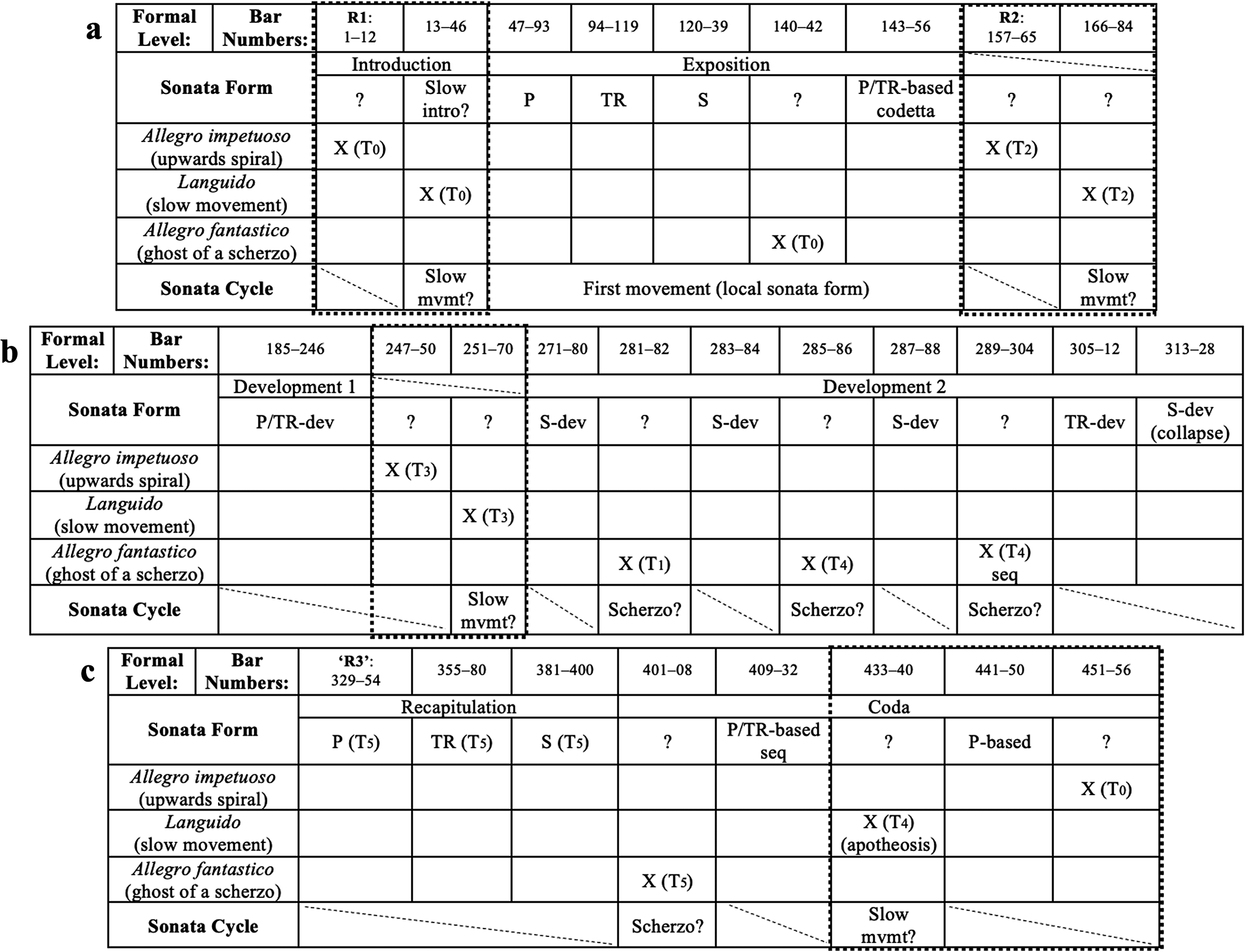
But the situation is not as simple as a two-dimensional potpourri of materials referable to sonata-cycle models intruding upon one single sonata form. For certain structural units in certain positions, Newman’s double-function moniker, though now often viewed as a mere precursor to Vande Moortele’s two-dimensional technology, seems an apt description of the formal functions certain sections acquire. Figure 1a–c provides a dotted outline for one particular musical unit, which is generated by suturing together the allegro impetuoso and languido materials. These two blocks (not in a sonata-form dimension) exhibit a kinship by repeated adjacency, with the allegro impetuoso always preceding the languido right up until their fourth and final appearances. In that apotheosized final appearance, the languido theme comes first, P-based coda material is interpolated in between, and the allegro impetuoso arises at its original transpositional level to conclude the sonata (compare bars 1–12 to bars 451–55), a strategy Scriabin employed often in later works with their great focus on cyclicity.Footnote 75
If we imagine a real-time listening to, rather than a bird’s-eye view of, the Fifth Sonata, the sutured-together allegro impetuoso–languido block also partakes in the trappings of a Hepokoskian/Darcian rotational structure; across bars 1–156 and bars 157–328, the exposition and development exhibit a remarkably similar ordered succession of themes (allegro impetuoso, languido, P, TR, S). However, the situation is complicated, in small part, by the intrusion of little fragments of allegro fantastico material (the scherzo block) and complicated in much larger part by the allegro impetuoso–languido appearance of bars 247–70, where this larger structural unit alters in character and threatens to interrupt the whole structure. Though the exposition and development perform relatively well from a rotational perspective, it appears best to invoke Wingfield’s preferred notion of ‘periodicity’ for the recapitulation, i.e. a more flexible concept that ‘can undergo permutation’.Footnote 76 The notion of a ‘reversed recapitulation’, a concept eschewed by Sonata Theory though germane to the writing of Schumann, Cone, Rosen, and Jackson, amongst others, finds a distant cousin in the Fifth Sonata:Footnote 77 the allegro impetuoso–languido adjoined-block reprises after the sonata-form dimension has fully recapitulated and reached its ESC, so the rotational structure, if we may deem it so, is topsy-turvy, not a precise rerun of the thematic layout espoused by the exposition and development. Both Smith and Edwards note topsy-turvy features in Scriabin’s later sonata forays, tonally and thematically; we will soon see this preference for an unusual kind of symmetry play out in both these regards in the Eighth.Footnote 78
Appearance 4 of the allegro impetuoso–languido block doubles as a coda, whilst appearance 1 can be rationalized without issue as a slow introduction with initial flourish. Neither explicitly suspends the sonata-form dimension of the piece because of the potential interpretative multiplicity of parageneric spaces.Footnote 79 Appearance 2 of the allegro impetuoso–languido block serves two potential functions. Firstly, it engenders the quasi-rotational reading briefly entertained above; secondly, it acts as something akin to a pre-core to the development, a ‘generally more relaxed’ state of suspension prior to the P/TR interminglings of quite incredible technical demand soon to ensue.Footnote 80 A reading of bars 157–84 as suspending the sonata-form dimension is not incompatible, though, and they may even be heard as an introduction repeat rather than as a development component; such a hearing renders the content summarized in Figure 1a ternary-like in its construction. Figure 1a acknowledges that the pre-core reading of bars 157–84 is at best at the periphery of a sonata-form interpretation given its lack of thematic integration (note the dashed lines, borrowed from Vande Moortele’s monograph).Footnote 81
Appearance 3, which carries an outlier designation in its explicit suspension of the sonata-form dimension (note the dashed line in Figure 1b, bars 247–70), serves to partition the development into two almost equally weighted halves (bar 256 is the central point). In the development’s first half, imbrication of P and TR material is rife, whilst in the development’s second portion, S and allegro fantastico materials alternate in a more discrete fashion. It is in this second half of the development that we see Scriabin’s fragment of a scherzo reach its most potent status, mirroring the placement of the scherzo ‘movement’ in Liszt’s Sonata (just prior to the recapitulation).Footnote 82 This material is, however, far from assertive of its own structural autonomy. Instead, allegro fantastico material is handled utterly discretely with regard to the S material stratified from it, as if Stravinsky’s well-documented compositional methods have cut and pasted Scriabin’s two blocks, one part of the sonata form and one not, with scissors and glue.Footnote 83 The breakneck motion and suspension of the sonata-form and sonata-cycle dimensions is a feature that differentiates Scriabin’s Fifth Sonata from all the two-dimensional models examined in Vande Moortele’s text; sonata-cycle fragments do not demonstrate formal integrity other than in miniature, topical terms.
The structure of the Fifth Sonata that we have rationalized so far can be distilled into a few sentences. There are two formal dimensions, one sonata-form and one sonata-cycle. The situation is complicated substantially by the fact that the sonata-cycle dimension is not linear in its presentation of material. Rather, musical units referable to a slow movement and to a scherzo intrude into the sonata form at various points. The allegro impetuoso material, which is quite unlike anything in the pre-1908 music, seems to exist in a sphere of its own, though it almost always occurs as a preparatory flourish for the languido. The blocks of the piece not in the sonata-form dimension ascend upwards in transposition, until their final appearances reprise the harmony of the work’s opening.
In its coda apotheosis, the Fifth Sonata reaches something akin to a synthesis, though far from the kind that Cone outlines in his reading of Stravinsky; there is no simultaneous statement or superimposition of musical blocks, not even of two at once. Rather, Scriabin stages a remarkably sophisticated tonal scheme that reconciles his two primary structural components: the sonata-form dimension and the slow-movement element of the sonata-cycle dimension. In this reconciliation, the allegro impetuoso and allegro fantastico materials are present, but only as frames to the apotheosis. Thus allegro fantastico material engenders the start of the coda and the great crescendo towards bar 433 (a vital moment of fusion to be discussed shortly), whilst allegro impetuoso material terminates the whole work’s structure, with a little assistance from P material, after the dynamic and registral apex of the apotheosis section (bar 440).
Let us unpack the sonata’s reconciliation between its two structural dimensions through a visual aid. Example 1 proposes a two-dimensional voice-leading sketch, where the upper staves refer to the sonata-form dimension and the lower staves refer to the four languido appearances; this graphic sidelines the two allegro blocks, though it captures their spiralling transpositional ascent through the similar treatment the rising languido material receives.Footnote 84 However, the opening allegro impetuoso appearance (bars 1–12) is factored into Example 1 for two key reasons, namely that the harmonic contents of this initial flourish entail an Edia macroharmonic profile scored with the bass note D♯. We are dealing with D♯ Locrian here, perhaps. This allows for the interpretation of the sonata’s sonata-form dimension as playing out two staggered Ursätze, one through E–B–E and another through D♯–B♭–E♭.Footnote 85 Both fundamental structures begin in bars 1–12, the first with E (I) implicated through Edia, before travelling, with temporal disconnect (generated by the intervening languido theme, which provides a secondary-dominant F♯ tonality), to B (V) through the Bdia profile of the exposition’s outset. Then, once the rest of the exposition and development have elapsed, a return to E (I) is achieved through the Edia profile of the recapitulation’s outset, the sonata’s ‘subdominant recapitulation’. This I–V–I motion is beamed in Example 1, though not marked with Roman numerals beneath it because it is the theoretically weaker of the sonata’s two Ursätze. The second I–V–I motion present in the sonata is inaugurated by the D♯ bass note of the work’s opening, subsequently moving to the chromaticized B♭ tonality of the S group in the exposition and then onto the chromaticized E♭ tonality of the S group in the recapitulation, a stronger motion (thus beamed with Roman numerals in Example 1) in that it aligns with where the EEC (bar 136) and ESC (bar 397) are most easily identified.
Scriabin, Fifth Sonata, voice-leading sketch: interspersion of two structural I–V–I progressions with two-dimensional sonata form.
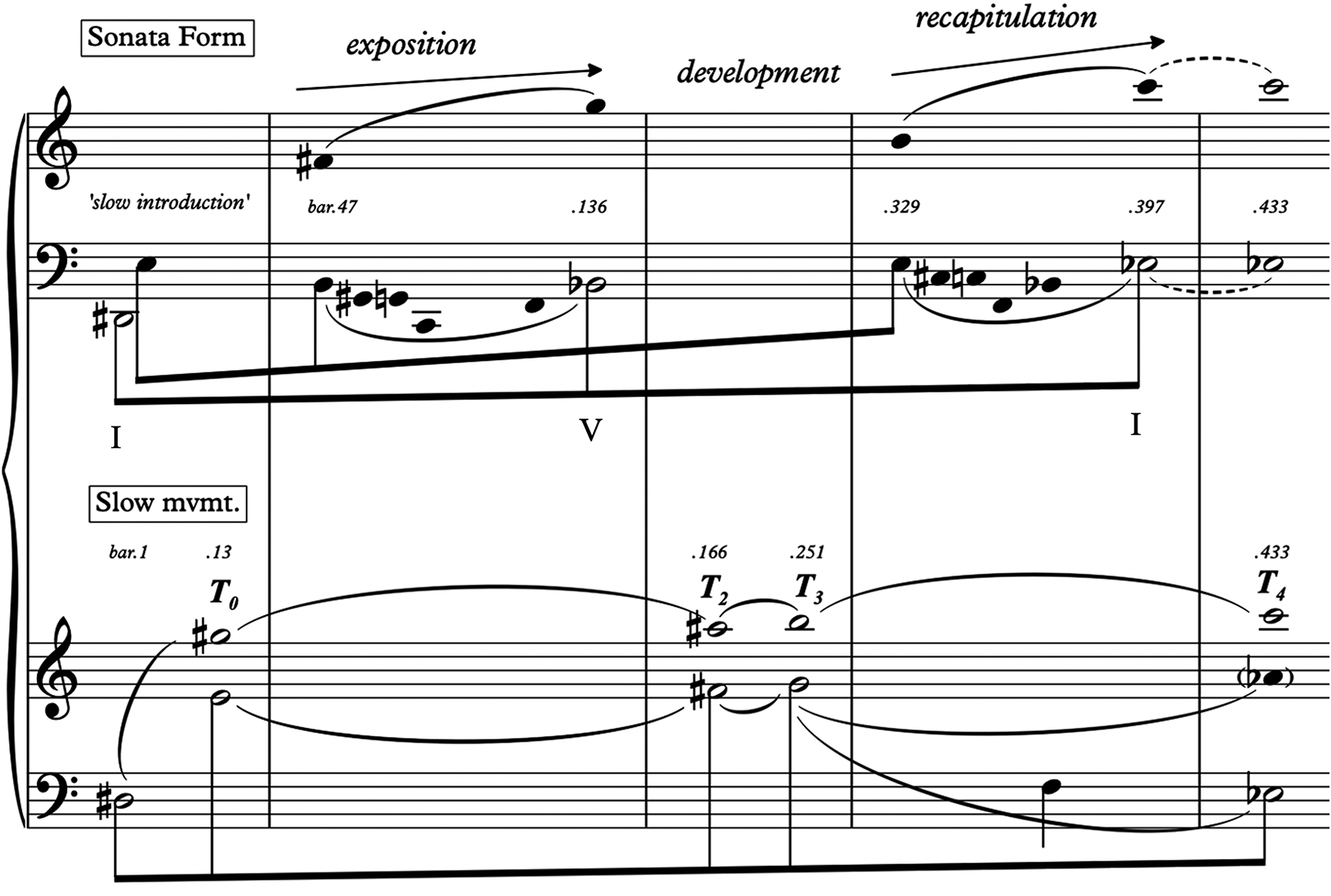
We can say two things about the Fifth Sonata in the above terms. Firstly, the opening allegro impetuoso material provides considerable utility from an extended Schenkerian perspective, containing the bass note required to generate the D♯–B♭–E♭ structural progression and the Edia macroharmonic identity required to generate a weaker E–B–E structural progression. This discontinuous Stravinskian block is, in just its first appearance, a key player in the tonal argument of the sonata before it spirals off into its own transpositional scheme that ‘operates simultaneously with the sonata process but does not invariably coincide with it’.Footnote 86 Secondly, the sonata-form dimension of the Fifth Sonata is itself constructed in two competing tonal structures of its own; it is clear that E♭ major is the principal goal of the two only at the outset of the apotheosis in bar 433. Related to the late clarification of the work’s tonal goal is that the first allegro impetuoso appearance in the sonata engages in a sense of ‘becoming’ (Janet Schmalfeldt’s term), though the formal function it acquires is dual in those very terms in that we only realize a) its placement and vital role in the sonata-form dimension’s two Ursätze once the recapitulation and coda have affirmed E♭ major so strongly, and b) its placement in the spiralling registral ascent of its own block once three further appearances of this material have occurred.Footnote 87
Turning to the lower pair of staves in Example 1, using the opening bass and melody notes of the languido theme appearances and charting these four appearances by upwards transposition generates an intriguing design that intercuts with the main sonata form. The original languido appearance at T0 and the second and third appearances at T2 and T3 generate an ascending stepwise progression in compound major thirds, utterly distinct from the tonal argument within the sonata-form dimension. However, the apotheosized iteration of the languido theme (bar 433) only continues this upward motion to T4 in the very top voice (see the right-hand C6 of bar 433, which connects to the arcing melody that concludes the S material in bar 397); bass support in this instance is instead derived from the E♭ pedal omnipresent until the work’s conclusion from bar 397 onwards (the recapitulation ESC). The expected pitch that previously offered bass support to the languido theme is thus relegated to a middle-voice A♭ in bar 433, with little to no structural significance beyond the generation of an extended dominant-quality chord in E♭ major atop a ‘tonic’ pedal. Scriabin could not have rendered his structural voice-leading more clearly in regard to bar 433 as the moment when sonata principles and slow-movement principles unite: a consolidation of sonata-form and slow-movement principles together under the resounding umbrella of E♭ major. By the apotheosis, we come to realize that Scriabin’s Stravinskian discontinuity was but a prelude all along, as the final presentation of slow-movement material is both transformed and assimilated into the design of the sonata-form dimension’s emergent tonal goal. Characteristic of Scriabin’s eschewal of cadential closure, E♭ major is never affirmatively cadenced in, despite the imposing three-stave texture and prolonged and extended dominant harmonies in this key. Instead, a relaunch into P and then allegro impetuoso material occurs, as if to wink at the rotational structure, now reversed, that the apotheosis has itself worked so hard to denature. The Fourth Sonata is a distant memory once the apotheosis of the Fifth has collapsed in on itself, though the two works do retain a kinship in that their respective movements (or ‘movements’) unite under one tonal umbrella in their closing stages.
The Enigmatic Eighth Sonata
By the composition date of the final three sonatas, of which the Eighth is the last, the most ‘extended in scope’, and has the ‘most comprehensive two-dimensional form’,Footnote 88 Scriabin had long departed harmony where extended Schenkerian tools can evince tonal forces as arbiters of coherence between structural dimensions (see notions of ‘implicit tonality’ in Baker’s work).Footnote 89 Within the Eighth Sonata, Scriabin also stages a remarkable evolution from the Fifth in terms of his Lisztian-Stravinskian strategy, breaking ground from even the Ninth and the Tenth Sonatas, with which the Eighth was concurrently completed.
To understand the Eighth Sonata’s formal argument, we must briefly grapple with two concepts: ‘neofunction’ and ‘octatonic neighbourhoods’.Footnote 90 In the sonata, the three octatonic collections expand in scope to encompass their acoustic, harmonic minor, and harmonic major cognates, that is, the three asymmetrical collections that maximally intersect one parent octatonic collection.Footnote 91 The result of this fertile linkage is that Scriabin constructs vast scalar ‘neighbourhoods’ where each octatonic collection provides a nexus for four acoustic collections, four harmonic minor collections, and four harmonic major collections.Footnote 92 Hereinafter, these expansive networks are designated OctNx,y, where ‘x,y’ refers to the parent octatonic collection. Harmonic minor, harmonic major, and acoustic collections within neighbourhoods all maximally intersect one another too, so within and between neighbourhoods there is great opportunity for flux and variation based on minute voice-leading change; in these terms, the Eighth differs sonically by several degrees from the ‘musical monochrome’ of pure octatonicism in the Sixth and Seventh Sonatas.Footnote 93 As both Smith and Edwards note, octatonic neighbourhoods, expansive as they are, acquire a sense of extended functional status within the Eighth Sonata, just as the three octatonic collections had, in much purer states, functioned as ersatz ‘keys’ in earlier works.Footnote 94 Based on thematic correspondences and the sense of harmonic cyclicity that had become a requirement in sonata structure for Scriabin by 1913, we can deduce that OctN0,1 holds a T neofunction in op. 66, OctN1,2 a D neofunction, and OctN0,2 an S neofunction. These neofunctional mappings mirror the ubiquity with which Scriabin employed the three parent octatonic collections as stand-in tonics, dominants, and subdominants throughout his late oeuvre.Footnote 95
Just like our Fifth Sonata analysis, we shall now see how the Eighth Sonata’s structure employs a Lisztian-Stravinskian argument through the interaction of its formal dimensions. Figure 2 provides a diagram with similar data to Figure 1a–c. However, because almost all of the Eighth Sonata is referable to its sonata-form dimension (little to no material is viewable as an interpolated movement), Figure 2 is rather more compact than its predecessor.Footnote 96 The Eighth Sonata reaches a level of integration between its two formal dimensions that is quite close to Liszt’s Sonata. Neofunctional designations and harmonic summaries for each of the sections are also provided in Figure 2, drawing on the two frameworks outlined above.
Scriabin, Eighth Sonata, formal/harmonic summary.
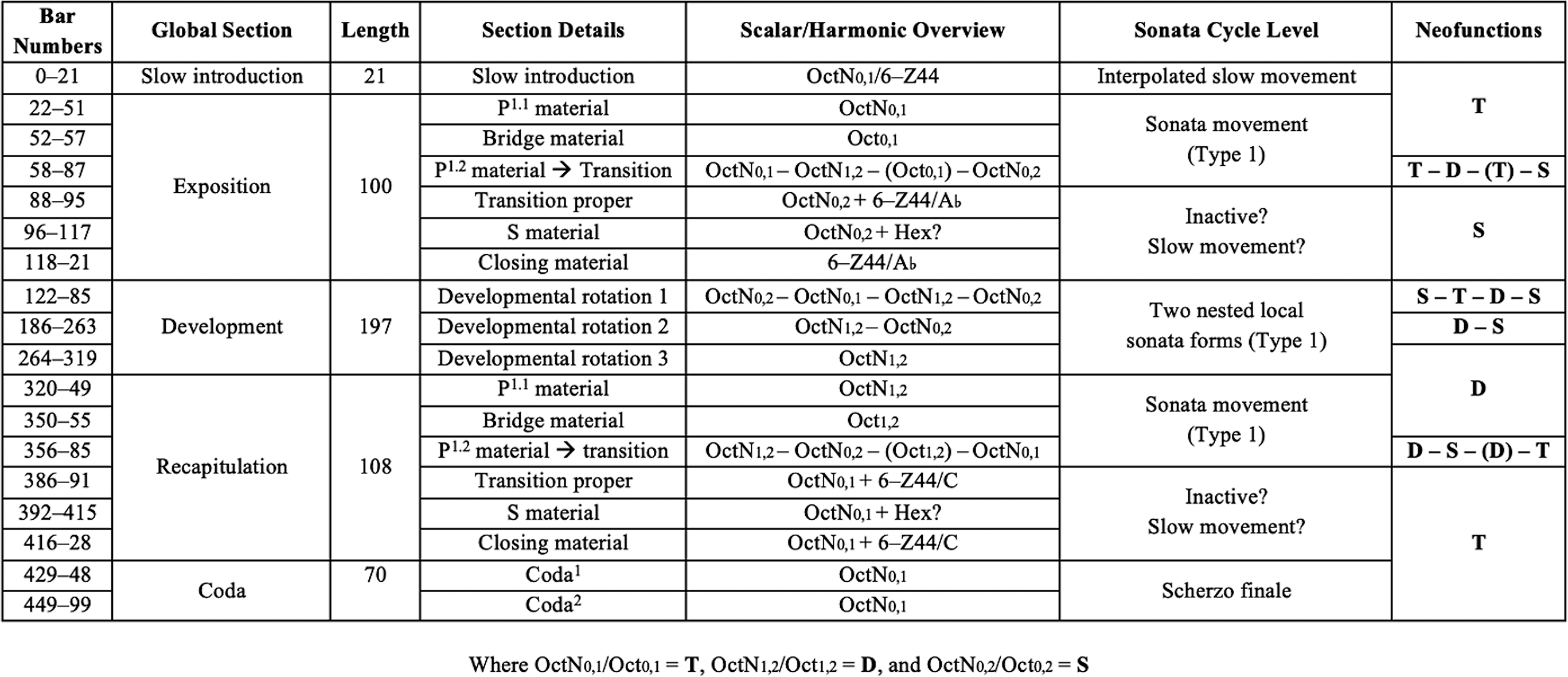
The Fifth and Eighth Sonatas are similar in some non-trivial ways. Firstly, both include a slow introduction in the sonata-form dimension that can also be conceptualized as a slow movement, though placed in an ‘incorrect’ first position in both instances. The Fifth Sonata’s languido was but one agent of montage in its broader structure. The treatment of slow-movement materials in the Eighth Sonata is altogether more remarkable: the S material of the sonata-form dimension seems to be only a slight recomposition of the opening 21-bar slow introduction; both sections are identical in length, use three staves at various points, employ interlacing of the very same array of motifs, and, crucially, stage a similar sense of hexatonic/octatonic ‘emulsification’.Footnote 97 When stacked, such likenesses suggest that the slow movement/slow introduction of the Eighth Sonata is a pre-emptive proto-iteration of the sonata form’s S material, a double function upon double function that has gone unmentioned in the literature so far — probably due to the tempo disparity.Footnote 98
There are other features of interest in the Eighth Sonata that differentiate it from the design of the Fifth. Whereas fragments of various movements were employed in a montage-like structure within op. 53, in op. 66 there are clear local sonata forms nested within the overarching sonata form, found in both the exposition and recapitulation P zones (bars 22–87 and bars 320–85; Smith notes only the first of these) and in the development between bar 174 and bar 263.Footnote 99 In the case of the local sonata movements nested within the exposition and recapitulation, from the overarching sonata-form perspective, these local forms are P1.1–bridge–P1.2 in construction, where both iterations of P material are comprised of two musical ideas: a descending flourish through harmonic minor material and an upwards striving through acoustic material. As such, Scriabin’s local sonata strategy (forms that, in their own structurally autonomous right, are best considered Type 1) concatenates two materials in a montage-like manner within its more global thematic layout, like a Russian tea doll, holding formal constituents that only truly make sense when considered two-dimensionally. The scherzo-like ‘bridge material’ identified in Figure 2, some of the sonata’s purest octatonicism, is an amplified cousin of the allegro fantastico block from the Fifth Sonata. In the Eighth’s exposition and recapitulation, the bridge material does not assume so Stravinskian a treatment as in the Fifth, instead working as a fleeting development substitute (from the local Type-1 sonata-form perspective) to partition P1.1 and P1.2 into two equally weighted 29-bar subsections. This material also arises in the development’s retransition (bars 306–19), where it is juxtaposed with fragmentary fanfare gestures from the earlier tragique transition proper; this same cut-and-paste narrative had played out in the Fifth Sonata’s retransition, though there with scherzo-like material juxtaposed with S just prior to the ‘collapse’ that Smith identifies.
The Eighth Sonata’s development is more complex than the Fifth’s. In op. 53, this section was subdivided into two parts by the conjoined allegro impetuoso–languido module. The Eighth’s development pursues its own quasi-rotational structure that consists of three distinct sections, each separated by a curious trill gesture quite unlike anything else in Scriabin’s output (see bars 185 and 263).Footnote 100 From the two-dimensional perspective, the Eighth Sonata’s development also betrays other structural tenets, based on structural mirroring. Pavchinsky identifies two intra-development sections that together generate what modern parlance describes as a Type-1 local sonata form, as shown in Figure 2.Footnote 101 Nicholls, drawing on the ‘experience of learning to play this enormous continuous movement’, locates five divisions in varying exact or partial correspondences, a sort of arch form.Footnote 102 Clearly, the development of op. 66 is multi-dimensional in the interpretations it engenders: two Type-1 sonatas, three rotations, and a five-part arch structure; it is little wonder that Smith’s essay requires three-dimensional spatial metaphors at times.
To fully understand the Eighth Sonata’s development, however, a detailed look at its recapitulation is required. The sonata’s exposition travels from the neofunctional space of T through D to S (with some fleeting doubling-back on itself in bar 73). This piece sits at the apex of a long line of subdominant S-material works: Beethoven’s Overture to The Ruins of Athens, the finale of Chopin’s Sonata for Piano and Violoncello, the finale of Schumann’s Fantasie, op. 17, and numerous movements by Schubert.Footnote 103 When the P material returns (bar 320) in the neofunctional realm of D, the order is reversed, and the recapitulation proceeds from D through S to T, bearing direct comparison with the dominant recapitulation of Beethoven’s Leonore Overture No. 3 and the first movement of Schubert’s Fourth Symphony.Footnote 104 Because Scriabin’s ‘tonal’ structure is tripartite (octatonicism comes in three distinct modes), rather than the bipartite I–V–I axis of functional tonality, the effect of a recapitulation in D neofunctional space is akin to the ‘self-evident logic’ that Hepokoski and Darcy identify in a Schubertian subdominant recapitulation; no recomposition is required for the recapitulation to travel back to T, minus some registral reworking that does not erode the nested local sonata form of bars 320–85.Footnote 105 A ‘parallel’ recapitulation thus ensues that produces the ‘necessary tonal resolutions for the S and C zones’, both in T neofunction OctN0,1, and this can only occur effectively if the development concludes in D space before bleeding over into the reprise.Footnote 106 In effect, the ‘standing on the dominant’,Footnote 107 or rather standing within D neofunctional space, that ‘ought’ to conclude the development is a feature of almost half of the recapitulation, meandering in the opposite manner to the exposition’s octatonic argument. Some new motivic interlacing does also occur (see bars 344–49, which parallel the texture of the close of the slow introduction), but the recapitulation is, broadly, a replica of the exposition in all significant terms. Only eight bars of closing material to usher in the coda differentiate their lengths.
Reading the present analysis of the Eighth Sonata so far, one could be forgiven for thinking that Scriabin’s strategy was in no way discontinuous; two-dimensional complexity and octatonic balance have been almost the sole features, and both appear executed with considerable elegance. There are Stravinskian characteristics at play here too, though. Firstly, the P zone is block-like, as previously mentioned. Secondly, the motivic interminglings in the development are often not so much mixtures but sharp juxtapositions between musical units; bars 297–319 are most instructive in this regard.
Eagle-eyed viewers of Figure 2 will note that there is some material, mostly in the transition sections, that is not referable to a single octatonic neighbourhood. In these instances, with an eye on the fact that in late Scriabin theme and harmony are joined at the hip, the set-class membership for the music is given, 6–Z44, alongside a hypothesized ‘root’ tone affiliated with each appearance of this set.Footnote 108 Set 6–Z44 is a pitch resource novel to the Eighth Sonata in Scriabin’s oeuvre, arising most prominently as a rhythmically obscure (triplet versus quadruplet) idea that a) seems to oscillate, at breakneck speed, between a minor triad with an added major seventh and a dominant seventh, and b) amplifies the uneasy semitone ‘tremors’ of the Fifth Sonata’s transitional material.Footnote 109 Bars 82–87 provide a representative example of 6–Z44 in context, treated with maximum thematic insulation from the striving P material that surrounds it.
Set 6–Z44 arises in other locations, too. Firstly, it is the upbeat sonority to bar 1 and a key player in the Introduction, framing the chorale-like texture of bars 1–4. There it manifests as a chord rooted on C, in first inversion, with minor and major thirds and minor and major sevenths; Example 2 rationalizes such an identity in terms of C as a pitch centre. This particular sonic likeness is hard to shake for the duration of the work, particularly in light of the much-explored role of pitch centricity in Scriabin’s late harmonic practice.Footnote 110 In such terms, 6–Z44 may even be heard as a concentrated fusion of the constituents of a neo-Riemannian ‘SLIDE’ transformation (E♭ major to E minor) over a C root, with the stabilizing C–G fifth held invariant.Footnote 111
Scriabin, Eighth Sonata, pitch-centred voicing of set-class 6–Z44, displaying coexistent third and seventh types.
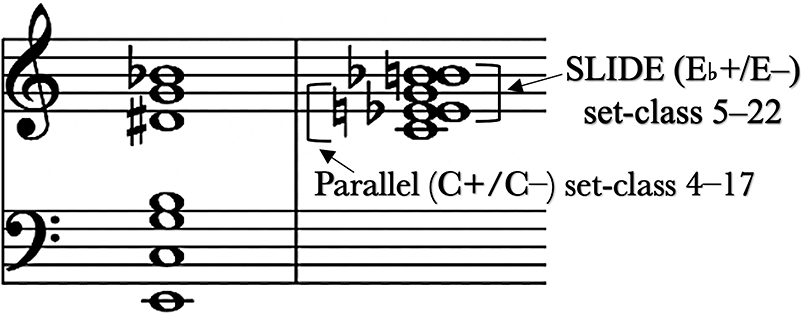
Other manifestations of 6–Z44 include its extensive surfacing in the development as part of the triplet–quadruplet rhythmic obfuscations, composing out its micro-appearances in the exposition’s transition. Moreover, the set arises as three piano stabbed chords in bars 214–15 and 292–93, gestures almost as athematic and peculiar as the aforementioned double trills that partition the developmental rotations. In this final instance, 6–Z44 appears to reset the development’s motivic working, in both instances engendering pseudo-reprises of S material set in sharp distinction from any other thematic ideas. Excluding those within the introduction, all 6–Z44 appearances are treated with the utmost insularity, as if these are little suspended fragments of some other piece or style (few will not have noticed the shared set-class membership with the ‘Schoenberg hexachord’) — just like the allegro fantastico ghost of a scherzo and the opening allegro impetuoso block from the Fifth Sonata. This thematic hermeticism noted, all 6–Z44 appearances in op. 66 exhibit what can be thought of as chordal root tones — built up thus: [0, 3, 4, 7, 10, 11], where 0 equates to a discernible pitch centre — that map neatly onto one of the four nodal points of the parent octatonic collection that governs the neighbourhood in force at that particular moment. Pitch centricity, an established essential condition in Scriabin’s late works, is in no way eroded by this unusual set and its strange orthography.
This harmony is remarkable in more than its spelling system, though, because despite its distinctly discontinuous treatment within the sonata structure (and thus its sense of non-belonging to either the sonata-form or the sonata-cycle dimensions), 6–Z44 summarizes the variable scale degrees of the various scalar maximal intersections that govern the work’s pitch structure. If we conceptualize 6–Z44 not as a set-class but as a pitch-centred entity in tertian voicing, in the manner outlined above in its very first appearance in ‘bar 0’ and rationalized in Example 2, we can note that it possesses both types of third and both types of seventh. These are precisely the key variable scale degrees that govern the parsimonious voice-leading in the sonata.
Let us step back for a moment. Smith’s ‘neofunctional’ and Edwards’s ‘octatonic neighbourhood’ analyses of op. 66 agree that OctN0,1, by way of example, holds an expanded tonic status, comprised of the following array of thirteen scales: Oct0,1, Cac, E♭ac, F♯ac, Aac, Ghm, B♭hm, C♯hm, Ehm, DHM, FHM, A♭HM, BHM. Whilst I agree that the sonata partitions its neighbourhoods in this way, there is no sense, within OctN0,1, for example, of G, B♭, C♯, E, D, G, A♭, or B centricity. Indeed, within a neighbourhood, pitch centricity remains entirely affiliated to the nodal points of the parent octatonic collection governing that neighbourhood. Although the hm and HM scales appear as enharmonic objects, they are modally permuted to adhere to the diminished-seventh quartet of pitch centricities that make up the nodal tones of the parent octatonic collection. Thus Scriabin uses the fourth mode of the harmonic minor scale, also known as the ‘altered Dorian’ scale, and the fourth mode of the harmonic major scale, also known as the ‘Lydian ♭3’ scale.
The role of 6–Z44 as an abstract transformational nexus now becomes clear, as shown in Example 3. The right-hand portion of this diagram shows Scriabin’s well-established whole-tone, acoustic, and octatonic voice-leading procedures that bridge larger neighbourhood relations; these have been understood since Callender’s 1998 work. Turning to the relationship between columns, acoustic collections are related to altered Dorian collections by lowering their natural third by a semitone to a minor third; this variable scale degree is summarized by one aspect of 6–Z44. Further, considering the relationships in the left-hand portion of Example 3, altered Dorian collections are related to Lydian ♭3 collections by raising their minor-seventh scale degree to a major seventh, a feature also exemplified by the 6–Z44 object. These variable scale degrees have profound ramifications for musical structure, for in the P material throughout the sonata, acoustic ➔ altered Dorian transformations are the harmony’s foundational premise; the two P-zone components alternate in this way, strictly, throughout bars 22–51. In the S material and in the development, altered Dorian ➔ Lydian ♭3 transformations are a more frequent manoeuvre, resulting in passages of complete near-hexatonic cycling through all four of Richard Cohn’s so-called ‘hexatonic systems’.Footnote 112 Bars 198–213 and 276–91 provide the clearest examples of such movement, an utterly novel soundscape in the broader context of Scriabin’s published oeuvre, in which (almost full) hexatonic collections rotate about the four nodal points of Oct1,2.Footnote 113 Discerning scalar theorists will note that Example 3 posits a particular richness to the soundscape of op. 66. It offers a complete model for how octatonicism and hexatonicism relate without eroding the pitch centricity germane to both Scriabin’s octatonic neighbourhoods and wider practice; diagrams extrapolating ‘acoustic ➔ altered Dorian ➔ Lydian ♭3 pathways’ from the other three nodal points of Oct0,1 would each yield different hexatonic collections to exhaust the quartet of Cohn’s systems. To achieve this, we must acknowledge that any given Lydian ♭3 harmony at play temporarily erodes the scalar purity of its relevant OctNx,y; C altered Dorian and Cac maximally intersect Oct0,1, for instance, whilst C Lydian ♭3 belongs to another neighbourhood altogether.
Scriabin, Eighth Sonata, scalar parsimony model for hexatonic/octatonic interaction.
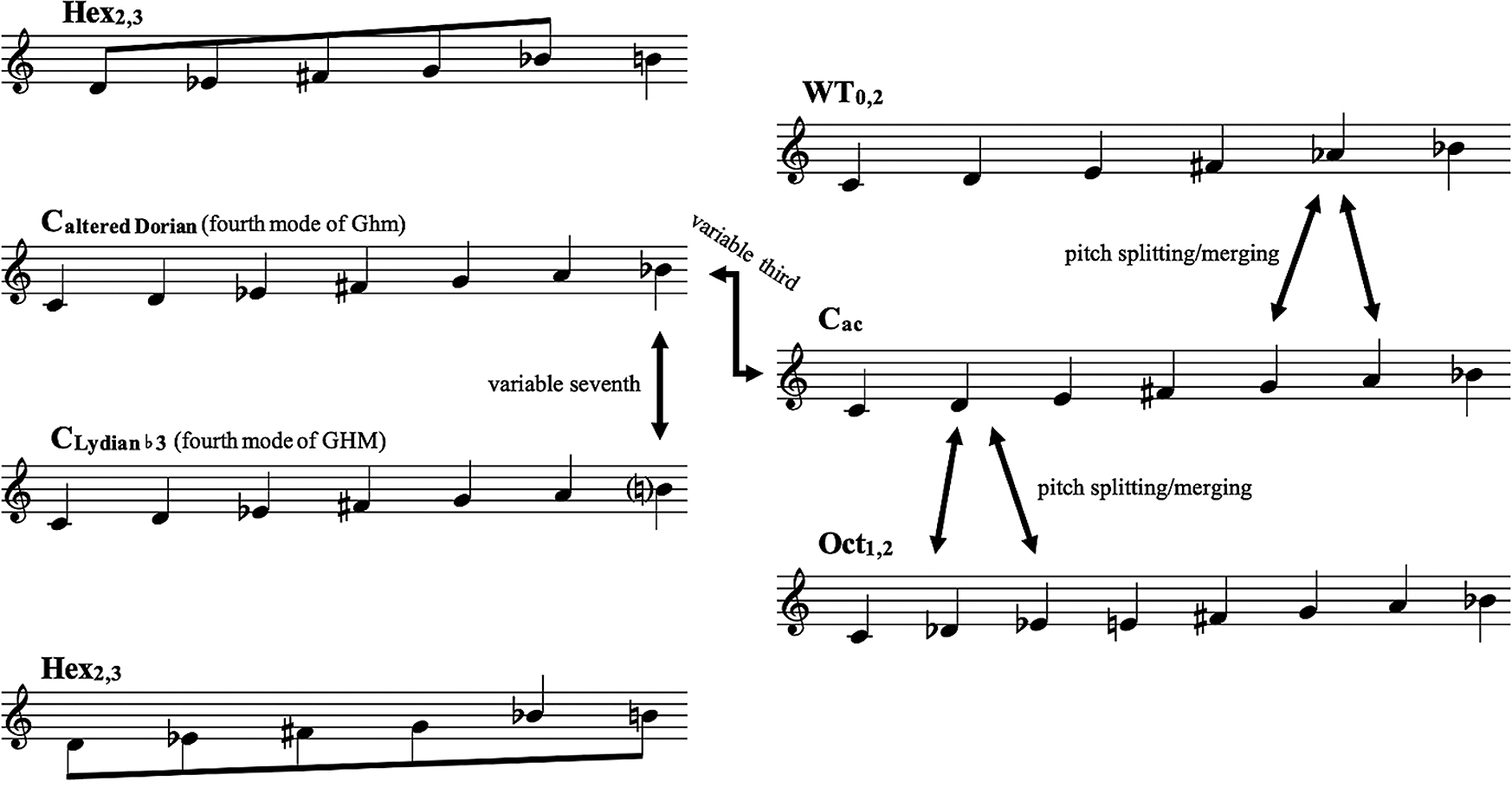
In sum, we are presented with a discordance in the Eighth Sonata’s treatment of its 6–Z44 block. On the one hand, this unit, in all its real-time, audible appearances within the sonata form (parageneric space excluded), suggests a lack of integration with the rest of the work. However, from a more abstract, harmony-orientated perspective, 6–Z44 is a summative entity regarding the work’s key pitch-collection interplays. It seems to me that the Eighth Sonata reaches a level of disjunction and obfuscation quite unique even for Scriabin, with the formal treatment of material contradicting its status as a harmonic nexus. Close comparison ought to be made with the first twelve allegro impetuoso bars of the Fifth Sonata; there too, a discrete block handled outside of the principal sonata form was a key player in the extendedly tonal argument that occurred. Between 1908 and 1913, Scriabin’s harmonic language evolved considerably, though the relationship between harmony and formal units retained its subtle trappings predicated on an uneasy discord. In both sonatas examined here, Scriabin’s discontinuous blocks fail to partake in any developmental trajectory associated with the sonata-form dimension; nevertheless, they present the missing piece to the enigma that is each work’s abstract harmonic argument.
It was Dahlhaus who first noted the problem that Scriabin’s late harmonic appetites posed for sonata form, a ‘contradiction’ that required ‘rescue’.Footnote 114 Such negative outlooks are reinforced in scholarship by Copland’s earlier assertion of ‘straitjackets’ and by Macdonald’s notion of Scriabin sonata analysis as an ‘unproductive activity’.Footnote 115 For Dahlhaus, only deferral to Lisztian virtuosity in recapitulations and codas could cure Scriabin’s sonata deficiency.Footnote 116 The Eighth Sonata is not ‘accelerative’ in these terms, though, despite its vertiginous coda; the central development is the virtuosic climax of the work and no late apotheosis is staged, as in the Fifth, Seventh, and Ninth Sonatas. Indeed, the exposition and recapitulation are mirror images of one another, not only in octatonic scheme but also in terms of character and real-time performance duration. The 70 bars of coda also mirror the 21 bars of slow introduction when accounting for their tempo disparity, as Ritter notes.Footnote 117 An elegance and balance of the harmonic and formal dimensions is clearly key for Scriabin in this work; Kelkel speaks of a ‘mirror with double facets’.Footnote 118 Such features are intruded upon and set into sharpest relief by the Stravinskian character of the 6–Z44 ‘block’, which both belongs and does not belong, in different senses, to the two deft formal dimensions.
Conclusions: How and Why, Influence versus Inheritance
At the outset of this article, I declared a desire to uncover not just how Scriabin’s mature sonata forms are Lisztian-Stravinskian but why. I hope that the first of those goals has been satisfied in some regard by the analyses above. Those that remain unconvinced about the application of a Lisztian-Stravinskian lens to the Sixth, Seventh, Ninth, and Tenth Sonatas might wish to note the language of thorough thematic demarcation employed in Garcia’s ‘symbolist plot archetype’ reading of the sonatas from the Fifth to the Tenth (minus the Eighth). The ‘block’ nature of Scriabin’s structural units has been a fixture, implicitly, of the literature for at least two decades; the commonplace ‘modular assembly’ construction elucidated in Hepokoski and Darcy’s Elements is adopted by Scriabin and made ever more modular, ever more discontinuous, ever more Stravinskian.Footnote 119 Scriabin, of course, was not to know of that final label in his lifetime.
As for the question of why Scriabin sought to construct his mature sonata forms in a two-dimensional manner with more than a hint of Stravinskian discontinuity worked into his structural arguments, several complementary factors appear to be at play. To each of the individual characteristics first: Scriabin’s sonata forms are two-dimensional and thus Lisztian in their inheritance not simply because the climate of sonata forms post-1853 required innovation to avoid stagnation. Nor do these traits manifest because Scriabin was directly wired into the world of Alexander Siloti, Liszt’s greatest champion in Silver Age Russia, though such existing, apparently self-explanatory, links between Liszt and Scriabin seem likely to have been nurtured and strengthened by this biographical bridge. Rather, Scriabin’s sonatas appear to me most justifiably two-dimensional precisely because they are ‘blocky’; that is, they are Lisztian because they are also Stravinskian. This may strike some readers as extraordinary historical acrobatics with composer-named conceptual heuristics. However, the interpretative angle of multi-dimensional movement nesting is necessitated, within Scriabin’s already small structures, by his desire to imbue ‘textbook’ sonata form with sharply contrasting materials that resemble — in well-delineated topical terms accorded by Garcia’s work — different movement structures in the sonata-analytic paradigm, both single- and multi-movement-framed. In short, the inclusion of certain discontinuous structural components prompts fertile interpretation in two-dimensional terms; we will revisit this notion again shortly.
Rerouting back to historical considerations, I have been careful in this article to minimize discussions of direct influence and instead to use the term ‘inheritance’. This softer vocabulary enunciates a more general biographical climate in which Liszt’s influence on Scriabin sonatas is theorized as thriving, one that flies closer to T. S. Eliot’s ‘generosity theory’ than to more anxious Bloomian frameworks popularized by Straus and Korsyn in musicological discourse.Footnote 120 Scriabin’s sonata forms are Stravinskian, to an extent, for quite the opposite reason to the Liszt connection; indeed, it seems likely that Stravinsky might have acquired what became his structural hallmark from Scriabin, not the other way around. And the notion of ‘inheritance’ holds sway here again, for Stravinsky likely acquired such hallmarks from composers in addition to Scriabin (Debussy? Mussorgsky? etc.), to say little of the uptake of octatonicism, and hexatonicism, that almost certainly also came from Rimsky-Korsakov as well as from his early theosophist idol.Footnote 121 Philip Ewell expounds the hexatonic angle in detail and further notes the important matter of a post-Wagnerian harmonic inheritance in this regard, a connection that the Scriabin scholar must feel acutely and relate both to harmony, which Scriabin maximalized in cardinality relative to even Wagner, and to the cultivation of ‘blocky’ structures.Footnote 122 Debussy, Strauss, Mahler, and even Schoenberg are also probably players in this shared climate of interconnectedness.
Scriabin’s Stravinskian sonata tenets are probably the result of negotiating several compositional penchants. The first is his preference for miniaturism.Footnote 123 This results in the brief duration of all the sonatas from the Fifth to the Tenth, relative to other two-dimensional works; these are compressions of a Lisztian model more accustomed to expansive temporal domains.Footnote 124 Miniaturism also plays into Scriabin’s sculpting of well-defined musical units referable to Symbolist plot archetypes. To create a tangible sonata structure, such small units must be combined en masse to render a broader form, this necessitating ambition that Scriabin was not usually accustomed to.Footnote 125 The compression is thus twofold, at the level of the overall piece and the level of the musical unit.
A negotiation of national identity may also have a role to play in Scriabin’s Stravinskian structures. Smith asserts that ‘Scriabin is doing something idiosyncratically Russian with these structures […] staging a dialogue along the lines of Eisenstein’s Montage cinema’.Footnote 126 A reference to Cone’s work follows, mooring Scriabin to Stravinskian ‘Russianness’ by implication. I do not wish to pursue generic national musical stereotypes in this article.Footnote 127 We know that Scriabin, though connected through publishing to the Belyayev school of composers for some time, was essentially ambivalent towards the Russianness espoused by several of his colleagues. Scriabin maintained a healthy distance, with a more cosmopolitan and yet (perversely) more insular outlook on style, though whether conscious rejection of Rimsky and his students, amongst others, is attributable to the all-consuming nature of his world views from about 1907 onwards or to personal grudges is up for debate.Footnote 128
I think that a more telling ‘Russianness’ in Scriabin’s music is his employment of the pitch collections that saw first extensive use in Rimsky-Korsakov, and concurrently in Liszt — with cross-pollination evident.Footnote 129 Because such symmetrical resources (chiefly octatonicism, known as ‘Rimsky-Korsakov’s mode’ in Russia during Scriabin’s lifetime) lend themselves to cyclical rotation, potentially ad infinitum, the harmonic evolution of Scriabin’s oeuvre almost necessitates a block-like structure in some regard. To cite the simplest possible example: when a passage’s harmonic motion is confined to octatonic collections, some sense of thematic insulation between materials is required to ensure that the sound world does not turn into Kallis’s idea of a ‘musical monochrome’. All octatonic collections have the same character, harmonically speaking, which engages in dissolution of the teleology familiar to functional tonal arguments, so the material itself must be juxtaposed in some other way to avoid prosaic circularity. The problem is particularly acute in extended sonata forms. Scriabin negotiated an avoidance of monochrome, perhaps what he would have deemed ‘Rimsky-Korsakoffery’, partly through his well-documented acoustic–octatonic interactions, though such subtle strategies, predicated on minute semitone inflection, go only so far.Footnote 130 Dahlhaus hit upon the true angle, however, in noting that both Scriabin’s miniaturist leanings and the harmonic nature of his thematic materials, ‘suggested by the chord centre technique’, work together to make the motifs ‘extremely short’, even cellular.Footnote 131 Scriabin, lover of prophecy that he was, staged his own self-fulfilling structural prophecy in his embrace of certain idiosyncratic harmonies most comfortably set as small musical units.Footnote 132
Ultimately, it is the interaction of so-called ‘Russian’ formal and harmonic strategies (whatever the cause–effect relation between these may be) with the more stereotypically ‘Germanic’, ‘European’ sonata principle that results in Scriabin’s curious Lisztian-Stravinskian approach towards structure and form in the mature sonatas. Scriabin, ever the cosmopolitan composer in his outlook, found a fruitful way to reconcile a New German model with the structural hallmarks of his homeland, whilst various other lateral and bottom-up forces exerted pressure on his sonata treatments from other angles. Figure 3 attempts to capture this convergence of factors; in short, the mature sonatas are pressure-cooked by numerous competing forces. Concordant with notions of multifaceted inheritance, the convergence of such forces is, of course, also a matter of their interplay. Indeed, one might extrapolate, with reference to the lack of formal self-sufficiency Scriabin’s sonata-cycle elements possess relative to the larger models surveyed in Vande Moortele’s 2011 monograph, that the atomization of the formal integrity of elements of a profoundly New German model provided a catalytic resource for the ‘blocky’ approach to structure that characterized much musical style across the twentieth century. In such terms, maybe we ought to speak of a Stravinskian New German inheritance too. Nevertheless, by reading his mature sonatas in such terms, we may now begin a more sophisticated reassessment of Scriabin’s ‘Russianness’, which likely exerted effects on Stravinsky, and his ties to the earlier tradition of sonata-form innovation pioneered by Liszt. Scriabin, far from being hermetically sealed from musics before, surrounding, and after him, is readily ‘stitchable’ into at least these two traditions, and probably many more. This position is clearest when scholarship shifts focus from harmony to form, though harmony undeniably has a role to play in the arguments outlined above. Indeed, in at least the two watershed works analysed above, harmony entails much of the glue that binds discontinuous and continuous formal tenets together.Footnote 133
Scriabin’s mature sonata forms: cross-currents and top-down/bottom-up factors.
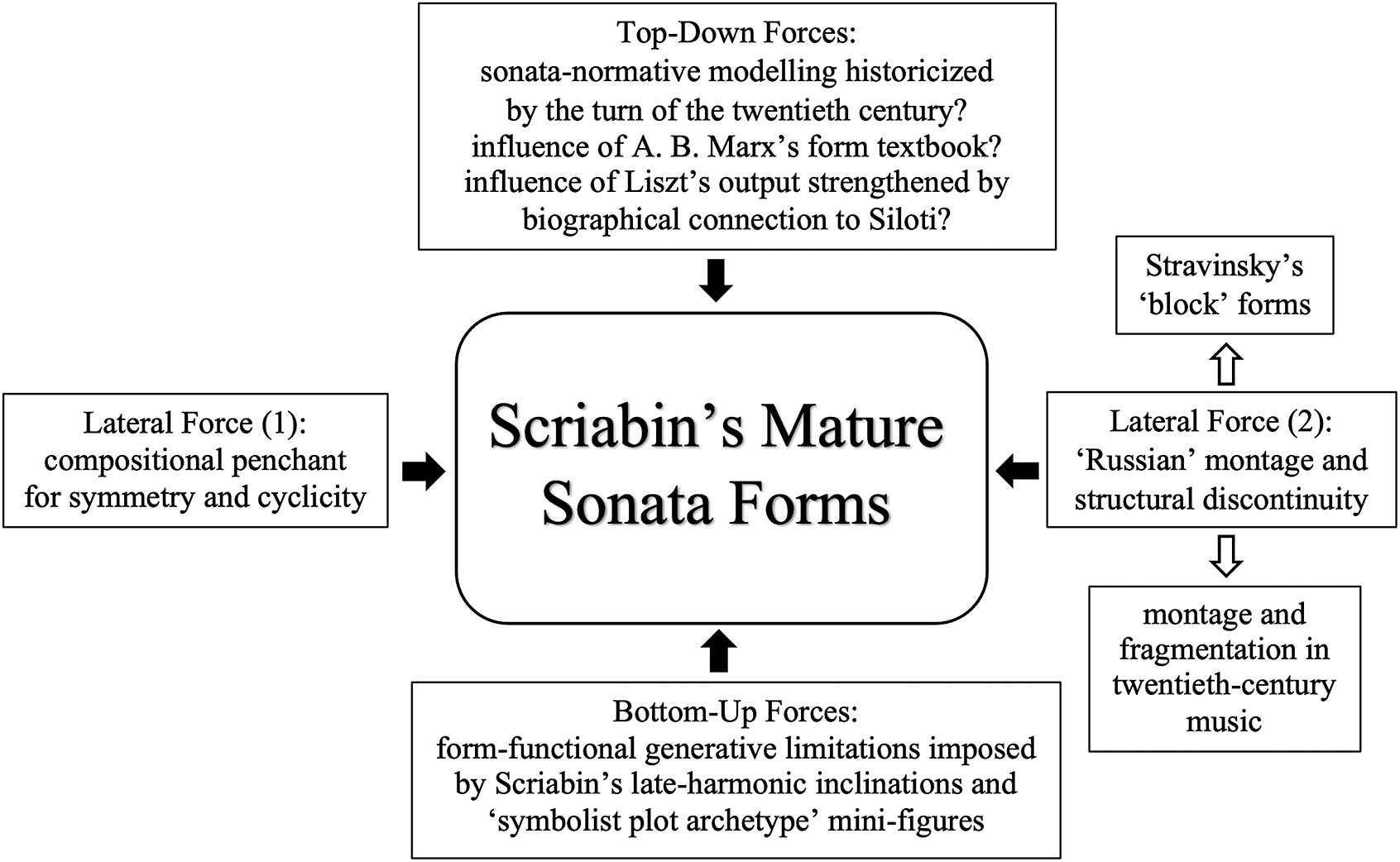
Because New German and Russian traditions are often conceptualized as diametrically opposed, and thus difficult to reconcile in a single piece, particularly alongside Scriabin’s harmonic appetites and his penchant for symmetry and miniaturism, the legacy and pre-legacy of their appearances in his sonata structures has resisted classification until now. Application of a Lisztian-Stravinskian lens to Le Poème de l’extase and Prometheus appears the next logical step, perhaps alongside consideration of the extramusical borrowing that these two tone poems also demonstrate with regard to New German and ‘Russian’ heritages.Footnote 134 As is often the case with Scriabin, we can only speculate what even larger asymptotic works might have achieved with their potential sonata inheritance. Certainly, they would not have been ‘straitjacketed’.
Parageneric Space: History and Analysis
In Scriabin study, historical musicology and musical analysis are quite cordoned off from one another. This is doubtless because relating Scriabin’s cocktail of beliefs to his music is difficult when the beliefs themselves are little understood. Nowhere is this more evident than in Smith and Kallis’s Demystifying Scriabin, an important and impressive essay collection that marked 150 years of the composer, though which nevertheless channelled its analytical chapters into one central section: ‘the music as prism’. Where such ‘technical depth’ is concerned, this grouping is of course a practical one for reader intelligibility;Footnote 135 such strategies have carried through into this present article, where analytical and historical sections demand a certain sense of isolation. This being said, Taruskin had much correct in his ‘millennial essay’ when arguing that going forwards, an ‘integrated perspective’ is vital for this mysterious composer, one that marries theory and analysis to context.Footnote 136 Taruskin’s view of ‘Russianness’ is a different one to mine and seeks to relate spiritual vision to scores; limits are also set ‘on the use of technical language’ in his enquiry.Footnote 137 I have contended above that the situation can be at once simpler and more complex; that is, that we need not even touch on belief system when prioritizing matters of form, rather than harmony, and that though we can engage with ‘historical musicology’ as a base and a prompt, we ought also to make no apologies for that ‘technical depth’ so valued by analysts. History and analysis can come together in this way; the practicalities engendered by their differing styles nevertheless necessitate that they must form in something of their own vacuums before such bubbles burst.
APPENDIX
Letter 1 — 23 June 1911
From Vera Pavlovna Siloti to Alexandra Pavlovna Tretyakova Botkina
Dear Sasha,Footnote 138 I was so glad to receive your letter, as I was lonely without news of you. With the help of Miss Rees, Oxana translated Sasha’sFootnote 139 ‘Memories of Liszt’ into English, which Sasha changed lots, as they were merely outlines the first time. They will be printed in Russian and English in the autumn, seeing as the English love everything which concerns famous people such as Liszt… Melartin visited us, with whom I have become closer and closer over the past winter. These are all our évènements. Footnote 140 It would have all been good, save for the two weeks of unrest for poor Mottl — and still, it’s his loss.Footnote 141 As you know, he was always sympathetic towards us. It’s sad, therefore, that Sasha lost touch with him completely; and for the Liszt-Festival. It’s awful to think that we will never hear his ‘Tristan’ again. But it’s great that he managed to win over the entire Russian public!! It’s fantastic that this past winter, Siloti and Mottl performed the ‘Dances of Death’ together! — Siloti is learning the A-major Liszt concerto again (he played it twenty-five years ago). He’s also learning Scriabin’s ‘Prometheus’, i.e. the score;Footnote 142 Siloti hasn’t compiled the programme yet; currently I only know a few things here and there. I’ll tell you when it’s more or less completed.
Sending the warmest of hugs to you three. Kisses from us. Vera.
Letter 2 — 12 November 1911
From Vera Pavlovna Siloti to Alexandra Pavlovna Tretyakova Botkina
Dear Sasha, today is literally the first day I have had a few hours break in amongst work and the daily race of life… I didn’t have a chance to write; it was the week and the day of the first concert. We’re happy in the knowledge that you will soon be with us! I’ll tell you what, the start of winter hugely spurred our interests in many relationships; there were tough and difficult goings; and in the toughest period (artistically and morally) — suddenly, all by itself (with no knowledge as to how or from where) there arrived something of which one could only dream in the future, the distant future in fact… I’m writing to you regarding the last couple of years, more specifically months. The facts are simple: Koussevitzky has his own orchestra, with whom he had forty-five rehearsals prior to the start of the season. Safonov’s orchestra is the IRMO, his own;Footnote 143 (both orchestras are young, but very well put together); he had thirty-two rehearsals (in September) prior to the start of the season. And here we both were, exasperated; dreaming to succeed (me — for the first time in my life), for Sasha to be able to partake in rehearsals in September for two years, to get his hands working; for the thirty rehearsals per year — ten thousand rubles, how I didn’t turn my head inside out — this cannot possibly be allowed; even to say it out loud, especially to somebody such as Tereschenko…
After the first concert, together with my atrocious mood — there was a stern word; to fight for two self-owned orchestras is pointless; Sasha even started to say that after ten years of concerts it may be better to just drop it all and become a pianist again; of course, I said, ‘Absolutely not’, and it was decided to continue working as is; Sasha wanted to see how he would fare with Debussy’s ‘La Mer’ and Scriabin’s ‘Prometheus’. And so, thanks to Michael Ivanovich, who asked to do as many rehearsals as it took, Sasha did one more rehearsal on ‘La Mer’ — and managed to achieve a performance more virtuosic than that of any contemporary conductor (I am convinced); you must first and foremost be a musician, not to mention the love and understanding of the newest music. The orchestra suddenly listened in to him, processed it, and played exquisitely. ‘La Mer’ is so hard to play that ‘Prometheus’ seemed comparably easy. There were also a lot of rehearsals for ‘Prometheus’ (between all of the rehearsals I make notes of the nuances and correct any issues in the voices), and they went like ‘the devil is sick’, as Sasha would say.Footnote 144 Scriabin’s second symphony (there was only one rehearsal for it) went just perfectly. The Scriabins were deeply impressed. Almost two weeks did we dawdle together with the Scriabins, the Ossovskis (who I found delightful), and Tereschenko. The Scriabins are both very interesting, mystics, but simple, well mannered. Massy played us some things from his future mystery. Footnote 145 The celebrations for Scriabin–Siloti–Tereschenko were held on 5 November. They went in a ‘drunken’ mood. Sasha kept saying to M. Ivanov that M. I. could not have performed ‘Prometheus’ without him (Siloti), who in turn could not have performed it without him (Tereschenko). Coates was astounded by ‘Prometheus’, banging on about the stellar performance and thanking Sasha for tightening up the orchestra with his rehearsals and making the performance of ‘Khovanschina’ much easier. In one word, both Sasha and I calmed down about Siloti the conductor. Yes, it is true, that what Siloti the conductor does (always new things) — not one is done or will be done. And so the five–six rehearsals which were for the musician, like Sasha, bore the fruits of a hundredfold; whereas for Safonov and Koussevitzky (fairly competent conductors and mediocre musicians), tens of rehearsals passed with not much gain.
A very close relationship quickly formed between me and the Scriabins; there has never been a time that we weren’t together and friends. On the second day, he said to me at the table: ‘I definitely returned home after the trials and tribulations, mountains and wanderings. Why hadn’t this happened before? It must be that time didn’t touch it then, but only does now: we all had to live through a lot, be made thinner — and then come together for the communion labour…’
Weingartner is now here; today — Beethovenabend is ours. Cortot should arrive in the coming days, of whom Casals and Thibaud speak very highly — yesterday I listened to ‘Khovanschina’ with Lyuba. It was an unfortunate performance (there were repeats); but you don’t even recognize the orchestra. Chaliapin worked as a producer and the decorations were better than in ‘Kitezh’ (Korovin). In fact, the opera becomes alive. Coates works for all of the conductors — the orchestra pays him directly with adoration; I, though, am rather lukewarm towards him. Slowly but surely, he will become more accustomed to Russian music…
There are many, many things I would have liked to write. But we will discuss it all when we next meet… If you see the Kazalsovs — tell them I send my warmest hugs and am waiting for Guillermina to come over along with Pablo. Since the last time we came together, both with the Thibauds, their older one has become very open and sweet; a lot can change in one’s life in five years. This year, it seems everyone is coming over with their wives (Thibaud, Cortot, Casals, Weingartner, Scriabin).
Sending you three many hugs. Kisses from Sasha and the children. Yours, Vera.
Letter 3 — c. March 1912
From Tatyana Fyodorovna Schloezer-Scriabin to Vera Pavlovna Siloti
Dear Vera Pavlovna,
I was planning on writing to you for a long time, but never managed to find a spare minute. Not only that, but recently I’ve had a terrible headache. I’m using this moment of relative relief to finally have a chat with you. You, I suspect, already know that Alexander Nikolayevich has finished his seventh sonata and is playing it on the 21st in his ‘Clavierabend’,Footnote 146 following which he will also play it in St Petersburg in April. We are terribly happy that it means we will be visiting your area and will be able to spend a few happy hours together.
Now we anxiously wait for the first performance of the sonata here in Moscow. It’s awful to play a new composition on stage for the time, and it doesn’t help that this sonata is so difficult! It’ll be interesting to see the public’s and critics’ opinion of it! Amongst the latter are people such as Sabaneev, who knows the sonata off by heart; the rest, maybe, will refrain from passing judgement after the first performance. Nevertheless, whatever the outcome, I’ll write to you after the 21st to let you know how it went. Concerning the St Petersburg performance, Alexander Nikolayevich would like to schedule it for 8 April, lest it be too late; anyway, he’s leaving the decision up to Alexander Ilyich.
Now I turn to a big favour to ask of Alexander Ilyich from Alexander Nikolayevich, who himself is in no mindset to even tie two thoughts together, for he is so worried about the forthcoming concert. The topic is of one M. A. Bikhter, whom you both know to be a fabulous musician and a delightful and well-mannered person of the highest order. He was deeply afflicted by the close encounter he had with the ‘famous’ philanthropist Koussevitzky, as he is known in Russia and abroad. I’ll go into details when we meet in person. Now the only thing that matters is that Bikhter was forced to break away from Koussevitzky and finds himself in a rather difficult position. He has a family, and it is imperative that he is helped. Bikhter is soon travelling to St Petersburg, where he has lived and continues to want to live. We thought that Alexander Ilyich wouldn’t refuse to help him in some capacity, such as finding him some sort of activity; in other words, bringing out the artistic streak.
Bikhter is a fantastic accompanist, a teacher of theory, and can take up the role of a choir director or conductor, yet remains a serious and good-spirited man. If you have nothing against the matter, he will come to you as soon as he arrives in St Petersburg, and we would be delighted if Alexander Ilyich would be able to find a purpose for his knowledge and talents.
We will have a few musicians gathering at ours today to listen to the seventh sonata; it is a great shame that you aren’t with us. You cannot imagine how much we fondly remember and reminisce about you! Alexander Ilyich’s last trip wasn’t too successful in regard to our seeing him. We barely met up with him, and when we did, we never managed to find anything good to talk about. It’s great that St Petersburg is yet to come! We will all be free, the whole season will be behind us, and only the holidays to look forward to! We hope that you are all well and await your news, undoubtedly only good. We’re sending you, dear friends, a hearty greeting, and Mother sends you her regards.
Sincerely yours, T. Scriabin
P.S.: ‘Prometheus’ will be performed in London, conducted by H. Wood. Alexander Nikolayevich may well be able to attend the concert, if we are to be in Belgium at that time.
Letter 4 — 1 March 1915
From Tatyana Fyodorovna Schloezer-Scriabin to Alexander Siloti
Dear Alexander Ilyich!
I am once again running to you for your kindness and courtesy: please don’t fail to pass on to G. N. Kudryavcev that of all the offered trips, Alexander Nikolayevich found the most convenient to be the last one, i.e. a trip along the Volga — starting on 17 April in Rybinsk and ending on 2 May in Astrakhan, hopefully skipping a stop at Volsk. We will send a biography and so forth in the coming days.
A thousand apologies for disturbing you, I shan’t do it again! Alexander Nikolayevich left yesterday for Kharkiv, with the doctor’s permission. I received a telegram this morning that he is well and asking not to worry for him — thank God!
Farewell, dear Alexander Ilyich, and sending you and Vera Pavlovna a hearty greeting and all the best.
T. Scriabin


 Open access

