




Introduction
The scholarship on anti-immigrant attitudes shows that subjective threat, realistic or symbolic, associated with the foreign-born population is one of the most powerful determinants (Norris and Inglehart Reference Norris and Inglehart2019). Across diverse empirical contexts, findings highlight outgroup threat—often overtly manifested in terms of economic, safety, and cultural concerns—as a central mechanism underlying intergroup conflict, prompting natives to reject foreigners in support of restrictive immigration policy (Caricati Reference Caricati2018; Harris et al. Reference Harris, Findley, Nielson and Noyes.2018; Meuleman et al. Reference Meuleman, Abts, Slootmaeckers and Meeusen2018; Mitchell Reference Mitchell2021; Quillian Reference Quillian1995; Schlueter and Scheepers Reference Schlueter and Scheepers2010). On the one hand, the bulk of evidence stresses the negative impact of immigration-induced threat, i.e., insecurities experienced by natives upon the arrival of foreigners. Here, the focus is on how their continuing presence contributes to anxiety felt by local citizens with respect to physical well-being, labor market competition, cultural incompatibility, and national identity. In a related, yet distinct, line of inquiry, a smaller volume of research examines threat as an external shock, one that has a sudden but not necessarily a long-lasting impact. A quintessential example is terrorism.
Terrorist attacks are unique events with devastating consequences on the general psyche of the immigrant-receiving society in terms of how its members view outsiders (Boomgaarden and de Vreese Reference Boomgaarden and de Vreese.2007; Bove, Efthyvoulou, and Pickard Reference Bove, Efthyvoulou and Pickard2021; Helbling and Meierrieks Reference Helbling and Meierrieks2020; Larsen et al. Reference Larsen, Cutts and Goodwin2019). In the minds of natives, witnessing a violent attack on domestic soil perpetrated by an individual or a group of foreign origin may cause immediate public safety worries and even generate xenophobic feelings. According to research, such outcomes can be expected even when terrorism occurs abroad and experienced vicariously, as it can have a “spillover effect” (see e.g., Böhmelt, Bove, and Nussio Reference Böhmelt, Bove and Nussio2021; Finseraas and Listhaug Reference Finseraas and Listhaug2013; Schüller Reference Schüller2016). Whether they emphasize a routine immigration-induced threat or an extraordinary circumstance caused by an unsuspecting terrorist act, prior findings share a common conceptual theme. In the face of terrorism, natives typically conjure up an identity distinction between “us” and “them”—a dichotomy that serves as a basis for ingroup solidarity in mobilizing against the source of external threat.
The present study builds on and extends earlier research by recasting this us-versus-them conception and related tension. What happens when the dichotomy is rooted in a domestic struggle involving natives who oppose outsiders (e.g., immigrants and refugees) versus those who embrace them? Put differently, how does a societal conflict concerning immigrants and immigration ultimately influence public opinion concerning those very issues? Previous studies, by and large, concentrate on intergroup tension and conflict between natives and foreigners—how the former feel threatened by the latter (see e.g., Caricati, Mancinia, and Marletta Reference Caricati, Mancinia and Marletta2017). As a result, there is limited understanding of how intragroup tension and conflict among natives themselves may shape attitudes toward outgroup members. There is much evidence, for instance, on how Europeans feel about incoming immigrants and refugees from abroad (Czaika and Di Lillo Reference Czaika and Di Lillo2018; Mitchell Reference Mitchell2021; Pellegrini et al. Reference Pellegrini, De Cristofaro, Salvati, Giacomantonio and Leone2021). Yet very little scholarly work has been done on the implications of internal struggles among the majority regarding immigrant perception and treatment. The present study fills this gap.
For the most part, current scholarship conceptualizes the ethnic majority (natives) as a relatively “homogeneous” group pitted against the minority (existing and/or potential immigrants). This paper problematizes this implicit assumption by exploring the heterogenous nature of the majority population in terms of immigration-related preferences and how the resulting tensions and conflicts from within may impact their outgroup attitudes. In doing so, the analytic attention is shifted to a relatively “new immigrant destination” in a global context (Winders Reference Winders2014): South Korea, a nation that has had growing inflows of migrant workers and marriage migrants during the last several decades (Lie Reference Lie2015; see Statistics Korea 2020). Beginning in early 2018, about 550 Muslim refugees from Yemen unexpectedly trickled via Malaysia to an island off the coast of mainland Korea seeking political asylum. This seemingly uneventful episode became a catalyst for explosive debates in the press and impassioned protests in the streets, ultimately becoming a “mega-political issue in South Korea” (Choi and Park Reference Choi and Park2020, 5). By July 13, it had culminated in a widely publicized e-petition, with a record number of more than 700,000 supporters demanding that the government deny asylum requests and immediately deport “fake refugees.”Footnote 1
During the period leading up to and after the e-petition signing, Koreans became galvanized into pro-refugee and anti-refugee camps, with public opinion sharply diverging on the question of how to handle Yemeni asylum seekers. Around this time, by happenstance, a nationally representative survey was conducted to gauge citizens' attitudes and views on a host of issues, including how they feel about immigration policy as well as specific religious groups (e.g., Islam). By taking advantage of the timing of this survey, which was fielded between late June and early October of 2018, this study investigates if and how the domestic conflict over a refugee policy impacted Korean natives' attitudes toward outgroup members (foreign workers in general and Muslims in particular). The empirical phenomenon under consideration presents a naturally occurring experiment (see Finseraas and Listhaug Reference Finseraas and Listhaug2013; Legewie Reference Legewie2013; Nussio, Bove, and Steele Reference Nussio, Bove and Steele2019; Schüller Reference Schüller2016), offering a causal estimate of domestic strife resulting in the nation's largest online petition ever. By using a regression discontinuity (RD) design (Cattaneo, Idrobo, and Titiunik Reference Cattaneo, Idrobo and Titiunik2020; Lee and Lemieux Reference Lee and Lemieux2010), the current research sheds light on a novel explanatory variable in a non-traditional host society: the opposing, and highly confrontational, reactions among Korean natives with respect to an unexpected (unlikely) entry of political refugees from Yemen.
Research using a quasi-experimental design
While existing findings on anti-outgroup attitudes mainly rely on the statistical method of covariate adjustment, a limited number of studies employ a quasi-experimental design, such as the one utilized in this paper. Aside from few exceptions, the vast majority consider domestic and/or overseas terrorism as the primary causal agent hypothesized to impact (i.e., increase) negative immigrant sentiment and support for restrictive immigration policy (Nägel and Lutter Reference Nägel and Lutter2020; for review, see Helbling and Meierrieks Reference Helbling and Meierrieks2020). For example, Echebarria-Echabe and Fernández-Guede (Reference Echebarria-Echabe and Fernández-Guede.2006) examine the aftermath of terrorist train bombings in Madrid, showing how the event led to increased reactionary prejudice. Using cross-national data, Finseraas, Jakobsson and Kotsadam (Reference Finseraas, Jakobsson and Kotsadam2011) analyze the impact of the death of Theo van Gogh, a Dutch filmmaker murdered by a member of a radical Islamist group. According to their results, European respondents surveyed after the murder (those assigned to the “treatment group”) were significantly more supportive of limiting the migrant inflow.
Two other studies further delve into exposing the spillover effect of terrorism-imposed threat. The first looks at whether the Mumbai terror attack of 2008 had shifted the public opinion on multiple issues across Western Europe based on the European Social Survey (ESS) but finds only limited support (Finseraas and Listhaug Reference Finseraas and Listhaug2013). Analyzing the same source of data, the second study investigates the link between the 2002 Bali nightclub bombing in Indonesia and the subsequent European perception of immigrants (Legewie Reference Legewie2013). Though there was no main effect of overseas terrorism, it found significant interaction effects along individual attributes (e.g., intergroup contact) as well as regional characteristics (e.g., proportion of immigrants) (for an alternative view, see Larsen et al. Reference Larsen, Cutts and Goodwin2019).
Attitudinal consequences of terrorism are also investigated by Schüller (Reference Schüller2016), according to whom the terrorist attacks that had occurred in North America increased xenophobia among the German population. A study looking at the terrorist attack on the Berlin Christmas market in 2016 demonstrates that natives' feelings toward refugees worsened among respondents interviewed after the event (Nägel and Lutter Reference Nägel and Lutter2020). Similarly, elevated levels of prejudice against Muslims among UK citizens were reported in the wake of the 2005 London bombings perpetuated by Al Qaeda (Van de Vyver et al. Reference Van de Vyver, Houston, Abrams and Vasiljevic2016). Employing the Eurobarometer survey data and taking advantage of the interview date, Ferrín et al. (Reference Ferrín, Mancosu and Cappiali.2020) probe the causal impact of the Paris (“Bataclan”) attacks of November 2015 on attitudes toward immigrants across 28 member countries in the European Union. Throughout, the key message is consistent: those surveyed immediately after the cutoff date (terror attack) took a more negative turn in their immigrant perception.
In the aftermath of an exogenous shock, albeit the phenomenon can be “decidedly short-lived” (Breton and Eady Reference Breton and Eady2021), natives' negative perception of outgroup members is shown to rise generally across various empirical contexts. Importantly, however, the available evidence is not consistent, as some researchers offer robust findings while others indicate little or no effect (Nägel and Lutter Reference Nägel and Lutter2020). For example, one study shows no short- or long-term shifts in outgroup attitudes among European subjects in the wake of terrorist attacks in Paris and Brussels (Van Assche and Dierckx Reference Van Assche and Dierckx2021). Another reports no substantial increase in anti-Muslim sentiments in the US following domestic and international acts of terrorism (Boydstun, Feezell and Glazier, Reference Boydstun, Feezell and Glazier.2018). Yet, another challenges earlier results by showing that across eleven European countries, no major changes in immigration policy preference were detected in the wake of the “Charlie Hebdo” shootings of 2015 in Paris (Castanho Silva Reference Castanho Silva2018).
Direct and heterogeneous effects
According to a systematic review, in fact, there is “substantial heterogeneity in… terrorism-induced anti-immigration views” (Helbling and Meierrieks Reference Helbling and Meierrieks2020, 10; italics added). In certain instances, post-terrorism attitudes toward immigrants may not necessarily worsen across the board (Czymara and Schmidt-Catran Reference Czymara and Schmidt-Catran.2017), or paradoxically become more positive (Jakobsson and Blom Reference Jakobsson and Blom2014). The “substantial heterogeneity” in prior findings suggests that the subjects surveyed for the study are themselves heterogeneous along various dimensions. When faced with a terrorist event, at home or abroad, people react differently according to their personal values, past experiences, preexisting convictions, and a list of other unique background characteristics. In particular, as conceptually elaborated and empirically demonstrated below, individual-level heterogeneity in terms of cosmopolitan identity and relative deprivation is of critical relevance. Hence, it is possible, if not likely, that across societies natives constitute a majority group characterized by potentially conflicting, if not irreconcilable, viewpoints on immigrants and related government policies.
What happens when members of a country become bifurcated in terms of pro- versus anti-immigrant groups? Irrespective of the level of threat, no society unanimously supports or condemns people of foreign origin. Even in the face of domestic or foreign terror attacks, a “common enemy,” natives do not mechanically exhibit uniform reactions. Rather, as aforementioned studies attest, natives differ in how they respond to them: that is, terrorism negatively affects some more than others, as evidenced by differential expressions of xenophobia or, at least, varying unwillingness to embrace foreigners (see Solheim Reference Solheim2020). In short, all societies have the potential for internal contention over whether to accept outsiders as well as how to incorporate them. This paper's objective is to analyze, for the first time, the causal impact of a widely publicized societal conflict regarding asylum seekers on attitudes toward outgroup members among South Korean adults. Across multiethnic and multicultural contexts (i.e., traditional host societies in Europe and North America), the analysis of anti-outgroup sentiments may be confounded by the presence of co-ethnic and co-religious groups. Given its traditionally homogeneous demographic makeup, the South Korean case makes it more feasible to address the issue of confounding.Footnote 2
Customarily, previous quasi-experimental studies have probed interactions between an external shock (event of terrorism) and individual and contextual moderators on outgroup attitudes (e.g., Ferrín et al. Reference Ferrín, Mancosu and Cappiali.2020; Jungkunz et al. Reference Jungkunz, Helbling and Schwemmer2018; Nägel and Lutter Reference Nägel and Lutter2020; Schüller Reference Schüller2016; Solheim Reference Solheim2020; Van de Vyver et al. Reference Van de Vyver, Houston, Abrams and Vasiljevic2016). In doing so, they highlight heterogeneous treatment effects, that is, how the xenophobic impact of terrorism may vary across certain characteristics. A parallel methodological approach is adopted in the current research by considering two respondent-level factors: cosmopolitan identity and relative deprivation. These two moderators are particularly important with respect to natives' welcoming of immigrants, or lack thereof (Esses Reference Esses2021; Hainmueller and Hopkins Reference Hainmueller and Hopkins.2015). According to prior findings, cosmopolitan identity is intricately related to openness toward minority groups including immigrants and refugees (Alba and Foner Reference Alba and Foner2017; Taniguchi Reference Taniguchi2021). Indeed, anti-immigrant sentiments are geographically distinct, with residents of larger (denser) cities embracing a significantly more cosmopolitan outlook toward foreign-born populations (Maxwell Reference Maxwell2019). This happens as urbanization incentivizes people to self-select into geographic locations based on, among others, ethnicity, age, income, and education. Over time, this natural sorting process creates a broad “urban-rural” divide with unique cultural value orientations and normative preferences—including those related to outgroup members (Adut and Kim Reference Adut and Kim2022). In the US and European countries, domestic politics has become sharply bifurcated along the issue of immigration, and “this polarization is expressed in a distinct geography” (Alba and Foner Reference Alba and Foner2017, 239). Specifically, those living in more urban areas, i.e., with cosmopolitan identification, are more likely to support pro-immigration policies (see Frasure-Yokley and Wilcox-Archuleta Reference Frasure-Yokley and Wilcox-Archuleta2019).
In the literature, along with cosmopolitanism, relative deprivation has been considered one of the key predictors of anti-immigrant prejudice. Economic or realistic threat has long been recognized as a vital component of intergroup competition theory (Heizmann and Huth Reference Heizmann and Huth2021). Yet, it does not affect the native group equally. That is, lower-status individuals are more vulnerable to the material competition from foreign-born laborers (Colantone and Stanig Reference Colantone and Stanig2018; Gest Reference Gest2016; Rooduijn Reference Rooduijn2022). Consequently, it is the more economically vulnerable (i.e., lower status) natives who are more prone to suffer from what one study calls “nostalgic deprivation,” a longing for yesteryear when the majority enjoyed greater social privileges and material rewards vis-à-vis their foreign-born counterparts (Gest et al., Reference Gest, Reny and Mayer2018). In many Western countries, populist (anti-immigrant) politics and movements have been on the rise, which can largely be attributed to, along with cultural backlash (Norris and Inglehart Reference Norris and Inglehart2019), the government's “failures in addressing the distributional consequences of economic shocks” (Colantone and Stanig Reference Colantone and Stanig2019, 128). While more privileged members of society are typically better protected, the low-status, or relatively deprived, segments must bear the brunt of them. All things equal, people who belong to lower socioeconomic strata thus are more likely to display hostility toward liberal immigration policy (Hickel and Bredbenner Reference Hickel and Bredbenner2022). Taken together, then, it is conjectured that incorporating cosmopolitan self-identity and subjective socioeconomic status as moderators may yield heterogeneous treatment effects.
The Korean context and study aim
Beginning in June of 2018, the anti-refugee group staged an increasingly organized campaign against the recently arrived asylum seekers, denouncing them as “fake refugees” (Kim Reference Kim2021) who pose a security threat and calling on the Korean government to deny their requests. To be sure, this movement was cheered on by certain segments of society. Undoubtedly, however, it was also repudiated by others,Footnote 3 those in favor of granting political asylum (Choi and Jang Reference Choi and Jang2019). Their logic was that as a signatory, as of 1992, to the UN Refugee Convention, Korea had a responsibility to not only hear the desperate plea of Yemeni refugees but grant them a legal residency status.Footnote 4 Failure to do so, according to the pro-refugee camp, meant nothing less than abandoning the country's moral duty as a conscientious and committed member of the international community.
Soon, the media coverage grew in tandem with the debate's growing controversy in Korea. This is illustrated in Figure 1, showing the numbers of offline newspaper articles containing the keyword “refugee” published in major Korean dailies between March and August of 2018. The relatively flat graphs start their ascendancy early June, peaking toward the month's end. This period coincides with the duration of the e-petition initiated by the anti-refugee demonstrators, whose online platform opened on June 13 and closed on July 13, collecting the highest-ever number of 714,874 online signatures (Kim Reference Kim2019; see Appendix 6). The newspaper coverage of this widely publicized and controversial petition is also shown in Figure 2, underscoring its saliency at the national level.Footnote 5 People who supported the petition wanted the government to acknowledge the “illegal nature” of the asylum seekers and to amend, if not annul, the Refugee Act to prevent future incidents. In many ways, this e-petition was the physical and symbolic manifestation of the xenophobic sentiment in Korea at the time, marked by unashamedly nativist and blatantly anti-foreigner rhetoric (Choi and Jang Reference Choi and Jang2019; Choi and Park Reference Choi and Park2020). It was also a turning point for the pro-refugee counter protestors, as well as those who had until then remained neutral, many of whom became disillusioned by the exclusionary (ethnocentric) views and opinions of their compatriots. Just as the Norwegians became highly condemning of the xenophobic terrorist (Jakobsson and Blom Reference Jakobsson and Blom2014), a member of their own ethnic group, so too did many Koreans become critical of their countrymen for upholding and propagating bigotry.Footnote 6
Coverage of the Yemeni refugee controversy among ten major newspapers in Korea.

Media reports on the e-petition sponsored by the anti-refugee group.

Empirical analyses below are informed by the following main research question (RQ). With respect to the main effect, how and to what extent did a societal conflict surrounding the refugee situation in Korea, as it culminated in the form of an e-petition, affect natives' attitudes toward immigration policy related to foreign workers and their views on the Islamic religious group (RQ1)? As mentioned previously, the Korean people are not homogeneous in terms of individual-level characteristics. Rather, like other populations, they vary along multiple dimensions. In previous scholarship, two of the most frequently cited predictors of attitudes toward immigrants are cosmopolitanism (Maxwell Reference Maxwell2019) and relative deprivation (Meuleman et al. Reference Meuleman, Abts, Schmidt, Pettigrew and Davidov2020). The former is a proxy of outgroup openness and acceptance; the latter is a proxy for outgroup hostility and rejection. If the conflict among Korean natives did, in fact, alter the domestic public opinion on immigrants in some way, its magnitude could partly depend on cosmopolitan self-identity and self-described (relatively lower) position on the status hierarchy.
With respect to heterogeneous treatment effects, a general expectation may be that pro-outgroup natives may become more favorable toward immigrants in the wake of the e-petition, while those who are anti-migrant before the event might be become less favorable. More specifically, following scenarios are plausible. On the one hand, since those who identify themselves more (less) as being cosmopolitan are more (less) accepting of outgroup members, the causal impact of the anti-refugee e-petition may have a stronger (weaker) effect. On the other hand, on average, low status individuals who are economically vulnerable are more prone to uphold anti-outgroup sentiments. Hence, they may become even more close-minded as a result. Based on these discussions, the following related hypotheses are presented: the causal relationship stated in the main research question will be greater among those who more strongly identify with cosmopolitanism (Hypothesis 1); similarly, it will also be greater among those who are more economically precarious, i.e., relatively deprived (Hypothesis 2).
Data and methods
To answer these questions—one having to do with the main effect and the other two concerning interaction (heterogeneous) effects—data are drawn from the 2018 version of Korean General Social Survey (KGSS), which is modelled after the General Social Survey (GSS) designed and implemented in the US (https://gss.norc.org/). KGSS is part of the East Asian Social Survey (https://www.eassda.org/), a consortium of biennial projects carried out in China, Japan, Korea, and Taiwan to promote comparative research. Along with the questionnaire (in English) and methodological details, data are available at the repository maintained by Survey Research Center at Sungkyunkwan University in Seoul, Korea (http://kgss.skku.edu/).
The 2018 KGSS consists of a nationally representative sample of 1,031 community-dwelling adults. The survey was fielded between June 28 and October 5, while the anti-refugee e-petition posted on the government website ran for a full month from June 13 to July 13. In this study, July 14 is treated as the critical threshold (cutoff date), widely recognized in the media as the pinnacle of the domestic conflict surrounding the Yemeni refugee situation (see Kim Reference Kim2019).Footnote 7 With three cases without the information on interview timing (running variable), the dataset contains 270 respondents interviewed before the cutoff and 758 respondents interviewed after. The KGSS 2018 data are hierarchically nested with individuals clustered across regions. In model estimation, the issue of data clustering is addressed by including regional fixed effects. With the listwise deletion of cases with item-level missing values, the effective sample size (for the fully specified model) is 917 and 895 for the two outcomes described below (Anti-immigrant and Anti-Muslim, respectively).
Measures
The dependent variables (DVs), Anti-immigrant and Anti-Muslim, are operationalized according to the following survey items.Footnote 8 The first is based on a question concerning immigration preference among Korean adults (“Would you like foreign workers to increase or decrease in your [country/region]?”), which is coded on a 5-point ordinal scale (e.g., 1 = should increase greatly, 5 = should decrease greatly). The second gauges existing preference on outgroup religion (“What is your personal attitude towards members of the following religious groups [Muslims]?”), also coded on a 5-point scale (e.g., 1 = very positive, 5 = very negative). The main predictor is the dichotomous assignment variable (Treated) coded 1 if the respondent was surveyed after the cutoff and 0 if surveyed before. Date is the running variable measuring the number of days away from (before and after) the time of the completion of the e-petition (July 14).
In addition to checking the main impact, heterogeneous treatment effects are examined by operationalizing two moderators: Cosmopolitan ID (“How close do you feel of being a ‘cosmopolitan citizen’?”) and Relative deprivation (“How would you rate the overall financial status of your family vis-à-vis others in the country?”) For the former, original answers are dichotomized given the highly skewed right-tailed distribution (“very close” and “somewhat close” = 1; 0 otherwise). For the latter, they are reverse coded (e.g., 10 = “very low,” 1 = “very high”) To improve precision, models also adjust for the following covariates: age, gender, education, marital status, employment status, citizenship, interethnic friendship, social trust, political ideology, and place of residency (regional dummies). Table 1 provides summary statistics and details on variable definitions and coding procedures.

Analytic approach
As the identification strategy, regression discontinuity (RD) analysis is carried out, where D represents a dummy variable indicating the discontinuous treatment assignment; X is the running variable rescaled by centering it at the cutoff date (i.e., July 14). The values for X refer to the number of days before and after the cutoff (c). D ∈ {0,1} so that D = 1 if X ≥ c and D = 0 if X < c. Observations are assigned either to the treatment group if X ≥ c (receive the value of 1) or to the control group if X < c (receive the value of 0). Since the probability of assignment is not “fuzzy,” that is, treatment is a discontinuous and deterministic function of X, a sharp regression discontinuity (SRD) design is applied (Angrist and Pischke Reference Angrist and Pischke.2009, Ch. 6). The estimated model takes the following form:  $Y_i = \alpha + \tau D_i + \beta _1X_i + \beta _2(D_i \times X_i) + \varepsilon _i$, where τ = the estimate of “local average treatment effect” (LATE) expressed as: τ SRD ≡ ${\rm {\open E}}$[Y i(1) − Y i(0)|X i = c]. That is, τ is the causal effect of Di on $Y_i$ at $X_i = c$. An interaction term ( $D_i \times X_i$) is included to allow the trends below and above the cutoff to vary temporally.
In RD analysis, determining the bandwidth is critical, as the causal estimate, in terms of effect size and significance level, may be very sensitive to it (Cattaneo, Idrobo, and Titiunik Reference Cattaneo, Idrobo and Titiunik2020). In the analysis below, consistent with earlier research (e.g., Dicks and Lancee Reference Dicks and Lancee2018; Machin et al. Reference Machin, Marie and Vujić2011), original data were converted using the inverse distance weight (IDW). This approach, comparable to the triangular kernel function, weighs more heavily observations closer to the center (cutoff date) so that identification comes mainly from variation close to the discontinuity (Machin et al. Reference Machin, Marie and Vujić2011). A major advantage of using IDW is that researchers need not choose an observation window, which is often criticized for its arbitrariness (Imbens and Kalyanaraman Reference Imbens and Kalyanaraman2012). Relatedly, another advantage is that local linear regression can be fitted with little loss of statistical power (de la Cuesta and Imai Reference De la Cuesta and Imai2017). Still, as robustness checks, alternative models are estimated below by using optimal bandwidth as well as by varying the range of observations. A series of falsification tests is also conducted based on placebo outcomes and cutoff dates.
RD analysis is equivalent to running two (nonparametric) regression models, one on each side of the cutoff, and then differencing the two intercepts, which would give the estimated treatment effect. A basic assumption is that the observations (survey respondents) are as if randomly assigned before and after the threshold date. To confirm whether the two groups are similar on pretreatment covariates, an imbalance test was performed. According to findings, on average, Korean respondents in the treatment group tend to be male, younger, less educated, and less trusting. They also tend to reside outside the capital city of Seoul due to the reachability bias (Legewie Reference Legewie2013). To increase model precision, or to “reduce the sampling variability in the estimator” (Lee and Lemieux Reference Lee and Lemieux2010, 297), these and other observable covariates are included in the RD estimation.Footnote 9
Aside from checking the “as-if-random” assumption, which is not a strict requirement under the RD design (De la Cuesta and Imai Reference De la Cuesta and Imai2017), the necessary continuity assumption was evaluated to ensure proper identification of the local average treatment effect. This was done by regressing each of the background controls on the treatment variable (Ti) while controlling for the selection function (Xi = α + β 1Ti + β 2Si + ɛi). For all of them, β 1 fell below the conventional significance level (p > 0.05), i.e., none was found to “jump discontinuously” at the threshold other than the treatment assignment itself (results not shown). Lastly, to further validate the identification strategy, a set of falsification tests was conducted using various placebo outcomes, as well as a randomly chosen date for the cutoff that is unassociated with the timing of anti-refugee online petitioning.
Empirical results
Initially, a scatterplot is drawn to visualize whether the main assumption of treatment discontinuity is present. Results are displayed in Figure 3 (with Anti-immigrant as the DV) and Figure 4 (with Anti-Muslim as the DV). Lines are fitted based on the local linear regression with the running variable (mean-deviated survey interview dates) on the x-axis. Each circle represents the sample average within evenly spaced bins using the mimicking variance, a default function built into the “rdrobust” package in Stata (Calonico et al. Reference Calonico, Cattaneo, Farrell and Titiunik2017). In both graphs, a discontinuous drop is shown at the threshold value of 0 (the day of July 14). In other words, there is preliminary evidence that the Korean public opinion toward immigrant workers and Muslims did not deteriorate but improved after the anti-refugee petition had been finalized and submitted to the Korean government for official response (on July 13).
Regression discontinuity plot for anti-immigrant attitudes.

Regression discontinuity plot for anti-Muslim attitudes.

Key findings from the RD analysis, based on inverse distance weighted data, are presented in Table 2 for main treatment effects and in Tables 3 and 4 for heterogeneous treatment effects. As a baseline comparison, Models 1 and 2 present estimates from running bivariate ordinary least squares (OLS) regression. In both cases, consistent with the plots shown in Figures 3 and 4, the negative sign for the predictor (Treated) indicates a decrease in outgroup prejudice against foreign-born laborers and Muslims in Korea after the cutoff date coinciding with the ending of the e-petition. Findings from the RD estimator (τ) are provided in Models 3 and 4, without including any covariates. With respect to Anti-immigrant, the refugee-related societal conflict caused a reduction of 0.413 points; for Anti-Muslim, the figure is roughly the same. This number is equivalent to over 40 percent of the standard deviation for the two outcomes. The multiplicative term (τ × Dates) indicates for both measures a statistically significant change (a declining trend) in the treatment effect over the investigated time span.
Results from regression discontinuity analysis using inverse distance weight (IDW): main effects
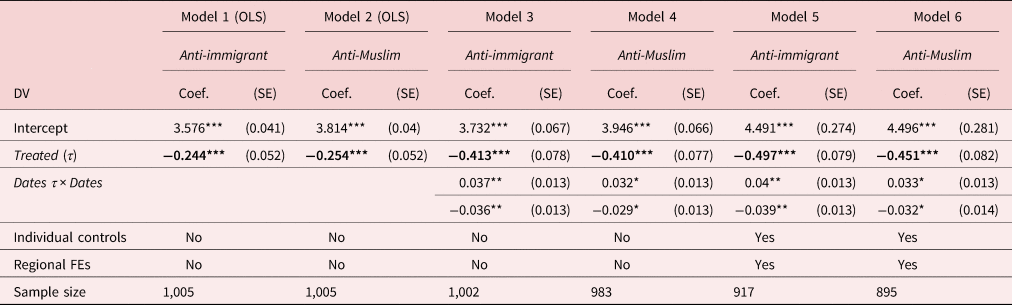
Note: DV = dependent variable. FEs = fixed effects. Standard errors are in parentheses. Individual controls include Age, Male, Married, Education, Non-citizen, Employed, Political ideology, Social trust, Interethnic friendship, Cosmopolitan ID, and Relative deprivation. Results for Models 1 and 2 are from bivariate OLS regression.
*p < 0.05, **p < 0.01, ***p < 0.001 (two-tailed tests).
Regression discontinuity analysis using inverse distance weight (IDW): interaction effects with Cosmopolitan ID

Note: DV = dependent variable. FEs = fixed effects. Standard errors are in parentheses. Individual controls include Age, Male, Married, Education, Non-citizen, Employed, Political ideology, Social trust, Interethnic friendship, Cosmopolitan ID, and Relative deprivation.
*p < 0.05, **p < 0.01, ***p < 0.001 (two-tailed tests).
Regression discontinuity analysis using inverse distance weight (IDW): interaction effects with Relative deprivation
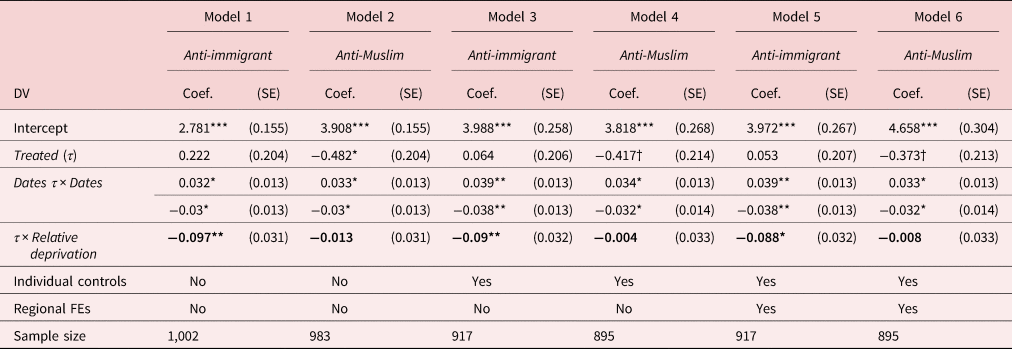
Note: DV = dependent variable. FEs = fixed effects. Standard errors are in parentheses. Individual controls include Age, Male, Married, Education, Non-citizen, Employed, Political ideology, Social trust, Interethnic friendship, Cosmopolitan ID, and Relative deprivation.
†p < 0.1, *p < 0.05, **p < 0.01, ***p < 0.001 (two-tailed tests).
In Models 5 and 6, individual controls and regional fixed effects are introduced. Adding them does not diminish the treatment effect estimates. Rather, they remain consistently robust at the p-value of less than 0.001. The RD models were also analyzed by adding higher order polynomials (quadratic and cubic terms) of the running variable (Dates). In estimations available on request, measures of fit (Akaike Information Criterion and Bayesian Information Criterion) supported the parsimonious model with a linear trend. This is typically expected since the estimated effect is mostly driven by variability in  ${\rm {\open E}}[Y_i(1)-Y_i(0)\left| {X_i]} \right.$ near the cutoff value (Angrist and Pischke Reference Angrist and Pischke.2009, 255). In short, with respect to RQ1, we can conclude that heated struggles among natives over the refugee situation in Korea, with the conflict reaching its peak in the form of a citizen petition intended to expel asylum seekers, resulted in generally more positive outgroup attitudes.
Is this treatment effect constant across all survey respondents or does it vary as a function of certain individual characteristics? That is, is the magnitude greater for individuals who identify more strongly with cosmopolitanism (Hypothesis 1) and those who are more economically underprivileged (Hypothesis 2)? To answer this question, we proceed with Tables 3 and 4. According to Model 1 in Table 3 (DV = Anti-immigrant), the multiplicative term (Treated × Cosmopolitan ID) is 0.461 (p < 0.001). Substantively, contrary to expectation, the treatment effect on attitude toward foreign workers is weaker for Korean natives who identify more with being a cosmopolitan citizen. Turning to Model 2 (DV = Anti-Muslim), the parameter estimate is 0.366 (p < 0.01): the treatment effect on attitude toward Muslims is similarly weaker for individuals who identify more with being a cosmopolitan citizen. In subsequent models, to increase precision, individual controls and regional dummies are incorporated, which leads to a slight reduction in effect size.
Overall, as shown throughout Models 4 through 6, there is substantial empirical support for the heterogenous effect, but in the opposite direction. That is, regarding Hypothesis 1, there is significant evidence that cosmopolitan self-identity dampens the magnitude of the treatment on outgroup prejudice among Korean adults. To examine the potential moderating role of relative deprivation in relation to Hypothesis 2, Table 4 is presented. For Anti-immigrant (Model 1), the interaction term is significantly negative (β = −0.97, p < 0.01): again, in contrast to the stated hypothesis, the treatment effect is stronger for those who are more relatively deprived based on (reverse coded) subjective social status. However, for Anti-Muslim (Model 2), the heterogeneous effect is not significantly different from zero. As individual controls and regional fixed effects are added (in Models 3 through 6), original results remain consistently robust, though in the fully specified model with Anti-immigrant as the dependent variable (Model 5) the effect size and the significance level diminish (β = −0.088, p < 0.05). In conclusion, with respect to relative deprivation, there is only conditional support for the interaction effect.
To buttress the above RD identification strategy, falsification tests are carried out using several placebo outcomes: Ageism, Gender role, Premarital sex, and Anti-Christian. Using the original dependent variables (Anti-immigrant and Anti-Muslim), RD models are also re-estimated by selecting a placebo cutoff date (August 2), two weeks after the e-petition was submitted and a day after the announcement of the government's official response to it (see Figure 2). Based on KGSS 2018, Ageism measures how Korean people feel about the older generation (“They are a burden on society”; e.g., 1 = strongly disagree, 4 = strongly agree), Gender role gauges their views on the traditional division of labor at home (1 = strongly agree, 7 = strongly disagree), Premarital sex taps their opinions regarding sexual union before marriage (1 = never right, 4 = always right), and Anti-Christian is a measure of attitude toward adherents to the Protestant faith (1 = very positive, 5 = very negative).
If the argument set forth in this study is valid, then these variables should not show a discontinuous break at the threshold value. That is, the anti-refugee petition should not have had any significant causal impact on Korean natives' sentiments and preferences concerning older citizens, traditional gender roles, premarital sex, or any religious category other than Islam (since most of the Yemeni refugees were Muslim). Models 1 through 4 in Table 5 make clear that none of the four placebo outcomes was affected by the treatment assignment. That is, the public opinion on these issues did not change because of the societal conflict surrounding the refugee situation. Finally, as shown in Models 5 and 6, using an alternative treatment date, the empirical median as recommended (Imbens and Lemieux Reference Imbens and Lemieux2008), does not yield statistically significant results in relation to Anti-immigrant or Anti-Muslim. Taken together, then, this set of null findings gives additional confirmation for the RD design.
Falsification tests for RD analysis using placebo outcomes with inverse distance weighted data
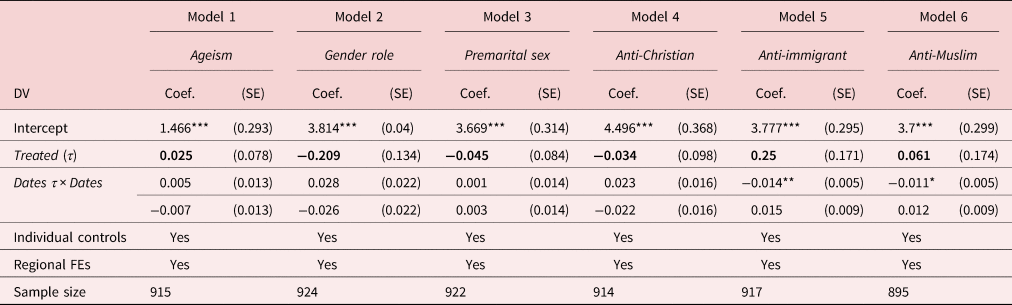
Note: DV = dependent variable. FEs = fixed effects. Standard errors are in parentheses. Models 5 and 6 are based on a placebo cutoff date (August 2nd).
*p < 0.05, **p < 0.01, ***p < 0.001 (two-tailed tests).
Still, to further check the robustness of these results, additional models were estimated. Initially, this was done by not using inverse distancing weights, as summarized in Appendices 1–3 that correspond to Tables 2–4. In Table 2, original estimates for the main causal effect (τ) on Anti-immigrant from Model 5 (β = −0.497, p < 0.001) and on Anti-Muslim from Model 6 (β = −0.451, p < 0.001) were based on the IDW method. Comparing them with the additional findings in Model 5 (β = −0.464, p < 0.001) and Model 6 (β = −0.381, p < 0.01) in Appendix 1 reveals a general pattern of complementarity. A crucial distinction here is that weighing the observations according to their distances (days from the critical date) allows for identification closer to the cutoff point of discontinuity. Hence, if the estimated causal effect was spurious (i.e., confounded by some unobserved event), then weighing the data should have produced less significant results (in Tables 2–4). But, in fact, the opposite is true. And this also applies to heterogeneous treatment effects across the measures of cosmopolitan identity (Appendix 2) and relative deprivation (Appendix 3).
Appendices 4 and 5 contain results from re-estimating the original models using different ranges of observation or bandwidths (<40 days, <30 days, and <20 days). The last category (<20) corresponds to the optimal bandwidth used to produce the RD figures. Parameter estimates for the interaction terms for Cosmopolitan identity (shown in Models 5 and 6 in Appendix 4) and for Relative deprivation (shown in Models 5 and 6 in Appendix 5) converge with those from the same models in Tables 3 and 4, respectively. Based on these analyses, it is concluded that social conflict surrounding the refugee crisis had the unintended consequence of raising pro-outgroup attitudes in Korea. Findings also indicate that in the process, contrary to expectations, people who were less “cosmopolitan” and more “relatively deprived” became even more, not less, open to immigrants in general and Muslim in particular.
Discussion and conclusions
Between January and May of 2018, a total of some 550 refugees from Yemen, after their temporary visas had expired in Malaysia, arrived fortuitously on Jeju Island located off the Korean Peninsula's southwestern coastline. As a relatively new immigrant destination, Korea has been making a steady progress in becoming a “multiethnic” nation (Lie Reference Lie2015). Apparently, though, the entry of asylum seekers from a distant, war-torn country in the Middle East caught many native Koreans off guard.Footnote 10 The foreigners' unexpected arrival was met with anxiety and suspicion at first, an unwelcoming reaction that quickly turned into anger, resentment, and bigotry (i.e., Islamophobia). At first, the anti-refugee group floundered in organizing public demonstrations on the island, which, for the most part, went unnoticed by the local media. Soon, however, they gained momentum and spread to Seoul, the capital, attracting the attention of international news agencies.Footnote 11 Over time, the refugee debate diffused throughout the country, “spurring increasingly fervent political and social interest and conflict” (Choi and Jang Reference Choi and Jang2019, 170). As a Foreign Policy (Park Reference Park2018) article puts it, at least temporarily, the country was caught up in a “xenophobic hysteria.”
Independent surveys conducted during this time offer suggestive evidence. Hankook Research Institute, one of the largest public opinion survey firms in Korea, reported that 56 percent of the population opposed granting political asylum to the Yemeni refugees, while 25 percent supported asylum.Footnote 12 Coincidentally, in early July of 2018, Gallup Korea conducted another nationally representative poll gauging the natives' xenophobic sentiment. Results corroborate the earlier survey: 62 percent of the respondents wanted the government to accept as few refugees as possible, while 20 percent wished to deport all of them immediately. The day Gallup released its results coincided with the completion of the e-petition that had garnered over 700,000 signatures, setting a record since the Moon administration's opening of its online system in 2017.
Then, things took a dramatic turn. Since the news broke concerning the anti-refugee petition, public opinion in Korea began shifting in support of refugees.Footnote 13 This paper's aim was to take an analytically rigorous approach in investigating this seemingly paradoxical outcome based on a regression discontinuity design. In a quasi-experimental setting, by exploiting the exogenous variation in interview timing, the present study provided causal evidence on whether societal conflict surrounding a refugee crisis led to outgroup attitudinal change among Korean adults. Under different model specifications, the RD estimator was found robustly significant, indicating those interviewed after the cutoff date were more supportive of immigrant workers and more positive toward Muslims. Moreover, unexpectedly, heterogeneous treatment effects revealed that the impact was greater among Korean natives who identified less with cosmopolitanism and who were less relatively deprived.
While what happened is empirically borne out, why it happened demands interpretation. In immigrant destinations, natives do not necessarily comprise an undifferentiated mass held together by some common bond. At times, this depiction may be closer to reality, as in when Americans came together and displayed solidarity toward political leadership during and after the 9/11 tragedy, a phenomenon known as the “rally round the flag” (Mueller Reference Mueller1970; Oneal and Bryan Reference Oneal and Bryan1995). But such external shocks are relatively rare. Previous quasi-experimental research almost exclusively focuses on the direct causal impact of terrorism in North American and European contexts. In comparison, the current study sought to provide answers concerning a shift in outgroup prejudice during “ordinary times” in an Asian context. Unlike extreme circumstances brought about by terror attacks, the refugee crisis in Korea created an extremely divisive, not unifying, situation. Instead of generating internal solidarity fueled by the ingroup–outgroup (native versus foreigner) distinction, the arrival of Yemeni refugees on the Korean soil created an internal conflict—one that culminated in a petition sponsored by the opposing group pressuring the government to take drastic action against them.
It was this conflict within—a bifurcation among natives—that ironically led to greater openness toward outgroup members. As the size of supporters for the petition grew, counter protestors became increasingly critical, calling it racist and morally reprehensible. Along the way, many bystanders, who up until then had remained neutral if not apathetic, began to empathize and even overtly identify with the pro-refugee group's view that “we are better than this.”Footnote 14 By the time the petition was submitted for official government response, the situation had reached a climax, tilting the scale of public opinion in favor of accepting outgroup members. As the findings indicated above, Korean natives overall became more lenient toward migrant workers and Muslims.
In making sense of these phenomena, insights are drawn from two relevant empirical cases—terror attack in Norway and Trump's travel ban in the US. According to Jakobsson and Blom (Reference Jakobsson and Blom2014), the acts of domestic terrorism committed in July of 2011, causing dozens of civilian casualties, led to an improved perception of immigrants among natives in Norway. How was this possible? The answer lies with the fact that those attacks were caused by an ingroup member, an ultra-conservative ethnic Norwegian. When the perpetrator's identity became public, as authors explain, natives collectively condemned the horrific violence and dissociated themselves from the terrorist (see also Shannah et al. Reference Shannah, Yogeeswaran, Greaves, Bulbulia, Osborne, Usman Afzali and Sibley2023). The initial hostility toward this (ingroup) outcast, fueled by emotional shocks, ultimately evolved into greater acceptance of and openness toward the generalized (outgroup) other. Additional evidence comes from a more recent study using panel data, showing that outgroup trust among Norwegians went up after the tragedy of July 2011 (Solheim Reference Solheim2020).
A related phenomenon took place in the US surrounding the so-called “Muslim travel ban,” an executive order that became a law when President Trump had signed it on January 27, 2017, shortly after his inauguration. As Collingwood, Laievardi, and Oskooii (Reference Collingwood, Laievardi and Oskooii.2018) explain, at first there was a growing domestic support for a tighter border control against unauthorized immigrants. Soon, however, Trump's ethnocentric policy became heavily criticized in the media. And eventually, the ban set off a fury of demonstrations across major US cities, with protestors calling for its immediate end. The main reason was that critics found the exclusionary law incompatible with their core beliefs and values concerning what it means to be American and what America symbolizes. Consequently, public opinion shifted as an unintended consequence of a policy that had inadvertently offended certain segments of the American society.
What these two studies emphasize, in common, is cognitive dissonance (Festinger Reference Festinger1957; Harmon-Jones Reference Harmon-Jones2000). For the Norwegian example, it emerged from the fact that domestic terrorism was perpetuated by a member of the ingroup, not a foreigner. For the US example, it was a product of the inherent tension between exclusionary law and value of inclusiveness championed by its critics. When the violent acts were discovered to have been committed by an ethnic majority (i.e., “one of us”), Norwegians became appalled by it and displayed greater hospitality toward the foreign born as a way of alleviating the felt psychological dissonance (Jakobsson and Blom Reference Jakobsson and Blom2014). Similarly, in the US when the travel ban was signed into law, the information environment (media) shifted against it by highlighting how the executive order had violated the American creed of religious liberty. Consequently, those who shared this conviction (“high American identifiers”) later became less supportive of the law as an attempt to address cognitive dissonance (Collingwood, Laievardi, and Oskooii Reference Collingwood, Laievardi and Oskooii.2018).
In an analogous fashion, the Korean pro-refugee demonstrators faced a dilemma. They saw the other group as antithetical to their catholic worldview. Their vision of a more inclusive Korea was at odds with what the xenophobic opponents represented and advocated. As a show of sympathy for the victims of terrorism and support for democratic values, Norwegians participated in what became known as “Rose Marches.” On the other hand, US urban centers witnessed huge numbers of demonstrators denouncing what they deemed a racist, or an “anti-American,” policy. In Korea, on a much larger scale and for a much longer period, a societal conflict broke out between those who vehemently opposed and those who passionately favored granting asylum to Yemeni refugees. This contentious and divisive debate had an unexpected impact. Rather than pushing public opinion toward outgroup prejudice, the virulent language and the Islamophobic message contained in the e-petition offended many Koreans. In the end, the anti-refugee campaign backfired by incentivizing a more pro-immigrant stance.
Also, contrary to expectations (Hypotheses 1 and 2), pro-outgroup attitudes grew stronger among natives who lacked cosmopolitan identification and those who were economically worse off. Why would cosmopolitan citizens and the relatively deprived not show greater leniency toward refugees in the aftermath of the xenophobic e-petition? One possibility is that there may be a sort of “ceiling effect” at work. That is, since such Korean natives had already been favorably predisposed to outsiders, their openness toward immigrants and Muslims in the wake of the refugee controversy did (could) not rise above a certain limit on the measured scale.Footnote 15 Conversely, it exerted a greater impact on ordinary citizens who had been initially less open to, or more hostile against, the people of foreign origin. As they witnessed the vitriolic anti-refugee movement in the country, many may have felt the need to dissociate themselves from it. A parallel phenomenon occurred in 2019 in Christchurch, New Zealand after a far-right terrorist attack against Muslims: many politically conservative (and even right-wing) New Zealanders grew more supportive of the Muslim immigrant population (Shannah et al. Reference Shannah, Yogeeswaran, Greaves, Bulbulia, Osborne, Usman Afzali and Sibley2023).
Conventional wisdom in the scholarship suggests that even a distant exposure to refugees can be enough at times to elicit outgroup prejudice (e.g., Hangartner et al. Reference Hangartner, Dinas, Marbach, Matakos and Xefteris.2019). Against this backdrop, the present study offers a more nuanced analysis: the exposure can create a domestic conflict among natives with unanticipated consequences. Findings from this study highlight a treatment effect leading to decreased outgroup prejudice in Korea. They also point to heterogeneous treatment effects: the causal estimate is stronger for the less cosmopolitan citizens and for natives who are relatively more deprived. Future research can advance the field by investigating the conditions under and the mechanism by which outgroup threat produces a homogeneous versus a heterogeneous outcome among the ingroup members. Clear understanding of this complex phenomenon would help explain perhaps one of the most critical as well as contentious social issues today: transnational migration and concomitant xenophobic, i.e., populist, backlash across immigrant destinations.
Competing interest
There are no conflicts of interest to declare.
Results from regression discontinuity analysis: main effects

Regression discontinuity analysis: interaction effects with Cosmopolitan ID

Regression discontinuity analysis: interaction effects with Relative deprivation

Heterogeneous treatment effects with varying bandwidths (for Cosmopolitan ID)

Heterogeneous treatment effects with varying bandwidths (for Relative deprivation)

The anti-refugee online petition in Korea (completed with 714,875 signatures).
Note: The title posted on the Presidential official webpage reads “A petition to abolish/amend the Refugee Act, visa-free entrance, and refugee determination due to the illegal asylum seeker problem on Jeju Island.”


 Open access

