

We need to move beyond a general theory of material culture to a more detailed analysis of particular domains. We need to move from a discussion of “why things matter” to one of “why some things matter” a lot in particular places and times.
—Linda S. Cordell and Judith A. Habicht-Mauche, “Practice Theory and Social Dynamics Among Prehistoric and Colonial Communities in the American Southwest”Incised stone artifacts are known from around the globe, some approaching 100,000 years old (Lemke et al. Reference Lemke, Wernecke and Collins2015; Ottenhoff Reference Ottenhoff2015: Table 2.1); related incising practices can perhaps be traced to premodern humans more than 450,000 years ago (Joordens et al. Reference Joordens, d'Errico, Wesselingh, Munro, de Vos, Wallinga, Ankjærgaard, Reimann, Wijbrans, Kuiper, Mücher, Coqueugniot, Prié, Joosten, van Os, Schulp, Panuel, van der Haas, Lustenhouwer, Reijmer and Roebroeks2015). Such so-called portable rock art can be documented archaeologically from more than one-quarter of the states and two provinces in North America (Lenik Reference Lenik2016:138–142; McKee and Thomas Reference McKee and Thomas1972; see Figure 1). The oldest come from the Gault Site (central Texas), where more than 100 incised stones span the early Paleoindian period (~11,000–7000 cal BC) into late prehistoric times (Wernecke and Collins Reference Wernecke, Collins and Clottes2012).
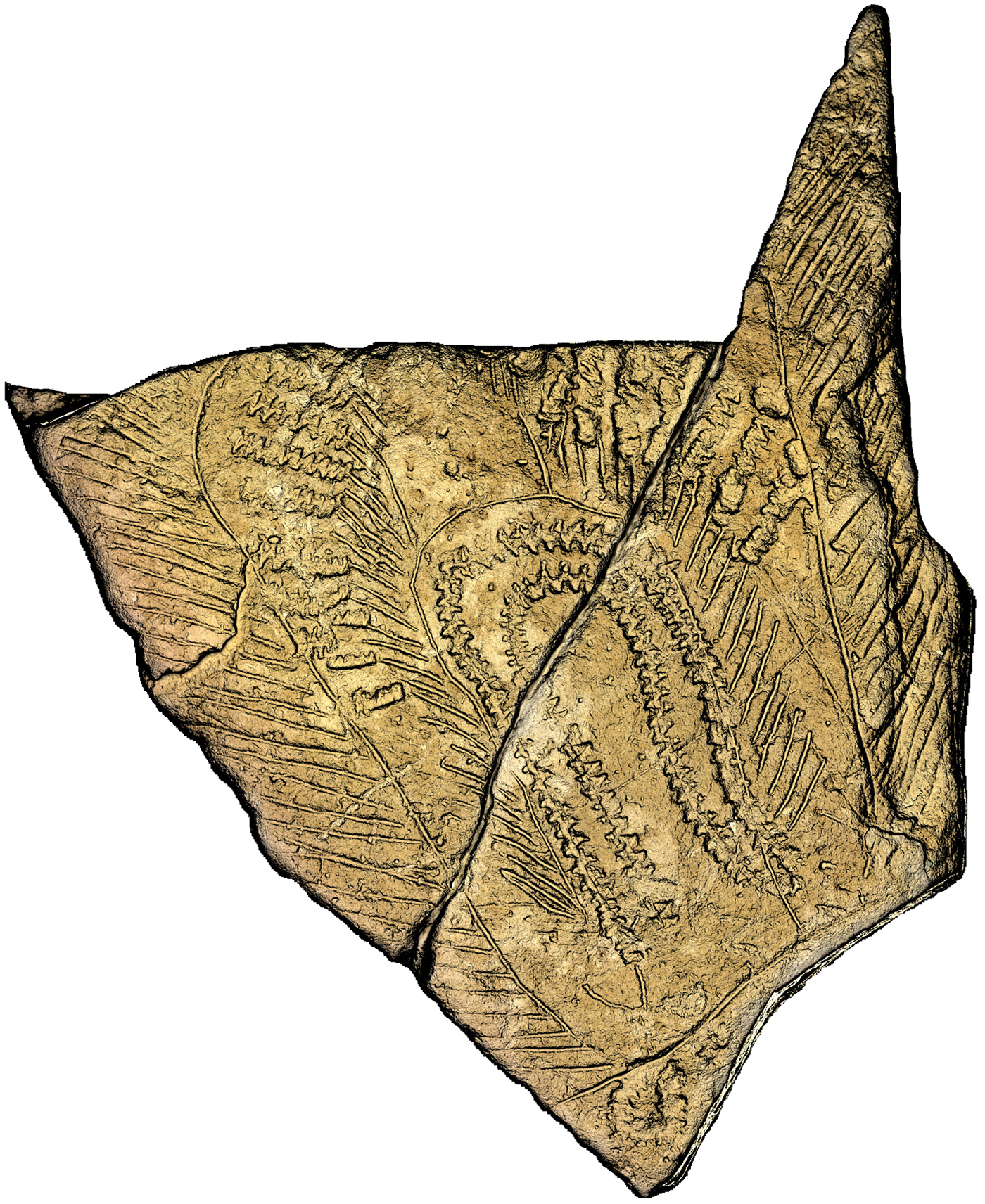
Incised stone from Gabbs, Nevada. Height is 17.2 cm. (courtesy of the Nevada State Museum; photograph by Eugene Hattori).
Archaeologists have long puzzled over the meaning and purpose of these enigmatic stone artifacts, postulating a host of potential purposes—ranging from doodles and graffiti to ornamental art, maps, geographic indicators, depictions (of plants, animals, the natural world, clothing, textiles, fossils, basketry, and pottery), anthropomorphic representations, tattooing, meteorological and astronomical calculations, notation of time (quantity and pneumonic meaning), entopic phenomena, utilitarian functions (such as jewelry, edge grinders, cutting boards, pottery or pigment stamps, shaft straighteners, toys, and gaming pieces), heraldic devices, ethnic identifiers, flintknapping guidelines, marks of ownership, rituals and rites of passage, talismans, amulets, sympathetic magic, healing stones, accentuated or central power, and offerings (Wernecke and Collins Reference Wernecke, Collins and Clottes2012: Figure 10).
Archaeologists have also employed multiple theoretical perspectives to study incised stone assemblages, including Marshack's (Reference Marshack1972a, Reference Marshack1972b) lunar notational model, chaîne opératoire (Wadley Reference Wadley2012; Zilhão Reference Zilhão2007), ethnographic analogy (d'Errico et al. Reference d'Errico, Henshilwood, Lawson, Vanhaeren, Tillier, Soressi, Bresson, Maureille, Nowell, Lakarra, Backwell and Julien2003), stylistic zones (T. Thomas Reference Thomas and Thomas1983a, Reference Thomas and Thomas1983b), design grammar (Klimowicz Reference Klimowicz1988; Ottenhoff Reference Ottenhoff2015), and human behavioral ecology (McGuire and Hildebrandt Reference McGuire and Hildebrandt2017). Here, I rely on community of practice perspectives to hypothesize that the thousands of incised stones from the Intermountain West are material representations of Shoshonean epistemologies, past and present.Footnote 1 If this hypothesis proves true, then, in the terminology of Cordell and Habicht-Mauche (Reference Cordell, Habicht-Mauche, Cordell and Habicht-Mauche2012), incised stones certainly would have mattered—a lot.
Defining Ancient Constellations of Ritual Practice
More incised stones have been found in the Great Basin region than any other parts of the world [offering] ideal conditions for the preservation and recovery of incised stones. But that alone doesn't explain their number. Clearly, incised stones were immensely popular among the foragers who inhabited this region for millennia. Few other places … witnessed such fidelity to tradition, including the custom of decorating pebbles.Footnote 2
—Carl Schuster, Materials for the Study of Social Symbolism in Ancient and Tribal ArtReinforcing the considerable archaeological and historic evidence demonstrating that several Numic-speaking groups employed incised stone artifacts (Figure 2; see also Supplemental Tables 1 and 2), contemporary Numic speakers believe that the hundreds of incised sandstone artifacts recovered from their sacred lands are ritualized objects, or “prayerstones”: “To me…they may have a spiritual purpose.…They're giving thanks for all the medicines or plants that the mountain provides for their security. I think that would kind of explain why most of it is found in that certain area” (tribal elders quoted in O'Meara Reference O'Meara2014:11). Integrating contemporary oral history within broader Shoshonean cosmology, the “prayerstone hypothesis” suggests that many incised Great Basin stone artifacts were deliberately emplaced in areas of known spiritual power, accompanying prayers for personal power to become healers, for success in hunting and gambling, and to give thanks for safe passage (Fowler Reference Fowler2002:173–176, Figure 110; Park Reference Park1938). I explore this hypothesis—grounded in the concept of puha (power) as the hallmark of Shoshonean religious practice—within the context of 3,500 incised stones from archaeological sites across the Intermountain West (Supplementary Table 1).
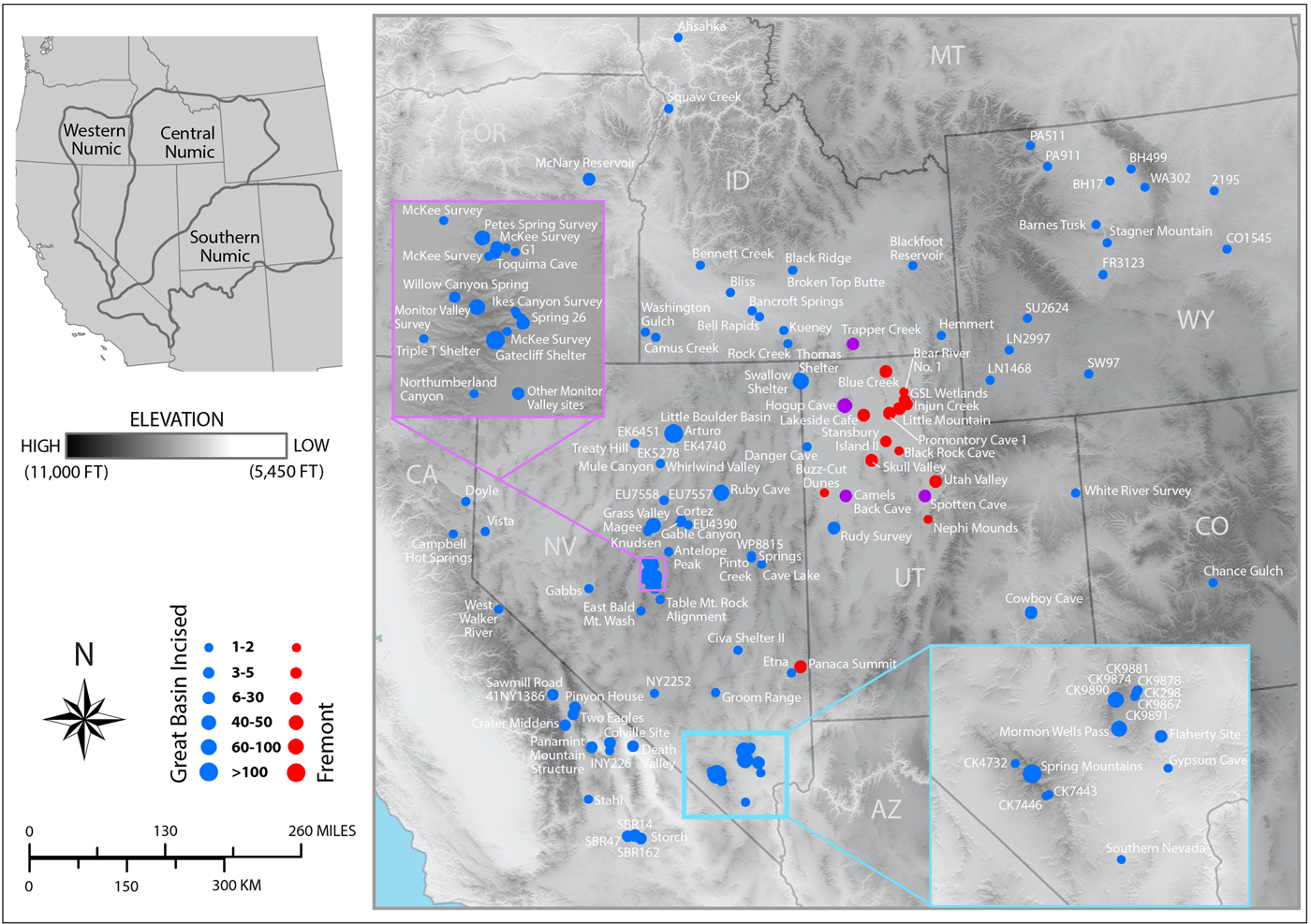
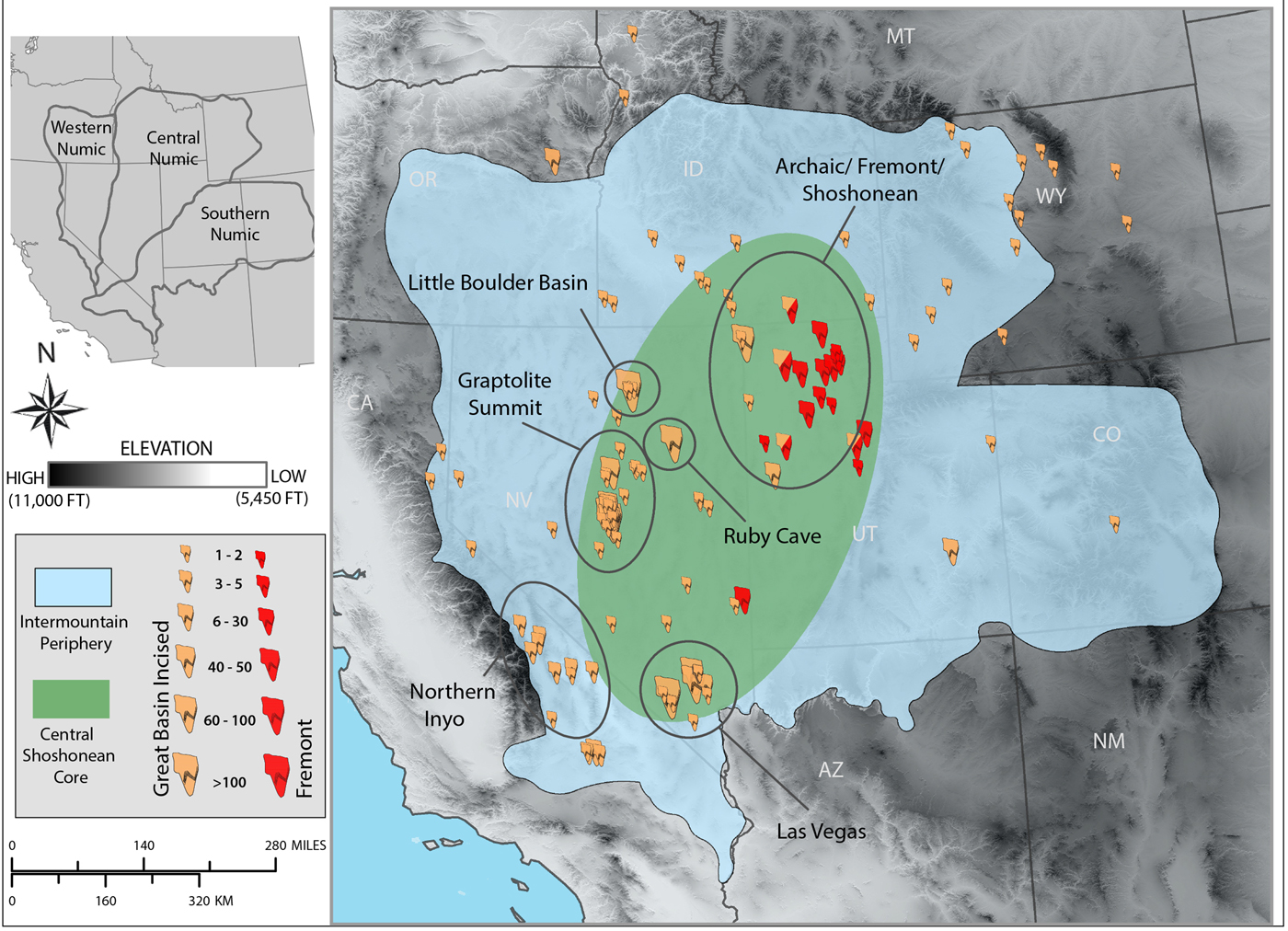
Distribution of ~3,500 incised stones from the Intermountain West (site identifications listed in Supplemental Table 1).
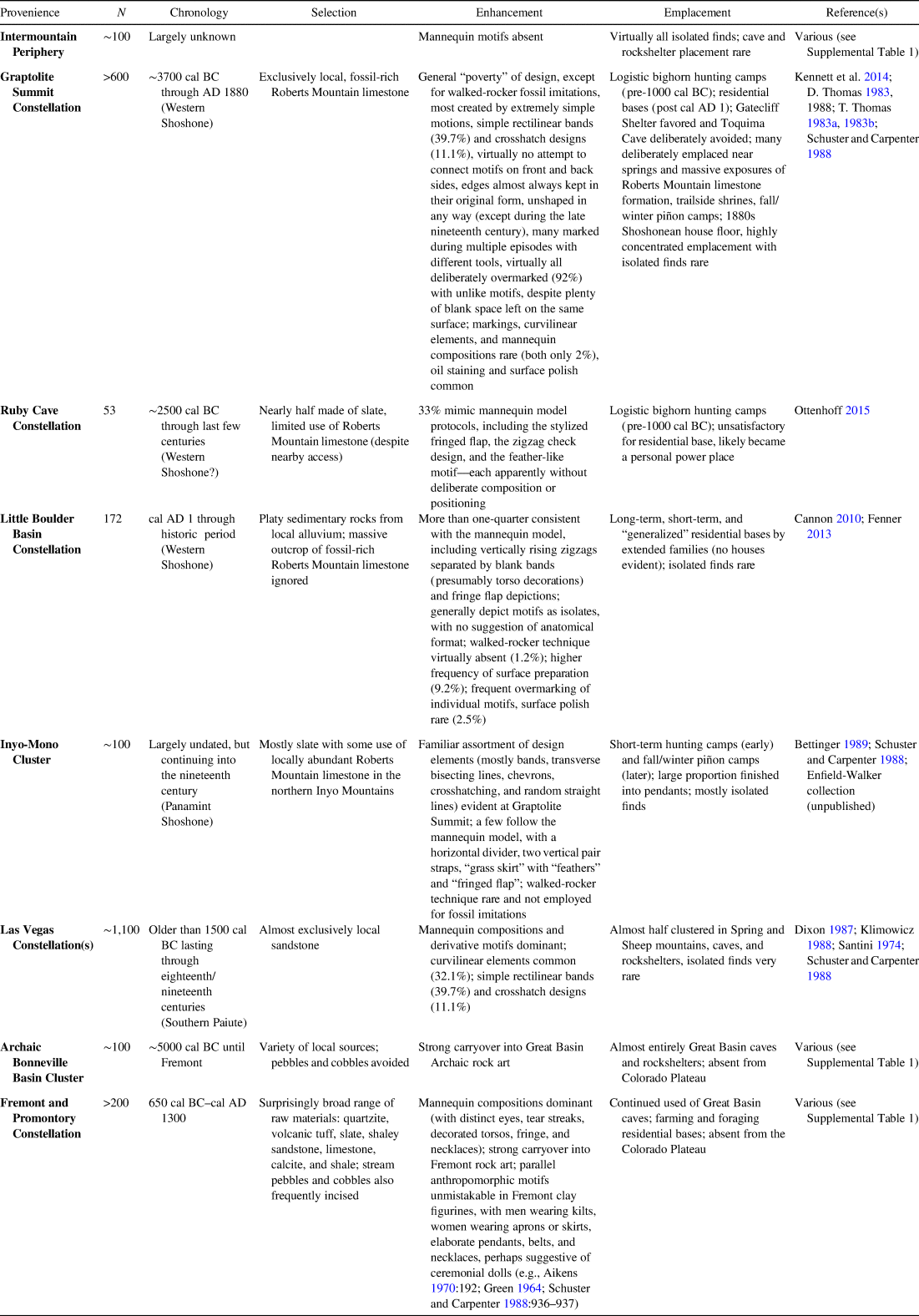
Incised Stone Characteristics in the Intermountain West (see Supplemental Table 1 for detailed proveniences and Supplemental Table 2 for age estimates).
Provenience and Age of Incised Stones Recovered from Gatecliff Shelter.
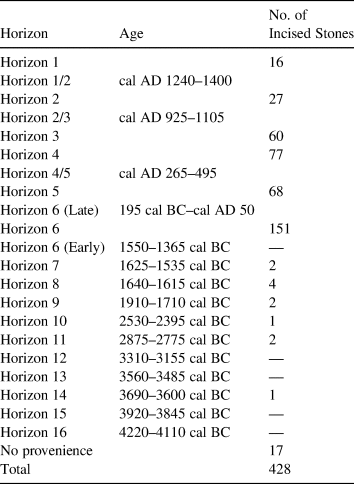
Note: After T. Thomas (Reference Thomas and Thomas1983a, Table 5) and Kennett et al. (Reference Kennett, Culleton, Dexter, Mensing and Thomas2014).
Prayerstones are perceived as votive offerings—gifts given to supernatural powers connoting a connection between an object and some vow or prayer. Such offerings attempt to cement an asymmetrical relationship in which what is received is fundamentally incommensurate with what is given:
Success, health, the flourishing of crops, animals or family, these are not things that can be equated in any way with a figurine, a piece of jewellery or a sacrificial chicken. The giving of gifts to the gods … establishes a pattern where exchange relations may be long term, and where it may be impossible to measure the return against the investment. And it establishes that as the pattern of exchange with beings who are more powerful [Osborne Reference Osborne2004: 3].
Archaeological evidence of such votive practices has been recognized around the world, with considerable time depth.
The multiscalar concept of “object itineraries” entwines ritualized things with people and places by tracking the movement of individual prayerstones through time and space (Walker and Lucero Reference Walker, Lucero, Dobres and Robb2000).Footnote 3 At the artifact level, prayerstones were crafted and manipulated within multiple communities of practice, conventionally considered to be a “network of relations among people and objects mediated by actions they conduct, taking place in relation to other communities of practice and continuing over time” (Joyce Reference Joyce, Cordell and Habicht-Mauche2012:150). Such communities shared ways of doing things as learned and reproduced during everyday life. Due to the repetition of practices learned in certain ways and passed along, communities of practice can persist over considerable spans of time—but they are difficult to isolate archaeologically (Cordell and Habicht-Mauche Reference Cordell, Habicht-Mauche, Cordell and Habicht-Mauche2012:3–4).
“Constellations of practice” emerge at a broader scale “through the articulation of separate communities of practice that share common historical roots, or have members in common, or share certain things, or engage in overlapping styles or related discourses” (Joyce Reference Joyce, Cordell and Habicht-Mauche2012:150). Because constellations have less face-to-face intentionality than communities, their material consequences can help define identities at a regional scale—even if it remains difficult to pin down the specific populations involved.
By viewing incised stones as material things embedded within broader genealogies of practice (Hahn and Weiss Reference Hahn, Weiss, Hahn and Weiss2013; Joyce Reference Joyce, Joyce and Gillespie2000; Kopytoff Reference Kopytoff and Appadurai1986; Miller Reference Miller and Miller1998; Pauketat Reference Pauketat2013:32), the prayerstone hypothesis attempts to complement and expand the prevailing “gastric” paradigm that has long dominated Great Basin anthropology (Kelly Reference Kelly and Beck1999; Morgan et al. Reference Morgan, Bettinger and Giambastiani2014; Steward Reference Steward1938:46; Zeanah and Simms Reference Zeanah, Simms and Beck1999:118).
The Power of Puha in Shoshonean Cosmology
Cosmology changed contours from one [Shoshonean] group to another and even within the same group.
—Sven Liljeblad, “The Religious Attitude of the Shoshonean Indians”Considerable archaeological evidence links several ethnohistoric Shoshonean communities to the manufacture and use of incised stone artifacts—including those found inside historic period houses in the Panamint Range and Grass Valley, plus others emplaced at Colville Rock Shelter, Two Penny Ridge, Coyote Springs Rockshelter, Gatecliff Shelter, and Trapper Cliff Shelter (Supplemental Table 2). Classic Great Basin ethnographies contain a wealth of clues about the workings of Shoshonean religion and epistemology. Although Shoshonean people spoke closely related languages, participated in the same basic culture, and shared a common epistemology, an acceptable degree of variability characterized each. The prayerstone hypothesis attempts to link a key element of Shoshonean material culture to its cosmological genesis.
Shoshonean cosmology is driven by the foundational concept of puha. Loosely translated as “power,” puha is a living, kinetic force that moves through the existing universe without boundaries or dividing lines separating animals, plants, and rocks—all considered to be “people” talking one language (Vander Reference Vander1997:217; see also Arnold and Stoffle Reference Arnold and Stoffle2006; Fowler Reference Fowler2002; Liljeblad Reference Liljeblad, d'Azevedo and Sturtevant1986:643–644; Miller Reference Miller1983:69, 78; Steward Reference Steward1933:224–226; Stoffle and Zedeño Reference Stoffle and Zedeño2001; Van Vlack Reference Van Vlack2018). Shoshonean epistemology maintains that puha is nonrandomly concentrated in certain people, places, and objects. Power places—particularly those that work well—can survive across generations, with repeated use and veneration increasing the power of place exponentially (Fowler Reference Fowler2002:170; Morgan et al. Reference Morgan, Bettinger and Giambastiani2014; Park Reference Park1938). Ritual knowledge is kept alive by powerful places, where effective rituals “anchor” the collective memory and help ensure success in the future (Basso Reference Basso1996). Power-place mystique operates cross-culturally in settings almost universally recognized for their intrinsic power—the most obvious being mountains, caves, oceans, volcanoes, springs, box canyons, and dramatic geological outcrops. More mundane places can also become puha-laden, ritualized settings because of their unique life histories—including mortuary spots, lightning strikes, key battles won or lost, and places of extraordinary healing (Stoffle and Zedeño Reference Stoffle and Zedeño2001).
Shoshoneans have long been attracted to places where power resides. Caves and mountains were sometimes visited by those wishing to become doctors. Hot springs and certain rock outcrops were visited to cure illness or to protect one's self or family. Myth-specific practices among the Northern Paiute were “mapped onto the landscape in a myriad of place names, often associated with individual features of the geography such as rock formations, specific caves or springs, petroglyph panels, trails, washes or arroyos, and much more. People could not move about the landscape without thinking of or feeling these links to the past” to the extent that the paths to sacred places also became sacred (Fowler Reference Fowler2002:170; see also Lowie Reference Lowie1924:228–229; Miller Reference Miller1983:81; Powell in Fowler and Fowler Reference Fowler and Fowler1971:39; Steward Reference Steward1933:308; Van Vlack Reference Van Vlack2018).
Significant power places were typically memorialized by votive offerings, stone cairns and features, rock art, and geoglyphs directly linking people to natural phenomena, often in the attempt to enlist such puha to help people, or a shaman seeking a spirit helper. Morgan and colleagues (Reference Morgan, Bettinger and Giambastiani2014) make a strong case that Campo Borrego, an alpine site in the White Mountains, was a ceremonial site where individuals seeking puha constructed more than 200 cairns, pits, and other stacked-rock constructions. Zedeño's (Reference Zedeño2009) concept of “index objects” helps translate this Shoshonean ritualized cartography to the artifact level, such as inherently animate objects (i.e., red paint, crystals, and fossils), objects relating to the soul of living beings (such as effigies and animal parts), and objects enhancing communication (including smoking pipes, roots of hallucinogenic plants, and leaves of smudging or incense plants). Because of their widespread regional distribution and long temporality, prayerstones may be considered a kind of index object that marks particular sites and places that have been ritualized through practice and object deposition. This “ritual cartography” of Great Basin landscapes links oral Shoshonean tradition to specific geographic indicators “connecting in predictable ways with other types of places to form landscapes illustrating a culturally-based logic of place and landscape” (Stoffle et al. Reference Stoffle, Chmara-Huff, Van Vlack and Toupal2004:24; Supplemental Table 3). And those “predictable ways” are available for testing in the empirical world.
The Prayerstone Hypothesis
Objective archaeological explanation can gain a great deal, without any loss of analytical rigor, by treating oral traditions not as scientific unassimilable myths but as a primary source of evidence and interpretation of past social formulations.
—Peter Whiteley, “Archaeology and Oral Tradition: The Scientific Importance of Dialogue”The prayerstone hypothesis holds that selected incised stone artifacts functioned as ritualized index objects among some Shoshonean communities (Brown and Walker Reference Brown and Walker2008:298). James Santini first articulated this view by suggesting that incised stones of southern Nevada “represent an expression of gratitude or request for future help incident to the makers’ food gathering practices. These concepts may be interwoven with aspects of prehistoric mythology such as Southern Paiute myths” (Reference Santini1974:12; emphasis in original). Santini's suggestion was reinforced during consultations among seven Southern Paiute groups and the University of Arizona's Bureau of Applied Research in Anthropology in a program specifically exploring the articulation of traditional religious and cultural values to significant archaeological sites, objects, places, and landscapes among contemporary Southern Paiute people (Arnold and Stoffle Reference Arnold and Stoffle2006; Stoffle et al. Reference Stoffle and Zedeño2000, Reference Stoffle, Chmara-Huff, Van Vlack and Toupal2004, Reference Stoffle, Toupal, Van Vlack and Arnold2005, Reference Stoffle, Van Vlack, Toupal, O'Meara, Medwied-Savage, Dobyns and Arnold2008).
Southern Paiute elders emphasized as an example the spiritual and symbolic importance of the Spring Mountains:
[We] believe that the Great Spirit is still sitting there in the mountain, and he's listening to you. And he's not going to come out and grab you, or whatever. He's going to wait until you decide to talk to him.…It was a special mountain, and they respected that, they didn't go up there, unless they gave prayer, and went up into the mountain and did their thing and came right back [quoted in O'Meara Reference O'Meara2014:11].
Archaeological evidence from the Spring Mountains demonstrates long-term occupation, and hundreds of incised stones have been collected here, some from caves and rockshelters (Klimowicz Reference Klimowicz1988:58; Santini Reference Santini1974; Tuohy Reference Tuohy, d'Azevedo and Sturtevant1986:230, Table 3). Southern Paiute elders are familiar with such incised artifacts because these votive objects were still used within contemporary memory. “I would think that they're prayer stones,” commented one elder, “an offering to the mountain because, to an Indian, they all have life, the trees, the rocks, and everything like that, and that mountain, it all has life” (quoted in O'Meara Reference O'Meara2014:8). Another added that “the high concentrations of incised stones are indicative of their function as prayerstones, placed to perform an ongoing function associated with prayer and other spiritual activities” (quoted in O'Meara Reference O'Meara2014:10).
The prayerstone hypothesis links Shoshonean oral histories to thousands of incised stones from the Intermountain West by arguing that the life trajectories and depositional histories of many (but not all) such artifacts reflect a Shoshonean practice of emplacing prayerstones as votive offerings and expressions of thanks. Specific object itineraries reflect a sequential, recursive process that transformed simple flat rocks into prayerstones: (1) the geological creation of stone blanks, (2) selection of stones for potential ritualization, (3) enhancement and empowerment through appropriate marking and performance, (4) and ritualized emplacement to draw out, memorialize, and express gratitude to the intrinsic puha residing there. This open-ended cartography also admits the possibility of additional performance rituals long after the initial transformations took place (Joyce Reference Joyce, Cordell and Habicht-Mauche2012; Joyce and Gillespie Reference Joyce and Gillespie2015; see also Carroll et al. Reference Carroll, Zedeño and Stoffle2004:128).
The prayerstone hypothesis tracks how incised stone artifacts move through time and space, fragmenting and accumulating in their travels (Hahn and Weiss Reference Hahn, Weiss, Hahn and Weiss2013; Walker Reference Walker, Skibo, Walker and Nielsen1995; Walker and Lucero Reference Walker, Lucero, Dobres and Robb2000; Supplemental Table 1). The prayerstones that populated the Great Basin landscape reflect a deliberate relationship between material culture and puha (power) places—a central religious concept that still underwrites shared Shoshonean worldviews (Figure 3).
Constellations of ritual practice for prayerstones within the Central Shoshonean core (site identifications listed in Supplemental Table 1).
A Heuristic Mannequin Model
You don't need to know why a golf course has 18 holes to play golf.
—Lord Raglan, as quoted in Mark Siegeltuch, “Lunar Calendars or Tribal Tattoos?”Julian Steward (Reference Steward1937:122) recognized the association between incised stone artifacts and Great Basin caves—a key feature of the prayerstone hypothesis developed here (see also Aikens Reference Aikens1970; McKee and Thomas Reference McKee and Thomas1972). The stylistic zones of Trudy Thomas (Reference Thomas and Thomas1983a, Reference Thomas and Thomas1983b) demonstrated the remarkable variability in incised stone assemblages across the Intermountain West (see also Budy Reference Budy, Elston and Juell1987; Fenner Reference Fenner, Cannon, Lechert, Creer and Adams2013; Klimowicz Reference Klimowicz1988; Ottenhoff Reference Ottenhoff2015; Santini Reference Santini1974; Schuster Reference Schuster1968; Schuster and Carpenter Reference Schuster and Carpenter1988:891; Tuohy Reference Tuohy, d'Azevedo and Sturtevant1986). But attempting to isolate specific constellations of ritual practice requires more detailed methodologies capable of capturing the complex spatial, structural, and compositional variability in these Intermountain incised stone assemblages.
I find some heuristic merit in a “mannequin model,” derived and modified by Carl Schuster (Reference Schuster1968), whose foundational research was posthumously expanded into a massive 12-volume monograph, edited and written by Edmund Carpenter (Schuster and Carpenter Reference Schuster and Carpenter1988; see also Schuster and Carpenter Reference Schuster and Carpenter1996). Suggesting that incised stones are best compared through a series of relatively objective landmarks designed to define the underlying structure, Schuster proposed that Intermountain incised stones often represent garments and/or clothed human beings. Some prayerstone motifs unquestionably do this; others certainly do not. Either way, Schuster's protocols help define compositional strategies that transcend simple motif comparisons.
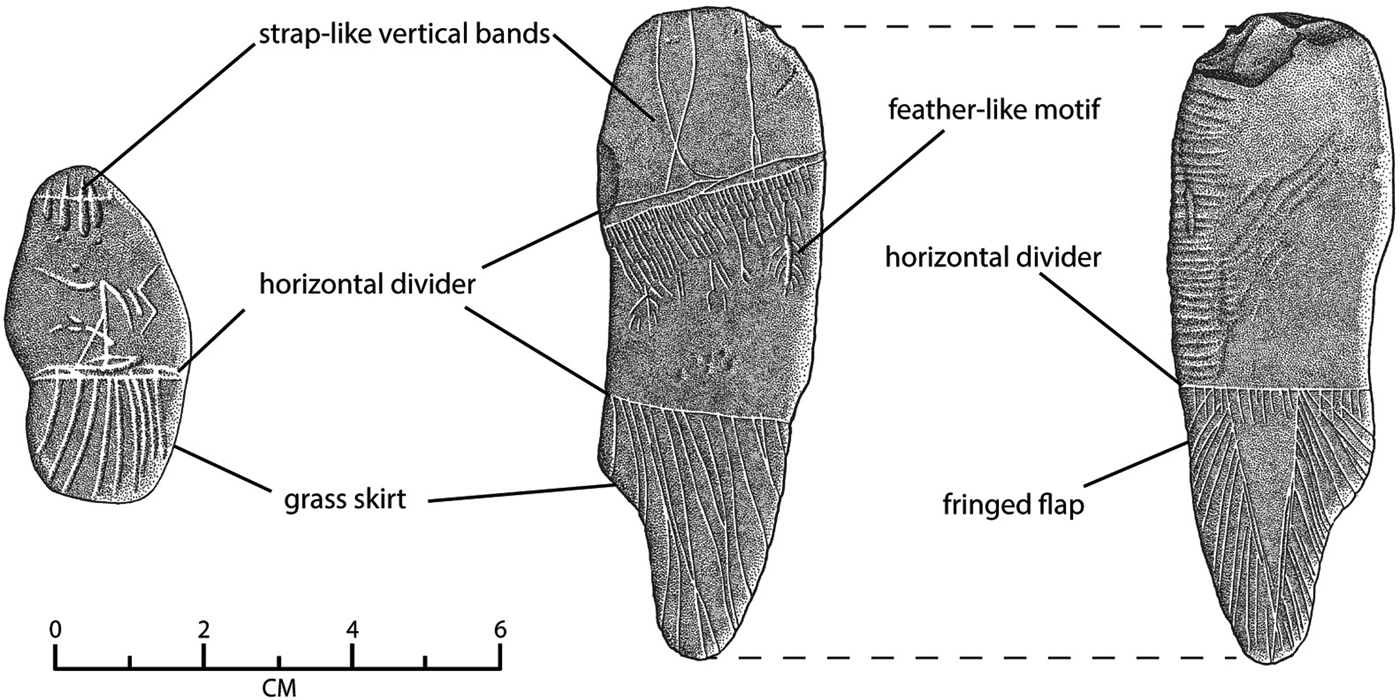
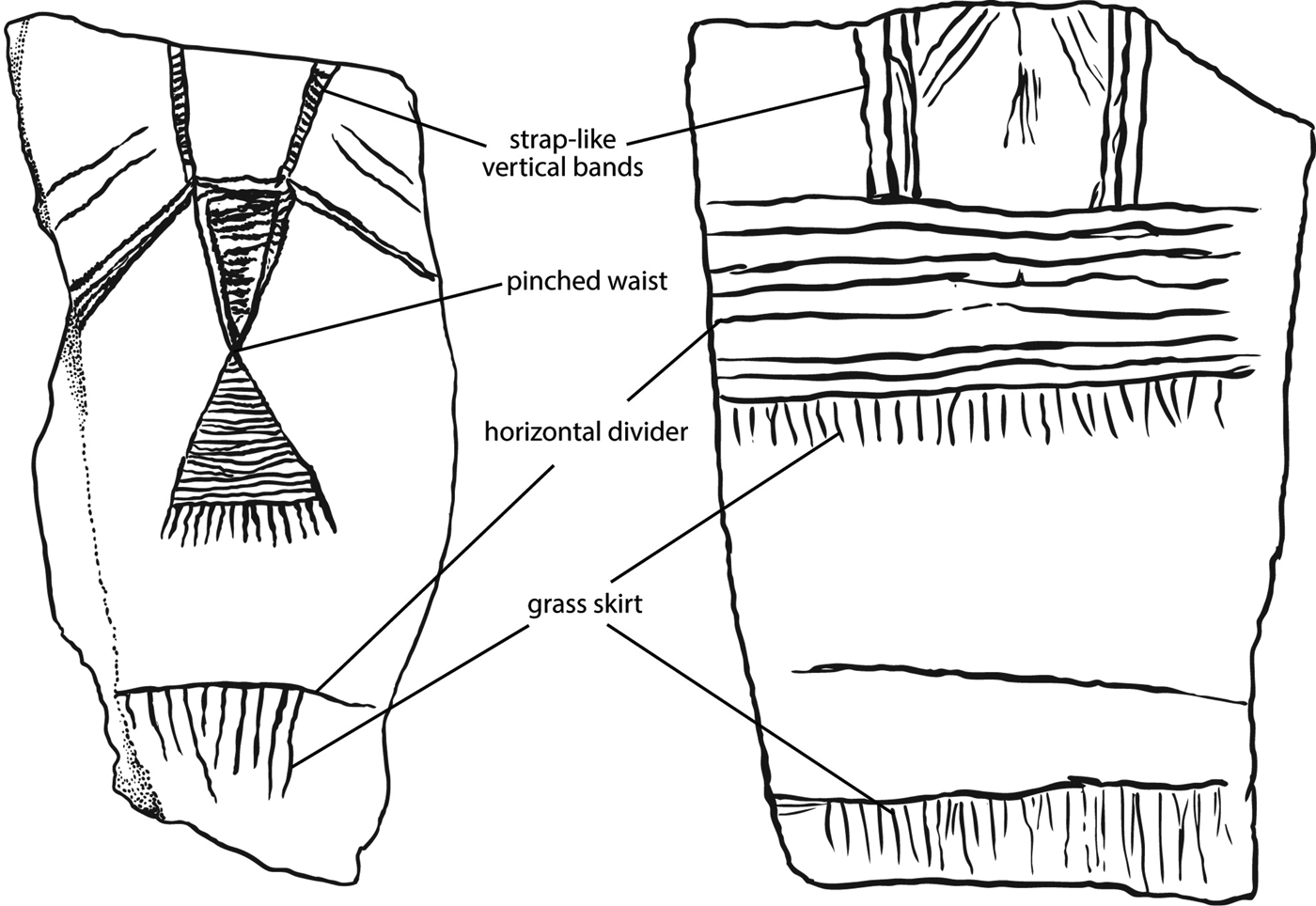
The mannequin model begins with a horizontal divider that establishes a waistline, with the upper part corresponding to the head or bust (Figure 4). To Schuster, the two strap-like vertical bands near the “shoulders” of many incised stones likely represented apron straps or maybe the seams of men's nineteenth-century shirts from the northwest plains, plateau, and Great Basin. Several stones also show what appears to be a necklace or perhaps a U-shaped neck flap with borders and fringes. Schuster saw the paired, opposed zigzag lines (here aligned vertically) as clothing seams, with the zigzags perhaps depicting painted designs on the garment itself (Schuster and Carpenter Reference Schuster and Carpenter1988:894, Figures 977–981).
Two southwestern Great Basin incised stones demonstrating the basics of Schuster's mannequin model. Left: Death Valley National Monument (Alice Hunt Collection; after Hunt Reference Hunt1960:Figure 72f; Schuster and Carpenter Reference Schuster and Carpenter1988:895, Figure 847). Right: Panamint Valley (Inyo County; Allen Sanborn collection; after Schuster and Carpenter Reference Schuster and Carpenter1988:841, Figure 846).
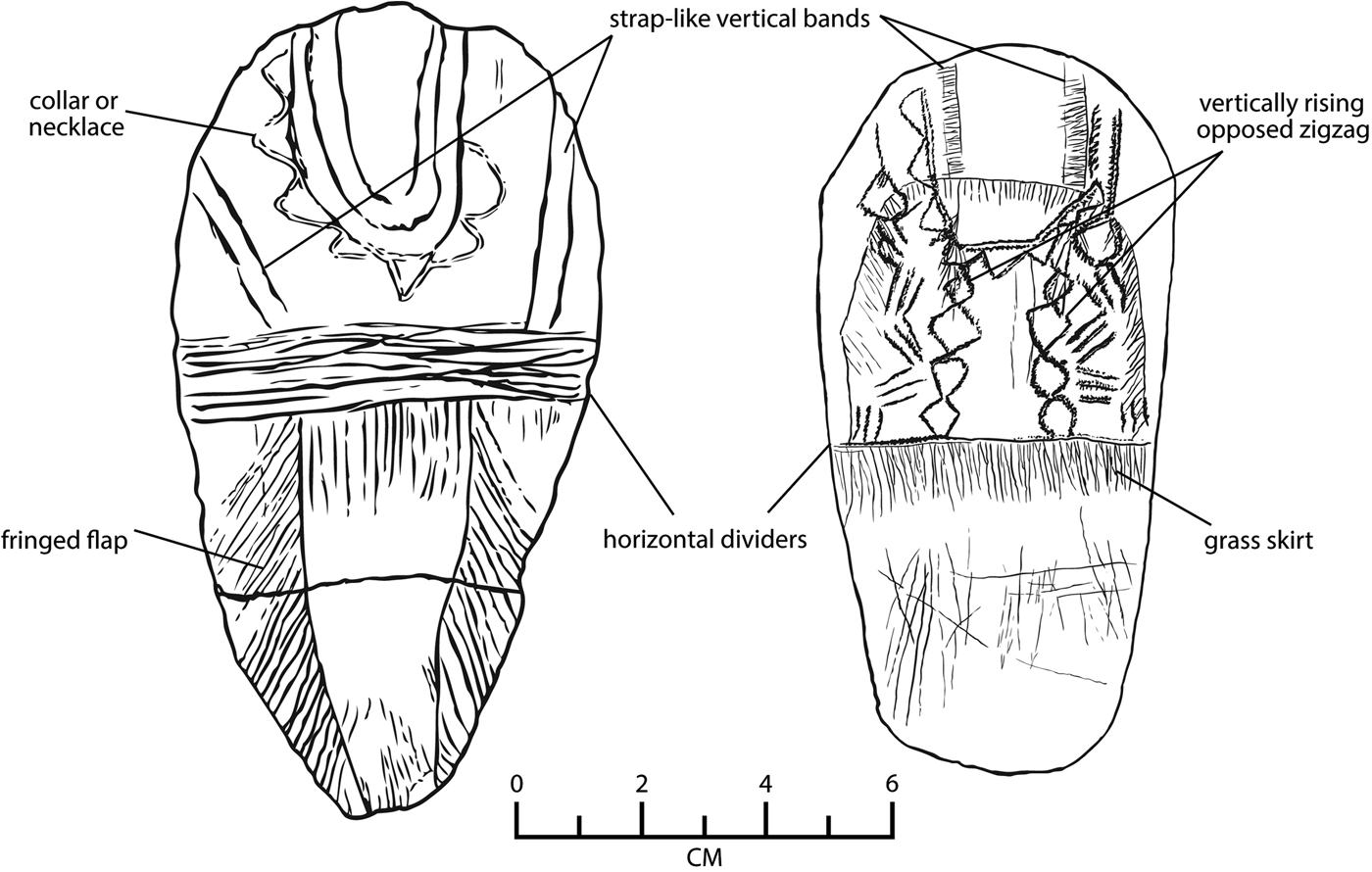
Figure 5 expands this mannequin model on two incised stones from Nevada's Spring Mountains, demonstrating other ways that the opposed zigzag pattern played out in practice. On the left, an entire human figure has vertically rising, opposed zigzags, which Schuster interpreted as a stylized rendering of the chest area. To the right is a “shorthand” rendition of the same zigzag motif, this time depicted as an isolated covering of the entire working surface.
Two incised stones from Lovell Canyon (Spring Mountains, Nevada). Schuster identified the distinctive fringed flap motif situated immediately below the horizontal divider (right), with opposing zigzags apparent across the “chest area” (Schuster and Carpenter Reference Schuster and Carpenter1988:916, Figure 1057). Left: after Schuster and Carpenter Reference Schuster and Carpenter1988:916, Figure 1057; see also Dixon, Reference Dixon1987:244; right: after Schuster and Carpenter Reference Schuster and Carpenter1988:917, Figure 1059; see also Dixon, Reference Dixon1987: 223. Dimensions unavailable.
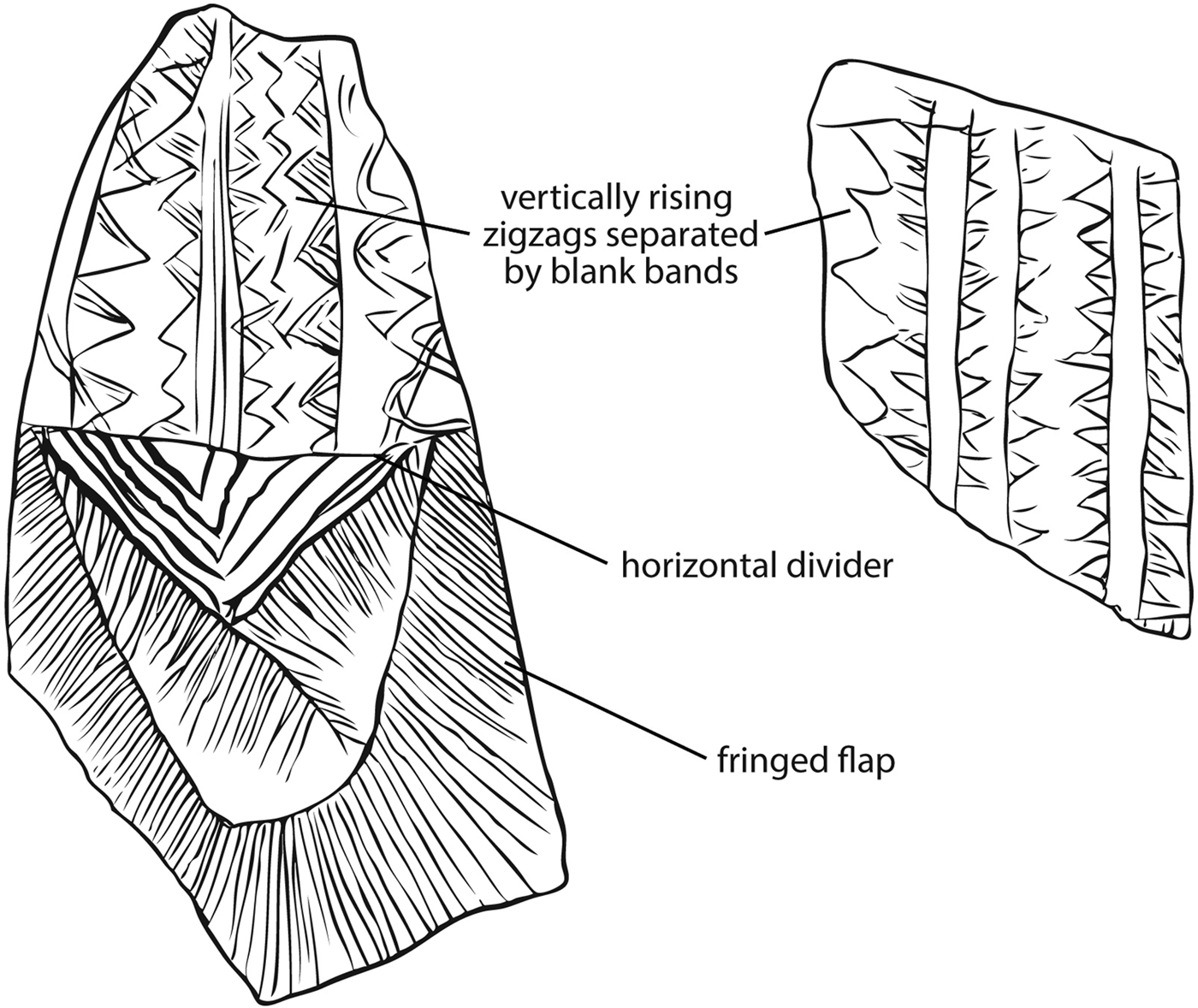
In Schuster's mannequin heuristic, the space “below the belt” sometimes had bunched fringes or a “fringed flap,” as on the Death Valley artifact (Figure 4, left), often with two “straps” at the top to create “a hanging pouch” (Schuster and Carpenter Reference Schuster and Carpenter1988:846). The compelling incised stone from Gabbs (Figure 1) renders the fringed flap motif in more detail, with loops defined by a walked-rocker technique and individual incisions defining the “fringes.” Figure 4 (left) depicts a more simplified fringed flap, and Figure 5 (left) does the same, adding a stylized rendering of the chest area. Schuster thought this “flap within a flap” might attempt to show the back and front simultaneously. Like the zigzag motif, fringed flaps were considered so fundamental to the mannequin model that they often appeared alone.
Although Schuster crafted this mannequin model as a genealogical iconography capable of tracing “roots in the Paleolithic and branches among the living” (Schuster and Carpenter Reference Schuster and Carpenter1988:796), he also warned against overinterpreting these designs, cautioning that “correspondences between incised stones and modern garments may be more apparent than real. We will probably never know what garments the engravers of these stones wore or if their engravings represented garments-worn or designs-remembered” (Schuster and Carpenter Reference Schuster and Carpenter1988:846). I agree. While agnostic about his overarching perspectives on global incised stone traditions, I do see Schuster's mannequin mapping as a simple, relatively operational, first-order heuristic for teasing out underlying structure and style in Great Basin rock marking strategies—nothing more.
It matters not (to me) whether the “fringed flap” motif represents ancient Siberian garb, Inuit overcoats, or Algonquin deerskin shirts—maybe they aren't fringed flaps at all. What's important (to me) is that significantly different permutations of incised stone motifs and designs were systematically repeated across the Intermountain West (at a local level), sometimes lacking any reference to anatomical placement at all. Whatever the meaning to the inscribers, the cosmological symbolism encoded in incised stones provides a material entry point for defining constellations of ritual practice that may have operated within the Great Basin. These votive practices spanned at least 5,000 years and carried forward, without a perceptible break, into contemporary Shoshonean oral history. These emerging communities of ritual practice that once produced these incised stones are wholly masked in design grammars that merely classify motifs as “curvilinear” or “rectilinear,” “bands” or “crosshatches.”
Incised Stones of the Intermountain Periphery
Incised stone assemblages of the Intermountain West span seven states and seven millennia, defining a Central Shoshonean Core surrounded by an Intermountain Periphery—a huge C-shaped borderland extending more than 3,000 km (1,900 miles), encapsulating ethnohistoric territories of the Northern Paiute, Northern Shoshone, Eastern Shoshone, Ute, and Washo communities (Figure 3; Supplemental Tables 1 and 2). I can document fewer than 100 incised stones from the Intermountain Periphery, and virtually all are isolated finds (Supplementary Table 1). At this stage in the research, little can be said about these haphazardly scattered artifacts, except that they belong to a multimillennial, continent-wide tradition of Pan-American stone incising, perhaps with roots in global artifact traditions extending back 100,000 years (Lemke et al. Reference Lemke, Wernecke and Collins2015; Schuster and Carpenter Reference Schuster and Carpenter1988:796; Wernecke and Collins Reference Wernecke, Collins and Clottes2012). Based on available evidence, a significant relationship between the incised stones of the Intermountain Periphery and the prayerstone hypothesis cannot be demonstrated (but this could well change with more intensified research and consultation in the future).
Incised Stones from the Central Shoshonean Core
The Central Shoshonean Core contains >3,300 incised stones. Both their compositional styles and their tightly clustered distributions define multiple distinctive communities of ritual practice that emerged thousands of years ago and persisted among many Numic-speaking communities during ethnohistoric and contemporary times (Table 1; Figure 3). The prayerstone hypothesis proposes that many (perhaps most) of these incised stones are material manifestations of Shoshonean epistemologies that can, perhaps, help “deepen our understanding of the changing social dynamics” of the ancient communities of practice that produced them (Cordell and Habicht-Mauche Reference Cordell, Habicht-Mauche, Cordell and Habicht-Mauche2012:1).
The Graptolite Summit Constellation
More than 600 incised stones come from the Graptolite Summit Constellation in the Simpson Park, Toquima, and Monitor ranges of central Nevada (Figure 3; Supplemental Table 1). Accounting for nearly 20% of incised stones known from the entire Great Basin, this constellation is distributed among three dozen artifact clusters. Only 2% are isolated finds. The earliest date to Horizon 14 at Gatecliff Shelter (3690–3600 cal BC), and the most recent were found on a Western Shoshone house floor occupied ~AD 1800 (Tables 1 and 2). Their individual artifact itineraries reflect a votive relationship to their landscape.
Geological Creation and Selection
These incised stones are made almost exclusively of local Roberts Mountain limestone, dramatically exposed in thrust-faulted “geological windows” (Stewart and McKee Reference Stewart and McKee1977:16). Graptolite fossils are abundant here, their distinctive, shiny look standing out clearly against the dull matte limestone surface. Some appear as if they were drawn by pencil onto the rock surface (the name graptolite meaning, quite literally, “writing on the rock”). Modern fossil hunters flock to this place they call “Graptolite Summit” where they find a fossil type rarely seen outside of textbooks. For decades, professional paleontologists and avocational collectors alike have found thousands of identifiable fossils at this well-known spot.
Pilgrimages to Graptolite Summit are nothing new. The first foragers traversing Graptolite Summit stepped into a ritually preadapted landscape replete with thousands of eye-grabbing graptolite fossils gleaming from slab-like, platy limestone blanks littering the landscape. Native American travelers drawn to these extraordinary limestone exposures were facilitated (then as now) by the Pete's Summit trail, the best east-west access through the northern Toquima Range. Shoshonean cosmology holds that some fossils possess a certain “personhood,” reflecting their animate role as conduits of puha (Zedeño Reference Zedeño2009:416), and the prayerstone hypothesis suggests that Graptolite Summit was recognized as a powerfully sacred place for millennia.
Enhancement and Empowerment
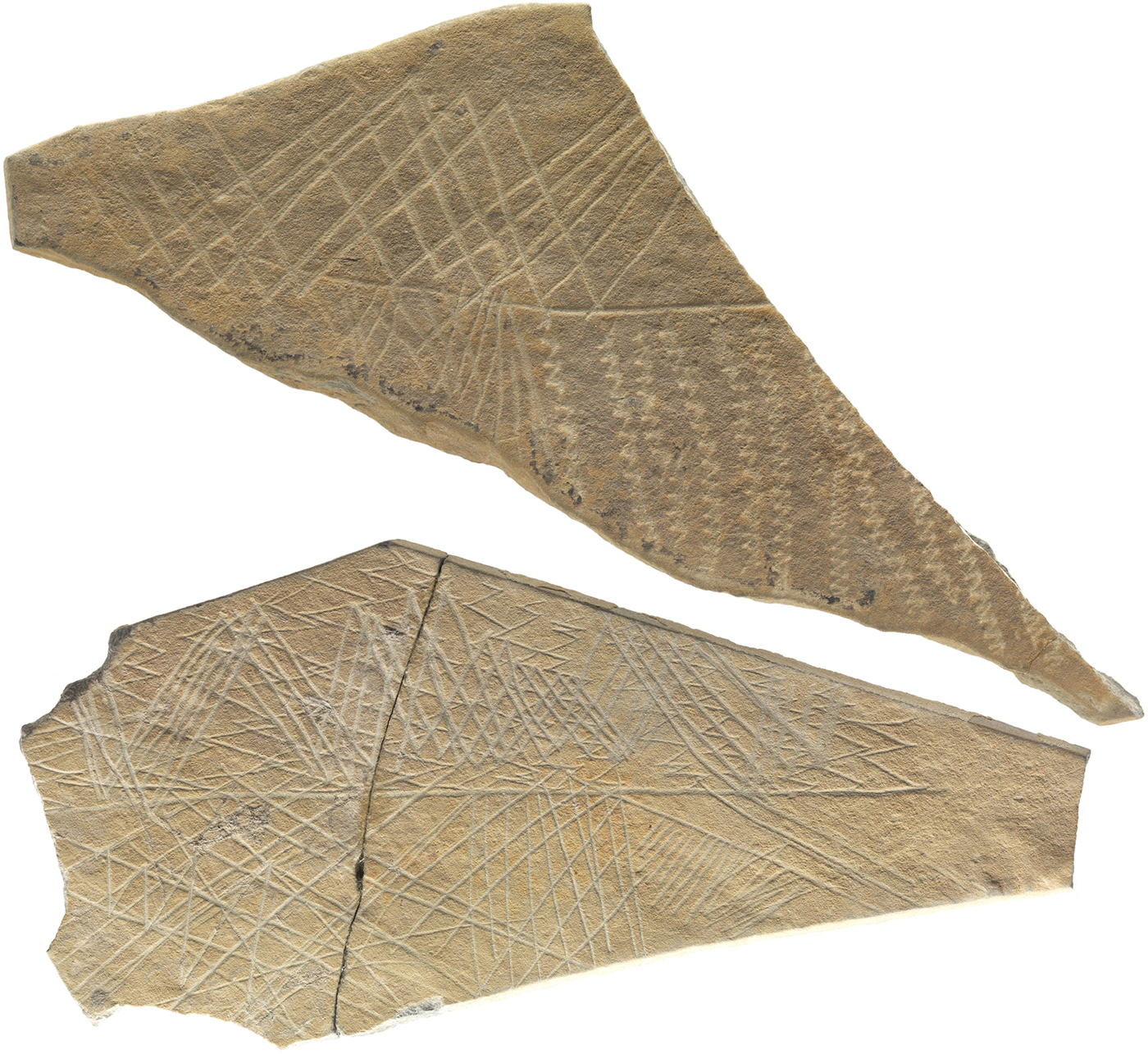
Although spanning a trajectory of more than 5,000 years, the Graptolite Summit incised stone assemblage remained remarkably homogeneous through time (T. Thomas Reference Thomas and Thomas1983a:249–253; see Table 1). Created by a minimally subtractive technology, the natural edges of the original limestone blanks were left unmodified—not shaped, ground, flaked, pecked, polished, or perforated in any way. In this sense, they recall incised stones from the Gault site: “Wherever these objects are produced, the end product does not seem to have retained its importance, and, in fact, the process of manufacture and the patterns employed may have been more important than the decorated object after its initial use” (Wernecke and Collins Reference Wernecke, Collins and Clottes2012:669). But unlike Gault, many Graptolite Summit incised stones were used repeatedly, some with oil staining, surface polish, and frequent overmarking from different tools (despite plenty of blank space left on the same surface).
McKee and I (Reference McKee and Thomas1972) postulated that many such “portable petroglyphs” were literal copies of local graptolite fossils. Some were barely “incised” at all, their surfaces modified instead by a distinctive “rocking” or “walking” movement of a double-tipped tool that produced sequences of “pivot points connected by ‘legs’ of crushed rock” (T. Thomas Reference Thomas and Thomas1983a:251–252, Figures 106 and 107). This walked-rocker technique—evident in nearly one-quarter of the Graptolite Summit incised stones—undoubtedly reprises the ancient fossils populating the immediate area (see Figure 6, upper).
Two incised limestone artifacts from early Horizon 6 at Gatecliff Shelter (1550–1365 cal BC). On the uppermost stone, note the upper fields of crosshatching from the “walked-rocker” lines (see T. Thomas, Reference Thomas and Thomas1983a:Figure 106); length is 17.4 cm. At least three different cutting edges are evident on this artifact: (1) the double-tipped walked-rocker tool, (2) a thin, single-tipped tool, and (3) another single-tipped tool with a tiny gutter along the cutting edge, producing a double-edged incised track. Top: AMNH 20.3/6325; bottom: AMNH 20.3/2158–2159; length is 19.2 cm (courtesy of the American Museum of Natural History, photograph by Mourrice Papi).
Mannequin model protocols are virtually absent at Graptolite Summit. Schuster, who personally examined many of these artifacts, dismissed the occasional mannequin motif as “abbreviations … shorthand versions of more detailed, standardized designs. … Apparently, details were remembered long after their logical positions have been forgotten” (Schuster and Carpenter Reference Schuster and Carpenter1988:911).
Emplacement
McKee and I found a lone incised stone on the surface of Gatecliff Shelter (McKee and Thomas Reference McKee and Thomas1972:Figure 3), but subsequent excavations exposed a 12 m (40 ft) deep stratigraphic column that spanned 7,000 years and contained more than 400 incised limestone artifacts (D. Thomas Reference Thomas1983; Table 1). Although the incised stones at Graptolite Summit did not change much through time, the emplacement strategies certainly did. The logistic bighorn hunters who began the trajectory ~3690–3600 cal BC (Kennett et al. Reference Kennett, Culleton, Dexter, Mensing and Thomas2014; Table 2) eventually emplaced hundreds of these distinctive incised stones inside Gatecliff Shelter over the next 2,000 years. Once family bands took up residence here, they too left hundreds of incised stones, the most recent postdating cal AD 1400—unquestionably linking the Graptolite Summit incised stone trajectory to ethnohistoric Western Shoshone communities.
The prayerstone hypothesis holds that these simple limestone artifacts were deliberately emplaced in “sacred places known to the people as places where power resides” (Fowler Reference Fowler2002:176)—effectively becoming “ceremonial trash” that passed through a gateway transcending the world of the mundane into the spiritual (Walker Reference Walker, Skibo, Walker and Nielsen1995:67). Shoshonean ritual cartography denotes numerous instances of those returning to a specific cave to pray for specific powers: some prayed for the power to become healers, others wished for success in hunting or gambling, still others wanted children, help protecting their families, or protection on a journey (Supplemental Table 3). Shoshonean epistemology requires that such spiritual favors be repaid, as with the pennies and beads left as votive offerings at Doctor Rock (Fowler Reference Fowler2002:Figure 111)—conveying respect and thanks for help from a powerful place (Stoffle et al. Reference Stoffle, Chmara-Huff, Van Vlack and Toupal2004:38). Maybe this explains why 96 prayerstones were emplaced together more than 3,500 years ago at the rear of Gatecliff Shelter (D. Thomas Reference Thomas1983:491). Western Shoshoneans similarly emplaced 19 prayerstones in their 1880s wickiup at Grass Valley, likely the result of a healing ritual. Other Graptolite Summit prayerstones look like trailside votive offerings left in thanks for safe passage. Even when emplaced individually, over time, such prayerstones clustered nonrandomly across the landscape.
The Ruby Cave Constellation
Ruby Cave incised stones look very different from their Graptolite Summit counterparts (Ottenhoff Reference Ottenhoff2015). Half were made of local slate and the rest were manufactured of Roberts Mountain limestone, imported from 40 to 80 km (25 to 50 miles) away. One-third of the Ruby Mountain incised stones clearly reflect Schuster's mannequin protocols (a high proportion unique within the Central Shoshonean Core; Table 1).
Despite such obvious visual differences, the Ruby Cave and Graptolite Summit incised stones reflect similar emplacement strategies, at least at first. The earliest prayerstones at Ruby Cave (~2500–1500 cal BC) were left by bighorn hunting parties camping there—likely accompanying prayers for success on upcoming hunts or expressing gratitude for prayers already answered. Given its utter unsuitability for family residential use, Ruby Cave likely transitioned into a personal power place within the last two millennia—someplace to seek and maintain puha, to pray, or to request healing or luck in hunting or gambling.
The Little Boulder Basin Constellation
The 172 incised stones from the Little Boulder Basin define a wholly different constellation of ritual practice. Several are 2,000 years old, and many others were emplaced within the last 700 years, persisting into the contact period (Fenner Reference Fenner, Cannon, Lechert, Creer and Adams2013).
The Little Boulder Basin is immediately adjacent to Bootstrap Hill—the northernmost significant exposure of Roberts Mountain limestone containing exceptionally well-preserved silicified graptolite fossils (Merriam and McKee Reference Merriam and McKee1976:16). Foragers here completely ignored these obvious limestone exposures, choosing instead to inscribe the platy sedimentary stones found in local alluvial gravels. At least one-quarter reflect Schuster's mannequin model, with motifs usually depicted as isolates (Table 1). The Little Boulder Basin incised stones were emplaced almost entirely in residential contexts, suggesting repeated curing episodes within domestic settings (like the Grass Valley incised stones during the 1880s).
The Las Vegas Constellation
The Las Vegas Constellation (Figures 3 and 7) lumps together ~1,100 incised stones from 28 distinct sites or clusters; future research will likely define multiple distinctive subconstellations of ritual practice. Lumped together for now, they demonstrate “organizational variations in the basic design system,” with complex internal structuring and a preponderance of curvilinear motifs (T. Thomas Reference Thomas and Thomas1983b:343; see also Klimowicz Reference Klimowicz1988:52, 62, 96–100, Table 3.4; Roberts Reference Roberts and Seymour2017; Santini Reference Santini1974:8). Schuster saw the fringed flap motif (a key element of his mannequin model) as diagnostic of the Las Vegas Constellation (Schuster and Carpenter Reference Schuster and Carpenter1988: 899–904).
Incised sandstone artifacts from southern Nevada (after Klimowicz Reference Klimowicz1988:Figures 9, 10, and 11), each a variant of the fringed flap motif with similar variations on the horizontal divider and feather-like motifs. Whereas “most designs follow set compositions … a few rearrange or simply ‘assemble’ basic elements … merely shorthand versions of more detailed, standard designs” (Schuster and Carpenter Reference Schuster and Carpenter1988:912–913, Figures 847, 1044).
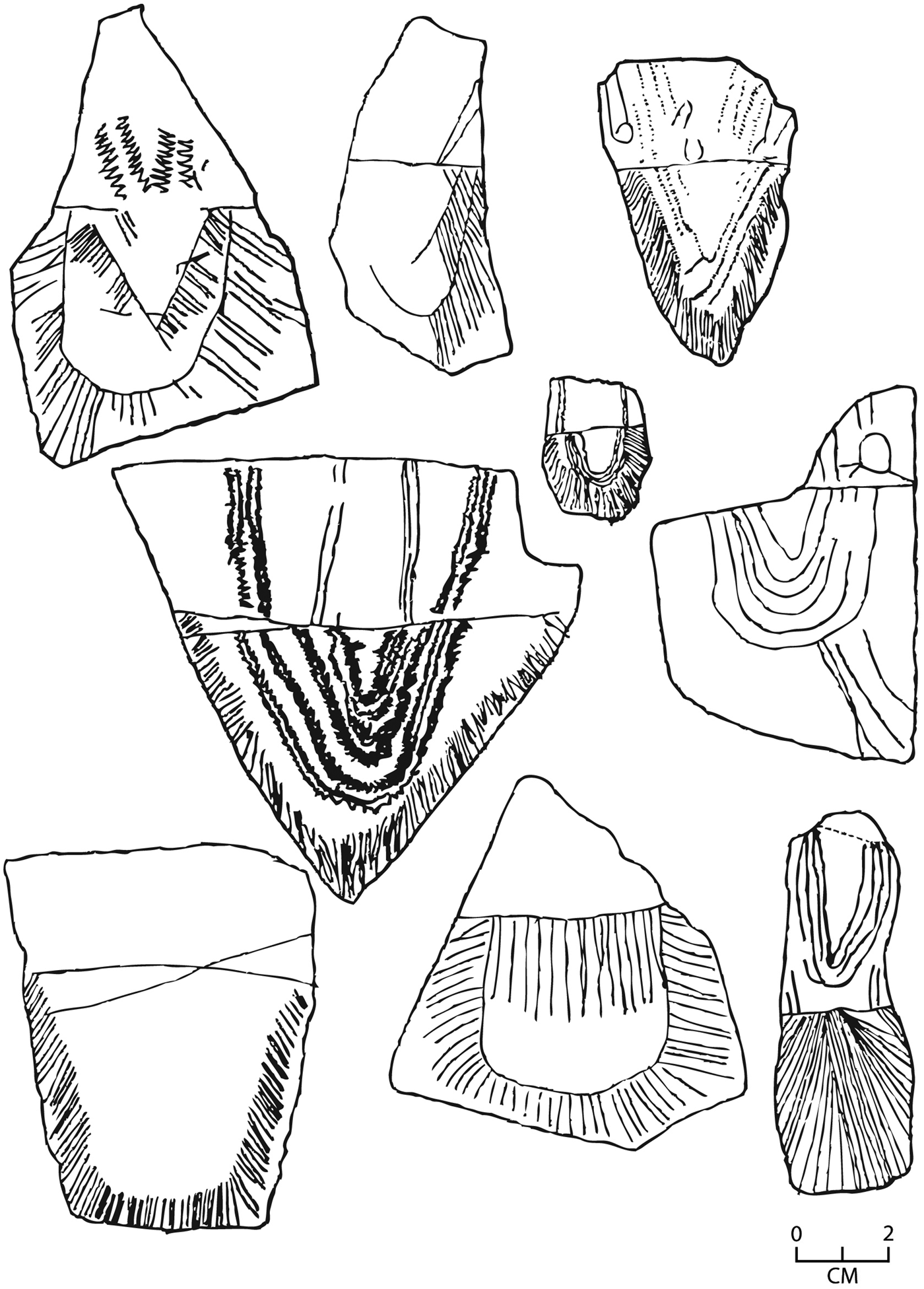
All agree that the Las Vegas assemblages differ dramatically from incised stones elsewhere in the Great Basin. Radiocarbon-associated incised stones from Flaherty Rockshelter now demonstrate the earliest-known fringed flap motif to 1500–650 cal BC in southern Nevada (Figure 8; see also Supplemental Table 2). This same motif persisted locally into the eighteenth or nineteenth century AD, when Southern Paiute people emplaced an identically styled incised stone in Coyote Springs Rockshelter. Whatever its meaning, the foundational fringed flap motif persisted, apparently unchanged in composition and layout, for (at least) 3,000 years.
Two incised stones from Flaherty Cave, each with the mannequin overlay (after Blair and Wedding Reference Blair and Wedding2001; reproduced with permission). Left: 5-1153-69-1 correlates with a 14C estimate of 1450–1090 cal BC; right: 5-1153-7064-1 (two sides) correlates with a 14C estimate of 750–210 cal BC.
Almost half of the Las Vegas incised stones come from the Spring and Sheep ranges, with several emplaced inside local caves and rockshelters (Supplemental Table 1). This is hardly surprising, given that the prayerstone hypothesis reflects contemporary Southern Paiute epistemology linking incised stones to prayers and other spiritual activities carried out near Mount Charleston: “The Indian interpretation of these stones is that they are used in prayers” (Stoffle et al. Reference Stoffle, Chmara-Huff, Van Vlack and Toupal2004:116, Figure 5.8).
The Archaic/Fremont/Shoshonean Cluster
The 500-plus incised stones from the state of Utah tell a complex story beyond the present scope, but certain trends are significant for a broader understanding of Shoshonean constellations of practice (Supplemental Table 1). The Bonneville Basin has a spotty distribution of Archaic (pre-Fremont) incised stones emplaced in several caves and rockshelters—and hardly anyplace else. The earliest assemblages from Danger, Camels Back, and Hogup caves dating ~5000–1500 cal BC are small, but their proveniences are consistent with the hypothesized practice of emplacing votive prayerstones in known power places. Simms and Gohier (Reference Simms and Gohier2010:87) suggest that these incised stones and local Archaic rock art largely consist of abstract designs representing “elements of a supernatural world that would carry forth into other, later styles … shamanism, especially vision questing, hunting magic, and an animistic world in which spirits may harbor in plants, animals, objects and places.”
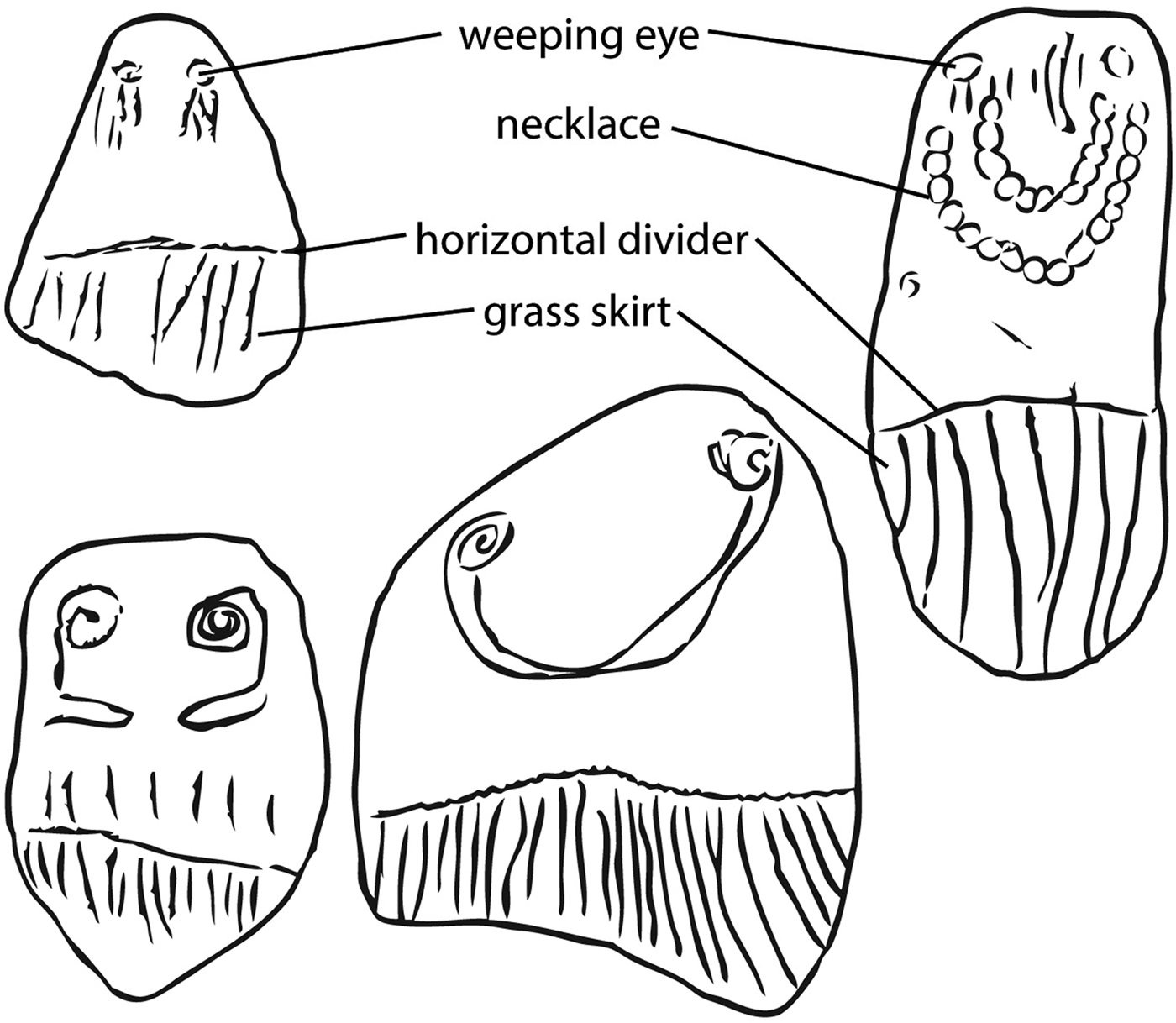
Eastern Archaic basketry and incised stones transitioned directly into the Fremont complex, as apparently did Archaic people themselves (Adovasio et al. Reference Adovasio, Pedler and Illingworth2002:12). Incised stones diagnostic of the Great Salt Lake Fremont (Marwitt Reference Marwitt1970:145) modified and amplified the ancestral Archaic patterning with the addition of mannequin-model elements prominently featured on Fremont incised stones (Figures 9 and 10; Table 1). The Fremont also augmented Archaic rock art with painted anthropomorphs and geometrics such as dots and ladders (and some elements also seen on ceramics)—creating an unmistakable Fremont tradition that conspicuously retained “ideological ties with the Great Basin peoples to the west [and] prevailed for several thousand years” (Schaafsma Reference Schaafsma1994:xii). Incised stones are found in post-Fremont contexts at various sites in northwestern Utah and southern Idaho.
Fremont-style incised pebbles showing the weeping eye, horizontal divider, and grass skirt motifs (western Utah; after Schuster and Carpenter Reference Schuster and Carpenter1988:938–938, Figure 1157; Warner Reference Warner1981:Figure 3). Dimensions unavailable.
The Northern Inyo Cluster
Something like 100 incised stones (mostly isolated finds) come from Inyo and Mono counties (southeastern California; Supplemental Table 1). Most were found in the northern Inyo Mountains; the earlier sites were probably short-term hunting camps, and later occupations were likely fall or fall-and-winter piñon residential base camps (per Bettinger Reference Bettinger1989). These incised stone assemblages are difficult to date (Supplemental Table 2), but the trajectory clearly carried over among the late nineteenth- or early twentieth-century Panamint Shoshone (Ritter Reference Ritter1980).
Relative to incised stones, pendants are extraordinarily common in the northern Inyo cluster. Bettinger has it right, concluding that these incised stones
differ from those that have been reported from central Nevada (e.g., McKee and Thomas Reference McKee and Thomas1972) in that they nearly always display some edge grinding in addition to incising. Presumably this reflects more careful curation of incised slates, perhaps as personal charm stones, in eastern California. In central Nevada, on the other hand, their importance may have been limited to individual magical or religious performances outside the immediate locational and temporal context of which they ceased to be of value [Reference Bettinger1989:78].
Although I believe that some northern Inyo incised stones were likely emplaced during healing rituals, the assemblage is sparse, and patterned associations with obvious power places is not convincing. Although this may change with further research, available data from northern Inyo provides little support for the prayerstone hypothesis, and these incised stones do not seem to belong to the Central Shoshonean core.
Prayerstone Votive Practice
The prayerstone hypothesis remains preliminary and requires further testing. The mannequin model was explored here, but additional fine-grained heuristics are necessary to explore alternative compositional and elemental strategies. More intensive analysis will doubtless generate tighter chronological controls, likely leading to finer-grained site and constellation genealogies. Ongoing Native American consultations promise to help refine and (perhaps) redefine the preliminary constellations proposed here, possibly adding new ones as well.
That said, working from the results presented here, I conclude that the isolated incised stones of northern Inyo and the rest of the outer perimeter fail to support the prayerstone hypothesis. They lack the distinctive regional look so evident within the central Shoshonean core, and their largely scattered, atomized distributions impart little sense of repeated ritual practice. But these incised stones do convey themes and motifs. They have proveniences, but their object provenances remain to be delineated. It is perhaps premature to dismiss them as merely decorated rocks.
In stark contrast, the place logic and structural composition evident in the >3,300 incised stones from the central Shoshonean core is entirely consistent with the prayerstone hypothesis, reflecting what Fowler called “spiritual associations with their geography” (Reference Fowler2002:180). To be sure, each prayerstone has a unique, personalized biography—picked up in a variety of places, they were selected for different qualities and marked in distinctive ways. Some were preplanned with complex designs, others only barely scratched. Some were carried around for a while. Some were decorated just once; others were repeatedly re-inscribed. But thousands of Shoshonean prayerstones share a fundamental, four-step itinerary—from geological genesis, to selection as potential ritualized paraphernalia, to enhancement and empowerment through a deliberate votive emplacement that was neither random nor haphazard.
Santini correctly perceived that the dense concentrations of incised stones around Las Vegas were clustered in distinctive ways, some apparently emplaced as a group: “if one were found there would be more” (Reference Santini1974: 13). The prayerstone hypothesis provides a relatively parsimonious explanation of these clusters—the common denominator being the perception of where puha resides and a shared belief in the “personhood” of prayerstones to serve as a conduit to that power (Zedeño Reference Zedeño2009). This explains why so many incised stones turned up in the precise locales projected by Shoshonean place logic—some tucked individually into cracks deep inside caves, some left inside houses, and others piled up along the trails, by sacred springs, petroglyph panels, and dramatic rock outcrops.
Protocols embodied in the mannequin heuristic permit relatively fine-grained description and classification into constellations of ritual practice reflecting the enormous variability manifest in the thousands of incised stones from across the Intermountain West. Mannequin references are virtually absent in the >600 incised stones from Graptolite Summit but dominate prayerstone assemblages from Las Vegas and Fremont territory. Obscure mannequin derivatives (appearing as elemental isolates) characterize the Little Boulder Basin and Ruby Cave constellations. So too with the walked-rocker technique—uniquely employed to imitate local fossils at Graptolite Summit but used entirely differently than mannequin-style prayerstones of the eastern Archaic and Las Vegas constellations. Over five millennia, each regional constellation developed its own distinctive look, a trajectory defining a structured variability unquestionably associated with many (but not all) Numic-speaking populations.
So viewed, prayerstones are embodied cultural practice. Individual actions created each prayerstone, and distinctive constellations of votive practice emerging as cumulative outcomes of personal decision-making and epistemologies created biographies of each such artifact. People do not necessarily pray the same way—and to suggest otherwise homogenizes the very lives of those we wish to understand (Simms Reference Simms and Beck1999:107–108). The constellation trajectories came to differ from one another because local petitioners periodically innovated. If these innovations produced desired results, the votive practices may have been deemed acceptable by others, who in turn encouraged similar innovations and caused these new practices to persist. The distinctive regional clustering can be attributed to the constellations of ritual practice developed through the interactions of multiple communities who shared a belief in prayerful petitioning for puha and ritualized expressions of gratitude for favors granted.
Prayerstones and Numic Language Distributions
None of us would confuse the Graptolite Summit prayerstone assemblages with those from Las Vegas—they look very different, and they were ritually emplaced differently. Available archaeology demonstrates that this regionally diverse votive practice began 5,000 years ago in the central and southern Great Basin and persisted among many (but not all) ethnohistoric Numic-speaking communities.
Does the prayerstone hypothesis imply anything about the distribution of Numic languages? The prevailing hypothesis—still apparently accepted by a majority of practicing Great Basin anthropologists—posits a single, simultaneous, and late expansion of Numic-speaking Paviotso, Shoshone, and Ute communities across the Intermountain West, characterized by “dialectic differences … so slight that one can only with the greatest difficulty imagine that they could have occupied the vast areas in which we find them for more than a very few centuries” (Lamb Reference Lamb1958:99). Evidence supporting the prayerstone hypothesis is consistent with major parts of Lamb's argument.
Archaeology, linguistics, and oral history have long suggested a collapse of the Lovelock culture and abandonment of Lahontan Basin before the Paviotso broke off from Mono speakers and moved northward into western Nevada (as summarized in Madsen and Rhode Reference Madsen and Rhode1994). The conspicuous absence of prayerstones in Paviotso territory reflects both unsuitable local geology and the fact that Penutian-speaking Lovelock communities did not make incised stones. Because votive prayerstones barely caught on in southeastern California, it is hardly surprising that the northward immigrants did not bring the practice with them. Although Northern Paiute cosmology involves considerable votive ritual in sacred places where power resides, there is no record (ethnographically or archaeologically) of incised stones as prayerful offerings (Fowler Reference Fowler2002:171, 177–178; Park in Fowler Reference Fowler1989; Supplemental Table 1).
Eastern Great Basin archaeology is also largely consistent with Lamb's (Reference Lamb1958) hypothesis (Rhode and Madsen Reference Rhode, Madsen, Madsen and Rhode1994). Multiple Archaic and Fremont communities emplaced prayerstones in the same caves and rockshelters (Supplemental Table 1). If individual males were largely responsible for the initial in-migration of farmers into Fremont territory (Simms Reference Simms2008:199–209; Simms and Gohier Reference Simms and Gohier2010:73), then perhaps already-resident females were responsible for carrying over Archaic prayerstone and rock art practices into Fremont communities.
Steward included “etched stones” as a significant element in his definition of Promontory culture (Reference Steward1937:77–79, 86, 122), and the mannequin motifs on Figure 10 raise intriguing issues regarding Fremont-Promontory relationships. Recent reanalysis and re-excavation suggests that late Fremont peoples—particularly women—became incorporated in the Athabascan-speaking Promontory cave population (Yanicki and Ives Reference Yanicki, Ives and Voorhies2017). If they brought with them Fremont ceramic, basketry, and incised stone practices, this ethnogenetic turn may account for the imitations of northern Plains garments made in the Fremont style (as in Figure 10, left; see also Ortman and McNeil Reference Ortman and McNeil2017).
The mannequin model applied to two incised stones from Promontory Point, Utah (after Schuster and Carpenter Reference Schuster and Carpenter1988:942–943, Figures 1175–1176). Left: note the distinctive pinched-waist style characteristic of many Utah incised stones (Schuster and Carpenter Reference Schuster and Carpenter1988:911; see also Steward Reference Steward1937:Figure 43/a). Length is 11.1 cm. Right: Natural History Museum of Utah, 19886. Length is 11.5 cm.
The demise of Fremont farming (~cal AD 1280–1460) may have led to a coalescing of indigenous and immigrant populations, with some moving elsewhere and others persisting as foragers (Madsen and Simms Reference Madsen and Simms1998:314–317). Although Fremont basketry and ceramics are wholly dissimilar from subsequent Shoshonean counterparts (Adovasio et al. Reference Adovasio, Pedler and Illingworth2002:21; Simms Reference Simms2008:248–255), incised stones turn up in post-Fremont contexts at Hogup Cave, Thomas Shelter, Spotten Cave, and Trapper Cliff Shelter. Perhaps they were emplaced by carryover Fremont foragers, or maybe the practice was (re)introduced by newly arrived Numic communities. Both alternatives are consistent with Lamb's (Reference Lamb1958) hypothesis.
Problems arise in the Central Shoshonean core. If Lamb's (Reference Lamb1958) pan-Great Basin hypothesis is correct, how could the forebears of Western Shoshone and Southern Paiute ancestral communities have participated in Shoshonean cosmological practices spanning multiple millennia if they only arrived in central and southern Nevada a few hundred years ago? Does prayerstone evidence reflect an ethnogenetic Shoshonean continuity across the millennia? Or are there explanations of how such material manifestations of deep cosmology could be picked up by unrelated newcomers?
One hypothesis would extend the Fremont/Promontory scenario westward to suggest that migrating Numic speakers adopted wholesale an ancient prayerstone practice upon arrival in the central and southern Great Basin. Maybe the newcomers incorporated still-resident non-Numics into their communities. Or perhaps arriving Numic speakers could recognize in their new landscapes former places of power and understand that the now-archaeological prayerstones emplaced nearby once served as conduits to that puha—basically applying their own cultural logic to adapt previous votive practice as their own. Both scenarios are consistent with Lamb's (Reference Lamb1958) hypothesis.
Admitting some personal discomfort with such cosmological makeovers, I favor an alternative hypothesis: distinctively Shoshonean prayerstone rituals originated ~5,000 years ago in the central and southern Great Basin, and some communities of practice carried this votive ritual forward into the ethnohistoric period. I think these continuities are amply demonstrated in the long-term, regionalized compositional trajectories and the individual emplacement practices across the millennia. Available prayerstone evidence fails to support a post-AD Numic arrival in the central or southern Great Basin—no perceivable breaks in prayerstone practices, no former constellations terminated, and no new constellations begun within the last 1,000 years. I think ancient incised stone genealogies support an ancient Shoshonean presence within the central Intermountain West—but not in Lamb's classic “Numic heartland” near Death Valley (Aikens and Witherspoon Reference Aikens, Witherspoon, Condie and Fowler1986; Grayson Reference Grayson, Madsen and Rhode1994; Holmer Reference Holmer, Madsen and Rhode1994; Thomas Reference Thomas2014:142).
Theoretical Pluralism and Shoshonean Ethnogenesis
Each of these multiple working hypotheses—those supporting Lamb's (Reference Lamb1958) Numic expansion and its competitors—is framed by analogies to ethnographic groups descending from a common ancestor. Such population histories invoking migration and/or in situ demographic expansion typically reflect an intertwining of genes, language, and behavior within a single cladistic tree “with ethnic groups in this phylogenetic unit as the leaves, and population events such as migrations being the branches” (Ortman Reference Ortman2012:32).
I am reminded of Simms's (Reference Simms, Madsen and Rhode1994) call for an “unpacking” of the Numic spread debate, but that has not happened. Conversations are still constrained by bounded taxonomic conventions that set the agenda—theoretically, spatially, and temporally. Criticizing a preoccupation with such “metaphors of boundedness,” Simms argued that epistemological abstractions such as “European history,” “Hopi history,” and “the Numic spread” have long tyrannized archaeologists and historians into transforming “dynamic interconnected phenomena into static, disconnected things” (Reference Simms and Beck1999:105–107). This is why hypotheses about the Numic spread (by Lamb and the others) share the assumption that genes, language, and culture necessarily evolved “as a package in bounded social groups” (Ortman Reference Ortman2012:2).
While certainly not precluding possibilities of past migrations, such “unpacking” would enable the tracking of an ethnic group's genetic, linguistic, and cultural heritage without the assumption of specific, parallel descent. The concept of “ethnogenesis” elevates the focus away from entire “peoples” to open up possibilities that “human beings [create] novel and new cultures and societies by combining bits and pieces of pre-existing cultures in a free and enterprising manner” (Moore Reference Moore1996:30; see also Ortman Reference Ortman2012:32; Weik Reference Weik2014). Such ethnogenic communities would sometimes lack close interactive correlations among language, biology, and culture—there conforming to anthropology's foundational premise that (1) these three variables do not necessarily coevolve as packages, and (2) they should instead be analyzed as potentially independent variables (Barth Reference Barth and Barth1969; Boas Reference Boas1904; Gregory and Wilcox Reference Gregory and Wilcox2015; Ortman Reference Ortman2012:32; Rhode and Madsen Reference Rhode, Madsen, Madsen and Rhode1994:220; Stojanowski Reference Stojanowski2010:48, 50, Table 1, Reference Stojanowski2013:7).
More productive pursuit of Shoshonean ethnogenesis will benefit from melding innovative ways to expand already-productive “gastric” strategies with a simultaneous exploration of practice theories capable of blurring the boundaries of conventionally imposed community identities. This enhanced theoretical pluralism could even trigger a parallel exploration of cultural pluralism in the past—one capable of recognizing that the emergence of new, hybrid communities through the organization of daily life—and free from the assumption of “monolithic clashes of categories per se” (Simms Reference Simms and Beck1999:106; see also Lightfoot et al. Reference Lightfoot, Martinez and Schiff1998). In this way, anthropological perceptions of identity could increasingly be perceived as situational, relational, and subject to negotiation (Hu Reference Hu2013).
This is why, within the spirit of theoretical pluralism, I propose prayerstones not as “ethnic markers” of Numic languages or Shoshonean identity, but rather as another potential avenue for teasing out “the social life of things” (Appadurai Reference Appadurai1986). So viewed, the diversity and antiquity of these long-term constellations of votive prayerstone practice suggest dramatically more complex cultural trajectories than implied by Lamb's widely accepted model of a single, late, simultaneous Numic spread across the Great Basin.
Acknowledgments
I thank Tom Blaber, Mourrice Papi, Diana Rosenthal-Roberson, Anna Semon, Nick Triozzi, Lorann P. Thomas, and Kayla Younkin for assistance in preparing this manuscript. I am grateful to María Nieves Zedeño for providing the Spanish translation of the abstract. Thanks also to several others who helped me round up the incised stones for this study (each individually acknowledged in Supplemental Table 1). I am particularly grateful to several friends and colleagues for comments on earlier drafts of this paper: Richard Arnold, Pat Barker, Elliot Blair, Michael Delacorte, Alan Garfinkel, Dayna Giambastiani, Mark Giambastiani, John Ives, Joel Janetski, Bill Hildebrandt, Kent Lightfoot, David Madsen, Kelly McGuire, Christopher Morgan, Steven Simms, Helen Wells, Gabriel Yanicki, David Yoder, María Nieves Zedeño, and an anonymous reviewer.
Data Availability Statement
Data used as the basis for this analysis are included in the supplementary data files.
Supplementary Materials
Supplementary materials are linked to the online version of this article, which is accessible via the Society for American Archaeology member log-in at https://doi.org/10.1017/aaq.2018.73
Supplemental Table 1. Incised Stones in Great Basin Contexts.
Supplemental Table 2. Incised Stones from Datable Contexts.
Supplemental Table 3. A Ritualized Shoshonean Cartography of Nevada Cultural Landscapes.
Supplemental References.



