


The European ground squirrel or souslik Spermophilus citellus is the western-most representative of the Palaearctic ground squirrels. This robust rodent occurs mostly in short-grass meadows up to c. 2,000 m altitude and, although well adapted to habitat disturbance, is vulnerable to both the anthropogenic conversion of grasslands for agriculture (Ružić, Reference Ružić1979) and urbanization (Hoffmann et al., Reference Hoffmann, Millesi, Pieta and Dittami2003). Formerly considered a major crop pest, the European souslik is now listed in the EU Habitats Directive (Council Directive 2006/105/EC of 20 November 2006) and has been categorized as Vulnerable on the IUCN Red List since 1996 (Coroiu et al., Reference Coroiu, Kryštufek, Vohralík and Zagorodnyuk2008).
Phylogeographic assessment based on a complete mitochondrial cytochrome b gene has shown that the European souslik comprises three historically isolated, independently evolving lineages. To preserve within-species diversity these deeply divergent lines should be regarded as independent units for conservation management purposes (Kryštufek et al., Reference Kryštufek, Bryja and Bužan2009). Although the conservation needs of the northern lineage of the European souslik, which occupies the largest range, have attracted attention among EU member states (Matĕjů et al., Reference Matĕjů, Hulová, Nová, Cepáková, Marhoul and Uhliková2010), the status of the smallest of the European souslik lineages, endemic to Mount Jakupica in the Republic of Macedonia, is virtually unknown. Here we focus on the distribution and population status of this lineage.
Mount Jakupica is dominated by volcanic and metamorphic bedrock with Mesozoic evaporites of limestone folded over basal rocks. The Mount Jakupica complex consists of four major ridges that converge at Solunska Glava, the highest peak (2,540 m). The climate is alpine, with strong altitudinal shifts in precipitation and temperature (Reed et al., Reference Reed, Kryštufek, Eastwood, Griffiths, Kryštufek and Reed2004). The western part of the area is managed as the Jasen Game Reserve. Grasslands are utilized as summer pastures by villagers from the foothills; however, there are no permanent settlements above 1,000 m. Sheep and cattle grazing is widespread and during our surveys the area of Gorno Begovo (Fig. 1) and its immediate vicinity were grazed by c. 2,600 sheep, 300 cows and 50 horses.
The occurrence of the 10 colonies (numbers as in Table 1) of the European souslik Spermophilus citellus on Mount Jakupica, central Macedonia. The shaded areas on the inset show the likely range of the European souslik in south-eastern Europe and the distribution of phylogeographic lineages (N, Northern; S, Southern; J, Jakupica). Phylogenetic relations between lineages are summarized in a simplified phylogenetic tree; numbers denote mean genetic distance (in %, above branch) and time (million years ago, below branch) elapsed since the divergence of two lineages (modified from Kryštufek et al., Reference Kryštufek, Bryja and Bužan2009).

We searched Mount Jakupica for souslik colonies during the first half of July in both 2006 and 2010. Juvenile sousliks were starting to be weaned at that time but were still obviously smaller than the adults. Information on the locations of souslik colonies was provided by rangers, shepherds and mountaineers. Each colony was mapped by walking around its periphery and recording the geographical position of souslik burrows at the margins. The surface areas of the colonies were calculated using ArcGIS v. 9.1 (ESRI, Redlands, USA). The number of adult sousliks was estimated by line transect sampling (Buckland et al., Reference Buckland, Anderson, Burnham, Laake, Borchers and Thomas2001). Because the population survey was incomplete in 2006 we used only the 2010 counts.
When animals occur singly the estimator of density (D) is n/2Lμ w , where n is the number of detections, L is the total transect length, and μ w is the estimated effective strip half-width. The constant μ w was estimated for each colony from the distribution of distances (r) of observed animals perpendicular to the transect. The distance was calculated for each individual as r=d sin(θ). The sighting distance (d) was measured from the observer to the souslik when first detected and the sighting angle (θ) between the transect line and the line of sight was measured to the nearest 5°. Two observers walked slowly (< 1 km h−1) within a souslik colony in a predetermined straight line, searching for sousliks using range-finding binoculars. A total of 30.71 km of transects were surveyed, of which only 10.76 km were used for density estimates. We omitted transects walked in weather conditions suboptimal for souslik activity (midday heat, rain and strong wind) as they yielded an obviously lower number of observations. The density of sousliks was calculated using Distance v. 6.0 (Thomas et al., Reference Thomas, Laake, Rexstad, Strindberg, Marques and Buckland2009).
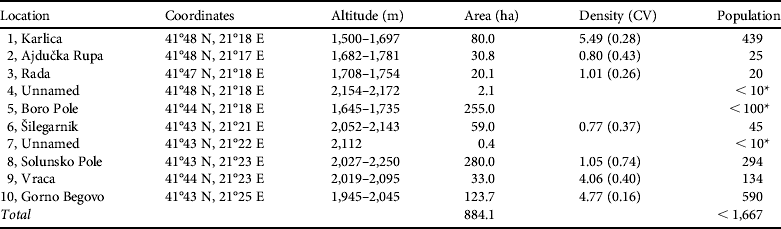
We recorded eight isolated colonies of sousliks, in areas of 20–280 ha, and two small groups, in 2.1 and 0.4 ha (Fig. 1, Table 1). These colonies were at altitudes of 1,500–2,250 m over c. 15 km of rugged mountain topography. The majority of souslik habitats were heavily grazed mountain pastures of short (<10 cm) grasses (Poa, Nardus, Bromus, Festuca) and herbs (Plantago, Thymus). Within 197 m perpendicular to the transects 419 sousliks were observed, c. 50% of which were seen within 33 m of the transect. The effective strip width was c. 60 m (range 59.8–63.7 m) for most of the estimates. Using Distance we estimated mean population densities in seven colonies to be 0.8–5.5 ha−1 (Table 1). We could not estimate densities in the other three colonies (locations 4, 5 and 7 in Fig. 1) because sightings were too few. High coefficients of variation (0.16–0.74), which imply wide confidence intervals, mean these estimates must be interpreted with caution. Published densities for European souslik populations are almost invariably higher than the densities estimated on Mount Jakupica; for example, 5–15 adults ha−1 in high mountain pastures in eastern Serbia (Ružić-Petrov, Reference Ružić-Petrov1950) and 6.5–110 adults ha−1 in anthropogenic habitats in Austria (Hoffmann et al., Reference Hoffmann, Millesi, Pieta and Dittami2003, Reference Hoffmann, Turrini and Brenner2008). The results from our study are possibly underestimates because it is unlikely that all sousliks were seen at zero distance from the line transect.
The 10 colonies of the European souslik Spermophilus citellus on Mount Jakupica (Fig. 1) surveyed in this study. Population densities were estimated in 2010 by line transect sampling. Density is given as adult sousliks per ha, with the coefficient of variation (CV) in parentheses.
* Tentative estimate (density could not be calculated; see text for details)
To check the reliability of our density estimates for the largest colony on Mount Jakupica, at Gorno Begovo, sousliks were counted on 0.25-ha plots in 2010. Each plot was observed with binoculars for at least 3 hours during the morning activity of the sousliks, with their burrows temporarily closed to avoid multiple counts of the same individuals. Care was taken to avoid recounting the same individuals on different plots. On 17 plots (total area=4.25 ha) 1–10 adults were recorded (mean=4.1±SD 2.76). These results suggest a mean souslik density of 16.5 ha−1, c. 3.5-fold higher than for the entire colony. These 0.25-ha plots were located on the western side of the colony where the number of sousliks was greatest.
Estimates for the total number of sousliks were 20–590 per colony (Table 1). The total area of the seven colonies (626.6 ha) for which densities could be estimated therefore contained c. 1,547 adult sousliks. The majority of these (c. 94%) were in four colonies (Gorno Begovo, Karlica, Solunsko Pole and Vraca) in two areas. Tentative population estimates for the other three colonies do not significantly modify the estimated total (Table 1). These data suggest that the overall number of sousliks within the Jakupica phylogeographic lineage is most likely <2,000 adults.
Boro Pole, with the second largest colony (Table 1), was only surveyed in 2010. Because sousliks were scarce there, with none seen <200 m from the transect, the density could not be estimated. We assume, from a scattering of occupied burrows, that the total number of sousliks in this colony is <100. Rangers employed by the Jasen Game Reserve indicated that the low density is the result of a catastrophic forest fire in 2007 that also burned the meadow. Sheep grazing was abandoned in Boro Pole c. 40 years ago when the Reserve management began to utilize hay from this pasture as supplementary feed for game. As a result, grasses (Festuca, Bromus and Stipa) now grow tall, although sparsely, and the presence of a relatively large number of umbellifers (species of Apiaceae) on the margin of the area suggests that it is overgrown. Rangers claimed that prior to the 2007 fire sousliks were as abundant in Boro Pole as they were in Karlica in 2010. This suggests there were formerly c. 1,000 sousliks in Boro Pole, about half the total estimate for the Jakupica lineage in 2010.
Our results show that the Jakupica lineage of the European souslik occupies a small, fragmented area. Colony densities are lower than those reported elsewhere for the species and the total population is probably <2,000 adults. Although souslik colonies in remote Mount Jakupica are not threatened by large-scale agricultural activities they are likely to become increasingly scarce. Livestock grazing is declining on Mount Jakupica (e.g. the number of sheep raised by villagers from Gorno Jabolchiste, in the eastern foothills of Mount Jakupica, had declined from 20,000 in 1980s to c. 10,000 at the time of our survey; pers. comms, local villagers). Fewer sheep means taller grass and more shrubs, which in turn increase the risk of high-intensity fires. In addition, the predicted advance of the tree line in response to climate change (Grace et al., Reference Grace, Berninger and Nagy2002) will most likely cause a further reduction in the area of habitat optimal for the souslik. The largest souslik colonies (Gorno Begovo and Karlica) are already fringed on one side by forest (Fig. 1).
A decline in souslik populations, together with increasing fragmentation, is likely to have a negative impact on fitness. In the small fragmented populations of the European souslik genetic drift could outpace the role of balancing selection and result in inbreeding depression (Říčanová et al., Reference Říčanová, Bryja, Cosson, Gedeon, Choleva, Ambros and Sedláček2011). A decline in fitness is therefore the most likely scenario for the Jakupica lineage. Monitoring needs to be implemented, at least for the largest colonies, to provide early warning of any declines. The management plan for Jasen Reserve for 2012–2021 (which, at the time of writing, has still not been approved) stipulates an action plan and monitoring for souslik colonies 6–10 (Fig. 1) but not for the Karlica colony, which had the second largest estimated population in 2010. The implementation of these measures will be the responsibility of the Reserve and the Ministry of Environment and Physical Planning.
Acknowledgements
We would like to thank the Jasen Game Reserve, Gordana Jankievska, Vancho Georgievski, Nataša Režek Donev, Dare Režek, Maja Gračner and Alenka Kryštufek. Peter Adamik and Darrell Smith provided valuable comments.
Biographical sketches
Boris Kryštufek is a mammalogist with a broad interest in rodent taxonomy, evolution, biogeography and conservation. He is the regional coordinator of the IUCN Red List Authority for Palaearctic small mammals. Peter Glasnović is studying plant diversity in the western Balkans. Svetozar Petkovski, a curator of vertebrate collections at the Macedonian Museum of Natural History, is involved in biodiversity conservation in Macedonia.



