

Introduction
Economic informality has taken over most of Nairobi’s central business district (CBD).Footnote 1 Most shops in the main streets have been subdivided into small cubicles that serve as kiosks or stalls for small-scale garment traders who also sell household accessories, electronic goods, and mobile phone accessories, among other items. In some streets like Taveta Road, women informal garment traders occupy the ground floor of buildings where they display goods on tables, as in any typical African market. This takeover by the informal economy has occurred on Moi Avenue, Du Bois Road, Accra Road, Taveta Road, and Luthuli, Latema, Ronald Ngala, and Tom Mboya Streets. Only a few streets in the CBD remain unaffected (Ngwala Reference Ngwalla2011).
The entry of economic informality into the CBD is somewhat similar to the phenomenon observed by Bayat (2000:45) which he called “the quiet encroachment of the ordinary” into the city—the entry of subaltern populations that do not belong to the dominant elite classes. I prefer to call it “subaltern urbanism” or “solidarity entrepreneurialism.” The people include market traders, garment makers and traders, hawkers, metal fabricators, shoe traders, and traders in household goods. According to official city by-laws, they should be excluded from the CBD, and therefore they have to operate differently from the dominant city classes of civil servants, five-star hoteliers, lawyers, and doctors, who are considered to be the legitimate business operators. They operate on a small scale, sell products in small batches, and make wide use of social relations and self-help associations in their transactions. They are also self-employed. In the colonial days these ordinary people were confined to lower-class residential areas in the eastern areas of the city referred to as Eastlands. After Kenya attained independence, efforts were made to license some of the hawkers to trade on street corners, but the rest were confined to markets such as Gikomba, Uhuru, Jericho, Kenyatta, and Kariokor. The CBD was the preserve of Asians and a few African businesses until the late 1990s, when the takeover by micro-retailers began. According to Ngwala (Reference Ngwalla2011), this development caught the city planners unawares. This article examines the changes that have taken place on Taveta Road in particular, where informal traders have steadily taken over spaces formerly occupied by Asian business owners.
Beginning with the works of Hart (Reference Hart1973) and the ILO (1972), the subject of economic informality in cities in Africa, Latin America, and Asia has attracted significant attention among scholars, international development agencies such as the ILO, and financiers such as the World Bank. Informal economy activities include petty trading, manufacturing, street hawking, and shoe shining, among others, and are carried out by unemployed or underemployed individuals or groups on the streets of big towns (Bengasser 2000). The category also can be extended to include carpenters, masons, tailors, cooks, drivers, and other tradesmen who have the skills needed to provide goods and services for a large but poor section of the population.
In most cases, economic informality is defined pessimistically, in terms of what is wrong with it or what it does not do. In the early writings, the informal sector economy is differentiated from the formal economy by certain characteristics: modest scale, ease of entry, reliance on indigenous resources, family ownership, labor intensiveness, use of adapted technology, reliance on skills acquired outside the formal school system, and operation within unregulated and uncompetitive markets (ILO 1972). In some instances, economic informality is viewed through a moral lens that highlights its perceived wrongs or weaknesses, such as its failure to provide social protection or insurance (Chen Reference Chen and Ravazi2009). Lund and Skinner (Reference Lund and Skinner2005) observe that informal workers lack business-related insurance, a basic infrastructure, funds, access to credit, information about existing service providers, and security against crime. The informal economy is also considered to be illegal since it operates largely outside the formally stipulated parameters (Tockman 2007). Success in economic informality is attributed to political connections (Benjamin & Mbaye Reference Benjamin and Mbaye2012), although some scholars point out that informal economy associations are also likely to gravitate toward criminality (Meagher 2011). In some instances urban planners view economic informality as a “planning pathology” that undermines the city’s modern status and they call for its formalization (Kamete Reference Kamete2012).
According to the ILO (2000), many of the informal sector workers are poor. Empirical evidence has shown, however, that the informal sector as a whole is highly heterogeneous and not necessarily synonymous with poverty (see Benjamin & Mbaye Reference Benjamin and Mbaye2012 on Francophone Africa). The very poor are engaged in subsistence activities at the bottom of the ladder, while profitable economic ventures thrive at the top. In this latter category individuals earn income well above the minimum wage in the formal sector economy. The urban informal sector also has its own mechanisms and networks of financial services, challenging the perspective that the informal sector is not organized (ILO 2000).
As I have argued elsewhere (Kinyanjui Reference Kinyanjui2010), economic informality needs to be treated as an economy in its own right rather than as an object of comparison with the formal sector. The evolution of the informal economy in African cities is in fact closely associated with a transition from Western to African modes of production, especially in matters of business norms. The formal sector in Kenya is operated by multinational corporations, state enterprises, or Asians (Kinyanjui Reference Kinyanjui2010), while most of the small firms in the informal economy are owned by Africans (Bigsten & Kimuyu 2004). It is in the informal sector that a large number of people in African cities repair their cars and buy groceries, clothes, shoes, and household goods like furniture. Thus economic informality in African cities can be understood only in the context of the creation of an African indigenous social economic order. The salient issue is not “normality” versus “abnormality,” but rather differences in world views in the realm of business ethics.
Gibson-Graham (Reference Gibson-Graham2006) refers to economic models that do not fit into the capitalist model of organization as “community economies.” These represent a postcapitalist socioeconomic order that is emerging as one of the effects of globalization. While most critics of the informal economy view it through a pessimistic lens, in terms of the standards that it does not meet and the problems it creates, in this article, the informal economy is examined in terms of what it does right. As a community economy, it makes wide use of social relations and applies African institutional values of utu (humanness) such as sharing, reciprocity, loyalty, and altruism. Its organization is horizontal rather than hierarchical, and holdings are diversified. Rather than operating one large shop, for example, an individual may have two or three stalls or diversify her business by investing in land, housing, or animals. Informal operators also rely on informal social groups known locally as vyama (singular, chama) for financial support. It is a postcapitalist social economic order in the sense that informal operators, on the basis of trust and interdependence, are able to reduce transaction costs involving transportation, space, information acquisition, or bulk purchasing. The collaboration involved and the solidarity that develops lead to the creation of nested communities (Kinyanjui Reference Kinyanjui2008, Reference Kinyanjui2010, Reference Kinyanjui2012).
The Taveta Road case study of women traders exemplifies this type of economic informality or “solidarity entrepreneurialism” in which individuals take risks along with others and form alliances for dealing with information asymmetry, business transaction costs, and economic uncertainties. Significantly, this entrepreneurialism has also involved what Bayat (Reference Bayat2000) calls “border crossing,” the movement of individuals and families from low-income neighborhoods and periurban locations into the CBD in order “to acquire basic necessities of their lives (land for shelter, urban collective consumption, informal jobs, business opportunities and public space) in a quiet and unassuming, illegal fashion” (2000:45). It is also important to note the vibrancy and entrepreneurship that has been observed in slum localities such as Dharavi, Mumbai, India, where over 70 percent of the residents work in the informal economy (see Nijman 2010). This vibrancy and entrepreneurship in economic informality cannot be ignored in theory and practice.
This article interrogates how subalterns penetrated the CBD in Nairobi and the implications of their entry. It begins by highlighting the factors that led to the exit of Asian-owned businesses and then documents the entry of economic informality, which caught the town planning department unawares. There is fear among planners that the CBD may be overcrowded and that the informal economy strains the existing infrastructure (Ngwala Reference Ngwalla2011). On a positive note, the entry has a bearing on equity, particularly with regard to the entry of women and their access to trading opportunities on Nairobi’s major streets. This development has also generated a mood of informality and relaxation in the city center.
Information for this article was obtained from selected news stories from the Daily Nation (Nairobi) newspaper spanning a number of years. The more current information on Taveta Road was obtained from interviews conducted in 2012 with fifty-three of the estimated three hundred and fifty women operating micro-businesses there. The women were asked what they did before establishing their retail businesses, what their sources of finance were, how they learned about the business space, and how the chama has helped them in business. The information was coded and two specific themes of self-organizing and “solidarity entrepreneurship” were identified. The article is organized into six sections. The following section provides the analytical framework of the analysis and is followed by a discussion of the exit of elite businesses from the CBD. The next sections discuss the movement of women from the economic and geographical margins to the city center. The article concludes by discussing the implications of this relocation.
Analytical Framework
While urban theory classifies cities into “global” and “world” categories, the majority of African cities do to not fit into either of these two categories on the basis of the poor service provision and lax governance standards found within them (Robinson 2002). In the case of Indian cities, terminologies such as “slumdog” are used (Roy Reference Roy2011). A city like Johannesburg in South Africa has been called an “elusive metropolis” (Mbembe & Nutall 2008). These terminologies denote the cities’ perceived incompleteness and informality in comparison to cities in the West. But while such cities, according to Yiftachel (Reference Yiftachel2009), tend to be characterized by frequent evictions, destruction of property, and lack of safety, the city of Nairobi, with more than 2.7 million people engaged in informal economic activity, hardly fits this description.
Nairobi, rather, is characterized by what I call “subaltern urbanism,” referring to efforts of ordinary people engaged in informal, grassroots economic activity and struggling to capture the city from the dominant elite planners and businesspeople and reconfiguring it as their own territory. This article depicts the subalterns as active participants striving to find an exit from their condition of material deprivation and builds upon the insights of Nijman (2010), Bayat (Reference Bayat2000, Reference Bayat2007) and Crerar (2010; cited in Roy Reference Roy2011), among others. Crerar (Reference Crerar2010), for example, speaks of the activities in the slums of Mumbai as inspired by the “alchemic ability to thrive when chips are down” (cited in Roy, 2007:223). Bayat (Reference Bayat2000, Reference Bayat2007) critiques the assumption that subalterns gravitate toward criminal activities and states that the urban poor have their own religiosity, a relatively autonomous informal life, and an intimate politics of the everyday. Because the informal economy tends to operate differently from the mainstream, scholars and planners consequently need to appreciate this difference before embarking on attempts to formalize it or integrate it into the formal economy.
Women’s Entrepreneurship
Women’s entrepreneurship is receiving considerable attention both in scholarship and in development discourse. This is because more than 80 percent of the women engaged in nonagricultural activities in sub-Saharan Africa are engaged in the informal sector (ILO 2002). Individual countries such as Kenya (83 percent), South Africa (58 percent), Benin (97 percent), and Guinea (87 percent) register particularly high proportions of women pursuing informal economic activity (ILO 2002). This makes economic informality high in the developmental agenda of countries in sub-Saharan Africa.
Chen (2009:199) observes that the informal economy is increasingly becoming feminized. Richardson (2004) advocates for the rescue of women from economic informality by formulating strategies geared at growing their businesses. This involves providing them with an enabling environment through provision of credit, property rights, entrepreneurial training, and attention to their practical needs such as water, health, and education (see also Ellis et al. Reference Ellis2007).
Empirical studies on women entrepreneurship have shown that compared to men, women in the informal economy are constrained and perform poorly in terms of earnings, poverty avoidance, and the growth of their businesses (Chen Reference Chen and Ravazi2009; Iyenda & Simon Reference Iyenda, Simon, Murray and Myers2006; Njeru & Njoka Reference Njeru, Njoka, Alila and Pedersen2001; Rono Reference Rono, Alila and Pedersen2001). Munyua (Reference Munyua, Buskens and Webb2009) observes that women entrepreneurs are concentrated in sectors that do not conflict with their gender roles such as community, social, and personal services. They resort to informal activities because of the longstanding gender segregation of work, constrained access to credit, limited training, skewed land rights, lower levels of education than men, inequalities in social relations, and the reproductive work burden (Tsikata 2009). However, besides being pushed into informal entrepreneurship, women are also motivated to start businesses out of ambition and a drive to achieve, the desire for autonomy and flexibility, or the need to finance children’s education (Cohoon et al. Reference Cohoon, Wadhua and Mitchel2010; Munyua & Mureithi (Reference Munyua and Mureithi2008). I wish to reinforce this latter perspective by emphasizing women’s agency. This case study illustrates how women are using strategies such as border crossing, solidarity entrepreneurialism, and collective alliances in running garment stalls along Taveta Road.
Perhaps inadvertently, studies comparing men and women in business tend to frame the qualities of successful entrepreneurship—such as assertiveness and the will to achieve—as inherently masculine (Baron Reference Baron1999). But as Cohoon et al. (Reference Cohoon, Wadhua and Mitchel2010) observe, women do not differ from men in terms of entrepreneurial abilities. As I argue elsewhere (Kinyanjui Reference Kinyanjui2008), entrepreneurship among women in the informal sector existed long before the scholarly interest in the subject, dating at least from the 1970s. Robertson (Reference Robertson1997), for example, has shown that the participation of women in the bean trade is traceable to the precolonial era, and it is only the commodities traded that have changed with circumstances. What has been particular to women is the protracted struggle that generations of women have waged in order to overcome an anti-woman stance in the city. As McFadden (2005:5) says,
For long, men in Africa have been accomplices to relegating women to rural spaces. In Nairobi’s urban areas during colonial times, black women could only traffic publicly under the auspices of a recognized black male figure as a wife. Women who could not show their husband were labeled prostitutes and socially stigmatized. During colonial times and shortly after independence, women who fled to the cities were repatriated to villages by their male relatives where they were humiliated and branded as traitors. All this served to ensure that young women remained within the boundaries of such communities. Nonetheless women left for the urban spaces, expressing their resistance to patriarchal surveillance.
Unfortunately, as Mohanty (Reference Mohanty1988) and McFadden (Reference McFadden2005) say, some contemporary scholars continue to present Third World and African women as powerless victims with little ability to work as agents of change.
Insurgency and the Exit of Elite Businesses from the CBD
The arrival of women traders along Taveta Road was triggered partly by the exit of Asian businesspeople as a result of the occasional harassment they were receiving from those who perceived foreigners as receiving preferential treatment in business matters. In addition, in the 1990s Kenya in general and Nairobi in particular were the sites of an insurgency mounted by pressure groups clamoring for multiparty democracy. While political rallies took place in public parks, rowdy gangs took advantage of the chaos to terrorize Asian businesspeople, with heavy losses resulting from looting. According to an article in the Daily Nation (1997a),
There were running battles between traders, askaris [security guards] and administration policemen in the Nairobi Central Business District. Passersby and hawkers scampered to safety while others threw stones at the askaris and policemen. Shop owners closed their businesses but many were affected by the looting that took place during the melee and they lost goods and property worth a great deal.
The 1990s and 2000s also witnessed a massive entry of informal workers in the CBD (Kamunyori 2007) as a result of the neoliberal policies that were imposed upon developing countries by the World Bank and International Monetary Fund. The policies entailed trade liberalization, the freeing of foreign exchange rates, a reduction in government spending by cutting costs in social services, and privatization of government services such as the railway and industry (Easterly Reference Easterly2005; Simutanji Reference Simutanji1996; Williams Reference Williams1994; Kraus Reference Kraus1991). These policies led to massive job losses and a general impoverishment of the people in Kenya and sub-Saharan Africa (Bangura Reference Bangura1994), and the victims of these policies sought alternative livelihoods in the informal economy. In Nairobi, street hawking increased, and these informal workers became a nuisance on the city streets as they obstructed movement and competed with established businesses that were paying taxes. They were also viewed as a security threat (Kamunyori 2007). The city authorities responded by either arresting the hawkers or chasing them from the city streets. The hawkers, for their part, put up a strong resistance and street battles between the informal workers and the combined forces of the police and the city council askaris became common in the city. Stories of these battles became regular features in Kenyan dailies such as the Daily Nation:
Armed policemen and city council askaris are accused of harassing vendors and hawkers along Nairobi streets, and in discriminatory fashion. The effort by police to clear the streets of hawkers followed riots sparked by the dispersal of a constitutional reform rally at Central Park. Hawkers were blamed for the chaos and looting that took place after the rally. The hawkers were evicted from the streets together with shoe shiners and the disabled traders. City Council askari had a few days earlier also flattened kiosks near the Railway Station in Nairobi, an operation that rendered hundreds of people jobless, and caused damage and loss of property worth thousands of shillings. Most kiosk owners did not know what to do after the destruction of their property. (Daily Nation 1997b)
Despite the effort put up by the country’s security apparatus to control the insurgency, Asian business operators succumbed to the intensity of the looting and the environment of fear and uncertainty, and exited from the CBD. The informal traders thus saw an opportunity in the vacated open-plan shops and either subdivided the buildings into stalls and kiosks or occupied the shops as a group. The inclusion of these subaltern workers thus resulted from an insurgency and a power dynamic involving a class struggle, rather than any technocratic urban planning procedures.
Women in the Margins
Historically, women in Nairobi have undergone formidable struggles in the search for space and opportunity in the city. Women were locked out of modernity and capitalist enterprise by the colonial powers. While colonial policies encouraged the migration of male laborers to work on farms, mines, factories, and shops, women were forbidden by law to migrate from rural areas to the city.Footnote 2 It was feared that women’s mobility would lead to a breakdown of the family order that was crucial to the sustenance of the labor supply.
Most communities in Kenya also discouraged women’s migration. Bujra (Reference Bujra1975) documents that the early women entrepreneurs in Nairobi, especially single women who migrated into the city, were prostitutes. Okuro (Reference Okuro2006) documents the activities of the Ramogi African Welfare Association, which worked with the colonial government in the 1940s and 1950s to repatriate women from towns to rural areas; “The women would be shaved, dressed in gunny bags and walked through the street in an endeavor to humiliate them” before being sent home (2006:71). Among the Gîkuyu of central Kenya, some popular music in the 1960s, such as the song “Cumî Cumî î Nguo Cianyu Nguhî” (Miniskirts, Miniskirts), stigmatized women who moved to Nairobi as miniskirt-wearing loose women. Another song, “Cehûra Cehûra” (Strip Strip), informed women supported by men who were not their husbands that they would be stripped, the way bread is stripped from its wrapping.
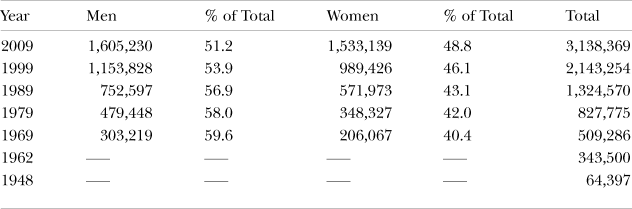
With independence, the official antimigration stance was relaxed, and the number of women migrants in the city has been growing considerably. In 1969 the proportion of women in the city was 40.4 percent. In 2009 the population of women in Nairobi had risen to 48.8 percent (see table 1). However, it was not until 1979 that women in Kenya were issued identity cards, and the lack of these cards denied women the chance to transact business with banks or own land. Moreover, in 1968 Parliament passed the vagrancy and prostitution act which enabled policemen to arrest women whom they suspected to be prostitutes or vagrants. Since the law did not spell out how the police would identify a prostitute, many women became victims of the law. They would be arrested, taken to court, and jailed in Lang’ata Women’s Prison. After the jail term, they would be repatriated to rural areas to be taken care of by their parents. Together with male hawkers, women were evicted from the streets by the city police in an attempt to keep the city clean, modern, and secure. In the 1980s and 1990s it was common to see women scampering away from the police with children strapped on their backs and their goods scattered all over.
Distribution of Women and Men in the City by Sex

Source: Population census
There were also limited educational opportunities for women apart from the Government Secretarial Training College, programs to train teachers and nurses, and the Maendeleo ya Wanawake Organisation, which taught modern housekeeping skills and arts and crafts. No institutions trained women for the world of work in industry or the retail trade. Government or City Council involvement in the welfare and general advancement of women was minimal, and women were left to fend for themselves in the informal economy. The only issue about women that concerned the City Council in the early days was the problem of single women parents. To deal with this issue, a hostel for such women was set up at Jamaa on Juja Road and run by Catholic nuns belonging to the order of the Sisters of Charity.
A review of the Nairobi City Council hawker’s license file between 1973 and 1975 revealed letters written by women who were making requests to the Town Clerk to be issued a license so that they could trade in the city without harassment from the City Council askari. The files contain numerous statements from the women about their desire to provide for their families, their lack of employment, and the constraints imposed by their lack of education. Having a license, however, did not provide automatic security for the women traders. The women continued to face regular harassment from the askaris, as is evident in a 1973 case from a woman names Namuruana Munyi, who protested against harassment by returning her license and leaving her four children at the office of the licensing superintendent.Footnote 3 The licensing superintendent retaliated by confiscating her license and issuing it to someone else. He also took the children to the police station. This single case testifies the desperate situation of the women in the city.
Case Study: From the Margins to the Center
The new millennium has witnessed a new kind of urban development in Nairobi’s central business district. Shop floors are being subdivided into micro-retail stalls, and a shop that earlier held only one shopkeeper is now holding as many as twenty. Ngwalla (Reference Ngwalla2011) observes that only a few streets in the CBD—namely Kenyatta Avenue, Kimathi Street, Koinange Street, City Hall Way, Mama Ngina, Standard Street, and Banda Street—have not been transformed in this way, and the reason is that they house major banks, government and private offices, and five-star hotels. These changes have brought in a large population of people, including women, most of whom initially worked or were situated in peripheral spaces in the city.
The entry of women into the CBD has been momentous. On Taveta Road alone, they occupy six buildings: Jitihada, Annas Arcade, ECT, Taveta Mall, Iqba, and Istanbul Centre. These buildings accommodate about three hundred and fifty women micro-traders selling garments and other accessories such as handbags, beauty products, shoes, and jewelry, as well as baby clothes. The women traders share shops that are subdivided into small cubicles/stalls or use separate tables to display their goods. These traders differ in many ways from the street vendors of the 1980s and 1990s. They do not bring babies with them; they dress formally, and are younger and relatively better educated than their predecessors. However, their work still exhibits attributes of informality such as the small scale of the business operation and the reliance on informal social networks and trade associations to start up and maintain the businesses, even among women who are competing at the same time.
In many ways, the women traders have benefited from the reformist work of Nelson Kajuma, a trader who in 1999 pioneered the idea of exhibition stalls in response to the problem of street hawking in the CBD. Initially he rented empty buildings and spaces in which he constructed stalls that he in turn rented out to vendors. Despite the success of this initiative, the markets were burned down in 2000. Kajuma’s attempt to reconstruct the stalls was denied by the City Council, which withdrew his license because the stalls did not meet the city planning regulations. The hawkers, however, had learned that if they traded in sheltered space they would not be considered a nuisance. They started renting spaces in groups and displaying their goods in buildings where Asian clothing shops were closing down. This new method of marketing came to be referred to as “exhibitions.” The conversion of shops into exhibitions was stepped up by the liberalization of the economy, which saw many shops that were dependent on garments produced by import-substituting industries cease operation along Moi Avenue, Tom Mboya Street, Ronald Ngala, Taveta Road, Latema Road, and Accra Road. Import substitution was a trade and economic policy that advocated replacing foreign imports with domestic production. Kwadwo (2000) notes that this kind of industrialization policy was abandoned by developing countries in the 1980s and 1990s due to the indebtedness that resulted from related policies imposed by the IMF and World Bank through their structural adjustment programs. The vacant spaces left by these industries were taken over and subdivided for use by operators in the informal economy. Women who were already organized or had the ability to organize themselves into groups took advantage of this change.
Another attempt made by women to gain entry into the city garment market was through the occupation of hotel rooms. Women traders would disguise themselves as hotel lodgers and use the rooms—for example, in Mombasa House Lodge—to display and sell their goods. This business transaction was largely illegal and customers would often be arrested while they walked in and out of the hotel. Several hotel owners, however, started embracing the traders’ initiative and consequently more women began to occupy lodges in the city. Today several buildings house women informal garment traders, with the most notable ones situated along Taveta Road.
Some fifty-three women traders from Taveta Road were selected for interviews in 2012. Although the results of conversations with such a relatively small number cannot be generalized, they do provide insights into the changing nature of women in the city. For example, most of the women informal garment traders in Taveta Road (45.3%, or 24) had completed secondary school, while 24.5 percent (13 women) had a college certificate. Some 13.2 percent (7 women) had completed an even more advanced level of education, including three women with university education. Only one woman in the survey had attended only primary school. The participation of women with college and university education in informal trade is a new trend, precipitated by the high level of unemployment in the country. Some had begun their Taveta Road business immediately after leaving school (6, or 11.3%) while others had been unemployed (8, or 15%). Another eight (15%) had been employed as garment sellers or had worked in government offices, while others had been hawkers selling food, second-hand clothes, green groceries, or potatoes. Others had worked as receptionists, tea girls, or accounts clerks. The youngest woman in the survey was twenty-one years old, while the oldest was fifty-five. The mean age was thirty-three, while the modal age was thirty. Roughly half (50.9 percent, or 27 women) were married. The majority (22, or 43.1%) had come from peri-urban locations. The next largest category was drawn from low-income neighborhoods (19, or 37.3%). The rest of the women came from middle-income (8, or 15.7%) or high-income (2, or 3.9%) areas.
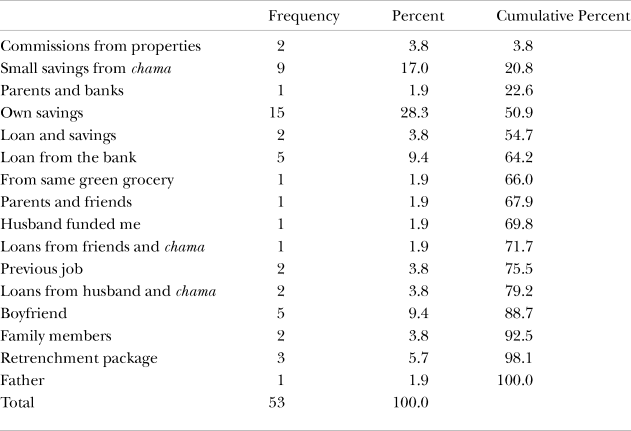
The women in the Taveta Road case study obtained start-up capital from a variety of sources (see table 2). The most important source was personal savings (15 women, or 28%). The next most important source (9 women, or 17%) was the chama, the organized social group or guild that commonly is used for mobilizing resources. Other sources included banks, relatives, spouses, and friends. Previous earnings were also an important source of startup funding.
Sources of Capital of the Case Study Women
Source: Field survey, 2012
The entrepreneurial journey of subaltern women from the margins to the center has required the ability to cross socially and economically defined borders and boundaries in the city. Such moves on the part of the political and economic elite are well-known phenomena; they move to different zones—including low-income neighborhoods—to open supermarkets and establish industries in the name of creating jobs and providing goods and services. At the same time, they extract profits from these neighborhoods and transfer the surplus to their own locales. While such boundary-crossing is not as familiar to the poor, or to women, the case study illustrates that women have indeed overcome actual or implied barriers imposed by a patriarchal culture and masculine planning ideologies. The movement has also been literal in the most basic sense—many take daily matatu (minibus) rides to the city or walk to the city center.
For many women, organizing themselves into vyama has facilitated their entry into the city center. These solidarity networks extend mutual support to members in a rotational manner. The women contribute a fixed sum of money every market day, and this money is given to one member who uses it for business expenses or to meet household demands. The chama also has a loan fund derived from the registration fees paid by each member upon joining the group. The money is loaned at an interest rate of 10 percent. The chama is thus a source of collective agency that helps the members enhance their businesses. By using their organized group as security, they are also able to bargain with formal banks such as the Equity Bank in Kenya and the Kenya Women Finance Trust to obtain loans. Other collaborative efforts reduce transaction costs. For example, women may import goods from overseas—say, from Turkey, Thailand, China, or the United Arab Emirates—and send one representative to carry out the transaction while they all share the cost of the trip. They also share the cost of the rent in the group occupancy setting, which itself boosts business through economies of agglomeration. Customers are drawn to one setting where traders congregate. This kind of entrepreneurship is based on trust. The women bond in the chama through weekly meetings and visiting one another. The weekly or monthly contributions they make also bind them together as a community in the spirit of the ubuntu adage: “I am because you are and since we are, therefore I am” (Mbiti Reference Mbiti1969:108).
Implications of Moving to the Center
The infiltration of the city by a subaltern population has often been met with acrimony from elite planners, whose first impulse has been to curtail this development rather than determine how to accommodate it. The planners have worried about overcrowding and strains on the infrastructural facilities within the city, among other problems (Ngwalla Reference Ngwalla2011). But the women are by now an established presence, and as such they have forced their way into being noticed and included in city planning rather than waiting to be invited or to have special zones created for them. Through group occupancy, sharing spaces, and collaboration they have initiated a new way of appropriating space in the city in a legitimate manner. Their presence is also perfectly legal. It is therefore incumbent upon the city planners to come up with imaginative planning models to accommodate them.
The women traders pay for City Council‒issued business licenses and are completely visible to income tax collectors. They comply with city laws and by-laws and cannot be accused of hiding. Regulations related to health and fire safety are taken care of by the various landlords. Most of the women no longer trade anonymously (see Kinyanjui Reference Kinyanjui2010); some have a business name and a stall number and advertise their business. This is partly a strategy to increase profitability, since such visibility makes it is easy for them to establish regular customers. As one woman testified,
Customers can easily identify me by the building name and the stall number. I no longer rely on passersby as I have regular customers who come to the shop. I even keep their cell phone numbers to alert them when I have brought new supplies. The personal relationship I develop with customers means that I am able to dispose-off my stock quickly. (Interview, Jitihada, Feb. 17, 2012)
As far as the employer‒employee relationship is concerned, the women traders do not operate within formal labor laws. Often employees receive no written contract. Hirings are based on the implicit understanding that the employee should be competent enough to ensure enough sales profit to cover the rent of the premises, the employee’s own wages, and the profit margin expected by the employer. Since garment prices are not controlled, an employee has the latitude to pocket whatever profits accrue above and beyond what the owner expects. Therefore, it is extremely unlikely that any such employee would even want to report nonremittance of dues to the National Social Security Fund and the National Hospital Insurance Fund. This flexibility has allowed some of the hired workers in the exhibitions to make enough money for themselves and start their own businesses.
Perhaps the key question should be: what happens when a noncolonial model of doing business takes over the CBD? Will the urban authorities and the state be able to recognize the significance, contribution, aspirations, entrepreneurial prowess, and sheer numbers of these businesswomen? These are some of the questions raised in a previous paper on the integration of informal business written for the United Nations Research Institute for Social Development (UNRISD) (Kinyanjui Reference Kinyanjui2010). As I concluded there, the power centers need to invite the women into the city and state administration or at least accept their presence; they can no longer ignore the significance of these businesswomen to the fabric of city life, both the contributions they are making to the exchange of goods and services and the alterations they have made to the city’s business landscape. The refusal or failure to do so is not a realistic option; the women, unlike the bureaucracy, are street smart and resilient, and will always devise strategies to ensure their livelihoods. The city and state administration must allow economic informality into their future planning with an understanding that economic informality is a socioeconomic order that is different from Western corporate capitalism. It uses a wide range of social relations and social capital and is unlikely to give in to state demands and elitist bureaucracies.
The collaboration among women discussed here represents a way of distributing wealth and providing for the material well-being of families that is different from the concentration of capital in the hands of one entrepreneur who then hires workers. The kind of space-sharing arrangements that the women traders engage in is an ubuntu route of redistributive justice that does not involve destroying competitors or blocking their entry into the same business space. It is this form of redistributive justice that planners need to understand before they dismiss it as organized chaos, and it calls for similarly novel planning strategies. What Miraftab (Reference Miraftab2009) calls “insurgent” or “radical” planning calls for the shedding of inherited colonial models of the city. Urban planners need to come up with innovative schemes and projects that serve all of the citizens, including the city’s new occupants.
Acknowledgments I wish to acknowledge the assistance received from Josephat Juma, John Kiragu, Perpetua Njeri, the women respondents, and three anonymous reviewers. I also wish to thank Ella Kusnetz, the copy editor, for the laborious editing of my paper.