





1 Executive summary
This paper presents the result of detailed discussions initiated in 2018 at the ECLIM conference and further promoted by the authors with the involvement of the broader scientific community, to propose a realistic but ambitious and coordinated approach to the development of a fusion power plant based on the concept of inertial confinement fusion (ICF) driven by high-power lasers. This project aims to create a scientific basis and a technological readiness that will enable future commercialization of laser fusion energy. The goal is to demonstrate direct-drive ignition of fusion reactions with lasers and high repetition rate (HRR) high-gain laser operation using frontier laser technology and sustainable materials. This goal will be achieved on a time scale of 20–30 years. It will be facilitated by creating a European Laser Fusion Research Centre – a joint venture of several major stakeholders – including research laboratories, universities, governmental organizations and private companies. In parallel with resolving scientific and technological challenges, this centre will enable the development of innovative laser technologies, neutron-resistant materials and high-performance computing, thus demonstrating the viability of inertial-fusion energy (IFE), attracting private investments and providing education of qualified personnel, all of which is of broader societal interest.
The critical element of the laser-driven ICF is a ‘target’, comprising a millimetre-sized hollow spherical shell filled with a mixture of deuterium (D) and tritium (T) fuel. An array of laser beams illuminates the shell, compressing the fuel more than 1000 times. This heats the fuel to 100,000,000°C in a few billionths of a second. At such extreme conditions corresponding to pressures of hundreds of billions of atmospheres, the nuclei of deuterium and tritium fuse and release energy in the form of the kinetic energy of fusion products that can be transformed into heat and electricity.
Until recently, uncertainty remained about how much laser energy was needed to produce more fusion energy than what was input by the lasers (energy gain). This was resolved by an experiment at the National Ignition Facility (NIF) in the United States, which provided a quantitative answer to this crucial question. In December 2022, it was demonstrated that with 2.1 MJ of laser energy, it is possible to achieve energy gain; the DT fuel released 1.5 times more nuclear energy than what was input by the lasers. A second successful experiment was announced in August 2023, confirming an ever-higher gain factor of around 1.7.
NIF’s achievement opens the way for the next stages of research and development, including (i) a robust control of fusion ignition, (ii) the design of targets able to produce approximately 100 times more fusion energy than the laser energy input, (iii) the creation of the supporting infrastructure, technology and materials for an IFE reactor that is expected to routinely produce about 10 laser–capsule interactions per second, (iv) education and training of the personnel. Based on existing projects, IFE power plants can be built on a safe separable modular technology that offers considerable flexibility in energy production and can be commercially viable. Building on the NIF’s success, ambitious IFE national programmes have been proposed recently in the United States[ Reference Ma and Betti 1 ] and Germany[ 2 ].
There are currently two ways to compress the DT fuel: the direct illumination of the target by laser light, the direct-drive approach, or the so-called indirect drive. In the latter approach, the laser beams are injected into a hollow gold cylinder, producing X-rays by heating its inner wall. Intense X-ray radiation then drives the implosion of the spherical capsule placed inside. The indirect-drive ignition scheme used at the NIF aims to achieve ICF for defence applications; the laser energy is used inefficiently due to the need to convert laser light into X-rays. In contrast, the direct-drive approach promises a four to five times more efficient use of the laser energy[ Reference Betti and Hurricane 3 ]. Thus, a lower energy is needed for ignition, and a higher fusion energy yield can be achieved. Yet, there is no laser facility in the world where direct-drive ignition can be demonstrated.
European scientists have made ground-breaking contributions to inertial fusion in theory, numerical developments and experiments. They performed pioneering works in high-energy-density physics by studying laser–plasma interactions (LPIs), including parametric instabilities, hot electron production and transport[ Reference Caruso, Bertotti and Giupponi 4 – Reference Batani, Antonelli, Barbato, Boutoux, Colaïtis, Feugeas, Folpini, Mancelli, Nicolai, Santos, Trela, Tikhonchuk, Badziak, Chodukowski, Jakubowska, Kalinowska, Pisarczyk, Rosinski, Sawicka, Baffigi, Cristoforetti, D’Amato, Koester, Gizzi, Viciani, Atzeni, Schiavi, Skoric, Gus’kov, Honrubia, Limpouch, Klimo, Skala, Gu, Krousky, Renner, Smid, Weber, Dudzak, Krus and Ullschmied 9 ]. European scientists are also leading in high-field physics with short-pulse, high-intensity lasers. These important contributions to high-energy, high-density and high-field physics have led to two large-scale laser projects included in the roadmap of the European Strategic Forum for Research Infrastructures (ESFRI): High Power Energy Research (HiPER)[ 10 ], dedicated to laser-driven IFE, and Extreme Light Infrastructure (ELI)[ 11 ], dedicated to fundamental studies of electromagnetic processes at extreme laser intensities. Unfortunately, due to the delay in achieving ignition at NIF, HiPER was stopped in 2013, while ELI is progressing successfully with its implementation at three sites in the Czech Republic, Hungary and Romania.
The recent achievement of ignition at the NIF calls for a change in the quest for inertial-fusion energy research, leveraging the significant legacy of the HiPER project but at a new level of knowledge and technology developed over the last 10 years. Different from other IFE national initiatives in the United States, Japan, Russia and China, European scientists propose a European project truly open to international collaboration. HiPER+ will be dedicated to civilian fusion energy production and developing high-level spin-off technologies.
HiPER+ centres on the shock ignition (SI) scheme developed by the European academic community in close collaboration with US scientists at the Laboratory for Laser Energetics (LLE) at the University of Rochester. This scheme is based on the direct-drive approach with a specific laser pulse shape conceived to facilitate ignition using less energy with respect to the original direct-drive scheme. According to preliminary experiments and numerical simulations, ignition via SI is possible with a laser energy of about 0.4–0.5 MJ, with higher energy gains with a 1 MJ laser. The SI scheme has already confirmed its advantages in dedicated sub-scale experiments at the multi-beam, multi-kJ US laser facility OMEGA. However, SI still faces scientific challenges, which require programmatic investigations. This concerns the efficiency of laser–target coupling and the generation of a sufficiently strong shock to produce a robust ignition. At the same time, the development of lasers operating at HRRs and technologies for target fabrication and energy recovery are needed. The SI approach shares many features with other advanced ignition schemes, like fast ignition, where the hot spot is produced by energetic protons or electrons. In all cases, a direct-drive implosion requires stable compression before the onset of the specific ignition scheme. This also means that many of the laser specifications and diagnostics concerning the implosion phase, which accounts for most investments, are common to all these schemes.
The project HiPER+ aims at the stage beyond the single-shot ignition demonstration through the construction of a high-performance laser facility with an HRR, the demonstration of robust and repetitive fusion energy production and then the conceptual design of a commercial inertial-fusion power plant. It will be conducted at the European Laser Fusion Research Centre in close collaboration with national laboratories, universities, private companies and industry. The centre will provide user access to conduct programmatic research and development activities at the best possible level, to test innovative target designs, for advanced diagnostics, for mass target fabrication, for laser and fusion technologies and provide internationally competitive theoretical, computational and logistics support. To this respect, we can count on the experience gained with the original HiPER project, which was a turning point in demonstrating the possibility of bringing together the European scientific community beyond the national limits within one joint research and development project directed towards IFE production. The new project HiPER+ takes off from the heritage of HiPER with the lessons learnt from the NIF experiments and the major advances in laser technology developments also driven by the ELI project.
A multi-beam laser facility operating at the energy level of a few hundred kilojoules, up to one megajoule (depending on the chosen target design) and with a repetition rate depending on the laser technology readiness (a realistic starting point can be one laser shot per minute) is the major milestone of this project, with a hundredfold increase compared to currently operating facilities and within reach of advanced high-power laser technology. This will be a test-bed for research on (i) the physics of IFE targets, (ii) the study of laser–target interactions, (iii) the development of new laser and target technologies and (iv) the design and testing of new materials resistant to extreme conditions of radiation, temperature and mechanical stress. This will be the first-in-the-world international laser facility dedicated to research on IFE and other applications in high-energy-density physics. It will unlock the major scientific and technological issues related to the ignition-scale experiments. It will address problems such as reproducibility of the capsule implosion, control and mitigation of different instabilities, optimization of target implosion and ignition schemes and the injection and alignment of targets. Such a laser facility will also address the technical aspects of primary importance: the effects of target debris and vapours in the chamber, damage to optics and chamber walls, activation of materials, protection from electromagnetic pulses (EMPs) and development of novel advanced diagnostics.
The progress made by laser technology in the last decade and the maturity of optics and the laser industry make it possible to build such a facility at an industrial level as a modular structure by replicating elementary blocks with an average power of a few hundred watts and laser pulse energy of a few kJ. The design and construction of such a laser facility will strongly benefit European industry, since the elementary laser modules will find many other industrial applications: compact secondary sources of protons and neutrons for material analysis and medicine; a new generation of thrusters for space propulsion; material modifications with lasers; space debris removal; mass fabrication of high-precision objects; and many others. It will also build stronger connections with magnetic confinement fusion research and related development activities, which share many common objectives in the design of the fusion power plant.
The creation of the European Laser Fusion Research Centre will be beneficial for both science and industry by consolidating the research groups spread over the different countries, providing them with a common, modern, high-performance research tool and prompting the development of innovative laser, material and optics technologies, which are the critical elements for the sustainable progress in the 21st century. It will also be a hub for the coordination of the IFE development with private initiatives and companies operating in the domain of high-energy lasers and applications. All these features make establishing a new European IFE initiative most timely and compelling, with the primary aim to create a breakthrough in direct-drive ICF ignition and prepare the technological bases for future clean, sustainable, flexible and safe IFE production.
2 Background
The concept of laser-driven ICF was proposed in 1972 in seminal papers by American and Russian scientists[ Reference Basov, Krokhin and Sklizkov 12 , Reference Nuckolls, Wood, Thiessen and Zimmerman 13 ], which initiated a worldwide effort to demonstrate inertial fusion in the laboratory. After five decades of continuous progress towards ignition, scientists at the NIF at the Lawrence Livermore National Laboratory, United States, announced major advances. In an experiment in August 2021, about 70% of the input laser energy was converted into products of the DT fusion reactions[ 14 – Reference Zylstra, Hurricane, Callahan, Kritcher, Ralph, Robey, Ross, Young, Baker, Casey, Döppner, Divol, Hohenberger, Le Pape, Pak, Patel, Tommasini, Ali, Amendt, Atherton, Bachmann, Bailey, Benedetti, Berzak Hopkins, Betti, Bhandarkar, Biener, Bionta, Birge, Bond, Bradley, Braun, Briggs, Bruhn, Celliers, Chang, Chapman, Chen, Choate, Christopherson, Clark, Crippen, Dewald, Dittrich, Edwards, Farmer, Field, Fittinghoff, Frenje, Gaffney, Gatu Johnson, Glenzer, Grim, Haan, Hahn, Hall, Hammel, Harte, Hartouni, Heebner, Hernandez, Herrmann, Herrmann, Hinkel, Ho, Holder, Hsing, Huang, Humbird, Izumi, Jarrott, Jeet, Jones, Kerbel, Kerr, Khan, Kilkenny, Kim, Geppert Kleinrath, Geppert Kleinrath, Kong, Koning, Kroll, Kruse, Kustowski, Landen, Langer, Larson, Lemos, Lindl, Ma, MacDonald, MacGowan, Mackinnon, MacLaren, MacPhee, Marinak, Mariscal, Marley, Masse, Meaney, Meezan, Michel, Millot, Milovich, Moody, Moore, Morton, Murphy, Newman, Di Nicola, Nikroo, Nora, Patel, Pelz, Peterson, Ping, Pollock, Ratledge, Rice, Rinderknecht, Rosen, Rubery, Salmonson, Sater, Schiaffino, Schlossberg, Schneider, Schroeder, Scott, Sepke, Sequoia, Sherlock, Shin, Smalyuk, Spears, Springer, Stadermann, Stoupin, Strozzi, Suter, Thomas, Town, Tubman, Volegov, Weber, Widmann, Wild, Wilde, Van Wonterghem, Woods, Woodworth, Yamaguchi, Yang and Zimmerman 16 ]. In an experiment in December 2022, the released fusion energy surpassed by 50% the 2.1 MJ input laser energy[ Reference Wilson 17 ]. A recent experiment in August 2023 provided an even larger yield: about 170% of the input laser energy[ 18 , 19 ]. It confirms the repeatability of the achieved ignition conditions. These ground-breaking results provide an unambiguous demonstration of the validity and feasibility of the concept of IFE with lasers. Much larger energy gains will likely be demonstrated by US scientists shortly.
The approach pursued by the Livermore scientists is based on the indirect-drive scheme, where the incoming laser radiation is first converted to soft X-rays in a gold cylinder cavity called a hohlraum (see Figure 1(a)). Then, these X-rays symmetrically irradiate a spherical capsule filled with DT fuel positioned in the centre of the cylindrical cavity. The radiation ablates the outer layers of the capsule, compressing the fuel inside more than 1000 times and heating it to a temperature of 100,000,000°C.
(a) Laser beams irradiating the hohlraum enclosing and the DT-filled capsule at the NIF (image courtesy of the LLNL). (b) Sequence of four stages of the ICF process in the indirect-drive scheme: (i) irradiation of the spherical capsule by X-rays; (ii) ablation of the outer part of the capsule and implosion of the DT fuel; (iii) ignition of the fusion reactions in the central hot spot; (iv) combustion of the compressed fuel and energy release.

These are conditions where the fusion reactions take place and release a surplus of energy in the form of energetic neutrons and radiation. Since this is a national, defence-motivated programme, the NIF laser was not built for the conversion of fusion energy into electricity, and the beam arrangement is not optimized for IFE. The facility time is shared among the stockpile-stewardship programme, basic science experiments, and ICF[ Reference Hurricane, Patel, Betti, Froula, Regan, Slutz, Gomez and Sweeney 20 ]. As such, it is not well suited for open IFE research from a technical and programme standpoint. Similar national, defence-oriented programmes are pursued in France, the UK, China and Russia.
The indirect-drive scheme can be considered for future energy production. The Livermore scientists have developed a project, LIFE[ Reference Dunne, Moses, Amendt, Anklam, Bayramian, Bliss, Debs, Deri, de la Rubia, El-Dasher, Farmer, Flowers, Kramer, Lagin, Latkowski, Lindl, Meier, Miles, Moses, Reyes, Roberts, Sawicki, Spaeth and Storm 21 ], based on solid-state laser technology, and a new startup company, XCIMER, has been recently launched aiming for fusion energy production by using excimer lasers[ 22 ]. This approach has certain advantages of smooth target irradiation, target protection from hostile environments in HRR operation and suppression of nonlinear LPIs. However, this scheme suffers from very inefficient laser energy coupling to the target[ Reference Betti and Hurricane 3 ], a large quantity of debris in the chamber and a large mass of hohlraum that increases the amount of radioactive waste.
The direct-drive approach consists of the direct laser irradiation of a capsule with a DT fuel, thus bypassing the step of conversion in X-rays in the hollow gold cylinder (see Figure 1(b)). It is more efficient and better suited for energy production, but implosion is less stable and needs better control. This is a promising approach for constructing a fusion power plant: an abundant, clean, sustainable and on-demand energy source for mankind. Research on the direct-drive ICF scheme is concentrated in the United States, the UK, Japan and the EU. The direct-drive project HiPER was included in the roadmap of the ESFRI and conducted for seven years from 2006 to 2013[ 10 ].
HiPER was a unique European initiative with international participation in IFE aimed at exploring the science and technology of laser direct-drive fusion schemes, which are suitable for commercial energy production from laser-driven DT fusion reactions. The general scheme of the ICF power plant developed within the HiPER project is shown in Figure 2. It consists of three modules: the laser amplifier and focusing system, the reactor chamber and the system of energy recovery and conversion to electricity.
HiPER original concept of the ICF power plant (adapted from Ref. [10]).

In the second phase, the HiPER project was focused on the SI scheme, which promises ignition at a lower laser energy level and higher fusion energy gains compared to the conventional direct-drive scheme. Many critical elements of the SI scheme can be tested at full scale on the existing laser facilities, including the NIF in the United States and LMJ in France. HiPER also had a crucial role in developing designs of reactor technologies that allowed us to define the research to be done and the risks associated with the different reactor systems. Another equally important objective of the HiPER project was to build a sustainable, long-term, basic science programme, strengthen international collaboration and training and stimulate high-level technological and industrial developments in high-power laser technology, high-resistance materials and optics. HiPER has made a strategic mistake by assuming to provide an electrical power plant in an unreasonably short time.
Unfortunately, HiPER was ahead of its time. Due to the delay in achieving ignition at the NIF, HiPER finished its preparatory phase in 2013[ 10 , Reference Edwards and Danson 23 ], and the direct involvement of Europe in ICF research has slowed down in the last eight years because of a very low level of funding and severely limited access to experimental facilities. Nevertheless, the funding coming mainly from the EUROfusion Enabling Research (ENR) projects at the level of 1 M€ per year and also from some national projects has allowed the European community to remain active and productive. The latest ENR action, ‘Advancing shock ignition for direct-drive inertial fusion’, for the period 2021–2024 is the continuation of two previous ENR projects, aiming at realizing a European research programme on an SI scheme and its implantation in a reactor, a promising approach to ICF developed in collaboration with US scientists[ Reference Betti, Zhou, Anderson, Perkins, Theobald and Solodov 24 , Reference Batani, Baton, Casner, Depierreux, Hohenberger, Klimo, Koenig, Labaune, Ribeyre, Rousseaux, Schurtz, Theobald and Tikhonchuk 25 ]. In addition, funding from the Erasmus+ programme contributed to the training of young scientists in the fusion sciences[ Reference Tatarakis 26 ]. Yet, the most important output of the HiPER project was its impact on the laser fusion community, which has experienced impressive growth in Europe, mainly directed towards exploiting a new generation of high-power, HRR laser facilities[ 11 ].
The energy gain of 1.5, achieved at the NIF in 2022, finally confirms that the physics of laser-driven ICF works as anticipated, thus enhancing the confidence that it could provide a viable solution for fusion energy. An inertial-fusion reactor has the advantages of modular technology, flexible configuration, a low tritium inventory and a relaxed constraint on first-wall damage. Moreover, ICF shares with magnetic confinement fusion common points, such as energy recovery, structural materials, remote robotics in a harsh environment and tritium breeding and handling. Development of both approaches in Europe will benefit each other and enhance the probability of success in establishing a commercial fusion power plant. With a strong background in plasma physics, material and laser technology, accumulated over 50 years of intense research, European scientists are capable of taking a leading role in IFE research and development at an international level[ Reference Atzeni, Batani, Danson, Gizzi, Perlado, Tatarakis, Tikhonchuk and Volpe 27 , Reference Atzeni, Batani, Danson, Gizzi, Perlado, Tatarakis, Tikhonchuk and Volpe 28 ].
The quest for clean and sustainable energy sources has recently attracted growing interest from the private sector[ 29 ]. Investments in fusion startups have accelerated in the last few years. In particular, in 2021, various fusion approaches, including laser fusion, attracted more than 6 B€ of venture capital funding, mainly for US companies. In Europe, industries joined the nuclear fusion race with growing interest. Industrial companies such as SIEMENS ENERGY, THALES and TRUMPF are interested in developing laser technology for nuclear fusion. The German company MARVEL FUSION raised 35 M€ in a funding round led by venture capital investor EARLYBIRD[ 30 ]. The German–US company FOCUSED ENERGY[ 31 , Reference Ditmire, Roth, Patel, Callahan, Cheriaux, Gibbon, Hammond, Hannasch, Jarrott, Schaumann, Theobald, Therrot, Turianska, Vaisseau, Wasser, Zähter, Zimmer and Goldstein 32 ] is one of the two companies devoted to IFE selected by the US Department of Energy for funding under the public–private Fusion Development Program. MARVEL FUSION and FOCUSED ENERGY also are receiving significant funding from the Germany fund SPRIN-D[ 33 ]. There is an evident need for much better coordination of IFE research through establishing a new ambitious programme in Europe. The HiPER+ initiative will pursue the original HiPER objectives at a new level of knowledge, technology and organization[ Reference Atzeni, Batani, Danson, Gizzi, Perlado, Tatarakis, Tikhonchuk and Volpe 28 ].
3 Inertial confinement fusion research in Europe
3.1 Physics of inertial confinement fusion
ICF entails a large variety of interesting physical phenomena such as nonlinear LPIs, target hydrodynamics and implosion symmetry, energy transport in the plasma by thermal and non-thermal particles and X-ray radiation, atomic physics, equation-of-state of matter at high energy densities, ionization processes and transition from the solid state to plasma, fusion burn physics, the generation of strong electric and magnetic fields and energy recovery. Correctly modelling target implosion under laser irradiation and fusion energy release requires accounting for all of these processes simultaneously, which needs a significant amount of theoretical, numerical and experimental work supported by innovative technologies and materials development. Simulation codes have been a fundamental building block in the development of ICF, particularly in achieving ignition. Open 1D codes, including hydrodynamics, laser energy deposition, electron and photon energy transport, energy production in fusion reactions and energy deposition by alpha-particles, were already developed in the 1970s and 1980s[ Reference Atzeni and Meyer-ter-Vehn 7 , Reference Velarde, Ahnert, Aragones, Gomez-Alonso, Leira, Luqui, Martinez-Val and Perlado 34 , Reference Velarde, Ahnert, Aragones, Gomez-Alonso, Leira, Luqui, Martinez-Val and Perlado 35 ]. However, the radiation transport was somewhat simplistic, corresponding to the then computer performance. In the last 20 years, the ICF community in Europe has made critical contributions to ICF code development in one and two dimensions, as summarized in several key references[ Reference Batani, Antonelli, Barbato, Boutoux, Colaïtis, Feugeas, Folpini, Mancelli, Nicolai, Santos, Trela, Tikhonchuk, Badziak, Chodukowski, Jakubowska, Kalinowska, Pisarczyk, Rosinski, Sawicka, Baffigi, Cristoforetti, D’Amato, Koester, Gizzi, Viciani, Atzeni, Schiavi, Skoric, Gus’kov, Honrubia, Limpouch, Klimo, Skala, Gu, Krousky, Renner, Smid, Weber, Dudzak, Krus and Ullschmied 9 , Reference Nicolaï, Vandenboomgaerde, Canaud and Chaigneau 36 – Reference Consoli, Tikhonchuk, Bardon, Bradford, Carroll, Cikhardt, Cipriani, Clarke, Cowan, De Angelis, De Marco, Dubois, Etchessahar, Laso Garcia, Hillier, Honsa, Jiang, Kmetik, Krása, Li, Lubrano, McKenna, Poyé, Prencipe, Rączka, Vrana, Woolsey, Zemaityte, Zhang, Zhang, Zielbauer and Neely 46 ]. This work, in turn, feeds through to the development of state-of-the-art simulation codes[ Reference Atzeni, Schiavi, Califano, Cattani, Cornolti, Del Sarto, Liseykina, Macchi and Pegoraro 47 – Reference Ogando and Velarde 50 ], validated by experiments and used to explore implosion physics, target designs and implosion schemes.
The original direct-drive ICF design is based on the central hot-spot ignition scheme, where a spherical shell target is symmetrically compressed at high velocity by direct irradiation of lasers until it reaches a sufficient convergence ratio (also called the ‘fuel assembly’ phase). The kinetic energy of the imploding shell is used to compress and heat the fuel in the centre of the target to the level needed to ignite fusion reactions. The burn wave then propagates into the cold, dense surrounding fuel material. This direct-drive scheme has been extensively studied using experiments on the OMEGA laser by US and European scientists. The challenges of this scheme are also shared with the SI approach. Several critical issues of both schemes have already been identified and addressed. However, the OMEGA experiments are limited by the laser energy of 30 kJ, which is two orders of magnitude below the ignition threshold[ Reference Gopalaswamy, Betti, Knauer, Luciani, Patel, Woo, Bose, Igumenshchev, Campbell, Anderson, Bauer, Bonino, Cao, Christopherson, Collins, Collins, Davies, Delettrez, Edgell, Epstein, Forrest, Froula, Glebov, Goncharov, Harding, Hu, Jacobs-Perkins, Janezic, Kelly, Mannion, Maximov, Marshall, Michel, Miller, Morse, Palastro, Peebles, Radha, Regan, Sampat, Sangster, Sefkow, Seka, Shah, Shmyada, Shvydky, Stoeckl, Solodov, Theobald, Zuegel, Johnson, Petrasso, Li and Frenje 51 , Reference Goncharov, Igumenshchev, Harding, Morse, Hu, Radha, Froula, Regan, Sangster and Campbell 52 ]. (The exact value depends on the energy scaling and the target design.) Demonstration of energy gain and reliable energy production poses new challenges. One needs reliable new laser systems able to perform many shots per day at the MJ level, a design of simple and robust targets capable of withstanding typical laser system errors[ Reference Colaïtis, Igumenshchev, Turnbull, Shah, Edgell, Mannion, Stoeckl, Jacob-Perkins, Shvydky, Janezic, Kalb, Cao, Forrest, Kwiatkowski, Regan, Theobald, Goncharov and Froula 53 ], which are suited for mass-manufacturing and are cost-effective. One of the possible solutions is the dynamic shell concept[ Reference Goncharov, Igumenshchev, Harding, Morse, Hu, Radha, Froula, Regan, Sangster and Campbell 52 , Reference Igumenshchev, Theobald, Stoeckl, Shah, Bishel, Goncharov, Bonino, Campbell, Ceurvorst, Chin, Collins, Fess, Harding, Sampat, Shaffer, Shvydky, Smith, Trickey and Waxer 54 ] using foam as a structural element.
An integrated approach must be developed that combines physics requirements with material constraints, reactor chamber issues, high-performance diagnostics and technology availability and capability. The reactor chamber design has to have an optimized laser port layout for both symmetry and robustness, compatible with the systems of target injection and energy recovery[ Reference Olson, Schmitt, Haines, Kemp, Yeamans, Blue, Schmidt, Haid, Farrell, Bradley, Robey and Leeper 55 ]. Materials that will be used to construct the reactor chamber, target injection system, energy recovery and tritium production must be resistant to harsh radiation environments, thermal loads and mechanical stresses. Hence, the reactor lifetime will be compatible with commercial energy production. Addressing these formidable challenges is possible at the existing level of science and technology. Still, it requires joint efforts of specialists from different science and technology domains within a common project.
3.2 Direct-drive alternative ignition schemes
The ICF research is mainly concentrated around the central hot-spot ignition approach. The ignition is produced as a culmination of the compression phase when the conditions of pressure, temperature and density reach the fusion threshold. The alternative ignition schemes open the possibility for optimization of ignition conditions by separating the compression stage and using a separate driver to achieve ignition out of the pressure equilibrium. Such schemes offer the possibilities for a more stable implosion, lower ignition threshold and higher fusion energy yield.
There are two families of alternative ignition schemes: fast ignition and SI. The fast ignition schemes enable working with thick shells at lower compression values and rely on the energetic proton or electron beams to achieve ignition in the off-centre hot spot[ Reference Tabak, Hammer, Glinsky, Kruer, Wilks, Woodworth, Campbell, Perry and Mason 56 , Reference Roth, Cowan, Key, Hatchett, Brown, Fountain, Johnson, Pennington, Snavely, Wilks, Yasuike, Ruhl, Pegoraro, Bulanov, Campbell, Perry and Powell 57 ]. A significant improvement in the laser–target coupling has been reported recently in electron-driven fast ignition by using the method of magnetized isochoric heating[ Reference Sakata, Lee, Morita, Johzaki, Sawada, Iwasa, Matsuo, Law, Yao, Hata, Sunahara, Kojima, Abe, Kishimoto, Syuhada, Shiroto, Morace, Yogo, Iwata, Nakai, Sakagami, Ozaki, Yamanoi, Norimatsu, Nakata, Tokita, Miyanaga, Kawanaka, Shiraga, Mima, Nishimura, Bailly-Grandvaux, Santos, Nagatomo, Azechi, Kodama, Arikawa, Sentoku and Fujioka 58 ] and electron super-penetration[ Reference Gong, Habara, Sumioka, Yoshimoto, Hayashi, Kawazu, Otsuki, Matsumoto, Minami, Abe, Aizawa, Enmei, Fujita, Ikegami, Makiyama, Okazaki, Okida, Tsukamoto, Arikawa, Fujioka, Iwasa, Lee, Nagamoto, Shiraga, Yamanoi, Wei and Tanaka 59 ]. Promising new results are also obtained in proton fast ignition by demonstrating tight proton focusing[ Reference Bartal, Foord, Bellei, Key, Flippo, Gaillard, Offermann, Patel, Jarrott, Higginson, Roth, Otten, Kraus, Stephens, McLean, Giraldez, Wei, Gautier and Beg 60 , Reference Morace, Abe, Honrubia, Iwata, Arikawa, Nakata, Johzaki, Yogo, Sentoku, Mima, Ma, Mariscal, Sakagami, Norimatsu, Tsubakimoto, Kawanaka, Tokita, Miyanaga, Shiraga, Sakawa, Nakai, Azechi, Fujioka and Kodama 61 ]. However, fast ignition schemes require an additional high-power, high-energy laser driver with pulse duration in the 10 ps range, a technology still less mature than the nanosecond high-energy lasers. Much of the European ICF research is focused on the SI concept, which relies on the high-energy laser driver with a pulse duration in the sub-nanosecond range and the central hot-spot ignition. These technologies for shock generation are on a much higher level of maturity and technical readiness.
The SI concept was proposed and developed in collaboration with US scientists[
Reference Betti, Zhou, Anderson, Perkins, Theobald and Solodov
24
,
Reference Batani, Baton, Casner, Depierreux, Hohenberger, Klimo, Koenig, Labaune, Ribeyre, Rousseaux, Schurtz, Theobald and Tikhonchuk
25
,
Reference Atzeni, Ribeyre, Schurtz, Schmitt, Canaud, Betti and Perkins
62
]. This scheme separates the fuel assembly phase from the ignition phase. The temporal shape of the laser pulse is shown in Figure 3(a). The target is first compressed by lower-intensity laser radiation at a low implosion velocity of approximately 280 km/s and then ignited by a strong laser-driven spherical shock. The separation of these two phases is the primary advantage of this scheme. It provides a more stable and energy-efficient capsule implosion and a larger amount of compressed fuel for the same laser energy. The implosion is achieved with a relatively low-intensity laser pulse of less than ${10}^{15}$
W/cm2, compressing the fuel at a low entropy to higher densities. The ignition of fusion reactions in the centre of the capsule is achieved with an additional short and intense laser pulse at the end of the fuel assembly pulse with intensity of about
${10}^{15}$
W/cm2, compressing the fuel at a low entropy to higher densities. The ignition of fusion reactions in the centre of the capsule is achieved with an additional short and intense laser pulse at the end of the fuel assembly pulse with intensity of about $\left(4{-}8\right)\times {10}^{15}$
W/cm2 and power of 200–400 TW. It generates a strong converging shock of pressure of 200–400 Mbar propagating into the capsule. The timing of this spike pulse is optimized such that the strong shock arrives at the centre when the fuel compression is maximal. Once ignition conditions are reached in the central hot spot, a burn wave propagates through the high-areal-density fuel assembly, leading to high fusion gain of the order of 50 for the input laser energy of 2 MJ[
Reference Atzeni, Ribeyre, Schurtz, Schmitt, Canaud, Betti and Perkins
62
]. The laser power and timing window for launching the strong shock to achieve ignition are several hundred terawatts and several hundred picoseconds, conditions that are challenging but could be compatible with the characteristics of the existing laser facilities at the NIF and LMJ.
$\left(4{-}8\right)\times {10}^{15}$
W/cm2 and power of 200–400 TW. It generates a strong converging shock of pressure of 200–400 Mbar propagating into the capsule. The timing of this spike pulse is optimized such that the strong shock arrives at the centre when the fuel compression is maximal. Once ignition conditions are reached in the central hot spot, a burn wave propagates through the high-areal-density fuel assembly, leading to high fusion gain of the order of 50 for the input laser energy of 2 MJ[
Reference Atzeni, Ribeyre, Schurtz, Schmitt, Canaud, Betti and Perkins
62
]. The laser power and timing window for launching the strong shock to achieve ignition are several hundred terawatts and several hundred picoseconds, conditions that are challenging but could be compatible with the characteristics of the existing laser facilities at the NIF and LMJ.
(a) Laser power temporal profile in the direct-drive shock ignition scheme. (b) Laser temporal profile in the shock-augmented ignition approach and the scheme of the capsule (adapted from Ref. [Reference Scott, Barlow, Trickey, Ruocco, Glize, Antonelli, Khan and Woolsey63]).

Preliminary SI experiments at the OMEGA laser facility in the United States at energy levels of 25 kJ have demonstrated the advantages of the SI scheme compared to the conventional direct-drive scheme: the creation of a strong laser-driven shocks resulted in an increased number of fusion reactions manifested in the number of detected neutrons[ Reference Theobald, Nora, Lafon, Casner, Ribeyre, Anderson, Betti, Delettrez, Frenje, Glebov, Gotchev, Hohenberger, Hu, Marshall, Meyerhofer, Sangster, Schurtz, Seka, Smalyuk, Stoeckl and Yaakobi 64 ] and a shock pressure exceeding 200 Mbar has been reported[ Reference Llor Aisa, Ribeyre, Duchateau, Nguyen-Bui, Tikhonchuk, Colaïtis, Betti, Bose and Theobald 65 ]. Other variants of the SI scheme, potentially more efficient, have been proposed: the ignition shock driven by the laser radiation and hot electrons[ Reference Shang, Betti, Hu, Woo, Hao, Ren, Christopherson, Bose and Theobald 66 ] and the shock-augmented ignition by using a dip in the laser power before launching the shock[ Reference Scott, Barlow, Trickey, Ruocco, Glize, Antonelli, Khan and Woolsey 63 ]. The latter scheme allows a reduction in the laser spike intensity by introducing a gap between the main pulse and the spike (see Figure 3(b)) and thus decreases the undesirable nonlinear processes and increases the gain. This scheme has recently passed the first experimental validation on the high-energy laser facilities OMEGA and NIF. There is an evident need for extensive numerical modelling and experimental benchmarking to further develop the SI scheme and its variants.
While the NIF and LMJ are designed for indirect-drive implosion, they can be used (with lower efficiency) in the direct-drive geometry by repointing and refocusing beams. This polar direct-drive (PDD) scheme[ Reference Skupsky, Marozas, Craxton, Betti, Collins, Delettrez, Goncharov, McKenty, Radha, Boehly, Knauer, Marshall, Harding, Kilkenny, Meyerhofer, Sangster and McCrory 67 , Reference Cok, Craxton and McKenty 68 ] has already been tested in experiments at the NIF[ Reference Radha, Hohenberger, Edgell, Marozas, Marshall, Michel, Rosenberg, Seka, Shvydky, Boehly, Collins, Campbell, Craxton, Delettrez, Dixit, Frenje, Froula, Goncharov, Hu, Knauer, McCrory, McKenty, Meyerhofer, Moody, Myatt, Petrasso, Regan, Sangster, Sio, Skupsky and Zylstra 69 – Reference Rosenberg, Solodov, Stoeckl, Hohenberger, Bahukutumbi, Theobald, Edgell, Filkins, Betti, Marshall, Shah, Turnbull, Christopherson, Lemos, Tubman and Regan 71 ]. We plan to continue these experiments at the NIF and LMJ in application to the SI scheme.
3.3 Challenges in ICF
While the results of radiation-hydrodynamic simulations and experiments are optimistic for the prospect of high gain with the direct-drive scheme and SI in particular, these schemes have scientific and technical challenges yet to be addressed. The major challenges of the direct-drive ignition scheme are shown in Figure 4. The studies on IFE require sustained and coordinated efforts of the scientific community, close relations with the private sector and strong governmental support.
Four stages of direct-drive ignition and the main challenges: (a) laser capsule interaction and energy coupling; (b) the shell inward acceleration – hydrodynamic and parametric instabilities; (c) shell deceleration phase, hot-spot formation and material mix; (d) ignition of fusion reactions and burn propagation (adapted from Ref. [Reference Campbell, Sangster, Goncharov, Zuegel, Morse, Sorce, Collins, Wei, Betti, Regan, Froula, Dorrer, Harding, Gopalaswamy, Knauer, Shah, Mannion, Marozas, Radha, Rosenberg, Collins, Christopherson, Solodov, Cao, Palastro, Follett and Farrell72]).
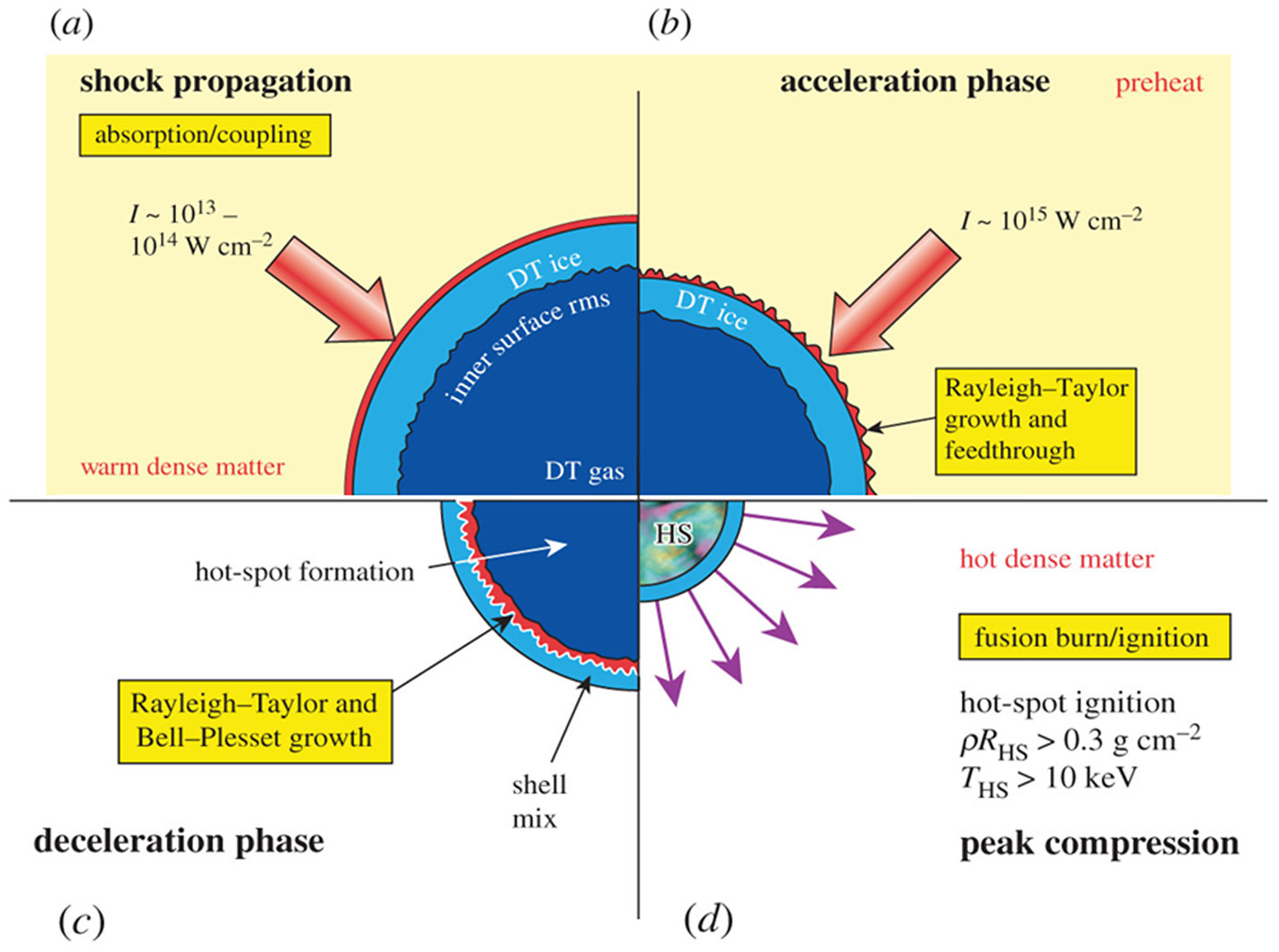
One major physics question is that of LPIs, particularly during the high-intensity laser spike pulse, which may reduce the amount of laser energy absorbed in the target[ Reference Colatis, Turnbull, Igumenschev, Edgell, Shah, Mannion, Stoeckl, Jacob-Perkins, Shvydky, Janezic, Kalb, Cao, Forrest, Kwiatkowski, Regan, Theobald, Goncharov and Froula 73 ], reduce the amplitude of the shock wave[ Reference Colaïtis, Igumenshchev, Turnbull, Shah, Edgell, Mannion, Stoeckl, Jacob-Perkins, Shvydky, Janezic, Kalb, Cao, Forrest, Kwiatkowski, Regan, Theobald, Goncharov and Froula 53 ] and prematurely heat the fuel by hot electrons[ Reference Colatis, Ribeyre, Le Bel, Duchateau, Nicola and Tikhonchuk 74 ]. Low-entropy implosions of standard direct-drive capsules have shown a high risk of failure, indicating new sufficiently resistant and robust target designs are needed. Furthermore, modulations of the ablator surface and density inhomogeneities resulting from target fabrication and sub-wavelength scale perturbations imprinted on the ablator by the laser irradiation can grow, reducing the igniting-shock launching window[ Reference Duchateau, Hu, Pineau, Kar, Chimier, Casner, Tikhonchuk, Goncharov, Radha and Campbell 75 , Reference Kaselouris, Fitilis, Skoulakis, Orphanos, Koundourakis, Clark, Chatzakis, Bakarezos, Papadogiannis, Dimitriou and Tatarakis 76 ]. Strategies for mitigating laser imprint on the ablator and hydrodynamic instabilities must be developed. The use of foam materials (see Figure 5) could be promising[ Reference Delorme, Olazabal-Loumé, Casner, Nicolaï, Michel, Riazuelo, Borisenko, Breil, Fujioka, Grech, Orekhov, Seka, Sunahara, Froula, Goncharov and Tikhonchuk 77 – Reference Wiste, Maliuk, Tikhonchuk, Lastovicka, Homola, Chadt and Weber 79 ]. Studies of ignition physics must be coordinated with developing a new generation of high-energy, HRR lasers and the design of high-performance plasma diagnostics and target mass fabrication technology.
Microscopic views of foams produced by chemical polymerization (a) and two-photon polymerization laser lithography (b) for ICF studies (adapted from Ref. [Reference Wiste, Maliuk, Tikhonchuk, Lastovicka, Homola, Chadt and Weber79]).

Studies of the baseline HiPER target SI design[ Reference Batani, Baton, Casner, Depierreux, Hohenberger, Klimo, Koenig, Labaune, Ribeyre, Rousseaux, Schurtz, Theobald and Tikhonchuk 25 ] suggest that depending on their energy, hot electrons could either improve or worsen the target performance. Hot electrons with energies less than 50 keV do not produce deleterious effects but amplify the shock strength and improve the target performance[ Reference Ribeyre, Gus’kov, Feugeas, Nicolaï and Tikhonchuk 80 ]. By contrast, more energetic electrons generated during the spike may ablate the DT ice inner interface and significantly increase radiation losses, preventing ignition[ Reference Colatis, Ribeyre, Le Bel, Duchateau, Nicola and Tikhonchuk 74 ]. These results highlight the necessity of designing more robust targets, considering the detailed characterization of nonlinear LPI effects, hot electron generation and transport.
LPI mitigation strategies allowing the reduction of laser energy losses and diminishing or tuning hot electron generation need to be investigated[ Reference Cristoforetti, Hüller, Koester, Antonelli, Atzeni, Baffigi, Batani, Baird, Booth, Galimberti, Glize, Héron, Khan, Loiseau, Mancelli, Notley, Oliveira, Renner, Smid, Schiavi, Tran, Woolsey and Gizzi 81 ]. The manipulation of laser coherence time and the development of broadband lasers appear promising for suppressing LPI[ Reference Eimerl and Schmitt 82 ]. Increasing laser bandwidth between a few tenths of a per cent and several per cent can inhibit laser filamentation and LPI[ Reference Cristoforetti, Antonelli, Mancelli, Atzeni, Baffigi, Barbato, Batani, Boutoux, D’Amato, Dostal, Dudzak, Filippov, Gu, Juha, Klimo, Krus, Malko, Martynenko, Nicolai, Ospina, Pikuz, Renner, Santos, Tikhonchuk, Trela, Viciani, Volpe, Weber and Gizzi 83 ]. Laser zooming[ Reference Canaud and Garaude 84 ] for the spike pulse has been proposed to improve laser–shock coupling and significantly reduce cross-beam energy losses. Improved control of LPI might allow the testing of ignition schemes using the second harmonic of Nd:glass lasers instead of the third harmonic, which opens the way to a more efficient use of laser energy[ Reference Atzeni, Marocchino and Schiavi 39 ] and is better suited for operation at HRRs.
3.4 Lessons from the NIF ignition campaign and OMEGA laser facility
The European IFE project profits from the knowledge and experience acquired during the 12 years of experiments at the NIF and several thousands of direct-drive implosion experiments conducted at lower energy on OMEGA[ Reference Boehly, Brown, Craxton, Keck, Knauer, Kelly, Kessler, Kumpan, Loucks, Letzring, Marshall, McCrory, Morse, Seka, Soures and Verdon 85 ]. The failure of the National Ignition Campaign in 2013 was due to many issues that needed to be better controlled and understood at that time. They included insufficient symmetry of laser irradiation, laser–plasma instabilities and defects in the target fabrication, which led to premature development of hydrodynamic instabilities and shell break-up. Also, insufficient precision of the radiation-hydrodynamic codes and a limited number of diagnostics available in the experiments did not provide the degree of accuracy needed to design a target that ignites in an experiment with a limited energy budget. The diagnostics were not capable of providing detailed information about the processes going on in the capsule inside a closed hohlraum. The lasers were not capable of delivering precision pulses with sufficient repeatability, power stability and pointing accuracy.
Since then, a large amount of work has been done addressing these issues. The issues related to the quality of implosion have been identified and resolved one after another. The physics included in the codes was greatly improved and now provides a better agreement with experiments and more stringent limitations on the parameter space where ignition and gain can be achieved. More than 60 high-fidelity diagnostics have been developed at the NIF, all providing valuable insights into the physics processes in the imploding target. The laser performance is continuously improving as the operators have better control of the beam quality and focus and better understand the physics issues at play. More than 1000 implosion experiments have been performed at the NIF since 2009. Many numerical simulations have provided an extensive database, which is used for fine-tuning hydrocodes, designing empirical scaling and improving it with machine-learning techniques. Along with a significant improvement in the laser performance and target fabrication technology, the progress in theory, simulations and diagnostics is thus the main reason for the recent successes of the NIF. Similar progress in diagnostics, codes and laser beam control was achieved in the last 10 years at the OMEGA facility. While laser energy is limited to 30 kJ, OMEGA is configured in direct drive and provides an invaluable test-bed for direct-drive physics.
The lessons from the NIF and OMEGA campaigns provide important input for the European IFE project that will reduce the risks and accelerate progress.
-
• The control of the shell symmetry during implosion has proven to be a key issue in the quest for ignition. It implies an advanced target design, high precision of laser beam focusing and a high quality of target fabrication: reduction of the surface roughness, suppression of asymmetry and control of homogeneity of the fuel layer by using high-performance metrology.
-
• The quality of laser irradiation on the capsule is crucial to achieve ignition. Deformations in the capsule resulting from nonuniform irradiation must be reduced by improving the quality of laser beams and pointing precision.
-
• Hydrodynamic instabilities have to be better predicted and controlled. They were the main reason for the failure of the National Ignition Campaign in 2013, and their mitigation by using a higher adiabat has led to the success of the most recent experiments. Nevertheless, better control of instabilities in lower adiabat implosions is still needed.
-
• The control of LPI is mandatory for efficient laser energy coupling to the target, energy transport and reduced fuel preheat. Direct-drive experiments have shown the importance of controlling cross-beam energy transfer (CBET) and its impact on laser energy absorption and implosion symmetry.
-
• Recent successful OMEGA and NIF integrated experiments strongly benefited from an extensive database that provided step-by-step improvements in the target performance based on machine-learning techniques[ Reference Gopalaswamy, Betti, Knauer, Luciani, Patel, Woo, Bose, Igumenshchev, Campbell, Anderson, Bauer, Bonino, Cao, Christopherson, Collins, Collins, Davies, Delettrez, Edgell, Epstein, Forrest, Froula, Glebov, Goncharov, Harding, Hu, Jacobs-Perkins, Janezic, Kelly, Mannion, Maximov, Marshall, Michel, Miller, Morse, Palastro, Peebles, Radha, Regan, Sampat, Sangster, Sefkow, Seka, Shah, Shmyada, Shvydky, Stoeckl, Solodov, Theobald, Zuegel, Johnson, Petrasso, Li and Frenje 51 , Reference Hatfield, Gaffney, Anderson, Ali, Antonelli, du Pree, Citrin, Fajardo, Knapp, Kettle, Kustowski, MacDonald, Mariscal, Martin, Nagayama, Palmer, Peterson, Rose, Ruby, Shneider, Streeter, Trickey and Williams 86 ].
-
• High-yield shots on OMEGA and NIF would only be possible by developing a comprehensive set of diagnostics, particularly X-ray and neutron diagnostics, characterizing the stagnation and burn phases.
These conclusions are considered important information in developing the European IFE roadmap.
3.5 Laser technology developments
ICF research has provided a strong boost for developing new laser technologies and the dramatic growth of the laser industry. In parallel, the advent of chirped pulse amplification has led to the construction of ultrashort pulse, ultra-high-intensity and HRR laser facilities worldwide[ Reference Danson, Häfner, Bromage, Butcher, Chanteloup, Chowdhury, Galvanauskas, Gizzi, Hein, Hillier, Hopps, Kato, Khazanov, Kodama, Korn, Li, Li, Limpert, Ma, Nam, Neely, Papadopoulos, Penman, Qian, Rocca, Shaykin, Siders, Spindloe, Szatmári, Trines, Zhu, Zhu and Zuegel 87 ]. Europe-based leading laser manufacturing companies, such as THALES, AMPLITUDE and TRUMPF, are capable of delivering turnkey high-power, HRR laser systems and provide technical support for their operation. The European ESFRI projects, ELI[ 11 ] and European Plasma Research Accelerator with excellence in Applications (EuPRAXIA)[ 88 ], stimulate rapid scientific and technological developments on a very short time scale aimed at high-field science, particle acceleration and secondary radiation sources. Many of these developments have generated industrial products impacting other commercial areas, including the medical and manufacturing industries.
The scientific communities in high-energy-density physics, plasma physics and high-power laser technology are working closely with each other, with large European research institutes having active research programmes in all of these areas, which share common background knowledge. The laser–plasma community is a large and expanding community partially merging with the synchrotron and X-ray free electron laser communities, sharing a common interest in investigating extreme states of matter with ultrashort and high-brightness X-ray pulses. These communities also share particle and radiation diagnostics and high-power laser technologies, which have significantly advanced over the last 10 years.
However, access to these extensive facilities is minimal due to their high cost, low repetition rate and large size. A further revolution is needed to reduce their size and price and to improve their reliability – the use of flash lamp pumping limits solid-state lasers’ average power and repetition rate. New approaches based on high-efficiency diode pumping and active cooling (see Figure 6(a)) are paving the way to high average power, high-efficiency and HRR lasers[ Reference Gizzi, Koester, Labate, Mathieu, Mazzotta, Toci and Vannini 89 ]. This transition is a necessary step for the IFE programme, and will make lasers and laser-based light sources available to a broader community, empowering small and medium high-tech enterprises and making them capable of industrial research currently only accessible at large installations.
(a) Schematic view of the DiPOLE cryogenically cooled, multi-slab amplifier head[ Reference Banerjee, Ertel, Mason, Phillips, De Vido, Smith, Butcher, Hernandez-Gomez, Greenhalgh and Collier 90 ]. (b) A 3.6 kW diode stack for pumping Yb:YAG pulsed high-energy class solid-state lasers[ Reference Platz, Eppich, Rieprich, Pittroff, Erbert and Crump 91 ].

In collaboration with industry, European laboratories are developing innovative high-power and high-energy laser technologies. The THRILL project, funded by the European Commission for 2023–2026 for 10 M€, involves five countries and aims to develop a kilojoule module with the repetition rate defined by the flash lamp pumping with the possibility to further increase the repetition rate and the wall-plug efficiency in a second stage replacing flashlamps with diodes. Its ambitions are to push the technology of high-energy, HRR lasers to a new level of performance in the context of large physics research infrastructures. Diode-pumped solid-state laser (DPSSL) technologies are under development in several countries: the APOLLON laser system is operating in France, the L3 beamline at ELI and the POLARIS and PENELOPE lasers in Germany. The Central Laser Facility (RAL-STFC) has delivered a kilowatt average power DPSSL system, DiPOLE. The DiPOLE amplifier head contains four ytterbium-doped yttrium aluminium garnet (Yb:YAG) ceramic disks. These disks are pumped from both sides by diode lasers and cooled using a flow of helium gas cooled by liquid nitrogen; see Figure 6(a). More recently, new schemes based on lasing media with broadband amplification and large energy storage, such as thulium-doped crystals[ Reference Tamer, Reagan, Galvin, Galbraith, Sistrunk, Church, Huete, Neurath and Spinka 92 ] or ceramics[ Reference Palla, Labate, Baffigi, Cellamare and Gizzi 93 ], have been proposed and are being investigated at LLNL and ILIL laboratory at CNR, among the others, and provide an entirely new platform for high-efficiency amplification. Crucial for developing these systems is the availability of efficient and robust diode laser stacks capable of high-duty cycle operation and long lifetime. Europe has an established capability to develop and assemble such light sources for applications that require high output powers with simultaneously high efficiency, such as pump lasers. Diode lasers, that is, single emitters or laser bars, are stacked together to achieve output powers in the kilowatt range, as in the case of the 3.6 kW diode stack developed[ Reference Crump, Miah, Wilkens, Fricke, Wenzel and Knigge 94 ] by the Ferdinand Brown Institute for pumping Yb:YAG solid-state lasers (see Figure 6(a)). These projects share common objectives with the HiPER+ project in terms of laser development.
The main challenges of laser technology for IFE are the average power and the wall-plug efficiency. The design of the lasers used for ICF research – such as OMEGA, LMJ and NIF – dates back to the last century and did not consider these features. Nowadays, the laser industry can produce kilojoule laser beamlines with a repetition rate in the minute range. That is an increase of two orders of magnitude compared to the existing ICF lasers, which opens the way to commercial solutions. Laser technology for high-energy lasers is still far from mature. Significant performance leaps will be seen in the next decade when laser diode pumping becomes kilojoule capable, improving high-energy laser performance in average power and wall-plug efficiency. The transition of high-energy, single pulse lasers to high average power and HRR is a crucial milestone for IFE research. Assuming an improvement of efficiency by a factor larger than 10, as anticipated by theoretical studies and demonstrated on sub-scale prototypes such as DiPOLE, the total energy needed per ignition cycle will still be above 100 kJ, which corresponds to an average laser output power of 100 kW at 1 Hz operation rate. In addition to this outstanding challenge of laser efficiency and robustness, special temporal and spatial laser pulse shape requirements are to be fulfilled. The laser architecture should also allow a maintenance scheme for 24/7 operation.
The transition from a proof-of-principle demonstration of ignition of fusion reactions at the NIF to the repetitive operation required in a future reactor is at the core of this IFE project. Technical specifications for IFE lasers are extremely challenging, but these technological developments are largely overlapping with other needs for industrial applications. Actually, two complementary strategies are pursued in laser technology development: a kilojoule module with flash lamp pumping and with a repetition rate on the 1 minute scale and a DPSSL module with a repetition rate on the few Hz scale and with pulse energy in the hundred joules range. There are no doubts that innovative and ground-breaking solutions in laser technology will emerge soon, permitting one to combine these approaches and bring them to the level needed for IFE plant construction. The European laser industry is sufficiently mature today to take on the construction of such a modern multi-beam, high-energy and HRR laser facility. An ambitious IFE programme will play a driving role by setting the laser specifications of interest for other high-tech applications.
3.6 Reactor technology developments
The history of the development of reactor designs in Europe comes from the 1980s[ Reference Badger, El-Guebaly, Engelstad, Hassanein, Klein, Kulcinski, Larsen, Lee, Lovell and Moses 95 , Reference Velarde, Aragonés, Gonzalez, Hernán, Honrubia, Hortal, Martínez-Val, Mínguez, Ocaña, Perlado, Santolaya and Sanz 96 ]. A significant European contribution, HIBALL and HIBALL-II, was developed for a heavy ion-driven IFE facility, contemporary to several similar projects in the United States, including lasers and X-rays. Some of the proposed solutions, such as the INPORT concept of using porous, flexible tubes of woven C or SiC fibres to contain liquid metals inside the vacuum chamber of an ICF system[ Reference Kulcinski, Moses, Sawan, Sviatoslavsky, Sze, Vogelsang and Sapp 97 ], are of interest now, not only in inertial fusion but also considered as a solution for a magnetic fusion divertor. IFE reactor designs have been significantly extended in the United States and Japan since the 1970s in collaboration with European groups on specific research subjects. From those computationally developed ideas, key IFE concepts emerged that enable first-wall protections in IFE: thick liquid jets[ Reference Blink, Hogan, Hovingh, Meier and Pitts 98 , Reference Moir, Bieri, Chen, Dolan, Hoffman, House, Leber, Lee, Lee, Liu, Longhurst, Meier, Peterson, Petzoldt, Schrock, Tobin and Williams 99 ], thin liquid[ Reference Badger, El-Guebaly, Engelstad, Hassanein, Klein, Kulcinski, Larsen, Lee, Lovell and Moses 95 , Reference Mima, Kitagawa, Takabe, Yamanaka, Nishihara, Naito, Hashimoto, Noritmasu, Yamanaka, Izawa, Murakami, Nishiguchi, Yamanaka, Kosaki, Yoshikawa, Nakajima and Nakai 100 – Reference Norimatsu, Kozaki, Miyanaga, Kawanaka, Azechi, Johzaki and Tomabechi 102 ] and gas protections[ Reference Dunne, Moses, Amendt, Anklam, Bayramian, Bliss, Debs, Deri, de la Rubia, El-Dasher, Farmer, Flowers, Kramer, Lagin, Latkowski, Lindl, Meier, Miles, Moses, Reyes, Roberts, Sawicki, Spaeth and Storm 21 , Reference Meier 103 ] have been studied and in some cases also experimentally proved. The neutronic fluxes/fluences and their corresponding responses (heating, tritium breeding, damage, activation) in the blanket and final protection have been extensively studied over many years[ Reference Perlado and Sanz 104 , Reference Sanz, Perlado, Guerra, Perez, Latkowski and Tobin 105 ], but also with more extensive and detailed numerical computations[ Reference Sauvan, Sanz and Ogando 106 , Reference Sanz, Cabellos and Garcia-Herranz 107 ]. Extraordinary new advanced models for determination of the activation and safety in 3D extremely detailed geometry, with advanced variance reduction techniques, have been developed in the last few years[ Reference Sauvan, Catalán, Ogando, Juárez and Sanz 108 – Reference García, Catalán and Sanz 110 ]. However, the conclusions concerning neutron-irradiated materials are waiting for experimental proof. These studies need coordination with similar research in magnetic confinement fusion and further studies for the specific IFE conditions of pulsed irradiation.
HiPER marked a significant European step towards designing a power plant prototype with direct-drive laser irradiation. The project has finished with a realistic computational design of the reactor systems, including the chamber dimensional layout, the first wall and blanket design with cooling systems and the neutron management, damage and activation assessment and safety considerations[ Reference Juárez, Sanz, Lopez-Revelles and Perlado 111 – Reference Sánchez, Juárez, Sanz and Perlado 113 ]. Significant progress in the multidisciplinary science of materials at extreme conditions driven by the HiPER project[ 10 , Reference Edwards and Danson 23 ] has enabled improvements in laser optics and structural materials, the key parts of the IFE chamber. After HiPER, more of the national research was dedicated to a better understanding of optical materials under extreme irradiation conditions[ Reference Páramo, Sordo, Garoz, Le Garrec, Perlado and Rivera 114 – Reference Prada, Sánchez-Pérez, Bailly-Grandvaux, Bringa, Caturla, Perlado, Kohanoff, Peña-Rodríguez and Rivera 116 ], including basic theory and proposal of optical materials[ Reference Kim, Santoro, Pawar, Lee, Peña-Rodriguez, Pal and Kang 117 – Reference González-Zavala, Calderón-Olvera, Muhl, Ramírez and Peña-Rodriguez 119 ]; tritium breeding optimization[ Reference Fierro, Sordo, Carbajal-Ramos, Perlado and Rivera 120 ] and its retention assessment; control of irradiation conditions of the first wall[ Reference Alvarez, Garoz, Gonzalez-Arrabal, Rivera and Perlado 121 ] and its material resistance to charged particles and X-rays[ Reference Gonzalez-Arrabal, Rivera and Perlado 122 , Reference Garoz, Páramo, Rivera, Perlado and González-Arrabal 123 ]; blanket material damage and liquid metal corrosion, including research on coatings[ Reference Hernández, Sánchez, Di Fonzo, Vanazzi, Panizo and González-Arrabal 124 – Reference Hernández, Moroño, Sánchez, Maffiotte, Monclús and González-Arrabal 126 ]; determination of neutron activation to establish the responses to thermo-fluid dynamics for the cooling and energy recovery systems. Beyond the ignition demonstration, three operation modes for the IFE facility were considered in HiPER: (i) a burst mode demonstrating some critical elements of the future power plant, such as repetitive laser shots, target injection and debris mitigation and management; (ii) a prototype of the fusion reactor with a blanket and heat exchanger for the energy recovery and tritium breeding studies; and (iii) a demo power plant with the fuel breeding and electricity generation for the optimization and commercialization of the IFE technology. This strategy can be reduced to two steps, (i) and (iii), thus reducing the overall time of the HiPER+ project. A chamber for goal (i) is the first affordable requirement to build a repetitive experimental facility, together with advances in power plant research (iii).
Improving the damage resistance and the development of optics refurbishing technologies are indispensable parts of the IFE technical background, which are also needed for promoting the insertion of lasers in the industry. Indeed, the development of radiation and neutron-resistant materials is a subject of common interest for any fusion energy project. It could act as an incubator of innovative solutions indispensable for a future power plant and for driving industrial development in other areas.
3.7 Targetry
One of the critical points that allowed the remarkable 2022 NIF results was the extremely high quality of the produced capsule. The future of IFE advancement towards an energy reactor needs to deal with the high-importance and delicate issues of the development of target mass fabrication, improvement of the target quality and metrology and target injection technologies. They will be in the scope of the IFE projects and will also benefit other industrial applications. Target fabrication is under permanent development because of new challenges not only linked to ICF/IFE but also to other science experiments on high-energy-density physics at X-ray radiation facilities such as ELI, XFEL and ESRF. The international situation is favourable for IFE, with target laboratories in the United States (General Atomics, LLE, LLNL), Japan (Institute Laser Engineering, Osaka) and China.
Europe contributed to developments in this area with the HiPER project, promoting collaboration among European groups with expertise in materials and targetry. More recently, such cooperation has been maintained[ Reference Prencipe, Fuchs, Pascarelli, Schumacher, Stephens, Alexander, Briggs, Büscher, Cernaianu, Choukourov, De Marco, Erbe, Fassbender, Fiquet, Fitzsimmons, Gheorghiu, Hund, Huang, Harmand, Hartley, Irman, Kluge, Konopkova, Kraft, Kraus, Leca, Margarone, Metzkes, Nagai, Nazarov, Lutoslawski, Papp, Passoni, Pelka, Perin, Schulz, Smid, Spindloe, Steinke, Torchio, Vass, Wiste, Zaffino, Zeil, Tschentscher, Schramm and Cowan 127 , 128 ] and further expanded through Laserlab Europe AISBL, that is acting as a coordinator and launcher of new initiatives, such as the expert groups on laser-driven inertial confinement fusion (ICF) - inertial fusion energy (IFE)[ 129 ] and on micro- and nano-structured materials for experiments with high-power lasers[ 130 ].
The critical point is that the requirements for the target quality, the cost and the materials are compatible with the technologies already developed in the industry. It is clear that their cost needs to be a small fraction of the energy value per target, so of the order of centimes of the euro. At the same time, the repetition rate needs to be in the range of 5–10 Hz, the target surface quality needs to be in the range of 10–100 nm and a precision of 10 μm is required. Mass-produced, cost-effective target configurations have to be pursued, an objective that can also be potentially achieved with low-density structured materials[ Reference Goncharov, Igumenshchev, Harding, Morse, Hu, Radha, Froula, Regan, Sangster and Campbell 52 , Reference Igumenshchev, Theobald, Stoeckl, Shah, Bishel, Goncharov, Bonino, Campbell, Ceurvorst, Chin, Collins, Fess, Harding, Sampat, Shaffer, Shvydky, Smith, Trickey and Waxer 54 ] (see Figure 5). In particular, the recent achievements in the micro-lithography and mass production of microchips share many technological requirements with IFE. They will provide a solid reference point for future IFE technologies.
Low-density micro-structured materials, also known as foams, have been studied for a long time[
Reference Desselberger, Jones, Edwards, Dunne and Willi
131
–
Reference Caruso, Gus’kov, Demchenko, Rozanov and Strangio
133
]. The ability to smooth the laser inhomogeneities by distributing the laser energy inspired new schemes for ICF[
Reference Gus’kov, Zmitrenko and Rozanov
132
] and has been confirmed experimentally[
Reference Delorme, Olazabal-Loumé, Casner, Nicolaï, Michel, Riazuelo, Borisenko, Breil, Fujioka, Grech, Orekhov, Seka, Sunahara, Froula, Goncharov and Tikhonchuk
77
,
Reference Depierreux, Labaune, Michel, Stenz, Nicolaï, Grech, Riazuelo, Weber, Riconda, Tikhonchuk, Loiseau, Borisenko, Nazarov, Hüller, Pesme, Casanova, Limpouch, Meyer, Di-Nicola, Wrobel, Alozy, Romary, Thiell, Soullié, Reverdin and Villette
134
,
Reference Nicolaï, Olazabal-Loumé, Fujioka, Sunahara, Borisenko, Gus’kov, Orekov, Grech, Riazuelo, Labaune, Velechowski and Tikhonchuk
135
]. Foams have found many more applications over the decades, as neutron sources[
Reference Gus’kov, Rozanov and Zmitrenko
136
], as pressure amplifiers for equation-of-state studies[
Reference Batani, Balducci, Nazarov, Löwer, Hall, Koening, Faral, Benuzzi and Temporal
137
] for extremely bright electron and X- $\gamma$
radiation sources[
Reference Pérez, Patterson, May, Colvin, Biener, Wittstock, Kucheyev, Charnvanichborikarn, Satcher, Gammon, Poco, Fujioka, Zhang, Ishihara, Tanaka, Ikenouchi, Nishimura and Fournier
138
–
Reference Günther, Rosmej, Tavana, Gyrdymov, Skobliakov, Kantsyrev, Zähter, Borisenko, Pukhov and Andreev
141
] and have been suggested to be used to reproduce the long plasmas expected in the corona of a fusion capsule in the direct-drive scheme[
Reference Tikhonchuk, Gu, Klimo, Limpouch and Weber
142
].
$\gamma$
radiation sources[
Reference Pérez, Patterson, May, Colvin, Biener, Wittstock, Kucheyev, Charnvanichborikarn, Satcher, Gammon, Poco, Fujioka, Zhang, Ishihara, Tanaka, Ikenouchi, Nishimura and Fournier
138
–
Reference Günther, Rosmej, Tavana, Gyrdymov, Skobliakov, Kantsyrev, Zähter, Borisenko, Pukhov and Andreev
141
] and have been suggested to be used to reproduce the long plasmas expected in the corona of a fusion capsule in the direct-drive scheme[
Reference Tikhonchuk, Gu, Klimo, Limpouch and Weber
142
].
Foams have a wide variety of parameters, such as density, pore size and shape, wall thickness and constituent elements. They have been traditionally obtained by chemical methods, but nowadays, some can be printed via the two-photon polymerization technique[ Reference Wiste, Maliuk, Tikhonchuk, Lastovicka, Homola, Chadt and Weber 79 , Reference Jones, Kemp, Langer, Winjum, Berger, Oakdale, Belyaev, Biener, Biener, Mariscal, Milovich, Stadermann, Sterne and Wilks 143 ]. In the near future, this technology could replace the chemical means for their production, overcoming the actual limitations in printing speed and price. The non-trivial internal structure of foams poses severe challenges for hydrodynamic simulation since it cannot be directly resolved in the codes and modelling them as homogeneous media of the same average density commonly fails when directly irradiated by the laser[ Reference Nicolaï, Olazabal-Loumé, Fujioka, Sunahara, Borisenko, Gus’kov, Orekov, Grech, Riazuelo, Labaune, Velechowski and Tikhonchuk 135 , Reference Cipriani, Gus’kov, De Angelis, Consoli, Rupasov, Andreoli, Cristofari, Di Giorgio and Ingenito 144 ], but they seem to be suitable when a foam with specific features is not directly exposed to the laser[ Reference Aglitskiy, Velikovich, Karasik, Schmitt, Serlin, Weaver, Oh, Obenschain and Cochrane 145 , Reference Paddock, von der Leyen, Aboushelbaya, Norreys, Chapman, Eakins, Oliver, Clarke, Notley, Baird, Booth, Spindloe, Haddock, Irving, Scott, Pasley, Cipriani, Consoli, Albertazzi, Koenig, Martynenko, Wegert, Neumayer, Tchórz, Raczka, Mabey, Garbett, Goshadze, Karasiev and Hu 146 ]. Some reduced models for the interaction of high-power lasers with foams have been developed over the years and implemented in hydrocodes[ Reference Cipriani, Gus’kov, De Angelis, Consoli, Rupasov, Andreoli, Cristofari and Di Giorgio 78 , Reference Cipriani, Gus’kov, Consoli, De Angelis, Rupasov, Andreoli, Cristofari, Di Giorgio and Salvadori 147 – Reference Hudec, Gintrand, Limpouch, Liska, Shekhanov, Tikhonchuk and Weber 149 ], but a lot of work remains to solve the problem fully.
3.8 Diagnostics
A large-scale IFE demonstrator can only be successful if a significant effort of the project is put into fusion-relevant diagnostics[ Reference Ducret, Bastiani-Ceccotti, Batani, Blanchot, Brambrink, Casner, Ceccotti, Compant La Fontaine, d’Humières, Dobosz-Dufrénoy, Duval, Fuchs, Hulin, Koenig, Lantuéjoul-Thfoin, Lefebvre, Marquès, Miquel, Reverdin, Serani, Szabo-Foster and Wrobel 150 – Reference Rubery, Kemp, Jones, Pelepchan, Stolte and Heinmiller 154 ]. They are required to characterize fusion products, the plasma and capsule evolution over time and the electromagnetic and particle radiation emitted. Over the last two decades, the US laboratories have acquired extensive experience in the field, such that methods and devices have been developed, fielded and tested. These are points of high technological importance in the path of improvement necessary for new IFE projects.
A central point for HiPER+ is the combination of driver lasers with laser backlighting capabilities from the early stage of the project. This technique, requiring laser beams of kilojoule energy and picosecond duration, has shown an invaluable advantage for generating ICF data indispensable for the target design, wherever it has been implemented[ Reference Zylstra, Hurricane, Callahan, Kritcher, Ralph, Robey, Ross, Young, Baker, Casey, Döppner, Divol, Hohenberger, Le Pape, Pak, Patel, Tommasini, Ali, Amendt, Atherton, Bachmann, Bailey, Benedetti, Berzak Hopkins, Betti, Bhandarkar, Biener, Bionta, Birge, Bond, Bradley, Braun, Briggs, Bruhn, Celliers, Chang, Chapman, Chen, Choate, Christopherson, Clark, Crippen, Dewald, Dittrich, Edwards, Farmer, Field, Fittinghoff, Frenje, Gaffney, Gatu Johnson, Glenzer, Grim, Haan, Hahn, Hall, Hammel, Harte, Hartouni, Heebner, Hernandez, Herrmann, Herrmann, Hinkel, Ho, Holder, Hsing, Huang, Humbird, Izumi, Jarrott, Jeet, Jones, Kerbel, Kerr, Khan, Kilkenny, Kim, Geppert Kleinrath, Geppert Kleinrath, Kong, Koning, Kroll, Kruse, Kustowski, Landen, Langer, Larson, Lemos, Lindl, Ma, MacDonald, MacGowan, Mackinnon, MacLaren, MacPhee, Marinak, Mariscal, Marley, Masse, Meaney, Meezan, Michel, Millot, Milovich, Moody, Moore, Morton, Murphy, Newman, Di Nicola, Nikroo, Nora, Patel, Pelz, Peterson, Ping, Pollock, Ratledge, Rice, Rinderknecht, Rosen, Rubery, Salmonson, Sater, Schiaffino, Schlossberg, Schneider, Schroeder, Scott, Sepke, Sequoia, Sherlock, Shin, Smalyuk, Spears, Springer, Stadermann, Stoupin, Strozzi, Suter, Thomas, Town, Tubman, Volegov, Weber, Widmann, Wild, Wilde, Van Wonterghem, Woods, Woodworth, Yamaguchi, Yang and Zimmerman 16 , Reference Gopalaswamy, Betti, Knauer, Luciani, Patel, Woo, Bose, Igumenshchev, Campbell, Anderson, Bauer, Bonino, Cao, Christopherson, Collins, Collins, Davies, Delettrez, Edgell, Epstein, Forrest, Froula, Glebov, Goncharov, Harding, Hu, Jacobs-Perkins, Janezic, Kelly, Mannion, Maximov, Marshall, Michel, Miller, Morse, Palastro, Peebles, Radha, Regan, Sampat, Sangster, Sefkow, Seka, Shah, Shmyada, Shvydky, Stoeckl, Solodov, Theobald, Zuegel, Johnson, Petrasso, Li and Frenje 51 ]. Having a short-pulse capability on HiPER+ not only fosters diagnostics but also enables testing of the fast ignition schemes[ Reference Atzeni and Meyer-ter-Vehn 7 ] that require short-pulse capability, particularly the proton fast ignition. This will also be the basis of future ultra-short laser-driven neutron sources[ Reference Roth, Jung, Falk, Guler, Deppert, Devlin, Favalli, Fernandez, Gautier, Geissel, Haight, Hamilton, Hegelich, Johnson, Merrill, Schaumann, Schoenberg, Schollmeier, Shimada, Taddeucci, Tybo, Wagner, Wender, Wilde and Wurden 155 , Reference Arikawa, Morace, Abe, Iwata, Sentoku, Yogo, Matsuo, Nakai, Nagatomo, Mima, Nishimura, Fujioka, Kodama, Inoue, Hashida, Sakabe, Gatti, De Luis, Huault, Pérez-Hernández, Roso and Volpe 156 ] to couple with the existing neutron source IFMIF-DONES currently under construction in Granada, Spain.
Diagnostics of the LPIs and the emitted wideband radiations, due to the strong interdisciplinary research required, are the subject where different fields of physics can find a common denominator and then collaborate and exchange knowledge. The diagnostics development effort is also what differentiates HiPER+ from the commercial approaches to IFE, as a large set of diagnostics methods ensures a more in-depth and precise understanding of physics, and it also offers the ideal platform for multidisciplinary education and science dissemination to support the commercial approaches to IFE.
A strong contribution to diagnostic development is expected for the fundamental IFE requirement of running experiments in high-intensity and HRR laser facilities[ Reference Cristoforetti, Antonelli, Mancelli, Atzeni, Baffigi, Barbato, Batani, Boutoux, D’Amato, Dostal, Dudzak, Filippov, Gu, Juha, Klimo, Krus, Malko, Martynenko, Nicolai, Ospina, Pikuz, Renner, Santos, Tikhonchuk, Trela, Viciani, Volpe, Weber and Gizzi 83 , Reference Antonelli, Forestier-Colleoni, Folpini, Bouillaud, Faenov, Fedeli, Fourment, Giuffrida, Hulin, Pikuz, Santos, Volpe and Batani 157 – Reference Salvadori, Di Giorgio, Cipriani, Scisciò, Verona, Andreoli, Cristofari, De Angelis, Pillon, Andreev, Antici, Borisenko, Giulietti, Migliorati, Rosmej, Zähter and Consoli 164 ]. Another significant issue is to develop high-sensitivity diagnostics[ Reference Consoli, De Angelis, Andreoli, Bonasera, Cipriani, Cristofari, Di Giorgio, Giulietti and Salvadori 162 , Reference Ingenito, Andreoli, Batani, Bonasera, Boutoux, Burgy, Cipriani, Consoli, Cristofari, De Angelis, Di Giorgio, Ducret, Giulietti and Jakubowska 165 – Reference Scisci, Di Giorgio, Andreoli, Cipriani, Cristofari, De Angelis, Salvadori, Cirrone, Giuffrida, Margarone, Milluzzo, Petringa and Consoli 169 ], in an environment heavily polluted with high radiation doses and with laser-generated EMPs of high intensity, as discussed in the next section.
3.9 Safety
General safety, personnel and device/electronic security are indispensable parts of the IFE project. They include reliable and sustainable operation of the laser, diagnostic, control and target injection systems, particularly in the HRR regime and harsh radiation environment[ Reference Eder, Song, Latkowski, Reyes, O’Brien, Lee, Young, Koch, Moran, Watts, Kimbrough, Ng, Landen and MacGowan 170 , Reference Eder, Anderson, Bailey, Bell, Benson, Bertozzi, Bittle, Bradley, Brown, Clancy, Chen, Chevalier, Combis, Dauffy, Debonne, Eckart, Fisher, Geille, Glebov, Holder, Jadaud, Jones, Kaiser, Kalantar, Khater, Kimbrough, Koniges, Landen, MacGowan, Masters, MacPhee, Maddox, Meyers, Osher, Prasad, Raffestin, Raimbourg, Rekow, Sangster, Song, Stoeck, Stowell, Teran, Throop, Tommasini, Vierne, White and Whitman 171 ]. In addition, safety must be provided for workers and the public in general against potential radioactive emissions during operation and shutdown[ Reference Datte, Eckart, Jackson, Khater, Manuel and Newton 172 , Reference Reed and Bell 173 ]. Adequate measures must be established with respect to national and European licensing procedures, and this needs to be made also by suitable planning and estimation by numerical evaluations[ Reference Sauvan, Catalán, Ogando, Juárez and Sanz 108 – Reference García, Catalán and Sanz 110 , Reference Verbeke, Young, Brereton, Dauffy, Hall, Hansen, Khater, Kim, Pohl and Sitaraman 174 , Reference Baggio, Jacquet, Schneider and Javier 175 ]. It is mentioned in Section 3.6 that the high precision and accuracy 3D codes link the computer-aided design (CAD)/computer-aided manufacturing (CAM) description with sophisticated computational models for radiation doses, heating and breeding. The radiation doses can be calculated globally, thus helping to design adequate safety procedures and shielding. The magnetic confinement fusion community also faces similar issues. Security includes data storage, with suitable backup and data handling systems and tailored protected storage spaces for the different users that can access the facility.
The interaction of intense laser pulses with matter generates a broad band of electromagnetic radiation and particles. In particular, very intense electromagnetic fields in the radiofrequency–microwave–terahertz regimes have been measured up to the MV/m order[ Reference Consoli, Tikhonchuk, Bardon, Bradford, Carroll, Cikhardt, Cipriani, Clarke, Cowan, De Angelis, De Marco, Dubois, Etchessahar, Laso Garcia, Hillier, Honsa, Jiang, Kmetik, Krása, Li, Lubrano, McKenna, Poyé, Prencipe, Rączka, Vrana, Woolsey, Zemaityte, Zhang, Zhang, Zielbauer and Neely 46 ]. Their intensity requires suitable countermeasures to get an EMP-resistant laser facility, but in many experiments of laser–matter interactions, it is indeed difficult to reach a sufficient protection level for laboratory personnel and hardware (system electronics and diagnostics). The common approach to reduce EMP-related problems implies the application of electric/electronic hardware shielding and careful interconnection of subsystems and instruments with appropriate protection/filtering. Since the protection cost scales with area, volume, complexity and number of devices to be protected, the complete protection price may be relatively high for a large facility with many electronic devices and instruments.
For this reason, the development of tailored mitigation strategies for laser-generated EMPs is of primary importance for present and future experiments of IFE and laser–plasma acceleration[ Reference Consoli, Tikhonchuk, Bardon, Bradford, Carroll, Cikhardt, Cipriani, Clarke, Cowan, De Angelis, De Marco, Dubois, Etchessahar, Laso Garcia, Hillier, Honsa, Jiang, Kmetik, Krása, Li, Lubrano, McKenna, Poyé, Prencipe, Rączka, Vrana, Woolsey, Zemaityte, Zhang, Zhang, Zielbauer and Neely 46 , Reference Dubois, Lubrano-Lavaderci, Raffestin, Ribolzi, Gazave, Compant La Fontaine, d’Humières, Hulin, Nicolaï, Poyé and Tikhonchuk 176 ]. It is well known that these fields scale with laser energy and intensity (see Figure 7). So, for future facilities with improved features, the problem will be even more severe. During recent years, primary sources of these intense fields have been so far identified[ Reference Dubois, Lubrano-Lavaderci, Raffestin, Ribolzi, Gazave, Compant La Fontaine, d’Humières, Hulin, Nicolaï, Poyé and Tikhonchuk 176 – Reference Poyé, Hulin, Ribolzi, Bailly-Grandvaux, Lubrano-Lavaderci, Bardon, Raffestin, Santos and Tikhonchuk 181 ]. Still, other sources have been recently observed and investigated, with significant potential for developing high fields[Reference Bradford, Woolsey, Scott, Liao, Liu, Zhang, Zhu, Armstrong, Astbury, Brenner, Brummitt, Consoli, East, Gray, Haddock, Huggard, Jones, Montgomery, Musgrave, Oliveira, Rusby, Spindloe, Summers, Zemaityte, Zhang, Li, McKenna and Neely182–Reference Scisci, Consoli, Salvadori, Andreev, Borisenko, Zhter and Rosmej185] (see Table 1).
Compilation of the measured amplitudes of EMP signals at different laser installations. The blue and red zones outline the data obtained with ps and ns laser pulses. All data were normalized to the reference distance of 1 m from the source. Values for the ABC, XG-III and LMJ experiments were obtained at distances 0.085, 0.4 and 4 m from the target, respectively. The normalization might produce a field overestimation of a few times (adapted from Ref. [Reference Consoli, Tikhonchuk, Bardon, Bradford, Carroll, Cikhardt, Cipriani, Clarke, Cowan, De Angelis, De Marco, Dubois, Etchessahar, Laso Garcia, Hillier, Honsa, Jiang, Kmetik, Krása, Li, Lubrano, McKenna, Poyé, Prencipe, Rączka, Vrana, Woolsey, Zemaityte, Zhang, Zhang, Zielbauer and Neely46]).

Characteristics of the identified EMP sources[ Reference Consoli, Andreoli, Cipriani, Cristofari, De Angelis, Di Giorgio, Duvillaret, Krása, Neely, Salvadori, Sciscio, Smith and Tikhonchuk 184 ].

For direct-drive irradiation schemes (both SI and fast ignition), we can expect these fields to be up to the MV/m level within the experimental chamber. This motivates the present international effort for mitigation strategies of these intense fields for future IFE reactors. The research activity related to EMP sources has a high potential for applications related to the generation of tailored localized magnetic[ Reference Santos, Bailly-Grandvaux, Ehret, Arefiev, Batani, Beg, Calisti, Ferri, Florido, Forestier-Colleoni, Fujioka, Giuffrida, Gremillet, Honrubia, Kojima, Korneev, Law, Marquès, Morace, Mossé, Peyrusse, Rose, Roth, Sakata, Schaumann, Suzuki-Vidal, Tikhonchuk, Toncian, Woolsey and Zhang 43 ] or electric[ Reference Consoli, Andreoli, Cipriani, Sciscio, Cristofari, De Angelis, Di Giorgio, Salvadori and Verona 186 ] fields of high intensity, or travelling electromagnetic waves[ Reference Kar, Ahmed, Prasad, Cerchez, Brauckmann, Aurand, Cantono, Hadjisolomou, Lewis, Macchi, Nersisyan, Robinson, Schroer, Swantusch, Zepf, Willi and Borghesi 187 ], that can be applied to advanced ICF configurations and also to a comprehensive multidisciplinary set of different fields, capable of attracting the interest of private companies.
3.10 The ICF community and its competences
The academic community is working in inertial fusion in Europe in close collaboration with national organizations such as CEA in France, UKRI and AWE in the UK, ENEA and CNR in Italy, CIEMAT in Spain and the Helmholtz Association in Germany and with international partners in the United States, Japan and China. European scientists have made ground-breaking contributions to ICF in the theory, numerical developments, experiments, materials and reactor developments. They made important, and often pioneering, contributions to the study of LPIs[ Reference Caruso, Bertotti and Giupponi 4 – Reference Velarde and Carpintero-Santamaria 8 ], including parametric instabilities[ Reference Giulietti, Giulietti, Batani, Biancalana, Gizzi, Nocera and Schifano 188 – Reference Cristoforetti, Antonelli, Atzeni, Baffigi, Barbato, Batani, Boutoux, Colaitis, Dostal, Dudzak, Juha, Koester, Marocchino, Mancelli, Nicolai, Renner, Santos, Schiavi, Skoric, Smid, Straka and Gizzi 191 ], hot electron production[ Reference Pérez, Debayle, Honrubia, Koenig, Batani, Baton, Beg, Benedetti, Brambrink, Chawla, Dorchies, Fourment, Galimberti, Gizzi, Gremillet, Heathcote, Higginson, Hulin, Jafer, Koester, Labate, Lancaster, MacKinnon, MacPhee, Nazarov, Nicolai, Pasley, Ramis, Richetta, Santos, Sgattoni, Spindloe, Vauzour, Vinci and Volpe 192 – Reference Malko, Vaisseau, Perez, Batani, Curcio, Ehret, Honrubia, Jakubowska, Morace, Santos and Volpe 194 ], transport[ Reference Gizzi, Mackinnon, Riley, Viana and Willi 195 – Reference Gizzi, Giulietti, Giulietti, Köster, Labate, Levato, Zamponi, Lübcke, Kämpfer, Uschmann, Förster, Antonicci and Batani 197 ], X-ray detection[ Reference Koester, Baffigi, Cristoforetti, Labate, Gizzi, Baton, Koenig, Colaïtis, Batani, Casner, Raffestin, Tentori, Trela, Rousseaux, Boutoux, Brygoo, Jacquet, Reverdin, Le Bel, Le-Deroff, Theobald and Shigemori 198 ], IFE SI and fast ignition target design[ Reference Atzeni and Meyer-ter-Vehn 7 , Reference Velarde and Carpintero-Santamaria 8 , Reference Atzeni, Ribeyre, Schurtz, Schmitt, Canaud, Betti and Perkins 62 ], diagnostics[ Reference Atzeni and Meyer-ter-Vehn 7 , Reference Velarde and Carpintero-Santamaria 8 , Reference Tatarakis, Watts, Beg, Clark, Dangor, Gopal, Haines, Norreys, Wagner, Wei, Zepf and Krushelnick 199 , Reference Tatarakis, Gopal, Watts, Beg, Dangor, Krushelnick, Wagner, Norreys, Clark, Zepf and Evans 200 ] and targetry[ Reference Atzeni and Meyer-ter-Vehn 7 , Reference Velarde and Carpintero-Santamaria 8 ]. Experimental and theoretical studies on laser–foam interactions and applications have been extensively performed[ Reference Delorme, Olazabal-Loumé, Casner, Nicolaï, Michel, Riazuelo, Borisenko, Breil, Fujioka, Grech, Orekhov, Seka, Sunahara, Froula, Goncharov and Tikhonchuk 77 – Reference Wiste, Maliuk, Tikhonchuk, Lastovicka, Homola, Chadt and Weber 79 , Reference Desselberger, Jones, Edwards, Dunne and Willi 131 – Reference Batani, Balducci, Nazarov, Löwer, Hall, Koening, Faral, Benuzzi and Temporal 137 , Reference Rosmej, Andreev, Zaehter, Zahn, Christ, Borm, Radon, Sokolov, Pugachev, Khaghani, Horst, Borisenko, Sklizkov and Pimenov 139 – Reference Tikhonchuk, Gu, Klimo, Limpouch and Weber 142 , Reference Cipriani, Gus’kov, De Angelis, Consoli, Rupasov, Andreoli, Cristofari, Di Giorgio and Ingenito 144 , Reference Paddock, von der Leyen, Aboushelbaya, Norreys, Chapman, Eakins, Oliver, Clarke, Notley, Baird, Booth, Spindloe, Haddock, Irving, Scott, Pasley, Cipriani, Consoli, Albertazzi, Koenig, Martynenko, Wegert, Neumayer, Tchórz, Raczka, Mabey, Garbett, Goshadze, Karasiev and Hu 146 – Reference Hudec, Gintrand, Limpouch, Liska, Shekhanov, Tikhonchuk and Weber 149 , Reference Caruso, Strangio, Gus’kov and Rozanov 201 ].
European scientists are taking the lead in high-field physics with short-pulse high-intensity lasers. They developed advanced plasma diagnostics[ Reference Tomassini, Giulietti, Gizzi, Galimberti, Giulietti, Borghesi and Willi 202 ] based on laser-driven radiation and particle sources and use them for studying new extreme states of matter[ Reference Pérez, Debayle, Honrubia, Koenig, Batani, Baton, Beg, Benedetti, Brambrink, Chawla, Dorchies, Fourment, Galimberti, Gizzi, Gremillet, Heathcote, Higginson, Hulin, Jafer, Koester, Labate, Lancaster, MacKinnon, MacPhee, Nazarov, Nicolai, Pasley, Ramis, Richetta, Santos, Sgattoni, Spindloe, Vauzour, Vinci and Volpe 192 – Reference Malko, Vaisseau, Perez, Batani, Curcio, Ehret, Honrubia, Jakubowska, Morace, Santos and Volpe 194 , Reference Malko, Cayzac, Ospina-Bohórquez, Bhutwala, Bailly-Grandvaux, McGuffey, Fedosejevs, Vaisseau, Tauschwitz, Apinaniz, De Luis Blanco, Gatti, Huault, Perez Hernandez, Hu, White, Collins, Nichols, Neumayer, Faussurier, Vorberger, Prestopino, Verona, Santos, Batani, Beg, Roso and Volpe 203 – Reference Vaisseau, Debayle, Honrubia, Hulin, Morace, Nicola, Sawada, Vauzour, Batani, Beg, Davies, Fedosejevs, Gray, Kemp, Kerr, Li, Link, McKenna, McLean, Mo, Patel, Park, Peebles, Rhee, Sorokovikova, Tikhonchuk, Volpe, Wei and Santos 209 ]. European scientists contribute with new ideas and development to the specific IFE challenges appearing when studying advanced nano-structured materials for the first wall[ Reference Díaz-Rodríguez, Munoz, Rogan, Martín-Bragado, Perlado, Peña-Rodríguez, Rivera and Valencia 210 , Reference Castro-Palacio, Ladutenko, Prada, González-Rubio, Díaz-Núñez, Guerrero-Martínez, de Córdoba, Kohanoff, Perlado, Peña-Rodríguez and Rivera 211 ], analysing the first-wall damage by light species accumulation[ Reference Gonzalez-Arrabal, Rivera and Perlado 122 , Reference Díaz-Rodríguez, Panizo-Laiz, González, Iglesias, Martín-Bragado, González-Arrabal, Perlado, Peña-Rodríguez and Rivera 212 – Reference Valles, Panizo-Laiz, Gonzlez, Martin-Bragado, Gonzlez-Arrabal, Gordillo, Iglesias, Guerrero, Perlado and Rivera 217 ], developing coatings against corrosion[ Reference Hernández, Sánchez, Di Fonzo, Vanazzi, Panizo and González-Arrabal 124 – Reference Hernández, Moroño, Sánchez, Maffiotte, Monclús and González-Arrabal 126 ], studying the neutronic transport, materials activation and damage and proposing an integral layout for IFE reactors. Extensive collaboration is established in this area with programmes on IFE[ 218 ] in the United States and Japan, the High Average Power Lasers Program (HAPL) in the United States and with magnetic European fusion in common areas, such as structural materials, cooling and tritium breeding.
EU laboratories and universities have recognized historical experience in the development of advanced diagnostics for the described ICF/IFE scenarios, and in general for laser–matter experiments[ Reference Cristoforetti, Antonelli, Mancelli, Atzeni, Baffigi, Barbato, Batani, Boutoux, D’Amato, Dostal, Dudzak, Filippov, Gu, Juha, Klimo, Krus, Malko, Martynenko, Nicolai, Ospina, Pikuz, Renner, Santos, Tikhonchuk, Trela, Viciani, Volpe, Weber and Gizzi 83 , Reference Ducret, Bastiani-Ceccotti, Batani, Blanchot, Brambrink, Casner, Ceccotti, Compant La Fontaine, d’Humières, Dobosz-Dufrénoy, Duval, Fuchs, Hulin, Koenig, Lantuéjoul-Thfoin, Lefebvre, Marquès, Miquel, Reverdin, Serani, Szabo-Foster and Wrobel 150 , Reference Casner, Caillaud, Darbon, Duval, Thfouin, Jadaud, LeBreton, Reverdin, Rosse, Rosch, Blanchot, Villette, Wrobel and Miquel 152 , Reference Antonelli, Forestier-Colleoni, Folpini, Bouillaud, Faenov, Fedeli, Fourment, Giuffrida, Hulin, Pikuz, Santos, Volpe and Batani 157 – Reference Scisci, Di Giorgio, Andreoli, Cipriani, Cristofari, De Angelis, Salvadori, Cirrone, Giuffrida, Margarone, Milluzzo, Petringa and Consoli 169 ]. They are thus capable of supplying a solid base for the innovation steps required for future IFE projects; in particular, for devices and methodologies that have to run on HRR regimes with associated data handling issues and with the requirement of high sensitivity in an environment heavily polluted by radiation and EMPs.
European scientists and engineers are the most active in research activities related to laser-generated EMPs[ Reference Consoli, Tikhonchuk, Bardon, Bradford, Carroll, Cikhardt, Cipriani, Clarke, Cowan, De Angelis, De Marco, Dubois, Etchessahar, Laso Garcia, Hillier, Honsa, Jiang, Kmetik, Krása, Li, Lubrano, McKenna, Poyé, Prencipe, Rączka, Vrana, Woolsey, Zemaityte, Zhang, Zhang, Zielbauer and Neely 46 ], and specifically on studies associated with these sources[ Reference Dubois, Lubrano-Lavaderci, Raffestin, Ribolzi, Gazave, Compant La Fontaine, d’Humières, Hulin, Nicolaï, Poyé and Tikhonchuk 176 – Reference Scisci, Consoli, Salvadori, Andreev, Borisenko, Zhter and Rosmej 185 ], their minimization, diagnostics and the use of these intense fields for multidisciplinary applications[ Reference Santos, Bailly-Grandvaux, Ehret, Arefiev, Batani, Beg, Calisti, Ferri, Florido, Forestier-Colleoni, Fujioka, Giuffrida, Gremillet, Honrubia, Kojima, Korneev, Law, Marquès, Morace, Mossé, Peyrusse, Rose, Roth, Sakata, Schaumann, Suzuki-Vidal, Tikhonchuk, Toncian, Woolsey and Zhang 43 , Reference Consoli, Andreoli, Cipriani, Sciscio, Cristofari, De Angelis, Di Giorgio, Salvadori and Verona 186 , Reference Kar, Ahmed, Prasad, Cerchez, Brauckmann, Aurand, Cantono, Hadjisolomou, Lewis, Macchi, Nersisyan, Robinson, Schroer, Swantusch, Zepf, Willi and Borghesi 187 ]. These activities are coordinated through the recently established Laserlab Europe AISBL expert group on laser-generated electromagnetic pulses[ 219 ].
Several laser facilities at the kJ energy level operate in France (LULI2000), Germany (PHELIX), the Czech Republic (PALS, L4n[ Reference Jourdain, Chaulagain, Havlik, Kramer, Kumar, Majerovà, Tikhonchuk, Korn and Weber 220 ]) and the UK (Vulcan). Smaller facilities, such as the Italian ABC laser at the 200 J energy level, exist and can allow some basic IFE laser–target interaction studies and diagnostics test-beds. The three ELI pillars in the Czech Republic, Hungary and Romania are joining as the European institution ELI ERIC[ 11 ]. Europe is also the worldwide leader in high-power laser facilities with several petawatt class lasers at the tens of joule energy level operating in France (Apollon), Spain (CLPU)[ Reference Volpe, Fedosejevs, Gatti, Pérez-Hernández, Méndez, Apiñaniz, Vaisseau, Salgado, Huault, Malko, Zeraouli, Ospina, Longman, De Luis, Li, Varela, García, Hernández, Pisonero, Ajates, Alvarez, García, Rico, Arana, Hernández-Toro and Roso 221 – Reference Apiñaniz, Malko, Fedosejevs, Cayzac, Vaisseau, De Luis, Gatti, McGuffey, Bailly-Grandvaux, Bhutwala, Ospina-Bohorquez, Balboa, Santos, Batani, Beg, Roso, Perez-Hernandez and Volpe 223 ] and Germany (DRACO). However, there are only two multi-beam multi-kJ laser facilities in Europe: Orion in the UK, operated by AWE, and LMJ-PETAL, operated by CEA, with limited academic access. (It has been a recent announcement by UKRI of the funding for the Vulcan 20-20 upgrade due to be operational in 2029 in the UK.) The lack of a research multi-beam, multi-kJ laser facility (like OMEGA in the USA or GEKKO in Japan) has limited the competence of European scientists in critical subjects such as the implosion of spherical targets and hydrodynamic instabilities. The contribution of the European scientific community to ICF for the last 10 years has been mainly related to the basic physics aspects, leaving the integrated approach aside.
Except for the 2006–2013 years of the HiPER project, no pan-European coordinated IFE programmes have existed. IFE-related projects are supported by short-/medium-term competitive low-/medium-level European, national and regional funding[ Reference Gonzalez, Román, Bañares, Ferre, García, González-Arrabal, Ibarra, Monge, Olivares, Perlado, Rapisarda, Sánchez, Sanz, Seco and Vila 224 ], which is incompatible with long-term coordinated collaborative projects. Moreover, restrictions connected to the defence commitments in France and the UK complicate the exchange between the academic and government laboratories and the private sector, which is needed to develop high-performance numerical tools indispensable for high-quality research. In contrast, magnetic confinement fusion research and technology development has benefited from the coordination and financial support of the EUROfusion consortium at the international level with a long-term focused programme.
The project HiPER was a turning point that demonstrated the possibility of bringing together the European community beyond national limits within one common research and development project directed to ICF for energy production. Now is the time to restart an IFE project in Europe aiming to construct a joint, entirely civilian, laser fusion research centre at a new level of confidence, with improved laser technologies, high-performance computing and a motivated, high-quality scientific team. A coordinated research programme will be supported by a dedicated educational programme at the master’s and doctoral levels and an exchange programme at the postdoctoral level. Such a programme has been developed within the Erasmus+ programme and tested on a collaboration basis among several European universities[ Reference Tatarakis 26 ].
The continuous achievements in IFE science, laser and material technologies and readiness of the laser fusion community provide a strong and valid background for a new European project, demonstrating the feasibility of the commercialization of laser fusion for energy production and paving the way for the development of integrated technologies needed for a demonstration power plant. It will be conducted in close cooperation with European universities and research laboratories, with industry and recently created private companies[ Reference Miller 225 ].
4 European roadmap for inertial-fusion energy
The European IFE roadmap was first produced in 2013. It is now outdated and needs to be updated urgently, accounting for significant developments during the last decade and from the contributions of the partner laboratories. Since the number of partners will increase with time, and the commitments and collaborations will evolve with growing support at the national level, the project will gain details, and the timeline will be adjusted correspondingly. In the first version of the IFE roadmap, we put together the main objectives on the long and short time scales. These scientific and technical components are needed for the overall coherence of the project and for achieving the ultimate goal of constructing the demonstrator of an ICF power plant ready for commercialization.
The general overview of the roadmap is presented in Table 2. The subjects are grouped into four primary research and development areas to investigate the physics and technology issues, develop the community and propose and test a power plant ready for commercialization. These areas are detailed in the following sections.
General roadmap of the IFE project.

The overall time scope of the project is estimated to be 30 years, which is divided into three major periods of 10 years each, with a progressive shift of activities from research and development to engineering and technology.
-
(1) Research and development in IFE, addressing unresolved physics issues, improving numerical models and performing experiments on existing facilities. A medium-scale multi-beam laser facility will be constructed during this period, and robust ignition will be demonstrated in single-shot experiments. The target design will be defined at this stage, and reactor technology will be advanced. The development of laser technology will be focused on diode pumping and increasing the laser bandwidth. Educational programmes in key areas will be established.
-
(2) At the end of the second period, a pilot IFE reactor will be constructed, and high-gain operation will be demonstrated in the burst mode. Readiness of the key IFE technologies will be demonstrated, including the development and testing of materials with realistic radiation, thermal and mechanical loads, and the development of the target mass production technology, target injection and guiding.
-
(3) Construction of the DEMO-IFE reactor, addressing the issues related to energy recovery, fuel conditioning, security and safety of operation; and long-term reactor operation: replacement of the structural materials and refurbishing of optic elements and fuel supply. At this stage, the solid-state DPSSL will be compared with other IFE drivers, and the industrial production laser modules will be developed.
The HiPER+ initiative is organized by setting up a collaboration agreement among the individual researchers, European research laboratories and universities. Several hundred scientists and engineers are working in universities and research institutions today in Europe. We expect their number will increase significantly in the coming years as partner countries and European institutions accept the programme. The project will coordinate joint experiments on high-energy laser facilities, undertake joint training of master’s and doctoral students and prepare proposals for competitive research and development programmes, for example, the application for inserting the European IFE project HiPER+ in the ESFRI roadmap in 2024–2025 based on support at national levels.
4.1 Physics and technology of IFE
-
(1) Study of unresolved physics issues related to LPI.
-
(2) Study of unresolved physics issues related to hydrodynamic instabilities and material mixing.
-
(3) Study of unresolved physics issues related to advanced target design: foams and wetted foams.
-
(4) Study of unresolved physics issues related to high-gain physics.
-
(5) Development and testing of a reliable suite of numerical tools for the target design and interpretation of experiments.
-
(6) Design, development and testing of advanced diagnostics for the laser–matter interaction, X-ray radiation and neutrons.
-
(7) Development of AI-guided technology for data analysis and target design optimization.
-
(8) Integrated experiments at existing facilities.
-
(9) Achievement of high-gain ignition. Down selection of the reactor target design.
-
(10) Design of the IFE-DEMO facility based on the direct-drive scheme and DT fuel.
-
(11) Design of robust, technologically acceptable and cost-effective high-gain targets.
-
(12) Demonstration of a repetitive fusion ignition performance with a power plant relevant energy gain.
-
(13) Considering other fusion fuels performance and alternative drivers .
4.2 Development of the IFE laser technology and construction of ICF laser systems
-
(1) Development of a broadband kJ/ns HRR laser module.
-
(2) Development of adaptive spatial and temporal pulse shaping.
-
(3) Development of DPSSL technology and optics.
-
(4) Design and construction of an HRR laser module at 10 kJ and 10 kW.
-
(5) Development of an HRR laser module for the neutron source for material testing.
-
(6) Construction of the IFE-TEST facility using a staged modular approach.
-
(7) Upgrade and exploitation of the IFE-TEST facility (sub-Hz repetition rate).
-
(8) Construction of the full-scale IFE-DEMO facility.
4.3 Material science and reactor technology
-
(1) Assessment of challenges and solutions in the IFE reactor technology.
-
(2) Chamber design for the burst mode operation.
-
(3) Adequacy of chamber protection for the SI scheme and research on the first-wall materials.
-
(4) Design of blanket layout and connection with the first wall and shielding.
-
(5) Design of optical transport and the final optics system.
-
(6) Design and implementation of early detection techniques of optical damage.
-
(7) Development of IFE structural materials in collaboration with magnetic confinement.
-
(8) Development of a pulsed neutron source and assessment of materials under intense irradiation conditions.
-
(9) Design of blanket cooling and power extraction system.
-
(10) Electromagnetic safety. Development of EMP mitigation strategies.
-
(11) Target mass-manufacturing for the SI scheme, and development of injection and tracking systems.
-
(12) Tritium handling systems.
-
(13) Protection and safety licensing procedures.
4.4 IFE community building, project management and development
-
(1) Coordination of the research between the participating laboratories: planning joint experiments, diagnostics and access to numerical tools.
-
(2) Development of joint communication tools and outreach activities: seminars and workshops, task groups and cross-topic coordination.
-
(3) Training personnel in close cooperation with research laboratories and universities.
-
(4) Development of public–private partnership (PPP). Collaboration on developing laser fusion-related technologies and technology transfer to other areas.
-
(5) HiPER+ ESFRI proposal preparation.
5 Detailed description of the roadmap
Each roadmap entry is described in more detail in this section with a tentative time scale and partners.
5.1 Physics and technology of IFE
-
(1) Study of unresolved physics issues related to the laser–plasma interaction.
Studies of laser energy deposition, hot electron generation and transport will be developed. Reaching a detailed understanding of LPIs is crucial. Suppression of laser energy losses due to stimulated Brillouin scattering (SBS), CBET and stimulated Raman scattering (SRS) is the key issue for the laser energy requirements and reactor design. Hot electrons generated by SRS and two-plasmon decay must be mitigated, and the shock propagation needs to be optimized. Single-beam interaction studies have to be complemented with multi-beam numerical simulations and experiments. Comparison studies of the third and second harmonic mitigation of LPI with laser beam smoothing techniques and laser bandwidth control are necessary.
This study includes theoretical developments and dedicated experiments for the project’s first 10 years.
-
(2) Study of unresolved physics issues related to hydrodynamic instabilities and material mixing.
Controlling the hydrodynamic instabilities of the imploding shell and fuel mix between the hot spot and cold shell near the stagnation times is of prime importance for achieving a robust ignition with a limited energy budget. This will be achieved by developing better models of the nonlinear evolution of Rayleigh–Taylor (RT) instability and by performing fully 3D numerical simulations of the target implosion on high-performance computing services. The improved models will include such effects as self-generated magnetic fields, shell preheating by hot electrons and density stratification.
Studies will include the early-time symmetry tuning of the ablator and the quality of laser irradiation. Modulations of the ablator surface resulting from the target fabrication and nanoscale perturbations imprinted on the ablator by nonuniform laser irradiation will be quantified and included in the target design. The methods of mitigation of the symmetry nonuniformities and the fill tube at the implosion phase will be developed.
According to the NIF and LLE experience, this study is highly important and will be conducted throughout the project. The first decade will be dedicated to the target design, which is resistant to the asymmetry of target irradiation and defects of the target surface. Furthermore, mitigation of hydrodynamic instabilities at the acceleration and deceleration phases will be achieved by reducing the laser imprint and optimizing the laser pulse temporal profile. After achieving ignition, other target designs will be investigated in the second stage, adopting them to mass production technology, cost efficiency and robustness.
-
(3) Study of unresolved physics issues related to advanced target design: foams and wetted foams.
Low-density structured materials present one of the promising possibilities to control and mitigate hydrodynamic instabilities by smoothing the density gradients and suppressing or reducing the growth rate of unstable modes. To achieve this, the foam material properties will be described with better equations of state validated in laser experiments. Kinetic modelling using particle-in-cell (PIC) codes will be used to characterize the process of foam homogenization and energy transport. A particularly promising material for target fabrication is additively manufactured foams that combine a low density with a high mechanical stiffness.
-
(4) Study of unresolved physics issues related to high-gain physics.
The key questions beyond ignition are associated with the efficiency of burning the cold fuel in the shell and achieving the highest possible burn fraction. In this context, the unresolved issues are related to the effect of the shell density on the stopping power of alpha-particles and the cross-sections of nuclear reactions, possible separation of deuterium and tritium in the shell and non-equilibrium ion distributions. Accurate neutron and X-ray transport modelling in the burning plasma will also be addressed.
Studies of fuel ignition will be focused on the SI scheme and its variations. The European fusion community chose this scheme during the HiPER project, and the research conducted in the last 10 years agrees with this decision.
Alternative ignition schemes, such as the standard direct-drive scheme and fast ion ignition, will be considered on a ‘keep in touch’ basis to acquire knowledge and information on advanced target design and physics issues. They will be used for the reactor target design, which will be made in the second decade of the project after the demonstration of ignition.
-
(5) Development and testing of a reliable suite of numerical tools for the target design and interpretation of experiments.
Advanced 3D computational modelling using the best physics models at adequate resolution is also required. The critical element is a high-performance 3D radiation-hydrodynamic code available to all project partners on a common and protected platform. The code must be complemented with adequate libraries of equations of state and opacities, models describing nonlinear LPI effects, electron energy transport, fusion reactions, neutron and alpha-particle transport and energy deposition. This code should be based on modern and well-known numerical methods and will be validated by comparison with the existing radiation hydrodynamics codes and experiments. Validation of such code requires a revision of legislation concerning nuclear non-proliferation.
The radiation hydrodynamics code should be completed with kinetic PIC, hybrid molecular dynamics and Vlasov-Fokker-Planck codes describing the microscopic physics of LPI, equations of state, ignition of fusion reactions and nuclear burn. In particular, ion kinetic studies of burning plasma are indispensable for optimizing the energy release. It is also essential to develop inline and post-processing diagnostics for comparison with experiments. In addition, it is necessary to develop codes for modelling the interaction of lasers with low-density structured materials. This suite of numerical tools will be designed in the project’s first 10 years.
-
(6) Design, development and testing of advanced diagnostics for the laser–matter interaction, X-ray radiation and neutrons.
It is of primary importance to develop high-performance diagnostics for the laser–matter interaction, the target evolution and the particle and electromagnetic radiation they produce to be operated at HRRs. This includes design, development, testing and validation in large-scale experiments of high-performance, HRR diagnostics for the laser–matter interaction, the high spatial and temporal resolution radiography measuring the growth of the perturbations, the generation of energetic particles and electromagnetic radiation. The diagnostic design needs to consider the requirement of high sensitivity, a very delicate issue in the harsh environment where diagnostics will operate, undergoing large fluxes of ionizing and EMP radiation. The optical and X-ray diagnostics commonly used in LPI experiments must be complemented with a large spectrum of nuclear and gamma-ray diagnostics, including secondary and tertiary reactions and detailed studies of the ignition and burning phases. In addition to real-time diagnostics, advanced nanometre-scale target metrology will be developed for the pre-shot characterization of the ablator surface and the quality of target layering. These diagnostics will be developed during the first decade of the project. During the second decade, high-performance target metrology, the performance of the laser amplification chain and the quality of each shot will be developed for the real-time performance assessment of the fusion reactor.
-
(7) Development of AI-guided technology for data analysis and target design optimization.
An efficient management of the project, the interaction between different work packages, optimization of target designs and recording and analysis of the shot performance will be achieved by developing a common structured database. Construction of the database will require the participation of specialists in the informatics and development of AI tools, which are not yet in the project. AI tools will be used to optimize the target irradiation by laser beams, target design, hydrodynamic and parametric instabilities mitigation, etc. This development is based on ongoing studies at participating laboratories.
-
(8) Integrated experiments at existing facilities.
Ignition schemes will be studied at available laser facilities worldwide. Access to European facilities for LPI and high-energy-density physics studies will be coordinated by Laserlab-Europe, including PHELIX (GSI), LULI2000 and Vulcan. ELI Beamlines will provide access to the L4n beamline for experiments at a repetition rate of one shot a minute[ Reference Jourdain, Chaulagain, Havlik, Kramer, Kumar, Majerovà, Tikhonchuk, Korn and Weber 220 ]. Integrated experiments at the NIF and LMJ will be conducted in the polar direct-drive geometry aiming at the studies of LPI mitigation, implosion symmetry control and ignition shock excitation. A collaboration with the NIF and LLE is strategically important for testing the key elements of ignition schemes at MJ energies. Integrated LMJ-PETAL experiments will be designed to demonstrate the key physics elements and incorporate full diagnostics systems.
-
(9) Achievement of high-gain ignition. Down selection of the reactor target design.
This is supposed to be accomplished at the end of the first decade or the beginning of the second decade. It requires access to a multi-beam direct-drive laser facility with a few hundreds of kJ or MJ energy. This could be a single-shot facility constructed outside this project or an HRR facility constructed within this project. This will be a major project milestone, demonstrating our capacity to achieve robust, repetitive ignition in the direct-drive SI scheme. It will demonstrate the technology readiness for laser performance and target manufacturing.
This achievement will provide the basis for defining the way to access the second major step: reactor operation in the burst mode. It includes: the target design capable of producing gains of approximately 100, technologically suitable for mass production, cost-efficient and providing the laser parameters needed for energy production, the reactor design and the main elements for the power plant design.
At that stage, other options will be analysed in terms of their competitiveness with the SI, laser performance and advantages for commercialization. This step may include using the second harmonic of the Nd laser, short-wavelength excimer gas lasers, warm targets, etc.
-
(10) Design of the IFE-DEMO facility based on the direct-drive scheme and DT fuel.
Such a design should include high-level engineering based on the research conducted at previous steps of the project. It includes laser driver design, fusion chamber design, physics modelling, target design, target injection and tracking systems, accuracy control systems, machinery and other supporting plants, laser and chamber construction, construction of supporting plants and workshops, safety and security systems and licensing. This step will start at the end of the second phase to have an operational facility in the middle of the third phase.
-
(11) Design of robust, technologically acceptable and cost-effective high-gain targets.
This step corresponds to the project’s third phase: optimization of the DEMO power plant performance and meeting the competitiveness criteria for commercialization. It may include testing other ignition schemes of different nuclear fuels, designing schemes of direct transformation of products of nuclear fusion into electricity and designing specialized fusion power plants for other applications, such as hydrogen fabrication, production of radioisotopes, space propulsion and fundamental research. Some of these applications need no high fusion gains. They can be developed in the project’s second stage as spin-offs, providing early valorization of investments and enhancing the general credibility of IFE.
-
(12) Demonstration of a repetitive fusion ignition performance with a power plant relevant energy gain.
This is the last step of the project to assess the quality of DEMO design, the performance of each module, the quality of integration, the efficiency of supplying systems (optics and first-wall damage detection and reparation) and the environmental effects. The network of personnel training and power plant licensing will also be developed. Experience from DEMO exploitation will provide input for further developments of fusion power.
5.2 Development of the IFE laser technology and construction of ICF laser systems
-
(1) Development of a broadband kJ/ns HRR laser module.
Development of a scalable module capable of kJ/ns operation at an HRR at the Hz level is currently a challenging task, requiring a step-change in laser pumping technology that is now rapidly emerging (see the item (3) below). The first step required here is already at a level sufficient to enable unprecedented developments in laser–plasma science and technologies. Assuming broadband operation, such a modular beamline will be capable, after compression, of generating short pulses with 10 PW power for ultra-relativistic interactions and fundamental physics studies. HRRs may open up the feasibility of measurements of nuclear reactions with small cross-sections.
-
(2) Development of adaptive spatial and temporal pulse shaping.
For the most efficient coupling of the laser energy to target, an adaptive reduction of the focus size and a free choice of large energy steps within the driving pulse are highly desirable. These options may improve the shell compression, the ignition shock drive efficiency and the energy gain.
-
(3) Development of DPSSL technology and optics.
Transition from flashlamp-pumped lasers to diode-pumped systems can enable two orders of magnitude gain in wall-plug efficiency. For example, the NIF laser uses 300 MJ of electricity to generate 2.1 MJ of third harmonic light, corresponding to 0.7% wall-plug efficiency. This poor efficiency is due to the flashlamp pumping. Moreover, the 298 MJ energy losses are converted into heat that must be removed from the system, requiring a long time (hours) to recover laser operation. Diode pumping is selective (the pumping wavelength is tuned to the absorption wavelength of the gain medium) and highly efficient (diodes have an efficiency of up to 50%), leading to an overall efficiency of up to 20%, more than 30 times more efficient than flashlamp pumping. The reduced heat load reduces power consumption for heat removal and enables an HRR and high average power operation. DPSSL technology is advancing fast, with fully diode-pumped joule-scale lasers emerging commercially. Scalability to kJ-scale systems is mainly limited by the cost of diode modules that, however, is continuing to decrease at a fast rate, now around a few €/W and expected to reach a few €/kW once mass production is established. Europe has a leading role in developing these laser technologies, with the industry already delivering components and complete systems with increasingly high average power and research institutes developing new schemes that are scalable to the average power needed for fusion and other major laser-based applications.
-
(4) Design and construction of an HRR laser module at 10 kJ and 10 kW.
This is an intermediate step based on the successful operation of the kJ/ns and DPSSL operation outlined above. Scaling to the 10 kJ/10 kW level will require significant funding but with reduced risk for the required proven technology. The cost is estimated in the range of 40–60 M€ and will lead to a beamline with HRR operation.
-
(5) Development of an HRR laser module for the neutron source for material testing.
Neutron production by laser–plasma acceleration has reached a full laboratory demonstration for base-level values of the number of neutrons per laser pulse energy. Projection to the high neutron fluxes needed for fusion technology applications and other nuclear tests will require further development for increased wall-plug efficiency and repetition rate. Quantitative analysis of both experimental results and theoretical simulations shows that the flux of neutrons required for material testing is well within the limits of the current laser-driven neutron generation, either by a proton beam or electron beam, as demonstrated by the results of pioneering experiments, at many laser installations already moving in this direction, motivated by emerging nuclear applications.
-
(6) Construction of the ICF-TEST facility using a staged modular approach.
Construction of a multi-beam laser ICF-TEST facility with a repetition rate of a few minutes and a 100 kJ energy level for ignition studies and technology development. A minimum number of 10 kJ beamlines will be required to establish an IFE-TEST facility capable of scaled implosion studies, similar to the existing OMEGA facility in the United States, but with a repetition rate operation sufficiently high enough to enable realistic testing of future reactor technologies where a repetition rate in the range of $1{-}10$
Hz will likely be required. The foreseen repetition rate of 1 shot per minute will be possible by engaging modular and scalable diode-pumped laser technology, possibly with composite gain materials, as demonstrated by the most advanced kW laser systems recently commissioned at leading facilities (e.g., DiPOLE, ELI).
$1{-}10$
Hz will likely be required. The foreseen repetition rate of 1 shot per minute will be possible by engaging modular and scalable diode-pumped laser technology, possibly with composite gain materials, as demonstrated by the most advanced kW laser systems recently commissioned at leading facilities (e.g., DiPOLE, ELI). -
(7) Upgrade and exploitation of ICF-TEST facility (sub-Hz repetition rate).
This is the intermediate step towards the full IFE-TEST for establishing the direct-drive implosion studies for ignition, needed diagnostics and target operations.
-
(8) Construction of full-scale IFE-DEMO facility.
This is the ignition-scale facility, similar to the NIF, but capable of a significantly higher repetition rate and aimed at demonstrating exploitable IFE for future reactors. It will be based on modular laser technology, multiple laser beams and the MJ-scale energy level.

5.3 Material science and reactor technology
-
(1) Assessment of challenges and solutions in the IFE reactor technology.
The roadmap in this area will start with a first step providing an assessment of the challenges that will identify the priorities in the IFE experimental reactor technology research and those complementary with magnetic fusion.
-
(2) Chamber design for the burst mode operation.
Related to the first proposed facility of repetition-low gain, the chamber conditions without a blanket (no energy extraction and breeding) will be assessed to have no insurmountable problems, and the computational response will demonstrate that present knowledge allows its construction. In addition, the particles and radiation transport calculations will ensure the appropriate activation, safety and protection response.
-
(3) Adequacy of chamber protection for the SI scheme and research on the first-wall materials.
The need for IFE chamber protection depends on the ignition scheme that constrains the residual gas pressure in the chamber, the target injection and other factors. The first study and decision with laser and target technologies is the choice and design of the protection. In particular, selecting and developing adequate materials will be critical if a drywall chamber is chosen. With that in mind, the choice of materials for the first wall could be very different and with different challenges with respect to the damage and lifetime.
-
(4) Design of blanket layout and connection with the first wall and shielding.
The development of the chamber (first wall, blanket and final protection) for the first step system (ICF-TEST) proposed in the roadmap, that will be a simple burst chamber, is very much different from the DEMO (IFE-TEST), where all the components will be required and tested. The request for materials and systems faces very different challenges. In any case, the first development needed is multi-scale modelling for covering both facilities. Three-dimensional computational capability for transport has been very much improved in recent years to cover the full description of very complex systems in great detail; neutrons, charged particles and radiation transport in very detailed CAD/CAM 3D geometries give key answers, such as activation, damage, heating and breeding. A definition of potential irradiation and gains from the target will allow us to define these characteristics.
-
(5) Design of optical transport and the final optics system.
Optical transport and the final optics systems in the reactor experience a large radiation and thermal load. The chamber design must minimize the impact of charged particles and radiation and neutron damage. This is linked to the development of dielectric materials or grazing-incident metallic mirrors resistant to such damage both to thermal loads and irradiation. Experiments are still needed in this area, and experimental campaigns must be done in state-of-the-art neutron and charged particle facilities.
-
(6) Design and implementation of early detection techniques of optical damage.
Development of the optics refurbishing technology for high-energy HRR laser systems. Development of innovative highly resistant optical materials for HRR, high-power laser systems, defining the system for efficient long lifetime final optics. Concerning those materials, experiments on neutron damage in optics must be developed in existing facilities.
-
(7) Development of IFE structural materials in collaboration with magnetic confinement .
The development of the first-wall materials is a key issue in the IFE chamber, which is still under full design. The main irradiation comes from charged particles and radiation with a double effect: very high thermal loads and atomistic defects. The effect is dependent on the potential protection available. The proposal of tungsten is not acceptable for drywall; advanced materials, such as nanomaterials, are being proposed. In addition to the multi-scale modelling of such effects, an experimental campaign is proposed using present charged particle facilities (H, He) in Europe, such as HZDR Dresden in Germany, JANNUS in Saclay, France and CID at CIEMAT in Spain and others that are double and triple beams of charged particles systems with surface and deep irradiation that could also mimic primary damage of neutrons. Magnetic fusion facilities such as the Italian Divertor Tokamak Test (DTT) facility at ENEA-Frascati can be incorporated into our strategy with the availability to study very high thermal loads.
-
(8) Development of a pulsed neutron source and assessment of materials under intense irradiation conditions.
The neutron damage of structural materials in the blanket of the reactor is a crucial challenge. The neutron doses can be computed with great detail in the 3D geometry of the reactor. The present knowledge of the accumulated neutron doses and neutron fluxes indicates that new materials need to be developed and experimentally proved. Advanced multi-scale numerical simulations of materials using density functional theory (DFT)-quantum models, molecular dynamics and kinetic Monte Carlo dislocation dynamics simulations are insufficient. Constructing a neutron source facility for the material tests is necessary. Two regimes can be considered. (i) Continuous irradiation to get the accumulated dose of neutrons. It will be achieved with the neutron source from European Project IFMIF-DONES and possibly other smaller scale facilities. (ii) Pulsed irradiation relevant to the IFE regime. No facility to reach the reactor conditions is proposed yet. High-energy, HRR lasers may contribute to constructing the pulsed neutron source. Laboratories in Europe (RAL-CLF, Queen’s University Belfast, TU Darmstadt) are working in this direction and cooperation with ILE Osaka is planned. Collaboration with the experimental facility, White Sand Reactor (United States), will be explored for extremely high neutron intensity similar to that achievable from one shot at ICF.
-
(9) Design of blanket cooling and power extraction system.
Design of the reactor blanket drives, among other goals, the definition of the coolant circuit. Assuming that the design will be based on liquid metal coolants (FLiBe, FLiNaBe), which are some of the first options in IFE, a full computational study will give the magnitudes for heat extraction, tritium breeding and potential permeation through a coolant system. The use of appropriate physicochemical properties of these materials, including the phase transition under blanket operation, is critical to adequately achieving the goal. For such a task, we envision a collaboration with the KAIROS project in the United States, which produces a high-purity coolant for reactors based on its fluoride being salt-cooled. LiPb is a promising option for a coolant in magnetic fusion that can be extended to inertial fusion. The study of LiPb, including the corrosion of structural materials, can be performed in existing facilities in Spain and Italy. The definition of the coolant and breeder performance in the blanket is linked to the power extraction system, and the tritium handling includes the recovery–treatment and refuelling system. Despite the specific characteristic of the blanket, the research and design of this system are very much related to that considered in magnetic fusion, except for the consideration of the tritium inventory and storage characteristics. A strong link among the target, fuel cycle and blanket teams must be implemented.
-
(10) Electromagnetic safety. Development of EMP mitigation strategies.
The high levels of radiofrequency–microwave fields expected (see Figure 7), especially in advanced direct-drive schemes (SI/fast ignition), set the problem of their minimization for saving electronics and diagnostics as one of the issues of primary importance, even for experiments performed much before the reactor time. Primary sources of these fields have been identified[ Reference Dubois, Lubrano-Lavaderci, Raffestin, Ribolzi, Gazave, Compant La Fontaine, d’Humières, Hulin, Nicolaï, Poyé and Tikhonchuk 176 – Reference Poyé, Hulin, Ribolzi, Bailly-Grandvaux, Lubrano-Lavaderci, Bardon, Raffestin, Santos and Tikhonchuk 181 ]. Still, others have been more recently observed, with a high potential of developing remarkable fields[ Reference Bradford, Woolsey, Scott, Liao, Liu, Zhang, Zhu, Armstrong, Astbury, Brenner, Brummitt, Consoli, East, Gray, Haddock, Huggard, Jones, Montgomery, Musgrave, Oliveira, Rusby, Spindloe, Summers, Zemaityte, Zhang, Li, McKenna and Neely 182 – Reference Scisci, Consoli, Salvadori, Andreev, Borisenko, Zhter and Rosmej 185 ], and these must be fully understood to mitigate/suppress them. Dealing with EMPs requires both the development of tailored diagnostics systems and multi-scale extensive modelling, taking into account the time-varying electromagnetic environment within the experimental chamber during and just after the interaction. Investigations on these topics require extensive, dedicated experimental campaigns with multi-diagnostic setups in large-scale facilities. The following step is the design, development and testing of suitable mitigation strategies that can take into account the multi-source nature of these fields. This implies, on the one hand, reduction/inhibition of each/most of the source mechanisms and, on the other hand, the development of electromagnetic compatibility (EMC) methodologies for robust electronics and diagnostics to be used in the reactor, with the involvement of private companies active in the EMC area.
-
(11) Target mass-manufacturing for the SI scheme, and development of injection and tracking systems.
Mass-manufacturing design systems for target launch, tracking and guiding. Design of laser–target synchronization systems.
-
(12) Tritium handling systems
The existence of tritium all over the circuit of the reactor and the well-known activation of materials by neutron irradiation drive the existence of radionuclides of low and medium lifetimes in the reactor. That imposes on the IFE technology a mandatory well-defined determination of the radiation doses in the full geometry of the reactor. This task is well covered in Europe through very detailed codes computing the fluxes and dose, such as those in Spain actually being referenced in the 3D ITER study. In advance, the tritium must be extracted from the cooling circuit and passed through a process of cleaning and epuration to be part of the fuel involved in the capsules. Although it has already started to be studied in programmes such as HAPL in the United States and certainly benefiting from the much research done in magnetics, that process will be studied from the second and third phases of this roadmap.
-
(13) Protection and safety licensing procedures
The interior of the reactor chamber and its materials will not allow the handling management of the systems in its interior. Moreover, the radiation still leaking from the blanket must be stopped and not be any danger for workers and the public in general. Then, a very robust and dedicated technology for remote handling under irradiation needs to be developed. Europe has, in this area, through magnetic fusion and other very large radiation facilities, a profitable and extensive knowledge base to benefit from. The radiological protection will be studied from the detailed calculations of radiation flux escaping from the blanket; those careful calculations will condition the design of the building protection. A very important aspect is the nuclear safety regulatory bodies involved in the task of defining the licensing conditions of facilities such as those proposed, both the DEMO and further in the future a commercial plant. In that key aspect, the experience in designing and officially licensing under French authorities large facilities such as ITER by Universidad Nacional de Eduacion a Distancia (UNED)[ Reference Juarez, Pedroche, Loughlin, Pampin, Martinez, De Pietri, Alguacil, Ogando, Sauvan, Revelles, Kolšek, Polunovskiy, Fabbri and Sanz 226 ] joining to the IFN-GV/UPM also involved in the original official licensing of the NIF[ Reference Sanz, Perlado, Guerra, Perez, Latkowski and Tobin 105 ] is a convincing guarantee.
5.4 IFE community building, project management and development
-
(1) Coordination of the research between the participating laboratories: planning joint experiments, diagnostics and access to numerical tools.
This action aims to establish an effective coordination scheme for the HiPER+ project to promote the necessary research, that is, experiments and simulations. In particular, the action aims to implement best practices to ensure efficient and controlled operations of the partners and support access to laser facilities and simulation hubs. The approach to reach this aim is twofold. On the one hand, universities, research organizations and private startup companies in IFE will devote strong efforts to develop common studies to improve the understanding of IFE-related physics and technology. On the other hand, the exchange between academic and industrial partners will strengthen the optimization of the methods, tools and diagnostics development. This interaction will lead to identifying integrated knowledge for the more efficient implementation of knowledge devoted to efficiently planning experiments and simulations. Laserlab Europe, which unites the European landscape in laser-based interdisciplinary research, can be important in promoting access to its laser facilities.
-
(2) Development of joint communication tools and outreach activities: seminars and workshops, task groups and cross-topic coordination.
The primary aim of this action is the development of joint actions towards an integrated communication platform. Such joint communication strengthens the HiPER+ partners’ ability to develop the IFE scientific and technological landscape efficiently. The development of communications tools is based on four pillars, namely networking, coordination, collaboration and outreach activities . The basic networking tool has been developed on the face of the ‘collaboration agreement’, which defines the basic rules. Task-performing groups (TPGs) coordinated by the coordinating committee (CC) have been chosen as the most effective method to facilitate the planning and coordination of actions. With the contribution of Laserlab Europe, the following TPGs have been established[ 129 ]:
-
• European IFE roadmap;
-
• advanced direct-drive schemes;
-
• laser technologies for IFE platforms;
-
• related technology development (targets, diagnostics, etc.);
-
• experiments on existing platforms;
-
• IFE reactor issues (overlap with magnetic fusion technologies);
-
• diversity, training and recruitment.
Under the platforms and tools mentioned above, common HiPER+ activities related to seminars, workshops, conferences, lobbying on the national and European levels, dissemination and training are effectively promoted.
-
-
(3) Training personnel in close cooperation with research laboratories and universities.
Development of a common educational programme at the master’s and doctoral levels and exchange programmes between laboratories is necessary for personnel training. Building the knowledge and human capital in IFE in Europe requires building expert capacities, providing training and enabling access and mobility opportunities for experts related to IFE science and laser technologies within Europe and wider. To reach the goal, various actions and tools will be used.
-
• Erasmus+ mobility tools and actions. Key Action 2 (KA2) ‘Cooperation among Organizations and Institutions’[ Reference Pasley, Andrianaki, Baroutsos, Batani, Benis, Borghesi, Clark, Cook, D’Humieres, Dimitriou, Dromey, Ehret, Fitilis, Grigoriadis, Kar, Kaselouris, Klimo, Koenig, Kosma, Koundourakis, Kucharik, Lavery, Limpouch, Orphanos, Papadogiannis, Petrakis, Riley, Rivetta, Pascual, Santos, Skoulakis, Tazes, Tikhonchuk, Trela, Tsitou, Volpe, White, Yeung and Tatarakis 227 , Reference Pasley, Andrianaki, Baroutsos, Batani, Benis, Ciardi, Cook, Dimitriou, Dromey, Fitilis, Gatti, Grigoriadis, Huault, Pérez Hernández, Kaselouris, Klimo, Koenig, Koundourakis, Kucharik, Limpouch, Liska, Lopez, Malko, Olmos-Miguelánez, Orphanos, Ospina, Papadogiannis, Petrakis, Psikal, Rico, Rivetta, Rodríguez-Conde, Santos, Sinor, Skoulakis, Tazes, Pascual, Touati, Tsitou, Vachal, Volpe, Vyskocil, White, Yeung, Zeraouli and Tatarakis 228 ], in particular, which also involves cooperation with the private sector (e.g., startups), is advantageous for the nature of HiPER+ activities.
-
• Erasmus+ ‘Partnerships for Innovation’ supports projects such as HiPER+ with the ambition of achieving systemic impact at the European level, developing the capacity to deploy the project outcomes at the European scale. It, too, focuses on thematic areas with strategic importance for Europe’s growth, competitiveness and social cohesion, which ideally fits the scope of HiPER+. The following sub-actions full under this type of partnership: (i) alliances for innovation and (ii) forward-looking projects.
-
• Training at the MSc level. Running English-spoken MSc courses earlier developed by HiPER+ partners using the Erasmus curriculum development programme can be adapted to the strategy.
-
• Development of a doctoral school between HiPER+ partners on high-energy-density physics studies. This action will enable training at the doctoral level and reinforce the enlargement of the European community in IFE-related physics and technology. This action can partially be supported by the Erasmus+ tool.
-
-
(4) Development of PPP. Collaboration on developing laser fusion-related technologies and technology transfer to other areas.
Embracing the concept of PPPs within IFE can prepare the conditions for essential capital when conditions are mature. Furthermore, PPPs are a tool to enhance the scope of HiPER+, since collaboration with the private sector and the continuously growing landscape of fusion-oriented startups enhance the scientific and technological ability, allowing for better risk management. PPPs can be implemented in various ways, such as the following:
-
• conclusion of cooperation agreements;
-
• collaboration studies in common IFE areas of interest;
-
• laser technologies for IFE platforms;
-
• technology development actions include targetry, diagnostics, large-scale simulations, materials and reactors;
-
• exchange of knowledge where commonly decided;
-
• participation in HiPER+ training activities;
-
• mutual support in lobbying strategies and dissemination activities.
-
-
(5) HiPER+ ESFRI proposal preparation.
Promoting the HiPER+ in the ESFRI roadmap as a user infrastructure is the first indispensable step in project development. It will provide international visibility, national recognition and the possibility of accessing dedicated financial support.
6 Conclusions
The recent achievement of ignition via ICF by lasers paves the way to credible IFE production. This is a historical accomplishment that is boosting research and technology developments worldwide. It is timely to engage in a coordinated programme in Europe aiming to fully demonstrate the viability of IFE in the direct-drive scheme by involving academic institutions, research laboratories, infrastructures and industry. Here, we have outlined a programme based on existing knowledge, instrumental and industrial assets and a strong scientific community. We are confident the proposed programme will attract partners from governmental organizations and the public sector with key contributions and funding. The complexity of fusion energy research needs multiple backgrounds and points of view. We recognize that diversity drives innovation and that motivated participation in the programme is key to this endeavour. We therefore aim to foster international collaboration and research programmes to solve crucial open questions in IFE in a way that is also mindful of participants’ needs to develop and manage their careers. We are committed to adopting both top-down and grassroots approaches to supporting the roadmap initiatives and objectives through the promotion of equality, diversity and inclusivity.
Acknowledgements
The authors are grateful to Stefano Atzeni, Focused Energy GmbH, Germany; Vincent Bagnoud, GSI Helmholtzzentrum, Germany; Warren Garbett, AWE, UK; Constantin Häfner, Fraunhofer Institute for Laser Technology ILT, Aachen, Germany; Stefan Weber, ELI Beamlines, Czech Republic; and Matt Zepf, University of Jena, Germany; for suggestions and fruitful discussions during the preparation of this document.


 Open access

