

“Music tells us of things we have not seen and shall not see.”
“The true musician does not need to play, or to have a piece played, to know how it sounds. He exercises the translation of sense; he can see with his ears; he can hear with his eyes.”Footnote 1
Sight, sound, music—it is the interrelationship of these three things that is the subject of my two Koan-like epigraphs. Both display the influence of nineteenth-century German idealism, insisting that music—true music—resides in the noumenal world. The first epigraph cordons music off from the phenomenal experience of sight, whereas the second isolates it from sound. At the same time, the latter epigraph posits a paraperceptual ambidexterity on the part of the “true musician.” Intoned here is the conviction that a defining skill of a musician—possibly the defining skill—is the ability to hear musical notation in one's imagination without the mediation of actual sound. This is heady stuff. And yet the context in which these two pronouncements were uttered could not have been more bound up in the materiality of the phenomenal world. They are part of the testimony organist and composer George William Walter delivered in a protracted lawsuit, White-Smith v. Apollo, that was ultimately decided by the U.S. Supreme Court in 1908.Footnote 2
The crux of the lawsuit was whether or not copyright law covered piano rolls, the long scrolls of paper punched with holes that encoded music for what has since become known as the “player piano” (Figure 1). (At the time, the favored locution was “piano player,” which most accurately describes the earliest commercial models, but for the sake of simplicity I will employ the term “player piano” throughout this essay.)Footnote 3 Trial proceedings expose the fault line between the auditory experience of music and its visual representation that opened up in the early years of the twentieth century, when the player piano was briefly more culturally significant than the phonograph.Footnote 4 The mechanisms of the device stimulated a level of introspection about the relationship of sight and sound in music that phonograph recordings could not. For while perforations on a piano roll were evocative of traditional musical notation, soundwaves etched on a receptive medium—foil, wax, shellac—bore little resemblance to notes on a printed page. White-Smith v. Apollo sought to determine the legal ramifications of the congruities between punched holes and printed notes. Depositions and testimony given in the trial are notable for disquisitions on the history of musical notation, exegeses of recently patented notation systems, and philosophical ruminations about the nature of a musical work in relationship to its visual representation and sonic instantiation. It is an exposition of the strategies Americans deployed to navigate the audiovisual experience of music, which new sound technologies irrevocably altered.
Two early models of “mechanical player” instruments: (a) the best-selling “pianola” model manufactured by the Aeolian Company of New York and (b) the Apollo model manufactured by the Melville Clark Piano Company of Chicago. Both models roll up to a regular piano and require an operator. Images courtesy of the Pianola Institute.

The changed relationship of sight and sound precipitated by the player piano and phonograph has been the subject of a robust scholarly discourse for roughly the last quarter of a century. Media historian Lisa Gitelman undertakes pioneering theoretical work on the subject in Scripts, Grooves, and Writing Machines (1999) by drawing explicit attention to what she characterizes as the “visuality of music,” the “sum of visual experiences that bolster and accompany musical practice.”Footnote 5 Since the publication of Gitelman's monograph, scholars hailing from several disciplines have developed the subject, illuminating how machines have altered the spectacle of performers performing and created new modes of musical engagement. They have explored strategies of compensation in contemporary advertising that depict spectral performers arrayed around mechanical players; identified practices that retain an element of performativity in the operation of the player piano and phonograph; and documented how new regimens of cultivated listening surged to the forefront of music education such that “knowing about music” no longer meant that one necessarily knew how to read traditional notation.Footnote 6 Most germane to the project I undertake in this essay is the work of three scholars who address the nature of visual engagement with the piano rolls themselves. Cecilia Björken-Nyberg foregrounds the conceptualization of using rolls as “reading” in early twentieth-century English literature.Footnote 7 Stephanie Probst undertakes a study of reading practices associated with the metrostyle model of player piano.Footnote 8 And Gerardo Con Díaz examines the ramifications of White-Smith v. Apollo for later legal debates about copyrighting computer code (which, like piano rolls, was punched on paper and a challenge for humans to read without the aid of a machine).Footnote 9
Complimenting this work, I use White-Smith v. Apollo to understand how Americans sorted through the relationship between sheet music and piano rolls. After placing White-Smith v. Apollo in the context of U.S. American copyright history, I devote each subsequent section of the essay to a different facet of music's audiovisuality. First, focusing on the testimony of the clerks who managed the humdrum routine of the music business reveals how commercial expediency separated sheet music from piano rolls, one an object that afforded visual pleasure as part of its use as a text for making music, and the other an object only incidental to the sounds created by the machines that read it. Next, I turn to the ways in which witnesses compared the legibility of sheet music to that of piano rolls, thereby making inferences about the legal status of the latter medium. Their comparisons demonstrate the extent to which the regulatory apparatus that governed copyright privileged sight. Stretching that apparatus to accommodate a medium conceived primarily in terms of its capacity for generating sound—piano rolls—caused a rupture requiring congressional intervention and a rethinking of musical ownership. In the subsequent section, I suggest that the crisis in audiovisuality was heightened by the music that was at the heart of the lawsuit: Two songs composed by Adam Geibel, a blind composer who relied upon a sighted amanuensis to translate the contents of his sonic imagination into the signs and symbols of staff notation. The visibility of blind musicians in American musical culture, a consequence of the steady growth of institutions for the blind that stressed musical education, inflected conceptions of the ontology of music in counterpoint to the broader adjustment necessitated by new technologies of sound recording. Returning to testimony bearing on matters commercial, I reveal an unexpected symbiosis, for despite sundering conceptions of musical sights and sounds, piano rolls actually stimulated desire for the old-fashioned visual apprehensibility of printed notes on a page, for sheet music. In the final section, I examine the commentary that White-Smith v. Apollo elicited in the influential trade journal Music Trade Review, showing how rapidly the troubled waters of music's audiovisuality were stilled as the player piano and its accompanying rolls became commonplace for Americans. In short, I argue that White-Smith v. Apollo, long overshadowed by the Copyright Act of 1909, provides a means of mapping the shifting fault lines between the auditory experience of music and its visual representation at the beginning of the era of recorded sound.
White-Smith v. Apollo: A Legal History
Article 1, Section 8 of the U.S. Constitution confers on Congress the power “To promote the progress of science and useful arts, by securing for limited times to authors and inventors the exclusive right to their respective writings and discoveries.” All subsequent copyright legislation sought to clarify this article, Congress sporadically taking up the task of stipulating the “exclusive right,” determining how long it ought to persist, and defining the nature of the “writings and discoveries” to which it applied. Because Congress moved slowly, lagging significantly behind the advent of new media, the courts were often left to fill in the gaps in the statutes.
Such was the case in 1902, when Boston music publisher White-Smith filed suit against the Apollo Company for selling piano rolls of music to which the publisher held copyright. At issue were two songs, “Kentucky Babe” and “Little Cotton Dolly,” for which, per the practices of the day, White-Smith had purchased the rights from composer Adam Geibel and lyricist Richard H. Buck. Apollo, for its part, was operating on the assumption that piano rolls were not covered by copyright—an assumption shared by other piano roll manufacturers. In point of fact, the Copyright Act then in force, dating from 1891, made no mention of the player piano, much less the rolls that were its essential adjunct.Footnote 10 The suit was filed in the Circuit Court for the Southern District of New York in June 1902. Depositions and testimonies were collected over the following year and a half: In Boston in October; in New York 2 months later; in Chicago in April 1903; and finally, early in 1904, again in New York. The case was heard in December 1904, but Judge John Hazel, who presided, delayed announcing his ruling in favor of the defendant until June of 1905. That ruling was upheld on appeal by the Second Circuit in 1906 and the Supreme Court in 1908.
The Supreme Court decision hinged on the question of whether piano rolls were “writings” and thus covered by the U.S. Constitution. As the statutes did not mention the new medium, Justice William R. Day, who wrote the majority opinion, was forced to fall back on precedent, invoking two recent cases where copyright law was deemed inapplicable to the parts of “mechanical instruments” that encoded specific pieces. In Kennedy v. McTammany, a case decided in 1888, it was determined that the perforated rolls used in organettes, a mechanical instrument that was the immediate predecessor to the player piano, were not “copies of sheet music within the meaning of copyright law.”Footnote 11 Similarly, in Stearn v. Rosey, decided in 1900, wax cylinders were deemed to be outside copyright law by virtue of the fact that they were incomprehensible to the eye and thus could not be construed as “writings.”Footnote 12 Similarly, Day declared that White-Smith had not adequately proved that perforated rolls were intelligible. Compositions, Day noted, were an intellectual creation, but they only acquired statutory protection once they had been put into a form that others could read—not a format that facilitated their sonic enactment through the agency of a machine.Footnote 13
Thus, the principle of strict construction won the day and the Apollo Company was vindicated. However, at least one of the Supreme Court Justices was discomfited by the situation. In a concurrence, Justice Oliver Wendell Holmes suggested that perhaps Congress ought to revisit the issue. Any given piece of music, he maintained, is a “collocation of sounds” and “On principle anything that mechanically reproduces that collocation of sounds ought to be held a copy, or if the statute is too narrow ought to be made so by a further act ….”Footnote 14 This was one of the main objectives of the congressional copyright hearings that took place from 1906 to 1908 (overlapping with White-Smith v. Apollo as it moved through the appeal process and prompted in part by Judge Hazel's ruling against White-Smith)—hearings that culminated with the Copyright Act of 1909.
On the surface, White-Smith v. Apollo seems a proxy confrontation between makers of an old medium—sheet music—and new medium—piano rolls. However, the impetus behind what was widely characterized as a “test case” had come from the Aeolian Company of New York, the biggest manufacturer of mechanical instruments in North America, and chief competitor of Melville-Clark, the Chicago company that made the player pianos sold by Apollo.Footnote 15 For several years, the Music Publishers Association (MPA), a trade organization that included most of the major American publishers, had contemplated taking legal action against manufacturers of piano rolls for copyright infringement. None of its members followed through until approached by an Aeolian representative, who made it clear that his company supported such an action. William B. Tremaine, president of Aeolian, publicly declared that his company stood ready to compensate composers and publishers for cutting rolls of their music if competing companies would also do so.Footnote 16 What Tremaine did not reveal was that Aeolian had secretly negotiated contracts with several MPA members. According to the terms of that contract, publishers would receive a royalty payment (10 percent on every roll sold for 35 yr) in exchange for granting Aeolian the exclusive right to convert music from each publisher's catalogue into piano rolls.Footnote 17
In 1902, the “exclusive right” sought by the company had no legal basis: It was not recognized in either statutes or case law. Aeolian was banking on either an updated statute that folded piano rolls into copyright law or a ruling that found piano rolls were subject to copyright law as it currently stood (the latter is what White-Smith v. Apollo was all about). If either of those things occurred, then Aeolian would have its exclusive right to make piano rolls of the music contained in the catalogues of publishers with which it had signed contracts. Not only that, as Aeolian rolls only worked on Aeolian machines, it would starve out all the other instrument manufacturers because Aeolian's exclusive right would prevent those manufacturers from cutting rolls to work on different machines. This was Gilded Age capitalism at its most cutthroat.Footnote 18
However for all the shrewdness of Tremaine, and for all the financial resources Aeolian poured into supporting White-Smith's litigation, the gambit failed. The decision in White-Smith v. Apollo did not provide a legal basis for the “exclusive right” that the company sought, and nor did the Copyright Act of 1909. The new statute was a landmark for bringing the heretofore unregulated auditory realm of musical experience under the aegis of the law, though it did so on an unequal footing with the visual representation of sound. It granted copyright holders the exclusive right to license the first mechanical reproduction (a piano roll or phonograph recording), but thereafter, any manufacturer could cut a roll or make a recording so long as they paid the copyright holder a flat fee of 2 cents for each copy made.Footnote 19 Thus, Congress denied Aeolian its monopoly.Footnote 20
From the standpoint of Aeolian, the resources expended on legal action and congressional lobbying across 7 years, from White-Smith filing its lawsuit in 1902 to President Theodore Roosevelt signing into law the new Copyright Act in 1909, were all for naught. At over a century's remove from White-Smith v. Apollo and the congressional hearings that led to the regulation of piano rolls, we are the beneficiaries of Aeolian's ruthless pursuit of monopoly. Left in its wake is a substantial body of evidence that furnishes insight into the thoughts of Americans living through the tumultuous early years of commercial sound technologies.
Piano Rolls and Sheet Music as Commercial Objects
Early on in the proceedings for White-Smith v. Apollo, a clerk for the Apollo Company, Adolf L. Janson, was called to testify about the sale of piano rolls in the company's Manhattan store. White-Smith's lawyers asked Janson about a quarterly catalogue issued by Apollo and whether rolls for “Kentucky Babe” and “Little Cotton Dolly” listed therein were available in store for purchase. Janson answered in the affirmative, but when asked if he knew whether or not rolls for these titles had actually sold, Janson could not provide a concrete answer. He explained that a salesclerk making a transaction involving piano rolls simply recorded that a roll (or rolls) had been sold for a certain dollar amount, not what specific titles a customer had chosen. Receipts from the store, submitted by the plaintiffs as evidence, did include catalogue numbers, by which means the titles could be identified. However, Janson testified that this was not information that the store usually kept in its own records.Footnote 21
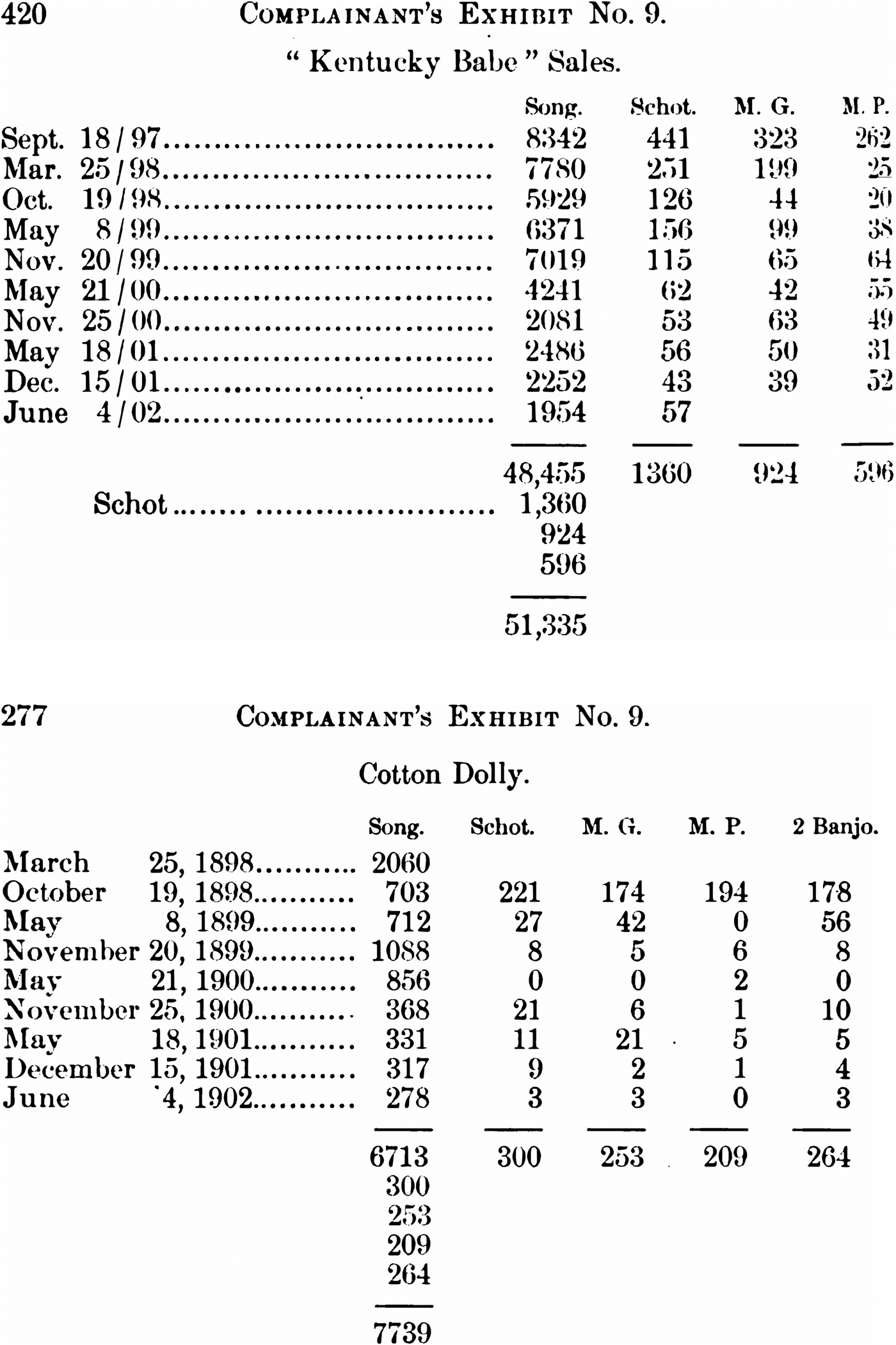
Depositions taken from White-Smith employees reveal, by contrast, that sheet music was subjected to far more rigorous accounting practices. The publisher was able to produce detailed information about how sheet music for “Kentucky Babe” and “Little Cotton Dolly” had sold (Figure 2). “Kentucky Babe,” the earlier of the two songs, had been a major success. According to White-Smith records, royalties had been paid out to the composer Adam Geibel for 51,335 copies of various arrangements. Excluded from this number were quartet arrangements, of which some 30,000 had been sold, because the terms of Geibel's contract did not cover royalty payments for such arrangements.Footnote 22 The success of “Kentucky Babe” motivated Geibel to write “Little Cotton Dolly” as a companion piece, and although it fared well enough, it was not quite as big a seller: Royalties were paid out on 7,739 copies of various arrangements, again, not including quartet arrangements, which numbered 13,800 sold.
Charts as exhibits by White-Smith (the complainant) that indicate earnings for various arrangements of Adam Geibel and Richard H. Buck's (a) “Kentucky Babe” and (b) “Cotton Dolly.” Transcript of Record: Supreme Court of the United States (TRSCUS), 163 and 286.
Obviously, in the context of the trial, White-Smith (unlike Apollo) had strong motivation to provide a detailed account of its sales. Establishing the success of both pieces was part of bolstering the claim that the company had suffered losses from the copyright infringements of piano roll manufacturers and vendors. Moreover, the existence of copyright regulations governing the relationship between composer and publisher necessarily meant that any transaction required more careful book-keeping in the event of a legal disagreement. Still, the difference in accounting practices for sheet music and piano rolls suggest the relative priorities of the industries that produced them. Piano rolls were subsidiary products that only worked in combination with the big-ticket items (player pianos); sheet music was the singular product of the publishers.
Corroborating evidence for the different commercial status of each medium comes from their respective patterns of distribution. Under further questioning, Janson, the Apollo clerk, mapped out the route piano rolls followed from manufacturer, distributer, to vendor. The rolls that were the concern of the trial had actually been made by the Q. R. S. Company in Chicago, on order from the Melville Clark Piano Company, which then supplied rolls to the dealers that sold its instruments, including the Apollo Company.Footnote 23 Generally in 1902, when Janson supplied his testimony, this was the industry pattern, and thus consumers wishing to purchase piano rolls had to look for them at an instrument dealer that sold the instrument for which the rolls had been cut. Consumers could find sheet music alongside piano rolls in the stores of instrument dealers like the Apollo Company. However there were also dedicated sheet music dealers, and in their stores, rolls were not available for purchase. Again, rolls were treated as an ancillary business to the principal one of selling player pianos, and as such were an afterthought for the people who sold them, whereas sheet music was treated as a stand-alone product.Footnote 24
The priorities I have inferred from trial testimony are further substantiated by the visual appearance of each medium. Sheet music for “Kentucky Babe” and “Little Cotton Dolly” is generally representative (Figure 3). Covers declare their titles and other textual information in a fanciful jumble of fonts, encircled by decorative vignettes, and enlivened by the photographs of celebrity performers. Sheet music was lavishly visual, drawing the consumer by making an appeal first to the eye.Footnote 25 Such was not the case for piano rolls, as one for “Kentucky Babe” demonstrates (Figure 4). It is packaged in a drab brown box, with a small end label identifying the manufacturer (Q. R. S.), catalogue number, title (notably, with the name of the composer absent), and performer. This is the sort of generic packaging used for spare parts, not for an object that was visually desirable in and of itself.Footnote 26 The early packaging of cylinder and disc recordings was similarly nondescript, with the largest text often reserved for the name of the manufacturer.Footnote 27
Sheet music covers for (a) Adam Geibel and Richard H. Buck's “Kentucky Babe” (courtesy: Lester S. Levy Sheet Music Collection, Sheridan Libraries, John Hopkins University, https://levysheetmusic.mse.jhu.edu/collection/141/152) and (b) “Cotton Dolly” (Vocal Popular Sheet Music Collection, Score 3650, https://digitalcommons.library.umaine.edu/mmb-vp/3650).

Q. R. S. piano roll for Adam Geibel and Richard H. Buck's “Kentucky Babe.” Although this roll is not one of the series that prompted the lawsuit by White-Smith (I have not been able to locate an extant copy), it does demonstrate that roll manufacturers continued to make the visual appeal of their products a low priority well into the twentieth century. This copy of “Kentucky Babe” is part of a later series recorded by J. Lawrence Cook under the pseudonym Sid Laney, and it dates, at earliest, from the 1920s, when Cook began recording rolls for Q. R. S. Image courtesy of the author.

The upshot is that although both sheet music and piano rolls were means for disseminating music, they were treated in different ways by the industries that produced them. Sheet music was regarded as a thing in itself, designed to be visually attractive and collectible. Accordingly, careful accounting was made of each copy sold. By contrast, piano rolls were sold as an adjunct to the machines that played them, almost as an afterthought. Manufacturers paid little attention to their appearance, and distributors and vendors were perfunctory in tracking individual rolls as they made their way from factory to consumer. To put it differently, business practices underscore what is evident in the material nature of the media: Sheet music was desirable in part because of its visual appeal, whereas the piano roll was merely the means to a sonic end.
There is an important caveat. The piano roll distribution network that the Apollo clerk mapped out was accurate in late 1902, when he supplied his testimony, but it would not remain so throughout the duration of the trial. Nor would player piano technology and its place in American musical culture remain static. In contrast to the sheet music industry, which was well established and relatively stable for the six and a half years in which White-Smith v. Apollo was litigated, the player piano industry, with its adjunct of piano roll manufacturers, changed substantially.
In late 1902, when Jansen testified, there was still skepticism about the viability of the player piano industry and, specifically, whether there was profit to be made selling rolls independent of the machines on which they were designed to play. The Perforated Music Roll Company addressed this doubt in an advertisement it ran repeatedly in the widely read Music Trade Review at the beginning of 1903. The industry had grown to such an extent, it asserted, that a company that made rolls for various players (as the Perforated Music Roll Company did) had a business model as viable as that of competitors like Q. R. S., which only produced rolls for a single brand of player.Footnote 28
By 1904, the Perforated Music Roll Company had stopped running the advertisement, replacing it with ones that featured a more generic ad copy stressing the quality and competitive price of its products. One could reasonably surmise that the company no longer felt the need to make the case for its viability given that it had found sure financial footing. According to the company's annual report, it had doubled the number of dealers selling its rolls.Footnote 29 Moreover, the company felt confident enough to embark on new ventures, inaugurating a “perforated music library” that operated on the model of the Tabard Inn Library, a successful for-profit book exchange system that was proliferating throughout the country.Footnote 30
That same year, a department store in Tacoma, Washington was the first institution of its kind to establish a department devoted to the sales of piano players and their rolls, thereby bringing piano rolls into a commercial context in which sheet music already thrived.Footnote 31 The price of individual rolls was also sharply declining, the push on the bottom line coming from new competitors, like, for example, the Universal Music Co., which began to supply trade in October.Footnote 32 Universal rolls were less expensive because the company substituted the metal core around which rolls were wound for a paper one and packaged its products in a cheaper box. By 1905, the price of piano rolls had come down from two–three dollar range to something approximating the price band for sheet music: 40 cents to one dollar. In sum, cost and the distribution networks of piano rolls and sheet music had drawn closer together, as people became more accustomed to thinking of rolls as a stand-alone product. Still, although rolls might have become more specific objects of desire, their appeal remained primarily in their sonic potential, not their physical appearance.
Arguing the Case: Piano Rolls as Music Notation
The challenge facing the plaintiff in White-Smith v. Apollo was to convince judges and justices that the regulatory framework that governed sheet music ought to be stretched to encompass piano rolls, despite the distinct places the two mediums occupied in the music industry. Initially, the strategy they pursued was to overcome the deficit in visuality that distinguished piano rolls by connecting them to sheet music via a narrative that treated musical notation as a form of technology. If the strategy was successful, the plaintiffs could then claim that while piano rolls might not be much to look at, they still offered something to see.
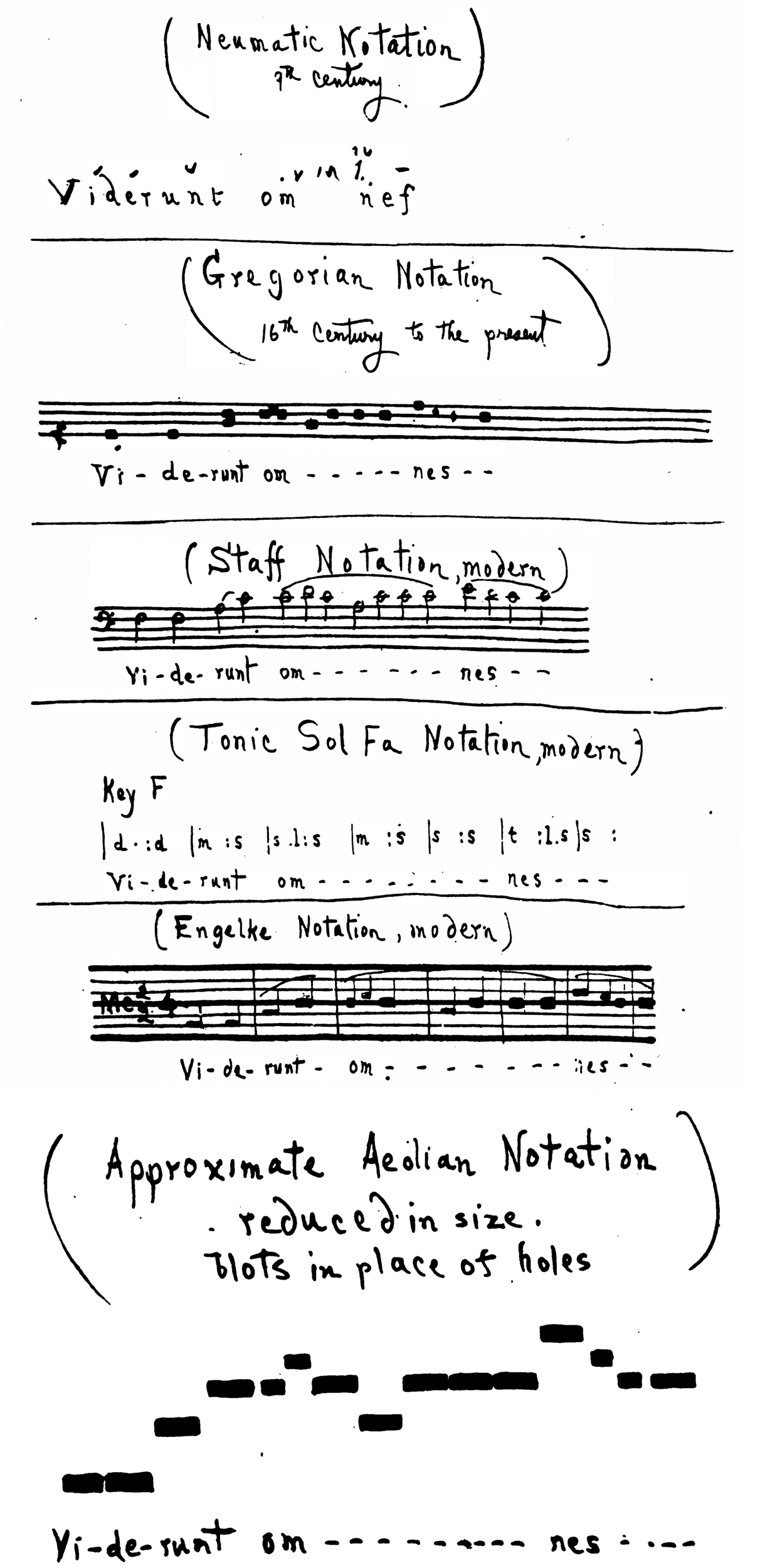
George C. Gow, a music professor at Vassar College, was one of the plaintiff witnesses critical for laying the groundwork for the argument. As part of his testimony, given in December 1902, Gow submitted an exhibit that featured a diagram of the opening of the same piece rendered in different notation systems (Figure 5). The piece in question was drawn from the Roman Catholic liturgy: Viderunt Omnes, a gradual for the Mass Proper on Christmas Day that remains a staple in undergraduate music history curricula today.Footnote 33 At the prompting of the plaintiff's lawyer, Gow offered a brief explanation of each system, beginning with ninth-century neumes, proceeding to quadratic “Gregorian” notation and then on through “standard notation,” “Tonic Sol Fa notation,” an expanded staff system by a recent inventor, and then finally a rendition of a piano roll version with the perforations represented by blots of ink. Gow drew his final example such that the blots ran horizontally rather than vertically (as would be their normal alignment when a roll was mounted on a player piano). As a result, the melodic contour outlined by the “perforations” matched that of the other examples. The point he was trying to make was clear: The perforations on a piano roll amounted to a system of notation. He went further, asserting, “a musician who understood any one of those notations would sing the melody in exactly the same way as from another notation.”Footnote 34 Gow was claiming an equivalence in the representational capacities of these systems, but the chronological arrangement of his examples hinted at another story: One of evolutionary development.
Plaintiff's exhibit submitted by George C. Gow illustrating different forms of musical notation. TRSCUS, 171–72.
That story, infused with melioristic convictions, is the one another White-Smith witness, Oscar Gunz, related when he took the stand over a year later, in January 1904. Gunz, an expert in patent law, as it pertained to musical technologies, launched into a far more detailed account of the history of notation than Gow had provided. The transcript of his testimony occupies many pages, all of it premised on the idea that new notation systems were superior to those preceding them.Footnote 35 Thus, for example, the increasing complexity of neumes, correlated with the desire to provide a more accurate representation of the music, led in turn to the gradual addition of staff lines. The language Gow employed exemplifies what Lisa Gitelman has characterized as the “aggressively narrative logic” of patents, which “all imply Whiggish accounts of technology, the gaps and misperceptions of the past cleverly remedied by the invention at hand ….”Footnote 36
For Gunz, the process of refinement did not terminate with standard staff notation. He pointed out that it took a considerable effort to learn the system and use it with any facility. Moreover, even experienced musicians found themselves adding in note names when stacks of ledger lines impeded the usability of the system. “Staff notation is used very extensively to-day,” Gunz conceded, “but yet many other systems of notation have been devised during the last few years and are being devised up to the present time, all with a view of simplifying and to facilitate learning and reading.”Footnote 37 To prove the point, he mustered several recent U.S. patents issued for notation systems, and described some of them in detail.Footnote 38 His inevitable conclusion was that perforations on piano rolls were just another example of the rich panoply of ever-evolving notation systems.
The defendants in White-Smith v. Apollo did not contest the narrative about the progress of musical notation that Gow hinted at and Gunz made explicit. Rather, they sought to demonstrate that perforated rolls were not part of that narrative. This was an approach they pursued relentlessly in cross-examining White-Smith witnesses. Among those witnesses were Walter Damrosch and Horatio Parker, two luminaries of American classical music who took the stand in January 1903, a week after Gow testified. Damrosch, who conducted the New York Symphony Orchestra and was a respected composer in his own right, opined that piano rolls were a form of notation. He went on to concede that though he himself could not read rolls, a “musician-mechanic” who made them for a living would be able to do so. The defense leapt on the assertion, and asked if Damrosch was acquainted with any such person. He admitted that he was not.Footnote 39 Parker, a well-respected composer and professor at Yale University, also found himself coming up short under cross-examination. He attempted to draw a distinction between a composition and any record thereof, the latter including both standard notation and the punched holes of piano rolls. The defense, however, pressed him on the status of these two records in the visual sphere, querying whether or not legibility was an essential criterion for them to be records. Parker, no doubt cognizant of the struggle Damrosch had had in proving that punched holes might be read, asserted that legibility was not a necessary requirement for a record to be a record. Defense shifted to the sonic sphere, offering the supposition then that perhaps a piano roll was a record that was intended to reach the mind through the ear and thus required audibility (as opposed to legibility). Parker, clearly disgruntled, responded “I don't see how a record can have audibility. The reproduction of a composition can be heard, the record itself cannot.”Footnote 40 The tactic here was to get Parker to concede that to make piano rolls audible required a machine, whereas a score was legible without an additional mechanism. Parker did not make this concession directly, but the damage was done, as suggested by his increasing futile attempts to sort through the logical implications of records for ears as opposed to records for eyes.
One of the most compelling moments of the trial occurred at the expense of another plaintiff's witness, Leonard B. McWhood, who was a colleague of Gow's at Vassar and also an instructor at Columbia University. Counsel for White-Smith followed much the same line of questioning as they had with Gow; McWhood, not surprisingly, also maintained that perforated rolls were functional as a form of music notation. When it came time to cross-examine McWhood, the defense asked him to demonstrate the readability of a roll by transcribing one. McWhood set to the task, but after a laborious 20 minutes, he gave up.Footnote 41 No doubt to his chagrin, the transcription he had produced turned out to be inverted. The point was made—and it would ultimately win the day for Apollo—a machine could read piano rolls, but a human could not.
To bolster their case that perforated rolls did not function as “writing,” the defense assembled an array of witnesses who were themselves either employed in the business of manufacturing perforated rolls or aficionados of mechanical musical instruments. Among them was Ernest G. Clark, the director of Q. R. S., which made the offending rolls, and brother of Melville Clark, who owned the piano manufacturing company through which those rolls had been distributed to Apollo.Footnote 42 On the stand, Clark provided a detailed description of the manufacture of piano rolls, establishing his intimate acquaintance with the process. However for all his experience, he observed that he had never “been able to accurately place a note when testing or when correcting [a roll] without the assistance of … [a graduated] rule” (the rule indexed note names to the location of a player piano's pneumatic tubes).Footnote 43 Clark and other defense witnesses established that the biggest challenge posed to transcribing a roll was deducing the rhythm implied by the punched holes and contending with the lack of standardization of rolls across different player piano models.Footnote 44
Blindness and the Mediation of Musical Sights and Sounds
The argument about the legibility of piano rolls presupposed that copyright inured in the visual realm, that it was a question of seeing—human seeing. Precedent set by earlier cases involving mechanical instruments ensured that this presupposition would be a fixed parameter of the debate. However what if musical copyright actually inured in the sonic realm, that it was a question of hearing? Although this was an argument that neither side developed, it was, I think, a consideration that was critical to White-Smith's decision to bring suit against Apollo specifically for sales of “Kentucky Babe” and “Little Cotton Dolly.” There were thousands of other pieces that could serve as the basis of an identical lawsuit. What distinguished these two songs was that they were the most popular works of Adam Geibel, a blind composer. The fact of his blindness dramatized the newly ruptured fault line between sight and sound.
Geibel was one of several blind musicians who enjoyed active careers in the latter half of the nineteenth century. The best known of such musicians then and now is hymn composer Fanny Crosby, with whom Geibel sometimes collaborated. These men and women were the beneficiaries of institutions for the blind that had sprung up in several major U.S. American cities during the 1800s, many of which included musical training prominently in their curricula.Footnote 45 According to musicologist Michael Accinno, romantic convictions about the transcendent capacities of music were a critical factor in the importance music assumed in such institutions. In particular, as Accinno has documented, the influential critic John Sullivan Dwight believed that blind students had natural affinities for music by virtue of the refined hearing abilities they developed to compensate for the loss of sight.Footnote 46
Geibel was an alumnus of the Pennsylvania Institution for the Instruction of the Blind, and at the time of the trial, had himself taught there for many years. In addition, he maintained a private studio; sustained a robust performance career as a pianist and organist; and acquired a reputation as an accomplished composer of religious music and secular song. Newspaper accounts of Geibel's activities sometimes drew attention to his disability, deploying the sobriquet “the blind musician” or “the blind composer.”Footnote 47 Undoubtedly, this was part of his appeal, particularly in the domain of religious music making, one of the principal spheres in which he operated. His abilities could be interpreted as symbolizing the providential nature of the divine who “giveth and taketh away.”
When Geibel took the stand as a witness for the plaintiff in White-Smith v. Apollo, counsel began examination in the customary fashion by asking his name, age, residence, and occupation. Then, instead of proceeding directly to establishing Geibel's authorship of “Kentucky Babe” and “Little Cotton Dolly,” counsel inquired about Geibel's teaching activities. Doing so provided the composer the opportunity to describe his work at the Pennsylvania Institution for the Instruction of the Blind and to note that he had himself been a student there. A third question prompted Geibel to explain his disability: An accident had deprived him of vision when he was “but nine days old, and I have never recovered it.”Footnote 48 Sight, in other words, was not a part of the man's experience. Clearly this was a fact that White-Smith's counsel wished to foreground. Having done so, counsel had Geibel confirm that he had indeed composed the two songs that were the subject of the lawsuit, and that he had authorized publisher White-Smith to take out copyright for both pieces. Then it was back to Geibel's disability with a question about the working methods necessary for him to generate visual (and thus sellable) records of his music. The composer described the painstaking process by which he dictated his music to an amanuensis—a process that meant Geibel composed in his head, independent of pen and paper.Footnote 49
As far as I am aware, there is no direct primary source evidence that confirms Geibel's songs were chosen strategically. However in asking questions that drew attention to Geibel's disability and the working methods to which it forced the composer to make recourse, White-Smith's counsel dramatized the difference between the act of composing and the visual representation of a composition. Implicitly, Geibel's testimony suggests that copyright law should cover the composition itself, not just its visual representation. At a moment when the auditory and visual relationship of the musical experience were very much in flux, happenstance seems unlikely to be the explanation for a pivotal copyright lawsuit being about the music of a blind composer.
Economics and the Mediation of Musical Sights and Sounds
The feat of cognition to which Geibel matter-of-factly laid claim in describing his compositional process—the ability to conceive of a piece independent of both visual and sonic stimulus—was, by the early twentieth century, widely presumed to be a skill that all good musicians possessed, not just those who were blind. As musicologist Sara Ballance shows in her compelling history of the concept of the musical ear and the pedagogical practices designed to cultivate it, musical elites came to equate “cerebral engagement with music (generally through a specific kind of listening or imagination) with ‘true’ musicality, while defining physical engagement [including performance] as ‘unmusical,’ or at least standing in the way of that pure cerebral approach.”Footnote 50 Indeed, George William Walter's assertion (see my second epigraph) that the true musician neither need play nor have a piece played “to know how it sounds,” is a pithy statement of this conviction, right down to the presumed gender of the musician in question (male). In the sphere of cultural values, imagined sound occupied the place of primacy. As the Supreme Court ruling in White-Smith v. Apollo attests, however, this was not so in the commercial sphere, for there the score was arbiter.
The dichotomy between musical sights (scores) and imagined sound (what scores were supposed to represent), the one monetizable and the other carrying cultural capital, has a complex history that is entangled with the precepts of romanticism and gender ideologies of the nineteenth century. It is a history that predates the player piano and phonograph and is transcontinental in nature, manifesting throughout what we are accustomed to thinking of as the musical West.Footnote 51 Nonetheless, as Oliver Wendell Holmes's concurrence suggests, new technologies did have the effect of drawing attention to the discrepancy between the two different kinds of value and the sensory realms to which they were linked.
The player piano and phonograph were also an integral factor for the emergence of a new hierarchy in the experience of music's sights and sounds. As with the conception of the musician's ear, this hierarchy privileged a specific kind of “intelligent” listening to music over other sensual modes of engagement, including the haptic stimulus of playing an instrument and the visual stimulus of perusing a score or watching performers in action. Here, though, the listeners in question were not musicians. Instead, they were members of an idealized audience, possessing nuanced sensibilities for what came to be called “music appreciation.” As several scholars have noted, the advocates of music appreciation seized on the player piano and phonograph as the perfect tools for acquainting Americans with classical music.Footnote 52 This repertoire, these proselytizers presumed, was not only more sophisticated in its aesthetic design than popular music—the fare issuing from the vaudeville stage, the Broadway theater, and (to a certain extent) the bandstand—but also morally superior.Footnote 53
Several proponents of music appreciation testified as part of the proceedings for White-Smith v. Apollo. Among them was the influential critic Henry T. Finck.Footnote 54 In his testimony, Finck imagined the voice of the player piano would spark a revolution: The emergence of an American musical democracy in which all citizens learned to love classical music and thus benefited from its salubrious effects. This kind of musical millennialism echoes in the testimony of other White-Smith v. Apollo witnesses, particularly the educators who took the stand and enthused about the beneficial impacts the player piano was having in their classrooms.Footnote 55 None of these witnesses remarked on the fact that the music that was the actual point of contention in the trial was popular fare.Footnote 56
Both the long-standing cultural veneration of the sonic imaginary in a composer's head—the “collocation of sounds”—and the regimens of listening prescribed by the music appreciation movement removed notation from the most essential musical experiences.Footnote 57 Notation did matter, however, to composers, who, by virtue of their profession were not run-of-the-mill citizens of Finck's musical republic. The mechanism of copyright was critical to the means by which they got their living and thus of pressing concern. New technologies that made it possible to disseminate sound without the mediation of sheet music destabilized the fundamentals upon which composers relied in order to carry out their business. One might assume then that they would welcome regulatory principles that bootstrapped piano rolls into the existing regimen of copyright statutory protections. However that was not the case, for composers were divided in their opinions about piano rolls, a consequence of competing convictions about the economic relationship between musical sights and sounds.
Of the composers who testified in White-Smith v. Apollo, Reginald de Koven was probably the most widely known at the time, his operettas handily negotiating the highbrow/lowbrow stratification that was by then sedimented into American musical life. When de Koven took the stand, he was quick to declare that perforated rolls had chipped away at sales of sheet music arrangements of his compositions. He asserted, “Whether the composer's thought is recorded on a phonograph, in sheet music or on a self-playing instrument, seems to me to make no difference as to his rights in receiving compensation for his work, which under one form of record is granted him by statute.”Footnote 58 This was the same position de Koven would advance in his testimony for the congressional hearings that led to the Copyright Act of 1909. Those hearings saw his view amplified by the assenting voices of Victor Herbert and John Philip Sousa, the latter penning an infamous screed that condemned the “menace of mechanical music” not only for its impact on the livelihood of composers but also for the moral degradation it would bring about because it disincentivized amateur musical activity.Footnote 59 Although the celebrity triumvirate of Sousa, de Koven, and Herbert might be in accordance about the adverse effects of mechanical music, their opinion was not uniformly shared by the members of their profession.
George Schleiffarth, a Chicago-based composer, expressed a very different view when he testified as a witness for the defense in White-Smith v. Apollo. Schleiffarth, who is all but forgotten today, enjoyed considerable success during the 1880s for the comic operas, popular songs, and “light” instrumental works that flowed from his prolific pen. A generation too old to be a part of the emergent cohort of professional American songwriters (the A-listers being the likes of Charles K. Harris, Harry von Tilzer, and George M. Cohan), he was, by the time of the trial, in his composerly senescence. As he conceded on the stand, his career had languished for “not being able to write the style of music popular now, such as coon songs and cake walks.”Footnote 60
Schleiffarth's view of the piano roll industry was a good deal more generous than that of his more famous contemporaries. He explained that any mechanism that got his music before the public, “whether done by mouth or by whistling or through a graphophone or with a perforated roll on the street corner played by some blind woman,” would redound to his benefit. He remarked, “I have often asked my publishers to allow the reproduction of my compositions on graphophones and self-playing devices.”Footnote 61
Schleiffarth's position was a consequence of the practices that had governed the relationship between composers and publishers for much of the nineteenth century. Composers generally sold their music to publishers outright and received no royalty payment regardless of how well the sheet music sold. By the time of the trial, royalty clauses in composer–publisher contracts were common, as evidenced by the ones contained in the contracts Geibel signed with White-Smith for “Kentucky Babe” and “Little Cotton Dolly.” Schleiffarth's output having slowed, he had limited experience with such clauses and their benefits. From the vantage point of a composer of his generation, for whom one-time payments from publishers had been the rule, actual sheet music sales numbers mattered less, though of course high sales did mean he could demand a higher price for the music he subsequently composed.Footnote 62 In Schleiffarth's view, the most important function of a piano roll was not the income that a composer might derive from it directly, but rather that it could aid in drumming a composition into the ears of consumers and thus help a composer become better known. It goes almost without saying that the likes of Sousa, Herbert, and de Koven, at the heights of musical celebrity, were already well-known and had no need of this benefit from piano rolls.
Schleiffarth was far from unusual. Other witnesses testified that many composers were content to have piano rolls of their music sold to consumers without receiving direct monetary compensation. In fact, the Vice President of the Melville Clark Piano Company, Charles H. Wagner, declared that several composers had offered to pay his company to have their music cut as rolls. Ernest Clark, director of Q. R. S., cited the specific case of a package of sheet music forwarded to his company by the Charles Harris Publishing Company with a request to make rolls of said music. When Clark was asked to speculate about why Harris wanted compositions reproduced as piano rolls, he suggested that it was because hearing the rolls would increase the demand for the publisher's sheet music.Footnote 63 Several publishers and music dealers who served as witnesses indicated that they knew of instances in which customers had purchased sheet music for works that they had first heard on a player piano. Stretching the point even further (though without making the causal link explicit), two other witnesses for the defense, the Dean of the School of Music at Northwestern and the bookkeeper for the Chicago Musical College, both noted that there had been increases in the number of students enrolling in their respective institutions. The implication was that growth of the player piano industry had also galvanized college students to pursue formal study of music.Footnote 64
At over a century's remove, it would be difficult to either prove or disprove contentions about the role of the player piano in stimulating the sales of sheet music (let alone causing a surge of students studying music). It is clear that the sheet music industry was growing, despite gloomy prognostications about its fate vis-à-vis the growth of “mechanical music.” However as the old adage goes, correlation is not causation, and to establish a direct causal link between the growth in sales of sheet music and the proliferation of piano rolls lies outside the scope of the present article. The point I am trying make is that, contrary to our own expectations, there were composers and publishers who believed that sales of sheet music had benefited from the new market of piano rolls. Despite the sonic immediacy facilitated by perforated rolls (in combination with the machines on which they were meant to be played), there was a concomitant desire for the visual representation of the sounds in the traditional sheet music format. Another way of putting this conviction would be to say that the auditory experience of hearing a piece was not sufficient for some consumers, and that they instead craved an older form of audiovisual musical engagement.
The Novelty Wears Off: the Reception of White-Smith v. Apollo in Music Trade Review
The twists and turns in White-Smith v. Apollo were closely attended to by the music industry press, and nowhere more so than in the pages of Music Trade Review.Footnote 65 The journal reproduced lengthy passages from depositions, testimonies, briefs, oral arguments, and judicial decisions, providing an account even of the tangential byways the proceedings sometimes traversed. The testimony of Gow, Gunz, Damrosch, Parker, and McWhood was all described in some detail, garnering a letter of thanks from Gunz himself, who expressed his admiration for the adept summary skills that the Review had shown in condensing his lengthy testimony.Footnote 66 Still, even though Music Trade Review was lavish in the column space it devoted to White-Smith v. Apollo, it could not provide an account of everything that transpired in the proceedings, much less a full transcript. Selectivity was a practical necessity and that being the case, one can reasonably assume that what Music Trade Review writers chose to include in their reports is indicative of the interests they imputed to their readers, and those interests were not static.
Early reporting about White-Smith v. Apollo in Music Trade Review focused on the issue of legibility: The extent to which piano rolls were an adequate substitute for standard staff notation. However, it also foregrounded broader issues about the relationship between sight and sound, the sort of thing that had tied Horatio Parker in knots as he attempted to distinguish between a composition itself and records that addressed the eye or ear (Music Trade Review reproduced the transcript of the testy exchange between Parker and the defense attorney).Footnote 67 Nor did the journal stint on the esoterica of music notation history that figured in the testimony of Gow and Gunz: Neumes and quadratic notation were accorded their cameo moments.Footnote 68 What this coverage suggests is that beyond the legal implications of the trial, there was a general inquisitiveness about how piano rolls might be philosophically conceived in relation to more traditional modes of musical representation—initially, at least.
By April of 1903, when the proceedings moved to Chicago in order to collect testimony for several defense witnesses, that curiosity seems to have waned. Reporting in the Music Trade Review indicates that ennui had set in with respect to excurses about the audiovisual status of a composition and the mediational capacities of piano rolls. Tense exchanges during cross-examination, which the journal had previously recounted in detail, now received short shrift. For example, a back-and-forth concerning the status of a piano roll—whether it was a mechanical controller as opposed to something that could be consumed visually—was dismissed as indulgent “word fencing.”Footnote 69 Another report, noted with exasperation, “The usual fencing match and hair-splitting was indulged in over the question: Are sounds of a musical composition intended for the ear or eye ….”Footnote 70 Clearly, several months into the trial, the novelty of courtroom digressions exploring the philosophical entanglements of eye and ear in music had become tiresome.
As the case wore on, attorneys on either side also shifted their attention away from issues of audiovisuality. When final arguments were heard in December 1904, almost a year after the last witnesses had testified, the pivotal issue was no longer whether a piano roll was legible. Instead, plaintiff and defense attorneys offered competing contentions about how to interpret the Constitution and the copyright statutes derived from it. Edwin H. Brown, who argued the case for White-Smith, did make a nod toward the idea that engaging with rolls involved a form of reading. He had a pianolist perform a metrostyle roll of Victor Herbert's “Badinage” in two ways, once mechanically, ignoring the expression markings on the roll, and a second time following them. Although “very much to the edification of the court” (as the Music Trade Review reported), the rolls that were the crux of the lawsuit lacked such expression markings and had been manufactured prior to the introduction of the metrostyle roll to the commercial market.Footnote 71 In any case, the argument Brown ended up presenting was not that punched holes constituted another form of notation, but rather that the Constitution “shows a clear intent to protect author and composer against everything which multiplies their work in such a manner as to make it commercially available as a commodity without their consent and to encourage intellectual production by reserving to them and their assigns exclusively whatever profit may be derived from such multiplication and sale.”Footnote 72 The use of the word “everything” suggests a tacit concession on the part of the plaintiff: The piano roll was not the same type of thing as sheet music. For its part, the defense held tenaciously to the letter of the law, maintaining that “copyright is strictly statutory, and is not subject to enlargement beyond the line of the statute ….”Footnote 73 If punched holes were not a form of writing, piano rolls stood outside the compass of the statutes. To put it succinctly, the issues that figured both in the proceedings of White-Smith v. Apollo and in its press coverage shifted over the course of the first 3 years of litigation, while the case remained pending in the Circuit Court for the Southern District of New York.
Undoubtedly, a factor in this shift was the cross-examination skills of the defense, which had handily dismantled the argument that perforated holes were a ready substitute for staff notation. Another factor, I would suggest, was that player piano technology was becoming increasingly familiar to Americans and the impetus to relate it to something with which they were already well-acquainted—sheet music—dwindled accordingly. I have already had occasion to describe changes in the manufacturing and distribution of piano rolls that made them more accessible. Equally important were technological changes that contributed to general appeal of player pianos. Aeolian's introduction of the Metrostyle in 1903 was one such development.Footnote 74 That same year, Melville Clark added to its line the Apollo Concert Grand Player Piano, which expanded the range of the player mechanism to the full eighty-eight keys (previously, sixty-five keys had been the norm), and all-in-one piano models that included an integrated player mechanism.Footnote 75 By 1905, when Judge Hazel issued his decision on White-Smith v. Apollo, player pianos had become such an important part of the music industry that the Music Trade Review introduced a department devoted solely to news from that sector. “With the Piano Player People” and another new department, “With the Phonograph People,” complimented the long-running section of the journal devoted to the music publishing sector, thereby acknowledging the distinctiveness of all three forms of musical media. Again, this suggests that the imperative to draw comparisons between new and old media—comparisons that had revolved around the different audiovisual orientations of a record for the eye as opposed to one for the ear—dwindled as the player piano and phonograph seeped into everyday musical praxis.
White-Smith v. Apollo continued to attract coverage in the trade press, and ultimately in the national press, when the Supreme Court issued its decision. However the originators of the lawsuit, members of the MPA (with Aeolian's backing), had long since turned their energies to lobbying congress for a change in the copyright statutes. Already in May 1903, when the brittleness of the argument about the legibility of piano rolls had become apparent, a music publisher was quoted in Music Trade Review as having declared that he and some of his colleagues intended to “endeavor to have the law amended during the coming session of Congress, so as to specifically bar the bushwhacking automatic players.”Footnote 76 The 1909 Copyright Act that was the eventual result of these efforts involved its own ponderous deliberations, and although issues of music audiovisuality figured occasionally, it was the economic ramifications of mechanical music that commanded the spotlight.
Conclusion: White-Smith v. Apollo, Audiovisual Culture, and the Limits of the Senses
The “separation of the senses” is something of a catchphrase in the humanities that scholars invoke to demarcate the cognitive and perceptual experiences characteristic of modernity, especially in relation to the advent of new media technologies at the end of the nineteenth century. In the sixties, Marshall McLuhan proposed that Western history alternated between periods in which sight and sound dominate, modern electronic media marking the advent of an “ear-culture” that replaced the visual orientation inculcated by the printing press.Footnote 77 Two decades later, Friedrich Kittler offered an alternative narrative in which print, once bearing the burden of storing all sensory experience, was superseded by modern media that separate sensory data streams: Gramophone, film, and typewriter.Footnote 78 Since then, scholars have been backdating modernity in prehistories of film and sound recording that stress new techniques of looking and listening that developed earlier in the nineteenth century.Footnote 79 The persistence of the “separation of the senses” thesis has had the effect of fostering an array of adjacent interdisciplinary pursuits clustered around each sense, with “visual studies” and “sound studies” being the most prominent.
Musicologist Deirdre Loughridge has recently argued that the scholarly tendency to cordon off the senses is worth challenging. What is neglected, she contends, is “the interdependency between sight and sound, looking and listening, and the ways interaction between the two perceptual modes has changed over time.”Footnote 80 White-Smith v. Apollo furnishes a technology-paned window on audiovisual culture at the beginning of the twentieth century. It reveals that although the player piano (and phonograph) made it easier to conceive of the auditory and visual aspect of music making separately, the two sensory streams remain entangled in various ways. On the one hand, new technology refracted music into two symbolic orders, one readable by machines (piano rolls and phonographs) and the other by humans (staff notation); on the other, it created the need for legal principles that could cover both of these visual orders in relation to the auditory conception of the composer. On the one hand, the different sensory orientation of the media via which music circulated—the visuality of sheet music as opposed to piano rolls—ramified in distinct processes for handling each medium as a commercial product; on the other, hearing a player piano arrangement of a piece could prompt desire for its visual representation as sheet music. Finally, although a blind composer could function solely in the realm of heard and imagined sound; his success depended on a sighted amanuensis to render his compositions a readable commodity. Music might “tell us of things we have not seen and shall not see,” but as of 1908, when White-Smith v. Apollo was decided, composers wishing to make a living needed to bank on the realm of things seen.
The Copyright Act of 1909, with its compulsory license provision, folded piano rolls and phonograph records into the statutory codes that regulated intellectual property in the United States. It was a codification of the separation of the senses because it made “records for the ear” distinct from “records for the eye.” The Act was a political and legal compromise that reflects the cultural shift documented in the latter part of this essay: The dwindling imperative to draw comparisons between old and new media.Footnote 81 As for White-Smith v. Apollo, which began with an assertion of identity (that the punched holes of a piano roll were just another form of musical notation), it was superseded by the Copyright Act.
Still, the case has had a surprisingly robust afterlife in debates about copyright pertaining to new media that challenge the limits of the human perceptual apparatus. It has been a point of reference in court cases and legislative proceedings that sought to determine whether computer software constituted a form of intellectual property.Footnote 82 Similarly, it figured in speculations about the legal status of early digitized musical scores, which involved the conversion of traditional notation into a format that machines could read (and humans only with great difficulty).Footnote 83 Moreover, it has become newly relevant again as we begin to assess the ramifications of artificial intelligence's creative facilities. What if the “collocation of sounds,” as Oliver Wendell Holmes puts it, did not issue from the sonic imagination of a human being, but instead from a machine? When something is created completely free of the human perceptual apparatus, whether embodied or imagined, who derives the benefit of ownership? What is the nature of that creative object and who is its creator?Footnote 84 Thus, legal questions of the moment push into ontology, and the crux of the matter is not so much whether or not the senses are separate, but whether they might be transcended altogether.
Acknowledgments
A version of this article was presented at the annual meeting of the American Musicological Society in New Orleans, 2022, under the same title. My thanks to Patrick McCray and Ben Levy, who read and commented on drafts, as well as to the two reviewers for this journal, both of whom provided insightful assessments. I'm particularly grateful to one of those reviewers, Mark Katz, for furnishing feedback that prompted some constructive revision work that strengthened the article considerably.
Competing interests
None.
David C. Paul is an associate professor at the University of California, Santa Barbara, whose work focuses on American music and popular culture at the turn of the twentieth century. He is the author of Charles Ives in the Mirror (2013) and is completing a book manuscript about the World's Columbian Exposition in popular media. He has published articles in American Music, Journal of the American Musicological Society, and the Journal of Musicology.


 Open access

