



There is a growing body of research exploring the effects of the neighbourhood environment on health behaviours, such as physical activity and healthy eating. Different methodologies are used to portray features of neighbourhoods, including food availability, that influence food intake. A popular method is to use geocoding to objectively assess the distance between respondents’ home and food retailers or restaurants and to document exposure to various shop types( Reference Aggarwal, Cook and Jiao 1 – Reference Thornton, Bentley and Kavanagh 8 ). Other objective measures used are store audits, allowing to precisely report what kind of foods individuals are exposed to when grocery shopping( Reference Caldwell, Miller Kobayashi and DuBow 9 – Reference Sharkey, Johnson and Dean 13 ). Despite the use of such objective measures, the relationship between the food environment and food choices is subject to conflicting results in the literature. Some studies have shown significant associations between food accessibility and/or availability and measures of food intake( Reference Morland, Wing and Roux 3 , Reference Zenk, Lachance and Schulz 12 , Reference Sharkey, Johnson and Dean 13 ), while other studies have found no associations( Reference Aggarwal, Cook and Jiao 1 , Reference Murakami, Sasaki and Takahashi 4 – Reference Pearce, Hiscock and Blakely 7 ). The fact that consumers do not always shop at the closest food retailer from home( Reference Aggarwal, Cook and Jiao 1 ) may explain part of these mixed results.
Given that different people may have different perceptions of the same food environment, other authors have opted for an approach that measures perceived food environment, i.e. participants’ perceptions of the availability and/or accessibility and/or affordability of healthy and unhealthy foods in their neighbourhood. Generally using relatively short questionnaires, authors have once again obtained mixed results when looking at the relationship between the perceived food environment and food intakes. Many authors have reported positive associations between perceived accessibility to healthy foods and diet quality( Reference Sharkey, Johnson and Dean 13 – Reference Williams, Ball and Crawford 17 ), but this has not been a systematic finding( Reference Pearson, Russell and Campbell 18 – Reference Lucan and Mitra 20 ). These mixed results may be partly explained by the diversity of items used in different studies and the fact that most of them were not validated. Dibsdall et al.( Reference Dibsdall, Lambert and Bobbin 16 ) and Mujahid et al.( Reference Mujahid, Diez Roux and Morenoff 21 ) have developed and validated very short (three items( Reference Mujahid, Diez Roux and Morenoff 21 )) or very long scales (thirty items( Reference Dibsdall, Lambert and Bobbin 16 )), both assessing almost exclusively perceived access to fruit and vegetables.
In the context of a large study aimed at identifying determinants of healthy eating in the French-Canadian population of the Province of Québec, Canada, our research team wanted to create a questionnaire in order to evaluate the potential influence of the perceived food environment on healthy eating. In addition to the small number of studies having used validated items, there is, to our knowledge, no such questionnaire that was developed and validated for a French-speaking sample. As recommended by Beaton et al.( Reference Beaton, Bombardier and Guillemin 22 ), questionnaires should not be translated and then used without some adaptations for cultural differences between populations. In this case, it was decided that a new questionnaire would be developed since most of the existing tools were not validated and did not assess access to both healthy and unhealthy foods. Therefore, the aim of the present study was to develop and validate a questionnaire assessing perceived food environment (i.e. perceptions of the availability and/or accessibility and/or affordability of healthy and unhealthy foods in the neighbourhood) in an adult French-Canadian convenience sample. We hypothesize that the questionnaire we developed is valid and reliable for the targeted population.
Materials and methods
Development of the items
For the development of the questionnaire, we were mostly inspired by items developed (but never validated) by Inglis et al.( Reference Inglis, Ball and Crawford 23 ) and by the results obtained by Kamphuis et al.( Reference Kamphuis, van Lenthe and Giskes 24 ) in focus groups conducted in high and low socio-economic groups. The items generated based on factors that were mentioned by their participants are therefore relevant for both high and low socio-economic groups. We were also inspired by items documented in several other studies having assessed participants’ perceptions of their food environment( Reference Caldwell, Miller Kobayashi and DuBow 9 , Reference Zenk, Lachance and Schulz 12 , Reference Moore, Diez Roux and Nettleton 15 , Reference Dibsdall, Lambert and Bobbin 16 , Reference Gustafson, Sharkey and Samuel-Hodge 19 , Reference Lucan and Mitra 20 , Reference Moore, Diez Roux and Brines 25 – Reference Moore, Diez Roux and Nettleton 29 ). The items were developed and chosen by a team of three nutrition researchers and one health behaviour researcher to ensure the face validity of the questionnaire, i.e. the extent to which the items seemed to measure what the developers claim they measure( Reference DiIorio 30 ).
The Perceived Food Environment Questionnaire that we developed first comprised fourteen items grouped into two distinct sections (see Table 1). The first section included twelve items assessing accessibility to healthy (nine items) and unhealthy foods (three items) and was developed to evaluate participants’ perceptions of the food environment in their daily life (e.g. accessibility to healthy foods in food retailers, accessibility to healthy/unhealthy foods at the workplace, kitchen equipment). The items were rated on a five-point scale, from ‘strongly disagree’ to ‘strongly agree’, with the addition of a ‘not applicable’ option for the items pertaining to the work environment. Indeed, these items will not concern unemployed individuals. The second section included two complementary questions documenting the self-reported travel time from home to the main food retailer by car and on foot. These two items did not assess food environment perceptions. They were, however, included in the questionnaire because they would be useful for the interpretation of the results obtained in the previous section, allowing the integration of subjective (i.e. perceived food environment) and more objective (i.e. travel time) measures, as it was proposed that the two types of measures can bring complementary information( Reference Moore, Diez Roux and Nettleton 15 , Reference Moore, Diez Roux and Brines 25 ). The questionnaire’s items were preceded by a short introduction text in which participants were informed that the questionnaire aims at assessing their own perceptions of their environment, and that there are no good or bad answers. A definition of ‘healthy foods’ was also presented: ‘Healthy foods are foods recommended by the Canada’s Food Guide, i.e. fruit and vegetables, whole grain products, low-fat dairy and alternatives, and low-fat meat and alternatives’.
Questionnaire items for assessing perceived food environment in a French-Canadian population

n/a, not applicable.
The French version of the instrument was validated. All items were translated from French to English using the back-translation procedure and should not be used in their English version without validation.
* Response scale: (i) strongly disagree; (ii) somewhat disagree; (iii) neither agree or disagree; (iv) somewhat agree; (v) strongly agree; (vi) not applicable. The ‘not applicable’ option is proposed only for items pertaining to the workplace.
† Response scale: (i) less than 10 min; (ii) from 10 to 20 min; (iii) more than 20 min.
Participants and procedures
The Perceived Food Environment Questionnaire’s development and validation took place in the context of a research project aiming at validating a series of questionnaires on potential determinants of healthy eating and blood biomarkers of fruit and vegetable intake. The Perceived Food Environment Questionnaire was validated using a two-step process, namely a pre-test and a validation study.
Pre-test
In order to perform a pilot testing of the questionnaire, a convenience sample of thirty-one participants was recruited from an internal list of individuals interested in participating in clinical studies. Participants were fourteen men and seventeen women from the Québec City metropolitan area and were aged between 18 and 65 years (mean age: 45·6 (sd 13·9) years). Participants had to have at least minimal informatics skills since questionnaires were completed online. Each participant commented on the clarity of the questionnaire’s items in a comment box on the Internet interface, which allowed us to assess acceptability and understanding of the items.
Validation study
For the validation study, a convenience sample of 150 participants (50 % female) was recruited through electronic mailing lists comprising Laval University students and employees as well as individuals interested in participating in nutritional studies at the research centre. As for the pre-test, participants had to be aged 18 to 65 years and to have at least minimal informatics skills. Since blood biomarkers of fruit and vegetable intake were measured as part of the larger study of validation, participants had to be free from conditions affecting intestinal absorption. Pregnant and lactating women were also excluded.
Eligible participants came to the research centre for a blood sample and anthropometric measurements. After their visit to the research centre, participants were allowed a 1-month period to complete the series of questionnaires to be validated on the Internet platform of the study. Questionnaires were assigned to participants in a random order. The completion time for the series of questionnaires was approximately 40 min. After a 2-week period, participants were asked to complete the questionnaires a second time within another 30d window.
Participants received a financial compensation of $CAN 50 for their participation in the study. The study was conducted according to the guidelines laid down in the Declaration of Helsinki. The experiment had approval from the Research Ethics Committee at Laval University. Implicit informed consent was obtained from the pre-test participants and all participants from the validation study gave written informed consent.
Statistical analyses
Analyses were performed on data derived from the validation study. An exploratory factor analysis (EFA) was performed on the twelve items of the first section of the questionnaire, using data from the first completion, in order to assess the number of factors (subscales). The two items of the complementary section were planned to be interpreted separately, therefore they were not included in the current analysis. The requirement for sufficient sample size for factor analyses was met in the present study, with a participant-to-item ratio >10:1( Reference Nunnally 31 ). The EFA procedure aims at retaining as few factors as possible while explaining most of the variation in the data. The scree plot( Reference Cattell 32 ) and the modified eigenvalue-greater-than-one rule( Reference Larsen and Warne 33 ) were used to properly identify the number of factors in this specific section of the questionnaire. Internal consistency reliability was evaluated using Cronbach’s α coefficients with data from the first completion of the questionnaire. The test–retest reliability was assessed using Pearson’s correlations between the mean scores of the two completions for each subscale. Because of the questionnaires’ random order, there is a possible time interval from 2 to 10 weeks between the two completions. To test the potential influence of this varying delay, partial Pearson’s correlation analyses between the two completions, while adjusting for the time interval, were performed. Since data derived from the complementary items are categorical, the test–retest reliability of these items was evaluated using Cohen’s κ agreement between the two completions. The κ coefficients were interpreted as follows: κ≤0·2, mediocre; κ=0·21–0·40, low; κ=0·41–0·60, moderate; κ=0·61–0·80, strong; κ=0·81–1·00, excellent( Reference McHugh 34 ). Statistical tests were two-sided and differences or associations at P<0·05 were considered significant. Analyses were performed using the statistical software package SAS version 9.4.
Results
Pre-test
Three participants did not complete the Perceived Food Environment Questionnaire; comments from twenty-eight participants were therefore considered in the pilot testing. The analyses of participants’ answers and comments revealed that all items were well understood and not found to be ambiguous. Therefore, the pilot testing did not lead to changes in the questionnaire.
Validation study
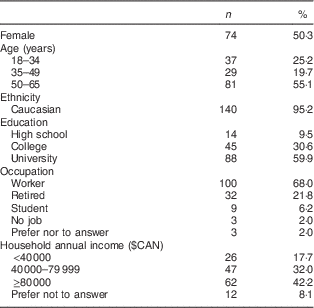
A total of 150 participants were recruited for the validation study. One participant dropped out of the study before completing the questionnaires and two participants did not complete the Perceived Food Environment Questionnaire. Characteristics of the 147 remaining participants are presented in Table 2. The mean completion time of the questionnaire was 2·3 (sd 2·4) min.
Characteristics of the validation study sample: men and women (n 147) from the Québec City area, Canada
Exploratory factor analysis
The twelve items of the questionnaire had adequate common variance, justifying the use of an EFA (Bartlett’s test of sphericity: χ 2=356·14, P<0·0001; Kaiser–Meyer–Olkin measure of sample adequacy=0·71( Reference Tabachnick and Fidell 35 )). The analysis revealed that two factors should be considered for the set of items, accounting respectively for 73·7 and 17·5 % of the variance. In order to obtain simple and interpretable factors, and since factors were not expected to co-vary, an orthogonal varimax rotation was used. Using a minimum loading cut-off of 0·30 or higher( Reference Costello and Osbourne 36 ), three items did not load on any factor and were therefore removed from the questionnaire (see Table 1). With this factor structure, six items loaded strongly on the first factor (see Table 1) and it was decided that the factor would be named ‘accessibility to healthy foods’. The second factor was named ‘accessibility to unhealthy foods’ since three items pertaining to fast-food restaurant and junk foods at work loaded strongly on it (see Table 1).
Internal consistency reliability
Both subscales were considered internally reliable, with Cronbach’s α of 0·77 for the ‘accessibility to healthy foods’ subscale and 0·62 for the ‘accessibility to unhealthy foods’ subscale.
Test–retest reliability
A test–retest reliability analysis was performed using data from participants who completed the scale twice (seventy-four women and seventy-one men). Pearson’s correlation coefficients between scores for the two completions for both subscales were calculated and revealed adequate reliability (r=0·59 and 0·60, respectively, for the ‘accessibility to healthy foods’ and the ‘accessibility to unhealthy foods’ subscales; both P<0·0001). The mean time lapse between test and retest was 40·4 (sd 11·8) d (range: 14–99d). The Pearson’s coefficients remained similar when adjusted for time lapse between the two completions (r=0·59 and 0·60, respectively; both P<0·0001). As shown in Table 3, weighted Cohen’s κ analyses revealed moderate agreement between the two completions for the two complementary items of the questionnaire.
Weighted Cohen’s κ values for test–retest reliability of the complementary questions in the Perceived Food Environment Questionnaire among men and women (n 147) from the Québec City area, Canada

Discussion
The purpose of the present study was to develop and validate a questionnaire assessing perceived food environment in a French-Canadian population, more specifically assessing the perception of the access to healthy and unhealthy foods. A new questionnaire was developed because of three major issues of the existing questionnaires which made them unsuitable for our needs. First of all, to our knowledge, only two of the existing questionnaires were subject to a validation process( Reference Dibsdall, Lambert and Bobbin 16 , Reference Mujahid, Diez Roux and Morenoff 21 ). Second, only few existing questionnaires assessed access to both healthy and unhealthy foods, and none of them was validated. And third, to our knowledge, no such questionnaire currently exists for French-speaking populations. Therefore, the questionnaire developed and validated in the present study addressed an important gap in this area of research. Other authors have generally assessed access to either healthy foods or fast foods using one to four non-validated items( Reference Caldwell, Miller Kobayashi and DuBow 9 , Reference Zenk, Lachance and Schulz 12 , Reference Moore, Diez Roux and Nettleton 15 , Reference Williams, Ball and Crawford 17 , Reference Lucan and Mitra 20 , Reference Zenk, Schulz and Hollis-Neely 26 , Reference Oexle, Barnes and Blake 28 , Reference Rose and Richards 37 , Reference Ho, Wong and Lo 38 ). Mujahid et al.( Reference Mujahid, Diez Roux and Morenoff 21 ) validated a three-item availability to healthy foods questionnaire, measuring the internal consistency and the test–retest reliability of the scale. However, items were limited to the availability and the quality of fruit and vegetables, and to the variety of low-fat products in the neighbourhood. Dibsdall et al.( Reference Dibsdall, Lambert and Bobbin 16 ) also proceeded to a complete validation of their thirty-item scale assessing accessibility, affordability and motivation to eat fruit and vegetables, with methods that are similar to the ones used in the current study, such as EFA and Cronbach’s α analyses. However, the length of the questionnaire, the fact that it was designed for low-income groups and the numerous items pertaining to motivation are some of the reasons why we developed a new questionnaire instead of translating this validated one.
The questionnaire we developed assessed participants’ perception of their environment, rather than assessing the environment using objective measures. According to Mujahid et al.( Reference Mujahid, Diez Roux and Morenoff 21 ), one of the limitations of assessing participants’ perception on the conditions in their neighbourhood is the potential bias related to some personal characteristics (e.g. socio-economic status, grocery shopping habits). However, Giskes et al.( Reference Giskes, Van Lenthe and Brug 39 ) and Williams et al.( Reference Williams, Ball and Crawford 17 ) found that perceived availability and price of foods were associated with purchase or consumption of those foods whereas objective measures were not. Behaviours may be more likely to be influenced by an individual’s perception of his/her environment than by the actual environment itself( Reference Giskes, Van Lenthe and Brug 39 ), since perceptions include notions of noticing and understanding. Moreover, measuring perceptions is easier and less time-consuming than objectively describing food environments in participants’ neighbourhood, particularly in large research projects where participants come from different geographical regions. Besides, Freedman and Bell( Reference Freedman and Bell 40 ) observed that participants’ perceptions did not differ significantly from objective measurements in terms of availability of healthy foods, suggesting similarities between results obtained from both measures. We believe that our questionnaire will help document the role of perceptions of the food environment in predicting healthy dietary habits and eating behaviours. Paired with questionnaires assessing other potential determinants of healthy eating, this newly developed tool will eventually enable the investigation of how perceived environment interacts with other factors in predicting successful adherence to dietary recommendations.
An EFA was performed on the twelve items of the main questionnaire (i.e. excluding items of the complementary section) in order to verify whether these items should be divided into different subscales, given that different concepts are assessed (e.g. variety/quality/affordability in the main food retailer, access to healthy foods at the workplace, access to fast-food restaurant). The EFA revealed a two-factor structure, accounting for more than 91 % of the variance. This structure reflects the fact that items related with perceived access to either healthy or unhealthy foods. Cronbach’s α confirmed that both subscales were internally reliable. The calculation of mean subscale scores will facilitate the use of data derived from the questionnaire. However, since the items cover different concepts, it will also be possible to use items separately according to different research questions to be addressed and allow comparison with results from other studies, where tools generally assess availability, accessibility and affordability with distinct items. The EFA led to the removal of three items pertaining to access to healthy foods at work, kitchen equipment and availability of healthy foods at home. It is possible that the latter item did not load on any factor given that the home environment reflects a decision that individuals have already taken, which is to buy healthy foods and to bring them home.
In the present study, the test–rest reliability was assessed in two ways according to the nature of the data (i.e. numerical or categorical). Measures of the two subscales of the questionnaire correlated strongly when repeated in time, which is similar to results obtained elsewhere( Reference Mujahid, Diez Roux and Morenoff 21 ). The adjustment for the time lapse between the two completions did not influence the strength of the association, suggesting that the perceived food environment concept is stable at least over a 1- to 2-month period. For the two complementary items of the questionnaire, the weighted Cohen’s κ coefficient showed moderate agreement between the two completions, once again suggesting a good stability over time.
Strengths and limitations
A major strength of the present study is the fact that it was designed expressly for the validation of questionnaires. Two different samples, one for the pre-test and one for the validation study, were recruited to assess the different steps using a rigorous validation process. Also, to our knowledge, the study led to the development of the first validated questionnaire assessing perceived accessibility to both healthy and unhealthy foods.
The main limitation of the study is its mostly Caucasian and highly educated sample, which is not representative of the whole French-Canadian population( 41 ). The fact that participants for the pre-test were recruited from a list of individuals interested in participating in clinical studies constitutes another limitation since their interest in nutrition may influence their perceptions and behaviours. These sample characteristics limit the external validity of the questionnaire. Further validation is needed for uses in different populations.
Conclusion
The aim of the present study was to develop and validate the Perceived Food Environment Questionnaire, which is, to our knowledge, the first validated tool assessing perceived accessibility to both healthy and unhealthy foods. The questionnaire demonstrated good psychometric properties and is thus considered a valid and reliable tool for the French-speaking Canadian population. This questionnaire will help document the role of the perceived food environment and its interaction with other factors in predicting healthy dietary habits and eating behaviours.
Acknowledgements
Acknowledgements: The authors express their gratitude to the participants for their involvement in the study. They would like to acknowledge the work of Annie St-Yves in the development of the questionnaire and of Catherine Laramée who contributed to the conduct of the study. Financial support: The present study was supported by the Canadian Institutes of Health Research (CIHR; grant number FHG 129921). CIHR had no role in the design, analysis or writing of this article. Conflict of interest: None. Authorship: S.L., B.L. and J.R. contributed in designing the study. L.C. and E.C. were responsible for carrying out the study. J.R. was responsible for developing the questionnaire. E.C. analysed the data and wrote the article. All co-authors revised and approved the final version of the paper. Ethics of human subject participation: This study was conducted according to the guidelines laid down in the Declaration of Helsinki and all procedures involving human subjects were approved by the Research Ethics Committee at Laval University. Written informed consent was obtained from all participants.



