


This article presents a methodological framework to characterize the acoustic properties of open and semi-open rock art sites. The protocol is based on the hypothesis that such sites were used by past societies as performative or gathering places where sound was intentionally used (Fritz et al. Reference Fritz, Tosello, Fleury, Kasarhérou, Walter, Duranthon, Gaillard and Tardieu2021; Santos da Rosa et al. Reference Santos da Rosa, Morales, Briz, Fernández Macías and Díaz-Andreu2023). Thus, it has been developed as a combination of two complementary approaches commonly used in archaeoacoustics studies, aiming to comprehensively assess the relevance or impact of sites’ acoustics both on the production of art and on the sociocultural activities that may have taken place on them, plausibly accompanied by sound production (Díaz-Andreu Reference Díaz-Andreu2025; Díaz-Andreu and Santos da Rosa Reference Díaz-Andreu, Santos da Rosa, Díaz-Andreu and Santos da Rosa2024; Jiménez Pasalodos et al. Reference Jiménez Pasalodos, Jiménez, Santos da Rosa and Díaz-Andreu2021; Morley Reference Morley2013).
The initial observational phase of the methodology is grounded in perceptual theories such as phenomenological archaeology (Hamilton et al. Reference Hamilton, Whitehouse, Brown, Combes, Herring and Thomas2006) and sensory archaeology (Skeates and Day Reference Skeates and Day2020), with a particular emphasis on the sense of hearing, which is considered to have remained relatively stable throughout human history (Pham and Fletcher Reference Pham and Fletcher2024). Building on this conceptual approach, this phase has two main objectives: to conduct a sonic exploration of the acoustics of the site using a variety of sounds to identify relevant sound sources’ and receivers’ locations and to gather subjective (person-centered) data that provide experiential context to the objective information gathered during the second phase.
The second phase of the protocol, centered on the impulse-response (IR) measurements, is built on the recommendations included in the international standards for room acoustic measurements (ISO 3382 series; International Organization for Standardization [ISO] 2008, 2009) outlined to collect a representative set of IRs—audio signals that capture a site’s acoustic properties based on emitter and listener positions, enabling objective analysis and preservation. Although originally developed for enclosed contemporary spaces, and despite ongoing debate regarding their applicability to archaeological settings (Till Reference Till2019), research in archaeoacoustics has demonstrated the adaptability of acoustical theories and methods to a wide range of archaeological contexts, including natural environments (Alvarez-Morales et al. Reference Alvarez-Morales, Santos da Rosa, Benítez-Aragón, Fernández Macías, Lazarich and Díaz-Andreu2023; Astolfi et al. Reference Astolfi, Bo and Shtrepi2020; Fazenda et al. Reference Fazenda, Scarre, Till, Jiménez Pasalodos, Guerra, Tejedor and Ontañon Peredo2017; Galindo del Pozo et al. Reference Galindo del Pozo, García Sanjuán and Sánchez Díaz2023; Kolar et al. Reference Kolar, Covey and Luis Cruzado Coronel2018; Mattioli et al. Reference Mattioli, Farina, Armelloni, Hameau and Díaz-Andreu2017; Rainio and Hytönen-Ng Reference Rainio and Hytönen-Ng2023; Rainio et al. Reference Rainio, Lahelma, Äikäs, Lassfolk and Okkonen2018).
To operationalize these principles in the field, we propose two measurement setups for the acoustic characterization, each involving different types of equipment. Particular emphasis is placed on establishing a common criterion for selecting source and receiver positions, as this remains one of the most challenging aspects of applying standardized protocols to open-air sites (further explanation is provided in the methodology section below). In addition, acoustic metrics recommended for evaluating indoor sound perception are not always suitable or easily interpretable in archaeological field contexts. Consequently, there is considerable variation in how IR-based results are presented and analyzed in archaeoacoustic studies (Alvarez-Morales and Díaz-Andreu Reference Alvarez-Morales and Díaz-Andreu2024; Navas-Reascos et al. Reference Navas-Reascos, María Alonso-Valerdi and Ibarra-Zarate2023). For this reason, we include here a section on recommendations for analysis and reporting.
The protocol presented has been refined with the experience gained from the ERC Artsoundscapes project, which involved case studies from different parts of the world, including the Spanish Mediterranean Basin, the south of the Iberian Peninsula, the Altai Republic (Russia), the Maloti-Drakensberg mountains (South Africa), and the White River Narrows Archaeological District in eastern Nevada (United States). The 115 sites studied differed widely in terms of physical characteristics, chronological framework, quantity of artwork, and other contextual variables. Thus, each site posed unique research questions, which, in turn, required adaptations to the original protocol in order to accommodate their specific features.
Given the special conditions under which acoustic measurements are conducted at open and semi-open rock art sites, it is essential to establish guidelines and best practices tailored to their unique typologies and cultural contexts. Doing so not only facilitates the application of a consistent methodology but also enhances the reproducibility and comparability of results by reducing the variability introduced by case-specific factors. Therefore, the guidelines presented in this article are intended to contribute to the advancement of methodology in both archaeoacoustics and archaeological fieldwork practices, serving as a reference for future research on the acoustics of rock art sites.
Methodology
Observational Phase
This phase entails three main tasks. The first task corresponds to Jordan’s concept of “sound-focused research of place,” which involves performing subjective acoustic tests using simple, observer-produced sounds—such as speech, singing, and clapping—to obtain preliminary sonic impressions unmediated by technical equipment (Jordan Reference Jordan2023). During this task, the evaluation should focus on describing the site’s acoustics in psychoacoustic terms: that is, describing how sound is perceived, with particular attention to attributes such as loudness, pitch, and directionality. The goal is to identify potential acoustic phenomena or particularities, as well as relevant sound sources’ and receivers’ locations, which will help define the usage hypotheses and, consequently, refine the source–receiver (S–R) combinations to be characterized during the acoustic measurements.
To incorporate an anthropological perspective, Kolar and colleagues (Kolar Reference Kolar, Pasalodos, Till and Howell2013; Kolar et al. Reference Kolar, Covey and Luis Cruzado Coronel2018) propose the use of “ecologically valid” sound sources—defined as “realistic and site-relevant” sounds, such as culturally significant instruments—as a means of better understanding how different types of sound interact with the acoustic characteristics of a given site. Thus, the second task involves identifying a set of ecologically valid sound sources, based on archaeological and ethnographic studies, to be used during the exploration of the different usage hypotheses. These include both fundamental human-produced sounds (e.g., vocal performances, clapping) and early instruments or artifacts that may facilitate the investigation of acoustic effects at frequencies rarely encountered in natural environments.
The third task focuses on documenting the sensory impressions evoked by ambient sounds heard at the rock art sites and their surroundings. This information contributes to interpreting how past communities may have perceived, and ascribed meaning to, the sound environment, which is considered a significant factor in experiences of place (Devereux Reference Devereux, Nash and Children2008; Mazel Reference Mazel2011).
The main strength of this observational phase lies in its flexibility, as it is not constrained by the use of electroacoustic equipment. This allows for a broad exploration of a site’s acoustic response, including the use of moving sound sources with varying directivities,Footnote 1 the production of frequencies that may not be properly reproduced by electroacoustic equipment, and the investigation of locations where access or safe placement of equipment are not feasible. However, three main sources of bias must be taken into account: first, it is not possible to evaluate the sonic experience within the appropriate cultural context of past societies. Second, the variability of ambient sounds over time and across seasons introduces temporal limitations to the observation. Third, and perhaps most significantly, the results are inherently dependent on the researcher’s skills, sensory perception, and cultural background. This not only limits reproducibility but also the interpretation of the resulting data. For these reasons, it is essential to include a detailed description of the observer and the conditions under which the sonic exploration was conducted—particularly any factors that may have influenced the listening process and/or the interpretation of sound. Furthermore, conducting ecologically valid recordings is recommended, preferably in binaural (using personal microphones placed in the observer’s ears) or Ambisonics formats. These recordings not only support the subjective impressions gathered by the observer but also serve as highly valuable material for disseminating the sonic aspects of rock art sites. The recommended format for these recordings is uncompressed audio, specifically WAV format at 24-bit and 48 kHz resolution.
Collecting Experimental Acoustic Data
Measurement Procedures
We propose two measurement procedures based on IR measurements for the acoustic characterization of rock art sites: a simple setup based on the impulse noiseFootnote 2 method and a detailed setup based on the exponential sine-sweep (ESS) method, both included in the standard (ISO 2009). The impulse noise method uses an impulsive source, whose response is recorded directly on-site. In contrast, the ESS technique requires the emission of a test signal—an ESS with a time duration, frequency range, and emission power adequate for each case study—through a controlled sound source (loudspeaker), requiring signal processing to obtain the IR (Farina Reference Farina2000).
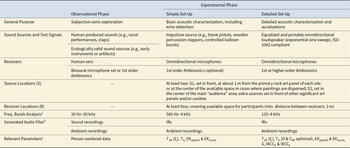
The choice between the two setups depends on the measurement purpose, site characteristics (e.g., morphology, geology, location in the landscape), and available time and equipment. The detailed setup is required for exhaustive acoustic characterization and auralization,Footnote 3 while the simple setup is suitable for echo detection and basic exploration, especially recommended in morphologically complex sites where loudspeaker placement is unfeasible due to rough, irregular terrain or other accessibility constraints. Table 1 gives an overview of the measurement procedures proposed.
Overview of the Methodological Procedure Proposed for the Acoustic Characterization of Open and Semi-open Rock Art Sites.

Table 1 Long description
The table outlines a methodological procedure for acoustic characterization across three phases: an observational phase, an experimental simple set-up, and an experimental detailed set-up. The general purpose shifts from subjective sonic exploration to basic characterization (including echo detection) and then to detailed characterization with auralizations. Sound sources become progressively more controlled: human-made sounds first, then impulsive sources (e.g., clappers or balloon bursts), and finally an equalized portable omnidirectional loudspeaker using an exponential sine sweep compliant with ISO 3382; ecologically valid sources may also be used. Receivers similarly progress from human ears to omnidirectional microphones, with optional binaural or Ambisonics in the simple set-up and 1st or higher order Ambisonics in the detailed set-up. Location guidance appears only in the experimental phases: at least two source positions (including one near the primary panel and one in the audience area) and at least four receiver positions spaced at least 2 m apart to cover participant space. Frequency-band analysis differs by phase, from full-range 20 Hz–20 kHz in observation to mid-band 500 Hz–4 kHz in the simple set-up and broader 125 Hz–8 kHz in the detailed set-up. Outputs expand from recordings to impulse responses plus ambient recordings, and reported parameters increase from person-centered observations to reverberation/clarity-related metrics (e.g., T20, TS, echo criteria) and then additional measures such as strength (G) and interaural cross-correlation (IACC). Some choices (equipment limits, file formats, and parameter definitions) depend on technical constraints and the study’s analysis methods.
a Depends on the technical features and limitations of the electroacoustic equipment use (e.g., the frequency response and directivity of the dodecahedral loudspeaker, the balloon’s type, inflation diameter and prick-off point chosen, etc.).
b Recommended format: uncompressed audio, WAV format at 24-bit, and 48 kHz resolution.
c Section “IR Analysis and Acoustic Parameters” of this manuscript provides a description of these parameters and their application in this context.
Equipment
For the simple setup, a portable explosive or impact device is used as the impulsive sound source. While wooden clappers offer a traditional option, they are less portable, and blank pistols are often prohibited at archaeological sites. For these reasons, large balloons represent an effective, low-cost, and highly portable alternative. Following the recommendations of Pätynen and colleagues (Reference Pätynen, Katz and Lokki2011), balloons should be inflated to approximately 40 cm in diameter (around 119 cm in circumference). For controlled bursts, the balloon should be held overhead and pricked at the bottom with a needle. To improve the reproducibility of results, a minimum of three bursts should be recorded and averaged for each S–R pair. Since the emission level of the bursts cannot be controlled, it is essential to adjust the recorder’s preamp mic gain to ensure an adequate dynamic range for the recordings, preventing any clipping of the loudest sounds while quieter sounds remain above the noise floor.
The use of protective equipment, such as earmuffs or earplugs, is strongly recommended during this procedure. Human-performance impulse sounds, such as striking rocks, clapping hands, or shouting in a vocal burst, introduce performative biases reducing consistency and repeatability (Papadakis and Stavroulakis Reference Papadakis and Stavroulakis2020) and therefore are not adequate for this phase.
For the detailed setup, an electroacoustic sound source compliant with ISO requirements in terms of directivity, frequency response, and emission power is needed (ISO 2009). This involves the use of an omnidirectional loudspeaker, typically dodecahedral, and capable of emitting sufficient power across relevant frequencies. Portability is crucial due to the challenging access to rock art sites, making lightweight, battery-powered equipment ideal. To minimize the influence of the equipment on the measurements, the loudspeaker’s frequency response must be equalized by adjusting its output levels to ensure a flat spectral profile, thereby producing all frequencies at similar levels. The emission level must also be high enough to ensure that the recorded signal maintains an impulse-to-noise ratio (INR) above 45 dB across all relevant frequency bands (Hak et al. Reference Hak, Wenmaekers and van Luxemburg2012), even at the most distant receiver positions, while avoiding distortion at closer ranges. Alternative sound sources can serve specific purposes. The Artsoundscapes project employed an advanced MIMO (Multi Input, Multi Output) loudspeaker array with adjustable directivity, based on Ambisonics principles (Farina and Chiesi Reference Farina and Chiesi2016). This system allows for the emulation of various source directivities, from omnidirectional to human voice or instrument patterns, within a single measurement set. While it offers remarkable flexibility for auralization, its use entails considerable logistical demands, including the transport of heavy equipment, extended measurement times (12 sweeps per IR), and complex post-processing.
Regardless of the sound source employed, a set of monaural IRs are registered with a calibrated omnidirectional microphone (typically ½-inch [12.7 mm] prepolarized condenser microphone) connected to a high-quality audio interface able to offer a minimum quantization sample rate of 44.1 kHz width and 16-bit depth, though 48 kHz at 24-bit is recommended. The omnidirectional IR set is essential for the acoustic characterization based on the ISO-3382 parameters.
In order to gather IRs that also contain spatial (3D) information—required for the detailed setup—multichannel microphone arrays based on Ambisonics decomposition of the sound field are employed (Farina et al. Reference Farina, Martignon, Capra and Fontana2006). The number of capsules in the array determines spatial resolution: higher-order Ambisonics (e.g., third-order with 16+ capsules) enhance 3D sound field representation but also increase processing demands and cost. Thus, the best option depends on measurement goals. First-order Ambisonics IRs suffice for studying the Direction of Arrival (DOA) of sound reflections in this context and for rendering binaural IRs, which quantify spatial perception via Interaural Cross-Correlation (IACC) parameters and enable headphone-compatible auralizations. Higher orders improve immersive loudspeaker-based audio reproduction and binaural rendering accuracy (Bertet et al. Reference Bertet, Daniel, Parizet and Warusfel2013). It is important to note that spatial IRs measured with impulsive sources aid DOA analysis; however, they cannot be equalized or provide sufficient broadband emission power for generating high-quality auralizations, making first-order Ambisonics enough for the simple setup (see Table 1).
Whenever possible, both types of microphone, omnidirectional and Ambisonics, should be used. This might appear redundant, since the Ambisonics microphone’s performance has been validated against the traditional microphone setup described in ISO 3382-1 (Dick and Vigeant Reference Dick and Vigeant2016). However, the omnidirectional microphone serves as a reliable backup, being easily recalibrated and facilitating IR monitoring on-site requiring minimal post-processing.
The final key element in the measurement chain is not hardware but software. A variety of commercial solutions is available that allow for immediate acquisition and visualization of IRs (even allowing for a rapid preliminary analysis), making them ideal for on-site monitoring. Alternatively, custom software solutions offer greater post-processing flexibility.
Besides the main equipment described, items like high-quality balanced audio cables, three-legged tripods resistant to vibrations and adjustable in height, batteries, tape/laser distance measurers, and a high-resolution photo camera are needed. Again, choosing the lightest, most robust options is essential. Additionally, the use of wind shields is always recommended, regardless of the type of microphone, to minimize noise caused by environmental factors. The use of 3D cameras or video cameras is optional but recommended for more detailed documentation of the fieldwork.
Measurement Positions
In room acoustics, the recommended number and locations of the emission and receiver positions depends on the architectural features of each space and its intended uses. However, these criteria are not easily transferable to open and semi-open rock art sites. Located in open-air natural settings, such sites exhibit considerable variability in size, morphology, and landscape context, making it difficult to define standardized S–R configurations, while low ceilings, natural obstacles, and uneven ground further limit equipment placement. Additionally, uncertainty about prehistoric sociocultural practices means a lack of feasible details regarding sound-source types and their positions, the area occupied by the attendees and their number, and other spatial configuration details. These factors led to substantial variation in S–R setups, further constrained by the limited measurement time.
Given the aforementioned challenges, we propose this set of specific guidelines as a starting point to mitigate the subjectivity involved in selecting S–R positions. These guidelines aim to account for the spatial variation of acoustic parameters within each shelter while simultaneously establishing a common criterion to facilitate comparisons among the results obtained at different rock art sites.
• Consider a minimum of two source (S) positions in each rock art site to account for the variation in the acoustic response depending on potential spatial configurations, as in Fazenda and colleagues (Reference Fazenda, Scarre, Till, Jiménez Pasalodos, Guerra, Tejedor and Ontañon Peredo2017). This includes a “reference” sound location (S1) set in front, at about 1 m, from the primary rock art panel, or at the center of the available space in cases where paintings are dispersed. Secondary S positions (progressively numbered) should be set in front of other significant art panels and/or cavities, to explore different usage hypotheses. A secondary S position should always be set in the center of the main “audience” area, to account for the hypothesis of the attendees to be a sound-active part during cultural or social activities.
• Receiver locations should be set strategically to cover the influence area of each S position, meaning the area where people might be located for each spatial distribution hypothesis proposed. At least four listener (R) positions are recommended by site, preferably arranged in asymmetrical pattern, with a minimum distance spacing of 2 m. The maximum distance between R positions required to account for the spatial variability of acoustic behavior of the space depends on the site’s size and morphology (Martellotta et al. Reference Martellotta, Cirillo, Carbonari and Ricciardi2009).
• In particularly small or irregular spaces, where S and R positions are constrained, at least two measurement positions should be considered (provided the minimum distance requirements are met), swapping source and receiver to ensure at least two distinct S–R combinations.
• Both S and R positions should be placed at least 1 m from the reflective surfaces, following the ISO recommendation. In exceptional cases with space limitations, or where a particular acoustic effect needs to be tested, this distance might be reduced (Till Reference Till2019).
• Various S–R distances should be included to explore sites’ acoustic behavior in terms of both intimate/personal and social interactions (Helmer and Chicoine Reference Helmer and Chicoine2013). A minimum S–R distance of 1.5 m should be ensured, following standard recommendations, and always avoid clipping. While a maximum of 20 m is recommended, this may vary, based on such environmental factors as temperature and wind, which can impact the site’s approximation to a Linear Time-Invariant (LTI) system necessary for IR-based characterization (Oppenheim et al. Reference Oppenheim, Willsky and Nawab1997).
• As far as practicable, S and R should be set at the height of 1.5 m, representing standing speakers/listeners. This height should be reduced to 1 m (the ISO 3382-1 minimum recommendation) for a hypothesis involving seated or kneeling individuals. Both the loudspeaker and the microphones must be properly leveled, stabilized, and oriented, facing each other by default.
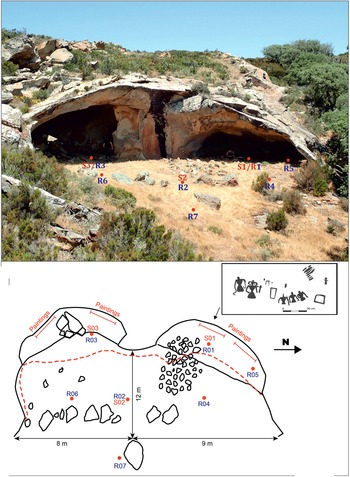
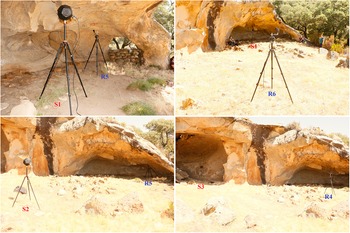
To ensure the reliability of the results obtained and the reproducibility of the measurements, we recommend detailing the S–R positions considered, including a scaled floor plan (or a sketch with main distances) of the site that specifies their locations within the space. Photos taken during the measurement sessions in which each S–R combination can be depicted are also recommended. Figures 1 and 2 show an example. The site must remain unoccupied during the measurements, with technicians, researchers, and their belongings as concealed as possible within the landscape to minimize any influence on the results.
Bottom: sketch of the floor plan of the shelter Mujeres I, located in Medina-Sidonia, Cadiz, Spain. The approximate source (S) and receiver (R) positions used in the survey are marked. Inset: a rock art scene published by Breuil and Burkitt (Reference Breuil and Burkitt1929:Plate XIII) located next to S1/R1. Top: photograph of the shelter with the positions of S and R marked in the picture taken during the measurement campaign. ©Artsoundscapes Project.

Figure 1 Long description
The top part shows a photograph of a rock shelter in a natural landscape with marked positions labeled S1/R1, S2, R2, R3, R4, R5, R6 and R7. The bottom part is a sketch of the shelter's floor plan, indicating the positions of sources and receivers with labels such as S01, R01, S02, R02 and others. The sketch includes a north arrow and scale, with the shelter's dimensions marked as 8 meters and 9 meters. An inset shows additional details of the site layout.
Pictures taken during the measurement session at Mujeres I with the equipment positioned for different acoustic tests.

Figure 2 Long description
Top left photograph: A tripod stands on sandy ground in front of a rock overhang. A round device is mounted at the top of the tripod. Text on the ground reads S1 and R6. Top right photograph: A tripod stands on sandy ground in front of a rock overhang. Text on the ground reads R6. A human figure stands near the right edge of the frame. Bottom left photograph: A tripod stands on sandy ground in front of a rock overhang. Text on the ground reads S2 and R5. Bottom right photograph: A tripod stands on sandy ground in front of a rock overhang with a dark opening. Text on the ground reads S2 and R4.
Monitoring Environmental Conditions
Environmental conditions to be monitored during fieldwork include ambient temperature and relative humidity, average wind speed and direction (including gusts), and background noise levels. Background noise should be recorded for at least two minutes using a type 1 or 2 sound level meter, with measurement time adjusted based on site variability. It is recommended to record these conditions at one of the R positions used for the IR measurements, before and immediately after the measurements related to each spatial configuration hypothesis. Background noise levels should be sufficiently low (ideally below 30 dB) and wind speeds kept under 3 m/s to ensure reliable measurements. Additionally, always verify the proper functioning of the equipment under extreme temperature and humidity conditions.
Analysis and Reporting
IR Analysis and Acoustic Parameters
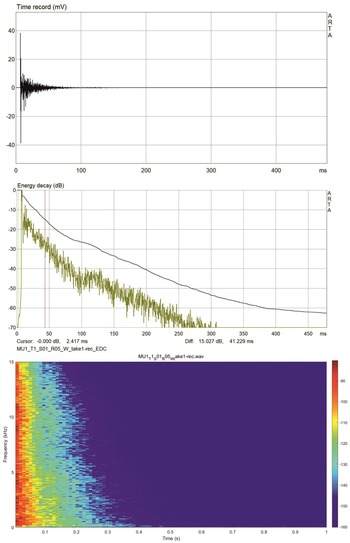
As rock art sites typically exhibit nondiffuse field conditions, IRs must be carefully inspected before deriving acoustic parameters. We recommend analyzing them over time to identify potential echoes and significant reflections, as well as the temporal evolution across frequencies. Figure 3 illustrates an example of the three main IR visualizations: waveform, its Energy Decay and Early Decay Curve (EDC) from which reverberation parameters are estimated, and its spectrogram.
Example of one of the omnidirectional impulse responses measured in Mujeres I, at the S01-R05 combination, represented both in time (sound wave and early decay curve) and frequency domains (spectrogram).

Figure 3 Long description
The image A showing a line plot labeled “Time record (mV)”. The horizontal axis is labeled “ms” and runs from 0 to 450. The vertical axis shows tick labels 40, 20, 0, minus 20, minus 40. A waveform with large oscillations appears near 0 milliseconds and decays toward the 0 line by about 100 milliseconds. The word “ARTA” appears at the top right. The image B showing a line plot labeled “Energy decay (dB)”. The horizontal axis is labeled “ms” and runs from 0 to 450. The vertical axis shows tick labels 0, minus 10, minus 20, minus 30, minus 40, minus 50, minus 60, minus 70. Two curves are shown: a jagged curve that drops from near 0 decibel at the start to near minus 70 decibel by about 300 milliseconds and a smoother curve that declines from near 0 decibel to around minus 60 decibel by about 450 milliseconds. Several thin vertical marker lines appear near the left side of the plot. Text below the plot includes “Cursor: 0.000 dB, 24.17 ms”, “Oct 15 2017 08:41 21.829 ms” and “M1I1p105wavrec.wav”. The word “ARTA” appears at the top right. The image C showing a spectrogram. The horizontal axis is labeled “Time (s)” and runs from 0 to 1. The vertical axis is labeled “Frequency (kHz)” and runs from 0 to 15. A vertical color scale bar appears on the right with tick labels 0, minus 40, minus 80, minus 120, minus 160. The spectrogram shows stronger intensity near time 0 across a wide frequency range, fading by about 0.3 seconds, with the remainder of the plot mostly uniform. Text above the spectrogram includes “M1I1p105wavrec.wav”.
Based on our experience with rock art sites and the existing literature on the acoustic analysis of outdoor places (Paini et al. Reference Paini, Gade and Rindel2011), and the likelihood that prehistoric societies produced sounds both through vocal expression and musical instruments and artifacts (Morley Reference Morley2013), we recommend considering the following metrics:
• reverberation time, T 20, for the assessment of reverberation. Reliable results can be obtained, provided that the EDC is not contaminated by background noise (INR ≥ 35 dB) and sufficiently linear for an accurate estimation of T 20 (the nonlinearity parameter, ξ, remains under 10‰ [ISO 2008]).
• echo criterion, EKspeech, and EKmusic, according to Dietsch and Kraak (Reference Dietsch and Kraak1986), for an objective assessment of the perception of (annoying) late reflections (echo).
• center time, T S, for a measure of sound clarity and as an indicator of late reflections and echoes. Speech definition, D, and music clarity, C 80, parameters might optionally be assessed.
• sound strength, G, to account for the subjective level of loudness. It is recommended to report G values as a function of the S–R distance, for their assessment in relation to the expected value according to theoretical free-field propagation. Due to the calibration required for its calculation (see ISO 3382-1), its estimation is inherently untrustworthy when using impulsive sources. Even if calculated with in situ calibration (Katz Reference Katz2015), it should be interpreted with caution, and only as approximated.
• Interaural cross-correlation coefficients, IACCE and IACCL, for assessing the feeling of spaciousness, due to the potential correlation between the value 1-IACCE and Auditory Source Width, and between the value 1-IACCL and Listener Envelopment (Hidaka et al. Reference Hidaka, Beranek and Okano1995; Okano et al. Reference Okano, Leo and Hidaka1998).
The physical characteristics of rock art sites might cause considerable spatial and frequency variability in their acoustic behavior. Therefore, we recommend studying the value of these parameters over the widest possible frequency range, limited by the technical features of the measurement equipment. Considering the typical operating range of commercial solutions, it commonly means from 500 Hz to 4 kHz and from 125 Hz to 8 kHz octave frequency bands for the simple and the detailed setup, respectively. Spatial variability of acoustic metrics must be evaluated before providing spatial averages, even for T 20 (since diffuse field conditions are not present), as spatial homogeneity cannot be assured in such irregular sites. The same applies to frequency averaging, and using ISO averagesFootnote 4 is recommended only when no significant acoustic effects are observed in frequency bands excluded from the spectral averages.
Considerations for the Evaluation of Objective Values
At present, there are no subjective studies that define the optimal or desired values of acoustic parameters for rock art sites. Therefore, the information we can extract from the results is quantitative; for example, a reverberation time below 0.5 seconds indicates lack of reverberation, which is favorable for speech transmission; or low values of IACC parameters suggest that listeners perceive the source as wide and experience a great sense of being surrounded by sound; and so on. However, moving to a more qualitative analysis requires that these quantitative results be evaluated from ethnoarchaeological and ontological perspectives, enabling the interpretation of acoustic data within cultural and experiential contexts.
Other aspects to consider when interpreting the results and assessing their significance are the environmental conditions during measurement and morphological alterations over time due to natural or anthropogenic causes, including, for example, erosion caused by environmental factors and modern fences or structures built for protection or accessibility.
Reporting
An acoustic report should be prepared summarizing at least the following:
Section 1. General information. 1. Rock art site name and location; 2. Description of significant alterations to the space of natural or anthropogenic origin; 3. Name of the person(s) conducting the study; 4. Date and time; 5. Environmental conditions, including background noise levels (Leq, Equivalent Continuous Sound Level); and 6. Graphical material.
Section 2. Sonic exploration. 1. Description of the sonic environment and ambient sounds; 2. Types of source and performance description; 3. Emission and receiver points’ locations tested—identifying those relevant to phase two and their justification; 4. Subjective impressions with different ecologically valid sources; 5. Recording devices; and 6. Graphical material.
Section 3. Experimental acoustic measurements. 1. Measurement procedure chosen; 2. Acoustic instrumentation and date of last calibration (including the entire measurement chain); 3. Emission and receiver points’ locations, including S–R distances; 4. IR waveforms and spectrograms for relevant positions; 5. Signal-to-noise ratios for quality assessment; 6. Acoustic parameters’ values and graphs, including energy decays and linear parameters to validate reverberation calculation; and 7. Graphical material.
Datasets. 1. Ambient recordings; 2. Sonic exploration recordings; and 3. IRs in different formats. Making datasets publicly available so that they can be reused and serve as support for published results is recommended.
Conclusions
This article has concisely detailed how to tackle the challenges of conducting a comprehensive archaeoacoustic study of open and semi-open rock art sites. We have provided guidelines to enhance repeatability and reproducibility of the experimental procedure while ensuring rigorous and comparable results across different case studies. Key aspects of the proposed protocol include standardizing S–R placement and proposing two setups with suitable hardware, highlighting the use of Ambisonics technology to take a step forward in aural heritage preservation. In general terms, this two-phase approach is applicable to other outdoor archaeological sites that had functioned as performative or gathering spaces, where contextualizing the study within the past always represents a challenge. However, the specific recommendations designed for rock art sites—such as the positioning of sources and receivers or the selection of parameters for analysis—should be adapted according to the particular characteristics of each site.
When interpreted from ethnoarchaeological and ontological perspectives, the empirical evidence of sound dynamics and the objective acoustic data obtained through this protocol help in understanding whether prehistoric people were aware of the acoustics surrounding them while also supporting—or challenging—the hypothesis that acoustics had an impact on their interactions with the sites. Moreover, acoustic data, together with the recordings and auralizations generated from the collected IRs, can significantly contribute to a holistic study of an archaeological site. In other words, by integrating acoustic information with other lines of archaeological and contextual evidence, it becomes possible to enrich our understanding of how rock art sites may have been experienced, used, and perceived in the past.
Acknowledgments
We are grateful for the permits issued by the many public administrations where we have undertaken our research. Fieldwork in Cádiz, illustrated in Figures 1 and 2, was undertaken with permission from the Cultural Goods Service, of the Consejería de Cultura y Patrimonio Histórico (Department of Culture and Historical Heritage) of the Junta de Andalucía (Autonomous Government of Andalusia) (permit 202199900646587—05/04/2021). We are also grateful to the landowners who allowed us access to the sites. We would like to express our most sincere gratitude to all our archaeological colleagues, guides, and collaborators who gave us their support during the various fieldwork campaigns. Last but not least, we extend our deepest gratitude to all our colleagues of the Artsoundscapes project, whose work and dedication made this study possible.
Author contributions
Conceptualization, Methodology, Investigation, and Resources: LAM, NSR, and MDA; Data Curation, LAM; Writing—Original Draft Preparation, LAM; Writing—Review and Editing, LAM, NSR, and MDA; Visualization, LAM; Project Administration and Funding Acquisition, MDA.
Funding Statement
This work was supported by the European Research Council (ERC) under the European Union’s Horizon 2020 research and innovation program, under Grant Agreement No. 787842, corresponding to the Advanced ERC Artsoundscapes project (Principal Investigator: ICREA Research Professor Margarita Díaz-Andreu).
Data Availability Statement
The datasets derived from the Artsoundscapes project (https://www.ub.edu/artsoundscapes/) are available open access in the institutional research data repository of the University of Barcelona at https://dataverse.csuc.cat/dataverse/artsoundscapes and in the EU Open Research Repository-Zenodo, DOI 10.5281/zenodo.15821382 and others.
Competing Interests
The authors declare no conflict of interest or competing interests.

 Open access

