




Introduction
Personal values and environmental education (EE) play a pivotal role in shaping environmental attitudes. Personal values occupy a significant place within individuals’ social psychology and influence many of our activities, including environmental actions (Hitlin & Piliavin, Reference Hitlin and Piliavin2004). Integrating values into EE curricula significantly enhances students’ environmental awareness (Alas & Korutürk, Reference Alas and Korutürk2024). Triyandana et al. (Reference Triyandana, Ibrohim, Yanuwiyadi, Amin and Hajar2024) show that incorporating EE in Business education also significantly improves students’ environmental awareness. Prior research suggests that values are central predictors of environmental attitudes and behaviours (Cirnu & Kuralt, Reference Cirnu and Kuralt2013; Papagiannakis & Lioukas, Reference Papagiannakis and Lioukas2012), a relationship reinforced by the value–belief–norm (VBN) theory (Stern, Reference Stern2000), which posits that values shape environmental worldviews and, through attitude formation, influence behavioural intentions.
EE further strengthens this value–attitude–behaviour chain by fostering ecological literacy, moral responsibility and pro-environmental value orientations (Steg et al., Reference Steg, Dreijerink and Abrahamse2005). EE has evolved from a narrow focus on ecological knowledge toward a holistic, values-driven and culturally responsive approach aimed at fostering environmental responsibility(ER). Global frameworks such as UNESCO’s Education for Sustainable Development (ESD) emphasise that EE must cultivate not only knowledge but also the values, attitudes and competencies required for informed and ethical environmental decision-making. Current EE scholarship highlights its role in shaping long-term pro-environmental commitments among business students (Albareda-Tiana et al., Reference Albareda-Tiana, Azcárate Goded, Muñoz-Rodríguez, Valderrama Hernández and Ruiz-Morales2019; UNESCO, 2021). Studies of MBA curricula reveal that sustainability concepts are often peripheral, appearing primarily as electives rather than core components (Muposhi & Shamhuyenhanzva, Reference Muposhi and Shamhuyenhanzva2024). EE efforts embedded in business curricula help future managers (MBA students) understand the ethical and social implications of corporate environmental practices, ultimately shaping their pro-environmental value systems and their sense of responsibility (Fukukawa et al., Reference Fukukawa, Shafer and Lee2007).
Culture also plays an essential role in shaping individual value priorities and environmental attitudes. Studies continue to affirm that cultural frameworks influence personal values, which subsequently inform attitudes toward environmental commitments (Halkos & Skouloudis, Reference Halkos and Skouloudis2016; Stern et al., Reference Stern, Dietz, Kalof and Guagnano1995; Trejos, Reference Trejos2023). National culture, therefore, is a critical contextual factor that shapes how individuals perceive their environmental responsibilities (Sagiv et al., Reference Sagiv, Sverdlik and Schwartz2011). For instance, the prioritisation of self-transcendence or self-enhancement values is shown to vary across cultural clusters, influencing how individuals interpret environmental problems and responsibilities (Roccas & Sagiv, Reference Roccas and Sagiv2010). Studies also indicate that cultural dimensions – such as individualism and collectivism – affect corporate environmental practices and individual-level support for environmental action (Graafland & Noorderhaven, Reference Graafland and Noorderhaven2018; Miska et al., Reference Miska, Szőcs and Schiffinger2018). Similarly, Bivek (Reference Bivek2023) argues that value-based EE rooted in cultural heritage can transform mindsets and lifestyles to instil sustainability as a core societal value. Prior studies (Li et al., Reference Li, Yang and Liu2024; Rouhiainen, Reference Rouhiainen2023) reveal that EE must move beyond universalist models to embrace cultural diversity and personal value systems, fostering a more inclusive and context-sensitive pedagogy. Despite these insights, cross-cultural investigations comparing distinct cultural contexts remain limited, with much of the prior work focusing on Western societies (Cordano et al., Reference Cordano, Welcomer, Scherer and Pradenas2011; Lan et al., Reference Lan, Gowing, Rieger, McMahon and King2010), neglecting the Asia-Pacific region (Benson et al., Reference Benson, Clarkson, Smith and Tutticci2015).
Despite this, the literature indicates inconsistent evidence regarding the extent to which values and attitudes translate into actual environmental behavioural intentions, signalling a need for continued examination within culturally diverse contexts. Moreover, prior studies in this domain mainly focus on the USA and Canada, which are culturally similar and ignore other parts of the world, the Asia Pacific regional cultural context (Benson et al., Reference Benson, Clarkson, Smith and Tutticci2015).
This paper addresses these gaps by situating EE within MBA programmes and examining how personal values and culture shape MBA students’ ER across different contexts. The paper aims to explore how MBA students from different cultural contexts perceive ER, and what values underpin these perceptions. It explores whether cultural differences between an individualist context (Australia) and a collectivist context (India) shape (i) the personal value priorities of MBA students and (ii) the relationship between personal values and ER. This research also considers the influence of EE embedded within MBA curricula, which has been shown to affect students’ ethical reasoning, sustainability awareness and attitudes toward ER (Krishnan, Reference Krishnan2008).
The study is distinctive because it bridges EE and business education (MBA), which is rare in the literature. Moreover, it foregrounds personal values and cross-cultural comparisons, examining how personal and societal value systems shape ER among MBA students in different regions. Personal values differ conceptually and empirically from broad cultural values (Roccas & Sagiv, Reference Roccas and Sagiv2010). Recent scholarship also emphasises the importance of distinguishing personal from cultural value systems when analysing environmental attitudes across nations (de Groot & Thøgersen, Reference de Groot, Thøgersen, Steg and de Groot2020). By examining personal values within different cultural contexts, the study contributes to understanding how cultural structures interact with value priorities to shape environmental attitudes.
The study is also essential because it compares individualist and collectivist cultures that also share some common historical, legal and political heritage, which is scant in the literature. Being members of the Commonwealth, Australia and India share a heritage of English common law and political similarities. Australia and India have similar cultural heritage (through British colonialism), but their cultures differ in several respects (individualist versus collectivist). Comparing these two national contexts offers unique insight into how culturally grounded value systems manifest within managerial education. Australia–India comparisons have attracted renewed academic interest amid expanding Indo-Pacific economic collaboration and shared sustainability agendas (DFAT, 2023). The integration of sustainability-focused EE within business programmes further underscores the importance of investigating how value formation and ER interact within future managerial cohorts. Furthermore, it is essential to study MBA students because most of them will work (or are working) as managers, and their collective and individual environmental activities will significantly influence their companies’ future environmental orientation. This study builds on the author’s (Reference Bhattacharyya2016) prior work and extends the literature by incorporating cultural context and EE perspectives into the values–ER relationship.
The study’s results will be beneficial to companies seeking to uphold and advance their corporate ER. Along with other selection criteria suggested by Hind et al. (Reference Hind, Wilson and Lenssen2007), the results will be very helpful in selecting the appropriate leader, which is the key to greater environmental performance because a pro-environmental leader motivates other colleagues to be accountable towards the environment (Appelbaum et al., Reference Appelbaum, Iaconi and Matousek2007).
Theoretical framework and hypotheses
Personal values
Personal values can be defined as “desirable trans-situational goals, varying in importance, that serve as guiding principles in the life of a person or other social entity” (Schwartz, Reference Schwartz1994, p 21). Rokeach (Reference Rokeach1973) also describes values as standards that guide actions and help us judge ourselves and others. Many definitions of value (e.g., Rokeach, 1973; Schwartz, Reference Schwartz1994) may be available, but recent interdisciplinary work continues to validate Schwartz’s value theory as the most robust framework (Vecchione et al., Reference Vecchione2023). Schwartz’s (Reference Schwartz1994) value theory defines ten broad value types based on their motivational goals. Schwartz (Reference Schwartz1994) also distinguished four higher-order value types, such as self-transcendence versus self-enhancement and openness to change versus conservatism. We adopted personal values from Schwartz’s (Reference Schwartz1994) Value theory, as the integration of basic value types into a broader value system, is one of the most interesting features of this theory (Kulin & Svallfors, Reference Kulin and Svallfors2013).
Cultural orientations and personal values
Culture refers to the sharing of ideas, values and behavioural expectations that regulate the societal context in which individuals’ values and behavioural intentions operate (Fisher, Reference Fisher2009). Hofstede et al. (Reference Hofstede, Hofstede and Minkov2010) notes that although a culture is composed of shared values and norms, significant differences persist between cultures. Individuals from various cultures differ in the extent to which they utilise their internal traits to guide their attitudes and behavioural intentions (Roccas & Sagiv, Reference Roccas and Sagiv2010, p. 30). Therefore, the power of the association among values, attitudes and other factors differs between different cultures.
Culture also affects the personal values-attitudes relationship by determining the meaning of attitudes and behaviour. Similar attitudes and behaviour may have dissimilar meanings in diverse cultures. A particular society prompts its people to follow its cultural values (i.e., broad goals), which subsequently help them differentiate themselves from other societies (Hofstede Reference Hofstede2001; Inglehart, Reference Inglehart1997).
However, “this does not mean that individuals and cultures do not differ in their values – they differ substantially,” argued Roccas and Sagiv (Reference Roccas and Sagiv2010). They also acknowledge that people vary in prioritising values for themselves and hence differ in the attitudinal consequences of validating their values. Current cross-cultural research also confirms that cultural orientations shape climate risk perceptions. Therefore, societies do vary based on the relative importance attributed to each value by their members. For example, benevolence and universalism values are given greater significance, while power is given less importance, by individuals in Western European countries compared to people in other countries. On the other hand, people in East Asian countries tend to place more emphasis on tradition and conformity than those in different societies (Schwartz & Bardi, Reference Schwartz and Bardi2001). Public expression of an individual’s opinion is valued more by English-speaking and Western European societies than by East Asian societies (Kim & Sherman, Reference Kim and Sherman2007).
Prior literature reported considerable differences in the value priorities of individuals in different cultural societies (Inglehart & Baker, Reference Inglehart and Baker2000; Roccas & Sagiv, Reference Roccas and Sagiv2010; Schwartz & Bardi, 2001). There is no consistent agreement about the value priorities in the literature. Fukukawa et al. (Reference Fukukawa, Shafer and Lee2007) and Lan et al. (Reference Lan, Gowing, Rieger, McMahon and King2010) report a low rank for universal value, whereas the author (2016) reports a high rank for universal value. “Tradition” values are ranked very poorly in the studies of Fukukawa et al. (Reference Fukukawa, Shafer and Lee2007) and Lan et al. (Reference Lan, Gowing, Rieger, McMahon and King2010), but the author (2016) reports moderately high ranks for these values. Values emphasising tradition correlate positively with national culture in Brazil (Gouveia et al., Reference Gouveia, Clemente and Vidal2002) in the USA (Roccas et al., Reference Roccas, Schwartz and Amit2018), but did not relate to Australian culture (Feather, Reference Feather1994).
Hofstede (Reference Hofstede, Hofstede and Minkov2010) stress that cultural classification of individualism and collectivism also affects personal values. A focus on the self, with an emphasis on emotional independence, is emphasised in individualism (Hofstede et al., Reference Hofstede, Hofstede and Minkov2010). Therefore, as a developed individualistic country, Australia will likely embrace post-materialist values, such as self-expression, quality of life and concern for the environment. Consequently, it is expected that Australian MBA students will embrace the self-transcendence value type, which comprises benevolence and universalism. Moreover, Schwartz and Bardi (2001) find that individuals in Western European countries place greater importance on the self-transcendence value type than people in other countries. Australian culture, social expectations and economic development are like those of Western European countries. Therefore, the study argues that Australians will also place greater importance on self-transcendence value types. Based on the discussion and apparent differences of Australian and Indian culture, the study hypothesises the following-
H1a: Self-transcendence values are more important to Australian MBA students than Indian MBA students.
In contrast, tradition and self-enhancement are likely to be more supported by Indians, who are likely to be concerned with their personal economic self-interest (Inglehart & Baker, Reference Inglehart and Baker2000). Hofstede (Reference Hofstede1983) suggests that, as a collectivist society, India will prioritise group goals over individual goals and place greater emphasis on sharing, duties and obligations. Based on the discussion and apparent differences of Australian and Indian culture, the study hypothesises the following:
H1b: Self-enhancement values are more important to Indian MBA students than Australian MBA students.
H1c: Traditional values are more important to Indian MBA students than Australian MBA students.
Personal values and attitudes towards environmental responsibility
Values extend beyond specific objects and situations, whereas an attitude unequivocally refers to a particular object (Fishbein & Ajzen, Reference Fishbein and Ajzen1975). Therefore, values occupy a more vital role within individual personality than attitudes (Hitlin & Piliavin, Reference Hitlin and Piliavin2004). Personal values serve as the controller and determinant of social attitudes, beliefs and activities. A Small number of values determines an individual’s many attitudes. Personal values influence individuals’ beliefs, attitudes and preferences associated with their social and environmental activities, as well as their inclination to prioritise environmental safety (Stern & Dietz, Reference Stern and Dietz1994).
The study predicts 3 hypotheses, excluding “Openness” value type as existing literature does not report any differences across cultures (Fukukawa et al., Reference Fukukawa, Shafer and Lee2007; Stern & Dietz, Reference Stern and Dietz1994). Prior literature reports that self-transcendence values are positively related to ER (Stern & Dietz, Reference Stern and Dietz1994; Stern et al., Reference Stern, Dietz, Kalof and Guagnano1995). Previous studies report a significant positive association between self-transcendence and attitudes towards ER (Davidov et al., 2008; Fukukawa et al., Reference Fukukawa, Shafer and Lee2007; Papagiannakis & Lioukas, Reference Papagiannakis and Lioukas2012; Schultz & Zelezny, Reference Schultz and Zelezny1999; Schultz, Reference Schultz2001). Additionally, culture affects corporate environmental practices (Miska et al.,Reference Miska, Szőcs and Schiffinger2018). Husted (2005) argued that high individualism should correlate with a high level of concern for the environment. He also recommends that economically poorer countries are less likely to invest in environmental enforcement. Hanson-Rasmussen and Lauver (Reference Hanson-Rasmussen and Lauver2018) argued that Indian culture is not conducive to positive ER. Australia, an individualist country, is economically developed than collectivist India. Therefore, the study proposes that:
H2a: The association between self-transcendence value type and attitudes towards ER of Australian MBA students will be positive and stronger than that of Indian MBA students.
Research suggests that people with a high self-enhancement value type will be less inclined to place importance on environmental matters and less motivated to act relating to ER (Davidov et al., Reference Davidov, Meuleman, Billiet and Schmidt2008; Gatersleben et al., Reference Gatersleben, White, Abrahamse and Jackson2022; Papagiannakis & Lioukas, Reference Papagiannakis and Lioukas2012). Prior studies predominantly report negative associations of self-enhancement value types with environmental concern (Schultz Reference Schultz2001; Wong et al., Reference Wong, Curtis and O’Brien2022). By investigating the consequences of power and achievement, Schultz and Zelezny (Reference Schultz and Zelezny1999) report a significant positive association between power and no association between achievement and environmental attitude. However, other studies found no association of self-enhancement value type with ER (Fukukawa et al., Reference Fukukawa, Shafer and Lee2007; Papagiannakis & Lioukas, Reference Papagiannakis and Lioukas2012). Therefore, the relationship remains inconclusive. The study likes to argue that Indian MBA students probably place more importance on self-enhancement value types and may be less inclined to place importance on ER, as individuals from a collective society are likely to be concerned with their economic self-interest (Inglehart & Baker, Reference Inglehart and Baker2000). Based on the above discussion, the study hypothesises that
H2b: The association between self-enhancement value type and attitudes towards ER of Indian MBA students will be negative and stronger than that of Australian MBA students.
Traditional value types reflect the preservation of group unity, such as conformity, family security, collective safety and self-discipline (Sosik, Reference Sosik2005). It is less likely that an individual with a strong traditional value construct will uphold ER. Prior research found that individuals with strong traditional value constructs are unlikely to take environmental matters seriously (Kilbourne et al., Reference Kilbourne, Beckmann and Thelen2002; Prati et al., Reference Prati, Pietrantoni and Albanesi2018). Prior studies reported mostly negative associations between traditional value types and altruistic and biospheric environmental attitudes (Schultz, Reference Schultz2001; Schultz & Zelezny, Reference Schultz and Zelezny1999; Stern et al., Reference Stern, Dietz, Kalof and Guagnano1995). However, Fukukawa et al. (Reference Fukukawa, Shafer and Lee2007) report a positive association of traditional value type with ER. Therefore, Indian MBA students, being from a collectivist society, are more likely to support traditional values (Inglehart & Baker, Reference Inglehart and Baker2000). Based on the interpretation and findings of prior research, coupled with value theory, the study predicts the following hypothesis.
H2c: The association between traditional value types and attitudes towards ER of Indian MBA students will be negative and stronger than that of Australian MBA students.
Research methods
The study uses a paper-based survey questionnaire. Paper-based surveys remain acceptable in cross-national studies where equivalence and response clarity must be ensured. To avoid standard method variance, we employ various approaches, such as minimising ambiguities in the survey items. To address common method bias (CMB), the study employs Harman’s single-factor test, following the literature (e.g., Aguirre-Urreta & Hu, Reference Aguirre-Urreta and Hu2020; Podsakoff et al., Reference Podsakoff, MacKenzie, Lee and Podsakoff2003). The CMB test indicated 34.05% as the highest amount of variance explained by a single factor. This suggests that the validity of our findings is not affected by CMB.
Measures
The measures of attitudes towards ER are adapted from literature (Bhattacharyya & Rahman, Reference Bhattacharyya and Rahman2021; Fukazawa et al., Reference Fukukawa, Shafer and Lee2007). The study uses a 5-point Likert Scale and adapts Schwartz’s (Reference Schwartz1994) 10 value measures, which are widely used in literature (Bilsky et al., Reference Bilsky and Schwartz2011).
The data
The study uses a sample size of 464, comprising 330 individuals from the Indian Institute of Management(IIM) in Kolkata, India and 134 from the University of Newcastle, Australia. The information is collected from MBA students from India and Australia. The English language ability and quality of IIM students are consistent with Newcastle University students, which eliminates the possible bias in understanding the questionnaire by both Australian and Indian participants. A total of 675 questionnaires (425 in India and 250 in Australia) were distributed. Survey questionnaires are distributed to students inside the lecture theatre before the start of class. Participants are requested to return the survey by dropping the completed survey questionnaire into a sealed container located outside the lecture room as they exit. 476 completed instruments were received out of 675 distributed questionnaires (the response rate was 75% in India and 66% in Australia). Twelve out of 476 are incomplete and excluded. The majority (73%) of respondents are in the 23–34 age group, and the remaining 27% are in the 35–44 age group. The majority (68%) of Indian respondents are male. Out of the total sample, most respondents (78%) have completed undergraduate studies, and 19% have completed a postgraduate degree before enrolling in their MBA. Fifty-six are recent graduates without work experience, and the remaining have previous work experience. All Indian respondents are Indian nationals. Only Australian nationals in the Australian data are used for comparison.
Model and analysis
A descriptive analysis of respondents’ responses to ER scale items is undertaken in the first step. To identify the number of factors that underlie ER, factor analysis with principal component extraction, varimax rotation and Kaiser Normalisation is undertaken in the second step. A Cronbach’s Alpha test is conducted to assess the reliability of the items. In addition, several diagnostic tests, such as Bartlett’s test of sphericity and the Kaiser-Meyer-Olkin (KMO) measure of sampling adequacy, are also performed to determine the factorability of the matrix before commencing the analysis, ensuring valid conclusions. KMO is 0.863 and 0.913 (P = 0.00) for Australian and Indian data, respectively.
To test the hypotheses, we develop a model using Multivariate Least Squares (MLS), following prior research (author et al., 2021; Cordano et al., Reference Cordano, Welcomer, Scherer and Pradenas2011; Fallan & Opstad, Reference Fallan and Opstad2014). Scores for the ER serve as the dependent variable, while the mean scores of the value dimension are used as the explanatory variable in the model. The model also incorporates additional variables (age, gender and work experience) for statistical control. The primary model is specified as follows:
 $$\eqalign{\!\!\!\!\!\!\!\! {\rm{ER}} = \ & {\rm {\rm{\beta}} _0} + {\rm{\beta} _{{\rm{i}}1}}\left( {{\rm{UNIV}}} \right) + {\rm{\beta} _{{\rm{i}}2}}\left( {{\rm{BENE}}} \right) + {\rm{\beta} _{{\rm{i}}3}}\left( {{\rm{ACHI}}} \right) + {\rm{\beta} _{{\rm{i}}4}}\left( {{\rm{POWE}}} \right) + {\rm{\beta} _{{\rm{i}}5}}\left( {{\rm{TRAD}}} \right) + {\rm{\beta} _{{\rm{i}}6}}\left( {{\rm{CONF}}} \right) \cr & + {\rm{\beta} _{{\rm{i}}7}}\left( {{\rm{SECU}}} \right) + {\rm{\beta} _{{\rm{i}}8}}\left( {{\rm{GENDER}}} \right) + {\rm{\beta} _{{\rm{i}}9}}\left( {{\rm{AGE}}} \right) + {\rm{\beta} _{{\rm{i}}10}}\left( {{\rm{\hbox {WOR-EXP}}}} \right) + \rm{\varepsilon} }\!\!\!\!\! $$
Where, ER = Environmental responsibility; UNIV = Universalism; BENE = Benevolence; ACHI = Achievement; POWE = Power; TRAD = Tradition; CONF = Conformity; SECU = Security; WOR-EXP = Work experiences.
Results
Value priorities of Australian and Indian respondents
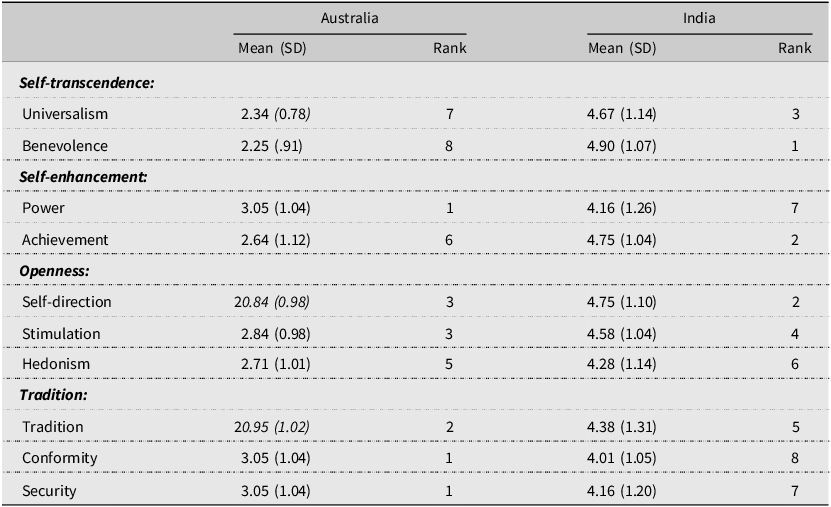
The mean response and ranking of the ten value types of the respondents of both groups are reported in Table 1. The three highly ranked values of Indian respondents are achievement, benevolence and self-direction. Universalism is also highly rated by Indian participants. However, Australian respondents surprisingly rate universalism, benevolence and achievement as the three lowest-rated values, thus not supporting Hypothesis 1a that self-transcendence values are more important to Australian participants than Indian participants. Power, conformity, security and tradition are ranked highly by Australian respondents, but Indian respondents rate them very low. Power and tradition are the two least essential values for Indian respondents. The rating of conformity and security value types indicates that traditional value types are less critical to Indian participants than those of Australian participants; therefore, H1C is rejected. Although achievement is one of the highest-rated values for Indian respondents, power is not appraised highly by them; thus, H1b, that self-enhancement values are more important to Indian MBA participants than Australian MBA participants, is partially supported.
Rank of value types

Table 1 Long description
The table presents a comparison of value types between Australia and India, showing mean scores and ranks. It includes categories such as self-transcendence, self-enhancement, openness, and tradition. For Australia, the mean scores and ranks are provided for values like universalism, benevolence, power, achievement, self-direction, stimulation, hedonism, tradition, conformity, and security. Similarly, for India, the mean scores and ranks are listed for the same values. Notable trends include high ranks for power, conformity, security, and tradition among Australian respondents, while Indian respondents rank achievement, benevolence, and self-direction highly. Universalism and benevolence are rated lower by Australians compared to Indians. The table highlights cultural differences in value prioritization between the two countries.
India (n = 330), Australia (n = 134). All responses were provided on a five-point scale.
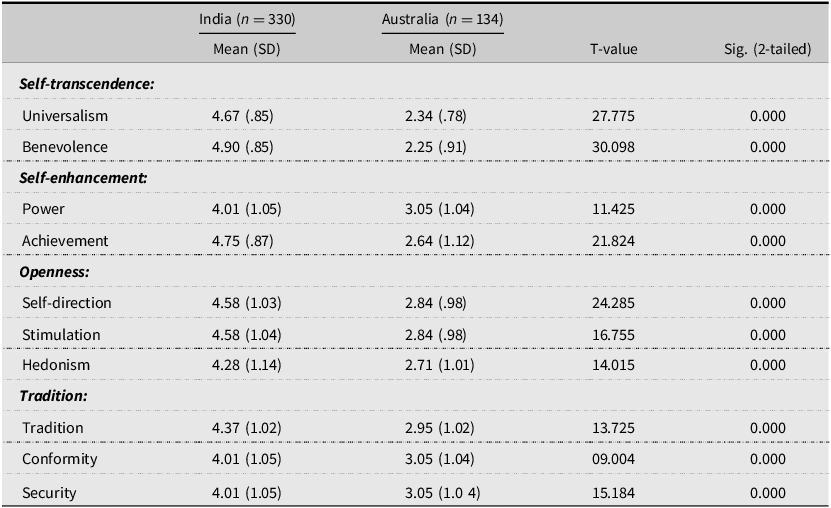
The relative value ratings of Australian respondents differ significantly from those of Indian respondents, as shown in Table 2.
Comparison of value types: T-test result of values

Table 2 Long description
The table compares value types between India and Australia, focusing on self-transcendence, self-enhancement, openness, and tradition. It includes mean values, standard deviations, T-values, and significance levels for each category. India shows higher mean values across all categories compared to Australia. Notable differences include universalism, benevolence, power, achievement, self-direction, stimulation, hedonism, tradition, conformity, and security. Each category has a corresponding T-value and significance level, indicating the statistical difference between the two countries.
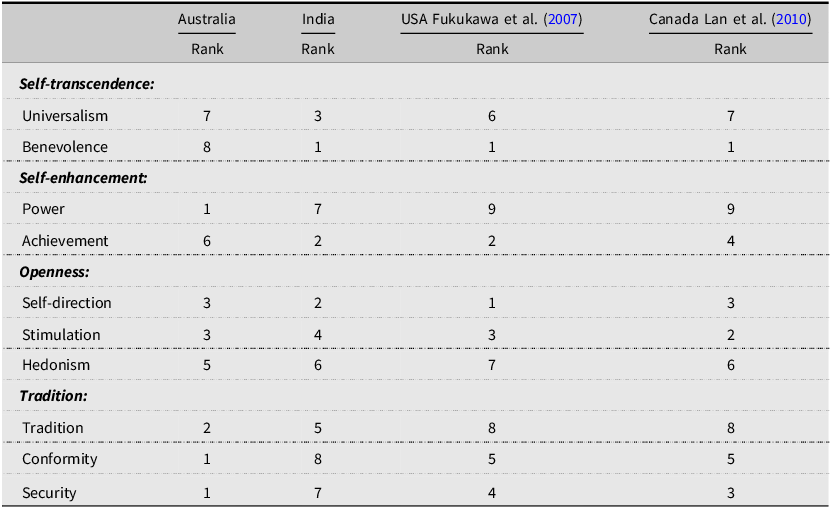
The ranking comparison of Australian and Indian participants is provided in Table 3. The comparison indicated some unexpected results. Indian respondents rank universalism as their third most valued value, whereas Australian respondents rate it as the sixth most valued value type. Benevolence rates as number one among the ten value types by the Indian respondents of the current study.
Comparison of the ranking of values

Table 3 Long description
The table presents a comparison of value rankings across four countries: Australia, India, USA, and Canada. It is divided into categories such as Self-transcendence, Self-enhancement, Openness, and Tradition. Each category lists specific values like Universalism, Benevolence, Power, Achievement, Self-direction, Stimulation, Hedonism, Tradition, Conformity, and Security. The table has four columns representing the rankings from each country. Notable trends include India ranking Benevolence highest, while Australia ranks Power highest. The USA and Canada show similar patterns in some values but differ in others, such as Universalism and Tradition.
Australian respondents, on the other hand, rank power, security and conformity equally. They also rank self-direction and tradition as the other two top-ranked values. Surprisingly, they rate achievement lowest. Australian respondents rank self-direction highly, but they rate benevolence low. The lower ranking of benevolence value indicates that Australian participants hold an individualistic conviction. Australian respondents rank power as the number one value, whereas power is one of the lowest-rated values for Indian respondents. It is not easy to explain this Australian result.
We undertake further comparison of value priorities of Australian and Indian respondents with the findings of Lan et al. (Reference Lan, Gowing, Rieger, McMahon and King2010) in Canada and Fukukawa et al. (Reference Fukukawa, Shafer and Lee2007) in the USA (Table 3). Australian respondents rate achievement lowest. However, achievement is ranked as number one by the USA respondents in Fukukawa et al. (Reference Fukukawa, Shafer and Lee2007) and number two by the Canadian respondents in Lan et al. (Reference Lan, Gowing, Rieger, McMahon and King2010). The lowest rating of achievement by Australians is somewhat not aligned precisely with the Western cultural expectation. We argue that this unexpected value ranking can be attributed to the relaxing and laid-back mentality of Australian culture or the generous social security system of Australia. The comparison reveals that the rankings of benevolence, power, achievement and tradition by Australian respondents differ from the rankings of respondents from the U.S. (Fukukawa et al., Reference Fukukawa, Shafer and Lee2007) and Canada (Lan et al., Reference Lan, Gowing, Rieger, McMahon and King2010). Theoretically, as an individualistic developed country, Australia is expected to embrace post-materialist values (Inglehart & Baker, Reference Inglehart and Baker2000); therefore, its value priorities should be similar to those of the U.S. and Canada. The results indicate that the personal value priorities of all individualistic developed countries are not identical; they differ based on the specific national culture of each country.
The relative rankings of values by Indian respondents are similar to the values of USA respondents in Fukukawa et al. (Reference Fukukawa, Shafer and Lee2007) and Canadian respondents in Lan et al. (Reference Lan, Gowing, Rieger, McMahon and King2010) studies. The three highly ranked values among Indian, American and Canadian respondents are achievement, benevolence and self-direction. Power and tradition are the least essential values for Indians, the U.S. and Canadian samples. These results are theoretically unexpected, as the national cultures of both the U.S. and Canada are significantly different from that of India. The results suggest that perceived value differences due to cultural differences are narrowing down, at least in the case of Indian MBA students. Our findings are incongruent with the recent comparative work of van Hoorn (Reference van Hoorn2019), which suggests that cultural value gaps in ER continue to narrow among younger managerial cohorts worldwide.
Factor analysis of ER items
Factor analysis of Indian data provides two factors. Factor one, with Cronbach’s alpha of 0.86 and loadings ranging from 0.64 to 0.82, is named “responsibility,” measures the notion that companies and their leaders, should be responsible for any social and environmental impact of their operations. The other factor, “Regime control”, measures the perception that ER should be mandatory and enforceable. Factor two includes items 7 to 10. Item 6 is dropped due to cross-loading. Factor loading of items ranged from 0.64 to 0.84 in factor two, with a Cronbach’s alpha of 0.79. Cronbach’s alpha and relatively high factor loadings suggest that ER items measure two distinct constructs.
Similarly, Australian data also provide two factors that collectively explain 91% of the variance. The “responsibility” factor consists of the same items as Indian data, with loadings ranging from 0.68 to 0.83 and Cronbach’s alpha of 0.87. Other factors, “Regime control” consists of only three items instead of four items, as in the Indian case. The factor also has high reliability (Cronbach’s alpha 0.85) and loadings (range from 0.77 to 0.86).
Values and attitude towards ER
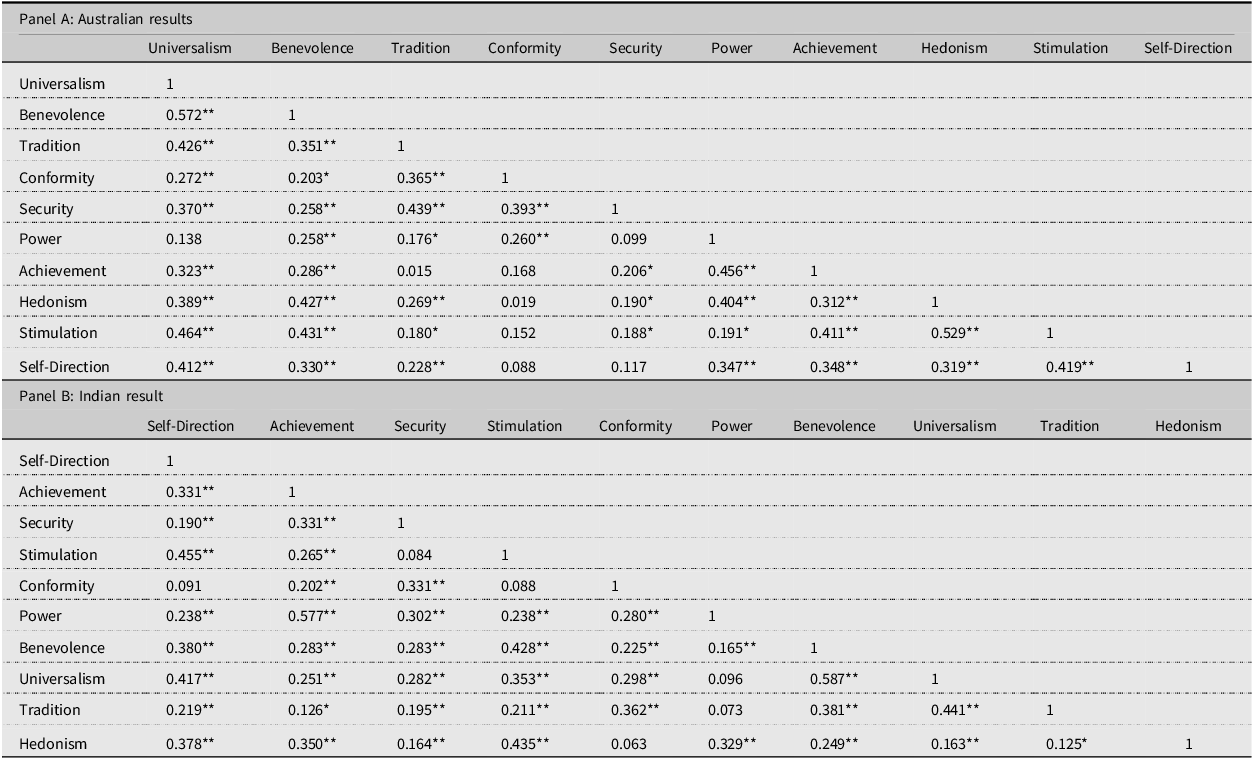
To examine the possible association between various value types and the ER, multiple regression analyses are undertaken. The study employs Van der Waerden’s transportation method to bring the variables closer to normality, as used by various researchers (e.g., Mahadeo et al., Reference Mahadeo, Oogarah-Hanuman and Soobaroyen2011). Table 4 presents the correlation matrix for both groups, which is used to assess multicollinearity.
Correlations of the value types of Australian and Indian data

Table 4 Long description
The table presents a correlation matrix for Australian and Indian data, showing the relationships between different value types. Panel A displays the Australian results with values ranging from negative to positive correlations across categories such as Universalism, Benevolence, Tradition, Conformity, Security, Power, Achievement, Hedonism, Stimulation, and Self-Direction. Panel B shows the Indian results with similar categories. Each cell in the matrix indicates the correlation coefficient between pairs of value types, with significant correlations marked by asterisks. The table helps assess multicollinearity in the data.
**. Correlation is significant at the 0.01 level (2-tailed). *. Correlation is significant at the 0.05 level (2-tailed).
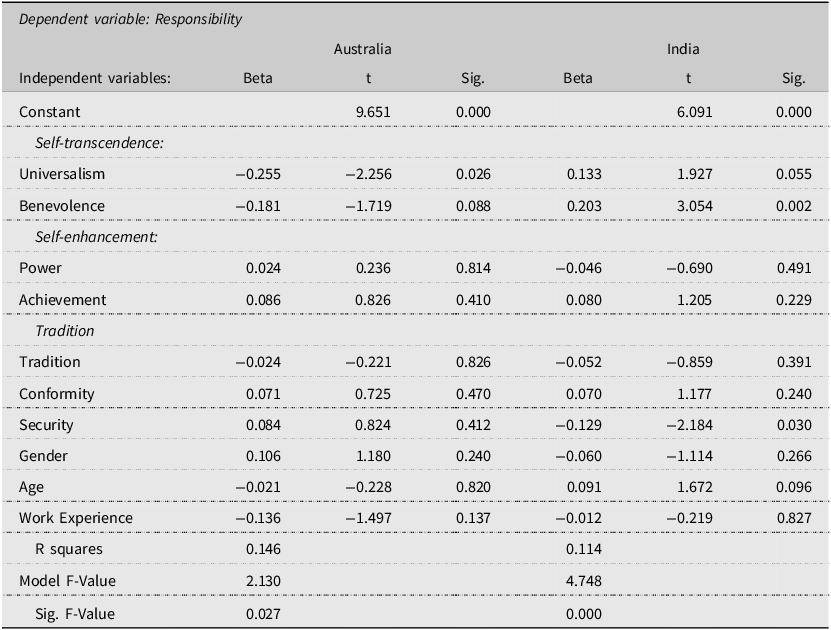
The relationship of values with the ER factor “responsibility” is presented in Table 5. The Indian results in Table 5 indicate a significant (p < 0.05; p < 0.00) and positive (β = 0.133; β = 0.203) association between the values of universalism and benevolence, respectively and “responsibility,” suggesting that MBA participants in India with higher values of universalism and benevolence will strongly support ER. However, different findings are documented by Australian results. The impact of universalism and benevolence towards “responsibility” is statistically significant (p < 0.02, p < 0.08,) respectively, but in a negative direction (β = −0.255; β = −0.181). The coefficients of self-transcendence value types indicated that the strength of the association between self-transcendence value types and ER in Indian respondents is stronger than in Australian participants; therefore, we reject H2a.
Relationship of values with attitudes towards environmental responsibility

Table 5 Long description
The table presents a comparison of the relationship between various values and attitudes towards environmental responsibility in Australia and India. It includes data for independent variables such as universalism, benevolence, power, achievement, tradition, conformity, security, gender, age, and work experience. The table has 18 rows and 10 columns, with columns for Beta, t, and Sig. values for both Australia and India. Notable trends include the significant positive association between universalism and benevolence with responsibility in India, and a negative association in Australia. The strength of the association between self-transcendence value types and environmental responsibility is stronger in Indian respondents compared to Australian participants.
Indian results demonstrate the predicted negative beta direction of power with ER, but show a non-significant association. Results also indicate a non-significant and positive relationship between achievement and “responsibility.” On the other hand, Australian results indicate a non-significant and positive relationship between power and achievement (β = 0.024; β = 0.086) and ER. Coefficients of self-enhancement value types suggest that the strength of the association between power and ER in Indian respondents is stronger than that in Australian respondents. However, the strength of the association between achievement and ER is weaker among Australian respondents; therefore, this partially supports Hypothesis 2b.
Indian results show a significant (p < 0.03) and negative (β = −0.129) relationship between security and “responsibility,” and a negative but non-significant relationship of tradition with ER. Whereas the Australian results indicate a non-significant relationship between all traditional value types (Tradition, conformity and security) and ER. However, coefficients of traditional value types suggest that the strength of the association between the “tradition” value type and the ER of Indian respondents is stronger than that of Australian students; therefore, partially supporting hypothesis H2c. The association of all value types with the ER factor “regime control” for both Australian participants and Indian results was found to be non-significant; therefore, it is not reported.
The observed results of the association between self-transcendence value types and self-enhancement value types and the ER of the respondents are unexpected. The results show that Indian respondents emphasised sharing, duties and obligations, indicating their collectivist views. With a collectivist view, Indian respondents will place more importance on power, tradition, conformity and security values, thus less importance on ER. These unexpected patterns align with recent research demonstrating that modernisation and globalisation increasingly reshape value hierarchies in emerging economies (Bauer et al., Reference Bauer, Pan and Shadrina2021).
Conversely, with an individualistic view, Australian participants should place more importance on self-transcendence and self-enhancement value types; however, our Australian respondents emphasised security, conformity and power more. Individualistic values such as “achievement” and “self-direction” were surprisingly not emphasised by Australian participants. Similar divergences in expected value hierarchies have also been noted in studies of Australian environmental attitudes by Fielding and Louis (Reference Fielding and Louis2021). A possible reason for this divergence is Australia’s abundant resources and relatively low population; Australian participants may achieve their career goals more easily compared to those in other Western economies. MBAs in countries with high populations and limited resources face stiff competition for scarce career opportunities. Originality and creative ideas are key success factors for the Indian MBA participants in their competitive careers. This could be another explanation for why the self-achievement value type was given more importance by the Indian respondents, despite their generally collectivist culture.
The study concurs with the findings of Krishnan (Reference Krishnan2008) that “MBA students’ self-oriented values are becoming more important and community-oriented values are becoming less important.” Broader sustainability education literature also reports a shift toward self-oriented and achievement values among business students globally (Lozano et al., Reference Lozano, Barreiro-Gen, Lozano and Sammalisto2021; Greenland et al., Reference Greenland, Saleem, Misra and Mason2022). Business organisations may not prefer this change; instead, it may be a cause for concern. Companies are keen on hiring business leaders with community–oriented values who can lead a team and fulfil stakeholders’ expectations in a diplomatic and accountable manner, because teamwork is critical in the business world. The reason for this reverse trend could be various, but one crucial reason could be the environmental Kuznets curve.
Conclusion
Respondents appear to be somewhat culturally similar in terms of the higher-order value groups. However, there are differences in the priorities of the value groups. Some differences are expected due to cultural differences, while others are unexpected. Indian respondents’ value ranking suggests that collectivism has vital influences on the priorities of their lives. Indian participants with inherent conviction in collectivism still place more importance on people-related values. These cultural characteristics influence the value differences of Indian and Australian respondents. However, a very high ranking of achievement and self-direction by Indian respondents indicates Western cultural influence on Indian management students who participated in this study.
The study suggests that Indian respondents are rapidly embracing individualism and self-achievement, a prominent characteristic of Western culture, in their lives, thereby narrowing the cultural value gap. Ranking tradition lowly by the Indian respondents also reconfirms this phenomenon. Our results suggest that the general expectation that MBA students from developing Asian countries will be less achievement-driven than students from Western countries, due to cultural differences, may no longer be valid. The results indicate that perceived value differences due to cultural differences are narrowing down, at least in the case of Indian MBA students who participated in this study. However, our results may not be generalised for non-MBA managers.
The results also indicated a significant difference in value types and the association of values with ER within Australian and Indian MBA respondents. The findings are consistent with prior research (Cirnu & Kuralt, Reference Cirnu and Kuralt2013; Lan et al., Reference Lan, Gowing, Rieger, McMahon and King2010; Papagiannakis & Lioukas, Reference Papagiannakis and Lioukas2012). A relatively small amount of variance is explained by personal characteristics, suggesting that demographic variables are less effective in explaining the association between attitude towards ER and individual values.
The study’s findings have institutional and policy implications. Policy makers, such as MBA directors, can initiate curriculum redesign to incorporate environmental, ethical and moral issues related to business in corporate social responsibility (CSR) and corporate governance-related courses. Current sustainability education frameworks emphasise integrating climate competencies and environmental ethics as core components of business curricula (UNEP, 2022; Mokski et al., Reference Mokski, Leal Filho, Sehnem and Andrade Guerra2023). The teaching of these aspects will influence the personal values of the students and this, in turn, will develop and improve ethical/moral obligations. Improved ethical/moral obligations will positively influence MBA students’ attitudes towards ER.
Acknowledgements
The author appreciates the constructive comments and feedback from an anonymous reviewer and the editorial team for their support in getting this article to publication.
Ethical statement
The research received ethical approval (approval Number) from the University of Newcastle, Australia, before collecting information from participants.
Financial support
This research received no specific grant from any funding agency, commercial or not- for-profit sectors.
Author Biography
Asit Bhattacharyya (PhD) is an associate professor of accounting. His main research is on CSR, accountability, and corporate finance. He has several successful competitive research grants. He provides leadership to multidisciplinary research projects. He has 61 publications and 20 research grants. Asit leads the successful Sustainable Enterprises Research Group of the School of Business and Law. Most of his research is published in ABDC A/A* ranked journals. His papers have a 22 h-index and a 30 i10-index. His works have been published in high-impact, high-ranking journals, such as Energy Economics (A*), ABACUS (A), and Accounts & Finance (A).

 Open access

