





1 Introduction
The last two decades have seen a steep increase of speaker evaluation studies (SES) that investigate how listeners evaluate speaker guises which differ in single variable features, for example, (ING) with its variants [ɪŋ] and [ɪn]. Many studies have shown that speakers are downgraded socially when they use forms that are more marked in a specific context (e.g. Campbell-Kibler Reference Campbell-Kibler2007; Labov et al. Reference Labov, Ash, Ravindranath, Weldon, Baranowski and Nagy2011), such as non-standard [ɪn] in newscaster speech. A large variety of factors has been shown to affect evaluation, including speaker and listener socio-demographic factors (Wagner & Hesson Reference Wagner and Hesson2014; Schleef & Flynn Reference Schleef and Flynn2015), specific feature combinations (Pharao et al. Reference Pharao, Maegaard, Møller and Kristiansen2014; Schleef Reference Schleef2023), region (Schleef et al. Reference Schleef, Flynn and Barras2017), the social and linguistic context in which a form occurs (Bender Reference Bender2005; Vaughn Reference Vaughn2022a), cognitive style (Wagner & Hesson Reference Wagner and Hesson2014; Levon & Buchstaller Reference Levon and Buchstaller2015), topic (e.g. Campbell-Kibler Reference Campbell-Kibler2009), etc.
This article focuses on a factor that has so far not been explored in much detail: the extent to which listeners vary in their ability to notice, identify and discriminate variable linguistic features. With the help of these concepts, we seek to get an analytical grip on several related phenomena of speech perception. The ability to notice variable features refers to a listener’s ability to become aware of a given variant without any previous indication of it. The ability to identify and discriminate variants, in turn, describes participants’ capacity to hear a given variant correctly when their attention has been purposely drawn to a focus word prior to listening to a stimulus.
We do not mean to suggest that listeners need to be able to notice, identify and discriminate variation to evaluate it as part of SES (see, e.g., Campbell-Kibler Reference Campbell-Kibler2011; De Reference De2017). Rather, we hypothesise that individual listeners’ ability to do this may be variable, which may have some effect on evaluation. We test what the extent of this variability is to determine its (potential) impact on the response patterns observed in SES. If we find evidence for low noticing, identification and discrimination rates, researchers may want to consider collecting such information and include it as a factor in statistical models, as null results in SES may otherwise conflate two separate phenomena: variation that listeners simply do not notice, and variation that listeners notice, but have no clear evaluation of.
To test listeners’ ability to notice, identify and discriminate variable pronunciation, we focus on three features which are (i) variable in England and (ii) differ somewhat in their sociolinguistic status: (ING), (T)-deletion and (K)-lenition. To account for the conceptual differences between the ability to notice, identify and discriminate variants, we implemented several listening tasks and collected responses from 160 listeners in England. We thereby seek to determine the proportion of correct response rates per task type, variable, variant and carrier type (word/sentence), and explore factors that affect participants’ responses. More generally, we aim to raise awareness of listeners’ ability to notice, identify and discriminate variable linguistic features as a dimension of SES that potentially has statistical relevance to listeners’ evaluation patterns.
Before we present the results of our study, we provide some background on SES and the variables. We introduce the concepts of noticing, identifying and discriminating, and explain how these concepts relate to our task designs. We then present our research questions and hypotheses regarding participants’ response patterns.
2 Background
2.1 Speaker evaluation studies (SES)
In SES, participants listen to several sets of recordings from either different speakers (verbal-guise technique, Cooper Reference Cooper1975) or the same speaker (matched-guise technique, Lambert et al. Reference Lambert, Hodgson, Gardner and Fillenbaum1960), which they are then asked to evaluate. Conducting an SES normally involves recording speakers and then manipulating the recordings, for example, by cutting one variant out and pasting another variant into the guise. The recordings differ in the aspects that the researcher is interested in, such as dialects (London versus Liverpool English) or specific features (e.g. non-standard versus standard features, such as [ɪn] vs [ɪŋ] in unstressed syllables).
Survey participants are then asked to rate each individual guise on, for instance, the perceived accuracy, educatedness or intelligence of the speaker. SES normally use scales to record the assessment, such as semantic differential scales with bipolar adjectives (Osgood et al. Reference Osgood, Suci and Tannenbaum1957). The fact that participants are asked to evaluate the speaker rather than the speaker’s speech is key; this way of collecting evaluations is supposed to access language attitudes in a more disguised manner – by not focusing on the language but the speakers of certain varieties.
SES at variant level have been used quite widely in the last few years as they allow us to answer questions that have emerged in recent strands of sociolinguistics, for example, regarding the interplay of psychological and sociolinguistic factors and third-wave variationist sociolinguistics (Eckert Reference Eckert2012). In particular, variation in (ING) and (T)-deletion have been an important focus of these studies, and we now provide more detail on these variables.
2.2 The linguistic variables
2.2.1 Variation in (ING)
In most English dialects, (ING) is stable and has minimally two realisations in unstressed positions: [ɪŋ], e.g. talking, and [ɪn], e.g. talkin’ (Wells Reference Wells1982: 262–3; Labov Reference Labov2001; Hazen Reference Hazen and Brown2006; Tagliamonte Reference Tagliamonte, Gunnarsson, Bergstrom, Eklund, Fidell, Hansen, Karstadt, Nordberg, Sundergren and Thelander2004). Both the sociolinguistic constraints operating on (ING) and the social meanings attributed to these variants are relatively well described (e.g. Campbell-Kibler Reference Campbell-Kibler2007, Reference Campbell-Kibler2009, Reference Campbell-Kibler2011; Labov et al. Reference Labov, Ash, Ravindranath, Weldon, Baranowski and Nagy2011; Schleef & Flynn Reference Schleef and Flynn2015; Schleef et al. Reference Schleef, Flynn and Barras2017; Bailey Reference Bailey2019). For example, Campbell-Kibler (Reference Campbell-Kibler2011) shows that [ɪŋ] guises are normally rated as intelligent, educated, articulate and less likely to be a student, while [ɪn] guises are considered informal and less likely to be gay-sounding.
Previous research has shown variation in (ING) to be constrained by both internal and external factors (e.g. Trudgill Reference Trudgill1974; Labov Reference Labov2001; Hazen Reference Hazen and Brown2006; Schleef et al. Reference Schleef, Meyerhoff and Clark2011). Among the internal constraints are phonological conditioning effects, for example, [ɪŋ] is more likely to occur when the following segment begins with a velar sound (Houston Reference Houston1985: 19–20). In previous segments, a velar stop or apical show a strong tendency to prompt the apical variant [ɪn]. Also, stress placement predicts the production of [ɪŋ] or [ɪn] (Hazen Reference Hazen and Brown2006: 583) as well as morphological class. Verbs tend to favour [ɪn], whereas [ɪŋ] typically occurs with nouns (Houston Reference Houston1985; Labov Reference Labov2001: 86–7; Tagliamonte Reference Tagliamonte, Gunnarsson, Bergstrom, Eklund, Fidell, Hansen, Karstadt, Nordberg, Sundergren and Thelander2004; Vaughn Reference Vaughn2022a: 513).
External constraints on (ING) include style, gender and socioeconomic class. The variant [ɪn] is normally more frequent in informal style. It is often used more frequently by men, and generally, there is more use of [ɪn] as one goes down the social scale; however, all of these constraints interact with region and the baseline frequency of [ɪn] in a particular area (e.g. Labov Reference Labov2001: 90). Based on VARBRUL probabilities, Houston (Reference Houston1985: 108) suggests there are two dialect groups in Britain regarding (ING): the southern or internal group, favouring [ɪŋ], and the northern and peripheral group, favouring [ɪn]. Houston (Reference Houston1985: 103), focusing on working-class (WC) speech, cites [ɪŋ] values of 20 to 42 per cent for London, 21 per cent for Manchester and 18 per cent for Edinburgh. Tagliamonte (Reference Tagliamonte, Gunnarsson, Bergstrom, Eklund, Fidell, Hansen, Karstadt, Nordberg, Sundergren and Thelander2004) found little symbolic social value attached to (ING) in York, England. Social class is the only social factor that reaches statistical significance, and its effect size is not particularly strong. This is very different from the more extreme sociolinguistic conditioning in the US, Australia and, notably, southern England (Tagliamonte Reference Tagliamonte, Gunnarsson, Bergstrom, Eklund, Fidell, Hansen, Karstadt, Nordberg, Sundergren and Thelander2004: 401).
2.2.2 (T)-deletion
In (T,D)-deletion, the English morpheme-final post-consonantal plosives /t/ or /d/ are deleted when followed by a consonant, vowel or pause. Similar to (ING), it occurs in almost all varieties of English. Much less is known about it in British English (Tagliamonte & Temple Reference Tagliamonte and Temple2005; Pavlík Reference Pavlík2017; Baranowski & Turton Reference Baranowski and Turton2020) than in American English (e.g. Wolfram Reference Wolfram1969; Fasold Reference Fasold1972; Guy Reference Guy and Labov1980, Reference Guy1991; Labov Reference Labov1989; Santa Ana Reference Santa Ana1996; Bayley Reference Bayley1994; Coetzee & Kawahara Reference Coetzee and Kawahara2013). (T,D)-deletion is constrained most strongly by the phonological context and the morphological status of the variable. Following consonants and non-sonorous segments favour deletion; vowels and sonorants inhibit it (Labov Reference Labov1989; Guy Reference Guy1991; Tagliamonte & Temple Reference Tagliamonte and Temple2005; Smith et al. Reference Smith, Durham and Fortune2009; Hazen Reference Hazen2011). Preceding sibilants favour deleted-[t], followed by stops, nasals, other fricatives and liquids (Labov Reference Labov1989). In addition, (T)-deletion is predicted by higher-level linguistic constraints, such as word class and the morphological structure of a word (Guy Reference Guy and Labov1980, Reference Guy1991; Tagliamonte & Temple Reference Tagliamonte and Temple2005; Baranowski & Turton Reference Baranowski and Turton2020; Mackay Reference Mackay2024). In particular, underived, mono-morphemic words have been shown to favour deleted-[t] (Tagliamonte & Temple Reference Tagliamonte and Temple2005: 284, 290), whereas inflected verb forms disfavour it (Guy Reference Guy1991; also Pavlík Reference Pavlík2017: 197).
Previous research has focused only rarely on (T)-deletion in England. Tagliamonte & Temple (Reference Tagliamonte and Temple2005: 287–8) found (T,D)-deletion to occur in 24 per cent of their York data. Baranowski & Turton (Reference Baranowski and Turton2020: 15) report rates of 37 per cent for males and females in Manchester. Pavlík gives a total of 26 per cent for words ending in -n’t, -nt and -ed in the Standard British English of sixteen BBC-newscasters. Social factors do matter, but this varies from study to study. In York, males delete slightly more frequently (Tagliamonte & Temple Reference Tagliamonte and Temple2005). There is no gender difference in Manchester (Baranowski & Turton Reference Baranowski and Turton2020: 15–16). Social class was also not significant in Manchester, but there are stylistic differences with less deletion in more formal styles.
2.2.3 (K)-lenition
(K)-lenition is regionally restricted and stereotypically associated with Liverpool English. It occurs word-finally and word-medially after vowels. When lenited after low and back vowels, (K) is realised as an affricate [k͡x] or a fricative [x], as in back [bax] (Watson Reference Watson2006: 58). Palatal fricatives occur after [iː, ei, ai] (Watson Reference Watson2007: 353). Although no precise and current usage rates are available, its status as a non-standard feature likely means that it is used further down the socioeconomic scale.
2.3 Variable linguistic features, perception and salience
2.3.1 Language-external and -internal explanations of salience
The notion of salience intuitively relates to phenomena of prominence, awareness or surprise, but it has often been found to be underspecified in academic discourse, including linguistics (Boswijk & Coler Reference Boswijk and Coler2020: 713; also Zarcone et al. Reference Zarcone, van Schijndel, Vogels and Demberg2016). More recently, scholars have sought to synthesise conceptualisations of salience in different fields of linguistics, such as sociolinguistics and cognitive linguistics (e.g. Boswijk & Coler Reference Boswijk and Coler2020), to arrive at a working definition that accounts for several important dimensions of salience.
Among these dimensions are language-internal and language-external aspects that can explain why certain linguistic features stand out to certain (groups of) language users. Language-internal explanations include the ‘presence of phonological contrast, great phonetic distance, internally defined naturalness, semantic transparency, or a particular syntactic or prosodic environment’ (Kerswill & Williams Reference Kerswill, Williams, Jones and Esch2002: 105, also quoted in Boswijk & Coler Reference Boswijk and Coler2020). Language-external explanations, in turn, comprise ‘cognitive, pragmatic, interactional, social psychological and socio-demographic factors’ (Kerswill & Williams Reference Kerswill, Williams, Jones and Esch2002: 105, also quoted in Boswijk & Coler Reference Boswijk and Coler2020).
In SES, empirical work has focused on language-external factors and the social meanings of variants (Levon & Fox Reference Levon and Fox2014; also Labov Reference Labov2001: 25–8). While language-internal factors are equally at work (see Trudgill Reference Trudgill1986: 11, also quoted in Boswijk & Coler Reference Boswijk and Coler2020: 716), their exact contribution to a feature’s salience has not been sufficiently tested.
Our study shifts the focus more clearly to the question of whether or not participants can reliably notice, identify and discriminate different variants, as reflected in the task types implemented. Slight differences in task design serve to explore various degrees of salience and the potential effect of drawing respondents’ attention to a variable.
2.3.2 Noticing, identifying and discriminating variants
Noticing. While terms may vary, the noticing of particular language use and connecting it to social meanings is common to various models of speech perception (e.g. Kristiansen Reference Kristiansen, Kristiansen and Dirven2008; Purschke Reference Purschke2011). The understanding of noticing adopted here may be best explained by referring to Preston’s work on language regard.
Preston (Reference Preston2017) has developed a processual model of where and why variability may emerge in the social evaluation process.Footnote 2 In a crucial first step, listeners must notice an instance of language use; otherwise, they cannot react to it. A variant may be noticed because it differs from the listener’s own preferred or expected realisation of the item. The noticed language instance is subsequently ‘classified’ according to social, contextual or linguistic criteria, and then ‘imbued’ with evaluative information drawn from the listener’s stored cognitive representations of the classification. In a final step, there is a deliberative or automatic response.
The model’s exact workings will not be tested here. Instead, we focus on the first step of noticing and examine to what extent individuals notice the different variants of a variable. In particular, our noticing tasks were designed in such a way that, in the question prompt, respondents’ attention is not initially drawn to a particular focus word or feature; instead, they first listen to a recording and are only afterwards asked to report which pronunciation variant was heard.
When it comes to interpreting the results, we believe that responses to our noticing tasks reflect the complexity of natural speech perception, with both language-internal and -external factors influencing participants’ ability to notice a variant. As argued above, Preston’s (Reference Preston, Gilles, Scharloth and Zeigler2010) conceptualisation of noticing provides important insights here. Crucially, he argues that noticing is a dynamic process that depends on situations, tasks and properties of individuals, which acknowledges the role of elicitation conditions and listeners’ procedural capacities, such as working memory (Bassili & Brown Reference Bassili, Brown, Albarracin, Johnson and Zanna2005: 553–4).
Different theoretical positions are evident in the literature as to how conscious the process of noticing is. According to Nycz, noticing (in second language learning research) refers to ‘conscious awareness and subjective experience of a linguistic feature; it is a step beyond mere perception of a feature’ (Nycz Reference Nycz and Babel2016: 64, quoted in Montgomery & Moore Reference Montgomery and Moore2018, original emphasis). Preston (Reference Preston2017: 20), on the other hand, argues that the noticing of a variant may be conscious or unconscious. We subscribe to this view and note that our task design does not support any conclusions as to how consciously or unconsciously a listener noticed a given variant. We also believe that evaluation is possible with or without a feature being noticed consciously – and with or without a listener completing a set of noticing tasks successfully (see Campbell-Kibler Reference Campbell-Kibler2011; De Reference De2017). However, the ability to notice a feature and indicate the correct variant may influence evaluation; we hypothesise that evaluation may be stronger among those who perform better in noticing tasks than those who struggle with them.
Identifying. The notion of identifying a feature refers to a participant’s ability to indicate precisely which variant they heard (e.g. answer options: singing or singin’) in a recording of a word or sentence (e.g. Drager Reference Drager2018: 75–8; Grover et al. Reference Grover, Shafer, Luca Campanelli and Levy2021). Typically, in so-called identification tasks, listeners are told they will hear words or sentences, sometimes their attention is drawn to a particular focus word, and they are subsequently asked to indicate what variant they heard (e.g. represented as a written word). In some cases, target words or sounds are purposely kept ambiguous (e.g. Squires Reference Squires2014). Our implementation followed what is commonly done, that is, drawing listeners’ attention to a focus word before hearing a stimulus, and presenting them with the orthographic equivalents of the respective variants from the start.
Identification tasks can be used for various research questions, for instance, to investigate the effect of specific social primes, or to test intelligibility (Hay et al. Reference Hay, Warren and Drager2006; Drager Reference Drager2018: 75–8). Given that many SES presuppose participants’ ability to correctly identify variants, we used identification tasks to test how accurately participants can identify different variants (e.g. [ɪŋ] or [ɪn]) of specifically prompted parts of speech. The ability to hear a variant correctly and assign the correct answer option may influence listener evaluation; evaluation may not be possible if a listener cannot correctly identify a variant. Alternatively, evaluation may occur but it may be weaker when compared to listeners with very high identification results.
Discriminating. By discriminating, we mean a participant’s ability to distinguish between two variants of a variable, although only indirectly by indicating whether a certain type of sound in two different recordings was pronounced the same or differently. This understanding builds on previous work, where speech perception data was collected by means of discrimination tasks (e.g. Drager Reference Drager2018: 78–80). Our exact experimental set-up differed slightly from other discrimination tasks commonly used to examine mergers in progress (Drager Reference Drager2018: 78–80), in as far as we pointed out the focus word in writing before participants heard the recordings and were asked to classify them as either same or different (or I don’t know). This was done deliberately, however, as we sought to test whether participants had the ability to discriminate between variants in an unambiguous setting without any fillers or added confounding variables.
Given this experimental design, discrimination and identification tasks showed many similarities. However, they also differed in a few key aspects: in the identification tasks, participants only heard one realisation of the variable in question, while in the discrimination tasks they heard two (e.g. [ɪŋ]/[ɪn], [ɪŋ]/[ɪŋ] or [ɪn]/[ɪn]) right after each other, giving direct comparability. Also, discrimination tasks seemed to demand a lower cognitive load, as the task only requires participants to compare and evaluate acoustic input regarding the sameness of sounds, but not to additionally match it with the corresponding written representation of a given variant.
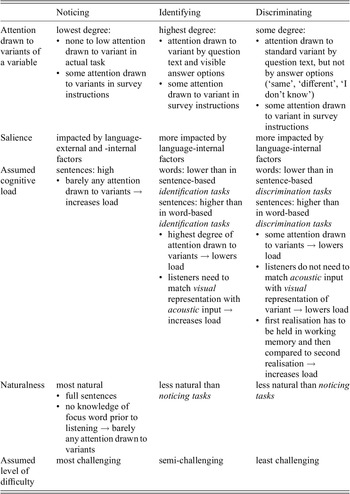
Table 1 provides a comparative summary of what precisely the speech-perception activities of noticing, identifying and discriminating involve. In particular, we make assumptions about the ways in which the different task types draw participants’ attention to variants, what types of salience are raised, and we hypothesise about the cognitive load the tasks demand. We specifically acknowledge that, in the present study, participants were introduced to variants at the beginning of the survey or – in the case of the identification and discrimination tasks – were explicitly told about focus words and sounds, which leads to a certain degree of introspective awareness on the part of the listener. Raising such introspective awareness happens deliberately in identification and discrimination tasks, so that responses mainly reflect the ability to listen selectively for certain variants, classify them or evaluate their sameness. In noticing tasks, however, we sought to avoid an unnaturally high level of introspective awareness to collect perception data that is most complementary to data typically elicited through SES. Taking such assumptions into account, the table also indicates the assumed level of naturalness and difficulty for respondents. Such a comparative account serves to pinpoint similarities and differences between task types and to ultimately be able to draw more nuanced conclusions about what precisely each of them tests, how performance differences ought to be interpreted and which task type lends itself best to an implementation in SES.
Overview describing the nature of the speech-perception activities of noticing, identifying and discriminating linguistic variants

2.4 Research questions and hypotheses
This study seeks to test respondents’ ability to notice, identify and discriminate variable linguistic features at word and sentence level. We focus on three features which are (i) variable in England and (ii) differ somewhat in their sociolinguistic status:
-
• variation in (ING) – e.g. talking realised with [ɪŋ] or [ɪn],
-
• variation in (T)-deletion – e.g. went realised with [t] or deleted-[t],
-
• variation in (K)-lenition – e.g. padlock realised with [k] or [x].
We ask the following questions:
-
• What is the proportion of correct noticing, identifying and discriminating of variants of (ING), (T)-deletion and (K)-lenition at word and sentence level?
-
• What task-dependent factors and listener characteristics affect correct noticing, identifying and discriminating?
-
• Would it be worthwhile to include tasks that assess respondents’ ability to notice, identify and discriminate variable linguistic features in SES to then use this information as a factor in the statistical analyses? If so, which task type is most suitable?
We hypothesise that the highest proportion of correct answers will be achieved for the discrimination of variants, followed by the identification and finally the noticing of variants. This is because the tasks differ in cognitive demand (see table 1). In addition, we expect more correct answers when a variant occurs in a single word rather than in a sentence, due to the additional cognitive load associated with processing sentences. Considering that the nature of the tasks is relatively independent of gender and social class, we do not expect these listener characteristics to influence the number of correct responses. Likewise, we do not expect region to affect respondents’ correctness rates significantly since we collected data from several regions in the North of England (not only Liverpool), so that familiarity with the [x]-variant was not a given. Additionally, all participants were briefly introduced to all relevant variants at the beginning of the survey, which may decrease the effect of region further.
3 Methods
3.1 Guise creation
In a first step, we created several sets of stimuli words. To ensure comparability and to exclude confounding factors, focus words and contexts follow several criteria: all target words consist of two syllables with the feature of interest occurring in the final coda. All word-final (T)-deletion targets are preceded by /n/; all word-final (K)-lenition features are preceded by back vowels and the non-standard form was recorded as [x]. In a next step, words were integrated into sentences, occurring as the third or fourth word of sentences that consist of 10–14 syllables in total. In sentences, features of interest are always followed by a vowel (see the Appendix for all text materials).
Words and sentences were recorded in a sound-attenuated booth at the University of Salzburg, with one female speaker in her mid-40s originally from Liverpool. Her accent is clearly Northern but may not allow listeners to place her in a specific city. We only worked with unmanipulated recordings of words and sentences since (i) we did not conduct an SES and therefore did not need to hide which features we were interested in, and (ii) recent research has questioned whether the cut-and-paste technique is suitable for all experimental goals (Vaughn Reference Vaughn2022b).
3.2 The survey
In total, we had five different tasks: noticing linguistic variants in sentences (2 blocks), identifying variants in words, identifying variants in sentences, discriminating variants in words and discriminating variants in sentences. To circumvent any fatigue effects, we split these tasks into two surveys (table 2).
Overview of surveys

To counteract possible confirmation bias or lexical effects, each survey came in two versions, which only differed in what variant participants would hear with each individual word or sentence. The surveys were created in LimeSurvey (LimeSurvey GmbH 2023). An information page ensured that only participants with working audio equipment and without any hearing impairments took part in the survey. A subsequent training section explained what the survey entailed and that it was about ‘identifying’ sounds. Each of the three variables was briefly introduced here to familiarise participants with the written representation of the non-standard forms: for the (ING)-variants, we used -ing and -in’, respectively. The variants of (T)-deletion were represented orthographically as -t and -’ (as in presen’), respectively. Finally, the spelling variants for (K)-lenition were -ck and -[x], respectively.Footnote 3 Participants also had the opportunity to listen to audio examples of the variants. This feature introduction is a potential weak point of the study, as we had to raise some awareness of the variables and variants. This is unproblematic for the discrimination and identification tasks but undesirable for the noticing tasks, as we did not want participants to be aware of the target feature before hearing the stimuli. To mitigate this risk, it was suggested to participants that they ‘might be asked’ about a feature on the training page. And, indeed, the survey contained other features as well (e.g. variation in (W) and (V) in the trial questions) to further draw away attention and avoid training effects.
The introductory part was followed by the instructions for the first block, a trial question and, eventually, the nine randomised sentences of the noticing tasks. The noticing tasks also included three fillers and an attention check. Next followed two further experimental blocks with identification and discrimination tasks, also with attention checks, but no fillers. At the beginning of each part, participants were reminded to always choose the answer that corresponds to what they actually heard rather than what they would expect based on Standard English. The order of test tokens was randomised throughout. The final section collected basic biographical and experimental information (see Appendix).
Prolific (Prolific 2023), a subject pool for online experiments, was used for data collection. We used its screening options to include 80 participants each, who were born and still live in the North of England (from the North East, North West or Yorkshire and the Humber) and the South (from London, South East or the South West). We recruited a total of 160 participants (50 per cent women, 50 per cent men), of whom 48.8 per cent self-identified as working class and 51.2 per cent as middle class.Footnote 4 We admitted participants between 18 and 100 years of age (mean age=44.25 years, sd=13.8 years, min=20, max=76) whose L1 is English and who are UK nationals who spent most of their time in the UK before turning 18. Participants could take part in only one of the surveys, which took 15 minutes on average, and they were paid £3.50 each. After survey completion, incomplete responses and participants who failed multiple attention checks were removed. Data files were then prepared for the statistical analysis in R (see section 3.6). Sections 3.3 to 3.5 provide more detail on the three experimental tasks.
3.3 Noticing tasks
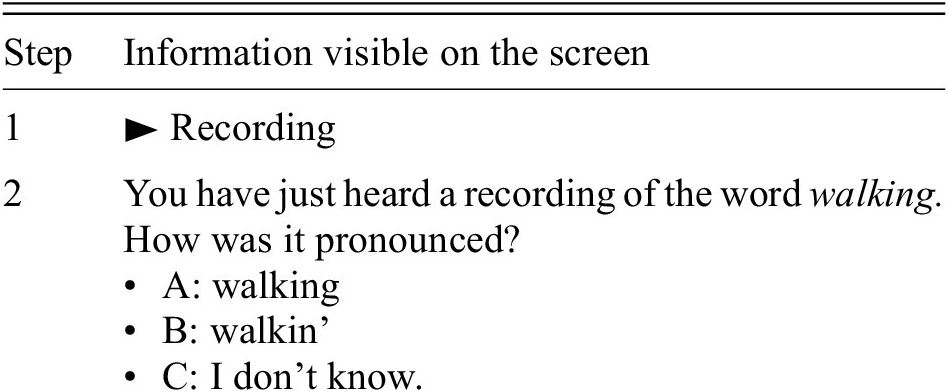
We conducted sentence-based noticing experiments in two randomised blocks, each containing three tokens of each of the three variables. Participants first answered a trial question to familiarise themselves with the question format. They then clicked Next to listen to the first test sentence; once the recording had played through, the audio player disappeared automatically to ensure that the recording could only be listened to once (step 1, table 3). Participants would then be asked whether a specific word in this sentence was pronounced in one way or another, that is, the target word was pointed out to participants only after the stimulus was heard (step 2, table 3).Footnote 5 We only used sentences as stimuli as this method most closely resembles what happens in SES.
Structure of a noticing task

3.4 Identification tasks
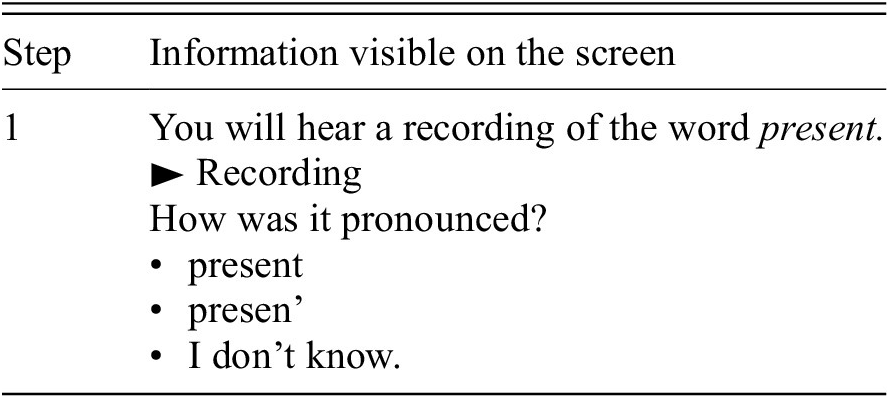
The identification tasks were very similar to the noticing tasks except that the target word was pointed out to the participants prior to hearing the recording. We conducted word- and sentence-based identification tasks in separate blocks and surveys, each containing six tokens of each of the three variables. After a trial question, participants clicked Next and read that they would hear a recording of a focus word after clicking the play-button, and that they would be asked how the focus word had been pronounced, choosing one out of three answer options (table 4).
Structure of an identification task

3.5 Discrimination tasks
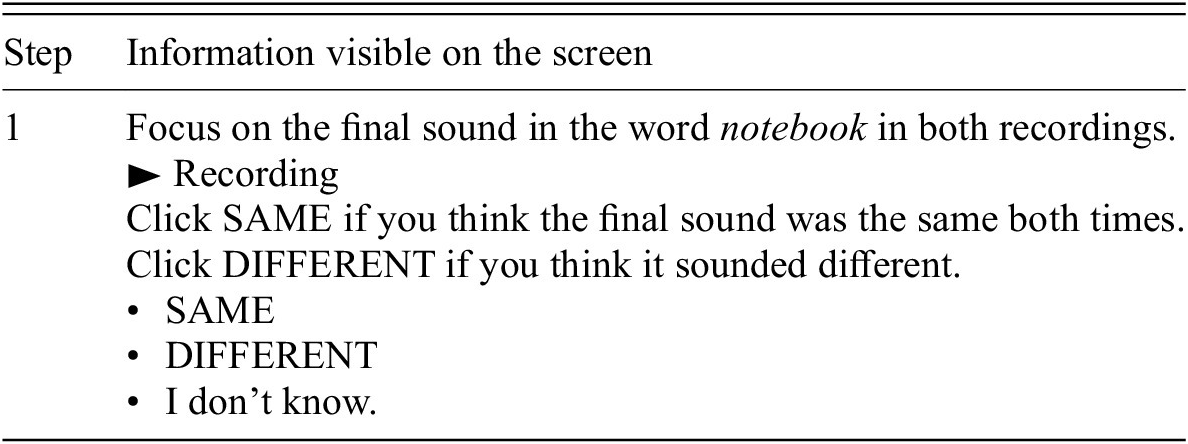
Finally, we implemented word- and sentence-based discrimination tasks in separate blocks, each containing six tokens of each of the three variables. After a trial question, participants clicked Next and read that they are asked to focus on a specific sound in a focus word contained in two separate recordings and to decide whether it sounded the same or different in both instances (table 5).
Structure of a discrimination task

3.6 Statistical analysis
Correctness rates were submitted to mixed-effects logistic regression models built with the glmmTMB package (Brooks et al. Reference Brooks, Kristensen, van Benthem, Magnusson, Berg, Nielsen, Skaug, Maechler and Bolker2017) in R (R Core Team 2021). Separate models were built to investigate the three variables (i.e. (ING), (T)-deletion, (K)-lenition) and the three task-types (i.e. noticing, identification and discrimination tasks). Responses were dummy coded with 0 for incorrect answers and 1 for correct answers. Models were fitted with random effects for participant and maximum models were manually stepped down to include factors which significantly improved the model fit. The following overview is an alphabetical list of the factors and levels considered when fitting the models:
-
• age: younger (≤ 35) | middle (36–65) | older (≥66)
-
• audio: headphones | in-built computer speakers | external speakers
-
• class: working class | middle class
-
• gender: man | woman
-
• region: North | South
-
• variant: standard | non-standard
4 Results
4.1 Degree of correctness: noticing, identifying and discriminating
Approaching our first RQ, table 6 and figure 1 show the overall proportion of correct responses (per variable, variant and task type).Footnote 6 L1 speakers of English do not discriminate and identify all variants correctly and – less surprisingly – do not show a 100 per cent noticing rate. Also, correctness rates vary within variables, which is why our focus will be on the variants of the three variables. Overall, we observe higher correctness rates in the discrimination tasks (never below 80 per cent). Correctness rates for noticing and identifying vary widely. Given the variation between task type and variant, we will now explore the factors influencing variation in these data based on binomial logistic regressions (tables 7–15).
Proportion of correct responses per task type, variable and variant, with number of correct responses (noticing tasks and identification tasks: out of a total of 240, discrimination tasks: out of a total of 480) as well as upper and lower 95 per cent confidence intervals in brackets

Visualisation of the proportion of correct responses per task type, variable and variant

(ING). Results of the noticing tasks binomial logistic regression model

4.2 Factors influencing correct noticing, identifying and discriminating
Noticing tasks. Results (table 7) indicate that respondents are significantly better at noticing the non-standard variant [ɪn] (90 per cent) compared to the standard variant [ɪŋ] (72 per cent) (est.=-1.42, p< 0.001). For both (T)-deletion and (K)-lenition, this pattern is reversed, with participants being able to correctly respond to noticing tasks at a higher rate when hearing the standard variants [t] (est.=1.15, p<0.001, table 8) and [k] (est.=0.97, p<0.001, table 9) as opposed to the non-standard variants (deleted-[t] and [x], respectively). When hearing non-standard [x], only 70.8 per cent of respondents answered correctly – one of the lowest scores overall. While it did not prove a significant predictor of respondents’ correctness rates, including region as a factor in the (T)-deletion model improved the overall model fit.
(T)-deletion. Results of the noticing tasks binomial logistic regression model

(K)-lenition. Results of the noticing tasks binomial logistic regression model

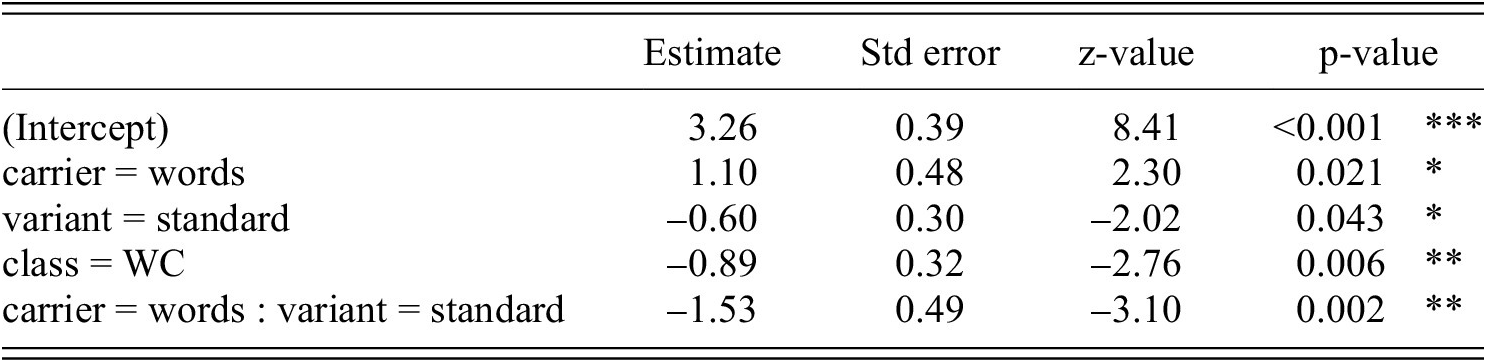
Identification tasks. As with the noticing tasks, participants performed significantly better when required to identify the non-standard variant [ɪn] as opposed to the standard variant [ɪŋ] (est.=-0.60, p=0.043, table 10). Results also indicate a significant effect for carrier. When the stimulus consisted of a word, respondents were significantly better at identifying the variant correctly than when they were presented with a carrier sentence (est.=1.10, p=0.021, table 10). Working-class participants had significantly more difficulty identifying (ING)-variants correctly. There was also a significant interaction term between carrier and variant indicating lower correctness rates when participants heard word-based stimuli that contained the standard variant but sentence-based stimuli that contained the non-standard variant (est.=-1.53, p=0.002, table 10).
(ING). Results of the identification tasks binomial logistic regression model

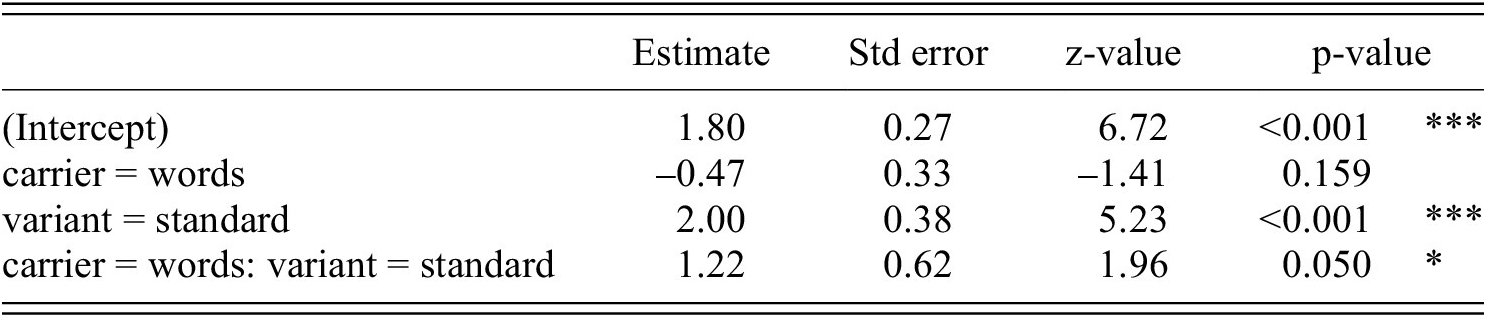
As for (T)-deletion, we find the same pattern for variant that we observed with the noticing tasks. Participants were significantly better at identifying the standard variant [t] as opposed to non-standard deleted-[t] (est.=3.42, p<0.001, table 11). A significant main effect for carrier suggests that, as with (ING)-based identification tasks, respondents were more likely to identify the (T)-deletion variants correctly if they were carried by a word rather than a sentence (est.=2.34, p<0.001, table 11). Results for the identification tasks of (K)-lenition variants indicate that [k] was more correctly identified than the non-standard [x] (est.=2.00, p<0.001, table 12). There was an interaction effect between carrier and variant pointing to significantly higher correctness rates when participants heard word-based stimuli that contained the standard variant but sentence-based stimuli that contained the non-standard (est.=1.22, p=0.050, table 12).
(T)-deletion. Results of the identification tasks binomial logistic regression model

(K)-lenition. Results of the identification tasks binomial logistic regression model

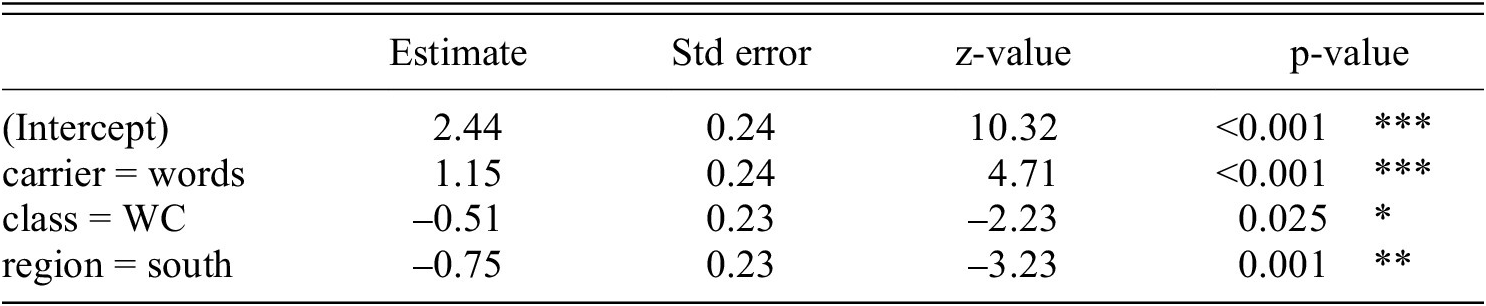
Discrimination tasks. Respondents were generally better at discriminating between the variants of (ING) when they were presented with individual words as opposed to sentences (est.=1.15, p<0.001, table 13). This pattern contrasts with the findings for both (T)-deletion (est.=-0.22, p<0.204, table 14) and (K)-lenition (est.=-0.30, p=0.165, table 15), where carrier was not found a significant predictor of respondents’ correctness rates. A correct discrimination of (ING)-variants was furthermore predicted by class and region. WC participants (est.=-0.51, p=0.025, table 13) and Southerners (est.=-0.75, p=0.001, table 13) performed significantly worse in the discrimination tasks than MC respondents and participants from the North.
(ING). Results of the discrimination tasks binomial logistic regression model

(T)-deletion. Results of the discrimination tasks binomial logistic regression model

(K)-lenition. Results of the discrimination tasks binomial logistic regression model

5 Discussion and conclusion
In this study, we set out to answer three questions: first, we asked about the proportion of correct noticing, identifying and discriminating of variants of (ING), (T)-deletion and (K)-lenition at word- and sentence-level. Second, we sought to determine task-dependent factors and listener characteristics that may lead to incorrect noticing, identifying and discriminating. Finally, we asked if it would be worthwhile to include tasks that assess respondents’ ability to notice, identify and discriminate variable linguistic features in SES and, if so, which task type is most suitable.
RQ1. Exploring the extent of listeners’ ability to notice, identify and discriminate variable linguistic features, we found that, indeed, L1 English speakers have these abilities but do not identify and discriminate all variants correctly. Also, they show relatively low correctness rates for noticing. In SES, we cannot assume that all listeners will correctly notice, identify and discriminate the variants of interest, which may, in turn, affect listener evaluation. Correctness rates are also influenced by various factors that are relevant to SES.
RQ2. Regarding task-dependent and listener characteristics that function as predictors of respondents’ correctness rates, we found variant and carrier to show a systematic effect. The effect of variant becomes particularly obvious with noticing and identifying. correctness rates differ drastically among variants (table 6), and we observe two patterns: one for (ING) and a different one for (T)-deletion and (K)-lenition. For (ING), non-standard [ɪn] is substantially more frequently noticed and identified correctly. Yet, for (T)-deletion and (K)-lenition, it is the standard variants that are correctly noticed and identified more frequently. Regression models show that this difference in correctness rates is statistically significant for all variables tested in the noticing and identification tasks. Footnote 7
One question remains: why do (ING) on the one hand and (T)-deletion and (K)-lenition on the other show contrasting patterns? Exploring these asymmetries was not part of our research design. Thus, we can only offer post-hoc explanations: regarding (i) variant frequency within a variety and (ii) the acoustic signal. Concerning (i), deleted-[t] and [x] generally occur less frequently than the standard variants do in the British varieties investigated; for (ING), this is not always the case, especially not in Northern and South-Western areas within England, where [ɪn] is more frequent than [ɪŋ] (see section 2). More experience with a variant may translate into more successful noticing, identifying and discriminating. While we did find a main effect for region in one of the models (i.e. Northern listeners were somewhat better in the discrimination tasks for (ING)), there were no interaction effects for variant and region in any of the models, which is what we would expect if variant frequency were indeed influencing correctness rates. Thus, we are forced to dismiss this as an explanation.
This leaves explanation (ii). It may be inherently easier to notice, identify or discriminate some sounds rather than others in certain phonological contexts. For example, it may be easier to notice, identify or discriminate a sound that is present than the lack of a sound, such as deleted-[t], especially when the preceding sound is also alveolar (e.g. /n/). Finding evidence for this hypothesis is clearly a task for future research. Nonetheless, the asymmetric noticing and identification of variants is an important finding of our study that seems relevant to how SES are designed.
As for carrier as a predictor of respondents’ correctness rates, we expected more correct answers when the feature of interest occurred in single words than when it occurred in a carrier sentence due to the additional cognitive load that processing a sentence is associated with. While some models support this assumption, findings are not as clear-cut as expected. For correct identification or discrimination of (K)-lenition variants, carrier does not matter. It also does not matter for the discrimination of (T)-deletion variants and for identifying [ɪŋ], where correctness rates are higher for sentences rather than words. Thus, variants in words are not more correctly noticed, identified and discriminated in all cases. Besides cognitive load, other factors must be influencing correctness rates in different carrier types, which should be explored in the future. We believe that the phonological context of variants, for instance, may be a confounding factor, which could explain the asymmetries in carrier type. In words, variants are followed by a pause; in sentences, they are followed by a vowel. For some variants, the following pause in a carrier word may reduce any advantages that a lower cognitive load in identification and discrimination may bring.Footnote 8
The effect of task type is a further aspect to consider. As discrimination tasks (same vs different) do not allow for determining correctness rates at variant-level, a statistical comparison of methods is not possible. It also does not seem necessary considering our primary goal of uncovering the extent to which English L1 speakers correctly notice, identify or discriminate different variables. It is clear that, moving from discrimination, to identification and noticing, the tasks become increasingly more demanding (see table 1). This is reflected in our data: correctness rates are comparatively high for the discrimination tasks, and results also reflect the additional cognitive load of the noticing tasks when compared to identification in the majority of cases. We created additional regression models to compare all six variants at sentence-level in the noticing and the identification tasks. Results show that identification rates are significantly more often correct than noticing rates for [ɪŋ], [t], [k] and [x] (p<.05 in all cases). There was no significant difference for [ɪn], and deleted-[t] is more often correctly noticed than identified (p<.001, see figure 2). These task-type asymmetries for different variants suggest that, in some cases (e.g. deleted-[t]), correctness rates are influenced by more than just the cognitive demands of a particular task type. What factors these are remains a question for future research.
Comparative overview of results of the noticing and identification tasks * = Difference is statistically significant.

Returning to the task types, it is obvious that, in the majority of cases, results for task type differ because they seem to test different processes. Discrimination tasks assess a participant’s ability to distinguish between pronunciation variants indirectly (same vs different). Identification tasks, in turn, also test if participants can hear variants correctly but pose the greater challenge of hearing for certain variants. In addition to hearing the variants of a variable correctly, noticing tasks rely on variants standing out to listeners. A direct comparison of results for noticing and identifying (see figure 2) makes apparent that these two task types test different processes as correctness rates for almost all variants differ clearly between both task types.
RQ3. Our results also provide us with some guidance as to whether noticing, identification and discrimination tasks should be included in SES in any way. As correctness rates fall into the mid-60s for some variants, testing whether they improve models in SES may certainly be worthwhile. What measure would one collect then in addition to data from actual SES? Considering that correctness rates differ for variants, discrimination tasks are not a suitable task type to include as they do not provide any variant-specific response data due to the same versus different answer options. Noticing and identification tasks, on the other hand, provide these data. Of these two, identification tasks seem to be most suitable to include in an SES since this task type is somewhat easier than noticing tasks. When implemented towards the end of a survey, which is the most likely scenario, they might be more effective when listener fatigue tends to become a serious issue. Also, in identification tasks, carrier sentences seem desirable as they are more in line with guises typically used in SES and they are not necessarily more challenging test materials than words. Using carrier sentences can also provide more control and variety regarding the element that follows the target feature than carrier words can. Generally speaking, identification tasks seem particularly suitable for studies that seek to assess the actual ability of a listener to hear sounds and label them correctly. To what extent the evaluation of language is influenced by the degree to which different listeners can identify features remains an open question. Noticing tasks, too, could in principle be used as follow-up tasks to an SES. They assess both the ability to hear a variant and the degree to which a given variant stands out. Regardless of their noticing abilities, participants may still evaluate guises – however, they may do so differently. Also, noticing tasks should be implemented if naturalness is of high priority.
Finally, our results provide some guidance on what variants to include in identification or noticing tasks, namely those variants that seem to trouble participants and not those with correctness rates of more than 90 per cent, as these would not be diagnostic of any identification or noticing issues. Future research needs to establish whether the inclusion of correctness rates for individual participants does improve speaker evaluation models at all, or whether other factors provide better measures. We tested some social characteristics of listeners and did not find much evidence that they influence Correctness rates. Cognitive factors, however, might do so, such as the capacity of participants’ short-term as well as simple and complex working memory, or psychometric measures, for instance, elicited through the BAPQ (Hurley et al. Reference Hurley, Losh, Parlier, Steven Reznick and Piven2007) or the Self-Monitoring Questionnaire (Cramer & Gruman Reference Cramer and Gruman2002).
Our results also speak to sociolinguistic theory. If social meanings are indexed by variants (see Campbell-Kibler Reference Campbell-Kibler2011) and if the ability to notice these varies (see our results), then it follows that the social meanings of some variants may be missed by some speakers. Alternatively, those listeners with high correctness rates in noticing variants may evaluate differently than those with low correctness rates. In any case, a poor performance at noticing tasks does not mean that listeners will not evaluate these features.
Of course, this reasoning is based on the assumption that individual variants are noticed in the perception of social meanings. Alternatively, listeners may access social meanings based on perceived styles and co-occurring features (Levon Reference Levon2014; Pharao & Maegaard Reference Pharao and Maegaard2017; Schleef Reference Schleef2023). Still, even when listeners focus on styles, the issue remains that some variants are more readily noticed, identified and discriminated than others. And indeed, research that explores co-occurring variants has found that some features are trumped by others, which has normally been explained with a view to social salience (e.g. Levon Reference Levon2014; Schleef Reference Schleef2023). Since we pointed listeners directly to the variable context, we assume that social salience did not influence correctness rates to any large extent (especially so in the identification and discrimination tasks). Instead, we have argued that correctness rates may be impacted by the perceptibility of a sound in a specific linguistic context.
In conclusion, this study provides more evidence for the disjunct of production and perception in variationist sociolinguistics (Levon Reference Levon2014; Schleef Reference Schleef2023). While research on style production has argued that features cluster into styles to create social meanings (Eckert Reference Eckert2012), it is by no means clear that listeners can perceive all features equally and recognise the intended meanings. The mechanisms involved in noticing, identifying and discriminating and in processing the social meanings of individual or co-occurring features remain rather obscure. The present study raises questions regarding the forms that can be noticed, identified and discriminated, and by whom, and results suggest that a more rigorous elicitation of such information might be useful for a more complete understanding of the nature of social evaluation.
Appendix
A.1 Test stimuli
Noticing tasks
The following stimuli (sorted by variable) were used in the noticing tasks (sentences only).
-
• He was running [ɪŋ][ɪn] out of excuses not to go. (1st block)
-
• They were making [ɪŋ][ɪn] excellent progress on the project. (1st block)
-
• She was reading [ɪŋ][ɪn] about current affairs over breakfast. (1st block)
-
• She was writing [ɪŋ][ɪn] a note when her pen ran out of ink. (2nd block)
-
• He was talking [ɪŋ][ɪn] angrily on the phone when he came in. (2nd block)
-
• She was walking [ɪŋ][ɪn] along the road when the tree fell. (2nd block)
-
• The undercover agent [t][ ] infiltrated the gang. (1st block)
-
• His boss’s positive comment [t][ ] on his work made his day. (1st block)
-
• The boy’s present [t][ ] is waiting for him under the tree. (1st block)
-
• The happy client [t][ ] immediately placed an order. (2nd block)
-
• In a moment [t][ ] of weakness he admitted his crimes. (2nd block)
-
• He was a student [t][ ] at a prestigious boarding school. (2nd block)
-
• She hung a hammock [k][x] in the shade beneath the trees. (1st block)
-
• He carries sunblock [k][x] in his bag when he goes hiking. (1st block)
-
• The big padlock [k][x] on the garage door was cut open. (1st block)
-
• In her notebook [k][x] Anne has a list of films she wants to see. (2nd block)
-
• She enjoyed the outlook [k][x] over the surrounding fields. (2nd block)
-
• They had a food truck [k][x] at their wedding reception. (2nd block)
-
• The cat/car is behind the house. [filler]
-
• Can you see the little mouse/house? [filler]
-
• He heard the rain/train through the window. [filler]
Identification tasks
The following stimuli (sorted by variable) were used in the sentence-based identification tasks. The focus words (in bold, e.g., running, making, reading, agent, etc.) were also used as part of the word-based noticing tasks. To save space, the list of single words is not repeated here.
-
• She was running [ɪŋ][ɪn] in order to catch the bus.
-
• He was making [ɪŋ][ɪn] a sandwich when his mother walked in.
-
• He was reading [ɪŋ][ɪn] a novel while she watched TV.
-
• He was writing [ɪŋ][ɪn] a letter to his favourite aunt.
-
• They were talking [ɪŋ][ɪn] about local politics.
-
• I was walking [ɪŋ][ɪn] in the park when I saw the fox.
-
• The young agent [t][ ] enthusiastically pitched the role.
-
• The insulting comment [t][ ] online worsened his mood.
-
• The wrapped present [t][ ] is on the table by the cake.
-
• The new client [t][ ] expressed satisfaction with the idea.
-
• She took a moment [t][ ] and relaxed on the sofa.
-
• The hard-working student [t][ ] excelled in her studies.
-
• The colourful hammock [k][x] is swaying in the breeze.
-
• She applied sunblock [k][x] once she got to the beach.
-
• She uses a padlock [k][x] and chain to secure her bike.
-
• He got his notebook [k][x] and took down the statement.
-
• He gave an outlook [k][x] on future plans and projects.
-
• The new food truck [k][x] is becoming very popular.
Discrimination tasks
The following stimuli (sorted by variable) were used in the sentence-based discrimination tasks, for which a combination of two sentences (same wording) with focus words were used. The focus words (in bold, e.g., running, making, reading, agent, etc.) were also used as part of the word-based discrimination tasks. To save space, the list of single words is not repeated here.
-
• She was running [ɪŋ][ɪn] in order to catch the bus.
-
• He was making [ɪŋ][ɪn] a sandwich when his mother walked in.
-
• He was reading [ɪŋ][ɪn] a novel while she watched TV.
-
• He was writing [ɪŋ][ɪn] a letter to his favourite aunt.
-
• They were talking [ɪŋ][ɪn] about local politics.
-
• I was walking [ɪŋ][ɪn] in the park when I saw the fox.
-
• The young agent [t][ ] enthusiastically pitched the role.
-
• The insulting comment [t][ ] online worsened his mood.
-
• The wrapped present [t][ ] is on the table by the cake.
-
• The new client [t][ ] expressed satisfaction with the idea.
-
• She took a moment [t][ ] and relaxed on the sofa.
-
• The hard-working student [t][ ] excelled in her studies.
-
• The colourful hammock [k][x] is swaying in the breeze.
-
• She applied sunblock [k][x] once she got to the beach.
-
• She uses a padlock [k][x] and chain to secure her bike.
-
• He got his notebook [k][x] and took down the statement.
-
• He gave an outlook [k][x] on future plans and projects.
-
• The new food truck [k][x] is becoming very popular.
A.2 Overview of the survey
-
• Prolific ID: Please enter your Prolific ID into the text box.
-
• Training Page: In this survey, you will listen to and answer questions about audio recordings. Please take a moment now to make sure you are in a quiet environment. Use the following audio samples to ensure your browser can play audio files and to adjust the volume to a comfortable level. If you are unable to hear the audio clearly due to technical difficulties or any other reason, such as a hearing impairment, please do not continue with the survey.
In this survey, you will be asked to decide whether certain words were pronounced in specific ways. For example, you might be asked to decide whether you heard a k sound in the word book or another sound that sounded more like [x] (like the final sound in loch in Scottish English). We use the symbol [x] for the second option. To help you understand what we mean, please listen to the audio examples below as often as you like.

You might also be asked to decide whether or not you heard a t sound at the end of a word. To help you understand what is meant, please listen to the audio examples below as often as you like.
Or you might be asked to decide whether you heard an -ing or an -in’ sound at the end of a word. To help you understand what is meant, please listen to the audio examples below as often as you like.
-
• PART 1. Introduction: This is Part 1 of the survey. In this part, you will be asked to, first, listen to an audio recording. Then, you will be given a question with several answer options. Click Play to start the recording. Once the recording has played through, the audio element will disappear. Then, answer the question that appears and decide on one of the answer options. Remember to choose the answer that you actually hear, rather than what you expect to hear based on Standard English. Now, click Next to practise with a trial question.
-
• PART 1. Trial question: Click Play to start the recording. Once the recording has played through, the audio element will disappear. Now, answer the question that appears and decide on one of the answer options.
-
► Recording
You have just heard a recording of the word went. How was it pronounced?
-
A: went
-
B: vent
-
C: I don’t know.
-
-
-
• PART 1. Noticing tasks (in randomised order)
-
○ 3 x (ING)
-
○ 3 x (T)-deletion
-
○ 3 x (K)-lenition
-
○ 1 x Attention Check
-
○ 3 x Fillers
-
-
• PART 2. Introduction: Well done! You’ve finished the first part. This is Part 2 of the survey. In this part, a question with several answer options will be shown to you. You will also be asked to listen to an audio recording. Click Play to start the recording. Once the recording has played through, the audio element will disappear. Remember to choose the answer that you actually hear, rather than what you expect to hear based on Standard English. Now, click Next to practise with a trial question.
-
• PART 2. Trial question: Click Play to start the recording. Once the recording has played through, the audio element will disappear. Then, answer the question given. Remember to choose the answer that you actually hear, rather than what you expect to hear based on Standard English.
You will hear a recording of the word went.
-
► Recording
How was it pronounced?
-
○ went
-
○ vent
-
○ I don’t know.
-
-
-
• PART 2. Identification tasks (in randomised order)
-
○ 6 x (ING)
-
○ 6 x (T)-deletion
-
○ 6 x (K)-lenition
-
○ 1 x Attention Check
-
-
• PART 3. Introduction: Well done! You’ve finished the second part. This is Part 3 of the survey. In this part, you will be asked to listen to a recording of two words. Also, a question with several answer options will be shown to you. Click Play to start the recording. Once the recording has played through, the audio element will disappear. Then, answer the question. Remember to choose the answer that you actually hear, rather than what you expect to hear based on Standard English. Now, click Next to practise with a trial question.
-
• PART 3. Trial question: Click Play to start the recording. Once the recording has played through, the audio element will disappear. Remember to choose the answer that you actually hear, rather than what you expect to hear based on Standard English.
Focus on the initial sound in the word volunteers in both recordings. Click SAME if you think the initial sound was the same both times. Click DIFFERENT if you think it sounded different.
-
► Recording
How was it pronounced?
-
○ SAME
-
○ DIFFERENT
-
○ I don’t know.
-
-
-
• PART 2. Discrimination tasks (in randomised order)
-
○ 6 x (ING)
-
○ 6 x (T)-deletion
-
○ 6 x (K)-lenition
-
○ 1 x Attention Check
-
-
• PART 4. Biographical questions
-
• Gender: Which of the following best describes your gender identity?
-
○ woman
-
○ man
-
○ non-binary
-
○ prefer not to say
-
○ Other: [textbox]
-
-
• Age: How old are you? [textbox, numbers only]
-
• Class: What social class do you think you belong to?
-
○ lower working class
-
○ upper working class
-
○ lower middle class
-
○ upper middle class
-
○ lower upper class
-
○ upper upper class
-
-
• L1: Is English your native/first language?
-
○ Yes
-
○ No
-
-
• L1 ➔ If ‘No’: What language would you consider your native/first language? [textbox]
How many years have you lived in the UK? [textbox, numbers only]
-
• Place of residence: What is your current place of residence?
-
○ North East, England (Tees Valley, Durham, Northumberland and Tyne and Wear)
-
○ North West, England (Cumbria, Greater Manchester, Lancashire, Merseyside)
-
○ Yorkshire and the Humber, England (East Riding, North Lincolnshire and Yorkshire)
-
○ London, England
-
○ South East, England (Berkshire, Buckinghamshire, Oxfordshire, Surrey, Sussex, Kent, Hampshire and Isle of Wight)
-
○ South West, England (Gloucestershire, Wiltshire and Bristol/Bath area, Dorset and Somerset, Cornwall and Isles of Scilly, Devon)
-
-
• Postcode: Please provide the first three characters of your UK postcode. [textbox]
-
• Audio: What type of audio output device did you use for this study?
-
○ headphones
-
○ in-built computer speakers
-
○ external speakers
-













 Open access

