


This paper contains supplementary material that can be found online at http://journals.cambridge.org
Introduction
Extinctions on islands are rampant and have many causes. For reptiles, particularly lizards, insular extinctions greatly exceed those of mainland species and the extinction of smaller lizard species is rarely documented (Case et al., Reference Case, Bolger, Richman, Fiedler and Kareiva1991). Incomplete knowledge of island fauna hinders an understanding of the true loss of diversity from these ecosystems, and the issue of morphologically cryptic species also masks quantification of these extirpations or extinctions (Bickford et al., Reference Bickford, Lohman, Sodhi, Ng and Meier2007). The Pacific Basin contains the majority of the world's tropical islands. These are most often inhabited by lizards of the families Scincidae and Gekkonidae (Adler et al., Reference Adler, Austin and Dudley1995; Allison, Reference Allison, Keast and Miller1996; Fisher, Reference Fisher1997). Various hypotheses exist for the dispersal of lizards across vast oceanic barriers and these include both natural and anthropogenic processes (Gibbons, Reference Gibbons, Grigg, Shine and Ehmann1985; Fisher, Reference Fisher1997; Keogh et al., Reference Keogh, Edwards, Fisher and Harlow2008). We have much less evidence for the extinction of insular lizard populations.
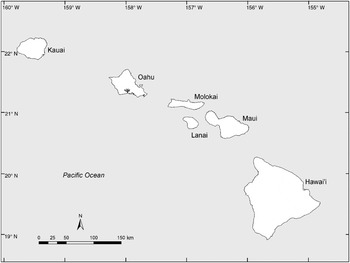
The Hawaiian Islands (Fig. 1) are one of the most isolated archipelagos and have experienced spectacular radiations of their biota, particularly invertebrates and birds (Zimmerman, Reference Zimmerman1970; Cowie & Holland, Reference Cowie and Holland2008). They contain a small lizard fauna that is thought to be of recent origin (McKeown, Reference McKeown1996; Fisher, Reference Fisher1997; Austin, Reference Austin1999), although this assumption is untested for some skinks (Cryptoblepharus and Emoia). James et al. (1987; see their Table 1) provided evidence of an early fossil lizard bone that predates humans on the islands, leaving open the question of natural dispersal to the islands. Most of the documented extinctions from the Hawaiian Islands have been from its bird, insect and snail radiations and many hundreds of species are now threatened (Cowie & Holland, Reference Cowie and Holland2008). Because of their role in international commercial routes the Hawaiian Islands have experienced major invasions of exotic species; for example, > 2,000 invertebrate species (Howarth, Reference Howarth, Stone and Scott1985) and many reptiles and amphibians (McKeown, Reference McKeown1996; Kraus, Reference Kraus2002, Reference Kraus2009; Kraus & Duvall, Reference Kraus and Duvall2004).
The large southern islands of the Hawaiian Archipelago. Historical records for Emoia impar were documented from all of these islands except Lanai. The invasive species Lampropholis delicata has now been recorded from all these islands. The exotic Emoia cyanura was only recorded for a limited period of time, from Kauai.
Distribution and collecting periods for Emoia cyanura, Emoia impar and Lampropholis delicata on the Hawaiian Islands (Fig. 1). The numbers in the cells represent the number of museum vouchers recorded from that decade.

Girard (Reference Girard1858) provided the first species list of Hawaiian reptiles but the first detailed study of reptiles was made by Stejneger (Reference Stejneger1899). Subsequent studies (McGregor, Reference McGregor1904; Snyder, Reference Snyder1917; Tinker, Reference Tinker1941; Oliver & Shaw, Reference Oliver and Shaw1953; Hunsaker & Breese, Reference Hunsaker and Breese1967; McKeown, Reference McKeown1996) followed and offer a potential history of the appearance and disappearance of species. These data indicate that when Europeans arrived three species of skinks (Cryptoblepharus poecilopleurus, Emoia impar [as cyanura and schauinslandi], and Lipinia noctua) were present on the Hawaiian Islands.
Until recently Emoia cyanura was considered a single species across the Pacific Basin but morphological and ecological analysis by Ineich (Ineich, Reference Ineich1987a,b; Ineich & Zug, Reference Ineich and Zug1991) indicated that there were two species (E. cyanura and E. impar) sympatric across this large region. Early recognition that Hawaiian Emoia had two distinct forms led Werner (Reference Werner1901) to the recognition of a blue striped one and a melanistic one, although these are colour morphs of the same species. They are members of E. impar, and this species is the only Emoia species that occurred historically on the Hawaiian Islands. This confusion, and the recent introduction of E. cyanura, confounded a full understanding of the history of Emoia in the islands. Here we examine literature reports and museum specimens and report field surveys to assess the current status of this genus on the Hawaiian Islands.
Methods
Combining literature and museum data with recent fieldwork we trace the historical and recent occurrence of E. cyanura and E. impar across the Hawaiian Islands. We also collected data on the recently introduced Lampropholis delicata (originating from Australia) as part of our assessment of extinction of Hawaiian Emoia. The three taxa are ecologically similar as generalist diurnal ground skinks. Of the other skinks, the snake-eyed skink Cryptoblepharus poecilopleurus is restricted to rocky or corallian shorelines of the Hawaiian Islands, and the moth skink L. noctua is semi-burrowing and semi-arboreal in the Islands.
Literature review
We reviewed all available literature on Hawaiian reptiles, including the main islands and the north-western islands, focusing on E. cyanura, E. impar and L. delicata. We tried to determine the validity of each report of these species and to locate museum specimens vouchering the reports. Data come from both the primary and grey literature.
Museum surveys
We examined E. impar and E. cyanura specimens in the major museums and confirmed the specific identity of Hawaiian specimens. Additionally, we used online collection query tools (Herpnet, Global Biodiversity Information Facility) to determine the presence of additional specimens and, where possible, examined the specimens to confirm identification. Only specimens with detailed island locations are considered. When known, the date of collection is reported in parentheses. See footnote to Appendix for museum acronyms.
Field surveys
We surveyed the historical localities for all reported Hawaiian Emoia to determine the current presence of skinks. We used visual encounter transects and random searches. All surveys were during daytime under appropriate weather conditions (sunny or partial clouds). Our fieldwork was conducted on the following islands and years: Kauai, 1988, 1990, 2003, 2008; Oahu, 1988, 2007; Maui, 1988; Hawai'i, 1988, 1990, 2001, 2007, 2008. In addition we consulted other field researchers who may have encountered these species in the field for their observations or additional specimens not deposited in museums.
Results
Literature review
We found literature records (Snyder, Reference Snyder1917) validating the occurrence of E. impar from the mid 1800s to 1902. We could not confirm the presence of E. impar after 1902 in any publication. We also found no records for any Emoia on the north-western islands and could confirm the occurrence of Emoia only from Kaua'i, Oahu, Molokai, Maui and Hawai'i Island (Appendix). Emoia have never been reported from any smaller offshore islets.
La Rivers’ (Reference La Rivers1948) general ecological study near the Pearl Harbor area of Oahu in 1944/1945 reported a skink as E. cyanura. He encountered only one species of skink. All 1940s Oahu skink voucher specimens (>100) are Lampropholis, most from Honolulu and a couple from Pearl Harbor. Thus L. delicata was the dominant ground dwelling skink, and he mistakenly identified his specimens as E. cyanura. We searched for voucher specimens from La Rivers' study and found none. Oliver & Shaw (Reference Oliver and Shaw1953) discussed E. cyanura based in part on their field observations from 1943. They did not indicate that they observed this taxon; their discussion of E. cyanura derived from the literature, as did Tinker's (Reference Tinker1941). Hunsaker & Breese (Reference Hunsaker and Breese1967) surveyed the Hawaiian herpetofauna in 1962 and they do not mention any Emoia in the results of their survey. Quay (Reference Quay1973) surveyed several sites on Kaua'i, including the Napali coast, and found only Lampropholis.
All subsequent literature reports are clearly not of Emoia, except Lazell (Reference Lazell1986) who discusses an introduced population of E. cyanura that was established in Po'ipu, Kaua'i. McKeown (Reference McKeown1996) summarizes the situation with the two Emoia species in the Hawaiian Islands and reports the discovery of the E. cyanura population at Po'ipu in 1979 by Matt Walsh. The only museum specimen of E. cyanura collected by Walsh (BPBM 8303) is listed as 23 July 1980. Kraus (Reference Kraus2005) reported two potential recent records of E. impar, one each from Kala'e and Mokapu Islands, both on the north coast of Molokai. Two additional important references are Baker's (Reference Baker1979) discussion of Lampropholis history and Bazzano's (Reference Bazzano2007) surveys of national parks on Hawai'i Island. Neither researcher found Emoia.
Museum surveys
Only a few Hawaiian E. impar and E. cyanura specimens are available in museums. We located fewer than 100 specimens (Table 1; Appendix). There are no Emoia voucher specimens from islands north of the main islands; E. impar was documented from five of the large islands and E. cyanura only from one site on Kaua'i Island. The temporal distribution of the samples shows that only three E. impar were collected after 1902, and all 14 E. cyanura were collected between 1980 and 1990 (Table 1). E. impar records with precise locality came from low elevations (<300 m; n = 48). It is probable that E. impar was present when Europeans arrived and that E. cyanura was a recent introduction. Although we did not locate any Emoia voucher specimens from islands north of Kaua'i, there are specimens of E. cyanura from Wake Island (Atoll) from as early as 1923 (USNM 66829) and these E. cyanura are currently still common (J. Helm, pers. comm.). Wake Island is not geographically, geologically, or politically part of the Hawaiian Islands and is thus unrelated to this current discussion.
We located > 700 Hawaiian L. delicata in collections. The first record is somewhat confusing; it might be 1909 (BPBM 899; Baker, Reference Baker and Smith1976) although the date is questionable and could be a few years later (P. Imada, pers. comm.). There are several records between 1914 and 1919 from Oahu, thus it was well established by then. The first records for islands other then Oahu are not until the 1940s (Table 1). Within the Hawaiian Islands L. delicata occurs from sea level to over 1,000 m. It is the numerically dominant Hawaiian skink in museum collections and now commonly observed in the field.
Field surveys
E. cyanura was observed only on Kaua'i at the Moir Cactus Gardens near Poi'pu and only during our 1990 survey. The specimen collected on that survey is the last one represented in a museum collection. During a 3-day visit in 1990 c. 20 individuals were seen in these gardens. The 2003 and 2008 surveys, conducted at the same site by the same observer (RNF), failed to detect any E. cyanura. We suggest that this species is now extinct on the Hawaiian Islands. It probably occurred on Kaua'i only from the late 1970s to the early 1990s, consistent with available museum voucher specimens. This species never spread outside these gardens. The 1990 sample was included in a genetic assessment of the cyanura complex and contained the same mitochondrial haplotype as other populations from the south Pacific, consistent with a recent human introduction to Kaua'i (Bruna et al., Reference Bruna, Fisher and Case1996a).
In 2008 we searched the three localities on the Napali coast where E. impar was last detected on Kaua'i. No Emoia were observed, although Lampropholis was present, as previously reported by Quay (Reference Quay1973). Other field surveys during other years and on other islands failed to detect any Emoia even though they specifically targeted Emoia species and the observers had much experience with these lizards elsewhere in the Pacific. This species now appears to be absent from the Hawaiian Islands.
Discussion
Our literature and museum review and recent field work indicate that E. impar is now absent from the Hawaiian Islands. The Hawaiian populations were the northernmost occurrence of this species in the Pacific (Ineich & Zug, Reference Ineich and Zug1991). Environmental conditions may have restricted it to lower elevations. The temporal pattern of E. impar extirpation is striking. They disappeared across all islands by the early 1900s. Museum records demonstrate their presence on multiple islands in the decade between 1892 and 1902. Only three individuals were collected after 1902 (one each in 1948, 1956 and 1963) and all were from within a few kilometres of each other along the remote and rugged Napali coast of Kaua'i, with no records for this species after 1963. These three individuals were collected by different observers and are housed in two collections, indicating that the species persisted along this remote stretch of mountains at least 60 years longer than in the rest of the archipelago.
The extinction of non-charismatic species frequently goes unnoticed, and data are typically lacking to determine the cause. These situations are even more confusing when there are unresolved systematic issues such as those within the E. cyanura species complex. Here we have documented the rapid disappearance of a small skink from several islands within the Hawaiian Archipelago in a temporally synchronous pattern. This pattern, and the timing of the extinction, matches that observed for Hawaiian land birds (Atkinson, Reference Atkinson1977) and several invertebrate groups (Howarth, Reference Howarth, Stone and Scott1985; Krushelnycky et al., Reference Krushelnycky, Loope and Reimer2005). This temporal concordance (from the early 1890s to early 1900s) might indicate a single causal factor for these declines. Alternatively, these declines might represent a series of extinctions that were ongoing since Polynesian and European contacts but were brought to the attention of scientists for the first time via the observations of Perkins (Reference Perkins1913).
Below we evaluate the main processes that might have caused the extinction of E. impar. We highlight the complexity of resolving causation for events that took place a long time ago but are relevant to investigate, as they may inform management and conservation of this and similar species throughout the Pacific.
Habitat destruction
There has been extensive development of the Hawaiian Islands both historically and recently, primarily for cultivation and housing (Burney et al., Reference Burney, James, Burney, Olson, Kikuchi and Wagner2001). Recent research on the south coast of Kaua'i shows that most lowlands of the Hawaiian Islands, including the dry leeward sides, were wetter before humans arrived and contained many species now extinct or restricted to higher, wetter and cooler habitats (Burney et al., Reference Burney, James, Burney, Olson, Kikuchi and Wagner2001). Although this drying has a role in the extinction and endangerment of many lowland species, the Napali coast of Kaua'i (the last known location of E. impar) is remote and currently well protected from land-use change. The valleys of this region were historically cultivated but are now regenerated forest habitats.
The introduction of E. cyanura onto the Hawaiian Islands was entirely within the Moir Cactus Gardens enclosed within a large hotel complex in Poi'pu on Kaua'i. The habitat is entirely managed and artificial. Elsewhere in the Pacific, E. cyanura is often associated with disturbance; E. impar typically prefers more forested areas (Ineich, Reference Ineich1987a,b; Bruna et al., Reference Bruna, Fisher and Case1996b; Schwaner & Ineich, Reference Schwaner and Ineich1998) but both species are often found in syntopy. Low elevation habitat change would affect E. impar but it does not alone explain the apparent rapid synchronous extinction of this species across all major Hawaiian Islands.
Competition
The rapid decline and extirpation could result from competition with other skinks. E. cyanura was not a competitor as it never spread beyond its point of introduction. Furthermore, it appeared well after the last sighting of E. impar. Oliver & Shaw (Reference Oliver and Shaw1953) suggest that the introduction and expansion of L. delicata is responsible for declines of L. noctua, and this is cited by other authors (Hunsaker & Breese, Reference Hunsaker and Breese1967; Quay, Reference Quay1973). This assumption derives from the few specimens of Hawaiian L. noctua in collections and statements by early collectors on its rarity (although see Tinker, Reference Tinker1941; he apparently confused L. delicata for L. noctua, stating it was very common, possibly the source of this later confusion). L. noctua is uncommonly seen because of its cryptic habits. However, there was little to no temporal overlap between the extinction of E. impar and the invasion and spread of L. delicata. Perhaps L. delicata would have been precluded by E. impar or the absence of E. impar allowed L. delicata to become established and then to expand across the islands. In 1990 E. cyanura and L. delicata were sympatric at the Moir Cactus Gardens, and the latter is still present. There is no evidence for competition from other skinks as a cause for the decline and extinction of E. impar.
Predation
Both vertebrate and invertebrate predators are widespread on the Hawaiian Islands. Potential vertebrate predators of E. impar were reviewed by Atkinson (Reference Atkinson1977) and Atkinson & Atkinson (Reference Atkinson, Atkinson and Sherley2000). Atkinson (Reference Atkinson1977) provided an accurate and thorough chronology of mammalian introductions as these introductions relate to synchronous bird declines. His assessment was that only the timing of the introduction of ship rats Rattus rattus matched the avian declines. The mongoose Herpestes auropunctatus and domestic cat (Kirkpatrick & Rauzon, Reference Kirkpatrick and Rauzon1986) are both present on the Hawaiian Islands and may have been important in affecting E. impar; both prey on small skinks elsewhere in the Pacific (Gorman, Reference Gorman1975; Kirkpatrick & Rauzon, Reference Kirkpatrick and Rauzon1986; Bonnaud et al., Reference Bonnaud, Medina, Vidal, Nogales, Tershy and Zavaleta2010). The mongoose has been explicitly blamed for the decline of large species of Emoia from the main islands of Fiji (Pernetta & Watling, Reference Pernetta and Watling1978). Atkinson (Reference Atkinson1977) argued that since the cat was present on Hawaiian Islands prior to the late 1800s it cannot be linked to the increase in bird extinctions later in the century. He also argued that because the mongoose is absent on Kaua'i and Lanai it was not a factor for the synchronous bird extinctions. As it relates to Emoia, both cats and mongoose are predators of E. impar; however, even where one or both species are present in large numbers, as in Fiji, Samoa, and Tonga, skinks persist although in reduced numbers (Fisher & Ineich, pers. obs.). Regarding the argument for ship rats, they are major predators of birds and skinks (Towns et al., Reference Towns, Atkinson and Daugherty2006). Atkinson's (Reference Atkinson1977) argument about the timing of ship rat introductions on Hawaiian extinction thus has merit but the evidence that they could have caused this skink extinction is inadequate. On Clipperton Atoll the stomach contents of rats were examined and few E. cyanura were found despite the high density of these lizards and the recent arrival of rats (Lorvelec & Pascal, Reference Lorvelec and Pascal2006).
Potential invertebrate predators of E. impar are many (Howarth, Reference Howarth, Stone and Scott1985) but the evidence for ants seems the strongest (Perkins, Reference Perkins1913; Krushelnycky et al., Reference Krushelnycky, Loope and Reimer2005). Ants are well known for causing declines or extinctions of reptiles by various mechanisms, including direct predation of adults or eggs, or indirectly by changing the food available for the reptiles (Mount, Reference Mount1981; Chalcraft & Andrews, Reference Chalcraft and Andrews1999; Fisher et al., Reference Fisher, Suarez and Case2002; Diffie et al., Reference Diffie, Miller and Murray2010). The timing of the introduction of the big-headed ant Pheidole megacephala and its documented effects on endemic invertebrates gives credence to their impacts on numerous invertebrate and bird populations (Gillespie & Riemer, Reference Gillespie and Riemer1993; LaPolla et al., Reference LaPolla, Otte and Spearman2000; Plentovich et al., Reference Plentovich, Hebashi and Conant2009). Wetterer (Reference Wetterer2007) indicated that this ant is common up to 900 m on Hawaiian Islands, well above the elevational limit recorded for E. impar, and has been the dominant ant of the Hawaiian lowlands for the last 125 years, often excluding all other ant species (Jones et al., Reference Jones, Westcott, Finson and Nishimoto2001). The early Hawaiian Islands' invasion and dominance of this species into the previously ant-free invertebrate communities may have led to disproportional impacts on species that evolved in the absence of ants (Perkins, Reference Perkins1913). We cannot refute the role of this ant in the decline and extinction of E. impar. L. delicata evolved in eastern Australia within a rich ant community and is probably not affected by these species in Hawai'i (Andersen, Reference Andersen1995).
Zoonotics
Zoonotics are a possible cause for skink extinction, especially if they were linked to the introduction of L. delicata, although there is no temporal overlap of these species on the Hawaiian Islands. Atkinson (Reference Atkinson1977) discussed the potential diseases of birds that were linked early to their decline. For some native birds, sick and diseased individuals were observed (Perkins, Reference Perkins1913) and disease remains a possibility. The Napali coast and Alakai swamp were also refugia for birds, sharing the same extinction pattern with E. impar (Warner, Reference Warner1968; van Riper et al., Reference van Riper, van Riper, Goff and Laird1982).
There is no evidence of mortality among Pacific skinks from virulent pathogens. Externally, E. cyanura and E. impar of the eastern oceanic Pacific lack parasites (Acari are present on some species in the western Pacific; I. Ineich & R. Fisher, unpubl. data) but there is no evidence of virulence of external parasites in skinks. All preserved specimens from Hawaii lacked external parasites. For internal macroparasites, two recent studies of Emoia, both including E. impar (Goldberg et al., Reference Goldberg, Bursey and Fisher2005, 2008), identified several species of cestodes, digeneans and nematodes but it is doubtful that any of these might have become virulent within E. impar. Surveys for coccidian species found many new skink coccidians (S.J. Upton, R.N. Fisher, C.C. Austin & D.W.Duszynski, unpubl. data) but there is no evidence that coccidia are virulent in Pacific skinks.
Lastly, malaria is a possible but unlikely cause of the extinction of Hawaiian E. impar. Although malaria affects the population density and ecology of lizards there is no evidence of any lizard extinctions from malaria (Schall et al., Reference Schall, Bennett and Putnam1982; Schall, Reference Schall1996; Eisen, Reference Eisen2001) and no evidence of blood parasites in Hawaiian geckos (Hanley et al., Reference Hanley, Vollmer and Case1995).
If a zoonotic did affect E. impar, where did it come from and why does it not affect L. noctua and Cryptoblepharus poecilopleurus? Since there is no evidence of virulence with any potential zoonotics it seems unlikely that there was a rapid spread across the islands that led to extinction.
Contaminants
Perhaps early use of chemicals to control mosquitoes or other insect pests caused the widespread declines of E. impar. Effects of pesticides and other chemicals are poorly studied in reptiles but recent reviews have identified evidence of some population level effects from modern chemicals although most effects appear to be non-lethal (Todd et al., Reference Todd, Willson, Gibbons, Sparling, Linder, Bishop and Krest2010; Wedding et al., Reference Wedding, Ji and Brunton2010). The extinction of E. impar preceded the development of modern chemicals, however, and thus it is unlikely that contaminants were important in its decline. It is possible that the loss of E. cyanura from Kaua'i was a result of chemicals used for insect or rodent control in the resort.
Synopsis
We have documented the early extirpation of E. impar and the later invasion and expansion of L. delicata across the Hawaiian Islands using various forms of evidence. There is, however, no obvious single explanation for the extirpation of E. impar. This event appeared to have been rapid, leaving only a small population along a short distance of the Napali coast of Kaua'i into the 1960s. This decline could have been drawn out over many decades, leading to the appearance of being rapid, with only the tail end of the event being documented. The species loss is consistent with the combination of low elevation habitat loss and xerification from human activities (sensu Burney et al., Reference Burney, James, Burney, Olson, Kikuchi and Wagner2001), and the introduction and rapid spread of P. megacephala ants throughout the islands. The evidence that exotic mammals, especially rats, caused the rapid extirpation of this species is poor, although their role in affecting lizards is well documented (Towns et al., Reference Towns, Atkinson and Daugherty2006). Parasites, pathogens and contaminants seem unlikely to have had a major role in the early extirpation of E. impar from the islands. The species may still occur on small offshore islands (such as Huelo Islet off Molokai; A. Allison, pers. comm.) as was found for skinks in Guam (Perry et al., Reference Perry, Rodda, Fritts and Sharp1998) and any detection of the species on the Hawaiian Islands would be an important finding.
The effects of ants on lizards was reviewed by Holway et al. (Reference Holway, Lach, Suarez, Tsutsui and Case2002) and there are several examples of ants negatively affecting lizards on tropical islands, including New Caledonia, the Mascarene Islands and the Seychelle Islands (Feare, Reference Feare1999; Jourdan et al., Reference Jourdan, Sadlier and Bauer2001; Turpin, Reference Turpin2002; Sanchez, Reference Sanchez2007; Hansen & Müller, Reference Hansen and Müller2009). The recently documented rapid spread of yellow crazy ants Anoplolepis gracilipes across Christmas Island and Tokelau has shown how rapidly ants can change island ecosystems and destroy biodiversity (Abbott, Reference Abbott2006; Sarty et al., Reference Sarty, Abbott and Lester2007; M. Smith, pers. comm.). The early invasion of much of the Pacific Basin by ants and their associated impacts (Krushelnycky et al., Reference Krushelnycky, Loope and Reimer2005) combined with our incomplete knowledge of the biodiversity of this region may have led to many of the observed species disjunctions. Species such as the small skink Leiolopisma alazon, which is known from one tiny island in Fiji (Zug, Reference Zug1985), may be currently restricted by ants as early surveys for ants showed invasive species were already present on some of these remote islands before the 1920s (Mann, Reference Mann1921). Increasing our knowledge of the impacts of invasive ants on vertebrates, particularly lizards, in the tropics should be a priority.
Acknowledgements
We thank the following curators for their help in the loan of specimens in their care: David Kizirian (AMNH), Colin McCarthy (BMNH), Carla Kishinami and Pumehana Imada (BPBM), Jens Vindum (CAS), José Rosado (MCZ), Chris Philips (UIMNH), George Zug (USNM) and the late Jens B. Rasmussen (ZMUC). The accomplishment of illuminating the reptile fauna of Hawai'i and the memory of the late Sean McKeown are greatly appreciated by RNF. Allen Allison and an anonymous reviewer offered comments that improved the manuscript, and George Zug provided both substantial encouragement and editing. The use of trade names does not imply U.S. Geological Survey endorsement.
Appendix
The appendix for this article is available online at http://journals.cambridge.org
Biographical sketches
Robert Fisher is a research scientist with the U.S. Geological Survey whose research focuses on the impacts of humans on biodiversity. Most of his research is conducted in southern California and the oceanic Pacific. This research involves natural history, historic biogeography, invasive species, and disturbance to determine baseline conditions and current/future impacts to better inform conservation management. Ivan Ineich has been the curator of the squamate reptile collections at the Paris Natural History Museum (MNHN) since 1988. He studies the systematics and biogeography of the reptiles of French Polynesia and has travelled to many Pacific islands and described new lizard and snake species from Vanuatu, Fiji, Micronesia and French Polynesia. His major interests are the systematics, biogeography and conservation of the reptiles of the Pacific islands but he also has an interest in African reptiles.



