




1. Introduction
Ever increasing insights into variation in English world–wide (e.g. Kachru Reference Kachru, Quirk and Widdowson1985; Schneider Reference Schneider2007; Mair Reference Mair2013; Bolton Reference Bolton2025) have led to pedagogical discussion and innovation as well as the emergence of new paradigms in the field of English Language Teaching (ELT) (see Saraceni, Ch.7 for an overview). These paradigms suggest that increased attention be paid to the pedagogical implications of the global spread and diversity of English in the classroom. Two important and closely related World Englishes–informed ELT paradigms comprise Teaching English as an International Language (TEIL; e.g. Matsuda Reference Matsuda and Matsuda2012) and Global Englishes Language Teaching (GELT; e.g. Rose and Galloway Reference Rose and Galloway2019).
One of the pedagogical implications frequently discussed in TEIL/GELT discourse is the question of which variety (or varieties) of English should serve as the instructional target of ELT. In their foundational work, Matsuda and Friedrich (Reference Matsuda, Friedrich and Matsuda2012) argue, above all, for an informed context–sensitive answer to that question. Specifically, as they suggest, the instructional variety should be selected ‘taking various contextual factors into consideration, including learner goals, the teacher’s background, local attitudes toward English(es) and the availability of didactic materials’ (Matsuda and Friedrich Reference Matsuda, Friedrich and Matsuda2012, 23).
In Germany, there has been a recent surge in research works concerned with context–specific perspectives on TEIL/GELT in the country (e.g. Callies et al. Reference Callies, Hehner, Meer and Westphal2021; König et al. Reference König, Römhild and Schildhauer2023). Several of these works have investigated contextual factors mentioned above (cf. Matsuda and Friedrich Reference Matsuda, Friedrich and Matsuda2012: 23), including: teachers’ and teacher educators’ backgrounds and perspectives on World Englishes (Forsberg et al. Reference Forsberg, Mohr and Jansen2019; Hölscher and Meer Reference Meer, Callies, Hehner, Meer and Westphal2021), local attitudes toward Englishes (Davydova Reference Davydova2015; Hartmann Reference Hartmann, Callies, Hehner, Meer and Westphal2021; Meer et al. Reference Meer, Hartmann and Rumlich2021, Reference Meer, Hartmann and Rumlich2022), curricular guidelines (Bieswanger, Reference Bieswanger, Callies, Hehner, Meer and Westphal2021; Meer, Reference Meer, Callies, Hehner, Meer and Westphal2021), and didactic materials (Syrbe and Rose Reference Syrbe and Rose2018; Schildhauer et al. Reference Schildhauer, Schulte and Zehne2020). However, learner goals – in particular secondary school students’ accent aims and their corresponding patterns of speech production – have been underresearched (but see Kautzsch Reference Kautzsch, Buschfeld, Hoffmann, Huber and Kautzsch2014, 220–222 on accent aims and pronunciation patterns concerning rhoticity/non–rhoticity among German university students; see Section 2).
Research on learners’ accent aims and pronunciation can provide important perspectives for teachers and TEIL/GELT curriculum designers with respect to the question of the instructional variety (or varieties). Firstly, such research can reveal learners’ goals in terms of pronunciation. Secondly, it can show whether and to what extent learners of English produce speech in line with their accent aim. That is, depending on the existence and strength of the link between accent aim and production, educators may gain important insights into the (individual) language learner (e.g. Dörnyei Reference Dörnyei2005).
The present paper provides a small–scale exploratory analysis of L2 English pronunciation and accent aims among secondary school students in Germany. As in many other countries where English is traditionally taught as a foreign language, learners of English in Germany are typically presented with two primary instructional models, namely Standard Southern British English (StSBrE) and Standard American English (StAmE) (e.g. Kautzsch Reference Kautzsch, Buschfeld, Hoffmann, Huber and Kautzsch2014, 211; Meer Reference Meer, Callies, Hehner, Meer and Westphal2021). More specifically, therefore, the study focuses on the students’ use of selected StSBrE and StAmE segmental phonological features. It further addresses the question of which accents the students aim at when speaking English. While this paper provides first preliminary insights into German secondary school learners’ accent aims and pronunciations that can inform TEIL/GELT and further related research, the study relies on a very limited dataset. Its findings need to be interpreted cautiously and cannot be generalized.
2. Background and previous research
2.1 Varieties of English in ELT in Germany
Varieties of English other than StSBrE and StAmE generally play a minor role in the German ELT classroom (e.g. Kruse Reference Kruse2016; Hehner et al. Reference Hehner, Meer, Callies, Westphal, Brandt, Buschmann–Göbels and Harsch2021). English language education in the country has traditionally had a strong focus on these Inner Circle varieties (Kachru Reference Kachru, Quirk and Widdowson1985). Both textbooks and classroom practice, for example, rarely cover non–British and non–American Englishes (Bieswanger Reference Bieswanger2008; Kruse Reference Kruse2016; Syrbe and Rose Reference Syrbe and Rose2018). Furthermore, when these varieties are introduced in the classroom, there appears to be a lack of explicit discussion and reflection on language–related aspects (Kruse Reference Kruse2016, 349–351). The underrepresentation of varieties of English is likely to be related to the relatively small extent and often indirect way in which TEIL/GELT aspects are represented in English language curricula (Meer Reference Meer, Callies, Hehner, Meer and Westphal2021).
Not unlike in other European and other Expanding Circle countries, English teachers in Germany often show a general preference toward StSBrE and StAmE. Teachers commonly view these standard varieties as the most ‘correct’, ‘pleasant’, and ‘internationally accepted’ forms of English (Jenkins Reference Jenkins2007, 188; Kruse Reference Kruse2016, 364; Forsberg et al. Reference Forsberg, Mohr and Jansen2019, 51). As a result, German (and many other European) teachers primarily rely on these Englishes as instructional varieties and often present them as the exclusive standards in the classroom (Henderson et al. Reference Henderson, Frost and Tergujeff2012; Kautzsch Reference Kautzsch, Buschfeld, Hoffmann, Huber and Kautzsch2014: 211; Forsberg et al. Reference Forsberg, Mohr and Jansen2019, 44–47). That is, learners of English are generally confronted with both StSBrE and StAmE as the main models for English language use in school.
2.2 L2 pronunciation and accent aims among German (and other) learners of English
Language attitude research has revealed that German secondary school students typically favor StSBrE and, to a smaller degree, StAmE with respect to the attitudinal dimensions of competence and professionalism (Meer et al. Reference Meer, Hartmann and Rumlich2022). On an attitudinal level, both varieties serve as the general reference standards for the learners (Meer et al. Reference Meer, Hartmann and Rumlich2021). Similar tendencies have also been observed among German university students (Davydova Reference Davydova2015; Hartmann Reference Hartmann, Callies, Hehner, Meer and Westphal2021; Seyranyan and Westphal Reference Seyranyan and Westphal2021). Likewise, research on L2 accent aims among German university learners of English indicates a general orientation toward StSBrE or StAmE as the target accent (e.g. Kautzsch Reference Kautzsch, Buschfeld, Hoffmann, Huber and Kautzsch2014, 213). At the same time, German learners of English tend to mix StSBrE and StAmE features in pronunciation without necessarily being aware of this (Kautzsch Reference Kautzsch, Buschfeld, Hoffmann, Huber and Kautzsch2014, 221; Rottschäfer Reference Rottschäfer2018; Jansen and Langstrof Reference Jansen, Langstrof and Hickey2019, 238–239). For instance, in a study of accent and identity among eleven German (and French) university students immersed in an international, English as a Lingua Franca setting (the University of Aarhus, Denmark), Rottschäfer (Reference Rottschäfer2018, 244) found that while most German participants reported to be influenced by StAmE pronunciation, their own accents were quite variable and not specifically American–oriented.
L2 pronunciation research with German (university) learners in Germany has so far focused on variation in the realization of two variables that characteristically distinguish StSBrE and StAmE: (i) rhoticity/non–rhoticity, i.e. the (non–) realization of non–prevocalic, non–linking /r/ in syllable coda position, and (ii) the bath vowel (Wells Reference Wells1982, 133–135), such as in words like staff, path, sample or half (e.g. Kautzsch Reference Kautzsch, Buschfeld, Hoffmann, Huber and Kautzsch2014; Jansen and Langstrof Reference Jansen, Langstrof and Hickey2019; Sönning Reference Sönning2020). While StSBrE is typically non–rhotic (e.g. Upton Reference Upton, Kortmann and Upton2008, 241), non–prevocalic coda /r/ is generally realized in StAmE (e.g. Kretzschmar Reference Kretzschmar and Edgar2008, 44). In StSBrE, bath varies between low back [ɑː] and more fronted [a] (e.g. Upton Reference Upton, Kortmann and Upton2008, 241–243). In StAmE, by contrast, the vowel is generally more raised and fronted to approximately [æː] (e.g. Kretzschmar Reference Kretzschmar and Edgar2008, 44).
Overall, the findings of L2 pronunciation research in the German context indicate two tendencies, namely (i) a certain link between L2 accent aim and pronunciation and (ii) a generally higher frequency of production of variants associated with StSBrE – in line with the language attitudinal preference of StSBrE among German learners mentioned above. Regarding (i), Kautzsch (Reference Kautzsch, Buschfeld, Hoffmann, Huber and Kautzsch2014, 221) observes that – with respect to the realization of non–prevocalic /r/ – learners with StSBrE as self–reported target accent generally produce very low rates of rhoticity in read speech. By contrast, learners targeting StAmE show substantially higher rates of rhoticity (though considerably lower rates than a control group of L1 StAmE speakers). Similarly, Sönning (Reference Sönning2020, 146) reports a split among the advanced German learners investigated in his study: one (potentially StSBrE–oriented) group of learners showed consistently low rates of rhoticity, while the other (potentially StAmE–oriented) group was found to produce high rates of rhoticity. However, self–reported target accents were not elicited in that study (Sönning Reference Sönning2020). Moreover, in their study of L2 pronunciation of non–prevocalic /r/ and bath among German university students of English, Jansen and Langstrof (Reference Jansen, Langstrof and Hickey2019, 239) identify a link between StSBrE– and StAmE–associated features, such that some speakers produce consistently high rates of rhoticity and raised bath [æː], while others avoid both pronunciations. With regard to (ii), the preference for StSBrE–associated variants in production is quite pronounced, both with regard to non–rhoticity and backed bath (Kautzsch Reference Kautzsch, Buschfeld, Hoffmann, Huber and Kautzsch2014; Jansen and Langstrof Reference Jansen, Langstrof and Hickey2019; Sönning Reference Sönning2020). As these studies report, of all tokens examined, a StSBrE variant is produced in around 2 out of 3 (or even 3 out of 4) cases (Kautzsch Reference Kautzsch, Buschfeld, Hoffmann, Huber and Kautzsch2014, 221; Jansen and Langstrof Reference Jansen, Langstrof and Hickey2019, 238; Sönning Reference Sönning2020, 146).
Large–scale studies on L2 pronunciation and accent aims are available for the Norwegian English language education context (Rindal Reference Rindal2010; Rindal and Piercy Reference Rindal and Piercy2013). The studies investigated variation in L2 pronunciation with respect to several phonological variables that distinguish StSBrE and StAmE. Apart from non–prevocalic /r/ and bath, these included the lot vowel (StSBrE [ɒ], StAmE [ɑː]), intervocalic /t/ (StSBrE [t], StAmE [ɾ]), and goat (StSBrE [əʊ], StAmE [oʊ]). Firstly, the findings of both studies revealed a blended use of StSBrE and StAmE phonological features, with American pronunciations being dominant overall (Rindal Reference Rindal2010, 246; Rindal and Piercy Reference Rindal and Piercy2013, 218–219). Secondly, the learners’ accent aims showed a clear preference of StAmE and, to a slightly lesser extent, StSBrE compared to a ‘neutral’, Norwegian, or any other accent (Rindal and Piercy Reference Rindal and Piercy2013, 221). Thirdly, the learners’ L2 pronunciations generally corresponded to their self–expressed accent aims. That is, with regard to bath, lot, goat, non–prevocalic /r/, and intervocalic /t/, learners aiming for StAmE or StSBrE produced comparatively more variants associated with their targeted variety than the respective other group (Rindal and Piercy Reference Rindal and Piercy2013, 221). Fourthly, for non–prevocalic /r/, intervocalic /t/, and lot, pronunciation was significantly influenced by the formality of the speaking style (word list vs. conversation), with the word list eliciting more rhotic than non–rhotic variants, more [t] than [ɾ], and more [ɒ] than [ɑː] – possibly due to the influence of orthography and/or L1 Norwegian (Rindal and Piercy Reference Rindal and Piercy2013, 218).
3. Research questions and hypotheses
The study investigates the following research questions (RQ) and investigates, where possible, corresponding hypotheses (H) based on previous research (Section 2):
RQ1 What are the L2 English pronunciation patterns among the German high school students, and which pattern is dominant?
H1 The learners will show blended use of StSBrE and StAmE phonological variants. However, StSBrE–associated pronunciations will be dominant overall (Kautzsch Reference Kautzsch, Buschfeld, Hoffmann, Huber and Kautzsch2014, 221; Jansen and Langstrof Reference Jansen, Langstrof and Hickey2019, 238; Sönning Reference Sönning2020, 146).
RQ2 What are the learners’ L2 accent aims?
H2 Most learners will aim for StSBrE–associated and, to a slightly lesser degree, StAmE–associated pronunciations (Kautzsch Reference Kautzsch, Buschfeld, Hoffmann, Huber and Kautzsch2014, 213; Meer et al. Reference Meer, Hartmann and Rumlich2021, Reference Meer, Hartmann and Rumlich2022).
RQ3 To what extent do the learners’ self–expressed target accents correspond to their L2 pronunciation?
H3 Overall, the learners’ L2 pronunciation will tend to align with their accent aims – a certain degree of possible variation notwithstanding (Kautzsch Reference Kautzsch, Buschfeld, Hoffmann, Huber and Kautzsch2014, 221; see also Rindal and Piercy Reference Rindal and Piercy2013; Rottschäfer Reference Rottschäfer2018; Jansen and Langstrof Reference Jansen, Langstrof and Hickey2019, 239; Sönning Reference Sönning2020, 146).
4. Data and method
4.1 Participants
The participants in this exploratory study were eight upper secondary school students (grade 11; Sekundarstufe II) attending an advanced–level course (Leistungskurs) at a high school (Gymnasium) located in the northern part of the Ruhr area in North Rhine–Westphalia (Kreis Recklinghausen), i.e. in the largest urban area in Germany in the country’s most populous state. The learners were between 16 and 19 years old (four females, four males). Their first language (L1) was German, and none had parents who are L1 speakers of English. None had spent longer periods abroad in an English–speaking country.
4.2 The phonological variables
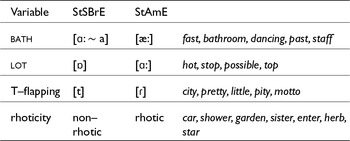
The study analyzes L2 pronunciation in terms of phonological variables that are distinct in StSBrE and StAmE, following previous studies (Rindal Reference Rindal2010; Rindal and Piercy Reference Rindal and Piercy2013; Kautzsch Reference Kautzsch, Buschfeld, Hoffmann, Huber and Kautzsch2014; Jansen and Langstrof Reference Jansen, Langstrof and Hickey2019; Sönning Reference Sönning2020; see Section 2.2). Two vocalic and two consonantal variables were selected: bath, lot, T–flapping, and rhoticity (seeTable 1).
Overview of the phonological variables with the StSBrE and StAmE variants as well as tokens included in the analysis

4.3 Data collection
The learners were recorded in two formal speaking styles, reading (i) a list of eight short sentences and (ii) a list of 14 words. The sentences contained three /t/, bath, and lot tokens, respectively, as well as five tokens of non–prevocalic coda /r/. The word list contained two tokens of each variable. See Table 1 for an overview of the tokens. Additional words were included as fillers. All recordings were made in a quiet room provided by the school using a Zoom H4n recorder.
The learners additionally filled out questionnaires. The questionnaire design broadly followed that in Rindal (Reference Rindal2010), but all questions had previously been translated to German to avoid misunderstandings among the learners. Apart from questions concerning personal data, the learners were asked which accent they aimed at when speaking English using the following options: ‘American’, ‘British’, ‘Other’ and ‘I do not care’. They were additionally asked to give reasons for their choices.
4.4 Data analysis
Following the methodological approach of related previous studies (Rindal Reference Rindal2010; Rindal and Piercy Reference Rindal and Piercy2013; Rottschäfer Reference Rottschäfer2018; Jansen and Langstrof Reference Jansen, Langstrof and Hickey2019), the recordings were analyzed auditorily by the first author and another phonetically trained coder in Praat (Boersma and Weenink Reference Boersma and Weenink2018). Auditory coding was complemented by visual inspection of the spectrogram (and speech waveform).Footnote 1 Both coders were L1 speakers of German. To ensure reliability, half of the data was analyzed by both coders, and an inter–rater agreement test was conducted. Inter–rater reliability (measured as percentage of agreements) of 93.2% was achieved. An agreement of 80% or higher is typically deemed reliable in the phonetic sciences (Clopper Reference Clopper, Di Paolo and Yaeger–Dror2011, 190). In total, 172 tokens were analyzed, including 40 bath tokens, 39 lot tokens, 39 tokens of /t/ and 54 tokens of non–prevocalic coda /r/.
Given that learner speech was analyzed, in some cases productions by the learners did not fully match the StSBrE or StAmE variant that they may have intended to produce. For instance, considering that the German vowel inventory includes /a:/ but not /ɑ:/ (e.g. Pätzold and Simpson, Reference Pätzold and Simpson1997; Grantham O’Brien and Fagan Reference Grantham O’Brien and Fagan2016), many non–raised realizations of bath were phonetically closer to [a:] or centralized [a̠:] than [ɑ:]. Similarly, since /ɒ/ does not form part of the German vowel inventory (e.g. Pätzold and Simpson, Reference Pätzold and Simpson1997; Grantham O’Brien and Fagan Reference Grantham O’Brien and Fagan2016), rounded productions of lot would often be closer to [ɔ] or [ɔ̞] than [ɒ]. It is also important to note that some of these potential German learner variants, such as bath [a:] or [a̠:] or lot [ɔ] or [ɔ̞], are naturally closer to their StSBrE counterparts (bath: both low, lot: both rounded) than the respective variants in StAmE (bath: raised, lot: unrounded). Unlike StAmE, German and StSBrE moreover show similarities in their phonologies with respect to the two consonantal features investigated here. Firstly, both are generally non–rhotic.Footnote 2 Secondly, while flapped /t/ is an allophonic variant in German, flapping is typically not associated with German standard speech.
Following Rindal (Reference Rindal2010, 243–248), tokens that auditorily resembled the StAmE or StSBrE realization in Table 1 were classified as either ‘StSBrE–oriented’ or ‘StAmE–oriented’. Tokens that could not clearly be matched to the StAmE/StSBrE variant were coded as ‘Other’, e.g. [ʌ] for <staff>. As a result of the above–mentioned phonological similarities between German and StSBrE it is possible that learners’ StSBrE–oriented productions are influenced by L1 phonological tendencies, at least in part, potentially facilitating the use of StSBrE–like features.
Given that the present study is exploratory in nature and includes relatively small samples of both learners (N = 8) and tokens (N = 172, approximately 21 tokens per learner), the statistical analysis of the data will be descriptive in nature. Inferential statistical tests and models were not employed.
5. Results
5.1 Pronunciation patterns
Overall, the learners produced StSBrE–oriented realizations most frequently (see Figure 1). In total, 74% of all tokens showed StSBrE–oriented realizations, 23% were StAmE–oriented. Most StSBrE–oriented productions were found for the lot vowel (90%), i.e. approximately [ɒ], and in the case of rhoticity (83%), i.e. non–realization of non–prevocalic coda /r/. Somewhat fewer StSBrE–oriented realizations were observed for T–flapping (67%), i.e. non–flapped [t]. Slightly more than half of all bath tokens were StSBrE–oriented (53%), i.e. approaching [ɑ:]. In other words, StAmE–oriented productions were by and large restricted to bath (38%), i.e. [æ:], T–flapping (33%), i.e. [ɾ], and rhoticity (17%), i.e. realized coda /r/.
Distribution of StSBrE–/StAmE–oriented tokens for each variable and in total. Token numbers displayed in the bars (Nbath = 40, Nlot = 39, Ncoda /r/ = 54, N/t/ = 39, Ntotal = 172).

A large degree of variation between learners was also observed, mediated by speaking style (see Figure 2). Overall, rates of production of StSBrE–oriented features ranged from approximately 50–60% for some learners (J; H) to 90–100% for others (A; C), with the majority of learners varying from 70% to 85%. In total, StSBrE–oriented realizations were more frequent in the word list (78%) compared to the slightly less careful reading style (72%). Most individual learners also showed higher rates of StSBrE–oriented productions in the word list style. That is, StAmE–oriented realizations tended to occur somewhat more often in the slightly less careful reading style.
Speaking style–mediated distribution of StSBrE–/StAmE–oriented tokens across individual learners. Token numbers displayed in the bars (total per learner: N = 21).

5.2 Accent aims
The learners’ accent aims were overall balanced (see Table 2). Three learners indicated that they aimed for British English, four said that they targeted American English. One learner noted that they did not care.
The learners’ (N = 8) reported accent aims

Learners preferring British English (henceforth BrE aimers) motivated their choice as follows. They argued that British English sounded ‘more pleasant’ and ‘more polite’, and that it was ‘often more clearly understandable’ (learner C). Other comments concerned an assumed superiority of the British standard as ‘the ‘correct’ English, which one ought to speak in school’ and suggested that American English was ‘more difficult to understand’ (learner F). Learner H did not motivate their choice.
Learners expressing a preference for American English (henceforth AmE aimers) provided overall similar arguments. Learner A suggested that American English was ‘most understandable’, while British English was described to sound ‘very strange’. Other explanations offered included the idea of American English sounding ‘more fluent and more rounded off’ (learner G) or simply ‘nicer’ (learner D).
5.3 Relationship between L2 accent aims and pronunciation
The results show that to a certain degree both BrE aimers and AmE aimers produced variants associated with their target accent of English. However, the absence of statistical modeling notwithstanding, the overall effect of accent aim appears to be minimal: AmE and BrE aimers produced equally as many StSBrE–oriented variants across all phonological variables in total (74%) (see Figure 3).
Accent aims and L2 pronunciation patterns: Distribution of StSBrE–/StAmE–oriented tokens among BrE vs. AmE aimers for each variable and in total. Token numbers displayed in the bars (Nbath = 40, Nlot = 39, Ncoda /r/ = 54, N/t/ = 39, Ntotal = 172).

An overall match of accent aim and L2 pronunciation was only observed for two phonological variables, namely lot and rhoticity. Specifically, for lot, AmE aimers produced more StAmE–oriented [ɑ] (11%) than BrE aimers (0%). For rhoticity, AmE aimers produced considerably more non–prevocalic coda /r/ (27%) than BrE aimers (10%).
Non–agreement of accent aim and L2 pronunciation occurred in the case of bath and T–flapping. For bath, AmE aimers realized StAmE–oriented [æ(:)] equally as often as BrE aimers (40% each). StAmE–oriented T–flapping, on the other hand, occurred more frequently among BrE aimers (40%) than AmE aimers (21%).
While the agreement of accent aim and L2 pronunciation appears to be limited overall and dependent on the phonological variable in question, there is also a high degree of variation between learners (see Figure 4). Among the BrE aimers, for instance, learner C produced StSBrE–oriented productions in 91% of all cases. Learner H, on the other hand, only produced StSBrE–oriented realizations in around half of all cases (55%). Similarly, among the AmE aimers, some learners produced comparatively high rates of StAmE–oriented realizations (learner J; 43%), while others produced almost exclusively StSBrE–oriented variants (learner A; 90%).
Distribution of StSBrE–/StAmE–oriented tokens across individual learners by accent aim. Token numbers displayed in the bars (total per learner: N = 21).

6. Discussion and conclusion
The present paper has aimed to provide a small–scale exploratory analysis of L2 English pronunciation and accent aims among secondary school learners in Germany – with a focus on the bath and lot vowels, rhoticity, and T–flapping. While first insights were gained, the results should be interpreted with some caution and cannot as yet be generalized.
Regarding the question of the (dominant) L2 pronunciation patterns among the learners (RQ1), our hypothesis (H1) has largely been confirmed. The eight learners investigated here show blended use of StSBrE and StAmE phonological variants with relatively high degrees of variation between individual learners. In line with studies on German university learners (Kautzsch Reference Kautzsch, Buschfeld, Hoffmann, Huber and Kautzsch2014, 221; Jansen and Langstrof Reference Jansen, Langstrof and Hickey2019, 238; Sönning Reference Sönning2020, 146), StSBrE–oriented productions were dominant among secondary school students overall. The results thus partially disagree with observations made among Norwegian secondary school students, who showed an overall preference for StAmE–oriented variants (Rindal Reference Rindal2010, 246; Rindal and Piercy Reference Rindal and Piercy2013, 218–219). A possible explanation for this difference is the prominent role of StSBrE in the German English language classroom – not only with respect to teachers’ perspectives and actual classroom practice (Kautzsch Reference Kautzsch, Buschfeld, Hoffmann, Huber and Kautzsch2014, 211; Kruse Reference Kruse2016, 364; Forsberg et al. Reference Forsberg, Mohr and Jansen2019, 44–47, 51; Hölscher and Meer Reference Meer, Callies, Hehner, Meer and Westphal2021) but also secondary school students’ attitudes toward different varieties of English (Meer et al. Reference Meer, Hartmann and Rumlich2021, Reference Meer, Hartmann and Rumlich2022). The finding that the learners produced comparatively more StSBrE–oriented variants in the most careful speaking style (word list vs. reading sentences) is in line with this possible explanation. A further explanation might be that German L2 learners of English are less exposed to American English than Norwegian learners. American TV and movie productions, for instance, are typically dubbed in Germany but offered in their original version in Norway (Rindal Reference Rindal2010, 242). Yet another explanation is related to certain phonological similarities between German and StSBrE with respect to the vocalic and consonantal features investigated here. It is conceivable that learners’ predominantly StSBrE–oriented productions were influenced by phonological patterns in their L1 German. In this regard, the findings need not necessarily be interpreted in light of (explicit) alignment with StSBrE norms but simply in terms of cross–linguistic influence, at least in part. Sampling and sample size might also play a role.
With regard to learners’ accent aims (RQ2), our hypothesis (H2) that most learners would aim for StSBrE–associated and, to a slightly lesser degree, StAmE–associated pronunciations (Kautzsch Reference Kautzsch, Buschfeld, Hoffmann, Huber and Kautzsch2014, 213; Meer et al. Reference Meer, Hartmann and Rumlich2021, Reference Meer, Hartmann and Rumlich2022), was partially confirmed. Seven of the eight learners indeed noted that they either aimed for a StSBrE– or StAmE–oriented pronunciation; only one indicated no preference. However, a relative preference for StSBrE was not observed; the learners approximately equally aimed for British– vs. American–oriented pronunciations. Given the small sample size, this tendency should be verified (or falsified) by further research.
The results offer interesting findings concerning the relationship between learners’ self–expressed target accents and their L2 pronunciation (RQ3). Our hypothesis (H3) that the learners’ L2 pronunciation would generally tend to align with their accent aims could only partially be confirmed. To a certain degree, both BrE aimers and AmE aimers produced variants associated with their target accents. However – partially in contrast to observations among Norwegian secondary school learners (Rindal Reference Rindal2010; Rindal and Piercy Reference Rindal and Piercy2013) and German university students in Germany (Kautzsch Reference Kautzsch, Buschfeld, Hoffmann, Huber and Kautzsch2014, 221; Jansen and Langstrof Reference Jansen, Langstrof and Hickey2019, 239; Sönning Reference Sönning2020, 146) – the agreement of accent aim and L2 pronunciation was largely feature–dependent and limited overall, with a high degree of variation between learners. In that regard, the findings agree with Rottschäfer’s (Reference Rottschäfer2018) observations among German university students in Denmark. A general match of accent aim and L2 pronunciation was only observed in the case of rhoticity and, to a lesser extent, the lot vowel. Bearing in mind variations in study design, phonological variables selected, and sample size, it is conceivable that the contrast between the German secondary school students analyzed here and German university learners (in Germany) investigated in previous research (Kautzsch Reference Kautzsch, Buschfeld, Hoffmann, Huber and Kautzsch2014; Jansen and Langstrof Reference Jansen, Langstrof and Hickey2019; Sönning Reference Sönning2020) is due to differences in language learning level. In other words, German secondary school students might be less familiar with phonological differences between StSBrE and StAmE than more advanced learners at university level.
The present study was exploratory in nature and based on a small sample size, concerning both the number of learners and tokens analyzed. As a result, wider generalizations on phonetic variation among German learners of English cannot be drawn. Further research should aim to substantiate (or falsify) the observed findings and put to the test the possible explanations offered here. Such research should be quantitative in nature and examine the relationship between accent aim and L2 pronunciation using established multivariate statistical approaches, taking into account the possible (confounding) effects of other variables not elicited and not examined here, such as the L2 accent of the teacher, learner gender, casual speaking styles, flanking phonetic environments, and others. While auditory analyses can provide first insights into patterns of phonological variation and have been used frequently in comparable studies of German and other European learners’ L2 English accent aims and pronunciation (e.g. Rindal Reference Rindal2010; Rindal and Piercy Reference Rindal and Piercy2013; Rottschäfer Reference Rottschäfer2018; Jansen and Langstrof Reference Jansen, Langstrof and Hickey2019), further research on secondary school learners building on the present study should also make use of acoustic phonetic methods to take into account a higher level of phonetic detail. This concerns variation in vowels, and in particular productions that acoustically fall in between StSBrE and StSBrE vowel targets (see e.g. Kautzsch Reference Kautzsch, Buschfeld, Hoffmann, Huber and Kautzsch2014; Sönning Reference Sönning2020). Future research into variation in pronunciation among secondary school students and other German learners of English should ideally further be complemented by analyses of learners’ phonetic and phonological perception, for instance with respect to differences in vowel contrasts between English and German (see e.g. Langstrof Reference Langstrof2013).
Implications of this exploratory study for the German ELT classroom should therefore be discussed cautiously, bearing in mind the above limitations. Based on the present findings, it seems worthwhile to raise more awareness of different (standard) varieties of English and their respective features among secondary school students – at least if one’s aim was to help students reach their own targets of pronunciation. Metalinguistic discussion combined with exposure to authentic speech materials might prove fruitful to this end. More specifically, with respect to TEIL/GELT and the question of the instructional target of ELT, the findings of the present study provide preliminary context–specific perspectives (cp. Matsuda and Friedrich Reference Matsuda, Friedrich and Matsuda2012, 23) for the secondary school level. Considering the students’ L2 English accent aims and pronunciation patterns observed here, along with related findings on German school students’ general accent attitudes (Meer et al. Reference Meer, Hartmann and Rumlich2021, Reference Meer, Hartmann and Rumlich2022) and teachers’ preferences and practices (e.g., Kruse Reference Kruse2016; Forsberg et al. Reference Forsberg, Mohr and Jansen2019; Hölscher and Meer Reference Meer, Callies, Hehner, Meer and Westphal2021), it seems prudent to implement further TEIL/GELT practices – including potentially adapting or liberalizing the instructional target – in an incremental, non–radical manner. Such an approach would be sensitive to learners’ (and teachers’) predominantly conservative, standard–oriented accent aims, pronunciations, and general attitudinal dispositions.
 LENA LOTTE LENHARDT is a secondary school teacher at Gesamtschule Lohmar, Germany, where she teaches History and English. She is also certified to offer classes on history in a Content and Language Integrated Learning (CLIL) environment. Her research interests include Applied Linguistics and English Language Education.
 PHILIPP MEER is a postdoctoral researcher in English linguistics at the University of Münster, Germany. His research focuses on World Englishes, phonetics, sociolinguistics, language attitudes, corpus linguistics and applied linguistics. Recent publications of his have been published in The Journal of the Acoustical Society of America, Journal of Pidgin and Creole Languages, English World–Wide, Language and Speech, Applied Linguistics, European Journal of Applied Linguistics and World Englishes. Email: philipp.meer@uni-muenster.de


 Open access

